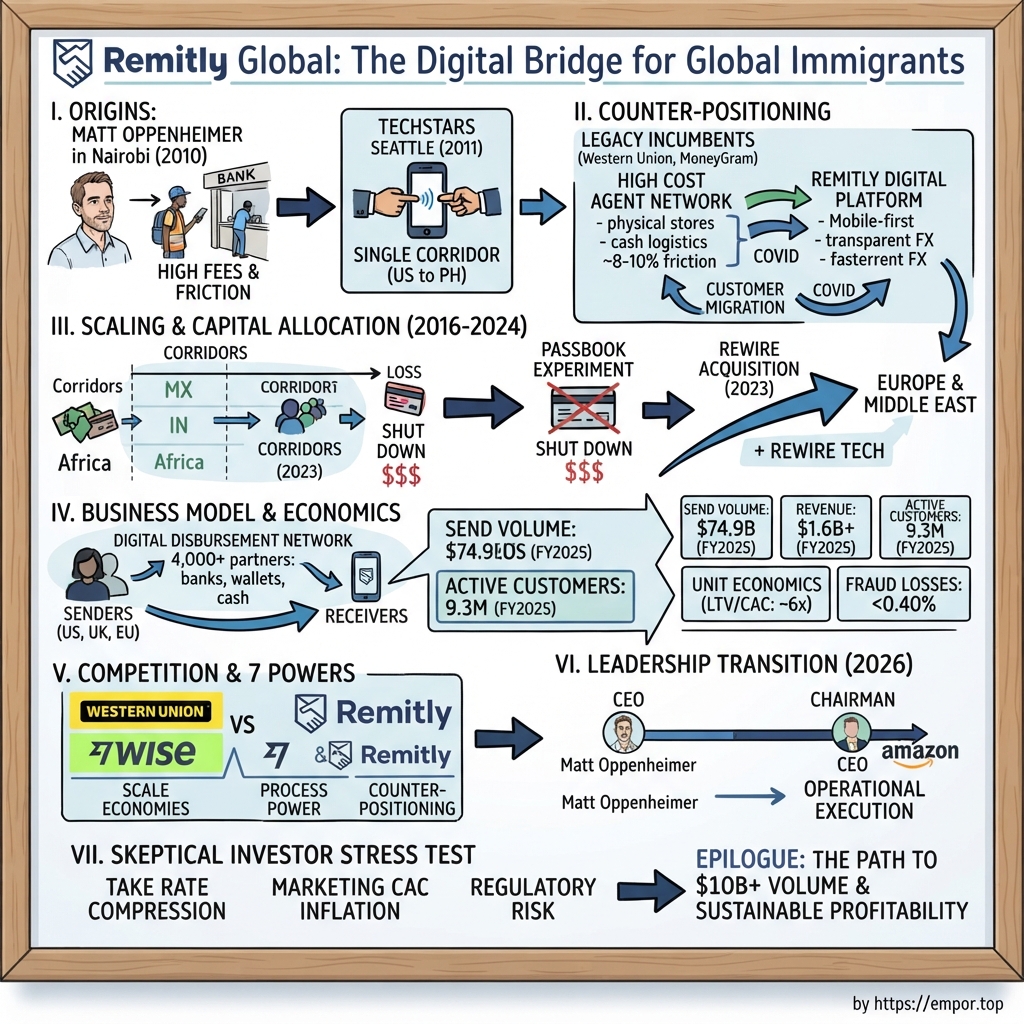
Remitly Global: The Digital Bridge for Global Immigrants
I. Introduction & Episode Roadmap (~10 min)
Somewhere in Houston, on a Friday evening, a construction worker finishes a shift, opens an app on a three-year-old Android phone, and sends $250 to his mother in Cebu. He does not think about foreign exchange spreads, correspondent banking, or the Bank Secrecy Act. He thinks about one thing: will the money be there tomorrow morning when she goes to the store? He has done this roughly a hundred times. He will do it a hundred more.
Multiply that transaction by ten million people twice a month, and the result is a massive enterprise. In the year ended December 31, 2025, Remitly Global moved $74.9 billion across borders and recorded $1.635 billion in revenue — up 29% year over year — while turning its first full-year GAAP profit of $67.9 million.1 By the quarter ended June 30, 2026, the company had crossed ten million quarterly active customers for the first time, moved $23.5 billion in a single quarter, and generated $114.7 million of Adjusted EBITDA.2
That is the headline figure; the critical dynamics lie beneath it.
Company snapshot. Remitly Global, Inc. trades on the NASDAQ Global Select Market under the ticker RELY, is incorporated in Delaware, and is headquartered at 401 Union Street in Seattle.3 It operates as a single reportable segment, with its chief executive serving as the chief operating decision maker.4 Its footprint spans more than 175 countries and more than 5,300 send-receive corridors, with the largest receive countries by volume being India, Mexico, and the Philippines.1 Its auditor is PricewaterhouseCoopers LLP, ratified by shareholders in June 2026.5
The thesis in one sentence. Remitly's argument to investors is that a digital-native cost structure, a directly integrated global payout network, and a growing volume of transaction data allow it to deliver money faster and cheaper than agent-based incumbents can, creating compounding advantages at scale. The counter-argument — which deserves equal scrutiny — is that remittances are a commodity service delivered over rented infrastructure, that customers actively shop on price, and that Remitly's own take rate fell for three consecutive years even as volume expanded.
Both arguments reflect real operational dynamics. That tension forms the central investment story.
Why this business is worth understanding even if you never own it. Remittances represent one of the few consumer financial products where customer demand is non-discretionary and recurring. A household in Lagos, Cebu, or Oaxaca does not evaluate remittances as discretionary spending; it relies on them for basic necessities. That creates a demand profile highly prized in consumer fintech: high transaction frequency, low seasonality outside a fourth-quarter holiday peak, and strong resilience through economic downturns. However, it also makes customers acutely price-sensitive, as every dollar of fee directly reduces funds delivered. Remitly operates within this fundamental balance between resilient demand and fee exposure.
What this episode covers. The origin in Nairobi, where a young Barclays employee observed families waiting days for money transfers that should have taken minutes. The deliberate initial decision to focus exclusively on a single corridor — the United States to the Philippines — before expanding. The 2010s competitive dynamics, when Remitly's primary structural advantage stemmed from legacy incumbents like Western Union being unable to cannibalize their physical agent networks without harming their core economics. The September 2021 IPO at $43 a share, followed by a severe valuation drawdown typical of mid-cap fintech during that period. The two pivotal capital allocation decisions defining management's record: shutting down the Passbook banking app and acquiring the Israeli fintech Rewire. The steady path toward profitability. And in February 2026, the leadership transition in which a founder who had run the company for nearly fifteen years handed management responsibility to a 63-year-old former Amazon executive — announced on the same day as the strongest earnings report in company history.3
A note on what the numbers already tell you. Between 2019 and 2025, Remitly's revenue grew from $126.6 million to $1.635 billion — roughly a thirteenfold increase over six years.61 Over that same period, the share of revenue derived from its three largest receive countries fell from nearly three-quarters to under half.61 Together, these metrics describe a company scaling rapidly while reducing geographical concentration, reflecting a repeatable operating model rather than reliance on a single fortunate corridor.
Along the way, three core market assumptions merit evaluation: that scale confers pricing power, that adjacent financial products represent real strategic optionality, and that customer acquisition economics remain durable across cycles. Remitly's regulatory filings contain the quantitative evidence required to test each claim, providing partial support for management's position alongside clear counter-evidence.
Start where the economics originate: with the substantial cost of moving small sums across international borders.
 Subscribe on LinkedIn
II. Anatomy of Cross-Border Money Transfers & Industry Structure (~15 min)
Picture the physical version of this transaction as it existed for most of the last century. A worker walks into a storefront — a check casher, a bodega, or a phone shop with a money-transfer sign in the window. He hands over cash and a form. The agent keys the details into a terminal and generates a transaction code. He texts the code to his family. Somewhere in Manila or Guadalajara, a relative walks to another storefront, presents the code alongside an ID, and receives local currency. Two physical locations, two human workers, two sets of cash inventory that had to be trucked, insured, and guarded — and two commission payments.
That physical architecture explains why remittances were, for decades, among the most expensive consumer financial transactions. The advertised fee was only part of the cost; the rest was embedded in the exchange rate — the spread between the wholesale currency rate the provider paid and the retail rate quoted to the customer. A sender might see a flat $5 fee without realizing that the foreign-exchange markup consumed another eight dollars. Combined, total friction on small transfers routinely reached high single digits as a percentage of principal.
The incumbent economics. Western Union remains the industry benchmark. For the full year 2025, the company reported revenue of $4.050 billion, down 4% on a reported basis, with consumer money transfer transactions down 1%.7 Its branded digital business grew 7%, but represented only about 30% of total consumer money transfer revenue in the fourth quarter — meaning roughly seven of every ten revenue dollars still came from its physical network.7 That dynamic illustrates the incumbent trap: the agent network is simultaneously Western Union's largest distribution asset and the primary structural constraint preventing it from pricing like a pure software provider. Every dollar of margin it surrenders online to defend market share undermines the economics of the physical channel on which it continues to rely.
MoneyGram exited public markets after being acquired by Madison Dearborn Partners. Euronet's Ria Financial and regional cash specialists like International Money Express share a similar physical-first cost structure. Illustrating the consolidation common to mature or contracting channels, Western Union agreed in August 2025 to acquire International Money Express for approximately $500 million.8 That transaction remained unclosed as of late August 2026. Although the New York State Department of Financial Services approved the acquisition, California's Department of Financial Protection and Innovation suspended a previously granted approval extension in August 2026 to conduct further review.8 Regulatory friction in money transmission is a tangible operational reality that can hold a half-billion-dollar transaction in limbo for a year.
Why corridors, not countries. The fundamental unit of analysis in cross-border payments is the corridor — a specific send country paired with a specific receive country. United States to Mexico is one corridor; Canada to the Philippines is another. Operationally, distinct corridors share little: they involve different regulators, payout partners, average transaction sizes, transaction frequencies, and risk profiles. Remitly's disclosure that it operates more than 5,300 corridors reflects combinatorial scale rather than purely geographical expansion; adding a single send country can instantly activate dozens of new corridors by leveraging pre-existing receive-side integrations.1
The hard part is the last mile. Withdrawing funds from an American bank account is straightforward; delivering local currency into the hands of a recipient in a town without a bank branch represents the core engineering challenge. Remitly addresses this by building direct software integrations across three endpoint categories: bank accounts, mobile wallets, and physical cash pickup locations. At year-end 2025, the company reported reach to more than 5.4 billion bank accounts and mobile wallets, alongside approximately 490,000 cash pick-up options.1 Functionally, this architecture resembles a global adapter kit comprising thousands of country-specific connections that must each be maintained, monitored for uptime, and periodically renegotiated on price.
Mobile wallets highlight the diversity of domestic payment preferences across markets. In the Philippines, GCash serves as a primary financial account for millions, much as M-Pesa did in Kenya a decade earlier. In China, domestic transactions are dominated by closed ecosystems — WeChat Pay (微信支付) and Alipay (支付宝) — that billions use daily as their default payment methods. Because a cross-border platform cannot impose a single interface across diverse payment cultures, it must integrate directly into local market norms. Remitly's localization efforts extend to brand trademarks, holding registered marks in Chinese characters — 汇美易 and 睿每易 — and in Japanese katakana as レミットリ.1
Regulation as both moat and tax. In the United States, Remitly is registered as a Money Services Business with FinCEN and holds money transmitter licenses in the 49 U.S. states where such licenses are required, plus the District of Columbia and various territories.1 Internationally, it holds payment institution licenses from the U.K. Financial Conduct Authority and the Central Bank of Ireland, the latter passporting across the European Economic Area. The company also disclosed pending applications for an electronic money institution license in the U.K. and a regulatory extension in Ireland, both required to offer wallet services.1 Each regulatory regime imposes ongoing capital requirements, safeguarding mandates, compliance examinations, and executive suitability approvals.
While these regulatory requirements present a formidable barrier to new startups, they offer little structural defense against established players like Wise, Revolut, or major global banks. Licensing effectively raises the operational baseline for the industry without establishing a protective moat against well-capitalized peers that have already satisfied identical standards.
One regulatory development provided a clear relative advantage to digital-first providers. Under the One Big Beautiful Bill Act, a 1% excise tax on remittance transfers took effect on January 1, 2026, targeting transactions funded by cash, money orders, cashier's checks, or similar physical instruments.9 Digital, account-funded transfers were excluded. The policy effectively applied a one-percentage-point tax penalty to physical storefront channels. Management noted on its fourth-quarter 2025 earnings call that the tax created an early-year tailwind, while Remitly's SEC filings state the company does not expect the law to have a material impact on its business.101
Which raises the key strategic question: how did a Seattle fintech position itself to capitalize on these structural shifts? The explanation traces back to Nairobi.
III. Origins & Founding Context: From Nairobi to Techstars (2011–2015) (~15 min)
Remitly's IPO prospectus describes the company's origin in the founders' own words: "The inspiration behind Remitly came when Matt, our co-founder and Chief Executive Officer, was working in Kenya. There, Matt realized how reliant some families were on the money sent from their loved ones working abroad. He also saw how difficult it was to send and receive money overseas — the process was painful, opaque, and expensive."6
Matt Oppenheimer had gone to Kenya to work for Barclays, a posting that placed him inside the machinery of a major bank in a market where formal banking and the informal economy operated side by side. What he observed was not an exotic financial problem, but an operational plumbing failure with real human consequences: money taking days to arrive, fees that were difficult to calculate in advance, and families organizing basic purchases around whether a transfer had cleared.
While many observers recognized those friction points, Oppenheimer's next move established the company's trajectory.
The team. In 2011, Josh Hug and Shivaas Gulati joined Oppenheimer to launch the company.6 Hug brought prior operating experience and remains on the board, holding approximately 2.1% of outstanding shares as of March 31, 2026.11 Launched through the Techstars Seattle incubator, the company initially operated under a different name before adopting Remitly. Its Seattle base proved strategic, granting early access to Amazon-trained operating talent and an investor community familiar with building long-term consumer technology platforms.
The single-corridor decision. Rather than launching as a global money transfer platform, the founders initially focused on a single corridor: the United States to the Philippines.
While logical in hindsight, this narrow focus carried strategic weight. The U.S.-to-Philippines corridor offered ideal conditions for a digital-first provider: a large, English-speaking diaspora in the United States, high smartphone adoption on both ends, a dense network of payout locations in the receiving country, and a remittance flow so significant that the domestic government tracks it as a key macroeconomic metric. Success in this corridor provided a clear operational blueprint.
Focusing on a single corridor also addressed the primary early hurdle in consumer money transfers: establishing customer trust. Senders entrust an unfamiliar digital app with substantial funds meant for immediate family needs, making delivery failures damaging to customer retention. By limiting initial geographic scope, management concentrated on delivery reliability across a targeted set of payout partners, identified operational bottlenecks, and established specialized customer support teams. Remitly later positioned in-house customer protection and risk operations in the Philippines and Nicaragua to maintain operational proximity to key customer segments.6
The architectural bet. Instead of establishing or renting a physical retail agent network, the founders chose to build direct software integrations with receiving banks and mobile wallet providers. In 2011, industry consensus still held physical cash pickup as the essential product and questioned whether customers would trust mobile applications with essential family funds.
That architectural decision anticipated key demographic and technology shifts: specifically, that smartphone adoption among international workers would outpace traditional bank account adoption. Remitly's IPO prospectus reflects how much growth lay ahead even a decade after founding: at its September 2021 listing, the platform served recipients across more than 115 countries and covered over 1,700 corridors.6 Compared to the more than 5,300 corridors and 175 countries served by mid-2026, the 2021 network represented about one-third of its current reach.1
Direct integration also yielded long-term cost benefits. By negotiating directly with regional financial institutions during its initial expansion rather than relying entirely on third-party aggregators, Remitly gained precise visibility into wholesale disbursement costs. That empirical baseline informed subsequent pricing decisions and network expansions, enabling the company to distinguish between competitive partner margins and inflated intermediary fees.
Capital. Throughout the 2010s, Remitly secured private venture capital from strategic and institutional investors that maintained substantial ownership positions post-IPO. Prosus's payments arm remained the largest external shareholder years after listing, with MIH Fintech Investments B.V. holding 13.4 million shares, or 6.38%, as of March 31, 2026, alongside a concurrent $25 million private placement completed by PayU Fintech Investments at the time of the IPO.116 Nigel Morris, co-founder of QED Investors and Capital One, served on the board and held approximately 1.8 million shares as of March 31, 2026.11
What the founding period actually proves. Remitly's founding trajectory highlights the value of disciplined execution over rapid expansion. By securing a structurally advantageous beachhead, avoiding premature geographic diversification, and systematically building direct disbursement relationships, the company developed an operational infrastructure that competitors could not quickly replicate. That focus yielded a structural process advantage that ultimately supported long-term gross margin expansion.
Whether that infrastructure translates into sustainable pricing power remains a central question — one that became increasingly prominent during the company's aggressive multi-corridor expansion from 2016 through 2021.
IV. Scaling the Corridors & Counter-Positioning (2016–2021) (~20 min)
By the mid-2010s, Remitly had established its operational playbook, turning its focus to geographic replication across Mexico, India, broader Latin America, and Africa. Each new corridor followed a predictable sequence: secure receive-side integrations, obtain or extend regulatory licenses, run targeted digital advertising to specific diaspora communities, track cohort payback metrics, and scale marketing spend only when customer returns justified expansion.
That customer acquisition model forms the core of Remitly's growth strategy. Rather than relying on traditional brand advertising, the company operates a performance-marketing engine that calculates the spread between customer acquisition costs and multi-year cumulative transfer volume. Because remittance patterns are highly recurring — involving consistent amounts sent to the same recipients on regular schedules — customer cohorts exhibit predictable lifetime value. Remitly describes its performance marketing as a disciplined process: setting strict acquisition targets, dynamically adjusting spend against measured returns, and treating acquisition costs as upfront investments that depress near-term earnings to generate long-term cash flow.1
What launching a corridor actually involves. Expanding a corridor involves building infrastructure comparable to opening a localized financial institution. On the send side, the company must secure licenses in each operating jurisdiction, enable local payment methods so customers can fund transfers through preferred channels, and implement compliance screening tailored to local identification documents. On the receive side, it requires disbursement partners with strong market coverage, operational reliability, and low error rates, alongside fallback systems to prevent transaction delays. Additionally, Remitly maintains a global treasury function to source foreign currencies at favorable rates and pre-fund disbursement accounts. That pre-funding requirement represented $234.6 million in capital held across global payout partners as of June 30, 2026.2
Because receive-side infrastructure requires significant fixed investment but is reusable across multiple send markets, marginal corridor economics improve with scale. As management has noted, adding a single send country can unlock dozens of new corridors simultaneously by leveraging pre-existing payout networks.1 By its September 2021 initial public offering, Remitly was processing send volume from the United States, Canada, the United Kingdom, European Union countries, Australia, and Singapore.6 Each additional send market multiplied against the existing payout architecture, driving network efficiency without requiring parallel infrastructure.
The mobile tailwind, and what it really was. While digital remittances are often framed as a byproduct of smartphone adoption, mobile connectivity arrived in many migrant communities before access to formal retail banking, reversing the traditional consumer finance adoption curve. Senders frequently managed daily communications via mobile devices despite lacking bank accounts or credit histories. By building identity verification, fraud risk modeling, and customer support around mobile-first users, Remitly created a distribution channel that reached underserved customers directly.
This mobile-centric model also enhanced performance marketing efficiency. Digital platforms permitted precise audience targeting based on language, geographic location, and cultural media consumption that physical storefronts could not match. Remitly could deploy targeted advertising to specific municipal diaspora populations, track 12-month cohort retention and transfer frequency, and adjust marketing allocations based on empirical returns. Physical storefront competitors, by contrast, remained constrained by static retail lease locations.
The counter-positioning. Strategist Hamilton Helmer defined counter-positioning as a structural dynamic where an incumbent chooses not to adopt a challenger's business model because doing so would cannibalize its core profit engine. Incumbents like Western Union possessed the resources to match Remitly's digital pricing structure, but matching lower fee margins would have impaired the profitability of their extensive physical agent networks, which generated the vast majority of their operating income.
The durability of this counter-positioning is evident in Western Union's performance over the subsequent decade: annual revenue remained roughly $4 billion while total volume contracted modestly, and digital growth was insufficient to offset retail channel declines.7 Rather than neutralizing the digital threat, the incumbent managed a slow transition while protecting physical channel cash flows.
However, counter-positioning primarily insulates a challenger against legacy incumbents. It provides no structural barrier against new digital-native competitors operating without physical legacy infrastructure. By the early 2020s, Remitly's primary competitive threat had shifted from traditional storefronts to rival digital payment platforms.
COVID as an accelerant. The onset of the COVID-19 pandemic in 2020 accelerated consumer adoption of digital remittances as physical agent locations faced lockdowns and operating restrictions. Senders were compelled to transition to mobile platforms, accelerating multi-year adoption trends into a matter of weeks.
Financial results reflected this shift. Remitly's revenue rose from $126.6 million in 2019 to $257.0 million in 2020 — a 103% increase that management attributed primarily to active customers roughly doubling.6 Revenue growth accelerated in 2021, with first-half top-line metrics rising 92% year over year before full-year revenue reached $458.6 million.612
The key analytical insight from this period lies in customer retention. Annual send volume expanded from $20.4 billion in 2021 to $28.6 billion in 2022, $39.5 billion in 2023, and $54.6 billion in 2024, while quarterly active customers grew from 2.8 million to 7.8 million over the same span.121 Senders acquired during pandemic restrictions remained on the platform after physical options reopened, demonstrating that user preference was driven by product utility rather than temporary necessity.
However, cohort efficiency metrics during this period require context. Remitly achieved lower customer acquisition costs in 2020 and 2021 because physical competition was constrained by public health restrictions. A portion of the marketing efficiency reflected favorable external conditions rather than permanent structural advantages, leading to higher acquisition cost inflation in 2022 and 2023 as digital ad markets normalized.
The IPO. Remitly completed its initial public offering in September 2021, pricing 7,000,000 shares at $43.00 per share, above its expected target range. Combined net proceeds from the IPO and a concurrent private placement totaled approximately $304.5 million, with 161.4 million total shares outstanding following the offering, implying a valuation just under $7 billion at the offer price.6
Secondary market commentary often misstated total proceeds at $500 million; net capital raised by the company was a little over $300 million net, with the balance of the offering consisting of shares sold by existing holders.6 This capital injection provided an operational cash buffer heading into a volatile macroeconomic environment.
At the time of its public listing, Remitly generated $458.6 million in annual revenue on $20.4 billion in send volume — representing an effective take rate of roughly 2.24% — across with about 2.8 million quarterly active customers and no profits.12
Two structural factors distinguished the IPO context. First, the listing occurred near the peak of public fintech valuations. Second, Remitly listed with a single class of common stock and no founder super-voting shares — unusual for a founder-led 2021 technology IPO, and a structural choice that would give public shareholders real leverage later.3
V. The Post-IPO Crucible & Capital Allocation Lessons (2022–2024) (~20 min)
The market de-rating was swift and severe. Having listed at $43.00, Remitly traded below $7.00 at its 2022 trough — an 80%-plus drop from its offer price in under a year, outstripping the decline in the broader fintech sector.13 Operationally, however, core expansion continued, with revenue growing 43% in 2022 to $653.6 million.12 What changed was market sentiment: investors shifted away from rewarding top-line growth funded by persistent operating losses.
Those operating losses were substantial. In 2023, Remitly generated $944.3 million in revenue but reported a net loss of $117.8 million.1 Operating costs were driven by heavy reinvestment, with marketing consuming $234.4 million and technology and development adding another $219.9 million, alongside significant stock-based compensation.1 While unit economics on transfers remained sound, investors increasingly questioned whether management could slow expense growth before revenue deceleration caught up.
Amid this market pressure, management executed two key capital allocation decisions in rapid succession. Moving in opposite strategic directions, these moves offer clear evidence of how leadership evaluates risk and deploys capital.
Case study one: Passbook.
In 2020, Remitly launched Passbook, a digital banking account for U.S. immigrants, developed in partnership with Sunrise Banks of St. Paul, Minnesota.14 The strategic rationale appeared compelling: with millions of customers using Remitly for routine transfers despite limited banking access, providing a checking account and holding deposit balances could turn a single-service transaction app into a broader financial relationship.
The initiative failed to gain traction. On Remitly's first-quarter 2023 earnings call, Oppenheimer announced Passbook's wind-down, with services terminating on May 1, 2023.14 Oppenheimer provided a direct rationale: "The product wasn't going to achieve the scale necessary fast enough to contribute to meaningful returns because it was just a different segment from Remitly customers. We didn't get that synergy." Oppenheimer added that the company would "redeploy our resources to higher returning investments, targeted at our core remittance customer."14
This outcome yields two key insights. First, management accurately identified the issue as a customer segment mismatch rather than an operational failure, acknowledging the strategic disconnect publicly. Second, contrary to common market assumptions, the shutdown did not cause a substantial financial write-down. Remitly reported just $1.4 million in total restructuring charges for all of 2023, consisting mainly of severance costs spread across support, engineering, and administrative functions.12 The company never disclosed Passbook's active user count.14 Consequently, the primary cost of the initiative was the opportunity cost of diverting engineering and marketing resources during a hyper-competitive period in fintech — a meaningful strategic expense, but not a balance-sheet impairment.
The realistic assessment of Passbook falls between extreme bullish and bearish narratives. It represented a strategic misstep that leadership recognized and unwound within three years at modest direct monetary expense, accompanied by clear public disclosure. While reflecting sound capital discipline in terminating an underperforming project, it also highlighted the challenge of expanding beyond core money transfer services.
Case study two: Rewire.
On January 5, 2023 — four months before terminating Passbook — Remitly completed the acquisition of Rewire (O.S.G.) Research and Development Ltd., an Israeli cross-border fintech, for total consideration of $77.9 million.12 The deal structure comprised $56.4 million in cash paid to selling shareholders, $7.2 million in equity, an $11.9 million holdback, and $2.4 million to settle a pre-existing receivable owed by Rewire to Remitly.12 In purchase price accounting, Remitly allocated $12.0 million to developed technology, $8.5 million to customer relationships, $1.0 million to trade names, and $54.9 million to goodwill.12
Management pursued the acquisition to accelerate expansion across Europe and the Middle East while adding account-based payment features. However, initial financial results reported in Remitly's regulatory filings were subdued: Rewire generated $13.4 million in revenue but recorded a net loss of $42.6 million in 2023 following the transaction date.12
In its first eleven months, an asset acquired for $77.9 million generated a $42.6 million net loss. While purchase accounting adjustments and integration costs contributed to the deficit, intangible amortization alone does not account for a gap of that scale.
Subsequent results present a nuanced picture. The $54.9 million in goodwill created by the acquisition remained unimpaired on Remitly's balance sheet as of June 30, 2026.2 Under U.S. GAAP standards, this indicates that management and auditor PricewaterhouseCoopers annually determined the reporting unit's fair value equaled or exceeded its carrying value. Concurrently, during the first quarter of 2026, Remitly initiated restructuring plans involving lease exit costs and property impairments tied to facility changes in Israel and Ireland as operations in those locations were re-evaluated.4 Israel served as Rewire's primary operational hub, and total restructuring charges across the company reached $15.8 million in the first half of 2026.4
While Remitly avoided goodwill write-downs, it subsequently reduced its physical footprint in the acquired entity's home market three years later. The evidence suggests Remitly secured European payment licenses, customer relationships, and technical talent, absorbed initial operating losses, and later consolidated regional infrastructure. Whether the $77.9 million purchase price earned its cost of capital cannot be verified from SEC filings, as Remitly does not break out Rewire's stand-alone financial results.
Myth versus reality on this period.
Three common assertions regarding Remitly's post-IPO record warrant comparison against regulatory disclosures.
Myth: the IPO raised about $500 million. Reality: estimated net proceeds to the company from the offering and concurrent private placement were approximately $304.5 million.6 The higher figure conflates company proceeds with gross transaction value, which included shares sold by existing shareholders.
Myth: shutting Passbook required a significant write-down. Reality: total restructuring charges across all of 2023 were $1.4 million, and no separate Passbook impairment appears in fiscal 2023 financial statements.12 The primary impact was diverted managerial focus rather than balance-sheet capital destruction.
Myth: Rewire cost $80 million and was quietly written off. Reality: total consideration was $77.9 million, and the $54.9 million in goodwill created by the transaction remained unimpaired on the balance sheet as of June 30, 2026.122 Rather than an asset write-off, Remitly undertook a restructuring of facilities in the acquired company's primary operating region in 2026.4
These discrepancies illustrate that secondary commentary on corporate capital allocation often exaggerates both successes and failures relative to audited SEC filings.
Marketing discipline under fire.
A third operational test centered on marketing discipline during an industry-wide rise in digital advertising costs throughout 2022 and 2023. Remitly's marketing spend rose 37% in 2023, accompanied by a 60% increase in marketing headcount.12 However, cost trends shifted over the following two years. Marketing expenditure reached $303.8 million in 2024 and grew 13% to $342.9 million in 2025, declining from 24% of revenue to 21% due to digital acquisition efficiencies and brand scaling.1 Over the same timeframe, customer support and operations expenses fell from 7% to 6% of revenue, technology and development costs decreased from 21% to 19%, and general and administrative expenses dropped from 15% to 14%.1
The simultaneous reduction of four primary operating expense categories as a percentage of revenue demonstrated tangible operating leverage. After two years of management commitments regarding scale efficiencies, margin expansion materialized across every major cost line.
This structural shift transformed Remitly from an unprofitable growth enterprise into a cash-generating platform, establishing the foundation for its current financial profile.
VI. Current Business Model, Segment Economics & Operating KPIs (~20 min)
Strip away the narrative and Remitly is fundamentally a spread business with a subscription-like demand profile. It earns money through two distinct mechanisms on each transaction: an explicit transaction fee that varies by corridor, funding method, disbursement channel, and transfer amount; and a foreign exchange spread — the margin between the rate quoted to the customer and the wholesale rate at which Remitly acquires currency, set by proprietary dynamic pricing models.1 Promotional incentives, such as waived first-transaction fees or temporary exchange-rate discounts, are recorded directly as reductions to revenue rather than marketing expenses.1 That accounting choice is significant: reported revenue is already net of the customer acquisition discounting used to drive volume, making Remitly's reported take rate a cleaner reflection of net pricing than that of peers who classify promotional costs as operating expenses.
Structure. Remitly operates as a single reportable segment, with no secondary business lines, cross-subsidies to unwind, or conglomerate discounts to evaluate.4 Revenue disaggregation is disclosed solely by sender location: in the second quarter of 2026, the United States produced $336.8 million of $495.2 million in total revenue, Canada contributed $43.3 million, and the rest of the world generated $115.0 million.4 Because roughly two-thirds of total revenue originates within a single country, geographic concentration remains an essential consideration whenever U.S. immigration policy or macroeconomic shifts enter the news.
The engine, in plain terms. Volume compounds because customer send habits are highly recurring while the overall active user base expands. Active customers reached 9.279 million in the fourth quarter of 2025 and 10.199 million in the second quarter of 2026, representing year-over-year growth of 19% and 20%, respectively.14 Average send volume per active customer exceeded $2,200 in the fourth quarter of 2025, up approximately 13% year over year — indicating that top-line growth is driven by both new customer addition and larger average transfer sizes.10
Take rate: the number that decides the argument. Revenue divided by send volume provides the cleanest single measure of Remitly's pricing. Its trajectory shows steady compression: the effective take rate stood at roughly 2.24% in 2021, 2.28% in 2022, and 2.39% in 2023, before stepping down to 2.31% in 2024, 2.18% in 2025, and about 2.08% across the first half of 2026.1214 Management confirmed that the second quarter of 2026 landed at 2.11%.15
This marks three consecutive years of take rate compression. Management has consistently attributed this trend to customer and corridor mix: high-volume senders and corridors such as India carry larger average transfer sizes at lower percentage economics, allowing a falling take rate to coexist with rising gross profit per customer. That explanation is credible and partially verifiable — senders in the high and very high volume tiers grew volume by 14% and 105%, respectively, in the fourth quarter of 2025, accounting for roughly half of total send volume by that time.10
However, mix does not provide a complete defense. On the second-quarter 2026 earnings call, Chief Executive Officer Sebastian Gunningham stated that Remitly intends to pursue market share aggressively, citing sharper pricing alongside speed and service as a primary tool.15 Because competitive price cuts reflect intentional strategy rather than passive corridor mix, investors should evaluate take rate compression as a combination of structural mix shifts and deliberate price investment.
What offsets it. Improving operational efficiency has counterbalanced take rate compression. Direct transaction expenses — payouts to disbursement partners, payment processing fees, and provisions for transaction losses — dropped from 35% of revenue in the second quarter of 2025 to 33% a year later.16 Consequently, transaction margin — Remitly's metric for revenue less direct delivery costs — expanded from 65% to 67% over that period, reaching 68% for the first half of 2026.2 Unit economics have strengthened because execution costs have fallen faster than unit pricing.
Fraud performance represents a primary driver of that cost discipline. Remitly reported transaction losses at a record low of 7.3 basis points of send volume in the fourth quarter of 2025 — roughly seven cents per hundred dollars moved — which management estimated contributed about $10 million in incremental transaction margin during the quarter, attributed to AI-driven fraud models.10 Running losses well below historical industry benchmarks demonstrates that risk management acts as an active margin driver rather than a passive compliance cost.
Unit economics. On the second-quarter 2026 call, management disclosed a lifetime customer value to customer acquisition cost ratio of approximately 6x with a payback period under twelve months, alongside non-GAAP marketing spend at 19.5% of revenue.15 Two analytical qualifications apply to these numbers. First, LTV-to-CAC is a management-defined metric without a standardized audit definition, and its specific underlying inputs are not disclosed. Second, Remitly does not break out the exact percentage of volume generated by repeat senders; the annual report states only that send volume is primarily driven by existing customers and that the majority of active users transact multiple times per month for recurring, non-discretionary needs.1
The growth accelerators. Beyond core money transfers, Remitly is developing four adjacent offerings: Remitly Flex, a zero-interest send-now-pay-later feature where the company advances transfer funds and records a consumer receivable repayable within 30 days, or 90 days for subscribers; Remitly Wallet and Card; Remitly One, a membership and loyalty layer; and Remitly for Business, serving small and mid-sized companies paying contractors and vendors abroad.1 Remitly Flex had roughly 120,000 users at the end of 2025 with sequential revenue nearly doubling, while Remitly for Business expanded from over 15,000 business clients at year-end 2025 to about 25,000 by the second quarter of 2026, recording average transaction sizes roughly double those of consumer transactions.1015 The company also launched a Remitly Global Card and, in Latin America, a USDC-enabled receiver wallet.1516
Sizing these initiatives requires close attention to shifting management definitions. On the fourth-quarter 2025 call, leadership described new products as accounting for just over 1% of 2025 revenue, with projections to more than double in 2026 and reach 5%–10% by 2028.10 By the second-quarter 2026 call, the CFO projected "growth accelerators" at roughly 5% of 2026 revenue and above 10% by 2028.15 Reclassifying metrics from "new products" to "growth accelerators" — which appears to incorporate high-value senders alongside new software features — expands the baseline metric. On the disclosed evidence, non-core offerings contributed low single digits to 2025 revenue and remain unproven as standalone profit drivers at scale.
Which brings the question of who Remitly is actually fighting.
VII. Competitive Landscape, Industry Structure & The 7 Powers (~20 min)
The competitive environment spans three distinct fronts.
Front one: incumbents in retreat. As established in Western Union's performance, traditional players manage a legacy model featuring a $4.050 billion revenue base declining in the low single digits, where digital channels remain structurally sub-scale and consolidation occurs via acquisition rather than product innovation.7 Remitly gains market share in this segment largely through structural channel migration. However, this front yields transaction volume rather than a permanent moat, as legacy market share is contested simultaneously by every digital provider.
Front two: the digital peer reframing price. Wise represents Remitly's most direct digital benchmark, though their underlying models address different customer needs. For its fiscal year ended March 2026, Wise generated $2.502 billion in net revenue — up 19% year over year — while earning $660.4 million in pre-tax profit at a 26% margin, serving 19 million active customers, and moving $243.5 billion in cross-border volume, a 31% increase.17 Over that period, Wise's take rate contracted from 0.58% to 0.52%.17
Evaluating Wise's half-percent take rate against Remitly's roughly two percent rate highlights a key strategic distinction rather than a direct pricing mismatch. Wise's volume concentrates in larger transfers made by expatriates, freelancers, and commercial entities moving several thousand dollars between bank accounts in developed markets. In contrast, Remitly's core customer typically transmits a few hundred dollars to a mobile wallet or cash pickup counter in an emerging economy, where last-mile disbursement costs remain higher. Consequently, a 0.52% take rate on a $10,000 bank transfer and a 2.11% take rate on a $250 cash or wallet payout can reflect economically rational pricing for their respective corridor structures.
The strategic risk for Remitly is less about Wise's current pricing than its explicit commitment to reducing customer fees as scale expands. With Wise's 31% volume growth outpacing Remitly's 27% growth rate, any expansion of Wise's payout network into Remitly's primary corridors threatens to narrow Remitly's pricing umbrella.172 Remitly's primary defense relies on delivery speed and last-mile payout optionality rather than price competition — a position that requires continuous operational differentiation.
Front three: broader digital and alternative channels. Additional competition includes neo-banks like Revolut, regional digital wallets such as Mercado Pago in Latin America, and informal transfer channels that retain volume across specific corridors.1
The role of stablecoins. A common bear thesis asserts that dollar-denominated digital tokens will render cross-border settlement instantaneous and nearly costless, eroding the value of Remitly's payout infrastructure. Addressing this perspective on the first-quarter 2026 earnings call, Chief Executive Officer Sebastian Gunningham noted: "Remitly delivers money in under a minute at a very low price today. So if you compare stablecoins to Remitly's existing capabilities, plus or minus a cent, we're already there."18
That assessment aligns with cross-border payment mechanics. The primary cost component of a remittance is not inter-institutional messaging, but the fiat on-ramp and off-ramp — capturing funds from a bank account in a send country and converting digital assets into local currency in locations lacking cryptocurrency infrastructure. Stablecoins primarily optimize intermediate settlement, a segment where costs were already low. Remitly's operational deployment reflects this dynamic: the company joined the OpenUSD consortium as a founding member to reduce pay-in settlement times by up to a day and optimize corridor treasury liquidity, while deploying USDC payout options in Latin America to accommodate regional preference for holding dollar balances.1516 Remitly's annual report characterizes stablecoins as an emerging payment rail capable of complementing existing infrastructure.1 While integrating stablecoins mitigates near-term disruption, the long-term defense depends on the off-ramp advantage remaining durable as local digital wallet ecosystems evolve.
Strategic assessment: The 7 Powers framework.
Scale economies: Substantial. Fixed expenditures in compliance, regulatory licensing, software development, and global treasury operations are distributed across nearly $74.9 billion in annual volume, evidenced by operating expense ratios declining across all major cost lines.1 This competitive advantage continues to strengthen with overall volume expansion.
Process power: This represents Remitly's primary operational advantage. It is built upon thousands of direct payout integrations, structural redundancy across corridor infrastructure, rigorous partner risk screening, and proprietary fraud detection algorithms refined over years of transaction history.1 Process power is complex to replicate, though regulatory disclosures focus on total reach rather than specific disbursement partner counts — an explicit partner tally is omitted from the fiscal 2025 10-K.
Counter-positioning: Effective against physical agent networks like Western Union, but inapplicable against digital-native competitors such as Wise or Revolut. This advantage naturally diminishes as physical storefront remittance volume contracts.
Switching costs: Modest in technical execution, but meaningful in consumer habit. Stored recipient information, pre-configured funding sources, and established delivery reliability create operational friction against switching. However, downloading an alternative application requires minimal effort, and remittance senders demonstrate high price sensitivity. The platform's 4.9 rating on the iOS App Store across approximately 4.0 million reviews reflects strong user satisfaction rather than structural customer lock-in.1
Branding, cornered resources, and network economies: Brand equity is expanding but does not yield pricing power. The company holds no cornered resources. Network effects remain absent, as adding a sender in one corridor does not directly enhance service quality for senders in another, except through general volume scale.
Competitive forces: Porter's framework. Buyer power is high due to individual transaction choices, lack of long-term contracts, and real-time price comparison tools. Competitive rivalry is intense and escalating as traditional market share contracts and digital providers consolidate. Threat of substitutes remains moderate, with informal transfer networks contracting and stablecoin protocols being integrated into existing infrastructure rather than replacing it. Supplier power exhibits dual dynamics: while disbursement banks compete to receive hard-currency inflows, giving Remitly negotiating leverage, supplier credit risk remains tangible. In 2025, Remitly's general and administrative expenses included a $21.5 million increase in provisions related to the collectibility of receivables from certain processing partners, demonstrating that counterparty risk can materialize as direct operational charges.1
The overarching competitive dynamic reveals a business benefiting from compounding operational efficiency, yet operating without durable pricing power. This balance places exceptional weight on managerial execution — and on the leadership team directing the platform.
VIII. Current Management & The 2026 Leadership Transition (~15 min)
February 18, 2026, presented an unusual backdrop for a chief executive transition. Remitly reported the strongest financial results in its history for fiscal 2025, delivering its first full-year GAAP profit, expanding Adjusted EBITDA by 93% to $272.2 million, and generating $283.3 million in free cash flow, up from $93.9 million the prior year.1 In the same press cycle, the company announced that its co-founder was stepping down as chief executive officer.3
Public markets responded immediately. Remitly's shares closed at $13.61 on February 18 and surged to $17.14 the following day — a 26% single-day advance on trading volume exceeding 22 million shares.13 While investors rarely celebrate the departure of a founding chief executive who just delivered record profits, the market welcomed the leadership shift.
Matt Oppenheimer's exit. Regulatory filings framed the change with deliberate care. Remitly disclosed that Oppenheimer "decided to transition the role of CEO to a new leader after nearly 15 years," stepped down as an employee, and remained as non-executive Chair of the Board.319 Lead Independent Director Phillip Riese thanked Oppenheimer "for the foresight to initiate and lead this transition,"3 while the accompanying Form 8-K confirmed the change did not stem from any disagreement regarding financial reporting or accounting policies.19
The transition reflects a familiar corporate evolution: a founder recognizing that scaling a startup from an incubator desk to $1.6 billion in revenue requires a different operational playbook than managing a multi-product financial platform at scale. As of March 31, 2026, Oppenheimer retained approximately 2.52% of outstanding common shares, maintaining tangible equity alignment as board chair.11 Because Remitly maintains a single-class share structure without super-voting stock, Oppenheimer's governance influence rests strictly on his equity stake and board position rather than structural voting control.11
Sebastian Gunningham, in full. Gunningham was 63 years old at his appointment.19 His career spans executive roles across major technology enterprises and complex operational restructurings. From 2007 to 2018, he served as Senior Vice President at Amazon and sat on its S-Team senior leadership committee, overseeing marketplace, payments, search, and fulfillment divisions.19 His earlier career included senior roles at Oracle and Apple following a degree in Mathematical and Computational Sciences from Stanford University.19
Subsequent roles added both banking exposure and high-profile turnaround experience. From 2018 to 2020, Gunningham served as Vice Chair and Co-CEO of WeWork, steering the company through its cancelled initial public offering and subsequent governance restructuring.19 He later returned to financial services, serving as Chairman of Santander Consumer Finance and Vice Chairman of Santander's digital unit, Openbank, from 2021 to 2025, alongside a tenure as CEO of Material Bank from 2023 to 2025.19
That background combines broad marketplace and payments experience with commercial banking exposure and a high-profile turn at WeWork during its 2019 governance crisis. What is clear from corporate disclosures is that Remitly's board — comprising ten members at his appointment, seven of whom were independent — chose an outside operational specialist over an internal promotion.3
Across his initial earnings calls, Gunningham outlined an operating strategy centered on product velocity, organizational flattening, and artificial intelligence integration. On the fourth-quarter 2025 call, he emphasized that "there is only one durable advantage that matters. Build the best product."10 By the second-quarter 2026 call, he pointed to structural modifications, stating that "fewer layers mean clearer ownership and faster decisions," while attributing below-plan headcount growth to AI-driven productivity gains.15
Financial filings reflect early execution of this strategy. General and administrative expenses fell 11% year over year in the second quarter of 2026, marking the first year-over-year G&A reduction since Remitly's public listing.15 Concurrently, the company recorded $15.8 million in first-half 2026 restructuring charges, driven primarily by employee severance costs and facility consolidations across Israel and Ireland.4 Management has framed these actions as sustainable operational discipline; whether they deliver ongoing efficiency gains or represent a single-year margin harvest will become evident as comparison periods tighten in 2027.
The rest of the bench — and its churn. Vikas Mehta continues as Chief Financial Officer, while Pankaj Sharma serves as Chief Business Officer. In February 2026, the board's Talent and Compensation Committee awarded Sharma a $2 million long-term cash retention bonus — split equally between February 2026 and February 2027 payments, subject to a one-year clawback provision — securing executive continuity during the transition.19
However, executive turnover extended into key technical and accounting positions. Chief Product and Technology Officer Ankur Sinha resigned effective June 19, 2026, with regulatory filings confirming no disagreement regarding financial reporting or accounting practices.20 Chief Accounting Officer Luke Tavis retired on March 31, 2026, succeeded by Tai-Hong Fung, previously Vice President and Controller at Starbucks.21 To strengthen governance, the board added Adam Messinger, former Chief Technology Officer at Twitter and technical advisor to Chime, as a director in April 2026.22
The departure of the senior product and technology executive four months into a CEO tenure focused on product execution presents an operational vulnerability, particularly as Remitly has yet to file a Form 8-K naming a permanent successor to the role.
Governance and pay. CEO compensation details illustrate the board's operational priorities. Gunningham received a base salary of $350,000, supplemented by 787,500 time-vesting restricted stock units, a $4 million upfront cash award split over two years with clawback provisions, and 1,462,500 performance stock units (PSUs) tied entirely to stock price thresholds measured on a 120-trading-day average: 15% each at $20 and $25, 20% at $32, 25% at $40, and 25% at $50, over a five-year performance period with separate time-vesting requirements.19 The company disclosed that the top threshold implies a market capitalization of roughly $10.5 billion.19
Because the PSU grid contains no fundamental operating targets — such as revenue, operating margin, or customer acquisition metrics — executive equity compensation relies entirely on share price appreciation. When established, the $20 and $25 hurdles stood 47% and 84% above the $13.61 closing price preceding Gunningham's appointment.13 Following the subsequent stock recovery to approximately $26.55 by late August 2026 — pushing market capitalization near $5.6 billion — the initial two PSU tranches representing 30% of the award moved within reach on a trailing-average basis during his first year in office.13
Shareholders endorsed governance arrangements at the June 10, 2026 annual meeting, approving advisory say-on-pay with about 96% of votes cast in favor and comfortably ratifying PricewaterhouseCoopers as auditor.5 Voting results showed selective board dissent: director Nigel Morris received 96.7 million votes in favor against 43.6 million withheld — roughly 31% withheld, compared to under 4% for the other two nominees.5 SEC filings disclose no proxy advisory recommendation or specific rationale for the vote distribution.
Institutional ownership remains conventional and unconcentrated, led by Baillie Gifford at 5.53% and BlackRock at 5.36% as of the beneficial ownership date, alongside the Prosus-affiliated stake.11 No activist investor has surfaced.
With the management architecture established, the platform's core operational claims can be evaluated against empirical performance.
IX. Historical Falsification Layer: Testing Thesis Claims (~15 min)
Every investment case rests on a series of falsifiable claims. The most rigorous way to evaluate Remitly's outlook is to test its core thesis assumptions against the empirical evidence in its own corporate record.
Claim 1: "Scale economies and compliance rails create an unassailable pricing moat."
The structural test of pricing power is price realization alongside volume expansion: if customers switch easily and competitors undercut prices, a platform's pricing capture erodes even as transaction volume expands. That dynamic is evident in Remitly's financial record. Its effective take rate fell across three consecutive years and continued declining in 2026, dropping from roughly 2.39% at its 2023 peak to about 2.08% across the first half of 2026.1214 Over the same span, volume expansion consistently outpaced revenue growth, rising 37% versus 29% in 2025, and 27% versus 20% in the second quarter of 2026.12 A business possessing genuine pricing power does not exhibit a persistent wedge between volume growth and revenue growth.
The competitive pressure behind this trend is tangible. Wise reduced its own take rate further in the year ended March 2026 while expanding volume by 31%.17 Meanwhile, Remitly's chief executive officer stated on the record that sharper pricing serves as an intentional instrument to capture market share.15 Regulatory frameworks reinforce fee and rate transparency: the Consumer Financial Protection Bureau's Remittance Transfer Rule mandates pre-transaction disclosure of exchange rates and total costs, while the agency has previously issued guidance regarding deceptive marketing practices in remittance transfers.123 Greater transparency is inherently anti-margin, rendering foreign-exchange markups — historically an opaque cost component — directly comparable across platforms.
However, a critical operational asymmetry works in Remitly's favor: transaction expenses have declined faster than the take rate itself. This operational leverage expanded transaction margins from 65% to 67% year over year in the second quarter of 2026, supported by record-low fraud losses.210 Remitly does possess a competitive moat — but it functions as a cost moat rather than a pricing moat.
Verdict: The empirical record refutes the strong version of this claim. Remitly does not possess pricing power; rather, it maintains a durable, improving cost structure that allows it to fund targeted price cuts while expanding operational margins. That forms a narrower, more defensible investment thesis. Falsification KPI: transaction margin flattening or declining while the take rate continues to contract. If both metrics move downward concurrently for two consecutive quarters, price competition will have outpaced unit cost reductions, breaking the core thesis.
Claim 2: "Adjacent non-remittance products provide multi-billion dollar optionality."
Evaluating strategic optionality requires examining management's track record of translating product initiatives into sustainable revenue. Remitly's historical record here remains limited and, where complete, uneven.
Passbook represented a complete product life cycle — development, launch, scaling effort, and shutdown — spanning roughly three years without yielding an ongoing revenue contribution.14 Similarly, Rewire — acquired in part to secure account-based features that Remitly had not developed organically — generated $13.4 million in revenue alongside a $42.6 million net loss in its initial year, and its primary operational facilities are undergoing restructuring.124 Balancing that outcome, the $54.9 million in goodwill recorded from the acquisition has remained unimpaired on the balance sheet, representing a tangible validation of fair value under accounting standards.2
The active product portfolio is earlier in its development and expanding, yet remains modest in total scale. Remitly Flex reached approximately 120,000 active users, Remitly for Business expanded to roughly 25,000 clients, and the company introduced a branded payment card and digital wallet.1015 Non-core products generated just over 1% of total revenue in 2025 under management's fourth-quarter reporting definitions.10 The subsequent reclassification of these initiatives as "growth accelerators" projected to reach roughly 5% of 2026 revenue does not represent a direct like-for-like comparison based on available financial disclosures.15
A notable counter-signal emerged on the second-quarter 2026 earnings call: when asked whether targeting non-remittance revenue above 10% by 2028 was conservative, Gunningham responded that leadership "would be disappointed over a longer time frame if they were not much bigger businesses."15 This statement sets management's operational ambitions above public targets, establishing an explicit benchmark for future accountability.
Verdict: Historical performance tempers this claim significantly. It does not invalidate current initiatives — existing features directly complement core remittance transactions rather than targeting an unrelated demographic, addressing the primary structural disconnect identified during Passbook's wind-down.14 Nevertheless, assertions of multi-billion-dollar product optionality remain unproven. Falsification KPI: non-core products failing to reach a consistently defined 5% of total revenue by the conclusion of fiscal 2027 under an unadjusted reporting baseline.
Claim 3: "CAC payback is permanently locked under twelve months."
Customer acquisition efficiency is dynamic rather than fixed, as Remitly's operational trajectory demonstrates. Digital acquisition costs escalated through 2022 and 2023, with marketing expenditure absorbing 24% of revenue in 2024 before declining to 21% in 2025 and reaching approximately 19.5% on a non-GAAP basis in the second quarter of 2026.115 While recent margin improvement is evident, historical volatility demonstrates how quickly marketing efficiency can shift when digital advertising rates fluctuate.
Additionally, forward-looking strategic initiatives present potential cost pressures. Management outlined plans to increase marketing allocations toward high-value senders, characterizing the strategy on the second-quarter 2026 call as "disciplined, gradual, and thoughtful," with broader expansion planned for 2027 following pilot evaluations.15 Acquiring clients transmitting between $5,000 and $100,000 requires higher acquisition expenditures and places the platform in direct competition with commercial banks rather than cash storefronts.18 As high-value transfer volume expands as a share of the customer mix, blended acquisition payback periods may extend, even if overall customer economics remain favorable.
Verdict: The claim holds in a conditional form: payback periods remain within twelve months, supported by marketing channel efficiency and technology optimizations. Characterizing this payback performance as permanent is unsupportable. Falsification KPI: marketing expenditure as a percentage of revenue increasing for two consecutive quarters without a corresponding acceleration in active customer growth, indicating rising unit acquisition costs for flat user expansion.
The ongoing resolution of all three claims unfolds quarterly through reported financial metrics and execution updates.
X. Earnings Call Analysis & Skeptical Investor Stress Test (~15 min)
Examining Remitly's earnings calls sequentially reveals a clear pattern: a consistent strategic narrative paired with conservative forward guidance.
The guidance record. At its Investor Day on December 9, 2025, held at the Nasdaq MarketSite, Remitly outlined a preliminary 2026 target of high-teens revenue growth with Adjusted EBITDA between $300 million and $320 million. It also set 2028 targets of $2.6 billion to $3.0 billion in revenue and $575 million to $600 million in Adjusted EBITDA—reflecting a 20% to 22% margin—framed as a "Rule of 40" commitment where three-year revenue compound annual growth plus Adjusted EBITDA margin sum to at least 40% by 2028.24
Subsequent quarterly updates raised that bar. In February 2026, full-year guidance moved to $1.94–$1.96 billion in revenue and $340–$360 million in Adjusted EBITDA.10 In May, management lifted projections to $1.960–$1.975 billion in revenue and $370–$385 million in Adjusted EBITDA.25 By August, guidance reached $1.978–$1.988 billion in revenue and $410–$415 million in Adjusted EBITDA, with third-quarter revenue expected between $505 million and $507 million.2 Over eight months, Adjusted EBITDA guidance rose roughly 30% above the Investor Day midpoint across three consecutive raises.
This progression demonstrates strong execution credibility. However, it also establishes a high performance bar: repeatedly beating and raising expectations conditions public markets to anticipate continued outperformance, reducing the margin for error.
Prepared remarks versus Q&A. Executive opening remarks emphasize active customer expansion, profitability milestones, and product rollouts, whereas analyst questions focus on market share defense, unit economics, and expense controls. On the second-quarter 2026 call, Monness Crespi Hardt analyst Gustavo Gala pressed management on competitive pricing pressures; leadership acknowledged aggressive moves by legacy competitors while asserting that delivery speed, competitive pricing, and service quality continue to win across corridors.15 Citizens Capital Markets analyst David Scharf questioned whether the 2028 growth accelerator target was overly conservative.15 Cantor Fitzgerald analyst Ramsey El-Assal probed the marketing investments behind high-value senders, prompting Chief Financial Officer Vikas Mehta to characterize the expansion strategy as "disciplined, gradual, and thoughtful."15
Management's responses have addressed operational risks directly. Responding to questions about macroeconomic conditions on the fourth-quarter 2025 call, Mehta described the customer base as "very resilient, even in geopolitical volatile background," citing the U.S. cash-remittance tax as an early-year demand catalyst.10 Leadership has also outlined explicit headcount targets, with Chief Executive Officer Sebastian Gunningham stating that Remitly can "flatline our people investment for the foreseeable future"—a clear corporate productivity commitment.16
The bear case, stated at full strength.
Price erosion is structural, not cyclical. Remitly's take rate contracted across three consecutive years against competitors like Wise, whose stated strategy centers on continuous fee reductions. If direct transaction expense savings eventually plateau as payout partners protect their own margins, operating margins will follow the take rate downward.
Concentration in the United States. Approximately two-thirds of total revenue originates from U.S. senders.4 Remitly's risk disclosures explicitly highlight policy developments, including higher H-1B visa costs and broader deportation activity.1 Stricter immigration enforcement directly reduces the U.S. migrant worker population, contracting Remitly's primary customer base—an exogenous demographic risk that software features cannot offset.
Corridor concentration. India, Mexico, and the Philippines generated approximately 46% of 2025 revenue, down from 49% in 2024, 55% in 2023, and roughly 75% at the 2021 public listing.16 Although geographic diversification has expanded, regulatory interventions, capital controls, or currency volatility within these three top receive countries would still impact nearly half the revenue base.
Counterparty and partner risk. A $21.5 million provision increase in 2025 related to uncollectible receivables from processing partners confirms that credit exposure carries direct financial consequences.1 Because Remitly pre-funds disbursement accounts globally—holding $234.6 million in pre-funded payout balances as of June 30, 2026—capital remains exposed to partner banks and payment processors daily.2
Governance and strategic questions. Skeptical investors highlight four operational concerns: the departure of the Chief Product and Technology Officer four months into a product-focused CEO's tenure without a named permanent successor; shifting management definitions between "new products" and "growth accelerators"; a CEO equity compensation package tied entirely to stock price hurdles without operating performance metrics; and the lack of standalone post-2023 disclosures for the $77.9 million Rewire acquisition.
Accounting considerations. Two reporting factors influence near-term comparisons. Second-quarter 2026 GAAP net income of $205.9 million included a $140.6 million discrete tax benefit from releasing the U.S. valuation allowance—a non-cash tax accounting adjustment resulting from achieving three years of cumulative profitability rather than an operational step-change.24 Consequently, headline GAAP net income comparisons will normalize downward as effective tax rates adjust in future periods. Additionally, Remitly capitalizes internal-use software, which drove a 39% increase in 2025 depreciation and amortization expenses.1 While fully compliant with GAAP standards, both items elevate near-term reported earnings.
The bull case, stated at full strength.
Structural channel migration. Approximately 70% of Western Union's consumer money transfer revenue still originates from physical agent locations.7 Digital market share capture retains substantial runway, supported by the federal 1% excise tax penalty on cash-funded transfers.9
Demonstrated operating leverage. All four primary operating expense categories declined as a percentage of revenue in 2025, and general and administrative expenses fell in absolute dollars during the second quarter of 2026.115 First-half 2026 free cash flow reached $202.8 million, up from $111.0 million in the prior-year period.2 Balance sheet strength expanded as Remitly fully retired its $155.0 million revolving credit facility, leaving zero long-term debt as of June 30, 2026, while repurchasing $65.2 million in stock under a $200 million authorization approved in July 2025.21 The company has transitioned from burning capital to operating a self-funded, cash-generative platform.
Non-discretionary customer demand. Family remittance transfers represent essential household support, sustaining high customer retention across economic cycles as demonstrated by cohort behavior following the 2020 demand surge.1
Aligned product expansion. Adjacent offerings—including Remitly Flex, the digital wallet and payment card, and Remitly for Business—build directly upon established sender relationships, avoiding the customer-segment mismatch that led to Passbook's shutdown.
XI. Playbook: Business & Investing Lessons (~10 min)
1. Corridor-first scale: constraint as strategy. The most counterintuitive lesson from Remitly's early trajectory is that refusing to expand geographically initially served as its core growth strategy. By restricting itself to a single corridor, the company forced itself to resolve payout reliability rather than masking delivery failures through breadth. The generalizable principle: in businesses where customer trust is the binding constraint and operational failures carry high visibility, narrow scope compounds faster than broad scope because it creates a repeatable reference experience that can subsequently be exported. The underlying requirement is that the beachhead market must be structurally representative—as the U.S.-to-Philippines corridor proved to be.
2. Product pruning is necessary but not sufficient. Winding down Passbook was a prudent managerial correction, accompanied by clear public explanations and executed at modest direct monetary cost.14 However, the primary strategic lesson lies in the underlying diagnosis: the initiative failed because it targeted a distinct customer segment, exposing the absence of assumed cross-sell synergies. True adjacency is not defined by offering complementary financial products, but by serving the same core customer with a tightly coupled need. Remitly's subsequent product initiatives reflect this lesson. Investors evaluating future adjacencies should assess whether new features serve existing senders directly, rather than relying on broad fintech optionality claims.
3. Counter-positioning is a clock, not a wall. Western Union's structural inability to match digital pricing without impairing its physical agent margins provided Remitly with a significant competitive window for over a decade. However, counter-positioning yields diminishing returns over time as legacy market share contracts and digital peers unconstrained by physical networks compete for the remaining volume. The investment implication is specific: analyze counter-positioning as a time-limited asset with a declining balance rather than a permanent moat. The critical questions are when that protection wanes and what replaces it. In Remitly's case, the replacement is a combination of process power and scale-driven cost efficiency—a less exclusive, but longer-lived advantage.
4. Treat the fraud model as a P&L driver, not a control function. Financial services firms typically treat risk management as an administrative cost center. Remitly manages fraud mitigation as a direct driver of transaction margin. The operating metrics substantiate this approach: transaction losses reached a record low of 7.3 basis points of send volume in the fourth quarter of 2025, contributing approximately $10 million in incremental margin during the quarter.10 Every basis point of credit or fraud loss avoided provides flexibility to reinvest in competitive pricing or expand operating profitability. In a commoditizing market, the provider with superior loss controls can price aggressively while maintaining margin superiority. That mechanism represents the practical substance behind operational efficiency claims.
5. In a commodity, distribution economics beat product economics. Moving small dollar amounts internationally involves standardized financial rails; the core economics depend on the cost of acquiring the customer and the cost of disbursing the funds. Remitly's operational advantage relies on maintaining lower costs across both dimensions relative to competitors, reflected directly in marketing and transaction expenses as percentages of revenue. When analyzing businesses in commoditized categories, the primary question is not the novelty of the product, but which operator maintains the lowest all-in cost to acquire and serve the marginal customer, and whether that cost gap is widening. For Remitly, scale has widened that margin differential.
6. Watch what management stops doing. Corporate disclosures are often dominated by product announcements and geographic expansions, yet subtractive decisions frequently offer greater analytical signal. Terminating underperforming products, consolidating regional facilities, restraining headcount expansion, and retiring long-term debt demonstrate capital discipline. Management teams that routinely publicize launches are common; leadership teams with a demonstrated record of ending unviable initiatives—with explicit public rationale—are rarer and provide clearer evidence regarding future capital allocation.
XII. Epilogue, Key KPIs & What to Watch (~5 min)
Nearly five years after listing at $43 per share, Remitly's stock traded around $26.55 in late August 2026, yielding a market capitalization near $5.6 billion — still below the roughly $7 billion valuation recorded on its first day of trading.136 Across that interval, revenue grew more than threefold, active customers nearly quadrupled, long-term debt was eliminated, and the business transitioned into sustained profitability while initiating capital returns. Yet the equity valuation remains below its initial listing level even as operational scale expanded significantly. Whether that gap reflects an attractive valuation entry point or an accurate market discount on long-term terminal margins remains the central debate for investors.
Several core metrics and operational milestones will determine how that debate resolves.
The three KPIs that matter.
First, take rate against transaction margin — read together, never separately. Take rate represents revenue divided by total send volume, while transaction margin measures the capital remaining after paying disbursement partners, payment processors, and fraud losses. A declining take rate paired with expanding transaction margins indicates that Remitly is deliberately investing pricing into market share capture while unit operational costs decline faster. Conversely, a falling take rate alongside flat or compressing transaction margins signals that market price competition is directly eroding profitability. While both scenarios present similarly in headline revenue figures, they carry opposing implications for business model durability.
Second, active customers alongside marketing as a percentage of revenue. Active customer growth drives transfer volume, while marketing intensity captures the acquisition cost of that volume engine. Expanding the active user base while holding marketing spend stable or declining as a percentage of revenue validates the compounding scale thesis. Conversely, sustaining customer growth only through higher marketing intensity indicates market commoditization. This relationship also serves as a practical proxy for customer acquisition payback efficiency, a metric Remitly does not disclose in audited financial filings.
Third, Adjusted EBITDA margin progress against the 2028 framework. Management has publicly committed to achieving $575 million to $600 million of Adjusted EBITDA at a 20% to 22% margin by 2028, alongside a Rule of 40 performance benchmark.24 Having raised guidance across three consecutive quarters, leadership has established explicit targets for market evaluation. The durability of investor confidence depends on whether management meets, exceeds, or quietly revises these multi-year targets.
What to watch beyond the metrics. Key qualitative indicators warrant ongoing tracking: - The appointment and background of a permanent Chief Product and Technology Officer. - Consistency in management's reporting definitions for "growth accelerators" relative to the prior "new products" baseline. - Execution of the facility and operational restructuring across Israel and Ireland against its targeted December 2026 completion date.4 - The extent to which U.S. immigration policy enforcement impacts U.S.-originated transfer volume. - Whether Sebastian Gunningham's flattened organizational structure delivers accelerated product velocity or reflects primarily an initial cost-reduction phase.
The construction worker in Houston will continue sending $250 home twice a month. He cares little about executive transitions, take rate compression, or goodwill accounting across acquired subsidiaries; his concern is whether the funds arrive reliably. Remitly's fundamental strategy rests on the premise that executing that core transaction dependably at scale — for ten million customers today, and twenty million tomorrow — builds an operational advantage strong enough to outlast the price competition it invites.
References
-
Remitly Global, Inc. — Annual Report on Form 10-K for fiscal year 2025 (SEC), 2026-02-18 ↩↩↩↩↩↩↩↩↩↩↩↩↩↩↩↩↩↩↩↩↩↩↩↩↩↩↩↩↩↩↩↩↩↩↩↩↩↩↩↩↩↩
-
Remitly Reports Record Second Quarter Results and Raises Full Year 2026 Outlook — Form 8-K Exhibit 99.1 (SEC), 2026-08-05 ↩↩↩↩↩↩↩↩↩↩↩↩↩↩
-
Remitly Appoints Sebastian J. Gunningham as Chief Executive Officer — Form 8-K Exhibit 99.1 (SEC), 2026-02-18 ↩↩↩↩↩↩↩
-
Remitly Global, Inc. — Quarterly Report on Form 10-Q for the quarter ended June 30, 2026 (SEC), 2026-08-05 ↩↩↩↩↩↩↩↩↩↩↩↩↩↩
-
Remitly Global, Inc. — Form 8-K, Item 5.07 Results of 2026 Annual Meeting of Stockholders (SEC), 2026-06-11 ↩↩↩
-
Remitly Global, Inc. — IPO Prospectus, Form 424B4 (SEC), 2021-09-24 ↩↩↩↩↩↩↩↩↩↩↩↩↩↩↩
-
Western Union Reports Fourth Quarter and Full Year 2025 Results — StockTitan, 2026-02-20 ↩↩↩↩↩
-
Western Union's Intermex Deal Wins New York Approval but Stalls in California — PYMNTS, 2026-08 ↩↩
-
Treasury, IRS issue proposed regulations on the new remittance transfer tax established under the One, Big, Beautiful Bill — Internal Revenue Service ↩↩
-
Remitly (RELY) Q4 2025 Earnings Call Transcript — The Motley Fool, 2026-03-13 ↩↩↩↩↩↩↩↩↩↩↩↩↩
-
Remitly Global, Inc. — Definitive Proxy Statement, Form DEF 14A (SEC), 2026-04-24 ↩↩↩↩↩↩
-
Remitly Global, Inc. — Annual Report on Form 10-K for fiscal year 2023 (SEC), 2024-02-23 ↩↩↩↩↩↩↩↩↩↩↩↩↩↩↩
-
Remitly Global Inc (RELY:US) Stock Price & Financial Summary — Bloomberg ↩↩↩↩↩
-
Remitly to shutter digital banking platform Passbook — Banking Dive, 2023-05 ↩↩↩↩↩↩↩
-
Remitly (RELY) Q2 2026 Earnings Call Transcript — The Motley Fool, 2026-08-12 ↩↩↩↩↩↩↩↩↩↩↩↩↩↩↩↩↩↩↩
-
Remitly's growth beyond remittances: CEO on Q2 26 — FXC Intelligence, 2026-08 ↩↩↩↩
-
Wise Group plc reports Full Year 2026 Financial Results — StockTitan, 2026-06-25 ↩↩↩↩
-
Remitly's new growth framework: CEO talks stablecoins in Q1 26 — FXC Intelligence, 2026-05 ↩↩
-
Remitly Global, Inc. — Form 8-K, Item 5.02 CEO appointment and compensatory arrangements (SEC), 2026-02-18 ↩↩↩↩↩↩↩↩↩↩
-
Remitly Global, Inc. — Form 8-K, Item 5.02 resignation of Chief Product and Technology Officer (SEC), 2026-06-08 ↩
-
Remitly Global, Inc. — Form 8-K, Item 5.02 Chief Accounting Officer transition (SEC), 2026-03-20 ↩
-
Remitly Global, Inc. — Form 8-K, Item 5.02 appointment of Adam Messinger to the Board (SEC), 2026-04-10 ↩
-
CFPB Circular 2024-02: Deceptive Marketing Practices in Remittance Transfers — Consumer Financial Protection Bureau, 2024-03-27 ↩
-
Remitly to host investor day, outlines growth targets through 2028 — Investing.com, 2025-12-09 ↩↩
-
Remitly Reports Record First Quarter Results and Raises Full Year 2026 Outlook — Form 8-K Exhibit 99.1 (SEC), 2026-05-06 ↩
 LinkedIn
 WhatsApp
 Reddit
 Hacker News
 Email
Email Kindle
 RSS Feed
 Spotify
 Apple Podcasts
 Amazon Music
 Audible
 YouTube