Regeneron: The Science Engine Meets Its Patent Cliff
I. The Drug That Became a Company
Early on the morning of October 1, 2026, before New York had finished its first coffee, a press release went out from Paris. Sanofi and Regeneron, partners for almost two decades, said they were expanding their alliance. Sanofi would pay Regeneron $1 billion upfront for four new antibodies, every one invented in Regeneron's laboratories in Tarrytown, New York, and would add up to $7 billion more if those molecules hit development, regulatory and sales milestones.1 Buried lower in the announcement was a sentence that mattered almost as much as the money: "The companies have settled their prior collaboration-related litigation."1
That lawsuit was not a small thing. For nearly two years, Regeneron had been suing its own partner in federal court in Manhattan, alleging that Sanofi had denied it full access to material information about the commercialization of Dupixent, and had restricted Regeneron's audit rights under the agreement that governs the drug.23
Dupixent is the eczema-and-asthma antibody that Regeneron's scientists discovered and that Sanofi sells around the world. In 2025 its global sales reached $17.8 billion.4 It is one of the best-selling medicines on earth, and the company that invented it had to go to court to see the books.
So the October morning carried two messages at once. The first was that the most productive partnership in Regeneron's history was being renewed, with a fresh cheque and a new generation of molecules designed to succeed Dupixent. The second was that the partnership had needed a lawsuit to get there. A collaboration can be a growth engine and a source of dependence at the same time. Regeneron's story is, in large part, the story of how it came to live with both.
Step back and look at the company on the day of this writing. Over the twelve months to June 2026, Regeneron reported about $15.5 billion of revenue.34 In 2025 it kept roughly a quarter of its revenue as operating profit, a 24.9% margin, after a very large research budget.4 On October 21, 2026, the stock market valued it at about $85 billion.
Those are the numbers of a large, profitable, mature biopharmaceutical company. But the company's economics rest heavily on two franchises it does not entirely control the fate of: EYLEA, its eye drug, which now faces cheap copies; and Dupixent, which Sanofi sells and whose U.S. compound patent runs out in March 2031.4
Four questions run through everything that follows. The first is whether the new high-dose version of EYLEA, together with Dupixent's growth, can outrun the erosion of the original EYLEA as biosimilars arrive. The second is whether Regeneron's research machine, which consumed about $5.85 billion in 2025, can produce new blockbusters before Dupixent faces generic competition.4 The third is whether Sanofi makes Regeneron more powerful or less independent. The fourth is whether the founders' voting control protects patient, long-horizon science or weakens the checks that outside shareholders would normally apply.
Underneath all four sits one tension. Regeneron was built to discover medicines. It is very good at that. What it now has to prove, again and against a clock, is that it can repeatedly turn scientific capability into large, durable commercial franchises. That has always been the harder half of the job, and the company's own history shows why.
 Subscribe on LinkedIn
II. Two Founders Bet on the Laboratory
In 1988, Leonard Schleifer was a young neurologist and assistant professor at Cornell University Medical College with an idea his mentors thought was a distraction. He had trained as a physician and earned a PhD in pharmacology at the University of Virginia, where his thesis adviser was Alfred Gilman, the biochemist who would later win a Nobel Prize.5
Schleifer had been reading about Genentech and the first wave of biotech companies, and he noticed that none of them was seriously pursuing the nervous system. When he told Gilman he wanted to build a company, the reply, as Schleifer later recounted it, was blunt: forget about that stuff, get back in the lab, and do what you are trained to do.5
He did not. Through a chain of introductions he reached George Sing, a venture capitalist at Merrill Lynch, and over a Chinese dinner Sing agreed to put up $1 million to start the company, a deal Schleifer describes as scratched out on a napkin.56 The name he chose, Regeneron, folds "regenerating" and "neurons" together, with "gene" in the middle.5 The ambition was explicit: a Genentech for the brain.
Schleifer then made the decision that would define the company for the next four decades. He went looking for a scientific partner, and on the advice of the geneticist Fred Alt he called one of Alt's graduate students at Columbia, a man in his late twenties named George Yancopoulos.5
Yancopoulos was a Queens kid, the son of first-generation Greek immigrants, valedictorian of the Bronx High School of Science, and an MD-PhD in biochemistry and molecular biophysics.5 He had a faculty position, a large grant and years of research funding lined up. David Baltimore, the Nobel laureate in whose lineage Alt's lab sat, reportedly told him, "You can't walk away from this."5 He walked away anyway. The two men had grown up about a mile apart in Queens.5
That partnership is the single most important fact about Regeneron. Schleifer has run the company as chief executive since 1988, and Yancopoulos has led its science since 1989; today both are board co-chairs and presidents.47 Very few companies anywhere, let alone in an industry built on fifteen-year product cycles, have had the same two people at the top for 38 years.
By the end of 2025 the company they built had 15,410 full-time employees, and 4,865 of them worked in research, preclinical and clinical development.4 That is a visible, measurable commitment to the laboratory. It is not, by itself, proof that the laboratory will keep producing commercial winners. A large scientific workforce is an input. Medicines that patients use are the output.
The early years make that distinction painfully clear. Regeneron's first bet was on neurotrophic factors, proteins that help nerve cells survive. The thesis was elegant: if you could supply those proteins, you might slow diseases like amyotrophic lateral sclerosis (ALS), in which motor neurons die. Amgen signed on as a partner in 1990 on a 50/50 profit-sharing basis, a structure that would become a Schleifer signature, and Regeneron went public in 1991, raising about $96 million.5
Then biology refused to cooperate. In 1993 a mid-stage trial of ciliary neurotrophic factor, or CNTF, in ALS showed no significant difference between drug and placebo, and the stock fell.8 In March 1994 the Phase 3 trial of CNTF in ALS failed as well.9
The board spent the rest of the year studying strategic alternatives, which is the polite corporate phrase for wondering whether to sell. In January 1995 it answered by appointing Roy Vagelos, the former head of Merck, as chairman, which the trade press read as a signal that Regeneron intended to stay independent.9
What happened next is the part of the founding story worth remembering. The neurotrophic thesis had failed in the clinic, but the scientific organization survived by changing what it pursued rather than pretending the original idea had worked. Working on growth factors and their receptors, Yancopoulos's group learned to engineer "traps": fusion proteins that borrow pieces of the body's own receptors to soak up a troublesome signaling molecule before it can do damage.5
The first trap to reach patients, Arcalyst, became Regeneron's first approved medicine in 2008.56 A second trap, built to capture vascular endothelial growth factor (VEGF), a protein that drives abnormal blood vessel growth, became aflibercept. In November 2011 the FDA approved it for wet age-related macular degeneration under the name EYLEA.10
At the same time the team was building tools. VelociGene and VelociMouse sped up genetic engineering in mice, and VelocImmune went further: Regeneron's scientists replaced, in the words of longtime scientist Neil Stahl, six million base pairs inside the mouse DNA with human DNA, so that the animal's immune system would generate fully human antibodies.5 Think of it as a factory that lets nature do the hard work of designing an antibody against a target, but produces antibodies that a human body will not reject as foreign.
The first major program failed. The company that emerged from the wreckage had swapped a single thesis for a method. Whether that method could be financed long enough to pay off was a separate question, and the answer came from Paris.
III. Sanofi Funds the Engine—and Gets a Seat at the Table
On November 29, 2007, Regeneron announced the deal that would bankroll its antibody ambitions for a decade. Sanofi-aventis agreed to pay $85 million upfront and to fund up to $475 million of antibody discovery over five years, with an option to extend.11 It also agreed to buy 12 million newly issued Regeneron shares at $26 each, lifting its stake from about 4% to about 19%.11 In effect, one of the world's largest drug companies was paying to rent Regeneron's VelocImmune mice, and buying a meaningful piece of the landlord at the same time.
The terms were classic Schleifer. Sanofi had an exclusive option to co-develop each antibody that emerged. Development costs were shared, with Regeneron reimbursing its half out of future profits rather than up front. Sanofi would lead commercialization. U.S. profits would be split equally, and profits outside the United States on a sliding scale, from 65% Sanofi and 35% Regeneron down to 55% and 45% as sales grew.113 Regeneron gave away control of global selling in exchange for capital, a partner's commercial muscle, and a share of every success it could not otherwise have afforded to develop.
The relationship grew. Funding rose to $160 million a year from 2010, the level at which the collaboration peaked.12 In July 2015 the companies launched a separate immuno-oncology alliance, with Sanofi paying $640 million upfront, the two sharing a $1 billion discovery budget roughly three to one in Sanofi's favor, and each putting up $325 million to develop a PD-1 inhibitor then known as REGN2810.13 That molecule would become Libtayo.
Then, in 2017, the founding bargain ended. Regeneron said the antibody discovery agreement would not be extended beyond its December 31, 2017 expiry.1214 The end of discovery funding did not end the product collaborations. Every antibody already selected under the deal, including Praluent for cholesterol, Kevzara for rheumatoid arthritis, REGN2810 and, above all, Dupixent, stayed inside the alliance with its original economics.12
Regeneron would no longer be funded to discover new antibodies for Sanofi, but it would share the profits of what it had already discovered for as long as those drugs sold. Five years later Regeneron bought Sanofi out of Libtayo, paying $900 million upfront plus milestones and an 11% royalty, and taking full global control of its oncology backbone.15 As part of that 2022 transaction the companies amended the antibody agreement so that Regeneron would repay its accumulated share of Dupixent development costs faster.15
Follow the money through Regeneron's accounts today and the dependency is obvious. In 2025, sales of products Regeneron sold itself made up 44% of revenue. Collaboration revenue, Regeneron's contractual share of what partners sold, was 51%.4 Sanofi accounted for about four-fifths of that collaboration revenue, and Bayer, which sells EYLEA outside the United States and splits those profits equally, for most of the rest.43 Sanofi alone produced about 41% of Regeneron's total 2025 revenue, up from 32% the year before.4
The mechanism deserves a plain explanation, because it changes how every Dupixent headline should be read. When Sanofi reports $17.8 billion of Dupixent sales, that money lands on Sanofi's income statement, not Regeneron's. Sanofi pays the costs of selling the drug, the two companies subtract the shared expenses, and Regeneron books its share of what is left as collaboration revenue. In 2025 that share came to about $5.24 billion, plus roughly $640 million for manufacturing the drug.4
Money also flows the other way: Sanofi reimbursed about $729 million of Regeneron's own commercialization costs that year, which Regeneron records as a reduction in its selling expenses.4 There was a further wrinkle. Under the development-cost arrangement, a slice of Regeneron's profit share went back to Sanofi each quarter to repay development costs that Sanofi had fronted years earlier. When the agreement was amended in 2022 that balance stood at about $3.1 billion; its repayment cut Regeneron's reported Sanofi revenue by about $930 million in 2025 alone.[^16] By June 30, 2026, the balance was fully repaid.3
Was this a good bargain? The case for it is strong. Without Sanofi's money and commercial reach in the late 2000s, it is hard to see how a company of Regeneron's size could have run the sprawling, multi-indication development program that turned Dupixent into a giant. Partner capital shared the risk of the many antibodies that did not work, and the successes produced a profit pool large enough to finance everything Regeneron does today.
The case against is equally concrete. Regeneron has less direct control over how its most valuable invention is priced, promoted and sold in most of the world, and it relies on the quality and transparency of partner execution for numbers that drive more than a third of its revenue.
That reliance is exactly where the alliance started to fray. In November 2024 Regeneron sued Sanofi in the Southern District of New York, seeking a declaratory judgment, injunctive relief and damages over access to Dupixent commercialization information and audit rights; in March 2026 the court denied Sanofi's motion to dismiss.3 You do not sue a partner over information unless the information matters and the conversation has stalled.
Schleifer's own framing on a July 2026 call was telling. When Regeneron first partnered with Sanofi, he said, "we were quite a different company," and the rules of the game had been different too.[^16] The founder who wrote the original deal was saying, in effect, that it no longer fit. Before seeing how that was resolved, it is worth seeing what the alliance's other great product, the one Regeneron kept for itself in America, was going through.
IV. EYLEA Turns Discovery into a Commercial Business
Picture a retina specialist's office on a busy morning. Patients in their seventies and eighties sit in a waiting room, eyes dilated, waiting for a needle. Wet age-related macular degeneration happens when abnormal blood vessels grow beneath the retina and leak, destroying central vision.
The treatment that changed the disease is an injection of an anti-VEGF drug directly into the eye, repeated every month or two, often for years. For the patient, every visit is a needle and a lost day. For the doctor, every visit is a reimbursable procedure. That combination, chronic use and physician administration, is what made EYLEA one of the most valuable drugs in America.
When EYLEA was approved in November 2011, the market belonged to Lucentis, sold by Roche's Genentech, and to off-label Avastin, a cancer drug from the same company that doctors repackaged cheaply for the eye.10 Regeneron's pitch was durability: after three monthly loading doses, EYLEA could be given every eight weeks, with vision outcomes that held up against monthly Lucentis in two large Phase 3 trials.10
Fewer injections mattered to patients and to crowded practices. By mid-2026, more than 100 million doses of EYLEA and EYLEA HD had been administered since the 2011 launch.[^16] Regeneron kept the U.S. market for itself, which is why EYLEA shows up in its accounts as product sales rather than as a profit share. It was the drug that turned a discovery platform into a commercial business.
Two things then happened. In January 2022 Genentech won approval for Vabysmo, a bispecific antibody that blocks both VEGF and a second blood-vessel signal called angiopoietin-2, with dosing intervals of up to four months after the loading phase.16 And EYLEA's own protection began to run out. Its regulatory exclusivity in the United States expired in May 2024, opening the door to biosimilars, copies of a biologic drug that regulators approve as highly similar to the original.417
Regeneron's answer was EYLEA HD: the same aflibercept molecule at a higher dose, designed to stretch intervals further. It launched in August 2023.4 The logic is a familiar one in pharmaceuticals. Convert patients to a new, patent-protected version before copies of the old one arrive, so the franchise survives the cliff.
The numbers for 2025 show how hard that is. U.S. sales of standard-dose EYLEA fell 42% to about $2.75 billion. EYLEA HD rose to about $1.64 billion. Put together, the U.S. franchise shrank by about 27% in a single year, and fell from 42% of Regeneron's total revenue to 31%.4 A product conversion is not complete just because the new formulation grows quickly. HD gained roughly $440 million of sales in 2025, while the original lost about $2 billion. The defense was real but the arithmetic was brutal.
The 2026 numbers are better, and they deserve a fair hearing. In the second quarter EYLEA HD sold about $596 million in the United States, up 52%, and for the first time outsold the original, which fell 45% to about $412 million.3[^16] HD now made up about 60% of the U.S. franchise, against 34% a year earlier, and physician demand for it rose 24% in a single quarter.[^16]
Management credits label expansions approved in late 2025: monthly dosing for patients who need it, a new indication in retinal vein occlusion, and intervals that range from every four weeks to every twenty.[^16][^19] The combined franchise even grew 7% from the first quarter to the second.[^16] Yet against the same quarter of 2025 the combined U.S. franchise was still down about 12%, and for the first half down about 11%.3 The fall is slowing, but the franchise is still shrinking.
The wider market explains why. In 2025 the overall anti-VEGF category still grew about 5%, management said, but the innovative branded segment, which excludes Avastin and biosimilars, shrank by about 12%.[^19] More eyes were being injected, but a growing share of those injections went to cheaper products.
Within the branded segment that remained, EYLEA and EYLEA HD together held about 57% in the second quarter of 2026, and HD was the only innovative brand to gain share from the prior quarter.[^16] That is a strong position in a shrinking room. Regeneron is winning the fight among premium products while the premium tier itself loses ground to price.
Copies at the door
The competition map has dates, not just a vague "patent cliff." Amgen launched its biosimilar, Pavblu, at risk in late 2024 after a court declined to block it; on September 23, 2024, Regeneron's request for a preliminary injunction was denied, and the Federal Circuit affirmed that denial on March 14, 2025.31819 Other challengers settled.
Under 2025 agreements, Mylan and Biocon could launch in the second half of 2026, Sandoz and Formycon in the fourth quarter of 2026, and Celltrion on December 31, 2026.420 On the July 2026 call, management guided to sequential declines in standard EYLEA demand in the low to mid-teens for each remaining quarter of the year, driven by conversion to HD and by "multiple aflibercept 2-milligram biosimilar launches."[^16]
The litigation record is mixed, and should be told that way. Regeneron has won parts of its long war with Amgen. A jury in Delaware found in Regeneron's favor in May 2025 on nine of ten counts in a separate case over Amgen's bundling practices against Praluent, awarding about $136 million in compensatory and $271 million in punitive damages, with post-trial motions pending.3
In a newer suit asserting a 2025 EYLEA patent against Amgen, a court in July 2026 dismissed most of Amgen's antitrust and fraud counterclaims, keeping only a prosecution-delay defense.3 None of that has removed Pavblu from the market. In Europe, the patent picture has also been uneven, with one EYLEA patent revoked, one upheld in amended form and one invalidated in April 2026.3
One more defensive layer went wobbly. Regeneron has been trying for more than a year to win approval for a prefilled syringe of EYLEA HD, a convenience that busy practices value. The FDA rejected the first application in October 2025 over inspection findings at a contract manufacturer, Catalent; the agency then missed an April 2026 decision date on a second application, and the company told investors in April that it expected a decision "during this quarter."4[^23]
By the end of July, Schleifer acknowledged that had not happened. "We had thought that we would get some action, perhaps an approval by the end of the second quarter," he said; the company was now working with more than two contract manufacturers and targeting approval by year-end.[^16] It is a small product enhancement, but a useful credibility marker: timelines that depend on third parties and regulators have slipped repeatedly.
Who has bargaining power here? Two U.S. wholesalers accounted for 77% of Regeneron's gross product revenue and 87% of its trade receivables in 2025.4 Regeneron does not name them, but they are national drug wholesalers, which move vials from factory to clinic; they do not decide which drug a patient receives. The real choosers are retina specialists, who weigh efficacy, interval and convenience, and payers, including Medicare, which reimburses many of these injections under Part B and so sets how much a doctor is paid for each choice.
Biosimilars bring lower prices, and lower prices change what payers will tolerate. The tests for whether the defense is working are therefore simple to state: HD's share of the franchise, total combined EYLEA sales, and the net price Regeneron realizes after rebates. The first is rising fast. The second is still falling. The third will be decided over the next year, as the settled biosimilars arrive. While EYLEA fights to stand still, the company's growth has come from somewhere else entirely.
V. Dupixent Becomes the Growth Engine
On March 28, 2017, the FDA approved Dupixent for adults with moderate-to-severe atopic dermatitis, the severe form of eczema that leaves some patients scratching until they bleed and sleeping a few hours a night.21 It was the first biologic approved for the disease. Within eight years, that single dermatology launch had become a $17.8 billion franchise.4
The reason it did is biology, told as a commercial story. Dupixent blocks the shared receptor subunit used by two immune signaling proteins, interleukin-4 and interleukin-13.21 Those two cytokines sit near the top of what immunologists call type 2 inflammation, a pattern of overactive immune response that turns out to drive a whole family of diseases that doctors had treated as unrelated.
Eczema is one. Certain kinds of asthma are another. So are nasal polyps, eosinophilic esophagitis (an allergic inflammation that makes swallowing painful), prurigo nodularis, chronic hives and, in some patients, chronic obstructive pulmonary disease. Find the switch upstream, and you can treat a whole branch of the tree.
Regeneron and Sanofi exploited that insight methodically. Approval followed approval, and by mid-2026 Dupixent was approved in nine indications across dermatology, pulmonology, gastroenterology, ear-nose-and-throat medicine and allergy, with more than 1.5 million patients on therapy worldwide.[^16]1 The newest uses, COPD, chronic spontaneous urticaria, bullous pemphigoid and allergic fungal rhinosinusitis, are still early in their launches.[^16] It is important to keep two things separate here. A label expansion is permission to sell; it is not yet sales. The fact that Dupixent is approved in COPD tells you about the size of the opportunity, not about how much of it has been captured.
What has been captured is impressive. In the second quarter of 2026, Dupixent sold $6.0 billion globally, up 38% at constant exchange rates, with U.S. sales up 42% to $4.6 billion.[^16] Management said demand across approved indications accounted for most of the growth, but also disclosed that a favorable gross-to-net adjustment, an accounting true-up in the rebate reserves, boosted U.S. sales in the quarter.[^16]
It also warned that growth would moderate in the second half as recent launches annualized.[^16] That candor is worth noting. A 38% growth rate on a franchise this size will not persist, and the company did not pretend otherwise. Outside expectations have run further: on the April call, one analyst said Dupixent now looked set to "well exceed $30 billion" of global sales.[^23] That is an analyst's forecast, not company guidance, but it shows how far the market's imagination has travelled since the drug's first eczema launch.
For Regeneron, the economics are now flowing more fully. Its share of Sanofi collaboration profits reached about $2.0 billion in the second quarter, up 59% on the year, partly because Dupixent grew and partly because collaboration margins improved.[^16]3 With the development balance fully repaid by June 30, management said Sanofi collaboration revenue should step up from the third quarter as Regeneron records its full share.[^16] Put simply, one partnered drug now generates more profit for Regeneron than the entire U.S. EYLEA franchise does in sales.
How long is the runway?
This is where durability has to be tested rather than assumed. The evidence for a long runway is real: steadily rising patient numbers, an unusual breadth of indications, years of sustained growth, and a safety record that has made Dupixent the most-prescribed biologic in several specialties, according to Regeneron's commercial team.[^16] The evidence that narrows the case is equally concrete.
Dupixent's principal U.S. composition-of-matter patent expires on March 28, 2031, after a patent-term extension; in Europe, the corresponding protection runs to 2032, or early 2033 with a pediatric extension.4 Competing biologics aimed at type 2 inflammation, and new oral drugs in dermatology, are multiplying. And Regeneron relies on numbers its partner reports for the economics of its largest profit stream, which is precisely what the lawsuit was about.
Sanofi has said it plans to defend the franchise well beyond 2031 through lifecycle work: new formulations, dosing changes, and method and formulation patents that, in Regeneron's own patent tables, run as late as 2042 or 2043.4 When an analyst asked Schleifer in January 2026 about Sanofi's suggestion that the runway might stretch into the 2040s, he declined to add anything, saying only that Sanofi had laid out "the realm of possibilities."[^19]
That is a management claim to measure against future launches and biosimilar entry, not a fact to bank. Secondary patents have extended some franchises for years; others have fallen quickly once the main patent lapsed. The way to judge it is to watch what is actually filed, approved and upheld between now and 2031.
The more convincing defense is the one Regeneron is building itself: successor molecules. In the July 2026 call, Yancopoulos described a long-acting IL-13 antibody whose early data suggested a half-life long enough to extend dosing "well beyond" current products, and a next-generation Dupixent that the company nicknames "Supi-Dupi."[^16]
Those are the very molecules that ended up in the October 2026 deal. Which brings the story back to the alliance: the partnership that made Dupixent possible is also the channel through which Dupixent's successors will be sold. Before seeing what that renewal bought, though, it is worth asking whether Regeneron can create the next franchise on its own.
VI. The Platform Has to Produce More Than Possibility
There is a slide Regeneron likes to show investors: a sprawling chart of roughly fifty clinical programs spread across six therapeutic areas.[^16] Set beside it a simpler picture. In 2025 the company spent $5.85 billion on research and development, about 41% of its revenue, and another $898 million on capital spending, mostly on research facilities in Tarrytown and manufacturing plants in upstate New York and Limerick, Ireland.4
For 2026 management guided to R&D of $5.9 billion to $6.1 billion and capital expenditure of $1.1 billion to $1.3 billion.[^19] Few biotech companies in the world earn in annual sales what Regeneron spends on research alone. Yet its commercial base still rests on two franchises. The question is whether the platform turns that spending into enough new products to reduce the concentration.
The discovery system has three layers. VelocImmune generates fully human antibodies. The broader VelociSuite of tools speeds up the genetic engineering of mice that model human disease. And the Regeneron Genetics Center, a large-scale human sequencing operation, has sequenced more than three million samples, which the company uses to find genes whose natural variants protect people from disease, then designs drugs to mimic that protection.4
Yancopoulos argued on the July call that this genetic approach has led the company to targets in liver disease that work on the disease's mechanism directly rather than indirectly.[^16] That is a hypothesis, not a result. The moat claim for this machine has to be tied to delivered products, not to patents, publications or prestige.
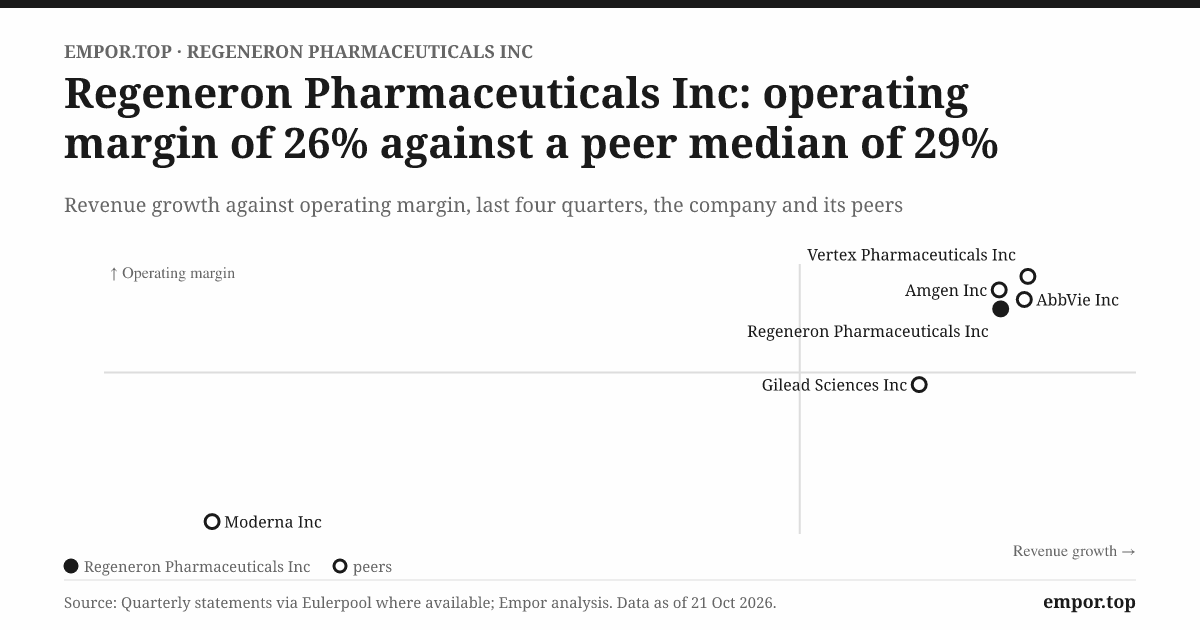
The reinvestment choice has a cost. Total R&D plus capital spending absorbed about 47% of 2025 revenue.4 Over the same years the operating margin slid from about 38% in 2018 to about 25% in 2025.4 Part of that is the EYLEA decline. Part is the Sanofi repayment. But part is a deliberate choice to fund more and bigger trials. Investors are being asked to accept lower margins today in exchange for a higher rate of future launches. That is only a good trade if the launches come.
Counting the hits and the misses
The record gives a calibrated answer. The neurotrophic program failed. The trap and antibody approaches then produced EYLEA and Dupixent, two of the most commercially important medicines of their generation, plus Libtayo, Praluent, Kevzara and a set of rare-disease drugs.4 That is an outstanding hit rate at the top. Below the top, the picture flattens.
Praluent, the cholesterol antibody, sold about $263 million in the United States in 2025, a modest result in one of medicine's largest therapeutic markets.4 Evkeeza, for an ultra-rare cholesterol disorder, sold about $53 million in the second quarter of 2026.[^16] Kevzara sold about $575 million globally in 2025.4 Several oncology bets have stumbled. The company's lymphoma bispecific odronextamab received a complete response letter from the FDA in July 2025 for a follicular lymphoma application.4
Libtayo deserves its proportional place. Global sales reached about $1.45 billion in 2025, and nearly $490 million in the second quarter of 2026, up 29%.4[^16] In first-line non-small cell lung cancer it now captures about 20% of new-to-brand prescriptions in the United States, having doubled its share since early 2025, and an approval in adjuvant skin cancer arrived in late 2025.[^16] That makes Libtayo commercially meaningful, a genuine blockbuster by the industry's usual definition. It is not yet large enough to offset either EYLEA's decline or Dupixent's eventual cliff.
The late-stage pipeline is where the next test sits, and 2026 has already delivered sobering evidence. Fianlimab, an antibody against the LAG-3 immune checkpoint, was meant to combine with Libtayo to challenge Merck's Keytruda in first-line melanoma. In the Phase 3 trial, the combination added about five months of progression-free survival numerically but "just missed" its primary endpoint, in Yancopoulos's words.[^16] A securities class action concerning the fianlimab program followed in July 2026.3 Earlier, the company had declined to move fianlimab into Phase 3 in lung cancer.[^23]
Itepekimab, an IL-33 antibody partnered with Sanofi in COPD, produced a split verdict in 2025: one Phase 3 trial cut exacerbations by 27%, the other missed its primary endpoint, and the companies said they were evaluating next steps.4 Linvoseltamab, a bispecific for multiple myeloma, won approval as Lynozyfic but sold only about $17 million in the second quarter of 2026 in its late-line setting; management expects growth to remain "modest" until confirmatory results from earlier-line trials, the first of which is due in 2027.3[^16]
The near-term cards that matter most are elsewhere. An FDA decision on cemdisiran, an siRNA drug for generalized myasthenia gravis given four times a year, is due in November 2026, after a Phase 3 trial that met its primary and all key secondary endpoints.[^16][^23] Pivotal results in a large Factor XI anticoagulation program are expected from 2027.[^16] Neither is revenue yet.
An analyst on the April 2026 call put the market's doubt bluntly, saying the investment community "lacks confidence that the company's candidates will move the needle commercially," and asked which late-stage programs could become multibillion-dollar products within eighteen months. Schleifer called it a penetrating question and answered with a tour of the pipeline rather than a ranking.[^23] That exchange captures the gap between a deep portfolio and a proven next franchise.
Gene editing and obesity belong in this story only as options. In January 2026 Regeneron paid $150 million, part upfront and part in equity, to work with Tessera on a gene-editing approach to alpha-1 antitrypsin deficiency; in July 2025 it paid $80 million upfront to license olatorepatide, a GLP-1/GIP drug from Hansoh Pharma that had completed a Phase 3 trial in China.4[^16] Regeneron plans its own Phase 3 obesity trials and argues it can differentiate by combining the drug with Praluent or with muscle-preserving antibodies.[^16]
On the January 2026 call, Schleifer said the commercial strategy was "not to directly compete without the combination," an implicit concession that Lilly and Novo Nordisk own the plain weight-loss market.[^19] These are early strategic bets relative to the current franchises.
The verdict on the platform is therefore narrower than the company's rhetoric: it has proven it can produce a very large winner every decade or so, and many smaller products; it has not yet proven it can produce the next large winner on the schedule the patent calendar requires. There was one moment, though, when the platform moved faster than anyone thought possible.
VII. The COVID Windfall Was a Stress Test, Not a New Base Rate
In the spring of 2020, as the coronavirus shut down New York, Regeneron turned its antibody machine on a new target. The product it built was a cocktail of two antibodies, casirivimab and imdevimab, given together against the virus.22 The logic of a cocktail is simple enough to explain at a dinner table: a virus that mutates its way around one antibody may still be caught by the second. The combination, first called REGN-COV2 and later REGEN-COV, moved from the laboratory toward large-scale manufacturing within months.
On July 7, 2020, the U.S. government agreed to share the bet. Under Operation Warp Speed, the Biomedical Advanced Research and Development Authority and the Department of Defense agreed to pay Regeneron $450 million for a large-scale U.S. manufacturing demonstration of the cocktail, with the government owning the resulting doses and offering them to patients free if the drug was authorized.23
On November 21, 2020, the FDA granted emergency use authorization for the combination in high-risk outpatients, based on a trial in which hospitalizations or emergency visits fell from 9% on placebo to 3% on the antibodies.22 The company had estimated that the government-funded manufacturing lots alone would yield between 70,000 and 300,000 treatment doses, a measure of how quickly a commercial antibody plant could be redirected to a national emergency.23
The financial effect was spectacular. Revenue nearly doubled, to about $16.1 billion in 2021, and the operating margin hit about 56%.4 Then the virus changed. Omicron's mutations stripped the cocktail of most of its activity, and on January 24, 2022, the FDA said REGEN-COV was not authorized for use anywhere in the United States because it was "highly unlikely to be active against the omicron variant."24 Revenue fell to about $12.2 billion in 2022.4 The windfall disappeared almost as fast as it arrived.
The windfall also left a lasting mark on the balance sheet. Shareholders' equity jumped from about $11 billion at the end of 2020 to about $18.8 billion a year later, and the investment portfolio roughly doubled to about $9.6 billion.4 Much of the treasury that now funds buybacks and research was built in that single year. The pandemic did not change the base business, but it changed what the base business could afford.
The episode is best read as a stress test, and it revealed two things. The strength it demonstrated was real: the speed of antibody discovery and the depth of manufacturing capacity that let a mid-sized company supply a national emergency. The limitation it exposed was just as real: no platform removes clinical, regulatory or demand risk. A product that depends on a single biological target can lose its market in one variant. Emergency demand is not recurring platform revenue, and anyone who extrapolated 2021 learned that quickly.
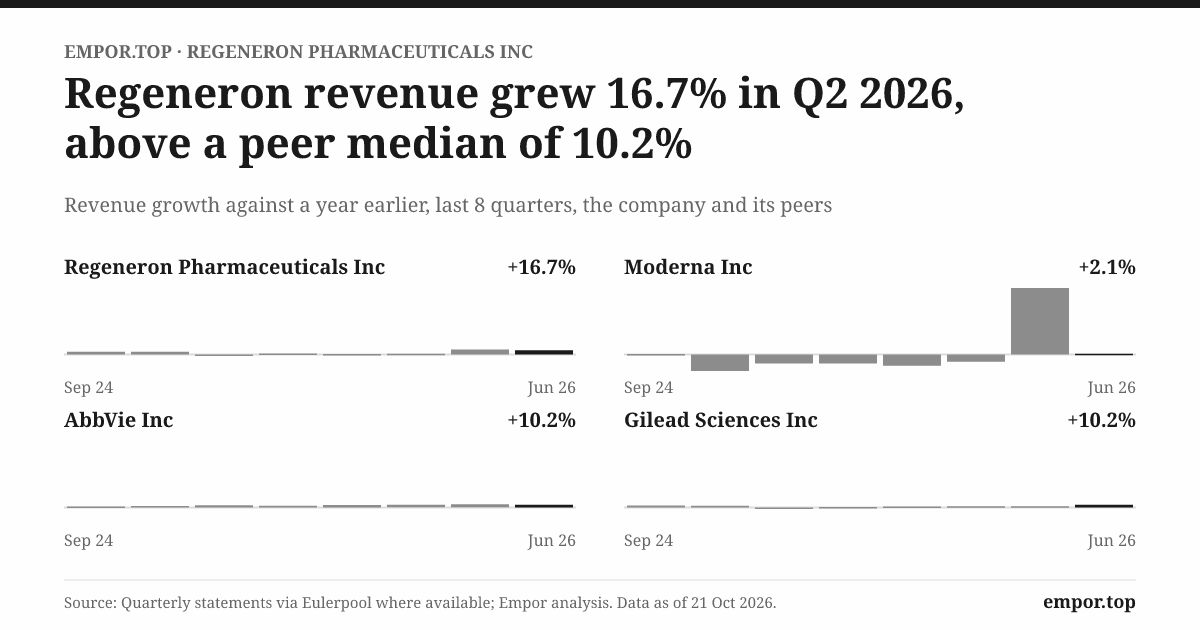
The better guide to the base business is what happened afterwards. From 2022 to 2025, revenue grew at about 5.6% a year, and net profit at barely 1%, as EYLEA's erosion offset Dupixent's rise.4 That is a much slower pace than the company's ten-year record of about 13% a year, which includes the earlier EYLEA and Dupixent ramps.4 Then growth returned: revenue rose about 19% in the first quarter of 2026 and about 17% in the second.[^23]3
The renewed growth is a Dupixent and EYLEA HD story, not a pandemic echo. The lesson carries forward: platform speed can matter enormously when biology and timing line up, but the durable business is the one that keeps selling after the emergency ends. And that durable business has thrown off a great deal of cash, which raises a different question about what management has done with it.
VIII. Profits Become Cash, Then Shares and Science
Picture the finance team in Tarrytown at the start of 2025. The company had just closed a year with about $4.4 billion of net profit, and its treasury of cash and marketable securities would reach about $18.9 billion by the end of the year.4 In 37 years it had never paid a dividend. It had been buying back stock for years. And in 2025, for the first time, it started sending shareholders a quarterly cheque. The decision says a lot about how a founder-led science company thinks about money once the money arrives.
Start with the most basic forensic question: are the profits real cash? Over the twelve years from 2014 to 2025, Regeneron reported about $36.4 billion of cumulative net profit and generated about $38.2 billion of cash from operations, roughly 105% conversion.4 That is a strong record. Profit has not been inflated by aggressive accruals or capitalized costs; if anything, cash has run slightly ahead.
The details still deserve care. In 2025, operating cash flow of about $5.0 billion exceeded net income of about $4.5 billion, but the reconciliation contained large offsetting items.4 Stock-based compensation of nearly $1 billion was added back as a non-cash charge, which flatters cash flow relative to the true cost of paying employees, since that cost is borne by shareholders through dilution. And reported earnings included about $966 million of realized gains on selling public equity stakes, a one-time harvest from earlier investments, not a recurring operating franchise.4
Other income altogether was about a third of 2025 pre-tax profit.4 That matters for anyone reading the P/E ratio: a meaningful slice of 2025 earnings came from the treasury, not the laboratory. It also explains a puzzle in the 2026 numbers. In the second quarter of 2026, revenue grew about 17% and operating income about 20%, yet net income fell, because other income dropped by almost half and the tax rate rose from about 8% to 15%.3
Now follow the free cash. Across those twelve years, free cash flow, operating cash minus capital spending, totaled about $29.8 billion.4 Where did it go? Not to dividends, which totaled only $370 million, all of it in 2025.4 Not mainly to the bank either, though cash and short-term investments did rise by about $7.9 billion since 2013, and including longer-dated securities the treasury reached about $18.9 billion at the end of 2025.4
The dominant use was buying back stock. In the three years from 2023 to 2025 alone, Regeneron spent about $8.28 billion on repurchases, including about $3.46 billion in 2025, and another $2 billion or so in the first half of 2026.43 The board authorized a fresh $3 billion program in April 2026.3 Diluted shares fell from about 115 million in 2024 to about 109 million in 2025 and 106 million by mid-2026.43
The new dividend is small by design: $0.88 a quarter in 2025, raised to $0.94 in 2026, about 8% of 2025 earnings.4[^19] CFO Chris Fenimore was explicit about its purpose. It widens the pool of potential shareholders to include funds that can only own dividend payers, "while share repurchases will remain the primary means of returning capital."[^19]
Testing the allocation
Is that a good use of the harvest? The fair test is whether repurchases and new investments create more per-share value than the alternatives. Two things can be said. First, the timing has been mixed. In 2025 the company bought 5.6 million shares for about $3.46 billion, an average price of roughly $617, while the stock touched a 52-week low of about $576 and is now about $804.4 Those purchases look reasonable in hindsight.
The earlier rounds look less so: the 2024 program averaged roughly $930 a share, well above today's price, and the 2023 program about $760, so the company bought heavily before the EYLEA erosion hit the stock.4 Second, buybacks compete with the research budget for the same dollars.
Over 2023 to 2025, repurchases ran at roughly a half of what the company spent on R&D. That is a sizeable bet that the stock is a better investment than another round of trials, made by the same management that argues internal research is the highest-return use of capital.
Treasury income is a quieter benefit. Interest earned on cash and bonds topped $700 million in 2025.4 The portfolio is conservative, concentrated in investment-grade corporate bonds and U.S. Treasuries.4 Debt is modest: about $2.7 billion of recorded borrowings at the end of 2025, consisting of $2 billion of low-coupon notes due in 2030 and 2050 and a $720 million finance lease on the Tarrytown headquarters.4
That lease, a synthetic arrangement with Bank of America, matures in March 2027 and has moved into current liabilities.3 Against $18.9 billion of cash and securities, net cash was about $16.2 billion at year-end and about $15.1 billion by June 2026.[^19][^16] The balance sheet could repay every dollar of debt many times over; the lease maturity is a detail to watch, not a risk.
What Regeneron has not done is large-scale M&A. There is no major acquisition price to benchmark against industry comparables, and no write-down of a big purchase to explain. Its external deals have been staged bets: $150 million for Tessera, $80 million for Hansoh's obesity drug, upfront fees and opt-in payments that totaled about $229 million of acquired research charges in the first half of 2026.43
When an analyst asked in July 2026 how the company squared its growing cash pile with its "aversion" to M&A, Schleifer pushed back on the premise. "I don't think I expressed an aversion to M&A," he said. "I think I expressed an aversion to overpaying."[^16] The test for that discipline is not whether the company avoids big deals but whether the small ones produce commercial returns. So far, none has. Whether anyone can force a different answer depends on who actually controls the company.
IX. Founder Control Makes the Science Bet Harder to Challenge
At Regeneron's annual meeting on June 12, 2026, the resolutions passed, as they always do. But the vote counts told a quieter story. Joseph Goldstein, a Nobel laureate and one of the longest-serving members of the board's compensation committee, received about 30.9 million votes against his re-election, roughly 30% of the votes cast.
Christine Poon, the lead independent director, drew about 23% against; Craig Thompson about 21%.25 The advisory vote on executive pay passed comfortably with about 93% support.25 In most American companies, a 30% vote against a director would trigger a board conversation. At Regeneron, it cannot change the outcome.
The reason is the share structure. Regeneron has two classes of stock. Ordinary common shares carry one vote each. Class A shares carry ten votes each and convert into common stock one-for-one.7 As of April 2026 there were about 1.8 million Class A shares outstanding against about 102 million common shares.
Leonard Schleifer alone owned about 95% of the Class A stock, plus about 2.8% of the common; George Yancopoulos owned about 2.4% of the Class A and 1.6% of the common. All directors and executive officers together held 97.4% of the Class A stock, worth about 17.7 million votes, plus about 4.9% of the common.7
The biggest outside holders are index giants: Vanguard with about 8.6% of the common stock, BlackRock with about 8.4%, and Capital World Investors with about 5%.7 Do the arithmetic and the insiders' Class A votes plus their common shares come to roughly a fifth of all votes outstanding. That is not an outright majority. But in a share register dominated by index funds that rarely coordinate, a fifth of the votes in friendly hands makes a contested election or a hostile change of control extremely difficult.
There is a real continuity case. The founders have led the company since its first day. They resisted the pressure to sell after the 1994 failure, built the platform that produced EYLEA and Dupixent, and have never staked the company on a transformational merger.
The board is mostly independent, with eleven of thirteen members independent and a lead independent director.7 The founders' wealth is heavily tied to the stock, which aligns them with long-term value. A company whose products take ten years to reach patients arguably benefits from leaders who cannot be pushed out by a bad quarter.
The accountability concern is equally real. The same structure that protects patient science also protects capital-allocation choices, compensation decisions and succession planning from outside challenge. Both founders have held their posts for more than 37 years, which makes succession an unavoidable question for any board. The persistent dissent against compensation committee members, year after year, is a signal that a sizeable minority of institutional holders does not believe the board challenges the founders hard enough.
A shareholder derivative suit over director compensation was pending in New York state court in 2026.3 The finance function has already been through one handover: long-serving CFO Robert Landry retired in 2024 and was succeeded by Christopher Fenimore, a Regeneron employee since 2003 and its controller since 2017.7 Promoting from within preserved continuity. Whether the same approach will apply at the very top is the question the board has not yet had to answer in public.
Put the pay itself in context. In 2025 Schleifer's reported compensation was about $7.3 million, including about $1.6 million of "other" compensation, mainly security and use of company aircraft; Yancopoulos received about $6.9 million.7 Together, about $14.2 million, set against $4.5 billion of net income. In company-wide terms that is modest; the founders' real economic interest lies in their shareholdings, not their salaries. The governance question is material, but not because of the paycheck. It is material because voting control insulates the decisions that matter most.
One small related-party item is worth mentioning only to size it. In 2025 and 2026 the company ran a preclinical research project at Schleifer's request, funded by a foundation he established, which paid Regeneron about $120,000 to cover the estimated fully burdened cost.7 It is immaterial, properly disclosed and priced at cost.
The audit evidence is clean within its bounds. PricewaterhouseCoopers issued an unqualified opinion on the 2025 financial statements and reported no material weaknesses in internal controls.4 The one critical audit matter it flagged was the company's reserve for uncertain tax positions, a judgment area in a company that routes much of its manufacturing and intellectual property through Ireland.4
That is an area of estimation, not an audit qualification. The verdict on governance, then, is a split one: founder stewardship has been consistent and the board is mostly independent, but dual-class voting power limits outside discipline, and the dissent is a real signal even though every vote passed. That distinction between power and accountability was about to be tested by the company's other great counterparty.
X. The $1 Billion Alliance Renewal
The deal announced on October 1, 2026, had been telegraphed for months. On the April earnings call, the day Belén Garijo officially took over as Sanofi's chief executive, Schleifer had publicly welcomed her and said he was "open-minded" about working together on Dupixent's successors, while noting pointedly that Regeneron could "do these things ourselves" and had had interest from other places.[^23]
By July he reported "productive early discussions," said he and Garijo had talked multiple times, and described the goal as a relationship "that reflects where the companies are now."[^16] He called himself cautiously optimistic. Ten weeks later the companies had a deal, and the lawsuit was gone.
Start with what Regeneron had been fighting about. Under the antibody collaboration, Sanofi sells Dupixent and reports the commercial results. Regeneron alleged that it had not been given full access to material information about Dupixent's commercialization, and that its audit rights had been limited.23
For a company booking billions of dollars a year from its share of a partner's profits, the ability to see how those profits are calculated, which expenses are charged against them and how the drug is being priced and promoted is not a technicality. It is the core of the bargain. As of October 2026 that dispute is settled: Regeneron agreed to dismiss the suit, and neither company disclosed any payment as part of the settlement.21
Now the new assets. Four Regeneron-invented antibodies join the alliance.12 The most advanced is REGN20423, a long-acting antibody against IL-13 that was in a Phase 1 study in atopic dermatitis. The other three, an antibody against IL-4, an antibody against the IL-4 receptor alpha subunit that Dupixent itself targets, and a long-acting bispecific against both IL-4 and IL-13, are expected to enter clinical studies in 2027.1 The strategic purpose is plain: these are designed to treat the same type 2 diseases as Dupixent, with less frequent dosing or broader coverage, so that the franchise can migrate to new molecules before 2031.
The money comes in two very different forms. The $1 billion upfront is cash in hand. The up to $7 billion in milestones is contingent: it is paid only if the molecules reach specific development, regulatory and sales achievements.2 For programs this early, the industry's historical success rates suggest that milestone totals of this kind are rarely paid in full. The headline "up to $8 billion" should be read as $1 billion plus an option on success.
The economics of the new programs mirror the Dupixent bargain in some ways and differ in others. Global profits on the new products will be shared equally, 50:50, and development costs will also be shared equally.2 But there is a budget cap: development costs above it fall on Regeneron, with the right to recoup the excess in later years.2 Regeneron leads research and development and the U.S. regulatory filings and U.S. commercialization; Sanofi leads commercialization outside the United States and leads global commercial efforts overall.12
Regeneron also gained options to add two Sanofi assets, including lunsekimig, a bispecific nanobody against TSLP and IL-13, exercisable after certain trials complete, provided it reimburses some of Sanofi's development costs.21 The existing Dupixent profit split does not change.1 Regeneron expected a roughly $22 million acquired research charge in the third quarter tied to the deal.2
What does it all mean? Garijo described the agreement as "a deliberate first step in igniting Sanofi's innovation engine."1 Schleifer called the alliance "one of the most productive in biopharma history."1 Both statements can be true, and both are revealing. For Sanofi, the deal secures the follow-on molecules to its single largest product. For Regeneron, it converts a public commercial dispute into a new shared pipeline and near-term cash, and it puts U.S. commercialization of the successors under Regeneron's own leadership, a step up from Dupixent, whose commercialization Sanofi has led.
The deal is also an admission. Access to information, governance and commercial control required negotiation, and in the end litigation, before they were resolved. The renewal is evidence of continued scientific partnership and evidence that the old arrangement did not adequately protect the inventor.
It does not change the Dupixent split, and its future value depends on clinical success, approvals and Sanofi's execution in global markets. The tests are straightforward to name: whether REGN20423 and its siblings advance on time, whether partner disclosure visibly improves, and whether these programs eventually produce durable revenue. Until then, the market has to price what it can see, and that is the subject of the next question.
XI. Analysis & Bear vs. Bull Case
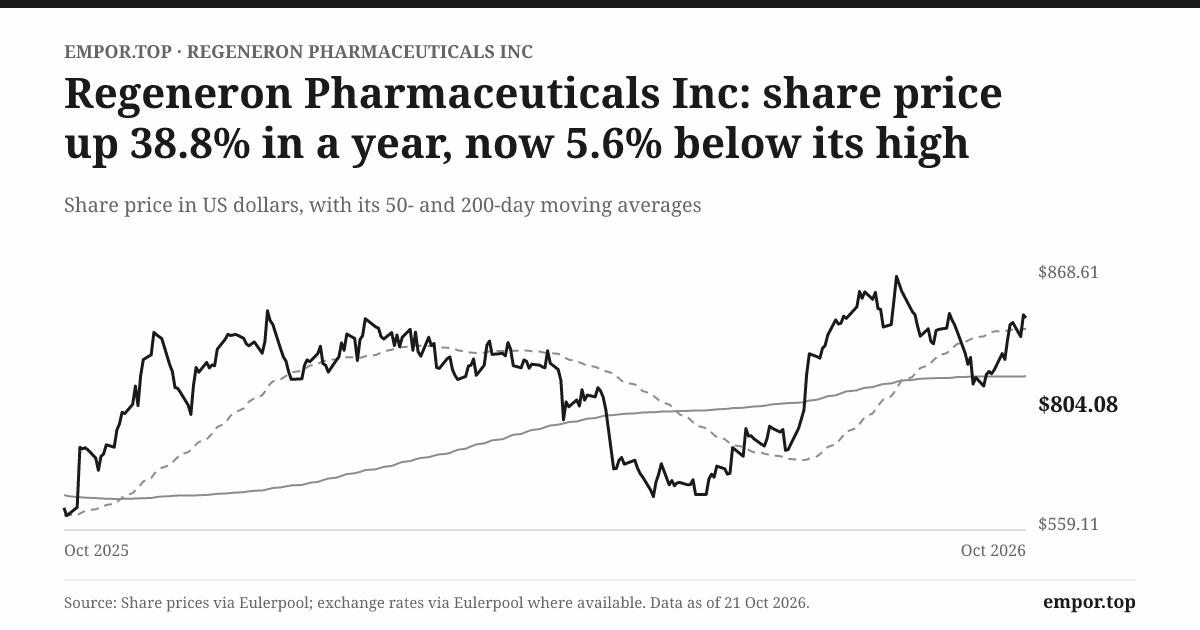
On October 21, 2026, Regeneron's shares closed at about $804, within 6% of their 52-week high and almost 40% above the low.4 At that price the market valued the equity at about $85 billion and, after deducting net cash, the enterprise at about $79 billion.
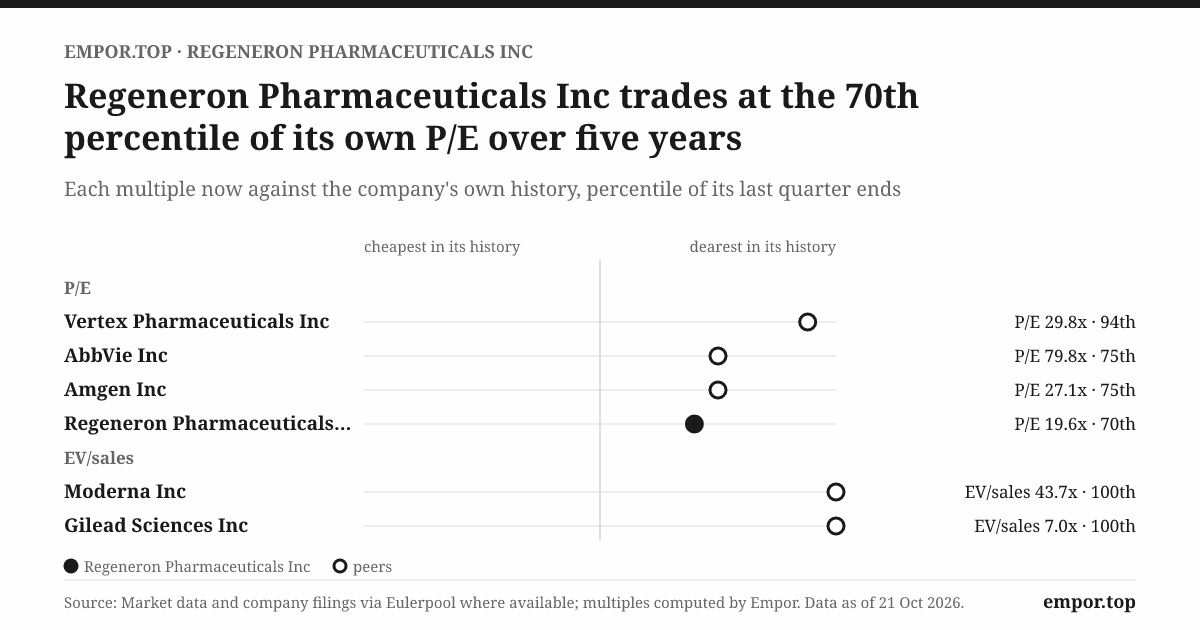
The stock traded at about 19.6 times trailing earnings, against a five-year median of about 17.3, and offered a free-cash-flow yield of about 4.1%. In plain terms, the market is paying a little more than usual for each dollar of Regeneron's earnings, having traded as low as about $576 within the past year before recovering as revenue growth returned to double digits in the first half of 2026.3
What does that price appear to assume? Not heroic growth. A multiple near 20 for a company with large net cash and a fast-growing partnered franchise implies the market expects moderate EYLEA erosion, continued Dupixent expansion and relatively little value from the pipeline. It is priced as a good business in a transition, not as a growth story. One caution about the headline multiple: trailing earnings include a large treasury contribution, so on operating profit alone the company looks slightly more expensive, at about 20 times enterprise value to operating profit.43
The case for, and the case against
The bull case is built on evidence that exists today. Dupixent is still growing faster than almost any large drug in the industry, with new indications in their first years of launch. EYLEA HD has passed the original in sales and is gaining share in a declining branded category. Libtayo has become a genuine lung-cancer contender.
The repayment of the Sanofi development balance mechanically lifts Regeneron's reported share of Dupixent profits from the third quarter of 2026. The October renewal gives Regeneron the lead on U.S. filings and U.S. commercialization activities for the Dupixent successors. And a net cash position above $15 billion can fund research at its current scale for years, even if revenue stalled.3[^16]
The bear case is just as concrete. Standard EYLEA is shrinking, and four more biosimilars were cleared by settlement to enter the U.S. market between the second half of 2026 and the last day of the year. Dupixent's main U.S. patent expires in March 2031, and the lifecycle defense is unproven.
The two most important franchises still account for the large majority of the company's economics, a concentration S&P and Moody's both cite as the main constraint on their ratings of BBB+ and Baa3.264 Recent late-stage readouts included a split result in COPD in 2025 and a Phase 3 miss in melanoma in 2026. And the research bill of about $6 billion a year is now a fixed feature of the cost structure.
Porter's five forces help organize the competitive picture once. Buyer power is substantial. Payers, above all Medicare, set reimbursement and formulary access, and two wholesalers handle about three-quarters of product revenue, though their role is logistical. Rivalry is rising as biosimilars arrive in the eye and as new biologics and oral drugs target type 2 inflammation.
The threat of substitution is real in both franchises: cheaper aflibercept copies and off-label Avastin in the retina, and competing mechanisms in immunology. Supplier power is limited but not zero, as the prefilled syringe delays at a contract manufacturer and a temporary bulk manufacturing interruption at Limerick in early 2026 showed.[^16][^23] Barriers to entry, in the form of patents, manufacturing know-how and clinical evidence, are high but do not eliminate substitution; they slow it.
Hamilton Helmer's 7 Powers framework sharpens the moat question. The most plausible power is process power: an embedded, hard-to-copy way of discovering and developing antibodies that has produced two of the largest drugs of the era. The proof of process power is repetition, though, not the platform's name. The record shows two giant successes spaced about six years apart and then a long wait for the third.
Counter-positioning and scale economies are weak arguments here; branding matters to physicians only through clinical data. Cornered resources, in the form of patents, are real but time-limited by definition. The fair verdict is that Regeneron's process power is plausible and has been demonstrated twice at scale, but the rate at which it converts science into large franchises has slowed relative to the company's spending, and must be re-proven.
Policy and legal risks belong in the same frame because they change net economics. The Inflation Reduction Act allows Medicare to negotiate prices for Part B drugs, with negotiated prices taking effect from 2028, and the company's own filing calls the effect on EYLEA and EYLEA HD "currently unclear."4
In July 2025 the President wrote to Regeneron asking for most-favored-nation pricing for Medicaid patients; in April 2026 Regeneron reached an agreement with the U.S. government that management described as lowering drug prices for American patients "while preserving innovation."4[^23]27 Separately, the Justice Department has two civil False Claims Act cases pending in Massachusetts.
The first, filed in June 2020, alleges that Regeneron used donations to a charitable copay foundation to induce Medicare purchases of EYLEA; the second, filed in March 2024, alleges that Regeneron inflated EYLEA's reported average sales price by failing to account for credit-card fee concessions to distributors, which would have raised Medicare reimbursement.284 A court denied Regeneron's motion to dismiss the second case in April 2025, and five states have since intervened.3 Regeneron disputes the claims.
It has also kept funding patient assistance: its fourth-quarter 2025 costs included a matching contribution of about $60 million to the Good Days retinal disease fund, an independent patient-assistance foundation, and management committed to matching up to $200 million in 2026.[^19][^23] The company presents these payments as support for access and affordability. Given the nature of the 2020 case, they are also a practice worth watching. False Claims Act cases carry the risk of treble damages, and both remain legal overhangs.
Receivables deserve a proportional word, because they look large: about $5.7 billion at the end of 2025, or 146 days of revenue.4 That figure is inflated by the structure of the business, since quarterly profit-share settlements from Sanofi and Bayer sit in receivables alongside wholesaler invoices. Debtor days improved from 160 to 146 during 2025, the company describes ordinary settlement terms with minimal credit losses, and nothing in its disclosures points to a late-paying customer.4 Receivables are large but not a red flag.
Management's narrative across the last three earnings calls has been broadly consistent on the big themes, EYLEA HD conversion, Dupixent runway and disciplined capital allocation, and it has been unusually explicit in guiding to standard EYLEA's continued decline. Where it has slipped is on dates that depend on others: the prefilled syringe, guided for the second quarter and then for year-end, is the clearest example.[^23][^16] Candor on the trend, optimism on the timelines.
Three KPIs will tell the story better than any narrative. The first is combined U.S. sales of EYLEA and EYLEA HD after biosimilar entry; the latest reading is about $1.01 billion in the second quarter of 2026, down about 12% on the year but up 7% on the prior quarter.3[^16] The second is Dupixent's global growth and Regeneron's share of its profits; the latest reading is 38% sales growth and a 59% jump in Regeneron's profit share.[^16]
The third is revenue from everything other than EYLEA and Dupixent, the cleanest measure of diversification; Libtayo, at nearly $500 million a quarter, is the main contributor, and the rest remains small.3 Those three numbers will settle most of the debate. The lessons, though, are already visible.
XII. Playbook: Business & Investing Lessons
The first lesson begins in March 1994, with a failed ALS trial and a board quietly weighing a sale. "A platform earns its keep when patients use the medicines it produces." VelocImmune is a marvel of genetic engineering, but its value is EYLEA and Dupixent, not the mouse.
The same platform also produced Praluent's disappointment, odronextamab's rejection letters and fianlimab's narrow miss. For founders, the lesson is that a research method is a promise of more shots on goal, not a promise of goals. For investors, it is that the right measure of a discovery engine is commercial output per dollar of research over a decade, counted honestly, misses included.
The second lesson comes from a Manhattan courtroom. "A partner can fund the runway and still own part of the road." In 2007 Sanofi's money let a mid-sized biotech run the experiment that became Dupixent. Seventeen years later the inventor of that drug was suing for the right to see how it was sold.
Partnerships are often judged at signing, when the cash is visible and the dependency is theoretical. They should be judged at maturity, when one party holds the sales data and the other holds only a contract. Any company that licenses away commercialization in exchange for funding is selling, along with economics, a measure of its own visibility.
The third lesson is written in EYLEA's 2025 numbers. "A replacement product has to replace the old economics, not just grow fast." EYLEA HD grew strongly and still could not stop the franchise shrinking by more than a quarter in one year, because the original lost roughly $2 billion of U.S. sales while the successor added a few hundred million. Fast growth from a small base can hide a shrinking whole. The only number that matters in a conversion is the combined franchise.
The fourth lesson lives on the balance sheet. "Cash is a choice." Regeneron converts profits to cash superbly, then makes a set of choices about what to do with it: nearly $6 billion a year of research, billions of buybacks, a small new dividend, modest licensing deals and a treasury that earns more than $700 million a year in interest.
Each choice is defensible on its own. Together they amount to a bet that the stock and the laboratory are both better investments than large acquisitions. The proof of that bet will be per-share value in 2031, not good intentions in 2026.
The fifth lesson comes from the vote tallies of June 2026. "Founder vision is strongest when the board can still challenge it." Regeneron's founders turned a failed neuroscience start-up into a company worth $85 billion. That record earns trust. It does not earn immunity. When nearly a third of the votes cast go against a compensation committee member and nothing changes, the structure is working as designed, and that is precisely the concern.
XIII. Epilogue
Tonight, Regeneron stands at a hinge. The first of the settled EYLEA biosimilars were cleared to launch in the second half of 2026, with more due by the end of December.4 Management has guided to spend about $6 billion on research this year.[^19] Dupixent is still growing at a pace that most drugs never reach, and the successor molecules meant to carry its biology past 2031 have just been placed inside a renewed alliance.
The next decisive moments are easy to name. The first is the ramp of the biosimilars. If combined EYLEA and EYLEA HD sales stabilize through 2027, with HD's share continuing to climb and net price holding, the first opening question tilts toward yes. If the combined franchise keeps sliding at double digits as cheap copies multiply, the conversion will have slowed the fall without stopping it. The second is the prefilled syringe and any further label changes for HD, small items that shape how retina practices choose.
The third is Dupixent's trajectory and the visible progress of its successors: REGN20423 moving through its early trials, the other three molecules entering the clinic in 2027, and any lifecycle patents that actually hold up. The fourth is the pipeline's first major wholly owned tests, beginning with the FDA decision on cemdisiran due in November and continuing with Factor XI results and myeloma confirmatory data from 2027.[^16]
Outside the laboratory, the government will shape the economics. The pricing agreement reached in April 2026 and the arrival of Medicare negotiation for Part B drugs will affect what EYLEA and its successors can earn, and the Justice Department cases over EYLEA pricing and patient assistance will, when resolved, show whether the company's past commercial practices carry a financial or reputational cost.2728
Return to the four questions. Can HD and Dupixent outrun the original EYLEA's decline? In 2026, yes, at the level of the whole company; revenue is growing again. Can the platform produce new blockbusters before 2031? Not yet proven; 2026 brought a positive Phase 3 result for cemdisiran but a costly miss for fianlimab, and nothing in late-stage development is yet near Dupixent's scale. Does Sanofi make Regeneron more powerful or less independent? Both, and the October renewal tilts the balance slightly toward Regeneron by giving it the U.S. lead on the successors. Does founder control protect the science or weaken shareholder checks? Both again, and the next succession will be the real test. The tension that remains is the one that has always defined the company: the clock of patent expiry runs on a schedule, and discovery does not.
XIV. Outro
Go back to Tarrytown, above the Hudson, to the laboratories of the company that two men from Queens founded in 1988 on the belief that a business could be built around discovery. One failed program sits behind them, a trial in a terrible disease that did not work. Ahead of them sits the next experiment, as it always has. In between lie EYLEA, Dupixent, a pandemic antibody and a long list of medicines that did not become franchises.
Regeneron is one of the rare companies that has actually been built around the laboratory, and it has proven twice that its laboratory can produce a medicine that reshapes a field. Its future depends on proving it a third time, on schedule, while the two medicines that made it gradually lose their protection. The science engine is running. The cliff is real. The bet, as it was on that napkin, is that the lab gets there first.
References
-
Sanofi and Regeneron Expand Global Alliance — Sanofi, 2026-10-01 ↩↩↩↩↩↩↩↩↩↩↩
-
October 2026 Form 8-K: Sanofi Agreement and Litigation Settlement — Regeneron Pharmaceuticals, SEC, 2026-10-06 ↩↩↩↩↩↩↩↩↩↩
-
Q2 2026 Form 10-Q — Regeneron Pharmaceuticals, SEC, 2026-07-30 ↩↩↩↩↩↩↩↩↩↩↩↩↩↩↩↩↩↩↩↩↩↩↩↩↩↩↩↩↩↩
-
2025 Form 10-K — Regeneron Pharmaceuticals, SEC, 2026-02-04 ↩↩↩↩↩↩↩↩↩↩↩↩↩↩↩↩↩↩↩↩↩↩↩↩↩↩↩↩↩↩↩↩↩↩↩↩↩↩↩↩↩↩↩↩↩↩↩↩↩↩↩↩↩↩↩↩↩↩↩↩↩↩↩↩↩
-
Regeneron: New York State of Mind — Pharmaceutical Executive, 2013-06-01 ↩↩↩↩↩↩↩↩↩↩↩↩
-
One of Biotech's Most Successful Bets Began on the Back of a Napkin — The Healthcare Technology Report, 2025-07-14 ↩↩
-
2026 Proxy Statement — Regeneron Pharmaceuticals, SEC, 2026-04-24 ↩↩↩↩↩↩↩↩
-
Regeneron Plots New Course with Vagelos — BioCentury, 1995-01-16 ↩↩
-
Regeneron Pharmaceuticals Wins FDA Approval for Blindness Drug Eylea — BioSpace, 2011-11-18 ↩↩↩
-
Sanofi-aventis and Regeneron Expand Collaboration to Discover and Develop Human Therapeutic Antibodies, Exhibit 99.1 — Regeneron Pharmaceuticals, SEC, 2007-11-29 ↩↩↩
-
Regeneron, Sanofi Antibody Discovery Deal Ending — BioCentury, 2017-08-04 ↩↩↩
-
Regeneron and Sanofi Launch Major New Immuno-Oncology Collaboration, Exhibit 99.10 — Sanofi, SEC, 2015-07-28 ↩
-
Q3 2017 Form 10-Q — Regeneron Pharmaceuticals, SEC, 2017-11-02 ↩
-
Regeneron To Buy Sanofi's Stake in Oncology Pact in $1.1-Bn Deal — DCAT Value Chain Insights, 2022-06-02 ↩↩
-
FDA Approves Genentech's Bispecific Antibody for Two Leading Causes of Vision Loss — Genentech, 2022-01-28 ↩
-
Biosimilar Product Information — U.S. Food and Drug Administration ↩
-
Amgen Wins Appeal in EYLEA Biosimilar Dispute — Fierce Pharma ↩
-
Federal Circuit Opinion in the Amgen EYLEA Biosimilar Dispute — U.S. Court of Appeals for the Federal Circuit, 2025-03-14 ↩
-
Sandoz Settlement Opens Path to EYLEA Biosimilar Launch — Fierce Pharma ↩
-
FDA Approves Dupixent for Atopic Dermatitis — BioPharm International, 2017-03-28 ↩↩
-
Coronavirus (COVID-19) Update: FDA Authorizes Monoclonal Antibodies for Treatment of COVID-19 — U.S. Food and Drug Administration, 2020-11-21 ↩↩
-
HHS, DOD Partner with Regeneron to Demo Investigational COVID-19 Treatment — Federal Laboratory Consortium, 2020-07-09 ↩↩
-
FDA Limits Use of Certain Monoclonal Antibodies to Treat COVID-19 Due to the Omicron Variant — U.S. Food and Drug Administration, 2022-01-24 ↩
-
2026 Annual Meeting Voting Results, Form 8-K — Regeneron Pharmaceuticals, SEC, 2026-06-17 ↩↩
-
Regeneron Credit Rating Rationale — S&P Global Ratings, 2024-09-15 ↩
-
Trump Announces Drug Pricing Agreement with Regeneron — Associated Press, 2026-04-23 ↩↩
-
U.S. Complaint Alleging Fraudulent EYLEA Price Reporting — Department of Justice, 2024-04-10 ↩↩
 LinkedIn
 WhatsApp
 Reddit
 Hacker News
 Email
 Kindle
 RSS Feed
 Spotify
 Apple Podcasts
 Amazon Music
 Audible
 YouTube