NRG Energy: The Power Company That Keeps Reinventing Itself
I. Thirteen Gigawatts, One New Bet
On January 30, 2026, NRG Energy closed the largest deal in its modern history. With a signature, the Houston company took ownership of a portfolio of gas-fired and dual-fuel power plants from LS Power, along with CPower, a business that pays commercial and industrial customers to cut their electricity use when the grid is tight.[^1] The package added about 13 gigawatts of generation, roughly doubling the fleet NRG had owned a month earlier.[^1] To get a sense of what 13 gigawatts means, picture a dozen large modern power plants, each capable of lighting a mid-sized city on a summer evening. NRG bought them in one transaction.
The headline price was about $12 billion of enterprise value.1 The bill arrived quickly. NRG paid roughly $6.4 billion in cash at closing and handed LS Power 24.25 million newly issued NRG shares.2 At the end of 2025 the company had held about $4.7 billion in cash and cash equivalents, an unusually fat cushion it had built for exactly this moment.3 Six months later, at the end of June 2026, cash and equivalents stood at about $162 million.2 NRG still had $5.3 billion of total liquidity, most of it in undrawn credit lines, so this was not a company scraping for change.2 But it was a company that had converted almost all of its spare cash into power plants, and that changes the kind of mistakes it can afford.
That is the paradox at the centre of NRG tonight. A company the stock market values at about $21 billion now controls about 25 gigawatts of generation and sells electricity and natural gas to millions of homes and businesses.4 It has more physical capacity than at any point since it shrank itself after the troubles of the last decade, and less ready cash than at almost any point in the same period. The plants are real. The question is whether they will produce enough free cash, after interest, maintenance and integration, to justify what NRG paid and what investors now pay for NRG.
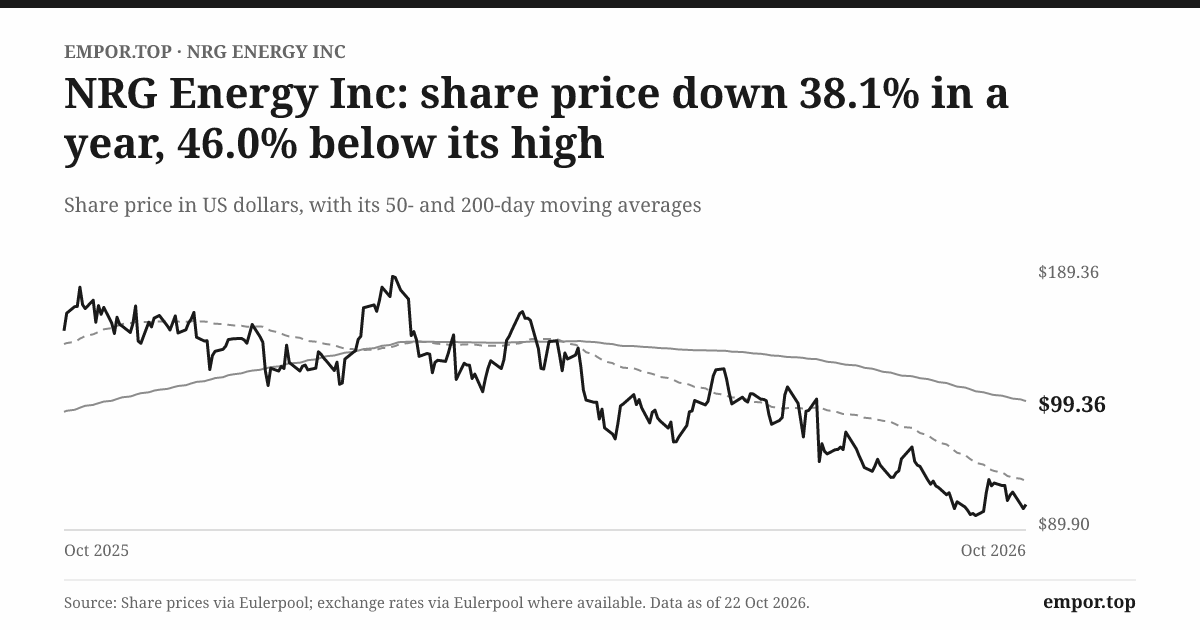
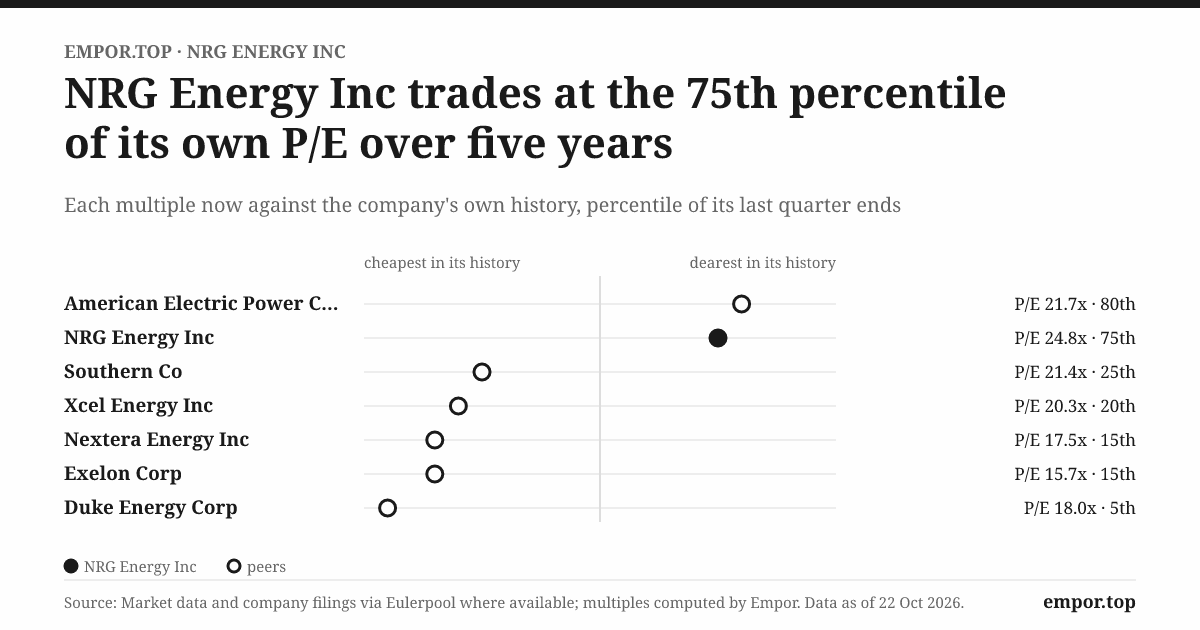
The market has been asking that question loudly. On October 22, 2026, NRG shares closed at about $99, roughly 46% below their 52-week high of about $184.[^6] Even after that fall, the stock traded at about 24.8 times trailing earnings, more than double its own five-year median of about 11.4 times, and at roughly 14 times trailing enterprise value to EBITDA. Those multiples are high for a business whose reported profits have swung from billions of dollars of losses to billions of dollars of gains within a decade. They are less dramatic against what management expects the enlarged company to earn: NRG has guided to 2026 adjusted EBITDA of roughly $5.3 billion to $5.8 billion, far above the $3.3 billion of EBITDA it reported for 2025.53 The whole investment debate lives in the gap between those two numbers, the backward-looking reported figure and the forward-looking adjusted promise.
There is a simple reason the gap exists. The 2025 annual accounts describe an older, smaller NRG. They end on December 31, 2025, so they contain none of the LS Power plants, which arrived a month later and will sit inside NRG for roughly eleven months of 2026.3[^1] The trailing multiples are therefore measuring today's price against yesterday's company. That cuts both ways. It flatters the bear, because the reported earnings base excludes the newly acquired cash flows. It also flatters the bull, because nobody has yet seen a full year of audited accounts showing what those plants earn under NRG's ownership, net of the debt that paid for them.
So this story asks four questions. Is the current earnings base comparable with NRG's long-run growth record, or did acquisitions do the growing? Can a company that keeps buying its way to scale turn that scale into cash without straining its balance sheet? How durable are the customer relationships and contracts that are supposed to make this a steadier business than a pure power generator? And can the reported earnings and today's valuation survive close scrutiny?
None of those questions is new for NRG. The company has been here before, more than once, holding a bigger fleet and a bigger debt load and a story about the future of energy that investors were asked to fund. The first time, it ended in a bankruptcy court in New York.
 Subscribe on LinkedIn
II. The Subsidiary That Went Bankrupt
NRG was born in 1989 inside Northern States Power, the Minneapolis utility, as a vehicle for investing in power projects that sat outside the regulated utility business.6 For a decade it was a quiet corporate offshoot. Then the late-1990s energy boom arrived. Deregulation was opening power markets across the United States and abroad, energy trading desks were minting fortunes on paper, and independent generators were buying plants as fast as banks would lend. Northern States Power merged with New Century Energies to form Xcel Energy in 2000, and NRG, now Xcel's unregulated arm, became one of the most aggressive buyers in the industry.
NRG's own filings describe the strategy without varnish. Since the early 1990s, the company said, it had pursued growth through acquisitions, and from 2000 it added the construction of new projects. That strategy required a great deal of capital, and NRG raised most of it from third-party lenders.6 By the end of 2002 the company carried about $9.4 billion of debt at the corporate and project levels.6 It owned plants across the United States and stakes in projects from Australia to Europe. It looked like a power empire.
Then Enron collapsed in late 2001, and the whole merchant-energy sector discovered that its creditors had been lending against confidence as much as cash flow. Wholesale power prices fell, trading counterparties demanded collateral, and the rating agencies started cutting. In 2002 NRG's credit rating dropped below investment grade, which triggered demands to post about $1.2 billion of collateral under its letters of credit.7 A company that had been built on borrowed money suddenly had to produce real money on short notice. It could not. NRG missed scheduled interest and principal payments to lenders and bondholders, and it recorded asset impairments of about $3.1 billion during 2002.6 Xcel injected $500 million in an attempt to avert a downgrade and pushed NRG to sell assets, but the hole was too deep.6
On May 14, 2003, NRG and 25 of its subsidiaries filed for Chapter 11 protection in the Southern District of New York.7 Xcel itself stayed out of the filing, and as part of the settlement it agreed to payments of up to $752 million for the benefit of NRG's creditors, in exchange for walking away.67 The reorganization moved quickly by bankruptcy standards. NRG emerged on December 5, 2003, as an independent public company with Xcel's ownership extinguished, and the plan eliminated roughly $5.2 billion of corporate-level bond and bank debt.7 The creditors became the owners. The new NRG started life with a smaller balance sheet and a hard-won lesson about what happens when a merchant generator borrows against prices it does not control.
What did NRG actually learn? The honest answer is that it learned how to buy and finance power assets better than almost anyone, which is both its defining capability and its recurring danger. In the years after bankruptcy, the company grew again by acquisition, and in 2009 it paid about $288 million in cash for Reliant Energy's Texas retail business and its roughly 1.8 million customers, the purchase that turned a generator into a retailer.8 Each deal made strategic sense on its own. Together, and with a decade of further plant purchases, they rebuilt a company whose debt load by the mid-2010s dwarfed the one that had sunk it in 2003. The 2003 bankruptcy did not end NRG's appetite for leverage. It simply taught the company to arrange it differently, with more non-recourse project debt, longer maturities and hedges.
That history matters for the 2026 deal because it reframes what kind of risk investors are taking. NRG ended 2025 with about $16.8 billion of borrowings on its balance sheet, before the LS Power transaction changed the debt and cash picture again.3 That figure already reflected a company that had added the debt for Direct Energy and Vivint, and had been raising money ahead of LS Power. The leverage of 2026 is not an aberration in NRG's story. It is the story's recurring motif. A generator that buys plants with debt makes a bet that wholesale prices, regulation and capital markets will stay friendly long enough for the plants to pay for themselves. In 2002 that bet failed spectacularly. In 2026 the company is making a version of it again, with better structure, but not without risk.
There is one important difference between the NRG of 2002 and the NRG of today, and it is the reason the company says this time is different. In 2002 NRG was almost purely a generator, selling power into wholesale markets and trading around it. Today it also owns one of the largest retail electricity businesses in the United States, a book of millions of customers who buy power every month. In theory, those customers are a natural hedge: when wholesale prices rise, the generation fleet earns more; when they fall, the retailer buys supply more cheaply. To understand whether that hedge really protects NRG, and whether it protects the LS Power bet, the story has to go to a kitchen table in Texas.
III. The Retailer That Sells Electricity by the Load
Somewhere in Houston, a customer sits down to choose an electricity plan. Texas lets most households in its competitive areas pick their retail provider, so the screen offers a menu: a fixed price for twelve months, a fixed price for twenty-four, a plan with free nights or a bill credit, a renewable option. The customer sees a cents-per-kilowatt-hour rate and maybe the name of a brand that NRG owns, such as Reliant or Green Mountain. What the customer does not see is the calculation behind that rate. To make the offer, NRG has to forecast how much electricity this household will use in July and in January, buy or produce that power at a cost it can lock in, pay the local wires company to deliver it, and still leave a margin.
That is the pricing unit of NRG's core business. Retail electricity and natural gas are sold by volume, by the kilowatt-hour and the therm. In 2025 NRG sold about 154 terawatt-hours of electricity and roughly 1,857 million dekatherms of natural gas.3 But volume is only the start. The economics depend on the load, meaning how much customers actually consume and when; on wholesale prices; on the hedges NRG puts on in advance; on the weather; and above all on the spread between what customers pay and what supply costs.3 A very hot August can be wonderful if NRG has hedged correctly and its plants are running, and painful if customers use far more power than forecast and NRG has to buy the extra at scarcity prices.
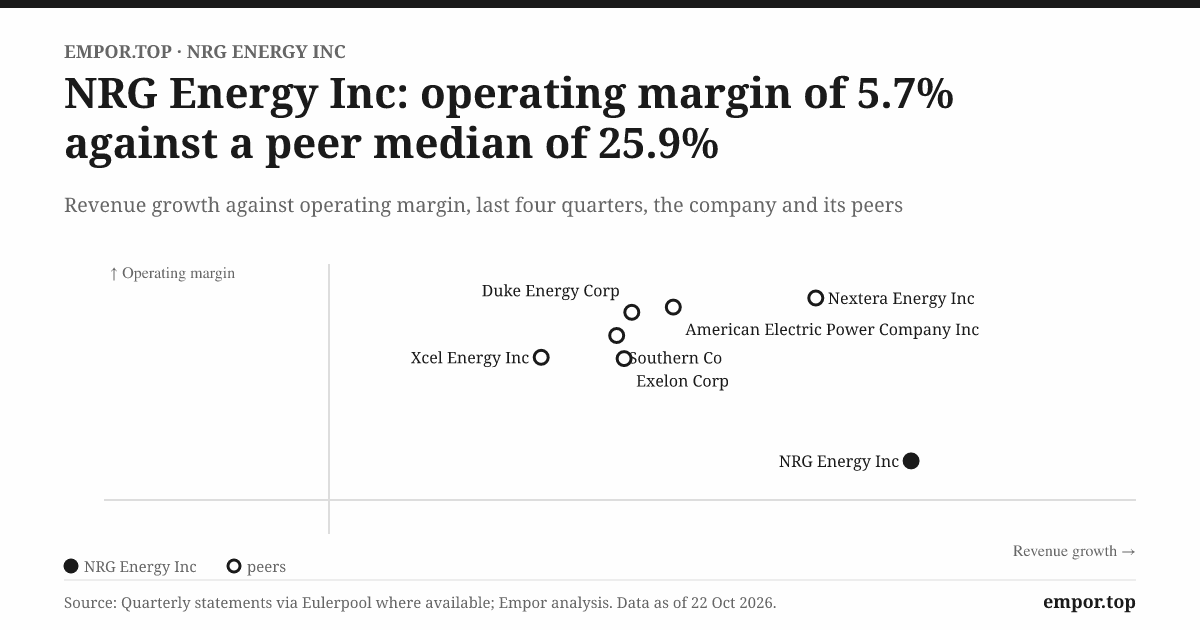
That is why revenue is a poor guide to NRG's health. Power sales are recorded gross, so the company's $30.7 billion of 2025 revenue includes huge amounts that simply pass through as purchased energy and delivery charges.3 When natural gas prices rise, revenue rises with them, without NRG necessarily earning a cent more. The operating margin tells the truer story, and it is thin: about 6% in 2025.3 A business that turns roughly $30 billion of sales into under $2 billion of operating profit is not a high-margin franchise. It is a high-volume, low-margin intermediary whose profit depends on getting a few cents right on every unit it sells.
The footprint is large. In 2025 NRG served about 5.7 million retail energy customers on average, plus about 2.3 million Vivint smart-home customers, and its energy brands operated across 25 U.S. states and eight Canadian provinces.3 No single customer accounted for more than 10% of consolidated revenue in any of the last three years.3 That sounds reassuring, and partly it is: no single household or business can bring NRG to its knees by leaving. But NRG does not disclose its top-five or top-ten customer concentration, nor a group-wide recurring-revenue share, nor a consistent retention series across the whole business.3 Investors know the customer base is big and fragmented. They do not know, from NRG's own numbers, how sticky it is.
The heartland is Texas, and there the competition has two names. In ERCOT's competitive retail market in 2025, NRG and Vistra each served roughly 23% of total load, and in the residential segment NRG held about 37% against Vistra's roughly 30%.9 Those are Texas shares, not national ones, but Texas is where NRG earns a large share of its energy profits, so they matter. They show a duopoly-like structure at the top of a market with dozens of smaller retailers. They also show that NRG has no runaway lead. In total load, its nearest rival is level with it, and trade coverage of the same data framed the year as one in which Vistra drew even with NRG and concentration eased.9
Here is where the integrated model comes in. NRG's generation fleet supplies a large part of the power its retail customers use, and the retail book gives its generators customers to serve. The company calls this matching generation and load. The Texas fleet sits near Texas load, and the LS Power plants were bought largely in Texas and the Northeast, where NRG also has customers.1
But the hedge has limits, and the limits are the point. Texas customers can switch providers when their contract ends, often with a few clicks, so NRG cannot simply raise prices after a bad summer. Competitors can price aggressively to win share, as Vistra has shown. And wholesale prices can move far faster than retail contracts reset. Winter Storm Uri in February 2021 was the brutal demonstration: as the Texas grid failed, NRG had to supply customers it had promised at fixed rates while wholesale prices sat at emergency levels and many customers and counterparties could not pay. Even after hundreds of millions of dollars of mitigation and expected recoveries through a state securitization, NRG booked a pre-tax loss of about $380 million from the storm, including roughly $600 million of provisions for credit losses.10 The integrated model reduces risk on average. It does not eliminate it in the tails, and the tails are where power companies have historically lost the most money.
Follow the cash through the customer book, and a second watchpoint appears. At the end of 2025, NRG's net receivables were about $4.1 billion, and about $1.7 billion of that was unbilled: electricity customers had already used, which NRG had recorded as revenue but not yet invoiced.3 Some unbilled revenue is normal in a business that bills monthly on meter reads. It is still an estimate, and it is only as good as the meter data and the customer's willingness to pay. NRG set aside $272 million for credit losses in 2025 and wrote off $343 million, which means write-offs ran ahead of new provisions.3 By June 2026 receivables had come down to about $3.5 billion, including roughly $1.5 billion unbilled, a seasonal pattern rather than an alarm.2 NRG does not publish a full ageing table for these balances, so investors cannot see how much is overdue by customer type. The bad-debt line is therefore one of the few windows into customer quality, and it is worth watching every quarter.
Then there is the long record, which looks better than the profit line and worse than it seems at first glance. Over the twelve years from 2014 to 2025, NRG generated about $16.2 billion of operating cash flow against cumulative net profit of only about $1.2 billion.3 That gap is not magic. NRG is a capital-intensive company whose profits are depressed by depreciation, impairments and huge non-cash swings in the value of its hedges, and its reported losses in 2015 and 2017 included enormous write-downs that never touched cash. The cumulative cash is the better gauge of what the business produced. But the annual pattern is jagged. Operating cash was negative $221 million in 2023, when NRG had to post collateral and absorb working-capital swings, then jumped to about $2.3 billion in 2024 and $1.9 billion in 2025.3 A business whose operating cash can swing by more than $2 billion between two consecutive years does not deserve to be valued like a utility, whatever its long-run average.
Where did the cash go? Over the same twelve years, free cash flow totalled about $9.3 billion. About $2.7 billion went out as dividends.3 Share repurchases took much more in recent years, including about $1.3 billion in 2025 alone.3 The balance of cash and short-term investments rose by about $4.7 billion between the end of 2013 and the end of 2025, with almost all of that increase in 2025, ahead of LS Power.3
A few smaller clues complete the picture, and none changes it. Related-party revenue was about $53 million in 2025, mostly from Ivanpah, the California solar thermal plant in which NRG holds an equity stake, which is roughly 0.2% of revenue.3 NRG says its fees to affiliates for operations and maintenance recover costs and may include a margin or incentive bonus, but it does not quantify those charges against its total cost base.3 Foreign-exchange exposure comes mainly from Canadian operations buying natural gas priced in U.S. dollars; NRG hedges part of it, and the 2025 filing says currency transaction effects were immaterial.3 Tax is noisier. The reported tax rate has bounced from negative to above 30% across recent quarters, because tax credits and special items swing against small pre-tax profits.3 That noise is one more reason to look through quarterly net profit toward cash.
What does all this say about the moat? It says NRG has scale, brands and an integrated supply model that are real advantages in Texas retail. It does not say NRG has a subscription business. Customers can leave, prices are visible and comparable, and the economics depend on hedging skill as much as on loyalty. That distinction matters because it is precisely the distinction the company has repeatedly tried to blur, most ambitiously a decade ago, when a charismatic CEO told investors that NRG would become something much more than a power company.
IV. The Green Reinvention That Could Not Carry Its Cost
In the first days of December 2015, NRG's board chairman and a longtime director delivered the news to David Crane: the board had decided to let him go.11 The public announcement on December 3 said Crane was stepping down as president and CEO effective immediately, and that Mauricio Gutierrez, the chief operating officer, would replace him.[^14] For Crane, who had run NRG since shortly after it emerged from bankruptcy, it was an abrupt end. For investors, it was overdue. NRG's shares had fallen from about $27 to about $11 during 2015.11 The market had stopped believing in the company Crane was trying to build.
Crane was not a typical power-company chief executive. He was articulate, restless and openly contemptuous of the idea that a generator should simply run its plants and collect cash. He had turned the bankrupt NRG of 2003 into one of the largest independent power producers in the country, and he believed the industry he had built was about to be disrupted. Rooftop solar, batteries, electric vehicles and smart homes, he argued, would let customers produce and manage their own energy, and the old model of big central plants pushing power down wires would erode. Better, he said, for NRG to disrupt itself than to be disrupted.
So he set out to pair one of the largest fossil-fuel fleets in America with a clean-energy consumer business. NRG built residential solar, invested in electric-vehicle charging through its eVgo network, pushed into home energy services, and promoted a distributed-energy platform that would sell customers not just electricity but a new relationship with power. It also built a yield vehicle, NRG Yield, to hold contracted renewable and conventional assets and raise cheaper capital from income investors. It was an ambitious, coherent vision of where the energy system might go. It was also expensive, and the timing was terrible.
The mismatch was simple. Fossil generation still produced the core earnings, and in 2015 those earnings came under pressure as natural gas prices and wholesale power prices fell. Meanwhile the new ventures consumed capital and investor patience without yet producing meaningful profit. The board's September 2015 plan to separate the home-solar and other green businesses into a new company was an admission that the market would not value them inside NRG.11 By year-end, the accounting caught up with the strategy. NRG recorded a net loss of about $6.4 billion for 2015, driven largely by impairments of its conventional fleet as lower power prices reduced what those plants were worth.12 The dream of a distributed-energy future sat on top of a fossil balance sheet that was being marked down.
The reversal under Gutierrez was swift. NRG scaled back the residential solar push, sold or wound down green ventures, and in 2017 launched a transformation plan built around cost cuts, asset sales and debt reduction.12 The centrepiece came in August 2018, when NRG completed the sale of its renewables platform and its stake in NRG Yield to Global Infrastructure Partners for about $1.35 billion.13 That sale generated cash and reduced complexity. It also ended, for a time, the claim that NRG would become a clean-energy growth company. By the end of 2018, NRG's borrowings had fallen to about $6.5 billion from roughly $19.5 billion three years earlier, as asset sales and deconsolidation removed not only debt but entire businesses from the balance sheet.12
One more episode belongs here because it shows how hard it is to turn a technical first into a commercial success. Petra Nova, a joint venture at NRG's W.A. Parish plant near Houston, captured carbon dioxide from a coal unit and piped it to an oil field to boost production, which made it one of the largest carbon-capture projects of its kind in the world when it started in 2017.14 Its economics depended on oil prices, because the captured carbon earned its keep by squeezing more crude out of old wells. When oil collapsed in 2020, the project stopped operating, and NRG recorded an impairment on its equity investment in the first quarter of that year.1514 The engineering worked. The business case did not.
So what did the Crane era prove? Not that his vision was wrong about the direction of travel. Solar, batteries and electric vehicles did grow, and some of the businesses NRG once owned outlived its interest in them. It proved something narrower and more useful for investors: a strategic vision is not proof of a profitable business, and NRG's own record shows the company reversing course under pressure when the cost of a vision exceeded the cash it produced. The episode is strong evidence against taking a story about what the energy system might become as a reason to pay for it today.
That lesson sets up the test for the NRG of 2026. When the company now talks about data centers, demand growth and new gas plants, does its strategy begin with contracted customers and existing generation, or with a story about the future? Before answering that, there was another reinvention to come, one that began not with power plants but with customers, and that took NRG into a business nobody would have predicted in 2015: home security.
V. The Customer Platform Gets a Security Business
On March 10, 2023, NRG completed its acquisition of Vivint Smart Home, the Utah-based company whose door-to-door sales teams and smart cameras had made it one of the largest home-security providers in the United States.16 With that, a company best known for running power plants and selling electricity also owned millions of doorbell cameras, smart locks and alarm-monitoring contracts. NRG said the combined company would serve about 7.3 million customers across North America and called it a leading essential home services platform.16 Many investors called it something else.
To understand why NRG made the Vivint bet, start with the deal that came before it. On January 5, 2021, NRG completed the acquisition of Direct Energy from the British company Centrica, paying about $3.6 billion in cash.17 Direct Energy brought millions of retail electricity, gas and home-services customers across the United States and Canada, and it changed NRG's scale overnight. Revenue rose from about $9 billion in 2020 to about $27 billion in 2021.10 That step-change was acquired scale, not organic growth, and it is the main reason NRG's ten-year revenue growth rate looks so much stronger than its recent three-year record. It also made NRG a far larger retailer, increasingly organized around customers rather than plants. NRG financed the purchase partly with new debt, and it closed just weeks before Winter Storm Uri tested every assumption about what a big retail book is worth in a crisis.
The Vivint deal was the logical extension of that thinking, and the most controversial. NRG announced it on December 6, 2022: an all-cash offer of $12 per share, a 33% premium to Vivint's previous closing price, and a transaction value of about $5.2 billion including Vivint's debt.18 NRG presented the price as about 6.3 times Vivint's projected EBITDA after expected synergies.18 The pitch was cross-selling. Vivint had long-tenured smart-home customers on multi-year contracts, NRG had millions of energy customers, and a household that bought both, the argument went, would stay longer and be worth more.
That 6.3 times figure deserves careful handling, because it was built from two forward-looking ingredients: Vivint's 2022 guidance and NRG's estimate of synergies that had not yet been realized.18 A multiple calculated on hoped-for earnings is a promise, not a price. The market judged the promise harshly. NRG's shares fell sharply on the announcement, and within months the activist investor Elliott Management disclosed an economic interest of more than 13% in NRG, called Vivint the worst deal in the power and utilities sector in a decade, and demanded that NRG unwind it.19 NRG did not sell Vivint. But in November 2023 it replaced Gutierrez as CEO and added four new directors in a settlement with Elliott, and the board's chair, Lawrence Coben, took over as chief executive.19[^23] The Vivint deal had cost a CEO his job even before investors knew whether it worked.
Three years on, Vivint is a meaningful earnings stream. In the second quarter of 2026 it produced about $301 million of adjusted EBITDA, against about $916 million from NRG's Texas and East segments combined.4 That is significant: in a quarter, Vivint contributed roughly a third as much adjusted EBITDA as the two core energy regions together, and its earnings are less tied to the weather than the power business. But it is not the main source of NRG's value, and the adjusted figures exclude costs that matter, including the steady investment needed to acquire new subscribers. What Vivint has not yet shown, in NRG's disclosures, is the thing the deal was supposed to prove. The filings say smart-home contracts generally last three to five years, but NRG does not publish an NRG-wide subscription revenue share or a consistent segment retention series that would show whether cross-selling is extending customer lives.3 The cross-sell thesis remains a management claim, not a demonstrated result.
There is also a trust problem that came with the asset. In April 2021, two years before NRG bought it, Vivint agreed to pay $20 million to settle Federal Trade Commission allegations that its sales staff had misused consumer credit reports, including by using other people's credit histories to qualify customers for financing; the settlement imposed monitoring, training and compliance obligations.20 NRG's 2025 annual report still describes an ongoing settlement-administration process and possible regulatory consequences.3 And in 2025 NRG recorded a $224 million working-capital outflow tied to a legal matter brought by CPI Security Systems, a rival alarm company, over Vivint's sales practices.3 A business that sells through door-to-door teams carries a reputational and legal risk that an electricity retailer selling through a website does not, and NRG now owns that risk.
The financing consequence closes the circle. Acquisition debt for Direct Energy and Vivint helped push NRG's borrowings from about $9 billion at the end of 2020 to about $11 billion by the end of 2023.103 At the same time, NRG kept paying a rising dividend and, under pressure from Elliott, stepped up buybacks. That combination worked while the business produced strong cash, as it did in 2024. It left less room for error if cash weakened. So the verdict on this phase is split. Direct Energy materially expanded the retail base and is now part of the core. Vivint contributes real earnings but has not yet demonstrated the long-tenure, cross-sell premium that justified its price, and it imported regulatory exposure that still appears in NRG's filings.
By 2025, NRG had a large customer platform and a smaller generation fleet than it had once owned. The obvious next move, if management believed demand for electricity was about to surge, was to rebalance toward generation. In May 2025 it did, with the biggest bet yet.
VI. The $12 Billion Bet on Dispatchable Power
On May 12, 2025, NRG and LS Power announced that NRG would buy a portfolio of 18 natural gas-fired and dual-fuel power plants totalling about 13 gigawatts, plus CPower, for an enterprise value of about $12 billion.1 The plants were concentrated in Texas and the Northeast, the regions where NRG already sold power to customers.1 Management described the deal as transforming the generation fleet for a period of growing demand. The word that mattered was dispatchable: these were plants that can be turned on when the grid needs them, unlike wind and solar, which run when the weather allows. In a market worried about whether there will be enough firm power for data centers, factories and electrified homes, dispatchable capacity had suddenly become the scarce resource.
NRG framed the price in two ways. First, as about 7.5 times projected 2026 EV/EBITDA, meaning the enterprise value was roughly seven and a half times the EBITDA management expected the assets to generate in 2026.1 Second, as about half of what it would cost to build equivalent new plants from scratch.1 That second number was the heart of the sales pitch. Building a new gas plant in the United States in 2025 meant waiting years for turbines, paying inflated construction costs and navigating interconnection queues. Buying existing plants at half the replacement cost looked like getting the scarce asset at a discount.
Both claims need testing. Start with the multiple. In December 2023 Capital Power, the Canadian generator, announced the purchase of two U.S. gas generation facilities at about 4.8 times 2024 adjusted EBITDA.21 NRG's 7.5 times is meaningfully higher. That does not prove NRG overpaid. The assets differ in size, contract structure and location, the market had moved sharply in the eighteen months between the two deals as data-center demand reset expectations for gas plants, and NRG's price included CPower, a business with different economics. But the comparison is a useful question: what is NRG assuming about the future that a buyer of similar assets did not assume two years earlier? The answer is a lasting increase in the value of firm capacity. That may prove right. It is an assumption, not a fact.
Now the replacement-cost claim. A plant bought at half the cost of a new one is cheap only if the plant earns a return on the price paid. Replacement cost tells you what a competitor would have to spend to compete with you; it does not tell you what the asset will earn. If power prices fall, or if new supply arrives faster than expected, a plant bought below replacement cost can still be a poor investment. The 2002 NRG owned plenty of assets that had cost a great deal to build and turned out to be worth far less. The real test is cash: post-acquisition EBITDA and free cash flow, after interest, maintenance, integration costs and the dilution of new shares.
The financial burden was substantial. At closing, NRG paid about $6.4 billion in cash, booked about $483 million of preliminary working-capital and other adjustments, and issued 24.25 million new shares to LS Power.2 At announcement, those shares represented about 11% of NRG.1 To fund the cash, NRG had raised new debt during 2025 and accumulated the cash pile that showed up at year-end, and in the first half of 2026 it issued further debt and amended its credit agreement.2
Then came a sequence that a skeptical investor will want to examine closely. In March 2026, barely five weeks after closing, LS Power sold about 14.3 million of its new NRG shares in a secondary offering priced at $164 per share, raising roughly $2.3 billion for the seller before fees.22 NRG received none of those proceeds. Instead, it agreed to buy back $300 million of its own stock from LS Power in a private transaction at the same price.22 The seller was cashing out a large part of its stake near the share price's peak, and NRG was spending cash to help. NRG's 10-Q shows the company had repurchased about $3.9 billion of stock cumulatively under its current authorization by June 2026.2 Seven months later, the shares traded at about $99.[^6] The buyback at $164 now looks expensive, and the broader question is whether repurchases alongside acquisition financing were consistent with the leverage path NRG had promised.
That promise was explicit. When it announced the deal, NRG said it would raise its leverage ceiling to below 3 times net debt to adjusted EBITDA, up from its earlier 2.5 to 2.75 times range, and reach that level within 24 to 36 months after closing.1 It also expected its ratings from S&P, Moody's and Fitch to be affirmed.1 Management guided to continued shareholder returns through the deleveraging period. At the time, NRG's own credit profile listed S&P at BB with a stable outlook, Moody's at Ba1 and Fitch at BB+, all below investment grade.[^27] S&P had affirmed BB and changed its outlook from positive to stable on May 12, 2025, the day the deal was announced, a signal that, in S&P's view at least, the deal pushed any upgrade further out rather than bringing it closer.3 Investors should treat the latest agency actions and rationales, not the company's presentations, as the independent read on whether the financing plan is working.
The first post-deal report showed what the bet looks like in practice. By June 30, 2026, cash and equivalents had fallen to about $162 million, and total liquidity of about $5.3 billion was roughly $4.3 billion below the level at year-end 2025.2 NRG reported higher interest expense and higher depreciation as the new plants and their financing came onto the books.54 By July, NRG had drawn $700 million on its receivables facility, which at June 30 carried no borrowings but supported $991 million of letters of credit.2 None of this signals distress; companies routinely use credit lines after a big acquisition. But it describes a company with much less slack than it had seven months earlier, operating in a business where collateral calls can arrive with a cold front.
CPower deserves a smaller frame than its headline suggests. NRG describes it as a business with about 6 gigawatts of demand-response capability and more than 2,000 commercial and industrial customers.1 Demand response pays businesses to reduce consumption when the grid is stressed, so it can help NRG manage load flexibly and earn capacity payments. But gigawatts under management are not gigawatts of owned generation, and they are not profit. The value of CPower depends on how much those customers are paid, how often they are called and what capacity markets pay for their flexibility.
Weighed together, the evidence narrows the case rather than rejecting it. NRG bought real, useful assets at a price that looks moderate against replacement cost and management's EBITDA forecast, and higher than at least one earlier deal for similar plants. It funded the purchase in a way that reduced its cash buffer to almost nothing and then, within weeks, spent more cash buying stock from the seller at a price far above where it trades today. The decisive figure is not the gigawatts. It is post-deal net debt to EBITDA, reported on a comparable basis, and operating cash flow after integration. Until NRG reports a full year of both, the LS Power deal is a plausible bet, not a proven one.
And the bet is not only about the plants NRG bought. It is about the plants NRG wants to build, for customers who have only just started knocking on the door.
VII. The Data Center Customer Has to Pay for the Power
On August 4, 2026, NRG reported its second-quarter results and slipped a new kind of announcement into them. The company said it had aligned on principal commercial terms with a hyperscaler, one of the giant technology companies building data centers for artificial intelligence and cloud computing, for a 1.2-gigawatt combined-cycle gas plant in Texas.4 NRG would develop, own and operate the plant, which would serve a data center load of about 1 gigawatt, with the possibility of expanding the relationship to as much as 2.4 gigawatts over time; the target was to deliver the plant in late 2029.23 On the earnings call, the new CEO described it as expected to be NRG's first "bring your own power" project.23[^29] The same day, Texas's governor announced a pause on data-center interconnections to the state grid while their impact was reviewed.23 The AI power boom and its political limits arrived in the same news cycle.
To see why that matters, step back to the structure of the industry NRG competes in. In deregulated markets such as Texas and much of the Northeast, power plants are not owned by utilities that earn a regulated return. They are owned by independent generators that compete to sell electricity and capacity into wholesale markets. Those generators compete on fuel flexibility, on where their plants sit relative to demand and transmission, on how reliably their plants run when prices spike, on how well they hedge, and on their access to markets. Retail suppliers, meanwhile, compete on price, plan design and the cost of acquiring customers. NRG plays both games at once.
Its closest rivals play different versions of them. Vistra, NRG's great Texas competitor, reported roughly 7.8 million residential customer equivalents across ERCOT in 2025 and owns a large fleet that includes nuclear, gas and coal plants as well as batteries.24 Constellation Energy, after absorbing Calpine, operates a fleet of about 55 gigawatts that is far more nuclear-heavy, which gives it a large base of carbon-free, always-on power to sell to the same hyperscalers NRG is courting.25 Comparing the three on company-wide revenue misses the point. Constellation sells mostly carbon-free baseload power, which commands a premium from technology companies with climate pledges. Vistra combines a big Texas retail book with a mixed fleet. NRG, after LS Power, is a large gas-heavy generator welded to a large retail and home-services business. Each will win different kinds of contracts.
NRG's moat case rests on its large customer book, nearby generation, recognized brands and operating experience in deregulated markets. Those are real but contestable advantages: its filings do not show superior price realization or retention, and Vistra's share of total Texas load drew level with NRG's in 2025.9 The honest verdict is that NRG has a scale advantage, not a fortress.
That is why bring-your-own-power matters strategically. The idea is simple. A large customer, such as a data center developer, supports the construction of new generation through a tailored supply arrangement, so that the plant is built for that customer and paid for, at least in part, by that customer's commitment rather than by whatever the wholesale market happens to pay. Think of it as the difference between building a hotel and hoping travelers arrive, and building one after a company has signed a long-term lease on most of the rooms. If the contract is structured well, the plant's economics are linked to contracted demand rather than merchant prices, which addresses exactly the risk that sank NRG in 2002.
But the distinction between signed and prospective business is the whole game. In August the 1.2-gigawatt project had principal terms aligned; it still needed final documentation, approvals and resolution of land and other matters.423 In September, ERCOT conditionally included the project as a studied load in its Batch Zero process for large new loads, a step forward that remained subject to ERCOT requirements.26 The Batch Zero process itself had been slowed by a gubernatorial directive requiring an audit and verification of large-load applications, with study results not due until April 2027.26 A hyperscaler term sheet, a conditional grid classification and a 2029 delivery target are milestones. They are not revenue. NRG has not named the customer, and it has not disclosed the full economics, the contract length or the credit protections in its filings.
NRG's record on converting announcements into earning assets is mixed, as Petra Nova and the green ventures showed, so the company's recent build record deserves fair credit. On May 26, 2026, its 415-megawatt T.H. Wharton peaking plant near Houston reached commercial operation, the first of three projects financed partly with low-cost loans from the state's Texas Energy Fund, and NRG's first new-build generation asset in nearly a decade.427 The fund had lent $216 million for the project, and NRG then signed a completion-bonus agreement with Texas regulators for up to about $55 million, payable over ten years if the plant performs.274 NRG says its two remaining Texas Energy Fund projects, a 721-megawatt unit at Cedar Bayou and a 455-megawatt addition at Greens Bayou, are on time and on budget, which would bring the program to about 1.5 gigawatts by mid-2028.427 That is real delivery. It is also a smaller, simpler, state-subsidized project than a 1.2-gigawatt combined-cycle plant built for a single private customer, and the remaining projects still have to meet schedule, budget and return targets.
There is also a system-wide tension that no single contract can dissolve. Texas regulators and customers care about affordability and reliability as huge new loads arrive. If data centers consume large amounts of power, ordinary households may pay more, the grid may become tighter, and politicians may respond, as the interconnection pause showed. The customer-backed structure matters only if it allocates the risks clearly: who pays if construction runs over budget, who bears the fuel-price risk, who pays for transmission upgrades, and who is left holding a stranded plant if the data center never fills or the technology company changes its mind. Big technology companies are buyers with enormous bargaining power. They negotiate bespoke terms, can choose among NRG, Vistra, Constellation and others, and can build or contract elsewhere. A data-center customer is not a fragmented retail customer who switches only when a contract ends. It is a sophisticated counterparty who will push the risks back onto the seller wherever it can.
So the operating indicators that matter are concrete. Investors should watch the share of gross margin that is contracted versus merchant, plant availability during peak periods, retail customer retention, the milestones on the bring-your-own-power contract, and above all free cash flow after the LS Power integration. If those move in the right direction, NRG will have built something genuinely new: a power company that sells long-term capacity to the world's richest companies while selling monthly electricity to millions of households. If they do not, the AI boom will have been another story told by a power company about the future.
The person who now has to deliver that story did not arrive from outside to reset the company. He has been inside NRG for a quarter of a century.
VIII. A New CEO Inherits the Old Promises
On April 30, 2026, at NRG's annual shareholder meeting, Robert Gaudette became chief executive.28 The board had announced the succession in January, naming Gaudette, then executive vice president and president of NRG's business and wholesale operations, as president immediately and as CEO from the date of the meeting.28 Lawrence Coben gave up the CEO role the same day and agreed to stay on as an adviser for the rest of 2026, and Antonio Carrillo, the lead independent director, became board chair.28 It was an orderly handover, the opposite of Crane's abrupt departure a decade earlier.
Gaudette is a company man in the most literal sense. He rose through the commercial side of the company, the parts that sell power to businesses and manage the wholesale book that matches NRG's plants to its customers.28 That background matters, because the LS Power plants and the bring-your-own-power strategy are wholesale and commercial bets. The man now running NRG knows the trading book, the hedging and the large-customer contracting better than almost anyone inside the company. It also means continuity, not a fresh outside reset. Gaudette was part of the leadership team that made the LS Power deal, approved the buyback from the seller and set the leverage path. He inherits those promises because he helped make them.
His predecessor's tenure is the immediate context. Coben took over after the Elliott settlement and Gutierrez's departure.[^23]19 His tenure coincided with investors' embrace of power producers as winners of the data-center boom, and NRG returned large amounts of capital while negotiating and announcing the LS Power deal. The 2026 proxy reports Coben's 2025 summary compensation at about $20.1 million, of which about $16.8 million was stock awards.[^23] The SEC's "compensation actually paid" measure was much higher, about $35.5 million, because it revalues outstanding equity awards as the share price moves.[^23] That higher figure is not cash Coben received. It reflects the rising value of stock he had been granted, which is exactly what equity pay is designed to do, and it would shrink if the measure were recalculated at today's lower share price.
The incentive structure in the proxy ties annual and long-term awards to financial measures and shareholder returns.[^23] The question a skeptical investor should ask is whether those targets reward durable cash generation or adjusted metrics that rise automatically with acquisitions. Adjusted EBITDA grows when a company buys plants. Earnings per share can grow when a company buys back stock with borrowed money. Neither, on its own, shows that management created value per share after the cost of capital. Shareholders gave the 2025 say-on-pay proposal about 96% support.[^23] That is evidence of shareholder approval, not proof that the pay tracked the quality of the results.
Ownership offers a further clue. NRG's largest holders, as listed in the 2026 proxy, are the big institutions: Vanguard, BlackRock, FMR, Putnam and State Street.[^23] Executive ownership is small relative to those institutions and to the stake LS Power received in the deal, which is typical for a large U.S. company but means management's personal exposure is mainly through equity awards rather than through a founder-sized stake. LS Power later sold much of its stake.22 The seller of the plants was not a patient long-term owner of the buyer.
Now stress-test the capital-allocation record over the long span, because that is what Gaudette's credibility will be measured against. The renewables platform was sold after Crane's tenure.13 Direct Energy is now core to the business. Vivint's earnings, regulatory exposure and activist campaign remain part of the record.19 The LS Power deal added generation and debt, and the buyback from the seller now looks poorly timed. The record is mixed, not a simple case for or against acquisitions. NRG is good at doing deals. Whether it is consistently good at buying at the right price, at the right time, with the right financing, is still being tested.
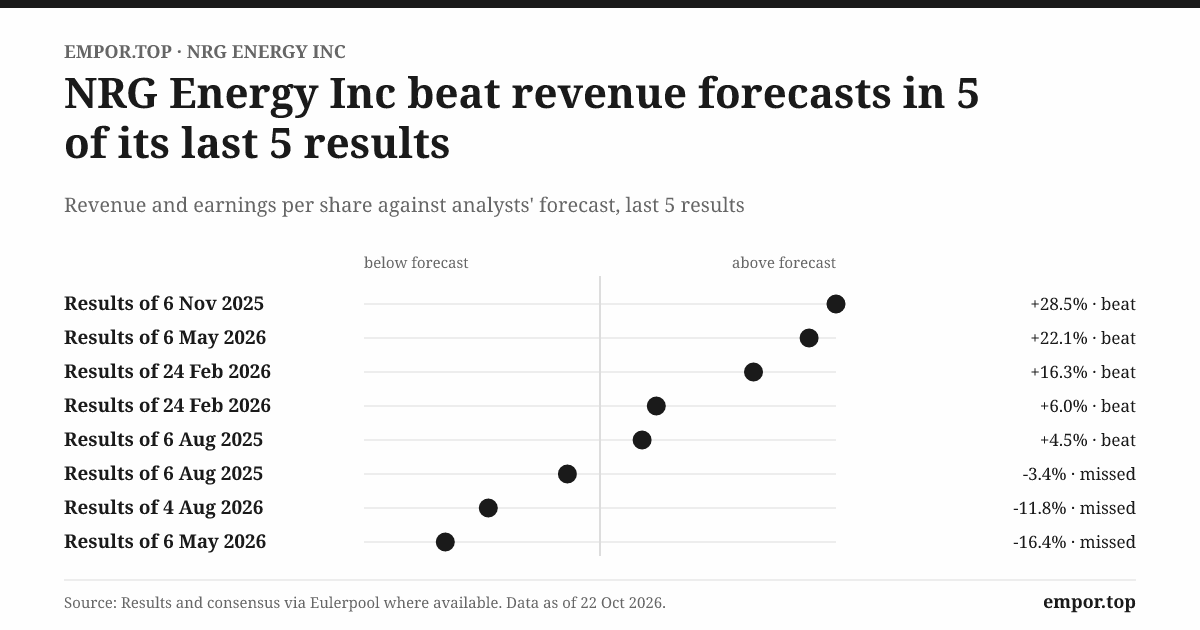
The guidance trail since the deal is short but instructive. On the first-quarter call in May 2026, management reported adjusted EBITDA of about $1.08 billion and blamed a weaker-than-expected quarter on mild weather in Texas, lower retail load and higher supply costs in the East, along with the absence of insurance proceeds from a prior-year plant outage, while higher interest and depreciation from the LS Power acquisition cut adjusted net income.5[^35] It reaffirmed 2026 guidance anyway, including adjusted EBITDA of roughly $5.3 billion to $5.8 billion and free cash flow before growth investments of roughly $2.8 billion to $3.3 billion.5 In August, with a much stronger second quarter, it reaffirmed guidance again.4 Explaining a miss by weather is legitimate in a weather-driven business. The test is whether, as integration proceeds, management's prepared remarks and answers to analysts become more specific: a clean bridge from pre-deal to post-deal earnings, a clear schedule for reaching the leverage target, and named milestones for the data-center project.
A few governance signals complete the picture. NRG's auditor gave an unqualified opinion on the 2025 accounts, but flagged revenue as a critical audit matter, because NRG's revenue spans many markets, systems and types of transactions.3 That is an audit-complexity signal, not a red flag, but it reinforces the point that NRG's reported revenue requires judgment to assemble. The 2025 annual report also records continuing Vivint compliance exposure under the FTC settlement and other material litigation whose outcomes management says it cannot always estimate.3 None of this is unusual for a company of NRG's size and complexity. All of it is reason to judge the new CEO by numbers, not narrative.
So Gaudette brings operating continuity and deep knowledge of the commercial engine that the new strategy depends on. What he cannot bring is a clean slate. NRG's history of strategy reversals and its most recent, highly leveraged acquisition leave credibility to be earned through transparent leverage reporting, cash flow and project delivery. And the market, in October 2026, is pricing that credibility in an unusual way.
IX. Analysis & Bear vs. Bull Case
On October 22, 2026, NRG trades at about 24.8 times trailing earnings, more than twice its five-year median of about 11.4 times. At the same moment its shares sit nearly half below their 52-week high.[^6] Both facts are true, and together they describe a market that has already changed its mind once about NRG this year and has not settled on what the company is. Is NRG priced as a volatile power company, or as a durable growth platform that has yet to prove its cash returns?
The answer depends on which earnings you use, so begin there. On trailing reported numbers, NRG looks expensive: about 14 times EV/EBITDA, a free-cash-flow yield of about 1.7% and a dividend yield of about 1.9%. Those figures use the latest twelve months of reported results, which include less than half a year of LS Power ownership, the mild first quarter, and the noise of hedge accounting. On management's guidance, NRG looks very different. Enterprise value of about $44 billion against the midpoint of 2026 adjusted EBITDA guidance, roughly $5.6 billion, works out to about 8 times. Market value of about $21 billion against the midpoint of free cash flow before growth guidance, about $3 billion, implies a cash yield of roughly 14%.5 Those are the multiples of a value stock, not a growth stock.
The gap between the two views is enormous, and it is the core of the debate. The bull says the trailing figures are an artifact of timing and the guided figures describe the company that actually exists. The bear points to three problems with that reading. First, adjusted EBITDA excludes real costs, and free cash flow before growth excludes the capital NRG is spending on new plants, which is precisely the strategy investors are being asked to fund. Second, NRG's own history shows reported operating cash flow converting only part of EBITDA into cash, about 58% in 2025 and negative in 2023, because collateral and working capital move violently.3 Third, the difference between enterprise value and market value implies more than $23 billion of debt and other claims, which against the guided EBITDA midpoint is well above the below-3 times target, even allowing that NRG's own leverage definition excludes some of those items. The market's falling share price suggests investors are giving the guidance less credit than management would like.
The bull case, built only from demonstrated assets, is real. NRG now owns about 25 gigawatts of generation, much of it dispatchable gas capacity in Texas and the Northeast, bought at what management says is about half of replacement cost in a market where new turbines are scarce.41 It holds a leading position in Texas residential retail, with roughly 37% of residential load.9 Vivint contributes material adjusted EBITDA that is less weather-sensitive than the energy business.4 It has delivered its first new-build plant on time and has two more on schedule.4 And it has a credible route to sell power to data centers through contracts that could make new plants less dependent on merchant prices. If demand for firm power keeps rising faster than new supply can be built, every gigawatt NRG owns becomes more valuable, and the company's retail book gives it a place to sell that power when large customers are not buying.
The bear case runs through specific mechanisms, not general gloom. Milder weather and lower retail load squeeze retail margins, as the first quarter of 2026 showed.5 Merchant prices can fall and plants can break down at the worst moment, as Winter Storm Uri showed.10 Texas customers can switch providers, which limits how far NRG can raise retail prices after a bad season, and Vistra has proved it can match NRG's scale.9 Higher debt and refinancing costs absorb cash that would otherwise go to shareholders, and NRG has already spent most of its cash buffer. Vivint's compliance burden could damage sales or reputation, and its litigation has already cost real money.3 And the AI demand story could arrive more slowly, more politically contested or on worse terms than the market assumed when it bid the shares to $184.
Test "AI power demand" against the actual commercial path, because the market often prices it as a single event. It is at least six. A hyperscaler aligns on principal terms. The grid operator studies the load. The parties sign a final contract. NRG builds the plant. The plant is energized and the data center starts drawing power. And then, over many years, the contract produces cash returns above NRG's cost of capital. As of tonight, NRG has passed the first milestone and part of the second.426 The other four lie between now and the end of the decade.
Earnings quality deserves its own reckoning. NRG's operating margin was about 6% in 2025, and its trailing twelve-month net profit was about $849 million, while operating cash and free cash flow remain sensitive to collateral and working capital.32 Over the long run, cash flow has been far stronger than reported profit, which is reassuring about the underlying business. Over any single year, it has been unpredictable, which is not. A valuation that capitalizes guided cash at a steady multiple assumes a consistency that NRG's own history has not delivered.
Valuation against peers is descriptive, not a verdict. NRG's 24.8 times trailing earnings is close to Vistra's roughly 23.9 times and below Constellation's roughly 25.9 times on the same date. The three companies differ in fleet mix, leverage and how much acquired earnings sit in their trailing numbers. Constellation's nuclear fleet commands a premium for carbon-free baseload power.25 Vistra's mix and retail book are closest to NRG's.24 That NRG trades near both suggests the market is pricing it as a member of the same power-demand trade, rather than as the leveraged, retail-heavy, home-services-carrying hybrid it actually is.
Hamilton Helmer's seven powers framework sharpens what NRG does and does not have. Scale economies are the clearest: a large retail book and fleet spread fixed costs of hedging, customer acquisition and operations across more units. Cornered resource is a partial claim at best; dispatchable plants in Texas and the Northeast are scarce today because new ones take years to build, but that scarcity erodes as competitors build. Switching costs are weak in retail electricity, where customers can change suppliers easily, and somewhat stronger at Vivint, where installed equipment and multi-year contracts make switching harder. Branding exists, through Reliant and others, but NRG does not disclose evidence that its brands earn higher prices than rivals. Network economies, counter-positioning and process power are not meaningful here. That is a moat built mainly on scale, plus a temporary scarcity premium on firm capacity. It is respectable, contestable and dependent on cycle.
What would change the call? Five pieces of evidence matter most: post-acquisition net debt to EBITDA on a comparable basis; operating cash flow after integration; the share of gross margin that is recurring or contracted versus merchant; returns on the new-build projects against the cost of capital; and retention and bad-debt trends in the retail book. Three of those deserve to be the key indicators for any investor following the company. The first is leverage: NRG targeted below 3 times net debt to adjusted EBITDA and was guiding to about 2.9 times before the deal; the post-deal reading has not yet been reported on a comparable full-year basis.[^27]1 The second is cash conversion: operating cash flow fell from about $2.3 billion in 2024 to about $1.9 billion in 2025, or from roughly 73% to 58% of EBITDA, before the acquisition.3 The third is contracted capacity reaching construction and operation, which today stands at one completed Texas Energy Fund plant, two under way and one data-center term sheet.4
Those indicators matter because NRG's history keeps teaching the same few lessons, and every new chapter tests whether the company has learned them.
X. Playbook: Strategic Lessons & Business Model Analysis
Put two moments side by side. In 2015, NRG's stock collapsed as investors refused to fund David Crane's vision of a distributed, clean-energy future. In 2026, NRG asked investors to fund a different vision: gas plants built for data centers, paid for by the world's richest technology companies. Two visions of the future, a decade apart, each asking shareholders to underwrite a different version of NRG. The company's long history offers four lessons about how to judge the second request.
The first lesson comes from NRG's bankruptcy and the impairments of 2015: a megawatt is only an asset when it can earn through the cycle. In both episodes, plants remained in operation but failed to earn enough to carry the debt used to buy them.612 For founders and investors, the wider lesson is that physical capacity is not the same as economic value. A power plant, a data center or a factory is worth what it earns in a bad year, not what it cost to build in a good one.
The second lesson comes from Direct Energy, Vivint and the Texas retail market: customers create optionality; retention and margin prove it. NRG bought millions of customers, and each purchase came with a story about cross-selling and lifetime value. Some of that has come true. Direct Energy is core to NRG, and Vivint contributes real earnings. But NRG still does not disclose the retention, customer acquisition cost and recurring-margin numbers that would prove its customer base is more than large. In Texas, Vistra has matched NRG's scale. A customer count is an opportunity. It becomes a moat only when the company can show that customers stay longer and pay more than they would elsewhere.
The third lesson belongs to LS Power: a bargain against replacement cost can still be expensive against cash. NRG's purchase price looked moderate against replacement cost and projected EBITDA, but neither comparison proves the plants will earn a return above the cost of the debt and shares that paid for them.1 The buyback from the seller at $164 now looks poorly timed.22[^6] The price of an asset is set by what it earns, not by what it would cost someone else to copy it.
The fourth lesson ties Crane to the current strategy: a strategic pivot is a promise; the next filing is the proof. Crane's renewable ambitions were coherent and, in some ways, prescient, but they ended in an asset sale that unwound the strategy for about $1.35 billion.13 Petra Nova was a technical first that became a write-down when oil prices fell.15 Today's bring-your-own-power project is, likewise, a strategy announced before it is a contract. The difference this time is that the strategy starts with a named type of customer, an existing fleet and a completed new plant. That is a better starting point than Crane had. It is still a starting point.
Michael Porter's five forces help explain why these lessons keep recurring. Rivalry is intense and visible in ERCOT retail shares and in customers' ability to switch suppliers. Buyer power is limited for the millions of fragmented households, which have little individual leverage, but it is very high for large data-center buyers, which can negotiate bespoke terms and play generators against each other. Barriers to entry in new generation are substantial, because building a plant requires capital, permits, turbines and interconnection, which is exactly why existing dispatchable plants command a premium today. Supplier power comes chiefly from natural gas markets and pipelines, which shape fuel costs, and from market operators and regulators, which shape the rules for capacity, interconnection and pricing. The threat of substitutes is real over the long run: batteries, demand response, rooftop solar and on-site generation can all reduce the need for grid power at the margin. The result is an industry where scale and assets help, but no player fully controls its economics.
That leaves the company-specific lesson that NRG has taught three times over: integration, leverage and project execution matter as much as demand growth. In 2002, demand for power did not disappear; NRG's financing did. In 2015, the energy transition did not stop; NRG's ability to fund it did. In 2026, demand for firm power is real; the question is whether NRG can integrate what it bought, deleverage as promised and build what it has proposed before the cycle turns.
XI. Epilogue: The Numbers That Decide the Next Chapter
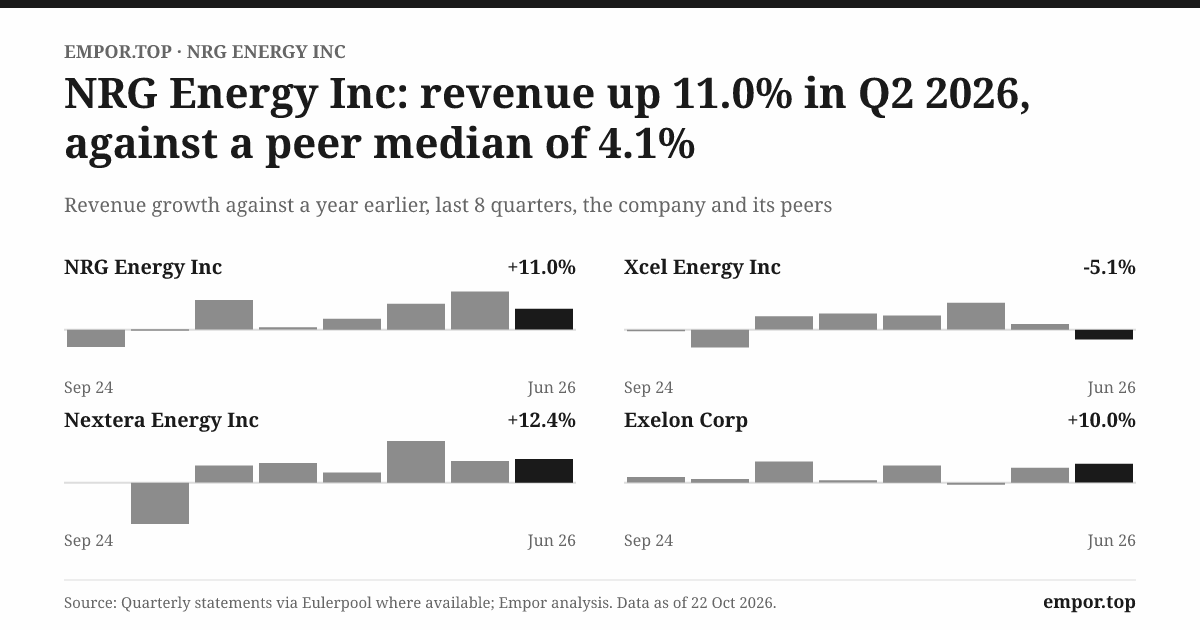
Tonight NRG stands between two quarters. The second quarter of 2026, reported in August, gave investors their first clean look at the enlarged company: revenue of about $7.5 billion, up about 11% from a year earlier, and net profit of about $506 million, after a weak first quarter.4 The third quarter, which NRG will report in the coming weeks, will be the next test. It will cover the hottest months of the Texas summer, when the generation fleet and the retail book are both under maximum stress, and it will be the first quarter with a full summer of the LS Power plants.
Several moments over the next year will decide the story. The first is the earnings bridge. Investors need a comparable reconciliation from pre-deal to post-deal earnings, one that shows how much EBITDA the LS Power plants and CPower actually contributed, and how much of that disappeared into higher interest, depreciation, integration costs and the dilution of new shares. If the bridge shows the acquired plants earning enough to justify the 7.5 times multiple NRG paid, the bull case gains its most important proof. If it shows the gains absorbed by financing costs, the bear case gains its sharpest weapon.
The second is the leverage path. NRG promised to reach below 3 times net debt to adjusted EBITDA within 24 to 36 months of closing, while continuing to return capital to shareholders.1 The question is whether it reaches the target before returning to the old buyback pace, or whether repurchases continue to compete with debt reduction, as they did when NRG bought stock from LS Power in March. Rating agencies will be the independent judges. An upgrade would say the plan is working; a negative outlook would say the opposite, regardless of what management says on the call.
The third is the data-center contract. The 1.2-gigawatt project now has to move from conditional study to signed contract, regulatory approvals, construction and finally delivered power in late 2029.2326 Each step can slip. A signed contract with clear risk allocation would turn the AI story into a real asset. A delay, a renegotiation or a political intervention in Texas would show how much of the share price had been built on hope.
The fourth is disclosure itself. NRG still does not report retention, customer acquisition cost, bad-debt trends by business or recurring margin in a consistent way. If it begins to, investors will finally be able to test the customer-moat claim that has underpinned every acquisition since Direct Energy. If it does not, the claim will remain what it has been: plausible, unproven and repeated.
Against the story's central questions, the scorecard tonight is incomplete. The current earnings base is not comparable with the long growth record, because acquisitions did much of the growing. The acquisition-led expansion has not yet been shown to produce cash without stretching the balance sheet. The customer and contract advantages are real in scale and unproven in durability. And the valuation, high on trailing numbers and low on guided ones, depends on which set of numbers the next four quarters vindicate. The story turns on cash returns, not added megawatts or customer counts.
XII. Outro: The Grid Is the Company's Mirror
Go back to that kitchen table in Houston. The customer picks a plan, clicks a button and expects the lights to stay on. Behind the price on the screen sits a chain the customer never sees: a gas plant on the coast, a hedge struck months earlier, a trader watching the weather, a credit line ready for a collateral call, and somewhere on the horizon, a proposed data center that may one day draw as much power as a city.
NRG is not a regulated utility, guaranteed a return in exchange for an obligation to serve. It is not a pure generator, selling into the market and hoping prices hold. It is the attempt to make the customer and the power plant work as one business, through about 8 million energy and smart-home customers and about 25 gigawatts of generation.34 Every reinvention, from the debt-fueled empire of 2002 to the green dream of 2015, the customer platform of 2021 and the dispatchable bet of 2026, has been a test of whether the cash can keep those two halves together. NRG sells a simple promise, power when you need it, through a business whose economics are anything but simple. The grid is its mirror: when the system is tight and the balance sheet is loose, it shines; when both tighten at once, the company has found out, more than once, exactly what it is.
References
-
NRG Energy to Acquire Premier Power Portfolio from LS Power — NRG Energy and LS Power (SEC), 2025-05-12 ↩↩↩↩↩↩↩↩↩↩↩↩↩↩
-
2025 Form 10-K — NRG Energy (SEC), 2026-02-24 ↩↩↩↩↩↩↩↩↩↩↩↩↩↩↩↩↩↩↩↩↩↩↩↩↩↩↩↩↩↩↩↩↩↩
-
NRG Energy Reports Second Quarter 2026 Results and Reaffirms 2026 Financial Guidance — NRG Energy (SEC), 2026-08-04 ↩↩↩↩↩↩↩↩↩↩↩↩↩↩↩↩
-
NRG Energy Reports First Quarter 2026 Results — NRG Energy (SEC), 2026-05-06 ↩↩↩↩↩↩
-
NRG Energy to Acquire Reliant Energy's Texas Retail Business — Renewable Energy World, 2009-03 ↩
-
ERCOT Retail Electricity Market Shares — Energy Choice Matters, accessed 2026-10-22 ↩↩↩↩↩
-
NRG Completes Sale of Renewables Platform to GIP — Utility Dive, 2018-08-31 ↩↩↩
-
Petra Nova Is Closed: What It Means for Carbon Capture — E&E News, 2020 ↩↩
-
NRG Completes Acquisition of Vivint Smart Home — NRG Energy (SEC), 2023-03-10 ↩↩
-
NRG Completes Acquisition of Direct Energy — NRG Energy, 2021-01-05 ↩
-
NRG to Acquire Vivint Smart Home — NRG Energy (SEC), 2022-12-06 ↩↩↩
-
NRG Energy, Elliott Recommendations and Stock Underperformance — Utility Dive, 2023 ↩↩↩↩
-
Vivint to Pay $20 Million for Misused Credit Reports — SDM Magazine, 2021 ↩
-
Capital Power Announces Strategic Acquisition of Two U.S. Gas Generation Facilities — Capital Power, 2023-12-11 ↩
-
NRG Energy Announces Pricing of Secondary Offering and Concurrent Share Repurchase — NRG Energy (SEC), 2026-03 ↩↩↩↩
-
NRG Nears 1.2-GW Hyperscaler Deal Amid Texas Data Center Pause — Utility Dive, 2026-08 ↩↩↩↩↩
-
Constellation Energy 2025 Annual Report — Constellation Energy (SEC), 2026 ↩↩
-
NRG's 1.2 GW Texas Generation Project Advances Through ERCOT Batch Zero Process — BIC Magazine, 2026-09 ↩↩↩↩
-
NRG Close to Completing 415-MW Gas Plant Backed by Texas Energy Fund — Utility Dive, 2026-05 ↩↩↩
-
NRG Energy Announces Leadership Succession Plan — NRG Energy (Business Wire), 2026-01-07 ↩↩↩↩
 LinkedIn
 WhatsApp
 Reddit
 Hacker News
 Email
 Kindle
 RSS Feed
 Spotify
 Apple Podcasts
 Amazon Music
 Audible
 YouTube