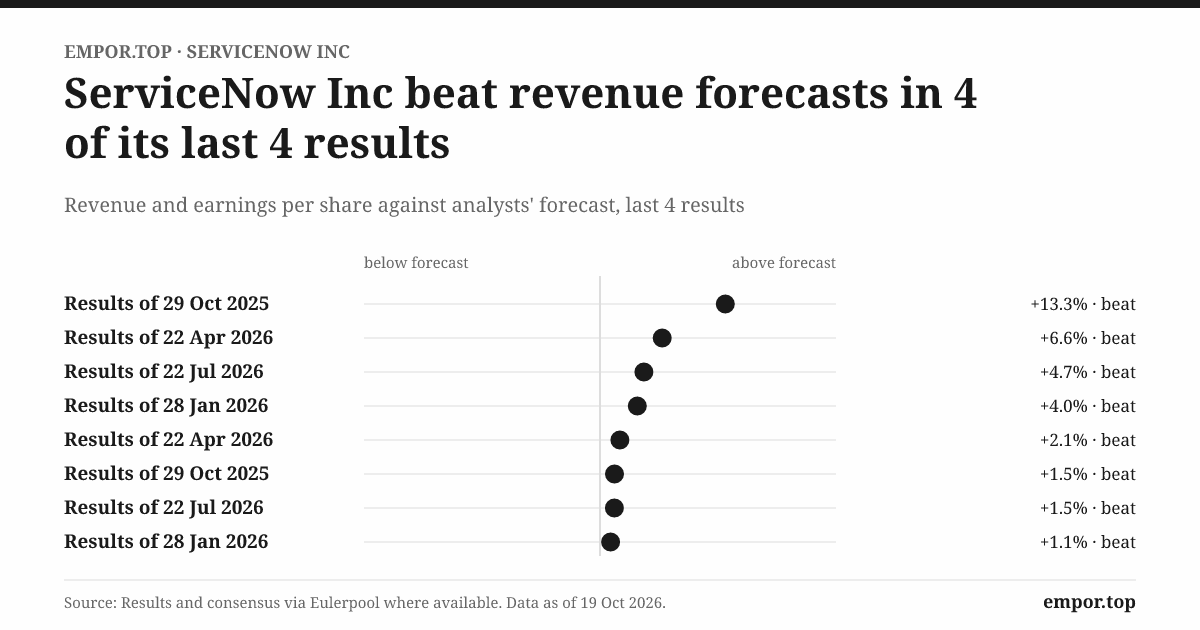
ServiceNow: The Workflow Platform Takes on AI
I. The Ticket That Became a Platform
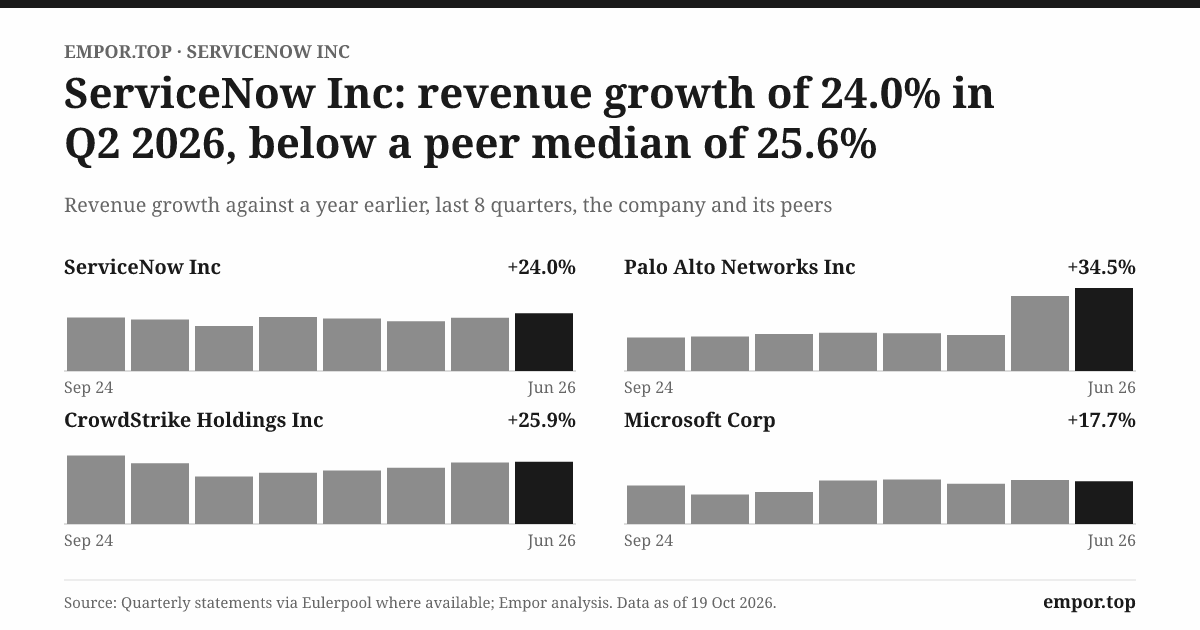
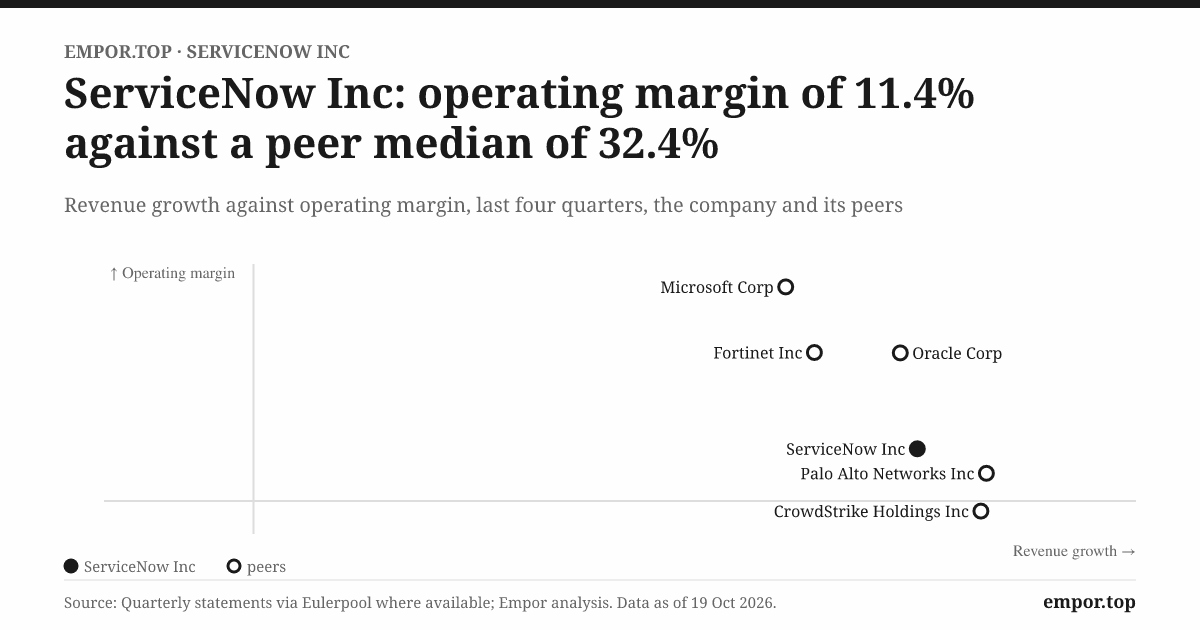
On July 22, 2026, ServiceNow's management reported two numbers that pointed in different directions. The first was the one they had been building toward for three years: the company's AI products had passed $1 billion in annual contract value, the yearly value of the contracts customers had signed for them.12 Software that writes summaries, routes requests and answers employee questions had stopped being a demo and become a line of business. The second number was in the income statement. In the June quarter, ServiceNow's GAAP operating margin was 4.1%. A year earlier it had been 11.1%.13
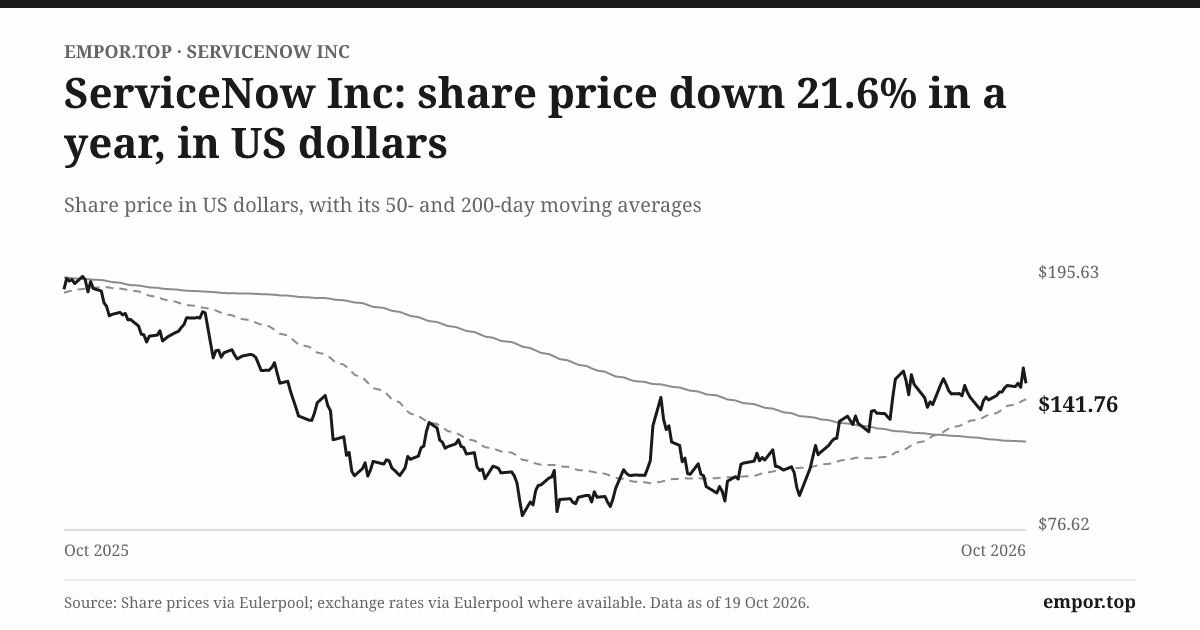
That pairing is the story. A company famous for steady, compounding, subscription growth had just reported revenue up 24% from a year earlier, its fastest pace in well over a year, and had kept almost none of the extra revenue as operating profit.1 Over the last four reported quarters, ServiceNow booked about $14.7 billion of revenue.3 Customers had signed about $29 billion of contracted business that had not yet been delivered or recognised.3 On October 19, 2026, the stock market valued the whole thing at about $148 billion, roughly a quarter below where the shares had traded at their 52-week high.4
So the question this story has to answer is not whether ServiceNow is a good business. Twelve years of filings answer that. The question is whether it can keep growing from a platform that large enterprises treat as essential plumbing, while two things change underneath it at once. The first is AI, which could make each customer more valuable or could quietly shrink the number of human users ServiceNow charges for. The second is money. In the space of about five months, from December 2025 to April 2026, ServiceNow closed three acquisitions worth roughly $11 billion and took its funded debt from about $1.5 billion to about $7.5 billion.53 A company that had mostly grown by building had started growing by buying.
There is a useful simplicity to the setup. ServiceNow is a standalone, NYSE-listed Delaware company with no parent, no controlling shareholder and a single reported operating segment.5 There is no group structure to untangle and no family holding company taking fees off the top. Every dollar of revenue, every share issued to employees and every dollar of new debt belongs to the same entity that public shareholders own. That makes the trade-offs unusually visible.
The route to this moment runs through four chief executives. It starts with an engineer named Fred Luddy who wanted to fix the IT help desk, passes through a hard-charging operator named Frank Slootman who turned the product into a public company, and arrives at Bill McDermott, a salesman's salesman who has spent seven years telling customers that ServiceNow is not an IT tool but "the AI platform for business transformation." Each of them inherited a bigger version of the same bet: that a system for routing one kind of work could become the system for routing all of it.
The test now is narrower and harder than the one any of them faced before. Demand looks strong. Renewal rates sit near the ceiling. But growth is no longer the whole story, because the latest growth arrived with a lower margin, a larger debt load and a set of acquired businesses that have to earn their price. Whether AI and cybersecurity deepen the platform's economics enough to justify that spending is the question the rest of this story tests. To see why the platform was worth extending in the first place, it helps to go back to the problem it was built to solve: a broken laptop and nobody who could say when it would be fixed.
 Subscribe on LinkedIn
II. The Help Desk Was the Wedge
Every large company has the same small tragedy playing out thousands of times a day. Someone's laptop dies, or a password expires, or a new hire arrives and has no access to anything. They email the IT department, or call, or walk over. The request lands in an inbox, or a spreadsheet, or the memory of whoever picked up the phone. Nobody can see where it is. Nobody can say who owns it. The person waiting has no idea whether it will take an hour or a week.
In the early 2000s, the software that was supposed to fix this was itself part of the problem. IT service management tools were sold as on-premise packages, installed on the customer's own servers, customised by consultants and upgraded in painful multi-month projects. Fred Luddy knew that world from the inside. He had spent years as an engineer and executive in enterprise software, most notably as chief technology officer of Peregrine Systems, a service management vendor that collapsed into an accounting scandal and bankruptcy in the early 2000s.6 He had seen what large companies would pay for the problem to be solved, and how badly the incumbents solved it.
In 2004 he started again, this time with a company first called Glidesoft, which was later renamed Service-now.com.6 The decision that mattered was where the software would live. Instead of installing it on customers' servers, Luddy's team would host it and sell access as a subscription over the internet. The customer would get a service desk on day one, and upgrades would arrive from the vendor rather than from a consulting project. At the time this was a contrarian bet for software sold to big, cautious IT departments, who were the people least comfortable letting their own systems run on someone else's computers.
The product, in human terms, was a ticket. A request came in, the system gave it a number, assigned it to someone, set a deadline and tracked it until it was closed. It sounds trivial. The value was everything around it: the forms that captured the right information, the rules that routed a printer problem to one team and a security question to another, the approvals, the escalations when a deadline slipped, and the reports that let an IT director see where work piled up. ServiceNow did not invent the idea of a help-desk ticket. It made the ticket configurable by the customer without writing much code.
That configurability turned out to be the seed of everything that followed. Luddy built the product on a common data model and a set of tools for defining forms, rules and workflows, so customers could reshape the application rather than wait for the vendor to.6 And some of the earliest customers did something the founder had hoped for but could not have forced. Having learned to route IT requests, they started using the same tools to route other things: facilities requests, HR questions, internal approvals. By the time ServiceNow filed to go public, the company was describing itself not as a help-desk vendor but as a provider of cloud-based services to automate enterprise IT operations, built on a platform that customers extended themselves.6
The familiar version of this story says ServiceNow was destined for platform dominance from its first line of code. The record supports something more modest and more interesting. IT service management was a narrow, unglamorous entry point into large enterprises, sold to a buyer, the CIO, who had both a budget and a pain. The platform was the reason customers could expand once inside. The later scale came through adoption, one workflow at a time, not through early dominance across every department. In FY2014, two years after the IPO, ServiceNow's revenue was about $682 million.5 In FY2025 it was about $13.3 billion.5 Almost all of the distance between those two numbers was covered by selling more to the kinds of customers who first bought the ticket.
Before any of that, though, there was a more basic problem. A product that delighted a few hundred mid-sized customers had to survive the demands of the largest, most complicated organisations in the world: their security reviews, their procurement departments, their global rollouts and their insistence that someone senior would answer the phone at 2 a.m. Engineers had built the product. Somebody would have to build the company.
III. The Ticket Queue Becomes an Enterprise Business
When Frank Slootman arrived as chief executive in May 2011, ServiceNow was a successful product with a small company wrapped around it. Revenue was on the order of $100 million a year.6 Slootman was not a founder or an engineer. He was a Dutch-born operator who had just sold Data Domain, a storage company, to EMC, and he had a reputation for blunt talk, intolerance of slack, and a near-religious belief that a company's culture is set by what its leaders refuse to tolerate. Luddy stayed on as chairman and product conscience. Slootman's job was to turn the product into a machine.
That machine required things that engineers do not naturally build. Large enterprises do not buy software from a website. They buy through long sales cycles with procurement teams, security questionnaires and legal negotiations. They need implementation partners to configure the product, training for administrators, and support that can handle a global company going live in thirty countries. Each of those is a cost that arrives before the revenue does, which is the central financial puzzle of every enterprise subscription company: the customer pays a little each year for years, but the company pays most of the cost of winning that customer up front.
The prospectus ServiceNow filed for its June 2012 IPO is a snapshot of that puzzle as investors first saw it. The offering raised about $210 million for the company, and the shares began trading on the New York Stock Exchange under the ticker NOW.6 The document showed a business growing quickly, losing money on a GAAP basis, and dependent on subscriptions that customers committed to for multiple years and paid for annually in advance.6 That last detail was the one that mattered most. A customer who signs a three-year contract and pays the first year up front is, in effect, lending the vendor money at zero interest. It meant ServiceNow could fund much of its expansion from its customers' prepayments rather than from shareholders.
There is a popular story about this period, retold in Slootman's own later writing and in countless podcasts, that ServiceNow was close to failing when he arrived: an engineering culture with no sales discipline, a product that crashed under load, a company that had to be rescued. The prospectus and the financial record tell a less theatrical version. The company was growing fast, its customers were renewing, and its problem was scale rather than survival.6 What Slootman clearly did was professionalise the go-to-market operation, hire a seasoned executive team and push the company toward a much larger addressable market. The "near-failure" version makes a better anecdote than the filings support, and it is safest to treat it as founder-era mythology layered on top of a genuine growth inflection.
The inflection itself is not in dispute. Under Slootman, revenue grew from roughly $100 million around his arrival to about $1.4 billion in FY2016.56 That is a company growing roughly fourteen-fold in about five years, in the hardest segment of software to sell into. The cost of that speed showed up in the income statement. In FY2016, ServiceNow's GAAP operating loss was about $423 million, its worst year on that measure, partly because of a large legal settlement and heavy stock compensation.5 But cash told a different story: across the mid-2010s, operating cash flow was positive every year, because customers kept paying in advance.5 The gap between losing money on paper and generating cash in practice is a theme that will return when this story follows the cash.
Slootman left in early 2017 and later went on to run Snowflake. His legacy at ServiceNow was not a product. It was proof that a cloud platform for IT could be sold, implemented and supported at the scale of the Global 2000. And by then the company had run into the limit of its first market. IT service management was a large category, but it was one budget in one department. If ServiceNow was going to keep compounding at the rates investors had come to expect, it would have to persuade customers that the same platform could run work far outside IT. That was a much harder sale, and it is where the moat argument begins.
IV. One Platform, More Departments
Picture a global bank that bought ServiceNow a decade ago to run its IT help desk. Over the years, the bank's IT team configured the platform deeply: thousands of request types, integrations with its directory of employees, its asset inventory, its monitoring tools and its approval chains. Then the HR team noticed that onboarding a new hire looked a lot like an IT ticket with extra steps. Someone had to approve the hire, create accounts, ship a laptop, book a desk, schedule training. The data about who the employee was, what equipment they had and who their manager was already lived in ServiceNow. So HR built its onboarding workflows there too. Then the security team wanted a way to track vulnerabilities and incidents through to resolution. Then customer service asked whether the same routing engine could handle client complaints.
That sequence, repeated across thousands of companies, is the ServiceNow platform strategy. It is worth slowing down to understand why it works, because almost everything about the investment case depends on it.
How the money is made
ServiceNow sells subscriptions. A customer signs a contract, commonly three to five years long, that is non-cancellable without cause and typically billed annually in advance.5 The contract specifies which products the customer can use, at which tier, and for how many users or units of capacity. Subscription revenue made up about 97% of total revenue in FY2025; the remaining 3% came from professional services, the work of helping customers implement and configure the product.5 That tiny services share matters. It means ServiceNow mostly leaves the labour-intensive implementation work to partners such as Accenture and Deloitte, and keeps the high-margin software for itself.
The products are organised into four families. Technology workflows, which include the original IT service management plus IT operations and security operations, remain the largest base. Customer and Industry workflows handle customer service and industry-specific processes. Employee workflows cover HR and workplace services. Creator workflows give customers tools to build their own applications on the platform.5 The company reports a single operating segment, so there is no separately disclosed profit for any of these families, and ServiceNow does not publish a clean module-by-module revenue split that would let an outsider see exactly how much each one contributes.5 Investors have to infer the shape of expansion from management commentary, deal disclosures and the overall growth rate.
The pricing unit is concrete. A customer pays for its subscriptions, which are largely a function of how many people use the product ("fulfiller" seats for the IT agents who resolve tickets, for example) and which capabilities it buys. Customers move up through Standard, Professional and Enterprise tiers, and newer AI capabilities are sold either as higher-tier "Pro Plus" style packages or as add-ons and consumption packs.52 Hold on to the seat detail. It is the part of the model AI could most disrupt.
Why customers stay
Switching costs are the core of the moat, and they are of a specific kind. When a company configures ServiceNow for years, it is not just storing data there. It is encoding how the company works: who approves what, which team handles which request, what happens when a deadline slips, which systems are notified when an employee leaves. The platform's shared data model, the configuration management database that records the company's IT assets and how they relate to each other, becomes the source of truth that other systems depend on. Ripping that out is less like changing software vendors and more like rewiring a building while people are working in it.
The behavioural evidence supports the theory. ServiceNow's gross renewal rate, the share of expiring contract value that customers renew, has held at about 98% to 99%.53 For context, a subscription business that keeps 90% of its customers is generally considered healthy; keeping essentially everyone is rare. Remaining performance obligations, the contracted value not yet recognised as revenue, reached about $29 billion at the end of June 2026, roughly twice the trailing year's revenue.3 That backlog is non-cancellable, which means the next two years of revenue are already substantially spoken for.
But a careful reader should notice what these numbers do and do not prove. A 98% renewal rate shows that customers rarely leave. It does not show that ServiceNow can raise prices at will, and it does not show that customers expand into new workflows rather than simply renewing the old ones. High retention can coexist with tough renewal negotiations, discounting and slower expansion. The durability is proven. Pricing power, beyond the specific AI uplifts discussed later, is plausible but not demonstrated by renewal rates alone.
The rivals in each lane
ServiceNow does not compete with one company. It competes with a different set in each lane. In IT service management, its home market, the main rivals are Atlassian, whose Jira Service Management grew up from developer tools and appeals to cost-conscious and technically minded teams, and BMC, the long-time incumbent whose Remedy product ServiceNow displaced at many large accounts. In the broader IT operations management market, which covers monitoring, automation and infrastructure management, ServiceNow sits alongside Microsoft, IBM and Broadcom. Gartner's market-share work on IT operations management software tracks these vendors category by category, and ServiceNow is among the largest players there, though the category is fragmented and no single vendor dominates it the way ServiceNow dominates enterprise ITSM.7 In customer service workflows, Salesforce is the giant and specialists abound. In employee workflows, SAP and Workday own the core HR systems of record that ServiceNow's HR products sit on top of.
The comparisons need care. ServiceNow's FY2025 revenue of about $13.3 billion was larger than Atlassian's entire company revenue, but Atlassian sells collaboration and developer tools that have nothing to do with service management, and ServiceNow sells far more than ITSM. Comparing total company revenues is not the same as comparing market share. The honest version is this: ServiceNow holds a leading position in enterprise IT service management, a strong but contested position in IT operations, and a challenger's position in customer service and HR, where it often wins by selling into companies that already run its platform rather than by beating Salesforce or Workday on their home turf.
Who holds the power
No single enterprise customer accounts for 10% of revenue, so no buyer can dictate terms to the company as a whole.5 There is one concentration worth naming, though. Carahsoft, a federal reseller and systems integrator, accounted for about 11% of FY2025 revenue.5 That is not one customer; it is a channel through which many U.S. government agencies buy. It becomes important later, when the federal story gets complicated.
On the supply side, ServiceNow historically ran its platform in its own data centres housed in colocation facilities, but it increasingly also relies on Amazon Web Services and Microsoft Azure, with more than $1.5 billion of non-cancellable cloud commitments outstanding at June 2026.3 That is a meaningful dependency, and it has a particular sting: Microsoft is both a supplier of computing capacity and one of ServiceNow's most capable competitors.
The counterpressure on the moat is real. ServiceNow is expensive to buy and expensive to implement. Mid-sized companies and engineering-led organisations can choose Atlassian or Freshworks at a fraction of the cost. Microsoft can bundle adequate-enough workflow tools into licences customers already pay for. Salesforce and SAP sell broad suites into the same executive offices. None of this has dented the renewal rate, but it can slow the rate at which customers adopt new workflows or accept higher prices. The question for investors is not whether the moat exists. It is whether it is widening. The evidence that would show that is sustained subscription growth well above the renewal baseline, growth in the number of customers paying more than $5 million a year, and product-level adoption outside IT. The evidence that it is narrowing would be slower expansion, more discounting at renewal, and AI capabilities from rivals that let customers do ServiceNow-style automation without ServiceNow.
The company that would have to answer that question by the end of the 2010s had a new kind of leader, one who would turn "platform" from a product architecture into the entire company's identity.
V. McDermott Makes "Platform" the Company Strategy
John Donahoe's tenure was the bridge. He arrived from eBay in February 2017, pushed the platform deliberately into HR and customer service, and grew revenue to about $3.5 billion by FY2019.5 Then, in October 2019, he left to run Nike, and the board made a hire that surprised many people: Bill McDermott, who had just stepped down as chief executive of SAP.
McDermott's biography reads like a sales manual. He grew up in a working-class family on Long Island, bought a delicatessen as a teenager and ran it to pay for school, and then spent seventeen years at Xerox before joining SAP, where he rose to run the company. He is relentlessly optimistic in public, fond of big numbers and bigger metaphors, and unapologetic about the idea that a chief executive's job is to sell. He is also a survivor in a literal sense: in 2015 he lost an eye in an accident, and returned to work wearing dark glasses that became a trademark. At ServiceNow he became chairman as well as CEO, consolidating the two roles.8
He took over in November 2019 as annual revenue was approaching $3.5 billion.5 By FY2025 it was about $13.3 billion, almost four times larger in six years.5 Whatever one thinks of the rhetoric, that is an exceptional record for a company of this size, and it is the record against which every claim about his current strategy should be measured.
The bill for growth
What makes the McDermott era distinctive is how much the company kept spending while it grew. Research and development consumed about $3.0 billion in FY2025, about 22% of revenue, a ratio that has barely fallen in three years even as revenue nearly doubled.5 Headcount rose to 29,187 by the end of 2025, split almost evenly between the United States and the rest of the world.5 Capital spending on data centres and servers ran well above $800 million a year.5 And the company kept building its partner ecosystem, which does most of the implementation work, and its global sales force.
The operating choice was to stay profitable while spending heavily, rather than maximise margin. GAAP operating margin rose from about 1% in FY2019 to about 14% in FY2025.5 That is a meaningful improvement and a sign of operating leverage: each new dollar of subscription revenue cost less to deliver than the last. But a 14% GAAP margin is modest for a software company with 97% recurring revenue, and the difference between that figure and the much higher margins management highlights on a non-GAAP basis is mostly stock-based compensation, which this story will come back to.
"One platform" as an argument
McDermott's central message to customers, analysts and employees has been consistent: ServiceNow is one platform, with one data model and one architecture, rather than a collection of acquired products stitched together. The point of the message is both technical and commercial. Technically, it means a workflow built for IT can reuse the same data and rules as one built for HR. Commercially, it means every ServiceNow salesperson can sell the next workflow to a customer who already trusts the first one.
The claim deserves both credit and scrutiny. The credit is that ServiceNow has, for the most part, built rather than bought its major products, and the shared architecture is real. The scrutiny is that the recent acquisitions, Moveworks, Veza and Armis, each come with their own code, data and customer bases. "One platform" will be harder to say with a straight face if those products remain separate in practice. And management's market-size language, which on calls has included descriptions of ServiceNow as the "AI control tower" for the enterprise, is a statement of ambition, not evidence of adoption.2
On recent calls, the evidence worth seeking has been specific: how management splits growth between organic and acquired; whether subscription guidance is raised because of new products or because of currency and acquisitions; and how much of the reported growth is in constant currency. About 29% of revenue is denominated in foreign currencies, mainly the euro, pound, yen and Australian dollar.5 ServiceNow hedges forecast foreign revenue with forward contracts out to about 34 months, which smooths but does not remove the effect, and in FY2025 its hedges actually reduced reported subscription revenue by about $42 million.5 A weaker dollar flatters reported growth; a stronger one dents it. Investors comparing quarters need the constant-currency figure, and management does provide it.1
The question that carries into the next chapter is whether growth is still broadening, through more customers buying more workflows, or whether it is becoming dependent on larger deals, acquisitions and more assertive guidance. For most of McDermott's tenure the answer was clearly the first. Then, at the end of 2025, the company began to write much larger cheques.
VI. The New Acquisition Bill
For most of its life, ServiceNow bought small. It acquired companies for their engineers and their technology, folded the code into the platform and rarely spent more than a few hundred million dollars on any one deal. The largest acquisitions before 2025 were rounding errors next to its cash flow. Then, between December 2025 and April 2026, ServiceNow closed three deals that, together, cost roughly $11 billion.53 In five months it committed close to two years of operating cash flow to a concentrated set of bets.
It is worth taking them one at a time, because they do very different jobs.
Three deals, three roles
Moveworks came first. It was an AI assistant and enterprise search company whose product let employees ask, in plain language, for help with IT or HR problems and have the request resolved or routed automatically. ServiceNow announced the deal in March 2025 at a headline value of about $2.85 billion, its largest acquisition to that point.9 The strategic logic was that Moveworks would become the front door: the conversational layer where employees start, sitting on top of the ServiceNow workflows that actually do the work. The deal closed in December 2025.10
Veza, acquired in March 2026 for about $1.2 billion in cash, was an identity security company.3 Its software maps who and what has access to which data and systems inside an enterprise: people, service accounts, and increasingly AI agents. If ServiceNow wants to be the place where automated agents take actions inside a company, it needs to know what those agents are allowed to touch.
Armis was the big one. ServiceNow announced it in December 2025 at a price of $7.75 billion and closed it on April 20, 2026.11123 Armis provides visibility into the devices connected to an enterprise network: laptops and servers, but also factory machines, building systems and medical devices, the "operational technology" that traditional IT tools often cannot see. ServiceNow's pitch was that Armis would close the gap between knowing what assets exist and managing the risk they carry, feeding its security and IT operations workflows with a far richer map of the attack surface.1112
All three are adjacent to what ServiceNow already does. None is a wild diversification. That is the bull case on strategy. The harder question is price.
What the prices say
Armis had disclosed more than $340 million of annual recurring revenue when the deal was announced.11 Paying $7.75 billion for that means paying more than 22 times ARR. That is a demanding price by any standard, but it should not be compared mechanically with the revenue multiples of public cybersecurity companies, whose growth rates, margins and contract terms differ. The plain reading is this: ServiceNow paid for growth and strategic position, not for current revenue. For the deal to work, Armis has to keep growing quickly and ServiceNow has to sell it to its own enormous installed base at a pace Armis could never have reached alone.
Moveworks offers a rarer view inside a negotiation, because ServiceNow had to file a registration statement for the shares it issued. That filing traces the bargaining from an initial ServiceNow proposal of about $2.65 billion to a higher proposed price and then to final terms.13 Moveworks' last private valuation, in a 2021 funding round, had been about $2.1 billion.9 The company grew in the years between, so the premium is not purely a measure of overpayment. But it does show ServiceNow raising its bid to win a competitive asset at a time of intense investor appetite for AI companies. And a detail in the accounting matters: when the deal closed, ServiceNow's purchase accounting valued it at about $2.4 billion, made up of roughly $905 million in cash and about $1.5 billion in stock, below the announced $2.85 billion headline, largely because ServiceNow's own share price had fallen between announcement and closing.5 Moveworks shareholders who took stock bore some of that decline.
Paying for it
The financing marks the real break with the past. Moveworks was mostly paid with cash on hand and stock. Veza and Armis, about $8.8 billion in cash between them, required borrowing.3 In April 2026, ServiceNow set up a $3 billion commercial paper programme, a way of borrowing short-term from money-market investors, and drew a $4 billion term loan. In May it refinanced the term loan by selling $4 billion of fixed-rate bonds across five maturities from 2029 to 2036.3 By the end of June, funded debt had reached about $7.5 billion, including about $2.1 billion of commercial paper, up from about $1.5 billion at the end of 2025.35 Cash and marketable securities fell from about $10 billion to about $6.7 billion over the same six months.53
In absolute terms, this is not a dangerous balance sheet. Operating cash flow was more than $5 billion in FY2025, and the rating agencies kept ServiceNow firmly in the single-A range, with S&P arguing that cash generation would let the company bring leverage back down within one to two years.5 But the money now has more claims on it. The same cash flow has to fund buybacks, debt service, data-centre investment and, possibly, future acquisitions. Commercial paper has to be rolled over continuously. A company whose financial profile was "net cash, no worries" has become "modest net debt, plenty of capacity," which is a different, if still comfortable, place.
Did the promise change?
There is one sentence from recent history that every investor should hold next to these deals. On the Q4 2025 call in January 2026, by which point Moveworks had closed and Armis had been announced, management told analysts that ServiceNow's medium-term growth and margin targets could be met without M&A.14 The framing was that the acquisitions were accelerants, not supports.
That framing is testable. If the deals are accelerants, the next year should show organic subscription growth holding near its recent pace, acquired products adding to growth on top of it, and margins recovering as integration costs fade. If they have become supports, the tell will be growth that relies on acquired revenue to meet guidance, slower organic expansion and margin recovery that keeps slipping.
The June 2026 quarter is the first hard data point, and it is uncomfortable. GAAP operating profit fell to about $162 million, from about $358 million a year earlier, even as revenue grew by about $770 million.3 The 10-Q and the call point to where the money went. Amortisation of acquired intangibles, the accounting charge that spreads the cost of the technology and customer relationships ServiceNow bought, rose sharply with Armis on the books. Cost of subscription revenue jumped by roughly two-thirds from a year earlier, driven by cloud infrastructure, third-party compute for AI workloads and technical headcount, pulling subscription gross margin down into the low 70s from around 80%.32 Acquisition-related and integration costs, plus Armis's own operating expenses, added to the bill. Goodwill and intangible assets, which were about $4.9 billion at the end of 2024, reached about $13.6 billion by June 2026.3
Some of that is pure accounting: amortisation does not cost cash. Some of it is timing: integration expenses should fade. But the rise in the cost of delivering subscriptions is neither accounting nor one-off. It reflects the real cost of running AI and a bigger infrastructure footprint. That is the bridge to the most important question in the story: whether the AI ServiceNow is selling is worth what it costs to deliver, and whether it is adding to the business or slowly eating its foundations.
VII. The Agent That Might Sell More—or Need Fewer Seats
On the Q2 2026 call, management delivered the line they had been building toward for three years. ServiceNow's AI products, marketed under the Now Assist name, had passed $1 billion in annual contract value.2 Customers who moved to the new AI-native product packages, management said, were paying price uplifts of roughly 20% to 30% over their previous tiers.2 The company reiterated a target of $1.5 billion in AI ACV for 2026.2 And subscription revenue had grown about 24.5% from a year earlier, an acceleration rather than the steady deceleration a company of this size would normally show.1
For a company whose AI products barely existed as commercial SKUs in 2023, that is a remarkable sequence. It is also the most important claim in the investment case, so it deserves the most careful handling.
What Now Assist actually is
Think of a ServiceNow agent's day before AI. A ticket arrives saying "VPN not working." The agent reads it, checks the employee's device in the system, searches the knowledge base for similar cases, writes a reply, and closes it. Now Assist does pieces of that automatically. It summarises long tickets, drafts replies, suggests fixes based on past cases, lets employees ask questions in plain language, and increasingly lets AI "agents" take the steps themselves: resetting a password, provisioning access, rerouting a request. The newest versions are designed to act across workflows, not just within one.
ServiceNow sells this three ways. Customers can buy higher product tiers with AI included, they can buy add-ons to existing products, and they can buy consumption packs, essentially prepaid bundles of AI "assists" used up as the system does work.52 That mixture is deliberate. It lets the company charge a premium where the AI is clearly valuable while experimenting with usage-based pricing that does not depend on the number of human seats.
What the evidence proves
It helps to separate three kinds of evidence. Customer stories and deployment counts show that people are using the product. They do not prove recurring revenue. ACV shows that customers have signed contracts that include AI, which is genuine commercial traction. Margin data shows whether those contracts are profitable. ServiceNow has shown the first two. The third is unproven, and the June quarter's gross margin compression is a warning that AI is expensive to run.
The sequence of calls is telling. On the Q4 2024 call, management was already describing Now Assist as its fastest-growing new product family and setting expectations for AI to become a major contributor.15 On the Q4 2025 call, it set the $1.5 billion AI ACV target for 2026.14 On the Q1 2026 call, it described progress toward that goal and new AI-native packaging.[^7] By Q2 it reported the $1 billion milestone.2 The narrative has been consistent, and the reported numbers have kept pace with it. That is to management's credit. But both the growth rate of AI ACV and the 20% to 30% uplift were statements made on the call rather than audited disclosures, and the company has not disclosed how much of the $1 billion is genuinely new spending versus customers moving existing spend onto AI-inclusive tiers, nor how much is usage-based versus seat-based.
Analysts on the Q2 call pressed precisely on those gaps. They asked how much incremental spend customers were committing beyond their existing contracts, whether AI was lengthening sales cycles as customers ran pilots, and why ServiceNow, rather than Microsoft, Salesforce or the model providers themselves, had the right to be the "control tower" that orchestrates AI agents across the enterprise.2 Management's answers leaned on the platform argument: ServiceNow already holds the workflows, the data model and the permissions, so its agents can act where others can only talk.2 That is a coherent argument. It is also the same argument management makes about everything, and the specific numbers that would settle the incrementality question were not provided.
The seat question
Here is the uncomfortable mathematics. ServiceNow's core revenue has historically scaled with people: the IT agents, HR caseworkers and customer service representatives who use its software every day. If AI agents resolve half the tickets that humans used to handle, a customer might eventually need far fewer human agents. If it needs fewer human agents, it needs fewer seats.
There are two ways this can play out. In the optimistic version, ServiceNow captures the value of the automation directly: it charges more per remaining seat, sells consumption-based AI on top, and expands into workflows that were never automated before, so total contract value rises even as human headcount falls. The 20% to 30% uplift is early evidence for that version. In the pessimistic version, customers use AI to shrink their service desks, push back on seat counts at renewal, and treat AI as a feature that should come included rather than a premium. The revenue per customer then stalls even as the work done on the platform grows.
The record does not yet decide between them, because seat compression, if it comes, will show up slowly, at renewals spread over three to five years. What can be said is that ServiceNow is pricing for the first version and building its packaging to hedge against the second, which is the right instinct. The KPIs that will tell the difference are AI ACV growth relative to total subscription growth, the share of AI revenue sold on consumption rather than seats, subscription gross margin, and whether customers expand their spending after pilots rather than renewing flat.
It is worth keeping agentic AI in proportion. Now Assist is already a material commercial product, which makes it a plausible growth vector rather than a science project. But autonomous agents doing real work across enterprises at scale remain more ambition than revenue, and the history of enterprise software is full of technical breakthroughs that took a decade to show up in the income statement. A billion dollars of ACV is a real start. It is about 7% of trailing revenue.
While analysts were debating how AI might change the commercial model, a quieter risk sat in the footnotes: one that had nothing to do with technology and everything to do with how the U.S. government buys software.
VIII. The Government Channel, the Receivables, and the Investigation
In March 2023, ServiceNow hired the former Chief Information Officer of the U.S. Army to run its global public sector business. It looked like a coup: someone who understood federal technology procurement from the inside, joining a vendor that wanted more of it. Sixteen months later, on July 24, 2024, ServiceNow announced that CJ Desai, its president and chief operating officer and one of the most senior executives in the company, had resigned. The public sector head left too.16
The explanation came in the filings. An internal investigation, conducted with outside counsel after an internal complaint about compliance on a government contract, found that Desai and the former Army CIO had violated company policy on conflicts of interest in the hiring.516 ServiceNow notified the Department of Justice, the Department of Defense Office of Inspector General and the Army's suspension and debarment office. The DOJ opened its own investigation and requested documents. ServiceNow says it is cooperating, and that it cannot predict the timing or outcome.53 Amit Zavery, recruited from Google Cloud, later took over as chief operating officer and chief product officer.8
It is important not to overstate this. The investigation concerned hiring policy and conflicts of interest, not revenue recognition or financial reporting. No penalty has been disclosed or accrued. No contract debarment has been announced. The filings do not quantify any procurement consequence.53 As of October 2026, it remains unresolved.
Why the channel matters
The reason this deserves attention is the channel through which ServiceNow sells to the government. Carahsoft, a federal reseller, accounted for about 11% of ServiceNow's FY2025 revenue, about $1.5 billion, and about 11% of its gross receivables at year-end.5 Carahsoft is not the end customer. It is the distributor through which many agencies buy software, which is common in federal procurement because it simplifies contracting. So the concentration is in a channel, not a buyer, and no commercial customer accounts for 10% of revenue.
Carahsoft itself has faced federal scrutiny; its offices were searched by federal agents in September 2024 in an inquiry that has not been tied publicly to the ServiceNow hiring matter.5 If government procurement rules or enforcement actions disrupted that channel, ServiceNow could reroute sales through other resellers, but it would cost time and relationships. The direct financial exposure is to a federal market that remains a significant customer base, and to the reputational risk of any adverse finding.
The receivables themselves look clean. ServiceNow bills mostly in advance on standard terms of 30 to 60 days, so it carries almost no unbilled revenue, and the allowance for credit losses and actual write-offs were immaterial in each year from FY2023 through FY2025.5 The company reports no historical collection concerns with Carahsoft. Debtor days, the number of days of revenue sitting in receivables, improved from 88 in FY2019 to 72 in FY2025.5 Customers are paying faster, not slower.
Trust, measured
The Desai episode was a governance event, and the best way to judge its significance is to look at how shareholders and auditors have treated management over time. Shareholders sent a clear signal before the investigation: at the June 2023 annual meeting, they rejected the advisory vote on 2022 executive pay, with about 59% voting against.17 That is unusual for a company performing as well as ServiceNow was, and it reflected discomfort with the size and structure of equity awards. Support recovered to about 88% in 2024 and 2025 and was about 85.5% in May 2026, after the board reshaped some pay practices.18 The recovery is real. The dip in the most recent vote, as McDermott's reported pay rose sharply, is worth watching.
The auditor's signals are reassuring. PricewaterhouseCoopers issued an unqualified opinion on the FY2025 financial statements and internal controls, with no material weaknesses.5 It identified one critical audit matter, subscription revenue recognition, because testing contract terms across an enormous volume of transactions takes significant auditor effort.5 That is a sign of audit complexity, not a qualification, and it is common for large subscription companies.
The verdict here is narrow. The Carahsoft concentration is material and the DOJ inquiry is a genuine overhang whose cost cannot yet be measured. But nothing in the receivables, the audit or the revenue trend suggests that federal exposure is currently damaging the business. It is a tail risk, not a present wound. A more immediate question for shareholders is hidden in plain sight in the cash flow statement: how much of all that cash actually belongs to them.
IX. When Cash Is Not the Same as Earnings
Here is the puzzle. Across the twelve years from FY2014 to FY2025, ServiceNow reported a cumulative net profit of about $5.2 billion. Over the same twelve years, it generated about $23.1 billion of cash from operations, roughly four and a half times as much.5 After subtracting capital spending, free cash flow totalled about $18.2 billion.5 How does a company produce nearly four dollars of cash for every dollar of profit, and is the cash or the profit the truer picture?
The engine
The first answer is the prepayment. Because customers pay annually in advance for multi-year contracts, ServiceNow collects cash before it recognises revenue. At the end of FY2025, deferred revenue, cash collected for service not yet delivered, stood at about $8.4 billion.5 As long as the business grows, that balance grows too, and each year's increase shows up as extra operating cash. ServiceNow runs with structurally negative working capital: its customers fund its operations rather than the other way around. That is a genuine economic advantage, and it is one reason the company never needed to raise much equity after its IPO.
The second answer is less flattering. Stock-based compensation is a real cost to shareholders, because it dilutes their ownership, but it is not a cash cost, so it is added back when calculating operating cash flow. In FY2025, ServiceNow's stock-based compensation was about $2.0 billion, larger than its entire net income of about $1.7 billion.5 Over the twelve-year period, stock compensation totalled more than $10.5 billion.5 Add depreciation and the amortisation of deferred sales commissions, which also reduce profit without consuming cash in the period, and the gap between earnings and cash is largely explained.
A tax year to discount
There is one distortion investors should strip out. FY2023 net income of about $1.7 billion was inflated by an $857 million non-cash tax benefit, the result of releasing a valuation allowance against deferred tax assets once the company became consistently profitable.5 It is why net profit appears to fall in FY2024. The underlying earnings trend is smoother and steadier than the headline numbers suggest: profitable, rising, but not lurching.
Where the cash went
Of the $18.2 billion of free cash flow, none went to dividends; ServiceNow has never paid one.5 Cash and short-term investments rose by only about $5.6 billion over the period.5 The rest went into acquisitions, investments, longer-dated securities and, increasingly, share repurchases. The board authorised its first repurchase programme in May 2023 and has since raised cumulative authorisations to $9.5 billion.5 ServiceNow bought back about $1.8 billion of stock in FY2025, and in January 2026 it entered a $2 billion accelerated repurchase that retired about 18.5 million shares at an average of about $108 each, after the 5-for-1 split of December 2025.319
That last price is worth pausing on. In October 2026 the shares traded around $142, so the accelerated buyback looks well-timed in hindsight. But the bigger question is what buybacks are for. In FY2025, buybacks and the cash spent withholding employee taxes on vesting stock together consumed about $2.6 billion, roughly half of operating cash flow.5 Yet the diluted share count still rose by about 1.4% over 2025.5 In other words, for most of their history, repurchases have offset stock compensation rather than shrunk the share count. Only the large ASR in early 2026 produced a clear net reduction in shares outstanding.3
The plain conclusion is this. ServiceNow's cash conversion is a real strength, rooted in a business model where customers pay first. But it does not make stock compensation free. A meaningful slice of the "free" cash flow is effectively recycled to buy back the shares handed to employees, and that slice is now competing with debt service and acquisition spending for the same dollars. Investors who value ServiceNow on free cash flow should subtract stock compensation, or at least the cash spent neutralising it, before calling the remainder theirs.
Who gets paid
The leadership incentives fit the pattern. McDermott's reported compensation was about $51.6 million in 2025, up from about $37.6 million in 2024, and the great majority of it came as stock awards.8 His beneficial ownership was below 0.3% of the company, most of it in options.8 Institutions own roughly 88% to 90%, with BlackRock and Vanguard each holding close to 9%.8 This is a professionally managed company owned by index funds and asset managers, with no founder or controlling holder who would naturally push back on dilution. The pay vote is the main check, and it has been used once.
Related-party dealings are minor: a $365,000 engagement for a former director to serve as chancellor emeritus of ServiceNow University, and the ordinary-course employment of an executive's adult daughter.8 There are no parent-company fees, guarantees or loans, because there is no parent.
The cash machine, then, is real but more spoken-for than the headline free cash flow suggests. That matters a great deal for how the market prices the company today.
X. Analysis and Bear vs. Bull Case
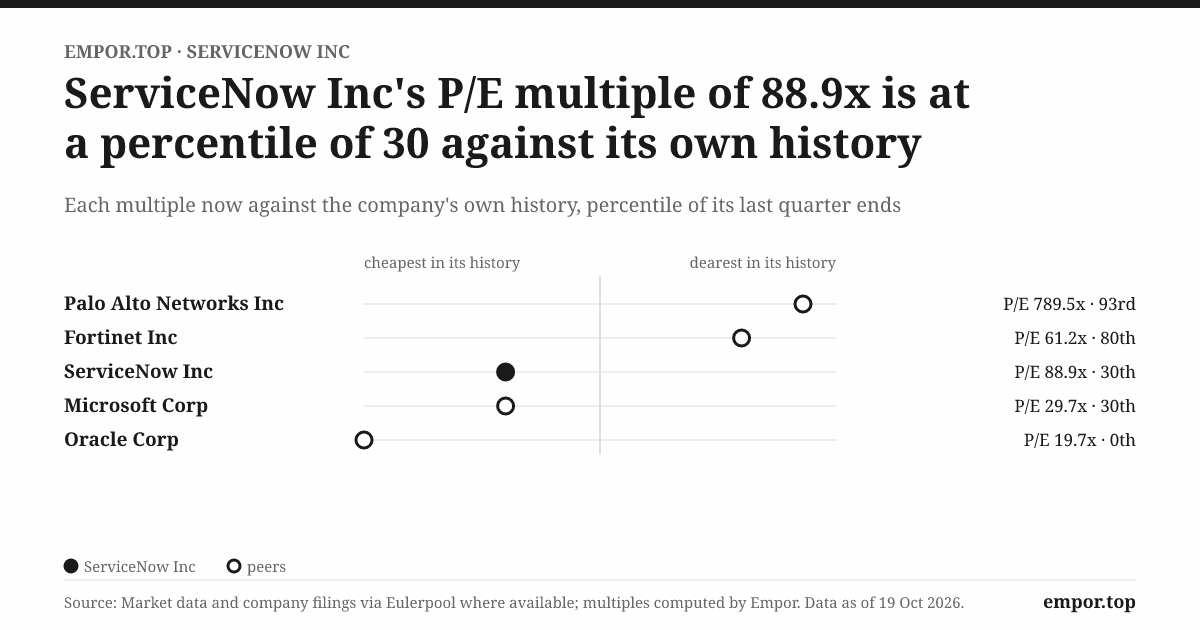
On October 19, 2026, ServiceNow's shares traded at about 89 times trailing earnings.4 Five years earlier, that would have looked cheap: the five-year median was about 135 times. It is still, by any absolute standard, an expensive stock. The enterprise value was about 10.5 times trailing sales, and the free cash flow yield was about 3.1%.45 The market is paying for growth that will have to persist for many years. The question is whether the business can deliver it while carrying a heavier balance sheet and absorbing the cost of AI.
The industry, force by force
Start with buyers. ServiceNow's customers are large enterprises and government agencies with sophisticated procurement departments, and they negotiate hard at renewal. But no single customer is large enough to set terms, and switching costs mean their leverage is mostly about price, not about leaving. The 98% to 99% renewal rate is the scoreboard here: buyers bargain, but they stay.
Suppliers are more interesting than in most software companies. ServiceNow depends on hyperscale cloud providers, chip-hungry AI compute and colocation capacity. Microsoft, in particular, is both a supplier and a rival. As AI workloads grow, the cost of compute becomes a larger share of the cost of delivering subscriptions, and the June quarter's gross margin decline showed how quickly that can move.
Substitutes come in two forms. Below ServiceNow are cheaper specialist tools such as Atlassian's service management products and Freshworks, which win price-sensitive and mid-sized buyers. Above it are broad suites from Microsoft, Salesforce and SAP that can offer "good enough" workflow tools inside licences customers already own. And AI itself could become a substitute: if general-purpose AI agents can act across enterprise systems directly, some of the workflow layer ServiceNow owns could be bypassed.
New entrants face a high barrier in enterprise ITSM, where a decade of configuration and integration protects the incumbent, but a much lower one in AI agents, where well-funded start-ups and the model providers themselves are moving fast. Rivalry is strong across every adjacent workflow and moderate in the core.
The powers
Hamilton Helmer's framework helps clarify which of ServiceNow's advantages are durable. The strongest is switching costs: the embedded data model, integrations and encoded processes that make leaving costly and risky. The renewal rate and the $29 billion backlog are the evidence. Next is a form of scale economy: ServiceNow's R&D spending of about $3 billion a year is spread across a far larger revenue base than most rivals in its lanes, which lets it fund AI development, data centres and security certifications that smaller vendors cannot match. There is a modest counter-positioning element in its AI pricing: a company built on seats experimenting with consumption pricing is doing something incumbents with similar models find hard to do. There are weaker network effects, through the partner ecosystem and the pool of administrators and developers trained on the platform. There is a degree of brand in the CIO's office, where "nobody gets fired for buying ServiceNow" has become something close to true. What ServiceNow does not have is a cornered resource: its technology can be imitated, and its AI models are largely built on foundation models others can access.
The overall verdict: the moat is strongest where it began, in IT service management and adjacent IT operations, and it is credible but contested in HR, customer service and security, where ServiceNow wins mostly by extending its incumbency rather than by beating category leaders on their own ground.
The bull case
The bull case is straightforward and grounded in evidence. Customers almost never leave. Contracted backlog is about twice annual revenue and growing. Subscription revenue grew about 24.5% in the June quarter, faster than a year before, at a scale where most software companies are decelerating.1 AI has crossed $1 billion in contract value and, by management's account, commands meaningful price uplifts.2 The acquisitions add identity security, asset visibility and a conversational front door that fit naturally into existing workflows. Rating agencies, which have no stake in the equity story, kept ServiceNow firmly in single-A territory after the deals.5 And management has a long record of delivering growth through FY2025. On this reading, the 4.1% margin is a temporary dip caused by acquisition accounting and AI investment, and the multiple has already compressed enough to absorb it.
The bear case
The bear case is not that the business is weak. It is that expectations remain high while the economics are getting harder to read. Seat-based pricing faces structural pressure if automation shrinks service desks. Cheaper tools and broad suites cap price increases outside the core. Subscription gross margin fell sharply as AI and cloud costs rose, and nobody yet knows where it settles. The acquisitions were expensive, especially Armis at more than 22 times ARR, and their integration will absorb management attention. The federal channel carries an unresolved DOJ inquiry. Stock compensation exceeds net income, and buybacks mostly offset dilution rather than reduce share count. And debt, though manageable, means the company now has less room for error.
The activist's critique would focus on capital allocation. ServiceNow spent roughly $11 billion on acquisitions and several billion more on buybacks within about a year, while telling investors its targets did not depend on M&A.14 A sceptic would ask why, if organic growth was sufficient, the company needed to borrow to buy growth; what returns the board expects from Armis and how it will report them; and whether the rising pay of senior executives has been matched by rising returns on capital. On that last point, the data is sobering: return on invested capital fell from about 15.5% in FY2025 to about 7.3% in the twelve months to June 2026, largely because the acquisitions added capital faster than they added profit.53
Management, tested
Management's credibility rests on a long record of growth, steady guidance and a consistent narrative. That record is real and should not be dismissed. But the acquisitions are a new kind of test. Before 2025, ServiceNow built most of what it sold. Now it is integrating three substantial acquired businesses, on a deadline, with the market watching margins. The fair standard is to measure outcomes against guidance and against disclosed integration milestones, not against management's description of the strategy.
Reading the price
The lower P/E relative to the company's own history is not the same as cheapness. A multiple that fell from a median of 135 times to 89 times largely reflects slower growth than in ServiceNow's earlier years, lower margins and a more uncertain AI future. Against peers, ServiceNow still carries a large premium: Salesforce traded in the mid-20s times earnings and Workday in the high 30s, while Microsoft, growing more slowly but with far higher margins, traded around the low 30s.5 The market is still pricing ServiceNow as the fastest-growing large-cap enterprise software company, which it is. What the price appears to assume is that growth stays near 20% for years and margins recover once acquisition costs settle.
The June quarter's margin needs careful handling. The decline reflects a mix of acquired-intangible amortisation, acquisition and integration costs, Armis's operating expenses and genuinely higher costs to deliver subscriptions as AI and cloud usage grow.32 The first two should fade; the third is the one that matters for the long run.
Three KPIs will tell the story. The first is subscription revenue growth, latest reading about 24.5% and accelerating, ideally broken out between organic and acquired.1 The second is GAAP operating margin, latest reading 4.1% and sharply down, whose recovery will show whether the acquisitions and AI investment are earning their keep.1 The third is AI ACV, latest reading above $1 billion and rising toward a $1.5 billion target, which will show whether AI is a growing profit pool or a cost centre with a good story.2 Behind all three sit net debt and diluted share count, the two numbers that show whether the cash still belongs to shareholders.
XI. Playbook: Business & Investing Lessons
The first lesson starts with that dead laptop and the email that went nowhere. Fred Luddy did not set out to build an enterprise platform. He set out to fix the most universally hated workflow in corporate life: asking IT for help. The wedge was humble, which is exactly why it worked. Every company had the problem, every CIO had a budget for it, and nobody else was solving it well. Start with the work nobody wants to route by hand. For founders, the lesson is that a platform is rarely sold as a platform. It is sold as a fix for one specific, recurring frustration, and the platform emerges when customers trust that fix enough to ask for more.
The second lesson is about that bank whose HR team noticed onboarding looked like an IT ticket. ServiceNow did not expand into HR, customer service and security because it announced a strategy. It expanded because customers who already trusted the platform found it easier to build there than anywhere else, and because the data those workflows needed was already sitting in its database. A platform earns its next workflow; it cannot buy it. The investor's version: watch whether expansion is pulled by customers or pushed by sales. Pull compounds. Push gets discounted at renewal.
The third lesson sits in the twelve-year gap between $5 billion of profit and $23 billion of operating cash. Prepaid subscriptions gave ServiceNow an extraordinary funding engine: customers paid first, and the company grew on their money. But a large share of the apparent cash surplus came from paying employees in stock, and the company now spends billions buying that stock back. Cash flow paid in shares is not free money; it is a bill sent to a different address. For investors, the discipline is simple: before admiring a company's free cash flow, find out how much of it is spent undoing dilution.
The fourth lesson is the one still being written. In five months, ServiceNow bought an AI front door, an identity map and a view of every connected device in the enterprise, and took on billions of dollars of debt to do it. Every one of those deals makes strategic sense. That was never the question. A strategic fit still has a price, and the price is the strategy. The lesson for managers who have built a great organic business is that buying adjacent capabilities can accelerate a platform, but only if the acquired products show up in measurable cross-sell, adoption and returns. Otherwise "one platform" quietly becomes a holding company with a good brand.
XII. Epilogue
Tonight, ServiceNow stands in a strange place for a company with its record. Customers almost never leave. Backlog is near $29 billion. Revenue growth accelerated in the most recent quarter. AI products have crossed a billion dollars of contract value. And yet the stock sits about a quarter below its high, the latest operating margin is the thinnest in years, and funded debt is five times what it was a year ago. The business has rarely been stronger commercially, and its economics have rarely been harder to read.
The next chapters will be written on specific days. The first is the third-quarter results, expected in the coming weeks, the first full quarter with Armis consolidated from start to finish. That report will show whether the June margin was a trough or a new baseline. If amortisation and integration costs explain most of the dip and the core cost of delivering subscriptions stabilises, the bull case gains ground. If subscription gross margin keeps falling as AI usage grows, the question shifts from "how fast can AI grow?" to "can AI be profitable?"
The next is the FY2026 annual report and the January call that comes with it, which will show the first full year of Moveworks ownership and most of a year with Veza and Armis. Investors should look for how much of subscription growth came from acquisitions and how much organically, and whether management repeats its claim that targets do not depend on M&A. If organic growth holds near 20% with acquisitions adding on top, the deals look like accelerants. If organic growth slips and acquired revenue fills the gap, they look like supports, and the cost of them looks higher.
Then come the AI numbers. The $1.5 billion AI ACV target for 2026 is a public commitment.2 Hitting it would strengthen management's credibility; missing it would raise the question of whether AI is a new profit pool or an upgrade that customers expect for free. Alongside it, the share of AI sold on consumption rather than seats will reveal whether ServiceNow is successfully decoupling its revenue from human headcount before automation forces the issue.
The balance sheet will tell its own story. How quickly ServiceNow pays down or refinances its commercial paper, whether it keeps buying back stock while carrying debt, and whether the diluted share count actually falls will show how the cash is being divided between shareholders, lenders and employees.
And somewhere in the background, the DOJ inquiry continues. A quiet resolution would remove a tail risk. A finding that touched federal contract access would test how much of ServiceNow's government business depends on a single channel.
All of these return to the same question this story opened with: can ServiceNow make its platform more valuable to each customer, through AI, security and new workflows, while keeping the economics that made it worth extending? The evidence so far says the demand is there. The evidence still to come will say whether the price of meeting it was right.
XIII. Outro
Somewhere tonight, in an office building or a hospital or an Army base, someone's laptop is broken. They open a ServiceNow portal, type a sentence, and a request begins to move. Twenty years ago that request would have been a ticket waiting in a queue for a human. Today, increasingly, an AI agent reads it, checks the device, resets the setting and closes the ticket before anyone on the IT team has seen it.
That is the strange, unfinished arc of this company. ServiceNow's defining achievement was making enterprise work visible: giving every request a number, an owner and a deadline, until $13.3 billion a year of revenue rested on the simple promise that nothing would get lost.5 Its next ambition is to make much of that work disappear, done by software without a person in the loop, with more than $1 billion of AI contract value already signed.2 The business was built to route work to people. Whether it can thrive by routing work away from them is the question ServiceNow has bet its next decade on.
References
-
ServiceNow Reports Second Quarter 2026 Financial Results — ServiceNow Investor Relations, 2026-07-22 ↩↩↩↩↩↩↩↩
-
ServiceNow Q2 2026 Earnings Call Transcript — Stock Analysis, 2026-07-22 ↩↩↩↩↩↩↩↩↩↩↩↩↩↩↩↩
-
Form 10-Q for the Quarterly Period Ended June 30, 2026 — SEC EDGAR, 2026-07-23 ↩↩↩↩↩↩↩↩↩↩↩↩↩↩↩↩↩↩↩↩↩↩↩
-
Form 10-K for the Fiscal Year Ended December 31, 2025 — SEC EDGAR, 2026-01-29 ↩↩↩↩↩↩↩↩↩↩↩↩↩↩↩↩↩↩↩↩↩↩↩↩↩↩↩↩↩↩↩↩↩↩↩↩↩↩↩↩↩↩↩↩↩↩↩↩↩↩↩↩↩↩↩
-
Market Share: IT Operations Management Software, Worldwide, 2024 — Gartner, 2025-06-17 ↩
-
2026 Definitive Proxy Statement — SEC EDGAR, 2026-04-06 ↩↩↩↩↩↩
-
ServiceNow to Buy AI Firm Moveworks for $2.9 Billion — Reuters, 2025-03-10 ↩↩
-
ServiceNow Acquires Moveworks — ServiceNow Newsroom, 2025-12-15 ↩
-
ServiceNow to Acquire Armis — ServiceNow Newsroom, 2025-12-23 ↩↩↩
-
ServiceNow Completes Armis Acquisition — ServiceNow Newsroom, 2026 ↩↩
-
Moveworks Merger Agreement and Background of the Merger — SEC EDGAR, 2025 ↩
-
ServiceNow Q4 2025 Earnings Call Transcript — The Motley Fool, 2026-01-29 ↩↩↩
-
ServiceNow Q4 2024 Earnings Call Transcript — The Motley Fool, 2025-01-29 ↩
-
ServiceNow Parts With President and Public Sector Head After Internal Probe — Nextgov/FCW, 2024-07-25 ↩↩
-
2023 Annual Meeting Voting Results, Form 8-K — SEC EDGAR, 2023-06-02 ↩
-
Form 8-K, 2026 Annual Meeting Voting Results — SEC EDGAR, 2026-05-22 ↩
-
DEF 14A Proxy Statement for Special Meeting of Stockholders (5-for-1 Stock Split) — SEC EDGAR, 2025-11-12 ↩
 LinkedIn
 WhatsApp
 Reddit
 Hacker News
 Email
 Kindle
 RSS Feed
 Spotify
 Apple Podcasts
 Amazon Music
 Audible
 YouTube