Newmont Corporation: The Gold Standard Story
I. Cold Open: The Wall Street Syndicate That Conquered the Mines
Picture downtown Manhattan in 1916. There is no headframe here, no rail line, no wet rock. There is a financier named William Boyce Thompson, known to everyone as "the Colonel", a man who made his first fortune promoting copper shares and who liked big hats, big houses and bigger bets. He set up a holding vehicle to put New York money into mining claims, and he named it after the two places he was joining together: New York and Montana.4 It was not a mine. It was a portfolio, a way to buy geology the way a banker buys bonds.
That origin explains more about the company that trades on the New York Stock Exchange today than any pit or shaft does. Newmont is now the world's largest gold miner, worth about $130 billion on October 13, 2026, with revenue of roughly $25.4 billion over the last twelve months.12 It is the only gold producer in the S&P 500. It runs eleven managed operations and holds stakes in two giant joint ventures run by its old enemy, Barrick.1 Yet the habits that built it were never the habits of a prospector. They were the habits of a capital allocator: buy distress, defend the balance sheet, merge at scale, and sell what does not fit.
Here is the puzzle the rest of this story tries to solve. Over the twelve years to 2025, Newmont reported about $15 billion of net profit but collected about $44 billion of cash from its operations, almost three times as much.1 In 2023 its operating margin was a thin 5.5%. Two years later it was almost 50%.1 Did the company suddenly learn to mine? Or did the gold price do the work?
The honest answer is that mining is a strange business to analyse because the product has no brand and no contract. Newmont has zero recurring contracted revenue; every ounce it sells is priced off the spot market on the day it clears.1 At the same time, a mine is a melting ice cube. Every tonne hauled out is a tonne that must be replaced by exploration, development or acquisition, so the company has to keep pouring billions back into the ground just to stand still. That combination, a price it cannot control and a depletion it cannot stop, is what makes gold miners so cyclical and so tempting.
Three tensions will run through this episode. The first is whether today's record profits reflect operational mastery or a windfall from metal prices. The second is whether a brand-new leadership team, led by Natascha Viljoen since January 2026, can run some of the hardest underground engineering projects in the industry.8 The third is whether roughly $6.4 billion of reclamation obligations, the cost of closing and cleaning up old mines, will quietly drain cash that shareholders think is theirs.1
The verdict this story builds toward is uncomfortable for both bulls and bears. Newmont's century-long survival really does rest on countercyclical balance-sheet defence and well-timed scale deals. But the historic earnings of 2025 and 2026 also cover up grade depletion and cost inflation that only very high gold prices make invisible. To see why, it helps to go back to the moment the Colonel's paper trust first had to become a real miner.
 Subscribe on LinkedIn
II. The Thompson Syndicate and the Empire Star Pivot
Thompson was not a geologist by temperament. He was a promoter with a nose for optionality, a Wall Street operator who had made money in Utah and Arizona copper and who later led an American Red Cross mission to revolutionary Russia. What he understood was that a mineral deposit is a call option on a commodity price, and that whoever holds the cheapest options through a crisis tends to win.4
The early Newmont behaved exactly like that. In 1917 it took a stake in a new South African venture organised by Ernest Oppenheimer: the Anglo American Corporation, which would become one of the great mining houses of the twentieth century.4 An American syndicate helping to finance the birth of a South African giant tells you how global the Colonel's ambitions were, and how little he cared about owning the shovels himself.
The company reincorporated as Newmont Corporation in 1921, and for most of that decade it remained what it had been designed to be: an investment trust holding pieces of other people's mines and oil fields.4 Plenty of such trusts existed in the Roaring Twenties. Almost none of them survived the next decade, because their assets were mostly shares in other companies, and those shares were exactly what the crash of 1929 destroyed.
Newmont took a different path. Around the time of the crash it took control of the Empire Star mine in Grass Valley, California, one of the oldest hard-rock gold operations in the American West.4 It went from owning paper to owning rock. The timing turned out to be extraordinary. In 1934 the United States revalued gold from about $20.67 an ounce to $35, a jump of roughly 70% in the price of the one product a Depression-era gold mine sold, while wages and supplies were getting cheaper. Gold mining was one of the few businesses in America whose margins widened during the Depression.
Through the 1930s Newmont used that windfall to build up a portfolio of North American gold operations, keeping its exposure to the metal unhedged and its balance sheet conservative.4 The pattern is worth noticing because it repeats. A financial crisis that killed most investment trusts turned into the moment this one became an operator, and a currency policy decision in Washington, not any geological breakthrough, delivered the profits.
That is the genetic trait the rest of the story keeps returning to: patient capital moving into distress and then taking operating control when markets collapse. It is also the first warning. Newmont's founding success was a gift from the gold price as much as from management skill. The question of how much credit belongs to the operator and how much to the metal is a century old. After the war, a geologist would try to answer it by making Newmont about much more than gold.
III. The Oil, Copper, and African Diversification Years
In 1947 the presidency passed to Fred Searls, a field geologist who had spent his career walking outcrops rather than trading shares.4 The change mattered. Under Searls, Newmont stopped acting like a bank that happened to own mines and started acting like an exploration house that happened to have a bank's balance sheet. The problem was that his geologist's eye roamed far beyond gold.
Post-war gold was dull. The price was pinned at $35 by the Bretton Woods system, so a gold mine's revenue was effectively frozen while its costs rose with every year of inflation. A rational allocator in that world would look for metals and fuels whose prices could move. Newmont did. It built controlling interests in the Tsumeb base-metals mine in what was then South West Africa, now Namibia, and in O'okiep Copper in South Africa.4 It moved into petroleum, picking up offshore acreage in the Gulf of Mexico and fields in Texas, and later looked at the North Sea.4 By the 1960s and 1970s it was closer to a natural-resources conglomerate than a gold miner.
For a while the logic looked sound. Copper fed post-war construction, oil fed the car economy, and diversification smoothed the lumps in any single commodity. But diversification also had costs that did not show up on the income statement.
The first cost was political. Tsumeb ran on the contract labour system that apartheid-era South Africa imposed on Namibia, under which black workers were recruited from the north on fixed contracts, separated from their families and paid a fraction of white wages. In 1971 and 1972 a general strike by contract workers swept the territory, and the mines were at the centre of it. For a New York-listed company, owning a profitable mine inside that system became a growing reputational and governance liability as American institutions began to debate divestment from southern Africa.
The second cost was focus. A company that runs gold mines, copper mines, oil platforms and coal operations has to allocate capital across very different risks, and it is hard for investors to value any of them properly. Conglomerates of that era routinely traded below the sum of their parts. Mixing commodities also blurred the true depletion picture of the gold business, because cash from oil and copper could quietly cover for gold mines that were running out of ore.
Newmont did make one find in this period that would define its future. In the early 1960s its geologists identified the Carlin deposit in Nevada, a field of microscopic, "invisible" gold that could only be seen under a microscope, and which opened up the Carlin Trend, still one of the richest gold districts on earth.4 That discovery would become the foundation of the Nevada business that, decades later, forced a truce with Barrick.
By the early 1980s, the conglomerate model had left Newmont with a fatal combination: valuable hard assets scattered across many industries, a share price that did not reflect them, and no controlling shareholder to protect it. In the era of the corporate raider, that is not a company. It is a target.
IV. The $33 Special Dividend and the Raiders at the Gate
September 1987. T. Boone Pickens, the Texas oilman who had made himself famous by attacking companies he considered undervalued, launched a hostile tender offer for Newmont through a vehicle called Ivanhoe Partners.4 He was not the first to circle. Through the 1980s a parade of suitors had looked at the company: Consolidated Gold Fields of Britain, the Oppenheimer-linked Minorco, the financier James Goldsmith, and the conglomerate Hanson. What attracted all of them was the same arithmetic. Newmont's gold, oil and copper assets were worth more than its stock market value, and a buyer who could break it up could pocket the difference.
Newmont's chief executive, Gordon Parker, chose a defence that would shape the company for a decade. Consolidated Gold Fields, already a large shareholder, raised its stake under a standstill arrangement that put it on Newmont's side.4 Then the board declared a special dividend of $33 a share, a cash payout of roughly $2.2 billion, most of it borrowed.4 The logic was brutal and clever. A raider buys a company for the cash its assets can produce. If the company borrows heavily and hands that cash out to its own shareholders first, there is much less left to pay for the takeover, and the shareholders who might have sold to the raider have already been paid.
It worked. Pickens's bid failed. But a defence financed by debt does not end when the raider leaves, because the bank loans remain. A company that had just borrowed well over a billion dollars to pay a single dividend needed cash quickly, and the fastest way to raise it was to sell assets. Over the following years Newmont sold or spun out its oil, gas and coal businesses and stepped away from its non-gold metals interests.4 The conglomerate that Fred Searls had built was dismantled, not because anyone had a grand strategic vision of pure-play gold, but because the debt bill had to be paid.
Then, in the late 1980s, came the symbolic break. Newmont left New York, where it had lived since the Colonel's day, and moved its headquarters to Denver, Colorado.4 The investment trust had become a Western mining house.
The consensus version of this story is that the 1987 defence was a heroic stand that saved Newmont's independence. The record supports a narrower verdict. The defence did preserve independence. It also forced the company to sell assets at the bottom of an oil cycle and loaded it with debt at a time when it could have been investing, and it handed effective influence to Consolidated Gold Fields, which itself was soon swallowed by Hanson. What saved Newmont, in the end, was that the assets it kept, chiefly Nevada gold, turned out to be the best ones.
The lesson for investors is that financial engineering can win a battle while shrinking the company that fought it. And the new pure-play gold miner that emerged from the wreckage soon faced the question every gold company eventually confronts: should it sell its future production forward, or keep all its exposure to the metal?
V. Unhedging the Book and the Pure-Play Gold Bet
Through the 1990s, the standard answer in gold mining was to hedge. Boards sold their future production forward at fixed prices, which protected the budget when gold fell and reassured the banks that financed new mines. During the long slide in gold prices that decade, hedgers looked smart. Then, after 2001, gold began to rise, and the companies that had promised their ounces at yesterday's prices found themselves delivering metal well below spot. Investors who bought gold equities precisely to own the metal's upside began to punish them.
Newmont took the opposite view. By the mid-2000s, under chief executive Wayne Murdy and with Pierre Lassonde, the Canadian royalty pioneer, as president, the company committed to being the unhedged gold miner, and in 2007 it closed out the last of its legacy hedge positions, taking a large charge to do so.4 The bet was that equity investors, pension funds and the new gold-miner exchange-traded funds wanted pure exposure to the price of gold, and would pay for a company that offered it. That bet has paid off in the most literal sense: today Newmont reports no gold price hedges, and its revenue moves directly with spot.1
Being unhedged is a strategy, but it is also a temptation. When gold rallied hard after the 2008 crisis, Newmont did what cash-rich gold companies do at the top of a cycle. It consolidated full ownership of Boddington in Western Australia in 2009, buying out AngloGold Ashanti, and created what would become one of its long-life foundation assets.4 Then, as gold headed toward its 2011 peak near $1,900 an ounce, it paid about C$2.3 billion for Fronteer Gold, a Nevada exploration company.4 Earlier it had bought Miramar Mining for the Hope Bay project in the Canadian Arctic.4
What happened next is the test of whether that era showed capital discipline. Gold fell toward roughly $1,050 by late 2015. Hope Bay was eventually sold off at a fraction of what it had cost, and the Fronteer deposits did not deliver what the purchase price implied. Under Gary Goldberg, who became chief executive in 2013, Newmont spent years writing down assets, cutting costs and selling non-core operations to repair the balance sheet.4 In 2015 net profit was only about $220 million on revenue of about $6.1 billion, and in 2016 and 2017 the company reported net losses.1
The record therefore narrows the case for Newmont's capital allocation. The unhedging decision was right, and durable. The deals done at the top of the 2011 cycle were not. The company that understood how to profit from gold price swings did not, in that period, resist the urge to pay top-cycle prices for marginal ounces. Goldberg's repair work set the stage for the defining move of the next decade, and it began, as so many Newmont moves do, with a rival's aggression.
VI. The $10 Billion Goldcorp Chess Match
In September 2018, Barrick Gold announced that it would combine with Randgold Resources, and Randgold's chief executive, Mark Bristow, a blunt South African geologist with a reputation for squeezing costs out of African mines, ran the combined company. Overnight, Newmont's claim to be the world's leading gold miner was in danger. Barrick had more ounces and an aggressive new boss who did not hide his view that the industry carried too much corporate overhead.
Gary Goldberg answered in January 2019 with an all-share offer for Goldcorp, the Vancouver-based miner, valued at about $10 billion.4 Goldcorp shareholders received 0.3280 of a Newmont share for each of theirs, a premium of roughly 17%.4 The deal brought in Peñasquito in Mexico, Cerro Negro in Argentina, Éléonore and Musselwhite in Canada and a large project pipeline, putting Newmont back on top by production.
Not everyone cheered. Some large Newmont shareholders, including the hedge fund manager John Paulson, argued publicly that Newmont was paying a premium for a company whose mines had been disappointing for years. That critique deserves attention because it was largely correct about the assets. Goldcorp had a history of cost overruns and operating problems, and its flagship mines would take years to rehabilitate.
Then Bristow made his move. In February 2019 Barrick launched an unsolicited, no-premium bid for all of Newmont, valued at about $18 billion, with a plan to strip out corporate costs and sell off parts of the company.4 It was a bold piece of theatre and a real threat: Barrick argued that the true value in both companies lay in Nevada, where their mines sat side by side.
Goldberg's response was the cleverest move of his tenure. Rather than fight Barrick on price, he rejected the merger and offered instead what Barrick actually wanted: a joint venture combining the two companies' Nevada operations. Barrick dropped its hostile bid, Newmont completed Goldcorp in April 2019, and the two companies agreed to create Nevada Gold Mines.46 Newmont's shareholders' equity roughly doubled, from about $10.5 billion in 2018 to about $21.4 billion in 2019, as the shares issued for Goldcorp landed on the balance sheet.1
Was the Goldcorp deal a success? The record gives a split verdict. It gave Newmont global scale and helped force the Nevada partnership. But the Goldcorp mines required heavy capital and repeated write-downs. In 2023 Newmont took about $1.9 billion of impairment charges, much of it on legacy assets including Peñasquito, which also suffered a lengthy strike that year.1 Many of the Canadian Goldcorp mines were eventually sold. A buyer that pays a premium and later sells a large part of what it bought has not yet proved that the premium was earned. The partnership with Barrick, however, has a much cleaner record.
VII. The Nevada Gold Mines Detente
July 1, 2019. For three decades Newmont and Barrick had been neighbours in the Nevada desert who refused to share anything. Their claims along the Carlin and Cortez trends interlocked like puzzle pieces, but each company hauled ore to its own mills and roasters, sometimes past a rival's plant that could have processed it more cheaply. On that date the two companies' Nevada operations were combined into Nevada Gold Mines LLC, operated by Barrick.6
To see why this mattered, think of two neighbouring farmers who each own half a valley and each built their own barn, silo and road. Combining them does not create any new soil, but it removes a great deal of duplication. Nevada Gold Mines works the same way. Ore can go to whichever plant suits its chemistry best, mine plans can ignore old property lines, and the duplicate overheads disappear. At launch, the partners targeted about $500 million a year of pre-tax synergies.6
The ownership is uneven. Barrick holds 61.5% and runs the operation; Newmont holds 38.5%.6 Newmont is not passive, though. It has board seats and protections over major decisions, which is what allowed two rivals to sign on at all.
The mechanics of how Newmont earns its share are worth understanding because they shape its reported numbers. Newmont proportionately consolidates its 38.5%, and it buys its share of the gold doré produced in Nevada directly from the joint venture at cost, then resells it to bullion banks. In 2025 those purchases came to about $3.4 billion, roughly 15% of Newmont's sales.1 Because Nevada Gold Mines is a separate entity with its own books, PricewaterhouseCoopers audits it, while Ernst & Young audits Newmont. The joint venture accounts for about 13% of Newmont's assets and 16% of its sales.1 The two companies also share Pueblo Viejo in the Dominican Republic, 60% Barrick and 40% Newmont.1
The quality of the joint venture's synergies is hard for an outsider to audit precisely, because neither partner publishes a clean before-and-after cost ledger. What can be said is that the structure has survived seven years and a change of chief executive at both companies, that neither partner has tried to unwind it, and that Nevada remains a core contributor. That is a meaningful track record in an industry where joint ventures often end in lawsuits.
For investors, the lesson is that Newmont found more value in cooperation than in a takeover premium. The risk is control: Newmont depends on Barrick's operating decisions for a large slice of its output, and its returns from Nevada rise or fall with someone else's execution. That lesson in partnership, however, did not stop Newmont from pursuing the biggest takeover in gold mining history four years later.
VIII. Swallowing Newcrest and the Great Tier-2 Cull
November 6, 2023. Tom Palmer, an Australian engineer who had spent years at Rio Tinto before becoming Newmont's chief executive in 2019, completed the acquisition of Newcrest Mining, Australia's largest gold company.5 The deal was valued at about A$28.8 billion, roughly $15 billion at the time, paid largely in Newmont shares. With it came Cadia in New South Wales, one of the world's largest gold and copper block caves; Lihir, an island mine in Papua New Guinea; and Red Chris and Brucejack in British Columbia.5
The price of that scale was dilution. Newmont issued about 357 million new shares, taking the diluted share count from roughly 841 million to roughly 1.15 billion.1 And it bought at a moment that looked anything but lucky. In 2023 Newmont's operating margin fell to 5.5% and it reported a net loss of about $2.5 billion, weighed down by impairments, a strike at Peñasquito and higher reclamation estimates.1 Borrowings climbed to about $9.4 billion by year end.1
Here is the part that Palmer's critics underrate. He paid in shares when gold mining equities were cheap, then sold the assets he did not want into a rising gold market. Over 2024 and 2025 Newmont sold six non-core mines: Akyem in Ghana, Telfer in Australia, Musselwhite, Porcupine and Éléonore in Canada, and Cripple Creek & Victor in Colorado, raising more than $2.8 billion in gross cash.113 Several of those were Goldcorp's old mines, so the cull was also an admission about the earlier deal. The workforce fell from about 22,200 employees to about 17,500 as those operations left.1
The balance sheet changed shape fast. Gross debt fell from about $9.4 billion to about $5.1 billion by the end of 2025, and by June 2026 Newmont held about $9.0 billion of cash against about $5.1 billion of debt, a net cash position of roughly $3.9 billion.12 Then the company turned to buybacks to undo the dilution, with repurchases rising from about $1.2 billion in 2024 to almost $3.5 billion in the first half of 2026, which took shares outstanding down to about 1.07 billion.12
The copper angle is the other half of the rationale. Cadia and Red Chris are copper-gold porphyries, huge low-grade deposits that will produce copper for decades. Copper demand from electrification and data-centre construction gives Newmont a second commodity with a different set of drivers, without abandoning gold.
But the post-deal reality check is real. Cadia ran into dust and emissions problems with New South Wales regulators, and in February 2026 a class action was filed against Cadia Holdings alleging property damage and contamination.1 Costs in Australian and Canadian dollars rose, and in 2025, with gold at record prices, Newmont still booked about $842 million of impairments.1 A company that writes down assets in a boom year has not fully finished digesting its acquisitions.
So the verdict narrows rather than collapses. Palmer used equity as countercyclical currency and pruned the portfolio with speed, and the balance sheet result is clear. Whether Newcrest created lasting value per share depends on whether Cadia and Lihir deliver costs that justify 357 million shares, and that is still unproven. To judge that, one has to understand how Newmont actually turns rock into money.
IX. Inside the Machine: Doré, Bullion Banks, and Smelter Deductions
Follow one bar of gold. It is poured at a mine in Nevada or Western Australia, not as the shining pure ingot of the movies but as doré, a rough alloy of gold and silver with traces of other metals. It travels under armed escort to a refiner, which purifies it, and then it is credited to an account at a bullion bank that is a member of the London Bullion Market Association. It is priced off the London benchmark or the COMEX futures market and settles within a couple of days.1 That is the entire sales process. There is no salesforce, no negotiation and no marketing department.
This explains Newmont's strangest-looking statistic. In 2025 Standard Chartered accounted for about 27% of its sales, roughly $6.0 billion, and JPMorgan Chase for about 11%, roughly $2.5 billion.1 More than half of all sales were to customers in the United Kingdom.1 To a reader used to software companies, that looks like dangerous concentration. It is not. These banks are not end consumers of gold; they are clearing houses, the plumbing through which bullion flows to central banks, jewellers, ETFs and investors. Gold is perfectly fungible, so if one bank disappeared the metal would clear through another the same week. Newmont has reported no credit losses on these sales, and its allowance for bad debts stands at zero.1
Copper and gold concentrates work a little differently. Mines like Cadia, Red Chris and Boddington produce a powder that still needs smelting. That goes to smelters and traders under multi-year contracts, but the price is set by the market. The smelter deducts treatment and refining charges, its fee for doing the chemistry, and the final price is fixed over a quotation period of one to four months after shipment.1 When metal prices rise during that window, Newmont gets a bonus. In 2025, those provisional pricing adjustments added about $572 million to sales as copper and gold rallied.1 That is a nice tailwind, and it also shows how much of the recent revenue is a price effect.
Working capital is lean. Debtor days, the average time it takes customers to pay, were about 29 in 2025, down from about 60 a decade earlier.1 Receivables consist almost entirely of concentrate sales waiting for final settlement.
Now return to the cold-open puzzle of cash versus profit. Newmont's operating cash over twelve years was almost three times its reported net profit for three structural reasons. Depreciation and depletion, the accounting charge for using up mines and equipment, runs at roughly $2.5 billion a year and is not a cash cost in the year it is booked.1 Impairments, such as the $1.9 billion in 2023, cut profit without touching cash.1 And reclamation accruals add more non-cash charges. But the gap is not free money. Much of that operating cash had to go back into the ground as capital expenditure, roughly $3.0 billion in 2025, so over twelve years free cash flow was about half of operating cash.1
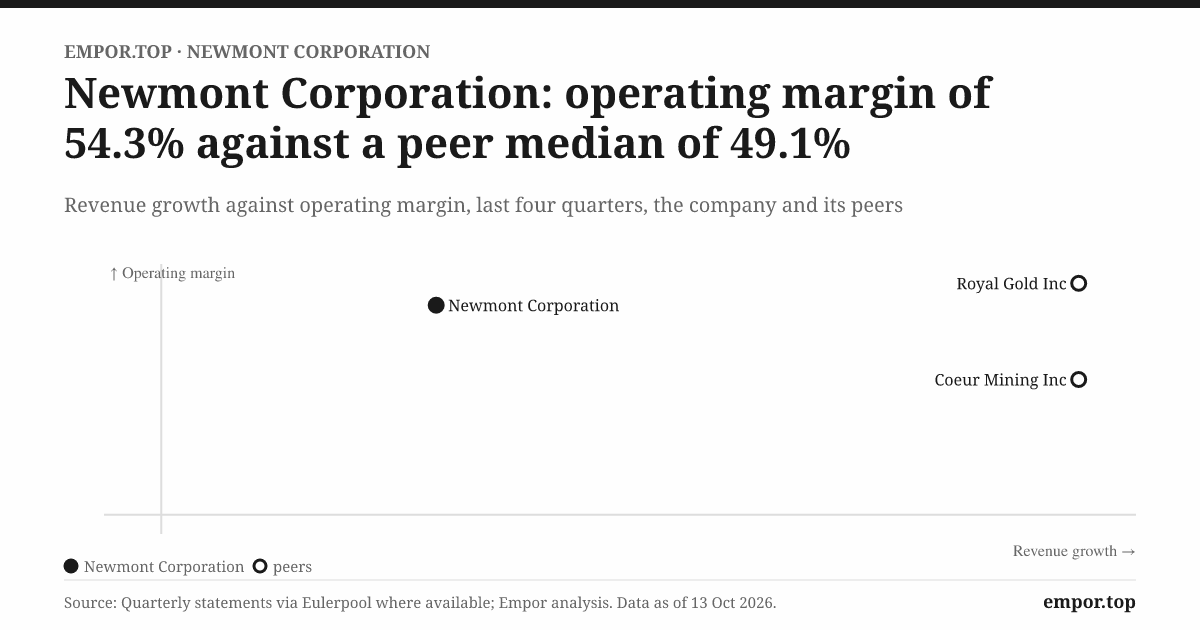
Finally, operating leverage. A gold mine's costs are mostly fixed in the short run, so every extra dollar of gold price falls almost straight to operating profit. That is how the operating margin went from 5.5% in 2023 to 49.9% in 2025, on a cost base that did not shrink.1 The conclusion is simple and unforgiving: Newmont has no pricing power and no credit risk. Its entire commercial success depends on one number, the all-in sustaining cost per ounce, staying well below a price set by someone else. Which brings us to the costs that do not appear in that per-ounce figure.
X. The $6.8 Billion Reclamation Clock and the C-Suite Reset
January 1, 2026. Natascha Viljoen walked into the Denver headquarters as president and chief executive, the first woman to run Newmont.8 She was not an outsider. A South African metallurgist by training, she had run Anglo American Platinum, a business built on deep, hard, labour-intensive underground mining, before joining Newmont as chief operating officer and then president.8 The board's choice signalled a priority: the next decade at Newmont is about running complex underground mines well, not doing another mega-deal.
She inherited an executive suite in motion. Tom Palmer retired at the end of 2025.8 Six months earlier, in July 2025, chief financial officer Karyn Ovelmen had resigned abruptly after less than two years in the role; the company stated no disagreement on accounting, and the chief legal officer, Peter Wexler, became interim CFO.7 He was still interim more than a year later. The chief technical officer, Francois Hardy, retired at the end of June 2026, and Mark Rodgers became chief operating officer on July 1.910 In September 2026 the board added Peter Beaven, formerly chief financial officer of BHP, as an independent director on the audit committee.11 That is a lot of change in one year for a company running block caves on three continents.
Governance markers give a mixed but mostly steady picture. Eleven of twelve directors are independent, under non-executive chair Gregory Boyce.3 Say-on-pay passed with about 92.5% support at the May 2026 meeting, recovering from about 87% in 2025.12 Palmer's pay rose to about $15.6 million in his final year, a period of record profits that owed a great deal to the gold price.3
Then there is the bill that never goes away. When a mine closes, its owner must reshape waste dumps, cap tailings dams, treat water, sometimes forever, and restore land. Accounting forces the company to estimate those future costs and carry them as a liability today. At the end of 2025, Newmont carried about $6.3 billion of non-current reclamation and remediation obligations plus a smaller current portion, within a total consolidated liability that its auditor framed at about $6.8 billion.1 Ernst & Young named the estimation of that liability as its only critical audit matter, the area of the audit requiring the most difficult judgement.1 That is not a red flag about the accounts, which received a clean opinion, but it does tell investors where the biggest uncertainty sits.
The more important signal is cash. Cash spent on reclamation rose from about $275 million in 2023 to about $803 million in 2025.1 Part of that reflects water treatment at legacy US sites, such as the Dawn mill site in Washington state, where standards keep tightening.1 The company backs the obligations with about $1.9 billion of surety bonds and letters of credit.1 In a year with more than $10 billion of operating cash, $800 million is easily affordable. In a year like 2023, it would have been more than a quarter of operating cash.
The legal radar adds smaller but real items: the February 2026 New South Wales class action over Cadia, putative shareholder suits filed in Colorado in 2025 alleging misleading statements about 2024 guidance and costs, and an Australian Taxation Office audit of a 2011 internal reorganisation.1 None is quantified as material by the company. All of them land on a new team. Whether that team can deliver is ultimately a competitive question, and in gold mining competition looks very different than it does almost anywhere else.
XI. Competitive Landscape and Moat Analysis
Imagine a room in Denver full of pension fund managers deciding where to put their gold-equity allocation. They have three obvious choices. Newmont, the biggest and most diversified. Barrick, led by Mark Bristow, cheaper and tougher on costs but heavily exposed to Africa and emerging markets. Agnico Eagle, the Canadian miner that has built its premium on doing one thing well in safe jurisdictions. What they are really asking is whether any of these companies has a lasting advantage at all.
Start with Hamilton Helmer's seven powers, the framework for durable competitive advantage. Newmont's one strong power is a cornered resource. Ore bodies like Tanami in the Australian desert, Ahafo in Ghana, Boddington, Cadia and its 38.5% of Nevada cannot be replicated by a competitor with more money, because geology made them, not management. Such Tier-1 deposits are rare and getting rarer; the industry discovers far fewer large deposits than it did in earlier decades. That is a real moat around the asset base.
Scale economies are moderate. Newmont buys equipment, energy and smelting services in bulk and spreads exploration and technical expertise across a large portfolio, but scale also adds corporate layers, and the company's history of overhead criticism from Paulson to Bristow shows the trade-off. Switching costs, network effects and brand are effectively zero, because no bullion bank prefers a Newmont ounce to a Barrick ounce. Counter-positioning and process power are hard to see in the record. The conclusion is plain: Newmont's advantage lives in its ore bodies and its balance sheet, not in anything customers feel.
Michael Porter's five forces point the same way. Buyer power is low despite the concentration figures, because the bullion banks take the spot price like everyone else. Supplier power is high: equipment makers like Caterpillar and Komatsu, energy suppliers, and scarce skilled underground labour capture a growing share of the value, which shows up as the cost inflation the company keeps fighting. The threat of substitutes is low for gold as a monetary asset, and for copper in power lines. Rivalry does not happen on price, which no one sets; it happens over who gets to own the next great deposit, which is why deal premiums and auctions matter so much.
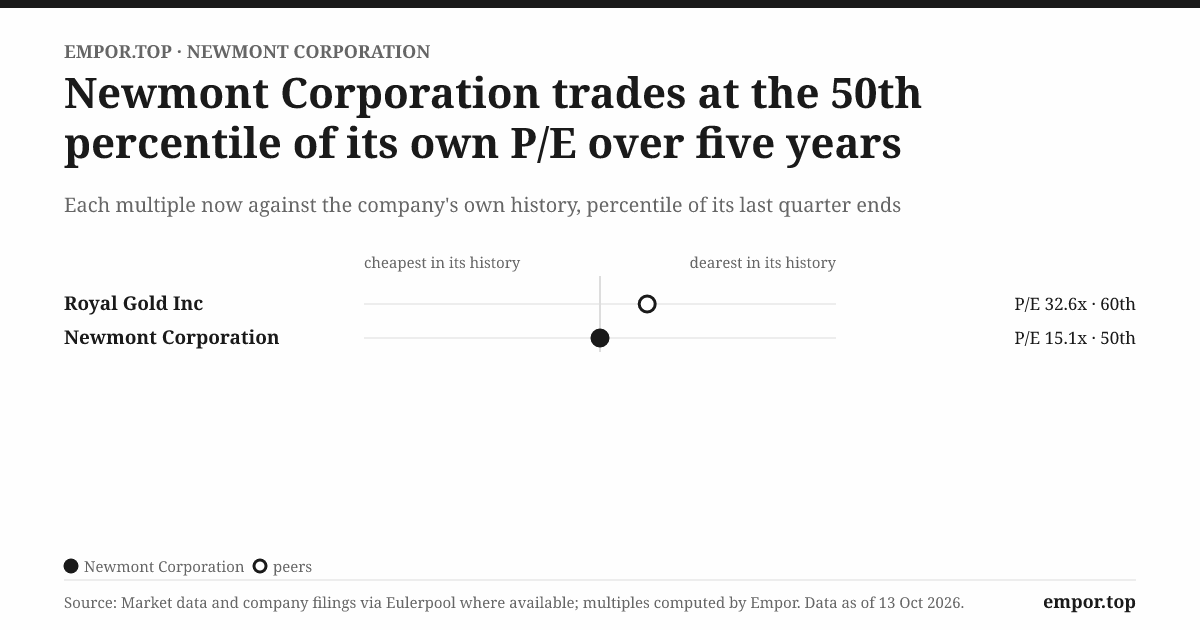
Now the peer comparison. Newmont trades at about 7.4 times enterprise value to EBITDA and about 15 times trailing earnings, close to its own five-year median price-earnings ratio of about 14.7.1 Barrick trades lower, at roughly 6 to 7.5 times EBITDA, a discount that reflects its exposure to riskier jurisdictions such as Mali.16 Agnico Eagle commands roughly 8.5 to 11 times, a premium earned by years of steadier delivery in Canada, Finland and Australia.17 Newmont sits in the middle.
What does that middle position imply? The market is paying for Newmont's balance sheet and its reserve base, but it is not paying an Agnico-style premium for operational consistency, because Newmont has not consistently earned one. Its own return on invested capital shows why. It was below 6% for most of the decade to 2023, and only jumped to about 21% in 2025 and about 31% over the last twelve months as prices surged.1 A moat built on ore bodies protects against new entrants. It does not protect against the gold price, and it does not guarantee that the owner of the ore will mine it cheaply. That distinction is the hinge of the bull and bear debate.
XII. Bear vs. Bull Case
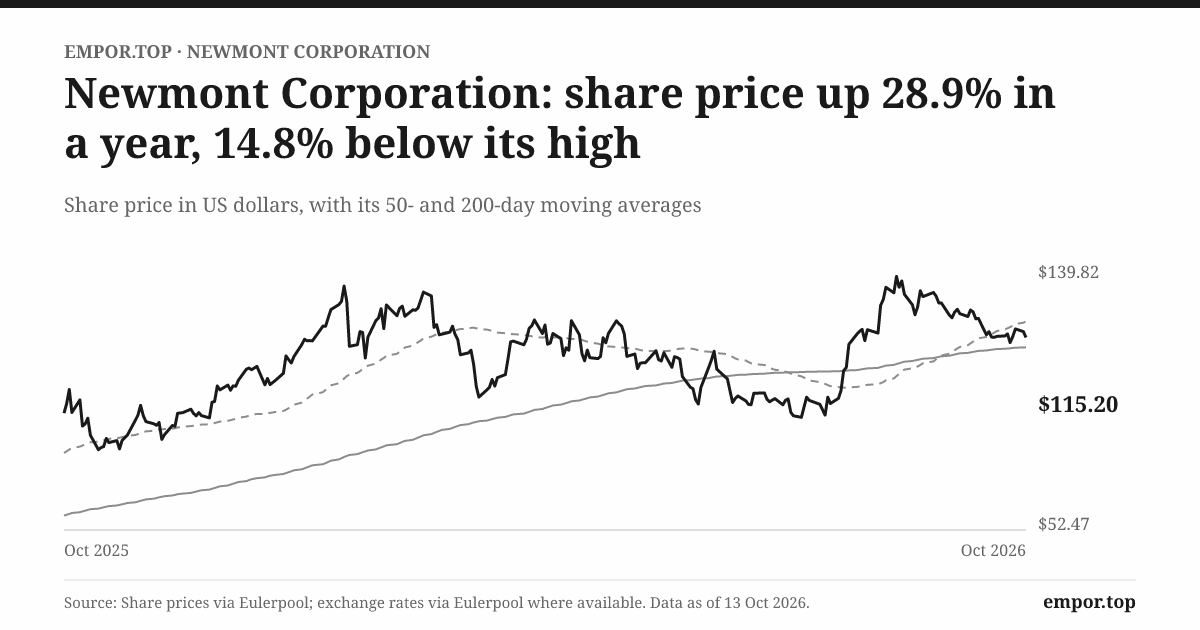
On October 13, 2026, Newmont closed at about $115 a share, roughly 15% below its 52-week high of about $135 and well above its low of about $79.1 Over the past five years the stock has fallen as much as 65% from peak to trough, and its one-year volatility is around 50%.1 This is not a quiet bond proxy. It is a leveraged bet on the gold price, wrapped in a corporation.
The bull case starts with the balance sheet. Newmont holds about $9.0 billion of cash, has no bond maturities until a small $267 million note in October 2029, and has an undrawn $4.0 billion revolving credit line.21 All three rating agencies have moved toward it: Moody's upgraded it to A3 in August 2025, Fitch affirmed A- in June 2026, and S&P moved its BBB+ outlook to positive in September 2026.131514 A company that cannot be forced to sell assets in a downturn can do what Newmont did in 1929 and 2023: buy when others must sell. The bull would add that free cash flow of about $7.4 billion in 2025 implies a free cash flow yield near 6% at today's price, and that management is returning that cash largely through buybacks.1
The bulls also point to the organic pipeline. Tanami Expansion 2 in Australia and Ahafo North in Ghana are meant to add lower-cost ounces, and management's plan is for the portfolio's all-in sustaining cost to fall as the divested higher-cost mines leave. Add copper from Cadia, Boddington and Red Chris, and the bull sees a company priced at about 7.4 times EBITDA that is better than its history.
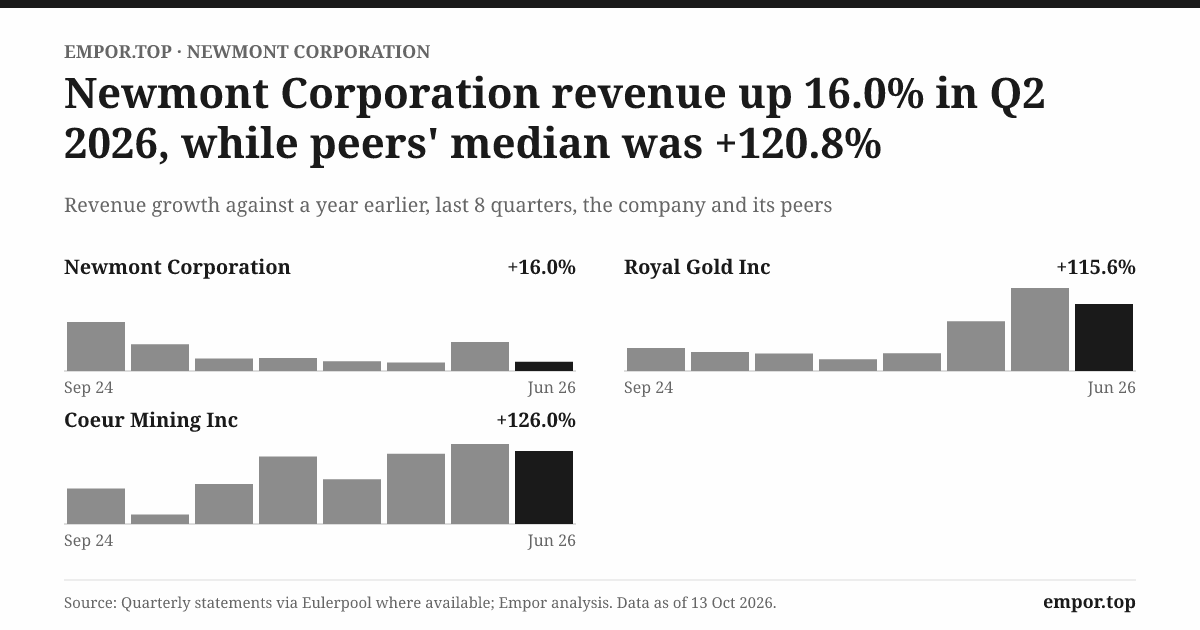
The bear case begins with the same margin chart and reads it differently. The margin chart shows how much prices rose while costs did not fall by anything like as much.1 If gold reverts even partway, the margin falls faster than revenue, because operating leverage cuts both ways. The free cash flow yield that looks so attractive is a yield on peak-cycle cash flow. In 2023 free cash flow was under $100 million.1
The bear's second point is currency. Revenue is in dollars, but a large share of costs is in Australian and Canadian dollars, roughly half or more of operating costs after Newcrest.1 When those currencies strengthen, unit costs rise with nothing management can do beyond partial hedging; foreign exchange cost the company about $137 million in 2025.1 Third comes technical risk: block caving at Cadia, where a mountain of ore is undercut and allowed to collapse under its own weight into draw points, is efficient when it works and punishing when it does not, and the dust problems there have already drawn regulators and a class action.1 Fourth is reclamation, which now consumes about $800 million of cash a year. Fifth is leadership: a new CEO, an interim CFO for more than a year and a new COO, all facing litigation.
An activist looking at Newmont would probably not attack the balance sheet. The questions would be different. Why has a company with this asset base so rarely earned more than its cost of capital outside of price spikes? Why do impairments recur in good years? Why has the CFO seat stayed interim for so long? And would the buybacks of 2026, made near record prices, look as smart at the bottom of the cycle as Palmer's share-funded purchase of Newcrest did?
Weighing it, the bull case rests on facts that are already true, chiefly a net cash position and lower debt, while the bear case rests on things that are likely over time: price mean reversion, currency pressure and execution slips. Two numbers will tell investors which side is winning. The first is the all-in sustaining cost per ounce, the true measure of whether operations are improving independent of price. The second is annual cash spent on reclamation, now about $800 million and rising.1 If the first falls while the second stabilises, the structural case strengthens. If not, today's margins were mostly the metal.
XIII. Playbook: Business & Investing Lessons
Three boardrooms define this company. A New York room in 1987, where directors borrowed to pay a $33 dividend. A Denver room in early 2019, where a CEO turned a rival's hostile bid into a partnership. And another Denver room in late 2023, where shares were printed to buy Australia's champion at the bottom of the cycle. Each holds a lesson that belongs to Newmont and no one else.
The first lesson comes from the Nevada desert: cooperate on geology, compete on capital. The partnership with Barrick captured shared infrastructure without a takeover premium. For founders and investors, the line to remember is this: when the prize is a fence line, tear down the fence, not the company.
The second lesson comes from the six mines sold after Newcrest: a mega-merger is judged by what you sell, not what you buy. Newmont's post-Newcrest disposals and return to net cash show how much an acquirer can learn from what it sells. The difference was not the size of the purchase but the speed of the subtraction. Every acquirer says it will be disciplined; the proof is a list of assets sold, with prices attached.
The third lesson comes from Gordon Parker's 1987 dividend: scorched earth leaves scorched land. The defence preserved independence but forced asset sales and left the company with fewer options. A board that wins a takeover fight by impoverishing the company should count the cost in the years that follow, not on the day the raider retreats.
The fourth lesson is the cycle mirage. Newmont's margin swing from 2023 to 2025 was a reminder that the only fair test of a miner's operating skill is its cost per ounce at the bottom of the cycle. Gold is a terrible teacher: it rewards everyone in a bull market and grades them only in the bear.
The fifth lesson is written in Ernst & Young's critical audit matter: reclamation is a mortgage, not a footnote. Those obligations compete directly with dividends and buybacks. Investors who value a miner on peak earnings without subtracting the cleanup are buying the house without the loan.
XIV. Epilogue: The Next Assays
Tonight, in the Tanami desert of Australia's Northern Territory, the new expansion shaft is hoisting ore from more than a kilometre underground. In Ghana, the mill at Ahafo North is turning. In Denver, a chief executive in her first year is preparing for a results season that will be the first full report card of her tenure. Gold sits near record territory, the company sits on about $9 billion of cash, and the stock trades about 15% below its high.21 Everything looks good. That is precisely why the next twelve to twenty-four months matter.
The first moment to watch is the annual report for 2026, due early next year. It will show the first full year without the six divested mines, and therefore the cleanest view yet of the portfolio's all-in sustaining cost. The company says its ambition is a meaningfully lower cost per ounce once the higher-cost assets are gone and Tanami and Ahafo North are contributing; a figure under roughly $1,350 an ounce would be strong evidence that the post-Newcrest portfolio is structurally better. If costs instead keep rising despite the cull, the answer to the first central question becomes clear: the record profits were the gold price, and the portfolio is not cheaper to run than before.
The second moment is a name. The board still needs a permanent chief financial officer. Interim leadership for more than a year at a company returning billions through buybacks is unusual, and the appointment of an experienced, credible CFO would close the most visible governance gap. A long further delay would invite the question of why the role is hard to fill.
The third set of moments comes from the mines themselves: whether Tanami Expansion 2 and Ahafo North reach commercial targets on schedule, and whether Cadia can operate without further regulatory and community conflict. These are the tests of Viljoen's underground pedigree. Each delay would add cost at precisely the assets meant to lower the portfolio's average.
The last number is the quietest: annual cash spent on reclamation. It rose from about $275 million to about $803 million in two years.1 If it settles back toward $500 million, the liability looks like a manageable long-tail obligation. If it keeps climbing, the cleanup becomes a structural claim on free cash flow that today's buyback programme does not reflect.
The tension at the centre of Newmont is therefore not whether it is a good company. It is whether the next downturn, whenever it comes, will find a cheaper, simpler and better-run miner than the last one did, or the same miner, merely richer for a while.
XV. Outro: The Golden Portmanteau
Go back to that office in Manhattan in 1916, and to the Colonel choosing a name that was really a thesis. New York and Montana. Money and rock. He did not imagine that his trust would outlive its peers by a century, survive a raid by a Texas oilman, move to Denver, share a desert with its fiercest rival, and buy Australia's largest gold miner. But the name already contained the whole story: a financial institution that happens to dig.
Today, thousands of feet beneath the Western Australian desert and the Nevada hills, machines grind rock around the clock, and every ounce they free is priced off the spot market on the day it clears. Newmont has spent 110 years learning that it cannot win by guessing that price. It wins by surviving its swings, buying when others are broken, and selling what it should never have bought. Newmont is not really in the mining business. It is in the business of turning geological and cyclical chaos into institutional cash flow, and its next chapter will show, once more, how much of that cash belongs to the miner and how much to the metal.
References
-
Newmont Corporation Form 10-K for the Fiscal Year Ended December 31, 2025 — SEC EDGAR, 2026-02-19 ↩↩↩↩↩↩↩↩↩↩↩↩↩↩↩↩↩↩↩↩↩↩↩↩↩↩↩↩↩↩↩↩↩↩↩↩↩↩↩↩↩↩↩↩↩↩↩↩↩↩↩↩↩
-
Newmont Corporation Form 10-Q for the Quarterly Period Ended June 30, 2026 — SEC EDGAR, 2026-07-23 ↩↩↩↩↩
-
Newmont Corporation Notice of 2026 Annual Meeting and Proxy Statement (DEF 14A) — SEC EDGAR, 2026-03-26 ↩↩
-
Newmont Corporation Investor Relations Portal — Newmont Corporation ↩↩↩↩↩↩↩↩↩↩↩↩↩↩↩↩↩↩↩↩↩↩↩↩
-
Newmont Completes Acquisition of Newcrest to Create World's Leading Gold Company — Business Wire, 2023-11-06 ↩↩
-
Barrick and Newmont Form Historic Nevada Joint Venture — Barrick Gold Corporation, 2019-07-01 ↩↩↩↩
-
Newmont Corporation Form 8-K: Departure of Directors or Certain Officers (Item 5.02) — SEC EDGAR, 2025-07-14 ↩
-
Newmont Corporation Form 8-K: CEO Succession (Item 5.02) — SEC EDGAR, 2025-09-29 ↩↩↩↩
-
Newmont Corporation Form 8-K: Retirement of Chief Technical Officer (Item 5.02) — SEC EDGAR, 2026-04-28 ↩
-
Newmont Corporation Form 8-K: Appointment of Chief Operating Officer (Item 5.02) — SEC EDGAR, 2026-06-15 ↩
-
Newmont Corporation Form 8-K: Election of Independent Director (Item 5.02) — SEC EDGAR, 2026-08-20 ↩
-
Newmont Corporation Form 8-K: Voting Results of 2026 Annual Meeting (Item 5.07) — SEC EDGAR, 2026-05-13 ↩
-
Moody's Upgrades Newmont to A3 on Strong Operating Profile and Debt Reduction — Moody's Investors Service, 2025-08-15 ↩↩
-
S&P Global Ratings Revises Newmont Outlook to Positive — S&P Global Ratings, 2026-09-18 ↩
-
Fitch Affirms Newmont at 'A-' with Stable Outlook — Fitch Ratings, 2026-06-20 ↩
-
Barrick Gold Corporation Annual Information Form and Financial Statements — Barrick Gold Corporation, 2026-02-27 ↩
-
Agnico Eagle Mines Limited Annual Information Form and Financial Statements — Agnico Eagle Mines, 2026-03-20 ↩
 LinkedIn
 WhatsApp
 Reddit
 Hacker News
 Email
 Kindle
 RSS Feed
 Spotify
 Apple Podcasts
 Amazon Music
 Audible
 YouTube