Marsh McLennan: The Architecture of Systemic Risk
I. Introduction & Episode Thesis (10–15 min)
On the morning of October 14, 2004, Eliot Spitzer, then New York's Attorney General, walked to a lectern in Manhattan and accused the largest insurance broker in the world of running a rigged market. His civil complaint said Marsh & McLennan had steered commercial clients toward insurers that paid it secret "contingent commissions," and that some of the competing quotes clients received were not real bids at all but staged ones, set up to make the chosen carrier look cheap.3 For a firm whose entire product was the claim that it worked for the buyer, the allegation went straight to the heart of the business. It was not about a bad trade or an accounting error. It said the advisor had been working for the other side of the table.
The market's verdict was brutal. Shares collapsed in the days that followed, wiping out billions of dollars of value, and within about two weeks the chief executive, Jeffrey Greenberg, had resigned.3 Commentators openly wondered whether the brokerage model itself could survive. If the profits came from kickbacks, what was left once they were banned?
Twenty-two years later, the answer is in the numbers. Marsh & McLennan Companies booked about $27 billion of revenue in 2025, at an operating margin of roughly 23%.[^16] It has raised its dividend for 17 years in a row.1 On October 7, 2026, the market valued its equity at about $85 billion and the whole enterprise, debt included, at about $106 billion.[^16] The company that was supposed to be dismantled by a regulator became larger, more profitable, and more central to how corporate capitalism buys protection than it was on the day Spitzer stepped up to the microphone.
That is the paradox this story tries to explain. MMC does not underwrite risk. When a hurricane flattens a refinery or a ransomware gang freezes a hospital chain, the insurer pays and MMC does not. Yet MMC's earnings have compounded faster and more steadily than those of many carriers it places business with. Its revenue rose from about $13 billion in 2014 to $27 billion in 2025, while operating profit grew almost threefold.1[^16] Over the same decade, carriers lived through hurricane seasons, social inflation in liability claims and a pandemic. Brokers like MMC took a cut of every premium regardless.
The working thesis is simple and it will be tested hard. MMC is a toll collector on corporate risk. It sits between buyers of protection (Fortune 500 risk managers, mid-sized manufacturers, HR departments buying health plans, insurers buying reinsurance) and the capital that sells it. Its value lies in knowing where the capacity is, how to word a policy, and how to price a peril nobody has seen before. It also has the scale to make that knowledge cheaper per client than any rival can. The Spitzer affair showed the limits of that toll: when the broker started collecting it from both sides, the franchise nearly broke.
Three questions run through the rest of the piece. First, how much of today's 23% margin is real scale, and how much is a temporary windfall from earning interest on client money while rates were high? Second, can the company digest its $7.75 billion purchase of McGriff Insurance Services without permanently diluting its returns on capital?[^6] Third, what happens when the commercial insurance pricing cycle, which lifted every broker's revenue for years, turns soft?
The route there runs from the ashes of Chicago through U.S. Steel's boardroom and the 1997 megamerger with Johnson & Higgins, to the North Tower on September 11, the Spitzer guillotine, and the long rebuilding that followed. Then come the JLT and McGriff megadeals, and the quieter question of who is now steering the toll booth. It starts, appropriately, with a fire.
 Subscribe on LinkedIn
II. Foundations of Modern Risk: The Chicago Fire to U.S. Steel (1871–1923) (25–30 min)
In October 1871, a fire started in a barn on Chicago's West Side and, driven by a dry wind, burned for two days across more than three square miles of a city built largely of wood. Roughly a third of Chicago's property was destroyed. For the insurance industry the fire was not just a disaster but a lesson in concentration. Dozens of insurers, many of them small local companies that had written heavily in a single city, simply could not pay; scores failed outright. Policyholders who had done everything right, bought coverage and paid premiums, discovered that a promise from an undercapitalized carrier was worth only as much as that carrier's balance sheet on the worst day of its life.
That lesson is the seed of the broker's business. If a single insurer can fail, the buyer needs someone who knows which carriers are solid, how to spread a large risk across many of them, and how to write the contract so it pays when it must. That someone does not need capital of their own. They need judgment, relationships and information. They are paid for the placement, not for bearing the loss.
Henry W. Marsh grew up in that Chicago. He joined the insurance agency of Burrows & Ulmann in the 1880s and, through his work, came to the realisation that would define the firm: the most valuable client was not the homeowner buying a fire policy from a local agent but the large industrial company whose risks were too big and too complex for any one carrier. Railroads, steel mills and grain elevators needed programs, not policies. Marsh started to sell to the purchasing side, representing the buyer rather than the insurer, a subtle shift that would become the brokerage industry's founding idea.
The firm's lore centres on the emerging industrial giants of the turn of the century. When J.P. Morgan assembled United States Steel in 1901, the new combine held mills, mines, railroads and ore boats spread across the country. The traditional approach was to buy cover piecemeal from dozens of local agents. Marsh's pitch, as the company tells its own history, was to treat the whole enterprise as one risk: retain the small, frequent losses that a giant could easily absorb and syndicate the catastrophic exposures across many carriers. It was, in effect, an early version of the self-insured retention and layered tower that every Fortune 500 risk program still uses.
Up in Duluth, Minnesota, Donald R. McLennan was building a parallel business around the railroads that fed the iron ranges. Railroad liability was a specialist's game, with long-tail injury claims, freight exposures and a regulatory web few local agents understood. McLennan's reputation for structuring those programs gave him an entry to the Great Northern and other lines. When the Chicago and Duluth businesses came together in 1904–1905, the new partnership, eventually styled Marsh & McLennan, combined Marsh's industrial client base with McLennan's railroad expertise. It was, from the start, a national firm in a business that was still mostly local.
The economics were as important as the client list. Consider how a broker differs from an insurer. An insurer collects a premium today and pays claims, possibly years later. It must hold reserves against those claims and capital against the chance that the reserves are wrong. Its profits swing with catastrophes. A broker collects a commission, typically a percentage of the premium, at the time the policy is placed and renewed. If the insurer later has a terrible year, the broker's commission is already earned. The broker carries no loss reserves at all. Its main costs are people, offices and, today, technology.
That asymmetry is the oldest and most durable part of the MMC story. The revenue model is fees and commissions on placements and consulting work, while reinvestment needs are modest because there is no underwriting balance sheet to feed.1 The firm's growth capital historically went into people and, later, acquisitions, rather than into capital reserves.
There is a catch that matters for everything that follows. A business whose revenue is a percentage of premiums is tied to the price of insurance. When rates rise, the broker earns more for the same work. When rates fall, it earns less. In the early twentieth century that link was barely noticed; by the twenty-first it would become the most-watched variable in the brokerage industry.
The partnership incorporated in 1923, and in the same year Marsh & McLennan acquired Guy Carpenter & Company, a reinsurance intermediary founded only a year earlier.1 Reinsurance is insurance for insurers. When a carrier writes too much hurricane exposure in Florida, it buys protection from a reinsurer to cap its losses. The intermediary that arranges those treaties sits one level further up the risk chain, between the world's insurers and the global pool of reinsurance capital in London, Bermuda, Zurich and Munich. By adding Guy Carpenter, Marsh & McLennan positioned itself at both levels: the retail layer where companies buy cover, and the wholesale layer where insurers lay it off.
Why does that matter now? Because a century later Guy Carpenter is still one of MMC's most profitable franchises, and because the decision shows an instinct that would recur throughout the firm's history: buy the adjacent layer of the risk chain before someone else does. The same instinct would later produce the consulting arm, the 1997 megamerger, JLT and McGriff. Sometimes it worked brilliantly. Sometimes, as the next section shows, it drifted into businesses with very different risks.
III. Assembling the Four Pillars: The Holding Company Era (1959–2000) (30–35 min)
Picture the corporate America of the late 1950s. Big employers were offering pensions, group life cover and, increasingly, health insurance to workers as a substitute for wage increases. Each of those promises needed actuaries to price it, administrators to run it and consultants to explain it. In 1959, Marsh & McLennan bought William M. Mercer, a benefits consulting firm with roots in Canada.1 It looked like a small step sideways. In hindsight it was the first brick of a second business that would eventually account for more than a third of the company.
The firm went public in 1962 and in 1969 reorganised as a holding company, Marsh & McLennan Companies, so it could own businesses that were not brokers.1 That structure permitted the next move: in 1970 MMC acquired Putnam Investments, a Boston mutual fund manager.1 The logic of the era was that a financial services firm with corporate relationships could cross-sell everything: insurance, benefits consulting, retirement assets. The reality was that Putnam was a different kind of business, exposed to market swings, retail investors and securities regulators. It would take more than three decades for the full cost of that mismatch to surface.
Mercer, by contrast, rode a structural wave. The Employee Retirement Income Security Act of 1974 imposed detailed funding, disclosure and fiduciary rules on private pension plans. Every large employer suddenly needed actuarial valuations, compliance advice and investment consultants. Then came the long inflation in US healthcare costs, which turned employer-sponsored health plans into one of the largest line items in corporate budgets. Mercer grew into the go-to advisor on both. Its work is unglamorous, recurring and deeply embedded: a company that uses Mercer to design and price its health plan tends to keep doing so year after year.
The brokerage side faced a rival. Patrick Ryan, a Chicago entrepreneur, had built Aon into an aggressive consolidator through the 1980s and 1990s. By 1997 Aon was buying Alexander & Alexander and threatening Marsh's long-held position as the world's largest broker. Marsh's response was to buy Johnson & Higgins, a venerable New York firm founded in 1845 and one of the last big private partnerships in the industry, for about $1.8 billion.1 The deal restored Marsh's lead and folded in a deep book of large corporate clients. It was the opening move in a consolidation that would leave a handful of global brokers controlling the large-account market.
Two strategic chess moves deserve attention here. The Johnson & Higgins deal established the pattern MMC would follow in 2018 and 2024: when a rival is gaining ground, buy scale outright and integrate it fast rather than grind it out organically. And it showed that in brokerage, scale is not simply size. A larger book of large accounts brings more data on losses and prices, more leverage with carriers, and more specialists who can be shared across clients.
The consulting pillar gained its third leg when MMC combined its management consulting units with Oliver, Wyman & Company, acquired in 2003, to create Oliver Wyman, a strategy firm with particular strength in financial services.1 Unlike Mercer, Oliver Wyman's revenue is project-based and discretionary. Banks hire it to rethink a business or answer a regulator; when budgets are cut, those projects are delayed. It is a higher-beta business inside a holding company that otherwise prides itself on stability.
By 2000, the company had four pillars: risk and insurance brokerage (Marsh and Guy Carpenter), human capital consulting (Mercer), management consulting, and investment management (Putnam). The question the outline poses is whether this was a platform or a conglomerate. The evidence of the following decade gives an uncomfortable but clear answer. The pieces that shared a common thread, advising corporations on risk and people, fitted together and still do. The one that took different risks, Putnam, did not. Asset management exposed MMC to market cycles, retail investors and regulators who knew nothing about insurance. When trouble came, it came from both directions at once.
That split, between businesses that sell advice and businesses that bear exposure, is the true lesson of the conglomerate era. It also sets up the most dangerous years in the company's history, because the brokerage itself had quietly started earning money in a way that blurred the line between advising the buyer and serving the seller.
IV. The Spitzer Guillotine and Existential Crisis (2001–2007) (40–45 min)
At 8:46 on the morning of September 11, 2001, American Airlines Flight 11 struck the North Tower of the World Trade Center between the 93rd and 99th floors. Marsh & McLennan occupied floors 93 through 100. The company lost 295 employees and 63 contractors and consultants that morning, one of the heaviest tolls of any organisation.1 For a firm whose business was understanding catastrophe, the attack was a personal one before it was a professional one. It was also, for the insurance industry, the largest insured loss in history up to that point, and it triggered a hard market: insurers raised prices sharply, which, in the cruel arithmetic of commissions, lifted broker revenue.
The firm grieved and rebuilt. Three years later, it faced a different kind of disaster, and this time it was self-inflicted.
The mechanism at the centre of Spitzer's case was the "contingent commission," which Marsh called a placement service agreement. On top of the normal commission paid on each policy, insurers paid brokers bonuses based on the volume or profitability of business the broker sent them. On its own, that was legal and industry-wide. The problem was the incentive it created. A broker hired to find the best deal for the client was also being paid by insurers for steering volume to them. Spitzer's complaint went further, alleging that Marsh had solicited fake, deliberately high quotes from some insurers so that a preferred carrier would win, and that insurers including AIG and ACE participated.3
The economics explain why the practice was so hard to give up. Contingent commissions were almost pure profit. They required no extra work, came on top of base commissions, and were paid by the insurer rather than the client. Marsh reportedly earned hundreds of millions of dollars a year from them, a substantial share of brokerage profits. In effect, the firm had been collecting a toll from both lanes of the road.
The personal dimension sharpened the drama. Jeffrey Greenberg, MMC's chairman and CEO, was the son of Maurice "Hank" Greenberg, who ran AIG, the largest commercial insurer and one of the carriers implicated. The image of a father and son running the two sides of a market accused of rigging it was irresistible to the press. Spitzer said publicly that he would not negotiate with the existing leadership. Within about two weeks, Jeffrey Greenberg stepped down.3
His successor was Michael Cherkasky, a former Manhattan prosecutor who had run Kroll, the investigations firm MMC had acquired in 2004. The choice was deliberate: a lawyer from the prosecutorial world to settle with a prosecutor. In January 2005, MMC agreed to pay $850 million in restitution to policyholders, apologised for the conduct, and committed to stop accepting contingent commissions.4 Several employees faced criminal charges, though the later legal record was mixed, with some convictions overturned on appeal.
The cost of the crisis went beyond the settlement. Revenue from contingent commissions vanished. Client trust had to be rebuilt account by account. Simultaneously, Putnam was mired in a mutual fund market-timing scandal that drew separate penalties from securities regulators. MMC was fighting fires in two unrelated regulatory arenas, which is precisely the conglomerate risk described in the last section.
The response, under Cherkasky and then Brian Duperreault, who took over in 2008, was triage. In 2007, MMC sold Putnam to Great-West Lifeco, part of the Power Financial group, for about $3.9 billion.[^15] In 2010 it sold Kroll for about $1.1 billion, well below what it had paid only six years earlier, a write-down that is worth remembering whenever the company's acquisition record is praised.1 What remained was the core: brokerage, reinsurance intermediation, human capital consulting and strategy consulting.
The contract model changed too. Large corporate clients increasingly negotiated explicit fees or fully disclosed commissions. The broker's compensation became visible to the buyer. That did not make conflicts disappear, and the industry quietly revived some forms of carrier-paid compensation in later years under disclosure rules, but it reset the relationship around transparency.
Myth vs reality: did losing contingent commissions break brokerage economics?
The consensus fear in 2005 was that brokerage margins had been an illusion built on kickbacks. The record partly supports that view and partly refutes it. Margins did compress in the years after the settlement, and the late 2000s, with the financial crisis and a soft insurance market layered on top, were lean. The company's operating margin was about 18% in 2014; by 2024 it had reached nearly 24%.1 So the business recovered and then exceeded its earlier profitability, without the forbidden revenue stream.
The honest verdict is narrower than "the moat proved itself." The recovery took years, coincided with a long period of rising insurance prices, and was later helped by interest on client funds, which section VII examines. What the record shows is that the core advisory franchise could earn strong margins without double-dipping. What it does not prove is that every point of today's margin is structural. That question remains open, and it is the right one to carry into the Glaser era.
V. The Glaser Playbook & The Modern Machine (2008–2022) (35–40 min)
In 2008, while the financial system was buckling, MMC made a small decision that would turn out to be one of its most important. It set up Marsh & McLennan Agency, a separate unit dedicated to the US middle market: companies too big for a local agent and too small for the global Marsh team.1 These were regional manufacturers, construction firms, hospital groups and school districts, paying perhaps a few hundred thousand to a few million dollars in premiums. The market was enormous and fragmented across thousands of independent agencies, many owned by founders approaching retirement with no succession plan.
MMA's model was straightforward. Buy good local agencies, keep their producers and brand relationships, then plug them into MMC's carrier relationships, specialty expertise and back-office systems. A local agency in Ohio might have struggled to place a complex cyber or product-recall policy; once inside MMA, it could call on specialists. The seller got liquidity and a home for staff. MMC got a durable book of renewals that grows with its clients.
Daniel Glaser, who became CEO in 2013 after returning to MMC from a career that included senior roles at insurer Willis and running Marsh itself, became the face of this disciplined era. Glaser was a blunt, numbers-focused operator from Long Island who had started as a trainee in the industry. He talked about "underlying" or organic growth as the true test of the franchise, separate from what acquisitions added. Under his leadership MMC kept MMA's acquisition pace steady, pushed shared services across the businesses and resisted the temptation to chase revenue at the expense of margin.1
The results show in the numbers. Revenue grew from about $13 billion in 2014 to about $21 billion in 2022, and operating margin moved from about 18% to about 21%.1 Diluted earnings per share more than doubled, from about $2.67 to about $6.09.1 What these figures say is that each new dollar of revenue carried more profit than the dollars before it. That is the signature of operating leverage: the fixed costs of technology, compliance and senior expertise are spread over a growing base.
How does a people business achieve that? Through centralisation of the work clients never see. Policy checking, certificate issuance, claims administration and data entry moved to placement and service centres. Carrier submissions became standardised. Analytics teams built pricing benchmarks that a small agency could never afford. The client still deals with a familiar producer; behind them sits an industrial process.
Guy Carpenter profited from a different force. Global reinsurance became more analytical as catastrophe models improved and as capital from pension funds and hedge funds flowed in through catastrophe bonds and collateralised reinsurance. Insurers buying reinsurance need advice on how much protection to buy, at what layers, from which mix of traditional and alternative capital. In that market, Guy Carpenter and Aon's reinsurance arm became the two dominant intermediaries. The work is concentrated in a few renewal seasons each year and is highly profitable.
Mercer evolved as well. As companies froze defined-benefit pension plans, Mercer moved from simply advising on them to managing assets for clients through outsourced chief investment officer mandates, in which an institution hands Mercer discretion over its portfolio. Health and benefits consulting kept growing as employer healthcare costs rose. These businesses are tied to long relationships and recurring retainers, which helps explain why the company describes the bulk of Risk & Insurance and Mercer revenue as recurring or predictable.1
Capital allocation completed the machine. Capital expenditure has run at only about 1.5% to 2% of revenue, mostly on technology.1 Dividends rose every year. Share repurchases offset dilution from employee equity, shrinking diluted shares from roughly 545 million in 2014 to about 495 million by 2024.1 Cash flow covered all of this while also funding a steady stream of tuck-in acquisitions.
Two caveats temper the success story. First, margins did not rise in a straight line: the 2019 year, when JLT was absorbed, saw operating margin dip to about 16%.1 Second, the period coincided with a favourable backdrop. Commercial insurance prices rose for years after 2017, and organic growth benefits directly from that. Glaser's machine was well built, but it also enjoyed a tailwind. The real test of a toll road is traffic in a recession, and the 2008–2009 years were MMC's leanest. The strongest conclusion the evidence supports is that scale reliably improves brokerage margins in a stable or rising price environment; it is less clear how the machine performs when prices fall for several years.
Glaser's era ended with two enormous bets that tested his integration machinery at a scale never before attempted.
VI. The Megadeals: JLT, McGriff, and the Balance Sheet Stretches (2018–2025) (35–40 min)
On September 18, 2018, the London market woke up to news that Marsh & McLennan had agreed to buy Jardine Lloyd Thompson in a recommended all-cash offer, valuing the British broker's equity at about £4.3 billion, or roughly $5.6 billion.[^7] JLT was a prize for several reasons. It had built strong specialty franchises in energy, aerospace, marine and other complex lines placed through Lloyd's of London, a thriving reinsurance business, and an international employee benefits operation in Asia. It was also the kind of firm Aon or Willis Towers Watson might have wanted. MMC moved first and paid a full price.
The deal closed on April 1, 2019.[^7] The financial consequences were immediate. Borrowings rose from about $5.8 billion at the end of 2018 to about $14.2 billion a year later, and debt to equity jumped from under 0.8 to about 1.8.1 Return on invested capital, which had sat in the mid-to-high teens, fell to about 9%.1 For a company that had prided itself on balance-sheet conservatism, this was a dramatic leap.
Integration is where brokerage deals succeed or fail. The assets are people. If the top producers leave and take their clients with them to a rival, the buyer is left with goodwill and a payroll. MMC's approach combined retention packages for key talent, rapid alignment of the specialty businesses with Marsh's own, and aggressive consolidation of overlapping offices and systems. Management targeted and reported substantial cost savings over the following years.1
The post-deal record is the best evidence on whether it worked. Operating cash flow rose from about $2.4 billion in 2019 to about $3.5 billion by 2021.1 Debt to equity fell back to about 1.2 by the end of 2021, and return on invested capital recovered to about 16.5% by 2023.1 In plain English, MMC paid a steep price, absorbed a hit to returns and to its balance sheet, and then earned its way back within about four years. That is a strong outcome for a cross-border professional services deal, a category where failure is common.
In September 2024, MMC announced a second large deal: the acquisition of McGriff Insurance Services from Truist Insurance Holdings for $7.75 billion in cash.[^6] McGriff was a large US middle-market broker, strong in the Southeast, with commercial property and casualty, employee benefits and surety businesses. MMC said it added about $1.3 billion of revenue and roughly 3,500 professionals, who were folded into Marsh McLennan Agency.[^6][^3] The deal closed in November 2024.[^3]
The logic was MMA's playbook at a larger scale. Instead of buying dozens of small agencies one at a time, MMC bought a ready-built regional platform. The risk was also familiar: a heavy price paid for intangible relationships, funded with debt. Borrowings rose from about $15.4 billion at the end of 2023 to about $21.9 billion a year later, lifting debt to equity to about 1.6.1 Deloitte, the auditor, flagged the valuation of acquired customer relationships and other intangibles from business combinations as a critical audit matter in the 2024 annual report.1 That is not a warning of error, but it signals the size of the judgment involved: much of the purchase price sits on the balance sheet as goodwill and intangibles whose value depends on clients continuing to renew.
Historical falsification: does MMC destroy value in acquisitions?
The bull case is that MMC is a proven integrator, and JLT supports that. But the longer record is less tidy. The Kroll acquisition in 2004 ended with a sale six years later at a fraction of the purchase price, and Putnam brought regulatory trouble before its sale. Those were deals outside the core advisory franchise. Within brokerage and benefits, the record, from Johnson & Higgins to JLT to the steady MMA tuck-ins, is markedly better. The calibrated conclusion is that MMC's acquisition skill is real but narrow: it integrates brokers well, and it has historically struggled with businesses that carry different risks.
McGriff sits squarely inside that skill set, which is encouraging. The evidence so far is mixed rather than conclusive. Return on invested capital fell to about 13% in 2024 and recovered only to about 14% in 2025, still short of the pre-deal level.1 On a trailing twelve-month basis to June 2026, it was about 13%.[^16] Debt was trimmed only slightly, to about $21.4 billion at the end of 2025, while debt to equity eased to about 1.4 largely because equity grew.1 Moody's and Fitch both affirmed their ratings, at A3 and A- respectively, with stable outlooks in September 2026, which suggests the credit agencies see the leverage as manageable.56
The metric that will settle the question is return on invested capital. JLT took about four years to bring returns back to their earlier level. If McGriff follows the same path, returns should climb back toward the mid-teens by about 2027 or 2028. If they remain in the low teens, the price will have been too high for the growth delivered.
That leads to the deeper question beneath both deals: what exactly makes the combined machine so profitable, and how much of that profitability can be relied on?
VII. Anatomy of the Business Model: Tollbooths, Float, and Fiduciary Rents (30–35 min)
Deep in the notes to MMC's annual report there is a line most investors skim past. When a corporate client pays an insurance premium through Marsh, the money does not go straight to the insurer. It sits for a while in fiduciary accounts, segregated from MMC's own cash, until it is remitted. Claims payments flowing back the other way follow a similar path. At any given moment, those balances total more than $11.5 billion.1 MMC cannot spend that money. But it can, within regulatory limits, keep the interest it earns.
For most of the 2010s, when short-term rates were near zero, that interest was trivial. Then the Federal Reserve and other central banks raised rates sharply in 2022 and 2023. Suddenly, the fiduciary balances were earning a meaningful yield. MMC reported fiduciary interest income of $385 million in the first nine months of 2024, and roughly $500 million for the full year.[^2]1 Because there is almost no cost attached, nearly all of that falls to operating profit.
This is the closest thing in modern finance to float without risk. Berkshire Hathaway famously invests insurance float, but it must also pay claims. MMC holds other people's money briefly, earns interest and owes nothing beyond returning the principal. It is a genuine advantage, but a cyclical one, because the income depends entirely on where central banks set rates.
To see how much it matters, consider the size of the business. MMC has two segments. Risk & Insurance Services, which includes Marsh (with MMA) and Guy Carpenter, generated about $15.3 billion of revenue in 2024, roughly three-fifths of the total.1 Marsh contributed about $12.3 billion and Guy Carpenter about $3.0 billion.1 Consulting, made up of Mercer at about $5.8 billion and Oliver Wyman at about $3.5 billion, generated about $9.3 billion.1 Risk & Insurance typically produces a higher margin and the larger share of operating profit.
Fiduciary income sits inside the Risk & Insurance segment. Roughly $500 million of near-pure profit on a segment of around $15 billion of revenue is worth about three percentage points of that segment's margin, and around two points of the company-wide margin. A simple worked example shows the sensitivity. If rates fall by two percentage points, and the balances stay near $11.5 billion, the annual interest income falls by about $230 million. That would trim the company's operating margin by close to one percentage point, all else equal. Not catastrophic, but enough to slow reported margin progress for a year or two.
The fact sheet already hints at that dynamic. Company-wide operating margin reached about 24% in 2024 and then slipped to about 23% in 2025.1 The quarterly pattern in 2026 continued this trend: margin in the June 2026 quarter was about 25.6%, slightly below the year-earlier 26.2%.[^16] Many factors contribute, including McGriff's amortisation and integration costs, but the direction is consistent with fading tailwinds.
The structural strengths are real all the same. No single client accounts for even 1% of revenue, and the top 100 clients together account for less than 10%.1 Receivables run at about 104 days of revenue, typical of commercial insurance billing cycles, with allowances for credit losses that are small relative to the total.1 Capital spending is modest. The result is that profit turns into cash reliably: operating cash flow was about $5.3 billion in 2025 against net profit of about $4.2 billion, and free cash flow reached about $5.0 billion.1[^16]
That cash conversion is the cleanest evidence of the model's quality. Cash from operations comfortably exceeded net income because large non-cash charges, especially amortisation of acquired intangibles, depress reported profit without consuming cash.1 That is worth noting for anyone using earnings multiples: MMC's reported earnings understate its cash generation, partly because of its acquisition habit.
Two smaller points round out the picture. About half of revenue comes from outside the United States, so a strong dollar trims reported growth, typically by around a percentage point in a strong-dollar year.1 And the company reports no material related-party transactions; it has no controlling shareholder or promoter group.12
So is the 23% margin structural scale or rate windfall? The evidence points to both, in roughly this proportion: around two points of company margin came from fiduciary interest during the high-rate period, and the remaining twenty-odd points rest on recurring renewals, operating leverage and asset-light economics. The claim that MMC can hold margins above 21% in a lower-rate world is plausible but unproven, because the company has not yet operated at its current scale through a full rate-cutting cycle combined with softer insurance prices.
That brings the question of why rivals cannot simply undercut MMC's toll.
VIII. Strategic Moat Analysis: 7 Powers & Porter's 5 Forces (25–30 min)
On June 16, 2021, the US Department of Justice sued to block Aon's proposed acquisition of Willis Towers Watson, a deal that would have combined the second and third largest global brokers. The government argued that the merger would reduce competition in commercial risk broking, health benefits brokerage and reinsurance broking, markets where it said only a small number of firms could serve the largest clients.[^13] Five weeks later, on July 26, 2021, Aon and Willis Towers Watson terminated their agreement.8
For MMC, the episode was a strategic gift. It confirmed that the top tier of the brokerage market was concentrated enough to worry antitrust authorities, and it ensured that no rival would leapfrog MMC through a single combination. It also signalled limits: MMC itself would face hard scrutiny if it tried to buy a top-tier competitor. Growth at the top would have to come from winning share, not from consolidation.
This is the place to argue the moat in full, once.
Hamilton Helmer's 7 Powers
Scale economies. MMC sees more placements, losses and price points than nearly any other broker. That data helps it benchmark prices and structure programs for emerging risks like cyber and climate-related perils. Fixed investments in analytics, compliance and placement centres are spread across a very large revenue base. The margin expansion described in section V is the best evidence that this power is working.
Switching costs. A multinational's insurance program can involve dozens of policies across many jurisdictions, with bespoke wording and coordinated claims handling. Moving it to another broker is risky and disruptive, and an error can leave the client uncovered. Mercer's benefits and investment mandates are similarly embedded. Switching costs show up indirectly in the high share of recurring revenue rather than in a published retention metric; MMC does not disclose a company-wide client retention rate.
Cornered resource. The most valuable resource is people: experienced producers and specialists who hold client relationships. That resource is not truly cornered, because talent can be poached. Brokers routinely recruit entire teams from one another, and litigation over such lift-outs is common. This is the weakest of MMC's powers and the one most exposed to rivalry.
Network economies. Guy Carpenter benefits from a modest network effect: insurers seeking reinsurance go where the capital providers are, and capital providers go where the deal flow is. This is more of a two-sided marketplace advantage than a classic network effect, and it is shared with Aon, so it is a duopoly power rather than a monopoly one.
Porter's Five Forces
Buyer power: low. No client accounts for more than about 1% of revenue.1 Large clients can negotiate fees, and the Spitzer reforms made compensation more transparent, but no single buyer can squeeze the firm.
Supplier power: moderate. Insurers set prices, and those prices determine commission revenue. Insurers also need brokers for distribution, especially in large and specialty accounts, so the relationship is interdependent rather than one-sided.
Threat of substitutes: low for complex risk, higher at the edges. Digital insurers and direct channels have made inroads in personal and small commercial lines, where policies are standardised. They have made little progress replacing brokers for large, complex programs. Artificial intelligence is the open question. It can automate submissions, benchmarking and policy checking, which may lower costs for brokers; it could also, over time, reduce the value of some advisory work. The current evidence suggests AI is more a margin tool for incumbents than a substitute.
Barriers to entry: high. Licensing in many jurisdictions, global networks, errors and omissions exposure, and decades of carrier relationships make it very hard for new entrants to serve multinationals.
Rivalry: intense but rational. Aon, Willis Towers Watson, Arthur J. Gallagher and MMC compete hard, mostly on talent, service and specialty expertise rather than on price wars. The DOJ case shows that regulators see this tier as concentrated.
Historical falsification: does the moat hold?
The strongest test of a brokerage moat is client defection after a scandal, because that is when switching costs are tested. In 2004 and 2005, MMC faced exactly that. It lost revenue and margin, and it took years to recover, but it did not lose its franchise. Clients stayed despite a major breach of trust. That is powerful evidence for switching costs and scale.
The weaker point is pricing. MMC's revenue depends on insurance pricing it does not control. The moat protects its share of the toll, not the size of the traffic. A soft market lowers revenue for every broker. So the verdict is that the moat is intact in its narrow sense, protecting market position and client retention, but it does not insulate MMC from the insurance cycle.
The people who run the moat and the incentives they face are the next subject.
IX. Current Leadership, Governance & Incentive Engineering (20–25 min)
On January 1, 2023, John Q. Doyle became president and chief executive of Marsh McLennan, succeeding Dan Glaser.2 The handover was carefully planned and internal. Doyle had joined MMC in 2016 to run Marsh and later led the Risk & Insurance Services segment. Before that he spent decades at AIG, rising to run its commercial insurance business, and briefly served as its chief executive of US property and casualty lines.2 In other words, he came from the underwriting side of the table and joined the broking side. Few CEOs understand both ends of the toll road so well.
Doyle's style is quieter than Glaser's. He emphasises continuity: steady organic growth, margin discipline and the MMA acquisition program. The McGriff deal was his signature move, and it was a continuation of the playbook rather than a departure from it.
The 2025 proxy statement lays out his pay. In 2024, Doyle received total reported compensation of about $25.1 million, made up of a base salary of $1.5 million, stock and option awards of around $17.6 million, an annual cash incentive of about $5.5 million and other benefits.2 That was up from about $22.8 million in 2023.2 Shareholders approved executive pay with more than 92% support, and directors were re-elected with strong majorities.2
The structure matters more than the totals. Annual incentives are tied to measures such as adjusted earnings growth and operating income, while long-term performance stock units vest according to multi-year growth in adjusted earnings per share and relative total shareholder return.2 Those measures reward per-share outcomes rather than raw size, which is an important safeguard against empire building.
Ownership is the other side of alignment. Executives and directors together own less than 1% of the company.2 The largest shareholders are index and institutional managers, led by Vanguard with roughly 9.5%, BlackRock with about 7.8% and State Street with about 4.3%.2 There is no founding family or controlling holder. Alignment depends almost entirely on the design of equity grants rather than on management's own capital.
Activist stress test
A skeptical investor would raise three points. First, an adjusted EPS target can be met through acquisitions funded with cheap debt, even if returns on capital decline. The McGriff deal lifted earnings while lowering return on invested capital, which a pay plan centred on EPS would not penalise directly. Second, "adjusted" measures exclude acquisition-related costs and amortisation, so they can flatter the economics of deal-heavy growth. Third, with very low insider ownership, management bears little personal downside if a large deal underperforms.
The counterweights are real but partial. Relative shareholder return provides a market check. The company's commitment to its ratings, maintained through the 2024 debt surge, imposes discipline on leverage, and Moody's and Fitch both kept stable outlooks in 2026.56 The company also has a long record of integrating broking deals successfully. The fair verdict is that governance is clean and incentives are reasonable, but return on invested capital deserves more weight in the pay plan than it appears to receive. The KPI to watch is whether return on invested capital recovers after McGriff; if it stalls, the EPS-heavy incentive design will look more like a weakness than a strength.
Management will have to prove that discipline in a less forgiving environment, because the cycle that powered recent growth is turning.
X. The Rate Cycle & Forward Growth: Bull vs. Bear Case (25–30 min)
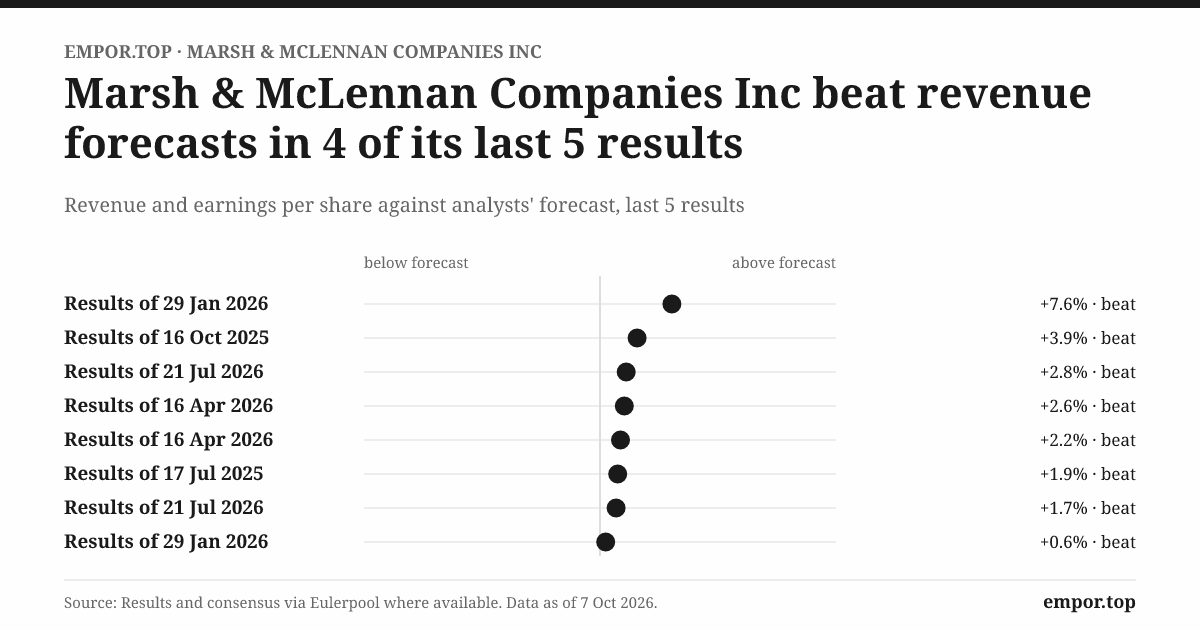
The June 2026 quarter looked solid on the surface. Revenue was about $7.4 billion, up about 6% from a year earlier, and operating margin was about 25.6%.[^16] But a year earlier, revenue growth had been about 12%, and the steady slowdown since then tells a story.[^16] Some of that deceleration reflects McGriff moving from new acquisition to the comparison base. Some reflects the insurance market itself. After years of rising commercial property and casualty prices, the Marsh Global Insurance Market Index had already shown rate increases moderating and some lines, especially property, turning flat or down.7
That is the crux of the debate. Brokerage revenue is a function of how many risks are placed and the price of each. For several years the second factor did a lot of the work. Now it is fading.
The market's verdict
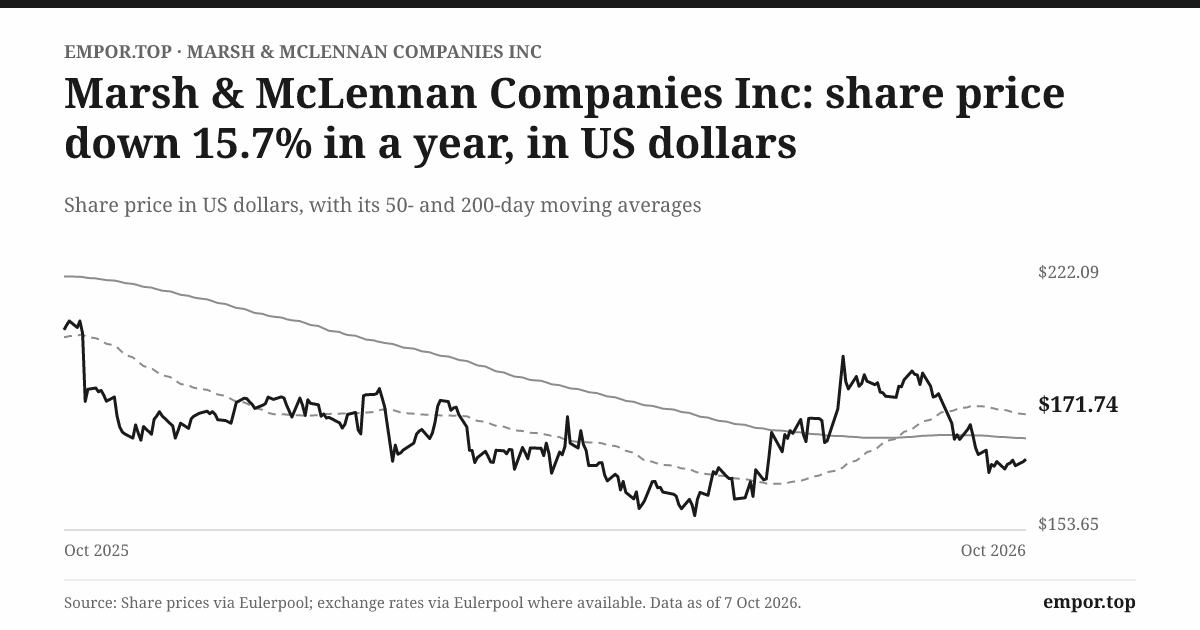
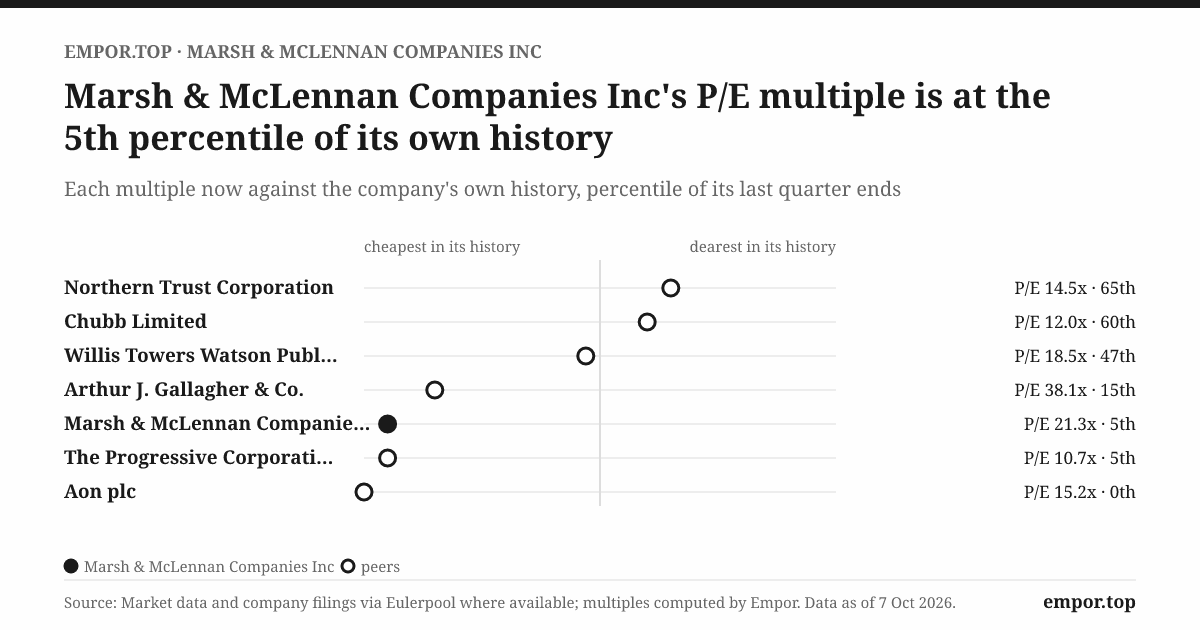
On October 7, 2026, MMC traded at about 21 times trailing earnings, compared with a five-year median of about 26 times.[^16] Its enterprise value was about 15 times EBITDA, and its free cash flow yield was about 5.6%.[^16] The shares sat about 17% below their 52-week high.[^16] In plain terms, the market has lowered its expectations. It is pricing MMC for slower growth than in the recent past, though still as a high-quality business.
The peer comparison sharpens the picture. Arthur J. Gallagher, the purest play on the middle-market roll-up model, trades at about 37 times earnings. Aon, still absorbing its $13 billion NFP acquisition, trades at around 15 times, and Willis Towers Watson at about 18 times.[^16] MMC sits in between. The market prizes Gallagher's growth and penalises Aon's integration risk; MMC's multiple implies investors view it as more stable than Aon but less of a growth story than Gallagher.
The bull case
The bull argument rests on the complexity of risk. Cyber threats, climate-related catastrophes, supply-chain disruption and geopolitical fragmentation make risk management more important and more technical, and demand for expertise tends to rise with complexity. Mercer and Guy Carpenter add growth drivers that do not depend on primary commercial insurance prices: health costs, pension and investment advice, and reinsurance demand driven by catastrophe exposure. MMA, enlarged by McGriff, still has a long runway in a fragmented middle market. And at today's valuation, investors are paying less for those advantages than they did over the past five years.
The bear case
The bear argument is about two cycles turning at once. If commercial insurance prices soften for several years, organic growth will slow across all brokers. If central banks keep cutting, fiduciary income will shrink. And McGriff's debt leaves less room for buybacks or further large deals until leverage comes down. Each of these is manageable on its own. Together, they could hold earnings growth to mid-single digits for a while, which would sit uneasily with even today's lower multiple.
Weighing it
The record offers a guide. MMC grew revenue through the softer years of 2015 and 2016 at only low single digits, and revenue growth was near zero in 2015.1 That was before MMA's scale and before fiduciary income mattered. It suggests that in a genuinely soft market MMC's growth can slow sharply, even if it does not reverse. The bull case on secular complexity is plausible, but it has not yet been tested against a broad soft market at MMC's current size.
Two KPIs will settle the debate. The first is underlying, or organic, revenue growth, particularly at Marsh; it was in the high single digits in 2025, and headline revenue growth slowed to about 6% in the June 2026 quarter.[^4][^16] The second is return on invested capital, last about 13% on a trailing basis and still below the pre-McGriff level.[^16] If organic growth holds near mid-single digits while returns climb, the bull case holds. If both stall, the bear case gains the upper hand.
What lessons does this long record offer to founders and investors?
XI. Playbook: Durable Business & Investing Lessons (20–25 min)
1. Sell the map, not the voyage. Henry Marsh's insight on the eve of the twentieth century, that the giant industrial buyer needed an advisor rather than another policy, created a business that has never had to hold a loss reserve. A century later, when hurricanes and cyberattacks hit insurers' earnings, MMC's commissions were already booked. The broader lesson for founders is that a business which sits beside risk, earning a fee for expertise, can compound more steadily than one that carries the risk itself. Underwriters live and die by the storm; Marsh McLennan gets paid for drawing the map.
2. A toll collected from both sides of the road is a toll that will eventually be seized. The contingent commission years showed how an intermediary's greatest asset, trust, can be monetised quietly until a prosecutor makes it public. MMC survived because it removed leadership, settled, and rebuilt its contracts around disclosure, and because it sold businesses like Putnam that carried unrelated risks. Investors should remember that an intermediary's margins are only as durable as its conflicts are clean. The broker's real balance sheet is the client's belief that it works for them.
3. Integration is the moat behind the moat. JLT cost MMC its pristine balance sheet and nearly half its return on capital for a year, yet within four years returns were back above where they had been. Kroll, by contrast, was sold at a deep loss. The difference was not the price paid but whether the acquired business shared the same economics. For investors, the lesson is to judge a serial acquirer not by its deal count but by what it does after closing, and in which business. A roll-up is only as good as the morning after the deal closes.
4. Float that is free is also fleeting. The fiduciary balances sitting between clients and insurers generated around half a billion dollars of profit when rates were high, without MMC taking any risk. That income will ebb as rates fall, and anyone extrapolating peak margins forward is mistaking a tide for a coastline. Investors should always separate an advantage the company built from one the interest rate cycle lent it. The cleanest float in finance is other people's money, and it always goes home.
XII. Epilogue & Outro (10–15 min)
Tonight, the company's leadership in Midtown Manhattan faces a familiar set of numbers in an unfamiliar combination. Revenue is still growing, margins are near record levels, cash flow is strong and the credit agencies have just reaffirmed their ratings.56 But growth has slowed for four quarters in a row, return on capital is still below where it stood before McGriff, and the two tailwinds that lifted recent years, rising insurance prices and high interest rates, are both fading.
Three moments will tell the story of the next two years.
The first is the McGriff test. MMC's own history says a well-integrated broking deal recovers its returns in about four years. If return on invested capital, about 14% for 2025, climbs back toward the mid-teens by 2027 or 2028 without new debt-funded megadeals, the JLT precedent will have repeated.1 If it stalls, McGriff will look like a deal that bought growth at the expense of returns.
The second is the rate test. As central banks lower rates, fiduciary income will decline. The question is whether Risk & Insurance margins can hold near current levels as that income shrinks. If they do, the structural case for MMC's margins will be confirmed. If margins fall by roughly the amount of lost interest, the market will conclude that a portion of recent improvement was borrowed from the rate cycle.
The third is the pricing test. Each quarter, Marsh publishes its Global Insurance Market Index.7 If commercial rates turn decisively negative for several quarters, the question becomes whether Mercer's health and investment work and Guy Carpenter's reinsurance broking can offset weaker retail brokerage. The answer will show whether MMC has truly become a diversified risk-and-people franchise or remains, at heart, a business that rises and falls with the price of insurance.
The tension that remains is the one that has run through this story since 1871. MMC prospers because the world is risky and because it is not the one holding the risk. That has made it one of the most consistent compounders in financial services. But the price of its toll still depends on forces outside its control, and the cost of its recent growth is still being paid down.
More than a century ago, Henry Marsh made his case to the builders of U.S. Steel: let the mills keep the small fires and let a broker spread the big ones across the world's capital. Today, the same firm models cyberattacks, pandemics and climate catastrophes for corporations and governments across more than 130 countries. The scale has changed beyond recognition; the idea has not.
Underwriters come and go with the turn of every storm. As long as capital fears catastrophe, Marsh McLennan will be standing at the gate, collecting its toll.
References
-
MMC 2024 Form 10-K Annual Report — SEC EDGAR, 2025-02-26 ↩↩↩↩↩↩↩↩↩↩↩↩↩↩↩↩↩↩↩↩↩↩↩↩↩↩↩↩↩↩↩↩↩↩↩↩↩↩↩↩↩↩↩↩
-
MMC 2025 Notice of Annual Meeting and Proxy Statement (DEF 14A) — SEC EDGAR, 2025-03-28 ↩↩↩↩↩↩↩↩↩
-
State of New York v. Marsh & McLennan Companies, Inc. et al. (Spitzer Complaint) — New York State Attorney General, 2004-10-14 ↩↩↩↩
-
Marsh & McLennan Settles Spitzer Investigation for $850 Million — New York State Attorney General Press Release, 2005-01-31 ↩
-
Moody's Affirms Marsh & McLennan's A3 Senior Debt Rating; Outlook Stable — Moody's Investors Service, 2026-09-28 ↩↩↩
-
Fitch Affirms Marsh & McLennan Companies at 'A-'; Outlook Stable — Fitch Ratings, 2026-09-16 ↩↩↩
-
Aon and Willis Towers Watson Terminate Merger Agreement — Aon plc Press Release, 2021-07-26 ↩
 LinkedIn
 WhatsApp
 Reddit
 Hacker News
 Email
 Kindle
 RSS Feed
 Spotify
 Apple Podcasts
 Amazon Music
 Audible
 YouTube