Live Nation Entertainment (LYV): The Toll Booth at the Stadium Gate
I. Introduction & Episode Roadmap
Picture opening night of a stadium tour. Sixty thousand people move through the turnstiles in a slow, glowing river of phone screens and merch bags. Somewhere in a production office under the stands, a settlement sheet is being drafted. The promoter who booked the show will be paid on how many heads came through the gate. The ticketing company that sold each of those seats will collect a fee on every one, whether the fan bought it six months ago or an hour before doors. The beer brand on the banners above the stage paid for the privilege of being seen by every one of those 60,000 people, and by the millions more who will watch the clips.
In much of the live-music world, those are three different businesses with three different sets of shareholders. At this gate, on this night, there is a good chance they are all the same company.
That company is Live Nation Entertainment. It is probably the most disliked name in live music: fans blame it for fees, senators have held hearings about it, and a federal jury found in April 2026 that it broke the antitrust laws.13 It is also the hardest company to avoid in the business. In FY2025 it reported $25.2bn of revenue.1 It is the largest concert promoter in the world, the largest primary ticketer through Ticketmaster, and a major seller of sponsorship against live audiences.
Here is the puzzle that runs through this whole story. Look at revenue, and Live Nation looks like a concert company: the Concerts segment brought in about $20.9bn in FY2025, roughly 83% of the total. Ticketing contributed about $3.1bn and Sponsorship & Advertising about $1.3bn.1 Now look at profit. In the second quarter of 2026, Ticketing and Sponsorship together produced about 72% of the company's adjusted operating income (AOI) from about 16% of its revenue.2
Revenue describes a volume business. Profit describes a toll booth. Most of what follows asks whether the toll booth survives.
The question matters more today than at any time since the company was formed, because the courts are now deciding exactly that. The episode works through four questions:
- Does the Ticketing and Sponsorship profit pool survive the remedies phase? States that won the April jury verdict want Ticketmaster separated from Live Nation.11
- Are the 2025–26 earnings falls a litigation one-off, or a sign of lower underlying profit? The company took a $450m provision in the first half of 2026.2
- How much of the cash pile and the deferred revenue is really the company's? Headline cash was about $9.1bn at the end of June, but most of it is not the shareholders' money.23
- Is the CEO's new contract aligned with shareholders, given the verdict? On 30 September 2026 the board doubled Michael Rapino's target pay.4
This is a company of about 17,700 full-time employees, plus roughly 17,000 seasonal and part-time workers at year end and up to 37,000 at the summer peak.1 Its history has four acts: a roll-up, a merger, a pandemic and a monopoly verdict. Each one left something on the balance sheet or in the legal record that still matters to an investor today.
The story starts with a radio company that decided it did not want to be in the concert business.
 Subscribe on LinkedIn
II. The Roll-Up: From Radio Spin-Off to Concert Giant (1990s–2008)
Concert promotion in the 1990s was a local trade. Every big American city had its own promoter, often a family business. The founder knew the arena managers by first name, called agents from a corner booth, and lived or died on whether a summer shed sold out. It was a business of handshakes and nerve. The promoter guaranteed the artist a fee up front, rented the room, paid for advertising and staff, and kept whatever was left. When a show sold out, the margin was thin. When it did not, the promoter covered the loss.
Then the roll-up came. At the end of the decade, SFX Entertainment bought one regional promoter after another and joined them into a national network. Around 2000 the radio giant Clear Channel Communications bought SFX, and with it what became the biggest concert promotion operation in the United States.17 Clear Channel's idea was cross-promotion: its stations would push the tours its promoters booked. The idea never produced the profits it promised. The concert arm was a different kind of business from radio, lumpy and full of risk, and its returns never justified the price Clear Channel paid. The purchase price and the deals of the time are in the public record in pieces, but the clearest verdict on whether Clear Channel overpaid is what it did next: it got rid of the business.
In December 2005, Clear Channel spun off its live-entertainment unit as a separate public company called Live Nation, based in Beverly Hills.1 Running it was Michael Rapino, a Canadian who had come up through Labatt's beer sponsorship marketing and then Clear Channel's international concert business. He had been CEO since August 2005.15 Rapino did not see himself as a classic promoter. He spoke about the business the way a marketer would. To him the concert was not the product. The fan was. The concert was simply the moment when the most fans were in one place.
Why consolidation paid, and why it did not pay enough. The roll-up logic was simple. A national promoter could offer an artist a whole tour, not one city at a time. It could guarantee larger fees because its risk was spread over hundreds of shows. And it could negotiate with venues, advertisers and suppliers at national scale. That is real scale economics, and it explains why the market rewarded whoever consolidated it.
It did not change the basic arithmetic, though. The artist holds the power in promotion. The biggest stars take most of the gross, often 85% or more of the profit after costs in a strong tour. A bigger promoter does not fix that. If anything, a promoter that must keep its national network busy has more reason to overpay for the next headline act.
The financial record proves the point. As late as FY2014, years after the merger with Ticketmaster described in the next section, Live Nation had revenue of about $6.9bn and an operating margin of 0.1%.1 Its operating profit was about $7m, and it reported a net loss of $90m that year.1 The company was the biggest in the business, yet it was earning roughly one dime on every hundred dollars of sales. The roll-up had bought scale, not profit.
Owning the artist. Rapino's early answer was to try to own more of the artist relationship. In 2007 and 2008 Live Nation signed "360-degree" deals with stars such as Madonna, covering touring, recordings and merchandise. It moved into artist management through Front Line Management, later run as Artist Nation.17 The idea was that a company that owned the whole of an artist's career would capture more of the money than a promoter that only rented the stage.
In practice, the music-rights side of those deals was mixed. Recorded-music revenue was falling across the industry, and a promoter paying a big upfront sum for a share of record sales was buying a shrinking asset. What did last was artist management, which gave Live Nation relationships, and venue ownership, which gave it control of physical rooms. Both became part of the antitrust case two decades later.
So what? For today's investor, the roll-up era sets the base rate. Concert promotion on its own is a scale business with very thin margins. Nothing in the record from 2005 to the mid-2010s suggests the promoter alone can earn the kind of return that justifies Live Nation's present market value of about $39bn.1 Something else had to be added. In 2009, Rapino found it.
III. The Ticketmaster Merger: Buying the Toll Booth (2009–2010)
In January 2010, the US Department of Justice did something many in the industry had not expected. It allowed the largest concert promoter in the world to merge with the largest ticketing company in the world.15 Approval came with conditions. Live Nation and Ticketmaster had to sell Paciolan, a ticketing software business. Ticketmaster had to license its software to AEG, Live Nation's main rival in promotion, so AEG could build its own ticketer. And the combined company accepted a consent decree barring it from retaliating against venues that chose a rival ticketing firm.15 Irving Azoff, the manager behind the Eagles and Ticketmaster's chief at the time, became executive chairman of the combined group.
On the day, it looked like a careful compromise. Sixteen years later, it looks like the founding act of both the company's profit and its legal trouble.
The strategic logic. The merger was a chess move between two players who each held a piece the other could not easily copy. Live Nation had the shows: the tours, the artists, the promoted dates. Ticketmaster had the venue contracts: multi-year exclusive deals with arenas, stadiums and theaters under which it sold every ticket for every event. Ticketmaster's position had been built up over decades. In the 1990s it was widely reported to handle roughly 80% of tickets for major US concert venues, a share critics such as Pearl Jam had attacked in a famous 1994 complaint to the DOJ.14
A promoter without ticketing had to share its fans with Ticketmaster. A ticketer without content risked losing its biggest supplier. Live Nation had actually begun building its own ticketing business in 2008 to get out from under Ticketmaster. Joining the two removed that threat for both sides and put the content and the gate in one hand.
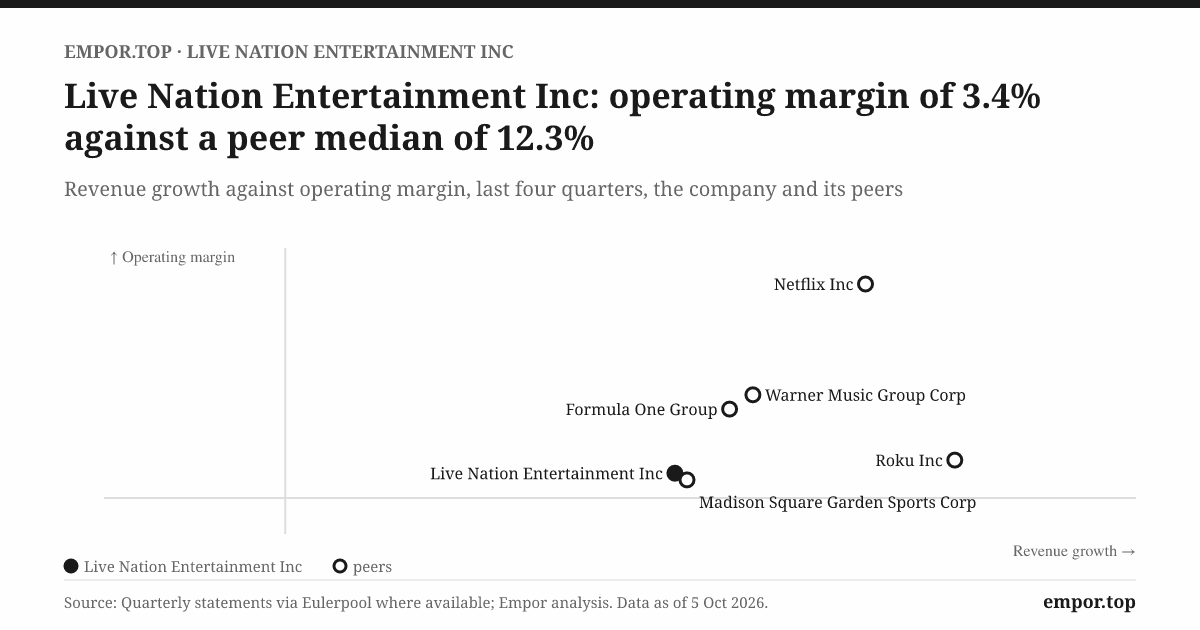
What the deal turned into. The numbers explain why investors came to see this merger as the single most important event in the company's history. In FY2017, seven years after the deal, Live Nation's operating margin was still only about 0.9%.1 By FY2025 it was 5.9%.1 That change was driven by Ticketing and by Sponsorship, the two lines that benefit most from owning both the show and the gate. In the second quarter of 2026 alone, Ticketing produced $331m of AOI.2 The whole of Live Nation's market value today rests largely on that pool.
Benchmarked against what it was worth to buy, the merger was a bargain. The deal was done in stock, at a time when both companies were struggling and Ticketmaster was a recently spun-off unit of IAC. Its rivals today are much smaller. AEG's AXS, the business the consent decree helped create, has never come near Ticketmaster's scale in North America, and SeatGeek, though it won several stadium and team contracts, is a private company that does not publish figures comparable with Ticketmaster's. Data on peer valuations is thin, and there is no clean public comparable. What can be said is that the business bought for stock in 2010 now produces the majority of the profit in a $39bn company.
The fence that failed. The consent decree was supposed to contain the power the merger created. It ran for a decade from 2010, and in 2019 the DOJ found that Live Nation had violated it by threatening venues that considered other ticketers. The decree was extended to 2025 and strengthened.15 Then in May 2024, before that extended term ran out, the DOJ and a group of states sued to break up the company.1510
That record is the strongest falsification test of the merger's original premise. The deal was approved on the theory that behavioral rules could stop a combined promoter and ticketer from using one business to protect the other. Fifteen years of experience, a finding of violation and, in April 2026, a jury verdict of monopolization say the theory did not work.3 The decree was a fence. The power walked around it.
So what? The merger gave Live Nation its profit pool and created the legal exposure that now threatens that pool. Those are not two separate facts. They are the same fact seen from two sides. The rest of the story is about how the company used the merger to build a flywheel, and how that flywheel came to be read by regulators as a trap.
IV. The Flywheel and Where the Money Is Made (2010–2019)
Take one show and look at three lines of its accounts.
The first line is the promotion. Live Nation guaranteed the artist a fee, rented the stadium, paid for staging, security and marketing, and sold the tickets. When the night ends, a good settlement leaves the promoter a few cents for every dollar of ticket sales. The second line is the ticketing fee. For each fee-bearing ticket, Ticketmaster collects a service charge, a share of which it keeps after paying the venue its cut. The third line is the sponsor. The beer brand, the credit-card company and the mobile network pay to be part of the show, often across a whole season of shows, and those cheques arrive with very little extra cost to Live Nation.
Pennies, dollars and cheques. That is the shape of the business.
The numbers behind the shape. In the second quarter of 2026, the Concerts segment reported about $6.44bn of revenue and $310m of AOI, a margin of under 5%.2 Ticketing reported about $852m of revenue and $331m of AOI, a margin near 39%.2 Sponsorship & Advertising earned about $257m of AOI on $383m of revenue, a margin of about two-thirds.2
Put plainly: Concerts carry about 83% of the revenue and earn the smallest share of the profit. Ticketing and Sponsorship carry about 16% of the revenue and earn about 72% of the AOI.2
How the flywheel works. Rapino has described the logic many times. Concerts bring fans. Fans bring sponsors. Ticketing data shows who those fans are. More data means better sponsorship deals and smarter pricing. Profits from those lines let Live Nation pay artists more, which brings more concerts. The company says it pays artists "nearly $15 billion annually".1 That figure is the fuel of the flywheel. It is also the reason Concerts margins are thin: most of the money goes to the talent.
The ticketing side is built on volume. Live Nation sold about 90m fee-bearing tickets in the second quarter of 2026, 8% more than a year earlier.2 It has about 10,500 ticketing clients worldwide.1 Each client is a venue or promoter that has signed a contract, often for several years, to use Ticketmaster for its events.
Feeding the flywheel with acquisitions. The decade after the merger was a buying spree. Live Nation took stakes in or bought festivals and regional promoters around the world. Union Events in Israel in 2016 and a controlling stake in Brazil's Rock in Rio in 2018 are examples, along with a long list of festivals and amphitheaters.17 Most of these deals were small, and Live Nation did not disclose the price for most of them. That makes it impossible to say from the public record which ones paid back. The company's overall return on invested capital, as calculated from its accounts, rose from under 1% in FY2014 to around 35% to 38% in FY2022–24 before falling to about 18% in FY2025.1 That is the consolidated result of all of those decisions together, and it was driven more by Ticketmaster's margins than by any festival purchase.
Venues: from asset to target. Owning amphitheaters, the outdoor sheds on the edge of American cities, was part of the strategy from the start. Owning the room protected Live Nation from paying a venue's markup and gave it control of the ticketing and sponsorship rights. It also gave artists a reason to tour with Live Nation: if you wanted to play the best summer sheds, Live Nation often controlled them. That is exactly what the DOJ later described as a lever of monopoly power, and in April 2026 the jury found Live Nation had monopolized the market for large amphitheaters.3
The pre-COVID baseline. By FY2019, Live Nation had grown revenue to about $11.5bn and operating profit to about $325m, an operating margin of about 2.8%.1 That was a big improvement on the roll-up years, but still a thin margin for a company with that much market power.
A crack in the engine. The flywheel is real, but the latest data says it is not frictionless. In the second quarter of 2026, Concerts AOI fell about 14% while attendance grew about 10%.2 Bigger crowds produced less profit. Management attributed the decline to timing and to a mix of stadium shows, which have higher artist costs.2 That explanation is plausible, but it is a claim, not a proof. A promoter that must pay more for every show to keep artists loyal, at a time when the ticketing gate is under legal attack, is a promoter whose margin may be getting squeezed from two sides.
So what? Live Nation's profit comes from owning the gate, not the stage. That made it a far better business than the pure promoter it started as. It also means the investment case depends on a single, highly profitable line that a court is now examining. Before the courts came, though, there was a moment when none of this mattered, because nobody was buying tickets at all.
V. Near-Death and the Float Machine (2020–2022)
In March 2020, the music stopped. Tours were cancelled across the world in a matter of days. Stadiums went dark, and the summer sheds never opened. For a business whose revenue arrives one show at a time, it was a near-death experience.
Live Nation's revenue fell about 84% in FY2020, from $11.5bn to $1.9bn.1 It made an operating loss of about $1.7bn.1 Shareholders' equity, already modest, turned negative.1
And yet the company held on to a large amount of cash. That cash is the clue to one of the most important features of the business.
Other people's money. When a fan buys a ticket for a show six months away, Live Nation collects the money now. On the balance sheet it is recorded as deferred revenue: cash received for a service not yet delivered. When the show happens, it becomes revenue. If the show is cancelled, the money goes back to the fan.
Ticketmaster also holds cash on behalf of its clients, the venues and promoters whose tickets it sells. That money passes through Ticketmaster's accounts on its way to the client. Live Nation calls it client cash.3
Think of it like a coat check. The attendant holds a lot of coats, but none of them belong to the attendant. During 2020, refund requests meant that coats were going back to their owners, and many fans chose to keep their ticket for a rescheduled date. Live Nation's ability to survive depended partly on how many coats stayed on the rack.
Borrowing to survive. The rest of the survival came from debt. Borrowings rose from about $4.8bn at the end of FY2019 to about $6.5bn a year later, and kept rising to about $12.4bn by FY2025, a figure that includes items such as lease liabilities.1 The company issued senior secured notes and convertible notes. In 2020, Saudi Arabia's Public Investment Fund disclosed a stake of about 5.7%, bought in the market as the shares fell.16 That was a share purchase by an investor, not new equity issued by the company. Over the whole period Live Nation paid no dividends.1 Its equity stayed negative from 2020 through 2023, and turned only slightly positive in FY2024 and FY2025.1
When the business reopened, the cash came in a flood. FY2021 revenue was only about $6.3bn and the company still made an operating loss of about $418m, but cash from operations was about $1.8bn.1 Fans were buying tickets for 2022 shows, and that cash arrived long before the revenue would be recognized.
Profit against cash over twelve years. Over FY2014 to FY2025, Live Nation's cumulative net profit was about −$158m. Over the same years it generated about $10.2bn of cash from operations.1 Those two figures look as if they belong to different companies. There are three reasons they do not.
First, depreciation and amortization are large. Live Nation has bought many businesses and owns many venues, and writing those down eats into accounting profit without using cash. In FY2025, EBITDA was about $2.1bn against operating profit of about $1.5bn.1 Second, the float. As the business grows, the pile of deferred revenue and client cash grows with it, and that growth shows up as operating cash inflow. Third, a share of net profit goes to minority partners in joint ventures, so attributable net profit understates what the operations produce.
The second reason is the one to watch. Float is cash, but it is not profit. It is a liability that happens to be paid in advance.
Today's cash, decoded. At 30 June 2026, Live Nation reported about $9.07bn of cash and equivalents.2 That sounds like a fortress. The company's own measure of "free cash", which strips out money held for clients and deferred revenue related to future events, was about $1.93bn, up from $1.10bn a year earlier.2 Client cash alone was about $1.9bn.3 Event-related deferred revenue was about $6.41bn, up about 25%.2
Set that against debt of about $9.2bn at 30 June, of which about $2.97bn was due within a year.3 That current portion includes the 6.5% secured notes and the 4.75% senior notes due in 2027, together about $2.15bn.3 On a free-cash basis, Live Nation has net debt of roughly $7bn, not net cash.
Receivables are not the issue. Debtor days peaked at 98 in FY2020, when revenue collapsed, and fell back to about 30 by FY2025.1 The balance-sheet risk sits on the other side, in the money the company owes to fans and clients.
What the rating agencies see. Moody's raised Live Nation's corporate family rating to Ba2 from Ba3, with a stable outlook.12 S&P affirmed its BB- rating in November 2024, with a negative outlook at the time.13 Both are below investment grade. That matters for the 2027 refinancing: a junk-rated borrower must refinance in a market that can charge more when the legal outlook is uncertain.
So what? The pandemic proved two things. The business can survive a total shutdown, and the reason it survived is that it runs on customers' money and borrowed money. The structure that saved it is still in place. An investor who counts the $9bn of headline cash as the company's own is counting the coats in the cloakroom. And just as the business came back to full speed, a different kind of crisis hit.
VI. The Eras Tour Meltdown and the Case Against Live Nation (2022–2025)
On 15 November 2022, millions of Taylor Swift fans logged on to Ticketmaster for a presale of the Eras Tour. The site buckled. Queues froze, codes failed, carts emptied. Some fans waited for hours and got nothing. Ticketmaster later cancelled the general sale entirely because of insufficient remaining inventory.
It was a customer-service disaster, but it became something far bigger. In a country where few political issues unite Republicans and Democrats, outrage at Ticketmaster did. In January 2023, the Senate Judiciary Committee held a hearing titled "That's the Ticket", in which Live Nation's President and CFO Joe Berchtold apologized to fans and blamed bot attacks for the collapse.14 Senators from both parties attacked the company's market power.
From outrage to complaint. The case did not come from the Swift onsale alone. The DOJ's antitrust division had been investigating Live Nation's conduct for years, and the 2019 finding of decree violations had already established a pattern.15 But the onsale changed the politics. It gave the investigation a public face, and it made any settlement that left Ticketmaster in Live Nation's hands harder to defend.
In May 2024, the DOJ and a coalition of state attorneys general filed suit, asking the court to break up the company.1015 The complaint was amended in August 2024 to add more states.3 The theory had three parts. First, that Live Nation used long-term, exclusive ticketing contracts to lock venues into Ticketmaster. Second, that its control of amphitheaters and its promotion business let it steer artists toward venues that used Ticketmaster. Third, that it threatened or punished venues that considered rivals, the same retaliation the consent decree had banned.15
The striking feature of that theory is that it is a description of the flywheel described in Section IV, with the sign reversed. What Rapino called a virtuous circle, the government called a closed loop.
Cyber and data risk. The same month the suit was filed, Ticketmaster suffered a major data breach. A hacking group claimed to have stolen data on hundreds of millions of customers through a third-party cloud database, and Live Nation disclosed the incident in a filing.16 The financial cost has not been shown separately in the company's reported results. What the breach signalled was more important than its cost: the fan data that powers the flywheel is also a liability. A company whose customers already distrust it, and whose regulator already argues it holds too much power, cannot afford to look careless with that data.
Management's tone. Through 2024 and 2025, management's public line on earnings calls was consistent: the case had no merit, Ticketmaster was not a monopoly, fees were set by venues, and the company would win in court. Rapino and Berchtold argued that venues, not Ticketmaster, chose and kept most of the fees, and that artists set ticket prices. Those were arguable positions. But the company's confidence was not matched by events. In March 2026 the DOJ settled, and in April the jury found against Live Nation on every remaining claim.310 An investor judging management credibility should note the gap between the tone of those calls and the outcome. The company did not say it would lose, which is normal for a defendant. It did tell investors that the case posed little risk to the business model, and a jury disagreed.
So what? Outrage did not cause the case. Years of conduct and a broken decree did. But the Eras Tour made it far harder for any government to settle on terms that left the company intact, which is why, when the federal government did settle, the states kept going.
VII. The Verdict: A Settlement, a Jury, and $450 Million
In early March 2026, the trial of United States v. Live Nation began in federal court in Manhattan. Within days, the Department of Justice settled.
The settlement terms, as reported, were softer than many expected. Live Nation would keep Ticketmaster. It would open its venues to rival ticketers, sell certain amphitheaters, and accept a cap on ticketing fees reported at 15%. It also set aside about $281m for the states that signed on.10 For Live Nation, it was the outcome management had worked for: no break-up. The structure of the settlement still needed to be confirmed in court filings, and the reported fee cap and divestitures are the details investors should check as the decree is finalized.
But the case did not end. A coalition of states refused to join the settlement and continued to trial. On 15 April 2026, the jury returned its verdict. It found that Live Nation and Ticketmaster had unlawfully monopolized the market for primary ticketing at major concert venues, the market for large amphitheaters and the market for concert promotion in violation of Section 2 of the Sherman Act. It also found that the company had unlawfully tied its services in violation of Section 1.3 Every remaining claim went to the states.
The damages. The jury found that fans had been overcharged by $1.72 per ticket on sales from May 2020 through 2024, at roughly 257 venues, without setting the total number of tickets.6 Live Nation estimates that single damages would be under $150m. Antitrust damages are trebled, which would put the figure under $450m. The company said it had accrued $280m for settlement obligations.6
At a post-trial hearing on 31 July 2026, Live Nation asked the judge to throw out the verdict or grant a new trial.6 The judge voiced "significant concerns" about the states' damages analysis.6 As of early October 2026, no ruling had been issued.
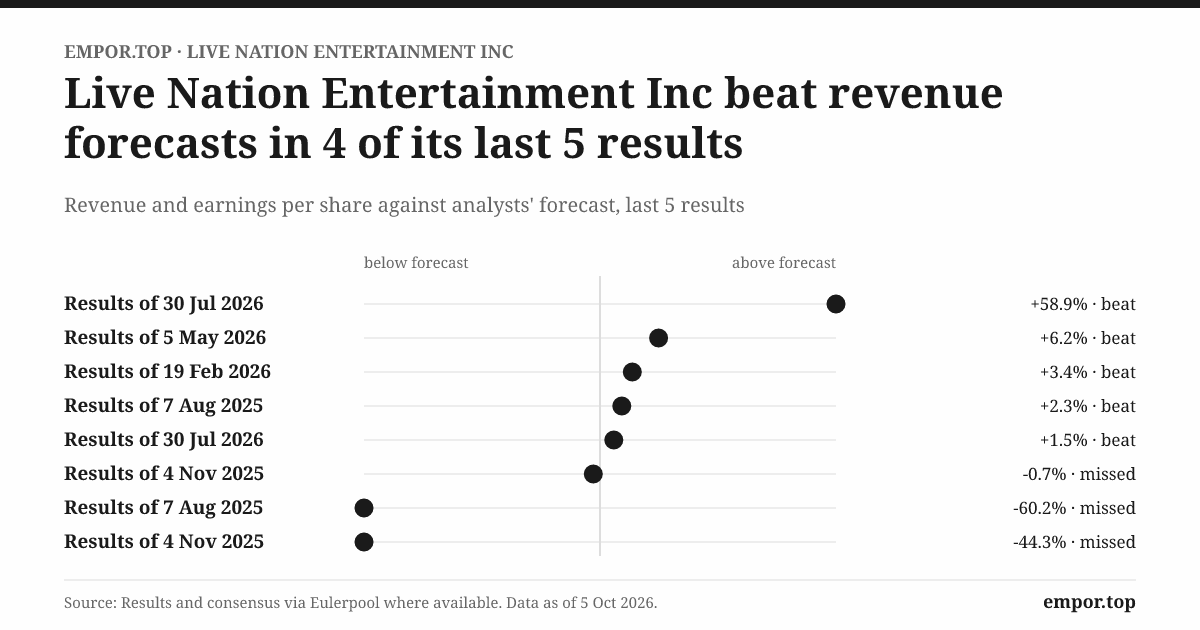
The charge and the loss quarters. In the first half of 2026, Live Nation recorded a provision of about $450m for governmental investigations and litigation.2 That provision is the main reason the first quarter of 2026 showed an operating loss of about $377m.1 The fourth quarter of 2025 also showed a small operating loss.1 Together, those two quarters dragged the last twelve months' net profit down to about $134m, against $896m in FY2024.1
So is the earnings drop a one-off?
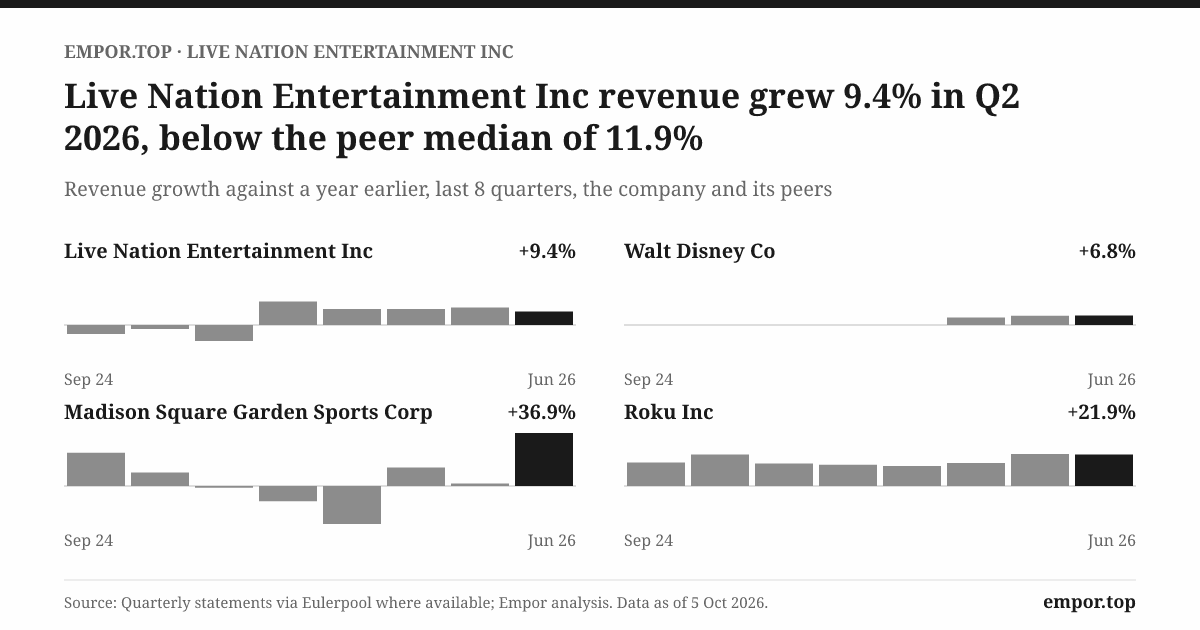
The case for one-off. Strip out the litigation charge, and the operating story is steady. Revenue grew about 9% in the second quarter of 2026.1 Ticketing AOI rose about 14%, and fee-bearing tickets rose 8%.2 Management reaffirmed guidance for double-digit AOI growth for the full year.2 Deferred revenue was up about 25%, and the company had sold more than 143m tickets for 2026 shows by mid-July.2
The case for lower underlying profit. But not every weak number is the lawsuit. Concerts AOI fell about 14% in the second quarter on higher attendance.2 And the clearest sign of strain appeared before the verdict. In FY2025, cash from operations was only about 67% of EBITDA, against about 107% in FY2024, and free cash flow fell to about $305m from about $1.1bn.1 That fall reflected heavier capital spending and working-capital timing, not the provision, which came later.
Guidance discipline. Management's claim that AOI would grow double digits in 2026 while the company was booking a nine-figure operating loss in the first quarter is not a contradiction: AOI, by the company's own definition, excludes items like the litigation charge. That is common practice. But it means the headline measure management steers investors toward is the one that leaves out the thing investors are most worried about. The test of the claim will be FY2026's reported free cash flow, which does not adjust anything away.
Verdict. The charge explains the loss quarters. It does not explain the weak FY2025 cash conversion or the fall in Concerts margin. The claim that the earnings fall is purely a one-off is narrowed, not rejected: the litigation is most of the drop in reported profit, but underlying profit is thinner than the 2024 peak suggested, and the real cost of the verdict will be set by the remedies, not the damages.
That brings the story to the question that matters most.
VIII. The Moat Test: Does the Toll Booth Survive? (Frameworks)
Imagine a venue manager at a 20,000-seat arena in 2028. The arena's Ticketmaster contract is up for renewal. Under the new rules, whatever they turn out to be, the venue is free to choose another ticketer, and Live Nation is barred from threatening to steer tours elsewhere if it does. SeatGeek has made an offer. So has AXS. Each offers a bigger share of fees and a signing bonus.
What does the manager do? The whole value of Live Nation's profit pool hangs on that decision, multiplied by roughly 10,500 clients.1
The remedies trial, a bench trial before the judge rather than a jury, is expected to begin around February 2027 and could run into the spring.11 The states want full structural separation of Live Nation and Ticketmaster.11 Before considering the scenarios, it is worth arguing the moat once, properly.
Porter's five forces
Buyer power is split. Fans have little power individually; they cannot shop for a different ticketer for a sold-out show. But the real buyers of ticketing services are venues, and the big ones have real leverage. A stadium owned by an NFL team can and does switch ticketers. The verdict will increase venue power by making it safer to switch.
Supplier power is strong. The suppliers to Concerts are artists, and the top artists capture most of the economics. That is why Concerts margins are thin, and why the Q2 decline in Concerts AOI on higher attendance is worrying: the suppliers are pushing back.2
Threat of new entrants has been low in primary ticketing because of exclusive contracts and Ticketmaster's scale. A court-ordered opening of venues lowers that barrier more than any technology could.
Substitutes are limited. There is no substitute for seeing a live show. Resale platforms compete for part of the fee pool but rely on primary tickets being sold first.
Rivalry has been muted in North American primary ticketing, which is precisely what the jury found.
Hamilton Helmer's 7 Powers
Scale economies. Real. Ticketmaster's technology, fraud controls and onsale capacity cost a great deal to build and are spread across a huge volume of tickets. A smaller rival with the same cost base would have higher unit costs. But scale did not stop the Eras Tour meltdown, and scale in software is less durable than scale in physical assets.
Switching costs. Real, but partly contractual. Venues sign multi-year deals, integrate systems and train staff. Some of that is genuine switching cost. Some of it, according to the jury, came from Live Nation's ability to reward venues that stayed and punish those that left. Remove that second part, and the switching cost may be much lower than the past retention rate suggests.
Network economies. Partial. More events attract more fans to the platform, and more fans make the platform more valuable to venues. But fans do not choose ticketers; they follow the show. That makes this network weaker than it looks.
Counter-positioning. This is the power rivals hold against Live Nation. SeatGeek and AXS can offer venues more of the fee pool because they do not need to protect a promotion business. Live Nation cannot match that easily without hurting its own margins.
Cornered resource. The amphitheaters and the artist relationships are the closest Live Nation has to a cornered resource, and the jury found them to be instruments of monopoly. The DOJ settlement reportedly requires the sale of some amphitheaters.10
Process power and brand. Ticketmaster's brand is widely recognized and widely disliked. That is an unusual combination: it gives the company reach but no goodwill to draw on.
Competitors and scale
AEG Presents is the main rival in promotion and owns AXS, the ticketer built partly on the software license the 2010 decree required. AEG is private and its figures are not published in a way comparable to Live Nation's. SeatGeek, also private, has won stadium and team contracts but is far smaller than Ticketmaster in concerts. Eventbrite is a public company focused on smaller, self-service events, and is not a direct rival for arena tours. Data on relative scale is thin, and that thinness is itself a sign of Ticketmaster's dominance: no rival publishes figures that would invite comparison.
The substitution test
The best evidence of a moat is what happens when a customer has a free choice. The record here is mixed. A number of sports venues and some arenas have moved to SeatGeek or AXS over the past decade, which shows that substitution is possible. But the jury's finding that Live Nation retaliated against venues means that the past retention record cannot be taken as proof of customer preference. Some of that loyalty was bought or enforced.
Remedy scenarios mapped to the profit pool
Full separation. If Ticketmaster is spun off or sold, Live Nation's shareholders would likely receive shares in, or proceeds from, the separated business. The value does not vanish, but the flywheel breaks: Ticketing would no longer have privileged access to Live Nation's shows, and Concerts would lose the profit that subsidizes its thin margins. The combined value would almost certainly be lower than today.
A ticketing carve-out of venues and amphitheaters. Forced sale of some amphitheaters and an end to exclusive contracts at Live Nation-owned or operated venues would weaken the loop without breaking the company. This resembles the DOJ settlement.
Behavioral remedies and fee caps. A fee cap, open venues and conduct rules would cut into Ticketing margins directly. The reported 15% cap in the DOJ deal is the first marker for how large that cut might be.10
The states also have new weapons. After the verdict, California gave its attorney general a new tool for monopoly enforcement, a sign that state-level actions may follow regardless of the federal outcome.7
Verdict on the moat. Scale, venue contracts and fan data are real advantages. But they are exactly what the verdict attacks. The moat is intact but unproven under open venues, because the company has never had to defend its ticketing share without the leverage of its promotion business. The KPIs that will answer the question are Ticketing's fee-bearing volume and its AOI margin, quarter by quarter, through and after the remedies.
That makes the decisions of the people running the company, and how they are paid to make them, more important than ever.
IX. Management, Pay and Capital Allocation
On 30 September 2026, Live Nation's board signed a new contract with Michael Rapino. It runs through 31 December 2031.4 From 2027, Rapino's target pay will be about $60m a year, double the previous target of about $30m.47 It is made up of a $3m salary, a $17m target cash bonus, $10m of performance shares, $15m of restricted stock units and $15m of performance stock units.7 On top of that, Rapino received an upfront grant of about $20m in RSUs, or 117,805 units, vesting through 2031.4
The timing is the story. The contract was signed after a jury had found the company guilty of monopolization and months before a judge decides whether to break it up.
The man
Rapino has run Live Nation for more than two decades, since August 2005.5 That tenure gives him a level of strategic consistency rare among American CEOs. The plan he described after the 2005 spin-off—use concerts to gather fans, then make money from the fans through tickets and sponsorship—is the plan the company still runs. He executed it through the Ticketmaster merger, through the pandemic and through a decade of acquisitions. Few CEOs can point to a strategy laid out in 2005 that still describes the company twenty years later.
But consistency cuts both ways. The same strategy that built the profit pool also built the legal case. Rapino's explanations of the Eras Tour collapse and of the antitrust case on earnings calls tended to stress outside factors—bots, venue-set fees, artist pricing—rather than the company's own conduct.14 A jury did not accept that framing. Joe Berchtold, the President and CFO, has been Rapino's partner through most of that period and was the public face of the company at the 2023 Senate hearing.514
The owners
Liberty Live Holdings, created from Liberty Media's split-off in December 2025, holds about 29.62% of Live Nation and can nominate two directors.5 The board has 12 directors, 11 of them independent.5 Liberty's stake makes it the single largest voice among shareholders, and its support is important for any pay package.
Executives as a group held stock worth nearly $1bn after an August 2026 vesting.8 In December 2025, the company bought back 166,107 net shares from executives, a transaction disclosed in the proxy.5 That is a small amount, but it is the kind of detail a skeptical investor reads closely: a company that does not buy back shares from the market did buy them back from insiders.
The bull and bear on pay
For the package. About 70% of the target pay is performance-based.7 The PSUs pay out between zero and twice the target, depending on Live Nation's total shareholder return relative to the S&P 500.7 If the remedies destroy value, the PSUs will pay little. In March 2026, Bloomberg reported that part of Rapino's pay had been tied to resolving the DOJ problem, a clear link between pay and the most important outcome for shareholders.9 Stockholders also get a say-on-pay vote.
Against the package. Doubling pay before the remedies ruling looks like the board is paying for a result that has not yet happened. The $20m upfront grant vests over time, but it is not tied to performance. Relative TSR rewards beating an index, not avoiding a break-up: if the whole market falls and Live Nation falls less, the PSUs can pay even if shareholders lose money. And a CEO whose strategy produced the legal exposure is being paid more to manage its consequences.
The previous say-on-pay results and Summary Compensation Table are disclosed in the proxy.5 The 2027 say-on-pay vote is the clearest test of whether shareholders other than Liberty agree with the board.
Related parties
The proxy discloses transactions with the Atlanta Braves, a team controlled by Liberty-related entities: about $32.2m of revenue and about $19.2m of expenses in 2025.5 That is about 0.1% of revenue, immaterial to the economics. The FY2025 10-K also identifies a related-party relationship with Azoff-linked entities.1 Neither changes the investment case, but both are the kind of item a governance review should track.
Capital allocation
Live Nation has never paid a dividend.1 It did not guide to share buybacks for 2026, and said it does not expect its share count to change materially.2 Its main use of cash is capex, and that has risen sharply. Capex can be read from the gap between operating cash flow and free cash flow: in FY2025 it was roughly $1.1bn, about 4.4% of revenue, against about 1.6% in FY2023.1 Property, plant and equipment more than doubled from about $2.5bn in FY2019 to about $5.3bn in FY2025.1
Most of that spending is on venues. In Europe, the company formed VenueCo and raised a €610m facility in April 2026 to fund it.3 It also carries about $3.5bn of convertible notes due 2029, 2030 and 2031.3
The skeptic's stress test
An activist would ask a simple question. Why is Live Nation spending more than ever on venues, including amphitheaters, at the very moment a jury has found that its control of amphitheaters is part of a monopoly? If the remedies force sales, the company may end up building assets it later has to sell at a discount.
The same activist would ask why the board doubled the CEO's pay before the ruling rather than after. And why the share of AOI from the regulated ticketing business has grown, not shrunk, during the years the company knew it was under investigation. Management's answer is that venues are the growth engine of Concerts and that demand for live events is strong. That is plausible. But it is also an answer that assumes the remedies will be mild.
So what? The package is incentive-heavy on paper, but its timing invites doubt, and its structure rewards relative performance in a case where the absolute outcome matters most. The capital allocation record shows a company committing more capital to the assets most at risk. Both sides have a fair argument, and the say-on-pay vote is where shareholders will say which they believe.
X. Playbook: Business & Strategic Lessons
"Own the show and the gate, and regulators will count both." In January 2010, Live Nation won the merger it needed and the profit pool that came with it. It took sixteen years for the bill to arrive. The lesson for founders who build vertical integration is that every link in the chain is also a count in an indictment. The more value you capture from owning both ends, the more a court will see those two ends as one closed loop. The best moats are the ones a regulator cannot describe in a single sentence. Live Nation's could be described in five words: it owns the shows and the tickets.
"Float is not profit." In 2021, while Live Nation was still losing money on paper, it collected about $1.8bn of operating cash. Twelve years of accounts show cumulative net losses alongside more than $10bn of operating cash.1 Investors who treated that cash as earnings misread the business. The money belonged, in the first instance, to fans who had paid for shows not yet played and to venues whose takings sat in Ticketmaster's accounts. The wider lesson: when a company holds other people's money, ask what it would look like if they all asked for it back. In 2020, Live Nation found out.
"A consent decree is a promise, not a moat." For fifteen years the 2010 decree stood between Live Nation and a break-up. The company treated it as permission. The government treated it as probation. When the probation was broken, the decree became evidence. A regulatory settlement buys time, not safety, and the time is worth only what the company does with it.
"A bad onsale becomes a federal case." On 15 November 2022, a ticketing failure turned a long-running antitrust investigation into a cause that united senators who agree on little else.14 The underlying conduct had been going on for years, but it took one failed presale to make it impossible for a government to look away. For any company with market power, the risk is not just what it does but how it fails in public. Operational stumbles do not create antitrust cases. They do decide whether governments settle them.
"Pay your CEO double before the verdict is final, and the market will read the timing." On 30 September 2026, the board chose to lock in Rapino's leadership through 2031 before knowing what company he would lead.4 Boards that want to show confidence often choose the wrong moment to show it. A pay rise that would look like a reward after a favourable ruling looks like insurance before one.
When scale becomes liability. The deepest lesson is about two-sided markets. Live Nation sits between artists and fans, and between venues and ticket-buyers. Its scale makes it valuable to both sides, until one side—or the government acting for it—decides the middleman has taken too much. The bigger the platform, the more its value depends on being seen as fair. Live Nation built the most valuable gate in live music and never persuaded the people walking through it that the toll was fair.
XI. Bull vs. Bear and the KPIs
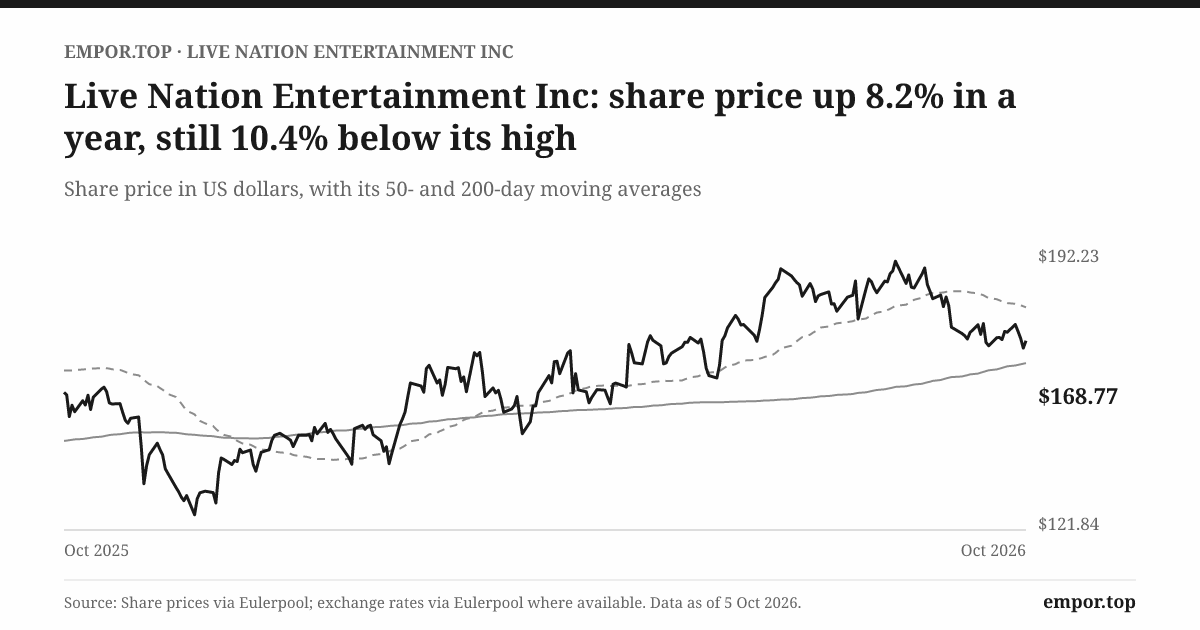
On 5 October 2026, Live Nation's shares closed at $168.77, about 10% below their 52-week high of $188.46 and well above the low of $125.61.1 The market values the equity at about $39.1bn and the enterprise at about $41.3bn.1
At that price, what is priced in?
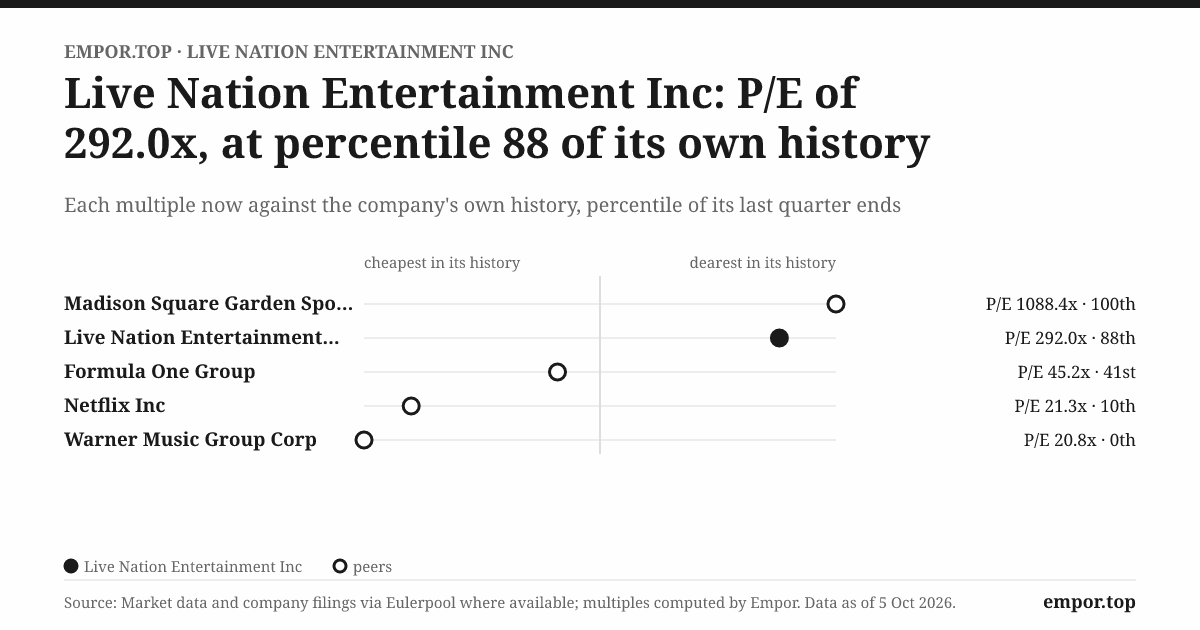
The distorted multiple. The trailing price-to-earnings ratio is about 292 times, against a five-year median of about 41 times.1 That figure is almost meaningless: it divides the price by earnings that were depressed by the $450m litigation provision. Earnings per share over the last twelve months were only about $0.59.1 A better guide is enterprise value to EBITDA, about 24 times, and the free cash flow yield, about 3.5%.1 Those measures say the market is pricing Live Nation as a high-quality, growing business—the multiple of a company expected to keep most of its profit pool.
Price-to-book of about 482 times is also unhelpful: book equity is close to nothing, at about $0.36 per share, because of the losses and the debt-funded structure built up since 2020.1
The bull case
Volume visibility is strong. Deferred revenue was up about 25%, and more than 143m tickets had been sold for 2026 by mid-July.2 Ancillary revenue from fans at venues is growing. The DOJ settlement, the federal government's own view of the right remedy, left Ticketmaster inside Live Nation.10 The judge's "significant concerns" about the damages model suggest the financial penalty may be reduced.6 If the remedies trial produces something close to the DOJ settlement, the bull would argue that the worst is priced in and that the profit pool survives with a fee cap and open venues.
The bear case
The jury found monopolization on every claim the states brought.3 The states are asking for full separation.11 Even without separation, open venues and fee caps could take a slice out of the 39% margin in Ticketing. Concerts margins are under pressure. Debt is about $9.2bn, with about $2.15bn of 2027 notes to refinance, at a time when the outcome of the remedies trial will not yet be known.3 Shareholders' equity is close to zero.1 A bear would argue that a multiple of 24 times EBITDA prices in a moat that a court has just found to be illegal.
Myth versus reality
Myth: Live Nation has $9bn of cash. Reality: about $1.9bn is free cash; the rest is client money and fan prepayments.23
Myth: The P/E of 292 shows the stock is absurdly expensive. Reality: the P/E is distorted by a one-time provision; the EV/EBITDA multiple is high but not absurd for a business of this quality.
Myth: The DOJ settlement ended the case. Reality: the states won at trial and the remedies phase is still ahead.11
The KPIs that matter
Three measures will tell investors whether the toll booth survives:
- Fee-bearing tickets. About 90m in the second quarter of 2026, up 8%.2 This is the volume of the toll booth. A decline would mean venues are switching.
- Ticketing AOI margin. About 39% in the second quarter ($331m on $852m), with AOI up about 14%.2 This is the price the toll booth can charge. A fee cap would show here first.
- Free cash against reported cash. About $1.93bn against $9.07bn at the end of June.2 This is the honest measure of the balance sheet.
Risk radar
Regulation is the dominant risk. Refinancing is next: the 2027 maturities and a junk rating mean the company must borrow during uncertainty. Demand is cyclical, as 2020's 84% revenue collapse showed in the extreme.1 Cyber and data risk is real after the 2024 breach.16 And FX matters more than before, now that the company has euro-denominated debt at VenueCo.3
So what? The trailing P/E is noise. The EV/EBITDA multiple and the free cash flow yield say the market expects the profit pool to survive largely intact. The case turns on the remedies and on free cash.
XII. Epilogue
Tonight, Live Nation is a company that has won and lost the same case. The federal government settled and let it keep Ticketmaster. A coalition of states won a jury verdict on every claim and wants Ticketmaster taken away.31011 The company's revenue is still growing, its tickets for next year are selling ahead of last year, and its CEO has just signed up for another five years at double the pay.24
What happens next will be decided by a handful of moments.
The ruling on post-trial motions. The judge could throw out the verdict, order a new trial, reduce the damages or let everything stand.6 A ruling that the damages model was flawed would cut the cash cost of the case. A ruling that sets aside the liability findings would change everything; a ruling that leaves them intact puts the remedies trial at the centre of the story.
The remedies trial, from around February 2027. This is the event that decides the first and most important question.11 A full separation would break the flywheel and test whether Ticketmaster can stand alone. Open venues and fee caps would leave the company intact but take a slice out of the profit pool. A remedy close to the DOJ settlement would vindicate the bull case.
The 2027 refinancing. About $2.15bn of notes come due in 2027.3 How easily and at what rate Live Nation refinances them will show what lenders think of the remedies risk, and will answer the third question about how much of the cash is truly the company's.
The say-on-pay vote. The next annual meeting will give shareholders their first formal chance to judge Rapino's new contract.5 A large vote against would signal that investors other than Liberty read the timing as a warning. A strong vote in favour would say the market trusts the man to steer the company through the remedies.
FY2026 results. Full-year AOI, the final litigation charge and, above all, free cash flow will show whether the earnings fall was a one-off. If free cash flow recovers toward its pre-2025 level while Concerts margins stabilize, the one-off argument wins. If it does not, the underlying business is thinner than the AOI headlines suggest.
The tension that remains is simple. The company's value is built on the very thing the courts are judging. Every good quarter in Ticketing makes the profit pool more valuable and the case against it stronger.
XIII. Outro
Go back to the stadium gate. Sixty thousand people, phones up, wristbands on. The promoter is counting heads. The ticketer is counting fees. The sponsor is counting eyeballs. For two decades, they have very often been the same company, and that company has turned a low-margin, handshake business into one of the most valuable franchises in entertainment.
Live Nation did not build the toll booth by being loved. It built it by owning both sides of the door. Now a judge will decide whether one company may keep holding the door, and the 60,000 people coming through the gate will find out what their ticket was really paying for.
References
-
Live Nation Entertainment, Inc. Form 10-K FY2025 — SEC, 2026 ↩↩↩↩↩↩↩↩↩↩↩↩↩↩↩↩↩↩↩↩↩↩↩↩↩↩↩↩↩↩↩↩↩↩↩↩↩↩↩↩↩↩↩↩
-
Live Nation Entertainment Reports Second Quarter 2026 Results — PR Newswire, 2026-07-30 ↩↩↩↩↩↩↩↩↩↩↩↩↩↩↩↩↩↩↩↩↩↩↩↩↩↩↩
-
Live Nation Entertainment, Inc. Form 10-Q for the quarter ended 30 June 2026 — SEC, 2026 ↩↩↩↩↩↩↩↩↩↩↩↩↩↩↩↩↩↩↩
-
Live Nation Entertainment, Inc. Form 8-K (Rapino agreement) — SEC, 2026-10-02 ↩↩↩↩↩↩
-
Live Nation Entertainment, Inc. 2026 Definitive Proxy Statement — SEC, 2026 ↩↩↩↩↩↩↩↩↩
-
Live Nation and Ticketmaster ask court to throw out monopoly verdict, or grant new trial — Music Business Worldwide, 2026-07 ↩↩↩↩↩↩
-
Live Nation Extends Michael Rapino Through 2031 With $60 Million Target Pay Package — TicketNews, 2026-10 ↩↩↩↩↩
-
Live Nation executives hold nearly $1 billion in stock as new equity tranche vests — TicketNews, 2026-08 ↩
-
Live Nation CEO's pay tied to solving DOJ antitrust problem — Bloomberg, 2026-03-19 ↩
-
Live Nation, Ticketmaster DOJ antitrust case — NPR, 2026-03-09 ↩↩↩↩↩↩↩↩
-
Penalties phase of Live Nation ticket monopoly trial will stretch into 2027 — Courthouse News, 2026 ↩↩↩↩↩↩↩
-
Live Nation's credit rating improved by Moody's, outlook stable — Investing.com ↩
-
Live Nation Entertainment Investor Relations — Live Nation ↩↩↩
 LinkedIn
 WhatsApp
 Reddit
 Hacker News
 Email
 Kindle
 RSS Feed
 Spotify
 Apple Podcasts
 Amazon Music
 Audible
 YouTube