Coca-Cola: The Real Thing Behind $375 Billion
I. Introduction & Episode Setup
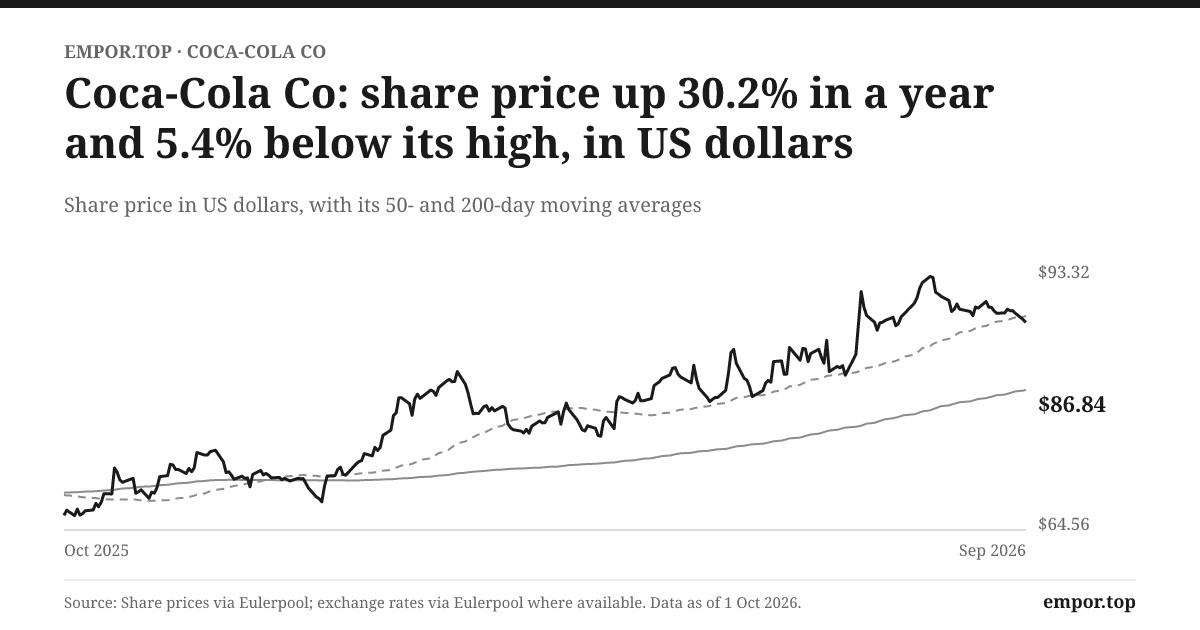
In the first year it was sold, Coca-Cola averaged nine drinks a day.3 Nine glasses, poured at a single soda fountain in Atlanta, at five cents apiece. One hundred and forty years later, the company that grew out of that fountain sits at the centre of a system that serves roughly 2.2 billion beverages every day across more than 200 countries.1 On October 1, 2026, its shares closed at $86.84, giving The Coca-Cola Company a market value of about $375 billion and an enterprise value, once debt is added and cash subtracted, of about $402 billion.17
Most investors think they already know this story. Coca-Cola is the sleepy one. It is the stock grandparents own, the "Dividend King" that has raised its payout for 63 consecutive years,1 the company Warren Buffett bought after the 1987 crash and never sold. It is the corporate equivalent of comfort food: reliable, a little boring, and priced accordingly.
That picture is about half right, and the wrong half is where the interesting story lives.
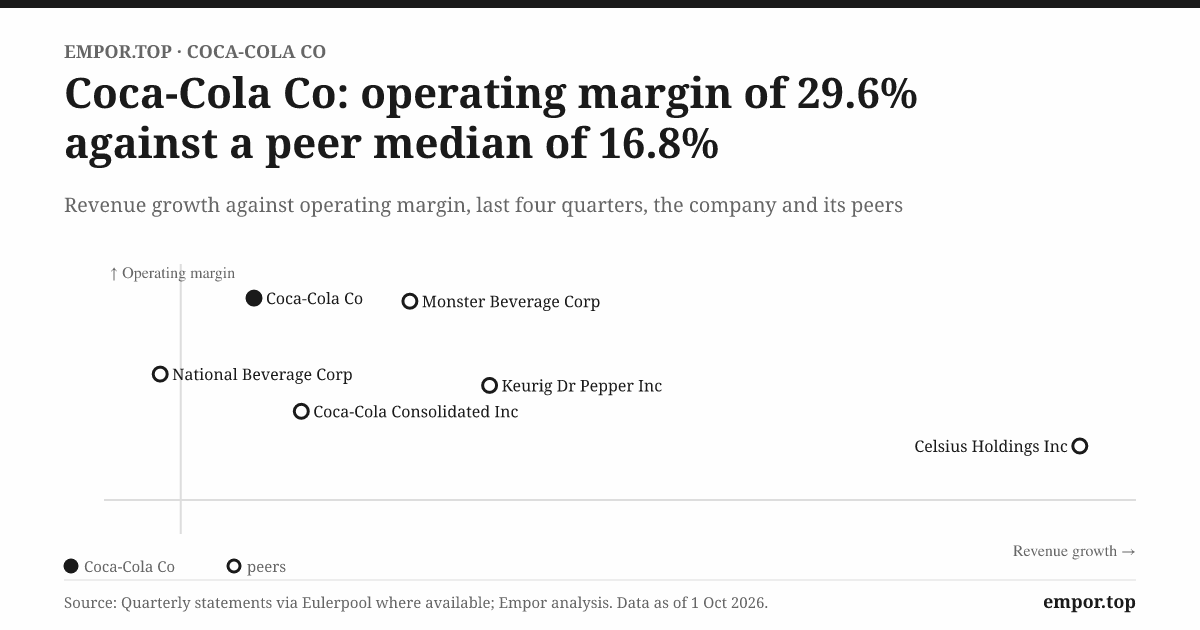
The modern Coca-Cola is not really a bottler, and in many ways it is not even a beverage manufacturer in the sense most people imagine. It is a brand-and-formula owner that sells concentrate (the flavoured syrup base) to a worldwide web of mostly independent bottlers, takes a toll on every case they sell, and leaves them to own the trucks, the factories, the coolers and the payroll. Over the last decade it pulled off one of the more dramatic balance-sheet transformations in consumer goods, shrinking its reported revenue by more than a quarter on purpose so that what remained could earn far more on every dollar of capital. Operating margin rose from about 21% in 2014 to about 29% in 2025, and has run near 35% in the first half of 2026.12
But three tensions sit under the calm surface, and they organise everything that follows.
The first is the tollbooth versus the treadmill. Refranchising made Coca-Cola extraordinarily profitable per unit, yet the number of units barely moves. Worldwide unit case volume was flat in 2025, and growth has come almost entirely from price and mix.1 A tollbooth is a wonderful business while the traffic keeps coming; the question is what happens when the toll goes up and the traffic does not.
The second is a tax fight that has quietly become one of the largest contingent liabilities in American business. Coca-Cola has already wired $6.0 billion to the Internal Revenue Service as a deposit while it appeals a transfer-pricing loss, and it estimates that applying the same logic to later years would cost a further $14.0 billion, plus a permanent increase of about 3.5 percentage points in its tax rate. Against all of that, it carries a reserve of about $512 million.1 The Eleventh Circuit heard oral argument on June 25, 2026, and has not yet ruled.11
The third is capital discipline. Over the twelve years from 2014 to 2025, Coca-Cola paid out about $83.9 billion in dividends against about $91.7 billion of free cash flow, roughly 92 cents of every free dollar.1 Meanwhile its forays beyond fizzy concentrate have a mixed record: one big win in fairlife milk, a costly coffee-shop chain in Costa, and $1.72 billion of write-downs on the sports drink BodyArmor.1
The route through all of this runs from the 1899 contract that accidentally created the concentrate model, through Roberto Goizueta's financial revolution and Buffett's arrival, into the Great Refranchising, the acquisition record, the IRS showdown and the cash-flow forensics, then to governance, the moat, and finally the question of what $375 billion is paying for. The story begins, as the business itself did, with a decision its maker considered minor.
 Subscribe on LinkedIn
II. Origins of the Concentrate Moat: The Accidental Tollbooth (1886–1980)
A pharmacist's syrup
On May 8, 1886, Dr. John Stith Pemberton, an Atlanta pharmacist, carried a jug of his new syrup down to Jacobs' Pharmacy, where it was mixed with carbonated water and sold for five cents a glass.3 Pemberton was a chemist and a Confederate veteran who had spent years tinkering with patent tonics. He was not, by any evidence, a great businessman. His partner and bookkeeper, Frank M. Robinson, had the better commercial instincts: he came up with the name, reasoning that "the two Cs would look well in advertising", and penned the flowing script that still appears on every can.3
Pemberton died in 1888, having sold his remaining interest that year to Asa Griggs Candler, an Atlanta druggist and businessman.3 Candler consolidated control and had spent about $2,300 to own the business outright by 1891.4 It was, by any measure, one of the cheapest acquisitions in business history.
Candler was a born salesman. He handed out coupons for free drinks, plastered the name on calendars, clocks and urns, and pushed the syrup to soda fountains far beyond Georgia. In his mind, the business was the fountain. Syrup went out in barrels; druggists mixed it with soda water; customers drank it at the counter. That was where the money was.
The contract of 1899
So when two Chattanooga lawyers, Benjamin F. Thomas and Joseph B. Whitehead, came to him in 1899 wanting to put Coca-Cola into bottles, Candler did not think he was giving away much. He granted them the exclusive rights to bottle and sell Coca-Cola across practically the entire United States.4 Business lore holds that the price was nominal; what matters more is what Candler kept and what he gave away. He kept the formula and the trademark, and the right to sell syrup. He gave away the hard part: the plants, the glass, the delivery wagons, the local labour and the capital to fund all of it.
Thomas and Whitehead brought in a third Chattanoogan, John T. Lupton, and, lacking capital to cover a whole nation themselves, began carving the country into territories and granting sub-franchises to local entrepreneurs.4 The first bottling plant opened in Chattanooga in 1899, the second in Atlanta the following year.4 Within two decades, more than a thousand local bottlers were selling Coca-Cola, each owning its own trucks, each building its own route, and each buying syrup from Atlanta.
That two-tier structure is the founding fact of this story. One tier owns the brand and the recipe and sells a small quantity of something very valuable. The other tier owns the physical system and does the expensive, low-margin work of turning that concentrate into cold drinks on shelves. Candler did not set out to invent the world's greatest capital-light licensing machine. He simply misjudged where the profit lived, and the misjudgment turned out to be genius. By 1916, the bottlers were coordinated enough to approve a shared, distinctive contour bottle designed by the Root Glass Company of Terre Haute, Indiana, a sign that the franchise system had become a system rather than a scattering of licensees.4
The Woodruffs
In 1919, Candler's family sold the company for $25 million to a group of investors led by Ernest Woodruff.4 Four years later, in 1923, his son Robert Winship Woodruff took over as president. Robert Woodruff was a college dropout who had been a truck salesman, and he would run or shadow the company for six decades. His obsession was ubiquity: Coca-Cola should be "within an arm's reach of desire". He standardised quality across the bottling network, pushed six-packs and coolers, and turned the brand into an advertising institution.
His defining moment came in 1941. Woodruff ordered "that every man in uniform gets a bottle of Coca-Cola for 5 cents, wherever he is and whatever it costs the Company."5 Within six months a company engineer had flown to Algiers to open the first plant, the forerunner of 64 bottling plants shipped abroad during the Second World War; servicemen consumed more than 5 billion bottles.5 The wartime plants did something no marketing budget could buy. They built a global bottling footprint largely on the logistics of the U.S. war effort, introduced the drink to a generation in Europe and Asia, and left behind the seeds of local franchise systems after the soldiers went home.
The nickel straitjacket
There is a myth worth puncturing here. Coca-Cola's famous five-cent price, which held from 1886 until the late 1950s, is often told as a story of branding brilliance: the nickel Coke as a democratic constant. The reality is less flattering. The fixed price was in large part an artefact of Coca-Cola's own legal architecture. Early bottler contracts fixed the price of syrup in perpetuity, and coin-operated vending machines were built around a single nickel. When sugar prices spiked after the First World War, the company found itself unable to pass costs through, and the bottler contracts had to be renegotiated in the early 1920s and again in the late 1970s.
That history is the first falsification test of the "pricing power" story that sits at the heart of today's bull case. Coca-Cola's brand was powerful from early on, but for decades its ability to monetise that power was capped by the very franchise contracts that made the system work. The lesson carries forward: the concentrate model gives the brand owner enormous returns on capital, but it also makes the brand owner dependent on the health and goodwill of the bottlers. Push them too hard, and the system pushes back.
By the 1970s, it was pushing back. Inflation squeezed bottlers' margins, many family franchises were too small to invest, and the U.S. system had fragmented into hundreds of operators of uneven quality. The franchise model that had built the brand was starting to hold it back. It would take a Cuban chemical engineer with an accountant's eye to fix it.
III. The Goizueta Blueprint & Buffett's Validation (1981–1997)
A chemist who thought like a banker
Roberto Goizueta had arrived in America from Havana, a Yale-trained chemical engineer from a wealthy Cuban family who joined Coca-Cola's Havana operation in the 1950s and left Cuba after Castro's revolution with little more than his shares in the company. He rose through the technical side of the business, an unusual path to the top of a marketing company, and became chairman and chief executive in 1981. He was formal, precise and relentless about one question that Coca-Cola's old guard had rarely asked: what return is this company earning on the money it uses?
His partner was Don Keough, the gregarious Iowan president who handled bottlers, customers and the company's emotional temperature. Goizueta supplied the arithmetic; Keough supplied the warmth. Together they ran Coca-Cola for most of the next sixteen years.
Goizueta's insight was that a company that earned high returns on its concentrate but tied up money in low-return assets was hiding its own quality. He adopted economic profit (sometimes called economic value added: profit after charging for the capital used to earn it) as the company's guiding metric, cut businesses that did not clear the bar, and borrowed modestly to buy back shares. It sounds ordinary now. In the early 1980s, at a consumer company famous for its ads, it was close to heresy.
Breaking the sacred rule
His first big product move broke another taboo. For nearly a century, the company had refused to put the name "Coca-Cola" on anything but Coca-Cola. In 1982, Goizueta launched Diet Coke, and it became one of the most successful launches in the history of packaged goods. It proved that the brand could stretch without breaking.
Three years later, it nearly broke anyway. In April 1985, worried about Pepsi's success in blind taste tests, the company replaced its formula with a sweeter "New Coke". The test data said consumers would prefer it. The public reaction said something else entirely: letters, protests and hoarding. Within about three months, the original returned as "Coca-Cola Classic". The episode is usually told as a blunder, and it was one. But it also delivered an expensive, accidental proof of the moat: consumers did not experience Coca-Cola as a flavour they could rationally compare, but as something they felt they owned. The taste test measured the liquid; the backlash measured the brand.
Fixing the bottlers
The bigger structural move came in 1986. Goizueta bought out a series of large family bottlers, consolidated them into Coca-Cola Enterprises, and floated a majority stake on the stock market while the parent kept a large minority. The logic was a sort of financial jiu-jitsu. Coca-Cola could shape the U.S. bottling system, invest in it and coordinate it, without carrying its heavy assets and debt on its own consolidated balance sheet. The concentrate company stayed light; the bottler absorbed the capital.
Critics later called this the "49% solution", and it had a cost. Coca-Cola could sell concentrate to a bottler it heavily influenced at prices that flattered its own profits, while the bottler's returns lagged. That tension would come back to haunt the company two decades later.
Buffett arrives
Then came the crash. In the months after October 1987, Warren Buffett's Berkshire Hathaway quietly bought Coca-Cola stock, and by the end of 1988 it owned about 14.2 million shares at a cost of roughly $592 million, then its largest single purchase.6 Berkshire kept buying in 1989; after later splits, its position settled at 400 million shares, unchanged for decades and today worth about 9.3% of the company.12
What did Buffett see? He later explained that he had first drunk Coca-Cola as a child and sold six-packs door to door, but had failed for decades to see what was in front of him.7 The case he eventually made was about inevitability: here was a product with global reach, a simple economic engine, and a management team finally focused on returns. The market, still pricing Coca-Cola like a mature domestic consumer stock, was paying modestly for a business whose overseas volumes were compounding. Buffett described in his 1993 letter how an investor who had bought a single share at the 1919 public offering for $40 and reinvested dividends would have turned it into more than $2.1 million by the end of 1993.7
Goizueta's era ended with his death in 1997, after a run in which Coca-Cola's market value multiplied many times over. The blueprint he left was clear: maximise return on capital, let others carry the heavy assets, and let the brand do the compounding. The problem was that the blueprint had a loophole. Coca-Cola still owned, consolidated or controlled big chunks of the bottling system, and over time it would end up owning even more.
IV. The Great Refranchising: Shedding Iron to Harvest Margin (2015–2020)
The bottling trap
To understand the refranchising, first understand why Coca-Cola had bought so much bottling back. By the late 2000s, Coca-Cola Enterprises, the bottler Goizueta had spun off, was struggling under debt and a stagnating U.S. soda market. In 2010, Coca-Cola bought CCE's North American operations, effectively reabsorbing much of the American bottling system it had pushed out the door a generation earlier. Elsewhere, from India to the Philippines to parts of Africa, Coca-Cola had stepped in to rescue or reorganise weak bottlers.
Each rescue made sense on its own. Collectively, they turned the brand company back into an industrial company. By 2014, Coca-Cola reported about $46.0 billion in revenue and owned about $14.6 billion of property, plant and equipment.8 Its operating margin was about 21%, and its return on invested capital had slipped to the low-to-mid teens.8 For a business that, at its core, sells a few litres of syrup that becomes hundreds of litres of drink, those returns were mediocre. The trucks were dragging down the formula.
The announcement
Muhtar Kent, the Turkish-American executive who had become chief executive in 2008, began the reversal. Kent was a lifelong system man who had started his career driving routes and selling cases, and he knew the bottling business intimately. In 2015 and 2016, the company accelerated plans to hand back company-owned territories in North America and sell bottling operations elsewhere, a programme that would deliberately shrink reported revenue by more than a quarter. James Quincey, the British-born executive who had run Coca-Cola's Mexican and European operations and was named chief operating officer in 2015, became its chief architect and took over as chief executive in May 2017.1
Quincey is a different kind of leader from Kent or Goizueta. An engineering graduate of the University of Liverpool who spent his early career in strategy consulting, he joined Coca-Cola in Latin America in 1996, ran the Mexican business and then Europe, and talks in the language of portfolios and systems rather than slogans. His central idea was simple: Coca-Cola should be a brand company, not a manufacturer, and its bottlers should be large, well-capitalised, independent partners able to invest on their own.
What the numbers did
The results are easiest to see as a before-and-after picture.
Revenue fell from about $46.0 billion in 2014 to about $34.3 billion in 2018, the low point, as bottling revenue left the consolidated accounts.81 Net property, plant and equipment shrank from about $14.6 billion to about $9.6 billion by 2025.1 The workforce dropped from about 123,200 people at the end of 2015 to about 69,700 at the end of 2025, a reduction of more than 50,000 jobs that moved, for the most part, onto the payrolls of the bottlers who took over the plants.1 Capital spending fell from about 5.2% of sales in 2014 to about 4.4% in 2025.1
And the margin climbed. Operating margin rose from about 21% in 2017 to about 27% in 2018, and reached 28.7% in 2025.1 In the first two quarters of 2026 it ran at about 35%.2
What does this mean in plain English? Coca-Cola gave up revenue it did not need in order to keep profit it did. The bottling revenue that left the company had carried thin margins and heavy capital. The concentrate revenue that stayed had very high margins and almost no capital. Remove the first and the second shines. Return on invested capital, which had sunk toward the high single digits in the messy year of 2017, recovered to about 17% by 2025.1
The shape of the business today
Today the business splits into two pieces. Concentrate operations produced about $28.5 billion, or 59% of 2025 revenue; finished-product operations, which include the remaining company-owned bottlers plus businesses like Costa and fairlife, produced about $19.5 billion, or 41%.1 The concentrate side is where the bulk of the profit lives. A bottler agreement typically grants an exclusive territory and obliges the bottler to buy all its concentrate from Coca-Cola.1 The bottler builds the route, stocks the cooler and fights for the shelf; Coca-Cola sets the brand, the formula and the marketing, and collects its toll on every unit case.
Independent and partly owned bottlers now dominate the system: Coca-Cola Europacific Partners in Western Europe and Australia, Coca-Cola FEMSA and Arca Continental in Latin America, Coca-Cola HBC across Central and Eastern Europe and Africa, Swire in parts of Asia and the American West, and Coca-Cola Bottlers Japan.1 Coca-Cola owns stakes in many of them, a detail that will matter later.
Did refranchising really remove the risk?
The tidy version of the story says refranchising insulated Coca-Cola from inflation and operational risk. The evidence narrows that claim considerably.
Refranchising did not abolish operating costs; it moved them. When aluminium, PET resin, diesel and wages rise, the bottler absorbs them first. Coca-Cola can raise its concentrate prices only if the bottler can pass the combined increase to retailers and consumers. If the consumer balks, the bottler is squeezed between Atlanta's price and the shopper's wallet. That is the same dynamic that frustrated the company in the 1920s, simply in a more sophisticated form.
The recent record shows the squeeze in action. Price and mix contributed about 10 points of growth in 2023 and about 4 points in 2025, while unit case volume moved by roughly 1% or less and was flat worldwide in 2025.1 The margin story is real. But the business that emerged from refranchising is one whose top line now depends almost entirely on how much more each case can cost, a dependence that ties Coca-Cola's prosperity to the financial health of partners it no longer controls.
The verdict, then, is that refranchising was an unambiguous win for return on capital and a partial win for risk. It turned Coca-Cola into a royalty-like business, but a royalty is only as good as the volume underneath it. Which raises the obvious next question. If concentrate volume in sparkling drinks was not going to grow fast, where would growth come from? Quincey's answer was to go shopping.
V. The M&A Treadmill: Costa, fairlife, and the $1.7 Billion BodyArmor Write-Down
The "total beverage company"
By the late 2010s, soda had a public-health problem. Sugar taxes were spreading from Mexico to the United Kingdom, anti-obesity campaigns were targeting sugary drinks, and younger consumers were drifting toward water, coffee, sports drinks and functional beverages. Quincey's response was to recast Coca-Cola as a "total beverage company": one that would compete wherever people drink, not just where they drink fizzy cola.
That was a defensible strategy. The question is execution, and acquisitions are where capital-light companies often reveal whether their discipline is real or merely a by-product of having little to spend money on.
Costa: buying a café chain
On August 31, 2018, Coca-Cola agreed to buy Costa Limited, the British coffee chain, from Whitbread for $4.9 billion; the deal closed in January 2019.[^9] The pitch was that Costa would give Coca-Cola a platform in hot beverages, one of the few large categories in which it had no meaningful position, through stores, vending machines and ready-to-drink coffee.[^9]
The trouble was that Costa was not a concentrate business. It was a retailer, with leases, baristas and coffee bean costs: precisely the kind of heavy, labour-intensive operation the refranchising had been designed to shed. Within about a year of the deal closing, COVID-19 shut its stores. Since then, Coca-Cola has not shown that Costa has become a material earnings contributor outside its home market. Costa's results are folded into Coca-Cola's finished-product and Global Ventures reporting, and the company does not disclose Costa's standalone profit. For a company that had just spent five years shedding physical assets, buying several thousand cafés was, at minimum, a contradiction.
fairlife: the deal that worked, at a price
The fairlife story is the opposite. Coca-Cola first invested in the ultra-filtered milk brand in 2012 and bought the rest of it in 2020, with part of the price tied to future performance.1 Ultra-filtration strips out sugars and concentrates protein, producing a milk that tastes like milk but behaves like a nutrition product. The product plugged neatly into the cold-chain distribution Coca-Cola's system already ran, and the brand grew rapidly.
It grew so fast that the contingent payment, calculated on fairlife's results through 2024, ballooned. In March 2025, Coca-Cola paid about $6.2 billion to settle that liability, a payment that flowed largely through its operating cash flow.1 This is a rare case where a big cheque proves success rather than failure: the payout was large because the business beat expectations. But it also illustrates a recurring theme, that Coca-Cola's acquisitions tend to be priced at the top of a trend, and the cost of success can arrive all at once.
BodyArmor: buying the hype
The third deal is the cautionary one. In November 2021, Coca-Cola paid $5.6 billion to acquire the 85% of BodyArmor it did not already own, aiming to challenge PepsiCo's Gatorade in sports drinks.9 BodyArmor had grown rapidly with celebrity investors and athlete endorsements, and Coca-Cola bought it near the peak of that enthusiasm.
The aftermath was not kind. Coca-Cola booked a $760 million impairment on the BodyArmor trademark in 2024 and a further $960 million in 2025, a combined $1.72 billion, citing weaker-than-expected performance.1 Ernst & Young, the company's auditor, flagged the valuation of indefinite-lived intangible assets including BodyArmor as a critical audit matter.1 Put simply, within four years of the purchase, Coca-Cola wrote off nearly a third of the price it had paid.
Testing the "disciplined capital allocator" claim
Taken together, these three deals offer a clear pattern. When Coca-Cola bought a product that genuinely fit its distribution system and solved a consumer need its existing brands could not (fairlife), it created value. When it bought physical retail (Costa), it bought the kind of business it had just paid to escape. When it bought a brand at the height of category hype (BodyArmor), it overpaid. The track record does not reject Coca-Cola's ability to acquire, but it narrows it: the company's edge lies in distributing and marketing, not in picking winners at fair prices.
The secret bank
There is one more piece of the capital story, and it is the most underrated. Coca-Cola's balance sheet holds a portfolio of stakes in listed companies, recorded at historical cost under equity accounting rather than at market value. At the end of 2025, its publicly traded equity-method investments were carried at about $14.0 billion but had a market value of about $34.3 billion, an unrecorded surplus of roughly $20.3 billion.1
The jewel is Monster Beverage. Coca-Cola owns about 21% of the energy-drink maker, a stake it acquired in 2015 when the two companies swapped businesses: Coca-Cola handed over its energy brands and Monster gained access to the Coca-Cola bottling system.1 That stake was carried at about $5.6 billion and worth about $15.7 billion at year-end 2025.1 It is a striking result. Coca-Cola failed to build its own winning energy brand, so it bought a minority of the company that did, and that minority has become its best-performing investment. It is also, as the competition section will note, a quiet admission that counter-positioning against energy drinks was beyond it.
These hidden assets give Coca-Cola an unusual cushion. They will matter a great deal if the next story goes badly.
VI. The $20 Billion Phantom: The IRS Section 482 Showdown
The wire
On September 10, 2024, Coca-Cola sent $6.0 billion to the United States Treasury.10 It was not a tax payment the company accepted it owed. It was a deposit, made to stop interest accumulating while Coca-Cola appealed a defeat in the U.S. Tax Court covering the years 2007 to 2009.10 The Tax Court had entered a decision on August 2, 2024, determining unpaid federal income tax of about $2.7 billion for those three years; with interest, the total came to about $6.0 billion.[^12]1
To understand why a company would hand over $6 billion it insists it does not owe, it helps to understand what the fight is actually about.
How the money flowed
Coca-Cola makes concentrate in a handful of overseas manufacturing hubs, which it calls "supply points", in places such as Ireland, Brazil, Mexico, Costa Rica and Eswatini (formerly Swaziland). These supply points held licences to use Coca-Cola's trademarks and formulas, made the concentrate and sold it to bottlers around the world.[^11]
Here is the essence of transfer pricing in a single analogy. Imagine a famous chef who licenses her secret sauce recipe to a cousin running a kitchen in another country. The cousin mixes the sauce and sells it to restaurants. How much of the profit belongs to the cousin, who mixes it, and how much to the chef, whose recipe and reputation make the sauce valuable? If the cousin keeps most of the profit, and the cousin's country taxes it lightly, the family's total tax bill falls.
Under a 1996 closing agreement with the IRS, Coca-Cola had used a formula that let the supply points keep a large share of the profit while paying royalties to the American parent.[^11] The IRS later argued that this split vastly overstated what the supply points deserved. In its view, the overseas plants were routine contract manufacturers; the real value, the brand, the formula and the global marketing machine, was created and directed from Atlanta, so most of the profit should be taxed in the United States. The tax law that governs this question is Section 482 of the Internal Revenue Code, which lets the IRS reallocate income between related companies to reflect what independent parties would have agreed.
The judicial beatdown
Coca-Cola's defence leaned heavily on the 1996 agreement. The company had used the same method for years after it was signed, and audits of later years had accepted it. In November 2020, Judge Albert Lauber of the Tax Court rejected that defence. He ruled that the closing agreement covered only the years it explicitly governed and did not bind the IRS for 2007 to 2009, and he largely upheld the IRS's reallocation, using comparable independent bottlers to measure what a routine return looked like.[^11] A supplemental opinion in November 2023 resolved the remaining issues against the company, and the August 2024 decision set the bill.1[^12]
It was not a narrow defeat. The Tax Court sided with the IRS on the central question, and twice.
The bigger number
The deposit covered only three years. The real exposure lies in what happens if the same method applies to every year since. Coca-Cola estimates that, if the Tax Court's approach is upheld and applied to 2010 through 2025, the additional tax and interest would total about $14.0 billion as of December 31, 2025.1 It also estimates that continuing to apply the method would raise its annual effective tax rate by about 3.5 percentage points.1
Translate those into ordinary terms. The $14.0 billion is larger than Coca-Cola's entire 2025 net profit of about $13.1 billion.1 The tax-rate increase, on 2025 pre-tax profit of about $16 billion, would mean roughly $550 million to $600 million less net profit every year, and that is before any change to how the company structures itself in response.
The balance-sheet bet
How much has Coca-Cola reserved against this? Under the accounting rules for uncertain tax positions, known as ASC 740, a company records a liability only for tax positions it judges not "more likely than not" to be sustained. Coca-Cola, relying on legal advice, has concluded that it is more likely than not to prevail on appeal, and has recorded a liability of only about $512 million related to the matter.1 Ernst & Young identified the accounting for uncertain tax positions as a critical audit matter, meaning the judgement was among the hardest in the audit.1
This is not improper. Accounting rules let a company decline to reserve for a loss it reasonably believes it will avoid, and lawyers' opinions are a legitimate basis for that view. But it is worth naming clearly what it means. The company has lost twice at trial, has already paid $6 billion in cash, and has reserved less than a tenth of that amount. The footnote expresses a legal opinion; the deposit expresses a fact.
The appeal
Coca-Cola appealed to the U.S. Court of Appeals for the Eleventh Circuit in October 2024.1 Its strongest new argument comes from the Supreme Court's 2024 decision in Loper Bright Enterprises v. Raimondo, which ended the doctrine known as Chevron deference, under which courts generally deferred to agencies' reasonable interpretations of ambiguous laws.1 Coca-Cola argues that the Tax Court leaned too heavily on Treasury regulations interpreting Section 482, and that, without deference, the IRS's reallocation cannot stand. It also maintains that the IRS acted arbitrarily in abandoning a method it had accepted for years.
The Eleventh Circuit heard oral argument on June 25, 2026.11 As of October 1, 2026, it has not ruled.2
How should an investor think about this? Two observations are worth weighing. First, the Loper Bright argument is real but not decisive: the Tax Court's opinion rested substantially on factual findings about what supply points did and what comparable companies earned, and appellate courts rarely overturn factual findings. Second, the range of outcomes is not binary. A full win would return the deposit with interest; a full loss would crystallise the $14 billion and the tax-rate increase; and a remand or settlement could land anywhere in between. The market, at 26 times earnings, does not appear to be pricing anything close to the bad end of that range.
Which brings the story to the place where all of these forces collide: the cash.
VII. The Cash-Flow Engine & The 92% Payout Trap (2014–2026)
The headline that frightened people
When Coca-Cola released its 2025 annual report in February 2026, a quick glance at the cash-flow statement could cause alarm. Operating cash flow was about $7.4 billion, down from about $11.6 billion in 2023.1 Dividends paid were about $8.8 billion.1 For the second year running, reported operating cash flow did not cover the dividend, let alone capital spending.
Is the cash machine broken? No. But the reasons it is not are worth understanding, because they reveal how much engineering sits beneath the calm.
Two cheques, not a collapse
The drop is explained almost entirely by two one-off payments. In 2024, the $6.0 billion IRS deposit flowed through operating cash flow.1 In 2025, the roughly $6.2 billion fairlife contingent payment did the same.1 Add each back and underlying operating cash flow comes to about $12.8 billion in 2024 and about $13.6 billion in 2025, consistent with Coca-Cola's long-run habit of converting roughly three-quarters or more of its EBITDA into operating cash.1
Over twelve years, the conversion record is solid. Cumulative operating cash flow from 2014 to 2025 was about $114 billion against net profit of about $99 billion.1 Coca-Cola's profits are real cash.
But "normalised" figures deserve suspicion when the abnormal items keep arriving. The IRS deposit was a real outflow, and a negative ruling would make it permanent; the fairlife payment was a real cost of an acquisition. These are not accounting quirks; they are capital decisions whose bills came due.
The factoring engine
The second thing to understand is how Coca-Cola collects its money. In 2025, its debtor days (the average time customers take to pay) fell to about 23, down from about 35 in 2014.1 On the surface, that is excellent collection discipline.
Look closer. Coca-Cola sells large volumes of its customer invoices to banks for cash, at a small discount, without recourse. In 2025 it sold about $14.7 billion of trade receivables this way; in 2024, about $21.9 billion.1 The cost was modest, about $60 million in 2025.1 Think of it like a shop that sells its unpaid customer invoices to a bank: the bank pays now, the customer pays the bank later, and the shop's books show almost nothing outstanding.
Factoring is legal, common and inexpensive for a borrower of Coca-Cola's quality. But it changes how the numbers should be read. Low debtor days partly reflect financing choices rather than faster-paying customers, and a fall in factoring volume, from about $22 billion to about $15 billion, can shift operating cash flow from one year to the next in ways unrelated to the business. Nearly half of Coca-Cola's net trade receivables, about 47%, are owed by bottlers in which it holds equity stakes.1
The supplier side
On the other side of the ledger, Coca-Cola stretches payment. Its standard supplier terms are 120 days, and it runs a supply-chain finance programme through which suppliers can get paid early by banks.1 About $1.4 billion was outstanding under that programme at the end of 2025.1 Days payable have risen from about 43 in 2014 to about 112 in 2025.1 The effect is that suppliers, and the banks behind them, fund a meaningful slice of Coca-Cola's working capital. The cash conversion cycle has gone from about 56 days to roughly zero.1
None of this is hidden; it is disclosed in the filings. But the combination means that Coca-Cola's working-capital metrics are partly engineered, and that the engineering could unwind if banks pulled back or suppliers resisted.
Where the free cash goes
Now the core question: what does Coca-Cola do with its money? Over 2014 to 2025, it generated about $91.7 billion in free cash flow and paid about $83.9 billion in dividends, roughly 92%.1 Cash and short-term investments fell by about $6.4 billion over the period.1
Buybacks, the other traditional return channel, have become minor. In 2025, Coca-Cola bought back about $746 million of stock while receiving about $313 million from employee share issuance.1 Diluted shares edged down from about 4.34 billion in 2023 to about 4.31 billion in 2025.1 In practice, buybacks mainly offset dilution from employee awards.
Debt has drifted up rather than down. Total borrowings were about $47.2 billion at the end of 2025, against about $15.8 billion of cash and marketable securities, leaving net debt of about $31 billion.1 About $1.8 billion matures in 2026 and $4.8 billion in 2027.1 The debt is cheap, with a weighted average effective rate of about 3.3%, and long-dated, with maturities stretching to 2098.1 Moody's rates Coca-Cola A1 and S&P rates it A+, both with stable outlooks; both agencies cite the high payout and the tax dispute among the constraints on the rating.1516
The verdict
The dividend is safe in any reasonable operating scenario: underlying cash generation of about $13 billion comfortably exceeds a dividend of about $9 billion. But Coca-Cola's margin for error has narrowed. The company has chosen to pay out nearly all its free cash, borrow for acquisitions, and lean on factoring and supplier financing to keep working capital lean. That is a sensible structure for a business with stable cash flows and no big surprises. It is a less comfortable one for a business facing a potential $14 billion tax bill. Should that bill arrive, Coca-Cola would have to borrow, sell assets (the $20 billion hidden equity surplus would come into play) or slow the dividend's growth. The 63-year streak would almost certainly survive, but its cost would become visible.
Those trade-offs are, ultimately, decisions made by people. And it is worth asking how the people making them are paid.
VIII. Governance & Management Credibility: The Quincey Regime
A quiet protest in April
The 2026 annual meeting of shareowners, held on April 29, was the kind of event that rarely makes headlines. Every director was re-elected. The say-on-pay vote passed. But buried in the voting results was a signal: about 24% of the votes cast went against director Thomas S. Gayner, the co-chief executive of Markel, while James Quincey received about 98% support.13 A year earlier, Gayner had drawn about 23% opposition.14 Advisory votes on executive pay passed with about 91% support in 2026, and about 92% in 2025.1314
None of these numbers signal revolt. A director facing roughly a quarter of votes against him two years running, however, signals sustained institutional discomfort. Proxy advisers and large holders often vote against directors over board tenure, workload or committee oversight; the company has not described a specific grievance, and the voting results do not explain the opposition.
The leadership team
Quincey has been chief executive since May 2017 and chairman since April 2019.1 John Murphy, an Irish-born career Coca-Cola executive who ran the company's Asia-Pacific business, has been chief financial officer since 2019 and also president since 2022.1 Henrique Braun, the Brazilian chief operating officer, joined the board at the 2026 annual meeting, a move widely read as succession planning.1213
The pay is substantial. Quincey's total compensation was about $31.2 million in 2025, up from about $28.0 million in 2024 and about $24.7 million in 2023.12 The median Coca-Cola employee earned about $18,500, putting the CEO pay ratio at 1,688 to 1.12 That ratio partly reflects the workforce's global, largely emerging-market composition after refranchising, but it is high even by large-company standards.
Incentives and their side effects
Coca-Cola's annual incentive plan rewards organic revenue growth, comparable operating income and free cash flow, while long-term awards are tied to measures such as earnings per share growth and relative shareholder return.12 In principle, that is a balanced scorecard. In practice, every one of those measures can be achieved through price rather than volume. When cost inflation was surging in 2022 and 2023, raising prices was necessary. Whether continuing to rely on price/mix as the main growth driver is wise is a judgement the incentive design does not force management to confront.
The earnings calls illustrate the tension. On the fourth-quarter 2025 call, management framed the year as one of resilient growth driven by "revenue growth management", pricing and pack architecture, while analysts pressed on soft North American volumes and on the health of the lower-income consumer.[^18] On the second-quarter 2026 call, the tone was more upbeat, with revenue growth near 7% and operating margin near 35%, but the core analyst questions were the same: whether volume would follow price, and what the GLP-1 class of weight-loss drugs would mean for sparkling drinks.[^19]2 Management's answers emphasised flexibility: smaller packs, mini-cans, affordable entry price points in emerging markets, and the growth of Coca-Cola Zero Sugar. Those are real tools. But they are, at heart, ways to manage price per serving rather than evidence that consumers want more servings.
The credibility ledger
Weighing behaviour over time, the record is mixed but not poor. On execution, Quincey's team delivered the refranchising it promised, defended margins through the pandemic and the inflation spike, and has been transparent about the tax dispute's size. On capital allocation, the BodyArmor write-downs and the Costa purchase sit awkwardly beside the language of disciplined portfolio management. On narrative, management has consistently described pricing as evidence of brand strength, while its own volume data show that pricing has been doing almost all the work.
Who watches the watchers?
There is one more structural fact. Berkshire Hathaway, the largest shareholder with about 9.3%, has held exactly 400 million shares for decades and does not act as an activist.12 Vanguard holds about 8.6% and BlackRock about 7.3%.12 Directors and officers together own less than 1%, led by Herbert Allen, the investment banker whose family has been close to Coca-Cola for decades.12 In this structure, the biggest owner is famously passive, the next two are index funds, and no one holds a block large enough to force a strategic debate. That is comfortable for management and a reason, on its own, for outside shareholders to watch capital allocation closely.
An activist examining Coca-Cola would likely ask three things: why the company still owns Costa; why it holds a $20 billion surplus in listed stakes instead of using part of it to cut debt; and whether the tax reserve fully reflects the risk. None of those questions has an obvious wrong answer. But the shareholder base makes it unlikely that anyone will ask them loudly.
The question underneath governance, though, is the moat itself. If the moat is wide enough, governance mistakes are survivable. So how wide is it?
IX. The Competitive Moat: Porter's 5 Forces & Hamilton Helmer's 7 Powers
The cooler in the village
Picture a small shop on a dusty road in rural India, or a kiosk in a mountain town in the Andes. Inside, there is a red cooler bearing the Coca-Cola logo. It was probably supplied by the local bottler, which may also have paid for the sign above the door. Once a week, a truck or a three-wheeler arrives, unloads cases, takes away empties and collects cash. The shopkeeper sells what the cooler holds. No startup, however well funded, can easily put its own product in that cooler.
That scene is the moat, more than any secret formula. The rest of this section tests it.
Hamilton Helmer's 7 Powers
Branding (strong, but with limits). Coca-Cola's brand is among the most valuable in the world, and the New Coke episode demonstrated that consumers treat it as something they own. The brand supports price premiums: a mini-can can cost far more per ounce than a two-litre bottle. The limit is that brand loyalty does not stop consumers from drinking less of the product overall, which is what volume stagnation suggests.
Scale economies, shared with bottlers (strong). Each bottler's costs per case fall as route density rises, and Coca-Cola's global marketing spend, from the Olympics to FIFA, supports demand in every territory at once. A local competitor cannot match the marketing scale, and an international one cannot easily match the route density.
Cornered resource (strong). Exclusive fountain contracts with restaurant chains, dedicated shelf space and cooler placement in millions of outlets act as a physical gateway. These positions are earned and re-earned contract by contract, but they compound: the more coolers the system has, the harder it is to dislodge.
Switching costs (mixed). A shopper can pick another drink at zero cost. A restaurant chain switching fountain supplier faces real costs, including equipment, contracts and menu changes. The switching cost is high in fountain and close to zero on the shelf.
Process power (moderate). Pack-price architecture, procurement and the ability to coordinate a system of independent bottlers are hard-won capabilities. They are valuable but not unique; PepsiCo has comparable skills.
Counter-positioning (weak). Coca-Cola has repeatedly struggled to beat new categories on their own terms. In energy drinks it ended up buying a stake in Monster rather than winning with its own brand. fairlife was a counter-positioning success, but bought rather than built.
Network economies (minimal). One person drinking Coca-Cola does not make the drink more useful to another, beyond social habit and ubiquity.
The verdict: Coca-Cola's power rests on three legs, brand, shared scale in distribution and cornered access to outlets, and the second and third are more durable than the first.
Porter's Five Forces
Threat of new entrants: low. Replicating a 200-country distribution system is not a venture-capital project. New brands enter, but typically by riding an existing system, often Coca-Cola's own, as Monster did.
Buyer power: moderate and rising. Coca-Cola's direct customers are bottlers, and one of them, Coca-Cola Europacific Partners, accounted for about 10% of revenue in 2025.1 About 40% of revenue came from sales to equity-method investees.1 Behind the bottlers sit giant retailers that can push back on price. The bottlers' captive contracts limit their bargaining power formally, but in practice, a squeezed bottler under-invests, and that is a form of power too.
Supplier power: low. Coca-Cola buys commodities from many sources: sweeteners, aluminium, PET resin, juice. Its 120-day terms show which side holds the cards.1
Threat of substitutes: high and structural. Water, tea, coffee, functional drinks and private-label sparkling water all compete for the same throat. The newest substitute is pharmacological: GLP-1 drugs reduce appetite and, early evidence suggests, consumption of sugary drinks. Coca-Cola Zero Sugar and smaller packs are the defence, but the threat is real and not yet measurable at scale.
Rivalry: moderate and rational. The cola wars have settled into a duopoly focused on price realisation rather than price cuts. PepsiCo is a very different company, with snacks providing much of its profit and company-owned bottling diluting its margins; its operating margin sits roughly in the low-to-mid teens against Coca-Cola's high twenties.1 Keurig Dr Pepper is concentrated in North America. Neither has an incentive to start a price war.
Where the moat leaks
Put together, Coca-Cola's moat is wide against competitors but narrower against substitution. It protects Coca-Cola's share of what people drink far better than it protects how much they drink. A moat that blocks rivals but not substitutes is the profile of a business that can sustain high margins on flat volume, which is roughly what the last few years have shown.
That leaves one question: does the market price reflect that profile?
X. Bear vs. Bull: The $375 Billion Valuation Test
The analyst's spreadsheet
Imagine an analyst on October 1, 2026, with two columns. In the first: Coca-Cola, at about 26 times trailing earnings and about 21.5 times EV/EBITDA, with a dividend yield of about 2.4% and a free cash flow yield of about 3.8%.171 In the second: PepsiCo, trading at roughly 20 to 22 times earnings with a yield near 3%. Coca-Cola's stock sits about 5% below its 52-week high of $91.78 and more than 30% above its 52-week low of $66.11.17
What is that price assuming? At 26 times earnings, the market is paying for an asset-light royalty with durable mid-single-digit growth, high returns on capital, and no catastrophic surprises. The PEG ratio, about 2.3, says investors are paying a lot for each unit of expected growth.17 The premium over PepsiCo reflects real differences: Coca-Cola's margin is about twice PepsiCo's, and it needs far less capital. The question is whether the premium also prices in a clean resolution of risks that are not yet resolved.
The bull case: the perpetual royalty
Emerging-market runway. Per-person consumption of Coca-Cola products remains far lower in much of India, Africa and parts of Asia than in mature markets. As incomes rise, so should servings, and the bottlers there are investing heavily.
Pack-price architecture. Smaller packs, returnable glass and affordable entry points let Coca-Cola raise revenue per serving while keeping products within reach of lower-income consumers. In emerging markets, the same tools can increase servings.
Zero Sugar. Coca-Cola Zero Sugar has been one of the system's strongest growth brands, giving the company a credible answer to sugar taxes and health concerns.1
Hidden assets. The roughly $20 billion surplus in listed equity stakes is a reserve that could fund the tax bill, cut debt or support the dividend without touching the core business.1
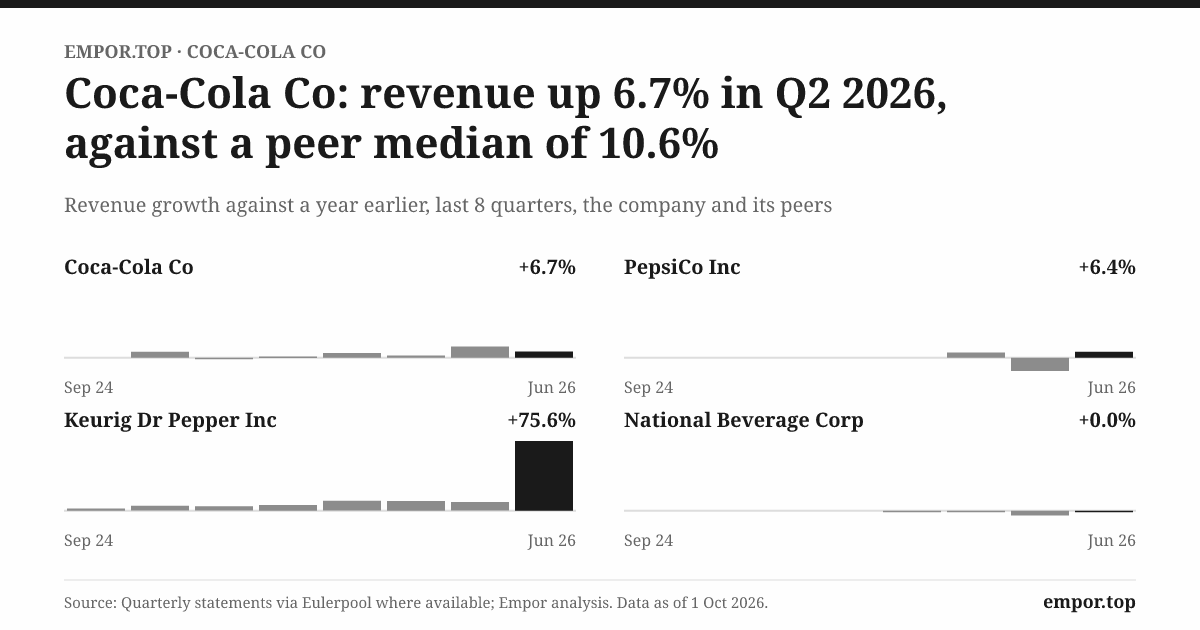
Recent momentum. In the second quarter of 2026, revenue grew about 7% and operating profit about 9% from a year earlier, with operating margin near 35%.2
The bear case: the inflationary treadmill and the tax trap
Volume is the weak spot. Worldwide unit case volume was flat in 2025, and North America declined about 1%.1 If growth is mostly price, then each price increase draws down a reservoir of consumer goodwill. When that reservoir runs low, growth slows sharply.
The IRS. If the Eleventh Circuit affirms, Coca-Cola forfeits the $6 billion deposit, faces about $14 billion more, and suffers a tax-rate rise of about 3.5 points that would trim net profit by somewhere around 4% to 5% a year.1 The one-off payment is affordable; the permanent drag is the bigger valuation issue.
Acquisition record. BodyArmor's $1.72 billion of write-downs and Costa's lacklustre returns show that capital deployed outside the core has struggled to earn its keep.1
Dividend commitment. With dividends absorbing nearly all free cash, debt has crept up rather than down. A higher-for-longer rate environment would raise refinancing costs on maturing low-coupon notes.1
The three KPIs that matter
-
Unit case volume growth. Flat worldwide in 2025, with North America down about 1%.1 This is the cleanest read on whether demand is growing or merely being repriced. Sustained growth above 1–2% would support the bull case; continued flat or negative volume would confirm the treadmill.
-
Net debt relative to EBITDA, adjusted for factoring. Net debt was about $31 billion at the end of 2025 against EBITDA of about $18.7 billion, roughly 1.7 times.1 The direction matters more than the level, and so does reading it alongside the swing in receivables sold.
-
The Eleventh Circuit ruling. Pending since oral argument on June 25, 2026.11 It is the single event most capable of changing the earnings base.
The price, in short, assumes a version of Coca-Cola in which none of these three goes wrong. That is possible. It is not guaranteed.
XI. Playbook: Business & Investing Lessons
Lesson 1: The best deal Candler ever made was the one he thought was worthless
In 1899, Asa Candler signed away the bottling of his product across most of America because he believed the real business was syrup at the fountain.4 He was wrong about where the volume would go and right, by accident, about where the profit would stay. The company that owns the recipe and the brand, and persuades someone else to own the trucks, ends up with the returns. Own the thing people ask for by name; rent everything else.
Lesson 2: A price increase is not a moat until the volume answers
From 2023 to 2025, Coca-Cola grew revenue with double-digit, then mid-single-digit, price and mix while volume stalled.1 That is pricing power, but it is not proof that pricing power is unlimited. The nickel Coke showed that even the strongest brand can be trapped by its own structure. Pricing power is measured in customers kept, not in cents added.
Lesson 3: A great distribution system cannot fix a bad purchase price
Coca-Cola's system can put almost any drink in front of almost anyone. It still could not make BodyArmor worth $5.6 billion.91 fairlife worked because the product was genuinely differentiated; BodyArmor struggled because Coca-Cola paid for momentum. Distribution multiplies a good brand; it does not manufacture one.
Lesson 4: Reserves are opinions; wire transfers are facts
In September 2024, Coca-Cola sent $6 billion to the Treasury while carrying a reserve of about $512 million.101 The accounting is defensible. The cash is gone until a court says otherwise. When a company argues with a sovereign, read the cash-flow statement before the footnote.
Lesson 5: A streak can become a straitjacket
Sixty-three years of rising dividends is a marvel of consistency.1 It is also a promise that consumes almost all free cash and leaves the balance sheet to absorb every surprise. The longer a dividend record runs, the more it shapes the company's choices, and the less the company chooses freely.
XII. Epilogue: What Decides the Next Century?
Tonight, Coca-Cola is a business with about $50 billion of trailing revenue, operating margins in the mid-thirties in recent quarters, and a share price within about 5% of its 52-week high.1217 It has never looked more profitable. It has also rarely faced so many unresolved questions at once.
The first will arrive from Atlanta's own federal appeals court. The Eleventh Circuit's ruling could come any week. If Coca-Cola wins outright, the $6 billion deposit returns with interest, the $14 billion overhang disappears, and the bull case gains a clean balance sheet. If it loses, the company faces a cash call larger than a year's profit, a permanently higher tax rate, and a dividend whose growth will be paid for with debt or asset sales. A remand or settlement would split the difference, and probably end the most consequential legal fight of the Quincey era with a number somewhere in the billions.
The second question will be answered more slowly, in quarterly volume figures. Can Zero Sugar, smaller packs and emerging-market investment restore real volume growth as Western consumers grow tired of price increases? Or will GLP-1 drugs and shifting tastes keep the volume line flat, leaving price as the only lever?
The third question is optional, and fascinating: what Coca-Cola does with its 21% stake in Monster, now worth well over $15 billion.1 It could buy the rest, sell some to fund a tax bill, or simply keep collecting the benefits of a partnership that has worked better than almost any of its own acquisitions.
Behind all three lies the question the company has faced since 1886: how much profit can be extracted from flavoured, carbonated water? For 140 years, the answer has been "more". The appeals court, the consumer and the pharmacy counter will decide whether that remains true.
XIII. Outro
Go back to Jacobs' Pharmacy in May 1886. A jug of brown syrup, a soda fountain, a price of five cents, and nine glasses a day.3 Pemberton, sick and short of money, sold his stake within two years and died the same year.3 He never saw a bottle, a truck, a cooler or a balance sheet.
What grew from his syrup was never really a drink company. It was a contract, a brand and a system of partners who carry the weight so that the brand owner does not have to. Coca-Cola did not conquer the world by owning factories. It conquered the world by persuading billions of people, and thousands of bottlers, that a small, sweet glass of fizz was worth paying for, again and again, at a price that only ever goes one way.
References
-
The Coca-Cola Company Form 10-K for the Fiscal Year Ended December 31, 2025 — SEC EDGAR, 2026-02-20 ↩↩↩↩↩↩↩↩↩↩↩↩↩↩↩↩↩↩↩↩↩↩↩↩↩↩↩↩↩↩↩↩↩↩↩↩↩↩↩↩↩↩↩↩↩↩↩↩↩↩↩↩↩↩↩↩↩↩↩↩↩↩↩↩↩↩↩↩↩↩↩↩↩↩↩↩
-
The Coca-Cola Company Form 10-Q for the Period Ended July 3, 2026 — SEC EDGAR, 2026-07-29 ↩↩↩↩↩↩
-
The Birth of a Refreshing Idea — The Coca-Cola Company ↩↩↩↩↩↩
-
The Chronicle of Coca-Cola: A Symbol of Friendship — The Coca-Cola Company ↩↩
-
Berkshire Hathaway Inc. Shareholder Letter for 1988 — Berkshire Hathaway, 1989-02-28 ↩
-
Berkshire Hathaway Inc. Shareholder Letter for 1993 — Berkshire Hathaway, 1994-03-01 ↩↩
-
The Coca-Cola Company Form 10-K for the Fiscal Year Ended December 31, 2024 — SEC EDGAR, 2025-02-20 ↩↩↩
-
Coca-Cola Completes Full Acquisition of BodyArmor for $5.6 Billion — The Wall Street Journal, 2021-11-01 ↩↩
-
The Coca-Cola Company Form 8-K Reporting $6.0 Billion IRS Litigation Deposit — SEC EDGAR, 2024-09-11 ↩↩↩
-
Coca-Cola Wins Key Appeal Milestone in Transfer Pricing Dispute — Bloomberg Law, 2026-06-25 ↩↩↩
-
The Coca-Cola Company DEF 14A Notice of 2026 Annual Meeting and Proxy Statement — SEC EDGAR, 2026-03-16 ↩↩↩↩↩↩↩↩
-
The Coca-Cola Company Form 8-K Reporting Voting Results of 2026 Annual Meeting — SEC EDGAR, 2026-05-01 ↩↩↩
-
The Coca-Cola Company Form 8-K Reporting Voting Results of 2025 Annual Meeting — SEC EDGAR, 2025-05-02 ↩↩
-
Moody's Ratings Credit Opinion: The Coca-Cola Company — Moody's Ratings, 2025-11-14 ↩
-
S&P Global Ratings Research Update: The Coca-Cola Company — S&P Global Ratings, 2025-12-05 ↩
-
The Coca-Cola Company Investor Relations — The Coca-Cola Company ↩↩↩↩↩
 LinkedIn
 WhatsApp
 Reddit
 Hacker News
 Email
 Kindle
 RSS Feed
 Spotify
 Apple Podcasts
 Amazon Music
 Audible
 YouTube