Gartner: The Oracle That Got Priced for Disruption
I. Introduction & Episode Roadmap
Picture a chief information officer at a Fortune 500 company in the autumn of 2023. She has a $400 million technology budget, a board asking about artificial intelligence, and a shortlist of three cloud security vendors. She does not have time to test all three. So she does what her predecessors have done for four decades: she opens the Gartner portal, pulls up the relevant Magic Quadrant, books a thirty-minute call with an analyst who has spoken to two hundred other CIOs about the same decision, and walks into her Monday meeting with an answer she can defend.
That thirty-minute call is the product. Not the report, not the conference, not the chart with four boxes. What Gartner, Inc. sells is defensible judgment: an opinion that a busy executive can buy, repeat, and hide behind if the decision goes wrong. For more than four decades that turned out to be one of the best businesses in the information economy. In fiscal 2025 Gartner generated roughly $6.5 billion of revenue, the overwhelming majority of it from subscriptions that renew year after year.1
Now fast-forward to the same CIO in 2025. She has a new tool on her desktop. She can type the same vendor question into ChatGPT or Claude and get, in eight seconds, a structured comparison of the three vendors, their strengths, their weaknesses, and a recommendation. It is not as good as the Gartner analyst. But it is free, it is instant, and it is getting better every quarter.
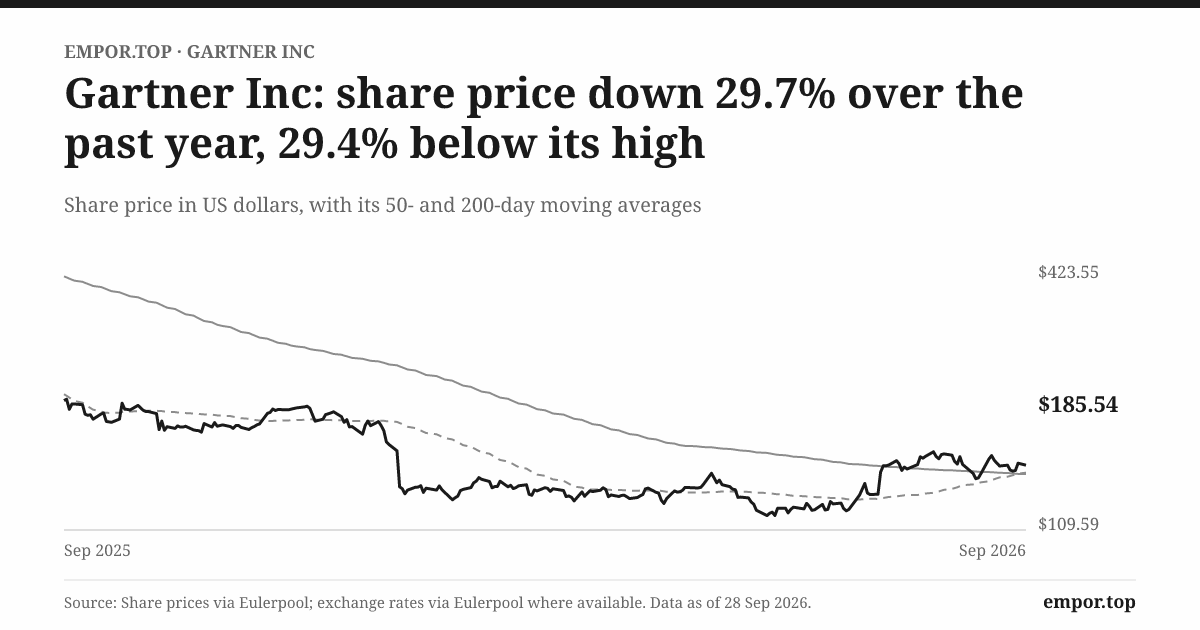
That is the fear that took Gartner's stock apart. Shares that traded around $409 in 2024 and early 2025 slid through the year and hit a 52-week low of $124.25 in February 2026 after the company issued 2026 revenue guidance that implied barely any growth.2 Across 2025 alone the stock was cut roughly in half.3 Peak to trough, the market erased about 70% of the company's value, pricing the world's most famous technology oracle as though it were the most obvious casualty of the technology it was paid to explain.
And then, just as abruptly, the story turned. Earnings beats in the first two quarters of 2026, raised profit and cash-flow guidance, and a torrent of share buybacks pushed the stock back above $265 at its high, more than doubling off the bottom, including a single month in which shares jumped 31.2%.4 By late September 2026 it had settled around $185, leaving the company with a market capitalization of roughly $12.4 billion, a fraction of its former value, but far from the obituary the market was writing in February.
So the central question of this story is simple to state and hard to answer: can the company that invented paid-for judgment survive a world where judgment is free?
To answer it, the story travels from an IBM analyst's side project in 1979, through a British advertising empire's fire sale, a private-equity rescue, two decades of subscription-machine building under one CEO, a transformational $2.6 billion acquisition, a decade-long e-commerce bet that ended in a write-down, and finally to the two most violent years in the company's history as a public stock. Along the way the thread that matters most for investors is not whether Gartner has a moat. It clearly had one. The question is whether that moat was built from something AI can't copy, or from something AI just made cheap.
 Subscribe on LinkedIn
II. Origins: The IBM Whisperer (1960s–1979)
In the 1970s, if a portfolio manager on Wall Street wanted to know what IBM would do next, there was one person to call. Gideon Gartner had spent years inside IBM before crossing to the sell side, where he became the top-ranked computer industry analyst in Institutional Investor's annual rankings through much of the decade.5 IBM in that era was not merely a big company; it was the weather system of the entire technology economy. Its pricing moves, product delays and mainframe roadmaps determined the fortunes of competitors, customers and suppliers alike. Knowing IBM well was the closest thing the 1970s had to knowing the future of computing.
Gartner's insight was deceptively simple. Investors were paying for his view of IBM so they could decide which stocks to buy. But the people making far bigger decisions, the corporate data-processing managers deciding which mainframes and software to buy, had no comparable source of independent intelligence. They were negotiating with IBM salespeople armed with nothing but IBM's own brochures. The same intelligence could be sold twice: once to the investors betting on vendors, and once, far more lucratively, to the buyers spending on them.
In 1979 Gideon Gartner and David Stein founded the Gartner Group, operating initially out of office space rented from the brokerage Dillon, Read & Co.5 The detail matters because it frames the company's DNA: this was a Wall Street research product transplanted into corporate IT. It borrowed the sell side's rhythm of short, frequent, opinionated notes rather than the consulting world's long, bespoke reports.
That format was the original innovation. The industry's existing research vendors tended to produce thick binders. Gartner's early product was built around brief research notes, often a single page, that told a reader what to think and why. The bet was that busy executives valued compression and conviction over comprehensiveness. A buyer did not want forty pages on IBM's storage strategy; he wanted to know whether to sign the contract this quarter or wait.
The bet worked. By 1983 the firm employed 80 research analysts and generated $8 million in revenue.5 More important than the numbers was the model: clients paid an annual subscription for continuous access to the research and to the analysts themselves, turning intelligence from a one-time purchase into a recurring relationship.
The founding story carries a lesson that echoes loudly in 2026. Gartner never won on the volume of information. It won on the authority of the conclusion. The single-page note is a direct ancestor of "AskGartner," the generative-AI interface the company now layers over its research, which promises the same thing in chat form: a short, decisive answer grounded in proprietary work. The irony is that compressed, decisive answers are exactly what large language models now produce for free. What made Gartner distinctive in 1979 was the format; what must make it distinctive in 2026 is the source behind the format.
Before that question could arise, though, the young company would first have to survive its own owners.
III. Going Public, Getting Bought, Getting Free Again (1979–1993)
The 1980s version of Gartner was a scrappy, fast-growing research shop with a very un-scrappy customer base: the largest corporate IT departments in America. As the client list grew, the firm began to formalize what would become its real competitive weapon, a research process. Analysts followed consistent methodologies, used standardized frameworks, and pressure-tested conclusions collaboratively before publication. The practical effect was that a Gartner opinion meant roughly the same thing no matter which analyst gave it. Consistency made the brand portable; a CIO in Chicago and a CIO in London were buying the same thing.
In July 1986 Gartner Group went public.5 The IPO was a validation of the subscription model, but it also put the company in play at the height of a decade defined by acquisitive conglomerates. Two years later it was swallowed by one of the most acquisitive of them all.
The Saatchi Years
In 1988 Saatchi & Saatchi, the British advertising empire run by the brothers Charles and Maurice Saatchi, bought Gartner Group for $90.3 million.5 Saatchi at the time was in the midst of a breathtaking shopping spree, assembling a global "business services" conglomerate that stretched well beyond advertising into consulting. Gartner was a trophy in that collection, a research franchise that fit a grand theory about one-stop professional services.
The theory did not survive contact with the balance sheet. By 1989 Saatchi was in serious financial trouble, weighed down by debt and underperforming acquisitions, and began shedding assets. Gartner, owned for barely two years, was suddenly for sale.
The Buyout and the Bain Lesson
In 1990 a management-led buyout returned the company to independence, backed by Bain Capital and Dun & Bradstreet.5 Manuel "Manny" Fernandez became CEO around this transition, and the company refocused on its core IT research business.6
What happened next is the single most instructive financial fact in the company's early history. Under the new owners, Gartner overhauled its pricing and expanded profit margins from roughly 10% to 30%.5 That tripling was not the result of a new product. It came from recognizing what kind of business Gartner already was. Producing a piece of research costs the same whether one client reads it or ten thousand do. Once the analyst is paid, each additional subscriber is almost pure profit. A company with that cost structure should be priced on the value to the customer, not on the cost to produce, and it should be run to maximize subscribers per analyst.
That is the economic engine still running Gartner today, and the Bain era was its first proof point.
Back to Public Markets, Founder Out
In October 1993 Gartner went public again, with Dun & Bradstreet retaining a 50% stake.5 Gideon Gartner departed during this period, leaving the company that bore his name well before it reached even a tenth of its current revenue.
For investors, the takeaway from this chapter is structural rather than sentimental. Gartner spent its first fourteen years as a founder-driven startup, a conglomerate subsidiary, and a private-equity turnaround, and the business model came through all three largely intact. The subscription relationship with IT buyers proved more durable than any of the owners. That resilience is worth remembering when judging whether a new owner of client attention, in the form of an AI model, can dislodge it. What the 1993 company still lacked was the thing that would make it indispensable: industry standards that vendors themselves would organize around.
IV. Scaling the Machine, Surviving the Bust (1993–2004)
In 1995 Gartner published a curve. It started with a steep rise labeled the "Peak of Inflated Expectations," plunged into a "Trough of Disillusionment," then climbed a gentle "Slope of Enlightenment" toward a "Plateau of Productivity." It was called the Hype Cycle.5
It is difficult to overstate how well that picture worked. It gave executives a vocabulary for a feeling they already had, that every new technology is oversold, then undersold, then quietly useful. It was simple enough to fit on a slide and memorable enough to repeat in a board meeting. Within a few years, vendors, journalists and CIOs were placing technologies on the curve themselves, which meant Gartner had created something more valuable than a report. It had created a standard: a shared frame of reference that everyone in the market used, and that everyone implicitly credited back to Gartner.
The Magic Quadrant, which sorts vendors in a category into Leaders, Challengers, Visionaries and Niche Players, works the same way. When a framework becomes the language of an industry, the firm that owns it becomes a toll collector on every conversation that uses it. Section VIII tests how strong that toll gate really is.
The Acquisition Spree
The late 1990s were a gold rush for anything connected to technology, and Gartner acted accordingly. Over roughly eight years following the Hype Cycle's introduction, the company acquired or made substantial investments in about 30 companies, including the market-data firm Dataquest and the IT professional community TechRepublic, which was later sold to CNET.5
Most of those deals are now forgotten, which is itself informative. The pattern is worth naming now because it recurs: Gartner has repeatedly bought broadly into adjacencies, then pruned what did not fit the core. TechRepublic is the earliest visible example. As later sections show, the same rhythm plays out with CEB's assessment business and, most painfully, with the Digital Markets unit two decades later.
The Bust
By 2000 the company had renamed itself Gartner and was approaching $1 billion of sales. Then the dot-com bubble burst, and technology budgets across corporate America were slashed.
Gartner bent but did not break. The reason was the same subscription structure the Bain owners had optimized. A software company selling one-time licenses sees revenue vanish the moment customers stop buying. A research subscription, by contrast, is typically renewed annually, and even a customer cutting spending tends to trim seats rather than cancel outright. The revenue cushion bought time.
The chapter's lesson is two-sided. Recurring research revenue proved resilient through the worst technology downturn of its era, which supports the idea that IT buyers treat Gartner as a necessary expense rather than a discretionary one. But the acquisition spree left the company sprawling and unfocused. What it needed next was an operator who would turn a collection of research businesses into a single, disciplined sales machine.
V. The Gene Hall Era Begins: Building the Modern Subscription Machine (2004–2016)
In August 2004 Eugene A. Hall walked into Gartner's Stamford, Connecticut headquarters as chief executive officer.5 Twenty-two years later he is still there.
Hall's resume explains a great deal about what Gartner became. He was a former McKinsey partner, trained in the consulting world's habit of reducing messy organizations to measurable systems. He then served as a senior executive at ADP, the payroll processor, one of the purest recurring-revenue businesses in American corporate history, where success is measured in client retention, sales productivity and the steady expansion of what each client buys. Hall brought both mindsets to Gartner. Research, in his framing, was not an intellectual product; it was a subscription service to be sold, renewed and expanded with industrial consistency.
Consolidating the Category
Hall's first strategic move was to eliminate the competitive fragmentation that had kept research prices in check. Gartner absorbed META Group, one of its closest rivals, and then AMR Research in 2009 and Burton Group, rolling the second tier of the industry into itself.5 By 2008 Gartner had reached $1.3 billion in revenue and controlled roughly 40% of the IT research market.5
In plain English: in four years, a company that had been one of several credible research vendors became the default. When a CIO's procurement team asked whether the company "had Gartner," the question increasingly had only one meaningful answer.
The Sales Machine
The quieter, more consequential work of the Hall era was operational. Gartner built a large, highly trained, heavily incentivized sales force organized around getting existing clients to buy more seats, more functional coverage, and more analyst access every year. The company's core disclosures moved in the same direction. Rather than emphasizing research output, Gartner increasingly reported itself through subscription metrics: contract value, client retention, and "wallet retention," which measures whether existing clients spend more or less with Gartner than they did a year earlier.
This is the direct ancestor of today's model. Research subscriptions became the core. Conferences, such as the flagship Symposium/Xpo events, and Consulting became complementary attachments: useful for engagement and cross-selling, but smaller and more cyclical.
The Hall era's first decade deserves more attention than the colorful Saatchi years because it built the economics investors now own. It also established a pattern of disciplined execution around a single model. The obvious limitation was that the model's market, IT buyers, was finite. By the mid-2010s Hall had a clear answer to that limit: sell the same product to every other executive in the building.
VI. The CEB Mega-Deal: From IT Research to All of Corporate Decision-Making (2017)
Across town in Arlington, Virginia, sat a company that looked like Gartner's mirror image. CEB, originally the Corporate Executive Board, had grown out of the Advisory Board Company with a membership model built around best practices. Instead of telling CIOs which technology to buy, CEB told heads of HR, sales, finance, legal and procurement what their best-performing peers were doing. Its members paid subscriptions to access benchmarking studies, peer networks and research on functional best practice.
To Gene Hall, CEB was not a diversification. It was a map of Gartner's future addressable market.
The Deal
In January 2017 Gartner announced it would acquire CEB in a cash-and-stock transaction valued at approximately $2.6 billion.78 The offer carried a substantial premium, reported in the registration statement's fairness analyses at roughly 31–41% over CEB's recent trading averages, and the deal was financed with a combination of new debt and Gartner shares.7
It was, by a wide margin, the largest and most trajectory-altering acquisition in the company's history. Overnight, Gartner's research offering extended from technology leaders to virtually every functional leader in a large enterprise. In the first full year, combined revenue reached $3.3 billion, up 35%.9 Gartner's analyst and advisor headcount swelled toward 2,000, cementing a scale gap over pure-play rivals such as Forrester that no competitor could close organically.
The strategic logic was powerful. Gartner's sales machine could now walk into a client that already bought IT research and sell HR research, finance research, and sales research to the same company. The cost of acquiring the customer had already been paid; the new products were pure wallet expansion.
The Capital-Allocation Stress Test
The deal also brought along businesses that did not fit. On February 7, 2018, roughly a year after closing, Gartner announced the sale of CEB Talent Assessment, the psychometric testing business formerly known as SHL, to Exponent Private Equity for $400 million.9 Hall explained that the unit "was not aligned with our core focus of providing research and advisory services to address the mission-critical priorities of every functional leader in the enterprise."9
There are two honest readings. The generous one: management identified a non-core unit, ran a strategic review, and exited at a reasonable price rather than letting it drift. The skeptical one: a business representing a meaningful share of what Gartner paid $2.6 billion to buy was jettisoned within about thirteen months, which suggests the deal was underwritten more broadly than the strategy required. Both are supported by the record, and they are not mutually exclusive. The sale was disciplined in execution and revealing about the original bet.
What Can't Be Measured
The more important verdict concerns CEB's core, the best-practice research. It has long since been folded into Gartner's Research segment, and Gartner does not report it separately.1 That means outside investors cannot cleanly calculate the return on the largest acquisition in the company's history. The company presents the functional expansion as a success, and the growth in non-IT research seats is consistent with that. But "consistent with" is not proof, and the absence of standalone reporting is an analytical fact worth flagging rather than a gap to be filled with assumption.
The CEB deal expanded Gartner's market and deepened its moat against smaller rivals. It also expanded something else: management's appetite for acquisitions at the edges of the core. The edge where that appetite was tested hardest was a business most Gartner investors barely knew existed.
VII. The Digital Markets Bet: L2, Capterra, and a Decade-Long Round Trip (2014–2026)
Search for "best project management software" or "CRM for small business" at almost any point in the late 2010s, and the odds were good that one of the top results belonged to Gartner. Not under its own name. Under the names Capterra, Software Advice and GetApp.
These were software-review and comparison websites, where small and mid-sized businesses browsed user ratings of software products. Vendors paid for leads and placement when shoppers clicked through. Gartner assembled the portfolio piece by piece: Software Advice in 2014, Nubera (the parent of GetApp) and Capterra shortly after. In March 2017 it added L2, the brand-benchmarking firm founded by NYU professor Scott Galloway, which rated how well consumer brands performed online.5
Collectively this became Gartner Digital Markets, a unit that looked nothing like the core. It served small businesses rather than large enterprises, earned money from vendors rather than buyers, and depended on search-engine traffic rather than analyst relationships. At the time, management and many analysts positioned it as genuine optionality: a faster-growing, internet-native adjacency that could capitalize on Gartner's authority in software evaluation.
The Write-Down
It did not work out that way. In the third quarter of 2025 Gartner recorded a $150 million goodwill impairment charge in the Digital Markets reporting unit.10 The quarterly filing tied the charge to ongoing weakness in the market and an internal reorganization that led the company to lower the unit's long-term forecasts.10 Goodwill impairment is an accounting admission that a business is worth less than the company paid for it; in plain terms, management told shareholders that part of the price paid for these acquisitions had been lost.
Then came the exit. In early 2026 Gartner disclosed an agreement to sell Capterra, Software Advice and GetApp to G2, the crowd-sourced software-review platform that had grown into the category's leading independent player.1
The irony is sharp. G2 built the business that Gartner tried to build by acquisition: an independent, user-generated review marketplace with a direct relationship to software buyers. Gartner, the most authoritative voice on software selection in the world, ended up selling its review sites to the competitor that out-executed it.
What the Record Says
This is the clearest capital-allocation falsification case in Gartner's modern history. An optionality bet begun more than a decade earlier never became a durable, differentiated revenue stream. The exit followed an impairment rather than a period of strength, which means management sold closer to the bottom than the top. And the search-traffic dependency that made the business attractive in 2014 is exactly what generative AI threatens, as more software shoppers ask chatbots rather than clicking through review sites.
The history does not reject the claim that Gartner can build successful adjacencies; CEB's core research integration appears to have worked. But it narrows the claim to a smaller version: Gartner has succeeded when adjacencies look like its core (subscription research sold to enterprise functional leaders) and struggled when they do not. The forward test for whatever Gartner tries next, whether AI tooling, data products or anything else, is whether it sits inside that circle. A clean multi-year track record on a new adjacent bet, reported transparently, would be the evidence that falsifies the concern. Until then, the buy-broad-then-prune pattern is a live behavior, not a closed chapter.
With the sideshow exited, the business left standing is the one that has always generated most of the value. It is worth taking apart piece by piece.
VIII. The Modern Machine: How Gartner Actually Makes Money
Imagine an annual renewal meeting at a large bank. A Gartner account executive sits across from the bank's CIO and a procurement manager. On the table: last year's contract, covering fifteen research seats across IT, security and finance. The account executive has usage data showing which executives logged in, how many analyst inquiries were booked, and which reports were downloaded. The pitch is not "renew." It is "expand": add the chief HR officer's team, add supply-chain coverage, upgrade two seats to executive-level programs with dedicated advisors.
Multiply that meeting by thousands of clients, and that is Gartner.
The Three Segments
Gartner reports three segments, and their weight is lopsided. In fiscal 2025, Research generated roughly $5.3 billion, about 82% of total revenue. Conferences contributed roughly $645 million, about 10%. Consulting delivered roughly $552 million, about 8.5%.1 Any analysis of Gartner is overwhelmingly an analysis of Research; the other two segments matter at the margin.
Research sells subscription access to published research, benchmarking data, peer communities, and one-on-one inquiry with analysts. Clients typically buy by seat, meaning by the named individual who has access, and contracts renew annually or over multiple years. Revenue is recognized ratably over the contract term, which makes the segment highly visible and predictable for investors: most of next year's revenue is already under contract today.
Conferences, headlined by the Gartner IT Symposium/Xpo, earn money from attendee tickets and vendor exhibitors. They are high-margin when full but vulnerable to travel budgets and, as 2020 proved, to anything that keeps people at home. Consulting provides project-based advisory work, frequently on IT cost optimization and contract negotiation. It competes more directly with McKinsey, BCG, Bain and Deloitte, and it is more cyclical because projects are discretionary.
The Three Numbers That Matter
Gartner's Research engine can be understood through three metrics the company discloses every quarter.
Contract value is the annualized value of all subscription research contracts in force. It is effectively the run-rate of the business. As of the second quarter of 2026, total contract value stood at roughly $5.3 billion.11[^12]
Client retention measures the share of client organizations that renewed. Gartner's has been running around 84%.[^12] Put differently, roughly one in six client organizations does not come back each year, a real rate of churn, concentrated historically among smaller clients.
Wallet retention measures how much the clients who existed a year ago are spending now, including expansions and net of reductions and cancellations. Running around 103%,[^12] it means that the existing base, taken as a whole, spends a little more with Gartner each year even after accounting for departures. That number has fallen from the double-digit expansion Gartner achieved in stronger periods, and the trend is the central tension in the story.
Geography
Roughly 62% of revenue comes from the United States and Canada, about 26% from Europe, the Middle East and Africa, and about 12% from the rest of the world.1 The "global oracle" framing overstates the diversification. Gartner is fundamentally a North American enterprise-budget business, with meaningful exposure to US federal government spending, a detail that becomes important in the compensation discussion in Section IX.
Competition
The competitive landscape has three rings. The innermost is pure-play research: Forrester, a public company an order of magnitude smaller than Gartner, and IDC, now privately owned by Blackstone. Industry insiders sometimes call the group "FIGs," for Forrester, IDC and Gartner. The middle ring is strategy and technology consulting, where the big consultancies compete with Gartner Consulting and, increasingly, with Research for executive attention. The outer ring, relevant to the now-divested Digital Markets business, is crowd-sourced review platforms such as G2 and TrustRadius.
The scale gap in the inner ring is enormous. Gartner can afford to cover more technology categories, more functions and more geographies than any rival. For a CIO who needs one research vendor, that breadth is a powerful reason to pick the biggest.
The Standard-Setter and the Courtroom
Gartner's frameworks, particularly the Magic Quadrant, function as de facto industry standards. Vendors plan marketing campaigns around placement, sales teams brandish "Leader" status in pitches, and buyers use the chart to build shortlists. That influence has long attracted suspicion: if vendors pay Gartner for research subscriptions and advisory services, does money buy a better dot?
NetScout Systems tested exactly that proposition. In 2014 the network-monitoring company sued Gartner, alleging that its Magic Quadrant placement was harmed by a pay-to-play bias. The case was dismissed, with the court treating the Magic Quadrant as protected opinion.12 In January 2020 the Connecticut Supreme Court upheld the outcome, confirming First Amendment protection for subjective vendor ratings.1314
The ruling matters, but it should be read precisely. Courts found no actionable basis for NetScout's claims and treated Gartner's ratings as opinion. That substantially narrows the legal risk to the franchise. It does not settle the reputational question; buy-side skepticism about vendor-funded research objectivity persists, and the ruling was about the legal status of opinion rather than a positive certification that no bias exists.
The Power Sources, Tested
Viewed through Hamilton Helmer's 7 Powers and Porter's lens, Gartner's case rests on four mechanisms, each of which should be paired with evidence.
Switching costs: Gartner research is embedded in procurement workflows, vendor-selection templates and budget justifications. The evidence is wallet retention above 100% even through a year of intense AI anxiety. The limitation is that client retention of about 84% shows switching costs are far from absolute.
Network effects: Peer benchmarking becomes more valuable as more peers contribute data; an analyst who has heard from hundreds of CIOs this quarter has insight no single client can replicate. This is plausible and consistent with Gartner's scale lead, but Gartner does not disclose data that would quantify it.
Scale economies: Research production has high fixed costs and near-zero marginal costs, as the Bain-era margin expansion demonstrated. Gartner's breadth of coverage is the direct product of that scale.
Counter-positioning: Against traditional consulting, Gartner offers cheaper, faster, subscription-based advice. Consultancies struggle to copy this without cannibalizing lucrative project fees.
What large language models attack is not any single one of these powers. They attack the output format that all four powers produce: synthesized, confident opinion. The question is how much of Gartner's value lies in the format and how much lies in the proprietary inputs, including the peer data, analyst conversations and the defensibility of the brand. That question belongs to the person who has run the company for two decades.
IX. Current Management: Gene Hall's Two Decades and the Capital Allocation Record
Gene Hall is not a flamboyant CEO. On earnings calls he speaks in the measured, metrics-first cadence of a former McKinsey partner, returning again and again to the same handful of numbers: contract value, retention, sales productivity, free cash flow. He tends to answer questions about disruption with operating data rather than grand narrative. For most of his tenure that style was an asset; the numbers kept going up. In 2025 and 2026, it was tested by a market that wanted a story.
Tenure and Governance
Hall has been CEO since August 2004, now more than 22 years, one of the longest tenures among large-cap technology-adjacent chief executives.15 He added the title of Chairman of the Board only in July 2024.15 Combining the roles after two decades is a governance choice worth flagging rather than glossing over. It concentrates authority in a CEO who has no obvious internal successor presented publicly, at precisely the moment the company faces its most serious strategic question. Boards often justify combination by citing continuity and a lead independent director; investors should judge it by whether succession planning becomes visible.
Pay
Hall's 2025 total compensation was approximately $19.2 million, with the bulk of target pay variable and tied to measures such as adjusted EBITDA and revenue growth.15 One detail in the proxy deserves a second look: the board excluded the US federal public-sector business from certain bonus calculations.15 The board frames this as insulating management from volatility beyond its control, as federal spending cuts weighed on that business. The alternative reading is that a struggling segment was removed from management's own scorecard. Compared with the prior year's proxy,16 the adjustment illustrates how boards can soften accountability in bad years without changing headline targets.
The Capital Allocation Record, Weighed
Taken as a whole, Hall's capital allocation record contains three distinct types of decisions.
The CEB acquisition expanded the addressable market meaningfully and appears to have succeeded in its core, though its return cannot be verified from public disclosure (Section VI). The Talent Assessment sale was a clean correction of an overbroad purchase.
The Digital Markets round trip is the clearest failure. A decade of investment ended in a $150 million impairment and a sale to the competitor that outperformed it (Section VII). Any claim that Hall's capital allocation is uniformly disciplined has to confront that record.
The third category is buybacks, and here 2026 was extraordinary. Gartner repurchased roughly $535 million of stock in the first quarter of 202617 and roughly $547 million in the second.11 Together that is more than $1 billion in six months, equal to roughly 9% of the company's current market value, much of it purchased after the stock had already collapsed.
That is either well-timed opportunism or a costly act of faith. If the AI fear was overdone, management bought back nearly a tenth of the company near multi-year lows, one of the better capital-allocation decisions in its history. If the fear was right and growth keeps decelerating, the company spent its cash defending a stock price rather than reinvesting in a business that needed to change. The stock's 2026 rebound flatters the first reading so far, but a valuation bounce is not the same as a vindicated business.
The CFO and Guidance Discipline
Chief Financial Officer Craig Safian has long been the steward of Gartner's guidance. The key credibility test, examined in the next section, is how management explained two sharp misses, in February 2025 and February 2026, and whether its narrative shifted between them.
A Monitored Development
Since roughly mid-2026, the law firm Bernstein Liebhard has issued a series of press releases announcing an "investigation" into potential breaches of fiduciary duty by Gartner's officers and directors, linked to disclosures made before February 24, 2025.18 Such announcements are common after large stock drops and do not by themselves indicate wrongdoing. As of this writing, no filed complaint arising from the investigation has been confirmed. It is a monitored overhang, not a settled fact.
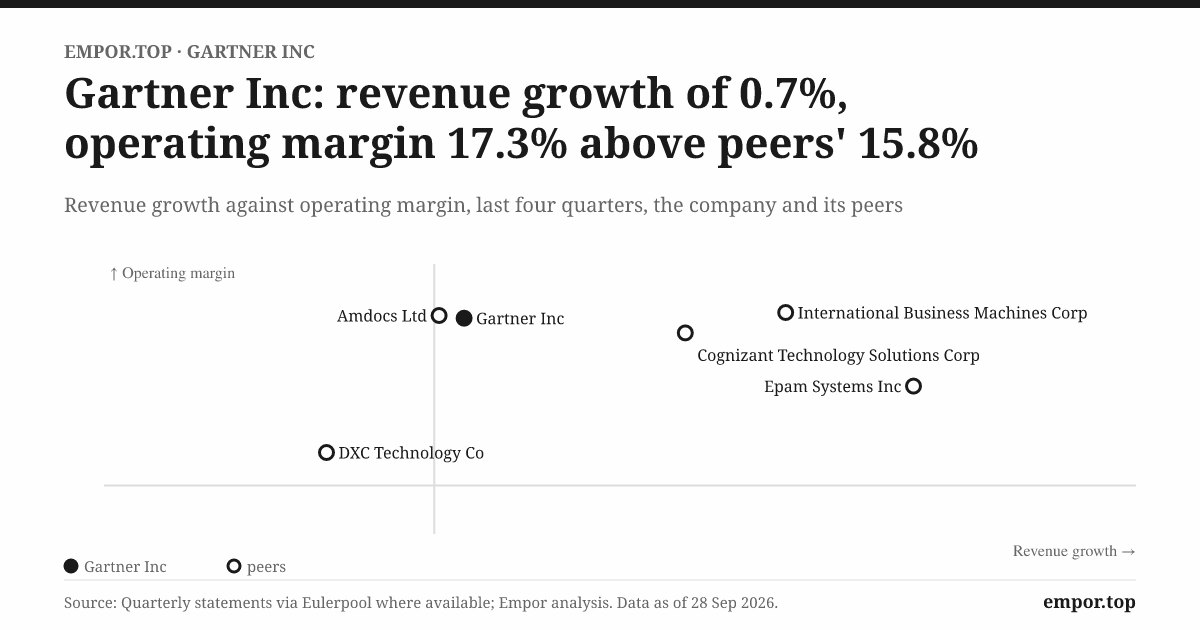
The management record, then, is mixed in a specific way: strong at operating the core, uneven at the edges, and aggressive with the balance sheet once the stock fell. The crisis that triggered all of this deserves its own full telling.
X. The AI Reckoning: Crash, Impairment, and Rebound (2024–2026)
On the morning of February 3, 2026, Gartner released its fourth-quarter 2025 results. By the close of trading, the stock had fallen about 21% in a single session.2 It was the second time in twelve months that a February earnings report had shredded the share price, and this time the market was not reacting to a quarter. It was reacting to a verdict on the future.
The Fear, Stated Plainly
"AI risk" is a vague phrase. The specific fear is precise. Gartner's Research segment sells synthesized market opinion and buying guidance. Generative AI systems such as ChatGPT, Claude and Perplexity produce synthesized market opinion and buying guidance at near-zero marginal cost. If a CIO can get 80% of the value of an analyst inquiry by asking a chatbot, then some share of the 82% of revenue that comes from Research is at risk. The fear does not require AI to be as good as Gartner. It requires AI to be good enough that a cost-conscious CFO cuts two seats out of fifteen at renewal.
Commentary in mid-2025 captured the mood: Forbes noted the stock was down 49% and asked what the CEO could do about it.19
The First Drop: February 2025
The first significant blow landed with the fourth-quarter 2024 results in early February 2025, the period the Bernstein Liebhard inquiry references. Growth in contract value slowed and the tone about the federal government business and client budgets softened. First-quarter 2025 results later showed a business still growing but at a visibly slower pace.[^21] Comparing that release with the company's 2023 supplement, a period of steady expansion before the AI panic,[^22] shows the deceleration clearly: the company was still growing contract value, but the growth rate had been cut substantially.
The Low Point: Q3 2025
The third quarter of 2025 was the financial nadir. Net income fell to $35.4 million, far below the roughly $240 million quarterly run rate the company had been producing, driven primarily by the $150 million Digital Markets goodwill impairment and other charges.10 Read alongside Section VII, the quarter was less a revelation about AI and more a reckoning with a legacy acquisition. But arriving in the middle of an AI panic, it reinforced the narrative that the business was deteriorating.
The Second Drop: February 2026
Then came February 3, 2026. Fourth-quarter revenue missed expectations, and management guided 2026 revenue growth to only about 2% on an FX-neutral basis.2 On the call, management acknowledged that clients were shifting budgets toward AI infrastructure and away from strategic consulting.2 The stock fell to its 52-week low of $124.25.2
That guidance is the single most important piece of evidence in the entire story, because it came from management itself. Whatever the bulls say about moats, the company's own forecast told investors that growth had decelerated structurally from the double-digit pace of the post-CEB era. That statement must sit beside every claim about durability that follows.
The Recovery
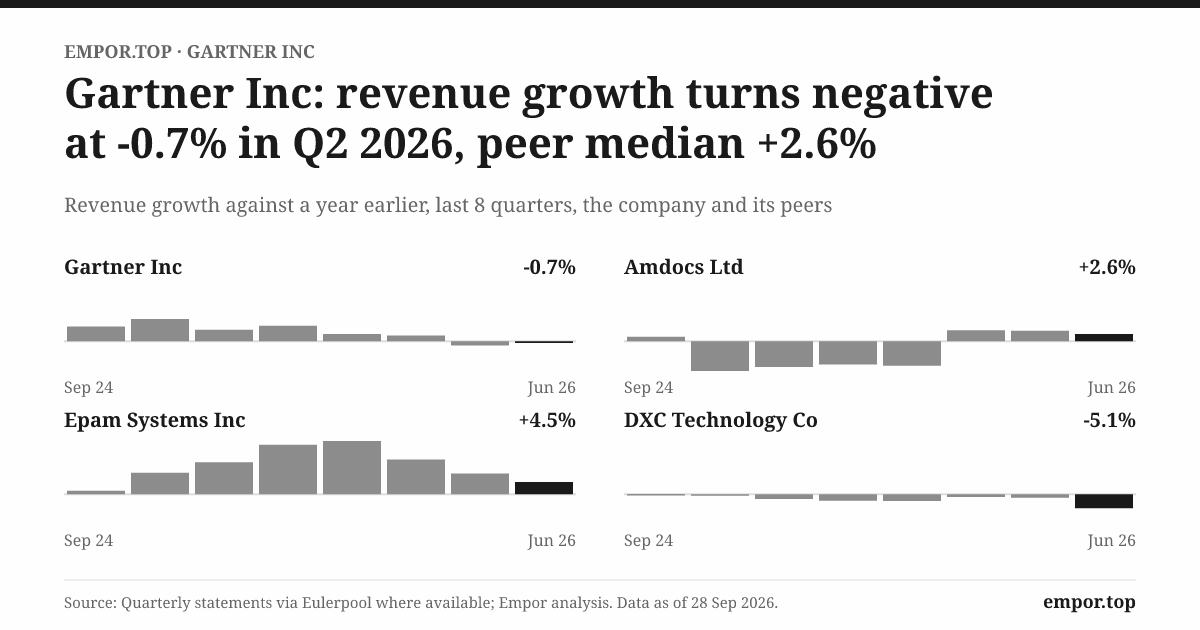
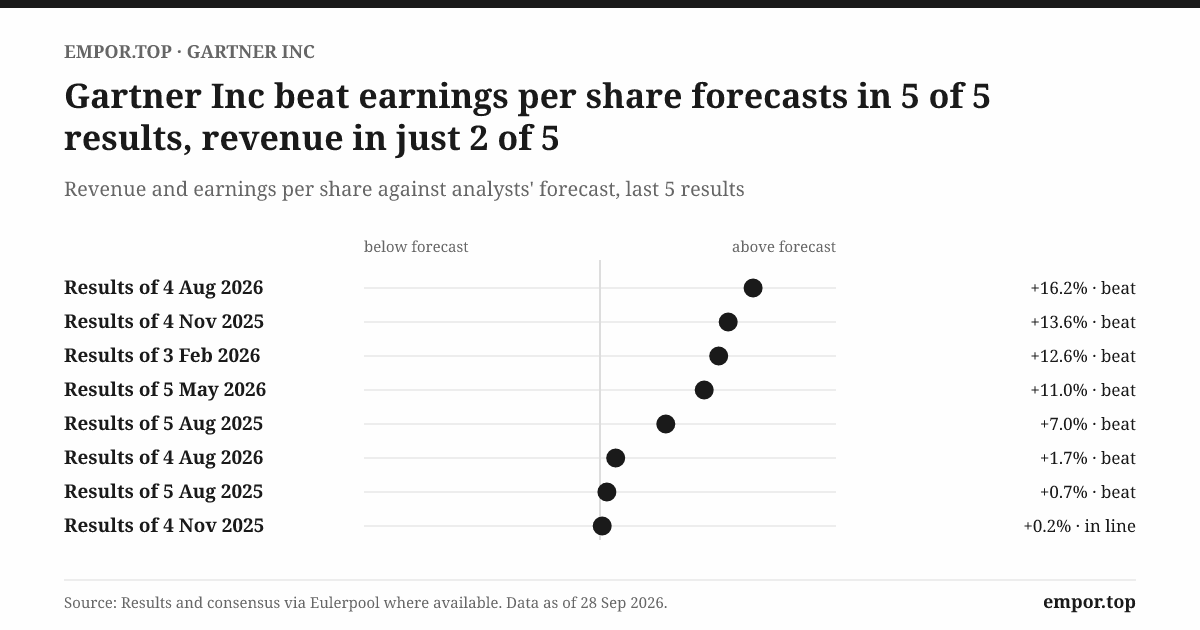
And yet the business did not fall off a cliff. First-quarter 2026 results beat expectations.17 Second-quarter results beat again, and management raised full-year guidance for earnings per share and free cash flow even while revenue guidance stayed modest.11 Margins expanded as cost discipline took hold. Combined with the accelerated buybacks, this drove the rally, including a 31.2% jump in a single month in the late summer of 2026.4
Management's explanation centered on two themes: retention was stabilizing, and enterprise confusion about AI was generating demand for advice on how to deploy AI. In that framing, Gartner is not AI's casualty but its interpreter, the vendor executives call when they need to decide which AI tools to buy, how to govern them, and how to budget for them.
That argument is plausible, and it has historical precedent: every prior technology wave, from client-server computing to the cloud, created confusion that Gartner monetized. But it remains management's claim, and the evidence so far is stabilization, not reacceleration.
AskGartner
Gartner's offensive move is "AskGartner," a generative-AI interface that lets clients query the company's proprietary research conversationally. It is a sensible product: it takes the substitute threat and makes it a feature of the subscription. But it is a capability, not a disclosed revenue line.1 Gartner has not reported how much revenue, retention or pricing it drives. Given the company's record in converting adjacent bets into durable revenue (Section VII), AskGartner should be treated as a defensive necessity whose monetization is unproven.
Net Assessment
The moat claim is narrowed, not rejected. Wallet retention near 103% through the worst of the panic is real evidence that the existing subscriber base did not defect en masse to AI substitutes.[^12] But management's 2% revenue guidance is an admission that the engine is no longer growing the way it did.
The KPI that will confirm or falsify the "AI-resilient" thesis is whether Research wallet retention and growth in contract value reaccelerate over the next four to six quarters. If they do, 2026 was a demand recovery. If they flatten, 2026 was a valuation snap-back from an oversold low, and the underlying erosion continues more slowly than the market feared. That tension is exactly where the bull and bear cases split.
XI. Bear vs. Bull Case
Two investors sit at the same table in September 2026, looking at the same filings. One sees a franchise that survived its worst stress test and is buying itself back at a discount. The other sees a mature business whose growth has quietly ended, managed by a long-tenured CEO who just bet a tenth of the company on the stock. Both are reading real evidence.
The Bear Case
The growth deceleration is management's own admission. The 2% FX-neutral revenue growth guidance for 2026 was not an analyst's pessimism; it was the company's forecast.2 A research subscription business whose clients face AI-driven budget reallocation may be experiencing the early phase of structural erosion, which subscription accounting delays rather than prevents. Revenue recognized ratably over contract terms means that a slow drip of seat reductions today shows up as decelerating revenue for years.
Capital misallocation is recent, not hypothetical. The Digital Markets impairment and divestiture happened in 2025 and 2026.101 A bear asks why the same team that spent a decade on an adjacency that failed should be trusted to allocate more than $1 billion a half-year to buybacks.
Governance deserves scrutiny. A combined Chairman/CEO after two decades, a compensation carve-out that removes a weak segment from the bonus scorecard,15 and an open law-firm investigation18 form a cluster an activist would press on. An activist would likely challenge succession planning, the independence of board oversight of Hall, and whether buybacks are the best use of cash compared with debt reduction or AI investment.
Consulting remains weak. Management's own comments in 2026 described clients shifting budget away from strategic consulting.2 The business is not uniformly healed.
The Bull Case
The base held. Wallet retention near 103% through the peak of the panic means the existing clients, in aggregate, still spent more with Gartner.[^12] If AI were already a strong substitute, this is the number that would have broken first.
The scale gap is enormous. No pure-play competitor comes close to Gartner's breadth. Forrester is an order of magnitude smaller, and IDC is a private company. The legal system has rejected the pay-to-play claim that most directly threatens the credibility of the Magic Quadrant.13
Management is putting cash where its mouth is. Raised EPS and free-cash-flow guidance and margin expansion in 202611 show a business that can grow profits even with slow revenue. Aggressive repurchases at depressed prices suggest management believes the dislocation was about valuation, not a broken business.
Switching costs persist. Gartner's research is threaded through procurement processes and vendor evaluations in a way a general-purpose chatbot is not, at least not yet.
Five Forces in Brief
Buyer power is rising: enterprise CFOs now have a credible "good enough" alternative for part of the work, which strengthens their hand at renewal. Threat of substitutes is the dominant force and has sharply increased since 2023. Supplier power, mainly analyst talent, is moderate; star analysts are valuable but the brand outweighs any individual. Rivalry among pure-play research firms is low given Gartner's lead. Threat of new entrants has changed shape: the new entrants are not research firms but AI model providers and AI-native research tools, which do not need analysts to compete for attention.
7 Powers in Brief
Of Helmer's seven, Gartner has clear scale economies and switching costs, a credible brand in the specific sense that a Gartner recommendation is defensible to a board, and a partial network economy through peer benchmarking. It lacks cornered resources in any legal sense; its research is not protected against AI synthesis. The bear argument is that AI weakens the brand power's role, since the defensibility of "Gartner said so" matters less if executives trust AI output. The bull argument is that brand power increases in a world flooded with unverified AI output, because a trusted human-verified source becomes scarcer. Neither argument has yet been settled by data.
The honest resolution is to test the moat through the mechanisms that would actually break it.
XII. Power Analysis: Stress-Testing the Moat
A moat does not fail because a commentator declares it dead. It fails through specific, measurable mechanisms. For Gartner, there are three, and each can be tested against the record.
Substitution
Has generative-AI usage measurably reduced renewals? Not yet, according to the retention data. Wallet retention stayed above 100% through 2025 and 2026.[^12] If clients were replacing Gartner with chatbots, renewals would show it first. The caveat is that substitution typically starts at the margin: fewer seats, lower-tier contracts, slower expansion. Wallet retention near 103% is well below the levels Gartner reported in its growth years, which is consistent with a margin-level substitution rather than wholesale defection.[^22]
Multi-Sourcing
Are large clients adding Forrester, IDC or consultancies alongside Gartner, or replacing it? The industry's "FIGs" framing, in which enterprises often subscribe to several research firms, suggests coexistence. The real multi-sourcing threat is new: clients adding AI tools alongside Gartner and gradually shifting routine questions to those tools while keeping Gartner for high-stakes decisions. That pattern would appear as stable client retention combined with slowing seat growth. That is broadly what the 2025–2026 numbers look like.
Price Realization
Has Gartner had to discount to preserve contract value? This is the most important open question, and the public disclosure does not answer it clearly. The FY2025 10-K discusses contract value and retention but does not isolate pricing from volume in a way outside investors can verify.1 A skeptical investor should chase this in future filings and on earnings calls. A company protecting contract value through discounts would show stable retention and eroding margins in the Research segment; Gartner's margin expansion in 2026 argues against heavy discounting, but it is inference rather than disclosure.
Switching Costs, Specifically
Switching costs are embedded in CIO and CFO procurement cycles and in vendor-selection processes. They are real but understudied: Gartner's filings do not provide named customer case studies or granular churn commentary that would let investors measure their strength directly. The 84% client retention rate is the best public proxy, and it shows moderate rather than extreme lock-in.
Conclusion
The moat is intact but unproven under a genuinely mature AI-substitution scenario. 2025–2026 was the first real stress test, and the base held. But the test occurred while AI tools were still early, and management's own growth guidance means "held" is not the same as "grew." The moat has survived the first wave. Whether it survives models that are dramatically better in 2028 is a question the current evidence cannot answer.
If Gartner's future is uncertain, its history nonetheless offers durable lessons that apply well beyond one company.
XIII. Playbook: Durable Business & Investing Lessons
Information-as-subscription is one of the best business models ever invented, until the information stops being scarce. Gartner's Bain-era margin expansion demonstrated how near-zero marginal costs, high switching costs and peer benchmarking can compound over decades. But every one of those advantages presumes that the core content is differentiated from what a buyer can obtain elsewhere. The lesson for investors in any information business is to ask not "is this a subscription?" but "what is being subscribed to, and could a general-purpose model approximate it?"
Buy-broad-then-prune is a pattern, not a series of accidents. TechRepublic in the dot-com era, CEB Talent Assessment in 2018 and Digital Markets in 2026 are three instances of the same behavior across three decades and two CEOs. Each individual exit could be defended. Together they show a company that has repeatedly bought more than its strategy needed and later sold the excess. Investors should expect the pattern to recur and should measure the next adjacency against it.
Standard-setting is a moat that courts protect but technology can erode. The Hype Cycle and Magic Quadrant turned Gartner's opinions into industry language, and NetScout confirmed that the law treats those opinions as protected speech. But standards derive power from the attention they command. If buyers' attention moves to AI interfaces, a standard can lose influence without anyone ever challenging it in court.
Buybacks are a real-time vote of confidence, and should be scored later. Spending roughly 9% of market cap on repurchases in two quarters is one of the most direct signals a management team can send. Unlike guidance, it costs real money. The lesson is to track the outcome: if the business reaccelerates, those purchases will look shrewd; if growth continues to fade, they will look like a management team defending its own narrative with shareholders' cash.
Recurring revenue hides decay as well as it hides strength. Ratable subscription accounting smoothed Gartner through the dot-com bust. The same accounting can mask the early stages of erosion today. When a subscription business decelerates, the leading indicators, retention and expansion, matter more than the reported revenue line.
These lessons converge on a single irony about the company at the center of the story.
XIV. Epilogue: The Oracle's Hardest Prediction Is About Itself
For 46 years Gartner has told the world's largest companies how to navigate technology disruption. It told them when client-server computing would displace mainframes, when the cloud would displace data centers, and where each new technology sat on the Hype Cycle. In 2025 and 2026, for the first time, it had to make the same call about itself.
The paradox is striking. The organization best equipped to analyze AI's impact on every other industry was, for more than a year, priced by the market as AI's most obvious casualty. Generative AI itself sat atop the Hype Cycle's Peak of Inflated Expectations just as Gartner's own stock was plunging into a trough of disillusionment.
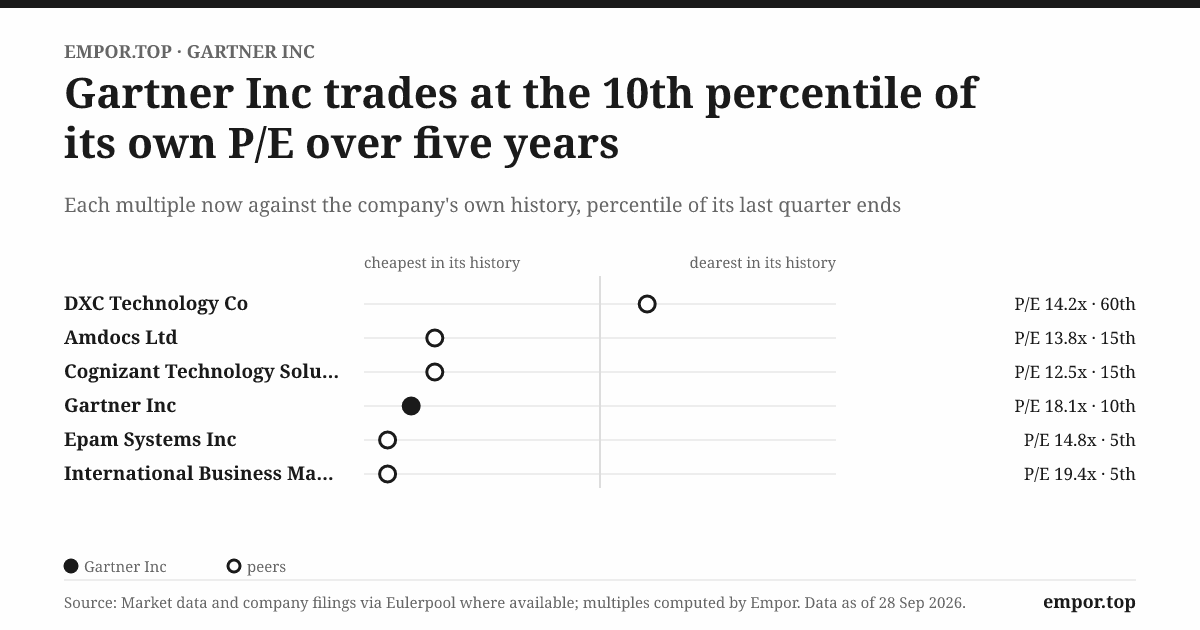
What does the 2026 rally prove? It proves that the market's February 2026 pricing assumed a faster collapse than the data supported. Clients did not flee; profits did not evaporate; cash kept coming in and was returned aggressively. It does not prove that the business has returned to growth. A valuation reset and a demand reacceleration can look alike on a stock chart for months, and then diverge sharply.
For investors tracking the story from here, two numbers carry almost all the signal:
- Research contract value growth, the forward-looking run-rate of the core business, and whether it reaccelerates from its 2026 low single digits.
- Research wallet retention, and whether it climbs back toward the levels Gartner achieved in its growth years or erodes further below 100%.
The next two or three earnings cycles, not the last one, will be the real test. The oracle's hardest prediction was always going to be about itself, and for once, the market will not need to buy the research to find out the answer.
XV. Recent News
Several developments are scheduled or pending as of late September 2026.
Q3 2026 earnings. Gartner's third-quarter 2026 results are expected in early November 2026, the first reporting period following the agreed sale of Capterra, Software Advice and GetApp to G2.1 Investors will look for whether the raised full-year EPS and free-cash-flow guidance from the second quarter holds,11 and for the first clean read on the remaining business after the divestiture.
The late-summer rally. The stock's 31.2% jump in a single month in the summer of 2026 reflected stronger-than-expected results and renewed confidence in retention.4 Shares have since pulled back to around $185, well above the February low but well below the 2026 high.
Bernstein Liebhard inquiry. The law firm issued another announcement on September 22, 2026, repeating its investigation into potential breaches of fiduciary duty related to disclosures before February 24, 2025.18 No complaint arising from the investigation had been confirmed as filed at the time of writing. Resolution, dismissal or the filing of a derivative suit would be the next milestone.
AskGartner monetization. Gartner has not disclosed revenue, retention or pricing data specific to AskGartner or to AI usage within the Research segment.1 Any such disclosure in coming quarters would be the first hard evidence on whether the company's AI response is creating value or merely defending it.
Further filings and presentations are available through Gartner's investor relations site.[^23]
References
-
Gartner, Inc. Form 10-K FY2025 (filed 2026-02-12) — SEC EDGAR, 2026-02-12 ↩↩↩↩↩↩↩↩↩↩
-
Gartner Stock Plunges to 52-Week Low After 2026 Revenue Guidance Misses Expectations — TIKR ↩↩↩↩↩↩↩
-
Why Gartner Stock Was Cut In Half In 2025 — The Motley Fool, 2026-01-15 ↩
-
Why Gartner Stock Skyrocketed 31.2% Last Month — The Motley Fool, 2026-09-08 ↩↩↩
-
Gartner, Inc. Form S-4 — CEB acquisition registration statement — SEC EDGAR, 2017 ↩↩
-
Gartner selling talent assessment business for $400 million — Westfair Communications, 2018-02-07 ↩↩↩
-
Gartner Q2 2026 earnings release (8-K Exhibit 99.1) — SEC EDGAR, 2026 ↩↩↩↩↩
-
Judge Grants Gartner Motion to Dismiss NetScout Lawsuit — Gartner Ombuds Office ↩
-
First Amendment Protection for Subjective Vendor Ratings Confirmed in NetScout v. Gartner — CaseMine ↩↩
-
Remember when NetScout sued Gartner over Magic Quadrant placement — The Register, 2020-01-16 ↩
-
Gartner, Inc. Form DEF 14A — 2026 Proxy Statement — SEC EDGAR, 2026-04-15 ↩↩↩↩↩
-
Gartner, Inc. Form DEF 14A — 2025 Proxy Statement — SEC EDGAR, 2025-04-15 ↩
-
Gartner Q1 2026 earnings release (8-K Exhibit 99.1) — SEC EDGAR, 2026 ↩↩
-
GARTNER, INC. (NYSE: IT) Shareholder Investigation Alert — Bernstein Liebhard, GlobeNewswire, 2026-09-22 ↩↩↩
-
Gartner Stock Down 49%. Learn Why, What CEO Can Do — Forbes, 2025-08-06 ↩
 LinkedIn
 WhatsApp
 Reddit
 Hacker News
 Email
 Kindle
 RSS Feed
 Spotify
 Apple Podcasts
 Amazon Music
 Audible
 YouTube