Samsara: Physical AI for the Analog Economy
I. Introduction & The Big Picture (8–10 min)
Picture a refrigerated trailer idling at a loading dock outside Memphis at four in the morning. The driver is on hour nine of an eleven-hour shift. The produce behind him is two degrees warmer than it should be. A forklift three bays over is overdue for maintenance, and a construction excavator the same company leases out is sitting unused across town while a customer waits for one. None of these facts lives in a spreadsheet anyone will look at today. For most of the twentieth century, this was simply what physical operations looked like: expensive machines, thin margins, and a fog of missing information between the people who run the equipment and the people who pay for it.
Samsara Inc. is a company built to burn off that fog. It sells small, rugged devices — vehicle gateways, dash cameras, asset tags, equipment monitors — and a cloud platform that turns what those devices see into dashboards, alerts, coaching, and increasingly automated decisions. The company calls this the Connected Operations Cloud, and in the summer of 2026 it began calling the whole enterprise something grander: Physical AI.12
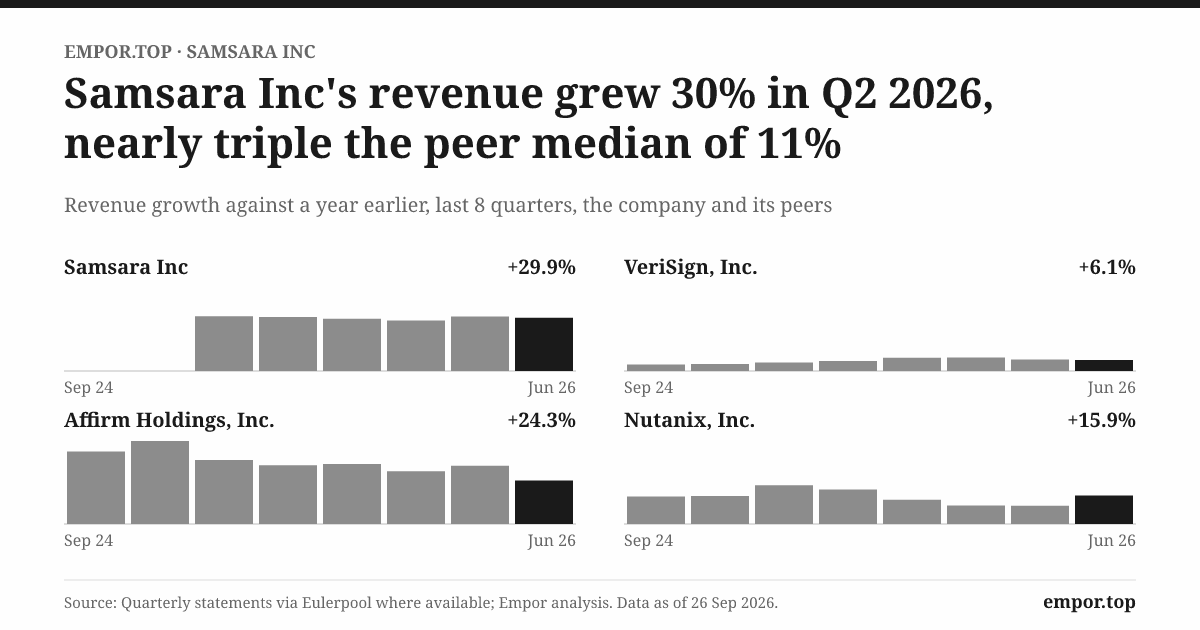
The scale is no longer small. In the quarter that ended in early August 2026, Samsara reported $508.4 million of revenue and annual recurring revenue of $2.125 billion, both up 30% year over year.1 It also reported its fourth consecutive quarter of GAAP profitability, a milestone that arrived roughly a decade after the company was founded and after years of heavy losses.13 Management guided full-year fiscal 2027 revenue to $2.043–$2.047 billion, about 26% growth.1
The founders are the reason people pay attention. Sanjit Biswas and John Bicket had already built and sold one company, Meraki, to Cisco for $1.2 billion.4 Instead of retiring into venture investing, they went looking for another overlooked market and found one in trucks, forklifts, cold-chain trailers, and job sites — the analog economy that software mostly ignored.
That backstory makes the present moment interesting rather than merely impressive. In July 2026, Samsara rebranded around "Physical AI," timed to its $2 billion ARR milestone.2 The investor question is sharp: is that a genuine platform inflection, where AI features become a second growth engine on top of telematics, or is it a valuation-friendly relabeling of a business the market already understands?
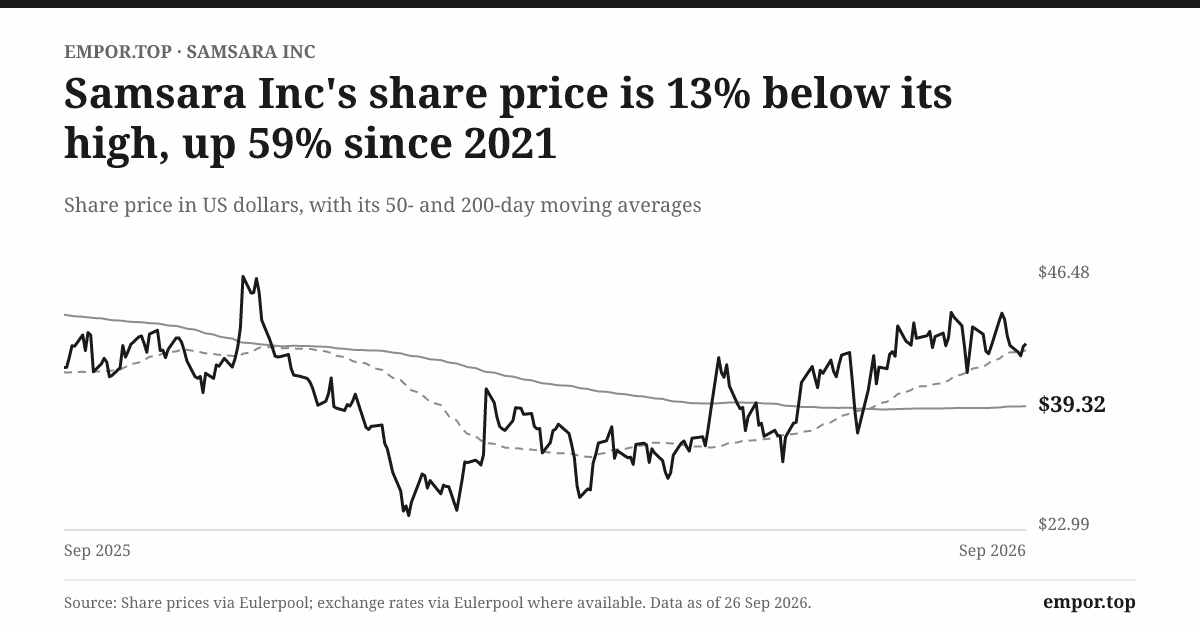
The answer matters because the stock embeds a lot of hope. Around $38 a share in late September 2026, Samsara carried a market value of roughly $22 billion, having traded between about $23 and $47 over the prior year. Analysts at the time noted it traded at close to 50 times forward earnings.3 That is not a price for a steady fleet-tracking vendor. It is a price for a platform that keeps finding new things to sell into the same customers.
This story walks the full arc. It starts with an MIT research project and a Cisco exit, moves through the founding of Samsara and its expansion from one product into a bundle, then into a 2021 IPO and a governance structure that still shapes everything. From there it gets analytical: the real cost of reaching $2 billion in ARR, the substance behind the AI rebrand, the economics of land-and-expand, a competitive field where Samsara is not the undisputed leader, and a litigation record that tested its technology moat and mostly failed to confirm it.
The through-line question is simple to state and hard to answer. Samsara is clearly a good business. The question for a long-term investor is whether it is a defensible one, and whether per-share value creation will keep pace with the operating story. To get there, the story starts where the founders' playbook was written: on rooftops in Cambridge, Massachusetts.
 Subscribe on LinkedIn
II. Origins, Succinctly: MIT, Meraki, and the Muscle Memory of a Second-Time Founder (15–20 min)
In the early 2000s, a handful of MIT graduate students were bolting cheap Wi-Fi antennas onto rooftops around Cambridge. The project was called Roofnet, and the idea was quietly radical: rather than one expensive tower serving a neighborhood, dozens of cheap radios could talk to one another and route internet traffic in a self-organizing mesh. Two of the students were Sanjit Biswas and John Bicket, who met at MIT as graduate students.5
Biswas was the more outward-facing of the two, a builder with a business instinct. Bicket was the systems engineer who cared about how things actually worked in the field. The pairing mattered, because Roofnet taught them something that software-only founders rarely learn early: hardware in the real world breaks, gets rained on, loses power, and gets installed wrong. If the software cannot manage messy physical devices remotely, the whole system collapses.
They turned that lesson into Meraki. The insight was that businesses wanted enterprise-grade Wi-Fi but hated the complexity of managing it. Meraki sold access points and switches, but the real product was the cloud dashboard that let an IT generalist configure a hundred sites from a browser. Hardware was the delivery vehicle; the subscription to the cloud was the business.
Cisco bought Meraki for $1.2 billion in 2012.4 Inside the networking giant, Meraki became a cloud-managed networking franchise, and the founders gained something rarer than money: a full cycle of building, scaling, selling, and integrating a hardware-plus-cloud business.
Why does this matter in 2026 rather than as nostalgia? Because Meraki is the template Samsara follows almost line for line. Design your own hardware so it just works. Make the cloud the brains. Sell to buyers the incumbent vendors treat as an afterthought. Charge for the subscription, not the box. When bulls talk about "second-time founder pattern recognition," Meraki is the evidence they mean, and it is genuinely strong evidence that these two people know how to build this particular type of machine.
There is also a meaningful limit to that evidence, and it deserves plain treatment. Meraki sold into IT departments — buyers who already had budgets for networking and already understood recurring software. Cisco also had enormous distribution to push Meraki through. Trucking fleets, construction contractors, utilities, and food distributors are different buyers. Their operations managers are often not technologists. Their margins are thinner. Their equipment is dirtier, hotter, colder, and more violently used than any office access point. A dash camera bolted to a windshield in Arizona faces a reliability test a ceiling-mounted Wi-Fi router never will.
So the Meraki record supports a narrower version of the founder claim: Biswas and Bicket have proven they can build a cloud-managed hardware business and sell it at scale into a neglected market. It does not, on its own, prove the playbook transfers to industries with a different sales motion and a harsher hardware bar. That proof has to come from Samsara's own record, which is where the story turns next.
III. Finding the White Space: Founding Samsara (2015–2018) (20–25 min)
The founders were, by most measures, free. They had money, a successful exit, and every reason to take a victory lap. Instead, in 2015, they incorporated a new company in San Francisco.5 The name, Samsara, is a Sanskrit word for the cycle of rebirth, and the symbolism was hard to miss: a second life for the same set of ideas.
The founding thesis borrowed directly from Meraki. Across industrial and logistics markets, the founders saw a landscape of legacy telematics vendors selling clunky hardware and dated software, often bolted together from acquisitions. Nobody seemed to be building hardware, software, and cloud as a single designed system for the physical economy. The white space was not a new technology; it was a better-integrated product for customers who had been underserved.
Andreessen Horowitz became an early backer, and General Catalyst joined later.6 The money mattered, but so did the signal: top-tier venture investors were willing to fund a hardware-heavy business at a time when "software eats the world" was the fashionable doctrine. They were effectively betting that Samsara's hardware was a distribution mechanism for software, not a drag on it.
The first beachhead was fleets. The Vehicle Gateway plugged into a truck's diagnostic port, reported location via GPS, pulled engine data, and in refrigerated trailers could monitor temperature. For a small or mid-sized fleet, the value was immediate and legible: know where your trucks are, know when an engine is about to fail, prove to a customer that the lettuce stayed cold.
Then customers pulled the company somewhere more valuable. Fleets wanted cameras, both road-facing and driver-facing. A camera turned telematics from a location service into a safety and liability product. When a truck is involved in a crash, video can exonerate a driver or reveal a problem worth fixing before it becomes a nuclear verdict in court. Samsara's IPO prospectus later showed that its product launches unfolded in a steady cadence: vehicle telematics, then equipment monitoring in 2018, driver workflows in 2019, an app marketplace in 2020, and site visibility in 2021.5
The private markets rewarded the momentum. In September 2019, Samsara raised $300 million from new investors Tiger Global and Dragoneer alongside Andreessen Horowitz and General Catalyst, at a $6.3 billion valuation, bringing total funding to $530 million.6 At the time it claimed more than 10,000 customers and about 1,300 employees, and said it planned to add another 1,000 people.6
That plan says a great deal about the company's posture. This was not a cautious hardware start-up nursing capital. It was a land-grab business betting that whoever instrumented the fleet first would own the relationship for years. The use of proceeds pointed at Europe, Mexico, and Canada, plus more R&D and account teams.6
It also set a benchmark that would later haunt the stock. A $6.3 billion private valuation in 2019, followed by the 2021 IPO at roughly $11 billion, meant public investors inherited a business whose growth was already richly priced. The early years proved demand was real. What they did not yet prove was whether a fleet-tracking beachhead could become something broader. That was the task of the next three years.
IV. Building the Platform: From Point Product to Connected Operations Cloud (2018–2021) (20–25 min)
Imagine a regional food distributor that bought Samsara to track fifty delivery trucks. A year later, the same distributor adds dash cameras after a costly accident. Then it puts sensors on its warehouse freezers. Then it gives its drivers a tablet app for electronic logs and proof of delivery. By year three, the fleet manager, the safety director, the maintenance chief, and the warehouse lead all log into the same dashboard every morning. Nobody signed a giant contract on day one. The account simply grew.
That pattern — land with one use case, expand into four — is the core commercial idea of Samsara, and it took shape between 2018 and 2021. The architecture underneath it matters. Every device feeds data into one platform. That data is processed, analyzed, and increasingly scored by AI models. It then triggers workflows: an alert, a coaching session, a maintenance ticket, an API call into the customer's own systems. In plain terms, Samsara built one plumbing system and then kept adding faucets.
It is worth pausing on how this works physically, because it explains both the strength and the cost of the model. A Samsara vehicle gateway is, in effect, a small ruggedized computer with a cellular modem, a GPS receiver, and a connection into the truck's engine computer. A modern AI dash camera goes further: it carries enough onboard processing to run computer-vision models at the "edge," inside the vehicle, rather than streaming every second of video to the cloud. Think of it as a smart doorbell for an eighteen-wheeler. Most of the time it quietly watches and does nothing. When it detects something that matters — a hard brake, a rolling stop, a phone in the driver's hand, a following distance that is too close — it clips the relevant seconds, uploads them, and alerts a safety manager or the driver directly.
That design choice has economic consequences. Processing at the edge keeps cellular data costs manageable and makes alerts fast enough to prevent an accident rather than merely record one. But it also means the device itself has to be capable, which means more expensive components, more careful engineering, and inventory that must be bought before a customer is billed. Every new camera generation raises the capability bar and, with it, the upfront hardware cost. That tension between smart devices and cash efficiency runs through the rest of this story.
The other half of the design is the cloud dashboard, where the Meraki inheritance is most visible. A fleet manager does not configure devices one by one. New gateways appear on the dashboard when they are plugged in, receive software updates over the air, and can gain new features without anyone touching the truck. That is what makes the land-and-expand motion cheap: once the hardware is installed, many new capabilities are simply switched on, and billed, from the cloud.
The claim that this bundle is a strategic masterstroke is often made, so it is worth being specific about what the evidence showed at IPO. According to the prospectus, about 89% of customers subscribed to multiple applications.5 That is a real signal: customers were buying the bundle, not just a tracker. But the same period also revealed concentration. A PitchBook analyst noted that at least 87.7% of ARR as of the third quarter of fiscal 2022 came from just two products, video-based safety and vehicle telematics.4 The "platform" was real in architecture and in customer behavior, but economically it was still mostly a fleet-camera-and-tracking business with promising add-ons.
Expansion also went geographic and vertical. The company pushed into Europe, Canada, and Mexico, and beyond trucking into construction, utilities, field services, and the public sector.6 Construction would later become the largest single industry contributor to net new business for many consecutive quarters, a sign that the non-trucking push worked.7
Then came COVID-19. For a company selling into logistics, construction, and field operations, the pandemic was a live stress test. Demand could plausibly have collapsed as fleets idled and job sites shut. Instead, fiscal 2021 — the year ending in January 2021 and spanning most of the pandemic's first wave — produced revenue of $249.9 million, up 108% from the prior year.5 ARR reached $341.2 million.5
What does that tell an investor? First, that the subscription base behaved like infrastructure rather than discretionary spend; customers kept paying during a shock. Second, that the pandemic may have helped at the margin, because remote visibility into physical assets became more valuable when fewer people could be on site. The caveat is that 2020–2021 was also a period of stimulus-fueled freight demand, so the resilience evidence is somewhat flattered by macro tailwinds. A true downturn in freight volumes, rather than a pandemic dislocation, remains a less-tested scenario.
By the eve of the IPO, the company had 452 customers paying more than $100,000 in ARR.5 That number would become one of the most important in the entire story, because it showed that large enterprises, not just small fleets, were beginning to adopt the bundle. The pitch had become a pattern visible in the numbers. The next step was to sell that pattern to public-market investors, on terms that kept the founders firmly in charge.
V. The IPO and the Governance Structure That Still Matters Today (December 2021) (20 min)
December 15, 2021, was close to the peak of one of the frothiest markets for growth stocks in a generation. Software multiples were stretched, IPO windows were wide open, and investors were paying up for anything with high growth and a recurring-revenue model. Samsara walked onto the New York Stock Exchange under the ticker IOT that day.
The company sold 35 million shares at $23, raising $805 million and valuing itself at about $11.4 billion.4 The stock closed its first day at $24.70, a respectable but not euphoric 7% pop.4 At the time, it was growing fast and losing money; it had posted a net loss of $210.2 million in fiscal 2021.5
The more durable decision was the share structure. Samsara went public with three classes of stock: Class A with one vote per share, Class B with ten votes per share, and Class C with no votes at all.5 The founders held the Class B shares, and after the offering they controlled about 81.8% of the voting power.5
In practical terms, that means public shareholders own a large part of the economics but very little of the control. Biswas remains CEO and Chairman; Bicket remains CTO.8 Strategy — how much to spend on hardware, whether to acquire, whether to buy back stock, how to price AI features — is set by the two people who founded the company.
Supporters of this structure argue it lets founders make long-duration bets without quarter-to-quarter pressure. Critics argue it removes the accountability mechanism that shareholders would otherwise use when capital is misallocated. Both are true, and which one dominates depends on the founders' decisions. At Samsara, one consequence is concrete: no activist investor has surfaced, and the super-voting structure is a large part of why. An activist with a five-percent Class A stake would have almost no leverage.
Now consider what the IPO priced in and what happened next. By late September 2026, the stock traded around $38, with a 52-week range of roughly $23 to $47. That means a holder who bought at the IPO price has earned a positive but unremarkable return over nearly five years, with brutal volatility along the way — the stock fell below its IPO price during the 2022 growth-stock collapse and nearly revisited that level within the past year.
Meanwhile, the underlying business transformed. Revenue grew more than sixfold from fiscal 2021 to fiscal 2026.59 Losses swung to GAAP profits. That disconnect is worth sitting with. It says that much of the IPO-era optimism had already been capitalized into the entry price, and that fundamental progress mostly worked to grow into a valuation rather than to expand it. For anyone framing Samsara as a proven "compounder," the stock-price record since 2021 is the first sobering data point.
The IPO narrative promised scale with discipline. The next five fiscal years would be the test of whether that promise was kept, and the financial record, examined carefully, gives a more nuanced answer than either the bulls or the bears tend to offer.
VI. The Financial Arc: From $250M to $2B+ ARR, and the Real Cost of Getting There (35–40 min)
On a Thursday afternoon in early September 2026, CFO Dominic Phillips delivered a sentence that most growth-company CFOs would rather avoid. After a quarter in which revenue grew 30% and ARR crossed $2.1 billion, he told investors that free cash flow margin was expected to land about 100 basis points below the prior year.103 The reason was not a sales miss. It was the physical world asserting itself: more devices to buy, more inventory to hold, higher supply-chain costs.
That moment captures Samsara's financial arc better than any headline number. This is a business that has scaled beautifully in revenue and improved dramatically in profitability, but it carries a hardware anchor that software-only peers do not.
A quick primer on the metrics
Two measures dominate Samsara's reporting, and they are easy to confuse. Revenue is what the company recognized as earned during a period, under accounting rules. Annual recurring revenue, or ARR, is a snapshot: the annualized value of all active subscriptions at a moment in time. If a customer signs a three-year contract for 1,000 vehicles on the last day of the quarter, ARR jumps immediately, while revenue arrives gradually over the following years. That is why ARR, and particularly net new ARR added each quarter, tends to move before revenue does. It is the leading edge of the business; revenue is the trailing shadow.
That distinction matters for interpreting deceleration. If net new ARR growth holds up while revenue growth slows, the slowdown is partly mechanical and may stabilize. If net new ARR growth slows faster than revenue, the future is weaker than the current income statement suggests.
The revenue climb, and the deceleration
Start with the top line, remembering that Samsara's fiscal year ends in late January or early February. Revenue was roughly $428 million in fiscal 2022, about $653 million in fiscal 2023, $937.4 million in fiscal 2024, $1.249 billion in fiscal 2025, and $1.619 billion in fiscal 2026.8119 The growth rates tell the story more clearly than the dollars: roughly 52%, then 44%, then 33%, then 30%.
That is deceleration, but graceful deceleration. Most companies see growth fall off a cliff as they pass $1 billion in revenue. Samsara's rate held around 30% for two years at that scale, which says something real about demand. Its fiscal 2027 guide of 26% implies further slowing, and the company guided the third quarter to about 24% growth.13 The slowdown is not bear-case speculation; it is the company's own forecast.
There is one important nuance in favor of management's credibility. When Samsara first guided fiscal 2027 in March 2026, it called for revenue of $1.965–$1.975 billion, or 21–22% growth.9 By September, it had raised that to about 26%.1 A company that starts conservative and raises as the year unfolds is behaving very differently from one that starts aggressive and cuts. Deceleration is real, but so far it has been slower than management itself predicted.
The profitability inflection
Now the part that changed the investment conversation. In fiscal 2022, the year of the IPO, Samsara posted a GAAP operating loss of roughly $352 million.8 By fiscal 2026, the full-year GAAP operating loss had narrowed to $52.6 million and the net loss to just $9.1 million.9 The third quarter of fiscal 2026 was the first GAAP-profitable quarter in company history, and the fourth quarter brought net income of $22 million.79 Two more profitable quarters followed in fiscal 2027.13
On a non-GAAP basis, the operating margin rose to 17% in fiscal 2026 and is guided to 21% for fiscal 2027.91
What does this mean in plain English? The company proved that its sales and R&D machinery has operating leverage: revenue has been growing faster than costs. That is the core promise of any subscription business, and Samsara has delivered it.
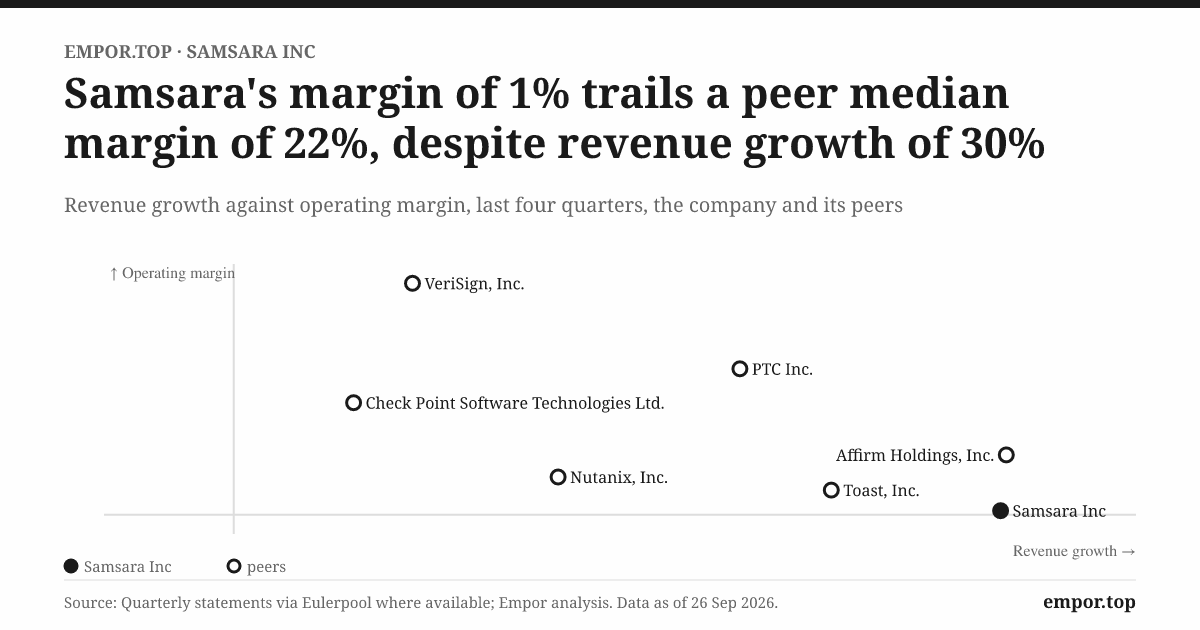
But look carefully at the quality of that GAAP profit. In the second quarter of fiscal 2027, GAAP operating margin was just 1%.1 GAAP net income is being helped by interest earned on the company's cash pile. The gap between a 21% non-GAAP operating margin and a 1% GAAP operating margin is almost entirely stock-based compensation. That gap is the next part of the story.
Free cash flow, and management's own contrary data point
Free cash flow turned decisively. It was deeply negative in fiscal 2022, around negative $191 million, then became positive, reaching about $111 million in fiscal 2025 and $207.4 million in fiscal 2026.8119 In the second quarter of fiscal 2027 alone, free cash flow was $64.7 million.1
The bull narrative says a hardware-plus-software flywheel gets more efficient with scale: more devices deployed, more data, more software attached, lower incremental cost. Management's own fiscal 2027 guidance runs in the opposite direction in the near term. Free cash flow margin is guided down, not up, because customers are buying more IoT devices, inventory is rising, and supply-chain costs are elevated.10 Inventory rose from $48.2 million to $57 million in a single quarter.3
This is the juxtaposition that matters. The hardware is how Samsara lands and expands, and the more successful the land, the more hardware it must buy up front. Growth, in other words, carries a working-capital tax. That does not refute the flywheel; it narrows it. The software economics clearly improve with scale. The hardware economics do not automatically improve, and may worsen when tariffs or component costs rise. The falsification test is simple: if free cash flow margin recovers in fiscal 2028 as inventory normalizes, the fiscal 2027 decline was a timing issue. If it keeps sliding as growth continues, hardware intensity is a permanent feature of the model.
The dilution ledger
Here is the number bulls often skip. Stock-based compensation was about $177 million in fiscal 2023 and $335 million in fiscal 2026.119 That fiscal 2026 figure is larger than the year's entire free cash flow. Weighted diluted shares rose from roughly 505 million in fiscal 2022 to 585.4 million in fiscal 2026, roughly mid-teens dilution over four years.89
Why does that matter? Because owners of the stock get paid per share, not per company. Free cash flow of $207 million sounds like a turning point; free cash flow after accounting for the value handed to employees in stock looks much closer to breakeven. Samsara is hardly unusual among 2021-vintage software companies in this respect, and equity pay is how it competes for engineers in San Francisco. But the investor case has to net the two against each other.
The earnings press release for fiscal 2026 did not announce a share repurchase authorization, which means the company is not yet using cash to offset that dilution.9
The KPIs that follow from this section are straightforward: net new ARR growth, which leads revenue; free cash flow margin against the guided decline; and the durability of GAAP operating margin. Those financial numbers describe what customers are paying. The next question is what they are paying for, and whether the new Physical AI identity reflects a different product or simply a different label.
VII. Current Strategy: The "Physical AI" Rebrand — Product Substance or Narrative Repackaging? (25–30 min)
On July 21, 2026, Samsara announced that it was evolving its brand to reflect "the next decade of scale in Physical AI."2 It was the first major brand change since the company's founding, and the timing was exquisite: the company was crossing $2 billion in ARR the same season.
Rebrands are cheap. A new logo and a trendy phrase cost almost nothing, and in 2026 attaching "AI" to anything is a well-worn tactic to borrow a higher multiple. So the right question is not whether the rebrand sounds good. It is whether the products underneath it are real, sold, and paid for.
What "Physical AI" means in plain terms
Most people think of AI as chatbots writing emails. Physical AI is different: models that interpret what is happening in the physical world, from video, sensor readings, and machine signals, and then act on it. A camera that spots a driver's eyelids drooping and triggers an in-cab alert is Physical AI. So is a system that notices a refrigerated trailer's temperature trending up and dispatches a technician before the cargo spoils.
Samsara's advantage in this framing is data volume. The company said its platform captures more than 25 trillion data points annually.9 Every camera installed on a fleet feeds footage that can train better models. In theory, this creates a data flywheel: more customers, more video, better models, more customers. In practice, the value of that data depends on whether it produces measurably better outcomes than competitors' models, which also train on enormous datasets.
What has actually shipped
The product list is concrete. Samsara has introduced AI-assisted safety coaching, multi-camera AI video, workflow automation tools, and a Bluetooth Tracking Label for shipment visibility.210 On the second-quarter fiscal 2027 call, management also highlighted a 360 Camera for equipment operators, Waste Intelligence for verifying waste-collection service, and Ground Intelligence for automatically mapping road defects.10 Biswas told investors that customer adoption of some of the latest AI features was up more than fourfold in the two months after the company's Beyond conference.10
These are real SKUs, sold into an existing install base of fleets and job sites. That matters. The strategic logic is that AI features raise the value of cameras and sensors the customer has already installed, which lets Samsara sell more per account without a new sales cycle.
The commercialization evidence
The most useful data point is the share of net new annual contract value coming from "emerging products" — equipment monitoring, site visibility, asset tags, and newer AI-attached SKUs. In the third quarter of fiscal 2026, emerging products launched within the prior year contributed 20% of net new ACV, up from 8% the quarter before.7 Asset Tags grew more than 400% year over year.7 By the second quarter of fiscal 2027, emerging products had contributed more than 20% of net new ACV for the third consecutive quarter, and Phillips said no single emerging product accounted for more than half of that bookings mix.10
That last point is revealing. It means the growth is spread across multiple products rather than dependent on one hit. That is evidence the platform architecture is doing its job: once the plumbing exists, adding new faucets is relatively cheap.
Here is the honest limitation. "Emerging products" is a management-defined category, and "net new ACV" is a bookings metric, not recognized revenue or ARR retention. Twenty percent of net new business is meaningful, but it is still a small slice of the total base. And "adoption up fourfold" describes usage, not dollars. Certification, launches, and conference demos are not revenue. The past record helps here: the IPO-era concern that almost 88% of ARR came from two products was genuinely addressed over time, as the multiproduct share rose.47 That is a decent track record of converting new products into bookings.
So the calibrated conclusion: the rebrand is not empty, because the AI products are shipping and contributing to bookings. But it is not yet proven either, because the contribution is to the flow of new business rather than a separately disclosed revenue stream. The test is whether the emerging-products share of net new ACV keeps rising through fiscal 2027 and fiscal 2028, or plateaus once the easy upsell into existing customers is exhausted.
The privacy shadow over AI cameras
The AI camera push carries its own regulatory friction. In July 2025, Samsara agreed to pay $3.95 million to settle a class action alleging that its dual-facing dash cameras violated Illinois' Biometric Information Privacy Act by collecting drivers' biometric data without proper consent.12 The class covered drivers who operated vehicles with these cameras in Illinois from December 2016 to June 2025.12
Financially, $3.95 million is trivial for a company of this size. Strategically, it is a preview. The more Samsara's cameras watch drivers' faces to detect drowsiness or distraction, the more the product sits in the path of biometric-privacy laws, labor-relations disputes, and data-protection regimes in Europe. The regulatory surface grows precisely as the AI product line grows. And that is worth remembering as the story turns to who is actually paying for all of this.
VIII. The Business Model, Segment Economics, and Who Actually Drives the Value (25–30 min)
Walk into a Samsara quarterly earnings call and listen to what management celebrates. It is rarely a new small-fleet logo. It is a record number of large customers, or a new seven-figure deal with a utility or a city. That emphasis reveals where the growth engine has moved.
The enterprise mix-shift
At the IPO, Samsara had 452 customers paying more than $100,000 in ARR.5 By the second quarter of fiscal 2027, it had 3,605 such customers, after a record 242 additions in that single quarter.10 That cohort's ARR grew 38% year over year and represented about 63% of total ARR.10 At the very top, 210 customers pay more than $1 million annually, and that group generated over $500 million of ARR, growing more than 50%.101
Translate that into plain English. The company that started by selling trackers to small trucking fleets now makes most of its money from large enterprises, and those enterprises are growing faster than the business overall. The blended 30% growth rate conceals two different engines: a large-customer engine running near 38%, and a smaller-customer engine running considerably slower.
That is mostly good news. Large customers tend to be stickier, buy more products, and are harder for a competitor to rip out once thousands of vehicles are instrumented. In the third quarter of fiscal 2026, management said 95% of large customers subscribed to multiple products.7
It also has a cost. Management itself warned that larger deals come with "inherently longer and less predictable sales cycles," which may create quarterly volatility.7 Enterprise buyers also negotiate harder. As more of Samsara's revenue comes from sophisticated procurement departments, pricing power becomes a real question rather than an assumption.
Net retention: good, but flat
Net dollar retention measures how much a group of customers spends this year compared with last year, after accounting for upgrades, downgrades, and churn. A figure of 115% means that a customer cohort spending $100 last year now spends $115, without counting any new customers.
Samsara reported net retention of about 115% for core customers, a level it has held steadily.107 By SaaS standards, that is solidly above the median. But it is flat, not improving. For a company claiming a steady stream of new AI products to upsell, stable retention is a mild puzzle: if customers were eagerly adding the new AI SKUs, one might expect retention to climb. The more likely reading is that new product attach is offsetting some combination of pricing pressure, fleet downsizing at certain customers, and competitive churn. Retention is the single most important number for spotting early competitive erosion.
Hardware in the model
About 98% of revenue comes from subscriptions to the Connected Operations Platform.13 Hardware is typically bundled into multi-year subscriptions rather than sold as a separate product line, which is why Samsara looks like a software company on its revenue line. But the devices still have to be bought, stocked, and shipped before the subscription revenue arrives. That is why the inventory build and the free cash flow guide discussed earlier matter: hardware does not show up as a revenue segment, but it shows up in cash.
Customer diversity and the public sector
The customer base is broad. Construction was the largest industry contributor to net new ACV for the ninth consecutive quarter as of late 2025.7 Public sector — cities, states, and agencies managing vehicle fleets, snowplows, and waste trucks — delivered its second-highest net new ACV mix ever in the second quarter of fiscal 2027.10 International markets contributed 18% of net new ACV in the same quarter, while about 14% of fiscal 2026 revenue came from outside the United States.1013
Public sector here is a diversifying channel, not a dominant customer. No single government controls enough of Samsara's revenue to dictate terms the way a sovereign buyer can at a defense contractor. That limits one form of buyer power, but it does not eliminate public-procurement risks such as re-bids and budget cycles.
The model is sound and the mix-shift is favorable. But every one of these strengths — retention, enterprise growth, multiproduct attach — has to hold up against competitors who sell very similar products. That is where the moat claim gets its real test.
IX. Industry Structure and Competition: Where the Moat Claim Gets Tested (35–40 min)
On January 24, 2024, Samsara filed a federal lawsuit against its most aggressive rival, Motive Technologies, formerly known as KeepTruckin.1415 Two weeks later, it asked the U.S. International Trade Commission to ban imports of Motive's AI hardware.14 The message was unmistakable: Samsara believed its technology was protectable, and it was willing to use the courts to prove it.
Two years later, the courts gave their answer. It was not the one Samsara wanted.
The market map
Commercial telematics is a large, fragmented market with legacy vendors, telecom-backed players, and venture-funded challengers. The competitive set includes Geotab, Verizon Connect, PowerFleet, Trimble's transportation business, Solera and its Omnitracs assets, Motive, Lytx, and Platform Science, among others.16
Scale is where the "category leader" narrative needs a counterweight. In ABI Research's commercial telematics competitive ranking published in February 2025, Geotab ranked first and Samsara second, followed by PowerFleet and Verizon Connect.16 Geotab, a privately held Canadian company, reported more than 4.6 million connected vehicles and offers a marketplace of more than 430 solutions from nearly 350 partners.16 Most public-market investors have barely heard of it, but by installed base it is the larger player.
That does not make Samsara the loser. Its revenue growth, enterprise momentum, and product breadth are strong. But any framing of Samsara as the undisputed #1 in telematics is contradicted by the most-cited independent ranking. The fair statement is that Samsara is the fastest-scaling public leader in a market where a private rival still holds the largest installed base.
The Motive litigation: the sharpest test of the IP moat
Here is the full sequence. Samsara sued Motive for patent infringement and false advertising in January 2024 and followed with the ITC complaint in February.14 Motive countersued on February 15, 2024, alleging among other things that Samsara had created more than 30 fictitious accounts starting in April 2016 to copy features of Motive's platform.14 Samsara, in turn, alleged that Motive began unauthorized access to Samsara's platform in October 2017, viewing its dashboard more than 20,000 times over five years.14
In February 2026, the ITC ruled that Motive did not infringe any valid Samsara patent. It invalidated eight of the nine asserted claims, found no violation, and found that Samsara had not met the domestic-industry requirement.14 Any threat of an import ban vanished.
Separately, a JAMS arbitrator awarded Samsara $30.3 million over Motive's false-advertising claims about benchmark studies, along with a permanent injunction requiring Motive to correct misleading advertising.14 Samsara's legal team said the facts showed Motive "made false claims about our product capabilities."14 Motive's CEO, Shoaib Makani, told employees that Motive had beaten Samsara at the ITC and that Motive's own patent and false-advertising case against Samsara would be heard by a jury in district court.14 That case remains pending.
Myth vs. reality
The myth: Samsara's hardware-plus-software integration is protected by defensible technology that competitors cannot copy.
The reality: when Samsara put that claim before a federal trade tribunal, eight of nine asserted patent claims were found invalid and Motive was found not to infringe. What Samsara won was a marketing case, meaning Motive had overstated its own product performance, not a technology-appropriation case. And the mutual fake-account allegations suggest that both companies watched each other closely enough that product features converge.
The history therefore narrows the moat claim considerably. Samsara's advantage is not primarily legal intellectual property. It is closer to brand, integration depth, sales execution, and account entrenchment. Those are real advantages, but they are the kind competitors can erode with price and persistence, not the kind a court will enforce.
Where advantage does exist
Evidence for real advantage comes from customer behavior rather than patents. Net retention around 115% shows customers expanding rather than leaving.10 The large-customer cohort growing faster than the whole business shows switching costs visible in expansion, not just logos. And a fleet instrumented with thousands of Samsara devices, integrated into payroll, maintenance, and safety programs, is expensive and disruptive to swap out.
In the language of Hamilton Helmer's 7 Powers, this is mostly switching costs plus a developing form of process power — the accumulated know-how of shipping reliable devices and continuously improving models at scale. It is not a cornered resource; the patent case showed as much. Scale economies exist but are shared with Geotab, which is larger by installed base.
The rival playbooks, one by one
It helps to war-game each competitor's strategy rather than lump them together.
Geotab's game is ecosystem and reach. Its marketplace of hundreds of partner solutions means a fleet can buy a Geotab device and then plug in specialized third-party software for fuel cards, insurance, or compliance.16 That is a different philosophy from Samsara's: Geotab is the open platform with many partners, while Samsara prefers to build more of the stack itself. The open model tends to win on breadth and price; the integrated model tends to win on polish and speed of feature delivery. Neither is obviously superior, and large fleets frequently run bake-offs between the two.
Motive's game is aggression. It targets the same mid-market and enterprise fleets, markets directly against Samsara on camera accuracy and price, and — as the litigation showed — is willing to make comparative claims forceful enough that an arbitrator ordered them corrected.14 A challenger that keeps fighting after losing an arbitration award is not a challenger about to retreat.
Verizon Connect's game is distribution. A telecom carrier already has a commercial relationship with many fleets for phones and data plans, and can bundle telematics into that relationship. That makes it a price-anchoring force at the low end of the market, even if it is less feature-rich.
The most interesting long-term threat comes from a different direction entirely: vehicle manufacturers. Ford Pro appears in ABI's ranking as a telematics provider in its own right.16 New trucks increasingly ship with factory-installed connectivity. If manufacturers make that embedded data good enough and cheap enough, the aftermarket gateway — Samsara's original wedge product — loses some of its reason to exist. Samsara's likely defense is to become the neutral layer that works across mixed fleets of many brands, since few large fleets buy from a single manufacturer. That is a plausible defense, but it shifts the value from the hardware to the software and data integration, which is exactly where the moat has to be proven.
A quick Porter's Five Forces read
Rivalry is intense and multi-front: Geotab competes on scale and ecosystem, Motive on price and aggression, Verizon Connect on telecom bundling. Buyer power is rising as fleets professionalize procurement and run multi-vendor pilots, and the growing enterprise mix concentrates that bargaining power. Supplier power is moderate: Samsara depends on Taiwan-headquartered joint-design manufacturers but uses off-the-shelf components.13 The threat of substitutes is modest but real, particularly from vehicle manufacturers embedding their own telematics at the factory. The threat of new entrants is limited at the enterprise tier by the cost of hardware, data, and distribution.
The net read: Samsara has a real but proportional moat that grows with install-base depth, not with IP. Which puts a spotlight on the people deciding how to defend and extend it.
X. Management Credibility, Ownership, and Capital Allocation (25–30 min)
Every few weeks, a routine filing lands on the SEC's EDGAR system: a Form 4 disclosing that Sanjit Biswas or John Bicket has sold another block of Samsara stock under a pre-arranged trading plan.17 In August 2026, as the company approached its second-quarter results, the filings kept coming.17 There is nothing illicit about any of it. But in a story about founder alignment, it is part of the picture.
The leadership team
Biswas is CEO and Chairman; Bicket is CTO; Dominic Phillips is CFO.810 The founders' cash compensation is nominal, with pay overwhelmingly tied to equity, a standard structure for founder-CEOs that links their wealth to the share price rather than to salary.8
Biswas's style on earnings calls is calm and engineering-minded. He talks about customer outcomes — fewer accidents, less fuel burned, fewer hours of paperwork — more than about financial engineering. Phillips handles the numbers with a notably conservative tone, which matters for guidance credibility.
Guidance discipline
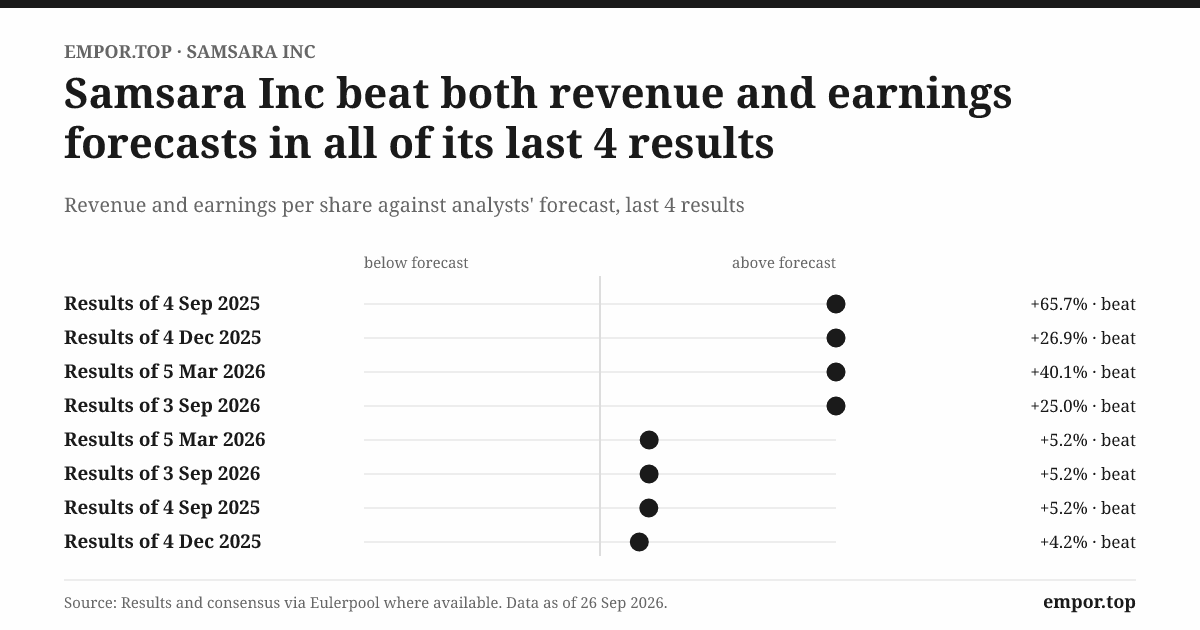
Here, the record is favorable. In December 2025, management guided fiscal 2026 revenue to $1.595–$1.597 billion.7 It delivered $1.619 billion.9 It initially guided fiscal 2027 growth at 21–22%, then raised it to 26% by September.91 In the same breath, it flagged the free cash flow margin decline ahead of time rather than after a miss.10
That is the behavior of a management team that prefers to under-promise. It also explains why the market has been willing to trust guidance. The caveat is that consistent beats also suggest conservative initial targets, so investors have learned to treat the initial guide as a floor rather than a forecast.
Narrative consistency across calls
A useful credibility test is whether the story told on one call matches the story told on the next. Here Samsara's messaging has been notably stable. On the third-quarter fiscal 2026 call, management emphasized large customers, multiproduct adoption, and a 115% net retention target it said it had achieved.7 Nine months later, on the second-quarter fiscal 2027 call, the same themes led: record large-customer additions, emerging products above 20% of net new ACV, and retention around 115%.10 The company has not quietly swapped out metrics that stopped flattering it, which is a common tell of a weakening story.
There is one area where the narrative has shifted: the vocabulary. Earlier materials leaned on "Connected Operations," while the 2026 rebrand leans on "Physical AI."2 The underlying KPIs did not change with the words, which is a mild positive — the rebrand has not so far been used to introduce new, harder-to-audit metrics. Management also volunteered caution in the Q3 fiscal 2026 call that larger deals would make quarters lumpier, rather than waiting to explain a miss after the fact.7 Those are small signals, but they point the same way: an operating team that tends to explain headwinds before they arrive.
Ownership and insider selling
The founders' super-voting shares preserve control even as they sell economic stakes.5 Their sales run under Rule 10b5-1 plans, which are designed to remove discretion over timing.17 Routine diversification by founders who have held concentrated positions for more than a decade is normal and not, by itself, a red flag.
But it is worth naming plainly. The combination of heavy stock-based compensation, steady insider selling, and no buyback means that the flow of shares runs in one direction: toward the market. Against a stock that has lagged its own earnings improvement since the IPO, that pattern invites a fair question about whose interests the capital structure prioritizes.
Capital allocation: discipline, or simply absence?
Samsara's growth has been overwhelmingly organic. The fiscal 2025 and fiscal 2026 annual reports and earnings releases reviewed for this story disclose no material acquisition and no share repurchase program.11139 That is genuine restraint in one sense: no overpriced acquisitions of adjacent technology, no diworsification into unrelated markets, no write-offs of failed deals.
In another sense, it means there is no public-company track record at all. The "second-time founder capital allocator" claim rests almost entirely on the Meraki exit — a sale, not a deployment of capital. Samsara now generates hundreds of millions of dollars of free cash flow a year, and the decisions about what to do with it are still ahead.9 Absence of bad deals is not the same thing as evidence of good ones.
An activist-style stress test
Imagine a skeptical long/short investor with a seat at the table. The questions would be pointed. Why is stock-based compensation larger than free cash flow five years after the IPO? Why no buyback to offset dilution when the company is generating hundreds of millions in cash? Why should founders who are steadily selling retain ten votes per share indefinitely? And what is the plan for the cash balance?
None of those questions can be forced to an answer, because the dual-class structure makes activism largely moot. That is the real governance point. The founders' judgment has been good on product and guidance. Whether it is equally good on capital return and dilution is unproven, and outside shareholders have little recourse if it is not. Which leads directly to the risks that could break the thesis.
XI. Risk Radar: What Could Actually Break the Thesis (20–25 min)
Consider a single shipment of dash cameras leaving an Asian factory bound for a California warehouse. Its cost depends on component prices, freight rates, currency, and tariff policy set in Washington. Its arrival date depends on shipping lanes and, in a worst case, on geopolitics across the Taiwan Strait. Until it arrives, a customer who signed a contract cannot be fully deployed. That one box captures why Samsara's risk profile differs from a pure software company's.
Competitive intensity
The competitive pressure described in the previous sections is structural, not cyclical. Geotab's installed-base lead and Motive's aggressive pricing will not fade on their own. The first visible symptoms of erosion would be net retention dipping below its steady ~115% level, or the large-customer cohort's growth decelerating faster than the company overall.10 Neither has happened yet.
Hardware and supply chain
Samsara outsources device manufacturing to joint-design manufacturers headquartered in Taiwan, with mass production across Asia and North America.13 The annual report flags tariffs, geopolitical tension, and supply-chain disruption as risks.13 The mechanism is not hypothetical: fiscal 2027 guidance already embeds higher device and supply-chain costs that push the free cash flow margin down.10 A sharper tariff regime or a cross-strait disruption would hit exactly the part of the model that is hardest to pass through to customers on multi-year contracts.
The freight cycle
Samsara's customers live and die by physical activity: freight tonnage, construction starts, delivery volumes. The subscription model cushions the company from short-term swings, because contracts run for years. But a prolonged freight recession would hurt in quieter ways. Struggling fleets shrink their vehicle counts, which reduces the number of paid devices at renewal. They delay adding new products, which slows expansion. And they negotiate harder on price. The COVID period tested demand resilience during a dislocation propped up by stimulus-era freight demand; it did not test a long, grinding downturn in which customers are cutting trucks. That scenario remains largely unobserved in the public-company record.
AI as a double-edged sword
The Physical AI push also carries a technology risk. Computer-vision models are getting cheaper and more capable across the industry. If good-enough driver-safety detection becomes a commodity that any camera maker or vehicle manufacturer can license, the premium Samsara charges for its AI features could compress. Samsara's defense is its data scale and the integration of AI into workflows customers already rely on. That defense is plausible, but it is a race rather than a fortress.
Regulatory and privacy exposure
The Illinois biometric settlement was small, but the underlying exposure scales with the product roadmap.12 Driver-facing AI cameras, drowsiness detection, and behavior scoring all sit near biometric and workplace-surveillance law. European data-protection regimes and U.S. state privacy laws are expanding. The risk is less a single large fine than a slow tax: consent requirements, feature restrictions in certain jurisdictions, and union pushback that slows adoption.
Dilution
Stock-based compensation of more than $300 million a year is a persistent drag on per-share value creation.9 Unless offset by buybacks or a material decline in equity grants, the share count will keep rising even as the company becomes more profitable.
Valuation and execution
At roughly $22 billion of market value against about $2.1 billion of ARR growing in the mid-20s, the stock prices in continued platform expansion.13 Short interest near 9% of the float in September 2026 signals that a meaningful minority of investors are betting against that outcome.3 If emerging-product bookings stall or growth decelerates faster than guided, multiple compression could overwhelm operating progress, as it did in 2022.
Litigation overhang
Motive's own patent and false-advertising case against Samsara is still headed for a jury.14 Its outcome is unknowable, and the accounting impact is not quantified in the materials reviewed here. It is a live contingent liability worth watching rather than a known cost.
Those are the ways the thesis could break. Weighing them against what could go right is the job of the next section.
XII. Bull vs. Bear Case (20–25 min)
Two investors could read the same Samsara 10-K and walk away with opposite convictions. Both would be looking at real evidence. The difference is which evidence each believes will dominate over the next five years.
Bull Case
- A large, underpenetrated market. Trucking, construction, utilities, field services, public works, and logistics remain far from fully digitized. Samsara's growth into construction and the public sector shows the addressable market extends well beyond its original fleet beachhead.710
- The enterprise engine. Large customers, now around 63% of ARR and growing at 38%, are the mix-shift that tends to earn durable valuations.10 Seven-figure customers growing over 50% suggest the platform is becoming mission-critical at the biggest accounts.1
- Real operating leverage. GAAP profitability for four straight quarters and positive free cash flow for multiple years, after a decade of losses, show the model works at scale.19
- A proven founder pairing. Biswas and Bicket have built and sold this type of business before, and their guidance behavior at Samsara has been credible.
- Shipping, monetizing AI products. Emerging products have supplied more than a fifth of net new ACV for three straight quarters, across multiple SKUs.10
Bear Case
- Deceleration is guided, not imagined. Growth is heading from 30% toward the mid-20s by the company's own forecast, and free cash flow margin is guided down on hardware costs.110
- The moat did not survive its hardest legal test. The ITC found no infringement by Motive, and Geotab outranks Samsara in the leading independent ranking.1416
- Dilution undercuts per-share economics. Stock-based compensation exceeding free cash flow means the FCF turnaround looks much thinner per share.9
- Founder selling with no buyback. Continuous insider sales under trading plans, alongside no repurchase program, mean share supply flows one way.179
- Capital allocation is asserted, not demonstrated. There is no public-company M&A or capital-return record to judge.
- Risks scale with the bull thesis. The AI-camera push that drives the bull case also enlarges the hardware, tariff, and biometric-privacy exposure.1312
Putting the frameworks together
Through Porter's lens, Samsara operates in an attractive but contested industry: intense rivalry, rising buyer power at the enterprise tier, moderate supplier power, and a slow-building substitution threat from factory-installed vehicle telematics. Through Helmer's 7 Powers, its strongest power is switching costs, supported by developing process power and shared scale economies. It lacks a cornered resource and has limited network effects beyond the data flywheel, whose competitive value is plausible but not independently proven.
Comparing peers sharpens the picture. Against Geotab, Samsara is smaller by installed base but, as a public company, far more transparent about growth, retention, and profitability; the private rival's economics are not disclosed, so direct efficiency comparisons are impossible. Against Motive, Samsara holds the edge in scale and in enterprise penetration, and it won the one ruling about truthful marketing, but it lost the ruling about technology. Against Verizon Connect and other telecom-linked providers, Samsara wins on product breadth but not on distribution cost. That pattern — a leader on execution, a peer on technology protection, and a challenger on scale — is exactly the profile of a company whose moat depends on continuing to out-execute rather than on a structural lock.
A skeptic would add one more comparison: other 2021-vintage software companies that reached GAAP profitability. Many achieved it on paper while stock-based compensation remained high, and markets have learned to discount such profits. Samsara's GAAP operating margin of about 1% in its most recent quarter places it squarely in that group, not above it.1
Weighing the evidence, the history does not reject the bull case. It narrows it. Samsara is best understood not as an unassailable monopoly-in-the-making but as the best-executing, fastest-growing public player in a competitive market, whose durability depends on keeping retention steady and continuing to add products faster than rivals can copy them. That makes the next set of numbers, rather than any single narrative, the arbiter.
XIII. What to Watch: The Forward KPIs That Confirm or Falsify the Thesis (15–20 min)
A long-term holder does not need fifty metrics. Samsara reports a handful every quarter, and three of them carry most of the analytical weight.
The three core KPIs
- Net new ARR growth, together with $100K+ customer growth. Net new ARR is the leading indicator, showing up before revenue does. It grew 28% in the second quarter of fiscal 2027 to $134.1 million.1 If net new ARR growth drops well below the revenue growth rate, deceleration is accelerating. Watching large-customer additions alongside it shows whether the enterprise engine is still driving the business.
- Net dollar retention for core customers. Around 115% today.10 Any sustained slippage is the clearest quantifiable sign of competitive share loss to Geotab or Motive, or of pricing pressure from professionalized buyers.
- Emerging products' share of net new ACV. Above 20% for three consecutive quarters.10 This is the real-time readout on whether Physical AI is commercializing or merely rebranding. A rising share confirms the platform thesis; a plateau suggests the easy upsell is done.
Two secondary watch items
- Free cash flow margin through fiscal 2027 and fiscal 2028. Does the guided decline reverse once inventory and tariff costs normalize, or does hardware become a permanent tax on the model?
- The first major capital-allocation decision. A first sizable acquisition, a buyback authorization, or a change in equity grant practices would be the first real data point on whether the founders' discipline extends beyond "don't do deals."
These are not calculations for this story to perform. They are the instruments on the dashboard, the same way Samsara's customers watch their own fleets. With them in hand, the story can return to where it began.
XIV. Epilogue (10–15 min)
Back on the rooftops of Cambridge, two graduate students learned that the hard part of connecting the physical world is not the radio. It is making thousands of imperfect devices behave like one reliable system, managed from a single screen. They applied that lesson to Wi-Fi and sold the result to Cisco. Then they applied it to trucks, trailers, excavators, and snowplows, and built something roughly an order of magnitude larger.
The through-line from Meraki to Samsara is a repeatable playbook: find unglamorous physical infrastructure that software has neglected, wrap it in a cloud-managed hardware-plus-software bundle, and expand inside each account over time. At $2 billion of ARR, the second test of that playbook is well past proof-of-concept and deep into the harder middle.
The honest scorecard is mixed in the ways that matter. On the plus side: revenue compounding near 30% at scale, a genuine profitability turn, a large-customer engine that keeps accelerating, and AI products that are shipping and contributing to bookings. On the minus side: steady dilution, founders selling while the stock lags the business, a lost patent case that exposed the limits of the technology moat, a free cash flow margin guided down by hardware costs, and a #2 ranking behind a private rival most public investors have never heard of.
The core lesson is about which evidence to trust. A rebrand is a statement of intent. A conference demo is a statement of capability. What actually proves a moat in this business is customer behavior: retention that holds, large accounts that keep expanding, and new products that keep taking a growing share of new bookings. If those numbers stay strong, Physical AI will have been more than a label. If they soften, the analog economy will have taught its digitizers the same lesson it has taught everyone else — that the physical world is harder, slower, and more competitive than a cloud dashboard makes it look.
References
-
Samsara Q2 FY2027 Earnings Press Release — 8-K, SEC EDGAR, 2026-09-03 ↩↩↩↩↩↩↩↩↩↩↩↩↩↩↩↩↩↩
-
Samsara Evolves Brand to Reflect Next Decade of Scale in Physical AI — BusinessWire, 2026-07-21 ↩↩↩↩↩
-
Samsara (IOT) Crosses $2B, But Growth Comes With A Hardware Tax — Yahoo Finance, 2026-09-12 ↩↩↩↩↩↩↩↩
-
IoT platform Samsara raises $805M in IPO and shares rise 7%, valuing it at $12B+ — SiliconANGLE, 2021-12-15 ↩↩↩↩↩↩
-
Samsara Inc. — Form 424B4 IPO Prospectus — SEC EDGAR, 2021-12 ↩↩↩↩↩↩↩↩↩↩↩↩↩
-
Samsara raises $300 million in new growth capital — PR Newswire, 2019-09-10 ↩↩↩↩↩
-
Samsara (IOT) Q3 2026 Earnings Call Transcript — The Motley Fool, 2025-12-05 ↩↩↩↩↩↩↩↩↩↩↩↩↩
-
Samsara Inc. — SEC EDGAR full filing history (10-K/10-Q/DEF 14A/8-K) — SEC ↩↩↩↩↩↩↩
-
Samsara Q4/Full Year FY2026 Earnings Press Release — 8-K, SEC EDGAR, 2026-03 ↩↩↩↩↩↩↩↩↩↩↩↩↩↩↩↩↩↩↩
-
Samsara (IOT) Q2 2027 Earnings Call Transcript — The Motley Fool, 2026-09-09 ↩↩↩↩↩↩↩↩↩↩↩↩↩↩↩↩↩↩↩↩↩↩↩↩
-
Samsara to Pay $3.95M to Settle Biometric Privacy Lawsuit Over Dash Cams — ID Tech Wire, 2025-07-30 ↩↩↩↩
-
Samsara Inc. — Form 10-K, FY2026 (fiscal year ended Jan 31, 2026) — SEC EDGAR, 2026 ↩↩↩↩↩↩↩
-
Samsara awarded $30M over Motive's marketing claims; Motive beats patent infringement case — FreightWaves, 2026-03-16 ↩↩↩↩↩↩↩↩↩↩↩↩
-
Tech battle: Samsara sues Motive Technologies for patent infringement, false advertising — FreightWaves, 2024 ↩
-
Geotab, Samsara, and PowerFleet Take the Top Spots in ABI Research's Commercial Telematics Competitive Ranking — PR Newswire, 2025-02-20 ↩↩↩↩↩↩
-
Samsara CEO Sanjit Biswas Form 4 insider sales, Aug 2026 — SEC EDGAR, 2026-08 ↩↩↩↩
 LinkedIn
 WhatsApp
 Reddit
 Hacker News
 Email
 Kindle
 RSS Feed
 Spotify
 Apple Podcasts
 Amazon Music
 Audible
 YouTube