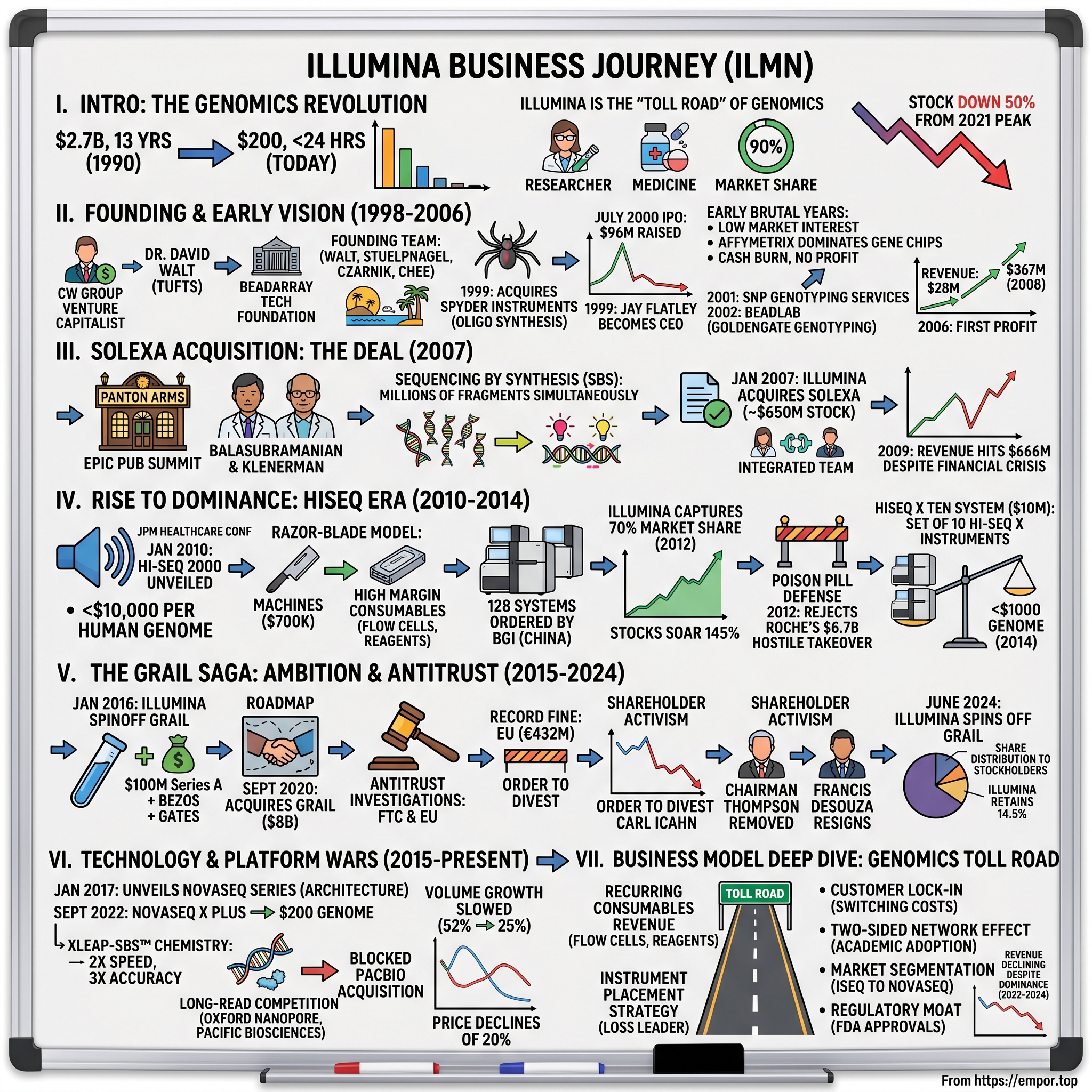
Illumina: The Genomics Monopoly That Nearly Broke Itself
I. Introduction & Episode Roadmap
Somewhere in a hospital laboratory right now, a technician is loading a flow cell, a glass slide about the size of a smartphone, into a machine the size of a large refrigerator. On that slide sit billions of tiny clusters of DNA fragments drawn from a newborn with an undiagnosed seizure disorder, a cancer patient whose tumor needs profiling, or a pregnant woman screening her fetus for chromosomal abnormalities. Over the next day, the machine will flash colored light across those clusters hundreds of times, photographing each one and translating the flashes into As, Cs, Gs and Ts.
The odds are very good that the machine is made by Illumina, and even better that the chemistry inside it was bought from Illumina and will be bought again next month. That is the quiet genius of this company: it does not just sell sequencers, it sells the consumable reagents that every sequencer eats on every run. In fiscal 2025, consumables made up about 74% of Illumina's roughly $4.4 billion in revenue, while instruments were only about 11%1. The machine is the tollbooth; the reagents are the toll.
For most of the past two decades, that toll road looked about as close to a monopoly as the life-sciences tools industry has produced. Illumina's chemistry made the "$1,000 genome" real, turned whole-genome sequencing from a moonshot into a routine clinical test, and put the company underneath a large share of the world's genomic data.
And then, in the span of about three years, the company very nearly broke itself.
The hook of this story is a question worth sitting with: how does a company invent the workhorse technology of modern genomics, fight off a hostile takeover from one of the world's largest drug companies, and then detonate billions of dollars of shareholder value on one acquisition that regulators on two continents fought, that its shareholders revolted against, and that it ultimately had to give back?
This is really two stories braided together. The first, running from 1998 to about 2020, is a textbook platform-economics story: a bet-the-company acquisition, a relentless cost curve, and an installed base that generated reagent revenue like a utility. The second, running from 2020 to 2024, is a governance and capital-allocation cautionary tale, the GRAIL affair, whose consequences current management is still cleaning up.
The present tense matters too. In the second quarter of 2026, Illumina reported revenue of $1.16 billion, up 9.5% year over year and 6.5% on an organic basis2. Management raised full-year 2026 revenue guidance to $4.60 to $4.64 billion and lifted its organic growth outlook (excluding China) to more than 5%, from 2% to 4% previously2. For a company that spent 2024 and 2025 barely growing at all, that is a real change in trajectory. Whether it is a durable one is the question this article tries to answer.
The roadmap: the founding years and the Solexa acquisition that made the company; the HiSeq and NovaSeq years when Illumina became the toll road; the GRAIL acquisition and its unwinding; the Icahn proxy fight; Jacob Thaysen's turnaround; the economics and competitive map of the core business today; geopolitics as a line item on the income statement; the durable lessons of the playbook; and finally a bull-versus-bear reckoning.
The thread connecting all of it is a simple investor question. Illumina's moat was once described in three overlapping ways: patents, scale, and switching costs. The record since 2019 has tested each of them in public. Some have held; one has plainly failed. Knowing which is which is most of the analytical work, and the story begins, fittingly, with a scrappy San Diego startup that did not sequence DNA at all.
 Subscribe on LinkedIn
II. Founding & the Solexa Bet That Made the Company (1998-2010)
A bead company in a bubble
Illumina was incorporated in California in April 19983, built around BeadArray technology licensed out of Tufts University: microscopic beads sitting in tiny wells etched into the ends of optical fibers, each bead carrying a DNA probe. Think of it as a very dense egg carton where every egg is a molecular sensor. The early business was genotyping, which reads specific known positions in the genome to check for common variations, rather than sequencing, which reads every letter.
The company reincorporated in Delaware in July 20003 and went public that summer, directly into the teeth of the dot-com collapse. It was, in other words, a small tools company with a promising technology, a thin revenue base, and a stock market that had just decided anything with "genome" in the name was a bubble artifact. The early 2000s were a grind of patent disputes, modest product launches, and the permanent anxiety of a subscale company in a market dominated by Affymetrix.
The person who kept it together was Jay Flatley, who became chief executive in 1999 and would run the company until 2016. Flatley was not a scientist-founder in the romantic mold. He was an engineer-operator with a salesman's instincts and a strategist's patience, the kind of leader who thinks in product cycles and installed bases rather than in Nature papers. That orientation turned out to matter enormously, because Illumina's defining move was not an invention. It was a purchase.
The purchase that changed everything
In the late 1990s, two chemists at the University of Cambridge, Shankar Balasubramanian and David Klenerman, had been working on a way to watch DNA polymerase, the enzyme that copies DNA, add one letter at a time. Their insight evolved into a chemistry now known as sequencing by synthesis, or SBS. The layman's version: you anchor millions of short DNA fragments to a glass surface, copy each fragment into a tight cluster of identical clones, and then add fluorescently tagged letters one at a time. Each tagged letter carries a temporary "stop sign" so only one letter can be added per cycle. A camera photographs the color at each cluster, the stop sign is chemically removed, and the cycle repeats. It is like developing a photograph, one frame per letter, across hundreds of millions of spots at once.
Their company, Solexa, had the chemistry but not the commercial muscle. Illumina had the commercial muscle but was facing a flattening genotyping market. On January 26, 2007, Illumina completed its acquisition of Solexa in a stock-for-stock merger, issuing roughly 13.1 million shares3, for a total purchase price in the region of $600 million. The first product, the Genome Analyzer, began shipping in the first quarter of 2007; the company described it as generating more than a billion bases in a single run at roughly one-hundredth the cost of conventional capillary instruments3.
To appreciate the scale of the bet, compare the price to the business doing the buying. Illumina's 2006 revenue was only about $185 million3. The company paid something like three times its own annual sales, in stock, for an unproven chemistry competing against entrenched Sanger sequencing incumbents such as Applied Biosystems. If SBS had failed to scale, the dilution would have been a permanent scar.
It did not fail. Revenue roughly doubled to about $371 million in 20073, and sequencing grew from a side business into the entire company. Today, sequencing accounts for about 92% of Illumina's revenue1. Solexa is the rare acquisition that became its acquirer.
This matters for more than nostalgia. The Solexa deal is the benchmark against which every later Illumina acquisition deserves to be judged: it was a technology buy in the company's core, at a price that was bold relative to Illumina's size but tiny relative to the value it unlocked, and its success depended on Illumina's own engineering and distribution machine rather than on a speculative downstream market. Hold that template in mind; the GRAIL deal inverted almost every element of it.
The Roche raid
By 2012, the Solexa bet had made Illumina valuable enough to become prey. On January 27, 2012, Roche, the Swiss diagnostics and pharmaceutical giant, launched a hostile tender offer at $44.50 per share4. Illumina's board unanimously rejected it as "grossly inadequate," arguing Roche had timed its bid to exploit a temporary dip in the share price5. On March 29, Roche raised its offer to $51 per share in cash, about $6.7 billion on a fully diluted basis and an 88% premium to Illumina's pre-rumor closing price4. Roche chief executive Severin Schwan complained publicly that the board "continues to rebuff our attempts to engage in substantive discussions"4. Illumina held firm, Roche walked away, and Illumina's subsequent market value multiplied several times over the price on offer.
It is worth noting what the Roche episode says about the board of that era: it had a clear, and correct, view of the platform's intrinsic value, and it was willing to defend that view against a large premium. The irony is that a later version of the same board would misjudge value in the opposite direction, overpaying to buy rather than underpricing to sell.
Flatley's lasting contribution was a playbook that still defines the business: place instruments at thin or zero margin if needed, lock customers into validated workflows, and earn the real profits on every run's consumables. The next decade would show just how powerful that playbook could be when paired with a steep cost curve.
III. HiSeq X Ten, Network Effects, and Becoming the Toll Road (2010-2019)
The supersonic age
At the J.P. Morgan Healthcare Conference in San Francisco in January 2014, the room full of bankers and biotech executives heard Jay Flatley announce the number the industry had chased for a decade. Illumina's new HiSeq X Ten, he said, could sequence a human genome for about $1,000, ushering in what he called "the supersonic age of genomics"6. The first human genome, completed barely more than a decade earlier, had cost billions.
The fine print was even more revealing than the headline. The HiSeq X Ten was sold only in sets of ten machines at roughly $1 million each, designed to process some 20,000 genomes a year6. Of the $1,000 per-genome cost, about $797 was reagents, while machine amortization accounted for only $137 and labor for $55 to $656. Early buyers included the Broad Institute, the Garvan Institute in Sydney, and the Korean genomics firm 마크로젠 Macrogen6.
Read that breakdown again, because it is the entire business model in one line. Roughly four-fifths of the cost of a genome went to consumables that Illumina sold, over and over, for the life of the instrument. The $10 million entry ticket bought a customer into a decade-long reagent annuity.
From research instrument to clinical workhorse
The quieter revolution of the 2010s happened not in genome centers but in hospitals and diagnostic labs. As the cost of sequencing fell, a series of applications crossed the line from scientific curiosity to reimbursable medical test. Non-invasive prenatal testing let expectant parents screen for chromosomal conditions from a maternal blood draw instead of an invasive procedure. Tumor profiling panels let oncologists match patients to targeted drugs based on the mutations driving their cancer. Rare-disease programs began sequencing the exomes and genomes of critically ill infants to end years-long diagnostic odysseys in weeks.
Each of these applications was built, validated, and in many cases submitted to regulators on Illumina instruments. That sequence matters. The clinical lab that develops a test on a given platform is not merely a customer; it has embedded that platform into a regulated product. Every step of the test, from how samples are prepared, to the error profile the software expects, to the quality metrics auditors review, is tuned to one chemistry. The research customer who buys a sequencer can walk away when a better one appears; the clinical customer who builds a business on it mostly cannot.
This is the seed of the growth engine discussed in Section VI, and it was planted a decade before it became the company's main source of growth.
Myth versus reality: "network effects"
Illumina is often described as enjoying network effects, the phrase attached to social networks and marketplaces where each new user makes the product more valuable for every other user. The reality is subtler and worth getting right.
Illumina does not have classic network effects; one lab's sequencer does not become more useful because another lab bought one. What it has is an ecosystem-standard effect. Because most published genomic datasets, reference databases, bioinformatics pipelines, and trained technicians grew up around Illumina short-read data, the platform became the default format of genomics, much as a file format becomes a standard. Researchers comparing their results against large public datasets find it easier when the data came from the same kind of machine; software vendors build for the largest installed base first; graduate students learn on the platform they will later buy.
That standard-setting effect is real, but it is weaker than a true network effect and it erodes as competitors demonstrate data compatible with Illumina's formats. It raised the cost of switching in the 2010s; it does not, by itself, prevent a lab from adding a second vendor today.
How the moat actually worked
It is tempting to summarize Illumina's position in those years as "a monopoly" and leave it there. Investors are better served by breaking the moat into testable claims, because they did not all survive.
The first claim is scale economics. Each generation of instrument lowered the cost per gigabase of data, which expanded the number of economically viable applications, which increased total data volume, which funded the next generation's R&D. This flywheel is real, but it has a built-in tension: Illumina is constantly cutting the price of its own product. The company is, in effect, deflating its unit revenue to grow volume, and the arithmetic only works if volume grows faster than price falls. That tension becomes the central problem later in this story.
The second claim is switching costs. A clinical laboratory running a validated diagnostic test does not simply swap sequencers the way an office swaps printers. The test's performance was validated on specific chemistry; regulators and payers approved it on that basis; laboratory software, quality systems, and technician training were all built around it. Changing platforms means revalidating the test, a costly, slow, and legally fraught process. This is the most durable source of Illumina's position, and it grows stronger precisely as sequencing shifts from research into regulated clinical use.
The third claim is intellectual property: the notion that foundational SBS patents fenced competitors out. This is the claim the record rejects.
The patent fight Illumina lost
For years, 华大基因 BGI Genomics and its instrument affiliate 华大智造 MGI Tech sought to sell low-cost sequencers in the United States, and Illumina fought them in court on multiple fronts. In May 2022, a Delaware jury found that Illumina's two-color SBS chemistry infringed patents held by Complete Genomics, the US subsidiary of the BGI group, and awarded $333.8 million. In July 2022, Illumina settled the multi-front litigation, agreeing to pay $325 million and granting cross-licenses that ended the US legal battle7.
This deserves to sit right next to the moat claim rather than in a distant risks section. A company whose defensive story leaned in part on foundational patents lost the central patent fight against its most direct low-cost rival, paid a nine-figure sum, and cleared the path for that rival's legal operation in the US. The honest conclusion is that the patent-thicket version of Illumina's moat is not supported by the record. What survived is narrower but still meaningful: scale, workflow integration, and regulatory-grade validation. The KPI that tests the surviving version is not litigation outcomes but whether clinical customers stay on Illumina chemistry when cheaper instruments are available, a question the rest of this article returns to.
The first antitrust warning shot
The second disconfirming episode arrived even earlier. In November 2018, Illumina agreed to buy Pacific Biosciences, the leading maker of long-read sequencers, for about $1.2 billion. Long-read technology reads much longer continuous DNA stretches than Illumina's short reads, which helps with complex genomic regions, and at the time it was the most plausible technological alternative to Illumina's platform.
On December 17, 2019, the Federal Trade Commission voted 5-0 to challenge the deal, alleging that Illumina sought to "unlawfully maintain its monopoly in the U.S. market for next-generation DNA sequencing systems by extinguishing PacBio as a nascent competitive threat"8. Just 16 days later, on January 2, 2020, the companies abandoned the transaction8.
Two things stand out. First, this was the first time US regulators formally described Illumina as a monopolist and its acquisition strategy as a tool of monopoly maintenance. Second, it was a clear signal about the limits of M&A for a company in Illumina's position. A dominant platform cannot easily buy its most credible future threats. Management walked away quickly from PacBio, which was sensible. But the lesson, that regulators were now watching every major deal through a monopoly lens, apparently did not travel far enough inside the building.
By 2020, then, Illumina was a dominant but increasingly scrutinized platform. Competition from BGI/MGI, PacBio, and a new wave of short-read upstarts was gathering; sequencing costs kept falling; and the growth rate of the core was slowing. Management's answer was to reach downstream, into applications that could be worth far more than the sequencing itself. That reach had a name: GRAIL.
IV. The GRAIL Acquisition: Capital Allocation Meets Antitrust — and Loses (2020-2024)
The vision
Picture the pitch as Illumina's leadership framed it in September 2020. Every year, millions of cancers are caught too late, after they have spread, when survival odds collapse. What if a single annual blood draw could detect signals of dozens of cancer types before symptoms appeared, by sequencing fragments of tumor DNA floating in the bloodstream? GRAIL, a company Illumina itself had incubated and then spun out, was building exactly that test. It was called Galleri.
The strategic logic was seductive. A multi-cancer early detection test would be sequencing-intensive at population scale, potentially tens of millions of tests a year, and whoever owned the test would capture far more value per sample than the supplier of reagents. Illumina's then chief executive, Francis deSouza, a former Symantec executive who had succeeded Flatley in 2016, believed the opportunity was historic. After the deal went sour, he would write that his belief in GRAIL's "potentially life-saving technology and the benefits of merging it with Illumina remains unshakable"9.
So in September 2020, Illumina agreed to reacquire GRAIL for roughly $8 billion in cash and stock9. There was one major problem: GRAIL's test was in large part commercially unproven, and Illumina sold sequencers to GRAIL's would-be competitors in cancer screening. Regulators saw a supplier buying one of its own customers and gaining the ability to disadvantage that customer's rivals.
Close first, litigate later
The decision that defines this episode was not the acquisition itself. It was the timing. The FTC sued to block the deal in March 2021. In Europe, the European Commission asserted jurisdiction through an unusual procedural route, accepting a referral in April 2021 even though the deal fell below EU merger-filing thresholds10. While both reviews were live, Illumina completed the acquisition on August 18, 202111.
This was an extraordinary gamble. Large public companies almost never close a transaction while a standstill obligation is pending in Europe and a federal antitrust challenge is underway at home. Illumina's argument, that GRAIL was too important and time-sensitive to wait, may have been sincerely held, but it converted a regulatory review into a regulatory confrontation. From that day, the company's outcome depended on winning legal battles on two continents, events no management team can control.
It is worth dwelling on why the regulators' concern landed with Illumina's own customers. Several diagnostics companies were developing their own blood-based cancer tests, and every one of them depended on Illumina sequencers and reagents. From their perspective, their essential supplier had just bought their most visible competitor. Illumina tried to defuse this with a long-term supply commitment offered to those customers, promising equal access and pricing. But promises by a dominant supplier to treat a rival fairly are exactly the sort of behavioral remedy antitrust agencies tend to distrust, because they are hard to monitor and easy to erode at the margins. More importantly for investors, the episode put a question in the minds of Illumina's most important clinical customers: is our supplier also our competitor? For a business whose moat rests on customers willingly building their products on its platform, that question alone carried a cost that never appeared in any impairment line.
An activist-style stress test of the decision, applied in real time, would have asked four things. What was the probability-weighted cost of losing on antitrust, including a forced sale at a depressed price? How much of GRAIL's value depended on reimbursement decisions that were years away? Why did the value case require owning GRAIL rather than simply supplying it, as Illumina already did? And what signal would closing early send to the clinical customers who generated the core business's growth? None of those questions had comfortable answers in 2021.
Consequence one: Europe
On September 6, 2022, the European Commission prohibited the deal11. In July 2023, it fined Illumina a record €432 million for implementing the acquisition before approval, the largest gun-jumping fine in EU merger enforcement history, plus a symbolic €1,000 on GRAIL itself, the first such fine imposed on a target company[^12]1210. On October 12, 2023, the Commission issued a divestment decision requiring Illumina to separate GRAIL11.
Then came one of the stranger twists in modern merger law. On September 3, 2024, the European Court of Justice ruled that the Commission had lacked jurisdiction to review the deal at all under the referral mechanism it had used, overturning the General Court's July 2022 decision in the Commission's favor and knocking out the legal basis for the fine, which the Commission then withdrew10.
In other words, on the European jurisdictional question, Illumina was ultimately right. But it won after it had already agreed to divest GRAIL and after years of hold-separate obligations had prevented it from integrating the business it had paid billions to own. The legal vindication was real; the economic vindication never arrived. That distinction is the heart of the lesson: being legally correct and being a good steward of capital are different tests, and Illumina passed only the first.
Consequence two: the United States
In the US, the FTC's own administrative law judge initially ruled in Illumina's favor in 2022. The full Commission, which reviews such decisions, reversed that finding in April 2023 and ordered divestiture13, a pointed rebuke. Illumina appealed. On December 17, 2023, Illumina announced it would divest GRAIL, targeting completion by the end of the second quarter of 202411.
Consequence three: the balance sheet
The accounting followed the legal failure. In the third quarter of 2022, Illumina recorded a $3.91 billion goodwill impairment on GRAIL, attributing it to adverse capital markets and higher discount rates14. Further impairments followed in 2023. Then, in the second quarter of 2024, as the spin-off approached, Illumina took another $1.47 billion goodwill impairment and roughly $420 million against GRAIL's in-process R&D intangible assets15.
Stack those charges together and several billion dollars of the purchase price was written off within about three years of closing. Impairments are non-cash in the period they are booked, but they are an accountant's admission that capital already spent will not earn its return.
The operating drain was cash, and it was real. In the third quarter of 2022 alone, GRAIL generated just $10 million of revenue against a non-GAAP operating loss of $148 million14, a run rate approaching $600 million a year. Carl Icahn, in his campaign, put the annual burden at closer to $800 million13. Whichever figure one prefers, Illumina's core business was funding a startup's losses at a time when its own growth was slowing.
Consequence four: the boardroom revolt
Enter Carl Icahn. In early 2023, the veteran activist launched a proxy fight, nominating three candidates, Vincent Intrieri, Jesse Lynn, and Andrew Teno, and arguing that the board had overpaid and closed without approval16. Illumina's board argued in its own proxy that it could not legally divest GRAIL while the European hold-separate measures remained in force16. It also pointedly noted Icahn's statement that he did not know how to run the business16.
At the May 25, 2023 annual meeting16, shareholders delivered a split verdict. Icahn's nominee Andrew Teno won a seat, displacing chairman John Thompson, while deSouza kept his board seat, but with only about 71% support; shareholders also voted against executive compensation913. On June 11, 2023, deSouza resigned as CEO, with general counsel Charles Dadswell serving as interim chief executive9. In September 2023, the board named Jacob Thaysen, a decade-long Agilent veteran who ran its Life Sciences and Applied Markets Group, as chief executive17.
The sequence is instructive. Shareholders did not endorse Icahn's full slate; they did something more targeted, removing the chair who had presided over the decision and signaling deep dissatisfaction with pay. Within weeks, the CEO most associated with GRAIL was gone. Whatever one thinks of activism, this was governance correcting itself under pressure, not proactively.
The unwind
On June 24, 2024, Illumina completed the spin-off, distributing about 85.5% of GRAIL's shares to Illumina stockholders and retaining about 14.5%18. The European Commission required that GRAIL be capitalized so it could operate independently; Illumina provided roughly $1 billion, partly funded by a $750 million loan, enough by management's estimate to fund GRAIL through 202619. GRAIL debuted on Nasdaq the next day19.
So where did this leave Illumina? Roughly where it had been before the deal, a sequencing platform company with a minority interest in GRAIL, minus billions in written-off capital, a large cash contribution, years of management distraction, and the goodwill of regulators on two continents.
The verdict
Held against the Solexa benchmark, the GRAIL deal fails on every dimension that mattered. Solexa was a core technology bought cheaply relative to the value it unlocked; GRAIL was an adjacent-market bet bought expensively before its product had proven commercial traction. Solexa's success depended on Illumina's own execution; GRAIL's depended on regulatory outcomes Illumina could not control. Solexa strengthened the moat; GRAIL alienated the very clinical customers whose loyalty underpins the moat.
The history therefore rejects any general claim that Illumina's large, adjacent-market M&A is reliably value-accretive. It leaves open a narrower claim: that small, core-adjacent tuck-ins under a chastened management team can work. The forward test is whether the post-2023 regime sticks to deals at the scale of its proteomics acquisition, discussed later, rather than reaching again for a transformative bet.
The coda: activism as a standing condition
The Icahn chapter itself closed quietly. By 2025, Icahn had fully exited his Illumina position, a stake of roughly 220,000 shares by the end20. But activism did not leave the building. In March 2025, Keith Meister of Corvex Management joined the board21, and Scott Gottlieb, the former FDA commissioner who had served as a director since 2020, now chairs it22. The presence of an activist-aligned director is a live variable rather than a closed chapter: it signals that sophisticated investors still see room for improvement, and it gives them a direct voice if growth disappoints again.
The job of rebuilding credibility fell to the new CEO, a Danish physicist who had never run a public company.
V. Jacob Thaysen's Turnaround: Management, Incentives, Credibility (2023-Present)
The outsider arrives
When Jacob Thaysen walked into Illumina's San Diego headquarters in the autumn of 2023, he inherited a company in something close to institutional shock. The chair had been voted out, the previous CEO had resigned under pressure, regulators on two continents were ordering a divestiture, and the core business was barely growing. Employees who had joined a company famous for inventing the $1,000 genome now worked for a company famous for a failed acquisition.
Thaysen's background was a deliberate contrast to his predecessor's. He holds a PhD in physics from the Technical University of Denmark and spent about ten years at Agilent Technologies, most recently as senior vice president and president of its Life Sciences and Applied Markets Group from 2018 to 20232217. Agilent is a notably disciplined, operationally focused tools company, not a place known for bet-the-company moonshots. The board had, in effect, hired an operator to clean up after a visionary.
His mandate was straightforward to state and hard to deliver: finish the GRAIL separation, cut costs, rebuild credibility with a shareholder base that had just revolted, and restore growth in the core.
Cost discipline: delivered, but costly in its own way
The restructuring record is concrete. At the end of 2023, core Illumina employed roughly 9,250 full-time staff11; by the end of 2025, headcount was about 8,6001. Restructuring charges were taken in both 2023 and 2024, largely for severance and facility consolidation18. This is executed cost discipline, not a promise.
It is worth being precise about what this does and does not prove. Cutting costs at a company that had been carrying a money-losing subsidiary and an expanded corporate structure is the easier half of a turnaround. The harder half is growth, and there the record is mixed.
Guidance: the promise, the miss, and the recovery
In 2024, Thaysen set a multi-year target: return to high-single-digit revenue growth by 2027. Then 2025 happened. China blacklisted the company, new US tariffs raised costs, and a proposed deep cut to NIH funding chilled academic demand. By mid-2025, Illumina was guiding 2025 revenue to decline between 0.5% and 2.5%23. Full-year 2025 revenue ultimately came in around $4.4 billion1, essentially where the core had been two years earlier.
That is a genuine miss against the trajectory implied by his own framework. What is notable is how it was handled. In an August 2025 interview with STAT, Thaysen maintained that high-single-digit growth by 2027 remained achievable23. He did not quietly retire the target or rename it. Management also chose to exclude China from its growth framework rather than forecast a political resolution it could not control, which is discussed in Section VII.
Then the numbers started moving his way. In August 2026, the company raised its full-year organic growth outlook (excluding China) to more than 5% and lifted its non-GAAP earnings guidance to $5.30 to $5.40 per share, while holding its non-GAAP operating margin guide at 23.4% to 23.6%2. The source of the upgrade, clinical consumables, is analyzed in Section VI.
The honest read: Thaysen's credibility today rests on two to three years of evidence. The pattern is encouraging, with costs cut as promised, misses explained with specific causes, and guidance raised on identifiable drivers. But the 2027 target has not yet been met, and 5% organic growth, even excluding China, is still some distance from high single digits. The claim "management is credible" is supported but not yet proven; the event that would confirm it is 2027 growth landing near the target.
What the Q2 2026 call revealed
Earnings calls often reveal more in the questions than in the prepared remarks. On the August 2026 call, the questions that mattered were about durability rather than survival: how long clinical momentum could last, how quickly the remaining clinical volume would convert to NovaSeq X, and whether the late-quarter improvement in research was real. Management's framing was notably bounded. Executives described clinical strength as "broad-based across regions," gave a specific year-end conversion target for clinical volume, and declined to call a research recovery24. The chief financial officer also acknowledged freight and memory-cost headwinds alongside the guidance raise24.
That combination, specific where the evidence is strong and cautious where it is not, is what credible guidance looks like. It is also worth noting what was not offered: no new long-term financial targets and no quantification of multiomics revenue. A management team rebuilding trust has chosen, sensibly, to under-describe the future rather than over-describe it.
Incentives and ownership
According to the 2026 proxy statement, Thaysen's total 2025 compensation was about $11.0 million, with base salary around $1.0 million and roughly 70% of annual equity awards granted as performance-based stock units, alongside a stock-ownership requirement of six times base salary22. That structure ties most of his pay to multi-year performance. The limitation is that no full cycle of performance units granted under his tenure has yet paid out, so there is no track record of how rigorously the board sets and enforces the hurdles. Given that shareholders rejected executive pay in 20239, this is a variable worth watching.
A remade board
The board has changed substantially since the proxy fight. Gottlieb chairs it; Meister joined from Corvex in 202521. For the 2026 annual meeting, three long-serving directors, Frances Arnold, Robert Epstein, and Gary Guthart, left the slate, and David P. King, the former chief executive and executive chair of LabCorp, was nominated22. King's appointment is notable: he ran one of the largest clinical laboratory businesses in the US, exactly the customer type whose volumes now drive Illumina's growth.
Why the credibility pattern matters
The most useful thing about the Thaysen era, from an analytical standpoint, is how management separates what it controls from what it does not. China, tariffs, and NIH funding are described plainly as external shocks with named magnitudes; GRAIL was a self-inflicted wound and is treated as history. Management's language about the research market has remained cautious even as it improved: on the Q2 2026 call, executives noted early signs of recovery in research late in the quarter but called it premature to declare a turnaround24. That is the trust-preserving pattern, the opposite of the pre-2023 regime's insistence that GRAIL's value was self-evident.
A new CEO can control costs, guidance, and tone. He cannot control the physics and economics of the market. That is where the deepest analysis lies.
VI. The Core Business Today: NGS Platform Economics & Competitive Landscape
The refrigerator that changed the math
Walk into a large clinical genomics lab today and the defining machine is the NovaSeq X, Illumina's flagship high-throughput sequencer, launched in 2023. It is a big, humming box that can generate tens of thousands of genomes a year. Its predecessor, the NovaSeq 6000, sits in many of the same labs, often still running, a reminder that platform transitions in this industry are measured in years, not quarters.
Illumina now effectively operates as one business: sequencing instruments, the consumables that feed them, and a service and informatics layer, with a small but growing multiomics tail. In fiscal 2025, consumables were about 74% of revenue, instruments about 11%, and services and other about 15%1. Consumables carry the profits.
The NovaSeq X transition: the key operating story
Every Illumina platform transition carries a known, uncomfortable trade-off. New instruments produce data far more cheaply per gigabase, which is good for customers and good for long-run volume. But when a customer migrates, the revenue Illumina earns for the same amount of sequencing falls, sometimes sharply. The transition is a deliberate act of cannibalization, and the bet is that cheaper data will unlock enough new demand to more than fill the hole.
In the second quarter of 2025, NovaSeq X accounted for about 55% of high-throughput gigabases shipped and roughly 44% of high-throughput consumables revenue[^26]. By the second quarter of 2026, the transition was largely done in volume terms: 83% of sequencing volume had moved to the X platform, which represented 59% of sequencing revenue, and Illumina placed more than 95 units in the quarter24. Clinical customers had converted about 78% of their volume, with management expecting 80% to 85% by year-end24. Total gigabase output on connected instruments grew more than 30% year over year24.
Two conclusions follow. First, the transition is executing ahead of where skeptics feared, and the evidence is pull-through, not just instrument sales: data output rising more than 30% is customers actually running more samples. Second, the gap between volume share (83%) and revenue share (59%) is the price deflation made visible. Illumina is getting paid less per unit of data on the new platform. The revenue drag from migration should diminish as the transition completes, which is one reason 2026 looks better than 2024 and 2025. But this is a one-time easing of a headwind, not proof that the underlying growth algorithm has been repaired.
The broken growth algorithm
This is the bear's favorite argument, and it deserves a direct hearing. A decade ago, sequencing volumes grew at rates that comfortably outran price declines. Over time, volume growth decelerated while consumable pricing kept falling, and for several years volume growth minus price erosion came close to zero net revenue growth. The core business spent 2023 through 2025 essentially flat.
The 2026 guidance, more than 5% organic growth excluding China2, is the first real evidence that the algorithm is inflecting. But look at where the growth is coming from, because that changes the risk profile of the whole company.
Clinical up, research down
The single most important fact about Illumina in 2026 is the divergence between its two customer halves. In the second quarter, clinical customers accounted for about 65% of sequencing consumables revenue. Clinical consumables grew about 15% excluding China, with the US and Canada growing more than 20%, while research and applied consumables declined about 7% on funding uncertainty24.
This is the growth algorithm being rebuilt on a different foundation. Clinical demand comes from oncology testing, prenatal screening, rare disease diagnosis, and minimal residual disease monitoring, where tests are reimbursed and volumes scale with patient populations rather than with grant cycles. That demand is stickier because of the switching costs explained in Section III: a laboratory with a validated, reimbursed test on Illumina chemistry is very unlikely to switch.
But the new foundation carries different risks. Clinical growth is exposed to insurance reimbursement decisions, FDA oversight of laboratory-developed tests, and the commercial fortunes of a relatively concentrated set of large diagnostic labs. Those customers have real bargaining power; a handful of high-volume clinical accounts can negotiate hard on price and credibly threaten to qualify a second supplier. The shift from research to clinical trades one kind of cyclicality (government funding) for another kind of concentration (large, sophisticated buyers).
The competitive map, war-game style
Illumina is still the largest player in next-generation sequencing by a wide margin; in 2019 the FTC described it as a monopolist in US NGS systems8. But the map has more players than at any time in its history, and each attacks a different flank.
Element Biosciences, with its AVITI benchtop system, targets the mid-throughput research lab with a short-read chemistry pitched on data quality and lower running costs. Its natural customer is exactly the academic lab whose budget is under pressure, the segment where Illumina is already declining. Ultima Genomics goes after the other end, ultra-high-throughput sequencing at aggressively low cost per genome, aimed at genome centers and large-scale projects where price per gigabase is the dominant purchase criterion. Oxford Nanopore and PacBio compete in long-read sequencing, which is increasingly complementary to short reads in research, and in some applications a substitute.
Then there is MGI Tech, the one competitor with both a proven short-read chemistry and the scale of a large group behind it. After the 2022 settlement, it can sell in the US, but its path is constrained by US political hostility toward Chinese genomics firms, including the BIOSECURE legislative effort, which targeted BGI and MGI and which Illumina supported25.
The war-game read is this: no single competitor today threatens Illumina's core clinical franchise head-on. The attack is at the edges, mid-throughput research on one side, cost-per-genome at mega-scale on the other, and the edges are exactly where volumes are most price-sensitive. The practical mechanism of erosion is multi-sourcing: large genome centers and biobanks qualifying a second vendor and using that option in price negotiations. Market-share loss may show up first not as lost customers but as lower prices.
The software layer nobody talks about
One underappreciated piece of the franchise is informatics. A sequencer produces raw signal, billions of short reads that look like shredded pages of a book. Turning that into a medically useful result means reassembling the shreds against a reference genome and spotting where the patient's text differs, a computationally heavy task. Illumina's DRAGEN software, which runs on dedicated hardware or in the cloud, does this quickly and has been integrated into many clinical pipelines.
The analogy is a camera maker that also supplies the photo-editing software every professional studio uses. The software is not the main revenue source, but it deepens the workflow lock-in: a lab that switches sequencers may also need to rebuild and revalidate its analysis pipeline. That is a genuine strengthening of switching costs, though it is also a place where competitors can attack by offering open, platform-agnostic analysis tools.
Myth versus reality
Three popular narratives deserve a fact check.
Myth: "Illumina is a monopoly, full stop." Reality: Illumina is dominant in clinical, high-throughput short-read sequencing, and regulators have treated it as a monopolist8. But research budgets, long-read applications, and ultra-low-cost population projects are now genuinely contested. A more accurate description is a dominant incumbent with a fortified core and contested frontiers.
Myth: "The NovaSeq X transition fixed growth." Reality: the transition removes a temporary drag as customers finish migrating, and it lowers the cost of data, which should stimulate volume over time. But price per gigabase will keep falling, as it always has, and the long-run growth rate depends on whether new applications arrive faster than prices decline. The transition clears the runway; it does not provide the lift.
Myth: "Clinical growth is structural and permanent." Reality: clinical demand is stickier than research demand, and its growth is real today. But it rests on reimbursement policy, a limited number of large lab customers, and specific test categories such as oncology and prenatal screening, any of which can slow, reprice, or consolidate. It is a stronger foundation than grant-funded research, not an unbreakable one.
Porter's five forces, briefly
Supplier power is low; Illumina controls its own chemistry, optics, and flow-cell manufacturing. Buyer power is rising in high-volume accounts, for the multi-sourcing reasons above. The threat of substitutes is the live variable: long-read platforms for some workflows, alternative short-read chemistries for others. Rivalry is intensifying at the low and mid end, while Illumina still dominates ultra-high-throughput clinical-grade workflows. Barriers to entry remain real, including regulatory-grade validation, informatics, and a global service network, but they are visibly lower than a decade ago.
Hamilton Helmer's lens
Helmer's 7 Powers framework helps sharpen which part of the moat is real. Cornered resource, in the form of patents, is the power the BGI settlement undermined. Scale economies still matter, since Illumina amortizes its R&D and manufacturing across the largest installed base, but upstarts have shown that a new chemistry can reach competitive cost per gigabase without Illumina's scale. The strongest surviving power is switching costs, embedded in validated clinical assays, integrated laboratory workflows, and the DRAGEN informatics software many labs use to process Illumina data. There is also a degree of process power in the company's manufacturing reliability at clinical grade.
The distinction matters because switching costs protect existing customers far better than they win new ones. The moat defends the installed base; it does not guarantee share of the next wave of applications. The revised claim, then, is that Illumina's position is durable in clinical workflows already built on its chemistry and contestable almost everywhere else. The KPI that would falsify it is clinical consumables growth falling well below clinical test-volume growth in the industry, a sign of share loss or price concessions in the franchise that matters most.
That franchise is also being stress-tested by forces with nothing to do with chemistry: trade wars, tariffs, and federal budgets.
VII. Geopolitics as a P&L Line: China, Tariffs, and the New Multiomics Bets
A blacklist arrives
On February 4, 2025, China's 商务部 Ministry of Commerce added Illumina to its 不可靠实体清单 Unreliable Entity List18. A month later, on March 4, the ministry followed up by prohibiting the export of Illumina's genetic sequencers into China, while permitting the company to keep operating in the country and serving existing customers26. The move was widely read as retaliation for rising US tariffs, and it came against the backdrop of US legislative efforts to restrict Chinese genomics firms, efforts Illumina had supported2625.
The numbers show the damage. Greater China revenue was $308 million in 202418, about 7% of revenue26, and fell to $243 million in 2025, about 5.5%1. According to the 2025 annual report, Chinese authorities began allowing some instrument sales again from November 2025 on a case-by-case approval basis1. The door is ajar, not open.
Management's response is analytically important. Rather than forecast a resolution, it excluded Greater China from its organic growth framework altogether224. That is a credibility-supporting choice: it avoids promising something outside the company's control. It also means the headline "more than 5%" figure flatters the consolidated picture somewhat, since total company growth still absorbs the China decline.
The deeper point is structural. China is also home to Illumina's strongest low-cost competitor, MGI. Even in a benign political scenario, Chinese hospitals and research institutes face policy encouragement to buy domestic. The China business is unlikely to return to its former role as a growth engine regardless of how trade relations evolve.
Tariffs: a real, external cost
New US import tariffs in 2025 added an estimated $85 million of cost, forcing a mid-year guidance revision[^26]23. In 2026, the CFO has cited elevated freight and memory-chip costs as further headwinds, partly offset by inventory positioning24.
It is important to keep this category analytically separate from GRAIL. Tariffs are a macro cost imposed on the whole industry; GRAIL was a controllable, self-inflicted capital-allocation error. Blending the two, as in "Illumina has faced headwinds," lets a management team hide mistakes behind macro. The current regime has, to its credit, not done that, and investors should not do it on management's behalf.
NIH: the single largest risk to the research half
The Trump administration proposed an approximately 40% cut to NIH funding for fiscal 2026, alongside pressure on the overhead reimbursements universities rely on23. The effect on grant-funded sequencing was immediate: labs delayed purchases, rationed runs, and waited. In August 2025, Thaysen welcomed signs that Congress would instead consider a slight NIH budget increase, which would let universities avoid drastic cuts23. Yet by the second quarter of 2026, research and applied consumables were still declining about 7%, and management remained unwilling to call a recovery24.
This is the disconfirming voice to set against any "research demand is fine" framing: management's own description of a muted, soft research market. Research is the segment where competition is fiercest and pricing most elastic, so a recovery in academic budgets will not necessarily flow back to Illumina at the old rate.
A second-layer risk radar
Beyond the headline geopolitical items, a few quieter exposures deserve a brief mention. The first is supply chain. Illumina's instruments depend on precision optics, semiconductors, and memory components, and the company has already flagged higher memory and freight costs in 202624. These are margin issues rather than existential ones, but they show that a manufacturer with a global footprint cannot fully insulate its cost base from trade policy.
The second is concentration inside the growth engine. With clinical customers now around two-thirds of sequencing consumables24, the fortunes of a relatively small number of large diagnostic laboratories, and of the reimbursement decisions that fund their tests, matter more to Illumina than at any time in its history. A payer decision that slows a major category, such as a coverage change in prenatal or oncology testing, would hit Illumina's fastest-growing revenue first.
The third is data sensitivity. Clinical sequencing generates some of the most private data that exists, and Illumina's instruments and cloud software sit inside hospital networks. Any security failure involving patient genomic data would be reputationally costly precisely in the clinical segment where trust is the product. None of these is a present crisis; each is a place where the risk profile has shifted as the business moved from research to medicine.
Multiomics: real, but small
The second half of this section is about optionality. Illumina has pushed beyond DNA sequencing into what the industry calls multiomics, reading not just the genetic code but also which genes are active in individual cells, where in a tissue they are active, and which proteins they produce.
The launches are real. Illumina introduced a single-cell RNA preparation product in January 2025 and single-cell RNA and protein workflows during the year1. In 2026 it launched StrataMap, a spatial sequencing workflow for mapping gene activity across tissue24. In proteomics, it launched Illumina Protein Prep and announced the acquisition of SomaLogic, a pioneer in large-scale protein measurement, from Standard BioTools for about $425 million27. SomaLogic integration costs showed up in second-quarter 2026 expenses2, and the gap between 9.5% reported and 6.5% organic growth that quarter reflects currency and acquisitions2. On the call, management cited "strong interest" in SomaLogic's proteomics and reported that its Billion Cell Atlas project had delivered 300 million cells and signed six biopharma partners, plus three more after quarter-end24.
Here is the right size for all of that. None of these products is disclosed as a discrete revenue line; together they are a small fraction of a roughly $4.6 billion business. And Illumina's own history counsels caution about equating launches with revenue: the PacBio route to long reads was blocked, the GRAIL route to clinical applications destroyed value, and earlier forays into consumer and clinical services never became material. Technical milestones are not commercialization.
The calibrated verdict is "optionality with early commercial proof points." The acquisition price for SomaLogic was sized as a tuck-in, not a transformation, which is exactly the discipline the GRAIL episode demanded. The KPI that would confirm the optionality is converting is simple: the day Illumina discloses multiomics revenue as a separate line and it is growing meaningfully faster than the core.
These are the forces acting on the business from outside. The more enduring question is what the story as a whole teaches about how platform companies should be run.
VIII. Business Model & Playbook: Durable Lessons
Lesson one: the razor only works if the blades keep selling
Illumina's model, instrument placement as the entry ticket and consumables as the profit pool, is the purest version of the razor-and-blade strategy in life-science tools. The HiSeq X economics made that explicit: reagents were roughly four-fifths of the cost of a genome6.
The lesson is that instrument placements are a leading indicator, not an end. A placed instrument that runs few samples is a cost, not an annuity. That is why clinical volume, not unit sales, is the metric that matters, and why the research downturn hurts disproportionately: academic instruments that sit idle generate service costs without reagent pull-through. A platform company's health is measured by utilization of its installed base.
Lesson two: do not bet the company on a regulator
GRAIL offers a reusable cautionary case for any dominant platform tempted to pre-empt regulators. Closing ahead of clearance turned a reversible decision (walk away, as with PacBio) into an irreversible one (own it, fight for it, then unwind it at a loss). Even the eventual European court victory did not repair the economics. The generalizable principle: when a deal's value depends on a regulatory outcome management cannot control, closing early does not reduce that risk; it concentrates it on shareholders.
Lesson three: dominance narrows the menu
The PacBio block and the GRAIL divestiture are two separate regulatory defeats in five years811. Together they establish that "acquire the nascent threat" and "vertically integrate into our customers' markets" are not reliably available strategies for a company with Illumina's share, regardless of how the deals are argued internally. That constrains the growth menu to organic innovation, small tuck-ins, and partnerships, which in turn raises the stakes on R&D productivity.
Lesson four: discipline is a pattern, not a press release
Post-2023 capital allocation looks different: a tuck-in rather than a transformative acquisition, and share repurchases, with a $1.5 billion authorization in August 2024 and a further $1.5 billion in April 2026, according to the company's investor communications[^30]. The balance sheet can support it: at the end of the second quarter of 2026, Illumina held about $1.17 billion of cash against about $2 billion of term debt, and generated $162 million of free cash flow in the quarter2.
An activist would push on two points. First, the sample size is tiny: one bolt-on, one or two buyback cycles. The GRAIL decision was made by a board that had, only eight years earlier, shown admirable discipline in rejecting Roche. Discipline has proven to be a property of particular leadership teams, not of the institution. Second, buybacks at Illumina have historically been a mixed use of capital when the core stops growing; repurchasing shares is only value-creating if the intrinsic value of the platform holds. The claim "capital allocation has changed" is supported by the post-2023 record but is not yet proven over a full cycle.
Which brings the story to the ledger: why Illumina could win from here, and what could break the case.
IX. Bear vs. Bull Case
The bull case, with evidence
The first bull argument is execution on the platform transition. NovaSeq X carried 83% of sequencing volume by the second quarter of 2026, up from about 55% of high-throughput gigabases a year earlier24[^26], and data output on connected instruments grew more than 30%24. That is an operating KPI, not a narrative, and it suggests the pricing drag of the transition is nearing its end.
The second is the clinical engine. Clinical consumables grew about 15% ex-China, over 20% in the US and Canada, and now make up about 65% of sequencing consumables24. This demand rides on reimbursed tests whose validation locks in Illumina chemistry, the strongest surviving element of the moat.
The third is governance repair. Costs were cut as promised, the GRAIL separation was completed, M&A has been tuck-in scale, and guidance was raised in 2026 on identifiable drivers2. The board now includes a large-lab operator and an activist representative, which arguably improves accountability.
The fourth is the policy shield. US political hostility toward Chinese genomics firms structurally disadvantages MGI, the only rival with a proven short-read chemistry at scale, in Illumina's most profitable market25.
The bear case, with evidence
The first bear argument is the research downturn. Research and applied consumables fell about 7% in the second quarter of 2026, and management declined to call a bottom24. That half of the business faces both funding pressure and the most direct competition.
The second is China. A market that was about 7% of revenue26 is now excluded from the growth framework entirely, shrinking, and structurally tilted toward domestic suppliers even if politics improve.
The third is the moat itself. The patent-based version lost in court7. The surviving switching-cost version is strong in clinical workflows but is being tested at the edges by Element and Ultima, where erosion shows up first in price concessions to large buyers.
The fourth is governance as an open question. An activist-aligned director on the board21 signals that sophisticated investors still see the company as under-optimized. If growth stalls, the board's posture could shift toward more aggressive action.
The fifth is a constrained strategic menu. Two regulatory defeats in five years mean large-scale M&A is unlikely to be available as a growth lever, placing the entire burden on organic innovation and small deals.
An activist's checklist
Imagine a skeptical long/short investor walking into a meeting with the board today. The questions would be pointed. First, margins: a non-GAAP operating margin guided around 23.5% for 20262 is healthy, but well below what the company earned in its monopoly heyday; how much of the gap is structural price erosion, and how much is cost that can still be taken out? Second, disclosure: why does a company pitching multiomics as a growth pillar not break out its revenue, and why is the clinical-versus-research split discussed on calls rather than reported as a formal line? Third, capital allocation: with repurchases underway and a tuck-in acquisition closed, what return hurdle governs the next deal, and who on the board is accountable if it misses? Fourth, the GRAIL residual: with Illumina retaining a minority stake in a company whose funding was expected to last only through 202619, what is the plan for that holding?
None of these questions implies the answers are bad. They illustrate where the burden of proof still sits after the events of 2021 to 2023: with management, not with shareholders.
Weighing it
The strongest version of the bull case is not "Illumina's monopoly is intact." It is narrower: Illumina is the default infrastructure for clinical genomics, and clinical genomics is growing fast enough to carry the whole company back to mid-single-digit-plus growth even while research stagnates. The evidence supports that narrower claim in 2026 but has not yet tested it across a full cycle, a reimbursement shock, or a serious price war in clinical accounts.
The strongest version of the bear case is also narrower than it sounds: not that Illumina will be displaced, but that it has become a mature, mid-growth franchise whose growth depends on a single customer segment, operating in a market where every other segment is contestable.
The KPIs that matter
Two numbers will do most of the work of telling investors which version is winning. The first is clinical sequencing consumables growth, excluding China: if it holds in the mid-teens, the rebuilt growth algorithm is working; if it decays toward high single digits, the 2027 target becomes hard to reach. The second is the gap between NovaSeq X share of volume and share of revenue: as the transition completes, that gap should narrow, and if it does not, price erosion rather than migration is the real cause.
X. Epilogue & What to Watch
Back in that clinical lab, the flow cell finishes its run. Somewhere in the data is an answer for the family with the newborn, or the oncologist choosing a therapy. The machine will be reloaded tomorrow with new reagents, bought from the same supplier, and the toll will be paid again. That repetitive, almost boring transaction is the reason Illumina survived the most self-destructive stretch in its history. The installed base kept running while the boardroom burned.
The indicators to watch in the next two to three years are few but telling. The NovaSeq X consumables mix will show when the platform transition is truly complete and whether revenue per unit of data stabilizes afterward. The clinical-versus-research consumables split will show whether the demand mix is being rebuilt on durable ground. China's revenue trajectory, currently a slow partial reopening, will show whether the geopolitical overhang is shrinking or permanent. And any discrete disclosure of proteomics, spatial, and single-cell revenue would be the first real evidence that multiomics optionality is converting into business, given the company's uneven record of turning technical launches into durable revenue.
The open questions are equally specific. Can clinical growth alone deliver the high-single-digit growth promised for 2027, with research still soft? Will tuck-in-scale discipline hold as the balance sheet strengthens and the temptation to buy growth returns? And will a board that now includes an activist voice remain constructive if growth stalls again, or push for something more drastic?
Illumina's story so far has a clear moral. The company created enormous value when it bought a technology it could make better and sold it through a machine it understood. It destroyed enormous value when it bought a market it hoped to own and bet on regulators it could not control. The next chapter will be written by whether the current leadership remembers which of those two companies it wants to be.
References
-
Illumina Form 10-K, FY2025 — Illumina, Inc. / SEC, 2026 ↩↩↩↩↩↩↩↩
-
Illumina Q2 2026 Earnings Release (8-K) — Illumina, Inc. / SEC, 2026 ↩↩↩↩↩↩↩↩↩↩
-
Illumina Form 10-K, FY2007 — Illumina, Inc. / SEC, 2008 ↩↩↩↩↩↩
-
Roche statement on increased $51.00 offer, Form DFAN14A — Roche / SEC, 2012-03-29 ↩↩↩
-
Illumina Form DEFA14A (response to Roche tender offer) — Illumina, Inc. / SEC, 2012 ↩
-
Illumina claims the $1,000 genome crown — Progress Educational Trust, 2014-01-20 ↩↩↩↩↩
-
Illumina to Pay $325M Under Settlement With BGI Affiliates, Ending Multifront US Legal Battle — GenomeWeb, 2022 ↩↩
-
Illumina, Inc./Pacific Biosciences of California, Inc., In the Matter of — Federal Trade Commission ↩↩↩↩↩
-
Illumina CEO Francis deSouza resigns weeks after surviving Icahn board battle — MedTech Dive, 2023-06-12 ↩↩↩↩↩
-
European Court of Justice deals blow to European Commission's Article 22 referral policy in landmark Illumina/GRAIL case — Slaughter and May, 2024-09 ↩↩↩
-
Illumina Form 10-K, FY2023 — Illumina, Inc. / SEC, 2024 ↩↩↩↩↩↩
-
Illumina hit with record $476 million EU fine for closing Grail deal without approval — CNBC, 2023-07-12 ↩
-
Illumina shareholders oust board chair, CEO survives Carl Icahn proxy battle — CNBC, 2023-05-25 ↩↩↩
-
Illumina Q3 2022 Earnings Release (8-K) — Illumina, Inc. / SEC, 2022-11-03 ↩↩
-
Illumina to take $1.47 billion goodwill impairment charge related to Grail in Q2 — Yahoo Finance, 2024-06-27 ↩
-
Illumina Form DEFC14A (contested proxy statement) — Illumina, Inc. / SEC, 2023 ↩↩↩↩
-
Illumina names Agilent executive as new CEO — STAT News, 2023-09-05 ↩↩
-
Illumina Form 10-K, FY2024 — Illumina, Inc. / SEC, 2025 ↩↩↩↩
-
Illumina completes Grail spinoff — MedTech Dive, 2024-06-24 ↩↩↩
-
Carl Icahn Exits Dana and Illumina: Capital Redeployment Signals Portfolio Repositioning — The Acquirer's Multiple, 2025-09 ↩
-
Corvex's Meister joins the board at Illumina. How he can create value — CNBC, 2025-03-29 ↩↩↩
-
Illumina Form DEF 14A (Proxy Statement), 2026 Annual Meeting — Illumina, Inc. / SEC, 2026 ↩↩↩↩
-
Illumina CEO Jacob Thaysen on tariffs, NIH, and the future of genomics — STAT News, 2025-08-26 ↩↩↩↩↩
-
Illumina (ILMN) Q2 2026 Earnings Call Transcript — The Motley Fool, 2026-08-03 ↩↩↩↩↩↩↩↩↩↩↩↩↩↩↩↩↩↩
-
The Illumina Ban and What It Means for Life Science Companies — Ropes & Gray, 2025-03 ↩↩↩
-
China bans Illumina sequencer imports — MedTech Dive, 2025-03 ↩↩↩↩
-
Illumina to acquire SomaLogic from Standard BioTools — Illumina press release, 2025 ↩
 LinkedIn
 WhatsApp
 Reddit
 Hacker News
 Email
 Kindle
 RSS Feed
 Spotify
 Apple Podcasts
 Amazon Music
 Audible
 YouTube