Hubbell: The Grid's Silent Bottleneck
I. Introduction & Cold Open (10 min)
On May 4, 2026, a company headquartered in Shelton, Connecticut agreed to pay $3.0 billion in cash for a business most investors had never heard of.1 The target, NSI Industries, makes electrical fittings, connectors, grounding hardware and timers under brands like Bridgeport, Polaris and Tork: the small metal and plastic parts that hold wire in place inside factories, data halls and commercial buildings.1 The seller was Sentinel Capital Partners, a private equity firm.2 The buyer was Hubbell Incorporated, a company that has been making electrical parts since 1888 and that most people have touched thousands of times without ever reading the name stamped on the plug.
The market's reaction to the deal was muted, and so, to an outsider, was the deal itself. There was no flashy technology, no software platform, no AI angle in the press release. But the price told a story. Hubbell paid roughly 15.5 times NSI's anticipated 2026 EBITDA for a business expected to generate about $570 million of revenue that year.1 That was the richest multiple on any large deal in Hubbell's modern history, and it was, by a wide margin, the largest acquisition the company had ever made. It closed in early June 2026, was financed with a term loan, a bond offering and commercial paper, and pushed Hubbell's net debt to roughly 2.9 times EBITDA.34
To understand why a 138-year-old plug maker would stretch its balance sheet that far, one has to understand what has happened to the American electrical grid over the last five years. Demand for electricity, flat for most of two decades, has started rising again, driven by data centers, manufacturing reshoring and electrification. Utilities are rebuilding transmission lines, substations and distribution networks at a pace not seen in generations. And almost every piece of that rebuild needs components Hubbell makes: the insulators, connectors, anchors, switches, enclosures, meters and control panels that turn copper and steel into a working grid.
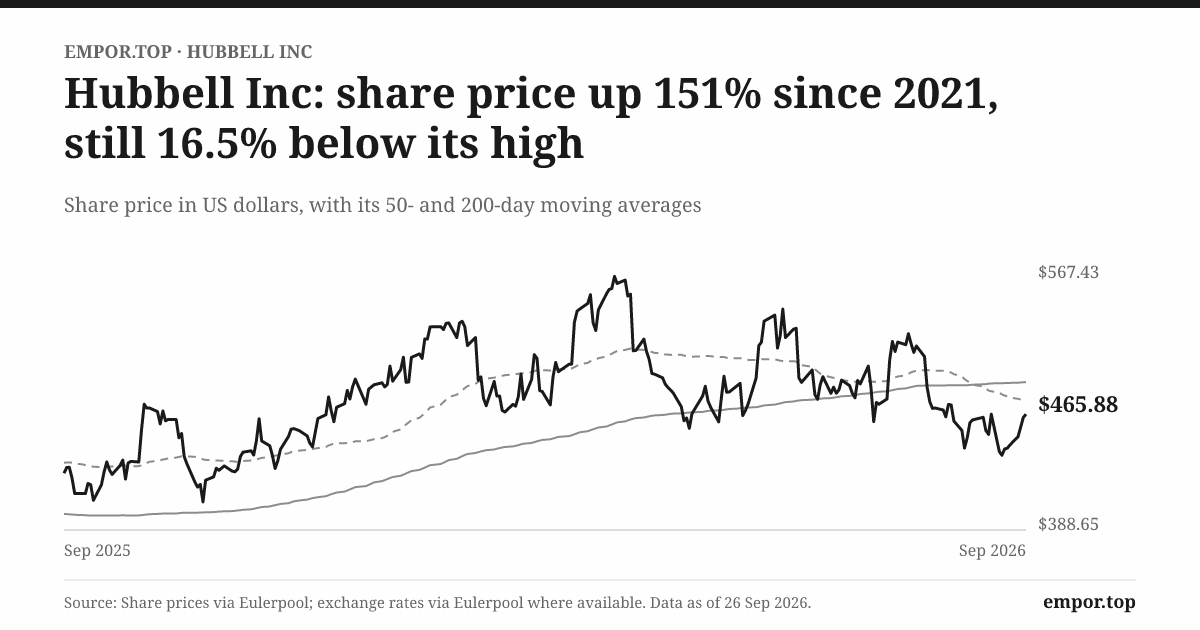
The scale today is substantial. Hubbell reported $5.84 billion of net sales in 2025, with an adjusted operating margin of 22.7% and $875 million of free cash flow.5 In late September 2026, the stock traded around $466, giving the company a market value of about $25 billion.6 That price is well below the 52-week high above $560, but still roughly 28 times 2025 GAAP earnings per share of $16.54.5 This is not a sleepy industrial valued like one. The market is paying for a growth story.
That is the puzzle of this episode. Hubbell's founding insight was to make the standardized, unglamorous part that every electrician must buy, regardless of who designs the building or owns the grid. That insight still underwrites the business. But the company now finds itself in a very different posture: a serial acquirer, running more leverage than at any point in recent memory, paying rising multiples for assets tied to the hottest themes in industrial markets.
Hubbell has been here before. In 2017 it paid $1.1 billion for a smart-metering business called Aclara, marketed as the company's leap into grid software and data. By management's own account, that business spent most of 2022 to early 2026 shrinking or stagnating. So the real question is not whether the grid buildout is real. It clearly is. The question is whether Hubbell has started paying up for growth it used to get cheaply, and whether its own history gives investors reason to discount the newest round of megatrend narratives.
The story starts, fittingly, in an arcade.
 Subscribe on LinkedIn
II. Origins, Compressed: Harvey Hubbell and the Invention of the Outlet (1888–1960s) (18–20 min)
Picture a New York City penny arcade in the 1890s. Rows of coin-operated machines, some of them among the first electrically powered amusements the public had ever seen, hum and flash under gas-lit and electric lamps. The machines are popular. They are also a maintenance headache. Each night, a janitor has to disconnect the wires that feed the games, which in those days meant unscrewing terminals by hand, and every morning someone has to reconnect them in the right order.
Harvey Hubbell II, a Connecticut inventor and manufacturer, watched this ritual and saw a product. According to company histories, the scene gave him the idea for "an electrical plug in which the wires were permanently attached in their proper sequence," so that a device could be detached from its power source and reattached without anyone touching the bare wiring.7 It sounds trivial now. At the time, it was the conceptual ancestor of every plug and outlet in the modern home.
Hubbell had founded his manufacturing company in Bridgeport in 1888, at a time when electricity was a novelty rather than a utility.7 His early success came from things that had nothing to do with electricity, including a paper-roll cutter for retail stores, but he quickly pivoted toward the new electrical economy. He patented a pull-chain light socket in 1896, the kind still found dangling in basements and closets across America. In 1901 he published his first product catalogue, listing 63 electrical items.7
The business incorporated as Harvey Hubbell, Inc. in 1905. By 1917, the catalogue had swelled to 100 pages and more than 1,000 products, including toggle switches and heavy-duty industrial components.7 Those numbers matter more than they first appear. Even in its first two decades, Hubbell's strategy was breadth: not one clever invention, but a catalogue an electrician could order from again and again.
The Second Generation and the Public Company
When Harvey Hubbell II died in 1927, leadership passed to his son, Harvey Hubbell III.7 He took the company public in 1936, in the depths of the Depression, a move that gave the business access to capital at a time when many manufacturers were starved of it.7 During the Second World War, the plant turned to military work, producing battery-charging systems and other electrical equipment for the war effort. After the war it swung back to civilian markets; one showcase project was supplying custom electrical components for the ocean liner SS United States, launched in 1952.7
Why This History Still Matters
Most founding stories in business are trivia. This one is not, because the core economic idea survived intact. Hubbell's plug succeeded not because it was proprietary magic, but because it became standard. Once electricians knew the product, trusted its quality and could buy it through the same distributor they used for everything else, there was little reason to switch. The product was cheap relative to the cost of the labor installing it, and very expensive if it failed.
That same logic, "low cost of ownership and high cost of failure," is almost word for word how CEO Gerben Bakker described the NSI acquisition on the July 2026 earnings call.4 The company's language has changed very little in 138 years because the economics have changed very little. A utility lineman or an industrial electrician does not want to gamble on an unfamiliar connector to save a few dollars on a job worth thousands.
What the origin story also shows is a limitation that investors should keep in mind. Harvey Hubbell's inventions were copyable, and the plug did not stay proprietary for long. The company's durable advantage came from catalogue breadth, brand trust and distribution, not from a technological lock. That distinction becomes crucial later, when Hubbell tries to buy its way into a more technology-driven business and discovers that the rules of that game are different.
By mid-century, Hubbell was a respected, profitable maker of wiring devices. The next phase would turn it into something much larger and much harder to describe.
III. From Product Company to Portfolio: The Conglomerate Decades (1960s–2016) (15 min)
In 1962, Hubbell bought Kellems, a maker of cable grips and wire-management products whose woven mesh "Kellems grips" were used to pull and support heavy electrical cable.7 It was the first move in a buying pattern that would last for more than half a century. Grelco and Shalda Lighting followed in 1963, Euclid Electric in 1966, cable maker Kerite in 1969, telecom-equipment company Pulse Communications in 1972 and Ohio Brass, a maker of utility insulators and transmission hardware, in 1978.7
Ohio Brass deserves a pause. It marked Hubbell's serious entry into the utility market, selling hardware that sits on power lines rather than inside buildings. That thread would eventually become the company's largest business. In 1994, Hubbell added A.B. Chance, a Missouri-based maker of utility anchors, insulators and tools used by lineworkers, which brought the "Chance" brand that still appears on utility trucks across America.7 In 1991 it bought Bryant Electric from Westinghouse, and in 2002 it paid $250 million for LCA Group, a lighting business.7
The Quiet Compounder
For decades, this model worked in a quiet, unexciting way. By 2004, Hubbell had sales of $1.99 billion and about 10,600 employees worldwide.7 By 2016, net sales had reached $3.51 billion.8 Growth came in small increments: 2012 sales were $3.04 billion, and the company added a few percentage points a year through a mix of modest organic growth and bolt-on deals.8 In 2016, acquisitions contributed three points of growth, while organic volume added only about one.8
The composition of that business matters for what comes next. In 2016, the Electrical segment, which included wiring devices, industrial products and lighting, accounted for 70% of revenue, while the Power segment serving utilities was only 30%.8 Hubbell was primarily a building-and-industrial electrical supplier with a utility sideline. The company operated plants across the United States, Puerto Rico, Mexico, China, Brazil, the United Kingdom and elsewhere, a footprint that still largely exists today.9
The investment case for Hubbell in this era was steady rather than thrilling. It was a well-run, dividend-paying cyclical tied to non-residential construction and industrial spending. It had no obvious catalyst to re-rate, and the lighting business in particular was drifting into a problem: LED technology was turning fixtures into a commoditized, price-driven category where Asian competition and falling component costs squeezed margins.
Why the Era Ended
By the mid-2010s, management faced a strategic question that many diversified industrials confronted. The portfolio had grown by accretion rather than design. Some pieces, particularly utility hardware, sat in markets with long replacement cycles, specification requirements and customer loyalty. Others, particularly commercial lighting, looked increasingly like consumer-electronics businesses, with fast product cycles and brutal price competition.
The answer Hubbell arrived at was to lean toward the utility grid. The grid was aging, most of its hardware had been installed decades earlier, and utilities earn regulated returns on the capital they spend, which gives them a structural incentive to invest. The question was how to make that pivot. Hubbell's first big answer came in December 2017, and it was not a connector or an insulator. It was software and sensors.
IV. The 2017 Aclara Bet and the Smart-Grid Reckoning (30 min)
In the last week of 2017, while most of corporate America was on holiday, Hubbell announced it would pay $1.1 billion to buy Aclara Technologies from private equity firm Sun Capital Partners.[^10] Aclara made smart meters, the devices that let utilities read electricity, water and gas usage remotely, along with the communications networks and software that tie those meters together. The industry calls this advanced metering infrastructure, or AMI. It also made grid sensors and related products.
The deal was priced at roughly 12 times Aclara's adjusted EBITDA of about $90 million, on around $500 million of revenue.[^10] The pitch was explicit: this was Hubbell's entry into the "smart grid," a second act beyond steel and porcelain hardware. Metering data would give utilities visibility into their networks. Hubbell would move up the value chain from selling the parts on the pole to selling the intelligence about what flows through them.
What a Smart Meter Business Actually Is
It helps to explain why AMI is a different animal from the rest of Hubbell. A connector on a transmission line can last 40 years, is bought constantly in small quantities, and gets reordered through distributors every time a line is extended or repaired. A smart meter program is different. A utility decides, often after a multi-year regulatory process, to replace hundreds of thousands or millions of meters in one large project. The vendor wins a big contract, deploys it over several years, and then the customer goes quiet until the next generation of technology. Revenue arrives in lumps, and competition for each project is intense, with specialists like Itron and Landis+Gyr bidding on the same work.
In other words, Hubbell bought a project business with technology risk and bid competition, and bolted it onto a company whose strengths lay in catalogue breadth and repeat distributor orders.
The Reckoning, in Management's Own Words
For several years, Aclara's big projects masked the underlying issue. But as that backlog was worked through, the business shrank. In 2025, Utility Solutions net sales grew only 2%, to $3.67 billion, even as grid infrastructure products grew at double-digit rates, because metering and AMI dragged the segment down.510 In the fourth quarter of 2025, grid automation sales fell 8% year over year as "weaker new project activity in meters and AMI" more than offset growth in protection and control products.10
On the fourth-quarter call in February 2026, an analyst noted that management had hoped the decline would be over by then, and asked whether something deeper was wrong. Bakker's answer was candid: Hubbell had consumed its large-project backlog through 2025, and "what we haven't seen return is a lot of those larger projects." The business, he said, had become "more smaller project, more replacement product."10
The first-quarter 2026 call in April went further. Grid automation organic sales fell 7% year over year.11 Bakker explained that Aclara's decline was "just starting to get smaller and smaller," and that utilities were "deselecting this a little bit over the other areas of investments."11 He added a phrase that should be pinned above any analyst's desk covering this company: "We're not super expecting great growth rates, but the dynamics are such that this business should grow from here."11
By the July 2026 call, grid automation had returned to modest year-over-year growth, with book-to-bill above 1.0. Bakker described it as the payoff of a deliberate refocus: in 2025 Hubbell had pivoted Aclara's investment toward municipal utilities and electric cooperatives, pulled out some prior investment, and "rightsize[d] the business a little bit."4 He acknowledged directly that grid automation "had gone through, you know, some declines for several quarters," led by Aclara.4
Weighing the Evidence
This is not stale history. It is the same business unit, under the same management regime, described in the company's own words within the last eight months. It is also material in scale: grid automation represents roughly a quarter of Utility Solutions revenue, since grid infrastructure makes up about three quarters.10
What does the record say about the original thesis? It does not reject the idea that Aclara was a sensible asset to own; the business survived, is profitable enough to keep, and is now growing again off a lower base. But the "software-like growth engine" thesis of 2017 has been narrowed to something much smaller: a stabilized utility metering and grid-automation business that management itself expects to deliver "modest growth." Utilities, when forced to choose, spent their capital budgets on wires, substations and transmission rather than on meters. Nearly a decade after the acquisition, the software-and-data second act has not arrived in the form it was sold.
There is a broader lesson for investors reading the rest of this story. Hubbell's core advantage has always been in physical, specified, repeatedly purchased components. When it moved into a lumpier, more technology-driven category, its edge was weaker and its forecasts proved too optimistic. That history is the right lens through which to evaluate the company's current "megatrend" acquisition narratives.
The KPI that will confirm or kill even the narrowed version of the Aclara thesis is simple: grid automation organic growth through 2026 and 2027, particularly the municipal and cooperative orders management has flagged as the swing factor. If those orders keep converting, the business settles into a low-growth contributor. If they stall again, the case for owning it at all gets weaker.
What Hubbell did next, however, suggests management absorbed at least part of that lesson.
V. Rebuilding the Portfolio: Divestiture and the M&A Sprint (2021–2026) (55 min)
Selling the Lights
On October 26, 2021, a year into Gerben Bakker's tenure as CEO, Hubbell announced it would sell its Commercial and Industrial Lighting business to GE Current, a Daintree company, for $350 million in cash.[^13] The business had generated roughly $515 million of sales in 2020.[^13] In plain terms, Hubbell sold a half-billion-dollar revenue stream for about 0.7 times sales.
That is not a flattering price, and it was not meant to be. Commercial LED lighting had become a crowded, deflationary category where product differentiation was hard to sustain. Bakker framed the sale as creating "a more focused Hubbell portfolio with higher growth and margin characteristics," centered on "critical infrastructure solutions for Electrical and Utility applications."[^13] The implicit admission is that a business Hubbell had spent decades assembling, including the LCA Group purchase in 2002, was no longer worth much to its owner or to anyone else.
Divestitures are an underrated test of management quality. It is easy to buy things; it is much harder to admit that part of the portfolio no longer earns its keep and to accept a low price to exit. The lighting sale is a genuine discipline data point. It removed a margin drag and simplified the company's story. But it should be weighed alongside Aclara: the same era of portfolio building produced both a business worth exiting at 0.7 times sales and a technology bet that underdelivered for years.
Systems Control: The Template Deal
Two years later, on October 30, 2023, Hubbell agreed to buy Northern Star Holdings, known commercially as Systems Control, for $1.1 billion in cash.12 Systems Control makes substation control and relay panels and builds turnkey "control houses," the prefabricated buildings that sit inside a substation and contain the electronics that detect faults and direct power flows.12 The business expected about $400 million of 2024 revenue, and the price represented roughly 12 times projected 2024 EBITDA.12
Think of a substation as a highway interchange for electricity, where voltage is stepped up or down and power is routed between lines. The control house is the traffic control center. Utilities increasingly prefer to buy these buildings fully assembled and tested in a factory rather than wiring them up in a muddy field with scarce skilled labor. Systems Control sat directly in the path of utility transmission and substation spending, which was about to accelerate sharply.
Notice the multiple: about 12 times EBITDA, the same neighborhood as Aclara six years earlier. The difference was the asset. This was physical, specified, capacity-constrained infrastructure, much closer to Hubbell's historical sweet spot. On the April 2026 call, Bakker said Systems Control was seeing "very similar dynamics of good demand and need to add capacity" as the company's other substation assets.11
DMC Power: Paying More for Faster Growth
On August 12, 2025, Hubbell agreed to buy DMC Power from private equity firm Golden Gate Capital for $825 million in cash.13 DMC makes connectors and tooling for utility substations and transmission, with anticipated 2026 revenue of about $130 million and EBITDA of about $60 million.13 That implies a price of roughly 14 times forward EBITDA, and an EBITDA margin near 46%, which is exceptional for a component maker.
DMC's product is a clever solution to a labor problem. Traditionally, connecting heavy conductors in a substation meant welding them in the field, which requires certified welders and time. DMC's "swaged" connectors use hydraulic tooling to compress a fitting onto a conductor, creating a permanent joint with less skilled labor and less time. Bakker described exactly this on the July 2026 call: a connector "crimping" onto a bus bar where "the traditional way of that would have been to do a weld in the field."4
The deal closed on October 1, 2025.[^16] Early results look good. In April 2026, Bakker said DMC was "off to a really good start" and "meeting and even exceeding a little bit our expectations," adding that the ability to grow output was "more a function of our ability to get capacity in place because orders are really supporting."11 That is a strong early read, but it is also only two quarters of evidence, and capacity-constrained demand is exactly the condition under which almost any acquisition looks good.
NSI: The Inflection Deal
Then came NSI. On the April 30, 2026 call, Bakker told an analyst that Hubbell's balance sheet "certainly supports doing acquisitions at larger scale than perhaps we were able to afford in the past," and CFO Joe Capozzoli said the company would "continue to remain disciplined in our approach."11 Four days later, Hubbell announced the $3.0 billion NSI deal.1
NSI is an electrical fittings, connectors and wire-management business serving light industrial, data center, network infrastructure and commercial markets.1 Its Bridgeport fittings brand, in Bakker's words, "fills a key product line gap" in the Electrical Solutions segment, while Polaris connectors complement Hubbell's grounding and connector lines.4 The price, at about 15.5 times anticipated 2026 EBITDA, implies NSI generates roughly $190–195 million of EBITDA on its expected $570 million of revenue, or a margin in the mid-30s.1
The financing changed Hubbell's balance sheet overnight. Total debt rose from $2.33 billion at the end of 2025 to $5.37 billion at the end of June 2026, and net debt to total capital jumped from 28% to 52%.3 Management put pro forma leverage at about 2.9 times net debt to EBITDA, up from 1.3 times at the end of 2025.410
The Benchmarking Question
So is 15.5 times a break in discipline, or a rational price for a scarce asset in a hot market? There are honest arguments on both sides.
The case that it is rational: NSI's margins appear higher than Hubbell's own, its end markets overlap heavily with Hubbell's existing distributor channels, and good grid-adjacent and electrical-component businesses have been re-rated across the industry as investors bid up anything tied to data centers and electrification. Private equity owners like Sentinel and Golden Gate know exactly what these assets are worth to strategic buyers, and they price accordingly. Paying 12 times in 2023 and 15.5 times in 2026 may simply reflect the market moving, not Hubbell getting sloppy.
The case for caution: the trajectory is unmistakable. Systems Control at about 12 times, DMC at about 14 times, NSI at 15.5 times, with the deal size nearly tripling from the previous record. Each of these deals has been justified by the same set of megatrends. If those megatrends cool, Hubbell will own several assets bought at peak-cycle prices with a balance sheet carrying far more debt than it has historically tolerated.
Management's own promises give investors a way to keep score. Capozzoli said NSI would add about $0.20 of adjusted EPS accretion in 2026 and about $0.80 in 2027, and that the company was targeting 2% to 3% sales synergies and 3% to 5% cost synergies over three years.4 He also said Hubbell intends "to pay down significant portions of debt and deleverage our balance sheet over the next 24 to 30 months," positioning it "for further accretive M&A investment over the next several years."4 In the first partial month of ownership, NSI contributed $35 million of sales at accretive margins, "in line with our expectations."4
These are specific, testable commitments, and that is to management's credit. But they remain forecasts, and Hubbell's own record with Aclara shows how far realized outcomes can drift from an acquisition thesis.
Tallying the Sprint
Step back and the pattern is clear. In five years, Hubbell exited a large, low-margin business and bought three significant ones in grid and electrical infrastructure, alongside smaller bolt-ons. The average deal size has stepped up from about $1 billion to $3 billion. Goodwill and intangible assets already totaled about $4.46 billion at the end of 2025, before NSI was added.9 The company has turned itself into a more focused, higher-margin business, but also a more acquisitive and more levered one.
The honest conclusion is that the strategy is intact but unproven at its new scale. The two most recent deals have early positive signals. The largest deal has barely begun. The forward markers are clear: net debt to EBITDA trending back toward roughly 2 times on the stated 24 to 30 month timeline, and NSI's realized, not guided, accretion of around $0.80 per share in 2027.
What exactly did all this dealmaking build? To answer that, one has to look inside the two segments that now make up Hubbell.
VI. The Business Today: Two Segments, One Grid (60 min)
Drive along almost any rural highway in America and look up at the wooden poles. The crossarm hardware, the insulators keeping live wires away from the pole, the anchor holding the guy wire in the ground, the connectors splicing conductors together, the enclosure buried at the base: there is a good chance several of those items came from a Hubbell factory. Walk into a data center under construction and the story repeats inside, in the connectors, grounding lugs, plugs, receptacles and modular power skids feeding server halls.
Hubbell today reports two segments. Together they generated $5.84 billion in 2025, with about 93% of sales in the United States.59 The company employed about 18,000 people at the end of 2025.9
Utility Solutions: The Larger, Higher-Margin Core
Utility Solutions produced $3.67 billion of 2025 revenue, about 63% of the total, with an adjusted operating margin of 24.1%.59 By the second quarter of 2026, the segment's adjusted margin had reached 25.6% on quarterly sales of $1.03 billion.3 More than 80% of the segment is aligned to electric transmission and distribution components and solutions.10
The segment breaks into two parts. Grid infrastructure, roughly three quarters of sales, covers the physical hardware for distribution, transmission and substations, including brands like Chance, Anderson, Ohio Brass and Quazite enclosures, plus Systems Control and DMC Power.910 Grid automation, the remaining quarter, covers Aclara's meters and AMI along with protection and control products.10
It is worth spelling out how different the 2016 company was. Then, the utility-facing Power segment was only 30% of revenue.8 A decade of acquisitions, divestitures and outgrowth has inverted the business. Hubbell is now primarily a utility grid supplier with a building electrical business attached, not the other way around.
The industry structure is favorable. Hubbell sells into thousands of buyers: large investor-owned utilities, municipal utilities and electric cooperatives. None is dominant enough to dictate terms alone, though Hubbell's ten largest customers, many of them electrical distributors, together account for about 42% of net sales.9 Products must be approved by utility engineers and added to qualified-vendor lists, and the items are cheap relative to the cost of the truck, crew and outage risk involved in installing them.
The competitive set depends on what one is looking at. In heavy transmission and substation equipment such as transformers and switchgear, GE Vernova, Siemens Energy, ABB and Schneider Electric are the giants, though they mostly make different products than Hubbell. In metering, Aclara competes with Itron and Landis+Gyr. Construction firms like Quanta Services and MYR Group are not competitors but customers-of-customers, installing the hardware Hubbell sells.
The 85% Claim, Examined
Management's favorite proof point for this segment came on the April 2026 call: on a typical transmission line, Bakker said, Hubbell serves "85% to 90% of the material that goes up on that."11 It is a striking figure, and it says something real about the breadth of the catalogue. A utility can buy nearly everything for a line from one supplier, which simplifies procurement, logistics and specification.
But breadth is not exclusivity. The statement describes the share of product categories Hubbell can supply, not the share of orders Hubbell wins. In the very same answer, Bakker acknowledged that Hubbell would "get our fair share" of transmission growth, and later he noted plainly that "we're not the only participant" in high-voltage transmission.11 Utilities typically maintain multiple qualified vendors for key items precisely to preserve pricing leverage and supply security. When asked in July about win rates on the larger projects now flowing through, Bakker said the win rate was "probably similar to what we have seen traditionally, but there is just more of those coming through right now."4
The fair reading is that Hubbell has a leading, broad and deeply specified position, which is valuable, but that the evidence supports "preferred supplier among several" more than "lock-in." That distinction will matter when the cycle turns.
Electrical Solutions: Smaller, Faster, and Now Data-Center-Driven
Electrical Solutions generated $2.17 billion of 2025 revenue, about 37% of the total, with an adjusted operating margin of 20.2%, the first year in the segment's history above 20%.510 It sells wiring devices, connectors, grounding products, industrial and hazardous-location equipment and lighting controls under brands like Hubbell, Raco, Burndy and Killark, and now NSI's Bridgeport and Polaris lines.19
This segment spent years as the less exciting half. Management's "compete collectively" program, unifying previously separate brands into one sales force organized around vertical markets, helped push margins up, and data centers then turbocharged the top line.10 In the second quarter of 2026, segment sales rose 25% to $686 million, including 18% organic growth, while the adjusted operating margin fell 130 basis points to 21.2%, driven by price-cost timing and about 60 basis points of higher restructuring spending.34
The competitive field here is crowded and familiar. Eaton is the most direct large-cap comparison, and market commentators routinely set the two side by side as electrification plays.14 nVent competes in enclosures and connectors, Acuity Brands in lighting controls, and privately held Leviton alongside Legrand in wiring devices. Unlike the utility business, much of this segment is sold through electrical distributors to contractors, with shorter purchase cycles and more exposure to general construction activity.
Sizing the Data Center Story Honestly
Data centers are the headline, so it is worth sizing them carefully. In February 2026, management said data centers represented "more than 10% of segment sales" in Electrical Solutions and were expected to grow at a mid-teens rate.10 That was based on a segment of roughly $2.2 billion, so data centers were a business of somewhat more than $200 million, well under 5% of total company revenue.
Then growth exploded. Data center sales rose more than 60% in the fourth quarter of 2025, about 40% in the first quarter of 2026 and about 65% in the second quarter.10114 The full-year growth outlook moved from mid-teens, to more than 25% in April, to approximately 50% in July.10114
Capozzoli described the mix in April: roughly half of the data center exposure is a long-cycle modular power-distribution skid business, with orders "booked out through the year" and little incremental capacity; the other half is short-cycle "book-and-bill" components, where winning depends on having inventory on the shelf.11 This is real, material and fast-growing. But even growing at 50%, data centers remain a minority of Electrical Solutions and a single-digit share of Hubbell's total revenue. The growth rate is spectacular; the absolute contribution is still modest.
That combination, a small base growing very fast, is exactly the profile that can surprise in both directions. Who is steering the company through it?
VII. Gerben Bakker and the Current Management Team (30 min)
In 1988, the year Hubbell celebrated its centennial, a young manufacturing engineer joined the company.15 His name was Gerben Bakker. Thirty-two years later, in October 2020, he became its chief executive, and in May 2021 its chairman.15
Bakker's career is the definition of an internal succession. He spent years in operations roles, ran Hubbell Power Systems, the utility business, from 2014 to 2019, and served as president and chief operating officer from 2019 to 2020 before taking the top job.15 He joined the board of Regal Rexnord in February 2025.15 On earnings calls he comes across as an engineer rather than a salesman: he answers questions in operational terms, explaining why a swaged connector beats a field weld or why a 765-kilovolt line needs more substations, and he tends to let the CFO carry the numbers.
That background explains a lot about the strategy. Bakker ran the utility business during the years it was becoming the company's growth engine, and he knows the product lines from the factory floor up. It is no surprise that his biggest moves have pushed the company deeper into utility transmission and substation hardware. It is also worth noting that he was running Hubbell Power Systems when Aclara was acquired, and has been CEO throughout its multi-year decline, so the Aclara story is part of his record, not a predecessor's mistake.
The Team Around Him
CFO Joe Capozzoli handles the financial side on calls, walking through guidance, price-cost math and capital allocation with notable precision.4 The operating segments are run by Gregory Gumbs in Utility Solutions and Mark Mikes in Electrical Solutions.9 This is a bench developed largely from inside, which supports continuity but also means few senior voices with experience of very different business models.
Capital Allocation: What Management Says Versus What It Does
The stated hierarchy has been consistent across calls: reinvest in the business first through capital spending, then acquisitions, then buybacks, with the dividend growing steadily.11 Behavior mostly matches. Capital spending was guided to $175–190 million for 2026, up from $155 million in 2025.4 In 2025 Hubbell repurchased $225 million of stock and paid $286.6 million in dividends.5 In the first quarter of 2026 it bought back $168 million of shares at an average below $500, explicitly framed as neutral to 2026 earnings but accretive in 2027.11
One sequence deserves attention. On April 30, management described an M&A approach that would "remain disciplined" and mentioned buybacks as a use of capital "in periods where perhaps there is a little bit of a void in acquisition."11 Within days the company announced the largest deal in its history. That is not necessarily contradictory; the NSI process was obviously underway. But it means that the first-quarter buybacks at just under $500 a share were followed by borrowing billions for an acquisition, a sequence a skeptical shareholder might question given where the stock trades today.
Guidance Discipline
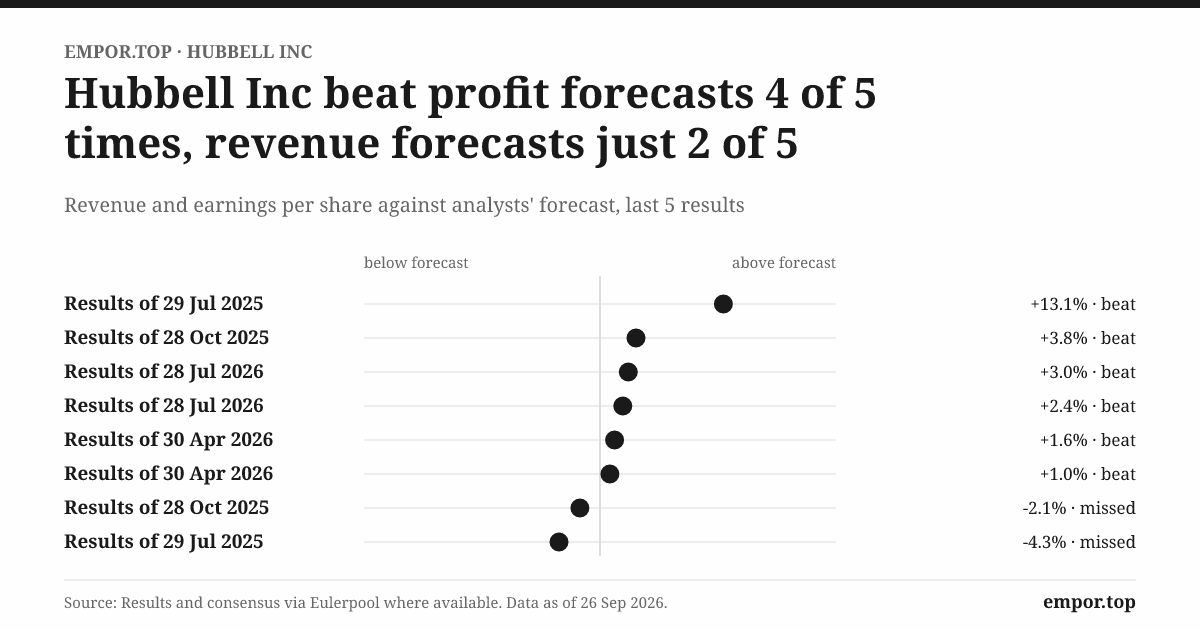
On guidance, the recent record is strong. In February 2026, management initiated full-year guidance of 7–9% total sales growth and $19.15–19.85 of adjusted EPS.5 In April it raised sales growth to 8–11% and adjusted EPS to $19.30–19.85.11 In July it raised again, to 16–18% total sales growth (including about five points from NSI) and $20.25–20.55 of adjusted EPS.4 That is two consecutive raises after the initial outlook, driven by real volume and order strength rather than accounting.
The fair caveat is that raising guidance in the middle of a grid and data center capital-spending boom is a lower bar than hitting guidance through a downturn. Hubbell's willingness to talk plainly about Aclara's weakness is a credibility positive; its record through a real demand recession, with this much debt, has not yet been tested.
Pay, Votes and the Board
Hubbell's incentive system leans heavily on performance-based equity. In the 2025 proxy, about 53% of Bakker's target pay was long-term equity, and 75% of equity awards were performance-based.15 Performance shares were weighted evenly across relative sales growth, adjusted operating margin and relative total shareholder return.15
An activist would flag the absence of a return-on-capital metric in that mix. When a company is spending billions on acquisitions, sales growth and margin can both be improved by buying high-margin businesses, regardless of the price paid. Whether acquired growth counts toward the sales-growth metric is a detail shareholders should check in the proxy; either way, no metric in the long-term plan directly penalizes overpaying.
Shareholder votes offer a directional signal. At the May 2024 annual meeting, say-on-pay passed with 43.4 million votes for and 2.2 million against, roughly 95% support.16 In May 2025, the tally was 39.6 million for and 4.6 million against.17 In May 2026, it was 40.2 million for and 5.0 million against, roughly 89% support.18 That is still comfortable approval, but opposition roughly doubled in two years. Lead director Neal Keating, a board member since 2010 and chair of the governance committee, drew the most opposition among director nominees in 2026, with about 8.0 million votes against, up from 5.6 million the year before.151718 None of this signals a crisis, but it is a measurable softening that deserves to be named rather than ignored.
A search of Hubbell's annual meeting results and major news coverage for 2025 and 2026 turned up no activist campaign against the company. That is a bounded result for that period, not an assurance about the future, especially now that leverage is elevated.
With the leadership team profiled, the next question is whether the growth vectors they are betting on are as durable as they appear.
VIII. The New Growth Vectors: Data Centers, High-Voltage Transmission, and Electrification (35 min)
The first 765-kilovolt lines in America were built decades ago, and then the country mostly stopped building them. As Bakker put it in April 2026, "There just wasn't a need for it."11 Electricity demand was flat, and utilities focused on maintaining what they had.
That has changed. When a hyperscale data center campus wants a gigawatt of power, or a region needs to move bulk electricity hundreds of miles from where it is generated to where it is consumed, the most efficient answer is often very high voltage. Operating lines at 765 kV, roughly double the voltage of the more common 345 kV lines, lets utilities push far more power through a single corridor with lower losses and less land.11
The 765 kV Opportunity
Management first framed this opportunity on the April 2026 call. Hubbell estimates high-voltage transmission represents an addressable market of about $1.5 billion over the next ten years, corresponding to about 7,000 miles of new lines.11 Bakker said it could "drive a point of growth above" the high-single-digit growth already expected in transmission and substation, and described it as "incremental," not a substitute for existing spending.11 His analogy was a highway: a 765 kV line is the interstate, and it needs off-ramps in the form of new substations that step the voltage down, which pulls through more of Hubbell's substation portfolio.11
There are concrete proof points. Hubbell has already won several 765 kV orders, with the first set to ship in 2027, and it is shipping 550 kV products for data center interconnects in the second half of 2026.4 Transmission and substation project quotes have "about doubled in the last couple of years."4 Content per mile also rises slightly at higher voltages.11 And customers are now placing orders for delivery in 2027, a sign of longer planning horizons.4
This makes the high-voltage story more tangible than Aclara's smart-grid pitch was in 2017. It is built on the same kind of product Hubbell has sold for a century, bought by the same customers through the same processes. But it is worth keeping perspective. A $1.5 billion market over ten years is about $150 million a year across all suppliers, and Hubbell will win only a share of it. Management's own estimate is roughly one extra point of growth. That is useful, not transformational, and it depends on multi-year utility projects surviving permitting, rate cases and political shifts.
Data Centers: The Biggest Swing Factor
The data center line is the fastest-growing part of Hubbell and the most debated. On the July call, management attributed the acceleration to capacity additions, new product introductions and content gains, including new higher-amperage pin-and-sleeve devices designed for the 800-volt power architectures appearing in AI data centers.4
The bull argument is that AI infrastructure is a multi-year buildout, and that every new data center requires grid interconnection, substations and internal power distribution, touching both of Hubbell's segments. The bear argument is that hyperscaler capital spending is concentrated among a handful of buyers whose budgets can change quickly, and that the short-cycle half of Hubbell's data center business, sold from inventory, would feel any pause immediately.
What makes this the single largest swing factor is not its size today but its role in the valuation narrative and the growth guidance. A deceleration from 50% to, say, 10% would not break Hubbell's financials, but it would remove much of the reason the stock trades at a premium to its history.
Grid Hardening: The Deep, Boring Profit Pool
Behind the excitement sits the oldest and largest driver: distribution grid replacement and hardening. Much of the grid's wooden-pole infrastructure is decades old, storms and wildfires are forcing utilities to invest in resilience, and regulators increasingly measure utilities on outage performance.10 After a two-year period in which distributors worked down excess inventory, distribution sales grew at double digits in the second quarter of 2026, partly helped by easy comparisons.4 Bakker said he expects this to be a "mid single digit plus" market longer term.4
This is the least glamorous vector and probably the most reliable. It is also the one least exposed to a single category of customer.
All of these vectors show up, ultimately, in the numbers. So how do the numbers look?
IX. Financial Performance & Capital Allocation (30 min)
A useful way to read Hubbell's recent financials is as three chapters: a pandemic dip, a price-driven surge, and now a volume-and-acquisition acceleration.
The Revenue Arc
After the lighting sale, Hubbell's continuing operations grew from about $4.9 billion of sales in 2022 to $5.63 billion in 2024 and $5.84 billion in 2025.5 The 2022–2023 period benefited heavily from pricing as inflation hit metals and components. By 2025, growth had slowed markedly: organic sales grew just 3.3% for the year, held back by the Aclara decline and by distributor destocking in utility distribution.5
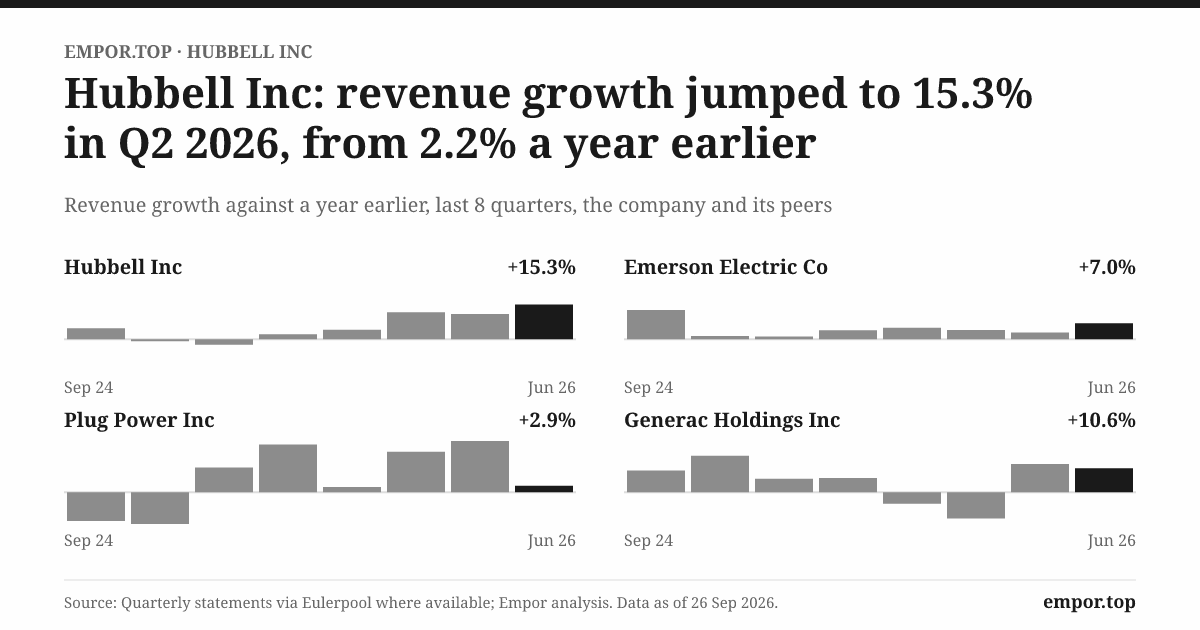
Then came the reacceleration. First-quarter 2026 sales rose 11% to $1.517 billion, with 8% organic growth.11 Second-quarter sales rose 15% to $1.712 billion, with 10% organic growth and five points from acquisitions.3 Management now expects 16–18% total sales growth for 2026, including 9–11% organic.4
The composition of that growth matters. Of the organic growth, pricing accounts for a meaningful part. Capozzoli said the company expects "3 to 4 points" of price for the full year, after price increases in April and July to offset metals inflation.4 So of 9–11% organic growth, perhaps six to seven points are volume. That is still strong, and much healthier than 2025, but it is not all underlying demand.
Margins and Cash
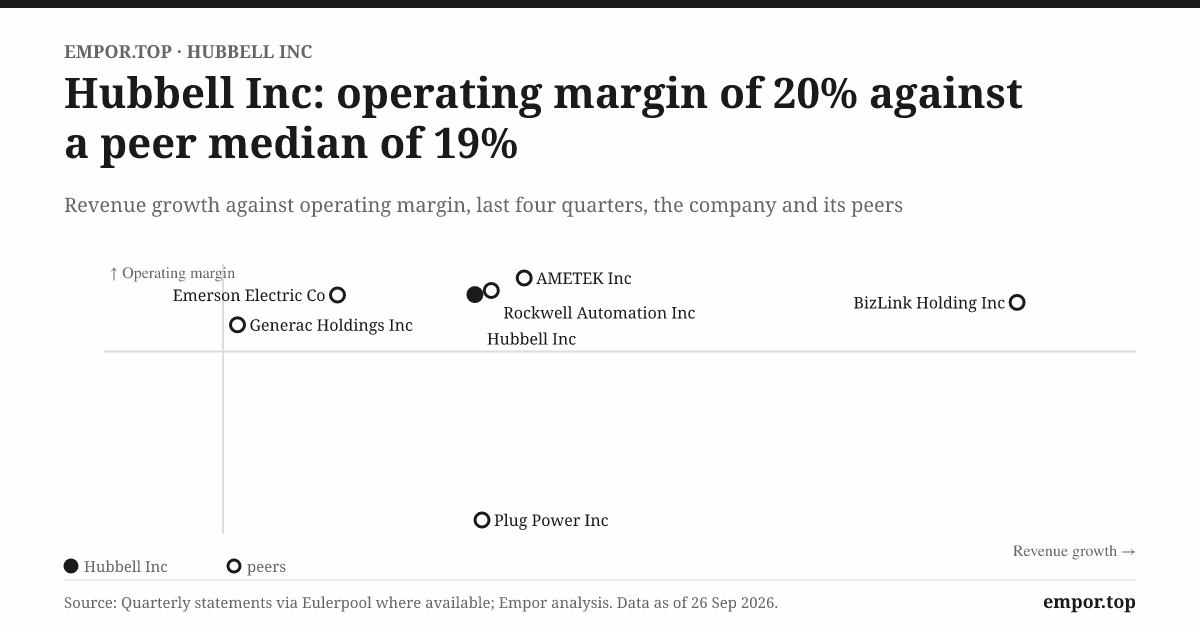
Adjusted operating margin reached 22.7% in 2025, up 80 basis points.5 Guidance for 2026 is 23.1–23.4%, a further 40–70 basis points of expansion.4 In April, before NSI, management had been guiding to only about 20 basis points of expansion at the midpoint, noting that roughly a point of dilution came simply from passing inflation through at cost.11 When an analyst on the July call broke down the higher outlook, attributing about 40 basis points to NSI's richer margins and about 30 basis points to the net tariff benefit, Capozzoli agreed with the arithmetic, adding that stronger volume was being partly offset by heavier reinvestment.4
That tells investors something specific. Most of the improvement in this year's margin outlook came from an acquisition and a one-time tariff refund, not from the core business suddenly earning more on each dollar of sales. Hubbell is managing price against cost well, but the underlying operating leverage on its organic growth is modest, because it is spending heavily to add capacity. Pricing math adds another subtle drag: when a company raises prices just enough to cover higher metal costs, profit dollars are protected, but margin percentages shrink because both revenue and cost rise by the same absolute amount.
Free cash flow was $875 million in 2025, about 90% of adjusted net income.510 Historically, Hubbell converted 100% or more of net income into free cash. Capozzoli explained the gap directly: capital spending used to be below 2% of sales and is now running at 2.5–3%, and management expects conversion to stay around 90% "for the next couple of years."4 This is an explanation, not an alarm. The extra spending is going into factories, not into covering up weak profitability. But it does mean less free cash for debt reduction at exactly the moment the company has taken on the most debt.
Tariffs: A Real, Not Hypothetical, Line Item
Trade policy has moved Hubbell's reported numbers repeatedly. In the first quarter of 2026, after the IEEPA tariffs fell away and were replaced by other measures, including a Section 122 tariff and changes to Section 232 duties, Capozzoli said the sum of all changes was "about neutral to us for the year."11 By July, the company expected a net benefit of about $20 million, mostly from IEEPA tariff refunds net of potential customer considerations, concentrated in the third quarter and split roughly evenly between segments.4 At the same time, changes to the Section 301 framework slightly increased underlying tariff costs.4
The practical point is that tariff policy is a live variable, shifting multiple times in a single year, and it flows straight into margins. The $20 million refund is a one-time benefit that will not recur, and investors comparing 2027 margins to 2026 should adjust for it.
Valuation Context
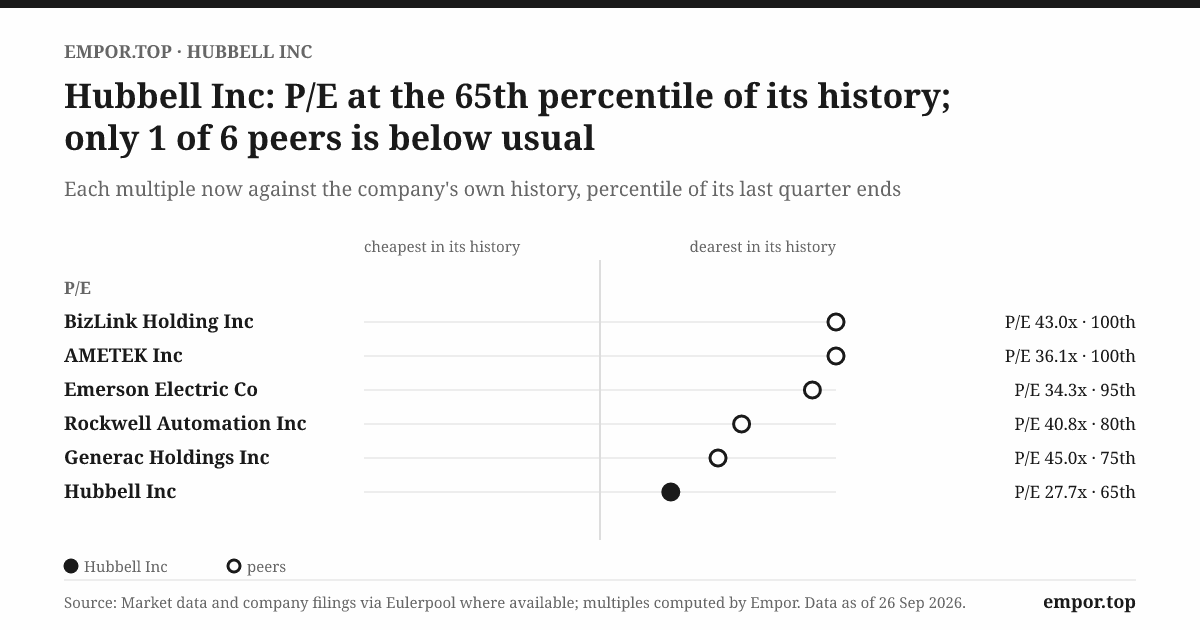
At roughly $466 per share, Hubbell trades at about 28 times 2025 GAAP earnings and about 23 times the midpoint of 2026 adjusted EPS guidance.456 Over the last decade the stock delivered a total return of about 425%, roughly 18% a year.6 The dividend yields about 1.2%, and the company has raised it for 18 consecutive years.6
This valuation prices in continued execution. It does not leave much room for a stumble in data center demand or an NSI integration problem, and it leaves little margin for a replay of the Aclara pattern.
That raises the central analytical question: how strong is the moat that is supposed to justify this premium?
X. The Moat, Tested: Porter's Five Forces and Seven Powers (30 min)
Imagine a procurement manager at a mid-sized electric cooperative in the Midwest. She has a storm-restoration budget, a list of approved vendors, a distributor she has worked with for fifteen years and a line crew that knows exactly how a Chance anchor or a Hubbell connector installs. A competitor offers a similar part at 8% less. What does she do?
In most cases, she sticks with what works. The saving on the part is trivial next to the cost of a crew, a truck and the risk of a failure during the next ice storm. But she also keeps a second approved vendor on the list, precisely so that the incumbent never gets too comfortable on price. That scene captures Hubbell's moat, and its limits, better than any framework.
Porter's Five Forces
Buyer power is moderate. Utilities and distributors are sophisticated, and the ten largest customers account for about 42% of sales, but no single buyer dominates, and components are a small share of project costs.9 Utilities' multi-vendor qualification practices cap how far Hubbell can push price.
Supplier power is moderate and rising. Copper, aluminum and steel are major inputs, and metals inflation forced two price increases in 2026.4 Hubbell has so far passed these costs through, but it is a price-taker on its raw materials.
Threat of new entrants is low for core hardware. New connector makers face years of utility qualification, testing and distributor relationships. Tellingly, the successful niche players, like DMC and NSI, did not become competitors to Hubbell; they became acquisitions. The threat is higher in grid software and metering, where the Aclara record suggests Hubbell's edge is weakest.
Threat of substitutes is low for physical components. Power still has to move through metal. But substitution happens within product categories, as DMC's swaged connectors replacing field welds shows. Hubbell benefited here by buying the substitute.
Rivalry is moderate. Eaton, ABB, Schneider, nVent and numerous private players compete in overlapping categories, but the market is fragmented enough that no one competes across Hubbell's full catalogue.
Hamilton Helmer's Seven Powers
Switching costs are Hubbell's most-cited power, and the evidence is real but partial. Specification and qualification create friction, and the 85–90% content breadth on transmission lines makes Hubbell a convenient one-stop supplier.11 But multi-sourcing is the norm, and management's own description of stable win rates suggests share is held, not locked.4 Verdict: intact but narrower than the "lock-in" framing implies.
Scale economies are real in manufacturing and distribution. Decades of acquisitions have given Hubbell purchasing leverage and a large, efficient footprint. But Eaton and Schneider enjoy similar or greater scale. This is a relative advantage against small players, not against large peers.
Counter-positioning, network economies and cornered resources are largely absent. Hubbell has no network effects, and its products are not protected by unique resources.
Brand functions as a proxy for reliability among lineworkers and electricians. Names like Chance, Burndy and Hubbell carry weight in the field. This supports pricing modestly, not dramatically.
Process power is emerging as a possible advantage. The Burndy automation cells that cut processing time "from days to minutes" on high-volume connector lines are an example of manufacturing know-how that could compound.10 It is early, and not yet clearly differentiated from peers doing similar work.
Myth Versus Reality
Myth: Hubbell has pricing power because it is essential. Reality: Hubbell has pricing pass-through, which is not the same. Its price increases in 2025 and 2026 have tracked metals inflation, and management has said it aims to keep price-cost-productivity "dollar-neutral or better," with margin dilution from the math.11 That is evidence of an ability to defend profit dollars, not to expand margins at will.
Myth: The 85% content share means utilities cannot switch. Reality: it means Hubbell can supply almost everything. Utilities still multi-source, and Hubbell says it will get its "fair share."11
Myth: Utility spending is a moat. Reality: rate-case-approved capital plans create multi-year visibility, reflected in the 1.2 times book-to-bill in Utility Solutions during the first half of 2026.4 That is a demand floor that benefits every qualified supplier, not a barrier that protects Hubbell specifically.
The overall conclusion is that Hubbell's moat is real, built on breadth, specification and field trust, but it is a moat of friction rather than a fortress. It protects profit dollars well; it does not guarantee share or margin in a downturn.
With the moat measured, the bear case can be stated plainly.
XI. Bear Case & Risk Radar (25 min)
Picture Hubbell's treasury team in late 2027. The deleveraging plan assumed robust free cash flow, steady data center orders and smooth NSI integration. Now suppose a hyperscaler or two trims its capital budget, distributors cut inventory the way they did in 2024, and utility rate cases slow as customers push back on electricity bills. The debt does not shrink on schedule. This is not a forecast. It is the scenario a skeptical investor has to price.
Leverage and Integration
Net debt at about 2.9 times EBITDA is well above the 1.3 times Hubbell carried at the end of 2025.410 The 24–30 month deleveraging plan depends on sustained free cash flow, at a time when capital spending is elevated and conversion is running around 90%.4 NSI is Hubbell's largest integration by far, and it is being run alongside an ongoing restructuring program in Electrical Solutions that cost about 60 basis points of segment margin in the second quarter.4 Integration risk is compounded, not isolated.
Rising Deal Multiples
The progression from about 12 times EBITDA for Systems Control, to about 14 times for DMC, to 15.5 times for NSI raises a fair question about whether Hubbell is buying at peak-cycle prices.11213 If growth normalizes, those assets will have been purchased for the cycle's best earnings. The Aclara precedent is instructive: a confident, thesis-driven deal at a full price that took most of a decade to settle into "modest growth."
Data Center Durability
The data center business is short-cycle in half its mix and highly concentrated in its end customers.11 Its growth rates, which went from mid-teens guidance to roughly 50% within five months, can reverse just as quickly.410 It is still a minority of revenue, but it is a majority of the excitement in the stock.
Tariff and Trade Volatility
The tariff framework changed repeatedly in 2026, from IEEPA to Section 232 to Section 301 revisions.411 Hubbell has managed it well so far, but each change can shift costs by tens of millions of dollars, and one-time refunds flatter 2026.
U.S. Concentration
About 93% of sales come from the United States.9 That simplifies currency and tariff exposure, but it means there is no geographic diversification if U.S. construction, utility financing or interest rates turn against the business.
The Optionality Discount
Finally, any new megatrend story, whether 765 kV transmission, further grid automation or data center content, should be underwritten at a lower conversion rate than management presents. That is not a judgment of bad faith; it is Hubbell's own historical base rate. The company's last major grid-technology thesis took years longer than planned and ended smaller than promised.
The Activist's Checklist
A skeptical long-short investor might press on four points. First, why was stock bought back near $500 in the first quarter just before borrowing $3 billion? Second, why does the long-term incentive plan reward sales growth and margins but not return on invested capital during an acquisition spree? Third, does Aclara still deserve a place in the portfolio, or would it be worth more to a metering specialist? Fourth, what is the plan if deleveraging slips? None of these is a crisis. All of them are fair questions for a company trading at a premium multiple.
Yet the bull case is not merely the inverse of these risks. It rests on some genuinely strong evidence.
XII. Bull Case & the Investment Thesis (25 min)
On the July 2026 call, Bakker announced that Hubbell's next investor day would be held on March 4, 2027, at the Utility Solutions training center in Centralia, Missouri, the historic home of the Chance business.4 The choice of venue is symbolic: the bull case is rooted not in a Silicon Valley narrative but in a small Missouri town where lineworkers learn to install anchors and insulators.
Multi-Year, Physics-Driven Demand
The strongest argument for Hubbell is that demand is driven by physical needs with long lead times. Load growth from data centers and electrification requires new generation, which requires new transmission, which requires new substations, which require new distribution. Aging infrastructure requires replacement regardless. Utilities are now booking orders into 2027, a sign that their planning horizons have lengthened.4 Unlike a consumer trend, the grid cannot be rebuilt in a single year even if everyone wants it to be.
Execution Evidence
In the first half of 2026, Hubbell delivered double-digit growth in sales, adjusted operating profit and adjusted EPS, raised guidance twice after its initial outlook, and managed price-cost through volatile tariffs and metals prices.3411 Utility Solutions' first-half book-to-bill of about 1.2 times gives visibility into the rest of the year.4 DMC and Systems Control are both described as capacity-constrained, meaning demand is not the limiting factor.11 Return on invested capital was 19% in 2025, and free cash flow margin was 15%.10
Balance Sheet Optionality
If deleveraging proceeds on schedule, Hubbell will have capacity for further consolidation in a still-fragmented supplier base by 2028. The pipeline, by management's account, includes both bolt-ons and larger deals.11 In a market where many strong niche component makers are owned by private equity, Hubbell has shown it can be the natural buyer.
Why the Bull Case Might Not Win
The bull case leans on two unresolved bets. The first is that data center and utility capital spending prove structural rather than a temporary spike. The second is that NSI performs more like DMC than like Aclara. Neither is settled. The balanced reading is that Hubbell is well positioned in real, long-duration markets, but that its valuation and balance sheet now assume those markets cooperate.
What, then, does this story teach?
XIII. Lessons & Takeaways (15 min)
Harvey Hubbell's plug never won because it was clever. It won because once an electrician trusted it, there was little reason to use anything else. That is still the heart of the business: being the standardized, reliable component in a system nobody wants to redesign.
Boring is durable, but not immune to price. The strongest parts of Hubbell are its least exciting: anchors, connectors, insulators and fittings bought again and again by specification. But boring businesses can still be overpaid for. The step from 12 times to 15.5 times EBITDA shows that Hubbell, like everyone else, is paying hot-market prices for grid-adjacent assets.
Acquisition theses can take a decade to be tested. Aclara was sold in 2017 as a growth engine and described in 2026 as a business management was "not super expecting great growth rates" from.11 The lesson is not that Hubbell makes bad deals; Systems Control and DMC look promising. It is that confident narratives deserve patient verification.
Divestiture is a management test too. Selling commercial lighting at 0.7 times sales was an unglamorous decision that improved the portfolio. It showed a willingness to exit, which is rarer than the willingness to buy.
The KPIs that matter. For investors following Hubbell from here, three measures will say most of what needs to be known:
-
Utility Solutions organic growth and book-to-bill. Sustained book-to-bill above 1.0 and high-single-digit organic growth would confirm that the transmission and substation cycle is still running. A drop below 1.0 would be the earliest warning of a slowdown.
-
Price-cost-productivity balance. Management's promise is to stay dollar-neutral or better through tariff and metals shocks. Slipping below neutral would reveal the limits of pricing power.
-
Net debt to EBITDA. Movement from about 2.9 times back toward roughly 2 times on the stated 24–30 month timeline is the clearest test of whether NSI was a disciplined bet or a peak-cycle stretch.
The grid is being rebuilt. Hubbell will supply a large share of the parts. The open question is whether the price it paid to widen that share will look shrewd or stretched once the boom ends.
References
-
Hubbell to Acquire NSI Industries — Hubbell Incorporated (Form 8-K, Exhibit 99.1), 2026-05-04 ↩↩↩↩↩↩↩↩
-
Hubbell to acquire NSI Industries from Sentinel for $3 billion — StreetInsider, 2026-05-04 ↩
-
Hubbell Reports Second Quarter 2026 Results — GlobeNewswire, 2026-07-28 ↩↩↩↩↩↩
-
Hubbell Incorporated (HUBB) Q2 2026 Earnings Call Transcript — Seeking Alpha, 2026-07-28 ↩↩↩↩↩↩↩↩↩↩↩↩↩↩↩↩↩↩↩↩↩↩↩↩↩↩↩↩↩↩↩↩↩↩↩↩↩↩↩↩↩↩↩
-
Hubbell Reports Fourth Quarter and Full Year 2025 Results — GlobeNewswire, 2026-02-03 ↩↩↩↩↩↩↩↩↩↩↩↩↩
-
This Overlooked Grid-Technology Stock Could Be Your Ticket to Millionaire Status — The Motley Fool, 2026-09-18 ↩↩↩↩
-
Hubbell Inc. — Company Profile, Information, Business Description, History — Reference for Business ↩↩↩↩↩↩↩↩↩↩↩↩
-
Hubbell (HUBB) Q4 2025 Earnings Call Transcript — The Motley Fool, 2026-02-03 ↩↩↩↩↩↩↩↩↩↩↩↩↩↩↩↩↩↩↩
-
Hubbell (HUBB) Q1 2026 Earnings Transcript — The Motley Fool, 2026-04-30 ↩↩↩↩↩↩↩↩↩↩↩↩↩↩↩↩↩↩↩↩↩↩↩↩↩↩↩↩↩↩↩↩↩
-
Hubbell to Acquire Systems Control — Hubbell Incorporated (Form 8-K, Exhibit 99.1), 2023-10-30 ↩↩↩↩
-
Hubbell to Acquire DMC Power — Hubbell Incorporated (Form 8-K, Exhibit 99.1), 2025-08-12 ↩↩↩
-
Eaton vs. Hubbell: Which Electrification Stock Has an Edge? — Zacks, 2026-08-21 ↩
-
HUBBELL INC — 2025 DEF 14A Proxy Statement — SEC, 2025 ↩↩↩↩↩↩↩
-
HUBBELL INC — Form 8-K, 2024 Annual Meeting voting results — SEC, 2024-05-07 ↩
-
HUBBELL INC — Form 8-K, 2025 Annual Meeting voting results — SEC, 2025-05-06 ↩↩
-
HUBBELL INC — Form 8-K, 2026 Annual Meeting voting results — SEC, 2026-05-05 ↩↩
 LinkedIn
 WhatsApp
 Reddit
 Hacker News
 Email
 Kindle
 RSS Feed
 Spotify
 Apple Podcasts
 Amazon Music
 Audible
 YouTube