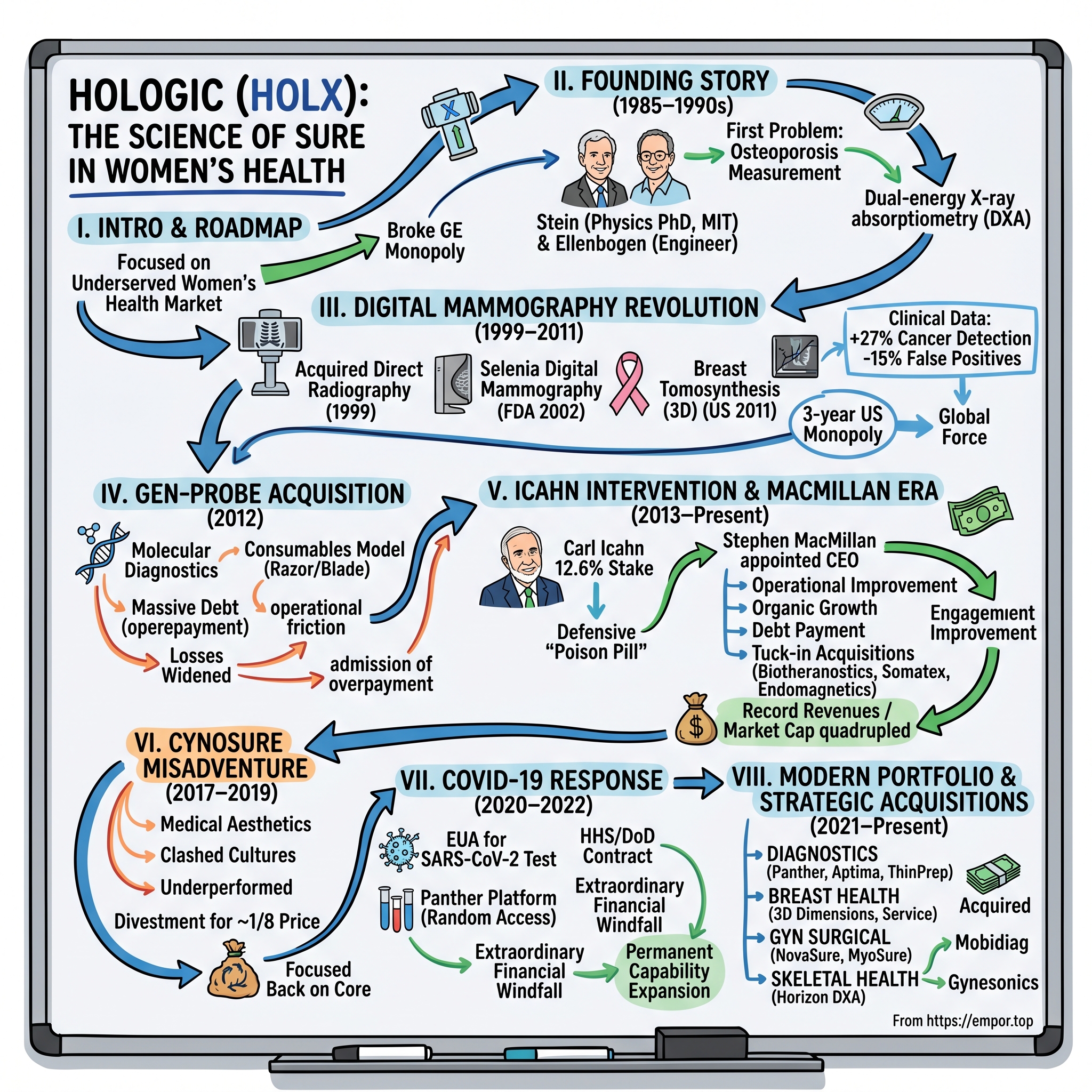
Hologic: The Science of Sure in Women's Health
I. Introduction & Episode Roadmap
On the morning of April 7, 2026, a ticker that had traded on Nasdaq for more than three decades went quiet. HOLX stopped trading. Stephen MacMillan, who had led the company for more than twelve years, retired as chairman, president, and chief executive. In his place stepped José "Joe" Almeida, an operating veteran of Baxter and Covidien, as chief executive of a company owned by funds managed by Blackstone and TPG, with minority stakes held by a subsidiary of the Abu Dhabi Investment Authority and an affiliate of GIC.12 Shareholders received $76 in cash per share plus a non-tradable contingent value right (CVR) worth up to another $3, payable only if Hologic's Breast Health business hits revenue targets in fiscal 2026 and fiscal 2027.1 The enterprise value of the deal reached up to $18.3 billion.3
That marked the end of Hologic's run as a public company. It was an ambiguous conclusion for a business that, at its best, looked like one of the steadiest compounders in medical technology, and at its worst, resembled a case study in undisciplined acquisition strategy. Both descriptions fit. That tension is the core of the story.
Hologic began in 1985 as a two-founder X-ray physics venture measuring bone density. By fiscal 2025, its final full year as a public company, it generated $4.1 billion in revenue across three main franchises: diagnostics ($1.72 billion), breast health ($1.51 billion), and gynecological surgery ($636 million), with a small skeletal health business trailing behind.4 It converted that revenue into more than $1 billion of operating cash flow that year and closed it with net leverage of just 0.4 times.4
The Central Paradox
Hologic is not the product of a single breakthrough invention. It is an operating chassis assembled through acquisitions—some visionary, others financially damaging. The company paid roughly $6.2 billion for Cytyc in 2007, then wrote down $2.34 billion of goodwill eighteen months later. It paid $3.8 billion in cash for Gen-Probe in 2012, only to take a $1.1 billion goodwill impairment on molecular diagnostics the following year. In 2017, it acquired an aesthetics business named Cynosure, divesting it just two and a half years later at a steep loss.
Yet those transactions also delivered the core franchises that defined Hologic's earning power. Gen-Probe brought the Panther, a fully automated molecular testing system that established a high-margin razor-and-blade model. Meanwhile, building on detector technology acquired in 1999, Hologic's internal engineering team developed the Selenia Dimensions 3D mammography system, securing the first commercial clearance for breast tomosynthesis in the United States. The paradox is that Hologic's most criticized capital-allocation decisions and its most durable competitive moats often involved the very same assets, separated only by time.
Then came the COVID-19 pandemic, which transformed the Panther into a critical public-testing asset, flooded the balance sheet with cash, and roughly doubled the installed base of instruments. The decisive question for the post-pandemic period was whether that windfall had permanently elevated Hologic's baseline earnings power or merely flattered it temporarily. Public markets never reached a confident consensus. The stock drifted, private equity stepped in, and the board accepted a buyout.
The Roadmap
The story unfolds in five acts. Act I covers the hardware foundations from 1985 to 2006: bone densitometry, the acquisition of Direct Radiography Corp., and the commercial battle against General Electric in digital mammography. Act II, from 2007 to 2013, examines the dealmaking crucible: the Cytyc merger, the launch of 3D tomosynthesis, and the leveraged Gen-Probe acquisition. Act III, from 2013 to 2019, details Carl Icahn's intervention, the operational turnaround under Steve MacMillan, and the Cynosure misstep. Act IV covers the COVID-19 testing windfall and the subsequent tuck-in acquisition strategy. Act V evaluates the business model through the strategic frameworks of Porter and Helmer, audits management's historical claims against disclosed performance, and frames the bull-and-bear debate.
Analyzing Hologic today remains highly practical, even with its equity delisted. CVR holders continue to track breast health revenue targets. Lenders and credit investors carry exposure to a newly leveraged medtech buyout. Competitors holding shares in GE HealthCare, Siemens Healthineers, Roche, Abbott, or Becton Dickinson face Hologic in hospital procurement every day. Moreover, private equity sponsors eventually seek liquidity, often through a public re-listing. When Hologic returns to public scrutiny, investors will require a clear framework to evaluate it—a framework that begins in a small physics lab in Massachusetts.
 Subscribe on LinkedIn
II. Origins & The Bone Density Foundation (1985–1998)
In October 1985, two entrepreneurs who had already built and sold one medical technology venture decided to launch another. S. David Ellenbogen and Jay A. Stein had founded Diagnostic Technology, Inc. in 1981 to develop an X-ray system for digital angiography. They sold the business in 1982 to Advanced Technology Laboratories, a subsidiary of Squibb, and spent the following three years running ATL's digital angiography group, with Ellenbogen serving as manager and Stein as technical director.5 In October 1985, they departed to establish Hologic.5
The partnership divided along classic lines. Ellenbogen was the commercial operator, serving as president from the company's founding until 1994, when he became chairman and chief executive.5 Stein, an MIT-trained physicist who eventually held fifteen patents on X-ray technology, served as the technical conscience of the company for decades.5 That division created an engineering-first culture that persisted for years—a distinct advantage when marketing systems on image quality, but an operational liability when the company later struggled to integrate sprawling corporate acquisitions.
The Problem They Chose
Their initial target was osteoporosis. For millions of post-menopausal women, bone loss progressed silently until a hip or vertebra fractured, and the available diagnostic tools were crude. The founders recognized that dual-energy X-ray absorptiometry, or DXA, could quantify bone mineral density with high precision at a low radiation dose. The core physics were straightforward: bone and soft tissue attenuate X-rays differently across energy spectra. By passing two beams at distinct energies through the patient and measuring the differential transmission, software could subtract soft tissue from the image and calculate how much mineral remained in the bone.
Hologic introduced the first commercial DXA system in 1987. By 1999, the company had sold more than 7,500 units and reported that more leading medical schools, universities, and osteoporosis opinion leaders used its densitometers than those of any competitor.6 That academic footprint proved decisive. As the clinical definition of osteoporosis coalesced around DXA-based bone density scores, the manufacturer whose systems generated the reference data enjoyed an institutional credibility advantage. This formed Hologic's original commercial playbook: win over key clinical opinion leaders, and the diagnostic standard of care will follow your hardware.
The Public Company and Its First Ceiling
Hologic reincorporated in Delaware in March 1990 as it grew into a public company, listing on Nasdaq under the symbol HOLX.67 The underlying business model was straightforward: sell capital equipment at healthy gross margins to hospitals and clinics, then collect recurring service revenue over the operating life of each machine.
The structural limits of that model materialized quickly. Capital equipment markets inevitably saturate. Once target radiology suites and rheumatology practices owned a densitometer, sales relied primarily on replacement cycles and price competition with rivals such as Lunar and Norland.6 In fiscal 1999, Hologic's revenue fell 27%, dropping from $115.6 million to $84.1 million.6 A business built around a single clinical niche had reached that niche's commercial ceiling.
That slowdown established an enduring strategic lesson. Bone densitometry remains part of Hologic today, now reported within Skeletal Health, but it generated only about $70 million of fiscal 2025 revenue—less than 2% of the corporate total—with part of that year's growth reflecting a recovery from earlier supply constraints.48 The fiscal 2025 Form 10-K disclosed that Hologic was discontinuing sales of its Fluoroscan Insight FD mini C-arm systems in fiscal 2026.9 While the founding business remains cash-generative, it no longer drives the core investment thesis. Its lasting value lay elsewhere: establishing deep institutional competence in low-dose X-ray physics and detector design, along with a disciplined habit of selling to physicians on the strength of clinical evidence.
By the late 1990s, the founders faced a strategic crossroads. They could continue defending a mature, saturated niche, or they could redirect their X-ray expertise toward a much larger screening market: breast health.
III. The Digital Mammography Breakthrough & Breaking the GE Monopoly (1999–2006)
On January 30, 2000, the FDA approved General Electric's Senographe 2000D, the first full-field digital mammography system to reach the U.S. market.10 GE had spent 13 years and more than $100 million developing the platform.10 For Hologic, which had just watched its revenue drop by more than a quarter, it appeared the race to digitize the most critical cancer-screening examination in women's health was already over.
Hologic had quietly placed a different bet seven months earlier.
The Detector Bet
On June 3, 1999, Hologic acquired Direct Radiography Corp. for about $20 million in cash plus roughly 1.9 million shares of stock.6 The prize was a flat-panel detector coated in amorphous selenium—a technical distinction that sounded arcane, but went straight to the core of clinical image quality.
GE's detector relied on amorphous silicon.10 In that indirect-conversion architecture, incoming X-rays first strike a scintillator that converts them into flashes of visible light, which photodiodes then translate into an electrical signal. Because light scatters as it travels, that intermediate conversion step introduces optical blur. Hologic's selenium detector bypassed the optical stage entirely: X-ray photons were converted directly into electrical charge.611 The difference was analogous to photographing an original document directly versus photographing a photocopy of it. In screening mammography, where radiologists search for microcalcifications smaller than a grain of sand, that structural sharpness offered a distinct clinical advantage.
Owning a detector, however, was not the same as operating a full mammography business. In September 2000, Hologic completed the $55 million purchase of the U.S. assets of Trex Medical, acquiring the Lorad mammography line.12 Lorad provided Hologic with an established installed base of analog systems, a dedicated manufacturing footprint, and long-standing relationships with breast imaging centers. Management outlined a two-step regulatory approach: seek initial FDA approval using Trex's older CCD-based digital technology, then transition as rapidly as possible to selenium detectors through a regulatory supplement.12 It was a pragmatic commercial bridge—reaching the market with an existing system while preparing the proprietary upgrade.
Selenia and the Reversal
In October 2002, Hologic received FDA approval to market the Lorad Selenia full-field digital mammography system, built around its DirectRay amorphous selenium detector.11 The commercial pitch targeted breast radiologists directly, promising sharper diagnostic detail and more confident reads. Emphasizing image resolution over price concessions aligned naturally with Hologic's engineering roots.
The market responded quickly. In fiscal 2005, Hologic shipped more than 900 mammography systems—including 239 high-margin digital units—expanding its footprint to a global installed base of more than 13,000 systems, while total company revenue reached approximately $288 million.11 In six years, annual revenue had more than tripled from its 1999 trough. Perhaps most telling, Siemens had adopted Hologic's DirectRay detectors for its own digital mammography systems.11 When a diversified global conglomerate sources its core imaging component from a specialized competitor, it offers clear validation of underlying technical leadership.
A balanced assessment requires nuance. GE was never dislodged from its broader clinical stronghold, and Hologic's fiscal 2005 Form 10-K listed GE, Siemens, Philips, Fuji, and Kodak as active competitors.11 Hologic's early lead stemmed from focused execution and detector physics rather than an insurmountable structural moat. Hardware advantages in medical imaging inevitably face catch-up from well-capitalized peers. Instead, the enduring value of the Selenia rollout lay in hospital inertia: once a facility installed a Hologic gantry, trained its technologists on the proprietary console, and signed an annual service contract, Hologic entered the next replacement cycle as the entrenched incumbent.
That same 2005 Form 10-K noted an ongoing collaborative research program with Massachusetts General Hospital to evaluate prototypes of an advanced three-dimensional imaging technique known as breast tomosynthesis.11 That exploratory program would eventually mature into the franchise's definitive clinical breakthrough. Yet commercializing 3D imaging on a global scale and absorbing the clinical trial costs required far greater financial scale—a platform management decided to build in a single, transformative transaction.
IV. The Cytyc Megadeal & The 3D Tomosynthesis Revolution (2007–2011)
On October 22, 2007, Hologic closed its merger with Cytyc Corporation.7 Under the terms of the transaction, each Cytyc share converted into 0.52 Hologic shares plus $16.50 in cash—requiring the issuance of roughly 65.8 million new shares and $2.1 billion in cash, for an aggregate valuation of approximately $6.2 billion.7 Hologic continued to trade on Nasdaq under HOLX, and Cytyc became a wholly owned subsidiary.7
Jack Cumming, who had served as Hologic's chief executive since 2001, remained at the helm of the combined entity.13 The timing of the transaction quickly became its defining vulnerability.
What Cytyc Brought
Cytyc brought two core commercial franchises, each operating on a recurring-revenue model unfamiliar to Hologic's legacy hardware business. The first was the ThinPrep Pap test. Rather than smearing cervical cells directly across a glass slide, clinicians rinsed the sampling device into a vial of preservative liquid, enabling laboratories to prepare a uniform, thin layer of cells. By dramatically reducing obscured or unreadable slides, ThinPrep gave pathologists a clearer diagnostic view and established itself as the standard liquid-based cytology method in U.S. cervical cancer screening.9 The second was NovaSure, a device that delivers radiofrequency energy to ablate the uterine lining in patients suffering from heavy menstrual bleeding—a minimally invasive procedure typically performed in an outpatient setting, avoiding the risks and costs of a hysterectomy.9
The commercial logic of the combination was persuasive. Hologic had historically functioned as a capital equipment manufacturer reliant on lumpy hospital radiology budgets. Cytyc sold high-margin consumables and single-use disposables to diagnostic laboratories and gynecologists, collecting recurring revenue with every test and procedure performed. The merger effectively built out Hologic's modern women's health platform across three complementary clinical touchpoints: breast imaging, cervical screening, and gynecological surgery.
The Bill Arrives
To fund the cash component of the purchase price, Hologic levered its balance sheet just as the global financial crisis took hold. Hospital capital budgets froze, credit contracted, and equity valuations plunged. By December 27, 2008, Hologic's market capitalization had fallen significantly below the carrying value of its net assets—a clear accounting trigger requiring a formal goodwill impairment test.14 In the fiscal quarter ended March 28, 2009, the company recorded a goodwill impairment charge of $2.34 billion.14 The allocation of the write-down highlighted where expectations had unraveled fastest: roughly $1.17 billion was charged to GYN Surgical, $908 million to Diagnostics, and $266 million to Breast Health.14
An accounting write-down of goodwill consumes no cash, but it represents a formal post-hoc admission that the acquiring company overpaid relative to revised cash-flow expectations. Within eighteen months of closing, Hologic had erased more than a third of the transaction's value from its books. Cytyc's operating franchises remained commercially viable and durable, but acquiring them with elevated leverage at the top of an economic cycle severely damaged the balance sheet—an acquisition pattern that would repeat.
Seeing Through Tissue
While corporate finance absorbed the accounting shock of the write-down, Hologic's R&D organization concentrated on breast tomosynthesis. A standard screening mammogram compresses three-dimensional breast tissue into a single two-dimensional projection. In dense breast tissue, overlapping structures can obscure a hidden malignancy or falsely mimic one. Tomosynthesis resolves that limitation by sweeping an X-ray tube in an arc across the breast, capturing multiple low-dose exposures from different angles, and computationally reconstructing them into thin cross-sectional slices. The diagnostic difference is comparable to turning the individual pages of a book rather than holding the entire volume up to a light and attempting to read every page simultaneously.
On February 10, 2011, the FDA approved Hologic's Selenia Dimensions system as the first X-ray mammography device to offer 3D tomosynthesis imaging for breast cancer screening and diagnosis.15[^16] In pivotal clinical trials submitted for regulatory clearance, radiologists reviewing combined 2D and 3D images improved their diagnostic accuracy—distinguishing cancer from non-cancer—by 7% compared to 2D mammography alone.15 That clinical gain involved an engineering trade-off: the combined protocol roughly doubled the patient's radiation exposure compared to a conventional 2D exam.15 Rob Cascella, then Hologic's chief executive, called it a "ground-breaking, superior imaging technology."15
The Monopoly Window and What It Bought
That regulatory clearance gave Hologic an exclusive commercial window in the United States that lasted more than three years. GE Healthcare did not secure FDA approval for its competing SenoClaire tomosynthesis platform until September 3, 2014, becoming only the second manufacturer with an approved system.16 GE's marketing strategy targeted Hologic's initial technical compromise directly, highlighting that its own imaging approach did not increase radiation dose over a standard 2D mammogram.16
The strategic significance of Hologic's three-and-a-half-year regulatory head start lay in the operational moat it allowed the company to establish. Hologic used its exclusivity to place gantries across hospital radiology suites, train clinicians, and build an extensive library of peer-reviewed clinical evidence. By fiscal 2021, Hologic reported an installed base of nearly 8,700 Genius 3D mammography systems across the United States.17 In medical imaging, a dominant installed base anchors recurring service revenue, creates deep user familiarity with proprietary software, and positions the manufacturer as the default choice in future replacement cycles. The first-mover advantage was not an unbreakable barrier, but Hologic effectively converted an early regulatory lead into entrenched institutional incumbency.
With its tomosynthesis platform commercialized, management turned to the remaining gaps in its diagnostic portfolio. While Cytyc had delivered market leadership in liquid-based cytology, the diagnostic landscape was migrating from cellular microscopy toward automated molecular testing. Hologic decided to purchase that next generation of technology—once again turning to substantial debt financing.
V. The Gen-Probe Leveraged Gamble & The Debt Trap (2012–2013)
On August 1, 2012, Hologic completed its acquisition of San Diego-based Gen-Probe for $82.75 per share in cash, a transaction carrying an enterprise value of approximately $3.7 billion.18 Unlike the Cytyc transaction, which was funded partly with equity, Gen-Probe was an all-cash purchase financed almost entirely through debt. The borrowing package included $2.8 billion in senior secured credit facilities and $1.0 billion in senior notes.19
What Hologic Actually Bought
Gen-Probe specialized in molecular diagnostics. Its core chemistry, transcription-mediated amplification (TMA), provided a method for replicating pathogen genetic material until it reached detectable levels—functioning much like a photocopier targeting a single target sentence across an entire library. Gen-Probe's Aptima assays used TMA to detect sexually transmitted infections, primarily chlamydia and gonorrhea, from a single patient sample.
The operational centerpiece was the Panther instrument. Many molecular analyzers of that era operated in batches: laboratory staff loaded a rack of samples, waited for the test cycle to finish, and unloaded results before starting again. Panther introduced a continuous "sample in, result out" architecture. Technicians could load patient samples continuously while the system handled extraction, amplification, and detection automatically. For mid-sized hospital and reference laboratories managing staffing constraints, that automated throughput was the primary commercial appeal.
The financial engine followed a classic razor-and-blade model. Hologic placed Panther instruments—either through direct capital sales or by embedding equipment costs into multi-year reagent agreements—and then collected high-margin revenue on every assay cartridge consumed over the life of the machine. Over time, laboratory switching costs compounded: the analyzer was integrated into hospital information systems, technologists were trained on its protocols, and clinical validation paperwork had to be completed for each assay. This dynamic is examined in depth in Section IX.
When the Wheels Came Off
While the strategic rationale was coherent, the balance sheet was ill-equipped to absorb any operational friction. By the end of fiscal 2012, long-term debt approached $5 billion, and it remained at $4.24 billion twelve months later.20 That leverage eliminated any buffer for execution errors, and fiscal 2013 brought several.
For the full year, Hologic reported a net loss of $1.17 billion, or $4.36 per share, on revenue of approximately $2.49 billion.20 The loss was driven by a $1.1 billion non-cash goodwill impairment recorded in the Diagnostics segment during the fourth quarter. The company attributed the charge to "a full re-evaluation of the Company's existing product development efforts and cost structure, as well as a change in revenue forecasts."20 In practical terms, molecular assay volumes were not expanding fast enough to validate the aggressive growth assumptions baked into the purchase price.
It was Hologic's second ten-figure write-down in five years. Executive leadership shifted in response. Jack Cumming, who had stepped down as chief executive in 2009, returned to lead the company in July 2013 following Rob Cascella's departure.13 His outlook alongside the fiscal 2013 results remained cautious, framing fiscal 2014 as "a transitional year."20
The Investor's Reading
Comparing the Cytyc and Gen-Probe impairments reveals a consistent pattern. In both instances, Hologic acquired commercially durable assets with established clinical moats at premium valuations, financed the transactions with heavy debt, and subsequently discovered that initial growth forecasts were too optimistic. The underlying products were technically sound, but capital allocation was undisciplined.
That distinction is essential to understanding the Panther's eventual commercial success. Gen-Probe did not validate its purchase price because the original deal model succeeded. Rather, it became a cornerstone asset years later, after new leadership overhauled operations and an unprecedented pandemic made the Panther an indispensable piece of public-testing infrastructure. The long-term cash generation was real, but it was not delivered by the original transaction underwriting.
By late 2013, Hologic paired market-leading clinical platforms with a heavily leveraged balance sheet, interim leadership, and a depressed share price. That combination created classic conditions for an activist investor to step in.
VI. Carl Icahn's Raid & The Steve MacMillan Playbook (2013–2016)
In November 2013, a Schedule 13D filing landed at the Securities and Exchange Commission. Carl Icahn and his affiliates disclosed a 12.63% stake in Hologic.21 At the time, Icahn was among the most formidable activist investors on Wall Street, and Hologic matched his target profile: high-margin clinical franchises paired with depressed equity returns, operating under a board that had overseen two ten-figure write-downs in five years.
The confrontation resolved quickly. On December 9, 2013, Hologic announced a settlement. Two Icahn Capital managing directors, Jonathan Christodoro and Samuel Merksamer, joined an expanded eleven-member board. Icahn, controlling roughly 12.5% of the shares, agreed to vote in favor of the company's director slate at the 2014 annual meeting.13 That same day, Hologic named Stephen P. MacMillan president and chief executive, replacing Cumming.1322
The Operator
MacMillan arrived at Hologic from Stryker, where he had served as chief executive.22 Stryker operated under a decentralized, sales-driven culture where divisional leaders held strict accountability for their own results. MacMillan's industry reputation was that of an operating disciplinarian rather than a financial dealmaker—a commercial leader who argued that superior clinical technology falters when sales organizations lose focus, overhead expands unchecked, and no single executive owns the profit-and-loss statement.
His diagnosis of Hologic reflected that operating philosophy. The underlying technology was not at fault. Selenia Dimensions remained the only 3D mammography system approved in the United States, Panther provided best-in-class molecular automation, and ThinPrep and NovaSure maintained commanding market positions. The breakdown was organizational: disparate corporate cultures had never been properly integrated, and commercial execution had drifted.
The Playbook
The operational turnaround centered on four core initiatives.
First, organizational accountability. MacMillan restructured Hologic into distinct business units—Breast Health, Diagnostics, GYN Surgical, and Skeletal Health—each led by executives held directly responsible for their division's revenue and operating margins. In a company pieced together through three major corporate acquisitions, establishing clear P&L ownership marked a decisive cultural shift.
Second, balance-sheet repair. Transformative M&A was halted, and free cash flow was redirected toward debt reduction. Even before MacMillan took over, Hologic had directed $300 million toward voluntary debt prepayments in fiscal 2013.20 Under MacMillan, balance-sheet deleveraging shifted from an ad hoc measure to formal corporate policy. That discipline inevitably limited capital flexibility and slowed external growth during the recovery years, but it steadily rebuilt financial resilience.
Third, clinical evidence as a commercial engine. In June 2014, the Journal of the American Medical Association published a landmark study led by Dr. Sarah Friedewald evaluating 454,850 screening examinations across 13 U.S. clinical sites. The data demonstrated that adding tomosynthesis to conventional digital mammography increased invasive cancer detection by 41% while reducing patient recall rates for additional imaging by 15%, dropping from 107 to 91 per 1,000 screens.23 That publication provided radiologists, hospital procurement committees, and commercial payers with the peer-reviewed evidence required to justify investing in 3D systems and securing dedicated reimbursement codes. Critically, the study appeared just months before GE's competing system won approval.16 By the time GE entered the market, Hologic's clinical dossier was already the benchmark competitors had to answer.
Fourth, instrument placements over upfront margins. In molecular diagnostics, Hologic shifted emphasis from selling Panther hardware at an immediate margin to accelerating instrument placements in laboratories, locking in high-margin consumable and reagent revenue over multi-year cycles. While the full economics of this razor-and-blade model are analyzed in Section IX, the strategic significance was timing: this aggressive placement strategy was fully operational years before the COVID-19 pandemic arrived. When public health emergencies hit, Hologic's automated testing chassis was already deeply entrenched across clinical laboratories.
The Activist Exit
On March 3, 2016, Christodoro and Merksamer stepped down from the board. Icahn had recently divested nearly 3 million shares at prices between $34 and $35—a gain of more than 60% relative to his average entry price of around $21—lowering his stake to approximately 9%.24 The stock had climbed roughly 56% since his initial disclosure in November 2013.24 Icahn posted that "Hologic is the quintessential example of activism at its best," while MacMillan quipped that "Carl Icahn is going home happy, which is every CEO's dream."24
Popular accounts often exaggerate the episode, claiming Icahn tripled his investment. The filings demonstrate a more measured outcome: a gain exceeding 60% on a substantial equity position over roughly two and a half years. While not an outsized activist windfall, the campaign functioned as intended. Activist pressure prompted the board to replace an exhausted leadership regime with an operator who stabilized the core businesses, trimmed debt, and revitalized commercial execution.
The ultimate test for any turnaround executive, however, arrives once the balance sheet is repaired and growth expectations resurface. MacMillan faced that challenge less than a year after Icahn left the board.
VII. The Cynosure Misadventure: Anatomy of a $1.4B Capital Destruction (2017–2019)
On February 14, 2017, less than a year after Carl Icahn's representatives departed the board, Hologic announced an agreement to acquire Cynosure for $66 per share in cash, representing an enterprise value of about $1.44 billion.25 Because Cynosure held cash on its balance sheet, the total equity purchase price reached roughly $1.65 billion. Cynosure manufactured and marketed energy-based and laser systems for aesthetic procedures: SculpSure for non-invasive fat reduction, PicoSure lasers for tattoo removal and skin revitalization, and the MonaLisa Touch for vaginal health.25
The Thesis
Management's investor presentation framed the transaction around market expansion. Medical aesthetics represented a $2 billion-plus market projected to expand at double-digit annual rates, with non-invasive body contouring serving as the fastest-growing niche. Between 2013 and 2016, Cynosure had expanded revenue at a 24% compound annual rate, generating $434 million.25 The acquisition presentation asserted that the portfolio "complements Hologic's strong position in the OB/GYN and women's health channels."25
On paper, the strategic logic appeared straightforward: the same female patient demographic, adjacent physician specialties, out-of-pocket cash-pay procedures unencumbered by insurance reimbursement negotiations, and an operating team that had just demonstrated its ability to revitalize commercial execution.
What Went Wrong
Almost every structural advantage underpinning Hologic's core franchises was absent in medical aesthetics.
Hologic's legacy businesses sold capital equipment and consumables to hospital laboratories, radiology suites, and OB/GYN practices. Those institutional customers operated through lengthy procurement cycles, demanded rigorous peer-reviewed clinical validation, and rarely displaced established workflows once a platform was installed. By contrast, aesthetics buyers—primarily dermatologists, plastic surgeons, and medical spas—operated more like small retail proprietors making discretionary capital investments. They purchased consumable treatment packs only as long as paying patients walked through the door. Consumer demand was closely tied to discretionary spending and aesthetic trends rather than diagnostic medical necessity. Customer loyalty was thin, competitive barriers were low, and rival devices could capture market attention within a season or two. In body contouring, Allergan's cryolipolysis-based CoolSculpting was already an entrenched incumbent.
Hologic's core commercial strengths—peer-reviewed clinical dossiers, installed-base service contracts, and deep hospital relationships—failed to translate. In financial terms, there were no switching costs to protect pricing and no mission-critical diagnostic workflows to defend.
The Exit
On November 20, 2019, Hologic announced an agreement to sell Cynosure to an affiliate of private equity firm Clayton, Dubilier & Rice for $205 million in cash, with expected net proceeds of about $138 million after closing adjustments.26 The company projected an additional non-cash impairment charge of $155 million to $185 million in the fourth quarter of fiscal 2019 as part of the exit.26 About 825 employees transferred with the business.26
MacMillan delivered an unusually candid assessment. "Since we acquired Cynosure in 2017, it has significantly underperformed our expectations," he acknowledged, explaining that divesting the asset would allow Hologic to "focus on what we do best — helping women and their families live healthier lives through early detection of disease."26 He then outlined a revised capital-allocation guideline: "Our business development strategy remains focused on the smaller, tuck-in deals that have been performing well for us and strengthening our core franchises."26
Myth vs. Reality: Did Hologic Learn Its Lesson?
The prevailing corporate narrative suggests that MacMillan recognized the error early, sold the asset quickly, and formally prohibited non-core acquisitions. Disclosed records support the first two observations: executive commentary was forthright, and the divestiture closed within roughly two and a half years. Public disclosures reveal no formal board policy banning acquisitions outside women's health; the documented commitment was simply a stated preference for smaller tuck-in deals in core franchises.
The more significant strategic takeaway is that the Cynosure misstep occurred under the very chief executive credited with turning the company around. The acquisition was announced barely three years after Icahn's intervention forced operational discipline, and less than twelve months after activist directors stepped down. That timeline suggests capital discipline was sharpest when external oversight was most intense. The broader lesson for evaluating management is not that an executive who makes a flawed deal cannot execute sound ones; rather, it highlights how readily management teams drift into unfamiliar commercial adjacencies when balance sheets recover and organic growth rates moderate.
The realized capital destruction was severe. Hologic committed roughly $1.65 billion in equity and recovered only about $138 million in net cash proceeds at exit, before accounting for cumulative operating losses and diverted management distraction.2526 Across Cytyc, Gen-Probe, and Cynosure, write-downs and capital losses from the company's three largest acquisitions totaled well above $4 billion. That track record of capital misallocation formed critical context for what lay ahead: within months of closing the Cynosure sale, an unexpected global crisis was about to flood Hologic's balance sheet with more cash than the company had ever seen.
VIII. The COVID-19 Windfall & The Panther Installed Base Coup (2020–2022)
In early 2020, as the pandemic spread through the United States, hospitals canceled elective surgeries, screening centers turned away women due for annual mammograms, and gynecologists postponed outpatient procedures. Two of Hologic's core franchises, Breast Health and GYN Surgical, saw their commercial demand evaporate almost overnight.
The third franchise, however, was about to emerge as one of the country's critical testing platforms.
The Pivot
Hologic's diagnostics team, built largely from the Gen-Probe acquisition in San Diego, quickly developed two SARS-CoV-2 molecular assays: one on the Panther Fusion module and another utilizing Aptima TMA chemistry on the core Panther instrument.17 The primary operational bottleneck during the early pandemic was not molecular chemistry, but industrial manufacturing scale. While competing platforms frequently relied on specialized, individually packaged cartridges that faced severe supply-chain shortages, Hologic's high-throughput architecture and bulk reagent production enabled it to deliver testing volume at a scale few competitors could match.
The federal government moved quickly to secure that testing pipeline. In November 2020, the Department of Defense, working in coordination with the Department of Health and Human Services, awarded Hologic a $119 million contract to expand domestic production capacity for COVID-19 tests.27
The Numbers
The resulting financial surge was unprecedented in Hologic's history. COVID-19 assay revenue reached $929 million in fiscal 2020 and climbed to $2.16 billion in fiscal 2021.28 Total revenue in fiscal 2021 expanded to $5.63 billion, up from $3.78 billion the previous year, generating more than $2.3 billion in operating cash flow.28 Over the course of fiscal 2021 alone, Hologic delivered approximately 92 million SARS-CoV-2 tests to customers worldwide.17 Even as emergency testing began to normalize in fiscal 2022, COVID assay sales contributed $1.43 billion, alongside $211 million in related revenue, lifting total revenue to $4.86 billion and operating cash flow to $2.13 billion.29
The strategic takeaway was the sheer scale of the balance-sheet transformation. A business that had spent the preceding decade methodically paying down debt accumulated several billion dollars of surplus cash within roughly three years, propelled by a diagnostic product line that had not existed before 2020.
The Installed Base Coup
The more durable commercial impact occurred in instrument placements. Clinical laboratories racing to process surge volumes required Panther systems, and Hologic deployed them aggressively across the healthcare system. The company's installed base expanded from just over 1,700 Panthers at the close of fiscal 2019 to nearly 2,900 by the end of fiscal 2021—an increase of roughly two-thirds in two years, with approximately 650 units placed in fiscal 2021 alone.17 Management outlined the underlying commercial strategy directly in its 2022 proxy statement: newly placed instruments could subsequently be transitioned to run Hologic's broader diagnostic menu.17
Section IX examines the structural switching costs governing this razor-and-blade model. Within the arc of the pandemic windfall, the critical reality was that emergency public-health demand effectively financed the placement of more than a thousand new instrument consoles across hospital and reference laboratories, including accounts that had never previously operated Hologic hardware. The defining question for the post-pandemic era was how many of those newly placed razors would continue buying high-margin diagnostic blades once COVID testing subsided.
What the Company Did With the Money
Management deployed this influx of operating cash across three main channels.
First, share repurchases. Hologic spent $410 million on buybacks in fiscal 2021, $542 million in fiscal 2022, and $475 million in fiscal 2023, followed by an additional $500 million accelerated repurchase program.282930 In fiscal 2025, the company allocated another $753 million to share repurchases.4
Second, balance-sheet deleveraging. At the end of fiscal 2021, principal debt stood at $3.05 billion, bringing net leverage down to 0.6 times.28 By the close of fiscal 2025, Hologic held about $2.2 billion of cash and short-term investments against $2.5 billion of debt, reducing net leverage to 0.4 times.4
Third, a programmatic series of tuck-in acquisitions. The company acquired Biotheranostics for $230 million, adding the Breast Cancer Index test for predicting late recurrence,31 and Mobidiag for $795 million, acquiring the Novodiag multiplex PCR platform for near-patient testing.32 Smaller transactions followed, including Diagenode, SOMATEX breast markers, and Bolder Surgical.17
Myth vs. Reality: Were the Tuck-Ins Disciplined?
The prevailing post-Cynosure narrative credited management with disciplined capital allocation: abandoning transformative megadeals in favor of focused, low-risk tuck-ins within core franchises. The size discipline was genuine. None of the pandemic-era transactions approached the financial scale of Cytyc, Gen-Probe, or Cynosure. However, the subsequent operating record demonstrated that smaller transactions can still dilute capital.
In fiscal 2023, Hologic recorded $224 million of intangible asset and equipment impairments, primarily related to Mobidiag and ultrasound imaging assets.30 In fiscal 2025, the company recognized another $226 million of intangible impairments, primarily affecting Acessa, Bolder Surgical, Mobidiag, and Diagenode.4 Mobidiag, the largest of the pandemic-era tuck-ins, was written down in two separate fiscal years. Acessa, an earlier laparoscopic fibroid ablation acquisition, suffered impairments as well, as did Bolder Surgical.
The tuck-in framework successfully capped the financial downside of individual underwriting errors—a meaningful operational improvement over the ten-figure write-downs of the Cytyc and Gen-Probe eras—but it did not eliminate capital misallocation. A realistic characterization is "smaller bets with mixed execution" rather than flawless portfolio expansion. Measured against Hologic's multi-billion-dollar pandemic cash flow, the write-downs were manageable. Measured against the purchase prices paid for the target assets themselves, the impairments were significant.
As emergency testing revenues faded, investor focus shifted to the structural earning power of the underlying business. That durability rested on the competitive moats protecting Hologic's three core franchises.
IX. Segment Economics & Current Portfolio Deep Dive
Across clinical settings, Hologic's commercial presence takes three distinct forms: a refrigerator-sized Panther analyzer running continuous automated testing in a hospital laboratory, a 3D tomosynthesis gantry acquiring cross-sectional scans in a breast imaging suite, and a MyoSure device resecting tissue in an outpatient gynecological procedure room. Each represents a fundamentally different commercial architecture—and understanding the operational interplay among those models is central to evaluating Hologic's earning power.
In fiscal 2025, Diagnostics generated $1.72 billion—down 2.3% as residual COVID-19 testing volumes continued to recede—while Breast Health delivered $1.51 billion (up 2.4%), GYN Surgical produced $636 million (up 1.3%), and Skeletal Health contributed $70 million.4 Excluding COVID-19 assays, total organic revenue expanded 6.2%.4 Those figures established the baseline: by the time private equity stepped in, Hologic was compounding as a mid-single-digit organic grower rather than an accelerating diagnostic platform.
A. Diagnostics: The Annuity Machine
Molecular diagnostics generated $1.24 billion of fiscal 2025 revenue, with liquid-based cytology and perinatal screening accounting for most of the remainder of the segment.4 The commercial engine operates on classic razor-and-blade economics: platform value resides not in upfront equipment sales, but in the steady consumption of proprietary consumables over years of continuous operation.
The core test menu focuses on women's health and sexually transmitted infections: Aptima assays for chlamydia, gonorrhea, human papillomavirus (HPV), and trichomoniasis, alongside a vaginitis panel detecting bacterial vaginosis and candida from a single swab.9 An optional Panther Fusion module enables the same console to run PCR-based respiratory panels. By spring 2025, management reported that approximately one-third of diagnostics customers had adopted Fusion capabilities.8
The primary strategic imperative following the pandemic was converting that enlarged installed base into multi-assay workhorses. A laboratory running only a single assay on a Panther remains commercially vulnerable: if testing demand shifts, the analyzer occupies underutilized bench space. Conversely, a laboratory running STI panels, HPV screening, vaginitis assays, and respiratory tests on the same platform has woven the instrument into its clinical protocols, technician staffing, and laboratory information systems. That entrenched operational integration creates substantial switching costs.
Operating results illustrated both the durability and the vulnerabilities of that annuity. In the second quarter of fiscal 2025, Diagnostics revenue grew 5.2% excluding COVID-19 products, led by strong adoption of vaginitis assays.8 Yet that same reporting period underscored external dependencies. HIV viral load testing volumes in Africa contracted sharply following U.S. foreign aid funding cuts, leading management to disclose that it assumed that revenue stream was "gone."8 In the first quarter of fiscal 2026, molecular diagnostics revenue fell 3.5%.33 Meanwhile, ThinPrep cytology—a mature franchise facing lengthened screening guidelines and the clinical transition toward primary HPV screening—grew 5.7% in the fourth quarter of fiscal 2025 and 1.1% in the first quarter of fiscal 2026.433
The takeaway is that while the razor-and-blade model locks in institutional market share inside the laboratory, it cannot insulate the business from broader shifts in underlying test utilization. The installed base protects platform retention; it does not protect against government funding retrenchment, changing screening guidelines, or the natural runoff of pandemic-era volume.
B. Breast Health: Capital Cycles and a Service Cushion
Breast Health operates as a hybrid business. The primary 3D mammography gantries represent major capital investments whose placement depends heavily on hospital capital budgets and scheduled hardware replacement schedules. Surrounding that cyclical equipment base is a more predictable ecosystem of service contracts, proprietary software upgrades, interventional biopsy tools, and surgical consumables.
The volatility of the hardware cycle was demonstrated across recent fiscal periods. In the fourth quarter of fiscal 2022, Breast Health revenue dropped 17.7% as global semiconductor shortages constrained gantry manufacturing, even as management asserted underlying order demand remained sound.29 By the fourth quarter of fiscal 2023, the segment rebounded 28.2% as supply-chain bottlenecks cleared and delayed gantries shipped to customers.30 Once that accumulated demand was fulfilled, capital spending normalized. In the second quarter of fiscal 2025, Breast Health revenue declined 6.9%—down 9.2% on an organic basis—as the replacement cycle slowed.34
Recurring service contracts provided a stabilizing buffer against that equipment cyclicality. During that same second quarter of fiscal 2025, breast health service revenue grew 12% to $212.6 million, accounting for more than half of total segment revenue.34 That expanding service revenue supports the thesis that Hologic's hardware base generates compounding recurring cash flows. However, it functions as a partial cushion rather than full protection: when gantry shipments contract steeply, overall segment performance still weakens.
To reinvigorate capital sales, management prepared a next-generation gantry platform, Envision, targeted for commercial launch in 2026. On the second-quarter fiscal 2025 earnings call, leadership stated that Hologic would not discount hardware to defend market share, noted that hospital procurement teams were not broadly deferring purchases in anticipation of the new system, and reported that the sales organization had been split to separate capital equipment representatives from disposables specialists.8 MacMillan asserted that the division had "turned the corner organizationally."8 Subsequent results offered mixed validation: Breast Health revenue expanded 4.8% in the fourth quarter of fiscal 2025, but moderated to 1.8% growth (0.8% in constant currency) in the first quarter of fiscal 2026, supported primarily by portfolio contributions from Endomag.433
Completed in July 2024, the Endomag acquisition expanded Hologic from cancer screening and diagnosis into surgical intervention. The portfolio centers on Magseed, a tiny magnetic marker implanted into a tumor site, and Sentimag, a surgical detection probe that locates the lesion intraoperatively. In clinical practice, the magnetic pairing replaces traditional wire-guided localization—a cumbersome procedure that required patients to have a localized guide wire placed on the morning of breast surgery.35
C. GYN Surgical: The Quiet Compounder
GYN Surgical represented the smallest of Hologic's three core segments, but by the time of the buyout, it had become the fastest-growing. Segment revenue expanded 10.2% in the fourth quarter of fiscal 2025 and 8.7% in the first quarter of fiscal 2026, driven by MyoSure tissue removal devices, the Fluent fluid management system, and commercial contributions from Gynesonics.433
The surgical portfolio targets common intrauterine pathologies through minimally invasive techniques. MyoSure allows gynecologists to resect uterine fibroids and polyps hysteroscopically through the cervix without requiring abdominal incisions, while NovaSure—retained from the Cytyc acquisition—delivers radiofrequency ablation for abnormal uterine bleeding. In October 2024, Hologic agreed to acquire Gynesonics for approximately $350 million, adding the Sonata platform.36 Sonata integrates intrauterine ultrasound guidance with targeted radiofrequency ablation, enabling gynecologists to treat deep intramural fibroids that hysteroscopic resection tools cannot access, once again without external incisions.36
Sonata also represented an effort to recover from an earlier strategic stumble. Acessa, a laparoscopic fibroid ablation technology Hologic acquired in 2020, required general surgery suites and failed to achieve anticipated clinical adoption, culminating in impairment charges against its intangible assets in fiscal 2025.4 Sonata effectively marked Hologic's second attempt to establish a standard of care in non-resective fibroid ablation. That history warrants an analytical note of caution: regulatory clearance and clinical efficacy do not guarantee rapid physician adoption, and Hologic's track record in shifting established surgical workflows has produced mixed financial returns.
Across all three divisions, Hologic's strongest financial returns emerge where the company controls proprietary consumable streams linked directly to an installed platform. Its weakest margins and highest execution risks emerge in lumpy capital equipment cycles and initiatives requiring physicians to alter ingrained clinical habits. That structural distinction underpins the strategic analysis that follows.
X. Strategic Analysis: Porter's Five Forces & Hamilton Helmer's 7 Powers
Imagine the procurement meeting. On one side of the table sits a purchasing director representing dozens of regional hospitals, armed with a group purchasing organization contract. On the other sits a Hologic commercial sales team. Across the table lies a multi-year proposal spanning mammography gantries, service agreements, breast biopsy consumables, and a Panther instrument placement. The hospital system seeks pricing concessions; Hologic seeks multi-year volume commitments. Who holds the leverage? The answer varies sharply across clinical franchises, and that operational variation forms the core of the strategic analysis.
A. Porter's Five Forces
Buyer power: high, but uneven. Hospital systems, group purchasing organizations, and national reference laboratories are sophisticated institutional buyers that consolidate volume and run rigorous competitive tenders. In capital equipment, where a mammography gantry purchase occurs once every seven to ten years, buyers hold peak leverage at the moment of procurement. Hologic's counterweight is entrenched clinical preference. Radiologists who read thousands of Hologic screening scans each year and laboratory directors who have built high-throughput workflows around the Panther consistently push back against switching vendors. Management's 2025 disclosure that long-term contracts limited near-term pricing flexibility demonstrated that this contractual dynamic cut both ways: multi-year commitments locked in customers, but they also fixed prices, which constrained margins when tariffs raised costs.8
Supplier power: moderate, with occasional acute vulnerabilities. The global semiconductor shortages of 2022 demonstrated that an advanced mammography gantry is only as deliverable as its scarcest electronic component. That single supply bottleneck triggered a 17.7% drop in Breast Health revenue in a single quarter.29 Trade friction introduced additional pressure: tariffs on Costa Rican and Chinese production were estimated to impose an ongoing cost burden of $20 million to $25 million per quarter in 2025.8 Consequently, the fiscal 2025 Form 10-K highlighted international supply-chain dependencies and volatile trade policy as persistent operational risks.9
Threat of substitutes: low in the near term, structural over the long horizon. In diagnostics, the primary substitution risk stems not from competing hardware, but from shifts in clinical practice and screening protocols. The gradual transition from liquid-based Pap cytology to primary HPV screening is already well established, while self-collection methods could decentralize sample gathering away from traditional clinics. In breast imaging, blood-based multi-cancer early detection tests remain an unproven screening alternative to tomosynthesis. In gynecological surgery, pharmaceutical alternatives for uterine fibroids compete directly with operative interventions.
Threat of new entrants: low. The regulatory and commercial barriers to entry are formidable. Securing FDA premarket approval for Hologic's 3D tomosynthesis platform in 2011 required multi-year clinical trials and extensive peer-reviewed documentation.15 Beyond regulatory clearance, a prospective rival must establish an expansive commercial sales and field-service infrastructure—a capital-intensive operational hurdle that early-stage ventures cannot readily finance.
Rivalry: intense among an entrenched oligopoly. In molecular diagnostics, Hologic competes directly with Roche, Abbott, Becton Dickinson, and Danaher's Cepheid—diversified conglomerates that command substantially larger corporate balance sheets. In mammography, GE HealthCare, Siemens Healthineers, and Fujifilm contest every replacement cycle. GE's 2014 commercial entry into tomosynthesis, backed by a targeted low-dose marketing campaign, brought an end to Hologic's regulatory monopoly.16 The competitive landscape functions as an oligopoly where participants contend aggressively on enterprise bids, even if open price wars are avoided in public.
B. Hamilton Helmer's 7 Powers
Helmer's framework poses a more stringent question: what structural mechanism allows a company to generate persistent returns above its cost of capital, and what prevents well-capitalized competitors from replicating it?
Switching costs: Hologic's primary power, concentrated in diagnostics. Replacing an installed Panther platform requires a clinical laboratory to revalidate each individual diagnostic assay, retrain laboratory staff, reconfigure laboratory information systems, and maintain dual platforms in parallel during the validation window. In breast imaging, migrating away from Hologic hardware requires retraining technologists and interpreting radiologists, alongside reconfiguring PACS archiving and reading workstations. These switching barriers provide meaningful pricing defense, but their protection is localized to individual facilities. They reset whenever gantries reach scheduled hardware replacement cycles, and they diminish when healthcare networks consolidate regional laboratories into single centralized tenders.
Cornered resource: historically decisive, now substantially diminished. Between 2011 and 2014, Hologic held what amounted to an exclusive commercial monopoly on 3D mammography in the United States.1516 That regulatory exclusivity has expired. What remains is an extensive proprietary repository of longitudinal clinical data and image-reconstruction software algorithms. While clinically valuable, competing imaging manufacturers have developed their own clinical validation dossiers and algorithmic toolsets, reducing what was once an unassailable cornered resource to an incremental operational advantage.
Scale economies: moderate. Hologic's consolidated sales and field-service network across radiology, pathology laboratories, and gynecological surgery distributes fixed commercial overhead across three specialized clinical touchpoints. However, broad-based healthcare conglomerates like Roche, Abbott, GE HealthCare, and Siemens Healthineers operate with far greater overall scale. Hologic's scale provides an insurmountable advantage against venture-backed startups, but it delivers minimal cost leverage against its primary multinational peers.
Process power: plausible in molecular diagnostics. The automated, continuous-loading workflow and day-to-day instrument reliability of the Panther platform, refined over more than a decade of high-volume field deployment, remain difficult for competitors to replicate quickly. That operational consistency was demonstrated during the COVID-19 pandemic, when clinical laboratories gravitated toward Panther units to handle surge volume, though the supporting evidence remains primarily qualitative rather than reported as a standardized performance metric.
Counter-positioning, network economies, and branding: largely absent. Hologic's brand commands clinical respect among breast radiologists and diagnostic laboratory directors, and its title sponsorship of the Women's Tennis Association raised its public profile after 2022.37 Nevertheless, patients rarely specify their imaging equipment manufacturer or molecular diagnostic platform, and consumer brand awareness generates negligible pricing power in hospital procurement negotiations.
Hologic's economic moat is genuine but narrow. It is anchored primarily in high switching costs across installed diagnostics platforms, supported by peer-reviewed clinical dossiers and specialized commercial sales forces. That moat is most defensible in high-margin diagnostic consumables and most vulnerable in cyclical capital equipment. Crucially, none of these structural advantages proved potent enough to shield the business from undisciplined capital allocation—raising the fundamental question of how effectively management deployed the cash those core moats produced.
XI. Capital Allocation, Management Governance & The Historical Falsification Audit
On January 12, 2025, at a healthcare conference, a Blackstone executive approached Steve MacMillan.38 That conversation started a nine-month negotiation that would end the public life of the company he had rebuilt. Governance at Hologic had come full circle: an activist had brought MacMillan in, and a private equity consortium would take the company out.
A. The Management Record
MacMillan's tenure divides into three distinct phases. From 2013 to 2016, he was a turnaround operator: reorganizing the commercial structure, paying down debt and championing the tomosynthesis evidence base. From 2017 to 2019, he made the Cynosure mistake and then reversed it. From 2020 to 2026, he was the steward of a pandemic windfall, returning cash through buybacks, repairing the balance sheet and making tuck-in acquisitions of mixed quality.
His communication style was candid when things went wrong. His assessment of Cynosure was blunt.26 On the Q2 fiscal 2025 call, management was direct about Africa and China: it cut its China outlook by about $20 million and told investors to treat any recovery of U.S. aid-funded HIV testing as upside.8 That is a credibility asset. The less flattering pattern is that Breast Health commentary repeatedly promised imminent stabilization, and the segment kept surprising to the downside.83433
Compensation: What Management Was Paid To Do
Hologic's incentive design explicitly addressed its capital allocation history. Starting in fiscal 2017, the board added relative total shareholder return to performance stock units, which already included return on invested capital (ROIC), and in fiscal 2020 it added adjusted free cash flow. PSU grants were divided equally among ROIC, relative TSR and free cash flow.17 The use of ROIC was explicitly supported in discussions with shareholders.17
An activist would flag two details from the pandemic years. First, the fiscal 2021 annual bonus target required only about 2.1% growth in adjusted revenue and about 7.6% growth in adjusted EPS, while the maximum payout required about 60% revenue growth.17 Given COVID testing demand, the payout scale was wide open to windfall. Second, the board shortened the ROIC performance period for fiscal 2021 PSUs from three years to one year, citing pandemic uncertainty.17 The board restored three-year periods for fiscal 2022 grants and explained its reasoning, which is to its credit. Still, the result was that executives were rewarded during the period when returns were least attributable to management skill.
The Take-Private: A Governance Case Study
The sale process itself is the most important governance test of the MacMillan era. According to the background disclosed in the merger proxy, Blackstone first approached in January 2025. In May, the Blackstone-TPG consortium proposed $70 to $72 per share. The Financial Times reported the talks later that month. The bid rose to $74.50 in July, to $76 in cash plus a $2.25 CVR in August, and to what the buyers called a "best and final" offer of $77 plus a $3 CVR at the end of August.38 On October 7, the buyers tried to cut the price back to $74.50 plus the CVR. The board rejected it, and the parties signed at $76 plus up to $3 on October 21.38
After the leak, Goldman Sachs contacted four strategic parties; none pursued a bid. During the 45-day go-shop after signing, twelve potential bidders were contacted, and none made a proposal before the go-shop expired on December 5, 2025.383 Shareholders approved the deal on February 5, 2026, and it closed on April 7.12
A skeptical investor would raise several points. The 46% premium was measured against the stock price on May 23, 2025, which was depressed by the Breast Health slump and tariff worries.3 Goldman's discounted cash flow analysis produced a value range of $66.67 to $99.09 per share, so the deal price landed in the lower half of the banker's own intrinsic value range.38 Part of the consideration was pushed into a CVR contingent on the very business that had been underperforming. And the consortium's willingness to attempt a late re-trade suggests the buyers believed they had leverage.
The board's defense is also documented: a real auction with strategic outreach before signing, a public go-shop that drew no rivals, and a price that rose by several dollars under pressure.38 The absence of any competing bid is the strongest evidence that $76 plus the CVR approximated what the market would pay. The fair conclusion is that the process was adequate, but the price reflected a company whose growth story had stalled, not one whose potential was fully appreciated.
B. The Historical Falsification Audit
Four claims were central to the Hologic investment case. Each is tested here against the company's own record.
Claim 1: The Panther installed base creates a durable recurring-revenue moat. The strongest disconfirming evidence is the post-COVID pattern. Molecular diagnostics revenue fell 1.4% in fiscal 2025 and 3.5% in the first quarter of fiscal 2026, even though Hologic had nearly 2,900 Panthers installed by 2021, about 70% more than before the pandemic.43317 The Africa funding shock showed that a public-health customer can disappear regardless of switching costs.8 On the other side, core non-COVID diagnostics grew mid-single digits in periods not hit by external shocks, and the vaginitis and Fusion menus kept expanding.8 Verdict: narrowed. The moat protects Hologic's share inside existing labs but does not guarantee volume growth. The installed-base expansion from COVID did not produce an obvious step-change in non-COVID molecular growth. The metric that would confirm or refute the narrowed claim is non-COVID molecular revenue growth staying in the mid-single digits without acquisitions.
Claim 2: Hologic's 3D mammography leadership brings durable pricing power. The record shows that the monopoly ended in 2014 when GE entered with a lower-dose alternative.16 The segment's revenue swings, from a 17.7% quarterly decline during the chip shortage to a 28.2% gain on the recovery and then a 9.2% organic decline during the replacement lull, are those of a capital-equipment business, not a franchise with pricing power.293034 Management's statement that it would not cut prices on the new Envision gantry is an assertion that pricing power remains, but it has not yet been tested in the market.8 Verdict: partially falsified. Hologic has a strong installed-base position and a valuable service stream, but the hardware business is cyclical and competitive. The CVR thresholds are the cleanest public test: Breast Health revenue must reach between about $1.557 billion and $1.572 billion in fiscal 2026, and between about $1.651 billion and $1.666 billion in fiscal 2027, for the payments to vest.38 From a fiscal 2025 base of $1.511 billion, that requires roughly 3% to 4% growth in fiscal 2026 and another 5% to 6% in fiscal 2027.4
Claim 3: Management allocates capital with discipline. This is the claim with the heaviest disconfirming evidence. The three largest acquisitions of the pre-2020 era led to a $2.34 billion goodwill write-down (Cytyc), a $1.1 billion goodwill impairment (molecular diagnostics after Gen-Probe), and a sale for a small fraction of the purchase price (Cynosure).14202526 Two of those three happened under previous management; Cynosure happened under MacMillan. Post-2020 tuck-ins were smaller but still produced about $450 million of impairments across fiscal 2023 and fiscal 2025.304 On the positive side, the buyback program was large, and the balance sheet was repaired to 0.4 times net leverage.4 Verdict: narrowed. Hologic's discipline was real in sizing deals and repairing the balance sheet, but its record of picking acquisitions is weak. The relevant test now shifts to the new owners: whether they make large leveraged acquisitions on top of buyout debt.
Claim 4: Mobidiag, Gynesonics and AI provide growth optionality. Mobidiag was bought for $795 million in 2021 and impaired in fiscal 2023 and again in fiscal 2025.32304 Acessa, a previous attempt at fibroid ablation, was also impaired.4 Gynesonics' early contribution to surgical growth is encouraging but short.433 Revenue figures for Hologic's AI mammography products have not been disclosed separately. Verdict: unproven, and history points to caution. Hologic's record of turning acquired platforms into large revenue streams is weak outside Gen-Probe. The key indicator is whether Sonata's contribution keeps GYN Surgical growth above the high single digits after the acquisition anniversary.
These verdicts lead directly into the question that every investor, public or private, has to answer: from here, why does Hologic win, and what could break the case?
XII. The Bull vs. Bear Investment Spine & Key Operating KPIs
Consider the view from the Blackstone and TPG investment committees in the fall of 2025. They were evaluating a business generating more than $4 billion in revenue, producing steady cash flows, carrying negligible net debt, and trading at an equity valuation that had decoupled from its historical earning power. The underwriting thesis assumed that public markets were underpricing a durable medtech franchise, and that operational focus, structural leverage, and private ownership could unlock substantial value. Whether that thesis proves correct is now the defining question for the company's sponsors, lenders, and contingent value right (CVR) holders.
A. The Core Investment Spine
The bull case.
-
The expanded installed base remains an under-monetized asset. Hologic had placed nearly 2,900 Panther instruments globally by fiscal 2021.17 Under a razor-and-blade commercial architecture, adding complementary assays to an existing analyzer generates high-margin consumable revenue without requiring incremental hardware capital. If laboratories steadily adopt vaginitis, respiratory panels, and HPV screening across that footprint, organic molecular diagnostics growth could re-accelerate. The counterevidence is that molecular revenue contracted in fiscal 2025 and early fiscal 2026; the bull thesis requires those declines to reflect transitory public-health funding shocks rather than structural market saturation in sexually transmitted infection screening.
-
Breast Health has reached a cyclical trough. The recent gantry replacement lull arrived in the wake of fulfillment surges that followed the post-pandemic semiconductor recovery.34 If the commercial rollout of the Envision platform catalyzes a broad hardware upgrade cycle while service contracts continue their steady expansion, Breast Health could return to sustainable mid-single-digit organic growth. The contractual CVR targets illustrate what the private equity consortium itself viewed as an achievable operating outcome.38
-
GYN Surgical continues to benefit from site-of-care migration. Minimally invasive platforms like MyoSure and Sonata enable gynecologists to perform uterine-sparing interventions in outpatient and office settings, eliminating surgical incisions and hospital stays. Divisional revenue growth near 9% to 10% in recent quarters represents the most consistent organic expansion in the corporate portfolio.433
-
Underlying cash generation reliably supports buyout leverage. Hologic generated more than $1 billion in operating cash flow in fiscal 2025, and operating cash flow expanded 21% in the first quarter of fiscal 2026.433 For private equity owners operating with elevated balance-sheet leverage, highly predictable cash conversion provides essential downside protection.
The bear case.
-
Molecular diagnostics growth has structurally plateaued. Core domestic screening for chlamydia and gonorrhea is mature and heavily penetrated, while international testing volumes remain vulnerable to foreign aid retrenchment and geopolitical friction.8 If baseline organic diagnostics growth permanently settles in the low single digits, the premise that the expanded Panther footprint guarantees accelerating cash flow loses its commercial force.
-
Breast Health remains fundamentally tied to lumpy capital cycles. Executive commentary attributed sequential quarters of divisional weakness to distinct temporary factors: component shortages, then post-shortage delivery digestion, and subsequently cyclical procurement pauses. An alternative interpretation is that healthcare networks are deferring capital outlays and lengthening gantry replacement timelines because 3D mammography is now a mature clinical modality where competing systems offer comparable diagnostic resolution. Management's assertion that the division had "turned the corner" was followed by quarters of low single-digit expansion.833
-
Clinical guidelines and third-party payers dictate procedural demand. Cervical cancer screening intervals have lengthened across major clinical guidelines, while the gradual transition toward primary HPV testing and patient self-collection risks eroding legacy liquid-based cytology volumes over time. Routine mammography screening frequency remains an active clinical debate. These institutional screening protocols directly govern patient testing volumes, yet lie outside Hologic's commercial control.
-
Elevated debt sharply restricts financial flexibility. Hologic closed its final fiscal year as a public company with net leverage of just 0.4 times.4 The private buyout was financed with substantial debt commitments provided by Citigroup, Bank of America, Barclays, RBC, and SMBC.3 Hologic's history of pairing heavy leverage with over-optimistic commercial forecasts—most visibly in 2009 and 2013—serves as a cautionary precedent. Under private-equity debt burdens, an extended lull in breast imaging capital expenditure or a structural contraction in diagnostic assay utilization would rapidly constrain funding for research, development, and commercial sales support.
-
The historical track record in external business development warrants skepticism. Private equity sponsors routinely pursue debt-financed add-on acquisitions to accelerate enterprise growth. Hologic's repeated multi-million-dollar impairments on acquired technology platforms suggest that future programmatic M&A should be viewed with analytical caution until integrated assets demonstrate sustained operating returns.
Myth vs. Reality: "COVID permanently transformed Hologic"
The prevailing popular narrative suggests that the COVID-19 pandemic permanently altered Hologic's operational scale by doubling its Panther footprint and transforming the enterprise into an accelerated growth engine. That assessment is only partially supported by the record. The pandemic windfall undeniably transformed the balance sheet, funded extensive share repurchases, and substantially expanded the global installed base. What it did not alter was the underlying growth trajectory of the core medical technology franchises. Organic revenue excluding COVID-19 testing expanded 6.2% in fiscal 2025, but moderated to 2.9%—or 1.6% in constant currency—in the first quarter of fiscal 2026.433 Those figures describe a mature, mid-single-digit medical technology compounder rather than a fundamentally accelerated diagnostic platform. The pandemic fundamentally restructured Hologic's capital structure, but left its baseline organic trajectory largely unchanged.
B. The Three KPIs That Matter Most
With regular public SEC filings discontinued, future insight into Hologic's operational health will emerge primarily through private credit disclosures, CVR compliance certificates, and potential re-listing documentation. Three core metrics will determine the success of the buyout:
-
Non-COVID molecular diagnostics organic growth. This remains the clearest indicator of whether hospital and reference laboratories are monetizing their Panther platforms across broader clinical menus. Sustained mid-single-digit revenue growth validates the switching-cost and consumable-pull thesis; flat or negative performance signals that pandemic-era hardware placements have failed to generate lasting testing demand.
-
Assay menu breadth per Panther console. The number of distinct validated assays running on an individual Panther instrument is the operational mechanism underpinning customer retention. Broad assay adoption increases average revenue per placement and creates prohibitive laboratory switching barriers. While Hologic disclosed this metric infrequently as a public company, any tracking data in future lender or sponsor updates will offer vital evidence of platform stickiness.
-
Breast Health revenue versus contractual CVR thresholds, evaluated alongside recurring service mix. With fiscal 2026 concluding this week, the initial contingent value right payment depends on whether full-year Breast Health revenue reached the target corridor of approximately $1.557 billion to $1.572 billion.38 The realization and size of that payment will provide the first objective public verdict on the commercial reception of the Envision platform and the defensive durability of Hologic's recurring service revenues under private ownership.
Financial metrics, however, capture only the quantitative surface of the enterprise. The broader question is whether the institutional culture and clinical mission that built Hologic over four decades will endure under the financial demands of private equity ownership.
XIII. Epilogue & The Future of Women's Health
In 2022, fans at professional tennis tournaments around the world began seeing a new corporate name on the courts: the Hologic WTA Tour. Hologic had become the title sponsor of the Women's Tennis Association, placing its brand before an international consumer audience.37 For an enterprise whose capital hardware and laboratory consumables were purchased almost exclusively by hospital procurement committees, radiologists, and pathology directors, the sponsorship marked an unconventional branding gamble. It signaled how executive leadership viewed the enterprise: not merely as a specialized medical technology supplier, but as an overarching women's health brand.
From Conglomerate to Mission
Hologic's corporate identity evolved across four decades. It began as a two-founder venture focused on bone densitometry, transformed into a disruptive mammography challenger, and eventually expanded into a multi-segment clinical platform assembled through debt-financed transactions. The "Science of Sure" tagline and the unified women's health mission represented deliberate efforts to weave that acquired portfolio into a coherent corporate identity. The clinical franchises genuinely intersect across the continuum of care: a patient might receive a Hologic screening mammogram, undergo an interventional biopsy using Hologic localization tools, have a Magseed placed to guide surgical excision, receive an annual ThinPrep Pap test or Aptima panel during an OB/GYN examination, and undergo an outpatient MyoSure or Sonata procedure to treat symptomatic uterine fibroids. Few medical technology suppliers establish that many discrete clinical touchpoints in women's healthcare.
The mission also functioned as a strategic boundary. When the Cynosure acquisition faltered, MacMillan framed the divestiture as an overdue return to "what we do best."26 Whether that clinical perimeter holds under private-equity ownership remains an open question.
The Next Frontier
Over the coming decade, women's health is poised to evolve along two operational vectors that carry direct consequences for Hologic's business model.
The first is diagnostic personalization. Across clinical guidelines, uniform annual screening protocols are gradually giving way to risk-stratified models that integrate breast density assessments, genetic predisposition, and advanced imaging modalities. Hologic's 3D tomosynthesis gantries, proprietary AI-assisted reading algorithms, and specialized diagnostic assays like the Breast Cancer Index align directly with that migration.31 Yet diagnostic personalization carries dual implications: while high-risk patients may receive more frequent and comprehensive surveillance, risk-tailored guidelines could simultaneously lengthen screening intervals or reduce overall scan volumes among lower-risk populations.
The second shift is the migration of procedural care outside traditional hospital operating rooms. Transitioning gynecological interventions into ambulatory surgery centers and physician offices lowers aggregate healthcare costs, accelerates recovery times, and generates steady disposable revenue for instrument suppliers. MyoSure and Sonata are positioned directly for that outpatient migration, though the clinical struggles and subsequent impairment of Acessa serve as a reminder that regulatory clearance and novel technology alone cannot guarantee a permanent shift in entrenched physician workflows.4
The New Owners' Test
In assuming the chief executive role, Joe Almeida brings an operational pedigree distinct from that of Steve MacMillan. At Baxter, Almeida directed a multi-year restructuring centered on operational efficiency and portfolio repositioning, following a tenure leading Covidien through its eventual acquisition by Medtronic.2 That operational background aligns with the core priorities of private equity sponsors: extracting structural margin gains, rationalizing commercial overhead, and positioning the corporate portfolio for a future liquidity event. For former public shareholders holding contingent value rights, his operational execution—specifically in stabilizing the Breast Health division—remains directly tied to the final cash distribution they receive.
A Final Reflection
Hologic's forty-year public trajectory offers a definitive case study in the divergence between product excellence and capital discipline. The company's engineering and clinical innovations were frequently exceptional: direct-conversion amorphous selenium detectors, pioneering 3D breast tomosynthesis, the continuous-access Panther automation architecture, ThinPrep liquid cytology, and minimally invasive MyoSure resection. Yet its historical record in pricing, timing, and financing major corporate acquisitions proved repeatedly flawed, resulting in billions of dollars in goodwill impairments and capital destruction. In each instance, what preserved enterprise value was the resilient cash-generating power of its underlying clinical moats, paired with external catalysts: activist intervention in 2013 and an unprecedented public-health testing windfall in 2020.
The enduring lesson for investors is that a narrow economic moat, anchored in laboratory switching costs and entrenched clinical workflows, can withstand significant executive misallocation. What it cannot do is manufacture organic acceleration on demand. Hologic departed the public markets much as it operated through its steadiest years: a cash-generative, mid-single-digit compounder commanding market leadership across women's health, facing an unresolved debate over where its next leg of expansion would originate. That operational challenge now rests with Blackstone, TPG, and Joe Almeida—and the first tangible verdict arrives with the fiscal 2026 Breast Health numbers.
References
-
Blackstone and TPG Complete Acquisition of Hologic — Hologic, 2026-04-07 ↩↩↩
-
Blackstone and TPG Complete Acquisition of Hologic (Form 8-K Exhibit 99.1) — SEC EDGAR, 2026-04-07 ↩↩↩
-
Hologic to be Acquired by Blackstone and TPG for up to $79 per Share — Hologic, 2025-10-21 ↩↩↩↩
-
Hologic Announces Financial Results for Fourth Quarter of Fiscal 2025 (Form 8-K Exhibit 99.1) — SEC EDGAR, 2025-11-03 ↩↩↩↩↩↩↩↩↩↩↩↩↩↩↩↩↩↩↩↩↩↩↩↩↩
-
Hologic, Inc. Proxy Statement for 1997 Annual Meeting (DEF 14A) — SEC EDGAR, 1997 ↩↩↩↩
-
Hologic, Inc. Form 10-K405 for Fiscal Year 1999 — SEC EDGAR, 1999 ↩↩↩↩↩↩
-
Hologic, Cytyc Complete Merger — Imaging Technology News, 2007-10-22 ↩↩↩↩
-
Earnings call transcript: Hologic Q2 FY2025 — Investing.com, 2025-05 ↩↩↩↩↩↩↩↩↩↩↩↩↩↩↩
-
Hologic, Inc. Form 10-K for Fiscal Year Ended September 27, 2025 — SEC EDGAR, 2025-11 ↩↩↩↩↩
-
FDA approves GE's full-field digital mammography system — AuntMinnie, 2000-01-30 ↩↩↩
-
Hologic, Inc. Form 10-K for Fiscal Year 2005 — SEC EDGAR, 2005 ↩↩↩↩↩↩
-
Hologic to use both Trex, DRC technology in digital mammo — AuntMinnie, 2001-03-01 ↩↩
-
Hologic Names Stephen P. MacMillan President and CEO; Agreement with Icahn (Form 8-K Exhibit 99.3) — SEC EDGAR, 2013-12-09 ↩↩↩↩
-
Hologic, Inc. Form 10-Q for the Quarter Ended June 27, 2009 — SEC EDGAR, 2009 ↩↩↩↩
-
FDA approves Hologic's 3D digital breast tomosynthesis system — AuntMinnie, 2011-02 ↩↩↩↩↩↩
-
FDA Clears GE Healthcare's SenoClaire 3-D Tomosynthesis Mammography System — Imaging Technology News, 2014-09-03 ↩↩↩↩↩↩
-
Hologic, Inc. 2022 Proxy Statement (DEF 14A) — SEC EDGAR, 2022 ↩↩↩↩↩↩↩↩↩↩↩↩
-
Hologic Completes Acquisition of Gen-Probe — Hologic Investor Relations, 2012-08-01 ↩
-
Hologic, Inc. Form 10-K for Fiscal Year 2013 — SEC EDGAR, 2013 ↩
-
Hologic Announces Financial Results for Fourth Quarter and Fiscal 2013 (Form 8-K Exhibit 99.1) — SEC EDGAR, 2013-11-11 ↩↩↩↩↩↩
-
Carl Icahn Discloses 12.63 Percent Stake in Hologic Inc. — SEC Schedule 13D, 2013-11-21 ↩
-
Hologic Appoints Stephen P. MacMillan as President and CEO After Icahn Agreement — Reuters, 2013-12-13 ↩↩
-
3-D Tomosynthesis Increases Breast Cancer Detection Rate — Imaging Technology News, 2014-06 ↩
-
Carl Icahn cashes in on Hologic success — The Boston Globe, 2016-03-04 ↩↩↩
-
Hologic to Acquire Cynosure — Investor Presentation (Form 8-K Exhibit 99.2) — SEC EDGAR, 2017-02-14 ↩↩↩↩↩↩
-
Hologic to Sell Cynosure Medical Aesthetics Business to Clayton, Dubilier & Rice (Form 8-K Exhibit 99.1) — SEC EDGAR, 2019-11-20 ↩↩↩↩↩↩↩↩↩
-
DoD Awards $119 Million Contract to Hologic, Inc. to Expand COVID-19 Test Production Capacity — U.S. Department of Defense, 2020-11-02 ↩
-
Hologic Announces Financial Results for Fourth Quarter of Fiscal 2021 (Form 8-K Exhibit 99.1) — SEC EDGAR, 2021-11-01 ↩↩↩↩
-
Hologic Announces Financial Results for Fourth Quarter of Fiscal 2022 (Form 8-K Exhibit 99.1) — SEC EDGAR, 2022-10-31 ↩↩↩↩↩
-
Hologic Announces Financial Results for Fourth Quarter of Fiscal 2023 (Form 8-K Exhibit 99.1) — SEC EDGAR, 2023-11-09 ↩↩↩↩↩↩
-
Hologic to Acquire Biotheranostics, Expanding Its Presence in Oncology — Hologic Investor Relations, 2021-01-05 ↩↩
-
Hologic Completes Acquisition of Mobidiag — Hologic Investor Relations, 2021-06-18 ↩↩
-
Hologic Announces Financial Results for First Quarter of Fiscal 2026 (Form 8-K Exhibit 99.1) — SEC EDGAR, 2026-01-29 ↩↩↩↩↩↩↩↩↩↩↩
-
Hologic Inc (HOLX) Q2 2025 Earnings Call Highlights — Yahoo Finance, 2025-05 ↩↩↩↩↩
-
Hologic Completes Acquisition of Endomagnetics Ltd (Endomag) — Hologic Investor Relations, 2024-07-25 ↩
-
Hologic to Acquire Gynesonics for Approximately $350 Million — Hologic Investor Relations, 2024-10-14 ↩↩
-
Women's Tennis Association Announces Hologic as Global Title Sponsor — WTA Tennis, 2022-03-03 ↩↩
-
For Fairness Sake: Hologic to be acquired by Blackstone and TPG for $18.3 billion — For Fairness Sake (Substack), 2025 ↩↩↩↩↩↩↩↩↩
 LinkedIn
 WhatsApp
 Reddit
 Hacker News
 Email
 Kindle
 RSS Feed
 Spotify
 Apple Podcasts
 Amazon Music
 Audible
 YouTube