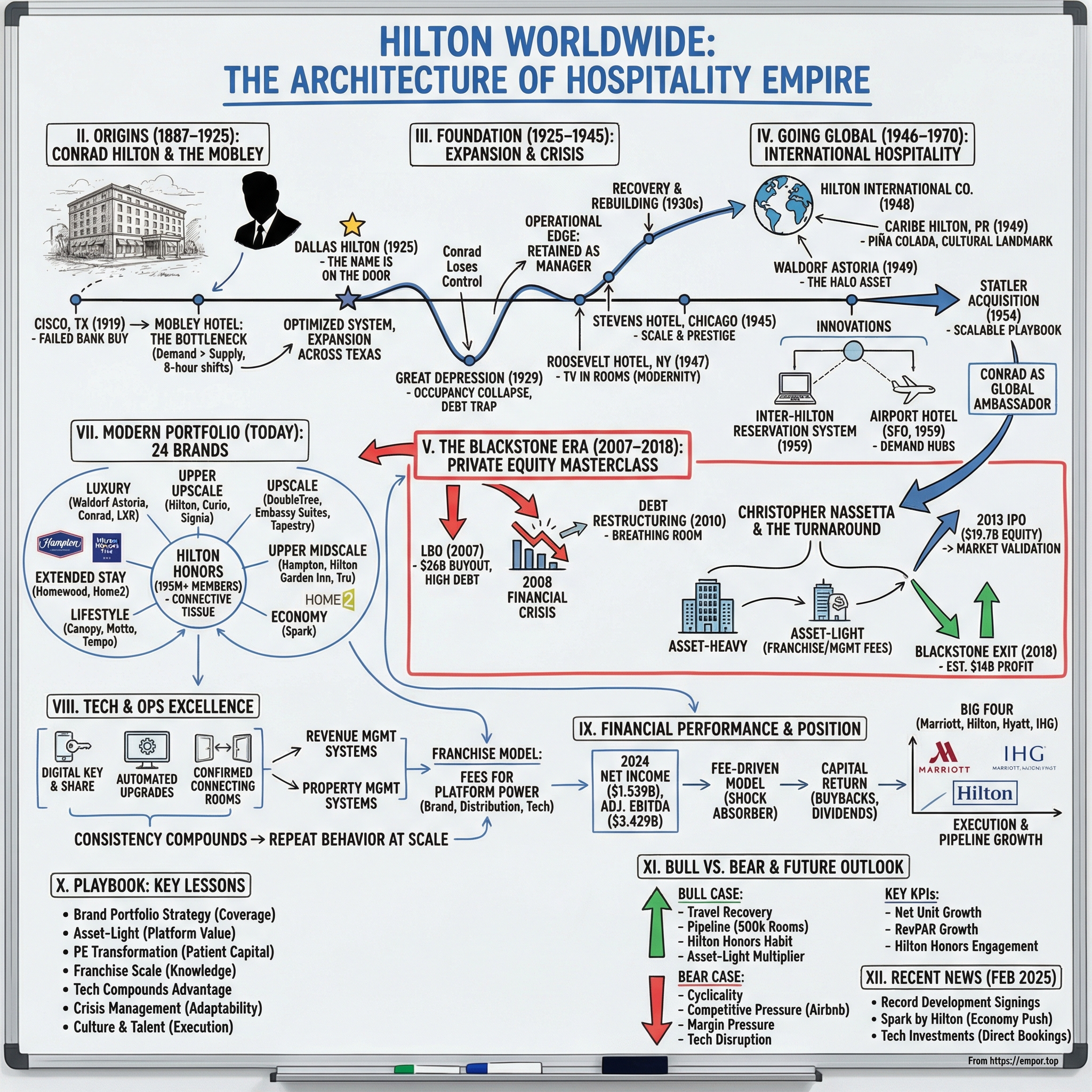
Hilton Worldwide Holdings Inc.: The Asset-Light Royalty Machine
I. Introduction & The Asset-Light Flywheel
Picture a Hampton by Hilton off an interstate exit in Tennessee. A sales representative checks in at 9:40 p.m. and unlocks room 214 with a tap of her smartphone. The next morning at 6:15, she grabs a complimentary waffle in the lobby. Nothing about her stay feels like an encounter with a complex financial instrument. Yet a slice of her room rate—roughly five cents of every room-revenue dollar—leaves the property and flows to corporate headquarters in McLean, Virginia. A few more cents depart for centralized marketing and reservations, and another fraction follows because she is a Hilton Honors member. Hilton does not own the building. It does not own the mattresses, the waffle maker, or the underlying real estate mortgage, nor does it employ the front-desk staff. What Hilton owns is the brand on the sign, the digital distribution app in the guest's pocket, and the contractual right to collect a royalty stream.
That dynamic defines modern lodging. Travelers generally view Hilton as an owner-operator of hotels, but the balance sheet tells a different story. By year-end 2025, Hilton's global network spanned 9,158 properties and roughly 1.35 million rooms across 143 countries and territories. Only 46 of those hotels, accounting for about 15,300 rooms, remained in its ownership segment, and the majority of those were leased rather than owned outright.1 That represents roughly one room in ninety. Third-party owners operated the rest: 8,239 properties were franchised or licensed, and 873 were managed under long-term operating contracts.1 By mid-2026, Hilton had expanded into a 28-brand platform of more than 9,400 properties and approximately 1.4 million rooms in 144 countries and territories, backed by a development pipeline of 541,300 rooms.2
The income statement reflects this structural separation. Hilton reported $12.04 billion in total revenue for 2025, though that top-line figure conceals more than it reveals.3 More than $7 billion represented cost reimbursement revenue: funds property owners transfer to Hilton to cover systemwide marketing, reservation infrastructure, and loyalty administration, which Hilton spends on their behalf without taking an operating margin.3 The core economic engine is fee revenue. Franchise and licensing fees totaled $2.78 billion in 2025, base and other management fees generated $376 million, and incentive management fees contributed $313 million.3 Net income reached $1.46 billion and Adjusted EBITDA stood at $3.73 billion, funding a record $3.3 billion capital return to shareholders.3 In 2024, the business delivered $1.54 billion in net income and $3.43 billion in Adjusted EBITDA on $11.17 billion in revenue, returning $3.0 billion to investors.4
Stripping out pass-through reimbursement revenue leaves Hilton with a 2025 Adjusted EBITDA margin of 74.4%.3 Few enterprises tied to physical real estate generate comparable cash-conversion rates. In operational terms, Hilton functions as three layered businesses: an intellectual property licensor collecting franchise royalties, a global reservation and distribution network directing travelers into third-party buildings, and a clearinghouse that sells loyalty points to financial institutions and settles room redemptions across independent property owners.
The underlying unit economics are straightforward. Dividing roughly $3.5 billion in management and franchise fees across approximately 1.35 million rooms yields just over $2,500 in annual fee income per room.31 Because franchisees and real estate partners supply the property capital, Hilton incurs nominal direct expense to add an incremental key. As the system expands its net room count by 6% to 7% a year, it compounds these high-margin revenue streams. Hilton's enterprise value ultimately depends on two fundamental levers: the pace of net unit growth and the fee yield generated per room. Every strategic milestone—from its 1919 origins to its 2024 brand acquisitions—is designed to accelerate one or both variables.
The Central Dramatic Question
Hilton did not begin as an asset-light royalty platform; it arrived here through recurrent market disruptions and restructuring. Conrad Hilton opened his first hotel in a Texas oil boomtown in 1919. In 1964, the company split its domestic and international operations into separate corporate entities, spending four decades attempting to reunify the brand. In 2007, near the peak of the pre-crisis credit cycle, Blackstone acquired Hilton for $26 billion, funding the transaction with approximately $20.5 billion in debt.5 Within two years, the private equity firm wrote down the value of its equity position by roughly 70%.5 Yet by the time Blackstone sold its remaining shares in 2018, it had generated roughly $14 billion in realized profit,56 concluding one of the most lucrative leveraged buyouts on record.
How a transaction that appeared overleveraged and distressed in 2009 turned into a benchmark private equity success illustrates the durability of the fee-based hotel model. This narrative traces that transformation from Conrad Hilton's Mobley Hotel in Cisco, Texas, through the financial crucible of the Blackstone ownership era and Christopher Nassetta's operating restructuring. It analyzes the 2017 three-way spin-off that created today's pure-play fee vehicle, examines the unit economics embedded in hotel franchise contracts, and evaluates the company's 2024 shift from purely organic brand creation toward boutique acquisitions, where royalty extraction meets the economic boundaries of property owners.
The central investment question is direct: Does Hilton operate as an unassailable toll road with pricing power over travel distribution, or as a service vendor whose hotel-owner partners can ultimately renegotiate the terms of trade? The answer begins in a dusty Texas boomtown in 1919.
 Subscribe on LinkedIn
II. The Texas Wildcatter & The Golden Age of Hospitality (1887–2006)
In 1919, the Ranger oil boom had turned Cisco, Texas, into a town where workers slept in shifts. Conrad Hilton was 31, newly returned from service in the First World War, carrying capital pooled from friends and family and a plan to buy a bank.78 He brought financial experience to the transaction: born in 1887 in San Antonio, New Mexico, when it was still a territory, he had founded a small bank there with $2,900 in capital and grown it to $135,000 in assets.8 The Cisco bank's owner agreed to sell for $75,000, but then wired that the price was now $80,000. Hilton walked away, reportedly replying: "He can keep his bank!"8
He walked into the Mobley Hotel instead. It was a 40-room building doing so much business that its beds turned over with the oilfield shifts, every eight hours.8 Hilton bought it for $40,000.8 By the company's own telling, the Mobley ran at an average occupancy of 300%.7 Hilton later called it "a cross between a flophouse and a gold mine."8
That first venture illustrated an economic reality that still governs the enterprise: a hotel room is perishable inventory, and every square foot that does not generate revenue is an unrecoverable loss. In Cisco, expanding earnings did not require constructing a new building; it required turning over the same physical space more efficiently.
Texas Expansion and the Modern Standard
Hilton expanded rapidly. By 1923, he owned five Texas hotels. The first to carry his name, the Dallas Hilton, opened in 1925, and by 1930 he was the largest regional hotel operator in the state.89 The Great Depression pushed his debt-extended chain to the brink. That brush with insolvency taught him that the operator running a hotel and the owner holding the physical building do not need to be the same, an insight his corporate successors would eventually formalize into an industrywide doctrine.
After the Second World War, the company became an architect of the modern corporate hotel era. In 1946, it was the first hotel company to sell stock after the war.9 In 1947, the Roosevelt Hilton in New York became the first hotel to put televisions in guest rooms.9 Hilton introduced its first multi-hotel reservation system in 1948.9 In 1954, it bought the Statler chain for $111 million, the largest real estate deal of its time.9 It opened the first airport hotel concept in San Francisco in 1959 and launched a computerized central reservation system in 1973.9 The Waldorf Astoria became the flagship of the system and in 1957 was the first hotel to offer in-room direct-dial telephones.9
Most of those operational milestones were not fundamentally about physical real estate. In-room amenities, centralized booking, and airport locations were tools of distribution and standardization: ensuring a traveler recognized the standard of service in advance and could reserve a room across a unified network. The core architecture of the modern franchise model—a recognized brand promise paired with a central reservation platform—was firmly in place by the 1950s.
The Bifurcation Disaster
Then the company made a strategic choice that took four decades to undo. In 1964, Hilton Hotels Corporation spun off its international operations to shareholders.10 That business ended up inside Britain's Ladbroke Group in 1987, which later renamed itself Hilton Group plc.10 For more than 40 years, two unrelated companies controlled the same name: one operated Hilton in the United States, while the other ran Hilton everywhere else.
For a brand whose market value rested on global consistency, that structural division created chronic friction. The two companies began to cooperate in 1997, including on loyalty.10 Even so, a traveler moving across borders was dealing with two corporate owners behind the same sign.
A definitive reunion arrived on December 29, 2005. Hilton Hotels Corporation agreed to buy Hilton International's lodging assets for about £3.3 billion, or $5.71 billion, in cash. The deal brought the Conrad brand, the international reservation system, and full ownership of the HHonors loyalty operation back under one roof.10 When the transaction closed in February 2006, the combined company had nearly 2,800 hotels and about 475,000 rooms in 80 countries.10 Chief executive Stephen Bollenbach called it "the final and logical step in a process that began in 1997."10
Reunification restored a single global brand near the peak of a debt-fueled real estate cycle. It also left Hilton with the classic profile of a private equity buyout target: an iconic international brand name, a large owned-hotel portfolio that could serve as collateral for asset-backed debt, and an underlying fee stream that public equity markets had not valued as a standalone franchise. Within 18 months, the buyer arrived.
III. The Blackstone LBO: Crisis, Mezzanine Mastery, and the Nassetta Playbook (2007–2013)
In the summer of 2007, that buyer materialized when Jonathan Gray, then leading Blackstone's real estate group, pursued an ambitious thesis: acquire the whole of Hilton—its brands, fee streams, and trophy real estate—and expand the platform globally. In early July 2007, Blackstone agreed to acquire Hilton Hotels Corporation.11 The transaction was priced at $47.50 a share, representing roughly a 40% premium over the prior stock price and valuing the enterprise at approximately $26 billion including debt.5 About $20.5 billion of the purchase price was funded with debt supplied by a syndicate of commercial banks, hedge funds, and real estate lenders. Blackstone committed $5.6 billion in equity, backed by a $560 million breakup fee that reflected the determination of both sides to close the deal.5 At signing, the company's leverage stood at approximately 12.5 times EBITDA.5
The timing proved precarious. The acquisition closed just as global credit markets began to freeze, and within twelve months, several of the financial institutions that had underwritten the buyout were facing solvency crises of their own.
The Near-Death Experience
When the global financial crisis struck, corporate travel budgets collapsed and group bookings evaporated. Hilton's revenue fell roughly 15% in 2009, and its EBITDA that year arrived at approximately half of original underwriting projections.5 With cash flows sharply compressed, Blackstone wrote down the carrying value of its equity position by about 70%.5 To industry critics, the transaction seemed to embody late-cycle buyout excess: an unprecedented equity commitment written at the market peak, now largely impaired on paper.
An accounting write-down, however, is a valuation assessment rather than a liquidity default. Because Hilton's debt maturities were sufficiently long-dated and its underlying fee business generated durable cash flow, the company avoided hitting an unmanageable maturity wall. That structural runway provided the sponsor with both time and strategic flexibility.
The Debt Restructuring Masterclass
By 2010, secondary market pricing on Hilton's junior debt had dropped to distressed levels as institutional investors fled leveraged lodging exposure. Blackstone turned that market distress into an opportunistic recapitalization. It repurchased roughly $1.8 billion of mezzanine debt at a 54% discount, deploying approximately $827 million in fresh capital. Other junior mezzanine lenders agreed to convert their holdings into preferred equity. In total, the restructuring eliminated about $3.5 billion in debt from the balance sheet.5 Concurrently, sharp declines in benchmark interest rates lowered borrowing costs, reducing Hilton's annual interest burden by roughly $700 million.5
This balance-sheet engineering set Hilton apart from many troubled buyouts of that cycle. The maneuver was fundamentally defensive: it did not generate enterprise value on its own, but it insulated the equity long enough for an operational turnaround to take root. The strategy hinged on recognizing that distressed credit markets had priced Hilton for liquidation, underestimating the staying power of its recurring franchise and management fee streams.
Christopher Nassetta Takes the Helm
To execute that operational turnaround, Blackstone brought in Christopher J. Nassetta as chief executive. Nassetta had served from 2000 to 2007 as president and CEO of Host Hotels & Resorts, the largest lodging REIT in the United States, having joined the firm as an executive vice president in 1995 and stepped into the chief operating officer role in 1997.12 Earlier in his career, he co-founded Bailey Capital and spent seven years as chief development officer at the Oliver Carr Company, a commercial real estate developer based in Washington.12 He held a finance degree from the University of Virginia's McIntire School of Commerce.12 Nassetta was an executive molded on the ownership side of the lodging industry, having spent his career across the negotiating table from hotel brand managers. That background proved critical: he understood the operational pressures and return hurdles of hotel owners because he had spent years managing them directly.
His first major cultural directive was geographic. In March 2009, in the depth of the economic downturn, Hilton announced it would relocate its corporate headquarters from Beverly Hills, California, to Tysons Corner in McLean, Virginia, leasing roughly one-third of a 323,000-square-foot office building.13 Nassetta described the relocation as "an important milestone in our corporate transformation."13 The move signaled a calculated cultural shift. The enterprise stepped away from its historical associations with Hollywood celebrity and trophy real estate, establishing its leadership in a suburban Washington corporate corridor populated by government contractors and business-services firms.
The Engine: Net Unit Growth
Under Nassetta, the central mechanism of equity creation was expanding the property network using third-party capital. Between mid-2007 and September 2013, Hilton expanded its open room count by 36%, adding 176,248 rooms—a pace its IPO prospectus described as "the highest growth rate of any major lodging company."14 The company added roughly 1,180 hotels over that six-year window, including more than 170 openings in China alone.5 By 2013, approximately 92% of the system operated under franchise or management contracts.5
Hilton did not finance the physical construction of those properties. Third-party owners and developers supplied the equity and construction loans, while Hilton licensed its trademarks, integrated the rooms into its central booking channels, and collected fee royalties. By the time of the public listing, Hilton's development pipeline reached 185,699 rooms, with 99% of those projects located in the management and franchise segment.14
The 2013 IPO and the Historic Exit
On December 11, 2013, Hilton returned to the New York Stock Exchange, pricing its shares at $20 and raising $2.35 billion in what stood as the largest hotel IPO on record.145 The public offering valued Hilton's equity at approximately $19.7 billion and its enterprise value at roughly $33.6 billion.5 Blackstone retained about three-quarters of the outstanding shares.5 The registration filing outlined a transformed global network: 4,080 properties and 671,926 rooms across 90 countries, with total debt brought down to approximately $16.4 billion.14
Blackstone subsequently monetized its holding through a phased series of secondary sales. The largest single block went to HNA Group, the Chinese aviation and logistics conglomerate. On October 24, 2016, HNA agreed to acquire 247.5 million Hilton shares—a roughly 25% ownership stake—at $26.25 per share, representing a transaction value of approximately $6.5 billion.15 Blackstone liquidated its final shares in 2018. Over an eleven-year ownership span, the firm realized roughly $14 billion in total profit, returning about three times its invested capital at an internal rate of return of approximately 16%.56
The HNA transaction merits analytical scrutiny. The buyer of Blackstone's cornerstone stake was a highly leveraged conglomerate whose aggressive, debt-financed global acquisition spree subsequently unraveled under regulatory and financial pressure. While Hilton's operational improvements justified a higher valuation, Blackstone's ultimate return was enhanced by timing: finding a motivated, capital-abundant acquirer near the zenith of Chinese cross-border investment activity.
The Blackstone era illustrated three foundational levers of private equity value creation: patience through severe cyclical stress, opportunistic debt restructuring that captured steep market discounts, and an operational strategy that expanded the fee-earning room base using third-party capital. By 2016, however, one remaining structural legacy prevented Hilton from commanding the valuation multiple of a pure-play fee platform: the portfolio of real estate it still held on its balance sheet.
IV. The Grand Unbundling: The 2017 Spin-Offs & Creating the Pure-Play Royalty Machine
Consider an equity analyst in 2015 attempting to model Hilton. On one tab sat a franchise business generating high-margin fee streams with minimal capital reinvestment. On another sat a portfolio of trophy real estate: big-box convention hotels and beachfront resorts carrying union labor contracts, periodic renovation cycles, and mortgage debt. A third tab held a timeshare operation that sold vacation intervals on credit and managed a consumer loan portfolio. Each unit commanded a distinct valuation multiple, a different cost of capital, and a separate investor base. Bundled together under a single corporate umbrella, the assets traded at a composite discount.
That structure produced a classic conglomerate discount. Owned lodging real estate is cyclical and capital-intensive: guest rooms, common areas, and mechanical systems require continuous reinvestment, prompting public markets to price hotel properties conservatively. A franchise royalty stream, by contrast, commands premium valuation multiples comparable to consumer brands and asset-light franchisors in other sectors. Combining all three operations into one equity vehicle forced investors seeking pure fee exposure to absorb balance-sheet real estate risk.
The January 2017 Triple Split
On January 4, 2017, Hilton finished splitting itself into three independent public companies.16
Park Hotels & Resorts (NYSE: PK) took the owned real estate: 67 premium-branded hotels and resorts with more than 35,000 rooms, making it the second-largest publicly traded lodging REIT.16 Those properties continued to fly Hilton flags under long-term management and franchise agreements, allowing Hilton to shed physical property liabilities while preserving the fee stream.
Hilton Grand Vacations (NYSE: HGV) took the timeshare business: 46 resorts in destinations such as Hawaii, New York, Orlando, and Las Vegas.16 HGV licenses the Hilton name and pays Hilton licensing fees.1 The timeshare debt and underwriting risks left Hilton's balance sheet, while the associated royalty stream remained behind.
Hilton Worldwide Holdings (NYSE: HLT) kept the brand portfolio, the franchise and management contracts, and Hilton Honors, while executing a 1-for-3 reverse stock split at the same time.16 Nassetta described the standalone company as "a fee-based, capital efficient, and resilient business with tremendous growth potential."16
What the Unbundling Actually Changed
The spin-off did not alter the guest experience. The same properties flew the same flags. What changed was the corporate allocation of risk. Following the separation, the obligations of real estate ownership—capital expenditures, property taxes, union labor contracts, and mortgage refinancing—belonged entirely to Park and third-party franchisees. Hilton remained exposed to broader lodging demand, since its fees are calculated as a percentage of property revenue, but it insulated itself from property-level operating expenses.
Financial results illustrate the mechanics of that separation. In 2025, the management and franchise segment generated $3.58 billion in segment Adjusted EBITDA. The ownership segment, consisting of the remaining leased hotels, produced $177 million on $1.23 billion of revenue.1 Total depreciation and amortization across the entire company was only $177 million.1 For an enterprise producing roughly $3.7 billion in Adjusted EBITDA while depreciating less than $200 million in physical assets annually, capital reinvestment hurdles are nominal, leaving nearly all operating cash flow free for distribution.
That capital-light framework warrants precise scrutiny, as asset-light models are easily romanticized. Hilton's model is not entirely free of capital requirements. Instead, it shifts property-level capital requirements onto third-party owners who supply equity and debt, while deploying capital on its own balance sheet through debt-funded share repurchases (Section VIII). Hilton also selectively deploys "key money"—upfront cash incentives paid to developers to secure coveted management or franchise contracts. On the fourth-quarter 2025 earnings call, Nassetta noted that key money was involved in about 9% of deals, mostly in luxury and upper-upscale.17 On the second-quarter 2026 call, asked about a Waldorf Astoria signing in Miami Beach, he conceded that "key money is in every deal like that" in competitive U.S. luxury markets.18 The asset-light model remains real, but at the apex of the market, Hilton commits capital to win.
The unbundling left Hilton as an enterprise whose valuation hinges on two variables: the net growth of rooms carrying its flags and the fee yield generated per room. Evaluating whether those cash flows are durable requires examining the terms of the franchise contract itself.
V. The Engine Room: Unit Economics of the Hotel Franchise & The Loyalty Moat
The economic pitch delivered to prospective hotel developers rests on straightforward arithmetic. An owner might spend $20 million to construct a 120-room property, debt-financing the majority of the project, hiring the staff, paying property taxes, and absorbing operational risk. In exchange for licensing a recognized brand flag, the owner remits a percentage of revenue over a twenty-year term, operating on the premise that the brand's distribution engine will fill rooms at higher occupancy and average daily rates than an unbranded property could achieve alone.
Where the Money Comes From
Hilton's top-line revenue divides into three functional layers. The primary economic engine is fee revenue. In 2025, franchise and licensing fees reached $2.78 billion, supplemented by $376 million in base management fees and $313 million in incentive management fees.3 Franchise fees represent a contractual percentage of room revenue, while base management fees are calculated on total property revenue. Incentive fees reflect a share of property-level operating profit above pre-negotiated hurdles, rendering them the most cyclically sensitive fee component.
The second layer is the residual ownership segment: 46 properties generating $1.23 billion in revenue but only $177 million in segment EBITDA.13 Because physical hotel operations bear direct labor, utility, and maintenance burdens, their operating margins remain modest compared to pure licensing royalties.
The third and largest accounting layer consists of pass-through cost reimbursements. Cost reimbursement revenue totaled $7.09 billion in 2025.1 These funds represent payments property owners remit to cover centralized reservations, global marketing campaigns, loyalty program management, and shared payroll services. While designed in principle to operate on a zero-margin basis, the accounting rarely balances out to zero within an individual reporting period. In 2025, reimbursed expenses of $7.55 billion exceeded reimbursement revenues by approximately $465 million; in 2024, that deficit was roughly $557 million.1 The variance largely reflects timing differences in how Hilton Honors recognizes revenues and expenses, and Hilton removes this net effect when calculating Adjusted EBITDA. Accounting for the loyalty program relies heavily on management estimates regarding redemption rates, timing, and property reimbursement costs, factoring in assumptions about occupancy, room rates, and potential program modifications.1 For investors evaluating GAAP net income, this represents one of the largest subjective accounting areas across the financial statements.
Evaluating that fee structure requires tracking RevPAR—revenue per available room. Calculated as total room revenue divided by available rooms, RevPAR combines occupancy and average daily rate into a single operating metric. A 100-room property that sells 70 rooms at $150 per night generates a RevPAR of $105. Because franchise royalties are assessed directly against gross room sales, system-wide RevPAR serves as the primary short-term driver of fee income, while net unit growth—the total number of rooms flying Hilton flags—governs long-term expansion.
The Owner's Math
The franchise disclosure document details the contractual fee stack that governs each property. Under Hilton's 2024 U.S. disclosure for its flagship Hilton Hotels & Resorts brand, a franchisee pays a monthly royalty fee of 5% of gross room revenue, a program fee of 4% of gross room revenue, and a 3% royalty on food and beverage revenue.19 In addition, the property incurs a Hilton Honors fee of 4.3% of the eligible guest folio on stays where a member earns points.19 Depending on the proportion of room nights booked by Honors members, the cumulative cash remitted to corporate headquarters can range into the low-to-mid teens as a percentage of room revenue.
The contractual exit provisions are equally demanding. Should an owner terminate a franchise agreement prematurely after a hotel opens, the contract typically mandates liquidated damages equal to 60 months of average royalty fees, or the royalties due over the remaining term if fewer than 60 months remain.19 Franchise agreements generally span 20 years for new builds and 10 to 20 years for property conversions, while management agreements frequently run 20 to 30 years.20 Exiting early effectively requires an owner to pay five years of royalties in a lump sum. This contractual friction creates substantial switching costs, shielding Hilton's fee generation from short-term lodging cycles.
Property owners agree to these economics based on three principal commercial considerations:
First, owners seek a RevPAR premium. Hotel franchisors benchmark performance through RevPAR index, measuring a property's revenue per available room against a defined competitive set in its local market. Hilton places substantial emphasis on the metric, including "RevPAR Index Growth" among the core performance targets governing long-term executive equity compensation.21 However, Hilton does not publish an audited, system-wide RevPAR index figure in its annual regulatory filings, leaving the precise empirical scale of that premium reliant on corporate claims and third-party industry benchmarks.
Second, the brand promises lower distribution costs. Online travel agencies (OTAs) extract substantial commissions on third-party bookings. Hilton's regulatory filings caution that if booking volumes migrate toward online intermediaries, third-party distributors "may be able to obtain higher commissions or other significant concessions" while potentially suppressing property rankings within search algorithms.1 Channeling reservations through Hilton's proprietary direct platforms bypasses third-party booking commissions, forming the core commercial justification presented to franchisees.
Third, institutional branding facilitates commercial lending. Financial institutions typically underwrite construction loans and property mortgages on more favorable terms for flagged hotels, presuming that centralized global distribution cushions debt-service coverage. While difficult to isolate from public regulatory disclosures, this underwriting preference remains standard practice across commercial real estate markets.
The Hilton Honors Flywheel
The economic value of Hilton's distribution network centers on its loyalty program. Hilton Honors expanded from 211 million members at the end of 2024 to 243 million by year-end 2025, marking a 15% annual increase.201 Headline membership figures warrant analytical caution, as a considerable portion of loyalty rosters across the lodging industry consists of inactive or infrequent travelers. Systemwide enrollment growth is partly propelled by co-branded partnerships and front-desk sign-ups; standard franchise agreements explicitly waive the Honors assessment on stays during which a guest enrolls on-site.19 A rising membership count does not automatically equate to recurring, high-frequency booking volume.
The software platform, however, provides operational stickiness. Hilton began rolling out digital smartphone room keys in 2014.9 The proprietary app enables members to select specific rooms from a digital floor plan and bypass the front desk, capabilities restricted exclusively to reservations made through direct brand channels.19 By tying digital convenience to direct booking, Hilton creates guest incentives to bypass third-party intermediaries, delivering the distribution insulation promised to property owners.
The Hidden Cash Stream: Co-Brand Credit Cards
Some of the most profitable fee revenue in the Hilton system originates outside hotel properties. Financial institutions issuing co-branded credit cards—most notably American Express—purchase Honors points in bulk to distribute as cardholder rewards. Hilton recognizes these revenues within its licensing fee line. In 2025, licensing fees grew by $104 million, an increase Hilton attributed "predominantly resulting from activity under our co-branded credit card arrangements," alongside fee growth from Hilton Grand Vacations.1 The company does not disclose the aggregate dollar value of its financial-partnership income. During the fourth-quarter 2025 earnings call, Nassetta declined to provide specific revenue breakdowns, though he stated that he expected co-branded card fees to "continue to grow at above algorithm" for "many years to come."17 While financial partnerships represent an exceptionally high-margin cash stream requiring virtually no physical capital, the lack of segment disclosure prevents investors from independently verifying the underlying contract economics.
Myth vs. Reality: Is the Loyalty Moat a Captive Monopoly?
The claim: Hilton Honors renders the company indispensable to property owners, granting Hilton unconstrained pricing power over its fee structure and perpetual control over guest distribution.
The strongest disconfirming evidence: First, online travel intermediaries retain significant commercial leverage. Hilton's regulatory risk disclosures continue to characterize third-party booking channels as a substantial booking vector, noting that these platforms retain the capacity to demand higher commission rates and alter algorithmic search rankings.1
Second, franchisees do depart. In 2025, Hilton opened 97,000 rooms but recorded net additions of only 81,100, indicating that roughly 16,000 rooms—exceeding 1% of the total system—exited the network.1 While a portion of these terminations reflects aging properties or assets removed for failing brand quality standards, others represent owners defecting to rival franchise platforms.
Third, Hilton has demonstrated that its fee structure faces practical economic ceilings. On the second-quarter 2026 earnings call, Nassetta detailed "reductions in loyalty fees for most hotels globally," alongside an initiative designated RISE that offers fee discounts linked to property quality metrics, which management projected would return 75 to 100 basis points of operating margin to owners.18 Nassetta attributed the concessions to post-pandemic economic pressures, where domestic owners confronted compressed top-line growth alongside elevated operating costs, noting the friction of "very low top-line growth and expenses growing higher."18 An enterprise possessing absolute pricing power does not voluntarily concede fee yield.
The verdict: Disclosed operating realities temper the monopoly thesis. Hilton Honors constitutes a powerful direct-booking engine, and standard 60-month liquidated-damages covenants impose onerous exit costs on franchisees. However, Hilton's fee extraction remains tethered to franchisee profitability. When property-level margins erode, corporate leadership must moderate its take to protect the development pipeline, as unprofitable franchisees will not finance future expansion. The critical operating indicators for investors are gross room deletions relative to additions and the trajectory of corporate fee concessions. If property attrition accelerates while fee yields contract, the loyalty moat is narrower than bullish arguments assert.
Sustaining the asset-light compounding model ultimately relies on signing new development partners rather than squeezing existing franchisees—a dynamic that places brand segmentation and capital allocation at the center of Hilton's forward strategy.
VI. The Brand Portfolio & Capital Allocation: Organic Incubation vs. The 2024 M&A Pivot
In January 2023, Hilton introduced a concept sharply removed from the luxury heritage of the Waldorf Astoria: Spark by Hilton, a premium-economy flag conceived strictly as a conversion vehicle for independent roadside motels.22 The commercial proposition was straightforward: an owner renovated the guest-facing areas of an existing property to a standardized specification, and Hilton integrated the rooms into its global distribution channels. Hilton announced more than 100 franchise commitments at launch.22 By year-end 2025, Spark had expanded to 228 open properties encompassing roughly 20,000 rooms.1
Spark epitomizes the brand-building strategy Christopher Nassetta spent more than a decade refining: identify an unserved price band in lodging, engineer a standardized, low-cost operating prototype, and recruit third-party franchisees to finance its physical footprint.
The Architecture
By the close of 2025, Hilton's platform spanned from high-end luxury to entry-level economy.1 The luxury tier comprised Waldorf Astoria, Conrad, LXR, and the acquired NoMad flag. Lifestyle concepts encompassed Canopy, Curio Collection, Tapestry Collection, Tempo, Motto, and Graduate Hotels. Full-service convention and urban properties centered on Hilton Hotels & Resorts, DoubleTree, and Embassy Suites, supported by focused-service and extended-stay brands, and anchored at the entry tier by Spark and LivSmart Studios.
The commercial foundation of the enterprise, however, rests in limited-service lodging. Hampton by Hilton alone operated 3,195 properties comprising nearly 360,000 rooms at year-end 2025—accounting for more than a quarter of Hilton's global room inventory.1 Hilton Garden Inn contributed 1,124 properties, Home2 Suites added 865, and DoubleTree operated 715.1 System expansion continued apace into 2026. Hilton opened its initial conversion-oriented Outset Collection hotels in late 2025 and launched Apartment Collection by Hilton in January 2026.317 In June 2026, the company introduced Undergraduate by Hilton, an upper-midscale concept tailored to university communities.2 The launch brought Hilton's brand portfolio to 28 distinct flags.2
The "Build, Don't Buy" Creed
For most of Nassetta's tenure, corporate identity was defined by transaction discipline. On September 23, 2016, rival Marriott International finalized its $13 billion acquisition of Starwood Hotels & Resorts, forming an industry giant of 30 brands, 5,700 properties, and 1.1 million rooms.[^23] Hilton operated approximately 773,000 rooms at the time.[^23] In November 2021, Hyatt Hotels completed its $2.7 billion purchase of Apple Leisure Group, absorbing 99 resort properties and roughly 32,000 rooms.23 Hilton abstained from large-scale corporate consolidation. Management argued that incubating brands organically avoided goodwill balance-sheet bloat and integration friction across disparate reservation and loyalty systems, while allowing architects to engineer prototypes optimized specifically for franchisee return on investment.
Across limited-service categories, operating results substantiated that thesis. Home2 Suites, developed during the 2008 downturn, scaled to 865 open hotels by year-end 2025.1 Midscale prototype Tru by Hilton expanded to 338 properties.1 Spark debuted its first open property less than twelve months after its public announcement, marking what management characterized as the fastest brand rollout in corporate history.22
Hilton's most effective expansion within lifestyle lodging bypassed traditional standardized branding entirely. Soft brands such as Curio Collection and Tapestry Collection allow independent hotel operators to preserve distinctive architectural identities while integrating into Hilton's distribution network and loyalty ecosystem. Tapestry reached 192 open hotels by the end of 2025, with management signing nearly 20 additional franchise commitments in the fourth quarter alone.13 Because soft brands require lower upfront conversion expenditures, they serve as efficient pipelines for capturing existing independent properties. The strategic trade-off lies in consumer consistency: because property designs are heterogeneous by definition, the commercial value delivered by Hilton centers on booking volume rather than a standardized guest experience.
The 2024 Pivot: Tuck-In Deals and Alliances
In early 2024, that organic orthodoxy shifted. Across three transactions executed within two months, Hilton pursued targeted acquisitions and distribution partnerships to penetrate market niches where in-house development had lagged.
Small Luxury Hotels of the World (February 2024). On February 7, 2024, Hilton announced an exclusive strategic partnership with Small Luxury Hotels of the World, an affiliation network of 560 independent boutique properties across 90 countries.24 Participating hotels retained independent operational autonomy while gaining direct access to Hilton's central reservation channels, enabling Hilton Honors members to earn and redeem loyalty points across the collection.24 The alliance required negligible upfront capital expenditure while immediately expanding Hilton's luxury presence in resort and boutique destinations where its proprietary footprint remained limited.
Graduate Hotels (March 2024). On March 14, 2024, Hilton reached an agreement to acquire the Graduate Hotels brand from Adventurous Journeys Capital Partners for $210 million, securing a portfolio of more than 35 operating and pipeline properties located in prominent university markets, including Ann Arbor, Knoxville, Oxford, and Cambridge.25 AJ Capital retained title to the underlying real estate and entered into long-term franchise agreements with Hilton.25 Management projected the acquisition would generate approximately $16 million in fee revenue during its first full year of operations.25 At roughly 13 times initial fee generation, the valuation represented a measured multiple compared to mega-merger lodging transactions, though the asset base concentrates exposure in a specialized demographic segment.
NoMad (April 2024). On April 3, 2024, Hilton acquired a controlling interest in the Sydell Group, the creator of NoMad Hotels, establishing a structure where Sydell managed brand design and hotel operations while Hilton assumed responsibility for global franchise development and loyalty integration.26 The transaction included only a single operating property—its London flagship—while excluding NoMad Las Vegas.26 Hilton did not disclose the purchase consideration upon signing, though subsequent regulatory filings revealed a cash outlay of $56 million.27 Management outlined an ambition to scale the boutique flag to as many as 100 locations over time.26
Myth vs. Reality: Is Organic Incubation Always Better?
The claim: In-house brand incubation universally outperforms mergers and acquisitions across lodging segments by avoiding balance-sheet goodwill, integration disruption, and acquisition premiums.
The strongest disconfirming evidence: Operating growth across Hilton's proprietary lifestyle concepts reflects tangible friction. Motto by Hilton, an internally developed urban micro-room concept, counted just 10 open hotels at year-end 2025.1 Tempo by Hilton, an upscale lifestyle brand, operated only six properties.1 Conversely, the university-market niche cultivated by Graduate proved sufficiently difficult to replicate that Hilton committed $210 million to purchase the established brand rather than engineer an in-house substitute. Furthermore, following that acquisition, Hilton introduced Undergraduate by Hilton to target college markets where, as Nassetta acknowledged on the fourth-quarter 2025 earnings call, developing a full-service Graduate property proved economically unfeasible for owners.17
The verdict: Execution records invalidate the absolute thesis while preserving a more nuanced reality. Organic incubation remains highly effective for standardized, cost-engineered prototypes where uniform consistency drives consumer demand—exemplified by Hampton, Home2, Tru, and Spark. The strategy has proven considerably more challenging in boutique lifestyle and luxury segments, where appeal depends on authentic local character and specialized hospitality design rather than centralized corporate efficiency. While Hilton's 2024 tuck-in transactions demonstrated pricing discipline relative to industry mega-mergers, they also signaled an operational recognition that certain consumer segments cannot be efficiently manufactured internally at corporate headquarters. The forward test for investors is quantitative and straightforward: whether NoMad, Graduate, and the Small Luxury Hotels alliance drive material fee growth and pipeline acceleration, or remain peripheral boutique contributors within an enterprise of roughly 1.4 million rooms.
The brand portfolio dictates what Hilton offers, but geographic execution governs where fee streams compound. In recent operating cycles, some of the most complex structural tests for that platform emerged outside North America.
VII. Global Frontier & Headwinds: The China Squeeze, Regional Bank CRE Freezes, and Labor Friction
On October 30, 2014, at a ceremony in Beijing, Hilton signed an exclusive license with 铂涛集团 Plateno Hotels Group to develop Hampton by Hilton across China. The agreement targeted more than 400 hotels, with Plateno overseeing development and property management.28 Plateno brought substantial domestic scale, operating five brands and more than 3,000 hotels across 300 Chinese cities.28 Plateno later became part of 锦江国际 Jin Jiang International. The master-license arrangement gave Hilton a mechanism to deploy its midscale brand across hundreds of Chinese metropolitan markets without committing corporate capital or managing local property workforces.
The International Engine
By year-end 2025, the Asia Pacific region encompassed 1,259 Hilton properties and more than 232,000 rooms. As Hilton's largest regional footprint outside the United States, the portfolio was overwhelmingly franchised or managed rather than owned.3 The China expansion was propelled predominantly by midscale flags. In 2023, for example, Hilton opened approximately 100 properties in China, with 68 flying the Hampton flag and fewer than 10 entering high-end, full-service segments.29
The Construction Financing Bottleneck and the Conversion Pivot
In the United States, the post-2022 constraint was capital availability rather than travel demand. Higher benchmark interest rates and stricter commercial bank lending criteria constrained construction financing for new hospitality projects, causing industrywide ground-up starts to decelerate sharply. Hilton adapted by accelerating property conversions, integrating existing independent hotels and competitor flags into its brand system. Conversions accounted for roughly 40% of room openings in 2025, and management projected that conversions would represent 30% to 40% of net additions over the medium term.17 In the second quarter of 2026, conversions represented 36% of room openings.18
Financing conditions subsequently showed signs of thawing. Management reported that U.S. construction starts rose more than 25% in 2025 and projected global starts would increase more than 20% in 2026.17 In the second quarter of 2026, U.S. starts accelerated by more than 40%.18 Sustained momentum in ground-up development would rebalance Hilton's pipeline toward custom new-builds, reducing reliance on conversion activity. While conversions offer rapid unit expansion, they present durability trade-offs: converted properties are typically older, require ongoing renovation, and carry higher long-term attrition rates than newly built hotels.
Domestic lodging demand also experienced notable cyclical volatility beneath headline averages. In the fourth quarter of 2025, U.S. RevPAR declined approximately 1%, a contraction management attributed largely to a federal government shutdown that curtailed business transient and group bookings.17 By the second quarter of 2026, U.S. RevPAR rebounded by 5.4%.2 Nassetta reported that business transient RevPAR rose 5.7%, led by small and medium-sized enterprises tied to artificial intelligence infrastructure build-outs, while estimating that the FIFA World Cup contributed 1.5 to 1.7 percentage points of the quarter's system-wide expansion.18 Because those event-driven tailwinds were temporary, management maintained that the normalized underlying run rate was closer to 2% to 2.5%.18
Labor Friction
Over Labor Day weekend in 2024, more than 10,000 hospitality workers across 25 properties—including Hilton, Hyatt, and Marriott hotels in Honolulu, Boston, San Francisco, Seattle, San Diego, and San Jose—walked off the job.30 Organized by UNITE HERE, the strike demanded higher wages, manageable workloads, and the reinstatement of automatic daily room cleaning, a pandemic-era service reduction that hotel operators had sought to make permanent.30
For an asset-light franchisor, labor disputes introduce distinct economic asymmetries. Most workers across the brand network are not Hilton corporate employees. At year-end 2025, third-party franchisees employed roughly 328,000 workers across the system, compared with approximately 182,000 personnel at Hilton's leased and managed hotels and corporate offices.1 Approximately 25% of personnel employed or managed by Hilton globally, and 45% within the United States, were covered by collective bargaining agreements.1 Higher property-level labor expenses therefore primarily compress franchisee operating margins rather than corporate fee income. Yet this cost pressure directly reinforces the structural fee friction examined in Section V: when operating margins deteriorate, property owners negotiate more aggressively for fee relief and slow their capital commitments for new property development.
Myth vs. Reality: Is China a Diversifying Growth Engine?
The claim: China is an autonomous growth vector that diversifies Hilton away from the U.S. economic cycle.
The strongest disconfirming evidence: Fee generation from China has disappointed for three consecutive years. In October 2024, Hilton lowered its full-year outlook as third-quarter room revenue in China fell roughly 9%, prompting Nassetta to characterize domestic demand bluntly: "Demand is flat, maybe even a little bit down."31 In the first quarter of 2025, China RevPAR contracted another 3.1% even as the global system expanded.29 Mix shifts compounded that softness: as Hilton accelerated development of midscale Hampton properties, average revenue per room across China declined. In the first quarter of 2025, Hampton's RevPAR in China was approximately two-thirds that of the flagship Hilton brand.29 In the fourth quarter of 2025, China RevPAR slipped 1.4%, restrained by muted group bookings tied to government travel restrictions, while Asia Pacific outside China expanded 9.2%, propelled by Australia, Japan, and South Korea.17 In the second quarter of 2026, China RevPAR fell an additional 2.2%, leading management to project a low-single-digit decline for the full year.18
Geopolitical disruption has also resurfaced as a direct operational risk. In the second quarter of 2026, armed conflict in the Middle East drove RevPAR down 29.5% across the Middle East and Africa region.218 Management estimated that the regional shock would reduce full-year system-wide RevPAR growth by approximately half a percentage point and erase at least $20 million in Adjusted EBITDA.18
The verdict: Multi-year operating results substantially narrow the China diversification thesis. China remains an important engine of net unit additions, sustained by steady domestic developer demand for midscale flags like Hampton. Yet expanding room counts alongside falling RevPAR inevitably erodes fee yield per key. Incentive management fees, which hinge on property-level operating profit, bear the brunt of that contraction. China diversifies Hilton's room count, but it has failed to diversify its fee earnings in an economically meaningful way. Concurrently, the Middle East disruption demonstrates that international expansion exchanges domestic cyclical exposure for geopolitical and regulatory risks rather than neutralizing volatility. For investors, the decisive benchmark is China's RevPAR trajectory relative to the global system. A sustained rebound would validate the geographic diversification model; further contraction would indicate that the regional fee drag has become structural.
These headwinds converged on an enterprise whose senior leadership had been at the helm for nearly two decades, and whose corporate balance sheet had been engineered with virtually no equity cushion.
VIII. Executive Leadership, Governance & Financial Engineering
Christopher Nassetta has led Hilton since 2007, an operating tenure that has fundamentally reshaped the enterprise. The company he commands in 2026 bears little financial resemblance to the one he inherited: in 2007, Hilton was a leveraged private equity holding company that owned physical hotel real estate; today, it is a pure-play fee platform operating with negative stockholders' equity. In a lodging sector where chief executive tenures typically average five to seven years, nearly two decades in the chief executive seat provides an extensive track record across multiple operating cycles.
Skin in the Game
Executive ownership and board oversight reflect that extended tenure. According to the company's 2025 proxy statement, Nassetta beneficially owned approximately 4.63 million shares, representing roughly 1.9% of the company.21 Kevin Jacobs, the chief financial officer, owned about 443,000 shares, while Christopher Silcock, president of global brands and commercial services, held approximately 178,000.21 Jonathan Gray, president and chief operating officer of Blackstone, serves as Hilton's non-executive chair and held about 739,000 shares.21 Although Blackstone liquidated its final equity stake in 2018, Gray's continued board leadership preserves a direct governance link to the architects of the buyout.
Executive compensation mirrors this strategic design. Nassetta's total reported compensation for 2024 was approximately $28.0 million.21 Half of his long-term incentive equity was granted in performance share units evaluated across a three-year cycle against four core metrics: Adjusted EBITDA, free cash flow per share, the compound annual growth rate of net unit growth, and growth in RevPAR index.21 That structural mix ties executive payouts directly to corporate compounding. Net unit growth incentivizes continuous brand expansion, while free cash flow per share rewards debt-funded share repurchases. Concurrently, incorporating RevPAR index ensures that corporate management remains accountable to property owners for delivering a RevPAR premium over unbranded competitors. Institutional investors have largely endorsed this incentive framework, with Hilton reporting that its advisory say-on-pay proposal received more than 90% shareholder support.21
The Capital Allocation Playbook
Hilton's capital allocation follows a defined, recurring formula: convert high-margin fee revenue into free cash flow, expand borrowing capacity alongside EBITDA growth to maintain leverage targets, and return nearly all available capital to shareholders. In 2025, the company repurchased 12.5 million shares at an average price of $253.71 and paid $143 million in dividends, returning $3.3 billion in total capital.3 In January 2026, the board of directors authorized an additional $3.5 billion for share repurchases.3 During the first half of 2026, Hilton bought back 5.6 million shares for approximately $1.83 billion at an average price of $314.62 per share,2 maintaining a full-year target to return approximately $3.5 billion to shareholders.2
A steadily shrinking share count enables per-share earnings to outpace underlying net income. In 2025, adjusted diluted earnings per share increased from $7.12 to $8.11, even as GAAP net income contracted from $1.54 billion in 2024 to $1.46 billion.3 Both figures reflect reported financial reality, but they tell divergent operational stories: while top-line net earnings softened, financial engineering magnified per-share results by retiring roughly 5% of the equity float.
This repurchase cadence has grown increasingly capital-intensive. Hilton's average buyback price climbed from approximately $254 in 2025 to roughly $315 across the first half of 2026.32 Share repurchases create durable economic value only when executed below intrinsic business value; as valuation multiples expand, each dollar deployed purchases a smaller claim on future fee generation. Management's standing defense is that Hilton's fee stream compounds reliably and that an asset-light royalty platform requires negligible capital reinvestment, leaving repurchases as the most accretive deployment for surplus cash.
Guidance Discipline: Promises Versus Outcomes
Tracking management's forward guidance against realized performance reveals a distinct operational pattern. For 2025, leadership initially projected system-wide RevPAR growth of 2% to 3%, net unit growth of 6% to 7%, Adjusted EBITDA between $3.70 billion and $3.74 billion, and approximately $3.3 billion in capital returns.4 Realized RevPAR expanded by just 0.4%, falling well below the projected range. Yet net unit growth arrived at 6.7%, Adjusted EBITDA reached $3.725 billion, and capital returns totaled $3.3 billion, matching guidance across every metric within corporate control.3 The divergence highlights a clear structural reality: Hilton frequently misses on broad macroeconomic travel demand, which it cannot control, while consistently hitting targets on unit expansion, cost discipline, and capital return.
A comparable dynamic played out in 2024. In October 2024, management lowered its full-year outlook, reducing net income guidance to between $1.40 billion and $1.42 billion amidst softer leisure travel demand.31 Hilton subsequently reported full-year net income of $1.54 billion, comfortably exceeding the revised forecast.4 The 2026 cycle demonstrated the reverse pattern: initial RevPAR guidance of 1% to 2% was revised upward to 3% to 3.5% by July, lifted by strong event-driven transient bookings.32 Across multiple cycles, management has demonstrated reliable execution on controllable operating levers, while its guidance on RevPAR has functioned primarily as a directional sentiment gauge rather than a dependable predictive forecast.
Myth vs. Reality: Is the Balance Sheet Conservative?
The claim: Hilton's capital allocation is disciplined, conservative and insulated from financial distress.
The strongest disconfirming evidence: The balance sheet reveals structural leverage. At year-end 2025, Hilton reported a stockholders' deficit of $5.36 billion, widening from a deficit of $3.71 billion a year earlier.1 Cumulative share repurchases have substantially outpaced cumulative retained earnings, with the gap funded by balance-sheet debt. Long-term debt stood at approximately $12.4 billion at the end of 2025, bringing net debt to roughly 3.1 times Adjusted EBITDA, up from 2.9 times a year earlier.3 By mid-2026, long-term debt expanded to approximately $13.4 billion following a $1.0 billion senior notes offering.2
Operating history demonstrates the vulnerabilities of this structure during severe cyclical downturns. The 2020 pandemic represented the only comprehensive stress test the asset-light business model has endured. System-wide RevPAR collapsed 56.7%, swinging Hilton to a net loss of $720 million while Adjusted EBITDA dropped to $842 million.32 As late as February 2021, approximately 220 hotels remained temporarily suspended.33 Hilton furloughed nearly 60% of its corporate workforce, eliminated roughly 30% of corporate staff, and reduced executive salaries by 50%.33 Solvency required securing emergency liquidity through repeated debt issuances, including $1.9 billion in senior notes in December 2020 and an additional $1.5 billion in February 2021.32
Yet the 2020 experience also substantiated the structural durability of the franchise model. Even amidst unprecedented travel shutdowns, Hilton achieved net unit growth of 5.1%, adding 47,400 net rooms and ending the year with a development pipeline of 397,000 rooms.32 Third-party owners continued building through the sharpest downturn in modern hospitality history. The immediate fee base contracted, but the underlying contract base expanded.
The verdict: Operating history reframes the balance sheet debate. Hilton's asset-light franchise model has proven operationally resilient because property-level operating losses remain with third-party real estate owners rather than corporate headquarters. The capital structure, however, is not inherently conservative: it is engineered for stable macroeconomic conditions and relies on continuous access to credit markets. With negative book equity and leverage held at roughly three times EBITDA, a demand shock that cut operating earnings by half would push net leverage above six times. That leverage does not threaten solvency as long as corporate bond markets remain open, as they did in 2020. However, it would force an immediate suspension of share repurchases, halting the per-share earnings compounding that underpins equity valuation. For investors, the decisive balance-sheet indicator is whether net debt to EBITDA begins drifting persistently above management's target range of three times.
With the history, operational machinery, and balance-sheet mechanics established, the analytical focus turns to the competitive moat: where Hilton's commercial power truly originates, and how durable that position remains against rival hotel platforms.
IX. Strategic Frameworks: 7 Powers & Porter's 5 Forces
Every major hotel company claims the same competitive advantages: scale, loyalty, and brand equity. Marriott operates a larger global system. IHG and Wyndham control deeper economy footprints, while Hyatt focuses on a higher-end property mix. If a durable competitive advantage required merely operating a loyalty program and curating a portfolio of brands, every scaled hospitality chain would possess an unassailable moat. The analytical task is therefore identifying which structural powers Hilton genuinely commands, and which advantages are merely industry table stakes shared across a global oligopoly.
Hamilton Helmer's 7 Powers
Network economies (the strongest power, but shared). The lodging flywheel operates as a two-sided platform. A denser hotel footprint attracts travelers into Hilton Honors, whose 243 million members generate direct room demand.1 In turn, an expanding member base enhances the brand's commercial appeal to developers, who commit capital to build or convert properties. Yet while this network flywheel operates effectively, it functions within an oligopoly rather than a natural monopoly: Marriott operates a comparable direct-booking engine at an even larger scale. The resulting network density insulates Hilton against independent operators and sub-scale regional chains, but delivers little defensive advantage against its primary global peers.
Scale economies. Hilton distributes fixed investments in reservation software, cloud infrastructure, and global marketing across approximately 1.4 million rooms.2 The more than $7 billion in annual cost-reimbursement revenue paid by property owners finances commercial infrastructure that no unflagged hotel could replicate independently.1 This scale dynamic creates a structural cost advantage over independent properties, underpinning the commercial rationale for conversion flags such as Spark: an independent motel operator gains immediate access to enterprise distribution infrastructure that would be economically prohibitive to develop from scratch.
Branding. Decades of standardized execution have established tangible brand equity, from Hampton's uniform value proposition in limited service to Waldorf Astoria's heritage in luxury lodging. However, brand power faces diminishing returns through portfolio expansion. With 28 distinct flags across the system, consumer perception risks blurring across overlapping price points and design tiers.
Counter-positioning. During earlier lodging cycles, the asset-light franchise framework served as an effective counter-positioning strategy against legacy competitors burdened by capital-intensive property ownership. That asymmetric advantage has largely eroded, as nearly every major global hotel chain has transitioned toward an asset-light, fee-oriented licensing model.
Switching costs (high for owners, moderate for guests). For property owners, contractual switching costs are formidable: terminating an agreement prematurely typically triggers liquidated damages equal to 60 months of average royalties, followed by the capital expenditure required to bring the physical building into compliance with a rival franchisor's brand standards.19 For travelers, by contrast, switching costs remain modest. The friction of abandoning accumulated points and elite tier benefits provides behavioral stickiness, but digital comparison tools allow consumers to cross-shop competing properties with minimal effort.
Porter's Five Forces
Threat of new entrants: very low. Constructing an enterprise-grade reservation network, amassing a loyalty program exceeding 200 million participants, and assembling a development pipeline of half a million rooms would require decades of execution and tens of billions of dollars in capital. Hilton's contracted pipeline of 541,300 rooms alone exceeds the total operational room inventory of almost every regional lodging enterprise globally.2
Bargaining power of buyers (guests): moderate to high. Consumers and corporate travel managers operate with near-perfect rate visibility across online distribution platforms and alternative lodging providers. While corporate negotiated rates and loyalty incentives cultivate repeat direct bookings, consumer price sensitivity and low guest switching costs prevent any single brand from exercising unfettered room-rate pricing power.
Bargaining power of suppliers (owners and labor): high, and rising. Real estate owners represent the true commercial clientele of a hotel franchisor, and institutional franchisees command substantial bargaining leverage. The fee concessions and loyalty-assessment reductions introduced in 2026 illustrate that Hilton must periodically yield margin to protect franchisee solvency when property-level economics deteriorate.18 Concurrently, organized labor campaigns impose cost pressure directly on property operating margins, indirectly constraining corporate fee extraction.30
Threat of substitutes: moderate. Short-term residential rentals compete directly for family leisure and extended-stay bookings. To counter that migration, Hilton introduced Apartment Collection in 2026, integrating residential-style inventory directly into its proprietary booking channels.3 Conversely, corporate group meetings, convention business, and luxury resort stays have proven significantly more resilient against residential substitutes.
Competitive rivalry: intense, focused primarily on developers rather than room rates. Hilton's regulatory filings identify Marriott, IHG, Hyatt, Wyndham, Choice, Accor, and Radisson as primary competitors across operating tiers.20 In an asset-light system, the primary competitive arena is not a price war over nightly room rates, but a contest to sign third-party developers through competitive royalty terms, upfront key money incentives, and RevPAR premium commitments. This developer-facing rivalry establishes an effective ceiling on corporate fee extraction.
Both strategic frameworks converge on a single analytical conclusion: Hilton commands substantial economic power, but that power is characteristic of a disciplined global oligopoly rather than an unassailable monopoly. Its structural moats are formidable when deployed against independent motels and unflagged operators, yet largely symmetric when facing peers like Marriott, IHG, and Hyatt that wield comparable scale, loyalty currencies, and brand portfolios. That structural balance sets the terms of the broader investment debate.
X. Bear vs. Bull Case & Skeptical Investor Stress Test
Picture a short seller preparing for a meeting with Hilton's investor relations team. The slide deck would open with a stark chart of 2025 system-wide RevPAR growth: just 0.4%.3 Domestic RevPAR actually fell 0.8% that year.1 Yet the equity price continued to climb, Adjusted EBITDA expanded, and the company repurchased a record volume of shares at ascending valuations. The skeptical thesis is straightforward: a mature business whose core revenue driver is stalling, compensated for by unit additions and share buybacks.
The Skeptical Investor's Three Questions
Question 1: Are buybacks masking slower organic growth? In significant measure, yes. At the approximately $315 average price Hilton paid for its own stock in the first half of 2026, the company's equity was worth around $70 billion. Adding net debt of about $12.4 billion places enterprise value at roughly 20 times the midpoint of 2026 Adjusted EBITDA guidance of $4.04 billion to $4.08 billion.2 That is a premium multiple, and it presumes the fee base will compound uninterrupted. When RevPAR growth is roughly flat, as in 2025, earnings growth comes almost entirely from adding rooms and shrinking the share count. Management acknowledged on the second-quarter 2026 call that after stripping out the World Cup and easy comparisons, the underlying domestic RevPAR trend was running at only about 2.5%.18
Question 2: Has the brand portfolio reached the point of dilution? Hilton's platform encompasses 28 distinct brands.2 Several internally incubated lifestyle flags maintain minimal market footprints: Motto has 10 hotels, Tempo six, and LivSmart Studios two.1 Introducing new flags allows Hilton to sign franchise agreements that would otherwise violate territorial exclusivity covenants with existing franchisees, but multiplying names also blurs brand identity. If travelers cannot distinguish Tapestry from Curio or Canopy, the RevPAR premium property owners pay to access the network may erode.
Question 3: What happens when owners' loans come due? Franchisees who financed properties during the era of low interest rates face refinancing at significantly higher borrowing costs. Cash-strapped owners inevitably delay renovations, and a property that falls behind brand standards eventually either leaves the system or tarnishes the brand. The fee concessions and loyalty-fee reductions announced in 2026 show management is acutely aware of the financial pressure on owners.18
A fourth question the activist would add: technology and AI. Hilton's 2025 annual report listed failing to keep pace with artificial intelligence as a standalone risk factor, specifically citing the threat of "generative and agentic AI."1 The underlying economic mechanism is critical: if travelers increasingly book through autonomous AI assistants that cross-shop hotels across chains, the assistant becomes a powerful new intermediary, threatening to erode the direct-booking channel Hilton Honors was built to defend. Hilton is responding by establishing direct links with corporate booking platforms, citing a direct connection with travel-management company Navan on the second-quarter 2026 call.18 Whether AI agents will act like online travel agencies charging booking tolls or like neutral pipes routing traffic into loyalty programs remains unsettled, but for a platform whose value proposition rests on owning the customer relationship, technological disintermediation represents a profound structural risk.
The Bull Case
A compounding, contracted royalty. Fee streams originate from franchise contracts that typically last 20 years or more, reinforced by exit penalties requiring roughly five years of royalties upon early termination.2019 Even during the severe travel collapse of 2020, the system grew 5.1%.32
A long runway of committed growth. The pipeline of 541,300 rooms equals roughly 38% of today's system, and almost half of those rooms were under construction at the end of 2025.23 Management guided to net unit growth of 6% to 7% in 2026 and beyond, having delivered 7.3% in 2024 and 6.7% in 2025.34 Meanwhile, domestic construction starts began accelerating again in 2026.18
Strength in conversions. When new construction gets hard to finance, independent owners look for the distribution security of an established brand. Conversions made up about 40% of room openings in 2025, demonstrating that Hilton can expand even when construction lending is tight.17
Substantial cash returns. Requiring little capital to reinvest, Hilton can return almost all of its free cash flow to investors. The 2026 capital allocation plan calls for about $3.5 billion in repurchases and dividends.2
The Bear Case
Fees follow the broader economic cycle. An asset-light model is not cycle-proof. Royalty fees are assessed as a percentage of hotel revenue, and 2020 demonstrated how quickly property revenue can collapse.32 A milder recession would still hit cyclically sensitive incentive management fees first and hardest.
Unit growth depends on other people's capital. Franchise expansion requires third-party developers to secure debt and equity; if commercial lending tightens, construction starts slow. Furthermore, the more growth that relies on conversions of older buildings, the higher the long-term attrition rate.
China softness and geopolitics. Years of weak China RevPAR and the sudden Middle East shock in 2026 show that international growth brings its own risks rather than smoothly diversifying the domestic cycle.182
Owner fatigue and fee ceilings. The fee concessions announced in 2026 may be the first clear signal that the corporate fee stack has hit its practical limit. Owners confronting rising labor, insurance, and debt-service expenses have more reasons to push back, and every concession made to protect the development pipeline comes out of Hilton's margin.18
Leverage without an equity cushion. The stockholders' deficit keeps widening, and net debt has crept up past three times Adjusted EBITDA.13 In an economic downturn, share repurchases would be the first capital allocation lever cut, and per-share earnings compounding would stall with them.
The Three KPIs That Matter Most
1. Net unit growth, alongside gross removals. This is Hilton's primary structural growth engine and the variable its executives are paid on.21 The annual guidance range is 6% to 7%.3 Investors should watch the spread between gross openings and net additions, as that gap reveals how many owners are defecting or being terminated.
2. RevPAR index premium. This metric provides the empirical proof that the brand delivers higher revenue than unbranded competitors, and it is directly embedded in executive pay.21 If index premiums erode across key flags, fee concessions and property departures will follow.
3. Direct booking share versus OTA share. This measures whether Hilton Honors actually delivers proprietary, lower-cost guest distribution relative to third-party travel agencies. Hilton discloses direct-booking share only intermittently, requiring investors to piece the trend together from earnings calls, franchise filings, and industry channel disclosures.
The debate ultimately comes down to one question: can Hilton keep signing third-party developers without giving back its fee margins? The company's century-long evolution offers clear lessons about how it reached a position to try.
XI. Business & Investing Playbook Lessons
When Conrad Hilton turned beds over three times a day in Cisco, Texas, he recognized that lodging economics depend less on owning physical brick and mortar than on maximizing the revenue generated from physical space. A century later, Hilton has pushed that logic to its conclusion: it scarcely owns the physical buildings at all.
1. Separate the royalty from the real estate. The 2017 spin-offs did not alter the guest experience, but they fundamentally redistributed balance-sheet risk. Distributing the owned hotel real estate to Park Hotels & Resorts and the timeshare business to Hilton Grand Vacations converted Hilton into a pure-play fee platform, insulating the corporate parent from property-level capital burdens and unlocking a premium valuation multiple on its recurring royalty streams.161
2. Private equity value creation relies on operational expansion. Blackstone's landmark gain was not achieved through balance-sheet leverage alone. While opportunistic mezzanine debt repurchases in 2010 preserved the equity from insolvency, expanding the global room base by 36% between 2007 and 2013—financed almost entirely by third-party capital—created the underlying enterprise value.514 Surviving an ill-timed cyclical buyout requires patient capital and debt restructuring, but generating exceptional returns demands fundamental operational execution.
3. Other people's capital is a compounding engine with structural constraints. Expanding a hotel network using third-party developer balance sheets enables rapid unit growth without dilutive corporate capital expenditures. The trade-off is an operational dependence on property-level profitability. When elevated debt-service, labor, and construction costs compress franchisee margins, corporate management faces practical limits on fee extraction, prompting the fee concessions and loyalty-assessment discounts Hilton introduced in 2026 to protect its development pipeline.18
4. Defend customer distribution against digital intermediaries. Proprietary features such as digital room keys and floor-plan selection serve a direct economic function: driving travelers into Hilton Honors and bypassing online travel agency commissions, providing the commercial justification for franchisee fees.919 Yet the loyalty moat has natural boundaries, as third-party online intermediaries continue to command substantial booking volume and retain pricing leverage across travel search.1
5. Recognize strategic blind spots while maintaining capital discipline. After adhering strictly to in-house brand incubation for more than a decade, Hilton acknowledged that specialized lifestyle and boutique appeal cannot always be engineered at corporate headquarters, acquiring Graduate Hotels for $210 million and NoMad for $56 million.2527 The strategic discipline lay in avoiding debt-fueled mega-mergers in favor of targeted bolt-on transactions. The ultimate test of that pivot will not be measured by headline announcements, but by whether these acquired flags accelerate pipeline signings and fee generation over the coming operating cycles.
References
-
Hilton Worldwide Holdings Inc. Form 10-K for FY 2025 — SEC EDGAR, 2026-02-11 ↩↩↩↩↩↩↩↩↩↩↩↩↩↩↩↩↩↩↩↩↩↩↩↩↩↩↩↩↩↩↩↩↩↩↩
-
Hilton Reports Second Quarter 2026 Results (Exhibit 99.1) — SEC EDGAR, 2026-07-28 ↩↩↩↩↩↩↩↩↩↩↩↩↩↩↩↩↩
-
Hilton Reports Fourth Quarter and Full Year 2025 Results (Q4 2025 Earnings Release) — Hilton, 2026-02-11 ↩↩↩↩↩↩↩↩↩↩↩↩↩↩↩↩↩↩↩↩↩↩↩↩
-
Hilton Reports Fourth Quarter and Record Full Year 2024 Results (Exhibit 99.1) — SEC EDGAR, 2025-02-06 ↩↩↩↩
-
Vintage Private Equity – The Best Leveraged Buyout Ever: Blackstone x Hilton — Bocconi Students Investment Club ↩↩↩↩↩↩↩↩↩↩↩↩↩↩↩↩↩
-
Blackstone Exits Hilton, Generating $14 Billion Profit — The Wall Street Journal, 2018-05-18 ↩↩
-
The Mobley Hotel – The Start of Something Big — Stories From Hilton ↩↩
-
Oil Boom Brings First Hilton Hotel — American Oil & Gas Historical Society ↩↩↩↩↩↩↩
-
Leading the Way Through Hospitality: A Look at Hilton's 100 Years of Industry Firsts — Stories From Hilton ↩↩↩↩↩↩↩↩↩
-
Hilton Hotels Corporation to Acquire Hilton International (Form 8-K Exhibit 99.1) — SEC EDGAR, 2005-12-29 ↩↩↩↩↩↩
-
Blackstone Agrees to Buy Hilton Hotels for $26 Billion — The New York Times, 2007-07-04 ↩
-
Christopher J. Nassetta, President & CEO — Stories From Hilton ↩↩↩
-
Park Place II in Tysons Corner to Become Hilton's Global Headquarters — Hospitality Net, 2009-03-12 ↩↩
-
Hilton Worldwide Initial Public Offering Prospectus Form 424B4 — SEC EDGAR, 2013-12-13 ↩↩↩↩↩
-
Hilton Worldwide Holdings Inc. Form 8-K (HNA Stock Purchase) — SEC EDGAR, 2016-10-24 ↩
-
Hilton Completes Spin-Offs of Park Hotels & Resorts and Hilton Grand Vacations (Form 8-K Exhibit 99.2) — SEC EDGAR, 2017-01-04 ↩↩↩↩↩↩
-
Hilton (HLT) Q4 2025 Earnings Call Transcript — The Motley Fool, 2026-02-11 ↩↩↩↩↩↩↩↩↩
-
Hilton Worldwide Holdings (HLT) Q2 2026 Earnings Call Transcript — StockAnalysis, 2026-07-28 ↩↩↩↩↩↩↩↩↩↩↩↩↩↩↩↩↩↩
-
2024 U.S. Hilton Franchise Disclosure Document — Hilton Franchise Holding LLC, 2024 ↩↩↩↩↩↩↩↩
-
Hilton Worldwide Form 10-K Annual Report for FY 2024 — SEC EDGAR, 2025-02-06 ↩↩↩↩
-
Hilton Worldwide Form DEF 14A Notice of Annual Meeting of Stockholders — SEC EDGAR, 2025-04-04 ↩↩↩↩↩↩↩↩↩
-
Hilton Unveils New Brand, Spark by Hilton — Stories From Hilton, 2023-01-11 ↩↩↩
-
Hyatt Hotels Corporation Fourth Quarter 2021 Earnings Release (Apple Leisure Group acquisition) — SEC EDGAR, 2022-02 ↩
-
Hilton Partners with Small Luxury Hotels of the World to Dramatically Expand Global Luxury Portfolio — Stories From Hilton, 2024-02-07 ↩↩
-
Hilton to Accelerate Expansion in Fast-Growing Lifestyle Category with Addition of Graduate Hotels — Stories From Hilton, 2024-03-14 ↩↩↩↩
-
Hilton Acquires Majority Controlling Interest in Sydell Group to Expand NoMad Hotels Brand Worldwide — Stories From Hilton, 2024-04-03 ↩↩↩
-
We Now Know What Hilton Paid for NoMad Hotels: Just $56 Million — Skift, 2025-02-06 ↩↩
-
Hilton Signs Exclusive Agreement with Plateno for Major Expansion of Hampton in China — ChinaTravelNews, 2014 ↩↩
-
Hilton's China RevPAR Drop: More Than Just Market Saturation — ChinaTravelNews, 2025 ↩↩↩
-
Thousands of U.S. Hotel Workers Strike Over Labor Day Weekend — PBS NewsHour, 2024-09-02 ↩↩↩
-
Hilton Cuts 2024 Room Revenue Growth Forecast on Slowing Consumer Spending — Reuters via Yahoo Finance, 2024-10-23 ↩↩
-
Hilton Reports Fourth Quarter and Full Year 2020 Results — Stories From Hilton, 2021-02-17 ↩↩↩↩↩
-
Hilton Worldwide Form 10-K Annual Report for FY 2020 — SEC EDGAR, 2021-02-17 ↩↩
 LinkedIn
 WhatsApp
 Reddit
 Hacker News
 Email
 Kindle
 RSS Feed
 Spotify
 Apple Podcasts
 Amazon Music
 Audible
 YouTube