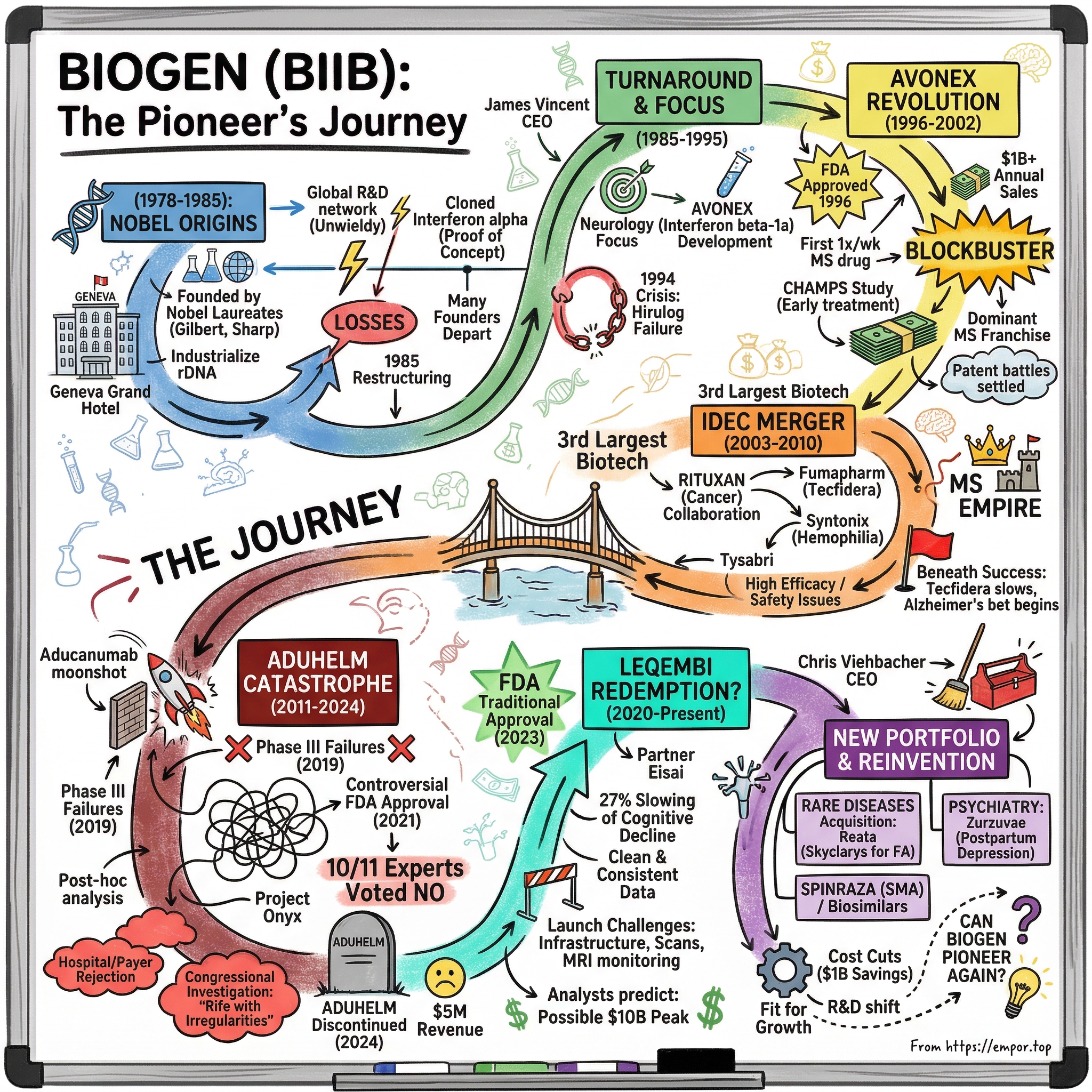
Biogen: The Pioneer that Lost Its Way (and Found It Again?)
I. Introduction & Cold Open
In the summer of 2021, pharmacy and therapeutics committees at some of the most respected hospitals in the United States held meetings that almost never make the news. The question before them was whether to stock a newly approved drug. The drug was Aduhelm, an intravenous antibody for early Alzheimer's disease from Biogen Inc., and the answer at institution after institution was no.
That refusal was extraordinary. The U.S. Food and Drug Administration had granted Aduhelm accelerated approval in June 2021—the first new Alzheimer's therapy cleared in nearly two decades. Approval normally functions as a green light; here, it served as the opening of an argument. Seven months earlier, the FDA's own Peripheral and Central Nervous System Drugs Advisory Committee had voted against the evidence supporting approval, an outcome so lopsided that several committee members resigned in protest after the agency approved the drug anyway. Biogen then priced Aduhelm at $56,000 per patient per year, a figure a subsequent congressional investigation described as unjustified by the drug's demonstrated value and set with an internal awareness of what it would do to Medicare.[^1]
The commercial system then did what the regulatory system had not. In April 2022, the Centers for Medicare & Medicaid Services finalized a national coverage determination restricting Medicare payment for amyloid-targeting antibodies that lacked traditional FDA approval to patients enrolled in FDA- or NIH-approved clinical trials.1 For a therapy whose target market was predominantly elderly Americans on Medicare, that was not a partial setback; it was the end. In November 2023, Biogen notified Neurimmune SubOne AG, the Swiss biotech that had discovered the antibody, that it was terminating their collaboration agreement, and the following January the company stopped selling and developing the drug entirely.2 Aduhelm had cost the better part of a decade, hundreds of millions of dollars in development and launch preparation, and something more valuable than either: the presumption that when Biogen claimed a drug worked, it worked.
The pedigree that makes it worse
Biogen was not a company that arrived late to the biotechnology era. Founded in 1978, it stands alongside Genentech and Amgen as one of the handful of firms present at the creation of the industry itself.2 Its founding scientists included two future Nobel laureates. It built the first major commercial franchise in multiple sclerosis and industrialized the manufacture of complex proteins when few others could. Yet over roughly a decade, the company watched its patent wall collapse, a gene-therapy acquisition fail twice, a flagship Alzheimer's program become a case study in regulatory controversy, and its core neurology franchise get out-competed by rivals selling more convenient versions of the same idea.
Where the numbers stand in August 2026
Where things stand in August 2026 remains contested. For fiscal year 2025, Biogen reported total revenue of $9.89 billion, up 2% from $9.68 billion in 2024—marking its first annual top-line increase in years—alongside GAAP diluted earnings per share of $8.79 and non-GAAP diluted EPS of $15.28.3 In the second quarter of 2026, revenue reached $2.74 billion, up 3%, and for the second consecutive quarter the company's "growth portfolio" out-earned the legacy multiple sclerosis business that had funded Biogen for a generation.4 Management subsequently raised full-year 2026 revenue guidance from a mid-single-digit percentage decline to a mid-single-digit increase.4 The stock, which had traded as low as roughly $132 within the past year, recovered to around $218, bringing Biogen's market capitalization near $32 billion.5
The central strategic question is therefore narrower and sharper than whether Biogen can recover. Under CEO Chris Viehbacher, the company that once discovered its own medicines has increasingly relied on external acquisitions—including Reata, HI-Bio, Alcyone, Apellis, and RayThera—financed increasingly with debt. While top-line growth has returned, it has been purchased rather than internally generated. For long-term investors, the fundamental issue is whether Biogen is compounding organic capability or renting inorganic revenue, and whether a management team judged by its own compensation committee to have delivered 13th-percentile shareholder returns over 2023–2025 has earned the benefit of the doubt on its next $5 billion in capital allocation.6
To understand why that question is so complex, the story begins in Geneva.
 Subscribe on LinkedIn
II. Nobel Origins & The Founding of Biotech (1978–1995)
In 1978, a group of European and American molecular biologists gathered in Geneva to discuss whether the new tools of recombinant DNA—the ability to cut, paste, and copy genes—could be turned into commercial medicines. Among them were Walter Gilbert of Harvard, Phillip Sharp of MIT, Charles Weissmann of the University of Zurich, Kenneth Murray of Edinburgh, and Heinz Schaller of Heidelberg. Gilbert would win the Nobel Prize in Chemistry in 1980; Sharp would win the Nobel Prize in Physiology or Medicine in 1993. The company they created was Biogen, and Biogen's official histories still date its founding to 1978.2
What recombinant DNA actually meant
The significance of what these scientists were proposing is best understood through the analogy of a printing press. Before recombinant DNA, a protein drug had to be extracted from living tissue in minuscule quantities. Weissmann's group cloned the gene for human interferon alpha, which meant that instead of harvesting a signaling protein from blood, scientists could instruct bacteria to manufacture it at scale. Biological manufacturing shifted from foraging to printing.
The near-death experience, and the operator who fixed it
What followed established a pattern repeated across biotech history: scientific validation preceded commercial success. Interferon was initially heralded as a broad cancer therapy, but proved in practice to be a niche antiviral. Biogen burned cash through the early 1980s on an unfocused research portfolio, and by mid-decade the company faced severe liquidity pressures.
The fix was managerial rather than scientific. James Vincent, an experienced operating executive, took over in the mid-1980s, trimmed exploratory programs, consolidated operations in Cambridge, Massachusetts, and focused on the one asset generating immediate cash flow: intellectual property. Biogen's early survival depended substantially on licensing income, including royalties on hepatitis B vaccines and alpha interferon commercialized by corporate partners.
That structural model remains central to Biogen in 2026. The company has historically derived a substantial share of its profits from third parties selling drugs it helped invent. In 2025, revenue from anti-CD20 therapeutic programs—chiefly royalties on Roche's Ocrevus alongside a share of profits on Rituxan, Gazyva, and Lunsumio—totaled $1.86 billion, with the Ocrevus royalty alone accounting for $1.41 billion.2 That represented roughly 19% of Biogen's total top line, generated with almost no associated cost of goods, dedicated sales force, or clinical development expense. It remains the company's highest-margin income stream, produced entirely by outside partners.
Choosing neurology
The second structural choice of this era was the strategic decision to enter neurology. Rather than competing in oncology against larger, better-capitalized pharmaceutical firms, Biogen directed its interferon expertise toward multiple sclerosis—a chronic autoimmune disease in which the immune system attacks the protective myelin sheath surrounding nerve fibers.
From a commercial perspective, multiple sclerosis offered an attractive target profile: patients were diagnosed relatively young, treatment was lifelong, the specialist prescriber base was compact enough to cover with a targeted sales force, and existing therapeutic options were minimal.
For long-term investors, the key takeaway from Biogen's first seventeen years is not its academic lineage. It is that the company survived by monetizing intellectual property while a single core therapeutic bet matured, with financial discipline imposed by a professional manager who kept research spending from consuming the balance sheet. Both dynamics—reliance on high-margin royalties and externally driven cost discipline—define Biogen in 2026 much as they did in 1985. The critical transition came in 1996, when Biogen finally brought its own proprietary drug to market.
III. The MS Empire Built: Avonex, Tysabri, and Tecfidera (1996–2014)
Avonex, an interferon beta-1a injected once weekly into muscle, received initial U.S. approval in 1996 for relapsing forms of multiple sclerosis.7 Although it was not a cure, it reduced relapse frequency and slowed disability accumulation. More importantly for Biogen, Avonex was the first drug the company commercialized directly rather than licensing to third parties. It established the core commercial infrastructure—neurologist relationships, specialty distribution channels, and patient support services—that supported all subsequent drug launches.
Biogen aggressively defended its market position. Its multi-year patent litigation against Schering AG's Berlex unit demonstrated an operational principle that became central to Biogen's strategy: in commercial biotechnology, a proprietary molecule is only half the asset; the patent enforcement surrounding it forms the other half.
Tysabri: the crisis Biogen handled brilliantly
The second major product in the franchise was Tysabri (natalizumab), approved in late 2004 as a potential step change in treatment efficacy. However, in February 2005, Biogen and its partner Elan voluntarily pulled the drug from the market after three patients developed progressive multifocal leukoencephalopathy (PML), a rare and frequently fatal brain infection caused by the reactivation of the JC virus in immunocompromised patients.8 Roughly 3,000 patients had received the therapy, and early estimates suggested as many as one in a thousand treated patients might develop PML.8 For most drugs, a risk profile of that severity would have permanently ended commercial development.
Instead of abandoning the asset, Biogen collaborated with regulators to establish a restricted distribution program and later commercialized a diagnostic blood test for JC virus antibodies. Because patients without prior exposure to the virus faced a dramatically lower risk of developing PML, clinical management shifted from asking whether Tysabri was too dangerous overall to identifying which specific patient populations could safely receive it. This early application of stratified medicine allowed Tysabri to return to the market in 2006 under a mandatory monitoring program. The therapy grew into a multi-billion-dollar product; by 2025, it generated $1.67 billion in revenue and remained, alongside Spinraza, one of only two products individually accounting for more than 10% of Biogen's total revenue.2
Tecfidera: the pill that made the decade, and set the trap
The third pillar of the multiple sclerosis franchise was Tecfidera (dimethyl fumarate), an oral pill approved in 2013. Biogen acquired the underlying fumarate chemistry by purchasing Swiss biotech firm Fumapharm. The business model proved exceptionally lucrative: an orally administered small molecule sold at biologic-level prices into a disease market Biogen already dominated. Tecfidera became the most prescribed oral multiple sclerosis therapy globally, generating over $4 billion annually at peak with high gross margins. Biogen continued paying out on the transaction for years, including a $300 million contingent consideration payment tied to the Fumapharm acquisition recorded in the company's 2019 cash flows.9
Despite this commercial success, the multiple sclerosis franchise concealed structural vulnerabilities. By 2014, Biogen's revenue engine depended on three single points of failure. Avonex was an aging injectable facing competition from more convenient alternatives. Tysabri carried severe safety warnings that constrained its addressable patient population. Most critically, Tecfidera was protected not by biological complexity or difficult manufacturing processes, but by a single patent covering a specific dosing regimen. At its financial core, Biogen's competitive position in multiple sclerosis rested heavily on legal defensibility.
At the time, corporate communications emphasized neurology leadership, disease expertise, and an entrenched market position. That narrative, however, faced an impending test—and understanding how exposed Biogen had become requires examining how management allocated the substantial cash flow generated by its core franchise.
IV. Capital Allocation & The IDEC Merger Record (2003–2018)
On June 23, 2003, Biogen and IDEC Pharmaceuticals announced a merger of equals valued at approximately $6.8 billion, with Biogen shareholders receiving 1.15 shares of the combined company for each share held. On paper, it was a coastal marriage—Cambridge neurology meeting San Diego oncology. In substance, it proved to be one of the most lucrative annuity purchases in biotechnology history.
The annuity that keeps paying
What IDEC brought to the transaction was its share of Rituxan, the anti-CD20 antibody co-developed with Genentech that became one of the top-selling drugs in industry history. Biogen did not need to manufacture, market, or fund the drug's ongoing development. Genentech, and later Roche, handled operations while Biogen collected a share of pre-tax profits. When Roche subsequently developed Ocrevus—a next-generation anti-CD20 antibody for multiple sclerosis—Biogen's legacy contract entitled it to a tiered royalty on U.S. net sales starting at 13.5% and rising to 24% once annual sales exceeded $900 million, alongside a 3% gross royalty outside the U.S. lasting eleven years from first commercial sale in each country.2
That structure created one of the stranger paradoxes in large-cap pharmaceuticals: Roche's Ocrevus became the single most effective commercial threat to Biogen's core multiple sclerosis business, yet Biogen profited from every dose. In 2025, Biogen's Ocrevus royalty revenue rose 5.6% to $1.41 billion, even as Biogen's own multiple sclerosis product revenue fell 7.1% to $4.04 billion.2 The company was effectively short its own product line while long its principal competitor.
Investors must be precise about what this arrangement demonstrates. The Ocrevus revenue stream does not represent recent strategic foresight; it is an inherited dividend from a 2003 transaction. Nor is it permanent. According to company disclosures, U.S. royalty rates will be cut by 50% upon the first entry of an FDA-approved Ocrevus biosimilar, while international royalties simply expire eleven years after the first commercial sale in each country.2 Consequently, roughly a fifth of Biogen's revenue—and a disproportionate share of its high-margin profits—remains tied to a fixed timeline that management cannot extend.
What Biogen did with the money
The broader capital allocation record from this era presents a sharper contrast. Rather than using cash flows from the IDEC merger and Tecfidera to build a replenished early-stage pipeline, Biogen narrowed its operational footprint. It spun off its hemophilia business as Bioverativ in 2017—a move defended as a sharpening of strategic focus, but one that looked far less advantageous after Sanofi acquired Bioverativ the following year. Meanwhile, management returned substantial capital to shareholders. Biogen repurchased approximately $6.7 billion of its own stock in 2020 and another $1.8 billion in 2021—executing massive share buybacks at precisely the time its Tecfidera patent wall was collapsing and its Alzheimer's program was stumbling commercially.9
This capital allocation track record left a mixed scorecard for the 2003–2018 era. Biogen secured one transformational deal whose ultimate value depended on an outside partner's execution and is now running on a finite clock. It executed one highly successful targeted acquisition in Fumapharm. Yet it also completed a spinoff that left substantial upside on the table for an acquirer, while directing billions into share repurchases funded by cash flows that proved far less durable than management assumed. Returning capital aggressively while an internal pipeline thins rests on an implicit premise: that cash will not be needed for internal reinvention. Biogen made that bet, and the subsequent three years put that assumption to the test.
V. Historical Falsification: Patent Collapses, M&A Write-downs, and Pipeline Failures (2019–2021)
Falsification Test 1: "Biogen's MS patent wall protects cash flows"
The premise—stated explicitly by management and embedded across Wall Street financial models in 2019—held that Tecfidera's patent protection would extend into the late 2020s, securing a stable stream of high-margin cash flow.
That premise unravelled in June 2020, when a U.S. district court in West Virginia ruled in favor of generic manufacturer Mylan, invalidating key claims of Biogen's main Tecfidera patent for lack of adequate written description. Biogen appealed immediately and sought an injunction, but the Federal Circuit affirmed the decision in November 2021, and a subsequent petition to the Supreme Court failed to overturn the verdict.9
What followed was a rapid erosion of the product line. More than ten generic manufacturers launched discounted versions of dimethyl fumarate in the United States. U.S. fumarate sales plummeted 60.3% in 2021 alone, driving Tecfidera from roughly $4.4 billion in annual global revenue at its 2019 peak down to a small fraction of that total within two years.9
The episode demonstrated a fundamental structural vulnerability. Biogen's competitive moat in oral multiple sclerosis rested neither on complex manufacturing processes nor on distinct clinical advantages; it depended on a single patent, making its failure mode binary. Neither the company's established commercial footprint, nor its prescriber relationships, nor its brand equity slowed the revenue collapse by more than a few months.
The legal fallout remains ongoing. In consolidated federal antitrust proceedings in Illinois, health funds and municipalities filed an amended complaint in October 2025 alleging antitrust and RICO violations stemming from Biogen's contracts with pharmacy benefit managers for Tecfidera and Vumerity, following related claims filed by Walgreen and Kroger in September 2025.2
For investors, the broader lesson is structural: a single asset has yielded a patent loss, a sudden top-line collapse, and a multi-front litigation overhang.
Falsification Test 2: "Targeted external M&A replenishes the pipeline"
In June 2019, Biogen acquired Nightstar Therapeutics for $25.50 per share in cash—totaling $847.6 million, alongside $4.6 million in equity compensation—to secure two mid-to-late-stage gene therapies for inherited retinal disorders: BIIB111 for choroideremia and BIIB112 for X-linked retinitis pigmentosa.9
Both candidates failed in clinical testing. Biogen took a $115.0 million impairment charge on BIIB111 in 2020, followed in 2021 by additional write-downs of $365.0 million on BIIB111 and $220.0 million on BIIB112, alongside a $44.3 million charge on vixotrigine and a $75.4 million charge on Parkinson's antibody BIIB054.9
Investors should evaluate these results beyond the general hazards of biotechnology. For an acquisition-led growth strategy, the central question is whether management's clinical underwriting and due diligence have proven reliable. Under previous leadership, the Nightstar transaction suggests they did not: Biogen purchased two late-stage assets in a technical modality outside its core expertise, and both missed their primary clinical endpoints. Rather than demonstrating that external deals reliably rebuild the pipeline, Biogen's largest gene-therapy acquisition achieved the opposite.
A relevant distinction is that Biogen's current chief executive and head of development did not orchestrate the Nightstar purchase. However, that context narrows the analytical focus to whether acquisitions executed since late 2022 demonstrate improved discipline. Early asset write-downs remain a key performance metric: Biogen has already recorded a $40.0 million write-down on early-stage intangible assets acquired from Reata—reducing their book value to zero—alongside a $7.9 million impairment on compounds acquired from HI-Bio.2
While neither charge is financially material on its own, both offer early signals regarding asset valuation discipline under current leadership.
Competitive substitution: the moat erodes from a direction nobody defended
While Biogen defended its patent positions in court, competitors captured market share. Roche's Ocrevus established a strong foothold by offering a twice-yearly infusion based on B-cell targeting. Novartis then introduced Kesimpta, a monthly at-home subcutaneous anti-CD20 injection that removed the need for clinic visits altogether.
This shift highlights a recurring dynamic in specialty pharmaceuticals: in chronic disease management, convenience drives real-world adherence. A treatment that patients can easily administer at home steadily gains market share over therapies requiring regular clinic visits, even when comparative efficacy data remain nuanced.
As a result, Biogen's multiple sclerosis product revenue declined steadily from $4.66 billion in 2023 to $4.35 billion in 2024 and $4.04 billion in 2025, with management projecting further contraction as Tecfidera faces accelerating European generic competition and Tysabri loses share to a biosimilar approved in the United States and European Union in 2023.2
That ongoing contraction left Biogen urgently needing a new growth driver—leading directly to its high-stakes bet on Alzheimer's disease.
VI. The Aduhelm Catastrophe: Regulatory Capture, Hubris, and Commercial Collapse (2019–2024)
March 2019: the futility analysis
On a Thursday morning in March 2019, Biogen halted two Phase 3 trials of aducanumab. An independent data monitoring committee had conducted a futility analysis on the EMERGE and ENGAGE studies and concluded that the drug would not meet its primary endpoints. Biogen's stock lost roughly a third of its value in a single day. Executives told investors that the amyloid hypothesis had been given its best shot and had missed.
The antibody itself came from Neurimmune, the Swiss biotechnology company Biogen had partnered with in 2007; Biogen had consolidated Neurimmune's results for years because it funded 100% of the collaboration's research and development costs.2 Aducanumab was designed to clear amyloid-beta plaques—the protein deposits that accumulate in the brains of Alzheimer's patients. Yet clearing plaque had never previously been shown to improve cognitive function. That remained the central scientific question.
October 2019: the reversal
Seven months later, Biogen reversed course. After additional data accumulated past the futility cutoff, a post-hoc analysis of patients receiving the high dose in one of the two trials showed a statistically significant benefit. The other trial showed no such effect. Nevertheless, Biogen submitted a Biologics License Application to the FDA.
While Biogen presented a scientific rationale for its decision, the approach carried a well-understood statistical hazard: analyzing enough post-hoc subgroups across multiple datasets increases the likelihood of finding a result that clears the p < 0.05 threshold by chance. When the FDA's advisory committee reviewed the data in November 2020, members voted overwhelmingly against approval, with ten opposed, one uncertain, and none in favor.
June 2021: approval anyway
In June 2021, the FDA granted accelerated approval based on a surrogate endpoint—reduction of amyloid plaque—rather than demonstrated clinical cognitive benefit. In response, three advisory committee members resigned in protest.
The controversy extended beyond clinical debate to the regulatory process itself. A December 2022 joint staff report by the House Committee on Oversight and Reform and the Committee on Energy and Commerce documented extensive interaction between Biogen and the FDA. The report detailed an internal working group whose contacts the committees deemed inappropriate for an arm's-length review, as well as joint work on the briefing document presented to the advisory committee.[^1] The investigation also revealed that Biogen set Aduhelm's $56,000 annual list price to "make history" commercially, despite internal projections detailing what the resulting burden on Medicare would be.[^1]
The market says no
Commercial rejection followed rapidly. In April 2022, the Centers for Medicare & Medicaid Services finalized a national coverage determination restricting payment for accelerated-approval amyloid antibodies to patients enrolled in clinical trials.1 Major academic medical centers refused to administer the therapy. Cumulative sales never reached commercially viable levels. By the time Biogen terminated its Neurimmune agreement in November 2023 and discontinued the program, Aduhelm was reported inside the company's financials as a rounding item bundled with Fumaderm.2
What it cost, beyond the money
The direct financial write-offs represented only part of the damage; three broader consequences persist into 2026.
First, legal exposure. Biogen and several current and former officers remain defendants in federal securities class actions in Massachusetts related to public statements about Aduhelm—including a November 2020 lawsuit and a February 2022 action led by the Oklahoma Firefighters Pension and Retirement System. The litigation expanded in 2024 with an action involving statements about Leqembi, Tecfidera, and Vumerity, alongside five stayed shareholder derivative actions naming the board.2 Although the Securities and Exchange Commission closed its Aduhelm-related enforcement inquiry in April 2025 without recommending action—a meaningful data point in the company's favor—private litigation continues.2
Second, an active commercial dispute with the drug's originator. In May 2025, Biogen sued Neurimmune seeking a declaratory judgment on its rights under the terminated agreement; in September 2025, Neurimmune counterclaimed for breach of contract and unfair competition.2 The relationship that produced the drug has transformed into an active legal contingency.
Third, a lingering credibility discount. Investors and prescribers now approach Biogen's clinical data interpretations with heightened skepticism. When management characterizes a trial result as compelling, market participants look first to the primary endpoint. That skepticism faces another test on a different molecule.
The executive hired to navigate these challenges, Chris Viehbacher, assumed the chief executive role in November 2022—just three weeks before the congressional report landed.
VII. The Turnaround Under Chris Viehbacher: Strategy & Portfolio Restructuring (2022–Present)
The operator
Christopher Viehbacher is not a scientist. A Canadian-German accountant by training, he spent two decades at GlaxoSmithKline before serving as CEO of Sanofi from 2008 to 2014, where his defining transaction was the $20 billion acquisition of rare-disease specialist Genzyme—a hostile offer that turned negotiated and ultimately paid off. After leaving Sanofi following a board dispute, he managed a healthcare investment fund and joined Biogen's board before stepping into the chief executive post.
His reputation is distinct: Viehbacher is a capital allocator and operational cost cutter who is comfortable purchasing growth rather than a research visionary tasked with rebuilding an in-house discovery engine. That orientation matched Biogen's immediate predicament, but it also defines the central risk in his strategy.
Reata: the first bet
In September 2023, Biogen closed its acquisition of Reata Pharmaceuticals for $172.50 per share in cash—a transaction valued at approximately $7.3 billion and funded substantially with new debt.10 The primary asset was Skyclarys (omaveloxolone), the first approved treatment for Friedreich's ataxia, a rare inherited neurodegenerative condition.
Evaluated strictly as a commercial product, the acquisition is delivering results. Global revenue for Skyclarys grew 36.1% to $520.5 million in 2025, supported by rollouts across Europe and the Middle East as the global patient base expanded by roughly 30%.23 In the second quarter of 2026, revenue reached $168 million—up 29% year over year—with commercial availability extending to 36 countries.4
Evaluated as a broader platform deal, however, the purchase was far less successful. Biogen wrote the acquired early-stage Reata intangibles to zero with a $40.0 million impairment in 2024, followed by a $52.9 million write-down in 2025 on the right-of-use asset for Reata's leased facility.2 In effect, Biogen paid roughly $7.3 billion for a single commercial drug and its international expansion potential rather than a durable research engine. Whether that purchase price proves justified depends entirely on where Skyclarys sales ultimately peak—a question addressed directly in Section XII as a central element of the bear case.
HI-Bio, Alcyone, and the pivot into immunology
In May 2024, Biogen agreed to acquire Human Immunology Biosciences (HI-Bio) for $1.15 billion upfront plus potential milestone payments, primarily to obtain felzartamab, an anti-CD38 antibody targeting plasma cells in immune-mediated kidney diseases.11 Felzartamab has become the company's most significant pipeline asset. Biogen initiated Phase 3 trials in IgA nephropathy (the PREVAIL study) and primary membranous nephropathy (the PROMINENT study) in June 2025, following the March 2025 launch of a Phase 3 trial in antibody-mediated rejection among kidney transplant patients (the TRANSCEND study), which triggered a $30.0 million milestone payment to MorphoSys.2 However, Biogen discontinued an open-label Phase 1b study in lupus nephritis in November 2025—a reminder that clinical expansion carries inherent failure risk.2
In November 2025, Biogen acquired Alcyone Therapeutics for its ThecaFlex DRx implanted delivery port, a device designed to ease repeated intrathecal administration of Spinraza, offering up to $75.0 million in additional milestones upon regulatory approval.12 Though modest in size, the deal followed a straightforward tactical rationale: reduce the administration burden rivals had exploited to gain market share.
Apellis: the big one
On May 14, 2026, Biogen completed a tender offer for Apellis Pharmaceuticals at $41.00 per share in cash—an equity value of approximately $5.3 billion—alongside a contingent value right worth up to $4.00 per share tied to future Syfovre sales thresholds.1312 Apellis brought two commercial complement-pathway therapies: Syfovre for geographic atrophy, an advanced form of age-related macular degeneration, and Empaveli for paroxysmal nocturnal hemoglobinuria and rare complement-driven kidney conditions. Combined, the two drugs generated $689 million in net product revenue in 2025.13
The transaction's balance-sheet impact warrants close inspection. Biogen funded the acquisition using cash on hand alongside a $2.0 billion term loan and a $400 million draw on its revolving credit facility.12 Consequently, net debt climbed from approximately $2.0 billion at year-end 2025 to roughly $6.8 billion by June 30, 2026, while cash reserves fell from $4.2 billion to $1.3 billion.34 Management projected approximately $0.85 in non-GAAP earnings per share dilution in 2026, followed by earnings accretion in 2027 and at least $250 million in annual run-rate cost synergies exiting 2027, primarily achieved by eliminating overlapping administrative overhead.4
The strategic logic is straightforward: Apellis brings established nephrology commercial and medical operations that Biogen can leverage to launch felzartamab, whose first Phase 3 data in antibody-mediated rejection are expected in the first half of 2027.13 Acquiring targeted commercial infrastructure ahead of a key launch is a recognized strategy.
Yet the financial leverage introduces tangible risk. Biogen has committed roughly $14 billion across Reata, HI-Bio, and Apellis to construct a replacement growth portfolio—funding the expansion with leverage while its highest-margin revenue source remains a third-party royalty subject to future biosimilar erosion. The deal activity has continued: in June 2026, Biogen acquired RayThera for $225 million upfront and up to $775 million in milestones for a Phase 1 immunology candidate.12
Fit for Growth, completed
The cost-reduction program Viehbacher launched in 2023 met its primary objective. Biogen disclosed that its "Fit for Growth" initiative generated approximately $1.0 billion in gross annual operating expense savings by the end of 2025, reduced net headcount by roughly 1,400 employees, and incurred approximately $320.0 million in restructuring charges.2 As management acknowledged, a portion of those savings was reinvested into business development rather than dropped to the bottom line.
Executing an operational cost reduction on schedule demonstrates managerial discipline. Yet structural cost cutting is ultimately easier to achieve than commercial underwriting. The far harder test—whether $14 billion in external acquisitions will generate an adequate return on capital—will begin yielding evidence in 2027 against the backdrop of a $6.8 billion net debt load.
VIII. Core Business & Segment Financials: Dissecting the Cash Flow Engine
Behind the strategic narrative, Biogen in 2026 functions as four distinct operating units, each displaying markedly different growth trajectories, profit margins, and long-term durability. Identifying how these segments cross-subsidize one another defines the company's overall financial profile.
The declining core: multiple sclerosis
In the second quarter of 2026, multiple sclerosis product revenue fell 13% year over year to $963 million, with the legacy portfolio—Avonex, Plegridy, Tecfidera, and Tysabri—contributing $767 million.4 For full-year 2025, the multiple sclerosis franchise generated $4.04 billion.2
The segment's internal composition is more illuminating than the headline total. Tysabri generated $1.67 billion in 2025, declining just 2.9% as high switching costs preserved its base against anti-CD20 competition and European biosimilar entry, reflecting neurologists' reluctance to alter treatment for stable patients.2 Interferons continued their structural decline, dropping to approximately $946 million in 2025.2 Meanwhile, Vumerity—the fumarate successor designed to buffer against Tecfidera generic erosion—grew 18.9% to $746.8 million, aided by favorable adjustments to rebate estimates.2 Management explicitly excludes Vumerity from its legacy multiple sclerosis decline projections, signaling that the remainder of the original franchise is in structural runoff.
For investors, the legacy multiple sclerosis business acts not as a durable franchise, but as a melting ice cube with an unusually slow rate of decay. It produces substantial cash today, but revenue will contract predictably year after year.
The growth engine: rare disease and new launches
Rare disease revenue expanded 8.4% to $2.15 billion in 2025.2 Spinraza, the spinal muscular atrophy therapy, anchored the segment at approximately $1.55 billion globally, reflecting $625.5 million in flat U.S. sales and $921.3 million internationally, down 2.8%.2 Maintaining relative stability represents an operational achievement given competition from Roche's oral Evrysdi and Novartis's gene therapy Zolgensma.
Biogen's defense centers on higher dosing. The FDA approved a high-dose Spinraza regimen in March 2026. On the second-quarter earnings call, North America president Alisha Alaimo stated that conversion rates exceeded the drug's original launch trajectory across both treatment-naive and switching patients in its first thirteen weeks, while reporting anecdotal returns from oral competitors.14 Spinraza revenue rose 2% to $402 million in the second quarter of 2026.4 While this represents an effective defensive hold, it protects existing revenue rather than expanding the total market, and early conversion quarters are typically boosted by channel inventory stocking.
Skyclarys represents the clearest growth driver in the portfolio. Meanwhile, Zurzuvae—the oral postpartum depression therapy co-commercialized with Supernus—grew 53% to $71 million in the second quarter following its launch in Germany.4 Zurzuvae's commercial ceiling was largely established in August 2023 when the FDA approved it for postpartum depression but issued a complete response letter for major depressive disorder, citing insufficient evidence of efficacy in the far larger market. That regulatory division constrained what might otherwise have been a broader psychiatric indication.
Qalsody, approved for SOD1-mutation ALS, generated $86.9 million in 2025—clinically meaningful for a target patient subset, but immaterial to overall corporate earnings.2
The new leg: specialized immunology
Syfovre and Empaveli entered Biogen's consolidated financial results mid-quarter following the acquisition's close on May 14, 2026, contributing $128 million in reported product revenue.4 On a full-quarter basis, Syfovre generated $162 million, up 8% on peak volume demand since launch, while Empaveli reached $46 million, up 123%.4 Alaimo noted on the call that free-drug distribution had been reduced by approximately half through stricter access guardrails, resolving an issue where a significant portion of prior demand had been uncompensated.14
The financial engine nobody talks about
Beneath the commercial product lines lie two cash flow channels that account for a disproportionate share of total corporate profitability.
The first is the anti-CD20 revenue stream, which grew 6.3% to $1.86 billion in 2025, driven primarily by royalties on Roche's Ocrevus.2 This revenue flows to Biogen with virtually no associated operational cost.
The second comprises biosimilars, contract manufacturing, and peripheral royalties, which generated $729.1 million and $732.9 million respectively in 2025. These lower-margin streams are increasingly volatile as Biogen divests non-core assets; the company sold its rights to Tofidence and Byooviz during 2025 and returned Byooviz commercialization to Samsung Bioepis effective January 2026 for a $28.0 million payment.2
The Alzheimer's collaboration line—reflecting Biogen's 50% share of net revenue and development expense for Leqembi with Eisai Co., Ltd.—recorded $177.7 million in 2025 and $64 million in the second quarter of 2026.24 Three years after initial approval, the most scientifically prominent drug in Biogen's portfolio accounts for less than 3% of total revenue.
What the cost structure says
Full-year 2025 non-GAAP cost of sales stood at 21% of revenue, while non-GAAP R&D spending declined 7% to $1.73 billion, as Fit for Growth savings offset expanding Phase 3 trials for felzartamab and litifilimab.3 Free cash flow reached approximately $2.1 billion for the year.3 By the second quarter of 2026, however, the financial impact of recent M&A emerged: GAAP cost of sales rose to 28% of revenue due to product mix shifts, R&D expense increased 33%, SG&A costs grew 22% with the integration of Apellis's commercial infrastructure, and acquired IPR&D and milestone expenses totaled $164 million.4
Two accounting details clarify the earnings outlook. Biogen excludes acquired IPR&D charges from its initial full-year guidance until realized. As a result, reported GAAP EPS guidance fell from $15.25–$16.25 in February to $12.00–$13.00 in July, even as management raised non-GAAP operational guidance to $15.85–$16.85.4 While both figures are accurate under their respective accounting frameworks, only the lower GAAP range incorporates the upfront capital spent on external assets. Separately, a $200 million R&D funding contribution from Royalty Pharma lowered reported 2025 R&D expense—a real cash offset, but not a permanent structural reduction in development costs for litifilimab.2
Structural concentration risks remain notable: two wholesale distributors accounted for 28.0% and 15.8% of gross product revenue in 2025, while Tysabri and Spinraza each individually generated more than 10% of total revenue.2 Customer and product concentration leaves top-line performance vulnerable to isolated supply chain or clinical disruptions.
In summary, Biogen's declining multiple sclerosis core and inherited anti-CD20 royalties still provide the foundation for corporate profits. While the acquired growth portfolio has surpassed legacy multiple sclerosis in revenue, it has yet to match its profit margins and was assembled using significant debt. Corporate performance now depends on whether these acquired and partnered assets can generate sufficient cash flow to service that leverage.
That leads directly to the asset with the largest addressable market and the longest history of disappointment.
IX. The Alzheimer's Frontier: Leqembi Economics & Competition
The science that finally worked, sort of
In July 2023, the FDA converted Leqembi (lecanemab) to traditional approval based on data from the Phase 3 Clarity AD trial, which demonstrated a 27% slowing of cognitive decline over 18 months compared with placebo.15 Unlike its predecessor Aduhelm, lecanemab met its primary endpoint in a prospectively designed confirmatory study. This represented a genuine scientific milestone: the first clear clinical evidence that removing amyloid-beta plaque alters the progression of Alzheimer's disease.
However, the absolute magnitude of that benefit requires realistic assessment. A 27% slowing over 18 months does not restore lost cognitive function or arrest disease progression; it buys incremental time. Whether that statistical difference translates into a meaningful clinical outcome for patients and families remains a subject of active debate among clinicians.
Falsification Test 3: "Leqembi will replace declining MS cash flows"
The bullish thesis in 2023 posited that Leqembi would generate over $1 billion in annual revenue by 2024 or 2025, rapidly stepping into the financial void left by the eroding multiple sclerosis franchise.
That projection failed to materialize due to structural healthcare bottlenecks rather than commercial execution. Diagnostic protocols required confirming amyloid pathology via PET scans or lumbar punctures—diagnostic infrastructure that most health systems lacked at scale. Treatment required bi-weekly intravenous infusions. Furthermore, safety monitoring for amyloid-related imaging abnormalities (ARIA)—brain swelling and microhemorrhages that are typically asymptomatic but occasionally severe—mandated a dense schedule of MRI scans in the first year, creating operational burdens and liability concerns for community neurologists.
International reimbursement hurdles further slowed adoption. The European Commission approved Leqembi in April 2025, but restricted coverage to ApoE ε4 non-carriers and heterozygotes—excluding the highest-risk genetic subgroup entirely—with country-by-country commercial rollouts beginning in August 2025.2 Additional regulatory approvals followed in Australia, China, Canada, and the United Kingdom through the second half of 2025, each carrying specific dosing and safety monitoring mandates.2
Consequently, commercial ramp-up has been modest relative to initial expectations. Biogen's 50% share of collaboration revenue yielded $177.7 million in 2025.2 Global in-market sales reached $184 million in the second quarter of 2026—a 15% sequential increase—with the U.S. market contributing $97 million.4 Eisai's financial reporting placed global Leqembi revenue at approximately ¥88 billion for its fiscal year ended March 2026, while forecasting ¥143.5 billion for the following fiscal year.16
The verdict on Falsification Test 3: the original thesis that Leqembi would rapidly offset declining multiple sclerosis revenues is rejected. While Leqembi has established itself as the leading commercial anti-amyloid therapy by revenue, its growth trajectory will not replace legacy multiple sclerosis cash flows on a timeline relevant to 2026 investors. The revised, testable hypothesis is substantially narrower: whether Leqembi can develop into a $1 billion to $2 billion global product, of which Biogen captures half the economics.
The unlock: taking the infusion centre out of the equation
Commercial expansion may depend on resolving the administration bottleneck—mirroring how convenient administration reshaped the multiple sclerosis market described in Section V.
In August 2025, the FDA approved Leqembi IQLIK, a subcutaneous autoinjector, for weekly maintenance dosing following 18 months of intravenous therapy. On July 13, 2026, the FDA expanded approval for IQLIK to include initiation dosing—administered as two 500 mg injections taking roughly 15 seconds each week—making Leqembi the first anti-amyloid therapy eligible for at-home initiation and maintenance via specialty pharmacy distribution, with U.S. commercial availability planned for late August 2026.17 Management highlighted the approval as a pivotal catalyst on Biogen's second-quarter 2026 earnings call, with North America president Alisha Alaimo arguing that at-home administration directly addresses the patient drop-off caused by infusion center logistics.414
The strategic rationale aligns with historical precedent: Novartis's Kesimpta demonstrated that self-administered subcutaneous injections can capture significant market share from clinic-bound infusions. However, empirical evidence that subcutaneous delivery will accelerate Leqembi adoption does not yet exist. Investors should evaluate management's growth expectations as a plausible hypothesis requiring quarters of commercial proof.
The competitor and the coming test
Eli Lilly's Kisunla (donanemab), approved in July 2024, competes on a distinct treatment paradigm. Because Kisunla clears amyloid plaque more aggressively, protocol permits treatment discontinuation once plaque clearance is confirmed, lowering total lifetime treatment cost and patient burden. Leqembi, by contrast, requires continuous maintenance therapy. Eisai's disclosures indicating that Leqembi has outsold Kisunla in both the U.S. and Japan show that prescribers have not defaulted solely to a finite-dosing model. Nevertheless, a subcutaneous, self-administered Leqembi and a finite-duration Kisunla now offer distinct value propositions that payors and clinicians will evaluate closely.
The partnership itself is under strain
Beyond commercial competition, joint governance of the franchise faces operational friction. In June 2025, Biogen filed a request for arbitration with the International Chamber of Commerce seeking a commercialization plan for European territories that allocates responsibilities between Biogen and Eisai "in an equitable fashion" with "a meaningful role for each party."2 Commercial partners rarely initiate formal arbitration over regional launch execution when joint governance operates smoothly. For an asset structured around a 50/50 economic split that is intended to anchor Biogen's long-term product line, this legal dispute represents a noteworthy governance contingency.
And the third act: tau
On May 14, 2026, Biogen reported top-line Phase 2 CELIA trial results for diranersen (BIIB080), an antisense oligonucleotide targeting tau—the protein tangle that correlates more closely with cognitive decline than amyloid plaque. The trial missed its primary endpoint of establishing a clear dose-response relationship. However, the study demonstrated consistent reductions in tau biomarkers and a slowing of clinical decline across dose cohorts, with the most pronounced clinical effect observed at the lowest tested dose of 60 mg every 24 weeks.18
Biogen characterized the trial findings as "unprecedented and compelling" and confirmed plans to advance diranersen into Phase 3 registrational studies.18 Wall Street analysts reacted cautiously: Stifel analyst Paul Matteis noted that the inverted dose-response curve remained an unresolved question, while RBC Capital Markets analyst Brian Abrahams highlighted limited disclosure regarding absolute effect size. Biogen's stock declined approximately 5% following the announcement.18
This clinical setup echoes the pattern documented in Section VI: a trial missing its primary endpoint, post-hoc encouragement drawn from a specific dose cohort, and management applying superlative language before advancing to expensive Phase 3 trials. While diranersen targets a distinct biological pathway and demonstrated measurable biomarker reductions, the analytical burden of proof rests on Biogen. Initiating Phase 3 studies based on an inverted dose-response profile represents a high-risk research strategy. Chief Executive Chris Viehbacher offered a more tempered assessment on the earnings call, framing diranersen as a long-term, high-risk opportunity.14
X. Playbook & Strategic Frameworks: 7 Powers & Porter's 5 Forces
Hamilton Helmer's 7 Powers, applied honestly
Process power: weakened, not gone. Biogen's historical edge lay in manufacturing complex biologics reliably at scale—an advantage that persists in its contract manufacturing revenue but no longer differentiates the company. Monoclonal antibodies are now routinely produced by dozens of peers. The Tecfidera experience demonstrated the opposite extreme: a simple small molecule that anyone could synthesize, protected entirely by legal enforcement rather than manufacturing complexity.
Cornered resource: partially real, and expiring. The Ocrevus royalty is a genuine cornered resource—an irreplicable contractual entitlement to a share of a rival's cash flows. Yet it is not a renewable asset. The 50% reduction in U.S. royalty rates upon biosimilar entry, alongside the eleven-year term outside the U.S., are written directly into the underlying agreement.2 Treating this high-margin cash flow as perpetual remains one of the most common analytical errors in evaluating Biogen.
Switching costs: real in narrow places. Tysabri's durability and Spinraza's stability under pressure from oral and gene-therapy competitors demonstrate real patient and physician stickiness in chronic neurology. Clinicians rarely transition stable patients without a compelling clinical reason. This inertia represents Biogen's most underrated advantage, explaining why its legacy multiple sclerosis revenue has contracted gradually rather than falling off a cliff.
Branding: damaged, measurably. In specialty biopharmaceuticals, brand equity translates into credibility with prescribers, payors, and regulators. The Aduhelm launch eroded much of that equity, while ongoing securities and derivative litigation keeps the episode legally active.2 The clearest market-based evidence of this credibility discount was the reaction to the diranersen Phase 2 readout: a first-in-class biomarker reduction that was met by a decline in the company's stock price.
Counter-positioning: absent. Biogen possesses no structural business model advantages that larger pharmaceutical competitors cannot replicate. Rivals such as Eli Lilly and Roche can outspend Biogen in neuroscience; in complement biology, Biogen entered the market via acquisition rather than novel counter-positioning.
Scale economies: modest. Biogen maintains established global specialty infrastructure—evidenced by the Skyclarys launch across 36 countries—and acquired Apellis's nephrology commercial organization specifically to support the future rollout of felzartamab.413 Expanding commercial scale represents the primary power that management's acquisition strategy actively builds.
Network economies: not applicable.
Porter's Five Forces
Buyer power: high and rising. Government payors, pharmacy benefit managers, and European health technology assessment bodies dictate commercial terms. Biogen has already absorbed margin pressure from the Inflation Reduction Act's Part D redesign within Vumerity's financial results, faces most-favored-nation pricing policy risks highlighted in its public filings, and is defending against a Humana lawsuit filed in February 2025 regarding patient assistance practices.2 Wholesale distributor concentration further accentuates buyer leverage.
Threat of substitutes: high. Anti-CD20 therapies in multiple sclerosis, oral risdiplam in spinal muscular atrophy, and finite-duration Kisunla in Alzheimer's disease all illustrate a recurring vulnerability: in every core franchise, competitors offer treatments designed to be more convenient for patients and prescribers.
Rivalry: extreme. The scarcest resource in biopharmaceuticals is not investment capital but de-risked Phase 2 and Phase 3 clinical assets. Biogen routinely bids against rivals with significantly larger balance sheets, where paying $41.00 per share for Apellis and $172.50 per share for Reata illustrates the direct financial cost of competitive bidding.
Threat of new entrants: moderate. Regulatory and clinical development hurdles remain high, yet well-capitalized private biotechnology firms emerge continuously. Because Biogen relies heavily on acquiring these firms to rebuild its pipeline, the company absorbs the cost of entry premiums regardless.
Supplier power: low to moderate, with a critical structural wrinkle: Biogen's primary "suppliers" are its licensing and development partners, including Ionis for the antisense platform underlying Spinraza, Qalsody, salanersen, and diranersen; Eisai for Leqembi; Stoke Therapeutics for zorevunersen; and Denali Therapeutics for its Parkinson's program.2 Relying on shared intellectual property is capital-efficient, but it contractually limits Biogen's financial upside.
The strategic synthesis highlights a clear tension: Biogen's most durable advantages remain an inherited third-party royalty subject to a strict countdown and the commercial inertia of patients already on therapy. Neither constitutes a long-term growth engine. Management has made acquisition the company's primary growth engine, and an acquisition capability is fundamentally distinct from a competitive moat.
XI. Management Credibility, Governance & Activist Stress Test
The scoreboard nobody at Biogen wanted to publish
Buried in Biogen's 2026 proxy statement is one of the most candid performance disclosures a large-cap pharmaceutical company has published in recent years. The performance stock units granted in 2023, evaluated on relative total shareholder return from 2023 through 2025, paid zero. Biogen finished at the 13th percentile of its peer group against a target of the 55th.6 Separately, Chief Executive Officer Chris Viehbacher's new-hire performance award, carrying a grant-date value of $16.8 million, expired unearned in December 2025 and yielded nothing.6
The compensation committee noted that it granted no special awards or discretionary adjustments to offset those outcomes.6 That decision reflected standard governance discipline, avoiding the common corporate practice of altering targets when performance falls short.
Shareholders nonetheless expressed dissatisfaction. At the 2025 annual meeting, the say-on-pay proposal received 67.7% support—a level of opposition that functions in corporate governance as a formal warning.6 Biogen responded with extensive outreach, contacting its top 30 institutional holders representing 62% of outstanding shares, including 16 that had voted against the proposal, and holding nine formal engagement sessions.6
What changed, and whether it is meaningful
For 2026, Biogen restructured executive incentives to establish more demanding performance thresholds. The long-term equity mix shifted to 50% relative total shareholder return, 25% pipeline milestones, and 25% three-year earnings-per-share growth, while the total shareholder return target was raised from the 50th to the 55th percentile, ensuring median performance no longer earns a full payout.6 Under the annual bonus plan, the revenue metric pays above target only if actual top-line performance exceeds the prior year, while the earnings-per-share metric requires beating the 90th percentile of analyst consensus as of January 2026.6
These changes present distinct analytical implications. Requiring above-median relative shareholder returns for target payout and 90th-percentile consensus performance for above-target bonus represents genuine rigor by large-cap standards. However, introducing a 25% pipeline milestone metric carries dual implications: while it rewards the multi-year development cycle of biotechnology, it also compensates executives for regulatory milestones rather than commercial outcomes. Given that Biogen's recent history was defined by an FDA approval that failed commercially, investors must evaluate how rigorously those pipeline metrics are calibrated in practice.
Corporate governance oversight is also shifting. Board Chair Caroline Dorsa, who served on the board for 16 years, is stepping down, with Dr. Maria C. Freire assuming the chair.6 Executive leadership saw additional changes in 2025 when Robin Kramer was promoted to chief financial officer.6 Meanwhile, Viehbacher's base salary increased 5% to $1.675 million.6
Credibility, measured by behaviour rather than adjectives
An objective assessment of management's execution reveals a mixed record.
On operational execution, management delivered on key structural commitments. The leadership team established a $1.0 billion operating expense reduction target and achieved it within the stated timeline, disclosing the associated headcount reductions and restructuring charges. Management also demonstrated willingness to terminate underperforming research programs rather than continuing expenditure: the company discontinued cemdomespib for diabetic peripheral neuropathy in early 2025, stopped the felzartamab lupus nephritis trial in November 2025, and signaled an exit from its BTK inhibitor program BIIB091 after Head of Development Priya Singhal stated on the second-quarter 2026 earnings call that Biogen was evaluating next steps given increasing market competition, despite having recently reported proof-of-concept data.2414 Declining to advance a candidate into crowded Phase 3 testing following Phase 2 results marks a clear departure from Biogen's prior capital allocation practices. Additionally, 2025 non-GAAP diluted earnings per share reached $15.28, exceeding the upper bound of management's original guidance.3
Conversely, corporate narrative has at times outpaced commercial reality. At the JPMorgan Healthcare Conference in January 2026, company presentations emphasized "New Biogen" five times across a ten-slide deck, prompting analyst Eric Schmidt to characterize underlying earnings as "fairly unremarkable" and observe that the stock "continues to suffer from lackluster investor appeal" as launches for Leqembi, Zurzuvae, and Skyclarys tracked below initial expectations.19 CFO Robin Kramer's assertion that "2026 is going to be a really key year in our transformation" framed progress around timeline expectations that remain to be verified by financial results.19 Furthermore, characterizing a Phase 2 trial that missed its primary endpoint as "unprecedented and compelling" weakens scientific presentation.
Financial reporting practices also introduce communication complexities. Presenting an "underlying" earnings range alongside a reported range that is $3.85 per share lower due to acquisition-related charges aligns with non-GAAP reporting conventions, but it encourages market participants to focus on metrics that exclude the direct capital cost of the company's growth strategy.4
The activist stress test
Although Biogen faces no publicly disclosed activist campaign as of August 2026, its financial and strategic profile closely matches standard activist criteria, making an evaluation of potential shareholder arguments instructive.
Capital allocation presents the primary line of critique. A critical evaluation of historical decisions highlights a clear pattern: Biogen executed approximately $8.5 billion in share buybacks across 2020 and 2021 while its core fumarate patent protection was invalidated, followed by roughly $14 billion in external acquisitions financed substantially with debt, driving net balance-sheet leverage from $2.0 billion to $6.8 billion within six months.912 Critics would argue that management repurchased equity at elevated valuations and subsequently funded asset acquisitions through increased leverage. Management's counter-argument—that the acquired portfolio provides top-line growth while legacy revenue contracts—is factually correct, but it does not resolve questions regarding acquisition pricing and return on invested capital.
Balance-sheet leverage constrains operational flexibility. Biogen repaid $200 million of its $1.0 billion term loan tranche in the second quarter of 2026 and expects to retire the remaining balance by the end of 2027.14 Until debt levels are reduced, share repurchases remain restricted and capacity for additional large-scale acquisitions is constrained.
Portfolio complexity forms a secondary strategic concern. Biogen currently operates across neurology, rare diseases, immunology, nephrology, ophthalmology, and psychiatry, alongside a contracting biosimilars unit and a partner-dependent Alzheimer's franchise currently in commercial arbitration. An activist perspective would question whether Biogen represents the optimal owner for each distinct operating line, noting that the company has already begun divesting biosimilar assets individually.
Structural separation math remains complex. Decoupling the contracting multiple sclerosis franchise and anti-CD20 royalty stream from the growth portfolio would establish a dedicated cash-distribution entity and a standalone growth vehicle. However, because the growth portfolio has not yet demonstrated returns above its cost of capital, and the anti-CD20 royalty carries a defined contractual expiration, total sum-of-the-parts valuation remains dependent on the same commercial outcomes for felzartamab and Leqembi as the unified corporate structure.
Legal and tax contingencies introduce ongoing financial drag. Beyond securities class actions and antitrust proceedings, Biogen recorded a $124.3 million judgment in November 2025 favoring Genentech regarding post-expiry Tysabri royalties (which Biogen has appealed), recognized approximately $139.5 million in litigation charges during 2025, and received German tax assessments totaling approximately $246.5 million including interest in late 2025 and early 2026 (which it is challenging).2 While individually manageable, these matters collectively impose a financial cost and management focus tax.
In summary, current management has established operational credibility on cost discipline and portfolio rationalization, but has yet to demonstrate long-term investment returns on its acquisition strategy, while promotional descriptions of early-stage clinical data risk eroding hard-won investor trust.
XII. Bear vs. Bull Case
The bear case
The melting ice cube melts faster than the new business fills the bucket. Multiple sclerosis revenue fell roughly 7% in each of the last two years, and management guides to continued contraction outside Vumerity as European generic competition for Tecfidera accelerates and biosimilar competition for Tysabri spreads.2 Meanwhile, the $1 billion in annual savings from the Fit for Growth program has already been realized and partially reinvested, meaning that low-hanging operational cost cuts are exhausted.2 There is no second $1 billion cost-reduction program waiting in reserve.
The royalty cliff represents an underappreciated risk. The Ocrevus royalty yields Biogen's highest-margin earnings stream. Yet contractual terms dictate a 50% cut to U.S. royalty rates upon biosimilar entry, while international royalties simply expire eleven years post-launch in each market.2 That structure will eventually eliminate a major portion of pre-tax profit without providing any offsetting cost reductions. Any financial model that assumes this revenue stream remains flat indefinitely ignores the fixed contractual timeline.
Leqembi may prove to be a compelling therapy but a constrained business. Biogen captures only 50% of a partnered asset whose commercialization plan is currently in formal arbitration with Eisai.2 That economic split operates in a category where a major rival offers finite-duration dosing, and where health systems are still struggling to build diagnostic infrastructure. Capturing half the economics of a $2 billion product cannot replace a former $4 billion franchise.
Reata may fail to earn its cost of capital. Although Skyclarys is expanding rapidly, Friedreich's ataxia remains a small patient population. Biogen committed approximately $7.3 billion to acquire Reata and subsequently wrote the acquired early-stage pipeline assets to zero.102 If peak annual sales for Skyclarys settle near $1 billion, the transaction will generate modest capital returns at best—even before accounting for the interest expense on the debt raised to fund the purchase.
Diranersen risks becoming an expensive rerun of past clinical missteps. Advancing into Phase 3 registrational trials for an asset that missed its primary dose-response endpoint—where the strongest signal occurred at the lowest tested dose—represents a multi-year financial commitment made on disputed evidence.18 For a company with a documented history of advancing flawed clinical datasets into late-stage trials, the strategy carries significant risk.
The bull case
The portfolio mix shift is now documented in reported financial results. Biogen's growth portfolio outearned legacy multiple sclerosis revenue for two consecutive quarters, expanding 24% year over year in the most recent quarter.4 Rather than a forward-looking projection, that trajectory is reflected in current reporting. Consequently, management raised full-year 2026 top-line guidance from a mid-single-digit decline to a mid-single-digit increase.4
At-home subcutaneous delivery offers a tangible catalyst. If the weekly autoinjector approval unlocks anti-amyloid administration in the same way subcutaneous dosing reshaped multiple sclerosis treatment, the diagnostic and infusion bottlenecks that slowed Leqembi become manageable operational challenges rather than structural ceilings—supported by acceptability study data in which 94% of patients and care partners reported the device was easy to use.17 The delivery mechanism is established; commercial adoption metrics will become visible over upcoming quarters.
Felzartamab provides late-stage optionality across multiple indications. Registrational Phase 3 trials are underway in antibody-mediated rejection, IgA nephropathy, and primary membranous nephropathy—with initial data expected in the first half of 2027—supported by the nephrology commercial organization acquired through Apellis.213 A Phase 2 trial in Graves' disease extends that same biological mechanism into thyroid autoimmunity.4
Late-stage catalyst density is unusually concentrated. Five registrational readouts are expected across four quarters: litifilimab in systemic lupus by year-end 2026, followed by litifilimab in cutaneous lupus, felzartamab in antibody-mediated rejection, and zorevunersen in Dravet syndrome—anchoring a sequence of ten potential registrational readouts over four years.43 For an enterprise previously constrained by pipeline depletion, this catalyst pipeline presents a distinct operational backdrop.
Spinraza's core franchise is demonstrating commercial resilience. High-dose Spinraza adoption is tracking ahead of initial launch expectations, while reported patient returns from oral alternatives indicate that the rare disease foundation remains more durable than pessimistic models assume.14
Where the frameworks land
Evaluating these competing cases through the structural frameworks of competitive power and industry forces yields a definitive strategic diagnosis. Biogen's remaining structural advantages—patient inertia in chronic neurology and inherited contractual royalties—are defensive in nature and bound by finite timelines. Its buyer power leverage is eroding, substitution risk remains high across every product category, and the company competes for external assets against rivals operating with lower capital costs.
Consequently, the bull thesis cannot rely on Biogen maintaining an enduring competitive moat. It depends entirely on operational execution: converting subcutaneous Leqembi into broader patient adoption, translating felzartamab trials into regulatory approvals, and expanding Skyclarys beyond its core indication. Each objective represents a concrete, verifiable target tied to explicit timelines. That framework positions Biogen in a more defined operational context than in 2022, marking a fundamental transition from the self-sustaining franchise business of its past.
XIII. The Verdict & Forward KPIs
The company emerging from this multi-decade evolution is fundamentally altered from its founding identity. For three decades, Biogen built its business around internal discovery, early-stage licensing, and proprietary patent protection. That model eroded prior to Chris Viehbacher's appointment as chief executive—undermined by the Tecfidera patent invalidation, write-downs across acquired gene-therapy assets, and an initial Alzheimer's launch that failed to translate regulatory approval into commercial adoption.
In its place stands a specialty pharmaceutical operator focused on acquiring commercial-stage or late-stage clinical assets and deploying them through an established global launch infrastructure. Commercial rollouts for Skyclarys across 36 countries and early conversion to high-dose Spinraza demonstrate operational execution. Evidence of disciplined deal underwriting, however, remains limited, as early write-downs on acquired Reata and HI-Bio intangible assets highlight the integration risks inherent in external acquisitions.
The resulting financial profile presents a distinct duality. Top-line revenue has returned to growth, leading management to raise full-year 2026 guidance, while cash generation remains solid. Yet that expansion was purchased through roughly $14 billion in external transactions, increasing balance-sheet net debt to $6.8 billion from $2.0 billion at year-end 2025. Furthermore, Biogen's highest-margin profit contributor—its inherited anti-CD20 royalty stream—remains subject to defined contractual step-downs and expirations.
A definitive verdict on this transformation remains premature. Instead, the strategic trajectory will be determined by three primary key performance indicators.
1. Leqembi in-market sales conversion, reported quarterly. Beyond regulatory approvals, filings, or geographic expansion, the definitive metric is quarterly global and U.S. in-market sales following the launch of the Leqembi IQLIK subcutaneous autoinjector. This data series will reveal whether eliminating infusion center logistics accelerates commercial adoption, whether Eli Lilly's Kisunla is capturing market share, and whether the Alzheimer's franchise can meaningfully contribute to corporate earnings. If sales fail to inflect after subcutaneous availability, operational bottlenecks extend beyond administration infrastructure.
2. Skyclarys revenue growth, split U.S. versus international. As the flagship asset of recent dealmaking, Skyclarys serves as the primary test case for management's acquisition strategy. The drug must demonstrate that Biogen can acquire a rare-disease therapy and expand it globally at a return on capital that justifies its $7.3 billion purchase price. Decelerating international revenue growth as initial geographic rollouts complete would indicate that the addressable patient population is more constrained than management assumed.
3. Net debt reduction alongside operating margins. These metrics must be evaluated together. Debt reduction achieved by curtailing research investment does not represent sustainable progress, nor does debt-funded margin expansion. The critical test is whether organic free cash flow can retire term loan debt on management's target 2027 schedule while the acquired growth portfolio scales—restoring the balance-sheet flexibility Biogen will require before the high-margin Ocrevus royalty stream begins to step down.
Everything else—pipeline readouts, restructuring updates, and executive conference presentations—remains secondary to execution across these three metrics.
XIV. Recent Developments & Breaking Updates
The pace of news since the spring has been unusually dense, with three operational threads defining Biogen's near-term outlook.
The at-home Alzheimer's launch is unfolding. Following the July 2026 clearance for initiation dosing, U.S. commercial availability of the subcutaneous autoinjector was scheduled for late August 2026, positioning third-quarter financial results as the first empirical test of patient demand.17 International reviews for the subcutaneous formulation remain underway: Eisai submitted its regulatory filing in Japan in November 2025, while China's National Medical Products Administration accepted the autoinjector application in January 2026.2 Meanwhile, the United Kingdom approved monthly intravenous maintenance dosing in November 2025 and China granted approval in September 2025—incremental delivery enhancements that carry outsized weight in a market constrained by infusion logistics.2
The immunology pipeline forms the next operational test. Beyond the three Phase 3 studies for felzartamab, Biogen plans to start a Phase 2 trial in Graves' disease, while the RayThera acquisition completed in August 2026 adds a lead small-molecule asset that entered Phase 1 during the third quarter along with supplementary anti-inflammatory programs.412 Additionally, the company exercised its option with Ionis Pharmaceuticals for BIIB147—a Phase 1-ready antisense oligonucleotide targeting stathmin-2 in amyotrophic lateral sclerosis—for a $15 million license fee.4 The underlying pattern differs markedly from the large Nightstar transaction: Biogen is assembling early-stage assets through smaller individual commitments, a lower-cost approach whose commercial impact will take years to evaluate.
The regulatory environment for neurodegenerative disease continues to shift. In the wake of the controversy surrounding Aduhelm's accelerated clearance, regulatory and payor standards have tightened. The FDA required full Phase 3 confirmatory trial data before granting traditional approval to Leqembi, while Medicare coverage remains linked to clinical trial registry participation. Consequently, any future neurodegeneration program Biogen advances—including diranersen—will face a higher evidentiary threshold than previous candidates cleared under accelerated pathways.
Two operational items round out the current landscape. Biogen's biosimilars unit continues to contract intentionally following the sale of its rights to Tofidence and Byooviz in 2025.2 Meanwhile, formal arbitration with Eisai over European commercialization rights for Leqembi remains pending—a reminder that Biogen's central growth asset operates under shared, and currently contested, partnership governance.2
References
-
CMS Finalizes Medicare Coverage Policy for Monoclonal Antibodies Directed Against Amyloid for the Treatment of Alzheimer's Disease — Centers for Medicare & Medicaid Services, 2022-04-07 ↩↩
-
Biogen Inc. Annual Report on Form 10-K for the year ended December 31, 2025 — U.S. Securities and Exchange Commission, 2026-02-06 ↩↩↩↩↩↩↩↩↩↩↩↩↩↩↩↩↩↩↩↩↩↩↩↩↩↩↩↩↩↩↩↩↩↩↩↩↩↩↩↩↩↩↩↩↩↩↩↩↩↩↩↩↩
-
Biogen reports fourth quarter and full year 2025 results and provides full year 2026 financial guidance (Exhibit 99.1) — Biogen Inc. / U.S. Securities and Exchange Commission, 2026-02-06 ↩↩↩↩↩↩↩
-
Biogen reports strong second quarter 2026 results (Exhibit 99.1) — Biogen Inc. / U.S. Securities and Exchange Commission, 2026-07-29 ↩↩↩↩↩↩↩↩↩↩↩↩↩↩↩↩↩↩↩↩↩↩↩↩
-
Biogen Inc. (BIIB.O) Stock & Corporate Information — Reuters ↩
-
Biogen Inc. Definitive Proxy Statement (Form DEF 14A) — U.S. Securities and Exchange Commission, 2026 ↩↩↩↩↩↩↩↩↩↩↩
-
AVONEX (interferon beta-1a) FDA prescribing information — DailyMed, U.S. National Library of Medicine ↩
-
Natalizumab and progressive multifocal leucoencephalopathy — PubMed Central, National Institutes of Health ↩↩
-
Biogen Inc. Annual Report on Form 10-K for the year ended December 31, 2021 — U.S. Securities and Exchange Commission, 2022-02 ↩↩↩↩↩↩↩
-
Biogen Completes Acquisition of Reata Pharmaceuticals — Biogen Inc., 2023-09-26 ↩↩
-
Biogen to Acquire Human Immunology Biosciences — Biogen Inc., 2024-05-22 ↩
-
Biogen Inc. Quarterly Report on Form 10-Q for the period ended June 30, 2026 — U.S. Securities and Exchange Commission, 2026-07-29 ↩↩↩↩↩↩
-
Biogen Completes Acquisition of Apellis Pharmaceuticals (Exhibit 99.1) — Biogen Inc. / U.S. Securities and Exchange Commission, 2026-05-14 ↩↩↩↩↩
-
Biogen (BIIB) Q2 2026 Earnings Call Transcript — The Motley Fool, 2026-08-07 ↩↩↩↩↩↩↩
-
FDA Converts Novel Alzheimer's Disease Treatment to Traditional Approval — U.S. Food and Drug Administration, 2023-07-06 ↩
-
Eisai Co., Ltd. Global Investor Relations — Eisai Co., Ltd. ↩
-
FDA Approves LEQEMBI IQLIK (lecanemab-irmb) Subcutaneous Injection as an Initiation Dose for Early Alzheimer's Disease — PR Newswire, 2026-07-13 ↩↩↩
-
Biogen pushing tau drug forward despite Alzheimer's study failure — BioPharma Dive, 2026-05-14 ↩↩↩↩
-
JPM26: Biotech's M&A lift, the 'new' Biogen and Merck's $70B target — BioPharma Dive, 2026-01-13 ↩↩
 LinkedIn
 WhatsApp
 Reddit
 Hacker News
 Email
Email Kindle
 RSS Feed
 Spotify
 Apple Podcasts
 Amazon Music
 Audible
 YouTube