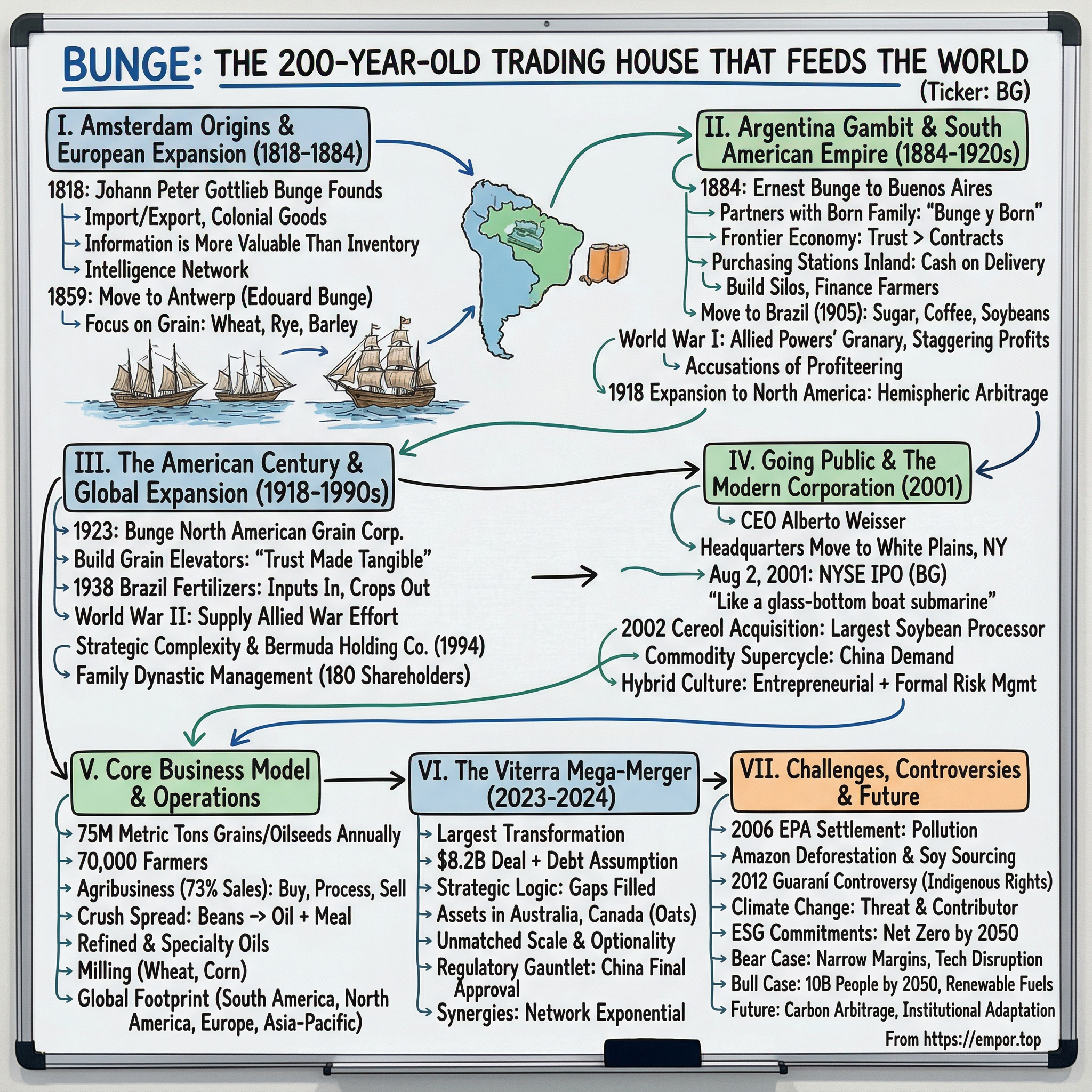
Bunge Global S.A.: The 200-Year Agribusiness Engine Redefining Global Food Security
I. Introduction & The Agribusiness Monopoly
On July 2, 2025, in a transaction with significant market consequences, a 207-year-old company completed its acquisition of one of its largest competitors. Bunge Global S.A., listed on the New York Stock Exchange under the ticker BG, finalized its combination with Viterra Limited — the grain-handling empire built by Glencore from the assets of the former Canadian Wheat Board system and Australia's ABB Grain.1 The headline transaction value was roughly $8.2 billion.2 Under the terms of the deal, Viterra's owners received approximately 65.6 million newly issued Bunge shares valued at about $5.3 billion on the closing date, along with roughly $1.9 billion in cash, while Bunge repaid approximately $3.6 billion of Viterra debt at closing.3
The combined enterprise emerged with roughly 37,000 employees operating in more than 50 countries.1 In its first full year as a combined entity, Bunge reported net sales of $70.3 billion for 2025 — up from $53.1 billion the prior year, a figure that included only six months of Viterra.4 On a full-year annualized basis, the combined company's top line approached $90 billion at 2026 price levels, as second-quarter 2026 net sales reached $24.0 billion compared to $12.8 billion a year earlier.5
This operational scale raises a fundamental question. Bunge began in 1818 as a trading house in Amsterdam, selling grain and colonial goods.6 It survived political instability in Argentina, the kidnapping of family heirs, hyperinflation, the Great Depression, two world wars, and an opaque family ownership structure that obscured its asset holdings for most of the twentieth century. After going public in 2001, the company nearly lost its independence in 2018 amid takeover interest from hostile suitors and pressure from activist investors. Understanding how the company survived this history leads to a broader evaluation of whether its long-term business model generates durable value.
The ABCD context. Global agricultural trade remains dominated by four principal firms, widely known by their initials: Archer-Daniels-Midland (ADM), Bunge, Cargill, and Louis Dreyfus Company. Together, they originate, transport, store, crush, refine, and distribute a major share of the world's traded grain and oilseeds. Two are publicly traded, while two remain private; Cargill is one of the largest private corporations globally, and Louis Dreyfus is controlled by a family trust. Wilmar International occupies a dominant position in Asian palm oil supply chains. The Viterra transaction did not expand this group; instead, it consolidated it. Viterra was itself a major global grain handler, and its integration into Bunge increased industry concentration, prompting more than two years of regulatory scrutiny across three continents.
These firms compete less for end consumers than for strategic asset positioning: grain elevators near farms, export terminal berths, crushing facilities adjacent to feed mills, and shipping vessels scheduled on key trade routes. Because market position in agribusiness relies heavily on physical infrastructure, major players rarely capture market share organically, relying instead on strategic acquisitions.
Bunge's acquisition of Viterra was primarily an investment in physical infrastructure. It acquired Viterra's grain elevator network across the Canadian prairies and Australia, European origination networks, Argentine crushing capacity, and key port terminals — assets that would require significant capital and regulatory approval to construct independently.
Analytical roadmap. The following analysis examines Bunge's trajectory in eight parts. First, an overview of its historical origin from a European trading firm into an international agribusiness powerhouse. Second, an evaluation of its 2001 initial public offering and the volume-driven operational strategy that delivered mixed capital returns over the subsequent decade. Third, an examination of the 2017–2018 corporate crisis involving unsolicited takeover approaches and activist board intervention. Fourth, an analysis of restructuring efforts under Chief Executive Officer Gregory Heckman and their operational impact. Fifth, an explanation of the soybean crush spread and its core financial identity. Sixth, a review of the Viterra transaction and its regulatory approvals. Seventh, a stress test evaluating four key investment theses against historical operating data. Finally, an assessment of the core conditions required to sustain Bunge's strategic valuation over time.
A central tension persists across this narrative. Bunge management has maintained for seven years that operational reforms have established a higher earnings floor for this cyclical business. However, the company's financial performance between 2022 and 2025 presents a nuanced test of that assertion.
 Subscribe on LinkedIn
II. 200 Years in 15 Minutes: From Amsterdam to Argentina
The oldest characteristic of Bunge is not a physical facility, but an operating strategy: purchase crops at origination, sell at points of consumption, and control enough physical infrastructure between surplus and deficit markets to prevent bottlenecks.
Johann Bunge founded the original trading house in Amsterdam in 1818, importing goods from the Dutch colonies — grain among them.6 The business expanded significantly a generation later, when Edouard Bunge moved the family firm to Antwerp in 1859, positioning it at the mouth of the Scheldt River just as the Industrial Revolution turned northern Europe into a permanent net importer of calories.6 That move established a structural pattern in the company's history: Bunge consistently positioned itself at the choke point between supply surpluses and demand deficits rather than attempting to control either end of the chain.
A second key expansion occurred in 1884, when Edouard's brother Ernest moved to Argentina and, with his brother-in-law Jorge Born, established Casa Bunge y Born to export the country's grain.6 The timing aligned with major structural shifts: the Argentine pampas were transitioning from cattle range to arable cropland, European immigration was supplying labor, British capital was constructing railway networks, and refrigerated shipping was solving long-distance logistics. Argentina became a primary global grain exporter for roughly half a century, with Bunge y Born operating key distribution assets.
The family subsequently expanded beyond grain trading into vertical and horizontal integration across flour milling, textiles, paint, chemicals, fertilizer, and banking. Expansion into Brazil followed in 1905 and North America in 1918.6 By mid-century, Bunge y Born operated as a private economic conglomerate controlled by the Bunge, Born, Hirsch, Engels, and De La Tour families, maintaining a corporate culture characterized by minimal public disclosure.
That lack of public visibility carried strategic risks that materialized on September 19, 1974, when Montoneros guerrillas ambushed cars carrying Jorge and Juan Born in Buenos Aires, killing two employees and abducting the brothers. The family paid a ransom widely reported at $60 million — at the time the largest in history — and the brothers were released after roughly nine months in captivity.7 The event shifted the firm's strategic focus: corporate operations gradually migrated toward São Paulo, and the family reduced its concentration of capital in a single volatile country.
The North American chapter, and the limits of the family model. Bunge entered North America in 1918, completing a trade triangle — connecting European demand with South American and North American supply — that few competitors of the era could match.6 Through the Great Depression, two world wars, and the postwar expansion of global grain trade, the group operated as a network of separately capitalized national businesses under common ownership, without public financial reporting.
That private structure offered specific operational advantages. With access to permanent private capital, the firm could hold inventory through market disruptions, provide liquidity when competitors faced capital constraints, and undertake multi-decade infrastructure investments without public quarterly earnings pressure. In commodity trading, the financial flexibility to manage inventory cycles often determines trading profitability.
However, the family-controlled structure created two primary operational limitations. First, by the 1990s, the capital required to compete in global agribusiness exceeded what a private family group could supply internally. Second, operating without public equity market reporting diluted capital discipline; without external returns on capital metrics, the company lacked standardized hurdles for evaluating asset efficiency. Consequently, when Bunge pursued its initial public offering on the New York Stock Exchange in 2001, it possessed extensive physical assets but lacked established public market capital-allocation metrics.
Geographic shifts further reinforced the need for diversification, mirroring the logic that later informed the 2025 Viterra acquisition. Argentina's dominance in global grain exports diminished over the twentieth century as export taxes, currency controls, macroeconomic instability, and farm-level grain storage as an inflation hedge reduced operational predictability. Meanwhile, Brazil expanded rapidly to become the world's largest soybean exporter.
Because Bunge had already diversified its supply origins following the political volatility of the 1970s, it absorbed this regional shift. Every major structural decision since — including the 2025 acquisition of Viterra's Canadian and Australian grain networks — reflects the same strategic framework: mitigating geographic reliance on any single harvest, regulatory regime, or export border.
Why any of this matters in 2026. Three primary inheritances persist from the pre-public era.
The first is physical asset positioning. Nineteenth-century river terminals and early port concessions in South America established an infrastructure footprint that would be cost-prohibitive to replicate, particularly given current environmental permitting and regulatory constraints for deepwater ports. Bunge's cost efficiency in South American export logistics stems in part from infrastructure investments executed long before modern market structures emerged.
The second is a structural preference for vertical integration, which has yielded mixed operational results. The same strategic rationale that drove expansion from grain trading into milling in 1900 led Bunge into Brazilian sugarcane ethanol and fertilizer retail in the 2000s — investments that delivered contrasting returns on capital, as detailed in subsequent sections.
The third is governance structure. Over a century of closed family ownership limited the development of public-market reporting standards, capital allocation frameworks, and return-on-invested-capital hurdles. When Bunge completed its initial public offering, it brought strong physical assets to market alongside an operational model that required significant governance and measurement reforms.
Addressing that divergence — strong physical assets paired with evolving capital allocation systems — defined the company's operational trajectory over the subsequent seventeen years.
III. The Public Era & The Operating Model Collapse (2001–2018)
In August 2001, Bunge went public on the New York Stock Exchange by selling roughly 23% of its equity, raising about $278 million.8 Chief Executive Officer Alberto Weisser, a German-Brazilian former chief financial officer who took the helm in 1999, persuaded family shareholders that a private firm with two centuries of history needed public equity to compete at scale against industry titans Archer-Daniels-Midland and Cargill. Following the listing, Bunge relocated its corporate headquarters to White Plains, New York, modernized its governance structure, and initiated an aggressive acquisition campaign.
The Cereol benchmark. The expansion strategy took shape rapidly. In October 2002, Bunge acquired a controlling 54.69% stake in Cereol S.A. from Edison S.p.A. for approximately €449 million in cash at €32 per share, with the subsequent buyout of remaining shares implying a total equity valuation of roughly €821 million.9 The acquisition integrated Central Soya in the United States, CanAmera Foods in Canada, and an extensive European crushing network, establishing Bunge at the time as the world's largest oilseed processor.10
Strategically, the deal filled a structural gap by combining Bunge's extensive South American crop origination with essential processing capacity in major consumer markets across both sides of the Atlantic. Over the subsequent two decades, however, the transaction underscored a fundamental industry reality: processing scale alone does not ensure durable profitability. Cereol introduced high-fixed-cost downstream European operations into a business already sensitive to underlying commodity spreads. When processing margins expanded, those fixed overhead costs were easily absorbed; when margins compressed, they severely undermined profitability.
The supercycle mask. From roughly 2003 through 2013, unprecedented growth in Chinese soybean demand reshaped global agriculture. As China transformed from a minor buyer into the destination for most internationally traded soybeans, high margins insulated every stage of the supply chain—from origination and shipping to crushing and meal distribution. Bunge expanded its revenue base and balance sheet aggressively, pushing into non-core adjacencies such as Brazilian sugarcane ethanol and retail fertilizer—sectors that carried risk profiles distinct from its core commodity trading operations.
The expansion into sugar and bioenergy highlighted the capital allocation risks of that era. Bunge built a substantial Brazilian sugarcane and ethanol platform during the bioenergy boom, yet the segment consistently failed to generate acceptable returns on invested capital. In 2019, Bunge contributed these assets to a joint venture with BP; as disclosed in its 2020 Form 10-K, the company recorded $1,526 million in impairment charges for the year ended December 31, 2019 associated with the transfer of those operations to the joint venture.11 The write-down effectively eliminated more than $1.5 billion in capital committed over a decade of construction.
The company's retail fertilizer venture met a similar outcome, albeit with less direct financial loss. Bunge sold its Brazilian fertilizer operations to Yara International for $750 million in August 2013, recording a gain of $148 million on the transaction.12 While generating a modest accounting gain upon exit, the divestment concluded a decade-long commitment of management focus and capital to a business lacking structural synergy with Bunge's core origination network.
Evaluating the public listing. Weisser's original rationale for going public centered on three objectives: securing capital, institutionalizing corporate governance, and expanding operational scale. On execution, management fulfilled all three objectives. Public markets supplied the funding for Cereol, governance was standardized through board oversight and regulatory reporting on a U.S. exchange, and the acquired processing footprint remained intact.
However, the transaction failed to establish the capital discipline typical of public ownership. Between 2001 and 2018, strong supercycle earnings masked weak returns on capital, insulating management from shareholder scrutiny. When commodity margins eventually tightened, accountability emerged not through routine governance, but through external intervention by activist investment funds acquiring positions to compel strategic change.
The mechanics of volume-seeking operations. Prioritizing volume over return on capital created systemic operational friction. Regional managers incentivized by tonnage and capacity utilization often purchased grain aggressively for facilities operating at negative margins, as idle plant capacity carried a harsher internal performance penalty than unprofitable throughput. Similarly, decentralized trading operations led origination desks in one region to take market positions offset by processing desks elsewhere, causing the firm to trade against itself. Furthermore, capital expenditures were frequently evaluated on growth narratives rather than strict incremental return metrics.
These operational flaws were masked during periods of wide commodity spreads but proved damaging when margins narrowed. For capital allocation in margin-dependent industries, organizational alignment directly determines whether physical assets cover their cost of capital.
The 2017–2018 operational crisis. A combination of headwinds tested Bunge's operational model between 2016 and 2018. Global processing spreads narrowed sharply. At the same time, South American farmers—benefiting from improved capital access and expanded on-farm storage—withheld crop sales during low-price periods, curtailing Bunge's origination volume when its plants required steady throughput. Concurrently, trade tensions between the United States and China disrupted traditional export flows, while internal risk positioning exacerbated trading losses.
The financial impact was evident in the company's results. Bunge reported net income of $126 million, or $0.89 per share, in 2017. While net income rose 85% in 2018 to $233 million, or $1.64 per share, overall profitability remained modest relative to a multi-billion-dollar revenue base.13 In late 2018, management disclosed an adjusted EBIT shortfall of $90 million to $100 million in Agribusiness and an additional $60 million to $70 million in Sugar & Bioenergy compared to the lower bound of its guidance.13 Meanwhile, net debt climbed to approximately $7 billion by the end of the third quarter of 2018 before unwinding to about $5 billion at year-end.13
Despite controlling an extensive global network of elevators, processing plants, and deepwater export terminals, the company generated minimal net earnings during this period, illustrating that extensive physical infrastructure does not inherently guarantee margin protection.
Takeover interest and activist intervention. Prolonged financial underperformance invited acquisition interest. Glencore made an informal takeover approach in mid-May 2017. After Bunge rejected the overture, the two parties signed a standstill agreement in October 2017 that granted Glencore access to confidential financial information while temporarily restricting unsolicited bids or share purchases.14 As the standstill expiration approached in early 2018, reports surfaced that Archer-Daniels-Midland had also held preliminary merger discussions with Bunge, signaling potential industry consolidation.15
While neither transaction materialized, activist shareholders stepped in. D.E. Shaw Group and Continental Grain built significant equity stakes to advocate for governance reforms. On October 31, 2018, Bunge entered into cooperation agreements appointing three new independent directors: Paul J. Fribourg, chairman and CEO of Continental Grain; Henry W. "Jay" Winship of Pacific Point Capital; and Gregory A. Heckman, a founding partner of Flatwater Partners. The agreements provided for a fourth independent director by year-end, while the board simultaneously established a Strategic Review Committee to evaluate corporate strategy and operational options.1617
This sequence highlighted that a major strategic review was initiated only after external takeover interest and activist shareholder pressure forced board-level changes. Eleven weeks after his appointment to the board, Gregory Heckman was named chief executive officer.
IV. The Heckman Turnaround & Current Management Playbook (2019–2023)
On January 22, 2019, Bunge announced that Soren Schroder was stepping down and that board member Gregory A. Heckman would take over as acting chief executive officer, effective immediately.18 Three months later, the board named Heckman permanent CEO. John W. Neppl joined as chief financial officer, establishing an executive partnership that has led the firm for over seven years — an unusually stable tenure in a sector where senior leadership historically rotated alongside commodity cycles.
Background and operational diagnosis. Heckman brought extensive operating experience in grain and energy trading, having spent years at ConAgra Foods before serving as chief executive of Gavilon, an Omaha-based grain and fertilizer merchant assembled from ConAgra assets and later sold in pieces to Marubeni and other buyers. At Gavilon, where asset scale alone could not shield a firm from poor execution, profitability depended on strict risk discipline and merchandising margins. Heckman subsequently co-founded Flatwater Partners before joining Bunge's board as part of the 2018 activist settlement.
Upon taking leadership, Heckman diagnosed Bunge's core issue not as owning the wrong physical infrastructure, but as lacking real-time visibility into global risk positions and asset utilization. Regional teams operated independent trading books, origination decisions in South America were detached from European crushing schedules, and compensation incentives prioritized volume over returns. Consequently, a firm built on arbitraging price and location differences operated with a fragmented view of its overall market exposure.
Operating Model 2.0. To address these inefficiencies, management collapsed regional silos into a centralized "value chain" model that consolidated risk management and capital allocation. Heckman summarized the underlying operational logic on earnings calls: "it's our competitive advantage to have great people across the organization having the same information at the same time and working toward unified objectives."19
Mechanically, the reorganization executed three core operational changes:
- Decoupling facility operations from proprietary risk. Processing plants were repurposed to focus strictly on throughput and conversion efficiency — operating at low cost and high capacity utilization. Meanwhile, market positioning decisions, such as managing long or short crop exposures or location spreads between South America and Europe, were shifted to a central risk desk tracking firm-wide earnings-at-risk.
- Centralizing capital allocation. Capital allocation decisions moved to executive headquarters rather than being defended by regional business units. Discussing the integration of Viterra's assets on Bunge's fourth-quarter 2025 call, Heckman noted: "we're now looking at the combined portfolio and making sure that we're running the right assets and the right businesses where we have a right to win for the long term. All the capital allocation is done from the center. And that's healthy for the teams to compete for that capital."19
- Aligning performance metrics. Management shifted strategic priority from gross volume toward return on invested capital (ROIC), disclosing adjusted ROIC against weighted average cost of capital quarterly.
Incentive metrics and governance. While Bunge highlights adjusted ROIC quarterly, proxy disclosures indicate that ROIC was introduced into performance-based equity awards for the 2014–2016 performance period, years prior to the activist intervention.39 The key operational shift after 2019 was not the creation of the metric, but the structural reorganization — centralizing risk and capital allocation while measuring plants on throughput — which enabled management to actively govern returns rather than merely record them.
Executive leadership and succession. Neppl joined Bunge as CFO from ethanol producer Green Plains, following earlier tenure at Gavilon. The shared background between the CEO and CFO reinforced a corporate culture centered on merchandising discipline. However, this alignment also concentrated executive oversight within a specific leadership pair. Following the Viterra transaction, former Viterra chief executive David Mattiske and Bunge's Julio Garros were appointed co-chief operating officers, establishing a clear operational bench while introducing a co-leadership structure that will test integration efficiency.1
Capital reallocation and divestitures. Over the seven-year turnaround, management systematically divested non-core assets to refocus capital on core processing and logistics bottlenecks:
- The Brazilian sugarcane and bioenergy operations were transferred to a joint venture with BP in 2019 — incurring over $1.5 billion in impairment charges — before Bunge completed its exit by selling its 50% stake to BP for $1.4 billion on October 1, 2024.2021
- The corn milling business was divested during the second quarter of 2025.19
- Across 2025, asset and business divestitures generated approximately $1.2 billion in cash proceeds.4
Concurrently, Bunge reinvested roughly $1.2 billion in capital expenditures during 2025, concentrating funds on four multi-year expansion projects: a multi-seed processing facility and barge unloader in Destrehan, Louisiana; a soy protein concentrate facility in Morristown, Indiana; an expanded refined tropical oils platform in Avondale, Louisiana; and a specialty oil plant in Westhaven, Netherlands.419
This capital reallocation strategy shifted resources away from non-synergistic adjacencies toward core crushing and refining bottlenecks. However, because these major projects remained in commissioning phases as of mid-2026, their financial returns remain unproven. On the fourth-quarter 2025 earnings call, Neppl noted that management had not included material earnings contributions from these projects in its 2026 financial projections, stating: "we have not modeled in really much if any contribution from those projects."19 Consequently, the ultimate return on roughly $2.5 billion in growth capital expenditure will emerge in 2027 and 2028.
The Chevron joint venture. In 2022, Bunge established a 50/50 joint venture with Chevron U.S.A. to supply lower-carbon feedstocks for renewable diesel and sustainable aviation fuel (SAF). Bunge contributed soybean processing plants in Destrehan, Louisiana, and Cairo, Illinois, while Chevron provided approximately $600 million in cash.22
The economic rationale reflects shifts in soybean processing dynamics. A crushed soybean yields approximately 80% meal and 20% oil by weight. Historically, soybean meal for animal feed drove crushing economics, while soybean oil functioned as a secondary product for food consumption. The expansion of renewable diesel introduced large-scale energy sector demand for vegetable oil, enhancing processing economics when oil demand rises.
However, processing facilities capture processing volume rather than guaranteed profit margins. Refineries evaluate feedstocks based on delivered price and carbon intensity rather than processor identity. As industry-wide crush capacity expanded between 2022 and 2025 to meet renewable fuel demand, increased supply compressed incremental margins. Demonstrating cautious guidance on the fourth-quarter 2025 earnings call regarding early certification of soybeans for SAF, Neppl stated: "we don't have anything baked into our forecast for that... in our 2026 numbers, we don't have anything meaningful baked in."19
Corporate redomiciliation. On November 1, 2023, Bunge completed the transfer of its primary legal domicile from Bermuda to Switzerland, forming Bunge Global S.A. while maintaining its primary listing on the NYSE under ticker BG.23 Management cited alignment between legal structure and global commercial operations. The jurisdiction change also altered Bunge's corporate governance framework, takeover defense provisions, and tax structure following the 2017–2018 takeover interest.
This structural and operational evolution underpins the financial mechanics that govern Bunge's ongoing profitability — centered on the soybean crush spread.
V. Core Business Model, Crush Spreads & Industry Economics
Strip away the 50 countries and the 37,000 employees and Bunge does four things in sequence. It buys crops from farmers. It moves them. It converts some of them. It sells the outputs to whoever needs calories, protein or fuel. Every dollar of profit comes from a spread captured somewhere along that chain — a spread in price, in location, in time, or in physical form.
The chain, and where the money sits.
- Origination. Bunge buys directly from farmers and through country elevators, then aggregates into rail, barge and port infrastructure. Heckman has been explicit that increasing the share bought directly from the farm gate is a strategic priority, because direct purchase gives the company control over quality, timing and plant utilization: "the more you can buy direct from the farm, better that is for controlling everything from your pipelines and capacity utilization and quality and yields."19
- Logistics. Rail cars, barges, port terminals and — post-Viterra — a substantially larger ocean freight book. Freight is not a sideline; it is where location arbitrage gets executed.
- Processing. Crushing soybeans, canola/rapeseed, sunflower seed and softseeds into meal and oil; refining oils for food and fuel customers; milling wheat and other grains.
- Distribution. Selling meal to feed compounders, oils to food manufacturers and fuel producers, and grains to importers, governments and processors worldwide.
The crush spread, explained without jargon. The single most important number in this business is the gross crush margin, and the identity behind it is almost embarrassingly simple:
Crush margin = (value of the meal produced + value of the oil produced) − (cost of the seed) − (cost of conversion)
Think of it as a toll. Bunge does not primarily bet on whether soybeans go up or down; it earns a fee for transforming one thing into two things people want more. When that toll is wide, every plant in the network runs flat out and the fixed costs are spread across enormous volume. When the toll narrows below variable cost, the rational move is to slow or idle the plant — which is exactly when a company with heavy fixed overhead discovers how much of its cost base is genuinely fixed.
Two structural features make the toll fluctuate:
- Meal and oil have different customers with different cycles. Meal tracks global animal protein production — chicken, pork, aquaculture. Oil tracks food demand and, since roughly 2020, biofuel policy. These two demand curves are not correlated, which is why a crusher can have a great year on meal and a poor one on oil, or vice versa. Through 2026 Bunge management has repeatedly flagged that meal demand has surprised to the upside globally while oil has been hostage to U.S. biofuel policy timing.1924
- Capacity is lumpy and slow. A crush plant takes years to build and cannot be moved. Industry-wide capacity additions therefore arrive in waves, and margins compress hard when a wave lands into flat demand.
Board crush versus cash crush — a distinction that matters. Analysts often model Bunge off the "board crush," the theoretical margin implied by exchange-traded futures for soybeans, meal and oil. Management uses those curves too — deliberately and mechanically, as the basis for guidance — but Heckman has been careful to flag the gap between the screen and the plant: "where you can see board crush in some of the markets, we still have to have some judgment in the physical crush in the cash."24
The gap is where a processor's skill lives. Board crush assumes a standard bean delivered to a standard place at a standard time. The physical business involves a specific truck of a specific quality arriving at a specific plant, with basis differentials, freight, drying, storage and counterparty terms all layered on top. A well-run network captures more than the board implies; a badly run one captures less. This is also why quarter-to-quarter comparisons between Bunge's realized results and published industry margins can diverge — as one analyst found on the Q2 2026 call, where Neppl attributed the discrepancy partly to Brazilian soybean origination volumes flowing through the same segment.24
For an investor, the practical implication is simple: do not treat published crush spreads as a proxy for Bunge's earnings. Treat them as the tide. What matters is whether Bunge is consistently above or below it.
Seasonality and the geographic hedge. Northern and southern hemisphere harvests are six months apart. North American soybeans come off in the autumn; Brazil's main crop arrives in the first quarter and Argentina's shortly after; Australian canola and barley harvest around the turn of the year. A processor with assets in only one hemisphere runs hot for one season and starves for the other. A processor with balanced assets in both can keep utilization high year-round and, more importantly, can choose where to crush based on which origin is cheapest at that moment.
This is the clearest, most concrete synergy in the Viterra combination, and Heckman described it in operational terms on the Q2 2026 call: with Australian canola potentially moving to China as those trade relations improve, "we now have the capability then to make sure that the Canadian canola that was going there, then that works through our processing."24 One flow shifts; the network re-routes rather than losing the volume.
Segments — and a disclosure change investors should notice. Bunge historically reported an Agribusiness segment that carried the large majority of earnings, plus Refined & Specialty Oils and Milling. Following the Viterra combination the company recast its reporting into Soybean Processing and Refining; Softseed Processing and Refining; Tropical Oils and Specialty Ingredients; Grain Merchandising and Milling; and Corporate & Other. For 2026 management guided that roughly half of pre-corporate segment EBIT would come from soybean processing and refining, about a quarter from softseed, about 20% from grain merchandising and milling, and roughly 5% from the remainder, with corporate costs of approximately $120–125 million per quarter running against it.19
The recast is defensible — the old Agribusiness bucket had become uninformatively large — but it does break multi-year comparability at precisely the moment when investors most need to compare. That is a real analytical cost, and it is worth watching whether the new disclosure holds stable or gets adjusted again.
What the second quarter of 2026 actually showed. In the quarter ended June 30, 2026, Bunge reported adjusted segment EBIT of $796 million against $373 million a year earlier, with soybean processing and refining at $445 million, softseed at $255 million, grain merchandising and milling at $67 million, and tropical oils and specialty ingredients at $29 million.524 Adjusted EPS was $2.00 versus $1.31.5
Two conclusions follow, and they point in opposite directions. The first is that the softseed platform — the part of the business most transformed by Viterra, with new Argentine sunflower crush balancing European rapeseed — improved across every region, which is the strongest available evidence that the acquisition delivered something operational rather than merely additive. The second is that grain merchandising, which is the largest single piece of what Viterra actually was, remains the weak link. Neppl said as much on the Q4 2025 call: "that's the biggest part of Viterra's business... it's going to take a little bit longer to get that humming."19 Two quarters later, Bunge lowered its full-year expectation specifically for grain merchandising and milling even as it raised the total.5
Competitive landscape. The relevant comparison is ADM, the closest listed analogue. ADM reported full-year 2025 adjusted EPS of $3.43 and guided 2026 to approximately $3.60–$4.25, with the low end explicitly assuming continued U.S. biofuel policy deferral and flat crush margins.25 Bunge's 2025 adjusted EPS of $7.57 and 2026 guidance of $9.25–$9.75 sit on a different share count and capital structure, so the levels are not directly comparable — but the shape is informative. Both companies were squeezed by the same crush compression in 2025; both are levered to the same biofuel policy resolution. That is a strong hint that most of what moved Bunge's earnings in that period was industry-wide, not company-specific.
There is also a governance contrast worth registering. In January 2024 ADM placed its chief financial officer on administrative leave pending an investigation by outside counsel and the audit committee into accounting practices in its Nutrition segment, including intersegment transactions; the company subsequently cooperated with SEC and Department of Justice inquiries and revised prior disclosures.26 Bunge has had no comparable episode. In an industry where intersegment transfer pricing is genuinely complex and where a great deal of value is recognized through mark-to-market on derivative positions, that absence has value — though it is an absence of discovered problems over a defined recent period, not a guarantee.
Myth versus reality. Three consensus narratives about this industry deserve correction before we get to the frameworks.
Myth: Bunge is a commodity trader. Reality: it is predominantly a processor and logistics operator that uses trading as a risk-management function. The distinction is not semantic. A trader's earnings come from directional and relative-value bets; a processor's come from throughput and conversion spreads. The explicit architecture of the post-2019 operating model was to push Bunge toward the second and centralize the first. That is why the most useful question about any given quarter is not "did they call the market right" but "did the plants run full, and at what spread."
Myth: the ABCDs are effectively a cartel. Reality: it is an oligopoly with genuinely brutal internal rivalry, and the evidence is in the numbers. If four firms could coordinate on price, 2025 would not have produced simultaneous crush margin compression at both listed members of the group, with ADM's crushing operating profit down sharply and Bunge's adjusted EPS falling by nearly a fifth.254 High barriers to entry protect the incumbents from newcomers. They do not protect the incumbents from each other, and regulators in three jurisdictions extracted real concessions from Bunge precisely because they take the competitive dynamic seriously.
Myth: farmers are price-takers with no leverage. Reality: this was true when farmers had no storage and no credit. It is not true now in the Americas, and the 2017–2018 earnings collapse is the proof. The modern origination business competes for grain against a supplier who can simply decline to sell, and Bunge's stated push to buy a higher share directly from the farm gate is an acknowledgment that this relationship must be earned rather than assumed.
The 7 Powers view. Applying Hamilton Helmer's framework honestly requires distinguishing what Bunge has from what it claims:
- Scale economies — present, but shared. High-fixed-cost crush plants and bulk marine logistics genuinely deliver lower unit costs at volume. But ADM, Cargill, LDC and Wilmar all clear the same scale threshold. Scale here is a ticket to play, not a differentiator among the majors. Its real force is against regional and single-country processors.
- Cornered resource — the strongest claim. Deepwater export terminals at Santos and Paranaguá in Brazil, up-river facilities at Rosario in Argentina, prairie elevator networks in Canada and port capacity in Australia are not replicable on any reasonable timeline. Permitting, land and community consent make greenfield equivalents close to impossible. This is the most defensible element of the moat — and, notably, the element Bunge bought rather than built in the most recent transaction.
- Process power — asserted, partially evidenced. The claim is that decades of accumulated trade-flow knowledge and execution capability cannot be copied. The 2017–2018 collapse is direct evidence that this power is not automatic; it degraded badly under a different management system and had to be rebuilt. Call it real but contingent on management.
- Counter-positioning, switching costs, branding, network economies — largely absent. Farmers sell to whoever bids best on a given morning. Feed compounders buy meal on price and specification. There is no consumer brand of consequence, no lock-in, and no meaningful network effect in the technical sense.
Porter's five forces, with the uncomfortable parts included. Supplier power — the farmer — is conventionally described as low because farmers are fragmented. That description is out of date. The single most damaging dynamic of 2017–2018 was farmers exercising exactly the power they were assumed not to have: sitting on grain, financed and stored on-farm, until prices improved. Buyer power is moderate, with one large exception discussed below. Threat of substitutes is genuinely low; calories and protein are not optional. Rivalry among the majors is intense and capital intensity is a serious barrier to new entrants — but a barrier that keeps newcomers out does not stop four incumbents from competing margin away among themselves.
The exception on buyer power deserves naming. A meaningful share of the traded soybean and canola complex ends up in China, and Chinese purchasing is heavily influenced by state-owned buyers. When the U.S.–China purchase commitments were being fulfilled through late 2025 and into 2026, the buyers of American beans were principally the state stockpiler Sinograin and the state trader 中粮集团 COFCO, while private Chinese crushers continued to favor cheaper South American supply.27 A customer base that can be redirected by policy in a single quarter is not a customer base with low bargaining power — and, as the next section shows, that customer's regulator now has a formal say in how Bunge operates.
VI. The Viterra Mega-Merger (2023–2025)
On June 13, 2023, Bunge announced an agreement to combine with Viterra. The transaction took 749 days to close—a two-year delay that reshaped both its financial mechanics and its regulatory profile.
The structure. Under the original terms, Viterra’s shareholders—Glencore, the Canada Pension Plan Investment Board, and British Columbia Investment Management Corporation—were set to receive approximately 65.6 million Bunge shares, valued at roughly $6.2 billion at announcement, alongside $2.0 billion in cash, representing a mix of 75% equity and 25% cash. Bunge agreed to assume approximately $9.8 billion of Viterra debt, which management emphasized was underpinned by roughly $9.0 billion in readily marketable inventories—the liquid working-capital float essential to commodity trading. Selling shareholders were slated to hold approximately 30% of the combined company on a fully diluted basis, expanding to roughly 33% following a $2.0 billion share repurchase program authorized by Bunge’s board prior to the announcement. Bunge agreed to expand its board to twelve directors, allocating eight seats to Bunge nominees and four to Viterra. Management targeted annual gross pre-tax cost synergies of approximately $250 million within three years and anticipated accretion to adjusted earnings per share in the first full year, projecting a closing by mid-2024.28
Key transaction parameters evolved significantly before closing.
Why the delay mattered financially. Between agreement and completion, the global agricultural cycle turned downward. Bunge’s adjusted earnings per share fell from $13.66 in 2023 to $9.19 in 2024, and dropped further to $7.57 in 2025.29304 Because stock consideration was fixed by share count rather than dollar value, the equity component declined from roughly $6.2 billion at announcement to approximately $5.3 billion at closing.283 While this contraction lowered the nominal equity purchase price, the extended regulatory clearance process left Bunge navigating a cyclical downturn with a transformational acquisition pending.
What Bunge did with the two-year wait. Rather than delaying corporate restructuring during the regulatory review, Bunge executed several portfolio divestitures. The company completed the transfer of its sugar and bioenergy joint-venture stake to BP in October 2024, sold its corn milling business in 2025, and collected approximately $1.2 billion in asset sale proceeds during 2025—liquidity that partially funded its $2.0 billion share repurchase commitment.21194 Management also initiated preliminary organizational integration, accelerating initial synergy realization. Chief Financial Officer John Neppl noted that Bunge "took some action ahead of close and actually started getting the organization structured and ready," capturing slightly over $70 million in cost synergies by year-end 2025 despite operating the combined business for only six months.19
This pre-closing preparation mitigated operational delays, though it occurred alongside a regulatory review period that exceeded management's initial timeline by a year.
Strategic rationale, tested. The strategic basis of the combination relied on asset complementarity. Bunge brought large-scale oilseed processing and extensive origination networks in South America and North America; Viterra contributed grain-handling infrastructure across the Canadian prairies and Australia, European grain networks, and a key stake in Argentina’s Renova crush facility, which Chief Executive Officer Gregory Heckman described as "the largest and lowest cost operating plant globally."24
Because the asset footprints were largely complementary rather than duplicate, regulatory approvals centered on targeted geographic overlaps. However, asset complementarity requires that value creation depend primarily on commercial synergies—such as optimized logistics, expanded market intelligence, and increased direct farm-gate origination—rather than direct facility closures. Commercial synergies remain difficult for external markets to audit, and management noted that only "a relatively modest amount" of commercial upside was included in its 2026 financial guidance.19
The combination also expanded Bunge’s marine freight footprint. Heckman noted that the merger roughly doubled Bunge's ocean freight volume, lowering unit transport costs and improving flexibility when trade routes shift.24 In bulk commodity merchandising, where cargo margins depend on freight execution, a larger chartering network provides a structural cost advantage.
The regulatory gauntlet. Regulatory agencies in three main jurisdictions required operational and structural commitments before granting approval.
European Union. The European Commission approved the transaction in August 2024 subject to remedies, concluding that the original proposal would have lessened competition in oilseeds and downstream markets for animal feed meal, crude seed oils, and refined oils across Central Europe. To address these concerns, Bunge agreed to divest Viterra’s entire oilseeds processing and merchandising business in Hungary and Poland.31
Canada. Regulatory review in Canada focused on grain origination infrastructure across the Western prairies. The federal government granted approval via order-in-council on January 14, 2025, subject to binding conditions: the divestiture of six primary grain elevators near Bunge’s canola crushing plants in Altona, Manitoba, and Nipawin, Saskatchewan; a commitment to invest at least C$520 million in Canadian operations over five years; the maintenance of Viterra’s Regina headquarters for at least five years; and a price protection program for select canola oil buyers in Central and Atlantic Canada.32 The Competition Bureau outlined its competitive impact analysis in a remedy assessment letter to the Minister of Transport.33
China. China’s State Administration for Market Regulation (SAMR) issued conditional approval on June 16, 2025, concluding a review that lasted over twenty months. SAMR evaluated import markets for soybeans, barley, and rapeseed, estimating based on 2022 market data that the combined firm would account for 20% to 25% of Chinese soybean imports, 35% to 40% of barley imports, and 30% to 35% of rapeseed imports. Rather than requiring asset sales, SAMR imposed behavioral conditions requiring Bunge to supply Chinese customers on fair, reasonable, and non-discriminatory terms, report quarterly sales metrics to regulators, and notify SAMR of global supply disruptions. These conditions remain in effect for five years, with two additional compliance terms remaining non-public.34
These regulatory conditions establish ongoing reporting requirements for Bunge’s primary destination market, reflecting regulator scrutiny over its expanded export market share.
Closing, and the register. The transaction closed on July 2, 2025, following the SAMR ruling.12 Upon closing, CPP Investments reported an equity stake of approximately 12% in Bunge Global S.A. Under shareholder agreements, Glencore and CPP Investments each retained the right to designate two board directors as long as their equity ownership remains at or above 10%, with both investors agreeing to a twelve-month lock-up period on share transfers.35
Executive leadership retained Bunge's core structure, with Heckman continuing as CEO and Neppl as CFO, while former Viterra CEO David Mattiske and Bunge’s Julio Garros were appointed co-chief operating officers.1
The overhang nobody has resolved. The twelve-month lock-up restriction expired in July 2026. On Bunge's second-quarter 2026 earnings call, management addressed inquiries regarding Glencore's equity position. Heckman stated that Glencore remained an supportive shareholder, recognized that commercial integration requires time, and indicated that the investor was proceeding deliberately without immediate divestment plans.24 Nonetheless, the presence of a substantial, unrestricted equity block remains an ongoing structural factor for public shareholders.
Did Bunge overpay? Deal commentary frequently referenced transaction multiples of roughly 7.5 times enterprise value to EBITDA, compared with historical agribusiness transaction multiples of 8.5 to 10 times. However, evaluating transaction multiples against peak 2022 and 2023 sector earnings reflects elevated mid-cycle commodity margins. Functionally, Bunge issued approximately 30% new equity, distributed $2.0 billion in cash, and assumed working-capital debt to acquire an enterprise whose largest operational unit—grain merchandising—continues to undergo post-merger integration. The long-term return on capital depends on management's execution of projected operational and commercial synergies.
What the synergy scoreboard actually says. Realized cost synergies have exceeded initial guidance. Bunge captured slightly over $70 million in savings by year-end 2025, projected approximately $190 million for full-year 2026, and anticipated reaching an annualized run-rate of roughly $220 million by late 2026.19 Based on integration progress, management increased its total annual cost synergy target from $250 million to $350 million, with Neppl indicating during the second-quarter 2026 call that the company is attempting to accelerate implementation.24
While cost reductions in procurement, corporate overhead, and administrative systems are directly verifiable, broader commercial synergies—including network optimization, expanded direct farm purchasing, and cross-selling across grain and oilseed product lines—remain largely unquantified in public disclosures.
VII. Historical Falsification & Activist Stress Test
Every investment case is a set of claims about the future. The only rigorous way to evaluate them is to ask what the company's own history says about each claim, using the longest span of evidence that actually bears on it. Bunge is unusually well suited to this exercise because it has been through a complete failure cycle and a complete recovery cycle inside a single decade.
Claim 1: "Global physical origination scale creates an impenetrable moat."
The disconfirming evidence. In 2017, owning essentially the same irreplaceable ports, elevators and crush plants it owns today, Bunge earned $126 million of net income — $0.89 per share.13 The assets did not shrink. What changed was that South American and U.S. farmers held their grain rather than selling into weak prices, crush margins compressed, and the company's own trading positions were on the wrong side. Asset scale provided no protection whatsoever.
The mechanism that broke it. This is the important part. A physical network is a toll road, and a toll road with no traffic earns nothing while still costing what it costs. Bunge's fixed cost base — the same base that produces enormous operating leverage in a good year — worked in reverse. Meanwhile the supposedly fragmented supplier base exercised real power, because the modern South American farmer has on-farm storage, access to credit, and the ability to wait.
The verdict. The claim is narrowed, not rejected. The assets are genuinely scarce and genuinely valuable, and the 2026 results demonstrate what they earn when utilization and spreads cooperate. But "moat" implies protected earnings, and the record shows the earnings were not protected. The correct statement is narrower: Bunge's asset network confers a durable cost position, which converts into profit only when paired with disciplined risk management and adequate throughput. The KPI that tests this on an ongoing basis is trough profitability — what Bunge earns in the worst quarter of a bad year, not the best quarter of a good one. On that measure the improvement is real: 2025 was a genuinely poor year industry-wide, and Bunge still produced $7.57 of adjusted EPS4 versus roughly $0.89 of GAAP EPS in the 2017 trough.13
Claim 2: "Expansion M&A into adjacent agribusiness sectors builds long-term shareholder value."
The disconfirming evidence. Bunge's own filings settle this one. The 2019 contribution of the Brazilian sugar and bioenergy operations to the BP joint venture carried $1,526 million of impairment charges.11 That business absorbed a decade of capital and management attention during the ethanol boom and never earned its cost of capital. The Brazilian fertilizer retail business, exited to Yara in 2013 for $750 million with a $148 million gain, was a gentler failure but the same category error.12 Both were adjacent to agriculture and orthogonal to Bunge's actual advantage.
The verdict. Rejected in its general form. Adjacency is not a strategy at Bunge; it is a warning sign. The narrower claim that survives is specific: capital deployed into oilseed processing, port and rail logistics, and higher-margin specialty and protein ingredients — businesses that use the existing network — has a plausible case. Capital deployed into anything that merely touches farming does not.
This matters directly for how investors should read the current capex program. Roughly $2.5 billion is going into four mega projects, and Bunge acquired IFF's soy protein concentrate business for $105 million in the first quarter of 2026.24 Protein concentrate is closer to the Cereol logic than the sugar logic — it processes an existing input stream into a higher-value output using owned infrastructure. But the Morristown SPC plant was still commissioning in mid-2026, and Neppl noted it "takes time" for customer qualification and that meaningful contribution would not arrive in 2026.19 The falsification test here is concrete and dated: if the four mega projects are not visibly contributing to segment EBIT by the end of 2027, the "surgical capital allocation" narrative should be downgraded regardless of what management says about it.
Claim 3: "Renewable fuels provide high-margin structural growth optionality."
The disconfirming evidence. Between 2023 and 2025, North American renewable diesel economics deteriorated badly: too much capacity chased subsidized demand, credit prices weakened, and the transition of federal incentives created a policy air pocket. Bunge felt this directly. Management spent the entire Q4 2025 call explaining that its 2026 guidance of $7.50–$8.00 excluded any assumption about the pending Renewable Volume Obligation, because "the curves do not properly reflect what opportunities should develop during the year once the policy is finalized."19 A first-quarter 2026 adjusted EPS of $1.83 was described in advance as "a really light quarter."1936
The counter-evidence, which is also real. Once U.S. policy clarity arrived, the same management raised full-year guidance twice — to $9.00–$9.50 in April and to $9.25–$9.75 in July.365 On the Q2 2026 call Heckman argued the improved U.S. crush curve was fundamentally justified: "we've got clarity around the RVO. We're now seeing that the crush has been added is here to meet that demand, and we continue to see strong meal demand globally."24
The verdict. Intact but reframed. The evidence supports a claim about volume, not margin. Renewable diesel and SAF create a structural second buyer for vegetable oil that did not exist a decade ago, and that raises baseline demand for the output of every crush plant Bunge owns. It does not confer pricing power, because the marginal crusher sets the spread, and it is hostage to policy set annually by governments. Bunge's own conduct is the tell: it has declined to forecast SAF revenue, declined to model mega-project contributions, and repeatedly attributed strength to policy clarity rather than to proprietary advantage. The falsification test is whether the next round of U.S. policy — the Set 3 biofuel volumes for 2028–2029 that management expects to see in draft after the autumn 2026 elections, and any small refinery exemption decisions — proves that policy dependence is a permanent feature rather than a transitional one.24
Claim 4: "The new operating model eliminates commodity cycle vulnerability."
The disconfirming evidence comes from management itself, which is the most persuasive kind. Bunge's adjusted EPS ran $13.91 in 2022 and $13.66 in 2023 — extraordinary years driven by the Ukraine war's disruption of Black Sea flows, short crops, and dislocated trade.29 It then fell to $9.19 in 2024 and $7.57 in 2025.304 That is a 45% peak-to-trough decline in adjusted earnings over two years at a company whose central strategic message is resilience. Neppl's own description of the environment on the Q4 2025 call is worth quoting because it is unusually honest: "farmers are spot, our customers are very spot and it just creates less opportunity for us."19
Note also the disclosure that management lowered its assumed weighted average cost of capital by roughly a percentage point in late 2025, reflecting the credit rating upgrade and the combined company's capital structure. Neppl paired it immediately with "importantly, we're not lowering our long-term investment return expectations."19 That is the right disclaimer to make, and investors should still note that a lower WACC mechanically makes reported ROIC-versus-cost-of-capital spreads look better without any operational improvement. As of the trailing twelve months ended June 2026, adjusted ROIC was 8.4% and GAAP ROIC 6.8%, both above their respective cost of capital; adjusting for construction-in-progress on the mega projects and excess cash, management put adjusted ROIC at 9.3%.24
The verdict. Intact but strictly bounded. The operating model appears to have raised the floor: Bunge's worst recent year produced returns above its cost of capital, which its worst year under the old model emphatically did not. But it has not flattened the cycle, and no honest reading of a $13.91-to-$7.57 swing supports the word "eliminates." Bunge remains a commodity processor whose earnings are set by spreads it does not control. The Investor Day framing of an approximately $13 mid-cycle EPS baseline with a target of at least $15 by the end of 2030 should be read as an explicitly mid-cycle number — meaning management expects years above it and years below it.37
Second-layer signals worth tracking. A few items sit below the level of the main thesis but bear on it.
- Credit. The combined company received a ratings upgrade after closing, and management explicitly reduced its assumed cost of capital as a result while borrowing at the tightest spreads in the company's history.1924 For a business that finances enormous working capital, a rating improvement is an operating advantage, not just a financing footnote.
- Ownership concentration. Three institutions received roughly 30% of the company as sellers, rising toward a third after the buyback, with two holding board designation rights tied to a 10% threshold.2835 This is a materially different register than Bunge had in 2019 and it changes how a proxy contest, a strategic proposal, or a large secondary offering would play out.
- Pension and one-time items. The fourth quarter of 2025 carried an unfavorable $0.95 per share of notable items driven primarily by settlement of the U.S. defined benefit pension plan, Viterra transaction and integration costs, and an impairment of a long-term investment.19 Pension settlement is a genuine de-risking of the balance sheet; the investment impairment is a reminder that write-downs at this company have not stopped, merely shrunk.
- Non-core optionality. Bunge Ventures and a captive insurance program both contributed to "Other" results in recent quarters.24 Neither is material today. Both are the kind of line item that deserves attention if it ever becomes material, given the company's history with adjacencies.
The activist's brief. If a skeptical fund were building the short case today, it would not focus on any of the above. It would focus on four things:
- Concentrated strategic holders with expired lock-ups. Roughly a third of the company sits with three institutions that acquired their stakes as sellers, not as long-term believers, and at least two have board designation rights contingent on maintaining 10% ownership. Any sell-down mechanically pressures the shares and could cost the board its Viterra-side representation.
- Complexity and mark-to-market opacity. Bunge's GAAP results swing wildly from adjusted results because of mark-to-market timing on derivative positions — in the second quarter of 2026, a favorable $1.67 per share of timing difference on a $3.47 GAAP quarter.24 That is not improper accounting; it is the nature of hedging physical inventory with financial instruments. But it means GAAP earnings carry limited information content, and investors are effectively required to trust a non-GAAP figure the company defines.
- Growth capex that has not yet earned anything. Approximately $1.5–1.7 billion of capex in 2026 on top of $1.7 billion in 2025, with management explicitly modeling minimal 2026 contribution.19
- The Chinese behavioral remedy. A five-year non-public undertaking to supply a strategic competitor's home market on regulated terms is a governance and margin risk that has no precedent in Bunge's history.
None of these are fatal. All of them are legitimate, and none of them are adequately addressed by the phrase "built for complexity and change."
VIII. Strategic Position, Bull vs. Bear Case & Key KPIs
Strip away the narrative, and the core investment question reduces to a single prompt: does owning the industry's most integrated origination-to-processing network allow Bunge to generate superior full-cycle returns on capital compared to its past performance and alternative capital allocations?
Why this company wins from here.
The affirmative investment case relies on four core operating mechanisms:
- Optionality in physical flows. Following the Viterra combination, Bunge balanced its geographic footprint by acquiring Argentine crush capacity and expanding its softseed footprint beyond Europe. The second-quarter 2026 softseed performance—where strength in Canadian and Argentine operations offset European margin pressure—demonstrated this geographic hedge in practice within four quarters of closing.24 When Black Sea sunflower crop yields dropped for two consecutive seasons, Bunge supplied European buyers through its Argentine origination channels.
- A measurable cost-of-capital advantage. Chief Financial Officer John Neppl noted during the second-quarter 2026 earnings call that Bunge was borrowing "at the tightest credit spreads we have in the history of Bunge," arguing that lower financing costs provide a structural edge in a merchant business that "generally trades on average interest cost."24 Because commodity merchants function largely as levered inventory financiers, reduced carry costs allow the firm to hold physical inventory during market dislocations that higher-cost competitors cannot sustain. The post-merger credit rating upgrade provides external validation of this structural improvement.
- Structural demand growth in vegetable oils. Management projects that soybean and softseed oils will account for roughly half of global vegetable oil production growth over the next decade as palm oil expansion slows.24 If industry trends align with this outlook, market demand will shift toward Bunge's primary processing crops. While this shift reflects a broad sector dynamic benefiting all oilseed crushers rather than a proprietary advantage, it raises the baseline volume for Bunge's processing platform.
- Accelerated synergy delivery. Management raised its total cost synergy target from $250 million to $350 million while executing integration ahead of its original timeline, providing tangible evidence of integration execution.2428
Why it may not.
- Integration friction in grain merchandising. Grain merchandising represents the largest operational unit acquired from Viterra and remains the primary underperforming segment. Management repeatedly stated across consecutive quarters that integrating this unit requires additional time, and lowered its full-year 2026 operating expectation for the segment during the second quarter.195 Merging two global trading organizations requires unifying risk management cultures, trade-accounting systems, and commercial counterparty relationships, representing a key risk area during post-merger integration.
- Crush capacity expanding faster than biofuel demand. North American crush capacity expanded significantly to meet anticipated renewable fuel demand. If regulatory mandates fall short of projections or administrative waivers dilute compliance volumes, industry-wide processing capacity will exceed market demand, exposing Bunge's largest operating segment to margin compression.
- Policy decisions as the primary earnings driver. Bunge's 2026 full-year adjusted earnings guidance shifted from an initial range of $7.50 to $8.00 per share up to $9.00 to $9.50, and ultimately to $9.25 to $9.75 per share.4365 This nearly 20% upward revision was driven primarily by regulatory rulings in Washington and subsequent shifts in forward commodity curves, illustrating that short-term earnings remain highly sensitive to administrative policy decisions rather than operational improvements alone.
- Regulatory constraints and state-directed buyers in China. Terms imposed by China's State Administration for Market Regulation (SAMR) extend through 2030 and require formal quarterly reporting.34 Simultaneously, Chinese purchases of U.S. soybeans have increasingly functioned as instruments of bilateral trade negotiations executed through state-owned enterprises.27 Although Bunge's Brazilian origination network hedges physical volume shifts when Chinese buyers favor South American suppliers, state-directed commodity flows typically yield lower commercial margins than open-market transactions.
How Bunge stacks up against the rest of the letter set.
Private competitors Cargill and Louis Dreyfus Company operate with opaque financial reporting and distinct capital structures, yet their private ownership removes public quarterly earnings pressure and equity market friction. Wilmar International maintains a dominant position across the Asian palm oil complex that Bunge does not match, as Bunge's Tropical Oils and Specialty Ingredients segment remains its smallest division, generating $29 million in adjusted segment EBIT in the second quarter of 2026.24 Consequently, Archer-Daniels-Midland remains Bunge's closest publicly listed peer for assessing operational performance against industry-wide trends.
This competitive landscape challenges simplified investment narratives. Bunge does not hold a clear origination advantage over Cargill or Louis Dreyfus, as all three maintain extensive South American logistics footprints. Instead, Bunge's distinct operational position lies in pairing the industry's largest oilseed processing platform with Viterra's grain-handling networks across Canada and Australia. Whether operating this integrated network generates returns superior to running the processing and merchandising businesses independently remains the central question for long-term investors.
Current risk radar.
- Execution and integration risk. Systems consolidation and commercial desk integration within grain merchandising carry risk of synergy loss. Performance tracking requires monitoring segment EBIT trajectory in grain merchandising and milling rather than aggregate corporate earnings.
- Crush margin normalization. Expanding global soybean supplies and processing additions in both hemispheres have altered baseline economics. Management acknowledged during second-quarter 2026 commentary that current crush spreads remain "above baseline" levels due to U.S. market conditions, confirming that current profitability exceeds mid-cycle expectations.24
- Geopolitical and trade disruption. While U.S.–China trade tensions redirect trade flows rather than eliminating volume—a dynamic Bunge mitigates through multi-origin sourcing—Black Sea conflict presents direct operational risk. Management noted in second-quarter 2026 that approximately a quarter of global wheat exports originate from the Black Sea region and described regional conflict conditions as reaching peak severity.24
- Deforestation compliance and regulatory costs. Implementation of the EU Deforestation Regulation begins December 30, 2026, requiring farm-level plot geolocation, risk assessments, and auditable supply-chain documentation for soy imports.38 Following two separate one-year implementation delays, Bunge carried compliance preparation expenses without capturing the early-adopter commercial advantage originally anticipated.
- Farm-gate input availability. Input constraints present secondary operational risks, with management highlighting phosphate fertilizer availability in South America as a key variable during second-quarter 2026 commentary.24 Reduced fertilizer application by Brazilian and Argentine farmers lowers crop yields, reducing origination volumes in subsequent harvest cycles.
- Weather volatility. Management cited an increased probability of a strong El Niño event, outlining transmission risks across Australian crop planting schedules, Brazilian second-crop timing, and medium-term palm oil production in Southeast Asia.24 Genuine global supply shocks represent one of the few market environments where a geographically balanced network generates expanding commercial margins rather than baseline volume defense.
The three KPIs that actually matter.
Evaluating Bunge's ongoing execution relies on tracking three principal metrics disclosed in quarterly filings:
- Adjusted ROIC relative to weighted average cost of capital. As management's primary internal efficiency metric, tracking ROIC requires evaluating whether spreads widen through operational profit growth or downward revisions to cost-of-capital assumptions. Bunge reported a trailing twelve-month adjusted ROIC of 8.4% through mid-2026, or 9.3% when excluding construction-in-progress and excess cash reserves.24 Once major capital projects transition into active operations, unadjusted return metrics must expand independently without balance-sheet adjustments.
- Grain Merchandising and Milling segment EBIT. This segment provides the clearest measure of integration success following the Viterra acquisition. While oilseed processing earnings track external crush spreads, grain merchandising results reflect operational integration, commercial optimization, and network synergies—the specific area management identified as lagging initial integration timelines.
- Cost synergy realization against the $350 million target alongside leverage. Bunge finished the second quarter of 2026 with an adjusted net debt to adjusted EBITDA ratio of 1.9 times, while net debt exceeded readily marketable inventories by $1.0 billion.24 Meeting synergy targets while maintaining leverage at or below 2.0 times—amid substantial capital expenditure commitments and a target to return at least 50% of discretionary cash flow to shareholders—serves as the test of balance-sheet durability.37
A note on what management has promised and what it has delivered.
Evaluating executive credibility requires assessing management commitments against historical operating results. Based on disclosed financial reporting, the centralized operating model introduced in 2019 has been executed consistently over seven years, the non-core divestiture program was completed as outlined, and cost synergy targets were expanded rather than revised downward. Furthermore, management maintained a mechanical guidance framework based on forward market curves, with Chief Financial Officer John Neppl noting on the fourth-quarter 2025 earnings call that "we were a little boring in our consistency" in relying on market curves rather than subjective earnings adjustments.19 When market consensus for first-quarter 2026 earnings diverged from company projections, management explicitly attributed the difference to renewable fuel policy timing and locked margin positions.19 The resulting first-quarter adjusted EPS of $1.83 exceeded those conservative guidance parameters.36
This track record demonstrates guidance discipline during recent operating periods. However, establishing long-term shareholder value creation depends on commissioning major growth projects and realizing unquantified commercial synergies—outcomes that remain to be proven in future financial results.
IX. Closing Thoughts & Broader Lessons
Certain essential global enterprises touch nearly every consumer daily while remaining largely unknown to the public. Within the global food system, Bunge represents a definitive example of this anonymity. The company maintains no consumer-facing brands and does not advertise. A consumer purchasing poultry fed on soybean meal processed through Bunge's network rarely encounters the corporate name. Its corporate history reinforces this posture: nearly two centuries of private family ownership and minimal disclosure, followed by a public listing that rendered its financial statements visible without making its underlying operational mechanics immediately legible.
This low public profile is a structural feature of operating as a primary supply-chain intermediary. Bunge's core economic role is to absorb market risk and logistical complexity, enabling agricultural producers to sell grain and food manufacturers to source ingredients without managing Panamax charter rates or South American export tariffs. The reward for managing these dislocations is an operating spread; the cost of mismanaging them was demonstrated by the operational crisis of 2017.
The commercial implications of this intermediary model dictate capital performance. Lacking a consumer brand, Bunge possesses no traditional retail pricing power or customer brand equity. Sustainable excess returns depend on operational efficiency: lowering freight costs per tonne-mile, securing strategic port berths, maximizing processing uptime, and rerouting physical cargoes faster than competitors during trade disruptions. While earning returns through physical infrastructure and execution is capital-intensive, it provides structural defensibility against shifts in consumer preferences.
Consequently, evaluating Bunge using frameworks derived from consumer or technology business models is fundamentally misleading. The business operates without platform network effects, proprietary software lock-in, or recurring subscription streams. Its valuation reflects a physical infrastructure network, a global derivative and merchandising position book, and the management controls governing both.
Four lessons that generalize beyond agriculture.
Long-term corporate survival requires structural adaptability. Over 208 years of continuous operation, Bunge's legal and organizational structure underwent repeated transformations—evolving from an Amsterdam trading house and South American family conglomerate to a public NYSE-listed entity, an activist-reformed business, and ultimately a Swiss-domiciled global processor. Each restructuring was prompted by external pressures or operational limitations: political volatility in Argentina during the 1970s, capital demands of international expansion in the 1990s, and the financial underperformance and takeover approaches of 2017–2018. Operational longevity reflects institutional willingness to alter governance and corporate domicile when legacy structures impede competitiveness.
Operational governance dictates asset returns during cyclical downturns. The contrast between Bunge's performance in 2017 and 2025 highlights the role of risk management over physical footprint alone. In 2017, operating a comparable global asset base, Bunge reported net income of $0.89 per share.13 In 2025—a year marked by sector-wide crush margin compression and spot-market customer purchasing—the company generated $7.57 in adjusted EPS.4 While the underlying physical infrastructure remained largely constant, centralized risk management and cost controls established a higher earnings floor during adverse market conditions.
Large-scale acquisitions require operational integration to deliver sustained returns. The Viterra transaction added grain origination networks in Canada and Australia that would have required decades to build independently. However, historical precedents warrant cautious evaluation. The 2002 acquisition of Cereol similarly established Bunge as the world's largest oilseed processor, yet introduced high fixed downstream costs that strained margins in subsequent downcycles.10 Subsequent expansions into Brazilian sugarcane ethanol and retail fertilizer resulted in substantial capital write-downs and divestitures.1112 Consequently, verifying the long-term success of the Viterra combination requires tracking empirical metrics—specifically grain merchandising segment EBIT, cost synergy realization against the $350 million target, and full-cycle ROIC—rather than relying solely on initial strategic rationale.
Regulatory clearance represents a major operational cost for mega-mergers in critical industries. Securing approval for the Viterra transaction required 25 months across three primary jurisdictions, resulting in mandatory asset divestitures in Europe and Canada, a C$520 million Canadian capital investment commitment, and a five-year behavioral compliance framework in China.313234 Beyond explicit structural remedies, extended regulatory timelines expose acquirers to cyclical market downturns while operational integration remains legally restricted.
Conclusion. Bunge functions as a capital-intensive intermediary converting and transporting global agricultural commodities, operated by a management team that has improved internal risk governance without eliminating underlying commodity cycles. Secular demand drivers—including population growth, rising protein consumption in emerging markets, and expanding bioenergy feedstock requirements—provide long-term volume support. However, annual financial results remain governed by external variables: physical crush spreads, farmer crop retention, U.S. renewable fuel policy mandates, South American weather patterns, and Black Sea geopolitical stability.
Chief Executive Officer Gregory Heckman summarized management's outlook on the fourth-quarter 2025 earnings call, asserting: "we've never been in a better position. We've never been more needed and we've never been more prepared."19 Assessing this perspective against disclosed operations yields a nuanced conclusion. Bunge's expanded physical footprint and investment-grade balance sheet support the assertion of improved positioning. However, ultimate operational success through 2028 depends on concrete execution: commissioning $2.5 billion in major growth projects, managing equity overhang from former Viterra owners holding roughly 30% of shares, navigating Chinese regulatory reporting, and maintaining returns above cost of capital through the next cyclical downturn.
References
-
Bunge and Viterra Complete Merger to Create Premier Global Agribusiness Solutions Company — Bunge Investor Relations, 2025-07-02 ↩↩↩↩↩
-
Bunge, Viterra complete $8.2 billion merger — World Grain, 2025-07-03 ↩↩
-
Bunge Global SA Form 10-Q for the quarter ended June 30, 2025 — SEC EDGAR, 2025 ↩↩
-
Bunge Reports Fourth Quarter and Full-Year 2025 Results — Bunge Investor Relations, 2026-02-04 ↩↩↩↩↩↩↩↩↩↩
-
Bunge Reports Second Quarter 2026 Results — Bunge Investor Relations, 2026-07-29 ↩↩↩↩↩↩↩
-
The Montonero guerrilla organization that terrorized Argentina — UPI Archives, 1990-06-01 ↩
-
Alberto Weisser of Bunge: Taking the Leap — Institutional Investor ↩
-
Bunge completes acquisition of Cereol — BakeryAndSnacks, 2002-10-15 ↩
-
Bunge acquires Cereol, creates largest oilseed processor in the world — Just Food, 2002 ↩↩
-
Bunge Limited Form 10-K for fiscal year 2020 — SEC EDGAR, 2021 ↩↩↩
-
Bunge Limited Completes Sale of Brazilian Fertilizer Business to Yara — Bunge Form 8-K exhibit, SEC EDGAR, 2013-08-09 ↩↩↩
-
Bunge warns of lower profits, appoints Acting CEO — Feedstuffs, 2019 ↩↩↩↩↩↩
-
Report: Glencore, Bunge agree to standstill deal — World Grain, 2017-10-16 ↩
-
ADM Said to Seek Bunge Merger Talks as Grains Traders Struggle — Bloomberg, 2018-01-20 ↩
-
Bunge Announces Appointment of Three Directors to Board — Bunge Investor Relations, 2018-10-31 ↩
-
Bunge Limited Form 8-K, Cooperation Agreements with D.E. Shaw and Continental Grain — SEC EDGAR, 2018-10-31 ↩
-
Bunge Names Gregory A. Heckman Acting Chief Executive Officer — Bunge Investor Relations, 2019-01-22 ↩
-
Bunge Global S.A. Fourth Quarter and Full-Year 2025 Earnings Call Transcript — Bunge Investor Relations, 2026-02-04 ↩↩↩↩↩↩↩↩↩↩↩↩↩↩↩↩↩↩↩↩↩↩↩↩↩↩
-
bp to acquire full ownership of bp Bunge Bioenergia while refocusing plans for new biofuels projects — bp, 2024-06-20 ↩
-
Bunge Global SA Form 8-K, completion of sale of interest in BP Bunge Bioenergia — SEC EDGAR, 2024-10-01 ↩↩
-
Bunge, Chevron announce joint venture focused on renewable fuels — Agri-Pulse, 2021 ↩
-
Bunge Completes Move of Place of Incorporation to Switzerland, Declares Dividend — Bunge Investor Relations, 2023-11-01 ↩
-
Bunge Global S.A. Second Quarter 2026 Earnings Call Transcript — Bunge Investor Relations, 2026-07-29 ↩↩↩↩↩↩↩↩↩↩↩↩↩↩↩↩↩↩↩↩↩↩↩↩↩↩↩
-
ADM Reports Fourth Quarter and Full-year 2025 Results; Provides 2026 Guidance — ADM Investor Relations, 2026-02-03 ↩↩
-
Archer-Daniels-Midland Form 8-K exhibit announcing CFO administrative leave and accounting investigation — SEC EDGAR, 2024-01-21 ↩
-
China Reaches 12 Million Ton US Soybean Purchase Pledge — Farm Policy News, University of Illinois, 2026-01 ↩↩
-
Bunge and Viterra to Combine to Create a Premier Diversified Global Agribusiness Solutions Company — Bunge Investor Relations, 2023-06-13 ↩↩↩↩
-
Bunge Reports Fourth Quarter and Full-Year 2023 Results — Bunge Investor Relations, 2024-02-07 ↩↩
-
Bunge Reports Fourth Quarter and Full-Year 2024 Results — Bunge Investor Relations, 2025-02-05 ↩↩
-
Commission clears Bunge's acquisition of Viterra subject to conditions — European Commission, 2024-08 ↩↩
-
Government of Canada announces approval of Bunge Global SA's acquisition of Viterra Limited — Transport Canada, 2025-01-15 ↩↩
-
Competition Bureau's remedy assessment letter to the Minister of Transport for Bunge's proposed acquisition of Viterra — Competition Bureau Canada ↩
-
SAMR Issues Three Conditional Clearances after Year-long Hiatus — Slaughter and May client briefing, 2025-07-30 ↩↩↩
-
CPP Investments to Acquire 12% Position in Bunge through Viterra Merger — CPP Investments ↩↩
-
Bunge Reports First Quarter 2026 Results — Bunge Investor Relations, 2026-04-29 ↩↩↩↩
-
Bunge Outlines Strategic Growth and Value Creation Plan at 2026 Investor Day — Bunge Investor Relations, 2026-03-10 ↩↩
-
EU Regulation on Deforestation-free products (EUDR): What Lies Ahead in 2026? — Mayer Brown, 2026-02 ↩
 LinkedIn
 WhatsApp
 Reddit
 Hacker News
 Email
Email Kindle
 RSS Feed
 Spotify
 Apple Podcasts
 Amazon Music
 Audible
 YouTube