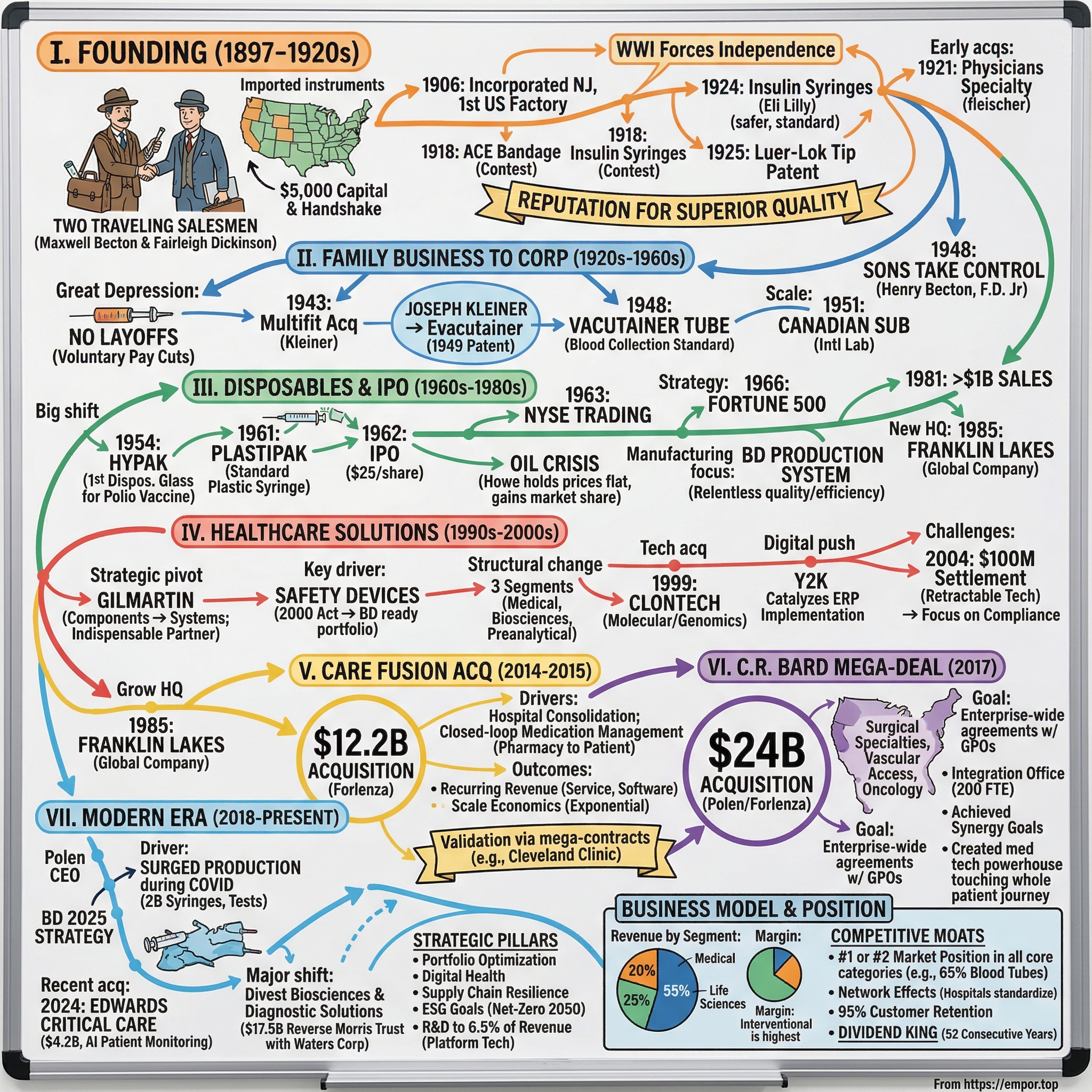
Becton, Dickinson and Company (BDX): The MedTech Consolidation Playbook and the Pure-Play Pivot
I. Introduction & Episode Roadmap
Walk into almost any hospital in the developed world and start counting the objects that touch a patient's body: the catheter in the forearm, the tube that catches the blood drawn at 5 a.m., the syringe that delivers the pre-op antibiotic, the pump on the IV pole that meters the drip, the locked steel cabinet on the ward from which a nurse pulls a controlled substance after scanning a badge, or the sensor threaded into a pulmonary artery in the cardiac ICU. On any given shift, a strikingly large share of those objects carries the same two-letter logo — BD — and none of them will ever be named by the patient, remembered by the family, or featured in a hospital's marketing.
That anonymity is central to the strategy. Becton, Dickinson and Company operates as medical infrastructure. It occupies a critical layer of healthcare that rarely attracts public scrutiny until a failure occurs, generating revenue models akin to a toll road: steady, high-volume, and reliant on high barriers to entry.
Two salesmen founded the company in 1897 by importing European thermometers into New Jersey. In fiscal 2025 — the last full year before divesting a third of its operations — BD reported $21.8 billion in revenue.1 On February 9, 2026, BD spun off and merged its Biosciences and Diagnostic Solutions businesses with Waters Corporation through a Reverse Morris Trust. The transaction valued the divested unit at $18.8 billion and returned $4 billion in cash to BD's balance sheet.2 What emerged is a streamlined company generating roughly $19 billion in annualized revenue across four operating segments, a structure management refers to as "New BD."3
Four key themes define the company's modern strategic trajectory.
First is the transition from a components manufacturer to an integrated systems provider. For most of its history, BD produced billions of sub-dollar consumables at microscopic defect rates. Between 2015 and 2018, it spent approximately $36 billion acquiring two major capital equipment, software, and implant providers — shifting its business model from high-volume manufacturing to clinical workflow control.
Second is the financial and operational burden of that acquisition spree. The accompanying debt, complex integration, and liabilities inherited from target companies — notably C.R. Bard's surgical mesh portfolio — resulted in roughly 38,000 lawsuits and a product-litigation accrual that stood at approximately $1.8 billion at the close of fiscal 2025.14
Third is the operational crisis that followed. The flagship Alaris infusion pump system was subject to a Class I recall in February 2020 and remained effectively off the U.S. market for over three years. In December 2024, the Securities and Exchange Commission ordered BD to pay a $175 million civil penalty for repeatedly misleading investors regarding the regulatory risks surrounding the Alaris platform.5 Evaluating BD's competitive moat and management track record requires examining this regulatory breakdown directly.
Fourth is the strategic pivot. Chief Executive Officer Tom Polen — who led the CareFusion acquisition before assuming the top role — spent six years restructuring the conglomerate. BD spun off its diabetes care division as Embecta in 2022 and completed the sale of its life sciences assets to Waters in 2026. Concurrently, BD acquired Edwards Lifesciences' Critical Care business for $4.2 billion in cash. The core analytical question is whether this reassembled portfolio represents a structurally superior business or simply a smaller footprint with a simplified narrative.
The roadmap. Part 1 details the foundational history — thermometers, the Luer-Lok, plastic disposables, and safety-engineered devices — focusing on how early standards created long-term cash flows. Part 2 analyzes the era of mega-acquisitions and portfolio assembly. Part 3 details the crisis period: the Alaris market hold, surgical mesh litigation, the SEC penalty, and the impact of China's volume-based procurement. Part 4 examines Polen's restructuring and the Waters divestiture. Part 5 evaluates unit economics and tests competitive advantages against established frameworks. Part 6 reviews growth vectors, particularly drug delivery systems for biologics. Part 7 assesses management performance and capital allocation. Part 8 outlines the bull and bear cases along with key metrics for long-term evaluation.
A note on posture before the analysis begins. BD is a Dividend King with a 54-year record of annual dividend increases and a sophisticated investor relations operation. This evaluation presents an objective analysis based on official filings and disclosed performance metrics.
 Subscribe on LinkedIn
II. The Foundation: Thermometers, Disposables, & Component Dominance (1897–1990s)
The founding scene is almost too tidy. In 1897, founders Maxwell W. Becton and Fairleigh S. Dickinson established a partnership in New York to import clinical thermometers and syringes from Europe and sell them to American physicians.6 They were not inventors. They were distributors who noticed that American medicine was industrializing faster than domestic manufacturing could supply it, and that the instruments doctors needed were being made primarily in Germany, France, and England.
Within a few years, they executed the strategic move that continues to define the company: they stopped importing and started manufacturing. The logic was pragmatic. If a physician uses an instrument hundreds of times a year and that device must be identical every time, the company controlling the manufacturing tolerances controls the market. Becton and Dickinson decided to own the tolerances rather than resell another maker's inventory.
The Luer-Lok and the invention of a standard. The decisive artifact arrived in 1925, when BD patented the Luer-Lok tip — a threaded locking collar that fixes a needle to a syringe so it cannot pop off under pressure.6 It is a simple piece of geometry. It is also the reason a nurse in Manila can take a needle from one manufacturer and a syringe from another and have them mate perfectly.
A standard is not a patent. Patents expire; standards compound. Once the Luer taper became the universal connection method for syringes and needles, every subsequent product in the category had to be designed around it, giving BD the advantage of factories already calibrated to make it at scale. However, owning a standard confers advantage over the category, not necessarily pricing power over the customer. That distinction becomes critical later in this analysis.
Blood, vacuum, and the second standard. In 1949, BD patented the Evacutainer — a glass tube evacuated of air and sealed with a rubber stopper, which fills itself with blood when a needle pierces the stopper.6 Renamed Vacutainer, it transformed phlebotomy much like the container ship transformed freight: it turned a bespoke, skill-dependent procedure into a standardized, stackable, machine-readable unit. It also carried BD into diagnostics, where the tube's chemical additives and draw order became embedded in clinical laboratory protocols worldwide.
The disposables revolution and the 1962 IPO. The most consequential decision in BD's first century was cannibalizing its own installed base. For sixty years, syringes were made of glass and needles of steel, both sterilised and reused. In 1961, after roughly a decade of development, BD introduced the Plastipak syringe — a single-use plastic device that a clinician threw away.7
Replacing a durable product with a disposable one required immense capital: automated molding, sterilization capacity, and a distribution network built to move high volume rather than high unit value. BD funded the transition by going public on April 23, 1962, at $25 per share — a family partnership converting into a public company specifically to finance the shift from reusables to disposables.6
The unit economics that emerged from that transition remain the foundation of the business. BD manufactures objects costing cents, in volumes measured in billions, at defect rates measured in parts per million. It sells them into medical channels where a product failure presents both patient risk and a severe regulatory event. Small competitors can match the product design, but few can simultaneously match the product, the volume, the audit trail, and the capacity to guarantee supply to a national health system for a decade. Scale in this market is less about marginal unit cost and more about being the vendor a hospital system does not have to worry about.
The safety-needle catalyst. The 1990s brought a regulatory tailwind that BD was uniquely positioned to capture. Needlestick injuries exposed healthcare workers to HIV and hepatitis. Engineered safety devices — such as retracting needles and shielded catheters — existed but carried higher prices than standard devices, leading hospitals to buy them sparingly. That dynamics changed on November 6, 2000, when the Needlestick Safety and Prevention Act became law, directing OSHA to require employers to identify, evaluate, and adopt safer sharps devices.8 A voluntary premium product instantly became a mandatory compliance standard, accelerating BD's safety-engineered syringes and IV catheters from a niche offering to the market default.
Historical falsification: was the consumables moat really about product superiority?
The thesis claim: BD's safety-needle dominance demonstrated an unassailable, product-driven pricing moat in medical consumables.
The disconfirming evidence: On July 2, 2004, BD paid $100 million in cash to settle a federal antitrust suit brought by Retractable Technologies, a small Texas maker of retractable syringes, ten days before trial was scheduled to begin in Texarkana.[^9] Retractable had earlier settled with the two largest hospital group purchasing organizations, Novation and Premier, and with Tyco.[^9] The core allegation was that hospital access was being controlled through GPO contracting arrangements rather than won purely on device merits.
Retractable sued again in a subsequent action, and in 2013 a Texas jury found for it on both antitrust and false-advertising claims. The Fifth Circuit reversed the antitrust judgment in December 2016 while leaving the false-advertising finding standing.9 That mixed outcome illustrates the underlying reality: BD ultimately defeated the monopolization claim on appeal, so the strongest version of the antitrust accusation did not survive judicial review. However, BD paid a nine-figure settlement to avoid a jury in the initial case, and the appellate record left intact a judicial finding that the company had misrepresented a competitor's product.
The calibrated conclusion: The thesis claim survives in a narrower form. BD's advantage in commodity consumables was and remains real, but it has always been a distribution and contracting advantage as much as a product advantage — the capacity to secure placement on every GPO agreement, in every distributor warehouse, and on every hospital standardisation list. That represents a durable moat, but it is distinct from pricing power. Anyone modeling BD's core consumables as a price-taking business with steady low-single-digit growth and defended market share is reading the historical record accurately; modeling it as a franchise that can raise prices at will is not.
By the early 2010s, that distinction emerged as a strategic limitation. BD dominated the components layer but could not grow significantly faster than underlying hospital utilization volumes. As healthcare delivery consolidated, management initiated a decade-long effort to reshape the portfolio alongside its changing customer base.
III. The Mega-M&A Playbook: CareFusion & C.R. Bard (2014–2017)
Around 2013, BD's leadership confronted a structural shift in hospital consolidation. Independent community facilities were being absorbed into integrated delivery networks, shifting purchasing decisions from individual materials managers to system-level committees overseeing supply spend across dozens of hospitals. These committees sought fewer vendors with broader capabilities, favoring suppliers that offered integrated systems rather than simple product catalogs.
For a company built on high-volume, low-cost component manufacturing, this shift presented an existential challenge. BD's core consumables were essential and its market position secure, but component dominance secured a seat at the table without dictating clinical workflow. To expand its role, BD chose to move up the technology stack—transitioning from the physical consumables that touch the patient to the automated systems that control medication delivery and dosage.
CareFusion: buying the workflow. On October 5, 2014, BD announced an agreement to acquire CareFusion Corporation for $12.2 billion, offering shareholders $49.00 in cash plus 0.0777 of a BD share for each share held.10 The transaction closed on March 17, 2015, with total consideration transferred valued at approximately $12.5 billion.11
What BD acquired was not another manufacturing operation, but two entrenched installed-base franchises. Pyxis was the dominant automated dispensing cabinet—a locked unit on hospital wards that logs nurse withdrawals under biometric or badge authentication against patient records. Alaris was the leading large-volume infusion pump—an IV-pole device metering fluids at programmed rates and cross-checking orders against a hospital's embedded drug library to prevent overdose errors.
The strategic rationale aimed to create a closed-loop medication management system. Hospital medication errors typically occur at four points: pharmacy selection, cabinet dispensing, pump programming, or bedside administration. BD already supplied the syringes and IV sets; CareFusion supplied the dispensing cabinets and infusion pumps. Integrating these assets theoretically connected physician orders electronically from pharmacy to cabinet to pump, verifying every step via barcode scan.
While compelling on paper, this strategy relied heavily on software integration—an operational discipline where BD had little historical experience.
Bard: buying growth. If CareFusion addressed clinical workflow, C.R. Bard was designed to elevate BD's top-line growth above low-single-digit consumable rates. On April 23, 2017, BD announced the acquisition of Bard for approximately $24 billion in cash and stock, valuing Bard at $317 per share.12 The transaction closed on December 29, 2017, with each Bard share converting into $222.93 in cash and 0.5077 of a BD share, creating an enterprise with roughly $16 billion in annualized revenue.13
Bard brought higher-margin, procedure-linked portfolios in vascular access, peripheral vascular intervention, urology, oncology catheters, and surgical implants, including hernia and soft-tissue repair mesh.1 These products offered faster growth and lower exposure to commodity price pressure than BD's legacy syringes. However, the purchase price required heavy debt financing and equity issuance, elevating leverage and restricting BD's capital allocation flexibility to debt reduction for the subsequent five years.
Historical falsification: did serial mega-M&A create an invincible franchise?
The thesis claim: Buying CareFusion and Bard converted a commodity manufacturer into an integrated MedTech juggernaut with structural cross-selling synergies and superior returns.
Disconfirming evidence one — BD bought a business that was already under a federal consent decree. This detail is frequently overlooked, though disclosed in BD's public filings. The U.S. infusion pump business operates under an amended FDA consent decree originally entered into by Cardinal Health 303, Inc. in 2007 and expanded in 2009 to cover all pumps manufactured by or for CareFusion 303, Inc.1 CareFusion 303 remains the legal manufacturer of Alaris pumps. Consequently, the cornerstone asset BD acquired in 2015 came with an eight-year-old regulatory encumbrance that has bound the company ever since, highlighting an established regulatory vulnerability prior to the acquisition.
Disconfirming evidence two — Bard's liabilities were larger and longer-lived than the deal model implied. In October 2024, BD reached an agreement to resolve the vast majority of its existing hernia litigation across Rhode Island coordinated proceedings and Ohio federal multidistrict litigation, structuring payments over multiple years within existing product-litigation reserves.4 Yet settling mass tort claims did not eliminate ongoing exposure. As of September 30, 2025—a full year after that settlement—BD was still defending approximately 6,905 hernia product liability claims, up from roughly 6,610 a year earlier, because new claims kept being filed.1 Accruals for product liability and related legal matters, including defense costs, stood at approximately $1.8 billion at the end of fiscal 2025, against roughly $1.9 billion a year earlier.1 Seven years after closing, surgical mesh liabilities remain a cash-consuming and persistent operational drag.
Disconfirming evidence three — the returns, measured the way GAAP measures them, were poor for years. BD's executive proxy disclosures illustrate the divergence between reported accounting performance and underlying deal metrics. For the fiscal 2022–2024 performance period, BD disclosed a three-year average GAAP return on invested capital of just 3.4%, with individual years of 3.4%, 3.2%, and 3.5%.14 Over the same span, the company highlighted an "Adjusted ROIC" of 11.7%, the metric governing executive incentive compensation.14 The substantial gap between these figures stems primarily from intangible asset amortization, restructuring costs, litigation reserves, and remediation charges categorized as non-recurring. In fiscal 2025 alone, purchase accounting adjustments consumed $1,898 million of pre-tax income.1
While excluding non-cash intangible amortization is standard practice across MedTech, BD defines "Adjusted ROIC" as adjusted EBITDA divided by adjusted average net assets—evaluating performance before depreciation, before tax, and before the cost of the assets it excludes from the denominator.14 In economic terms, this calculation functions more like an operational coverage ratio than a true metric of capital efficiency.
The calibrated conclusion. The evidence refutes claims of immediate M&A-driven outperformance while confirming a more nuanced reality. BD assembled a unique product portfolio, and the Interventional division acquired from Bard became its highest-margin segment, generating a 43.2% segment operating margin in fiscal 2025 versus 36.1% for the Medical segment.1 However, the financial record demonstrates that these acquisitions came at a heavy cost: GAAP returns on invested capital remained in the low single digits for years, debt obligations constrained strategy, and inherited liabilities outlived initial synergy targets. Demonstrating durable long-term value creation requires GAAP and adjusted returns to converge—a shift that depends on non-recurring expenses actually coming to an end.
They did not stop recurring. Within twenty-six months of closing the Bard deal, BD's most important acquired asset went dark.
IV. The Crisis Years: Alaris FDA Freeze, Mesh Liabilities, & China VBP (2018–2023)
On February 4, 2020, BD notified customers of a voluntary recall covering its Alaris System PC units and pump modules, flagging five separate ways the device might not behave as programmed — a system error code that could halt an infusion, faults in delay-option programming, a low-battery alarm that might not sound, and problems with the alarms that signal the end of an infusion or a keep-vein-open state.15 The FDA subsequently classified it as Class I, the agency's most serious designation, reserved for situations where use of the device may cause serious injury or death.16
Two days after the recall notice, BD cut its fiscal 2020 guidance. The reason was not the recall itself. It was that the FDA had directed the company to submit a comprehensive new 510(k) application covering years of accumulated software changes that BD had previously judged did not require fresh clearance.17 Until that application was granted, BD could not sell new pumps or push software upgrades into the field except where medically necessary.
Understanding why this was catastrophic requires understanding what a 510(k) is. It is the FDA pathway by which most medical devices reach market: a manufacturer demonstrates that its device is "substantially equivalent" to one already legally marketed. Critically, if a company changes a cleared device enough to affect its safety or effectiveness, it must clear it again. Software makes this treacherous, because code changes continuously and the judgment about when accumulated modifications cross the line is made in the first instance by the manufacturer. BD had been making that judgment in its own favor for years. The FDA disagreed.
The freeze lasted until July 21, 2023, when BD announced 510(k) clearance for the updated Alaris Infusion System, covering revised hardware and a new software version with cybersecurity and interoperability improvements, allowing the company to resume distribution and begin comprehensive remediation of the installed fleet.18 That was nearly three and a half years during which the flagship product of a $12.2 billion acquisition could not be sold to a new customer.
The accounting and enforcement tail. The financial consequences arrived in stages. In fiscal 2023, BD recorded $653 million of charges within cost of products sold to cover estimated future product remediation costs, followed by a further $98 million adjustment in fiscal 2025.1 Then, on December 16, 2024, the SEC issued a settled cease-and-desist order requiring BD to pay a $175 million civil penalty.5 The Commission's findings were unusually pointed: BD had determined in 2016 that software changes to Alaris required FDA clearance and then decided days later to resume shipping without it; on a November 2019 earnings call, BD told investors it was pausing Alaris sales to make "some improvements" as part of a strategy to "continually iterate and make enhancements to the platform"; and BD issued fiscal 2020 forecasts premised on the assumption that the FDA would permit sales to continue without clearance, without disclosing that premise.5 The order also found BD had overstated operating income by failing to record the costs of remediating the software defects.5 BD neither admitted nor denied the findings and accrued the $175 million in fiscal 2024.191
This mattered far beyond the dollar amount, which BD could pay out of a single quarter's free cash flow. A federal securities regulator concluded that the company's public description of a material regulatory problem differed from its internal understanding of that problem. For investors weighing management's framing of operational issues, that regulatory finding remains a long-lasting benchmark.
Historical falsification: are hospital switching costs really permanent?
The moat claim: Once Pyxis cabinets and Alaris pumps are installed and integrated into a hospital's electronic health record, the cost and disruption of switching make BD's market share effectively permanent.
The disconfirming evidence: The freeze served as a natural experiment on this question, yielding mixed results rather than a total breakdown. Independent purchasing research covering smart-pump decisions made between January 2020 and December 2021 found ICU Medical to be the most frequently chosen vendor in the sample. Buyers cited electronic-record interoperability, a broader array of pump types, competitive pricing, and — pointedly — the absence of recent recalls. The same study noted that most organizations choosing BD had done so before the series of Alaris recalls began.20 Competitors did not need to overcome switching costs; they simply waited at the door while BD was legally barred from entering.
But the counter-evidence is equally real, and it arrived later. By fiscal 2026, with the product cleared and remediation underway, BD reported gaining more than 200 basis points of infusion market share year-to-date, and on the Q2 call management stated it had recorded zero infusion account losses in the quarter.2122 The installed base bent, but it did not break.
The calibrated conclusion: The moat claim is narrowed rather than rejected. Switching costs in medication management are genuinely high — high enough that a three-and-a-half-year absence from new sales did not dislodge BD from its established accounts. What the episode disproves is the stronger formulation: that installed-base share is self-sustaining. It is not. Market share remains contingent on regulatory standing, and a manufacturer that loses clearance loses the ability to defend its position at the exact moment it needs to most. The moat is real, but the drawbridge is operated by the FDA.
And the FDA has not put the drawbridge away. On November 22, 2024, BD received a warning letter covering CareFusion 303's dispensing quality management system and Pyxis products — the other half of the closed-loop story.1 Trade reporting on the letter detailed findings including a large backlog of open software defect tickets categorized as potentially causing catastrophic or severe harm, tens of thousands of complaints regarding system freezes and shutdowns, and late adverse-event reporting.23 BD recorded a liability for the estimated costs of responding and stated in its annual report that total expenses could exceed the accrual.1 Separately, a May 2024 Form 483 notice covering the infusion quality management system — the entity governed by the consent decree — remained under FDA review as of the fiscal 2025 filing, with BD unable to predict further agency action.1
China: the growth engine that reversed. While the pump story unfolded in San Diego, a second growth thesis broke down in Shanghai. China's volume-based procurement (VBP) program — a national tendering system in which the government aggregates demand across provinces and awards contracts to the lowest bidders — expanded through successive categories of medical devices and consumables. For a premium-priced Western manufacturer, winning required accepting severe price cuts; losing meant exiting the category entirely.
BD's disclosures describe the operational mechanism plainly: revenue growth in both the Medical and Interventional segments in fiscal 2025 was partially offset by expected volume-based procurement impacts in China, affecting vascular access and hypodermic products on one side and the peripheral vascular portfolio on the other.1 The strategic consequence was that China shifted from a long-term growth engine into a managed contraction. Management has acknowledged the trajectory: on fiscal 2026 conference calls, executives noted that China represented roughly 4% of total revenue and expected it to decline into the low 3% range as other businesses grow faster.2422 This reflects a deliberate strategy to limit exposure rather than a turnaround plan, and investors should view it accordingly.
Embecta: the first amputation. On February 1, 2022, BD's board approved the spin-off of its diabetes care business as Embecta Corp, distributing shares to BD stockholders and completing the separation on April 1, 2022, supported by a private letter ruling from the IRS confirming tax-free treatment.25 Diabetes care was a mature business producing pen needles and syringes for insulin delivery, but it faced structural headwinds: price compression and a therapeutic shift toward products requiring fewer traditional needles.
The move carried broader strategic symbolism beyond its immediate financial impact. For twenty-five years, BD had grown primarily through acquisitions. Embecta marked the company's first major divestiture, establishing an operational template for portfolio pruning that management would later apply on a larger scale. Notably, this shift occurred under a chief executive who had previously overseen BD's major expansion phase.
V. Tom Polen & BD 2025: Strategic Pivot from Conglomerate to Pure-Play MedTech (2020–Present)
There is an uncomfortable fact at the center of BD's transformation story: the executive dismantling the empire is the executive who built it.
Tom Polen joined BD in 1999 and spent two decades rising through its operating ranks. As president of the Medical segment, he led the $12 billion acquisition of CareFusion, driving BD's expansion into clinical software and hospital automation; he later directed strategy for the C.R. Bard transaction. Polen was named president of BD in April 2017 — the month the Bard deal was announced — became chief operating officer in October 2018, took over as chief executive in January 2020, and added the chairmanship in April 2021.26
This is not a criticism. Executives who correct their own missteps are rarer than those who critique their predecessors. However, it alters how the narrative must be evaluated. When BD states that it has shifted from empire-building to portfolio discipline, this does not represent a new leadership team repudiating an old strategy. It is the same architect restructuring the same conglomerate, and the restructuring began only after operational and regulatory pressures mounted.
Polen assumed the CEO role during a volatile period. Within a month of his appointment in January 2020, the FDA Alaris recall landed, earnings guidance was cut, and the COVID-19 pandemic began. Management responded with a strategy branded "BD 2025," structured around three core themes — grow, simplify, empower — alongside an internal operating system called BD Excellence, a lean-manufacturing initiative designed to deliver sustained margin expansion.
Assessing the financial impact of BD Excellence requires separating productivity gains from external cost headwinds. While the program's implementation is documented, its contribution to net margin expansion has been muted by shifting cost structures. In the third quarter of fiscal 2026, BD's adjusted gross margin declined 100 basis points year over year, while adjusted operating margin fell 130 basis points to 24.9%.24 Management identified tariffs as the primary headwind, quantifying them as a 110 basis point drag on adjusted operating margin in the third quarter — following a second-quarter disclosure of 160 basis points of gross margin tariff pressure, which was partially offset by 70 basis points of internal productivity gains.2422 Taken together, those disclosures indicate that while BD Excellence is generating operational savings, those gains are currently being absorbed by trade tariffs and input-cost pressures rather than flowing through to operating income.
The Edwards Critical Care acquisition: a different kind of deal. On June 3, 2024, BD agreed to acquire Edwards Lifesciences' Critical Care product group for $4.2 billion in cash, closing the transaction on September 3, 2024, and renaming the unit BD Advanced Patient Monitoring, based in Irvine, California.2728
The clinical rationale for the transaction was straightforward. The Critical Care unit manufactures hemodynamics sensors and patient monitors — tracing back to the Swan-Ganz pulmonary artery catheter — as well as predictive software, including an algorithm that alerts clinicians to impending hypotension. Strategically, BD sought to pair its existing Alaris infusion pumps with real-time patient monitoring hardware, creating an integrated feedback loop between diagnostic data and drug delivery.
Financially, the deal carried a premium valuation that was not emphasized in initial announcements. At $4.2 billion for an asset generating roughly $900 million in annual revenue, BD paid a multiple in the mid-four-times-sales range. In its first full year under BD ownership, Advanced Patient Monitoring generated $1,082 million in revenue.1 While this top-line performance provides early validation, it represents a single year of results. Moreover, the acquired unit combines hardware, software, and regulatory oversight — the exact operational intersection where BD has historically faced integration challenges.
Starboard and the separation timeline. In early February 2025, reports indicated that activist investor Starboard Value had acquired a stake in BD and was urging the company to divest its life sciences assets, which third-party analysts valued in the $30 billion to $35 billion range. On February 5, 2025, BD announced that its board had unanimously authorized management to evaluate a separation of its Biosciences and Diagnostic Solutions units.2930
While management maintained that the strategic review was initiated prior to Starboard's involvement, the public sequence shows that formal board authorization followed news of the activist campaign by days. For investors, this timing highlights the role external pressure likely played in accelerating portfolio divestitures.
The Waters transaction. On July 13, 2025, BD signed a definitive agreement to combine its Biosciences and Diagnostic Solutions businesses with Waters Corporation using a Reverse Morris Trust structure.1 In an RMT transaction, a parent company spins off a business unit to its shareholders, and the spun-off entity immediately merges with an acquiring firm. Because the transaction is structured so that legacy parent shareholders retain majority ownership in the combined company, the distribution remains tax-free to the parent and its stockholders.
BD set a record date of February 5, 2026, and completed the transaction on February 9, 2026.312 BD shareholders received approximately 0.135 Waters shares for each BD share held, resulting in a 39.2% equity stake in the combined entity, while legacy Waters shareholders retained 60.8%.32 As part of the transaction, BD received $4 billion in cash, while Waters assumed approximately $4 billion in incremental debt.12 The transaction implied a total enterprise valuation of $18.8 billion for the divested business.2
That valuation is notable when evaluated against the divested units' operating performance. Diagnostic Solutions and Biosciences generated a combined $3.3 billion in revenue in fiscal 2025, and both divisions were experiencing currency-neutral revenue declines.1 Monetizing a declining $3.3 billion revenue stream at an $18.8 billion valuation represents a favorable execution outcome for BD. It also underscored a market misallocation: BD's diagnostic assets commanded higher valuation multiples when paired with a specialized life-sciences-tools company than inside a broader MedTech conglomerate.
Capital allocation and balance sheet impact. Management directed the $4 billion in cash proceeds toward equal parts debt reduction and share repurchases. The company retired $2.1 billion in debt and executed a $2 billion accelerated share repurchase in the second quarter of fiscal 2026; through the first nine months of the fiscal year, total debt paydown reached $2.696 billion alongside $2.25 billion in share buybacks.333 On the second-quarter earnings call, Polen noted that share repurchases were prioritized over small-scale acquisitions based on prevailing equity valuations.22
However, third-party assertions regarding post-transaction leverage require clarification. The transaction did not reduce BD's net leverage ratio to 2.3 times EBITDA. As of the third quarter of fiscal 2026, net leverage stood at approximately 2.9 times adjusted EBITDA, compared with management's long-term target of 2.5 times.24 While leverage has declined significantly from post-Bard peak levels, it remains above target. Additionally, management has deferred issuing revised long-term margin targets, stating on the third-quarter call that updated financial frameworks would be presented at a future analyst day.24 For a company pursuing structural margin expansion, the absence of an updated multi-year target framework remains an open analytical question.
This brings the analysis to the underlying question: what does the reassembled company look like, and is it a structurally superior business?
VI. Core Business Economics & 7 Powers Analysis
Start with a correction to the organizational map: pre-separation descriptions of BD no longer apply. The company did not emerge from the Waters transaction as a simple two-segment operator divided into BD Medical and BD Interventional. Beginning with its post-separation financial reporting, BD reorganized into four reportable segments — an architecture essential to evaluating its underlying economics.3
Medical Essentials represents the historical foundation of the enterprise: Medication Delivery Solutions — including IV catheters, vascular access devices, hypodermic products, and prefilled flush syringes — combined with Specimen Management, the blood collection franchise built on the Vacutainer standard. Generating $1.675 billion in revenue in the third quarter of fiscal 2026, up 3.2% on a currency-neutral basis, it remains BD's largest unit.3 It is a low-growth, high-volume, deeply entrenched core.
Connected Care houses the assets inherited from CareFusion alongside the newly acquired Edwards monitoring business. The segment pairs Medication Management Solutions — the Pyxis dispensing and Alaris infusion pump franchises and their associated software — with Advanced Patient Monitoring. The division generated $1.224 billion in third-quarter revenue, representing 4.4% growth.3 This segment concentrates BD's capital equipment, clinical software, and regulatory vulnerabilities.
BioPharma Systems supplies prefillable syringes, delivery pens, and self-injection systems to pharmaceutical manufacturers rather than hospitals. The segment generated $670 million in third-quarter revenue, an increase of 5.2%; management highlighted mid-teens growth when excluding vaccine delivery systems, which have continued to act as a drag on top-line expansion.321
Interventional comprises the legacy Bard portfolio: Surgery, spanning hernia and soft-tissue repair, biosurgery, and ChloraPrep infection-prevention products; Peripheral Intervention, including angioplasty balloons and the Rotarex atherectomy platform; and Urology and Critical Care, anchored by the PureWick external catheter line. Delivering $1.414 billion in revenue at a 5.5% growth rate, it stood as the quarter's fastest-growing major segment.31
The underlying economics across these franchises are clearest in fiscal 2025 disclosures, the last full year under the prior reporting structure. In that period, the Interventional segment produced a 43.2% operating margin on $5.217 billion in revenue, compared with 36.1% on $11.456 billion for the Medical segment.1 The assets acquired from Bard generate higher structural operating margins than BD's historical core — providing an important nuance to critiques of that transaction. The deal compressed overall capital returns due to its acquisition price and inherited liabilities, rather than underlying asset quality.
A broader accounting perspective frames the enterprise whole. In fiscal 2025, BD's three primary segments generated $8.034 billion in combined operating income on $21.840 billion in revenue, yet income from continuing operations before taxes reached just $1.881 billion.1 The roughly $6 billion bridge between segment-level profits and consolidated pre-tax income reflects corporate overhead, $575 million in net interest, purchase accounting adjustments, integration and restructuring expenses, litigation reserves, and separation costs.1 BD demonstrates strong divisional margins, but its consolidated GAAP performance has historically been constrained by the lingering costs of its acquisition expansion.
7 Powers, tested rather than asserted.
Switching costs. This serves as BD's cornerstone strategic advantage within Connected Care. Deploying Pyxis cabinets across a hospital network requires deep integration with electronic health record platforms — such as Epic or Oracle Health — alongside mapping pharmacy formularies, configuring drug libraries with customized dose limits, retraining nursing staff, and revalidating clinical protocols. Replacing these systems involves a costly, multi-year transition carrying inherent patient-safety risks, leading hospital systems to rarely switch voluntarily. This structural inertia was demonstrated by BD's retention of its core infusion accounts throughout a three-and-a-half-year FDA sales hold. However, this advantage has clear boundaries: an FDA warning letter citing systemic quality management failures in the dispensing division directly undermines the reputation for operational reliability that sustains those switching costs.23 High switching barriers grounded in clinical trust can be compromised by internal operational execution as easily as by competitive rivalry.
Scale economies. Scale advantages remain pronounced across Medical Essentials and BioPharma Systems. Producing tens of billions of sterile components annually with low defect rates requires immense capital and operational expertise. In medical manufacturing, scale yields a distinct regulatory advantage alongside traditional cost efficiencies. When the FDA issued a safety communication in November 2023 highlighting quality vulnerabilities in Chinese-manufactured plastic syringes and recommending alternative suppliers, the primary beneficiaries were established producers with validated, large-scale domestic and Western manufacturing footprints.[^35] While low-cost foreign producers exert pricing pressure on commodity items, they face substantial barriers when attempting to displace vendors offering high-volume, regulatory-compliant supply assurance.
Process power. BD's most defensible proprietary advantage resides in its specialized glass production for BioPharma Systems. A prefillable syringe for a complex biologic is an active component of the drug's stability profile rather than a passive container. Inner barrel surfaces must remain chemically inert to prevent monoclonal antibody degradation over multi-year shelf lives, silicone lubricant formulations must allow smooth plunger activation without contaminating the formulation, and glass geometry must withstand high-speed automated filling lines. Developing these precise tolerances required decades of proprietary manufacturing knowledge. Furthermore, because regulatory approvals tie a biologic drug to its specific container-closure system, pharmaceutical clients face substantial regulatory hurdles if they attempt to swap suppliers. Proprietary process knowledge is thus reinforced by client-side regulatory lock-in.
The powers BD does not have. BD possesses no meaningful network effects, as a hospital system derives no direct operational benefit from peers adopting Pyxis systems. It lacks counter-positioning, operating as the legacy incumbent against which emerging competitors position themselves. Its brand functions as a procurement assurance rather than a tool for premium pricing power. Finally, BD commands no cornered resources, lacking exclusive raw material access, irreplaceable talent, or foundational patent portfolios capable of blocking competitors from core categories.
Porter's five forces, in war-game terms.
New entrants: very low threat. Stringent regulatory clearance requirements, heavy capital intensity, and long-term GPO contracting cycles present severe barriers to entry. Competitors attempting entry are typically established MedTech manufacturers expanding adjacent product lines rather than venture-backed startups.
Buyer power: high, and the binding constraint on the whole business. Consolidated healthcare delivery networks and group purchasing organizations such as Premier and Vizient aggregate hospital purchasing volume specifically to negotiate aggressive price concessions. This buyer concentration caps BD's margin expansion in commodity consumables, a pressure that intensifies as hospital systems consolidate to counter their own labor cost inflation.
Supplier power: low. Essential inputs such as medical-grade resins and borosilicate glass tubing are sourced in high volumes under long-term contracts. The primary supply-side risk involves regulatory constraints on processing capabilities — specifically ethylene oxide sterilization — rather than raw material supplier pricing power.
Substitutes: low to medium, and asymmetric by segment. Intravenous access remains irreplaceable in acute clinical settings. Conversely, BioPharma Systems faces potential substitution risk if oral formulations replace injectable therapies — an operational uncertainty management acknowledged on the second-quarter fiscal 2026 call while declining to quantify its potential top-line impact.22
Rivalry: high, and segment-specific. BD faces focused competition across each division: ICU Medical and Baxter in infusion and dispensing; Boston Scientific, Medtronic, Stryker, and Teleflex in surgical and interventional lines; and Gerresheimer, Schott, and Stevanato Group in prefillable glass containers. These established peers possess substantial market presence, and key pump competitors spent over three years capitalizing on BD's regulatory sales hold.
A supply-chain concentration worth flagging. Ethylene oxide remains the primary sterilizing agent for medical devices and, for many product lines, the only viable technical option. The process faces tightening environmental and occupational regulation. The EPA's updated facility emissions standards took effect on April 5, 2024, followed by a July 17, 2025 presidential proclamation granting select facilities a two-year compliance extension, and a January 14, 2025 EPA pesticide registration decision imposing stricter occupational exposure limits phased in starting January 2026.1 BD has implemented enhanced emissions controls at key plants in East Columbus, Nebraska, and Sandy, Utah, aiming for full regulatory compliance by April 2028.1 Because finished inventory cannot ship without validated sterilization, any disruption to internal or contract sterilization infrastructure poses a direct operational risk to product delivery.
The competitive moat is structurally resilient but operationally bounded. The enterprise maintains market leadership through deep clinical integration, high-volume manufacturing reliability, and steep customer switching costs rather than discretionary pricing power. Consequently, long-term earnings expansion depends primarily on portfolio mix shifts and target growth vectors — where product differentiation and procedural demand can drive margin improvement.
VII. Fast-Growing Vectors & Optionality
The most strategic factory BD operates sits outside its traditional hospital supply chain. In Columbus, Nebraska — a town of roughly 25,000 people — the company committed about $110 million to expand prefillable syringe production, allocating approximately $100 million toward a Neopak glass prefillable syringe line targeted for mid-2026 that creates around 120 jobs.34 The driver behind this nine-figure investment in precision glass forming is straightforward: one of the pharmaceutical industry's fastest-growing drug categories faces a specialized packaging challenge.
Biologics, GLP-1s, and the container question. Traditional oral medications consist of small molecules that survive digestive stomach acid. In contrast, biologics — including monoclonal antibodies, insulins, and the GLP-1 receptor agonists that have transformed obesity and diabetes care — are complex, fragile proteins that stomach acid destroys. Consequently, these therapies must be injected, increasingly by patients at home rather than clinicians in healthcare settings. That delivery model requires primary packaging prefilled at the factory, shelf-stable for two years, and intuitive enough for an untrained individual to administer safely.
BD manufactures the two primary form factors serving this market: glass prefillable syringes under its Neopak platform — including a specialized configuration featuring thinner walls and a shorter needle for high-viscosity biologics — and disposable pen injectors marketed under the Vystra brand for GLP-1 therapies.35 In fiscal 2025, the legacy Pharmaceutical Systems unit that reorganized into BioPharma Systems generated $2.324 billion in revenue.1 This segment commands strong strategic value within BD's portfolio, as products are supplied under multi-year commercial agreements, embedded directly into drug regulatory filings, and protected from traditional hospital purchasing committee price negotiations.
Management has highlighted this commercial momentum in recent earnings updates. On its third-quarter fiscal 2026 conference call, BD reported reaching approximately 100 signed supply agreements across novel and biosimilar GLP-1 programs, alongside a partnership with Brazil-based EMS to expand semaglutide access using the Vystra pen platform.213 On the preceding second-quarter call, executives disclosed that biologics had expanded to represent roughly 55% of segment revenue, up from about 50%, while securing container-closure wins for two next-generation GLP-1 programs with major global pharmaceutical developers.22
Historical falsification: does BD have a chokehold on GLP-1 delivery?
The thesis claim: BD holds a near-monopoly position in the glass and pen components required for GLP-1 and biologic self-injection, giving it pricing power over the fastest-growing category in pharmaceuticals.
The disconfirming evidence: First, reported financial results contradict assertions of unassailable pricing control. BioPharma Systems generated 5.2% currency-neutral revenue growth in the third quarter of fiscal 2026, following a 1.8% currency-neutral contraction in the second quarter.333 A division benefiting from monopoly pricing power across a premier growth category does not experience quarterly revenue declines. Management attributed that second-quarter contraction to lower vaccine container volumes masking mid-teens growth across the broader portfolio — an explanation that underscores that GLP-1 demand represents one driver within a broader portfolio rather than the entire division.
Second, customer procurement dynamics limit supplier leverage. Pharmaceutical clients represent sophisticated global buyers operating with strict supply-chain redundancy mandates. Established competitors — including Gerresheimer, Schott, and Stevanato Group — maintain substantial market positions supplying primary drug packaging to the same pharmaceutical client base. When qualifying container-closure systems for high-volume therapies, drug manufacturers routinely validate secondary suppliers to mitigate delivery risks. Furthermore, BD has not disclosed its specific market share in GLP-1 containers, meaning unverified third-party share estimates should be evaluated with caution.
Third, capital allocation choices reflect competitive dynamics rather than pricing dominance. BD's multi-million dollar capital investment to expand manufacturing capacity in Nebraska demonstrates an effort to secure volume contracts rather than exercise pricing leverage over a constrained market.34 Suppliers possessing true pricing power expand margins by raising prices; companies competing for long-term supply contracts invest in dedicated production capacity.
Fourth, technological substitution presents an emerging long-term variable. Clinical development of oral GLP-1 formulations has progressed steadily. When addressed on the second-quarter fiscal 2026 conference call, Chief Executive Officer Tom Polen affirmed that injectables remain the core delivery mechanism for the category, though management did not quantify potential oral substitution.22 While injectable administration offers clear bioavailability benefits for complex proteins, the long-term competitive impact of alternative delivery mechanisms remains an open analytical question.
The calibrated conclusion: The GLP-1 expansion represents a material volume growth opportunity, but it does not constitute an unassailable pricing moat. BD operates as one of a select group of qualified suppliers serving an expanding therapeutic category, a position that supports steady volume growth, favorable product mix, and healthy incremental margins. However, it does not represent a cornered resource capable of commanding monopoly pricing. Evaluating the durability of this vector requires monitoring whether BioPharma Systems maintains currency-neutral revenue growth above mid-single digits across a full fiscal year — absorbing vaccine comparison headwinds — alongside explicit disclosure of segment-level margin expansion.
Smart connected care: optionality, not yet a business. The second potential growth vector centers on expanding recurring software revenue. The strategic objective is to integrate device telemetry from Alaris infusion pumps, inventory data from Pyxis dispensing cabinets, and predictive clinical analytics from the Advanced Patient Monitoring division into unified, subscription-based cloud dashboards — transitioning BD from a capital equipment supplier into a clinical decision-support partner with software-like margins.
The underlying technology offers demonstrated clinical utility. Predictive algorithms that alert anesthesia teams minutes prior to hemodynamic instability provide clear clinical value, and BD reported double-digit revenue growth across Advanced Patient Monitoring, the PureWick urine management line, and Rowa pharmacy automation platforms in fiscal 2026.21
Evaluating this opportunity requires distinguishing technological capability from financial monetization. BD does not report recurring software revenue as a standalone financial line, has not disclosed software attach rates across its installed base, and has not established explicit multi-year targets for software revenue contribution. Disclosed segment performance reflects capital equipment sales expanding at mid-single-digit rates. Furthermore, historical execution warrants analytical discipline: the closed-loop medication management narrative served as the core strategic justification for the $12.2 billion acquisition of CareFusion in 2015. Eleven years later, the primary operational markers of that strategy have included an FDA consent decree, a three-and-a-half-year commercial sales hold, a regulatory warning letter covering Pyxis dispensing systems, and a $175 million SEC civil penalty. Until management discloses standalone software revenues and adoption metrics, smart connected care represents potential optionality rather than a baseline valuation driver.
VIII. Management Credibility, Capital Allocation & Activist/Skeptical Investor Stress Test
Imagine a skeptical fund manager who has just built a position and requests a meeting. Having reviewed six years of earnings transcripts, proxy filings, and litigation notes, she is not hostile—she simply wants to distinguish demonstrated execution from unfulfilled promises. Here is how that conversation unfolds.
Start with what management actually delivered. This represents the strongest element of the investment thesis. Chief Executive Officer Tom Polen's team pledged to secure clearance for Alaris and accomplished it in July 2023. Management committed to resolving the bulk of the hernia litigation and structured a settlement in October 2024. Leadership set out to simplify the corporate portfolio, executing divestitures in 2022 and 2026—the second of which monetized a contracting $3.3 billion revenue unit at a valuation near $18.8 billion. Management stated it would deploy the Waters transaction proceeds toward debt paydown and share repurchases rather than new acquisitions; through the first nine months of fiscal 2026, BD retired $2.696 billion in debt and bought back $2.25 billion of stock, returning $3.1 billion to shareholders in total including dividends.324 BD has increased its dividend for 54 consecutive years, most recently in November 2025.36 Free cash flow through the first nine months of fiscal 2026 reached $1.728 billion, up 44.6% year over year.3
That execution record contrasts meaningfully with the operational missteps of the 2018–2020 period.
Now the harder questions.
Question one: why does the compensation arithmetic look so much better than the GAAP arithmetic? For the fiscal 2022–2024 performance period, BD's proxy disclosed a three-year average annual GAAP revenue growth rate of 1.8%, compared with a "PSU Revenue" growth rate of 3.5% after adjustments.14 Over the same span, the company reported a three-year average GAAP ROIC of 3.4% against an adjusted ROIC of 11.7%.14 Performance units covering that period subsequently paid out at 137% of target.14
While management maintains a rationale for each individual adjustment, the aggregate outcome allowed a period of subdued reported growth and low GAAP returns to generate above-target long-term incentive payouts. Shareholders have not mounted significant opposition—the 2025 say-on-pay advisory vote received approximately 89% support, a solid result, though below the mid-90% range typical for large-cap boards.14 The skeptical perspective is straightforward: because executive incentive plans evaluate performance using the same adjusted metrics management presents to the public, the scorecard does not serve as an independent test of underlying business value.
Question two: what happened in the finance function? On October 15, 2025, BD announced that Chief Financial Officer Chris DelOrefice would depart effective December 5, 2025, to pursue another opportunity, with Vitor Roque—a senior finance executive with over 25 years at the company—assuming the role on an interim basis.37 Roque was named permanent CFO on May 7, 2026.38 The executive transition was announced weeks before fiscal year-end financial reporting and roughly three months prior to the closing of the Waters transaction, with BD disclosing no disagreement on accounting or reporting matters. A seven-month interim CFO tenure surrounding an $18.8 billion corporate separation does not represent a governance failure, but it introduces operational friction that long-term investors should monitor.
Question three: is the margin story a plan or an aspiration? BD's central equity narrative posits that a simplified, higher-mix portfolio combined with the BD Excellence operating system will drive sustained margin expansion. In fiscal 2026, reported financial results moved in the opposite direction, with adjusted operating margin declining 130 basis points in the third quarter and full-year guidance set at approximately 25%.243 Management attributes the pressure to trade tariffs and asserts that pricing actions and productivity initiatives will offset these costs over time.24 That explanation is plausible and testable. However, management has declined to publish an updated long-term margin target, deferring new financial frameworks to a future analyst day.24 Consequently, investors are asked to underwrite structural margin expansion without a stated financial baseline.
Question four: what is left in the litigation column? Three distinct exposure areas remain open, only one of which is widely understood.
First, hernia claims continue to accumulate despite the global settlement framework, standing at approximately 6,905 filed cases as of the end of fiscal 2025.1 BD also discloses pending product liability litigation involving surgical continence and pelvic organ prolapse devices, vena cava filters, and implantable ports.1 The $1.8 billion product litigation accrual reflects management's estimate of these cases and associated defense costs—an accounting estimate rather than a final settlement.1
Second, and less recognized, is ethylene oxide (EtO) personal-injury litigation. Plaintiffs residing or working near BD's processing facilities in Covington, Georgia, have filed approximately 405 lawsuits involving roughly 415 individuals alleging cancer and other health impacts from EtO emissions.1 On May 2, 2025, the initial trial yielded a $20 million compensatory verdict, followed on May 6 by a $50 million punitive award. The trial judge subsequently set aside the punitive verdict and declared a mistrial on the punitive phase because the jury was not unanimous on specific intent—the legal threshold required under Georgia law to exceed a $250,000 per-claimant statutory cap.1 On September 15, 2025, the trial court ruled that any retrial would be limited strictly to the specific-intent determination, and the Georgia Court of Appeals granted BD's interlocutory appeal on October 23, 2025. No final judgment has been entered and BD has accrued no financial reserve for this single case.1 The key variable for investors is the statutory cap: if appellate rulings allow juries to evaluate specific intent case-by-case across 405 pending suits, potential liabilities would scale significantly. This represents an unaccrued tail risk with a wide distribution of possible outcomes.
Third, regulatory oversight remains active across Connected Care: a warning letter covering dispensing quality management systems—where recorded liabilities could prove insufficient—and infusion quality system inspection observations under review beneath a consent decree active since 2007.1
Question five: was the Bard deal a mistake, and has the lesson been learned? Empirical evidence indicates the transaction transferred substantial economic value from BD shareholders to Bard's. Although the acquired assets perform well operationally—Interventional now stands as BD's most profitable operating segment—the purchase price, financial leverage, and inherited liabilities absorbed nearly a decade of corporate flexibility. The Waters transaction has repaired the balance sheet without erasing that deal history; net leverage at roughly 2.9 times adjusted EBITDA represents marked progress from post-acquisition highs, but remains above management's 2.5 times long-term target.24
Whether leadership has adopted capital discipline remains an open analytical question. The case for discipline rests on the Embecta spin-off, the Waters divestiture, and management's explicit preference for share buybacks over acquisitions at current equity valuations.22 The counterargument notes that this discipline emerged under balance-sheet constraint, that the primary acquisition of this era—Edwards Critical Care at roughly mid-four-times sales—commanded a premium, and that capital allocation remains directed by the chief executive who oversaw the prior expansion phase. The disconfirming indicator is clear: if BD pursues another multi-billion-dollar platform acquisition once net leverage reaches 2.5 times and current buyback authorizations conclude, the capital discipline narrative collapses.
Question six: what should be read in the calls themselves? Three qualitative threads across quarterly conference calls warrant tracking. First is the Alaris conversion pace: management expects system remediation to conclude near the end of fiscal 2026, after which associated upgrade revenue will roll off.2122 Second is China strategy: executive communication has shifted from growth recovery to risk containment, reframing China as a shrinking portion of global revenue rather than an expansion engine.24 Third is capital allocation priorities: explicitly ranking share repurchases ahead of tuck-in acquisitions represents a clear shift from prior messaging.22 Across all three areas, management disclosures have provided specific quantitative detail—marking an operational evolution from the communication practices detailed in the SEC's 2019 regulatory findings.
IX. Bear vs. Bull Case & Future Outlook
The bull case, stated at its strongest.
The core bull argument is that BD has finally become the streamlined operator its underlying assets implied. The enterprise now consists of four operating segments sharing a common customer base, regulatory framework, and manufacturing culture, replacing a MedTech conglomerate bolted to a life sciences tools business that equity markets valued under entirely different logic. According to management characterizations on recent calls, more than 90% of the portfolio expanded at mid-single-digit rates or better in fiscal 2026, with the fastest-growing categories — Advanced Patient Monitoring, PureWick, pharmacy automation, and biologics delivery — carrying among the highest operating margins in the company.2122
The balance sheet has been strengthened using cash generated by selling an asset at a valuation multiple the market refused to grant within BD. Concurrently, the share count is falling, while free cash flow expands significantly faster than revenue. The infusion franchise has resumed market-share gains following the most severe regulatory hold in company history, providing empirical evidence of durable switching costs. Finally, the secular growth in injectable biologics represents one of MedTech's most reliable multi-year demand drivers.
Applying the 7 Powers framework gives the bull case structural backing: switching costs in Connected Care, scale economies in Medical Essentials, and proprietary process power in BioPharma Systems represent three distinct competitive advantages, reinforced by steep barriers to entry.
The bear case, stated at its strongest.
The bear case does not argue that BD is a flawed business, but rather that it remains a solid enterprise capped by customer pricing power — and that portfolio restructuring has not altered that reality.
Buyer power remains the primary operational constraint. Consolidated hospital systems facing labor-cost inflation and constrained capital budgets represent the primary counterparties for BD's revenue, and these networks are consolidating faster than their suppliers. Consequently, procurement organizations routinely attempt to capture the productivity savings generated by BD Excellence. The fiscal 2026 margin trajectory illustrates this dynamic: while internal operational gains were real, rising tariffs absorbed those savings, causing operating margins to contract.2422
Then there is the Alaris revenue dynamic, which represents the most critical yet frequently misunderstood element of the financial outlook. Bulls frame the pump replacement cycle as a multi-year growth catalyst. However, management has explicitly clarified that this revenue reflects a temporary remediation bolus rather than a permanent run rate. BD has pre-announced a 200 basis point revenue growth headwind for fiscal 2027 as the remediation cycle concludes, with CEO Tom Polen noting on the third-quarter call that "that 200 basis points will come off and lift, and we expect to be driving back to our mid-single-digit algorithm."24 That guidance places a clear boundary on the replacement narrative: the conversion represents a finite revenue surge, against which fiscal 2027 performance will be evaluated. Investors who model the Alaris cycle as structural growth are projecting expansion that management has warned will reverse.
In addition, product litigation obligations represent active cash outflows subject to ongoing accounting adjustments, while ethylene oxide personal-injury lawsuits carry an unaccrued tail risk. Persistent regulatory oversight directly targets the segment containing BD's primary switching costs. In BioPharma Systems, substitution risk from oral GLP-1 formulations remains unquantified, even as well-capitalized competitors expand prefillable glass capacity. Crucially, management has yet to disclose the multi-year margin framework required to validate a sustained valuation rerating.
Finally, an activist structural question lingers: having twice concluded that corporate units were worth more independently than combined, why should investors assume the remaining four divisions belong under one roof? Medical Essentials operates as a low-growth, scale-driven consumables manufacturer, whereas BioPharma Systems serves as a specialized industrial supplier to pharmaceutical firms with distinct customers, sales cycles, and capital requirements. The rationale that justified divesting life sciences applies in partial form to this pairing as well. Management has not addressed this structural overlap publicly, leaving the burden of proof on the argument for unified ownership.
The three KPIs that actually settle the argument.
Three specific financial metrics provide the foundation for an objective monitoring routine, with each testing a core claim in dispute.
One: currency-neutral organic revenue growth, evaluated excluding the Alaris remediation contribution. This serves as the master metric for determining whether the post-divestiture portfolio structurally outperforms its legacy predecessor. Management has targeted a mid-single-digit growth algorithm with expected acceleration over the next 12 to 24 months.24 Fiscal 2027 represents the decisive test: as remediation revenue rolls off and the 200 basis point headwind takes effect, performance will reflect underlying portfolio demand. If ex-Alaris organic growth fails to reach the mid-single digits by fiscal 2028, the pure-play thesis remains unvalidated.
Two: adjusted operating margin, tracked relative to GAAP operating income. The baseline adjusted margin demonstrates whether BD Excellence can generate net profitability improvements alongside tariff, mix, and price pressures. The gap between adjusted and GAAP metrics tests a broader question: whether the restructuring charges, amortization, and litigation reserves that have separated reported and adjusted earnings for a decade are finally receding. A narrowing gap offers definitive evidence of operational transformation, whereas persistent divergence indicates that non-recurring adjustments have become permanent features of the business model.
Three: free cash flow conversion, monitored alongside net leverage and diluted share count. Cash conversion evaluates true earnings quality, verifying whether adjusted profits convert into cash flow after accounting for litigation settlements, remediation expenses, and capital equipment working capital. Evaluating conversion alongside net leverage relative to management's 2.5 times target — as well as share reduction progress — answers the capital allocation question directly: is free cash flow retiring balance-sheet obligations and repurchasing equity, or being accumulated for another platform acquisition?
Beyond these three metrics, quarterly segment fluctuations, individual regulatory clearances, and new product announcements represent secondary noise.
X. Playbook: Business & Investing Lessons
One: standards outlive patents, but they do not confer pricing power. The Luer-Lok and the Vacutainer have generated steady cash for BD across a century because they became embedded in standard clinical workflows. That represents a formidable structural position. But BD's litigation history demonstrates that translating a technical standard into commercial dominance still required contracting, distribution networks, and group purchasing organization relationships—and that the financial outcome in commodity consumables is steady, low-single-digit volume growth rather than premium pricing power. When evaluating any company claiming to own an industry standard, investors must assess separately whether it controls the standard and whether it can extract the economic surplus.
Two: mega-M&A at peak multiples can depress returns for a decade even when the underlying assets are sound. The primary lesson of the C.R. Bard transaction is that the acquired business eventually became BD's highest-margin segment, yet the acquisition still burdened shareholder returns for years. Purchase price, leverage, and inherited product liabilities caused the damage, not asset quality. The practical discipline for investors is to separate the strategic quality of an asset from the purchase price paid for it, treating management synergy projections as an estimate of potential upside rather than guaranteed value creation.
Three: in regulated medical technology, the regulator holds a veto over customer switching costs. BD's switching costs proved durable enough to retain installed accounts through a three-and-a-half-year absence from new-equipment sales. However, that sales hold was imposed by the FDA rather than a market competitor, and customer entrenchment could not shorten the regulatory review. Any investment thesis premised on installed-base retention in a regulated industry must be stress-tested against scenarios where a company is legally barred from shipping. The operational takeaway is that quality-system compliance is not a routine administrative task; it is an essential moat-maintenance expense.
Four: portfolio divestitures can unlock more value than acquisitions, and market multiples signal when to act. BD monetized a declining $3.3 billion revenue unit at an enterprise valuation approaching $18.8 billion because specialized life-sciences buyers assigned higher valuation multiples to those assets than a broader MedTech conglomerate could command. That valuation gap was visible in public peer comparisons long before the deal closed. When a conglomerate's operating units carry divergent market valuations, management has an opportunity to execute structural arbitrage—and if executive leadership delays, external activist pressure frequently forces the outcome.
Five: examine the metrics governing executive compensation. BD's proxy disclosures present GAAP and adjusted performance metrics side-by-side, revealing contrasting financial pictures over the same decade. While that transparency is commendable, the analytical lesson is broader: when executive incentive plans are tied to the same adjusted figures management uses in public communications, board compensation payouts cannot serve as an independent validation of strategic success. Investors must evaluate underlying GAAP performance and capital returns independently.
Six: a temporary revenue bolus is not structural demand. The Alaris remediation cycle generates revenue with a defined end date, a boundary management has explicitly disclosed. Distinguishing a one-time product replacement push from an ongoing organic growth trend is critical to accurately modeling financial performance for fiscal 2027 and beyond—a distinction rarely reflected in headline revenue growth rates.
XI. Epilogue & Reflections
There is a specific category of American enterprise that rarely achieves public fame. It does not sell directly to consumers, and its products carry no emotional resonance. Its logo appears on packaging opened, used, and discarded in seconds. Yet an immediate, nationwide disruption across healthcare delivery would follow its absence.
Maxwell Becton and Fairleigh Dickinson built that kind of company almost by accident. Starting in 1897 as importers — arbitrageurs capitalizing on a technology gap between European instrument manufacturing and American medical demand — they made a decisive choice most distributors avoid: to stop reselling and start manufacturing. Everything that followed stemmed from that pivot: the Luer-Lok tip, the Vacutainer blood tube, the single-use plastic syringe that cannibalized reusables, and the 1962 decision to go public to fund automated factories.
Reading the complete historical arc reveals how consistent the core business has remained alongside a volatile corporate structure. The enterprise that employed approximately 72,000 people across 61 countries in fiscal 2025 was fundamentally pursuing the same objective it had in 1925: producing components at microscopic defect rates, selling them into channels that cannot tolerate failure, and defending market share through supply reliability rather than constant novelty.1 The aggressive expansion from 2014 to 2017 and the subsequent divestitures from 2022 to 2026 were both attempts to align that durable core with public market expectations. The core remained constant; the corporate shell was reshaped twice.
The founding families left executive management long ago, and the transformation from partnership to public company, conglomerate, and ultimately focused operator spanned nearly 130 years. Today's corporate organization would look unrecognizable to the founders. Yet they would instantly recognize the underlying strategic question: whether an enterprise creates greater value by expanding into adjacent offerings for the same customer, or by focusing narrowly on manufacturing execution.
BD's historical record demonstrates far stronger execution under the second model. The enterprise excels where manufacturing precision compounds at scale — high-speed glass forming, sterile consumables, and the Interventional division with its 43.2% segment operating margin. Its primary operational setbacks stemmed from attempting to operate as a systems integrator and clinical software provider in a heavily regulated environment that penalizes the iterative release cycles typical of software development.
The company that emerged in February 2026 is smaller, less leveraged, and more operationally focused than the conglomerate that entered 2020. Whether this reassembled portfolio generates capital returns that justify the restructuring costs remains an open analytical question. That outcome will be decided in fiscal 2027 and 2028, when Alaris remediation revenues phase out and BD's underlying organic growth algorithm faces its definitive test.
XII. Recent News & Current Developments
February 2026 — the separation completed. BD closed the Reverse Morris Trust transaction combining its Biosciences and Diagnostic Solutions businesses with Waters Corporation on February 9, 2026, following a record date of February 5.231 Under the terms of the deal, BD shareholders received approximately 0.135 Waters shares for each BD share held, representing a 39.2% equity stake in the combined entity, while BD received $4 billion in cash and Waters assumed approximately $4 billion in incremental debt.321 Chief Executive Officer Tom Polen framed the transaction's completion as the final milestone of the company's BD 2025 strategic plan.2
Fiscal 2026 financial results to date. In its third-quarter earnings report on August 6, 2026, BD generated $4.983 billion in revenue—up 5.4% on a reported basis and 4.4% currency-neutral—with adjusted diluted earnings per share of $3.23.3 Through the first nine months of the fiscal year, revenue reached $14.183 billion while operating cash flow expanded 33.3% to $2.104 billion.3 Management raised its full-year adjusted EPS guidance to a range of $12.62 to $12.72 and guided to an adjusted operating margin of approximately 25%.3 These gains followed a transitional second quarter reported on May 7, 2026, which reflected the near-term financial friction of the corporate split: revenue of $4.714 billion and adjusted EPS of $2.90 contrasted with a GAAP diluted loss of $0.13 per share, driven by separation costs and associated restructuring charges.33
Leadership transitions. Vitor Roque was appointed permanent chief financial officer effective May 7, 2026, after serving in the role on an interim basis since December 2025.3837 On June 1, 2026, Peter Menziuso joined the executive team as executive vice president and president of BD Interventional, succeeding Michael Garrison after Garrison's more than two-decade career at the company.24
Alaris fleet remediation. The remediation and replacement program for the cleared Alaris infusion platform continued throughout fiscal 2026, with management targeting completion around the end of the fiscal year while guiding to a 200 basis point revenue headwind in fiscal 2027 as the upgrade cycle concludes.2422 Concurrently, BD reported capturing more than 200 basis points of infusion market share year-to-date.21
BioPharma Systems expansion. BD announced a strategic collaboration with Brazil's EMS to expand access to GLP-1 therapies using its Vystra pen platform, while reporting approximately 100 signed supply agreements across novel and biosimilar GLP-1 programs.321 To support expanding delivery demand, the company continued building out prefillable syringe capacity at its facility in Columbus, Nebraska, with a new Neopak line targeted for operational launch in mid-2026.34
Open regulatory and legal matters. The FDA warning letter issued on November 22, 2024, covering the Pyxis dispensing quality management system remained outstanding as of the fiscal 2025 annual report, with BD noting that its recorded liability could prove insufficient.123 In environmental litigation, personal-injury claims surrounding ethylene oxide emissions from BD's Covington, Georgia facility remained pending; the Georgia Court of Appeals accepted BD's interlocutory appeal on October 23, 2025, and no final judgment has been entered.1 Meanwhile, pending hernia product liability claims stood at approximately 6,905 at the end of fiscal 2025, with aggregate product liability and related legal accruals totaling roughly $1.8 billion.1
Capital allocation and balance sheet. BD raised its dividend for the 54th consecutive year in November 2025, and through the first nine months of fiscal 2026 returned $3.1 billion to shareholders through dividends and share repurchases while reducing debt by $2.696 billion, leaving net leverage at approximately 2.9 times adjusted EBITDA against management's 2.5 times long-term target.36324
References
-
Becton, Dickinson and Company Form 10-K for the Fiscal Year Ended September 30, 2025 — U.S. Securities and Exchange Commission, 2025-11-25 ↩↩↩↩↩↩↩↩↩↩↩↩↩↩↩↩↩↩↩↩↩↩↩↩↩↩↩↩↩↩↩↩↩↩↩↩↩
-
BD Completes Combination of Biosciences & Diagnostic Solutions Business with Waters Corporation — BD Investor Relations, 2026-02-09 ↩↩↩↩↩↩
-
BD Reports Third Quarter Fiscal 2026 Financial Results — BD Investor Relations, 2026-08-06 ↩↩↩↩↩↩↩↩↩↩↩↩↩↩↩↩↩
-
BD Reaches Agreement to Resolve Vast Majority of Hernia Litigation — BD Newsroom, 2024-10-02 ↩↩
-
Becton Dickinson to Pay $175 Million for Misleading Investors About Alaris Infusion Pump — U.S. Securities and Exchange Commission, 2024-12-16 ↩↩↩↩
-
Becton, Dickinson & Company — Encyclopedia.com (International Directory of Company Histories) ↩↩↩↩
-
Needlestick Safety and Prevention Act, Public Law 106-430 — U.S. Government Publishing Office, 2000-11-06 ↩
-
Retractable Technologies, Inc. v. Becton, Dickinson & Co., No. 14-41384 — U.S. Court of Appeals for the Fifth Circuit, 2016-12-02 ↩
-
BD To Acquire CareFusion For $12.2 Billion — BD Investor Relations, 2014-10-05 ↩
-
Becton Dickinson Completes Acquisition Of CareFusion — BD Investor Relations, 2015-03-17 ↩
-
BD To Acquire Bard For $24 Billion — BD Investor Relations, 2017-04-23 ↩
-
C.R. Bard, Inc. Form 8-K, Exhibit 99.1: Completion of Merger with Becton, Dickinson and Company — U.S. Securities and Exchange Commission, 2017-12-29 ↩
-
Becton, Dickinson and Company Proxy Statement (Form DEF 14A) — U.S. Securities and Exchange Commission, 2025-12-17 ↩↩↩↩↩↩↩
-
BD Provides Update on Feb. 4, 2020 Voluntary Recall of BD Alaris System PC Units and Modules — U.S. Food and Drug Administration, 2020 ↩
-
FDA gives Class I label to BD Alaris infusion pump system recall — MedTech Dive, 2020 ↩
-
BD files new 510(k) submission for troubled Alaris infusion pump — MedTech Dive, 2021 ↩
-
BD Announces FDA 510(k) Clearance for BD Alaris Infusion System — BD Newsroom, 2023-07-21 ↩
-
BD to pay $175M to settle charges of misleading investors on Alaris pump — MedTech Dive, 2024-12-17 ↩
-
Smart Pumps 2022: Where Are Organizations Investing for the Future? — KLAS Research, 2022 ↩
-
BD (BDX) Q3 2026 Earnings Call Transcript — The Motley Fool, 2026-08-13 ↩↩↩↩↩↩↩↩
-
Becton Dickinson (BDX) Q2 2026 Earnings Call Transcript — The Motley Fool, 2026-05-07 ↩↩↩↩↩↩↩↩↩↩↩↩↩
-
BD receives FDA warning letter over quality system violations — MedTech Dive, 2024-12-20 ↩↩↩
-
Earnings call transcript: Becton Dickinson tops Q3 2026 estimates, lifts outlook — Investing.com, 2026-08-06 ↩↩↩↩↩↩↩↩↩↩↩↩↩↩↩↩↩
-
BD Board of Directors Approves embecta Spinoff and Declares Distribution of embecta Stock — BD Newsroom, 2022-02-01 ↩
-
BD Names CEO Tom Polen as Chairman of the Board — BD Newsroom, 2021-01-26 ↩
-
BD Completes Acquisition of Critical Care from Edwards Lifesciences — BD Investor Relations, 2024-09-03 ↩
-
Becton Dickinson to buy Edwards Lifesciences unit for $4.2 billion — Reuters, 2024-06-03 ↩
-
Starboard pushes an open door at Becton Dickinson as company seeks to separate its biosciences unit — CNBC, 2025-02-08 ↩
-
BD Announces Plan to Separate Biosciences and Diagnostic Solutions Business (Form 8-K exhibit) — U.S. Securities and Exchange Commission, 2025-02-05 ↩
-
BD Announces Record Date for the Spin-Off of its Biosciences & Diagnostic Solutions Business — BD Newsroom, 2026-01-27 ↩↩
-
Waters Completes Combination with BD's Biosciences & Diagnostic Solutions Businesses — Waters Corporation, 2026-02-09 ↩↩
-
BD Reports Second Quarter Fiscal 2026 Financial Results — BD Investor Relations, 2026-05-07 ↩↩↩
-
BD invests $110m to expand US prefillable syringe production — Pharmaceutical Technology ↩↩↩
-
BD to Highlight Advanced Biologics and Large-Volume Delivery Solutions at Pharmapack 2026 — BD Newsroom, 2026-01-19 ↩
-
BD Board Increases Dividend for 54th Consecutive Year — BD Newsroom, 2025-11-06 ↩↩
-
BD Announces CFO Transition Plan — BD Newsroom, 2025-10-15 ↩↩
-
BD Appoints Vitor Roque Chief Financial Officer — BD Newsroom, 2026-05-07 ↩↩
 LinkedIn
 WhatsApp
 Reddit
 Hacker News
 Email
Email Kindle
 RSS Feed
 Spotify
 Apple Podcasts
 Amazon Music
 Audible
 YouTube