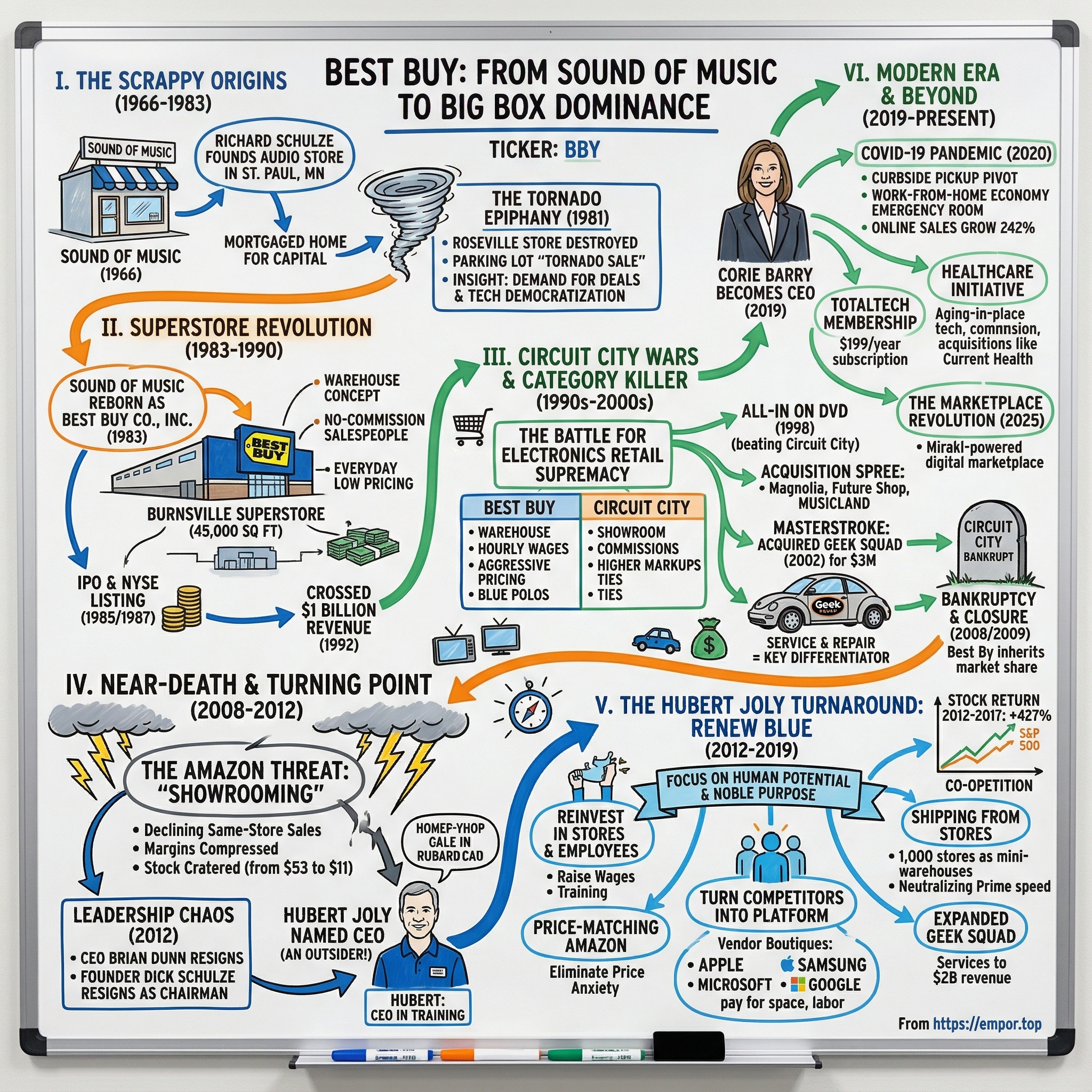
Best Buy: From Sound of Music to the Last Big-Box Standing
I. Introduction & Episode Roadmap
On the morning of August 27, 2026, Corie Barry opened her final earnings call as chief executive of Best Buy with a housekeeping note that would have been unremarkable at almost any other company: the new chief financial officer had started eight days earlier, so the CEO would read the numbers herself.1 It was a small, slightly awkward moment — and a fitting one. For sixty years, Best Buy has been a company that keeps having to do the unglamorous work itself, in public, while everyone waits for it to die.
The waiting has been going on a long time. Circuit City, once the undisputed king of American consumer electronics retail, filed for bankruptcy in 2008 and liquidated the following year. CompUSA collapsed. RadioShack went through two bankruptcies. hhgregg liquidated in 2017. Every one of them sold roughly the same boxes to roughly the same customers, and every one of them was killed by the same combination: a category where the product is identical everywhere, the price is visible everywhere, and a warehouse in Kentucky can undercut a store in Kansas without paying for the store.
Best Buy is still here. That is the central fact the entire investment case must explain.
The company that survived is smaller than the one that boomed. Fiscal 2026, which ended January 31, 2026, produced enterprise revenue of $41.69 billion — composed of $38.28 billion from domestic operations and $3.41 billion from Canada — down from a pandemic-era peak of $51.76 billion in fiscal 2022.23 It operated 1,068 stores at fiscal year-end — 926 in the United States and 142 in Canada — employing roughly 82,000 people.2 GAAP operating income was $1.39 billion, or 3.3% of revenue. On the adjusted basis management prefers, which excludes $190 million of restructuring charges and $171 million of impairments tied to its health business, operating income was $1.79 billion, or 4.3%.2 That gap between GAAP and adjusted figures is no accounting footnote; it distills the company's efforts over the last three years to reshape its cost base.
Inside the domestic business, product mix reveals what Best Buy has actually become. Computing and mobile phones generate 47% of domestic revenue; consumer electronics — including televisions, audio, imaging, and smart-home equipment — account for 28%; appliances bring in 11%; entertainment represents 7%; and services account for 6%.2 Laptops and phones represent nearly half of sales. That concentration drives current momentum while creating structural exposure to device upgrade cycles.
The spine of this story is a single question: does Best Buy have a durable economic advantage, or is it a well-run retailer in a structurally disadvantaged format that has merely bought itself time?
The case that it wins from here rests on four mechanisms, each of which this analysis tests rather than assumes. First, the store has been converted from a pure cost center into something closer to a leased media property: Apple, Samsung, Microsoft, Sony, LG, and Meta pay — through capital, labor, and advertising dollars — for branded real estate inside Best Buy's stores. Second, roughly a third of domestic revenue is now digital, and the physical store network doubles as the fulfillment layer that makes those online economics work.2 Third, Geek Squad and the paid membership program attach recurring, higher-margin service revenue to one-time hardware sales. Fourth, two newer profit pools — Best Buy Ads and a third-party marketplace launched in August 2025 — generate margins high enough to help fund price investments in core categories.14
The case that it does not is equally concrete. Operating margins sit in a narrow band of 4.0% to 4.5%, leaving little cushion against traffic declines. Five suppliers — Apple, Samsung, HP, LG, and Sony — account for approximately 55% of Best Buy's total merchandise purchases, and the twenty largest account for about 80%.2 Those same key suppliers sell directly to consumers. Foot traffic across large-format retail continues to erode. Meanwhile, Best Buy's track record of building growth outside its core format remains weak, marked by write-offs in international expansions, a music retailer, and a healthcare business, at a cumulative cost reaching billions of dollars.
The roadmap: a stereo shop in St. Paul and the tornado that taught it pricing; the superstore format and the war with Circuit City; acquisition missteps and international write-offs; the showrooming crisis; Hubert Joly's turnaround and the store-as-a-platform strategy; Corie Barry's pandemic boom and the four-year digestion that followed; adjacency bets, including the failed ones; industry structure evaluated through Porter and Helmer; a skeptical stress test; and the executive handoff, set for November 1, 2026, to a leader who joined the company as an inventory analyst in 1999.5
Start where it started: with a man, a mortgage, and a very bad storm.
 Subscribe on LinkedIn
II. Sound of Music & The Superstore Birth (1966–1989)
The tornado is the founding myth, and like most founding myths, it is both true and slightly beside the point.
Richard M. Schulze opened Sound of Music in St. Paul, Minnesota, on August 22, 1966 — a small hi-fi shop selling stereo components to audiophiles, financed by personal savings and a second mortgage on the family home.6 It was a specialty business in the most literal sense: high-margin gear sold by knowledgeable staff to customers who cared deeply about the difference between a $40 turntable cartridge and a $120 model. Schulze bought out his partner and built the chain store by store through the 1970s, concentrating in Minnesota and selling to a narrow, aging demographic of stereo enthusiasts.
Then, in 1981, a tornado tore the roof off the Roseville store — the chain's largest and most profitable location. The showroom was destroyed. The stockroom, improbably, was not.7
What Schulze did next altered the trajectory of the company. Rather than filing an insurance claim and waiting to rebuild, he moved the surviving inventory into the parking lot, spent the remainder of his marketing budget advertising a "Tornado Sale," and promised customers the best buys in town. The four-day event generated more revenue than a typical month.7
The lesson Schulze extracted was not about disaster recovery; it was about demand elasticity. His audiophile clientele had been a rounding error. The shoppers who filled that parking lot were ordinary Minnesotans who cared little about cartridge specifications and immensely about price and selection. The specialty model had been optimizing for the wrong customer.
By 1983, with seven stores and roughly $10 million in annual sales, Sound of Music became Best Buy Co., Inc., and opened its first superstore in Burnsville, Minnesota.7 The format was the strategy: larger store footprints, a deeper product assortment, inventory moved out of back rooms onto the sales floor for self-service browsing, and — most critically — the elimination of commissioned sales reps.
That shift in sales compensation represented strategic counter-positioning. Circuit City, the national market leader, relied entirely on commissions. Commissioned salespeople were effective at selling extended warranties and steering customers toward high-margin merchandise, but they were also a primary source of friction for shoppers. Best Buy's Concept II format, rolled out at the end of the 1980s, removed sales pressure and allowed customers to browse freely.7 Competitors could not replicate the model without disrupting their own compensation structures, gross margins, and top-performing sales talent.
The company went public in 1985 and moved to the New York Stock Exchange under the ticker BBY in 1987, securing the capital needed to expand the superstore format nationwide.6 Revenue crossed $1 billion in the early 1990s, and by 1993 Best Buy had become the second-largest consumer electronics retailer in the United States.7
Now the falsification pass, because the non-commissioned model is treated in most retellings as an unambiguous win.
The claim: removing commissions lowered labor costs, raised customer trust, and did so without sacrificing conversion or profitability.
The disconfirming evidence: the transition carried operational trade-offs. Removing commissions eliminated the primary financial incentive for staff to focus on attachment rates, inventory accuracy, and loss prevention. The transition period during the late 1980s and early 1990s brought predictable operational strain — elevated management turnover and inventory control challenges — before point-of-sale systems and centralized replenishment matured enough to enforce process discipline. The model also structurally reduced gross margin: Best Buy traded attachment revenue for foot traffic, spending the next three decades attempting to recover that margin through services, warranties, and memberships. The 22.5% gross margin reported in fiscal 2026 is a direct descendant of the choice made in 1989.2
The calibrated conclusion: the claim survives, but with qualifications. Removing commissions provided a durable customer-acquisition advantage at the expense of permanent gross-margin compression. Best Buy's subsequent strategic initiatives — Geek Squad, extended warranties, Totaltech, memberships, and retail media — represent an ongoing effort to rebuild high-margin service attachments on top of high-volume hardware traffic.
The format succeeded so well that it created a new challenge: a direct collision with the incumbent that had pioneered the category-killer model.
III. The Circuit City Wars, Category Killer Era, & Acquisition Disasters (1990s–2006)
For most of the 1990s, the American consumer electronics business was a two-horse race, and the two major players moved in opposite directions.
Circuit City held the stronger balance sheet, superior real estate, and a business model favored by Wall Street — commissioned sales specialists, tight assortment control, and disciplined gross margins. Best Buy relied on larger store footprints — 35,000 to 45,000 square feet compared to Circuit City's smaller, curated locations — non-commissioned sales staff, and a merchandising strategy centered on placing full inventory on the sales floor to encourage self-service browsing while competing on selection and price.
The 1990s favored Best Buy's model as successive waves of new consumer hardware entered the mass market: personal computers, compact disc players, CD-ROM drives, camcorders, digital cameras, and DVD players. Each product line represented a high-consideration purchase where consumers wanted to examine hardware directly, making broad selection more persuasive than a commissioned sales pitch. Best Buy's aggressive early rollout of the DVD format in the late 1990s — while Circuit City backed the competing, short-lived DIVX format — yielded compounding benefits by attracting early adopters, driving higher-margin software attachments, and establishing Best Buy as the primary retail destination for emerging electronics.
By the early 2000s, Best Buy had secured the top market-share position in U.S. consumer electronics. The operating model demonstrated peak category-killer efficiency, generating operating margins in the 5% to 6% range while maintaining its widest cost-of-goods advantage over department stores and independent retailers.
Flush with capital, executive management initiated a series of acquisitions to expand beyond the core superstore format.
Magnolia Hi-Fi (December 2000), roughly $88 million in cash. Best Buy acquired the high-end Pacific Northwest audio-video retailer and integrated it as a premium store-within-a-store format rather than expanding it as an independent chain. This curated, higher-margin department proved successful because it enhanced the core superstore footprint rather than competing against it.
Future Shop (November 2001), approximately $368 million in cash. To secure immediate national scale in Canada rather than building store by store, Best Buy purchased the country's leading consumer electronics retailer. Management operated both banners in parallel for over a decade before consolidating operations under the Best Buy brand in 2015. The Canadian business remains operational, though with $3.41 billion in annual revenue and a 1.8% comparable sales decline in the most recent quarter, it represents a slower-growing, lower-margin portion of the enterprise.12
Geek Squad (2002), roughly $3 million. Robert Stephens founded the Minneapolis computer repair business in 1994, styling technicians with black clip-on ties, badges, and custom-painted squad cars. Best Buy acquired the brand for a modest sum and expanded it into a nationwide service network. Measured against its eventual strategic contribution, the acquisition represents one of the most effective capital allocation decisions in modern retail. Rather than purchasing proprietary technology or customer lists, Best Buy acquired a recognized service brand for technical support that its core retail customers increasingly required as home computing grew more complex.
Musicland (January 2001), approximately $700 million including roughly $270 million of assumed debt.8 This acquisition rapidly eroded enterprise value.
Musicland operated roughly 1,300 mall-based locations under brands including Sam Goody, Suncoast Motion Picture Company, and Media Play, selling CDs and VHS tapes. Management sought to expand customer reach, as Musicland's customer base skewed younger and lower-income than Best Buy's core demographic, while mall locations provided foot traffic outside superstore trade areas. However, the deal coincided with the rapid growth of digital file sharing following Napster's 1999 launch. Within two years of closing, physical music sales entered a steep decline and mall foot traffic dropped, turning Musicland into an unprofitable asset.
Best Buy recorded substantial impairments as the unit generated an $85 million loss in 2002. On June 16, 2003, Best Buy transferred the entire capital stock of The Musicland Group to an affiliate of Sun Capital Partners for no cash consideration, with Sun Capital assuming Musicland's liabilities and lease obligations. Best Buy recorded an after-tax loss on discontinued operations of $66 million in addition to prior write-downs.910
The falsification pass on Best Buy's M&A competence:
The claim, implicit in the era's strategy: Best Buy's big-box merchandising and supply-chain playbook was transferable to adjacent physical retail formats.
The disconfirming evidence: Musicland absorbed approximately $700 million in enterprise value and returned zero capital within thirty months, despite digital disruption being well documented when the deal was signed. The failure stemmed from category selection: management acquired physical distribution infrastructure for a product class undergoing rapid digitization.
The calibrated conclusion: The general claim is unsupported. Best Buy has consistently succeeded with acquisitions that integrate directly into and support the core store, while failing with acquisitions that operate as independent retail formats. Magnolia and Geek Squad were absorbed as internal departments, whereas Musicland operated as a separate chain. This pattern — which subsequently recurred in international expansions and healthcare investments — serves as a key framework for evaluating future capital allocation. The primary metric to challenge this conclusion would be a standalone acquisition that achieves meaningful scale and positive segment operating income without restructuring or impairment charges.
Management was soon to repeat this expansion strategy on a larger international scale.
IV. International Overreach & The Showrooming Near-Death Experience (2006–2012)
In December 2006, Best Buy opened its first branded superstore in Shanghai. The company had spent $180 million earlier that year for a 75% controlling stake in Jiangsu Five Star Appliance (江苏五星电器), China's fourth-largest appliance retailer. The strategy appeared logical on paper: run Five Star as the high-volume, price-competitive local banner while Best Buy-branded superstores captured aspirational, service-oriented urban consumers.1112
It failed for reasons that were structural rather than operational.
Chinese consumer electronics retail at the time operated on a business model fundamentally distinct from American big-box retail. Major incumbents such as GOME (国美) and Suning (苏宁) functioned effectively as retail landlords. Vendors supplied and compensated their own on-floor sales representatives, funded promotional activity, and provided the bulk of retailer profits through vendor allowances and space fees rather than gross margin on merchandise sales. Best Buy introduced its traditional U.S. playbook — purchasing inventory, employing sales staff, charging premium prices for trusted service, and refusing to negotiate on price. Chinese shoppers, accustomed to price bargaining, encountered higher prices and fewer sales staff. Furthermore, Best Buy acquired and leased prime real estate on financial terms that assumed American-style store traffic and sales productivity.
In February 2011, Best Buy closed all nine of its branded superstores in China and consolidated operations into Five Star.12 In 2014, the company sold its Five Star stake to Zhejiang Jiayuan Group (浙江佳源集团) and exited the market entirely.
The European expansion produced larger losses. In June 2008, Best Buy committed $2.15 billion to purchase a 50% stake in Carphone Warehouse's retail business, creating Best Buy Europe — a joint venture operating across eight countries designed to layer large-format consumer electronics superstores onto an established mobile telecom retail network.13 The transaction closed just as the global financial crisis intensified. Best Buy opened eleven UK superstores, but the format failed to gain traction in a market where out-of-town big-box electronics retail lacked consumer familiarity and existing competitors were well entrenched. Best Buy closed its UK superstores in 2012, and in 2013 sold its 50% joint venture stake back to Carphone Warehouse for approximately $775 million.14
Falsification pass on international scale economies:
The claim: Best Buy's domestic scale, purchasing leverage, and merchandising format would generate profitable market positions in major international retail markets.
The disconfirming evidence: Two major international expansions across distinct retail environments ended in operational exits and capital losses. The European joint venture returned roughly a third of its invested capital, and cumulative write-downs and exit expenses across international operations during this period exceeded $1 billion.
The calibrated conclusion: The claim is rejected by historical performance. Best Buy's international footprint remains limited to Canada. The company's financial disclosures continue to note that international market conditions may "necessitate adjustments to our international strategy, including modifying or exiting our operations in certain locations," while warning of potential impairments and restructuring charges — risk factors informed by past market exits.2 For investment analysis, Best Buy operates effectively as a North American retail enterprise, and growth theses relying on international footprint expansion lack historical validation.
While international operations generated losses, a core structural threat developed in the domestic market.
Showrooming. By 2011, smartphone adoption enabled a shift in consumer behavior that directly challenged physical electronics retail. Shoppers routinely visited Best Buy stores to inspect display units, evaluate televisions or laptops, consult sales staff, and then use mobile devices to purchase the identical item online from Amazon — frequently at lower prices and, at the time, without state sales tax collection. Best Buy absorbed the capital expenditure and overhead of store real estate, product displays, and retail labor, while online competitors captured the transaction.
Financial metrics deteriorated quickly. Domestic comparable store sales turned negative, and operating margins compressed under competitive pricing pressure. Circuit City's 2008 bankruptcy filing and subsequent liquidation of over 500 stores in 2009 demonstrated the vulnerability of big-box electronics chains to structural market shifts. Investors adjusted valuations accordingly: Best Buy shares dropped from above $50 in 2010 to approximately $11 by December 2012, reflecting market pricing of severe distress.
Executive leadership and corporate governance destabilized concurrently. In April 2012, Chief Executive Officer Brian Dunn — who had joined the company as a store sales associate in 1985 and advanced through retail management to the chief executive role — resigned following an internal investigation into personal misconduct involving an employee.7 A subsequent board audit committee investigation concluded that founder and chairman Richard Schulze had been informed of the allegations prior to the formal inquiry and had not disclosed them to the board. Schulze subsequently resigned as chairman.
In August 2012, Schulze submitted an unsolicited proposal to acquire all outstanding shares he did not own for $24 to $26 per share, evaluating the equity at approximately $8 billion in a proposed private buyout.15 The board granted limited financial diligence, but necessary debt financing was not secured, and the acquisition proposal lapsed in early 2013.
By late 2012, Best Buy faced severe operational and financial headwinds: governance turnover, a depressed share price, declining comparable store sales, failed international investments, and persistent competitive pressure from e-commerce. Stabilizing the business required a fundamental reassessment of the physical store network and its operating economics.
V. The Hubert Joly Turnaround: "Renew Blue" & Vendor Coopetition (2012–2019)
The story Best Buy tells about Hubert Joly's first week begins not at corporate headquarters, but at a store in St. Cloud, Minnesota. He put on a blue shirt and worked the sales floor for several days without announcing his identity.
Wall Street's reaction to his appointment in August 2012 was sharply skeptical. Joly was a former McKinsey consultant and the outgoing CEO of Carlson, a hospitality and travel group. He had never run a retail organization or sold consumer electronics. The stock dropped on the announcement, and by November 2012, two months into his tenure, it had fallen below $15, a ten-year low.16
What the St. Cloud store visit produced was not a high-level strategy document, but a list of basic operational flaws. Employees could not look up inventory availability at nearby locations. The company's e-commerce site failed to display standard product specifications accurately, rendering bestbuy.com hard to find in search engine results for its own merchandise. Additionally, a substantial volume of televisions arrived at customer homes damaged due to improper transit and backroom handling. Remediating television packaging and handling protocols — an operational issue absent from corporate board presentations — eliminated roughly $200 million in annualized costs.
The early operational lesson of Joly's tenure underscored a reality of low-margin retail: in a business operating at a 4% operating margin, the boundary between solvency and liquidation often rests on frontline execution that traditional top-down financial restructurings overlook. Joly's initial move was simply asking store staff to identify operational failure points.
Renew Blue, announced in November 2012, rested on five operational pillars, separating core strategic initiatives from baseline retail requirements.16
One: price matching. In October 2012, ahead of the holiday quarter, Best Buy began matching the prices of major online retailers, including Amazon, at the register.17 This decision sacrificed short-term gross margin to neutralize showrooming arbitrage. The underlying financial logic was straightforward: if a consumer intended to inspect a product in-store and purchase it online, the margin was already lost, while Best Buy still absorbed the overhead of the physical demonstration. Matching online prices converted lost transactions into lower-margin sales and re-established the physical store as a point of sale. The margin impact remains permanent: Best Buy's gross margin is structurally constrained by its ongoing commitment to price parity on identical merchandise.
Two: the store as a fulfillment node. Best Buy converted its store network into roughly 1,000 mini-distribution centers, fulfilling online orders directly from store inventory and introducing in-store and curbside pickup. The underlying economics were compelling: large-format stores were situated within 10 to 15 miles of most U.S. consumers and held immediate inventory. Utilizing stores for e-commerce fulfillment reduced last-mile shipping expenses, turning physical real estate into distribution infrastructure that pure-play e-commerce competitors spent billions attempting to replicate.
Three: the store as a platform. This mechanism distinguished Best Buy from surviving big-box competitors. Management approached major tech vendors — including Samsung, Apple, Microsoft, Sony, LG, and Google — with a proposition that altered traditional vendor-retailer dynamics. Physical retail remained essential for high-consideration electronics, where buyers evaluate display quality, ergonomics, and audio performance. Because few vendors besides Apple could economically justify operating proprietary retail networks, Best Buy offered branded store-within-a-store shop-in-shops. Vendors funded store fixtures, displays, branding, and demonstration units, and in several instances provided dedicated sales personnel.
This arrangement altered store operating economics. Vendors absorbed capital expenditures on floor buildouts and shared labor costs, while vendor marketing funds flowed to Best Buy as co-op funding, lowering cost of goods sold and supporting gross margins. In effect, prime retail floor space transitioned from a pure operating expense into a rentable retail media asset. This physical showroom model provided a structural advantage that pure-play online retailers could not easily copy.
However, it also created a concentration dependency. Best Buy relies on a narrow group of key suppliers — Apple, Samsung, HP, LG, and Sony account for approximately 55% of total merchandise purchases — without long-term supply contracts guaranteeing ongoing space commitments.2 Vendor funding remains an annually negotiated outcome rather than a permanent contractual moat. Corporate disclosures quantify this sensitivity: a 10% change in vendor funding deferrals as of January 31, 2026, would impact net earnings by approximately $45 million, representing roughly 4% of annual net income based on accounting estimates.2 The store-as-a-platform model provides real operating leverage, but its durability requires continuous vendor alignment rather than contractual lock-in.
Four: cost reduction. Joly's team eliminated approximately $1 billion in costs during the initial turnaround phase, starting with corporate overhead, before expanding identified cumulative savings to roughly $1.9 billion across supply chain operations, procurement, product handling, and return processes.1617 Significantly, management did not bank these savings as expanded operating margin; instead, it reinvested the capital into competitive pricing and store labor, allowing business operations to stabilize faster than net margins expanded.
Five: workforce investment. Best Buy expanded employee training programs, restored reduced benefits, and reduced store labor turnover. In a retail model premised on knowledgeable customer assistance, employee turnover directly impairs service execution and customer retention.
The financial results marked a notable retail stabilization during the decade: five consecutive years of comparable sales growth, U.S. online revenue more than doubling to roughly $6.5 billion, and a share price recovering from the low teens to the mid-$70s by the time Joly stepped down in 2019.16
Falsification pass on the central thesis — that physical stores are an inevitable liability against pure-play e-commerce:
The claim, widely accepted in 2012: A national big-box retail footprint represents an unsustainable fixed-cost burden when selling commoditized products with transparent online pricing.
The disconfirming evidence: Best Buy's performance over the subsequent decade. Physical locations served dual functions as local fulfillment nodes, reducing variable shipping expenses, and as monetizable vendor showrooms unavailable to pure-play e-commerce operators. Domestic gross margins expanded over the period despite ongoing price-matching commitments.
The calibrated conclusion: The claim is invalid as a general rule, but holds under specific conditions. Physical stores function as economic assets when products require hands-on demonstration, average selling prices support labor overhead, and vendor competition for shelf space remains active. If any of those conditions weaken, store operating leverage deteriorates. This dynamic highlights the risk in Best Buy's current product mix: with computing and mobile phones accounting for nearly half of domestic revenue — categories where product familiarity is high and pre-purchase intent is established — the long-term value of physical store demonstration remains subject to ongoing shifts in consumer buying behavior.
The executive responsible for managing that structural question was the chief financial officer who helped design the original turnaround plan.
VI. Corie Barry Era: Pandemic Boom, Tech Slump, & Leadership Transition (2019–2026)
Corie Barry became chief executive officer in June 2019, having joined Best Buy in 1999 and served as chief financial officer since 2016.18 She was the first woman to lead the company, bringing a financial background to an executive role often associated with steady stewardship rather than structural reinvention. Nine months after her appointment, the COVID-19 pandemic forced every store in the chain to temporarily suspend normal retail operations.
What followed was, briefly, the most profitable two-year period in Best Buy's history and one of the more deceptive demand spikes any retail leadership team has navigated.
The boom. Pandemic lockdowns converted tens of millions of American households into simultaneous buyers of laptops, monitors, webcams, printers, televisions, kitchen appliances, and gaming consoles. Best Buy's fiscal 2022, which ended in January 2022, generated enterprise revenue of $51.76 billion and operating income of $3.0 billion — yielding a 5.8% operating margin, the highest in the company's modern era.3 Net earnings reached $2.45 billion.3 Operational adaptation was rapid: within days of initial store closures, the company shifted to curbside pickup, transitioned to appointment-based shopping, and utilized its physical store network to fulfill roughly half of all digital orders.
The hangover. The structural consequence of pulling forward several years of consumer electronics demand is that the subsequent sales cycle inevitably contracts. Best Buy's revenue dropped from $51.76 billion in fiscal 2022 to $46.30 billion in fiscal 2023, $43.45 billion in fiscal 2024, and $41.53 billion in fiscal 2025 — representing a top-line reduction of roughly $10 billion, or nearly a fifth of the business, over three years.3 Comparable sales fell 6.8% in fiscal 2024 and 2.3% in fiscal 2025.2 Replacement cycles for laptops and televisions extended as households retained hardware purchased during the pandemic, while inflation and elevated interest rates suppressed discretionary big-ticket spending.
Operating discipline throughout that contraction represents the clearest evidence of expense control during the Barry era. Adjusted operating margins remained remarkably stable at 4.2% in fiscal 2024, 4.2% in fiscal 2025, and 4.3% in fiscal 2026 — holding essentially flat even as annual revenue contracted by $1.8 billion over that three-year span.2 Adjusted diluted earnings per share held at $6.37 in fiscal 2024, $6.37 in fiscal 2025, and $6.43 in fiscal 2026.2 Preserving profitability during a 4% revenue decline required active cost management. Chief Financial Officer Matt Bilunas detailed the cost-reduction mechanism on the fiscal 2026 fourth-quarter earnings call, noting that incentive compensation flexes downward first, followed by store labor, marketing, and other variable expenses, "to make sure that we are putting in the right amount of SG&A to support the sales outlook that we see."4
That approach reflects an organization with a substantial fixed-cost base executing a tested expense-reduction playbook. Critically, it also indicates that earnings stability relies in part on reducing variable store labor and incentive pay during periods of slower sales.
The GAAP-versus-adjusted gap. A more critical evaluation of financial performance centers on the divergence between GAAP and non-GAAP reporting. GAAP operating income registered at 3.6% of revenue in fiscal 2024, 3.0% in fiscal 2025, and 3.3% in fiscal 2026 — consistently standing 90 to 120 basis points below the adjusted figures cited in management guidance.2 The gap stems from restructuring charges and asset impairments that have recurred annually. Fiscal 2024 included $153 million in restructuring costs; fiscal 2025 included $475 million in goodwill and intangible asset impairments; and fiscal 2026 recorded $190 million in restructuring charges alongside $171 million in additional impairments.2 Over three consecutive years, non-recurring charges absorbed between a fifth and a third of GAAP operating income — a persistent cost pattern tied directly to legacy acquisitions and restructuring efforts, particularly within Best Buy Health, which is examined in a subsequent section.
The credit card profit pool. Beyond core retail merchandising, financial disclosures reveal a high-margin income stream that significantly shapes Best Buy's operating profit. Roughly 25% of fiscal 2026 domestic revenue was transacted on the company's branded credit cards, with profit-sharing income from its issuing banking partner approximating 1.2% of domestic segment revenue.2 On $38.28 billion in domestic sales, that agreement generates roughly $460 million in high-margin fee income with minimal directly associated operating cost. Relative to $1.79 billion in total adjusted operating income, this fee stream constitutes a substantial share of enterprise profitability.
This revenue source operates alongside vendor funding as a primary profit contributor. Both vendor marketing support and credit card profit-sharing represent third-party payments for access to Best Buy's customer base, governed by commercial agreements rather than structural retail margins. Corporate disclosures outline the variables governing card revenue: transaction volume, promotional financing terms, bad debt and delinquency rates, interest rates, and "the regulatory and competitive environment."2 Rising consumer credit defaults, less favorable contract renewals, or regulatory caps on card fees would impact operating income directly without an obvious merchandising offset. Best Buy does not publicly disclose specific counterparty terms or agreement renewal dates, leaving investors unable to independently verify the long-term stability of this income stream.
Capital allocation. Capital deployment during this period remained conservative. In fiscal 2026, Best Buy distributed $801 million in dividends and repurchased $273 million in common stock — retiring 4.0 million shares at an average price of $69.18 — returning roughly $1.07 billion to shareholders against $704 million in capital expenditures.2 Share buybacks were systematically scaled back from $500 million in fiscal 2025 and $340 million in fiscal 2024 to $273 million in fiscal 2026, leaving the bulk of a $5.0 billion share repurchase authorization approved in February 2022 unused.2 On March 3, 2026, alongside fourth-quarter results, the board increased the quarterly dividend to $0.96 per share, marking its thirteenth consecutive annual increase.4
This capital structure underscores clear financial priorities: dividend coverage takes precedence over share repurchases, with buybacks serving as a discretionary buffer. This posture reflects balance-sheet discipline given $2.4 billion in net debt, which includes $2.3 billion in operating lease obligations against $2.96 billion in book equity.2 However, execution timing on buybacks proved mixed: the company repurchased stock at average prices of $86.42 in fiscal 2025 and $69.18 in fiscal 2026, while shares traded near $82 by late August 2026.19
Store footprint. The domestic store network contracted from 965 locations at the start of fiscal 2024 to 926 at the end of fiscal 2026 — a net reduction of 39 stores, primarily concentrated in the Outlet and Yardbird formats, while core Best Buy locations declined slightly from 901 to 886.2 A strategic shift occurred in March 2026, when management outlined plans for net domestic store expansion for the first time in over a decade, opening six smaller-format locations tailored for mid-sized trade areas while scheduling just two closures.4 By August 2026, incoming leadership reported that these smaller stores were exceeding initial return expectations and operating effectively as customer-acquisition portals, driving store visitors to adopt the mobile app, paid memberships, and technical services.1
The leadership transition. On April 22, 2026, Best Buy announced that Barry will step down as CEO and leave the board on October 31, 2026, with Jason Bonfig — then Chief Customer, Product and Fulfillment Officer — scheduled to become the company's sixth CEO on November 1.5 Bonfig joined Best Buy in 1999 as an inventory analyst and rose through merchandising leadership to oversee e-commerce, marketing, supply chain, Best Buy Canada, and Best Buy Ads. Board Chairman David Kenny described the transition as an effort to accelerate growth, calling Bonfig "the right leader to accelerate the business."5 Barry will remain as a strategic advisor for six months following her departure.5 Additionally, in early August 2026, the company appointed Anne Bramman as chief financial officer, succeeding Bilunas.1
This executive handoff is proceeding orderly, though it creates operational overlap as a new CEO and CFO assume leadership within three months of each other. Furthermore, incoming leadership takes charge just as key growth initiatives — including the third-party marketplace and retail media network — face the requirement to demonstrate durable profit contributions.
Management forecasting performance. A comparison of earnings guidance across fiscal 2026 and 2027 illustrates a conservative forecasting approach. In March 2026, management projected fiscal 2027 comparable sales between negative 1.0% and positive 1.0%, an adjusted operating margin of 4.3% to 4.4%, and adjusted EPS of $6.30 to $6.60.4 In May 2026, first-quarter comparable sales rose 2.0% — topping initial expectations — while full-year guidance was maintained.20 By August 2026, second-quarter comparable sales grew 4.1%, prompting management to raise full-year guidance to comparable sales growth of 1.9% to 3.0%, operating margin of 4.4% to 4.5%, and adjusted EPS of $6.70 to $6.90.1
While beating conservative guidance is standard corporate practice, the magnitude of the six-month shift — moving from flat sales expectations to a 4.1% quarterly comp — underscores the inherent volatility in forecasting consumer tech demand. On the August 2026 call, management attributed the outperformance to specific demand drivers: accelerating device replacement cycles, genuine hardware innovation, higher tax refunds, and improved merchandising execution in appliances and home theater.1 This pattern highlights that Best Buy's revenue remains more cyclical than its cost structure, with margin stability achieved primarily through disciplined expense flexing rather than predictable top-line growth.
Key analyst Q&A discussions. Financial analysts focused on three main operational questions during recent earnings calls. Addressing component cost inflation, Bonfig noted that second-quarter computing average selling prices rose in the mid-teens percentage range while unit volumes declined in the high single digits, producing a price-versus-unit trade-off that performed "a little bit better than what we expected."1 On gross margin flexibility, UBS analyst Michael Lasser questioned whether 30 basis points of gross margin expansion provided sufficient flexibility "in order to compete effectively"; Bilunas responded that the financial model accounted for ongoing promotional pricing necessary to maintain price competitiveness.4 Regarding whether computing demand was borrowed from future quarters, Barry stated that the company observed no broad-based demand pull-forward, aside from a short-lived sales bump following a price adjustment by a major vendor.1
The central strategic question facing incoming leadership is how performance will hold as macro tailwinds normalize. Management noted that computing sales growth is expected to moderate in the second half of fiscal 2027 as the comparison against the Windows 10 end-of-support upgrade cycle matures.1 That leaves open the crucial question of where substitute top-line expansion will originate.
VII. Hidden & Adjacency Bets: Subscriptions, Health, Marketplace & Retail Media
Best Buy's adjacency businesses collectively generate well under 10% of enterprise revenue. They matter nonetheless for two reasons: they carry operating margins several times the corporate average, and they represent the primary part of the business that does not depend directly on the consumer hardware replacement cycle. They also account for the company's most expensive recent strategic misstep.
1. The membership program, and what unlimited service actually costs
In 2021, Best Buy launched Totaltech at $199.99 annually, offering free technical support, free product installation, extended warranty coverage including AppleCare+, exclusive pricing discounts, and a 60-day return window.21 The strategic objective mirrored Amazon Prime: charge an annual fee to lock in consumer loyalty so that subsequent electronics purchases defaulted to Best Buy.
However, the underlying unit economics proved unsustainable. Providing free installation and unlimited support created open-ended liabilities on a service labor force paid by the hour, attracting members who utilized those benefits heavily. Meanwhile, 60-day return policies on high-priced electronics generated substantial costs through product refurbishments and markdown losses. While Totaltech drove subscription sign-ups and top-line services revenue, it eroded overall service profit margins.
In May 2023, Best Buy restructured the offering into a three-tier program: a free My Best Buy tier, My Best Buy Plus at $49.99 annually for promotional pricing and extended returns, and My Best Buy Total at $179.99 annually, which retained Geek Squad support and product protection while unbundling free standalone installation benefits.21
Testing the subscription thesis: The premise that an all-inclusive membership program could be added to a low-margin retailer to generate recurring, high-margin revenue failed on labor and fulfillment costs. What replaced it is a narrower, margin-conscious model. Current data indicates steady adoption under the revised structure: paid membership surpassed 8 million in February 2026, and executive management projects approximately 9 million members by the end of fiscal 2027, supported by a revised rewards structure that offers 1% cash back on eligible purchases and 5% back on the co-branded credit card.1 That reward enhancement represents a direct margin concession intended to drive member acquisition. The subscription business functions, but sustaining growth requires ongoing promotional support.
2. Best Buy Health: the most expensive lesson of the Barry era
In August 2018, Best Buy acquired GreatCall — developer of Jitterbug phones and Lively medical alert devices for senior citizens — for $800 million in cash.22 In 2021, the company expanded the unit by purchasing Current Health, a Scotland-based remote patient monitoring platform, for approximately $400 million. The strategy rested on a clear thesis: Geek Squad technicians already made thousands of home visits daily to install consumer electronics, and that existing field infrastructure could be repurposed to install and maintain patient monitoring systems for health networks operating "hospital-at-home" programs, effectively converting retail logistics into healthcare services.
However, that operational thesis encountered institutional selling hurdles within the healthcare industry. Health system procurement cycles span years rather than quarters, reimbursement models depended on a temporary Centers for Medicare & Medicaid Services (CMS) hospital-at-home waiver subject to regulatory uncertainty, and financially constrained hospital systems hesitated to enter major technology contracts. Chief Executive Officer Corie Barry acknowledged in 2025 that developing the commercial healthcare business proved more difficult and protracted than management had anticipated.
A series of substantial asset write-downs followed. Fiscal 2025 included a $475 million non-cash goodwill and intangible impairment charge.2 In June 2025, Best Buy divested Current Health back to co-founder Christopher McGhee, who returned the business to private ownership.23 Best Buy Health subsequently eliminated 161 positions.24 In the third quarter of fiscal 2026, shifts in Best Buy Health's customer base prompted a comprehensive asset impairment review, resulting in an additional $118 million goodwill impairment as part of $171 million in total annual goodwill and intangible write-offs, with management pointing to operational headwinds in Medicaid and Medicare Advantage markets.2
Financial disclosures highlight ongoing accounting risks within the division. First, independent auditor Deloitte designated the Best Buy Health goodwill valuation as a critical audit matter in the fiscal 2026 annual report, citing high management subjectivity regarding projected revenue growth, operating margins, and discount rates.2 Second, $298 million of goodwill attributed to Best Buy Health remains on the balance sheet out of $790 million total enterprise goodwill, with regulatory filings explicitly noting that adverse changes in financial projections could trigger further impairment charges.2
Testing the healthcare diversification thesis: The hypothesis that in-home retail servicing could serve as a springboard into health technology has been disproved by outcomes: approximately $1.2 billion invested in acquisitions yielded roughly $650 million in combined impairment charges, an operational divestiture, and a remaining asset flagged by auditors for valuation risk. The initiative mirrors the Musicland acquisition two decades earlier — a capital allocation effort that required Best Buy to operate an unfamiliar, standalone industry vertical rather than strengthening its core retail stores.
That structural distinction explains why the third-party marketplace and retail media operations warrant a different analytical assessment: both initiatives directly support the core store format.
3. Best Buy Marketplace: the second attempt
Best Buy previously operated a third-party digital marketplace between 2011 and 2016 before discontinuing the platform over merchant quality concerns. On August 19, 2025, the retailer launched a redesigned U.S. online marketplace powered by the Mirakl software platform, more than doubling the product catalog on bestbuy.com.2526 To maintain quality control, management limited initial onboarding to a curated group of several hundred pre-screened merchant partners.
Early operating metrics indicate positive initial traction. By the close of fiscal 2026, the marketplace included over 1,100 registered merchants, with more than 90% of active storefronts generating weekly transactions. Domestic marketplace gross merchandise volume (GMV) reached approximately $300 million in the fourth quarter, customer satisfaction scores matched first-party retail inventory, and return rates on third-party orders tracked lower than direct inventory, with over 80% of returned items processed directly through physical stores.4 In the second quarter of fiscal 2027, domestic marketplace GMV again hit roughly $300 million, prompting executive leadership to elevate full-year marketplace GMV targets to $1.3 billion.1 Additionally, the company began onboarding international merchants in the third quarter of fiscal 2027, lifting previous requirements for a domestic corporate presence.1
The strategic significance extends beyond headline GMV. Top-selling marketplace categories include mobile phone accessories, computer peripherals, physical media, and small kitchen appliances — product segments where Best Buy previously held limited market share.4 Rather than cannibalizing direct retail merchandise, the marketplace expands long-tail product assortment without balance-sheet inventory risk, generating high-margin vendor commission revenue. Furthermore, high in-store return rates demonstrate how the physical store network provides fulfillment and service support for digital marketplace sales.
4. Best Buy Ads: the highest-margin dollar in the building
Retail media networks have emerged as a high-margin expansion vector across the retail sector, allowing merchants to monetize first-party customer browsing and transaction data. Best Buy Ads generated over $900 million in gross advertising collections in fiscal 2026, representing a year-over-year increase of more than 7%, while expanding its advertising partner base to nearly 750 clients — with new growth driven largely by third-party marketplace merchants following the August platform launch.4 Executive leadership projects approximately 10% revenue growth for the ad network in fiscal 2027.1
Financial disclosures provide critical context on the margin composition of these ad dollars. On-site ad inventory — promotions displayed directly on bestbuy.com and the mobile app — accounted for slightly over 40% of total advertising collections, a proportion management noted was lower than established peer retail media networks.4 Because placement on owned digital channels commands higher profit margins than off-site programmatic channels, the $900 million gross figure reflects a mixed-margin revenue stream that management is seeking to shift toward higher-margin owned properties. Accounting rules treat most advertising collections as reductions to cost of goods sold rather than standalone top-line revenue, lifting the gross margin percentage rather than reported sales.
Evaluating the financial timeline: Corporate guidance indicates that fiscal 2027 represents the final phase of major initial infrastructure investment, with executive projections anticipating "more material operating income rate contribution coming in fiscal 2028 and fiscal 2029."4 During the August 2026 earnings call, outgoing CEO Corie Barry characterized the current operating income contribution from ads and marketplace as "maybe slightly better than where we started the year, but nothing massive."1 While both retail media and third-party marketplace operations show expanding adoption and positive gross margin impacts, their overall contribution to bottom-line operating profit remains modest. Consequently, fiscal 2028 will serve as the primary benchmark to test whether these digital adjacencies can deliver meaningful structural margin expansion.
VIII. Industry Structure, Competitors, & Segment Economics
Walk into a Best Buy in August 2026, and the floor plan reveals what the retailer has decided to be.
At the center of the store — across roughly seventy locations undergoing reconfiguration this year — lies computing.4 Along one wall sits a Meta Lab @ Best Buy: a dedicated 900-square-foot space staffed by employees trained exclusively on Meta's AI glasses and virtual reality hardware, with more than half of a planned fifty locations installed by late August.1 Elsewhere, branded shop-in-shops highlight Apple, Samsung, LG, Sony, Hisense, TCL, Breville, and SharkNinja. Near the front of select stores, outlet sections have been integrated from former standalone locations down the road. Meanwhile, a blue-shirted staff member explains why an RGB television — the biggest shift in TV panel technology in a decade, for which Best Buy holds a one-year national retail exclusive — looks different from the OLED display next to it.1
The segment arithmetic. Domestic operations generated $38.28 billion in revenue in fiscal 2026 at an adjusted operating margin of 4.4%, up from 4.3% and 4.2% in the two prior years.2 Canada produced $3.41 billion at a lower margin, representing a weaker operating trajectory: second-quarter international revenue fell 4.2% with comparable sales down 1.8%, against domestic comparable sales growth of 4.5%.1 Domestic online revenue reached $13.17 billion, accounting for 34.4% of segment sales.2
The category story, and why it is more concentrated than it looks. Fiscal 2026 domestic comparable sales rose 5.7% in computing and mobile phones — the largest category at 47% of revenue — and 6.8% in entertainment, while consumer electronics fell 5.4% and appliances fell 8.9%.2 Services grew 1.0%.2 The overall domestic comparable sales growth of 0.4% meant that a single performing category carried declines across the rest of the sales floor.
By the second quarter of fiscal 2027, the demand picture had broadened materially: computing posted its tenth consecutive quarter of positive comparable sales, home theater delivered its strongest growth since 2021 with domestic television sales up more than 10%, mobile phones grew for a sixth consecutive quarter, and appliances returned to slight growth after a long decline.1 A cluster of emerging categories — including AI glasses, trading cards, collectibles, and health rings — more than doubled, contributing roughly a full percentage point to comparable sales on its own.1 Meanwhile, Best Buy Business, the corporate sales arm serving education, hospitality, builder, healthcare, and commercial clients, generated more than $1.1 billion annually and grew 21% in the quarter.14
The competitive set, war-gamed honestly.
Amazon dominates on selection, price transparency, and delivery speed, with no incentive to cede ground. Where the e-commerce giant remains vulnerable is in transactions requiring physical evaluation or complex home installation — carrying a refrigerator up a staircase and connecting a water line. Addressing the appliance category in August 2026, Bonfig framed the strategic reality: with housing turnover depressed, most appliance purchases represent emergency replacements of broken units, making speed and convenience paramount — driving Best Buy to expand next-day delivery availability from under half of its metropolitan delivery locations in the first quarter to nearly all of them by the second.1 That focus on immediate fulfillment and complex delivery establishes a defensible position against pure-play online retailers.
Walmart and Costco pose a distinct challenge because they are not trying to match Best Buy's broad category depth. Instead, both retailers carry a curated selection of high-velocity consumer electronics as traffic drivers, pricing them aggressively. By capturing high-volume transactions without maintaining specialized sales floors, they place a structural cap on Best Buy's gross margins for mainstream SKUs.
Apple presents a dual dynamic as both Best Buy's largest supplier and a direct retail competitor. Apple's proprietary stores and website capture consumers who enter the market committed to iOS. Best Buy captures shoppers evaluating an iPhone against rival Android devices — explaining why Apple funds dedicated floor space in a store that also sells Samsung hardware.
Micro Center serves as a reminder of the limits of Best Buy's mass-market format. Operating roughly thirty stores, Micro Center maintains high customer loyalty among PC builders by stocking deeper component assortments and delivering specialized technical assistance. While Micro Center lacks the scale for national expansion, Best Buy cannot match its specialized depth, effectively ceding the highest-intent enthusiast segment in its largest product category.
The core economic engine, stated plainly. Best Buy's operating model functions when three conditions align: merchandise expensive enough that customers seek advice before buying; a competitive supplier base willing to subsidize physical demonstration space; and a retail footprint dense enough to fulfill orders efficiently. Remove any single leg, and a 4% operating margin fails to clear real estate overhead. Every major strategic initiative of the past decade — vendor shop-in-shops, ship-from-store fulfillment, Geek Squad services, tiered memberships, retail media, and the third-party marketplace — represents an effort to reinforce those three structural pillars.
That structural alignment sets up the formal evaluation: testing whether those three legs will hold under strategic framework analysis.
IX. Strategic Frameworks: Porter's 5 Forces & Helmer's 7 Powers
Evaluating Best Buy's competitive position through established strategic models requires testing each force and power against empirical operational data rather than executive narratives.
Porter's Five Forces
Threat of new entrants: LOW. Competitors are unlikely to build nearly 1,000 big-box consumer electronics superstores across North America. The required capital expenditure, real estate leases, logistics network, and trained service organization would cost billions of dollars to serve a retail category facing persistent foot-traffic headwinds. However, this high entry barrier protects a shrinking market footprint. The primary competitive threat is not a traditional retail entrant, but rather e-commerce platforms expanding physical showrooms, hardware manufacturers broadening direct-to-consumer store networks, or artificial intelligence shopping agents removing the physical store from the product discovery process entirely.
Bargaining power of buyers: HIGH. Hardware specifications remain identical across retail channels, and consumers can compare real-time pricing instantaneously on mobile devices. Best Buy's price-matching policy serves as an operational concession to this buyer leverage rather than a structural defense, permanently capping gross margins. Enterprise gross margin registered at 22.5% in fiscal 2026.2 Furthermore, management's guidance for 30 to 40 basis points of gross margin expansion in fiscal 2027 is explicitly tied to retail media and third-party marketplace monetization, while core product margins are expected to remain flat to slightly pressured.14 This dynamic demonstrates limited pricing power in core merchandise sales.
Bargaining power of suppliers: HIGH. Merchandise procurement remains concentrated, with five primary vendors accounting for approximately 55% of total purchases and twenty vendors representing roughly 80%, while Best Buy generally holds no long-term contracts requiring ongoing vendor commitments.2 Key suppliers also sell directly to consumers and, in Apple's case, maintain dedicated retail store networks. While Best Buy provides a multi-brand physical demonstration floor that hardware makers rely on to display products alongside competitors, this dynamic represents mutual dependency rather than an exclusive moat. Corporate disclosures quantify this exposure: a 10% change in annual vendor funding deferrals impacts net earnings by approximately $45 million.2
Threat of substitutes: MODERATE to HIGH. Direct-to-consumer manufacturer storefronts present an established substitute, while agentic AI commerce represents a rapidly evolving threat. If consumers delegate research and purchasing tasks to AI assistants, the demonstration value of physical store floors and the web traffic of traditional e-commerce sites erode simultaneously. Best Buy has responded by integrating directly into emerging AI channels — establishing a commerce partnership with OpenAI for product discovery and purchase within ChatGPT, adopting Google's universal commerce protocol for AI Mode and the Gemini app, launching native checkout capabilities with AI platform Wizard, and deploying its internal conversational tool, Ask Blue.14 While this integration preserves channel access, it also risks converting Best Buy into a back-end fulfillment option competing primarily on price and speed — reproducing the margin pressure that historically damaged category-killer formats.
Competitive rivalry: HIGH. Former Chief Financial Officer Matt Bilunas highlighted this ongoing pricing intensity on the fiscal 2026 fourth-quarter earnings call, observing that the sector "is always very competitive," that fiscal 2026 "was already a very promotional year," and that fiscal 2027 projections assume "probably a similar level of promotionality."4 The consumer electronics sector remains defined by continuous price competition.
Hamilton Helmer's 7 Powers
Counter-positioning — HISTORICAL. The strategic combination of price matching and vendor-funded shop-in-shops established between 2012 and 2016 represented genuine counter-positioning. Pure-play digital competitors could not replicate physical demonstration floors without incurring the substantial fixed real estate overhead their business models were designed to avoid. However, this competitive advantage has largely matured; while it enabled Best Buy's survival over the past decade, it generates limited incremental growth today.
Scale economies — ACTIVE. Physical store density reduces last-mile shipping expenses and enables rapid fulfillment. Management cited this operational capability during the fiscal 2026 holiday quarter, when 70% of online orders were fulfilled within two days — the fastest rate in company history.4 However, purchasing scale advantages remain narrower than overall corporate revenue implies, as mass merchants such as Walmart, Costco, and Amazon command larger aggregate purchasing volume across general consumer goods.
Process power — ACTIVE. Complex reverse logistics, real-time omnichannel inventory management, in-home service scheduling, and in-store returns processing for third-party marketplace sales represent capabilities built over decades of store operation. Operational data from the third-party marketplace confirms this process advantage: third-party return rates track below direct retail inventory, with over 80% of marketplace returns handled directly through physical stores.4
Cornered resource — WEAK. A trained technician workforce provides operational value, but field labor remains hireable, trainable, and replicable across competing service providers. Geek Squad's primary value rests in brand recognition rather than workforce exclusivity. Management's stated priority for fiscal 2027 — to reassess the Geek Squad service portfolio by simplifying offerings and introducing flexible price points — reflects a requirement to adjust service structures to maintain consumer adoption.4
Network effects — EMERGING. While core consumer electronics retailing exhibits no direct network effects, the digital platform businesses display early multi-sided network dynamics. Expanding seller participation on the third-party marketplace broadens product catalog selection, which attracts higher site traffic, draws additional merchant listings, and expands the advertiser base. This cycle contributed to Best Buy Ads nearly doubling its advertiser count to 750 clients following the marketplace launch.4 This mechanism represents the newest strategic power source in the portfolio, though it remains early in its development.
Switching costs — LOW to MODERATE. Paid membership tiers encourage customer retention through extended return windows, exclusive discounts, and product protection plans, sustaining a paid member base exceeding 8 million.1 However, an annual membership fee functions primarily as a promotional discount program rather than a structural lock-in. The introduction of 1% and 5% reward tiers enhances customer retention incentives while indicating that membership terms alone were insufficient to guarantee repeat purchases.1
Branding — MODERATE. Best Buy's core brand identity centers on offering knowledgeable in-person technical guidance. Customer feedback metrics reflect this positioning: Relationship Net Promoter Score reached an eleven-quarter high in the fourth quarter of fiscal 2026, recording year-over-year improvements across all five evaluated attributes.4 While brand reputation does not support premium pricing due to ongoing price-matching commitments, it sustains store foot traffic and reinforces vendor willingness to fund branded in-store shop-in-shops.
Net assessment: Best Buy maintains operational process power and local fulfillment scale, alongside a historical counter-positioning model, a non-exclusive service resource, and an emerging platform network effect that has yet to demonstrate substantial operating-income contribution. This structural profile defines a business with a defensible market position rather than an unassailable moat — a reality reflected in its 4% operating margin and mid-single-digit valuation multiples.
X. Playbook & Core Business/Investing Lessons
Lesson 1: A store can function as a media asset, but only while suppliers remain fragmented. The store-as-platform model converts fixed occupancy costs into vendor-funded income. Its durability depends on multiple manufacturers continuing to compete for shopper attention on the same sales floor. If hardware manufacturers consolidate further or shift primary focus to direct-to-consumer channels, those vendor subsidies vanish, leaving physical real estate as a pure cost center. Monitoring vendor-supported labor allocations and co-op funding trends provides a clearer indicator of structural health than tracking headline gross margins alone.
Lesson 2: Coopetition succeeds when partners need retail distribution more than they resist it. Best Buy turned potential disintermediators into paying tenants. Yet this arrangement is renegotiated annually and relies on mutual convenience rather than contractual lock-in. The Meta Lab rollout — featuring 900-square-foot dedicated spaces with vendor-supported specialist labor — represents an aggressive expansion of this strategy, with incoming chief executive Jason Bonfig explicitly noting that management sees "significant potential to expand this model to additional vendor partners."1 Still, the framework ties retail real estate efficiency directly to the market performance of individual vendor product categories.
Lesson 3: Retailers should extend into services existing customers already require, rather than entering unfamiliar industries. Three decades of capital allocation demonstrate a consistent pattern. Departmental integrations like Magnolia and service additions like Geek Squad succeeded by addressing the core retail customer base. Similarly, third-party marketplace and retail media initiatives leverage established digital site traffic. Conversely, acquisitions requiring standalone store networks or unfamiliar customer segments — including Musicland, international retail expansions in China and Europe, and Best Buy Health — resulted in operational exits and heavy write-downs, with Best Buy Health absorbing roughly $650 million in impairments and leaving residual valuation risk on the balance sheet.2 Strategic diversification succeeds when it reinforces core store operations rather than requiring management to operate entirely separate business models.
Lesson 4: Critical operational efficiencies originate from frontline execution rather than corporate headquarters. Eliminating $200 million in annualized expenses by revising television packaging and handling protocols was obvious to store personnel but absent from board-level presentations. In a low-margin retail environment, operational failure points are detected primarily on the sales floor. Reducing store labor to protect short-term profit margins risks weakening the frontline feedback mechanism required to identify operational waste.
Lesson 5: Capital discipline in low-margin retail requires distinguishing capital returns from capital deployment. Sustaining thirteen consecutive annual dividend increases while enterprise revenue contracted by nearly a fifth demonstrates commitment to shareholder payouts.4 However, overall capital discipline must reflect total balance-sheet usage. While management scaled back share repurchases to preserve liquidity, it simultaneously committed roughly $1.2 billion to healthcare acquisitions, subsequently writing off more than half that capital. Disciplined cash returns to shareholders do not offset unforced errors in capital deployment.
XI. Analysis & Bear vs. Bull Case (Skeptical Investor Stress Test)
The bull case
Consolidation has already happened, and Best Buy won it. Circuit City, CompUSA, RadioShack, and hhgregg have all disappeared. For a customer who wants to evaluate a $2,500 OLED television in person or have a $3,000 appliance suite installed, Best Buy is the sole remaining national specialist chain. While that does not make it a growth story, it makes it a market-share story — with management reporting flat to expanding overall market share through the fiscal 2026 holiday quarter and specific share gains in home theater during the second quarter of fiscal 2027.14
The replacement cycle is arriving, and the evidence is now operating data rather than hope. For two years, the replacement of hardware purchased during the pandemic was merely an investment thesis. In fiscal 2027, it translated into concrete results: ten consecutive quarters of computing growth, six quarters of mobile phone growth, a second-quarter television sales increase of more than 10%, appliances returning to positive growth, and a 4.1% enterprise comparable sales gain against initial guidance of roughly 1%.1 On the August earnings call, management framed the mechanism carefully, noting that the business model succeeds "when innovation and replacement cycles synergistically come together," rather than when either force operates in isolation.1
Two new profit pools are scaling on schedule. Gross advertising collections exceeding $900 million growing at a targeted 10% annual rate, alongside third-party marketplace gross merchandise volume tracking toward $1.3 billion, are already expanding gross margin percentages, with management projecting material operating income contributions beginning in fiscal 2028.14
The balance sheet is unremarkable in the best sense. With $1.74 billion in cash, $5.23 billion in inventory, $1.8 billion in funded debt alongside $2.33 billion in operating lease liabilities, and net debt of $2.4 billion, annual operating cash flow comfortably covers both capital expenditures and dividend payments.2 The retailer is not one weak holiday season away from a financial covenant crisis.
The bear case
The core category is structurally deflationary and increasingly commoditized. Nearly half of domestic revenue stems from computing and mobile phones — the exact items where consumers require the least hands-on assistance and competitors sell identical SKUs. Meanwhile, consumer electronics, the category where physical demonstration carries the highest value, declined 5.4% in fiscal 2026.2 If sales mix continues shifting toward products that require little physical evaluation, the fundamental economic rationale for maintaining large-format stores weakens.
A meaningful share of profit is rented, not earned in the aisles. The combination of vendor display funding and co-branded credit card profit-sharing means a substantial portion of operating income originates from third-party commercial agreements rather than retail merchandise spreads. Both income streams are subject to periodic renegotiation, and neither is disclosed in sufficient detail for outside investors to model potential downside risks.
Margin has almost no room. An adjusted operating margin of 4.3% means a drop of just 40 basis points erases nearly 10% of operating income. Gross margin remains capped by ongoing price-matching commitments, while management's expense-flexing mechanism — scaling back store labor and incentive compensation — faces an operational limit before it impairs the customer service quality rebuilt over the past decade. Store labor represents the precise point where the bull and bear cases collide: customer differentiation relies on knowledgeable staff, yet payroll remains the largest controllable operating expense.
Memory-cost inflation is a live, unresolved margin and volume risk. Average selling prices in computing rose in the mid-teens during the second quarter while unit sales fell in the high single digits, a dynamic management expects to persist through the fiscal year.1 Demand elasticity has held up better than anticipated, and the overall company-wide average selling price fell slightly as higher computing prices were offset by strong sales of lower-priced merchandise like trading cards.1 Yet product-mix dilution is not a long-term strategy: if unit declines accelerate, Best Buy's largest sales category will contract in volume while carrying higher inventory costs.
Agentic commerce is a genuine structural threat wearing the costume of an opportunity. Integrations with OpenAI, Google, and Wizard expand digital reach, but they also risk reducing the retailer to a back-end fulfillment engine embedded within third-party interfaces. It remains unproven whether these channels will expand customer access or disintermediate the retail brand.
The "non-recurring" charges keep recurring. Over the past three fiscal years, non-GAAP restructuring and impairment adjustments totalled roughly $989 million against cumulative GAAP operating income of $4.2 billion, while independent auditors continue to flag remaining healthcare goodwill as a critical audit matter.2 Investors evaluating the company on adjusted earnings per share must consider why non-recurring charges occur with annual regularity.
Governance and compensation would draw activist attention. Total CEO compensation reached $17.35 million in fiscal 2026 compared to a median employee salary of $32,018 — a pay ratio of 542 to 1 — which is elevated even by large-cap retail standards, particularly for a business that curtails workforce incentive pay when sales decline.27 Although say-on-pay approval has held between 91% and 95% for seven consecutive years, two shareholder proposals reached the fiscal 2026 ballot — one requesting a report on executive pay metrics and another requesting a return-on-investment evaluation of sustainability spending, both opposed by the board.27 Meanwhile, Chief Executive Corie Barry's beneficial ownership of 502,206 shares, including 316,879 held outright and the remainder in exercisable options, represents less than 1% of outstanding stock, offering substantial personal financial exposure but negligible voting control.27
The activist question that has no good answer yet: what is Best Buy's plan if the current replacement cycle is, like fiscal 2021 and 2022, a pull-forward rather than a new baseline? Management has cautioned investors that computing growth will moderate in the second half of fiscal 2027 as the Windows 10 upgrade comparison matures.1 Having previously misjudged a pandemic demand spike, the company risks repeating a cycle where temporary sales gains lead to subsequent multi-year cost reductions.
Weighing it
The evidence does not dismantle the core investment thesis, but it narrows it significantly. Best Buy is not an enterprise with an expanding competitive moat; it is a retailer maintaining a defensible operating position in a mature industry. Management has proven its ability to preserve operating margins through a 20% top-line contraction while building digital platform initiatives that have yet to reach full earnings contribution. At the same time, the company's historical record with non-core diversification remains poor. Ultimately, the bull case rests on operational execution rather than a structural moat — a distinction that dictates valuation limits for disciplined investors.
The three KPIs that matter
1. Domestic comparable sales growth. Customer traffic and average order value drive every downstream metric in the business. Comparable store sales represent the single metric that separates a multi-year hardware replacement cycle from short-term promotional discounting, while serving as the benchmark for management's forecasting credibility each quarter.
2. Ads and marketplace contribution to operating income rate. Management has projected a material operating income contribution from retail media and the third-party marketplace starting in fiscal 2028.4 This claim offers a direct test of strategy: investors must monitor whether gross margin gains from digital platform initiatives survive the overhead required to operate them.
3. Adjusted operating income rate, and the size of the gap to GAAP. Maintaining an operating margin within the 4.0% to 4.5% target band remains critical for a low-margin retail business model. However, investors must evaluate adjusted figures alongside GAAP results, as recurring annual adjustments signal ongoing operational and restructuring costs that reduce true economic returns.
XII. Epilogue & Future Outlook
On August 22, 2026, Best Buy turned sixty. The company marked the milestone with an anniversary sale — a fitting celebration for a business whose modern playbook traces back to a parking-lot sale after a 1981 tornado, updated with brighter lighting and a mobile app.1
The arc from that St. Paul stereo shop is not primarily a story about consumer electronics. It is a chronicle of a retailer repeatedly warned that its format was obsolete, responding each time by redefining what physical stores exist to do. The specialty hi-fi shop became a discount superstore. The superstore expanded into a national category killer. The category killer, written off during the 2012 e-commerce crisis, converted into a fulfillment network with a leasable vendor showroom attached. Now, that showroom is evolving into a retail media platform with a third-party digital marketplace.
Yet the sixty-year record carries a consistent counter-pattern: whenever Best Buy has attempted to build growth outside its core store footprint — as a music retailer, a Chinese appliance chain, a European superstore operator, or a healthcare technology provider — it has generated substantial losses and write-downs. The company has demonstrated a consistent ability to reinvent its core physical stores while failing to establish profitable standalone businesses outside them.
Incoming Chief Executive Officer Jason Bonfig will take over on November 1, 2026, having spent twenty-seven years advancing through the merchandising organization and leading the digital platform initiatives that underpin the current growth thesis.5 His stated priorities — advancing retail media and technology services, expanding market reach through new store formats and international marketplace sellers, elevating in-store service execution, and maintaining a human-powered advice model — are notable largely for what they exclude.1 There is no entry into new geographical markets, no expansion into unrelated industries, and no transformational acquisition. After a decade in which non-core investments yielded its largest capital write-downs, management's strategy centers on maximizing the economic yield of the core store network.
Bonfig will inherit near-term operating momentum: raised fiscal 2027 revenue guidance, quarterly comparable sales growth exceeding 4%, a temporary cyclical recovery in computing and home theater, and two digital adjacencies approaching the timeline where management expects meaningful profit contributions. However, structural headwinds remain immediate: an operating margin constrained to 4.4% with limited cushion, key supplier relationships subject to annual renegotiation, evolving AI shopping interfaces that threaten to disintermediate product discovery, and a demand curve that previously proved difficult to forecast.
Best Buy's sixty-year history demonstrates that physical retail relevance is not a permanent strategic position. It functions more like a subscription that requires periodic, costly renewal — by offering consumers new reasons to visit physical stores and identifying third-party partners willing to monetize that foot traffic. Best Buy has executed that renewal more successfully than its former competitors. Whether the current strategy can sustain those returns at a 4% operating margin remains the central question for long-term investors.
References
-
Best Buy Second Quarter Fiscal 2027 Earnings Call and Results — Best Buy Investor Relations, 2026-08-27 ↩↩↩↩↩↩↩↩↩↩↩↩↩↩↩↩↩↩↩↩↩↩↩↩↩↩↩↩↩↩↩↩↩↩↩↩
-
Best Buy Co., Inc. Annual Report on Form 10-K for the Fiscal Year Ended January 31, 2026 — U.S. Securities and Exchange Commission, 2026-03-18 ↩↩↩↩↩↩↩↩↩↩↩↩↩↩↩↩↩↩↩↩↩↩↩↩↩↩↩↩↩↩↩↩↩↩↩↩↩
-
Best Buy Co., Inc. Filings and Reports, CIK 0000764478 — U.S. Securities and Exchange Commission ↩↩↩↩
-
Best Buy Fourth Quarter and Full Year Fiscal 2026 Earnings Call and Results — Best Buy Investor Relations, 2026-03-03 ↩↩↩↩↩↩↩↩↩↩↩↩↩↩↩↩↩↩↩↩↩↩↩↩↩
-
Best Buy Announces Chief Executive Officer Succession Plans — Best Buy Corporate News, 2026-04-22 ↩↩↩↩↩
-
History of Best Buy Co., Inc. — International Directory of Company Histories, via FundingUniverse ↩↩
-
Best Buy to Acquire Musicland Stores Corporation, Form 8-K Exhibit 99.1 — U.S. Securities and Exchange Commission, 2000-12-07 ↩
-
Best Buy Completes Transfer of Musicland to an Affiliate of Sun Capital Partners, Form 8-K Exhibit 99.1 — U.S. Securities and Exchange Commission, 2003-06-16 ↩
-
Best Buy Drops Musicland Unit — The Washington Post, 2003-06-17 ↩
-
Best Buy Acquires Controlling Interest in Jiangsu Five Star Appliance, Form 8-K Exhibit 99 — U.S. Securities and Exchange Commission, 2006-05-12 ↩
-
Best Buy Shuts China Stores to Expand Five Star Retail Brand — Bloomberg, 2011-02-22 ↩↩
-
Best Buy and Carphone Warehouse Announce Global Retail Joint Venture, Form 8-K Exhibit 99.1 — U.S. Securities and Exchange Commission, 2008-05-08 ↩
-
Best Buy Quits Europe, Sells JV Stake Back to Carphone Warehouse for $775M — Fierce Network, 2013 ↩
-
Best Buy Board Statement Regarding Richard Schulze's Proposal, Form 8-K Exhibit 99.1 — U.S. Securities and Exchange Commission, 2012-08-20 ↩
-
Hubert Joly Leaves a Lasting Legacy as Best Buy CEO — Best Buy Corporate News, 2019 ↩↩↩↩
-
Best Buy Moves From Renew Blue Turnaround to Growth Phase — Star Tribune ↩↩
-
Corie Barry, Chief Executive Officer — Best Buy Corporate Leadership ↩
-
Best Buy Co Inc (BBY.N) Stock Profile and Financial News — Reuters ↩
-
Best Buy First Quarter Fiscal 2027 Earnings Call and Results — Best Buy Investor Relations, 2026-05-28 ↩
-
Best Buy Unveils My Best Buy Memberships — Business Wire, 2023-05-11 ↩↩
-
Best Buy Acquires GreatCall for $800 Million Cash — Best Buy Corporate News, 2018-08-15 ↩
-
Best Buy Divests Home Care Firm Current Health — Healthcare Dive, 2025 ↩
-
Best Buy Health Lays Off 161 Employees After Current Health Divestiture — Home Health Care News, 2025-07 ↩
-
Best Buy Launches Third-Party Marketplace as It Looks for Sales Drivers — CNBC, 2025-08-19 ↩
-
Best Buy Launches Digital Marketplace, More Than Doubling Number of Products Available Online — Best Buy news release via Nasdaq, 2025-08-19 ↩
-
Best Buy Co., Inc. 2026 Proxy Statement — Best Buy Investor Relations, 2026-04-19 ↩↩↩
 LinkedIn
 WhatsApp
 Reddit
 Hacker News
 Email
Email Kindle
 RSS Feed
 Spotify
 Apple Podcasts
 Amazon Music
 Audible
 YouTube