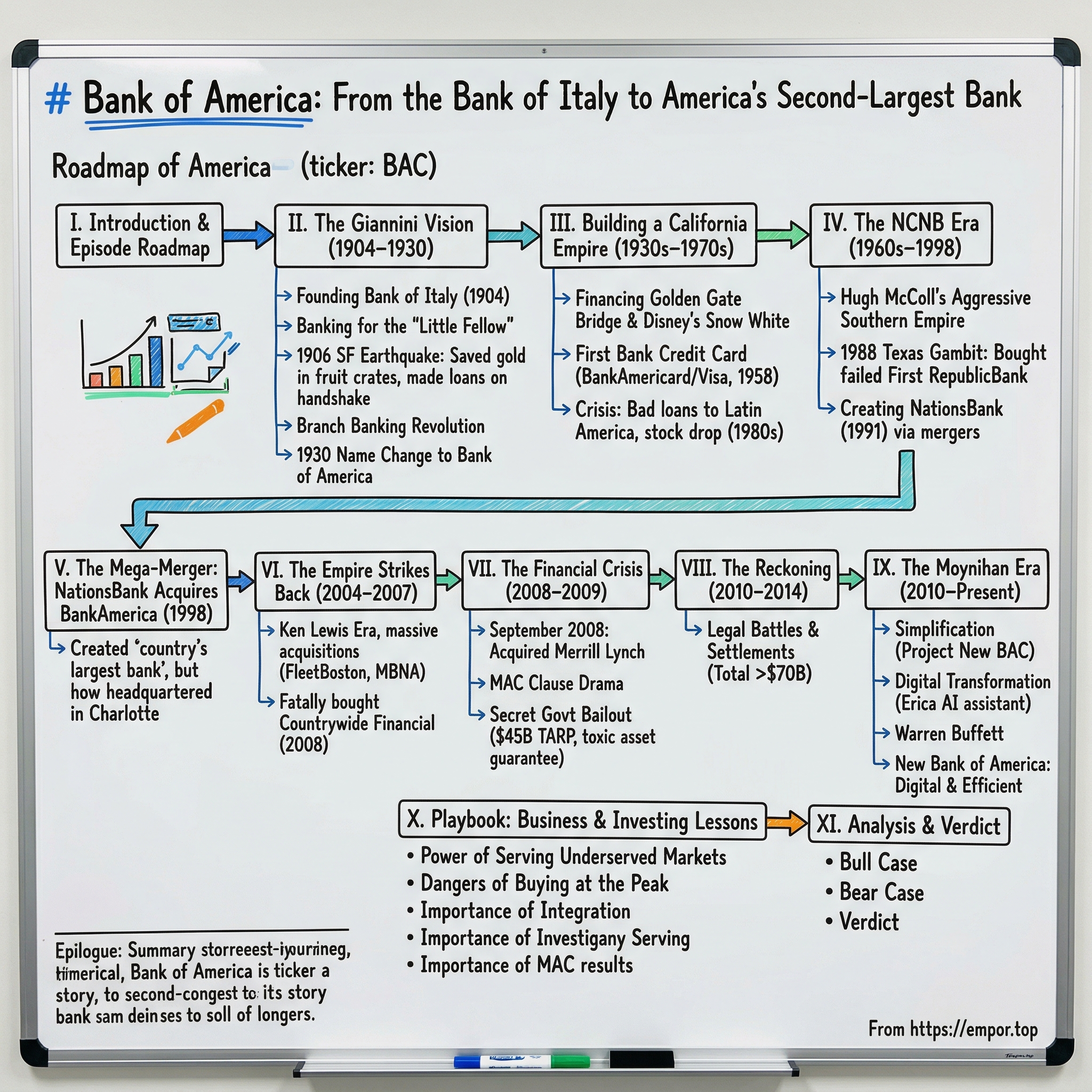
Bank of America: The Empire of American Banking
I. Introduction & Episode Roadmap
On the morning of July 14, 2026, on a bank earnings day so crowded that Bank of America's investor relations chief opened the call by apologizing for the traffic jam, Chief Executive Brian Moynihan reported a figure that would have seemed unthinkable fifteen years earlier: a return on tangible common equity of 17 percent.1
To appreciate why that figure carries such weight requires rewinding to the summer of 2011. Bank of America's shares traded below $7. The company faced litigation from virtually every corner of the American mortgage market. Its market capitalization had fallen below the book value of its equity—a sign that investors believed the assets on its balance sheet were worth less than management claimed. The bank was, in essence, a distressed asset with a national branch network attached.
Today, Bank of America Corporation (NYSE: BAC) sits on roughly $3.5 trillion in assets, funded by more than $2 trillion of deposits—making it the second-largest deposit franchise in the United States.13 It earned $30.5 billion in 2025 on $113.1 billion of revenue.2 It serves close to 70 million consumer and business clients through approximately 3,500 retail financial centers, 15,000 ATMs, and 60 million verified digital users.4 Its wealth management arm oversees $4.9 trillion of client balances,1 while its corporate treasury platform processes payments at a rate the bank measures in dollars per second.5
This history raises the central question of the bank's trajectory: How did a neighborhood bank opened in 1904 to serve working-class Italian immigrants in San Francisco become America's coast-to-coast banking empire, nearly destroy itself through the most expensive acquisition crisis in modern corporate history, and then spend fifteen years rebuilding into a disciplined, steadily compounding enterprise?
That arc runs through four distinct regimes, each offering a lesson in how capital and value are created—and destroyed—in commercial banking.
The merchant of North Beach. A.P. Giannini's foundational insight was simple: ordinary working people reliably repay small, fairly underwritten loans. His key innovation was industrializing that concept into California's first statewide branch network—building a low-cost deposit and distribution machine whose descendants still fund the company today.
The southern conquest engine. Hugh McColl, a former Marine officer who ran a mid-sized Charlotte bank, spent two decades exploiting the deregulation of interstate banking to acquire progressively larger rivals, culminating in the 1998 merger that brought the Bank of America name to the East Coast.
The near-death era. Ken Lewis inherited the acquisition engine and continued feeding it into the peak of a credit bubble. The back-to-back purchases of Countrywide Financial and Merrill Lynch within eight months created massive legal liabilities and credit losses that took Bank of America more than a decade to resolve.
The pivot to "Responsible Growth." Brian Moynihan, a lawyer by training who became CEO in 2010, spent the following decade executing the unglamorous work of settling litigation, shrinking non-core operations, consolidating branches, accelerating digitization, and refraining from bank acquisitions.
Along the way, this analysis examines the core mechanics that shape bank performance: the unit economics of a mega-cap deposit franchise, how asset-liability management decisions made during the 2020–2021 low-rate environment dictate net interest income for a decade, whether the Merrill Lynch acquisition ever earned back its cost, and what would have to happen for the current bull thesis to break.
The story begins where the money first accumulated—on a wharf in San Francisco, amid the smoke.
 Subscribe on LinkedIn
II. The Giannini Vision & The Foundation of Consumer Banking (1904–1980s)
The saloon was the first clue that this would be a different kind of bank.
In 1904, Amadeo Peter Giannini—the San Jose–born son of Italian immigrants and a former produce broker who had retired at 31—raised $150,000 from his stepfather and ten associates to open the Bank of Italy in a converted San Francisco saloon.6 The location was deliberate. San Francisco's established commercial banks lent primarily to merchants and industrialists, shunning North Beach's Italian fishermen, fruit sellers, masons, and laundry operators. Unable to read English-language loan documents, these working-class immigrants were left to rely on predatory lenders.
Giannini introduced a model that was radical for its time: he walked the neighborhood streets, explaining in Italian how commercial banking operated.6 He issued small, short-term installment loans and established a core principle of consumer finance: default rates among modest earners depend far less on income level than on sound underwriting, modest loan sizes, and realistic repayment schedules. When loans were structured around a borrower's cash flow and priced fairly, working-class borrowers proved to be reliable credit risks.
That insight established the bank's unit economics. A local disaster demonstrated its distribution strategy.
The wharf
At 5:12 a.m. on April 18, 1906, the San Francisco earthquake struck, followed by devastating fires. Before the flames reached North Beach, Giannini evacuated the bank's gold, silver, and ledgers out of the city in a produce wagon hidden under crates of oranges. The Bank of Italy emerged as the only local financial institution with intact assets and was the first to resume operations.6
Setting up on the North Beach waterfront, Giannini placed a wooden plank across two barrels and began extending immediate reconstruction credit to residents and small businesses—relying, as one contemporary account noted, on "a man's face and a signature."6 Meanwhile, competing banks remained closed for weeks while their heat-warped vault doors cooled.
The episode established a recurring theme in banking: market share is often forged during crises rather than booms. A century later, Bank of America would experience a similar dynamic during the March 2023 regional banking panic, when flight-to-safety deposits left smaller institutions for mega-cap balance sheets.
Branches as a risk-management technology
Giannini subsequently recognized that geographic expansion functioned as a mechanism for risk management and capital efficiency. A single-branch bank in an agricultural town was effectively a leveraged bet on a single crop in one county. To mitigate this, Giannini began acquiring local institutions across California, integrating them into a unified balance sheet.7 A statewide branch network meant agricultural downturns in citrus could be offset by strong yields in grain. This reduced earnings volatility, allowing the bank to operate with lower capital buffers per loan while offering competitive rates to rural borrowers.
By 1930, the Bank of Italy adopted the name of its holding company, becoming Bank of America.7 Over the next two decades, the institution underwrote major California infrastructure and industrial initiatives: financing construction bonds for the Golden Gate Bridge, funding early Hollywood projects—most famously Walt Disney's Snow White—and supporting post-war suburban development.7 By the end of World War II, it had become the largest commercial bank in the world.
In September 1958, the bank launched a major product experiment in consumer credit by mailing 60,000 unsolicited, pre-approved credit cards to residents of Fresno, California.8 Although the initial "Fresno Drop" produced severe fraud and delinquency—prompting regulatory bans on mass unsolicited card mailings—it demonstrated the viability of a universal revolving credit network. BankAmericard was rebranded as Visa in 1976.9 Through subsequent governance compromises with member institutions, Bank of America surrendered control of the network, transforming what became one of its most lucrative innovations into an independent enterprise that eventually achieved a market capitalization exceeding that of the bank itself.
The near-death that nobody remembers
By the 1980s, BankAmerica faced severe financial strain. The institution had accumulated heavy exposure to Latin American sovereign debt, which stopped performing after Mexico's 1982 default triggered a decade-long regional debt crisis.10 Combined with domestic agricultural loan losses and elevated interest rates, the bank posted consecutive annual losses from 1985 through 1987, driving its stock down to roughly $8 during the 1987 market crash.
To restore capital levels, the bank sold Charles Schwab & Co.—which it had acquired in 1983—back to founder Charles Schwab and an investor group for $280 million in 1987, just weeks before Schwab announced plans for an initial public offering.11 Former chief executive Tom Clausen returned to lead the board and executive team in 1986, spending four years restructuring the balance sheet.12
Two operational patterns from this era remain relevant for evaluating the bank today. First, the institution has a history of concentrating risk in asset classes broadly perceived as secure by contemporary market consensus—sovereign loans in the 1970s, subprime mortgages in the 2000s, and long-duration government bonds in 2020–2021. Second, the emergency sale of Schwab illustrates how distressed financial institutions often divest their highest-quality, most liquid holdings rather than their underperforming assets to cover capital shortfalls.
By 1990, BankAmerica had restored its balance sheet, even as a smaller regional competitor in Charlotte, North Carolina, was developing an aggressive acquisition strategy that would alter the bank's trajectory.
III. The McColl Acquisition Engine & The 1998 Mega-Merger (1980–1998)
Hugh McColl kept a crystal hand grenade on his desk and handed replicas to top-performing executives. Standing five feet seven, the former Marine Corps officer ran his bank much like a rifle platoon: clear objectives, high execution speed, and zero tolerance for hesitation.
McColl joined American Commercial Bank in Charlotte in 1959, an institution that merged the following year to form North Carolina National Bank (NCNB). He recognized earlier than most peers that the fragmentation of U.S. banking—a legacy of Depression-era laws restricting institutions to single states or even single counties—was a political restriction rather than an economic law, and political boundaries eventually erode. North Carolina permitted statewide branching, providing NCNB an early laboratory for bank consolidation. The rest of the country followed, state by state, through reciprocal interstate compacts in the 1980s and federal legislation in the 1990s.
The strategy was straightforward and, for roughly two decades, highly effective: become the fastest buyer in a consolidating industry, integrate operations swiftly, cut duplicate costs, and use the resulting earnings growth to fund the next deal.
Texas, and the art of buying a corpse
The blueprint deal arrived in 1988. First RepublicBank Corporation of Dallas, then the largest bank in Texas, collapsed under the weight of falling oil prices and real estate defaults. NCNB—a regional North Carolina bank with no Texas presence—acquired the failing institution from the Federal Deposit Insurance Corporation under a deal structured with federal loss-sharing agreements and tax incentives on acquired losses. Overnight, NCNB roughly doubled in size.
The takeaway for McColl was clear: the cheapest assets in banking are acquired from regulators during panics, with the government absorbing tail risk. That model proved effective in distress situations, but as successor Ken Lewis would demonstrate two decades later, it carried severe risks when applied to buying a troubled institution directly from shareholders rather than a federal receiver, leaving the acquiring bank holding the tail risk.
The acquisition pace quickened in the 1990s. In 1991, NCNB acquired the troubled C&S/Sovran Corporation and renamed the combined company NationsBank, establishing a dominant footprint in the Southeast. Boatmen's Bancshares followed in 1996, extending the map into the Midwest, and the 1997 purchase of Barnett Banks secured leadership in Florida. Each transaction reinforced the next: a rising stock price created a cheaper acquisition currency, while rapid cost synergies sustained earnings growth.
April 1998
Then McColl targeted the national brand itself.
In April 1998, NationsBank announced a merger with BankAmerica Corporation. Framed publicly as a merger of equals, the combined entity adopted the older, globally recognized Bank of America brand—a valuable asset tied to Giannini's legacy and the West Coast retail network. Yet the corporate structure reflected clear Charlotte dominance. McColl became chairman and chief executive of the combined bank, Charlotte served as corporate headquarters, and NationsBank's corporate registration and stock history remained intact while BankAmerica's was retired.
When the deal closed on September 30, 1998, it created the largest bank in the United States, holding $572 billion in total assets, full-service operations across 22 states and the District of Columbia, roughly 5,000 branches, relationships with 30 million households, and coverage of more than 85 percent of Fortune 500 companies.13 For the first time, a single financial institution operated a coast-to-coast retail deposit network.
That deposit base became the cornerstone of the company's long-term business model. Subsequent financial crises, litigation settlements, balance-sheet restructurings, and earnings recoveries all unfolded atop the retail deposit network built between 1904 and 1998. Establishing a nationwide retail deposit base organically today would be nearly impossible, requiring either an unaffordably dense branch network or aggressive deposit pricing that would erode profit margins. Bank of America possesses that network because hundreds of regional and local institutions were folded into it over a century, funded largely with equity during a regulatory window that has since closed.
McColl retired in 2001, handing leadership to a longtime lieutenant trained within the acquisition machine. The company retained strong momentum, but its strategy had not yet been tested against a severe, systemic decline in the credit quality of its acquisitions.
IV. The Great Financial Crisis: Countrywide, Merrill Lynch, & Near-Death (2007–2010)
Ken Lewis was not a charismatic empire builder. He was a career operator—a Mississippi-born accountant's son who joined NCNB as a credit analyst in 1969 and spent three decades handling integration work, the unglamorous process of merging computer systems and trimming redundant staff. When he succeeded Hugh McColl in 2001, the prevailing view of Lewis was that of a disciplined administrator: an integrator rather than an aggressor.
His record proved otherwise. Over his first seven years, Lewis expanded the bank's footprint through increasingly expensive acquisitions. The purchase of FleetBoston Financial in 2004 established a major Northeast presence for roughly $47 billion in stock.14 MBNA, a leading credit card issuer, followed for $35 billion, closing in January 2006.15 LaSalle Bank arrived in 2007 for $21 billion, securing the Chicago market.16 While each transaction seemed defensible on its own, collectively they revealed a management team that prioritized market share and, by 2007, had exhausted obvious regional expansion targets.
The Trojan horse
Then came the transaction that nearly derailed the institution.
Countrywide Financial was the largest mortgage originator in the United States, but by mid-2007, it was facing severe liquidity distress. Bank of America had already invested $2 billion in Countrywide convertible preferred stock in August 2007 as credit markets froze. On January 11, 2008, Lewis announced an agreement to acquire the entire company in an all-stock transaction initially valued at roughly $4.1 billion.17 The deal closed that July.
The strategic rationale was straightforward: acquiring Countrywide would immediately make Bank of America the nation's leading mortgage lender, securing the primary anchor product of consumer banking. Compared to Countrywide's peak market valuation, the purchase price appeared to be a steep discount.
Instead of acquiring a healthy mortgage franchise, Bank of America inherited a massive estate of unquantified liabilities. Countrywide had originated a vast portfolio of subprime, option-adjustable-rate, and teaser-rate loans. More critically, it had securitized and insured those loans under representations of underwriting quality that crumbled during legal discovery. Because Bank of America bought the corporate entity rather than purchasing assets out of receivership, it assumed all of Countrywide's legal liabilities.
The financial fallout unfolded over the next decade. In August 2014, the U.S. Department of Justice announced a $16.65 billion settlement with Bank of America—at the time the largest civil settlement with a single entity in American history—resolving federal and state claims largely tied to mortgage securitization practices at Countrywide and Merrill Lynch. The deal required $9.65 billion in cash, split between a $5.02 billion civil penalty under FIRREA and $4.63 billion in compensatory payments, plus approximately $7.0 billion of consumer relief.18 That agreement followed an $8.5 billion settlement with mortgage-bond investors, while the final major Countrywide claim, brought by bond insurer Ambac, settled for $1.84 billion in October 2022—fourteen years after the deal closed.19 By that point Bank of America had paid more than $50 billion to resolve investigations and litigation traceable to Countrywide.19
The math reveals the extent of the damage. A $4.1 billion acquisition produced cash settlements exceeding twelve times the initial purchase price—even before accounting for credit losses on the loan book, elevated servicing costs, and a decade of distracted management. Few transactions in American corporate history destroyed more capital relative to the price paid.
The weekend
The second deal came together in roughly 48 hours.
Over the weekend of September 13–14, 2008, as Lehman Brothers collapsed and interbank credit markets froze, Merrill Lynch faced imminent liquidity depletion. The firm—home to the "Thundering Herd" of financial advisers alongside a major investment bank—was days away from losing access to short-term funding. On September 15, Bank of America announced an all-stock acquisition of Merrill Lynch.20 The Federal Reserve approved it on November 26, 2008.20
Then Merrill's fourth-quarter results deteriorated rapidly. As trading and mortgage-related losses surged, Bank of America management concluded by mid-December that the damage might trigger the merger agreement's material adverse change clause—the contractual mechanism allowing a buyer to walk away if a target's financial condition suffers severe disruption before closing.
The events that followed produced conflicting accounts. Testifying before Congress on June 25, 2009, Federal Reserve Chairman Ben Bernanke stated that Bank of America first raised the possibility of terminating the deal on December 17. Bernanke noted that central bank officials believed invoking the clause after three months of due diligence would question the bank's competence and faced low odds of legal success. He also explicitly testified: "I did not tell Bank of America's management that the Federal Reserve would take action against the board or management if they decided to proceed with the MAC."21 In contrast, Lewis told investigators and congressional committees that regulators exerted strong pressure to close the deal. Bank of America's board ultimately voted to proceed on December 30. The government assistance package was announced on January 16, 2009: an additional $20 billion of TARP equity on top of the $25 billion already received, plus a loss-protection ring fence around roughly $118 billion of assets—a guarantee that, Bernanke noted, was never actually implemented because conditions improved.21
Regardless of the degree of regulatory pressure, the transaction highlighted a crucial structural lesson for financial institutions: when a government wants a private acquirer to absorb a failing institution during a systemic panic, the acquirer's shareholders bear the operational and legal tail risk unless a binding, documented loss-sharing agreement is signed before closing. McColl got that documentation in Texas in 1988; Lewis did not get it in New York in 2008.
The reckoning
Bank of America repaid the full $45 billion of TARP capital, with interest, in December 2009.22 While management frequently cited that repayment as evidence of recovery, the broader financial picture was more complex. Equity issued to repurchase government shares, combined with stock issued for the Merrill and Countrywide acquisitions and subsequent capital raises, heavily diluted pre-crisis shareholders—the share count roughly tripled between 2007 and 2010. A shareholder who owned the bank in 2006 did not merely suffer a price decline; they had their claim on future earnings permanently cut.
Lewis was stripped of the chairman title by shareholder vote in April 2009 and announced his retirement later that year. In 2014 he settled with the New York Attorney General over the failure to disclose Merrill's losses and bonus payments before the shareholder vote: Bank of America paid $15 million, Lewis paid $10 million personally and accepted a three-year ban from serving as an officer or director of a public company, without admitting or denying the allegations.23
The company that emerged in January 2010 combined a national deposit franchise and a premier wealth management business with a litigation docket that no one could size. It needed someone temperamentally suited to a decade of triage.
V. The Moynihan Turnaround & "Responsible Growth" Era (2010–Present)
Brian Moynihan is a lawyer, a background that proved central to his leadership style.
Raised as one of eight children in Marietta, Ohio, Moynihan studied history at Brown, played rugby, earned a law degree at Notre Dame, and practiced corporate law in Providence before joining FleetBoston. He entered Bank of America through the 2004 FleetBoston acquisition, subsequently running wealth management, investment banking, consumer banking, and the general counsel's office in rapid succession. When the board appointed him chief executive in January 2010, critics viewed him as a caretaker lacking specialized domain mastery.
Yet Bank of America did not require a visionary dealmaker. It needed an executive capable of triaging thousands of legal claims, determining which disputes to litigate or settle, divesting assets without triggering market panic, and enduring years of public scrutiny while executing a restructuring. A litigator's methodical temperament matched those requirements.
Phase one: shrink
Moynihan's first five years focused on contraction. To rebuild Common Equity Tier 1 capital—the high-quality, loss-absorbing equity emphasized by post-crisis regulators—Bank of America sold non-core international and domestic holdings. The divestitures included its stake in China Construction Bank, its remaining position in BlackRock, international wealth management units, and various private equity operations. These divested units were not inherently failing enterprises; rather, the bank required capital, and organizational complexity had become an unsustainable cost.
In September 2011, management launched Project New BAC, aiming to eliminate approximately 30,000 positions—roughly one-tenth of the workforce—and remove $5 billion in annual expenses by the end of 2013.[^24] The cost-cutting drive exposed the legacy of decades of acquisitions: the bank was operating 63 separate data centers inherited from prior deals, maintaining parallel deposit processing platforms, and holding tens of millions of square feet of redundant real estate.[^24] Management also steadily consolidated the retail footprint. By the end of 2025, the company operated 3,628 financial centers, down from 3,700 a year earlier and well below its pre-crisis peak of more than 6,000.3
The Buffett signal
Investor confidence reached a low point in August 2011. Bank of America's stock dropped below $7 as market participants feared that unquantified mortgage liabilities would force a highly dilutive equity issuance.
On August 25, 2011, Bank of America announced an agreement with Berkshire Hathaway. Berkshire purchased 50,000 shares of cumulative perpetual preferred stock with a liquidation value of $100,000 per share—a $5 billion investment—carrying a 6 percent annual dividend and redeemable at a 5 percent premium. In addition, Berkshire received ten-year warrants to purchase 700 million common shares at an exercise price of $7.142857 per share.24
The transaction terms reflected the urgency of the bank's situation. Berkshire secured a senior 6 percent yield alongside a long-dated call option on 700 million shares near the prevailing market price. Rather than making a conventional valuation assessment of the bank's underlying assets, Warren Buffett was compensated with favorable terms to provide market credibility when capital markets were constrained. The signaling effect was immediate, stabilizing the stock price.
The trade generated substantial returns for Berkshire. In 2017, Berkshire exercised the warrants by surrendering its preferred stock to cover the exercise cost, becoming Bank of America's largest shareholder and realizing an estimated $11.5 billion gain upon conversion.25
However, Berkshire's recent actions present a different picture for investors interpreting its position. Berkshire began steadily reducing its stake in mid-2024. In the second quarter of 2026, it sold approximately 30.2 million shares for an estimated $1.6 billion, marking its eighth consecutive quarter of net sales across the stewardships of both Buffett and successor Greg Abel. The transactions left Berkshire with roughly 308.8 million shares.26 Because Berkshire has not publicly detailed its rationale and the sales occurred alongside solid quarterly earnings, attributing the divestment to specific operational concerns remains speculative. Nevertheless, the prominent investor whose arrival signaled a market bottom in 2011 has spent two years trimming exposure.
Phase two: "Responsible Growth"
As litigation liabilities stabilized, Moynihan replaced the former expansion strategy with an operating framework styled as "Responsible Growth." The strategy rests on four core principles detailed regularly in corporate communications: pursue organic growth; deepen relationships with existing clients rather than offering stand-alone niche products; maintain strict adherence to risk parameters; and ensure sustainable growth by expanding revenue faster than operating expenses.
The emphasis on expense management centers on generating positive operating leverage—the spread between revenue growth and expense growth. For example, if annual revenue grows by 10 percent while expenses increase by 4 percent, the resulting 600 basis points of positive operating leverage flows directly to pre-tax income.
The risk discipline pillar prompted structural changes in consumer credit. Bank of America reoriented its retail lending portfolio toward prime and super-prime borrowers, unwinding the subprime and high-yield single-product origination models inherited from Countrywide and MBNA. During the 2020 economic disruption and the subsequent 2022–2024 interest rate increases, consumer charge-off rates remained well below levels expected from the bank's pre-2008 portfolio mix. On the second-quarter 2026 earnings call, Moynihan reiterated this strategy, telling RBC analyst Gerard Cassidy that the bank had "stuck to our credit knitting" while citing annual Federal Reserve stress test results as validation of its underwriting standards.1
That performance record warrants nuanced interpretation. The post-2010 underwriting standards have not been tested by a prolonged, unmitigated consumer recession; during the 2020 downturn, massive federal stimulus measures cushioned consumer balance sheets across the entire banking sector. While Bank of America has avoided major credit missteps for fifteen years, that record was compiled during a largely supportive macroeconomic backdrop.
The digital rebuild
The most visible transformation of the Moynihan era has occurred across the bank's digital infrastructure.
Bank of America invested more than $118 billion in technology over the past decade, including a $12.7 billion budget in 2025. Approximately $4 billion of that 2025 expenditure was directed to new initiatives, with $338 million allocated to data infrastructure supporting enterprise artificial intelligence.27 The platform generated 30 billion digital client interactions in 2025—a 14 percent increase—including 16.6 billion customer logins. Digital adoption reached 81 percent among consumer and small business clients, and 86 percent across both wealth management and corporate banking operations.28
Specific applications illustrate the scale of usage. Erica, the virtual assistant introduced in 2018, processed roughly 700 million interactions from 20.6 million users in 2025, bringing its lifetime total above 3.2 billion interactions.2829 On the commercial side, CashPro, the bank's corporate treasury management platform, processed $1.2 trillion in mobile-approved payments in 2025—averaging roughly $38,000 per second—across more than 35,000 corporate clients.5
Whether these investments create a defensible competitive moat remains a key strategic question. Two indicators suggest structural advantages. First, operating efficiency has improved: the bank achieved 660 basis points of positive operating leverage in the second quarter of 2026 while Chief Financial Officer Alastair Borthwick noted that headcount remained flat to slightly down over six consecutive quarters.1 Second, digital adoption embeds customers deeper into the franchise: 70 percent of consumer sales are completed through digital channels, while platforms like CashPro create operational switching costs for corporate treasurers integrated into Bank of America's payment systems.15
At the same time, large technology budgets are an industry baseline rather than an exclusive asset, as major peers spend comparable or larger sums. The fundamental advantage stems from scale: spreading fixed technology costs over approximately 70 million client relationships yields a lower unit cost per customer than smaller regional institutions can achieve. This scale advantage is substantial, though it is shared with a small group of peer mega-cap institutions.
On the second-quarter 2026 earnings call, Moynihan highlighted AI deployment metrics, reporting that over 200,000 employees were using internal AI tools to generate more than 400,000 daily prompts. Management disclosed over 300 approved AI use cases, including 114 active generative AI applications and 34 fully integrated systems.1 In response to Citi analyst Ben Gerlinger's question regarding whether strong revenue might lead to underinvestment, Moynihan focused on software productivity rather than net expense reductions, remarking that "the same amount of money in '27 will get us more code."1 Crucially, management has not provided explicit cost-reduction targets tied to AI, and internal usage statistics do not automatically convert into measurable dollar savings.
Governance: the uncomfortable part
Governance structure remains an ongoing topic among institutional shareholders. Moynihan has served jointly as chairman and chief executive since 2014. For 2025, the board approved total compensation of $41 million—a 17 percent increase from $35 million in 2024—consisting of a $1.5 million base salary, no cash bonus, and $39.5 million in equity awards, half of which are structured as performance-based restricted stock.30
Shareholders have periodically challenged the concentration of executive authority. At the annual meeting on May 4, 2026, a shareholder proposal requiring an independent board chair received 32.6 percent of votes cast and was defeated, while all director nominees were re-elected and the independent auditor was ratified.31 A vote of nearly one-third opposition represents notable investor scrutiny, maintaining pressure on board governance even if insufficient to mandate structural separation. Critics point out that after sixteen years as CEO, Moynihan maintains combined roles and received a 17 percent pay increase in a period when the bank set medium-term return targets that met analyst skepticism, while trading at a discount to its primary mega-cap peer on tangible book value metrics. Supporters counter that financial performance and operational stability have steadily improved under his tenure.
Executive leadership around Moynihan features a core group of senior managers: Chief Financial Officer Alastair Borthwick, Co-Presidents Dean Athanasia and James DeMare, Private Bank head Kathleen Knox, and Merrill Wealth Management Co-Head Lindsay Hans.32 The board has not publicly identified a designated successor, leaving executive succession an open consideration for an institution of Bank of America's size.
VI. Segment Breakdown & Engine Architecture: How BAC Makes Money Today
Strip away the history, and Bank of America functions fundamentally as a spread and fee engine: it gathers low-cost deposits from millions of retail and corporate clients and redeploys that capital into higher-yielding loans and securities.
In the second quarter of 2026, the bank generated $31.6 billion in revenue and $9.1 billion in net income, expanding earnings per share 34 percent year over year to $1.21.1 Operating efficiency—the proportion of revenue consumed by expenses—improved to 59 percent. Notably, all four operating divisions expanded revenue, increased net income, and lowered their efficiency ratios in the same quarter.1 Broad-based performance of this kind is difficult to generate through one-time accounting gains, signaling systemic operational improvement across the franchise.
Consumer Banking: the source of the funding
The Consumer Banking division delivered $3.3 billion in net income on $11.3 billion of revenue for the quarter—a 10 percent profit increase—while operating at a 51 percent efficiency ratio and generating a 29 percent return on allocated capital.1 Across full-year 2025, the segment earned $12.2 billion on $43.7 billion of revenue, cementing its role as the company's largest profit engine.2
The core asset powering this division is $957 billion in average consumer deposits funded at an average rate of 48 basis points.1 In practical terms, Bank of America borrows nearly $1 trillion from American households at under 0.5 percent while benchmark interest rates hover significantly higher. This low funding cost forms the bedrock of the firm's net interest margin. Primary checking accounts drive this advantage: because these operating accounts handle paychecks, mortgage payments, and daily card transactions, retail depositors rarely move core transactional balances to chase minor yield differentials.
Addressing deposit pricing on the earnings call, Chief Financial Officer Alastair Borthwick explained to KBW analyst Chris McGratty that the low average funding cost was "really about mix," propelled by non-interest-bearing balance growth rather than aggressive rate cuts on yield-sensitive accounts.1 The division added 162,000 net new checking accounts during the quarter, marking seven consecutive quarters of expansion in non-interest-bearing balances.1 Rather than underpaying yield-seeking depositors, the bank sustains its cost advantage by expanding transactional accounts that carry zero interest by design.
Consumer credit card spending grew 9 percent in the quarter to $266 billion, while retail investment balances expanded 18 percent to a record $640 billion.1 This growing pool of retail investment assets serves as an internal pipeline, feeding affluent clients directly into the bank's wealth management organization.
Global Banking: the switching-cost engine
Global Banking, which serves middle-market enterprises, major corporations, and institutional clients, generated $6.2 billion in revenue and more than $2 billion in net income—up 20 percent—while producing a 15 percent return on allocated capital.1 For full-year 2025, the segment earned $7.8 billion in net income on $24.1 billion of revenue.2
Quarterly performance benefited from investment banking fees excluding self-led deals, which jumped 50 percent year over year to exceed $2.1 billion.1 Borthwick cautioned, however, that part of this gain stemmed from a low base comparison in the prior-year period, when investment banking activity across Wall Street was suppressed.
The segment's underlying structural strength rests in CashPro, Bank of America's digital corporate treasury platform. By integrating client approval workflows, payment processing formats, enterprise software systems, and audit logging into a single portal, CashPro creates high switching costs; replacing a treasury provider requires a complex IT migration rather than a simple fee comparison. Driven by these operational relationships, Global Banking deposits grew 8 percent year over year—the fastest pace of any division—fueled by what management characterized as core operating account growth.1
Global Wealth & Investment Management: the fee annuity
Global Wealth & Investment Management delivered a record quarter, generating $6.9 billion in revenue (up 16 percent) and $1.4 billion in net income (up 42 percent), while expanding pre-tax margins beyond 27 percent.1 Total client balances reached $4.9 trillion, up 12 percent, while assets under management expanded 17 percent to $2.3 trillion, supported by $14 billion in quarterly net inflows and $78 billion over the trailing four quarters.1
Anchored by Merrill Lynch and the Private Bank, the wealth division operates on capital-efficient fee economics: asset-management fees scale directly with market values, while the marginal cost of servicing larger portfolios remains low, driving margin expansion ahead of top-line growth. In addition to advisory fees, the division earns net interest income on wealth deposits and securities-based portfolio lending, which grew to $277 billion.1
The division relies on an internal client referral loop: as consumer brokerage balances mature, accounts are routed to Merrill wealth advisers, whose high-net-worth clients eventually transition into the Private Bank. Management cited 6,000 net new affluent households added in the quarter alongside near-historic lows in financial adviser attrition.1 When Wells Fargo analyst Mike Mayo queried whether the firm was meeting its November 2025 investor day target of 5 percent organic net asset growth, Borthwick offered a cautious assessment, stating seven months into the initiative that performance was off to a good start with further work remaining.1
Global Markets: the cyclical amplifier
Global Markets posted $2.7 billion in net income excluding debit valuation adjustments—a 70 percent increase—on sales and trading revenue of $7.2 billion, up 33 percent.1 Equities trading reached a record $3.6 billion, up 70 percent, while fixed income, currencies, and commodities generated $3.5 billion, marking its strongest quarter in over ten years.1 The division has expanded sales and trading revenue year over year for seventeen consecutive quarters.1
While seventeen consecutive quarters of growth demonstrates deliberate balance-sheet allocation to institutional trading, market revenues remain inherently cyclical and tied to volatility and capital issuance. A 20 percent return on allocated capital during a peak trading period represents an elevated snapshot rather than a structural baseline.
Borthwick highlighted an important structural nuance on reported results: rapid asset expansion in the capital markets division—which operates on narrow net interest spreads—mechanically dilutes Bank of America's consolidated net interest margin.1 Consequently, the headline net interest margin figure understates the margin expansion achieved within the underlying retail and commercial banking books.
In combination, Bank of America's operational architecture couples a consumer deposit network supplying low-cost funding with a commercial bank protected by enterprise switching costs, a capital-light wealth management fee engine, and a capital markets division that magnifies earnings during active market cycles. While this structure offers broad revenue diversification, evaluating its efficiency requires comparing its returns against its closest mega-cap peers.
VII. Competitive Landscape & Industry Structure: BAC vs. JPM, Wells, Citi, & Wall Street
American banking features thousands of institutions, but only four operate at a national scale. JPMorgan Chase, Bank of America, Wells Fargo, and Citigroup hold a collective share of the nation's insured deposits that would trigger antitrust concern in almost any other sector. They are insulated by a dense regulatory perimeter—including capital surcharges, stress tests, and resolution planning requirements—that is so costly to maintain that it functions as a competitive moat for the very incumbents it was designed to oversee.
The most useful way to evaluate Bank of America's competitive position is to ask, business by business, whether the institution operates as a best-in-class leader or simply as an exceptionally large participant.
Against JPMorgan: structurally behind
The financial comparison shows a clear gap. In the second quarter of 2026, JPMorgan reported a return on tangible common equity of 29 percent—or 23 percent excluding significant items—compared with Bank of America's 17 percent.133 Equity markets price this performance discrepancy accordingly: JPMorgan's market capitalization has hovered at roughly double Bank of America's, despite operating a balance sheet less than 20 percent larger.34
Two primary structural mechanisms account for most of this valuation gap.
First, JPMorgan maintains a dominant market share in investment banking and institutional markets. The firm consistently leads global league tables in merger advisory and underwriting. In corporate finance, scale reinforces itself: the bank that arranges a transaction is positioned to secure subsequent mandates. While Bank of America's 50 percent year-over-year growth in investment banking fees during the second quarter was strong, it built off a lower base.
Second, asset-liability management represents the single most consequential strategic divergence between the two institutions over the past six years—and forms the foundation of the bear case for Bank of America.
The duration decision
When the pandemic hit in 2020, extraordinary fiscal and monetary stimulus flooded commercial banks with deposits. Facing an unprecedented surge in customer cash while benchmark interest rates sat near zero, bank treasuries confronted a strategic choice.
Institutions could park excess liquidity at the Federal Reserve, earning negligible yields while retaining maximum flexibility to reprice assets if interest rates rose. Alternatively, they could deploy cash into long-dated fixed-income securities—such as U.S. Treasuries and agency mortgage-backed securities—locking in modest yields of around 2 percent over multi-year horizons. In 2020 and 2021, the second option offered a slight premium: 2 percent surpassed 0.1 percent.
Bank of America chose duration at massive scale, designating a major portion of these purchases as held-to-maturity—an accounting classification that permits institutions to carry debt securities at amortized cost rather than marking them to market value. By contrast, JPMorgan maintained a significantly higher proportion of its assets in short-term cash.
When the Federal Reserve subsequently raised interest rates by more than five percentage points to combat inflation, bond prices plummeted. By the third quarter of 2023, Bank of America's unrealized paper losses on its securities portfolio reached $131.6 billion.35
As management points out, these unrealized losses do not threaten solvency because the government-guaranteed securities carry no default risk and pay back par value at maturity. However, the economic damage manifests as a persistent opportunity cost: every dollar locked into a 2 percent bond for a decade is a dollar that cannot be lent at 6 percent. The bank's 2025 Form 10-K quantifies the scale of this drag. As of December 31, 2025, the held-to-maturity portfolio stood at $522.7 billion in amortized cost against a fair value of $442.4 billion—representing a gross unrealized loss of $80.3 billion—carrying a weighted average yield of just 1.95 percent. Within that portfolio, $400.3 billion matures after ten years, and the agency mortgage-backed portion alone totals $395.4 billion yielding 2.11 percent.3 For comparison, the available-for-sale book of $404.7 billion yields 3.89 percent.3
Annual portfolio cash flows highlight the extended timeline of this repricing constraint: run-off from the held-to-maturity portfolio generated $34.8 billion in 2025, or under $9 billion a quarter.3 At that pace, recycling the bulk of a $522 billion portfolio into current market yields will take well over a decade.
This structural lag forms the core of both the bull and bear investment theses. On one hand, as low-yielding paper steadily matures, the proceeds are redeployed into higher-yielding loans and securities, providing a predictable, mechanical tailwind to net interest income without requiring asset growth. Chief Financial Officer Alastair Borthwick confirmed that the second half of 2026 will receive "a little bit more" of this repricing benefit than the first half.1 On the other hand, this gradual recovery represents the slow unwinding of a capital allocation decision that cost shareholders years of earning power.
Against Wells Fargo and Citigroup
Wells Fargo presents a more direct competitive comparison now that its primary structural constraint has been removed. In June 2025, the Federal Reserve lifted the $1.95 trillion asset cap imposed in 2018 following the bank's retail sales practices scandal, freeing Wells Fargo to expand its balance sheet for the first time in seven years.36 In the second quarter of 2026, Wells Fargo posted a 17.7 percent return on tangible common equity—slightly outpacing Bank of America—on a substantially smaller balance sheet.33 The unencumbering of a competitor with overlapping retail geography and a comparable return profile introduces renewed competitive pressure.
Citigroup represents an ongoing corporate turnaround. The bank reported $5.8 billion in net income on $24.8 billion in revenue for the second quarter of 2026—its strongest quarterly revenue in a decade—delivering a 13 percent return on tangible common equity against a full-year target of 10 to 11 percent.37 Although Citigroup remains a lower-returning franchise overall, its upward trajectory has narrowed the gap with peers.
Where Bank of America genuinely wins
Bank of America maintains clear structural advantages in two areas:
First, deposit cost and stability. Neither Citigroup, with its institutional and cross-border orientation, nor regional banks dependent on rate-sensitive commercial balances, fund themselves as cheaply or as stably as a franchise anchored in primary household checking accounts. Twelve consecutive quarters of average deposit growth, driven by expanding non-interest-bearing balances, is the operating evidence.1
Second, wealth management integration. The combination of Merrill Lynch, the Private Bank, and a national retail branch network creates an internal client referral loop that neither Wells Fargo nor Citigroup matches. While Morgan Stanley is the primary competitor in wealth management, it lacks Bank of America's retail deposit base and branch network funnel.
What analysts are actually pressing on
The pattern of analyst questioning on earnings calls highlights market concerns. On July 14, 2026, four analysts asked variations of the same question: whether full-year net interest income guidance was overly conservative. UBS analyst Erika Najarian stated directly that "the investor feedback so far is that they feel that the net interest income guide is conservative."1 Borthwick attributed the guidance to tougher comparisons in the second half of the year following strong growth in late 2025, narrowing the full-year net interest income growth range to "more like 8 percent for the full year."1
This exchange reflects a consistent pattern of conservative guidance management. Bank of America initially projected 5 to 7 percent net interest income growth in January 2026, raised the outlook to 6 to 8 percent in April, and guided to the upper end in July.1 Operating leverage guidance followed the same path, moving from "more than 200 basis points" to a range of 300 to 400 basis points after the first half delivered 450.1 Setting beatable targets builds short-term executive credibility, but it also prompts investors to routinely discount initial management guidance over the long run.
VIII. Moat Analysis: 7 Powers & Porter's Five Forces
Analytical frameworks are useful only when they enforce objectivity. Applied to a mega-bank, many frameworks flatter the subject by confusing sheer operational size with genuine competitive advantage. The discipline lies in separating what is uniquely defensible from what is merely large.
The seven powers, tested
Scale economies — strong, but shared. Amortizing a $12.7 billion technology budget across roughly 70 million clients yields a cost per relationship that regional banks cannot match.27 The necessary qualification is that this advantage is shared with three other mega-cap institutions, one of which spends even more. Scale operates as a barrier against regional institutions, not against immediate peers.
Switching costs — strong, and the most critical power. The primary checking account remains the stickiest consumer finance product because replacing it requires redirecting direct deposits, automated clearing house payments, recurring card charges, and bill-pay setups. In corporate banking, CashPro entitlement structures create similar friction at higher stakes. Behavioral evidence validates this mechanism: deposit balances continued growing through a rate-hiking cycle when depositors had clear incentives to seek yield, and the expansion occurred in non-interest-bearing accounts that pay zero interest.1
Process power — moderate, and unproven as a relative edge. The Responsible Growth framework has delivered fifteen years without a major credit misstep and, more recently, five consecutive quarters of positive operating leverage in Consumer Banking.1 However, process power requires an organizational capability that competitors cannot replicate, and there is little empirical evidence that Bank of America's underwriting is structurally superior to JPMorgan's rather than similarly conservative. This reflects disciplined execution rather than an uncopyable power.
Branding — real, but primarily valuable during panics. During the March 2023 regional banking panic, depositors migrated balances to the largest institutions under the assumption that federal regulators would not allow them to fail. That implicit safety net functions as a brand subsidy, representing a byproduct of systemic importance rather than commercial distinction.
Cornered resource — weak. The Merrill Lynch adviser network represents a valuable distribution asset, but financial advisers remain mobile, face constant recruitment from competitors, and can transfer client relationships. Management's claim that adviser attrition sits near historic lows acknowledges that retention remains the critical metric.1 A resource that must be continually defended is not cornered.
Network effects — weak. Zelle is jointly owned with competing banks, meaning network value accrues to the broader consortium rather than exclusively to Bank of America. While Zelle processed 1.8 billion transactions totaling $556 billion for Bank of America clients in 2025, that volume reflects industry scale rather than a proprietary network moat.28
Counter-positioning — absent for the incumbent. Neobanks and financial technology firms represent the counter-positioned entrants, targeting traditional branch networks, compliance overhead, and legacy software systems. Scale and depositor trust have blunted that threat so far, but counter-positioning remains an advantage held by challengers.
Porter, applied
Buyers: moderate to high power, and rising. Depositors face minimal switching costs on excess cash balances, as funds beyond daily operational needs can be transferred to higher-yielding money market instruments in an afternoon. Client retention protects transactional operating accounts, not rate-sensitive savings balances.
Substitutes: moderate and growing. Money market funds serve as direct substitutes for bank deposits, while digital wallets compete for card interchange fees. In corporate lending, private credit funds present a growing alternative—a shift Brian Moynihan addressed on the July 2026 earnings call, noting that some leverage that previously migrated outside the banking system was returning "on bank lendable terms" as competitive pressure eased, while acknowledging that "we always" see excesses somewhere.1
Rivalry: high. Four national mega-caps with overlapping geographical footprints compete for corporate and consumer relationships, alongside wealth management rivals like Morgan Stanley and a newly uncapped Wells Fargo targeting the same affluent client base.
New entrants: very low. Securing a new bank charter cannot replicate a nationwide deposit franchise, a capital structure built to satisfy Federal Reserve stress tests, or an annual technology budget in the billions. High regulatory barriers and capital requirements insulate incumbents from new banking entrants.
Suppliers: high, and structurally unusual. A bank's principal raw material is funding, and benchmark interest rates are dictated by the Federal Reserve. Bank of America can optimize its deposit mix, but it cannot dictate monetary policy rates. Furthermore, regulators exercise supplier power by establishing minimum capital requirements, which determine how much of the balance sheet must be funded with higher-cost equity.
The net assessment: Bank of America's competitive moat rests primarily on high switching costs in transactional operating accounts and a regulatory perimeter that prevents new entrants from replicating a nationwide franchise. While neither factor provides a distinct relative advantage over JPMorgan Chase, together they form a durable defense against regional and smaller competitors.
IX. Historical Falsification Layer: Testing Management & Strategic Claims
A moat description is a hypothesis. Analytical discipline requires taking the strategic claims central to the investment thesis and testing them against the institution's historical record over the longest available timeframe.
Claim 1: "Bank of America is a disciplined acquirer"
Rejected outright, and this claim is no longer made.
The historical record is unambiguous. Countrywide, acquired for roughly $4.1 billion, generated more than $50 billion in legal settlements and penalties.1719 MBNA, bought for $35 billion, brought a monoline credit card portfolio at a cyclical peak in 2005, three years before the consumer credit cycle turned.15 FleetBoston and LaSalle were acquired at top-of-market valuations in the final years of a credit expansion.1416 Meanwhile, Merrill Lynch was contracted over a weekend at a price that required an incremental $20 billion in government equity within four months.21
This evidence disproves the original claim. What makes the record analytically relevant today is that management appears to have internalized the failure. Bank of America has made no major bank acquisition since 2009—a sixteen-year abstention that stands out in an industry where scale is a primary executive objective. Instead, growth capital is allocated to physical branches: the company has invested more than $5 billion in its financial center network since 2016 and announced plans in May 2025 to open more than 150 new centers across 60 markets by the end of 2027 while renovating 500 more.38 Expanding one branch at a time offers a slower, less glamorous, but far less risky path into markets like Nashville or Boise than purchasing an entire regional bank.
The revised claim that survives: Management's capital allocation discipline is credible because it stopped doing acquisitions, not because it became proficient at them. What would falsify the revised claim: Any sizable bank acquisition. If Bank of America announces a multi-billion-dollar depository transaction, the sixteen-year abstention—the sole evidentiary foundation for its discipline claim—is invalidated in a single press release.
Claim 2: "The low-cost deposit moat insulates margins across rate cycles"
Narrowed substantially.
The deposit franchise is genuinely exceptional, as current operational metrics confirm. However, a low-cost liability base represents only one side of a net interest margin. The 2020–2021 duration decisions demonstrated that management can neutralize a world-class funding advantage through asset-side positioning, creating multi-year headwinds because a fixed-income portfolio cannot be easily unwound.
The critical analytical context is that the held-to-maturity repricing framed by bullish investors as a "mechanical tailwind" exists only because of a prior capital allocation error. Treating it purely as a tailwind overlooks the initial misstep—much like praising a runner's acceleration while ignoring that they started from behind. The tailwind is real: Chief Financial Officer Alastair Borthwick reaffirmed on the July 2026 earnings call that the bank continues to target a net interest yield of 2.30 percent and is "probably inside a couple of years" from reaching that goal, compared to 2.08 percent today.1 Yet the ultimate destination is simply a margin profile that several peers achieved without taking a decade-long detour.
The revised claim that survives: The deposit franchise provides a durable funding cost advantage over regional banks, but it does not independently insulate the net interest margin, which depends equally on asset-side decisions with multi-year lock-in. What would falsify it: A failure of the net interest yield to progress toward 2.30 percent on schedule, or a decision to extend portfolio duration into a low-rate environment once again.
Claim 3: "Digital leadership shields the bank from deposit repricing and attrition"
Narrowed, with a genuine internal tension.
Digital adoption cuts both ways, a reality management rarely highlights. The same mobile interface that makes a primary checking account convenient also enables customers to seamlessly transfer excess cash into higher-yielding money market funds. Throughout the 2022–2024 rate-hiking cycle, non-interest-bearing balances across the banking sector—including at Bank of America—declined materially before stabilizing, as yield-seeking behavior became frictionless.
The empirical data supports a more nuanced conclusion: digital capabilities do not prevent rate-sensitive capital from seeking yield, but they do strengthen core transactional relationships. Non-interest-bearing balances have grown for seven consecutive quarters, a trend Borthwick attributed explicitly to customer mix rather than aggressive deposit pricing power.1
The revised claim that survives: Digital investments protect and expand transactional relationships; they do not shield rate-sensitive savings balances from market pricing. What would falsify it: A resumption of sustained declines in non-interest-bearing deposits while total balances grow—the operational signal of a franchise purchasing deposits rather than earning primary relationships.
Claim 4: "The Merrill acquisition was transformational"
True eventually, false for years—and that temporal distinction is critical.
Today, Global Wealth & Investment Management operates as a record-setting, capital-light, high-margin division. That outcome is clear. However, the immediate post-acquisition period from 2009 through 2013 delivered $20 billion in incremental government equity, severe shareholder dilution, financial adviser attrition, cultural friction between a Wall Street brokerage and a Charlotte commercial bank, and a substantial portion of the mortgage liabilities settled in the 2014 Department of Justice agreement.1821
The broader investment takeaway is not whether the transaction was inherently good or bad. Rather, it illustrates that a strategically sound acquisition executed under distressed conditions without adequate due diligence can take a decade to generate net value—leaving the diluted early shareholders largely uncompensated while subsequent investors collect the returns.
The revised claim that survives: Merrill Lynch was strategically sound and now provides material earnings power, but the transaction destroyed shareholder value for at least five years, and its ultimate performance does not retroactively justify the acquisition process.
Claim 5: "Management sets and meets its targets"
Intact but young, and evaluated against a favorable initial sample.
At its November 5, 2025 investor day—the company's first in roughly fifteen years—management established a medium-term return on tangible common equity target of 16 to 18 percent over a three-to-five-year horizon, compared to 15.4 percent in the third quarter of 2025, alongside annual earnings per share growth of at least 12 percent.39 Initial market reaction was cautious; TD Cowen analyst Steven Alexopoulos noted that "the market may initially find this disappointing," and the stock dropped approximately 2 percent on views that the guidance reflected existing momentum rather than accelerated growth.39 Responding to questions regarding whether 18 percent represented a ceiling, Moynihan stated, "There is no cap to our ambition," while Borthwick acknowledged "a touch of conservatism."39
Nine months later, in the second quarter of 2026, the company posted a 17 percent quarterly return on tangible common equity—reaching the target range earlier than anticipated, prompting Moynihan to observe on the earnings call, "We thought it would take us longer to get there."1 This execution represents a tangible positive result.
However, two caveats remain. First, a single quarter does not constitute a sustainable trend, particularly given that this period benefited from record equities trading and a 50 percent year-over-year surge in investment banking fees off a depressed baseline—the franchise's two most volatile revenue streams.1 Second, reaching a multi-year goal within three quarters raises questions about how demanding the baseline target was set. What would confirm the claim: Maintaining a return on tangible common equity at or above 16 percent across a full year when capital markets revenue normalizes to baseline levels.
X. Playbook: Business & Investing Lessons
1. Peak-cycle M&A in leveraged industries compounds risk rather than diversifying it. The Countrywide and MBNA purchases were both bets on consumer credit, executed near the peak of a credit cycle by an institution already heavily exposed to consumer borrowing. When the cycle turned, the acquisitions did not offset the core business—they amplified losses. The generalizable principle: in a cyclical, leverage-sensitive industry, acquiring targets that mirror existing asset risks concentrates exposure at the worst possible moment. Furthermore, when a target's primary liability is legal rather than financial, the purchase price bears little relation to the ultimate cost.
2. A cheap liability is only half a margin. Bank of America built one of the nation's premier consumer deposit franchises and then surrendered years of its economic value by locking asset yields into long-duration paper near generational lows. Deposit franchise quality and net interest margin are separate operational variables; a low-cost funding base cannot insulate an earnings profile from asset-side duration errors. Evaluating a commercial bank requires examining both sides of the balance sheet—specifically the yield and maturity profile of the securities portfolio, where structural duration drag remains fully disclosed.
3. Abstention can be a strategy. The most consequential decisions of Brian Moynihan's sixteen-year tenure may be the transactions he chose not to pursue. Expanding a branch network city by city generates slower headline growth than acquiring regional competitors, but it avoids integration friction, goodwill write-downs, cultural collisions, and inherited litigation liabilities. Markets rarely reward capital discipline in real time; the payoff manifests years later in the absence of catastrophic write-downs.
4. Technology scale is a barrier against the tier below you, not the tier beside you. A $12.7 billion annual technology budget creates a formidable barrier against regional competitors, but it confers no structural advantage against JPMorgan Chase. Investors must distinguish between competitive tiers when evaluating scale: outspending regional peers does not establish a proprietary technology moat against equal-sized mega-cap rivals.
5. In crisis mergers, get the loss-sharing in writing before you close. Hugh McColl acquired a failed Texas bank from federal regulators with explicit loss-sharing agreements, creating substantial value. Ken Lewis acquired a troubled broker-dealer from its shareholders over a single weekend and received informal policy assurances that were announced after the fact and never executed. Opposite outcomes in corporate distress transactions are often determined by whether government loss protections are contractually binding before closing.
6. Watch what management stops saying. Bank of America's investor communications in 2007 emphasized total scale, market share, and franchise completeness. In recent years, management metrics have centered on positive operating leverage, efficiency ratios, and organic relationship growth. This vocabulary shift reflects a fundamental change in underlying operational priorities. Conversely, any future shift back toward aggressive market-share expansion would signal an early warning of strategic drift.
XI. The Investment Thesis: Bull vs. Bear Case & Key KPIs
The bull case
The repricing engine has years left to run. Roughly $9 billion in securities cash flow rolls off the low-yielding portfolio each quarter and is redeployed at prevailing market rates.3 Unlike top-line revenue expansion, this process requires no new customers, market-share gains, or broader economic acceleration—it proceeds automatically on a fixed maturity schedule. Management projects this transition will elevate net interest yield from 2.08 percent to 2.30 percent within roughly two years.1 On a $3.5 trillion balance sheet, that spread expansion delivers a predictable, mechanical earnings tailwind.
The funding franchise keeps compounding. The underlying engine remains the low-cost deposit base, built over more than a century. Operational metrics continue to reflect this strength, featuring twelve consecutive quarters of average deposit growth, seven consecutive quarters of non-interest-bearing expansion, 162,000 net new checking accounts added in a single quarter, and an average consumer deposit rate of just 48 basis points.1
Wealth management functions as a capital-light compounder. Global Wealth & Investment Management generated a pre-tax margin above 27 percent while overseeing $4.9 trillion in client balances—a 12 percent increase—producing expanding fee income that requires minimal regulatory capital.1 At these margins, incremental asset growth drives high-return earnings.
Capital return is substantial and rising. In July 2026, the board raised the dividend by 14 percent to $0.32 per share. Under a $40 billion authorization effective since August 2025, the company returned $13.2 billion through share repurchases and paid $4 billion in dividends in the first half of 2026, leaving approximately $17 billion authorized for future buybacks as of June 30.40 With a Common Equity Tier 1 capital ratio of 11.2 percent against a 10.0 percent regulatory minimum, management retains ample flexibility for ongoing capital returns.1
Regulatory headwinds have turned favorable. Banking regulators re-proposed the Basel III endgame rules on March 19, 2026. In a sharp reversal from the 2023 framework that threatened to raise large-bank capital requirements by 16 to 19 percent, agencies now expect aggregate system capital to decrease modestly. Following the close of the public comment period in June 2026, the Federal Reserve advanced the proposal by a 6–1 vote.41 Separately, the Fed's annual stress test on June 24, 2026, confirmed that all 32 participating institutions maintained capital well above minimums despite $708 billion in hypothetical severe losses, keeping stress capital buffer requirements unchanged for 2026.42 Lower capital mandates directly expand the capacity for shareholder distributions.
The bear case
The starting-point problem. The 17 percent quarterly return on tangible common equity was bolstered by record equities trading and a 50 percent year-over-year surge in investment banking fees against a depressed prior-year comparison—a dynamic Chief Financial Officer Alastair Borthwick highlighted on the earnings call.1 While core commercial operations expanded, a notable portion of the beat relied on volatile capital markets lines. If trading and advisory activity normalizes, returns risk drifting toward the lower bound of management's 16 to 18 percent target band.
The peer gap remains structural. In the same quarter, under identical macroeconomic and regulatory conditions, JPMorgan Chase reported a 29 percent return on tangible common equity compared to Bank of America's 17 percent.133 That persistent differential reflects a more lucrative fee mix, superior balance-sheet positioning prior to the rate-hiking cycle, and a dominant investment banking franchise. While Bank of America is working to narrow the gap, management has disclosed no distinct mechanism to eliminate it.
Credit quality has not faced a severe consumer downturn under current underwriting. Second-quarter provisions and net charge-offs stood near $1.4 billion each, while criticized commercial exposures declined by $2.3 billion to roughly $22 billion and non-performing loans held steady at $5.8 billion—signaling a benign credit environment.1 However, two concentrations warrant close monitoring. Commercial loan growth of 11 percent was driven largely by artificial intelligence and data center infrastructure spending; when asked on the earnings call about secondary credit exposure if AI investments slow, Chief Executive Brian Moynihan outlined an evaluation framework rather than quantifying specific risk exposures.1 Commercial real estate exposure, particularly in office properties, represents an additional area of watchfulness, though neither currently impairs financial results.
Deposit competition and disintermediation risk. Strong customer relationships shield operating accounts, but excess cash remains vulnerable. If interest rates remain elevated over an extended period, money market funds and fintech platforms will continue competing for savings balances, potentially reversing the favorable funding mix that has kept deposit costs low.
Governance and succession concerns. Concentrating authority in a combined chair and chief executive role—a structure opposed by nearly one-third of voting shareholders—alongside a 17 percent executive pay increase and the absence of a publicly identified successor after sixteen years, creates a persistent governance risk.3031
Ongoing legal and regulatory overhang. Although a federal CFPB lawsuit concerning Zelle fraud was voluntarily dismissed with prejudice in March 2025, a separate enforcement action filed by the New York Attorney General in August 2025 survived a motion to dismiss in July 2026.43 While not currently material to earnings, the litigation demonstrates that consumer payment liabilities remain subject to regulatory scrutiny.
Capital markets sensitivity to geopolitical shock. Management acknowledged this external vulnerability during the July 2026 earnings call, noting that geopolitical tensions in the Middle East create market unpredictability that can impair capital markets activity and initial public offerings—highlighting that a key driver of recent earnings outperformance remains exposed to factors outside the bank's control.1
The three KPIs that matter
Evaluating Bank of America's quarterly performance requires monitoring three core metrics.
1. Net interest yield trajectory toward 2.30 percent. Total net interest income in dollars can be inflated simply by expanding the balance sheet; net interest yield measures whether low-yielding securities are repricing into higher net margins. The metric stood at 2.08 percent in the second quarter of 2026.1 A multi-quarter stall in yield expansion would indicate that the mechanical thesis for earnings growth is encountering friction.
2. Operating leverage discipline. Management committed to maintaining 200 to 300 basis points of positive operating leverage through the cycle and raised its 2026 outlook to 300 to 400 basis points after achieving 450 basis points in the first half.1 Operating leverage serves as the primary test of whether technology investments generate genuine structural efficiency or merely absorb capital.
3. Non-interest-bearing deposit balance trends. Non-interest-bearing balances directly measure the health of the bank's retail deposit moat. Expanding balances confirm that the institution is winning primary transactional accounts. Conversely, declining non-interest-bearing deposits—especially if overall deposits expand—would signal that the bank is paying up for yield-sensitive funds, eroding its underlying cost advantage.
XII. Epilogue & Strategic Outlook
There is a straight line from a wooden plank across two barrels on a San Francisco wharf in April 1906 to a 17 percent return on tangible common equity reported in July 2026, but it is not a steady ascent. The path cuts through three near-death experiences—the Latin American debt crisis of the 1980s, the Countrywide and Merrill Lynch acquisitions of 2008, and the litigation siege of 2011. Each was driven by the same underlying behavior: concentrating risk in whatever asset class contemporary consensus had declared safe.
That pattern offers the clearest lesson from the bank's history. The 2020–2021 duration decision was not an anomaly; it reflected that same instinct, expressed through long-term government bonds rather than sovereign loans or subprime mortgages. The consequences were far milder—the institution required no government bailout—but the underlying mechanism was identical, locking in low yields that will constrain earnings power well into the 2030s.
What has fundamentally changed is operating discipline. Sixteen years without a major bank acquisition, a retail footprint expanded one branch at a time, technology investments generating positive operating leverage, and a management team that raised its guidance three times in seven months reflect demonstrable behavioral shifts rather than corporate rhetoric.
The strategic question facing investors is whether Bank of America can close the performance gap with JPMorgan Chase, or whether it remains structurally a second-tier performer—a franchise boasting a superior consumer deposit base paired with a weaker fee engine, permanently trading at a valuation discount to the competitor that managed asset-liability risk correctly. Management's position, outlined at its November 2025 investor day and reached within three quarters, is that medium-term returns on tangible common equity of 16 to 18 percent are sustainable and that "there is no cap" to its long-term ambition.39 Yet the evidence remains preliminary: a single strong quarter, bolstered by cyclical capital markets activity, within a target window established nine months prior.
The institution that A.P. Giannini built by extending credit to Italian fishermen, that Hugh McColl expanded by acquiring hundreds of regional rivals, and that Ken Lewis nearly derailed by purchasing two troubled firms now operates under a self-imposed ban on bank acquisitions. Whether that discipline holds when the next distressed competitor appears at a discount will determine the company's trajectory. Historically, that is precisely when Bank of America has proved most vulnerable.
References
-
Bank of America Second Quarter 2026 Earnings Announcement Transcript — Bank of America Corporation, 2026-07-14 ↩↩↩↩↩↩↩↩↩↩↩↩↩↩↩↩↩↩↩↩↩↩↩↩↩↩↩↩↩↩↩↩↩↩↩↩↩↩↩↩↩↩↩↩↩↩↩↩↩↩↩↩↩
-
Bank of America Reports Full Year 2025 and Fourth Quarter Financial Results (Form 8-K, Exhibit 99.1) — Bank of America Corporation, 2026-01-14 ↩↩↩
-
Form 10-K Annual Report for Fiscal Year 2025 — Bank of America Corporation / SEC EDGAR, 2026-02-25 ↩↩↩↩↩↩
-
Bank of America Reports Second Quarter 2026 Financial Results — Bank of America Newsroom, 2026-07-14 ↩
-
CashPro App Usage Rises 20% as Clients Approve $38,000 in Payments Every Second — Bank of America Newsroom, 2026-04-08 ↩↩↩
-
Bank of America: The Humble Beginnings of a Large Bank — Office of the Comptroller of the Currency ↩↩↩↩
-
The Decent Man Who Built the Bank of America — American Heritage, 1998-09 ↩↩↩
-
The "Fresno Drop" and the birth of VISA — KVPR / Central Valley Roots, 2026-06-04 ↩
-
Visa, Inc.: History, BankAmericard, IPO & Credit Card Innovation — Britannica Money ↩
-
Latin American Debt Crisis of the 1980s — Federal Reserve History ↩
-
Tom Clausen, Bank of America CEO, World Bank Chief, Dies at 89 — American Banker ↩
-
NationsBank Corporation Form 8-K: Completion of Merger with BankAmerica Corporation — SEC EDGAR, 1998 ↩
-
Bank of America to Acquire FleetBoston in Merger — NPR, 2003-10-27 ↩↩
-
Bank of America to buy LaSalle Bank for $21B, enters Chicago area — The Times of Northwest Indiana ↩↩
-
Bank of America to acquire Countrywide — NBC News, 2008-01-11 ↩↩
-
Bank of America to Pay $16.65 Billion in Historic Justice Department Settlement for Financial Fraud Leading up to and During the Financial Crisis — U.S. Department of Justice, 2014-08-21 ↩↩
-
Bank of America to pay $1.84B to settle last Countrywide case — Banking Dive, 2022-10-07 ↩↩↩
-
Order Approving the Acquisition of Merrill Lynch & Co., Inc. — Federal Reserve Board, 2008-11-26 ↩↩
-
Testimony of Chairman Ben S. Bernanke on the Acquisition of Merrill Lynch by Bank of America — Federal Reserve Board, 2009-06-25 ↩↩↩↩
-
Bank of America to repay TARP, raise cash — NBC News, 2009-12 ↩
-
NY settles with Bank of America and ex-CEO — KSL.com, 2014 ↩
-
Bank of America Announces $5 Billion Investment by Berkshire Hathaway (Form 8-K, Exhibit 99.1) — SEC EDGAR, 2011-08-25 ↩
-
Berkshire to swap BofA preferred stock for 700 million common shares — CNBC, 2017-06-30 ↩
-
Warren Buffett's Berkshire makes $1.6 billion move on major bank — TheStreet, 2026 ↩
-
Bank of America chases future gains from AI investments — eMarketer, 2025-11 ↩↩
-
BofA AI and Digital Innovations Fuel 30 Billion Client Interactions — Bank of America / PR Newswire, 2026-03-10 ↩↩↩
-
A Decade of AI Innovation: BofA's Virtual Assistant Erica Surpasses 3 Billion Client Interactions — Bank of America Newsroom, 2025-08 ↩
-
Bank of America Lifts Moynihan's Pay 17% to $41 Million for 2025 — Bloomberg Law, 2026-02-13 ↩↩
-
BofA shareholders vote not to separate CEO, board chair roles — American Banker, 2026-05 ↩↩
-
Management Team & Directors — Bank of America Corporation Investor Relations ↩
-
JPMorgan Chase Second Quarter 2026 Earnings Press Release — JPMorgan Chase & Co., 2026-07-14 ↩↩↩
-
Bank of America's unrealized losses on securities rose to $131.6 billion — Reuters via KFGO, 2023-10-17 ↩
-
Wells Fargo escapes Fed's asset cap after seven years, able to pursue growth — CNBC, 2025-06-03 ↩
-
Citigroup Inc. Second Quarter 2026 Results and Key Metrics — Citigroup Inc., 2026-07-14 ↩
-
BofA to Open 150 Financial Centers by 2027, Investing Over $5 Billion in its Network Since 2016 — Bank of America Newsroom, 2025-05-13 ↩
-
BofA projects financial gains, but investors want even more — American Banker, 2025-11-05 ↩↩↩↩
-
Bank of America Increases Common Stock Dividend 14% to $0.32 Per Share (Form 8-K, Exhibit 99.1) — SEC EDGAR, 2026-07-24 ↩
-
Federal Banking Agencies' Basel III Endgame Mulligan — Debevoise & Plimpton, 2026-03 ↩
-
Federal Reserve Board's annual bank stress test confirms that large banks are well positioned to weather a severe recession — Federal Reserve Board, 2026-06-24 ↩
-
CFPB drops lawsuit against JPMorgan Chase, Bank of America and Wells Fargo over Zelle fraud — CNBC, 2025-03-04 ↩
 LinkedIn
 WhatsApp
 Reddit
 Hacker News
 Email
Email Kindle
 RSS Feed
 Spotify
 Apple Podcasts
 Amazon Music
 Audible
 YouTube