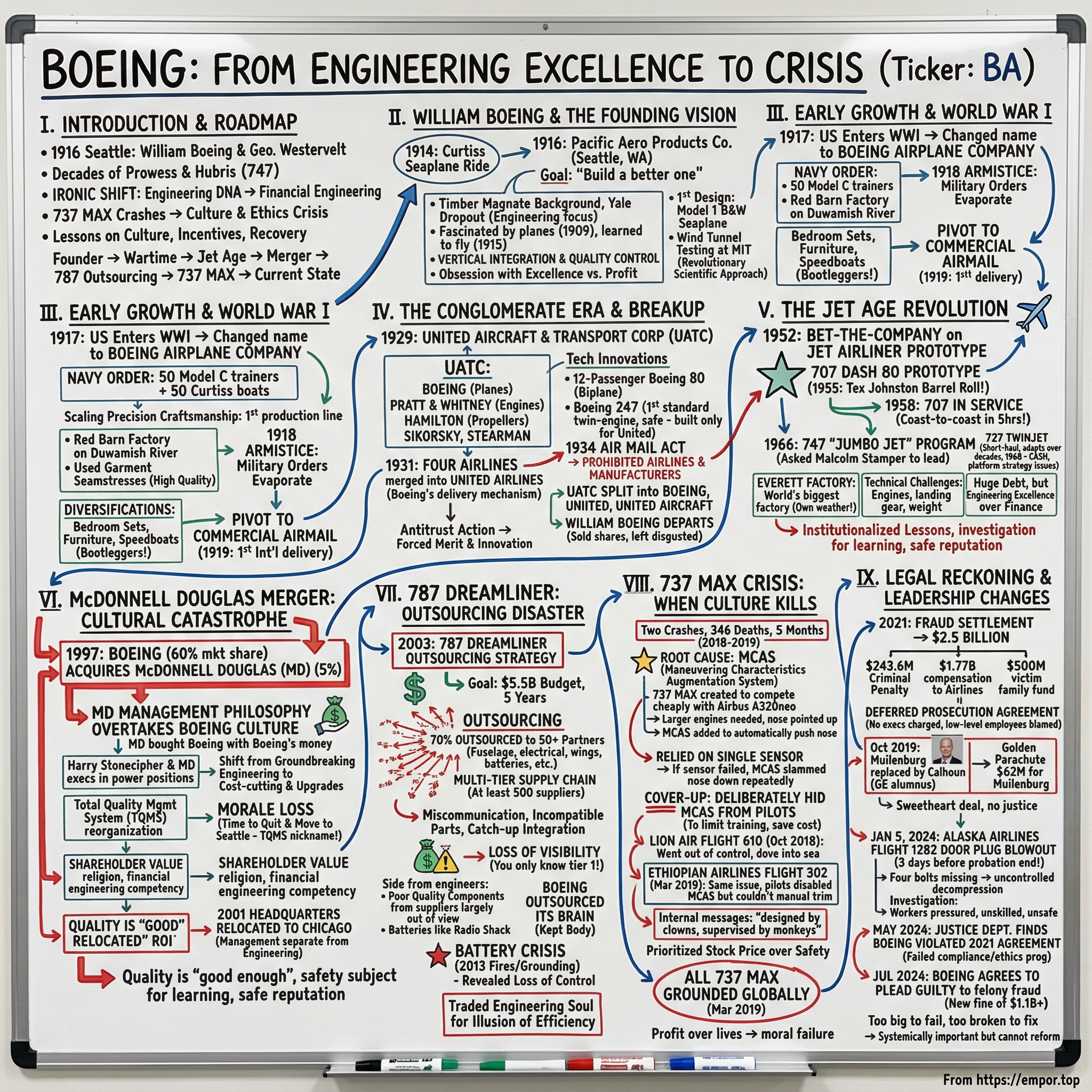
The Boeing Company: Engineering Greatness, Financialization, and the Long Road to Recovery
I. Introduction & Episode Roadmap
On a Friday afternoon in October 2025, the phone rang in Kelly Ortberg's office outside Seattle. On the other end was Bryan Bedford, administrator of the Federal Aviation Administration, calling to notify Boeing's chief executive that the regulator was lifting the production ceiling imposed on the 737 MAX line twenty-one months earlier.1 Boeing could now build 42 narrowbody aircraft a month instead of 38. In an industry that measures ambitions in decades and backlogs in trillions, an increase of four aircraft per month was treated as a landmark event — a stark indication of how far the manufacturer had fallen.
The Boeing Company trades on the New York Stock Exchange under the ticker BA. Its legal headquarters sits in Arlington, Virginia, near the Pentagon, though its chief executive has operated out of Puget Sound since 2024 — a geographic split that reflects the company's internal governance challenges.23 For the full year 2025, Boeing generated $89.5 billion of revenue, a 34% increase over the prior year, delivered 600 commercial aircraft — its highest total since 2018 — and reported net earnings of $2.2 billion.4 That headline profit came with a major caveat: it was driven almost entirely by a $9.6 billion accounting gain on the sale of Boeing's digital aviation software business, not by airplane manufacturing. Excluding that gain, Boeing burned $1.9 billion of free cash flow in 2025 and ended the year with $54.1 billion of debt.4
That performance was nonetheless an improvement over 2024, when Boeing generated $66.5 billion of revenue, sustained an $11.8 billion net loss, and recorded negative $14.3 billion of free cash flow — one of the largest cash burns in American industrial history outside a bankruptcy filing.5 Operational trends stabilized further by mid-2026. In the second quarter of 2026, Boeing recorded $24.6 billion of revenue, delivered 171 aircraft, generated $600 million of free cash flow, and reduced total debt to $45.9 billion.6 The commercial backlog stood at more than 6,200 aircraft within a record $715 billion company-wide backlog.6 Yet even with those gains, the company posted a net loss of $428 million for the quarter, marking seven consecutive years without an annual profit from commercial airplane manufacturing.
The Paradox
Here is the central paradox. Boeing is the company that built the B-17 and B-29 bombers that helped win World War II, launched the commercial jet age with the 707, bet more than its market value on the 747 and succeeded, and for two generations enjoyed an industry reputation summarized in six words: if it ain't Boeing, I ain't going. How did that institution become a classic case study on the risks of financial engineering displacing physical engineering?
The central thesis is that Boeing's decline was not caused by a single software flaw or missing airframe bolts. It was architectural. Beginning with the 1997 merger with McDonnell Douglas, Boeing progressively separated financial leadership from manufacturing operations: moving corporate headquarters away from assembly plants, outsourcing design authority alongside fabrication, converting fixed manufacturing assets into supplier contracts to boost return on invested capital, and redirecting cash to shareholders instead of new aircraft development. While each decision appeared defensible on a spreadsheet, their cumulative effect over twenty-seven years eroded the core engineering capabilities required to sustain the business.
The analysis that follows tests that thesis alongside the counter-claim from current management that the architecture is being rebuilt. Boeing has reacquired the fuselage supplier it spun off in 2005, relocated executive leadership back to factory operations, sold non-core software assets to pay down debt, and reset delivery commitments. Whether these measures mark a fundamental operational turnaround or a cyclical recovery buoyed by a decade-long aircraft shortage remains the central investment question.
The narrative path follows this trajectory:
- William Boeing and the founding engineering religion.
- The airmail monopoly that built the first American aerospace conglomerate, and the 1934 antitrust action that destroyed it.
- The jet age, when Boeing twice bet the company and twice won.
- The McDonnell Douglas merger and the cultural inversion that followed.
- The 787 outsourcing experiment and the Spirit AeroSystems divestiture.
- The 737 MAX, and 346 deaths.
- The legal reckoning, the Alaska Airlines door plug, and the 2024 liquidity crisis.
- Kelly Ortberg's reset and the segment economics underneath it.
- The duopoly with Airbus and the slow arrival of COMAC.
- A structural read using Helmer's 7 Powers and Porter's Five Forces, the playbook, and the bull and bear cases as they stand in the late summer of 2026.
Start where the industry started: with a timber heir who could not stop thinking about airplanes.
 Subscribe on LinkedIn
II. William Boeing & The Founding Religion
In the summer of 1909, a young timber merchant named William Edward Boeing attended the Alaska-Yukon-Pacific Exposition in Seattle expecting to see a demonstration of a manned flying machine. The aviator failed to show, but the absence only deepened Boeing's interest. Over the next several years, Boeing took flying lessons, bought a Curtiss seaplane, and grew increasingly frustrated by the delays in shipping spare parts from the East Coast whenever the aircraft needed repairs.
Boeing had the capital to address the problem himself. Born in Detroit in 1881 to a German immigrant father who had built a fortune in Michigan timber and iron ore, he attended Yale's Sheffield Scientific School before leaving without a degree to buy timberland in the Pacific Northwest. The timber business provided two principles that later proved critical: evaluating raw material quality visually and managing a business where margins depended on minimizing scrap. In 1915, aircraft manufacturing required spruce, linen, and wire. Boeing already owned the timber.
To build his first aircraft, Boeing partnered with George Conrad Westervelt, a U.S. Navy officer and MIT-trained engineer stationed in Seattle. Dissatisfied with the structural fragility of existing designs, the pair designed and built the B&W—a twin-float seaplane—in a boathouse on Lake Union. The aircraft made its first flight in 1916. That same year, Boeing incorporated Pacific Aero Products Company, which he renamed the Boeing Airplane Company in 1917 after the Navy reassigned Westervelt to the East Coast.
The operational philosophy that defined Boeing's early identity originated in that boathouse. Boeing told workers he had "no patience with the man who says it can't be done," establishing a core mandate: let no bad work leave the shop. In 1916, when mechanical failures were frequently fatal, structural integrity served as a key commercial differentiator. Prioritizing build quality over rapid output allowed Boeing to compete against better-capitalized East Coast manufacturers who faced similar early reliability challenges.
The Furniture Years
World War I brought the company its first major contract: Model C trainer aircraft for the U.S. Navy. It also exposed the firm to the volatility of defense procurement. The November 1918 armistice led to immediate contract cancellations, while surplus military planes flooded the commercial market at prices below manufacturing cost. Rather than disbanding his skilled workforce, Boeing shifted factory capacity to bedroom furniture, phonograph cabinets, flat-bottomed boats, and sea sleds. Utilizing the wood joinery skills of his craftspeople preserved the core manufacturing expertise required when aviation demand eventually recovered.
This pivot illustrated Boeing's early operational model, which treated skilled labor as a core asset to be retained and market demand as a variable to be navigated. Decades later, executive leadership would invert that strategy, treating manufacturing labor and capital assets as variable expenses to be minimized to hit short-term financial targets. The post-war adaptation established a historical baseline for how the company managed human capital and operational capacity during severe downturns.
After navigating the post-war decline, Boeing secured an Army contract to refurbish de Havilland DH-4 aircraft, rebuilding its production baseline. The catalyst that expanded the firm from a regional airframe builder into a national aerospace manufacturer, however, was not an aircraft design—it was federal airmail legislation.
III. The Airmail Monopoly & The 1934 Breakup
In 1925, Congress passed the Air Mail Act — known as the Kelly Act — transferring the transportation of U.S. mail by air from the Post Office to private contractors. For the first time, commercial aviation had a predictable, government-backed revenue stream for flying fixed routes on set schedules. Every major early U.S. airline effectively began as a mail contractor with extra space for passengers.
William Boeing grasped the economics early. When the Chicago-to-San Francisco route — the longest and most demanding in the airmail system — was auctioned in 1927, Boeing submitted a bid so low that competitors assumed it contained an arithmetic error. Instead, Boeing had engineered an aircraft tailored specifically to the contract's economics: the Model 40A. Powered by an air-cooled Pratt & Whitney Wasp engine that weighed hundreds of pounds less than the water-cooled Liberty engines used by rivals, the Model 40A converted weight savings into mail capacity. Transporting more mail per flight allowed Boeing Air Transport to operate the route profitably under its low bid.
Building the First Aerospace Conglomerate
Between 1928 and 1931, Boeing and Pratt & Whitney founder Frederick Rentschler assembled the United Aircraft and Transport Corporation (UATC), creating one of the earliest vertically integrated aerospace conglomerates. The holding company controlled the entire aviation supply chain. For airframes, it owned Boeing, Chance Vought, Sikorsky, and Stearman. For propulsion and components, it held Pratt & Whitney alongside Hamilton Aero Manufacturing and Standard Steel Propeller (later merged into Hamilton Standard). For airline operations, it consolidated Boeing Air Transport, Pacific Air Transport, National Air Transport, and Varney Air Lines into a single carrier: United Air Lines.
The strategy was commercially potent: a single enterprise could specify an in-house engine for its own airframe on a captive route, capture profit margins at every layer of production, and use stable mail subsidies to fund capital-intensive manufacturing. By the early 1930s, UATC stood as the dominant aviation enterprise in the world.
The Spoils Conference and the Reckoning
That concentration of market power quickly ran into political resistance. Under the 1930 McNary-Watres Act, Postmaster General Walter Folger Brown consolidated airmail routes among a small group of well-capitalized companies, arguing that fragmented regional operators could never construct a national passenger grid. The resulting route allocations — hashed out at meetings critics dubbed the "Spoils Conference" — sparked a political backlash. Following Franklin D. Roosevelt's election, Senator Hugo Black of Alabama chaired January 1934 congressional hearings into alleged fraud and collusion. Although later reviews suggested some allegations were exaggerated, the political momentum proved unstoppable.
President Roosevelt cancelled all existing airmail contracts and tasked the Army Air Corps with flying the mail — a policy reversed within weeks after several inexperienced military pilots died in severe winter weather. Congress responded by passing the Air Mail Act of June 12, 1934. The law reinstated competitive bidding, banned executives involved in the Spoils Conference from participating in new contracts, and prohibited single holding companies from operating both aircraft factories and commercial airlines. On September 26, 1934, UATC was broken up into three independent entities: United Air Lines for transportation, United Aircraft Manufacturing (later United Technologies, now part of RTX) for engines and components, and the Boeing Airplane Company for airframe manufacturing.
Viewing the legislation as a personal assault on his integrity, William Boeing sold his company shares, resigned his chairmanship in 1934, and permanently withdrew from executive management, taking only a minor advisory role during World War II. He spent his remaining years raising horses and developing real estate in the Pacific Northwest before passing away in 1956 aboard his yacht, one year before the inaugural flight of the 707.
The 1934 restructuring established a historical pattern that re-emerged across Boeing's century-long trajectory. The breakup did not destroy the manufacturing business; the standalone Boeing Airplane Company entered the mid-twentieth century equipped with the plants and engineering staff that powered its subsequent dominance. Instead, the intervention demonstrated that Boeing's commercial model ultimately exists subject to government policy. The federal government acts simultaneously as Boeing's largest defense customer, primary safety regulator, export financier, and — when political consensus demands — structural architect. Modeling Boeing strictly as a commercial duopolist ignores the regulatory and political dependencies that re-emerged during later crises in 2019 and 2024.
In 1934, Boeing retained its manufacturing footprint and engineering baseline. Over the following two decades, those assets proved decisive.
IV. The Jet Age Revolution: Betting the Company
On August 7, 1955, a crowd of airline executives and U.S. Air Force officers gathered at Seafair on Lake Washington to watch a hydroplane race. Boeing test pilot Alvin "Tex" Johnston was scheduled to perform a routine flyby of the company's new prototype jet transport. Instead, he executed a 360-degree barrel roll at low altitude directly over the lake in an aircraft that represented most of Boeing's accumulated net worth. Sitting in the crowd, Boeing President Bill Allen was reportedly told by a colleague that he had just watched his company get sold. When Allen confronted Johnston the following day, the pilot offered a brief explanation: he was selling airplanes.
The aircraft was the Model 367-80, known as the Dash 80, and its development illustrated the company's mid-century risk profile. In 1952, Allen — a lawyer by training who led Boeing from 1945 to 1968 — sought board approval to build a jet transport prototype without a launch customer, military order, or airline commitment. The board authorized approximately $16 million for the project, representing roughly two-thirds of Boeing's cumulative post-war net profit.7 Leveraging its military experience from the B-47 and B-52 bombers, management calculated that swept-wing jet technology had matured sufficiently for the first commercial mover to define the market.
The investment paid off structurally as well as financially. The Dash 80 served as the foundation for two distinct aircraft: the KC-135 aerial tanker, which the U.S. Air Force ordered in large quantities to underwrite production tooling, and the 707, which inaugurated the commercial jet age.8 Competitor Douglas Aircraft responded with the DC-8, but Boeing's two-year head start and military-subsidized production line provided a decisive cost advantage. Boeing, which had spent three decades as the second-largest U.S. airframer, assumed the industry's top position.
This operational pattern defined Boeing's business model for decades: military cash flow funded commercial risk-taking, while commercial scale reduced military unit costs. The strategy required executive leadership willing to commit the corporate balance sheet to major engineering initiatives — producing market dominance rather than steady quarterly earnings growth.
The 747 and the Second Bet
In 1965, Boeing repeated the strategy on a vastly larger scale. Pan American World Airways founder Juan Trippe requested an aircraft twice the size of the 707. According to industry accounts, Trippe told Allen that Pan Am would buy the airliner if Boeing built it, to which Allen replied that Boeing would build it if Pan Am bought it. Pan Am placed an initial order for 25 aircraft, launching the 747 program.
The program stretched conventional corporate risk management. Lacking a facility large enough to assemble the widebody jet, Boeing acquired farmland at Paine Field in Everett, Washington, to construct the world's largest building by volume — an enclosure of roughly 291 million cubic feet that was later expanded to house the 767, 777, and 787 lines. The first 747 rolled out on September 30, 1968, just thirty months after construction began. Total program costs exceeded $1 billion — higher than Boeing's total market capitalization at the time — requiring the company to secure substantial debt from a bank syndicate.
Before deliveries could generate sustained returns, market conditions deteriorated. Air travel growth slowed in the late 1960s, airline orders halted, and Pratt & Whitney's JT9D engine experienced severe development delays. Boeing accumulated undelivered airframes at its factory, mounting concrete weights to the wings in place of missing engines. Between 1969 and 1971, Boeing eliminated more than half its total workforce through two rounds of layoffs totaling 50,000 employees. The economic contraction in Seattle prompted two local real estate agents to erect a billboard near the airport asking the last person leaving the city to turn out the lights.
Boeing eventually resolved the engine issues, and the 747 operated for over five decades, establishing long-haul airline economics. Yet the program's near-collapse left a lasting mark on executive strategy. From a financial perspective, the 747 demonstrated that clean-sheet aircraft programs could generate immense long-term value, but also exposed the enterprise to existential financial risk and severe labor disruption.
For subsequent generations of financially focused executives, the takeaway was clear: Boeing needed to deliver returns without repeatedly risking the firm on clean-sheet developments. That rationale underpinned the strategic pivot Boeing executed in the late 1990s. The underlying vulnerability, however, was what would happen when the company curtailed that risk-taking without preserving the engineering capabilities that had made past recoveries possible.
V. The 1997 McDonnell Douglas Merger: The Cultural Rupture
In 1993, Defense Secretary Les Aspin hosted a dinner for the chief executives of America's largest defense contractors — a gathering the industry has ever since called the Last Supper. The message delivered over the meal was straightforward: post-Cold War defense budgets could no longer sustain the existing prime contractors, the Pentagon would not rescue struggling firms, and executives needed to consolidate. Industry leaders acted quickly. Over the next five years, the American defense industrial base consolidated from dozens of prime contractors into a handful.
Boeing pursued consolidation aggressively. The company acquired Rockwell's aerospace and defense businesses in 1996, securing the Space Shuttle orbiter program and a major space systems footprint. Then, in a transaction announced in December 1996 and completed on August 1, 1997, Boeing merged with McDonnell Douglas in a stock deal valued at roughly $13 billion to $14 billion. The merger absorbed the F-15 and F/A-18 fighter lines, the C-17 airlifter, and a commercial aircraft business — the MD-80 and MD-11 — that had lost narrowbody market share to Boeing and Airbus for a decade.9
On paper, Boeing acquired McDonnell Douglas. Yet a phrase that attached itself to the transaction, attributed to Boeing insiders and repeated across industry accounts, suggested the opposite: McDonnell Douglas bought Boeing with Boeing's money.10 Leadership assignments supported that interpretation. Phil Condit remained chief executive, but McDonnell Douglas chief executive Harry Stonecipher became president and chief operating officer. In 2003, after Condit resigned amid a defense procurement scandal, Stonecipher assumed the CEO role outright.
Stonecipher's management philosophy was central to this transition. A physicist by training, he had spent seventeen years at General Electric, absorbed Jack Welch's financial framework, led GE's aircraft engine business, and turned around Sundstrand before taking over McDonnell Douglas in 1994. His diagnosis of McDonnell Douglas — a company that had lost its commercial standing and survived on defense contracts — was that technical ambition untethered from financial discipline destroyed shareholder value. He arrived at Boeing convinced the enterprise had the opposite problem: extraordinary engineering capability paired with little attention to return on invested capital.
He articulated the shift plainly. In a 2004 interview with the Chicago Tribune, Stonecipher offered one of the aerospace industry's most frequently cited statements: "When people say I changed the culture of Boeing, that was the intent, so that it's run like a business rather than a great engineering firm. It is a great engineering firm, but people invest in a company because they want to make money."11
Viewed through a standard corporate lens, the argument appears straightforward. Boeing was a publicly traded company, and shareholders expected financial returns. The 747 experience had shown how unconstrained development costs could imperil the firm's balance sheet. What Stonecipher and his successors underestimated was that in commercial aerospace, engineering excellence was not an overhead cost sitting above the business; it was the mechanism that generated pricing power, regulatory confidence, brand equity, and customer trust. Prioritizing short-term financial metrics risked eroding the operational capabilities that produced those returns.
Two Thousand Miles From Renton
The physical expression of this philosophy arrived in 2001, when Phil Condit announced that Boeing would move its corporate headquarters from Seattle to Chicago. Management argued that a global enterprise should not embed executive leadership within a single operating division, and that a neutral site would allow executives to allocate capital across commercial, defense, and space divisions without regional bias. Roughly 500 executives relocated, placing 2,000 miles between corporate capital allocation decisions and the assembly lines in Renton and Everett. In 2022, under Dave Calhoun, headquarters moved again to Arlington, Virginia, closer to the Pentagon and Congress.2
Historical falsification: does distance from the factory improve executive focus?
The premise underlying both relocations was that separating corporate leadership from manufacturing strengthened capital allocation discipline. A quarter-century of Boeing's operational record provides a direct test of that claim, and the evidence does not support management's thesis.
The counter-evidence is specific and operational. Supply chain vulnerabilities on the 787 program were visible to line engineers long before appearing in executive financial models. Certification compromises on the 737 MAX emerged from program teams working under aggressive schedule pressure set by executives who were physically removed from factory operations. Furthermore, the National Transportation Safety Board's final report on the 2024 Alaska Airlines door plug accident identified the probable cause as Boeing's failure to provide adequate training, guidance, and oversight for the manufacturing process that removed and reinstalled the component — a failure of factory-floor execution rather than high-level strategy.12 The Board also faulted the Federal Aviation Administration for failing to ensure Boeing resolved repetitive and systemic quality defects.12
The most direct repudiation came from management itself. When Boeing hired a new chief executive in 2024, he chose to base his operations in the Seattle area rather than at the legal headquarters in Virginia — an implicit rejection of the geographic separation thesis.3 Historical evidence indicates that physical separation from manufacturing did not improve capital allocation; instead, it coincided with severe operational breakdowns and financial losses. While geography alone was not the sole cause, the relocation reflected a broader corporate culture that treated manufacturing as a secondary input — a philosophy that subsequent events thoroughly tested.
That leads directly to the aircraft where this operational philosophy was implemented in full.
VI. The 787 Dreamliner: The Outsourcing Experiment
Consider how the 787 Dreamliner program was pitched inside Boeing in 2003. The company proposed to design a breakthrough airliner — the first large commercial jet built with a carbon-fiber composite fuselage, delivering 20 percent greater fuel efficiency than the aircraft it replaced and opening long, thin point-to-point routes that had previously been economically unviable. Boeing promised to accomplish this while committing roughly $5.5 billion of its own capital — less than half the historical cost of a clean-sheet widebody program — and bringing the jet to market in four years rather than six.
The mechanism was an untried industrial architecture. Rather than manufacturing detail parts internally or purchasing them for in-house assembly, Boeing contracted with a small group of tier-one partners. These suppliers assumed responsibility for entire sections of the aircraft — including design, engineering, tooling, and fabrication — and were tasked with delivering completed, systems-installed modules to Everett, Washington, where Boeing planned to assemble them in just three days. Mitsubishi Heavy Industries built the composite wings, Fuji Heavy Industries produced the center wing box, Italy's Alenia manufactured the horizontal stabilizers and fuselage sections, and Vought built aft fuselage sections in South Carolina. In total, roughly 70 percent of the design and structural build content sat outside Boeing.
The tier-one partners were also required to fund their own development expenses. This structure formed the financial core of the strategy: by converting internal development capital into risk-shared supplier investments, Boeing shrank its capital base, boosted its return on invested capital, and improved key balance-sheet ratios. Alan Mulally headed commercial airplanes during the program's launch, while Harry Stonecipher served as chief executive when the architecture was finalized.
Extending that logic led to the 2005 divestiture of Boeing's Wichita, Kansas, and Tulsa, Oklahoma operations to the private equity firm Onex, creating Spirit AeroSystems. Those plants produced the complete fuselage for the 737 — the narrowbody that generated the majority of Boeing's commercial revenue — alongside the forward fuselage section of the 787. Boeing collected roughly $1.2 billion in the sale, removed a substantial fixed manufacturing asset and its unionized workforce from its balance sheet, and converted 737 fuselage production from an internal operational cost into a supplier purchase order. On paper, return on invested capital improved immediately as the asset denominator shrank.
What Boeing Gave Away Without Knowing It
In practice, the model severed the feedback loop between design and manufacturing. When an enterprise designs and builds a structure under one roof, manufacturing engineers routinely challenge design choices before tooling is cut. When design authority sits in Everett while fabrication takes place in Nagoya, Grottaglie, and Charleston, those critical trade-offs are either negotiated through costly contract change orders or omitted entirely. In doing so, Boeing surrendered a vital intangible asset: the systemic integration knowledge required to fit complex subassemblies together, a capability previously held by its internal manufacturing workforce.
Historical falsification: does tier-one outsourcing lower capital risk and shorten development?
The 787 served as the live test case, and the operational outcome from Boeing's own program provided a clear answer.
Originally scheduled for first delivery in May 2008, the 787 did not enter commercial service until September 2011, more than three years behind schedule. Early subassemblies arrived at the Everett final assembly line held together by temporary fasteners, lacking complete documentation, and requiring extensive rework — a condition known in aerospace as traveled work, where incomplete tasks migrate downstream to be finished out of sequence at substantially higher expense. Composite joins were out of specification, and tier-one suppliers subcontracted work to lower-tier vendors beyond Boeing's direct oversight. Against the initial $5.5 billion development budget, total program development costs swelled to an estimated $32 billion, while Boeing's deferred production cost balance — an accounting mechanism that defers early manufacturing cost overruns across a multi-year accounting quantity — peaked above $32 billion in the mid-2010s.13 In January 2013, thermal runaway events in lithium-ion batteries prompted a fleet-wide global grounding of the 787, marking the first fleet-wide grounding of a U.S. airliner model in nearly four decades.
Boeing's eventual recourse was to reacquire the operations it had divested. The company bought Vought's Charleston 787 facility in 2009 for approximately $1 billion in cash and forgiven advances, later establishing a second 787 final assembly line in South Carolina. Two decades after selling its Midwest manufacturing operations, Boeing fully reversed course by re-acquiring Spirit AeroSystems in a transaction completed on December 8, 2025, bringing roughly 15,000 employees and facilities in Wichita, Tulsa, Dallas, and Prestwick, Scotland back in-house.1415
The historical evidence refutes management's original thesis. Tier-one outsourcing failed to reduce capital risk; instead, it converted visible upfront development budgets into hidden operational losses, emergency supplier interventions, and an eventual repurchase at a premium over original divestiture proceeds. A narrower principle remains valid: outsourcing the fabrication of standardized components to qualified suppliers under strict quality controls is standard aerospace practice. What failed was transferring design authority and integration for a novel technology platform. That distinction remains central to Boeing's ongoing recovery, as key systems — including engines, avionics, landing gear, and cabin interiors — remain extensively outsourced. The primary question for investors is not whether Boeing relies on suppliers, but whether it has rebuilt the internal engineering capacity to specify, inspect, and integrate the components it buys.
The 787 represented a severe breakdown in engineering capability that Boeing spent over a decade and tens of billions of dollars to contain. The challenge that followed proved even more damaging.
VII. The 737 MAX Crisis: Derivatives Engineering & Regulatory Capture
In the summer of 2011, American Airlines was preparing to place one of the largest aircraft orders in commercial aviation history, and Boeing was losing it. Airbus had launched the A320neo in December 2010 — the same A320 airframe with new-generation geared and high-bypass engines, offering roughly 15% better fuel burn with minimal pilot retraining — and it was selling faster than any commercial airplane ever had. Boeing's answer had been that it was studying a genuinely new single-aisle aircraft, a clean-sheet replacement for the 737, available sometime in the 2020s. American's chief executive told Boeing that "sometime in the 2020s" was not a product.
Boeing capitulated within weeks. In July 2011 it announced it would re-engine the 737 instead, and the board formally approved the 737 MAX program later that year. The choice was between roughly $10-15 billion and eight to ten years for a new airplane, or a fraction of that for a derivative of an airframe that had first flown in 1967. Jim McNerney — another General Electric alumnus, who had run 3M before arriving at Boeing in 2005 — chose the derivative. In the moment, it was the rational commercial decision. Airbus was taking orders in real time.
But the derivative came with a constraint that turned out to be fatal, and the constraint was contractual before it was aerodynamic. Boeing's pitch to airlines, and specifically to Southwest Airlines — the world's largest 737 operator, whose entire cost structure depends on a single-type fleet — was that MAX pilots would not require full-flight simulator training to transition from the previous generation. Southwest's contract reportedly included a substantial per-aircraft rebate if simulator training proved necessary. Avoiding simulator training was therefore not a nice-to-have. It was a line item worth hundreds of millions of dollars, and it functioned as a design requirement imposed on the engineering organization from the sales organization.
The Physics Problem and the Software Answer
Here is the physics problem it collided with. The 737 was designed in the 1960s for airports without jet bridges, so it sits very low to the ground. The new CFM LEAP-1B engines are much larger in diameter than the engines the airframe was designed around. To fit them, engineers mounted the nacelles higher and further forward on the wing. At high angles of attack — nose well up, as in a steep climb or a slow turn — those large forward-mounted nacelles generate lift ahead of the aircraft's center of gravity, which tends to push the nose up further. In an airplane, that is a handling characteristic pilots would notice, and a handling characteristic pilots notice is exactly what triggers a simulator training requirement.
The solution was software. Boeing built the Maneuvering Characteristics Augmentation System, or MCAS, which sensed high angle of attack and automatically commanded the horizontal stabilizer to trim the nose down, restoring the control feel of the older 737. Think of it as an invisible autocorrect for the airplane's handling — a system whose entire purpose was to make a physically different aircraft feel identical to its predecessor so the paperwork could say nothing had changed.
Three design decisions turned that autocorrect into a killing machine. First, MCAS took its input from a single angle-of-attack vane on the outside of the fuselage, with no cross-check against the second vane on the other side — meaning one damaged sensor could tell the system the airplane was stalling when it was flying normally. Second, during development its authority was expanded so it could command large amounts of nose-down trim and could re-trigger repeatedly, so a false activation would not stop after one cycle. Third, and most consequentially, MCAS was not described in the flight manuals given to airline pilots. A pilot facing a runaway trim event in a 737 MAX did not know a system existed that was doing it deliberately.
The regulatory context made this possible. Under the FAA's Organization Designation Authorization program, the agency delegates large portions of certification analysis to designated employees of the manufacturer itself. The rationale is capacity — the FAA does not employ enough engineers to independently verify every system on a modern airliner. The consequence at Boeing was that the people signing off on MCAS's safety analysis were Boeing employees inside a program under intense schedule and cost pressure, evaluating a system whose disclosure would have destroyed the program's core commercial promise.
Thirteen Minutes, Then Six
On October 29, 2018, Lion Air Flight 610 took off from Jakarta with a miscalibrated angle-of-attack sensor. MCAS activated repeatedly. The crew fought the trim more than twenty times before the aircraft entered the Java Sea thirteen minutes after takeoff. All 189 people aboard died. Boeing issued a bulletin about the trim system, but the MAX kept flying. On March 10, 2019, Ethiopian Airlines Flight 302 departed Addis Ababa with the same failure mode. The crew followed the procedure Boeing had published and still could not recover. The aircraft crashed six minutes after takeoff, killing all 157 people aboard.
Regulators in China grounded the type first, then Europe, then — days later and last among major authorities — the FAA. The global grounding lasted roughly twenty months, the longest in United States aviation history, ending when the FAA rescinded the order in November 2020 after MCAS was redesigned to use both angle-of-attack sensors, to activate only once per event, and to be overridable by the pilots.
Historical falsification: are derivative airframes plus software augmentation a low-risk substitute for clean-sheet development?
The direct financial cost is the first-order answer. Boeing recorded roughly $21 billion in identified charges tied to the MAX — customer compensation, production disruption, inventory, and grounding costs — against a clean-sheet program it had estimated at $10-15 billion. The derivative was not cheaper. It was more expensive, and it arrived with 346 deaths, a criminal prosecution, and a permanent transfer of narrowbody market share to a competitor.
In January 2021, Boeing entered a deferred prosecution agreement with the Department of Justice resolving a charge of conspiracy to defraud the United States, agreeing to pay more than $2.5 billion — comprising a criminal monetary penalty, compensation to airline customers, and a $500 million fund for the families of the victims.16 In September 2022, the Securities and Exchange Commission separately charged Boeing and Dennis Muilenburg with misleading investors about the MAX's safety, settling for $200 million from the company and $1 million from the former chief executive.17 Muilenburg himself had been removed as chief executive in December 2019 and replaced by Dave Calhoun, a Boeing director and, once again, a General Electric alumnus.
But there is a second-order finding that matters more for the current investment case. The deeper problem was never software. It was that a 1967 airframe had been stretched across four generations until the physical envelope ran out, and Boeing had no successor product because it had spent the preceding decade returning cash to shareholders instead of developing one. The MAX 7 and MAX 10 — the smallest and largest variants — had still not been certified as of the middle of 2026, roughly a decade after launch, though Boeing reported in July 2026 that certification flight testing on both had been completed with deliveries anticipated in 2027.6 Airbus, meanwhile, spent those years selling the A321neo and A321XLR into a segment where Boeing has no competitive product at all.
The verdict: the claim is rejected outright on this evidence. What replaces it is narrower and still live — derivative development works when the airframe has physical margin remaining and the change does not require concealment to preserve its commercial rationale. The MAX failed both tests. Whether Boeing has internalized this is measurable: the company has said it will be positioned to fund a clean-sheet airplane around 2030, subject to fixing its balance sheet, having the technology, and seeing market demand.18 Three conditions, any one of which can be used to defer indefinitely.
VIII. Legal Reckoning, Door Plugs, & The 2024 Liquidity Crisis
At 5:07 p.m. on January 5, 2024, Alaska Airlines Flight 1282 was climbing through 16,000 feet over Portland, Oregon, when a rectangular door plug covering an unused emergency exit separated from the left side of the fuselage. The cabin explosively decompressed. Seats near the opening were unoccupied because two passengers had arrived late for the flight. Nobody died. The airplane was six weeks old.
What investigators found inside Boeing's Renton factory was worse than a simple assembly defect. The door plug had been opened on September 18, 2023, to repair damaged rivets on the Spirit AeroSystems-supplied fuselage — and opened without the required documentation. Boeing's own procedures called for specialized technicians to open and close door plugs, but none were working when the plug was shut the following day. Because no paperwork recorded that the plug had been opened, there was no trigger for a quality assurance inspection of its closure. The four retaining bolts were never reinstalled. The airplane was delivered and flew for weeks, held in place by little more than friction.
The National Transportation Safety Board's final report, adopted on June 24, 2025, identified the probable cause as Boeing's failure to provide adequate training, guidance, and oversight for parts removal. The board recommended that Boeing redesign door plugs on new aircraft, retrofit existing fleets, and overhaul its safety risk management and documentation processes.12 For an investor, the crucial word in that finding is systemic. This was not a rogue technician. It was a quality management system that permitted a critical structural component to be removed and reinstalled without a paper trail.
The regulatory response arrived within weeks. The Federal Aviation Administration barred Boeing from increasing 737 MAX production beyond 38 aircraft per month, mandated a comprehensive safety and quality improvement plan, and stationed inspectors inside the Renton and Charleston facilities.[^19] For a business whose fixed cost base is built for much higher output, a hard production ceiling is the single most damaging instrument a regulator can apply — capping revenue while leaving overhead intact.
The Money Runs Out
Then the money ran out.
To understand how a company holding a massive backlog reached a liquidity crisis, look at how Boeing allocated its cash in the years before the MAX crashes. Between 2013 and 2019, the company spent approximately $43 billion repurchasing its own shares — by some estimates roughly three-quarters of its free cash flow over that decade — while also paying a rising dividend.19 In December 2018, just three months before the second MAX crash, the board raised the dividend by 20 percent and authorized a new $20 billion repurchase program.20 Executed at share prices between $300 and $400, those buybacks consumed the balance sheet capacity that could have funded a clean-sheet narrowbody or absorbed the crisis that followed.
By 2024, those choices had compounded. On September 13, 2024, roughly 33,000 machinists represented by IAM District 751 walked out across the Puget Sound region after rejecting a contract offer endorsed by their own leadership — a clear measure of how thoroughly management had lost the workforce's trust. The 53-day strike halted 737, 767, and 777 assembly lines and burned cash at roughly $1 billion per month. Workers ratified a new agreement on November 4, 2024, securing a 38 percent general wage increase over four years and a $12,000 ratification bonus, though without restoring the defined-benefit pension frozen a decade earlier.21
With assembly lines idle, cash draining, and roughly $54 billion of debt outstanding, all three major credit rating agencies placed Boeing one notch above junk status with negative outlooks. A downgrade to high yield would have inflated borrowing costs across the capital structure and forced investment-grade-only bondholders to liquidate their holdings. In late October 2024, Boeing executed one of the largest equity offerings in corporate history: issuing 112.5 million common shares at $143 per share, along with $5 billion in depositary shares representing mandatory convertible preferred stock, raising roughly $21 billion in gross proceeds before underwriters' options.[^23]
The arithmetic is worth stating plainly rather than burying in a risk factor. Boeing retired shares through the 2010s at prices in the hundreds of dollars and issued new shares in 2024 at $143. That is a textbook case of value destruction through procyclical capital allocation: buying high with borrowed capacity and selling low under duress. Any assessment of Boeing's current management must start with the reality that the balance sheet they inherited was not broken primarily by two accidents — it was drained by a decade of distributing the cash needed to absorb them.
The Legal Endgame
The legal reckoning ran on a parallel track and ended in a resolution that satisfied almost no one. In May 2024, the Department of Justice determined that Boeing had breached its 2021 deferred prosecution agreement, and in July 2024, Boeing agreed to plead guilty to conspiracy to defraud the United States.[^24]
In December 2024, a federal judge in Fort Worth rejected that plea deal over terms governing the selection of an independent compliance monitor. In May 2025, the Justice Department moved instead to dismiss the case under a non-prosecution agreement requiring Boeing to pay approximately $1.1 billion — including a $243.6 million criminal penalty and $444.5 million for a fund designated for the families of the 346 victims. On November 6, 2025, U.S. District Judge Reed O'Connor granted the dismissal, writing that the settlement "fails to secure the necessary accountability to ensure the safety of the flying public," while holding that he lacked legal authority to reject it because prosecutors had not acted in bad faith.22
Families of the victims have petitioned an appellate court to overturn that order, so the matter is not fully closed.22
For an investor, the practical takeaway is that the criminal overhang is largely, though not entirely, resolved, allowing Boeing to avoid a felony conviction that would have disrupted procurement with its largest customer, the U.S. government. The reputational takeaway is that a federal judge stated on the record that the resolution was inadequate. Both facts belong in the file.
IX. Strategic Reset Under Kelly Ortberg
When Boeing's board searched for a new chief executive in the summer of 2024, internal candidates were inextricably tied to the company's recent operational failures. Looking outside the organization, the board named Robert K. "Kelly" Ortberg as chief executive on July 31, 2024, effective August 8.23
Ortberg's background stood in sharp contrast to the financial leadership of the preceding two decades. A mechanical engineer trained at the University of Iowa, he began his career at Texas Instruments before joining supplier Rockwell Collins in 1987 as a program manager. Over a three-decade tenure, he rose through avionics programs to become chief executive in 2013. Because Rockwell Collins manufactured cockpit displays, communications gear, and navigation systems, Ortberg spent thirty years handling demands from Boeing and Airbus, observing firsthand how schedule pressure from prime contractors ripples through the supply chain. He subsequently led Rockwell Collins through its acquisition of B/E Aerospace and its eventual sale to United Technologies, where he headed the combined Collins Aerospace unit until his retirement in 2021.
His first structural decision was geographic. Rather than managing from corporate headquarters in Arlington, Ortberg established his primary office in the Seattle area to stay directly connected to the commercial aircraft manufacturing operations that were generating the company's steepest losses.3 In an October 2024 message to employees, he framed the task as an operational and cultural imperative, stating that Boeing needed to reset its internal culture and rebuild public trust.24 While legal headquarters remained in Virginia with a small administrative staff, the operational center of gravity shifted back to Puget Sound.
The Four-Point Reset
The reset rested on four visible pillars, each requiring evaluation against concrete operational evidence rather than strategic intent.
Re-integration of the supply chain. Announced in July 2024 at roughly $37.25 per share in stock—representing $4.7 billion in equity value and $8.3 billion including assumed debt—the acquisition of Spirit AeroSystems closed on December 8, 2025, after an extensive regulatory review.1415 The transaction required a complex structure: competitor Airbus absorbed Spirit facilities producing Airbus components alongside receiving $439 million in cash compensation, while the Federal Trade Commission mandated those divestitures and required Spirit to continue supplying Boeing's rivals on future military contracts.15 The transaction brought 737 fuselage fabrication back under direct Boeing ownership for the first time in two decades. Strategically, re-integration directly targeted the systemic vulnerability highlighted in safety investigations: quality breakdowns at the boundary between separate corporate documentation systems. Operationally, however, Boeing absorbed a loss-making operation and approximately 15,000 workers into an enterprise that had not yet restored its own profitability.
Portfolio pruning. In April 2025, Boeing agreed to divest key units of its Digital Aviation Solutions portfolio—including Jeppesen navigation charts, ForeFlight, AerData, and OzRunways—to private equity firm Thoma Bravo for $10.55 billion in cash.25 Closing in early November 2025, the sale generated a $9.6 billion gain that pushed Boeing's full-year 2025 net income into positive territory.426 From a balance-sheet perspective, the divestiture monetized a high-multiple software asset inside a capital-intensive industrial enterprise, deploying software-valuation proceeds to pay down high-cost industrial debt. From an earnings perspective, however, the sale removed a reliable, high-margin revenue stream from the global services division. Total debt decreased from $54.1 billion at year-end 2025 to $45.9 billion by mid-2026 as proceeds were applied directly to deleveraging.46
Defense discipline. Ortberg pledged to end Boeing's practice of accepting fixed-price development contracts under terms that had generated billions in cumulative defense losses. Translating that policy into practice has produced mixed initial results: Boeing posted $280 million in further cost overruns on the VC-25B presidential aircraft program during the second quarter of 2026, pushing expected first delivery out to 2028.6 Under Steve Parker, who assumed leadership of the defense unit in 2024 and was later confirmed as its chief executive, segment performance improved from a $3.1 billion operating loss in 2024 to roughly breakeven by mid-2026. For the F-47 sixth-generation fighter contract awarded to Boeing in March 2025, Parker summarized management's operational mandate in concise terms: avoid repeating past execution failures.27
Guidance discipline. Ortberg abandoned the practice of providing speculative multi-year financial forecasts, replacing prior management's unmet projections of reaching $10 billion in annual free cash flow with operational metrics. During the second-quarter 2026 earnings call, management reported stabilizing factory operations and steady progress on active certification programs. Leadership outlined a stepped production ramp for narrowbody assembly—moving from 47 aircraft per month toward targets of 52 later in 2026, followed by targets of 57 and eventually 63 per month—while acknowledging that supply chain bottlenecks increase at each step.628 When questioned by analysts regarding specific production bottlenecks, Ortberg identified wing fabrication and engine deliveries as primary constraints, adding that existing parts inventories and scheduled supplier shipments covered near-term assembly requirements.28
Assessing management credibility. Two years into the reset, operational indicators show tangible progress: delivery rates have nearly doubled, federal regulators lifted the narrowbody production cap, quarterly free cash flow turned positive, total debt dropped by more than $8 billion, and legal uncertainties around the deferred prosecution agreement cleared. Credit rating agencies reflected that stabilization, with S&P and Fitch maintaining BBB- ratings with stable outlooks and Moody's assigning a Baa3 rating with a stable outlook following the Spirit AeroSystems transaction, keeping Boeing in investment-grade territory across all three major agencies.29 Counterbalancing those gains, critical commercial programs remain delayed: the MAX 7 and MAX 10 variants await certification, a $4.9 billion charge in the third quarter of 2025 deferred initial 777X deliveries to 2027—seven years behind the original 2020 schedule—and defense development programs continue to absorb write-downs.30 While leadership attributed 777X schedule revisions largely to regulatory review timelines rather than design flaws, investors must weigh that explanation against Boeing's history of shifting schedule accountability to external oversight.
The operational turnaround under Ortberg has restored short-term execution, but management has yet to face the strategic test that precipitated Boeing's long-term decline: allocating capital to a long-cycle, clean-sheet aircraft program. Executives have not yet had to choose between committing balance-sheet resources to a new commercial platform and returning capital to shareholders.
That balance faces an immediate labor test. Members of Boeing's engineering union, the Society of Professional Engineering Employees in Aerospace (SPEEA), overwhelmingly rejected a proposed contract offer on August 21, 2026—with the Professional Unit voting 64.3 percent against and the Technical Unit 71.9 percent against—and authorized strike action ahead of the October 6, 2026 contract expiration.31 The rejected contract included compounded salary increases ranging from 29 to 32 percent over its term.31 While the 53-day machinists' strike in 2024 disrupted physical assembly lines and drained cash, a work stoppage by engineers would directly stall active aircraft certification programs and regulatory compliance work.
X. Segment Economics & Industry Structure
Boeing reports three operating segments, each governed by distinct economic drivers. Treating the enterprise as a consolidated whole obscures the contrasting fundamentals beneath.
Commercial Airplanes. In 2025, Boeing Commercial Airplanes generated $41.5 billion in revenue across 600 aircraft deliveries — 447 737 narrowbodies, 88 787s, 35 777s, and 30 767s — while incurring an operating loss of $7.1 billion, reflecting a negative 17.1% margin.4 By the second quarter of 2026, segment revenue reached $11.8 billion while the operating margin narrowed to negative 2.7% — a significant operational improvement, yet still unprofitable.6
The underlying economics depend almost entirely on assembly rate. Commercial aircraft manufacturing requires massive fixed overhead — factory footprints, specialized tooling, engineering teams, and safety oversight systems — that remains constant regardless of output. Boeing manages these programs using program accounting, spreading estimated revenues and costs over a projected multi-year accounting quantity of aircraft rather than recognizing unit-level costs as they occur. While this method smooths reported earnings during stable cycles, it generates large, sudden reach-forward loss charges when cost projections rise — as demonstrated by the $5.3 billion in reach-forward losses recorded on the 777X and 767 programs in 2025.4 Consequently, program accounting relies heavily on executive judgment: a segment's reported margin in any single quarter reflects management's assumptions about production costs spanning hundreds of future deliveries.
The path to commercial profitability is fundamentally mathematical. At a monthly output of 38 narrowbody aircraft, fixed overhead absorbs the unit gross margin. At 47 aircraft per month — the pace reached by the 737 line in the second quarter of 2026 — the segment nears breakeven. At management's target of 52 to 57 aircraft per month, incremental deliveries yield high contribution margins because fixed expenses are already covered. This dynamic makes monthly assembly rates the primary focal point of corporate earnings presentations. For investors, the critical metrics to track are actual delivery cadences and, more importantly, whether aircraft exit assembly lines without requiring out-of-sequence rework.
Defense, Space & Security. Boeing Defense, Space & Security generated $27.2 billion in revenue in 2025 while recording an operating loss of $128 million — reaching near-breakeven performance, a marked recovery from the $3.1 billion operating loss posted in 2024 on $23.9 billion of revenue.45
Historical falsification: do fixed-price development contracts let contractors capture excess returns through efficiency?
This assumption served as the strategic rationale for Boeing's aggressive bidding on fixed-price military development contracts during the 2010s, but operational outcomes contradict the premise. The KC-46A tanker program, awarded under a fixed-price structure in 2011, has accumulated roughly $7 billion in charges stemming from Remote Vision System redesigns, fuel system defects, and manufacturing support costs — including $600 million in losses recorded in 2025 alone.4 The VC-25B presidential aircraft program has suffered recurring write-downs, including a $280 million charge in the second quarter of 2026, pushing expected initial delivery to 2028.6 Additional development losses on the T-7A trainer and CST-100 Starliner crew capsule pushed total pre-tax write-downs across Boeing's fixed-price development portfolio well into the billions.
The underlying failure mechanism mirrors the breakdown observed on the 787 Dreamliner. Fixed-price development contracts transfer all financial risk to the contractor on programs where technical specifications remain unsettled. Bidding under these terms assumes that internal engineering cost projections are precise — yet Boeing's cost-containment initiatives had weakened the very engineering estimation capabilities required to price that risk accurately. Operational efficiency cannot offset cost overruns created by fundamental component redesigns.
The verdict: the general claim is refuted by empirical performance, prompting management to alter its bidding strategy. Whether that shift endures can be tested against future contract structures — such as the F-47 program — and Boeing's willingness to decline unprofitable defense bids. A narrower principle remains intact: fixed-price terms can operate effectively on mature production runs, which explains why defense leadership frames the KC-46 program as transitioning into a higher-volume production phase, targeting 19 tanker deliveries in 2026 compared to 14 in 2025.27
Global Services. Boeing Global Services generated $20.9 billion in revenue in 2025.4 While reported operating earnings reached $13.5 billion, that figure was inflated by the one-time gain on the Jeppesen divestiture; the segment's underlying operations perform closer to the 18.1% operating margin posted in the second quarter of 2026 on $5.3 billion in quarterly revenue.6
This segment represents Boeing's most stable business model. Commercial airlines are legally required to maintain certified parts traceability for every airframe component, and Boeing holds the type certificates, proprietary tooling, and technical documentation for its global active fleet. Replacing OEM components with third-party alternatives requires individual regulatory approvals, creating high switching costs. Consequently, the existing global fleet generates steady maintenance, modification, component sales, and training revenue regardless of assembly-line disruptions — a cash flow stream that provided critical liquidity during Boeing's recent operational crises.
Two structural qualifications temper this outlook. First, divesting Jeppesen permanently eliminated a high-margin software business to generate cash for deleveraging — a pragmatic balance-sheet decision that nonetheless reduced the segment's recurring growth potential and earnings quality. Second, long-term aftermarket revenue depends directly on the size of the active fleet, and Boeing's share of the global fleet shrinks incrementally for every year that Airbus outpaces it in deliveries. While the services business provides a durable financial cushion, its long-term expansion remains constrained by ongoing market-share losses on commercial assembly lines.
XI. Competitive Landscape: The Global Commercial Duopoly
There is a version of the Boeing story in which competitive position barely matters, because only two companies worldwide can build large commercial aircraft at scale and airline demand exceeds their combined capacity for the rest of the decade. That argument is partly true, and it forms the foundation of the bull case. It is also incomplete. Within a duopoly, market share is not a vanity metric — it determines which manufacturer sets pricing, fills delivery slots first, and builds an installed base that generates long-term aftermarket profits.
By that standard, Airbus has established a dominant position in narrowbody aircraft, while Boeing fights to prevent the widebody segment from following the same trajectory.
The scale of the gap is clearest in order backlogs. At the end of 2025, Airbus reported a commercial backlog of 8,748 aircraft compared to 6,713 for Boeing, with the A320neo family alone accounting for over 7,100 units.32 In late 2025, the A320 family passed the 737 as the most-delivered jetliner in history — a symbolic milestone for a program launched two decades after Boeing's.32 Overall, Airbus controls roughly 60% of the narrowbody market against approximately 40% for the 737 MAX.32
The primary driver of Airbus's advantage is the A321neo and its long-range variant, the A321XLR. Airbus stretched the A320 airframe to deliver single-aisle operating economics on transatlantic routes, opening market segments that previously required widebody aircraft. Boeing's response, the 737 MAX 10, represents the largest variant of an airframe whose landing gear and ground clearance were designed around 1960s airport infrastructure. While the MAX 10 matches passenger capacity, it cannot match the range of the A321XLR, and the variant remained uncertified through mid-2026 — roughly a decade after the MAX program launched.6 Boeing spent years evaluating a clean-sheet competitor, the New Midsize Airplane, before shelving the project in 2020. As a result, in the fastest-growing and most profitable segment of the single-aisle market, Boeing currently offers no directly competitive alternative.
The widebody market remains more balanced. Boeing's 787 Dreamliner competes effectively against the Airbus A330neo and A350, while the delayed 777X offers substantial capacity at the high end of the passenger market. Boeing also maintains a leading position in dedicated freighters with its 767F and 777F lines, to be followed by the 777-8F. Freight capability carries strategic weight beyond its immediate revenue contribution, representing a segment where Airbus has never established a decisive competitor.
The Chinese Question
The Chinese threat. The Commercial Aircraft Corporation of China, known as COMAC, has long been cited as the standing answer to what might break the global duopoly. In 2026, a realistic assessment indicates that COMAC poses little immediate global threat, but represents a meaningful long-term shift. Its C919 narrowbody is in commercial service with domestic carriers, delivering roughly 15 aircraft in 2025 against an initial target of 75, with COMAC targeting no fewer than 28 deliveries in 2026 and projecting annual output of 150 by 2028.33 While production is expanding, the C919 remains heavily dependent on Western content — most notably its CFM LEAP-1C engines — leaving the program vulnerable to trade policy, as demonstrated by a five-week suspension of American engine exports in 2025.33 The European Union Aviation Safety Agency has conducted verification flights and found the airframe safe subject to minor modifications, but certification outside China is generally expected between 2028 and 2031.33
For financial models, COMAC is best understood not as an immediate global market share threat, but as a structural cap on Boeing's addressable market. Every C919 delivered to a Chinese carrier displaces a potential 737 sale in a market that has historically represented a fifth or more of global narrowbody demand.
China as a political variable. Beyond domestic competition, China functions as a political variable for Boeing rather than a purely commercial market. Boeing has not booked a firm order from a Chinese airline since 2017.34 Deliveries to China were suspended in April 2025 amid reciprocal tariffs before resuming in June after a partial de-escalation.35 A proposed government-to-government commitment for 200 aircraft, discussed publicly in May 2026 with a headline value in the high teens of billions of dollars, had by July 2026 stalled over Chinese demands for long-term guarantees on engine parts and maintenance support that the White House disputes were part of the framework.34 Ortberg told analysts in April 2026 that Chinese orders are "100% dependent on the U.S.-China negotiations and relations."36 That statement underscores a key risk: a meaningful portion of Boeing's potential order book remains a variable in trade negotiations the company does not control.
Supplier bargaining power. A final structural constraint is that Boeing does not manufacture the most expensive component of its aircraft. Engines are supplied by CFM International — the joint venture between GE Aerospace and Safran — and by Pratt & Whitney, a unit of RTX. Both engine makers face their own capacity constraints and command their own aftermarket profit pools, bounding Boeing's delivery ramp by their output. When Ortberg identifies wings and engines as the binding constraints above rate 52, he describes a business whose growth is gated by suppliers with independent bargaining power.
XII. Helmer's 7 Powers & Porter's 5 Forces Analysis
Frameworks are only useful if they are applied honestly, which means acknowledging where a company's advantages have decayed rather than restating the ones it used to have.
Scale economies — intact but underutilized. The spread of fixed costs over production volume is genuinely powerful in aerospace: development and tooling for a narrowbody run into tens of billions of dollars, intended to be amortized over thousands of aircraft across decades. Boeing possesses this power structurally. Yet the past eight years demonstrated that scale economies are a conditional advantage — operating effectively only when the factory runs at rate. Between 2019 and 2024, Boeing carried the overhead of an enterprise built to deliver 800 aircraft per year while actually delivering between 157 and 480. Scale economies in reverse explain how a duopolist can sustain severe segment losses when factory throughput stalls.
Switching costs — high and real. This remains Boeing's most durable competitive advantage. Pilot type ratings are aircraft-specific; an airline operating 737s has invested in flight simulators, training curricula, mechanic certifications, spare parts inventories, and maintenance documentation that cannot be transferred to a rival fleet. Southwest Airlines built its entire operating model on a single aircraft type. The reality of these switching costs is underscored by the fact that the entire 737 MAX design compromise was undertaken to preserve them. The critical limitation is that switching costs protect the installed base rather than new orders: an airline evaluating an incremental order for an additional fleet type faces the switching decision anew, and many carriers have selected Airbus.
Cornered resource — substantially impaired. Boeing historically held a concentration of elite aerospace engineering talent that no competitor could assemble. That is no longer safely assumed. Two decades of cost-out programs, the relocation of engineering work, buyouts of senior staff, and reputational damage have eroded it, and the August 2026 rejection of contract offers by roughly 17,000 engineers and technical workers — with strike authorization votes approaching 90% — is direct evidence of a workforce relationship under strain.31
Process power — impaired, under active repair. Boeing once possessed manufacturing know-how that competitors could not copy: the moving line at Renton and the integration expertise required to assemble complex airframes at rate. Traveled work destroyed that operational stability. The Spirit AeroSystems re-acquisition is an explicit attempt to rebuild that capability, and the Federal Aviation Administration's decision to lift the production ceiling after inspectors reviewed factory operations provides meaningful third-party evidence of improvement.1 It is not yet proof; process power is demonstrated over years of stable output, not a single rate increase.
Counter-positioning — absent. Boeing possesses no business model innovation that Airbus cannot or will not match. The inverse has proven true historically: Airbus's early commitment to fly-by-wire commonality across its family created training and fleet-flexibility advantages that Boeing could not replicate without abandoning its existing installed base.
Network effects — weak. Fleet standardization generates modest pooling benefits in spare parts and flight crews, but these are secondary factors largely captured within switching-cost dynamics rather than creating a standalone, winner-take-most engine.
Brand — damaged, with a distinction worth making. The consumer brand has clearly suffered, with passengers checking aircraft types on booking sites in ways unheard of before 2019. Yet Boeing's direct customers are airline fleet planners and defense procurement officials who purchase based on operating economics, delivery availability, and residual values rather than public sentiment. The commercially damaging brand erosion sits not with passengers, but with regulators whose willingness to grant flexibility on certification timelines has dropped sharply, as demonstrated by the delayed schedules for the 777X and 737 MAX 10.
Porter's Five Forces, applied briefly: The threat of new entrants remains exceptionally low, requiring tens of billions of dollars in capital and decade-long certification timelines — COMAC's fifteen-year trajectory to achieve fifteen deliveries a year provides clear proof. Supplier bargaining power is very high and rising, concentrated in engine manufacturers and major structural suppliers. Buyer power is high: major airlines and aircraft lessors stage competitive bidding between the two suppliers to extract deep discounts off list prices, rendering headline backlog values largely nominal. The threat of substitutes is low for long-haul and transoceanic travel, though high-speed rail competes at the short-haul margin in China and Europe. Competitive rivalry is intense but disciplined — a two-player market operating with sold-out capacity produces far less price destruction than a fragmented market, representing the strongest single argument for owning either manufacturer.
The synthesis: Boeing's structural position remains one of the most defensible in global industry, yet its firm-specific advantages within that position have narrowed considerably. Those are distinct realities, and conflating them represents the most common error in bullish Boeing analysis.
XIII. Playbook: Business & Investing Lessons
Culture is an asymmetric asset. It compounds slowly and breaks fast. Boeing spent from 1916 to the 1990s building an organization where an engineer could halt a production line, and roughly a decade dismantling the conditions under which that engineer would feel empowered to do so. The asymmetry matters for investors because cultural capital does not appear on a balance sheet and its destruction remains invisible in financial statements for years — often displaying initially as improving operating margins, since the eliminated costs are precisely the redundant checks whose value only becomes obvious when something fails.
Financial proxies degrade what they measure. Return on invested capital is a useful metric but a dangerous target for a heavy manufacturer, because the quickest way to boost the ratio is to shrink invested capital by selling factories and outsourcing component fabrication. Boeing's operational record demonstrates the hidden cost of that approach: divested manufacturing operations were ultimately repurchased two decades later at a premium, with the intervening operational disruptions costing far more than the initial divestiture proceeds. When management justifies a strategic decision primarily by its impact on a financial ratio, investors must evaluate what happens to the ratio's denominator over a ten-year horizon.
Derivative engineering has a physical limit. Extending a proven aircraft platform is typically the rational choice — it requires less capital, enters service faster, and carries lower development risk. Boeing successfully stretched the 737 across three generations before the fourth generation reached the physical limits of its airframe geometry. The core failure was not the decision to build a derivative, but the lack of an internal governance mechanism to acknowledge when a platform has reached its engineering limits — particularly when that admission would require acknowledging that capital returned to shareholders should have been re-invested in clean-sheet aircraft development.
Buybacks before a crisis guarantee dilution after one. Boeing repurchased tens of billions of dollars in stock during the 2010s at prices reaching several hundred dollars per share, only to issue equity in 2024 at $143 per share to avert a liquidity crisis. The broader takeaway is not that share repurchases are inherently flawed, but that in capital-intensive industries with fat-tailed operational risks — where a single safety failure can ground an entire revenue base — cash deployed on buybacks consumes the balance-sheet cushion needed to survive severe downturns without diluting equity holders at cyclical lows.
Re-integration is a necessary strategy, but an expensive one. When a supplier controls a critical manufacturing interface and its incentives diverge from quality control, ownership often becomes the only durable solution. Boeing ultimately re-acquired both Vought's Charleston facility and Spirit AeroSystems. Investors evaluating asset-light industrial transformations should evaluate whether outsourced operations sit on the critical path of complex system integration. If they do, short-term margin expansion may simply represent borrowing against an expensive future re-acquisition.
XIV. Analysis & Bear vs. Bull Case
Myth versus reality
Three consensus narratives about Boeing deserve fact-checking before the bull and bear cases are weighed.
Myth: the 1997 merger explains everything. It explains a great deal, and it marks the clearest inflection point in Boeing's shift from engineering to financial leadership. But Boeing had already lost early narrowbody ground to Airbus before 1997, and subsequent management teams repeatedly chose to stretch the 737 rather than fund a clean-sheet replacement. Blaming a single transaction is emotionally tidy but analytically incomplete; the more accurate framing is that a series of individually rational cost and capital decisions compounded across decades into a capability deficit.
Myth: the backlog represents $715 billion of guaranteed value. It does not. Commercial aircraft backlogs are disclosed at list prices, whereas actual transaction prices reflect steep, confidential discounts. Orders also carry cancellation and conversion rights, with a significant share held by aircraft lessors and airlines whose financial standing can fluctuate over long cycles. The backlog is best understood as a measure of demand duration—reflecting how many years of production capacity are booked—rather than an immediate realization of revenue.
Myth: Boeing is too big to fail, capping investor downside. The 1934 corporate breakup offers a historical counterexample. The federal government acts simultaneously as Boeing's largest defense customer, safety regulator, export financier, and—when political momentum demands—the architect of its structural reorganization. Government dependence is not equivalent to government protection. In 2024, the practical expression of that regulatory dependency was a hard production ceiling that capped narrowbody assembly for twenty-one months.
The bear case starts with the observation that Boeing's operational stabilization remains a volume recovery rather than a margin recovery. Commercial Airplanes remains unprofitable even after ramping output to 47 aircraft a month.6 The company's full-year 2025 net profit depended entirely on an accounting gain from an asset sale,4 while full-year free cash flow remained negative.4
Structurally, narrowbody market-share losses appear durable rather than cyclical. Airbus's backlog lead of roughly 2,000 aircraft secures delivery slots years into the future that Boeing cannot capture, while the A321neo and A321XLR dominate a high-margin segment where Boeing's competing variant remained uncertified a decade after launch.326 Because high-margin aftermarket revenues track the active fleet with a multi-year lag, today's lost delivery share erodes tomorrow's services annuity—compounding losses in the business segment that historically stabilized the firm.
The defense division, despite operational stabilization, has yet to demonstrate that its cost-overrun cycle has ended; an additional loss on the VC-25B program in mid-2026 indicates that legacy fixed-price contracts continue to generate write-downs with no immediate contractual exit.6 The balance sheet, though reduced by over $8 billion, still carries $45.9 billion in total debt against $20.0 billion in cash and short-term investments, creating an interest burden that restricts capital allocation for a clean-sheet narrowbody until at least the 2030s.618 Meanwhile, labor relations remain under strain, with contracts for the engineering union set to expire on October 6, 2026, after members decisively rejected management's initial proposal.31
Skeptical analysts and short-sellers highlight three additional vulnerabilities. First, program accounting affords executive leadership broad discretion over reported segment margins by deferring early cost overruns across future delivery quantities, and recurring reach-forward losses suggest that baseline assumptions have repeatedly proven overly optimistic. Second, while the Jeppesen divestiture generated cash for balance-sheet deleveraging, it removed the highest-margin, most stable recurring earnings stream in the portfolio, raising questions about whether current management is funding short-term debt reduction by shrinking long-term earnings quality. Third, leadership's attribution of 777X schedule revisions to FAA certification timelines rather than internal engineering flaws remains unverified by independent oversight, warranting skepticism given Boeing's historical tendency to attribute execution delays to external regulatory review.30
The bull case centers on a compelling industry dynamic: global passenger demand for commercial aircraft exceeds the total manufacturing capacity of the existing duopoly, a supply shortfall expected to persist for years. Boeing's order backlog expanded to a record $715 billion by mid-2026, representing more than 6,200 commercial airframes.6 Unlike headline list-price figures, that volume represents nearly a decade of committed factory production. In a supply-constrained environment, financial recovery depends primarily on internal manufacturing execution rather than competitive customer acquisition.
Factory execution is demonstrating tangible operational progress. Commercial deliveries increased from 348 aircraft in 2024 to 600 in 2025, reaching 171 units in the second quarter of 2026.546 The Federal Aviation Administration lifted its narrowbody production cap following on-site factory evaluations, providing independent confirmation of improved assembly discipline.1 Quarterly free cash flow has returned to positive territory, all three major credit rating agencies maintain investment-grade ratings with stable outlooks—with Moody's upgrading its outlook from negative to stable following the Spirit AeroSystems acquisition29—and the defense segment recovered from a $3.1 billion annual operating loss to near-breakeven performance.45
Re-integrating Spirit AeroSystems directly addresses the operational vulnerabilities identified in safety investigations by placing fuselage fabrication back under unified quality management. If in-house oversight successfully eliminates out-of-sequence traveled work at key subassembly boundaries, operational leverage will be significant: restoring narrowbody output to management's target of 52 to 57 aircraft per month under controlled rework conditions would shift Commercial Airplanes from operating losses to substantial profitability without requiring price increases or expanded market share.28 Meanwhile, Global Services continues to act as a financial stabilizer, generating operating margins in the high teens on approximately $21 billion in annual revenue.46
Weighing them. Boeing's structural duopoly position remains its most formidable asset. What remains unproven is whether current leadership has restored the internal capabilities—engineering rigor, factory process control, and long-cycle capital discipline—required to translate that market position into durable financial returns. Corporate history urges caution: previous executive teams announced cultural resets and discipline initiatives during the launch of the 787 and 737 MAX programs, even as those decisions set the stage for severe operational breakdowns.
The KPIs that matter. Three operational indicators will determine the outcome:
First, sustained 737 monthly production matched by delivery conversion. Stated assembly rates can be masked by building undelivered inventory; the critical metric is the rate of aircraft produced and delivered without out-of-sequence rework. This operational conversion is the single largest determinant of Commercial Airplanes' return to profitability.
Second, free cash flow excluding asset sales. Disclosed net income in 2025 was inflated by one-time divestiture gains, while operating margins remain subject to program accounting adjustments. Cash generated from operations minus capital expenditures, with non-recurring asset sales excluded, provides the truest measure of whether core manufacturing generates cash.
Third, the aircraft certification timeline—specifically commercial entry into service for the 737 MAX 7, MAX 10, and 777-9. Boeing has repeatedly revised these target dates. Every subsequent delay defers revenue recognition, increases customer concession liabilities, and tests whether regulatory relationships have fully normalized.
XV. Epilogue & "If We Were CEOs"
The plan a disciplined operator would pursue from this point is straightforward, which highlights a central theme of Boeing's history: its primary challenge has rarely been identifying the required operational steps, but executing them.
Through roughly 2028, operational priorities center on stability rather than expansion. That strategy entails maintaining 737 output at rates the supply chain can reliably support rather than prematurely pushing toward 63 aircraft per month, fully integrating Spirit AeroSystems so fuselages arrive in Renton complete and fully documented, securing certification for the MAX 7 and MAX 10, and resolving contract negotiations with the engineering union without a work stoppage. It also requires resisting early claims of victory: turnarounds are particularly vulnerable in the immediate aftermath of initial operational gains, when pressure mounts to reinstate dividends and issue long-term financial targets.
The Second Half of the Decade
Through the back half of the decade, the focus shifts to balance-sheet repair: converting non-core asset sales and rising delivery volumes into debt reduction, lowering financial leverage so future industry downturns do not imperil the capital structure, and completing the exit from legacy fixed-price defense development contracts. Boeing's stated ambition is to be positioned to fund a clean-sheet airplane by around 2030, conditional on the balance sheet, the technology, and market demand.18 Chief Executive Kelly Ortberg has also indicated that the market for a next-generation narrowbody looks less ready than it did a year earlier, and that airline customers are pressing Boeing to improve the reliability and output of existing programs rather than chase a new design.1837
That customer feedback introduces a central strategic tension. One reading suggests that airline preference for operational reliability over immediate innovation provides Boeing crucial time to restore its balance sheet and manufacturing capabilities before committing capital. Another reading warns that this logic mirrors the rationale that produced the 737 MAX: deferring a clean-sheet replacement until a competitor moves first and renders the delay permanent. Airbus has signaled it is aiming at an all-new single-aisle aircraft around 2030 with service entry later in that decade.37 Whichever company commits first will define the next forty years of the industry, and whichever commits second will spend those forty years responding.
Boeing has faced a similar juncture before. In 1952, Bill Allen committed two-thirds of the company's post-war profits to develop an airplane no customer had ordered, establishing five decades of commercial dominance. The question that financial metrics cannot answer—and that will determine whether the recovery underway is a structural restoration or merely a cyclical upswing—is whether the institution that made that decision still exists inside the enterprise assembling airplanes in Renton and Everett today.
References
-
FAA raises Boeing 737 Max production cap to 42 a month — CNBC, 2025-10-17 ↩↩↩
-
Boeing moving headquarters to Virginia — The Seattle Times, 2022-05-05 ↩↩
-
New Boeing chief will be based in Seattle; filing sheds light on 8-figure payday — The Seattle Times, 2024 ↩↩↩
-
Boeing Reports Fourth Quarter Results — Boeing Media Room, 2026-01-27 ↩↩↩↩↩↩↩↩↩↩↩↩↩↩
-
Boeing Reports Fourth Quarter Results — Boeing Media Room, 2025-01-28 ↩↩↩↩
-
Boeing Reports Second Quarter Results — Boeing Media Room, 2026-07-28 ↩↩↩↩↩↩↩↩↩↩↩↩↩↩↩↩↩
-
Boeing Marks 50th Anniversary of 707 First Flight — Boeing Media Room, 2007-12-20 ↩
-
The Long Fall of Boeing — The Wall Street Journal, 2019-07-12 ↩
-
Boeing's Inadequate 'Training, Guidance and Oversight' Led to Mid-Exit Door Plug Blowout on Passenger Jet — National Transportation Safety Board, 2025-06-24 ↩↩↩
-
Why 787 Slips Were Inevitable? — Yao Zhao, Rutgers Business School, 2013 ↩
-
Boeing to Acquire Spirit AeroSystems — Boeing Media Room, 2024-07-01 ↩↩
-
Boeing closes Spirit AeroSystems purchase in major supply chain realignment — CNBC, 2025-12-08 ↩↩↩
-
Boeing Charged with 737 MAX Fraud Conspiracy and Agrees to Pay Over $2.5 Billion — U.S. Department of Justice, 2021-01-07 ↩
-
SEC Charges Boeing and Former CEO Dennis Muilenburg with Deceiving Investors — U.S. Securities and Exchange Commission, 2022-09-22 ↩
-
Boeing CEO Kelly Ortberg says new jet is years away — Quartz, 2026-07 ↩↩↩↩
-
Pontifications: A contrarian view of stock buybacks — Leeham News and Analysis, 2023-04-25 ↩
-
Boeing Form 8-K, fourth quarter 2018 results press release — U.S. Securities and Exchange Commission ↩
-
Boeing Machinists Approve Contract to End 53-Day Strike — Bloomberg, 2024-11-04 ↩
-
Judge dismisses Boeing criminal case over 737 Max crashes at DOJ request despite skepticism — CNBC, 2025-11-06 ↩↩
-
Kelly Ortberg Named Boeing President and CEO — Boeing Media Room, 2024-07-31 ↩
-
Boeing CEO Ortberg tells staff company must reset culture — Reuters, 2024-10-23 ↩
-
Boeing to Sell Portions of Digital Aviation Solutions to Thoma Bravo for $10.55 Billion — Boeing Investor Relations, 2025-04-22 ↩
-
Boeing completes $10.55B sale of Jeppesen, ForeFlight to Thoma Bravo — AeroTime, 2025-11 ↩
-
How Steve Parker has recast Boeing's defence business — FlightGlobal, 2026-06 ↩↩
-
Boeing's Q2 Earnings Call: Our Top 5 Analyst Questions — StockStory, 2026-08-04 ↩↩↩
-
Boeing Form 10-Q for the quarterly period ended March 31, 2026 — U.S. Securities and Exchange Commission ↩↩
-
Boeing Form 8-K, third quarter 2025 results press release — U.S. Securities and Exchange Commission, 2025-10-29 ↩↩
-
Boeing engineers, technical workers reject contract offer — CNBC, 2026-08-21 ↩↩↩↩
-
Airbus and Boeing Report December 2025 Commercial Aircraft Orders and Deliveries — Forecast International Flight Plan, 2026-01-15 ↩↩↩↩
-
COMAC Aircraft Programmes — Status & Outlook — IBA, 2026 ↩↩↩
-
Boeing's 200-Jet China Order Reportedly 'Falling Apart' In Standoff Over Engine Parts — Simple Flying, 2026-07-23 ↩↩
-
Boeing to resume airplane deliveries to China next month, ramp up Max production, CEO says — CNBC, 2025-05-29 ↩
-
Boeing and Airbus prepare for next narrow-body battle – but airlines aren't pushing for new jets yet — CNBC, 2026-07-21 ↩↩
 LinkedIn
 WhatsApp
 Reddit
 Hacker News
 Email
Email Kindle
 RSS Feed
 Spotify
 Apple Podcasts
 Amazon Music
 Audible
 YouTube