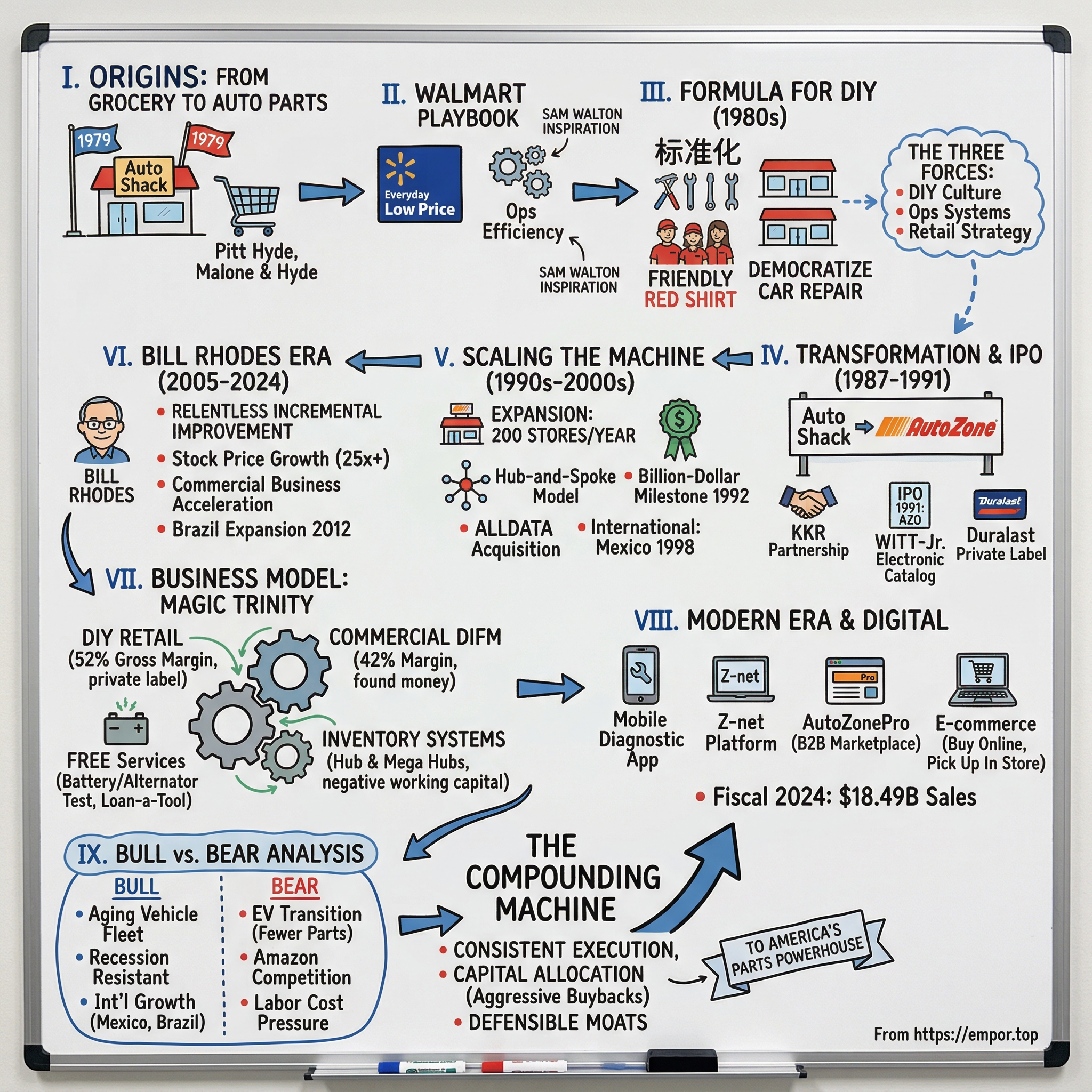
AutoZone: The Share-Cannibal Machine & The Retail Aftermarket Moat
I. Introduction & Episode Roadmap
On May 26, 2026, AutoZone reported its fastest quarterly sales growth in more than three years. Revenue rose 8.4% to $4.8 billion, driven by a 10.4% increase in domestic commercial sales. The company opened 82 stores in twelve weeks, bringing its footprint to 7,856 locations across the United States, Mexico, and Brazil.1 Yet by the closing bell, the stock dropped roughly 9%, falling from about $3,406 to $3,100 per share. By late August 2026, the equity traded near $2,935—down roughly a third from its peak the previous autumn, placing AutoZone's market capitalization at approximately $48 billion.
That disconnect between operating performance and market verdict lies at the heart of the company's current valuation. It presents a very different analytical picture than a decade ago, when the central question was simply how a company could shrink its share count by 90% without destabilizing its balance sheet.
AutoZone's financial blueprint remains distinct. Since initiating its buyback program in fiscal 1998, the company has repurchased about 156 million shares for roughly $39.8 billion—a volume exceeding the total shares outstanding when the program began—leaving 16.4 million shares in existence as of May 2026.1 It operates with negative book equity by design, has never paid a dividend,2 and uses vendor financing to fund more than 100% of its inventory. For most of the past decade, its return on invested capital exceeded 40%, a level rarely sustained in traditional retail.
However, corporate disclosures also document a clear operational deceleration. Adjusted after-tax return on invested capital, the efficiency metric management prioritizes, fell from 55.4% in fiscal 2023 to 41.3% in fiscal 2025, and reached 36.3% on a trailing four-quarter basis through May 2026.12 The accounts payable-to-inventory ratio—the core vendor-financing metric—slid from 129.6% in fiscal 2021 to 111.1% in the most recent quarter.12 Annual share repurchases dropped from $4.36 billion in fiscal 2022 to $1.53 billion in fiscal 2025.2 Diluted earnings per share fell 3.1% in fiscal 2025, and rose just 0.5% through the first three quarters of fiscal 2026 despite sales growth exceeding 8%.13
This shift reframes the core analytical question facing investors: AutoZone is spending heavily to convert a high-return, slow-growth retailer into a faster-growing, more capital-intensive distributor. Is that a moat being widened, or a moat being expensively rented?
Four key themes evaluate this transition. First, the microeconomics of urgency—why replacing a broken alternator differs fundamentally from standard retail transactions, keeping e-commerce competitors at bay. Second, the dynamics of serving two distinct customer groups: the do-it-yourself consumer needing an immediate replacement part and the professional repair shop requiring delivery within thirty minutes to keep service bays operating. Third, the hub-and-mega-hub inventory architecture, which serves as the physical network supporting both channels. Fourth, capital allocation—the discipline that established AutoZone's reputation, now tested by expanding capital investments.
The story begins where the business started: with a grocery wholesaler in Memphis who studied Sam Walton, opened a parts store in a small Arkansas town, and made a single decision that shaped the next forty-seven years.
 Subscribe on LinkedIn
II. The Malone & Hyde Roots & The "Auto Shack" Blueprint (1979–1987)
On July 4, 1979, in Forrest City, Arkansas—a town of roughly 13,000 people between Memphis and Little Rock—a store called Auto Shack opened and generated about $300 in sales on its first day.4 Few observers at the time foresaw that this single storefront would seed a retail network later valued near $48 billion.
The store was a side project of Malone & Hyde, a Memphis wholesale grocery business founded in 1907 that had passed to Joseph R. "Pitt" Hyde III, the founder's grandson.4 Hyde's perspective stemmed from retail systems rather than automotive enthusiasm. Having joined Sam Walton's board at Walmart during the 1970s, he observed how modern retail practices and disciplined supply chains were reorganizing fragmented merchant categories.
In the late 1970s, auto parts distribution remained fragmented among independent jobbers, service stations, and dealership counters. These operations catered to wholesale mechanics rather than retail drivers, offering limited store hours, unposted pricing, and counter-bound service. Hyde applied basic supermarket merchandising principles to the model: clean, well-lit stores, wide aisles, clear signage, posted everyday prices, extended operating hours, and salaried floor staff paid straight wages rather than commissions to eliminate sales conflicts.
While the physical layout was easy for competitors to copy, a second structural choice defined the business model: Auto Shack would retail parts, but would not install them. AutoZone continues to state that boundary in its regulatory filings: "We do not derive revenue from automotive repair or installation services."2
Avoiding repair services eliminated the capital requirements of service bays, expensive real estate, specialized labor, warranty liabilities on service work, and scheduling bottlenecks that limit throughput to bay capacity. Crucially, it also prevented direct competition with commercial repair shops. By bypassing service bays, AutoZone established a compact, scalable store footprint—averaging roughly 6,790 square feet—that generalist staff could operate without technician certifications, while remaining a non-threatening supplier to commercial mechanics who would later become key customers.1
Network growth proceeded rapidly, with the 100th store opening by 1983. Following trademark objections from RadioShack, the 390-store chain rebranded as AutoZone in 1987—a transition management presented as an upgrade to a broader brand identity.4 In June 1988, the company introduced its proprietary Duralast parts line, a private-label strategy that eventually developed into one of its most critical brand assets.4
The ownership structure evolved behind the retail operations. Malone & Hyde went private through a leveraged buyout led by Kohlberg Kravis Roberts (KKR), which assumed controlling equity. Hyde stepped away from wholesale grocery operations to focus on the auto chain. In April 1991, AutoZone completed its initial public offering on the New York Stock Exchange under ticker AZO, issuing 3.2 million shares while KKR retained approximately 68% of the company and management held about 16%.4 Four years separated the rebrand from the public listing, allowing the company to test and refine its retail model under private equity ownership before tapping public equity markets.
By the mid-1990s, the store footprint surpassed 1,000 locations, and Hyde turned over the chief executive role to Johnston Adams in 1997.4 While the core retail concept was fully established, the capital allocation strategy that would define AutoZone's financial reputation remained to be introduced, beginning the following year.
III. The Financial Flywheel: Negative Working Capital & The Buyback Machine
The central paradox of AutoZone's balance sheet lies in its working capital. As of August 30, 2025, the company held $7.03 billion in merchandise inventory while owing suppliers $8.03 billion in accounts payable.2 In effect, vendor financing covered more than 100% of the merchandise sitting across its 7,657 stores, leaving total stockholders' equity at negative $3.41 billion.2
This negative equity balance is not a sign of financial distress, but the core of its operational design.
The mechanism relies on the cash-conversion dynamics of auto parts retail. AutoZone purchases items like alternators from manufacturers on extended payment terms and distributes them to stores, where inventory turns at a relatively slow pace of about 1.4 times per year—a rate reflecting the need to maintain broad parts availability as a form of inventory insurance.2 Because retail do-it-yourself (DIY) customers pay immediately at the point of sale, AutoZone collects cash long before settling accounts with suppliers. This creates a working-capital float that exceeds the value of the inventory itself.
AutoZone outlines this structure in its regulatory filings: "Historically, we have negotiated extended payment terms from suppliers, reducing the working capital required and resulting in a high accounts payable to inventory ratio."2 The durability of these terms rests on scale and demand predictability. A brake rotor manufacturer is often willing to grant 150-day payment terms to a retailer offering reliable, long-term order volume across thousands of stores, rather than standard 30-day terms to a less established distributor.
However, disclosures in the same filing highlight a key structural dependency: "however, our ability to do so may be limited by our suppliers' ability to factor their receivables from us."2 Rather than relying solely on direct credit, these extended terms operate through supplier-finance programs with third-party banks that confirm invoice balances, allowing suppliers to sell receivables for early payment. As of August 30, 2025, $5.4 billion of AutoZone's accounts payable had been confirmed under these arrangements, up from $4.9 billion a year earlier, alongside $264.9 million classified in other long-term liabilities.2 Because roughly two-thirds of accounts payable relies on bank participation, the structure depends on financial institutions maintaining confidence in AutoZone's credit profile. As the company noted in its annual report, "A downgrade in our credit ratings or changes in the financial markets could limit the financial institutions' and our suppliers' willingness to participate in these arrangements."2
This requirement underpins AutoZone's commitment to maintaining its investment-grade rating and targeting an adjusted debt-to-EBITDAR ratio of approximately 2.5 times.1 Maintaining this leverage target is essential to preserving access to supplier-financing arrangements.
The second pillar of AutoZone's financial model is capital return. In 1998, the board authorized a share repurchase program.2 External influence strengthened this capital allocation strategy when Edward S. Lampert, chief executive of ESL Investments, joined the board in 1999 and became chair of its compensation committee by fiscal 2002.5 The core thesis was straightforward: a retail business generating free cash flow beyond its high-return reinvestment opportunities should shrink its share base rather than pursue unfamiliar acquisitions.
Over twenty-eight years, AutoZone maintained this repurchase policy. Cumulative buybacks reached $39.85 billion by May 9, 2026—a retired volume of approximately 156 million shares that exceeded total shares outstanding when the program began—leaving 16.37 million shares outstanding at the end of that quarter.1 The board expanded the repurchase authorization by $1.5 billion in October 2025, bringing total authorized repurchases to $40.7 billion, and added another $1.5 billion in June 2026.26
This approach reflects a systematic rule for allocating marginal capital. AutoZone's executive compensation structure aligns with this logic by tying annual incentives to economic profit, defined as net operating profit after tax minus a 10.5% capital charge.7 Projects failing to clear this hurdle rate offered lower returns to shareholders than repurchasing shares, reinforcing decades of consistent buyback activity.
However, recent disclosures indicate that both mechanisms supporting this financial flywheel are facing operational friction.
First, the vendor-financing ratio has declined steadily over five consecutive years, dropping from 129.6% in fiscal 2021 to 129.5% in 2022, 124.9% in 2023, 119.5% in 2024, 114.2% in 2025, and 111.1% by the third quarter of fiscal 2026.12 Management attributes this shift to supply chain expansion, as the company builds inventory across new store locations and mega hubs faster than payables can accrue—with total inventory rising 10.8% year over year in the third quarter of fiscal 2026.1 Consequently, a larger share of inventory must be funded through internal capital rather than vendor credit.
Second, cash allocation has pivoted from repurchases to network expansion. Share buybacks dropped from $4.36 billion in fiscal 2022 to $3.72 billion in 2023, $3.17 billion in 2024, and $1.53 billion in fiscal 2025.2 Over the same period, capital expenditures rose from $796.7 million in fiscal 2023 to $1.1 billion in 2024, $1.3 billion in 2025, and an estimated $1.6 billion planned for fiscal 2026.28 As a result, the annual reduction in share count slowed to approximately 2.1%, down from historical rates exceeding 5%.1
This shift reflects a strategic redirection of capital rather than an abandonment of financial discipline. Management's capital allocation model now favors store expansion and mega-hub rollout over equity repurchases at current share valuations. However, this transition turns AutoZone from a net returner of capital into a capital-intensive expanding enterprise. The success of this strategy depends on maintaining historical returns on invested capital. To date, overall efficiency metrics have compressed, with return on invested capital falling from 55.4% in fiscal 2023 to 36.3% by the third quarter of fiscal 2026.12 Part of this decline reflects time lags as newly deployed capital matures across expanded store footprints, but it also reflects higher capital intensity. Assessing whether this capital deployment will widen AutoZone's competitive moat leads directly to the inventory and fulfillment strategy driving current investment.
IV. The DIY vs. DIFM Pivot: Battling O'Reilly & Building the Mega-Hub Logistics Moat
Consider a two-bay independent repair shop on a Tuesday morning. A car sits on the lift with a failed water pump, and the shop owner faces a straightforward calculation: every hour that bay remains occupied without active repair work is an hour of unbillable labor. The shop owner is less sensitive to modest price variations than to delivery speed—the primary requirement is securing the correct replacement part before noon.
That operational scenario drives much of AutoZone's strategic evolution since roughly 2015 and accounts for the bulk of its capital investments since 2023.
For its first three decades, AutoZone operated primarily as a do-it-yourself (DIY) retail chain. Serving individual vehicle owners delivered predictable financial characteristics: high gross margins, immediate point-of-sale cash collection, zero accounts receivable, minimal credit risk, and demand driven by necessity rather than discretionary spending. The company's category mix continues to reflect that essential demand profile, with failure and maintenance items representing approximately 85% of fiscal 2025 sales and discretionary accessories making up the remainder.2
The professional repair segment—referred to in the industry as do-it-for-me (DIFM)—presents a fundamentally different business profile. Transaction sizes are substantially larger: management has cited average DIY tickets in the mid-$35 to $40 range, compared with $60 to $90 for commercial orders, depending on the job.9 Order volume is steady, but commercial clients require rapid delivery, extended credit terms, and competitive pricing. Consequently, gross margins on commercial sales are structurally lower than in retail, creating what AutoZone describes as a regular "mix drag" on overall gross margin rates as commercial volume grows.8
Competitor O'Reilly Automotive developed a dual-market fulfillment model earlier, structuring its supply chain to serve retail customers and professional repair shops simultaneously. In April 2008, O'Reilly acquired CSK Auto for approximately $1.0 billion, including about $500 million of net debt, establishing national coverage across the western United States.10 By 2025, O'Reilly's professional sales reached $8.65 billion, or 48.6% of its total revenue, compared to DIY sales at 49.3%—establishing a roughly equal revenue split across both channels.11
AutoZone, by contrast, ended fiscal 2025 with domestic commercial sales representing 31.7% of its domestic total.2 By the third quarter of fiscal 2026, commercial revenue rose to just under 34% of domestic auto parts sales and 29% of total company sales.8 Chief Financial Officer Jamere Jackson highlighted the strategic focus on that call: "if you look at a lot of our near-end competitors, [they] have a much higher mix on the commercial side of the business... which is why we are so focused on growing the commercial business."8 Chief Executive Officer Phil Daniele estimated the expansion opportunity, stating that AutoZone holds "roughly 5% of the market share opportunity that is out there" in commercial.8
This market position defines both opportunity and competitive risk. While the market provides a long runway for growth, AutoZone operates as a challenger in the faster-growing segment against an incumbent with a established fulfillment advantage. In fiscal 2025, O'Reilly posted a 19.5% operating margin, compared with AutoZone's 19.1%.112
The physical answer: hubs, mega hubs and the geometry of availability
Managing auto parts inventory requires balancing broad vehicle coverage against limited store square footage. A single replacement component often exists in dozens of configurations based on vehicle year, make, model, and engine type. Multiplied across the active vehicle fleet, the total catalog encompasses hundreds of thousands of stock-keeping units (SKUs)—far exceeding the physical capacity of a standard 6,800-square-foot storefront.
AutoZone addresses this complexity through a three-tier distribution structure detailed in its disclosures. A standard retail store carries between 20,000 and 25,000 unique SKUs, devoting 40% to 50% of floor space to hard parts. A hub store expands inventory to between 40,000 and 50,000 SKUs. A mega hub carries 80,000 to 110,000 unique SKUs, dedicating 70% to 85% of its floor space to hard parts.2 At the end of fiscal 2025, the network included 367 domestic and 53 international hub stores, of which 133 domestic locations and eight in Mexico functioned as mega hubs.2
Structurally, a mega hub is not a distribution warehouse but an oversized retail storefront. It sells directly to retail consumers, handles local commercial accounts, and acts as a same-day supply node for surrounding satellite stores. Jackson detailed this shift in deployment strategy: "we are using those mega hubs to go more direct to our customers than we have in the past as opposed to having them... be primarily focused on a fulfillment source for [other] stores."8
Network expansion has accelerated. AutoZone opened 14 mega hubs in the third quarter of fiscal 2026, reaching 156 locations, with approximately 15 additional openings scheduled for the fourth quarter to complete 38 locations for the fiscal year and at least 40 targeted for fiscal 2027. Management maintains long-term targets of approximately 300 mega hubs at full build-out, with more than 100 additional sites currently in the pipeline.8
Operational metrics indicate commercial traction, though full financial returns depend on continued network maturation. Average commercial sales per program per week rose 4.5% year-over-year to $18,500 in the third quarter of fiscal 2026, with 6,356 commercial programs covering roughly 94% of domestic stores.18 Commercial sales grew 9.8% in the second quarter of fiscal 2026—a figure management estimated would have exceeded 12% excluding winter weather disruptions—and 10.4% in the third quarter.121 Both national accounts and local independent repair shops achieved double-digit growth in the third quarter.8
When asked by a UBS analyst why AutoZone's relative outperformance versus peers had narrowed, Daniele responded that the company is "only about halfway through our hub and mega hub expansion strategy."8 This explanation hinges on execution over the coming multi-year roll-out. The measurable core of the thesis remains straightforward: commercial revenue per program is expanding at mid-single digits alongside program additions, while overall gross margin remains stable. In the third quarter of fiscal 2026, AutoZone achieved about 42 basis points of merchandise and supply-chain margin gains, which offset roughly 22 basis points of commercial mix drag.8 Maintaining this operational efficiency will be critical as commercial sales approach a larger share of total revenue.
Duralast: the quiet asset
Alongside logistics expansion, private-label branding serves as AutoZone's primary tool for margin management. Introduced in June 1988, Duralast has expanded into a tiered brand family alongside private-label lines such as Valucraft, SureBilt, TotalPro, ProElite, ShopPro, TruGrade, and Econocraft.42 AutoZone describes these exclusive in-house brands as "a key differentiating component versus our competitors," structuring them across a good/better/best quality ladder.2
Private-label lines provide three distinct structural functions: they capture manufacturing margin, create product exclusivity that limits direct retail price comparisons, and build brand equity among commercial buyers. Jackson cited "the quality of our Duralast brand" alongside hub proximity and inventory depth as core pillars of the commercial strategy.8
However, extensive reliance on proprietary brands increases exposure to supplier concentration. AutoZone disclosed that in fiscal 2025, a single product category accounted for approximately 14% of total revenue, while one vendor supplied 13% of total merchandise purchases.2 Although management states that alternative suppliers exist at comparable cost for most product categories, sourcing flexibility is less certain for specialized, high-margin engineered parts. Brand ownership does not fully eliminate supply-chain dependency.
The commercial expansion strategy unites localized high-density inventory, rapid fulfillment networks, and proprietary brand positioning to capture market share in professional repair. The model requires significant ongoing capital deployment—making historical integration performance and capital allocation discipline the next logical area of evaluation.
V. Capital Allocation, M&A Record, & Historical Falsification Pass
Every investment thesis for AutoZone rests on five key assumptions: that its physical availability advantage cannot be dislodged by e-commerce; that it can win commercial market share against a better-positioned incumbent; that auto parts demand is recession-proof; that international expansion can replicate domestic store economics; and that its vendor-financed balance sheet provides a permanent structural edge. Each of these claims has been tested by AutoZone's operational history, sometimes painfully. Below, each is weighed against the strongest disconfirming evidence in the corporate record.
Test #1: Can the store moat travel online? The AutoAnything and IMC record
The claim: AutoZone's retail advantage extends into pure-play digital channels and adjacent distribution networks.
The record. On December 19, 2012, AutoZone acquired AutoAnything, an e-commerce retailer of specialized automotive accessories, for up to $150 million—comprising $115 million in cash, a $5 million working-capital holdback, and up to $30 million in earnouts tied to operating income.13 Less than two years later, on September 27, 2014, AutoZone bought Interamerican Motor Corporation (IMC), then the second-largest U.S. distributor of original-equipment-quality import parts, for roughly $80 million funded through commercial paper.14 Together, these two adjacencies represented approximately $230 million in capital deployed during a period of high confidence in expanding the core model.
Both acquisitions faltered. In the second quarter of fiscal 2018, reported on February 27, 2018, AutoZone recorded $193.2 million in intangible and asset impairment charges within operating expenses related to IMC and AutoAnything, explicitly disclosing that "both of these businesses are being sold."15 The charge represented 8.0% of that quarter's total sales.15 Private equity firm Kingswood Capital Management completed its purchase of AutoAnything in February 2018.16
The verdict. These failures do not invalidate AutoZone's competitive moat—they clarify its boundaries. AutoZone's primary advantage is not a general capability in automotive e-commerce, but a hyper-local strength in immediate physical availability. Stripped of physical proximity and customer urgency, as pure-play online accessory retailing is, AutoZone holds no structural advantage over digital competitors. Management effectively acknowledged this boundary by refocusing its digital strategy on store-based fulfillment through autozone.com, the AutoZonePro commercial ordering portal, and same-day or next-day local delivery—all of which leverage existing store inventory rather than bypassing the physical network.2
Two qualifications put these historical missteps in context. First, scale: $230 million in write-downs against $39.8 billion in cumulative share repurchases represents a minor capital allocation error, underscoring AutoZone's overall financial discipline relative to retail peers. Second, accuracy: AutoZone's record is not one of avoiding bad acquisitions entirely, but of keeping them small and exiting quickly when they fail to perform. For investors, the key question is whether the company's much larger current capital deployment into store networks and mega hubs is being underwritten with that same willingness to acknowledge and correct course if returns lag.
Test #2: Does scale automatically translate into commercial dominance?
The claim: AutoZone's massive retail footprint allows it to capture commercial repair market share at will.
The record. Historical results contradict this assumption. For two decades, competitor O'Reilly Automotive built its network around professional repair shops, eventually achieving a near-even revenue split between do-it-yourself retail and commercial customers, while AutoZone management continues to acknowledge that the company remains "significantly underpenetrated in commercial."811 Retrofitting the supply chain has proved slow and capital-intensive: AutoZone is only halfway through its mega-hub expansion, allocating approximately $1.6 billion in annual capital expenditures to close the network gap.8
This transition also creates immediate financial pressure. Growing commercial sales carry structurally lower gross margins, requiring operational efficiencies elsewhere to protect overall profitability. In the third quarter of fiscal 2026, AutoZone's consolidated gross margin fell 57 basis points year-over-year to 52.2%.1
The verdict. Scale alone did not grant commercial dominance. Share gains in professional repair require localized inventory density and rapid delivery—a capital-intensive model with clear margin trade-offs. The key metric evaluating this transition is commercial sales per program per week, which reached $18,500 in the third quarter of fiscal 2026, up 4.5% year-over-year.1 If program additions continue while revenue per program flattens, growth will reflect capital expansion rather than deepening customer relationships.
Test #3: Is DIY demand actually recession-proof?
The claim: AutoZone's retail business is immune to economic downturns because vehicle repairs are unavoidable.
The record. While essential repairs provide stability, consumer demand remains sensitive to broader economic pressures. Domestic same-store sales grew just 0.4% in fiscal 2024 and 3.2% in fiscal 2025.2 Underneath headline revenue, transaction volume shows clear softening. In the third quarter of fiscal 2026, DIY comparable sales rose 2.2%, but same-SKU price inflation exceeded 7%, average ticket size increased 5.6%, and customer transaction counts dropped 3.6%.8 The second quarter of fiscal 2026 reflected identical trends, with average ticket rising 5.2% while transaction counts declined 3.6%.12 CFO Jamere Jackson highlighted the unusual persistence of this drag, noting that historical downturns rarely produced transaction declines in the 3% range across consecutive quarters.8
The verdict. AutoZone's demand resilience holds in revenue terms but shows vulnerability in unit volume. Higher prices and inflation are masking lower transaction counts as cost-conscious consumers defer discretionary maintenance. CEO Phil Daniele countered that mechanical failures force immediate spending—noting that a broken starter leaves a driver with no choice but to repair the vehicle or find alternative transportation.9 However, revenue growth driven primarily by 7% price inflation differs fundamentally from volume-driven expansion. The critical metric to track is domestic DIY transaction counts rather than overall comparable sales. If price inflation moderates in fiscal 2027 as management anticipates while foot traffic remains negative, sales growth will compress mechanically.8
Test #4: Does the model clone cleanly into emerging markets?
The claim: AutoZone can replicate its U.S. store economics and expansion pace across international markets.
The record. International results present a mixed record. Mexico represents a successful expansion, growing to 933 stores by May 2026 after launching its first location in Nuevo Laredo in the late 1990s.14 By contrast, Brazil has yielded slower progress: fourteen years after entering the country in 2012, AutoZone operates 157 stores—an average of roughly eleven net openings per year.12 This measured pace demonstrates that store deployment dynamics do not translate seamlessly across borders.
Demand trends also show foreign exchange volatility. Reported international same-store sales fell 3.2% in fiscal 2025, but rose 9.3% on a constant-currency basis.2 In the third quarter of fiscal 2026, constant-currency international comps slowed to 1.6%—which Daniele attributed to broader macroeconomic softness across Mexico and Brazil—while reported international comps surged 16.6% due to a nearly 13% appreciation of the Mexican peso against the U.S. dollar.18 Currency movements generated a $74 million revenue tailwind, a $20 million operating profit boost, and a $0.83 gain in earnings per share for the quarter.8 That trend reversed the prior year's impact, when foreign currency headwinds reduced fiscal 2025 sales by $273.1 million and operating profit by $88.2 million.2
The verdict. International replication has succeeded in Mexico but remains unproven elsewhere. Mexico accounts for roughly 14% of AutoZone's store footprint, with management reporting strong returns on capital even during periods of lower same-store sales growth.8 Operations in Brazil remain modest relative to market size. Crucially, quarterly international results remain heavily exposed to unhedged currency translation, which Jackson noted reflects the company's policy of avoiding transactional foreign exchange risks.8 Evaluating international operations requires focusing on constant-currency metrics, which indicate that foreign markets currently represent a softer operational segment than headline figures suggest.
Test #5: Is the vendor-financed balance sheet a permanent structural advantage?
The claim: AutoZone's negative working capital model provides a permanent, low-cost financing engine.
The record. Financial disclosures show that vendor financing is a negotiated arrangement rather than a permanent structural guarantee. AutoZone's accounts payable-to-inventory ratio has declined for five consecutive fiscal years, reaching 111.1% in the third quarter of fiscal 2026.1 Furthermore, approximately two-thirds of total accounts payable relies on bank-intermediated supplier financing programs, which remain subject to AutoZone's investment-grade credit rating and broader credit market liquidity.2 Demonstrating current borrowing costs, AutoZone issued $850 million of 4.950% senior notes due 2031 in July 2026—offering a benchmark rate for replacing vendor float with traditional debt financing.17
The verdict. Vendor financing remains a major operational advantage, but its coverage has compressed by nearly 18 percentage points over five years amid higher interest rates. Terming the structure a permanent moat mischaracterizes a commercial balance sheet dependent on scale, credit quality, and bank participation. Falsification will not occur through abrupt supplier policy changes, but through a continuing decline in the payables-to-inventory ratio as network inventory expands.
VI. The Management Architecture & Current Leadership
Every AutoZone meeting—from a store huddle in Lubbock to a board session in Memphis—opens the same way: with the Cheer and the Pledge, followed by an "Extra Miler Story" recognizing an employee who went beyond job expectations for a customer.7 While outsiders might dismiss it as corporate theater, for an operation spanning 7,856 near-identical retail locations staffed largely by part-time workers, the routine serves a practical purpose: it acts as a low-cost mechanism to enforce operational consistency across a distributed workforce.
That dynamic defines AutoZone's primary management challenge. About 91% of its roughly 130,000 employees work in retail stores or direct field supervision, and approximately 40% work part-time.2 Rather than relying on specialized store-level management, the company standardizes nearly every variable—store layout, parts catalogs, training paths, and operational terminology—and fills leadership positions from within.
The handover
Bill Rhodes became president and chief executive in March 2005, succeeding Steve Odland, who departed for Office Depot while founder Pitt Hyde served as non-executive chairman during the transition.18 Rhodes joined AutoZone in 1994 after starting his career at Ernst & Young, eventually overseeing store operations and commercial sales before taking the top role.2 He led the company for nearly nineteen years, assumed the chairmanship in 2007, and transitioned to executive chairman in January 2024.2
His successor, Philip B. Daniele III, reflects that internal promotion strategy. Daniele was named CEO-elect in June 2023 and assumed the chief executive role in January 2024.2 He previously led merchandising, marketing, and supply chain starting in 2021, served as senior vice president of commercial from 2015 to 2021, and earlier held vice president roles across commercial support, merchandising, and store operations.2 Consequently, the executive directing AutoZone's $1.6 billion annual capital budget spent six years heading the commercial segment that its mega-hub expansion is built to support.8
Despite its emphasis on internal promotion, AutoZone recruits external executives to address functional gaps. Chief Financial Officer Jamere Jackson arrived in September 2020 after serving as CFO at Hertz and holding earlier leadership roles at Nielsen and General Electric, alongside a board seat at Eli Lilly.2 The commercial division is led by Kenneth Jaycox, who joined in July 2024 as chief commercial officer from United States Steel following senior roles at Sysco.2 Merchandising and global sourcing are headed by Lucas Rauch, former chief merchandising officer at Walgreens,2 while the chief information officer was recruited from leadership roles at McDonald's and Walmart.2
This external hiring contrasts with the common narrative of an insular corporate culture. In practice, the executive team pairs long-serving operators—such as Chief Operating Officer Thomas Newbern, who joined in 1985—with external specialists brought in to address capabilities where internal pipelines were thin.2 Disclosures in fiscal 2025 also noted a series of senior retirements, including a veteran merchandising executive and the head of human resources.2 In an organization reliant on specialized operational knowledge, management succession remains an ongoing risk factor.
What the pay plan actually rewards
AutoZone's executive compensation framework offers clear insight into its operating incentives. Annual bonuses depend on economic profit—defined as net operating profit after tax minus a 10.5% capital charge—evaluated through a matrix of EBIT and ROIC performance.7 The plan enforces two key constraints: management receives no annual bonus unless the company achieves at least 90% of its economic profit target, and total payouts cannot exceed target unless EBIT targets are also surpassed, preventing executives from boosting returns by curtailing necessary capital investment.7 Long-term incentives are granted in stock options, which carries an automatic structural effect under the share repurchase program: because option grants are capped at a fixed percentage of total shares outstanding, the annual option pool contracts in tandem with the share base.7
Compensation disclosures for fiscal 2025 illustrate how these guardrails function in practice. Operating profit of $3.76 billion ($3,762.4 million) missed the $3.81 billion ($3,808.4 million) target, while adjusted ROIC reached 41.55% against a 42.38% hurdle, resulting in an annual bonus payout of 96.75% of target.7 Daniele received $1.26 million against his $1.3 million target bonus,7 while Rhodes, serving as executive chairman, received a $150,000 base salary with no annual incentive target.7
Two governance elements warrant closer examination. First, beginning in fiscal 2025, the compensation committee modified rules to exclude foreign-currency fluctuations beyond a set threshold from incentive calculations. That adjustment excluded an $88.2 million currency headwind from fiscal 2025 bonus calculations.7 Although disclosed in advance prior to the fiscal year, the rule change effectively removed a real operational cost from executive payout metrics. Second, the proxy statement reported an "improved" advisory say-on-pay vote receiving 89% shareholder approval.7 While 89% does not indicate an active shareholder revolt, it falls below typical large-cap benchmarks and indicates prior investor dissatisfaction.
The selling system
The core operational asset inside an AutoZone store is its proprietary electronic catalog, Z-net. The system identifies replacement parts by vehicle year, make, model, and engine specifications while displaying real-time inventory across the host store, neighboring locations, and regional fulfillment hubs on counter screens accessible to retail customers.2 Annual filings state that Z-net is designed to deliver "complete job solutions, advice and information."2
That objective reflects an internal sales protocol focused on full-job completion: a brake rotor purchase is paired with pads, hardware, and fluid to ensure the customer finishes the repair without secondary trips for missing components. While AutoZone does not operate a proprietary sales algorithm, it combines Z-net catalog prompts with vendor-supported Parts Expert certifications and complimentary diagnostic services—including Loan-A-Tool rentals, Fix Finder diagnostic scans, and free battery and alternator testing—to drive store traffic and assist DIY consumers.2
For investors, this customer-facing infrastructure provides a functional baseline rather than an unassailable moat, as major competitors offer similar parts catalogs, staff certifications, and diagnostic services. The primary operational challenge lies in executing that standard consistently across nearly eight thousand stores staffed predominantly by part-time employees. On the third-quarter fiscal 2026 earnings call, Daniele noted that employee turnover had returned to "historic low levels," citing improved retention as a driver for operational execution.8 Tracking workforce retention will be critical, as AutoZone's commercial growth thesis depends directly on maintaining service consistency across its distribution network.
VII. Competitive Landscape & Microeconomics: The 4-Way Aftermarket Battle
Consider a simple comparison. When a household washing machine breaks down on a Tuesday, the owner can spend a week researching models, comparing prices across multiple online sites, waiting for delivery, and scheduling installation. But when an automotive water pump fails on a Tuesday, the vehicle sits immobile on a driveway with a job to reach. The driver has an urgent demand for exactly one thing: the correct replacement part, today, at a reasonable price.
Everything unusual about the automotive aftermarket flows from that operational difference, explaining why a retail business selling commodity metal parts from strip-mall locations has insulated itself against digital disruption for a quarter-century.
Three microeconomic mechanisms drive this insulation:
Urgency collapses the shopping process. The decision window is measured in hours rather than days, making two-day delivery an inadequate substitute when the alternative is a rental car. This structural advantage specifically protects hard parts and failure categories, which together with maintenance items represented approximately 85% of AutoZone's fiscal 2025 sales.2 It provides far less protection for discretionary accessories such as floor mats or car wax, where retail sales mix has shown relative weakness.
Fitment risk makes the transaction advisory. The combination of vehicle years, makes, models, and engine configurations numbers in the hundreds of thousands. Installing an incorrect component causes project delays and, for commercial repair shops, unbillable service bay hours. This risk transforms a commodity purchase into an advisory transaction, prompting operators across the category to invest in proprietary parts catalogs and staff certifications rather than competing solely on price.
Freight economics punish individual shipping. Heavy, low-value-density items like brake rotors, batteries, radiators, and exhaust components incur high shipping costs relative to product value. Transporting individual units directly to residential addresses erodes retail unit margins. Maintaining localized inventory represents the most cost-effective method for distributing heavy automotive components.
The addressable market is substantial and expanding. The U.S. light-duty aftermarket reached $413.7 billion in 2024, up 5.7% year-over-year, with the Auto Care Association projecting 5.1% growth in 2025 and forecasting the total light, medium, and heavy-duty market to reach $664.3 billion by 2028.19 Against that industry backdrop, AutoZone's approximately $19 billion in annual revenue represents a modest market share, providing context for management's assessment that the company remains underpenetrated across key growth segments.
The field
O'Reilly Automotive serves as the primary industry benchmark and direct competitor. In 2025, O'Reilly generated $17.78 billion in revenue with a 4.7% increase in comparable store sales—marking its thirty-third consecutive year of positive comps—while posting a 51.6% gross margin and a 19.5% operating margin across 6,585 stores in the U.S., Puerto Rico, Mexico, and Canada.11 Its commercial business generated $8.65 billion in revenue, essentially matching its retail do-it-yourself (DIY) segment at $8.77 billion.11 O'Reilly also repurchased $2.10 billion of its stock in 2025, bringing cumulative share buybacks since 2011 to $27.49 billion.11 The key comparison between the two companies lies in revenue balance rather than total scale: while AutoZone produces higher total revenue, O'Reilly has already established the balanced dual-market distribution model that AutoZone is spending $1.6 billion annually to build, compounding at comparable operating margins. As an analyst noted on AutoZone's May 2026 earnings call, investors had long been "accustomed to AutoZone significantly outperforming the others, and now that spread is a bit more narrow."8
Advance Auto Parts represents the industry's primary turnaround case. Full-year 2025 net sales reached $8.6 billion, down from $9.1 billion in the prior year, with an adjusted operating margin of 2.5%—reflecting a 200-basis-point expansion and, according to Chief Executive Officer Shane O'Kelly, the company's first year of positive comparable sales following three consecutive years of declines.20 Advance achieved this operational stabilization primarily through network rationalization, opening 39 stores while closing 522 to reduce its total footprint from 4,788 to 4,305 locations.20 Management's guidance for 2026 targets an adjusted operating margin of 3.8% to 4.5%.20 Even at the top of that target range, Advance's operating margin would remain less than a quarter of AutoZone's level. Furthermore, financial disclosures highlight ongoing operational risks: full-year adjustments included expenses for "material weakness remediation efforts" as well as credit loss reserves tied to receivables from a vendor that filed for Chapter 11 bankruptcy in September 2025.20 The remediation costs indicate lingering internal control vulnerabilities, while the supplier credit loss underscores that the vendor base funding industry accounts payable faces credit pressure.
Genuine Parts Company operates through a distinct structural model. Although total 2025 revenue reached $24.3 billion, automotive distribution represents only a portion of its operations. In the fourth quarter of 2025, Genuine Parts reorganized its automotive reporting into two segments: North America Automotive—encompassing NAPA operations across the U.S. and Canada—accounting for roughly 39% of total net sales, and International Automotive generating about 24%, alongside its global industrial business.21 Consolidated operating income reached approximately $1.2 billion, yielding an operating margin near 5%, while net income fell to $66 million following restructuring and impairment charges.21 NAPA relies heavily on independently owned jobber stores, expanding market reach but diluting operational control—the opposite trade-off of AutoZone's fully company-owned store network.
Cross-company analysis demonstrates that competition among major auto parts retailers is not fought primarily on price. AutoZone's fiscal 2025 gross margin of 52.6% exceeded O'Reilly's, and both companies maintained pricing discipline while Advance rebuilt its business from a lower margin baseline.211 Instead, competitive differentiation centers on inventory availability and delivery speed, driving major operators to deploy larger, inventory-dense hub locations closer to commercial repair shops. Asked on the May 2026 earnings call whether competitors adopting mega-hub fulfillment models threatened AutoZone's positioning, Chief Financial Officer Jamere Jackson stated that the company's strategy "has not been muted or impacted at all by what others are doing."8 While management expresses confidence, the ultimate test will be whether commercial sales per program can continue expanding as competing chains establish deep local inventory within shared trade areas. If multiple distributors achieve sub-30-minute delivery capabilities in overlapping markets, speed risks becoming a baseline requirement rather than a competitive moat, shifting marginal competition back toward price.
One key structural asymmetry favors established incumbents over new market entrants and digital marketplaces: supply chain scale. AutoZone disclosed that a single product category accounted for roughly 14% of fiscal 2025 revenue, while one vendor supplied 13% of total merchandise purchases.2 Supplier concentration functions both as commercial leverage for high-volume buyers like AutoZone and as a barrier to smaller competitors. Combined with private-label programs that require substantial order volumes, these supply relationships mean the primary barrier to entry in automotive aftermarket retail is not physical shelf space, but attaining sufficient scale for manufacturers to allocate dedicated production lines and accept extended payment terms.
VIII. Strategy, International Optionality, & The EV Risk Radar
An AutoZone storefront in Monterrey, Mexico, mirrors those in Memphis, Tennessee: red exterior signage, bright interior lighting, and a long parts counter running the depth of the showroom. That operational uniformity is central to the company's expansion strategy—and explains why international growth has progressed fastest in markets where vehicle fleets and retail habits closely resemble those of the United States.
The two international engines
Mexico represents a substantial operational footprint, reaching 933 stores as of May 2026 supported by administrative centers in Monterrey and Chihuahua.12 Network expansion persisted despite local macroeconomic softness, with AutoZone opening 20 locations in Mexico during the third quarter of fiscal 2026 alone.1 Management stated on its May 2026 earnings call that international returns on capital remain robust despite slower same-store sales growth, asserting that broader macroeconomic recovery would reaccelerate comparative store trends.8 Conversely, operations in Brazil, managed out of São Paulo, remain sub-scale with 157 stores.12
Mexico's performance demonstrates operational viability, but also highlights the structural constraints of international portability. AutoZone's core advantage relies on store density within specific trade areas to make localized, same-day parts availability economically viable. Building that density requires step-by-step store deployment, effectively resetting supply-chain buildouts with each international entry. Consequently, AutoZone's international model operates primarily as a targeted expansion strategy in adjacent markets linked to existing distribution infrastructure, rather than a rapidly compounding global engine across multiple geographies.
Behind this store footprint, AutoZone's supply chain has globalized its direct sourcing operations. Beyond the Americas, the company operates a store support center in Gurugram, India, alongside sourcing offices in Shanghai and Istanbul.2 These international facilities manage private-label merchandise procurement—an asset for gross margins that also exposed earnings to trade and tariff friction in fiscal 2026.
The tailwind everyone quotes, examined
A central argument for long-term aftermarket growth is the steady aging of the vehicle fleet. Citing S&P Global Mobility data, AutoZone reported that the average age of U.S. light vehicles reached 12.8 years, with vehicles seven years and older accounting for approximately 43% of the total fleet.2 Management uses "our kind of vehicles" as internal shorthand for this older cohort—cars beyond factory warranty coverage and dealer service agreements, entering prime years for component failure.2 Meanwhile, total vehicle miles driven—the second metric management cites as highly correlated with industry growth—rose 1.0% in the twelve months ending July 2025.2
However, fleet age serves as a structural baseline rather than a short-term catalyst. As a slow-shifting stock variable, average vehicle age alters the addressable vehicle pool by only low-single-digit percentages annually. The metric has expanded continuously for two decades, spanning periods when AutoZone's domestic same-store sales grew just 0.4% as well as periods when comps surged 13.6%.2 While an aging fleet provides a persistent baseline for demand, it does not explain quarterly earnings fluctuations or offset declining store foot traffic.
Risk radar
Inflation and tariff pressures present near-term earnings headwinds, operating through inventory accounting mechanics. AutoZone values inventory on a last-in, first-out (LIFO) basis. When replacement costs escalate, higher current costs impact reported cost of goods sold immediately, even if physical inventory on store shelves was acquired at lower prices. In fiscal 2026, this dynamic generated substantial non-cash LIFO charges: $98 million in the first quarter, $59 million in the second, $20 million in the third, and approximately $30 million guided for the fourth quarter—totalling roughly $207 million for the fiscal year, compared with $64 million in fiscal 2025.812 This accounting effect accounted for the discrepancy between reported earnings-per-share declines in the first half of fiscal 2026 and the high-single-digit operating growth delivered by the underlying business.
These LIFO charges stem from input cost inflation and tariffs filtering through AutoZone's imported private-label merchandise. Same-SKU inflation exceeded 7% in the third quarter of fiscal 2026, though management projects average ticket growth to moderate to the mid-4% range as prior-year price increases are fully lapped.8 Responding to an analyst query regarding potential tariff rollbacks, Chief Executive Officer Phil Daniele noted that tariffs on steel and automotive components had remained active for extended periods, causing higher input costs to continue flowing through inventory.8 Chief Financial Officer Jamere Jackson acknowledged the ongoing uncertainty, noting that "this is a pretty fluid situation... it's going to impact suppliers and retailers differently."8
This cost environment creates two main implications for investors. First, the LIFO expense represents a non-cash, temporary charge that will diminish once cost inflation stabilizes. Second, passing higher input costs to consumers carries volume trade-offs: price increases have coincided with customer transaction counts declining in the mid-3% range across recent quarters, demonstrating price elasticity among retail consumers.
The transition toward electric vehicles presents a structural, long-term shift rather than an immediate risk. AutoZone explicitly identifies vehicle electrification in its annual disclosures: "Increased prevalence of electric vehicles, whether due to changes in consumer preferences or regulatory actions... can result in less frequent parts failures and reduced need for parts."2 Battery electric vehicles eliminate major internal combustion engine components—including spark plugs, oil filters, fuel pumps, mufflers, and traditional starters—removing high-frequency maintenance and repair categories from store sales.
However, this risk is constrained by two operational factors. First, electric vehicles retain core wearable components—including brakes, suspension, steering, chassis parts, wipers, thermal management systems, and low-voltage auxiliary batteries—some of which experience accelerated wear due to higher vehicle curb weights. Second, AutoZone serves the existing vehicle fleet rather than new vehicle sales. Even rapid adoption of electric models alters the seven-to-fifteen-year-old vehicle population only gradually, particularly as that fleet cohort continues to age. Consequently, vehicle electrification acts as a gradual headwind on the long-term growth rate of internal-combustion parts demand rather than an immediate disruption to current store revenue.
A more immediate regulatory and technological risk lies in vehicle data access. AutoZone warns in regulatory filings that restrictions on access to telematics and diagnostic tools and repair information imposed by original equipment manufacturers or by governmental regulation "may cause vehicle owners to rely on dealers to perform maintenance and repairs."2 As modern vehicles increasingly function as integrated software platforms, reading diagnostic fault codes and sourcing replacement parts independent of dealership networks depends on access permissions set by vehicle manufacturers. OEM restrictions on diagnostic software represent a direct threat to the independent repair ecosystem, independent of consumer preference.
Beyond macro and technological shifts, day-to-day operations remain exposed to standard retail risks—including weather variations, seasonality, and self-insurance liabilities. Mild spring weather, for instance, suppressed demand for air-conditioning and cooling products during the final two weeks of the third quarter of fiscal 2026.18 While AutoZone disclosed no material pending legal or environmental proceedings in its fiscal 2025 annual report, corporate compensation disclosures noted adjustments for "non-routine legal settlements"—reflecting routine legal exposures typical of a retail network operating nearly 8,000 stores with 130,000 employees.27
These structural forces and operational realities bring the analysis back to the central question driving AutoZone's valuation: how effectively management can navigate its transition from a pure retail compounder to a capital-intensive commercial distributor.
IX. The Playbook: Business & Investing Lessons
Strip away the retail specifics, and AutoZone serves as a case study in a simple, unfashionable proposition: a company does not need rapid top-line growth to compound value for shareholders, provided it maintains strict discipline over where its marginal capital is deployed.
1. Capital allocation can substitute for growth—until it cannot. For two decades, AutoZone expanded revenue at low-to-mid single-digit rates while compounding earnings per share at paces that outperformed faster-growing retail peers, largely by steadily shrinking its share count. The mechanism is pure arithmetic, but the execution requires behavioral discipline: a board willing to consistently repurchase a mature retail business rather than pursue dilutive acquisitions. However, buybacks convert excess cash into per-share earnings growth; they do not build a competitive moat. When reinforcing a market position requires substantial reinvestment—as AutoZone's commercial expansion demands—repurchases must recede, and equity markets reprice the stock to reflect higher capital intensity.
2. Vendor financing is an operational strategy, not an accounting artifact. Most retailers treat accounts payable as a treasury function. AutoZone treats supplier payment terms as a core strategic lever, using extended terms to ensure new store inventory arrives substantially pre-funded. This float allows a retail footprint to expand without requiring proportional equity capital. The broader lesson is that inventory-heavy businesses operate two balance sheets—the one they own and the one their suppliers finance—and managing vendor credit requires the same discipline as the primary balance sheet. The risk, however, is structural: vendor financing depends on investment-grade credit ratings and commercial bank participation, and can compress gradually when inventory growth outpaces payables.
3. In urgency-driven categories, inventory depth beats price. While standard retail relies heavily on promotional discounting, automotive aftermarket success hinges on immediate product availability. A full-price component in stock two miles away beats a discounted alternative arriving two days later, because the true customer cost is not the price of the part, but an immobilized vehicle or an unproductive service bay. This dynamic explains why AutoZone's mega-hub logistics strategy represents its most defensible capital commitment: mega hubs purchase inventory depth, and localized availability is the core product.
4. Strategic boundaries are as important as expansion. By refusing to perform automotive repair and installation services for forty-seven years, AutoZone bypassed an obvious potential revenue stream. That boundary preserved a compact store footprint, simplified store labor requirements, kept unit capital low, and—most importantly—prevented direct competition with professional repair shops that now represent its primary commercial growth channel. While many companies define strategy by the adjacencies they enter, resilient businesses are often defined by the service lines they decline.
5. Private-label branding converts commodity parts into proprietary margin. In-house brands capture manufacturing margins, eliminate direct online price comparisons, and build brand equity exclusive to the retailer's store network. However, proprietary branding does not equal manufacturing independence. Supply concentration risks remain intact, and extensive private-label expansion deepens dependency on key third-party suppliers rather than diversifying sourcing risk.
6. Executive incentive design dictates corporate behavior. AutoZone's executive compensation framework assesses economic profit by applying a 10.5% capital charge and capping payouts unless operating profit targets are exceeded. This single design element explains decades of capital allocation discipline far more accurately than corporate presentations. When evaluating capital-intensive businesses, inspecting the proxy statement's incentive structure—and tracking when metric definitions or adjustments are modified—provides the clearest signal of operational priorities.
These strategic principles define the central analytical question shaping AutoZone's valuation: whether its transition into a capital-intensive commercial distributor will widen its competitive moat or permanently compress its historical returns on invested capital.
X. Analysis & Bull vs. Bear Case
By late August 2026 AutoZone traded near $2,935 a share, roughly a third below its high of about $4,388 over the preceding year, with a market capitalisation of about $48 billion. The last three earnings reports each produced a single-day decline. That is not a business in trouble; it is a business whose narrative has changed from compounding machine to company in an investment cycle, and the market is repricing the certainty, not the cash flow.
Myth versus reality
Four claims circulate about AutoZone almost as settled fact. Each is close enough to true to be repeated, and each is wrong in a way that changes the analysis.
Myth: AutoZone has spent more than $42 billion buying back its own stock. Reality: it has authorised roughly that much and spent $39.85 billion through May 2026.1 The board's cumulative authorisation reached $40.7 billion after the October 2025 increase and about $42.2 billion after the June 2026 addition.26 The distinction matters because authorisation is a permission slip and spend is a commitment; the gap between them has widened precisely as the company has redirected cash toward capital expenditure.
Myth: AutoZone runs an operating margin near 20%. Reality: it did — 19.1% in fiscal 2025 — and it is currently running below that. Through the first three quarters of fiscal 2026, operating profit of $2.41 billion on sales of $13.74 billion works out to about 17.5%.1 The third quarter recovered above 19%, which management flagged as an achievement rather than a norm.1 Roughly half the gap is LIFO and roughly half is the cost of the store programme. The first reverses; the second reverses only if the new stores perform.
Myth: suppliers fund more than 100% of inventory as a permanent feature. Reality: they still do, at 111.1%, but the margin of comfort has thinned every year for five years, and the mechanism is intermediated by banks whose participation the company itself flags as conditional.12 Describing it as permanent is the single most common error in the bull case.
Myth: AutoZone delivers parts to commercial customers in under thirty minutes. Reality: AutoZone does not disclose any delivery-time metric. Its filings say "prompt delivery," and its executives talk about "improving speed to customer" and reducing "time to serve" without publishing a number.28 Delivery speed is central to the commercial thesis and it is, at present, not measurable from outside the company. Investors relying on a specific delivery-time claim are relying on something the issuer has never asserted.
The bull case
The commercial opportunity is genuinely large and genuinely early. AutoZone's domestic commercial mix of just under 34% sits far below the roughly even split its closest peer achieved years ago, and the company is adding programs, mega hubs and dedicated sales coverage against a market it says it holds a mid-single-digit share of.811 If sales per program continues compounding while program count grows, the revenue arithmetic is powerful without requiring any share gain heroics.
New store productivity appears to be beating plan. Management has repeatedly stated that stores opened over the last five years are exceeding the sales and earnings assumptions used to approve them, and that pro formas are set conservatively.8 That claim is unverifiable from outside — AutoZone does not publish new-store cohort economics — but it is falsifiable over time through the ROIC line, which makes it an honest claim rather than a slogan.
The demand base is unusually stable. Failure and maintenance categories dominate the mix, tickets are small in absolute dollars, and deferral by a consumer typically produces a larger repair later rather than a lost sale.29 Across the cycle this is one of the more inelastic consumer businesses in existence.
The compounding engine is intact, just smaller. Share count still fell 2.1% year over year, the board added $1.5 billion of authorisation in June 2026, and free cash flow ran $455 million in the third quarter and $1.1 billion year to date.168
The bear case
The returns are going the wrong way, and the explanation is a promise. ROIC has fallen for three consecutive years. The company's answer — that new stores and mega hubs mature into the numbers — is plausible and, so far, unproven. Every retailer in an expansion phase says this. Some are right.
Growth is being funded by shareholders now, not suppliers. With the payables ratio down to 111.1% and inventory up 10.8%, the working capital that used to arrive free is increasingly financed.1 That is a real, quantified reduction in the mechanism that made the model unusual.
The DIY customer is transacting less. Comparable sales carried by 7% inflation with traffic down 3.6% describe a business holding revenue while losing units.8 If pricing normalises before traffic recovers, comps compress with no change in competitive position.
Commercial growth mechanically dilutes gross margin, and management has to manufacture offsets every quarter. Jackson said explicitly that faster commercial growth "will put a little bit more of a mix drag on" and that the team is "working very hard to offset as much of that as we can."8 Working very hard to stand still is a fair description of the margin task ahead.
International reported growth is currently flattered by an unhedged peso. Strip currency out and it is the slowest-growing part of the company.18
Porter's five forces, applied honestly
Rivalry is the strongest force and it is intensifying, not easing: three well-capitalised chains plus a national jobber network are all building local inventory depth in the same trade areas, and the newest entrant to that arms race is the one with the most to prove.
Buyer power is asymmetric by segment. The DIY consumer has almost none — urgency, fitment risk and small ticket size see to that. The professional customer has real power, and it rises with account size: national accounts are, in Jackson's own description, "our most sophisticated customer set... they have scale that you would expect them to want to negotiate."8 AutoZone's mix shift is therefore, structurally, a shift toward more powerful buyers. That is the single most under-discussed consequence of the commercial strategy.
Supplier power is moderate and two-sided. AutoZone's scale extracts terms no small distributor could obtain; the disclosed 13% single-vendor purchase concentration and the dependence on supplier participation in bank financing programmes are the counterweight.2
Substitutes are weak in the near term and non-trivial in the long term: the substitute for buying a part is not another retailer but a dealer service department, and manufacturer control of diagnostics and telematics is the channel through which that substitution could grow.
New entrants face the hardest barrier in the category — not capital, but the decade of density required before same-day availability becomes economic in a trade area. Advance Auto Parts' experience is instructive in reverse: even an incumbent with 4,788 stores could not make the economics work without closing 522 of them.20
Seven Powers, applied honestly
Of Hamilton Helmer's seven, AutoZone holds three convincingly and one contingently.
Scale economies are the core power: fixed distribution, catalogue and brand costs spread over 7,856 stores, plus purchasing leverage that produces both better cost and better terms. Cornered resource applies narrowly to Duralast and the in-house brand family, which competitors cannot stock. Process power is the most underrated: replicating a consistent store experience, a shrink-controlled inventory and a certified counter across a largely part-time workforce is an accumulated organisational capability, not a decision — and it shows up in the merchandise-margin and shrink improvements that have offset commercial mix drag.8
Switching costs are the contingent one. For DIY there are effectively none. For commercial accounts they are real but soft — built on delivery reliability, credit terms, catalogue integration through the ordering portal and account relationships — and they are exactly what a rival with equivalent local inventory can attack. AutoZone does not have counter-positioning (it is the follower in commercial, not the innovator), does not have network economies, and does not have branding power in the pricing sense; its brand supports trust and traffic, not premium.
The activist's memo
A skeptical investor building a bear file would press on four points. First, disclosure: AutoZone reports commercial sales per program but not new-store cohort returns, mega hub payback periods or DIY versus commercial gross margin — so the central claim of the whole capital plan cannot be independently verified. Second, the incentive change that excluded currency effects in the same year currency was a headwind. Third, the buyback: repurchasing roughly $586 million of stock in a single quarter while ROIC falls and capex doubles invites the question of whether the company is over-earning on optics.1 Fourth, the balance sheet: negative equity is fine while credit ratings hold and supplier finance banks stay engaged, and it is the vulnerability if either changes.2
None of those is an accusation. Each is a place where the company's own disclosure stops short of the evidence its strategy requires.
The verdict, stated as calibration rather than conclusion
The moat is real and it is being widened at a price. AutoZone's advantage was never brand or technology; it was proximity, depth and terms. Proximity is being deepened through the mega hub build. Depth is improving. Terms are eroding. Returns are compressing while the investment runs. Whether this is the mid-point of a value-creating expansion or the beginning of a permanent reset in return on capital cannot be determined from the outside today — and anyone claiming certainty in either direction is reasoning from narrative rather than evidence.
Three KPIs decide it. Not a dashboard — three.
- Adjusted after-tax ROIC. This is the number the whole thesis reduces to. It has fallen from the mid-50s to 36.3%.1 Stabilisation and recovery would confirm that the new capital is earning its keep; continued decline through fiscal 2027 would say the growth was bought rather than earned.
- Domestic commercial sales per program per week. Program count can be grown by opening doors; sales per program can only be grown by winning accounts. At $18,500 and rising 4.5%, this is the cleanest single read on whether the mega hub investment is converting into share.1
- Domestic DIY transaction counts. Not comps — transactions. Comps have been carried by inflation. Traffic tells you whether the core customer is still walking in.
XI. Epilogue & Earnings Call Roadmap for Analysts
Phil Daniele closed the May 26, 2026 earnings call with a statement that carries different implications depending on an investor's time horizon: "this is a marathon and not a sprint."8 Coming from a chief executive thirty-one months into his tenure, midway through the largest capital deployment in company history while the equity trades roughly a third below its peak, the line reflects either strategic patience or a request for it.
The Daniele era has so far been defined by a clear capital reallocation: shifting cash from share repurchases into physical store expansion. AutoZone is tracking toward roughly 365 store openings in fiscal 2026, up from 304 the prior year, with management targeting approximately 500 annual openings by fiscal 2028—split between roughly 300 domestic and 200 international locations.89 Mega hubs are expanding at a rate that targets roughly 300 total sites within several years, with Chief Financial Officer Jamere Jackson floating potential expansion beyond that level.8 Management has maintained a consistent narrative across four consecutive calls despite stock price pressure.
What management has not provided, however, is clear disclosure to verify that expansion thesis. AutoZone does not publish cohort return profiles or payback periods for its new stores and mega hubs.
Where to look. The fiscal 2025 Form 10-K, filed October 27, 2025, serves as the foundational document. Item 7 provides a five-year table detailing the accounts payable-to-inventory ratio, return on invested capital, and per-store productivity, while the financial notes outline supplier-financing program balances.2 The proxy statement filed the following day offers the clearest view into executive compensation metrics and incentive structures.7 Finally, quarterly 8-K earnings exhibits contain return on invested capital reconciliations, adjusted debt calculations, and commercial segment statistics.1
Which calls repay study. The fourth-quarter fiscal 2025 call on September 23, 2025, framed the current investment cycle, detailing capital expenditure guidance, accelerated store rollouts, and the long-term target of 500 annual openings.9 The second-quarter fiscal 2026 call on March 3, 2026, demonstrated management's handling of an earnings miss by separating winter weather disruptions from underlying sales trends.12 The third-quarter call on May 26, 2026, featured direct analyst questioning regarding narrowing performance spreads against peers, competitive responses to the mega-hub strategy, and potential sales deceleration as price inflation moderates.8 The upcoming fourth-quarter fiscal 2026 results, expected in September 2026, will provide the first full-year evaluation of whether the expanded store program delivered promised productivity gains—alongside management's fiscal 2027 guidance.8
What would change the picture. On the upside: return on invested capital inflecting upward while store expansion remains elevated; DIY transaction counts turning positive as price inflation moderates; and commercial sales per program accelerating beyond mid-single-digit growth. On the downside: the accounts payable-to-inventory ratio declining further through the low 100s; commercial sales growth slowing toward high single digits while gross margins dilute; or international constant-currency comparable sales remaining near zero for another year.
XII. Recent News & Catalyst Tracker
Leadership. The management transition completed in January 2024 remains firmly in place, with Philip B. Daniele III serving as president and chief executive officer and William C. Rhodes III as executive chairman. The board of directors expanded its international and operational perspective in 2025 by appointing Rivian Chief Financial Officer Claire McDonough and FEMSA executive Constantino Spas Montesinos.27 The appointment of Spas Montesinos provides a clear signal regarding AutoZone's geographic focus for long-term international expansion.
Capital returns. The board authorized an additional $1.5 billion in share repurchases on June 16, 2026, following a $1.5 billion authorization increase in October 2025.62 Share buybacks in the third quarter of fiscal 2026 totaled $586.3 million at an average price of $3,582 per share, compared to $431.1 million at an average of $3,999 per share in the first quarter—a declining purchase price that reflects broader equity market pressure.122 AutoZone has maintained its long-standing policy of paying no cash dividend.2
Financing. On July 14, 2026, the company completed the sale of $850 million in 4.950% senior notes due July 2031, issued under its existing indenture and a shelf registration filed earlier that month, with BofA Securities, J.P. Morgan, Truist, and U.S. Bancorp serving as representatives of the underwriters.17 The proceeds fund general corporate purposes in a routine refinancing structured to preserve investment-grade credit ratings.
Footprint. AutoZone's store network reached 7,856 locations in May 2026, while its mega-hub count expanded to 156. Management expects to open approximately 15 additional mega hubs in the fourth quarter of fiscal 2026 and targets at least 40 openings in fiscal 2027.18 On a percentage basis, international store expansion continues to outpace domestic growth.
Operating trend. Third-quarter results generated the fastest total sales growth since the second quarter of fiscal 2023, accompanied by an operating margin returning above 19% and domestic commercial revenue expanding at more than twice the rate of retail DIY.1 Nevertheless, persistent operational headwinds—including non-cash LIFO accounting charges, gross-margin dilution from commercial mix shift, and declining DIY transaction counts—continue to drive investor caution.
The next catalyst will be the fourth-quarter and full-year fiscal 2026 earnings report, which will conclude the initial year of accelerated capital spending and establish management's operational framework for fiscal 2027.
XIII. Links & Resources
Company filings. AutoZone's Annual Report on Form 10-K for the fiscal year ended August 30, 2025, serves as the primary source for store formats, hub and mega-hub counts, supplier-financing disclosures, five-year operating metrics, and risk factors.2 Quarterly results published as Exhibit 99.1 to Form 8-K contain non-GAAP reconciliations for adjusted return on invested capital, adjusted debt-to-EBITDAR, cumulative share repurchases, and commercial operating statistics.1223 The definitive proxy statement filed October 28, 2025, details the economic-profit incentive design, executive payout matrix and attainment, board composition, and advisory say-on-pay voting results.7 Subsequent Form 8-K filings document share repurchase authorizations and debt issuances.617
Earnings calls. Management transcripts for the fourth quarter of fiscal 2025 alongside the second and third quarters of fiscal 2026 capture the executive team's operational arguments and analysts' primary counterarguments.9128
Historical record. Published company histories provide the most complete narrative source for the pre-IPO period, covering AutoZone's Malone & Hyde origins, its 1987 rebranding, the launch of Duralast, and its April 1991 listing on the New York Stock Exchange.4 Regulatory filings from earlier fiscal years document the acquisitions, subsequent asset impairments, and ultimate divestitures of AutoAnything and Interamerican Motor Corporation.131415
Industry context. The Auto Care Association's factbook series supplies the broader automotive aftermarket sizing data and growth forecasts referenced throughout.19
Competitive intelligence. O'Reilly Automotive's annual results release provides the closest available benchmark for dual-market fulfillment economics; Advance Auto Parts' reported results and guidance document the cost of losing operational discipline in this category; Genuine Parts Company's filings outline the jobber-network alternative.112021
References
-
AutoZone 3rd Quarter Fiscal 2026 Results — Form 8-K Exhibit 99.1, SEC, 2026-05-26 ↩↩↩↩↩↩↩↩↩↩↩↩↩↩↩↩↩↩↩↩↩↩↩↩↩↩↩↩↩↩↩↩↩↩↩↩↩↩↩
-
AutoZone, Inc. Annual Report on Form 10-K for the fiscal year ended August 30, 2025 — SEC, 2025-10-27 ↩↩↩↩↩↩↩↩↩↩↩↩↩↩↩↩↩↩↩↩↩↩↩↩↩↩↩↩↩↩↩↩↩↩↩↩↩↩↩↩↩↩↩↩↩↩↩↩↩↩↩↩↩↩↩↩↩↩↩↩↩↩↩↩↩↩↩↩↩↩
-
AutoZone 4th Quarter and Fiscal Year 2025 Results — Form 8-K Exhibit 99.1, SEC, 2025-09-23 ↩↩
-
AutoZone, Inc. Definitive Proxy Statement (DEF 14A) — SEC, 2002 ↩
-
AutoZone, Inc. Current Report on Form 8-K (additional $1.5 billion share repurchase authorization) — SEC, 2026-06-16 ↩↩↩↩↩
-
AutoZone, Inc. Definitive Proxy Statement (DEF 14A) — SEC, 2025-10-28 ↩↩↩↩↩↩↩↩↩↩↩↩↩↩
-
AutoZone (AZO) Q3 2026 Earnings Call Transcript — The Motley Fool, 2026-05-26 ↩↩↩↩↩↩↩↩↩↩↩↩↩↩↩↩↩↩↩↩↩↩↩↩↩↩↩↩↩↩↩↩↩↩↩↩↩↩↩↩↩↩↩↩↩↩↩
-
Earnings call transcript: AutoZone Q4 2025 — Investing.com, 2025-09-23 ↩↩↩↩↩↩
-
O'Reilly to Acquire CSK Auto for $1.0 Billion — O'Reilly Automotive, 2008-04-01 ↩
-
O'Reilly Automotive, Inc. Reports Fourth Quarter and Full-Year 2025 Results — O'Reilly Automotive, 2026-02-04 ↩↩↩↩↩↩↩↩↩
-
AutoZone (AZO) Q2 2026 Earnings Call Transcript — The Motley Fool, 2026-03-03 ↩↩↩↩↩
-
AutoZone, Inc. Quarterly Report on Form 10-Q for the quarter ended May 4, 2013 — SEC ↩↩
-
AutoZone, Inc. Annual Report on Form 10-K for the fiscal year ended August 30, 2014 — SEC, 2014-10-27 ↩↩
-
AutoZone 2nd Quarter Fiscal 2018 Results — Form 8-K Exhibit 99.1, SEC, 2018-02-27 ↩↩↩
-
Kingswood Capital Completes Acquisition of AutoAnything — Kingswood Capital Management, 2018 ↩
-
AutoZone, Inc. Current Report on Form 8-K ($850 million 4.950% Senior Notes due 2031) — SEC, 2026-07-14 ↩↩↩
-
Steve Odland Leaves AutoZone for Office Depot, New President and CEO Named — AftermarketNews, 2005 ↩
-
New Report: 5.1% Growth Expected for Auto Care Industry in 2025, Reaching $664 Billion in 2028 — Auto Care Association, 2025-06-13 ↩↩
-
Advance Auto Parts Reports Fourth Quarter and Full Year 2025 Results — Form 8-K Exhibit 99.1, SEC, 2026-02-13 ↩↩↩↩↩↩
-
Genuine Parts Company Annual Report on Form 10-K for the year ended December 31, 2025 — SEC, 2026-02-20 ↩↩↩
-
AutoZone 1st Quarter Fiscal 2026 Results — Form 8-K Exhibit 99.1, SEC, 2025-12-09 ↩↩
 LinkedIn
 WhatsApp
 Reddit
 Hacker News
 Email
Email Kindle
 RSS Feed
 Spotify
 Apple Podcasts
 Amazon Music
 Audible
 YouTube