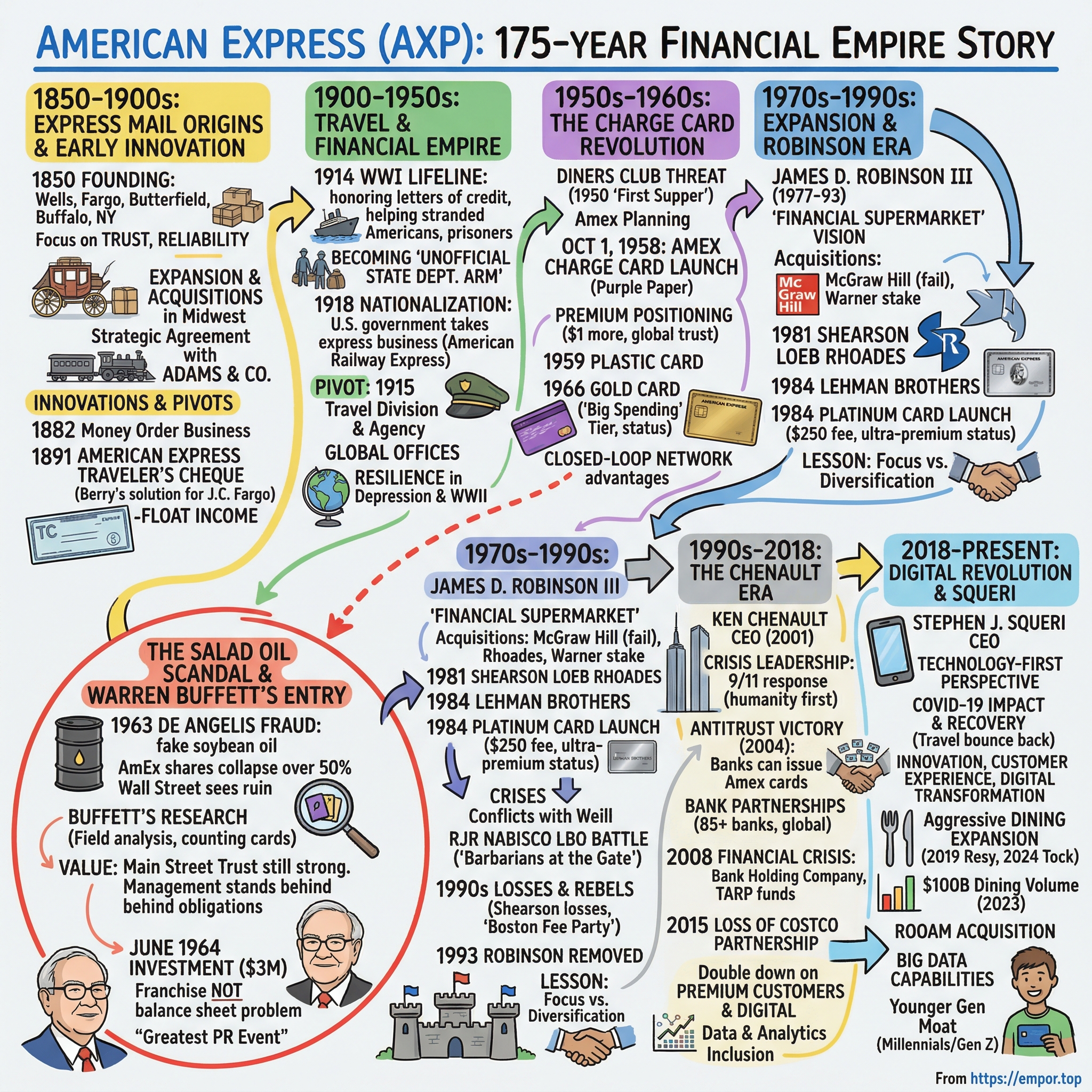
American Express: The Story of a 175-Year Financial Empire
I. Introduction & Episode Roadmap
On a July morning in 2026, during a routine earnings call, the chief executive of a 176-year-old enterprise did something rare for corporate leaders. Stephen Squeri informed analysts that American Express was outperforming its internal targets — and that he was choosing not to raise profit guidance as a result. "We have a choice," he said. "We can either drop the overperformance to the bottom line and buy back more shares or we can invest to grow the business further. We've chosen the latter."1
That decision illustrates the company's core strategic model. American Express is not primarily a lender, nor is it merely a payments processor. It operates as a subscription business selling access to an increasingly high-end membership program, continuously reinvesting revenue into perks that sustain cardholder demand. The central strategic question — determining whether the past decade's compounding can continue — is whether this continuous reinvestment functions as a competitive moat or an endless treadmill.
The financial scale behind this strategy is substantial. In fiscal 2025, American Express reported total revenues net of interest expense of $72.2 billion, up 10 percent year-over-year, and net income of $10.8 billion, generating diluted earnings per share of $15.38.2 Total spending on Amex-issued cards reached $1,669.8 billion — nearly $1.67 trillion — for the year, supported by 152.8 million active cards worldwide, including 86.6 million issued directly by Amex and 66.2 million by third-party network partners.3 For fiscal 2026, management projected full-year revenue growth between 9 and 10 percent, with earnings per share expected between $17.30 and $17.90, and increased the quarterly dividend by roughly 16 percent to $0.95 per share.2
The central question. How does a business founded as a stagecoach freight company in 1850 — one that navigated the rise of railroads, invented the traveler's cheque, survived a warehouse fraud involving fictitious soybean oil, lost a decade and billions attempting to build a Wall Street conglomerate, and endured the loss of its largest retail partner in a high-stakes fee dispute — transform into Warren Buffett's longest-held major equity position and one of the financial sector's highest-return-on-equity enterprises?
The structural paradox. Payment giants Visa and Mastercard operate open-loop, four-party networks: they build the processing infrastructure, collect a minimal toll on massive transaction volume, and carry zero credit risk. American Express operates a closed loop. It issues the card, onboards merchants, processes payments, carries credit balances, and manages the brand. Consequently, Amex collected an average merchant discount rate of 2.24 percent of billed volume in 2025 — far higher than the few basis points earned by open networks — but it also absorbs every reward cost, credit write-off, and merchant dispute.3 The closed loop is not an unearned windfall; it is a structural trade-off that exchanges higher revenue per transaction for substantially greater operational and credit exposure.
How this story unfolds: the original freight operations and the creation of paper currency for international travelers; the launch of the 1958 charge card and the design of the closed loop; the 1963 salad oil scandal and Warren Buffett's early investment analysis; the corporate expansion under James D. Robinson III that tested the core business; the Kenneth Chenault era marked by antitrust victories, macroeconomic crises, and the loss of the Costco partnership; the Stephen Squeri era of premium card repositioning and demographic shifts; and finally, an analysis of unit economics, moat sustainability, and the key operational metrics that signal future performance.
Three core metrics highlight the mechanics of the model. First, the average proprietary basic Card Member spent $25,453 on their card in 2025 — multiple times the industry average, providing the economic justification merchants require to accept higher processing fees.3 Second, average annual fee revenue per proprietary card in force expanded from $92 in 2023 to $103 in 2024 and $117 in 2025 — a 27 percent increase over two years that demonstrates pricing power.3 Third, Berkshire Hathaway held 151.6 million shares at the end of 2025 — unchanged from its 2020 holdings — yet its equity stake grew to 22.1 percent of the company as Amex systematically repurchased its own shares.45
That equity reduction represents a key driver of long-term shareholder returns. Before analyzing those financial mechanics, the analysis turns first to the company's origins in freight delivery.
 Subscribe on LinkedIn
II. Freight, Express Mail & Early Financial Innovation (1850–1900)
Picture upstate New York in 1850. There was no transcontinental railroad, no telegraphic money transfer, and no Federal Reserve. If a merchant in Buffalo needed to send $5,000 in gold coin to a supplier in Albany, he had one realistic option: hand it to an express carrier with a strongbox and a horse.
Three competitors dominated that regional trade. In March 1850, Butterfield & Wasson, Wells & Company, and Livingston, Fargo & Company merged their rival operations into a joint-stock association called American Express.6 It was not a bank, but a logistics firm carrying money, securities, bullion, and valuable freight. Its underlying strategic insight—that the primary constraint in commerce was not capital, but trust in transit—remains a central theme throughout the company's history.
Two years later, the partners split over expansion into California. Henry Wells and William Fargo wanted to follow the Gold Rush, but the board refused. The two founders established a separate firm, and Wells Fargo has operated as an independent enterprise ever since.6 The episode underscores that American Express's trajectory was not a continuous arc of strategic foresight, but rather a history shaped by a conservative board whose resistance was periodically overcome by entrepreneurial leadership.
That internal tension drove the transition from physical freight to financial services. In 1882, the company introduced the express money order—a standardized paper instrument sold through its office network in direct competition with the U.S. Post Office—designed by employee Marcellus Flemming Berry.7 The product altered the company's business model: instead of merely transporting third-party funds, American Express began issuing its own financial obligations, backed by its balance sheet, while holding customer capital between purchase and redemption.
A subsequent executive trip accelerated this evolution. Between 1888 and 1890, company president J.C. Fargo traveled to Europe using traditional letters of credit—the standard instrument for international travel at the time—only to find them difficult to encash outside major financial centers. Upon his return, he directed Berry to design a standardized solution.7
Berry's solution, launched in 1891, was the American Express Traveler's Cheque. Issued in fixed denominations of $10, $20, $50, and $100, the instrument relied on a simple security feature: the buyer signed the cheque at purchase and countersigned it in the presence of the accepting merchant, who verified the signature.7 The mechanism required no credit check, correspondent bank authorization, or telegraph verification, enabling merchants abroad to verify funds instantly.
The primary economic advantage of the product lay in the float. Customers paid American Express in full at purchase, but redeemed the cheques weeks, months, or even years later. In the interim, American Express invested those unredeemed balances, generating revenue from a zero-cost, self-replenishing capital pool provided by customers who paid upfront for transaction security.
Testing the moat claim. While conventional narratives often portray the traveler's cheque as a permanent financial engine, historical and regulatory records present a different reality. The product did not gradually decline; it was rendered obsolete by the arrival of global ATM networks and general-purpose credit cards. The float business that sustained American Express for nearly a century eventually shrank to an immaterial line item in its financial disclosures.3 The durable asset was not the physical cheque, but the network trust underlying it—the institutional credibility that induced third parties to accept American Express obligations. Over time, the company transferred that trust across three distinct formats: paper cheques, embossed plastic cards, and digital credentials. This progression highlights a key operational reality: specific payment formats do not constitute a lasting competitive moat. The true moat is counterparty trust in the network, a standing that must be maintained across every technological shift, including current developments in automated commerce examined later in this analysis.
By 1900, the foundation of the modern business was established: a recognized brand, an international distribution network, and a cash-generative business model based on upfront customer funding. Over the following five decades, American Express expanded that framework across global markets.
III. Building the Global Travel & Financial Empire (1900–1950)
In August 1914, as Europe entered World War I, thousands of American tourists were stranded abroad when commercial banks shut their doors and left letters of credit unhonored. American Express kept its offices open in Paris, London, and Rome, where staff cashed traveler's cheques, arranged transportation home, and effectively served as an emergency consular bank for U.S. citizens.6
The response reinforced public trust in the American Express brand at a time when conventional banking channels failed. Over the following decades, the company built on this reputation by expanding its physical footprint across Europe, Latin America, and Asia, establishing a global presence in travel booking, foreign currency exchange, and mail-forwarding services for international travelers.
By the middle of the 20th century, American Express operated a highly specialized business model. The firm generated revenue from traveler's cheques, freight forwarding, travel agency services, and currency exchange, but did not extend consumer credit. Its capital float depended almost entirely on a pre-funded paper product tied to travel outside the United States.
Meanwhile, regulatory constraints in U.S. banking were creating an opportunity for a universal payment credential. Commercial banks were barred from interstate branching, which prevented any single institution from building a national consumer payment network. Retail credit existed, but remained fragmented into merchant-specific charge accounts for individual department stores or oil companies. Given its national brand recognition, international office network, and experience managing transaction float, American Express was well-positioned to establish a general-purpose payment card.
However, the company hesitated to launch a consumer credit product, allowing competitors to enter the market first and forcing American Express into a multi-year effort to respond—a strategic pivot that laid the foundation for the modern enterprise.
IV. The Charge Card Invention & Closed-Loop Network Architecture (1950s–1970s)
In 1949, businessman Frank McNamara finished dinner at a New York restaurant and discovered he had forgotten his wallet. The following year, he launched Diners Club, issuing a cardboard card accepted at roughly two dozen Manhattan restaurants that billed members monthly and charged merchants a percentage of each transaction.
For most of the 1950s, American Express executives viewed the concept with skepticism. Skeptics within the company argued that a charge card threatened to cannibalize the lucrative traveler's cheque franchise while introducing credit exposure to an enterprise that had spent a century avoiding lending risks.8 By 1957, however, Diners Club had expanded beyond a niche market, rendering further hesitation impractical.
On October 1, 1958, American Express issued its first charge card in the United States and Canada—a purple paperboard card with account details typed on the surface.9 The accompanying pricing strategy established a foundational precedent for the enterprise. Amex set the annual fee at $6, deliberately pricing it one dollar above Diners Club's $5 fee to position the card as a premium product.8
Rather than competing on price or broad availability, American Express established a strategy based on exclusivity and high membership costs, requiring customers to pay for access to the network. Subsequent product iterations over the next seven decades—from the introduction of the plastic card in May 1959 to the Gold Card in 1966, the Platinum Card in 1984, and the invitation-only Centurion card—built upon this core positioning.9
How the closed loop actually works
In the open-loop payment networks operated by Visa and Mastercard, transactions involve five distinct entities: the cardholder, the issuing bank, the routing network, the acquiring processor, and the merchant. In that structure, the network functions primarily as a technology referee—setting operational rules, transmitting transaction data, and taking a small fee. The issuing bank collects the majority of the merchant transaction fee—the interchange—while absorbing the primary credit risk, leaving operational data fragmented across separate balance sheets.
American Express consolidates these functions into a single enterprise. The company issues cards directly to cardholders, routes transactions over its proprietary network, signs merchants, settles transactions, and carries the underlying receivables. Because American Express operates as both issuer and acquirer, there is no interchange split with third-party banks.
This integrated architecture creates three structural implications:
Economics. American Express retains the full merchant discount rate. In 2025, that rate averaged 2.24 percent of billed volume—substantially higher than the technology tolls collected by open-loop networks.3 However, because Amex operates the issuing side, it also funds all rewards programs and absorbs all credit write-offs, costs that open-loop network operators do not bear.
Data. By maintaining relationships with both the cardholder and the merchant, American Express obtains end-to-end visibility into spend patterns and merchant acceptance. In an open-loop model, this information is split across multiple financial institutions. Chief Executive Stephen Squeri has frequently cited this unified data asset as a key advantage in managing fraud and supporting future automated commerce platforms—a claim examined later in this analysis.
Accountability. When a cardholder disputes a transaction, American Express handles the resolution directly without delegating responsibility to an intermediary bank. While maintaining this service infrastructure increases operational overhead, it remains a primary driver of customer retention and fee justification.
The cold-start problem nobody advertises
Despite the advantages of an integrated system, building a closed-loop network presents significant operational hurdles. Unlike open-loop networks that rely on partner banks for card issuance and merchant acquiring, American Express was required to recruit cardholders and merchants independently. The company's sales force had to convince merchants individually that Amex cardholders spent enough to justify discount rates above those charged by bank card associations.
Merchants resisted these higher fees for decades. To establish initial volume, American Express focused on high-ticket, corporate-funded categories where merchants had stronger incentives to accept the fee structure: travel and entertainment, airlines, hotels, and upscale restaurants.
While this approach built a high-spending customer base, it resulted in a network that was deep but geographically and commercially narrow. Through the 1990s and 2000s, limited merchant acceptance—summarized by the common customer experience that a store did not accept Amex—served as an effective competitive wedge for Visa and Mastercard. Resolving this acceptance gap required decades of network expansion and the development of alternative merchant acquisition models, an initiative expanded during the Squeri era.
The history of the closed loop illustrates that integrated network architecture does not grant an automatic competitive advantage. Instead, the model's success is conditional on maintaining a cardholder spend premium large enough to compel merchant participation. When that spend premium narrows, or when major merchants leverage their volume to negotiate lower fees, the architecture creates operational friction—a vulnerability later demonstrated during negotiations with partners such as Costco.
Before addressing those later corporate developments, however, the company faced an immediate crisis when a commodity fraud scheme threatened its balance sheet in the 1960s.
V. The Salad Oil Crisis & Warren Buffett's Historic Rescue (1963–1965)
In November 1963, a subsidiary called American Express Field Warehousing was operating in a business unrelated to cards, traveler's cheques, or travel. It inspected physical inventories held as loan collateral and issued warehouse receipts certifying that the goods existed. It was a low-margin, low-attention fee business — the type of operation a diversified enterprise acquires and rarely scrutinizes.
Its largest client was Anthony "Tino" De Angelis, a former butcher who ran Allied Crude Vegetable Oil out of Bayonne, New Jersey. De Angelis had pledged massive quantities of soybean oil as collateral against loans from global banks and trading houses. Most of the oil did not exist; his storage tanks contained seawater topped with a thin floating layer of vegetable oil so that inspectors dipping measuring rods through the hatch found expected levels.
When the scheme collapsed in November 1963, financial system losses exceeded $180 million, and American Express held warehouse receipts certifying that the non-existent collateral was real.10 The primary market panic stemmed not from the direct loss, but from American Express's structure as a joint-stock association, which exposed shareholders to potential unlimited liability. Amex stock dropped from roughly $62 before the scandal broke to the mid-$30s by mid-1964 — a decline of more than 40 percent in under eight months.10 The news broke during the same week President John F. Kennedy was assassinated.
The Omaha field trip
In Nebraska, 33-year-old fund manager Warren Buffett recognized that while the immediate liability was large, it remained finite and quantifiable, whereas the core consumer franchise — if intact — retained its long-term earning power.
To test his thesis, Buffett conducted field research in Omaha. He observed whether restaurant patrons continued using the green card, asked bank tellers if traveler's cheque sales had declined, and surveyed local merchants about accepting Amex. Customers remained indifferent to the subsidiary's collapse; none had heard of the field warehousing division, and none changed their transaction behavior.10
Buffett subsequently committed a substantial portion of his investment partnership's capital to Amex equity, accumulating roughly a 5 percent position.10 The trade marked a pivotal shift in his investment approach, moving from purchasing statistically undervalued assets to investing in high-quality franchises whose valuation depended on customer habits and brand equity rather than physical balance-sheet assets.
American Express management chose to settle the claims rather than litigate the liability question, ultimately paying roughly $60 million to protect the brand — a major sum relative to company earnings at the time.10 While costly, the settlement preserved the network's foundational asset: counterparty confidence in the American Express name.
What the episode actually proves
A common interpretation of the salad oil scandal is that the American Express brand is virtually indestructible. A more rigorous analysis reveals that senior management risked a century-old franchise for minor fee income from a subsidiary operating without adequate internal controls. The breakdown was not merely an unavoidable third-party fraud, but a governance failure — offering the financial credibility of the American Express signature without establishing matching oversight.
This operational vulnerability recurred in subsequent decades: first during the 1980s expansion into investment banking, and later in the 2010s regarding small-business card sales practices. Historically, enterprise risk for American Express has rarely originated in its core card operations, but rather in adjacent business lines underestimated by executive leadership.
The stake that grew itself
Berkshire Hathaway's involvement with American Express extended well beyond the 1960s. After re-establishing a major position in the 1990s, Berkshire's disclosures demonstrated the long-term mechanics of corporate share repurchases.
At the end of 2020, Berkshire reported holding 151,610,700 American Express shares — acquired at a cost basis of $1,287 million — representing an 18.8 percent equity stake in the company.4 By the end of 2025, Berkshire held that exact same block of 151.6 million shares, yet its ownership stake had expanded to 22.1 percent of the company.5 Without purchasing additional shares, Berkshire's proportional claim on the enterprise expanded because American Express consistently retired its own common stock. Buffett highlighted this dynamic in his 2014 shareholder letter, noting that share buybacks at American Express, Coca-Cola, and Wells Fargo increased Berkshire's ownership automatically, with every tenth of a percentage point in incremental ownership generating approximately $50 million in annual look-through earnings across those holdings.11
However, assessing this capital allocation strategy requires two critical qualifications. First, under a 1995 agreement and subsequent passivity commitments to the Federal Reserve, Berkshire votes a significant portion of its shares in line with the board's recommendations and cannot exercise operational control.5 Consequently, the company's largest shareholder does not act as an independent governance check. Second, share repurchases generate shareholder value only when executed at prudent valuations; in 2025, Amex repurchased 16.8 million shares at an average price of $312.87, making the deployment of $5.3 billion dependent on future operational returns rather than the repurchase mechanism alone.3
This share retirement engine amplified equity returns over time, but its success remained tied to underlying operational performance. For sixteen years following this era, that operational performance was tested by corporate strategies pursued at the executive level.
VI. The Robinson Era: Financial Supermarket Ambitions & M&A Missteps (1977–1993)
James D. Robinson III became chief executive in 1977 at age 41. A courtly executive known on Wall Street as "Jimmy Three Sticks," he was a prominent figure in corporate boardrooms and Washington alike. He arrived with a strategic thesis that reflected the prevailing financial sector consensus of the era: the dominant institutions of future decades would be integrated financial supermarkets selling a full suite of products under a single trusted brand.
American Express appeared to be the ideal foundation for this model. It possessed a recognized global brand, an affluent consumer base, and a strong balance sheet. The missing element was product breadth.
Robinson moved aggressively to acquire that breadth. In 1981, American Express acquired major brokerage firm Shearson Loeb Rhoades. Investors Diversified Services, a financial planning firm, followed in 1984—the one acquisition from this expansion that ultimately proved successful, spun off decades later as Ameriprise Financial. Amex folded Lehman Brothers into its securities arm in 1984 and added E.F. Hutton in 1987, creating a major Wall Street brokerage and investment banking operation under the corporate umbrella.
Meanwhile, the core card operations continued to perform. The Platinum Card launched in 1984 as an invitation-only product with a $250 annual fee, establishing the ultra-premium charge card category.9 In 1991, the company launched Membership Rewards, converting cardholder spending into redeemable points and creating a structural switching cost in payments: customers who left American Express forfeited their accumulated balance.
Why the supermarket failed
The anticipated cross-selling synergies failed to materialize, driven by structural misalignments that remain instructive for corporate diversification strategies today.
First, customer overlap was far smaller than the strategic rationale assumed. A Platinum Card holder seeking concierge services and airport lounge access was not automatically a prospective buyer for institutional bond underwriting. Second, corporate cultures proved adversarial. American Express operated on long-tenure service culture, brand stewardship, and reputational risk management, whereas the trading floors prioritized individual performance and annual bonus maximization. Third, capital requirements ran in opposite directions. The payments business generated consistent cash flows and required minimal incremental capital to scale, whereas the securities business consumed substantial equity capital, generated volatile earnings, and periodically required financial support.
By the early 1990s, the securities arm was consuming capital and management attention at the precise moment Visa and Mastercard were building merchant acceptance ubiquity. Robinson departed as chief executive in 1993.
His successor, Harvey Golub, executed a rapid simplification of the enterprise. In March 1993, American Express agreed to sell Shearson's retail brokerage and asset management business to Primerica for roughly $1 billion plus contingent payments, merging it into what became Smith Barney Shearson.1213 The remaining institutional investment banking operations were spun off as Lehman Brothers in 1994, allowing American Express to refocus on its core card, travel, and payment network operations.
The falsification, and what it should still constrain
The financial supermarket thesis was not merely refined by market forces; it was disproved. A decade of aggressive capital deployment yielded no durable synergies beyond the incidental success of Investors Diversified Services.
For modern investors, the critical question is not whether American Express will repeat a broad conglomerate expansion—management has indicated no such intent. The relevant issue is whether the underlying assumption—that a trusted brand can be stretched into adjacent financial verticals—remains appropriately disciplined. The company's subsequent record has been mixed. Strategic acquisitions such as Resy and Tock represent focused additions designed to enhance cardholder engagement and retention rather than generate standalone profits. By contrast, the acquisition of small-business lender Kabbage proved far more problematic, producing legal consequences examined later in this analysis.
Before addressing those recent acquisitions, however, the enterprise faced a series of severe external tests that repeatedly challenged its core network model.
VII. The Chenault Era: Antitrust Battles, 9/11 & The Costco Breakup (1993–2018)
On September 11, 2001, American Express headquarters at 200 Vesey Street stood directly across from the World Trade Center. Eleven employees were killed, and the building sustained severe damage that rendered it unusable for months. Kenneth Chenault, who had become chief executive eight months earlier, led the organization through the immediate aftermath by relocating operations and tracking down displaced staff. The crisis established his public leadership profile, but it also coincided with a sharp downturn in travel and entertainment spending, testing a card business heavily dependent on corporate and leisure travel.
Breaking the bank distribution blockade
For decades, rules set by the Visa and Mastercard card associations barred member banks from issuing American Express cards in the United States. Because virtually every major domestic bank belonged to those associations, American Express was effectively locked out of third-party bank distribution—a major restriction in a market where consumers traditionally acquired payment cards through their primary banks.
The U.S. Department of Justice challenged those exclusivity rules in court, resulting in an antitrust ruling that invalidated the restrictions in the early 2000s. American Express subsequently sued Visa, Mastercard, and several member banks to recover damages for lost business opportunities. In November 2007, Visa agreed to a settlement of up to $2.25 billion.14 In June 2008, Mastercard followed with a settlement of up to $1.8 billion.15
While the total payout of over $4 billion provided substantial liquidity as the 2008 financial crisis took hold, the strategic result proved more modest than the headline figure suggested. Although American Express gained the legal right to partner with U.S. banks, third-party bank issuance never became its primary growth engine. The company's expansion remained rooted in its direct, proprietary card issuance, demonstrating that securing access to a distribution channel does not guarantee market share within it.
Becoming a bank
The 2008 financial crisis exposed a key structural vulnerability in the American Express model. While the company extended credit to Card Members, it funded those balances largely through wholesale debt markets, which froze during the credit crunch. On November 10, 2008, the Federal Reserve approved the company's application to become a bank holding company, granting it access to the Fed's discount window and emergency lending facilities.[^16] In January 2009, American Express issued $3.39 billion in preferred stock to the U.S. Treasury under the Capital Purchase Program; it repaid the capital in full by June 2009 alongside $74.4 million in dividends, repurchasing the associated warrants that July.16
The most significant long-term consequence of the transition was not temporary liquidity support, but the establishment of a direct-to-consumer deposit franchise. American Express built a retail savings and certificate-of-deposit program to fund card balances with FDIC-insured deposits rather than short-term commercial paper. By early 2026, management reported that high-yield savings and direct CD balances had increased 9 percent year-over-year, driven in part by Millennial and Gen Z customers who accounted for over half of those accounts, which lowered capital costs and supported net interest income growth.17 At that time, approximately 10 percent of U.S. Card Members held an Amex deposit account, presenting a potential area for further account penetration.1
The Costco divorce
On February 12, 2015, American Express announced that its exclusive co-brand and merchant acceptance agreements with Costco Wholesale Corporation would end on March 31, 2016.18 The announcement triggered a 6 percent decline in the company's stock price that day.19
The scope of the lost business was substantial. The Costco relationship accounted for roughly 8 percent of American Express's worldwide billed volume and approximately 20 percent of its consolidated loan balance.20 Costco demanded lower merchant fee terms that Chenault concluded would undermine card unit economics, leading American Express to walk away from renewal negotiations. Costco subsequently partnered with Citigroup and Visa in June 2016.
The split provided a realistic test of the company's merchant pricing power thesis. American Express maintains that merchants accept higher discount rates because its cardholders spend significantly more than average consumers. However, Costco leveraged its massive sales volume, high customer loyalty, and affluent member base to demonstrate that a single major retailer could reject those higher processing fees.
Consequently, merchant pricing power is strongest against fragmented merchants seeking high-spending customers and weakest against high-volume retailers with their own established customer bases. Company disclosures reflect this ongoing dynamic: the average merchant discount rate declined from 2.29 percent in 2023 to 2.27 percent in 2024 and 2.24 percent in 2025, a gradual erosion management attributed to shifts in geographic and merchant spend mix.3 This steady margin pressure highlights the trade-off required to achieve broader merchant acceptance across the retail ecosystem.
The Sapphire shock
A second competitive challenge emerged eighteen months later. On August 23, 2016, JPMorgan Chase launched the Chase Sapphire Reserve card, offering a 100,000-point sign-up bonus, a $300 annual travel credit, and a premium metal card design, generating demand so far above forecasts that the issuer temporarily ran out of metal cards.21
The product targeted the affluent demographic that American Express had long considered core to its Platinum card franchise. The market response demonstrated that premium card loyalty is not absolute; cardholders continually evaluate tangible rewards against annual fees, and well-capitalized competitors can disrupt customer retention by increasing upfront incentives.
In response, American Express expanded its perk structure and raised annual fees—a strategy that became central to its operating model over the following decade. Whether this approach represents a sustainable competitive moat or an ongoing margin burden remained a central question as Chenault retired in February 2018.
VIII. The Squeri Era: Premium Lifestyle Ecosystem, Gen Z Pivot & Modern Execution (2018–Present)
Stephen Squeri did not arrive as an outsider with a mandate to disrupt. He arrived after more than three decades inside the company, having run the technology organization and then the global commercial business. He is a Queens-born, plainspoken executive who on earnings calls answers analyst questions about strategy with digressions about the Jets, and who is unusually direct about the trade-off he is making — as when he told analysts in 2026 that beating plan gave him permission to lower his internal return thresholds and fund more projects, because "I don't think about it for this year, I think about the next year and the year after."17
That is a real strategic posture with a real cost, and it deserves scrutiny rather than applause. Investors are being asked to accept lower current profit in exchange for growth that will show up later. The record of the last several years supports the trade so far. It does not guarantee it forward.
Closing the acceptance gap
Squeri's first structural fix predated his promotion and was completed under it: OptBlue, a program under which third-party processors sign small merchants for Amex acceptance and set their own pricing, letting a coffee shop add Amex through the same processor handling its Visa and Mastercard volume rather than through a separate Amex contract. It was, in effect, a partial surrender of the closed loop's merchant-facing purity in exchange for reach.
It worked. Amex now states that its cards are accepted at 99 percent of U.S. locations that take credit cards, citing the Nilson Report.22 The decades-old "they don't take Amex" objection is substantially dead in the United States.
It also has a price, and the price is visible in the numbers already cited: broader small-merchant acceptance at processor-set rates is part of why the blended discount rate has drifted down. Amex traded yield for ubiquity. Given that acceptance gaps were the primary reason affluent customers carried a competing card, the trade looks correct. But it should be described accurately as a trade, not as a costless win.
Buying the dinner reservation
The more distinctive strategic move has been vertical: Amex has been buying the infrastructure of restaurant reservations. Resy came in 2019. In June 2024 the company agreed to acquire Tock from Squarespace for $400 million in cash, adding roughly 7,000 restaurants, wineries and hospitality venues.23 And in June 2026, Tripadvisor agreed to sell TheFork — an online reservation platform operating in 11 European countries with more than 50,000 restaurants — to American Express for $700 million in cash, in a deal expected to close by late 2026 and subject to regulatory approval.24 TheFork generated $232 million of revenue and $28 million of adjusted EBITDA in the twelve months to March 31, 2026.24
The strategic logic is coherent. Dining is the largest travel-and-entertainment spending category for Amex Card Members — restaurant spend grew 10 percent in the second quarter of 2026 — and owning the booking layer converts a generic rewards program into access that competitors cannot simply outbid for.1 Squeri described the rationale on the Q2 2026 call as creating "many closed loops within our closed loop," and noted a specific proof point: spend at Resy restaurants was growing at roughly double the rate of overall restaurant spend, and Amex Card Members carry higher tickets than non-members at those restaurants.1
Three things temper the enthusiasm. First, management explicitly does not evaluate these platforms on a standalone P&L — Squeri said so plainly — which means the return is asserted through spend and retention effects rather than demonstrated through segment disclosure. That is a defensible way to run the business and an unfalsifiable way to report it. Second, TheFork was bought at roughly 3x revenue and 25x adjusted EBITDA from a seller that had publicly put it under strategic review, which is a full price for a business whose strategic value depends on integration Amex has not yet executed. Third, the "2x spend at Resy restaurants" statistic is a correlation between two things Amex chose — its restaurants and its customers — and does not by itself establish causation.
The Platinum refresh, and what it actually reveals
On September 18, 2025, Amex refreshed the U.S. consumer and business Platinum Cards and raised the annual fee from $695 to $895 — a 29 percent increase — while more than doubling stated annual benefits to roughly $3,500, mostly in the form of credits usable on the card.2526 New applicants paid immediately; existing Card Members were repriced at their first renewal on or after January 2, 2026.
The results have been the strongest evidence to date for the pricing power thesis, and management has been unusually specific about them. By the end of Q1 2026, about a quarter of the U.S. consumer Platinum portfolio had been billed the higher fee, and retention rates were not merely holding but flat year over year against a prior year with no price increase at all.17 U.S. consumer billed business grew 11.4 percent in Q2 2026, the fastest since Q1 2018 excluding the pandemic distortion, and the CFO attributed the largest share of the acceleration not to new customers but to tenured Card Members consolidating more spend onto the refreshed product.1 Net card fees grew 15.4 percent in Q2 2026, the thirty-second consecutive quarter of double-digit growth in that line.1
Now the disconfirming evidence, which comes from management itself and belongs in the same breath. Asked on the Q1 2026 call whether the Platinum lift would compound into 2027, the CFO answered: "I don't think at this stage we should expect like a further acceleration in 2027. I expect that step-up to maintain into 2027. But I don't think that you should expect to see another one."17 The company also explained the mechanics that make the fee line lumpy: repricing flows into revenue over a twelve-month amortization, so it takes roughly two years for a refresh to work through the P&L, producing an acceleration and then a deceleration.1 Card fee growth is guided to exit 2026 in the high teens — and that peak is a function of a price increase already taken.1
That is the honest shape of the thing. The refresh is working, retention held through a 29 percent price increase, and that is genuinely strong evidence of pricing power in the premium consumer segment. It is also a step-function, not a compounding rate. Sustaining mid-teens fee growth past 2027 requires either another refresh cycle — which means another round of benefit spending first — or growth in the number of premium accounts. Investors should treat the current fee growth rate as cyclical around a product cadence rather than as a structural constant.
The cost side confirms this. Variable customer engagement expense — rewards, Card Member services and business development — ran at 44.6 percent of revenue in Q2 2026, and management raised its full-year expectation to a 44 to 45 percent range, above what it had originally planned, because Card Members were using the new benefits more than modeled.1 Card Member services expense alone rose 27 percent in 2025, to $6.1 billion, driven by benefit usage and the new Platinum benefits.3 When customers engage more with the value proposition, Amex pays more. The subscription is real; so is its cost of goods sold.
Demographic renewal
The most under-appreciated success of the Squeri era is who is now joining. In Q2 2026, 65 percent of new U.S. consumer accounts came from Millennials and Gen Z, and around 70 percent of new consumer Platinum accounts outside the United States came from those cohorts.1 Over 70 percent of all new accounts globally were acquired on fee-paying products, rising to 75 percent in the second quarter — the highest since the premium strategy began.1
This is the answer to the oldest bear argument about Amex, which was that it was a company for affluent Baby Boomers with a demographic expiry date. Squeri's framing on the Q1 2026 call is worth quoting because it is testable: the Millennial and Gen Z Card Members Amex is acquiring are not a representative slice of their generation but "the cream of the crop," and their credit performance is better than the industry's Gen X and Boomer performance.17 The CFO added a data point that cuts against the stereotype — roughly half of Amex's U.S. high-yield savings customers are Millennial and Gen Z, meaning these customers arrive with savings, not just spending.17
The credit numbers support the claim so far. The full-year 2025 net write-off rate was 2.0 percent, flat year over year, and delinquency rates have sat between 1.2 and 1.3 percent for over three years, below 2019 levels.21 In the Federal Reserve's 2026 stress test, Amex showed the lowest projected credit card loss rate of any bank tested and remained profitably capitalized under the severely adverse scenario.1 That is not a marketing claim; it is a regulator's model output, and it is the strongest single piece of evidence that the premium-customer strategy has genuinely changed the risk profile of the balance sheet.
Where execution has been worse
Two areas puncture any story of uniform excellence.
Compliance. In January 2025, American Express agreed to pay approximately $230 million to resolve investigations by the Department of Justice, the CFPB and the Treasury Department into deceptive sales practices in its small-business card and wire-transfer products between roughly 2015 and 2021.2728 Sales staff had misrepresented tax benefits and fees to small business owners and, in some cases, submitted applications using dummy information. Federal investigators had been probing the practices since at least early 2021, meaning the issue was known internally for years before resolution.29 The conduct is legacy, the remediation is disclosed, and the dollar amount is roughly two days of 2025 net income. But the pattern — a control failure in a business adjacent to the core, driven by sales quotas — is the same pattern as 1963 and the same pattern as the 1980s. It should discount, not eliminate, the premium an investor pays for governance quality here.
M&A. Amex acquired Kabbage's lending platform, team and technology in 2020, folding it into what became American Express Business Blueprint.30 The legacy loan portfolio, including Kabbage's very large Paycheck Protection Program book, was left behind in an entity that filed for Chapter 11 in 2022. On October 16, 2025, the post-bankruptcy wind-down estate sued American Express Kabbage Inc. and American Express Travel Related Services in Delaware bankruptcy court, seeking to recover up to approximately $746 million on the theory that the 2020 asset purchase was a fraudulent transfer that left Kabbage insolvent given its PPP-related liabilities to the DOJ and SBA.3 A parallel action against Kabbage's former directors and officers raises indemnity claims that Amex disputes.3 The outcome is not determined and Amex is contesting it. But a live claim of that size, six years after the deal, is exactly the kind of evidence that should be weighed before describing this management team's acquisition record as disciplined.
Set against that, the largest capital-allocation event of 2026 was a divestment. In May 2026, Amex announced it would sell its roughly 30 percent stake in Global Business Travel Group as part of GBTG's acquisition by Long Lake, generating approximately $1.5 billion of proceeds and an expected pre-tax gain of about $975 million, with closing expected in the second half of 2026 and existing brand licensing arrangements unaffected.31 The gain was explicitly excluded from EPS guidance.1 Exiting a legacy travel holding at a substantial gain while redeploying into the dining and premium ecosystem is a coherent portfolio move — and it is worth noting that it monetizes an asset from an earlier era rather than proving anything about the current one.
IX. Business Model & Unit Economics: Spend-Centric vs. Revolving Interest
The foundational operational distinction defining American Express is straightforward: the enterprise generates the majority of its revenue when cardholders spend, rather than when they borrow.
That distinction shapes every element of the underlying business model.
Where the $72.2 billion comes from
Of the $72.2 billion in total revenues net of interest expense reported in 2025, discount revenue from merchant transaction fees contributed $37.4 billion, a 6 percent increase year-over-year. Net card fees generated $9,993 million, expanding 18 percent as the fastest-growing revenue line, while service fees and other income accounted for $7.5 billion. Net interest income from lending contributed $17.4 billion, up 12 percent.3
This distribution highlights the structural design of the model: approximately two-thirds of total revenue derives from merchant processing fees and annual membership charges, with roughly a quarter generated by net interest income on credit balances. A conventional monoline credit card lender inverts this revenue ratio.
The four segments
American Express operates across four primary reporting segments, each reflecting distinct operational trajectories and margin profiles.
U.S. Consumer Services represents the primary operational driver, generating $34.8 billion in revenue and $6.8 billion in pretax income in 2025 on $707.5 billion of billed business, an 8 percent increase year-over-year.3 The segment includes Platinum, Gold, and co-branded cards, serving as the principal test ground for the enterprise's premium product refresh strategy.
Commercial Services generated $16.9 billion in revenue and $3.7 billion in pretax income, but billed business of $541.9 billion grew only 3 percent while proprietary cards-in-force declined 1 percent.3 This slower trajectory directly tests long-term expansion assumptions regarding corporate business-to-business payments. Chief Executive Stephen Squeri acknowledged that middle-market demand faced increased pressure from fintech competitors such as Ramp and Brex. In response, American Express launched several product initiatives in 2026, including eight new commercial capabilities, cash-back business and corporate cards, a pilot expense-management platform named Center, the acquisition of team assets from HyperCard, and a $300 annual ChatGPT statement credit for business Platinum and Gold accounts.171 Commercial spend growth modestly recovered to 5 percent by the second quarter of 2026.1 However, management indicated that the strategic financial benefits of these products will materialize primarily in 2027, leaving the business unit's repositioning pending future operational verification.17
International Card Services represented the fastest-growing card segment, delivering $13.0 billion in revenue, $1.6 billion in pretax income, and a 14 percent expansion in billed business to $418.0 billion.3 American Express executed Platinum card refreshes across roughly 80 percent of its international markets—often at pricing levels exceeding domestic fees—driving a 20 percent foreign-exchange-adjusted increase in international Platinum spend during 2026.1 While expansion rates remain elevated, the segment operates from a smaller relative scale, generating approximately 22 percent of total revenue and $2,993 million of the company's $13,795 million in total pretax income according to geographic disclosures.3
Global Merchant and Network Services—which encompasses merchant acquiring and network partner licensing—generated $7.8 billion in revenue and $4.0 billion in pretax income, representing the company's highest segment profit margin. However, it was also the sole segment to record a decline in pretax earnings in 2025, falling from $4,398 million to $3,968 million as operating expenses expanded faster than segment revenue.3 Because this unit reflects the ultimate monetization of the merchant discount rate, its margin compression represents an operational headwind requiring ongoing expense discipline.
The economics of one premium card
American Express does not disclose unit-level profitability per card, but baseline economics can be modeled using aggregated disclosures.
Consider an average proprietary basic Card Member who spends $25,453 annually.3 Applying the 2025 blended merchant discount rate of 2.24 percent, that spending volume generates approximately $570 in merchant fee revenue.3 Adding the $895 annual fee for a refreshed U.S. Platinum card brings gross annual revenue to roughly $1,400 to $1,500 per card before factoring in net interest income.25
Offsetting this revenue stream are substantial operational and engagement costs. Variable customer engagement expenses run between 44 and 45 percent of enterprise revenue, with premium cards occupying the upper end of that range due to enhanced benefit packages—translating to $650 or more in rewards, statement credits, lounge access, and concierge services per card.1 At the corporate level, marketing and customer acquisition totaled $6.25 billion in 2025 across 12.5 million newly acquired proprietary cards, representing an initial acquisition cost of roughly $500 per account amortized across the account's life cycle.3 Provisions for credit losses required $5.3 billion against $1.67 trillion in total billed volume,2 while administrative salaries and general operating expenses added $16.0 billion across the enterprise.3
These cost dynamics yield an enterprise model where approximately 19 cents of every revenue dollar converts to pretax income—generating $13.8 billion in pretax income on $72.2 billion of total revenue.3 The largest single expense line remains the ongoing cost of Card Member perks required to sustain fee-paying demand. Consequently, the business functions not as a zero-cost processing toll road, but as a premium subscription model bearing a significant and expanding cost of goods sold.
Why the mix matters more than the margin
Comparing American Express to revolve-centric lenders underscores the structural resilience of this spend-centric revenue mix. Institutions such as Capital One and Synchrony derive the majority of their revenue from loan interest and late fees on revolving credit balances, exposing their earnings directly to credit cycle downturns when default rates elevate alongside peak loan balances. By contrast, a macroeconomic downturn affects American Express primarily through reduced spending volume—a faster-adjusting and historically less damaging metric, as cardholders who reduce discretionary expenditures by 15 percent generally continue to settle their monthly charge card balances.
Financial disclosures from 2025 and early 2026 illustrate this credit performance profile. The enterprise maintained a 2.0 percent net write-off rate against loan balances, while 30-plus day delinquency rates remained between 1.2 and 1.3 percent. In the first quarter of 2026, total write-off dollars increased by only 4 percent year-over-year while net interest income expanded at a double-digit rate.217 This performance demonstrates that loan volume expansion has outpaced credit loss growth, reflecting the credit quality of its prime cardholder demographic.
Balance sheet capitalization provides further risk mitigation. American Express reported a Common Equity Tier 1 (CET1) ratio of 10.5 percent at the end of 2025 against a 7.0 percent regulatory minimum, aligning with management's internal target range of 10 to 11 percent. Capital strength permitted the company to return $7.6 billion to shareholders during 2025 through $5.3 billion in share repurchases and $2.3 billion in dividends, representing approximately 71 percent of net income available to common shareholders.3
While credit underwriting risks remain contained under current economic conditions, structural enterprise risk is not entirely absent. The principal strategic vulnerability facing American Express lies not in credit losses, but in the escalating cost required to maintain its Card Member value proposition and the willingness of merchants to continue supporting premium discount rates.
X. Playbook: Business & Investing Lessons
Counter-positioning beats competing. The 1958 decision to price its original charge card one dollar above Diners Club, rather than one dollar below, established an economic model dependent on customer quality rather than account volume. Incumbent bank issuers cannot fully replicate this strategy without cannibalizing the interchange fees and revolving interest income they depend on—a classic counter-positioning dilemma. Yet that structural barrier is not absolute. JPMorgan Chase demonstrated with its Sapphire Reserve launch that a major bank willing to fund substantial upfront incentives can attract premium cardholders without a closed-loop network, while Capital One's acquisition of Discover has provided a rival issuer with a proprietary network of its own.
Convert an abstract fee into concrete arithmetic. The reason an $895 annual fee survived a 29 percent price increase while maintaining cardholder retention is that American Express does not ask customers to buy abstract prestige. Instead, it provides a suite of statement credits—covering dining, travel, streaming, and retail—that engaged members can calculate to exceed the cost of the fee. This structure transforms an annual charge into a tangible purchase. However, maintaining that value proposition requires continuous investment, explaining why variable customer engagement expenses consume 44 to 45 percent of revenue and why the subscription framing should not be confused with high-margin economics.
Buy back stock relentlessly, and let the arithmetic work. Because American Express generates a return on equity in the mid-30s while requiring minimal incremental capital to expand transaction volume, management can routinely allocate cash flow to share retirements. The result is a steady reduction in share count: average diluted shares fell from 713 million in 2024 to 696 million in 2025.2 Berkshire Hathaway's ownership stake expanding from 18.8 to 22.1 percent without purchasing a single additional share highlights how persistent repurchases compound equity ownership over time.45 The essential qualification is that repurchases build long-term value only when executed at prudent prices, leaving the ultimate return on 2025's average buyback price of $312.87 tied to future operational performance.3
Crises come from the periphery. Historically, enterprise risk at American Express has rarely originated in its core card network, but rather in adjacent, under-scrutinized business lines. The 1963 salad oil warehousing fraud, the 1980s expansion into investment banking, deceptive small-business card sales practices in the 2010s, and ongoing litigation over Kabbage's pandemic lending liabilities all fit this pattern. In each instance, the primary payment franchise remained sound while auxiliary ventures created significant operational and legal exposure. Evaluating long-term stability therefore requires scrutinizing secondary strategic initiatives as rigorously as the core payment network.
XI. Strategy & Competitive Analysis (7 Powers & Porter's 5 Forces)
Hamilton Helmer's 7 Powers
Network economies — real but asymmetric. American Express operates a genuine two-sided network: affluent cardholders desire the card because merchants accept it, while merchants accept it to capture high-spending customers. However, this is not a classic self-reinforcing network effect because the company must continuously fund cardholder perks to sustain demand. In a pure network effect, each additional participant adds utility at zero marginal cost; at American Express, each new premium member brings an incremental expense for rewards and services. The strongest evidence of network reach is on the merchant side, where achieving 99 percent U.S. card acceptance has largely eliminated the historical coverage gap that led consumers to carry competing cards.22 Conversely, the primary counter-evidence is the gradual decline in the blended merchant discount rate, which indicates that the network commands slightly less fee yield per dollar processed over time.3
Counter-positioning — narrowed, not rejected. Operating an integrated closed-loop network remains structurally difficult for conventional bank issuers to replicate without disrupting their existing interchange and revolving-interest models. However, this structural barrier has narrowed. Capital One's acquisition of Discover provides a major issuer with its own proprietary network, creating a path toward closed-loop integration, while JPMorgan Chase demonstrated with the Sapphire Reserve that issuers can capture premium market share through aggressive reward spending without owning the underlying network.
Brand — the strongest of the powers, and the most testable. The brand's pricing power is demonstrated across multiple operating metrics: American Express absorbed a 29 percent fee increase on its U.S. Platinum card with flat cardholder retention,17 expanded its average annual fee per proprietary card by 27 percent over two years,3 and acquired 75 percent of new accounts on fee-paying products.1 While these figures indicate strong consumer demand, that pricing leverage carries an important caveat: fee increases were accompanied by expanded cardholder benefits, meaning members accepted higher prices in exchange for expanded perks rather than brand prestige alone.
Cornered resource — the least proven claim. Management contends that proprietary transaction data combined with owned restaurant reservation platforms creates a differentiated service ecosystem. Acquiring Resy, Tock, and TheFork provides access to approximately 75,000 bookable venues globally, securing scarce hospitality inventory.24 However, these platforms remain open to non-cardholders, management does not report their standalone profitability, and the proprietary data advantage represents an operational capability rather than an established, independent revenue stream. As a result, this lifestyle integration functions as a strategic growth option rather than an unassailable competitive moat.
Switching costs — moderate. Unredeemed Membership Rewards points create tangible switching friction for departing cardholders. However, competitors can offset this cost through lucrative sign-up bonuses, as demonstrated during the launch of competing premium cards in 2016.
Scale economies and process power — present but not differentiating. While American Express maintains substantial scale in technology and marketing spending, well-capitalized banking competitors deploy comparable resources, preventing scale alone from serving as a primary differentiator.
Porter's Five Forces
Threat of new entrants: low. Establishing a competing global payment network requires bank regulatory charters, merchant acquiring infrastructure, a pre-funded balance sheet, and a recognized premium brand. No fintech entrant has assembled all four elements. Consequently, the primary threat of entry originates not from a new card network, but from alternative payment mechanisms that bypass card rails entirely.
Bargaining power of merchants: moderate to high, and rising. The termination of the exclusive Costco partnership demonstrated that major high-volume retailers can successfully resist premium merchant processing fees, a dynamic reflected in the gradual decline of the company's average merchant discount rate.320 This merchant friction occurs against broader industry scrutiny: Visa and Mastercard agreed to a $199.5 million settlement in a merchant class action in October 2025, illustrating the sustained legal and regulatory pressure surrounding card acceptance costs across the industry.32
Bargaining power of customers: moderate to high. Affluent consumers represent a highly sought-after demographic in consumer finance, routinely evaluating credit card rewards against annual fees. Their brand loyalty remains conditional, requiring American Express to continually enhance cardholder perks as rival products—such as the Chase Sapphire Reserve and Capital One Venture X—compete aggressively for market share.
Threat of substitutes: low to moderate, depending on transaction type. Buy-now-pay-later services, real-time account-to-account payment networks such as FedNow, and digital wallets provide effective alternatives for routine, low-ticket transactions. However, they serve as weak substitutes for the core American Express value proposition, which integrates transaction float, dispute protection, travel insurance, airport lounge access, and concierge services. Consumers making high-ticket discretionary purchases prioritize service protections and rewards over processing cost. The long-term risk to American Express is not an immediate migration of premium card spending, but a gradual erosion of overall transaction volume growth at the margin over time.
Rivalry: high and intensifying. Competition among premium card issuers—including JPMorgan Chase, Capital One post-Discover, Citigroup, and international banks—remains focused on capturing high-spending consumers. Because issuers compete primarily through enhanced rewards and cardholder services, competitive pressure translates directly into higher operating and engagement expenses across the industry.
The legal foundation: Ohio v. American Express (2018)
One of American Express's key structural protections relies on federal antitrust law. Historically, the company's merchant contracts included anti-steering provisions that prohibited merchants from offering discounts or incentives to encourage customers to use lower-cost payment cards at the point of sale. State attorneys general challenged these terms, alleging they unconstitutionally suppressed price competition.
In June 2018, the U.S. Supreme Court ruled 5-4 in favor of American Express. The majority held that credit card networks function as two-sided transaction platforms that must be evaluated as a unified market serving both merchants and cardholders. Under this framework, the Court concluded that the plaintiffs failed to prove a net anticompetitive effect across the combined market, ruling that higher merchant fees directly fund the cardholder rewards that generate valuable transaction volume for merchants.33
While the Supreme Court ruling established a significant legal precedent protecting anti-steering provisions under antitrust law, its scope remains specific. The decision does not shield American Express from potential legislative action by Congress, state assemblies, or international regulators. For example, the Credit Card Competition Act, reintroduced by Senators Dick Durbin and Roger Marshall on January 13, 2026, proposes mandating that large issuing banks provide at least two unaffiliated routing networks on credit cards.3435 As drafted, the legislation targets open-loop, four-party networks rather than American Express's closed-loop structure, limiting its direct regulatory impact. However, the secondary effects could prove material: if legislative mandates compress interchange rates for Visa and Mastercard, the processing cost of accepting open-loop cards will fall, making American Express's premium merchant discount rate more conspicuous by comparison. A judicial victory in 2018 provides important contractual protections, but it does not fully insulate the model from future legislative shifts.
XII. Analysis & Bear vs. Bull Case
Myth vs. reality
Three widespread assumptions about American Express fail to hold up when tested against company filings.
Myth: Amex is a charge card company whose members pay in full, so it takes almost no credit risk. That model describes the enterprise in 1958, not today. Net interest income reached $17.4 billion in 2025, accounting for roughly a quarter of net revenue, while U.S. Consumer Services alone carried $100.2 billion in Card Member loans at year-end.3 Revolving lending features have expanded so thoroughly across the product lineup that, starting in the first quarter of 2026, American Express merged Card Member loans and receivables into a single "card balances" line in its financial disclosures, acknowledging that the old distinction no longer reflected how customers used their accounts.17 American Express is a lender. It is simply a highly effective one—a distinction far more nuanced, and operationally vulnerable, than taking no credit risk at all.
Myth: Amex is a subscale fourth network. Total network volume reached $1,897.0 billion—nearly $1.9 trillion—in 2025, including $227.2 billion processed for third-party issuing partners.3 While that volume is smaller than the totals routed by Visa or Mastercard, the comparison focuses on the wrong metric. American Express collects a merchant discount measured in full percentage points, whereas open networks take a fee measured in single-digit basis points, rendering total volume comparisons misleading. Evaluating payment networks solely by processed volume is akin to ranking retailers by unit volume rather than revenue.
Myth: The Costco breakup permanently damaged Amex. Volume did not merely recover; it expanded substantially. Total billed business grew from $1,459.6 billion in 2023 to $1,669.8 billion in 2025, far exceeding pre-breakup levels.3 What did not recover was merchant pricing leverage. The lasting impact of the Costco split is reflected in the merchant discount rates the company can demand, not the payment volume it can attract—a distinction central to evaluating its future growth.
Why this wins from here
The fee line functions as a true subscription compounding faster than the broader business. Net card fees expanded 18 percent in 2025 to $9,993 million—just under $10 billion—and grew 15.4 percent in the second quarter of 2026, marking thirty-two consecutive quarters of double-digit expansion, with management guiding toward a high-teens exit rate for 2026.31 This revenue is contractual, highly profitable at collection, and repriceable—as demonstrated when the U.S. Platinum card fee increased 29 percent while customer retention remained flat.17
The demographic profile rejuvenated without weakening credit quality. Millennials and Gen Z accounted for 65 percent of new U.S. consumer accounts and roughly 70 percent of new international consumer accounts, while Federal Reserve stress tests ranked the company's credit performance best among major tested banks.1 American Express addressed its long-standing demographic headwind while maintaining underwriting discipline—a combination that strengthens its long-term growth outlook.
International markets offer room to compound from a smaller base. Billed business outside the United States grew 14 percent, supported by Platinum card refreshes across most international markets at fee levels exceeding domestic pricing, driving a 20 percent foreign-exchange-adjusted increase in international Platinum spending.31
Top-line revenue provides built-in inflation protection. Because discount revenue is calculated as a percentage of overall transaction value, nominal price inflation automatically boosts top-line revenue without requiring an increase in transaction volume.
What could break it
Escalating cardholder engagement costs represent the central operational risk. Variable customer engagement expenses consume 44 to 45 percent of net revenue, a range management adjusted upward during 2026 as members used expanded benefits more frequently than modeled; meanwhile, Card Member services expense surged 27 percent in 2025.13 Aggressive reward offerings from competitors such as JPMorgan Chase and Capital One continually elevate retention costs. Because member perk usage exceeded internal projections, this expense line remains partially outside management's direct control.
Merchant discount yields are gradually eroding. The average merchant discount rate declined from 2.29 percent to 2.24 percent over two years.3 While a five-basis-point drop appears modest in isolation, steady yield compression over time poses a meaningful headwind to margin expansion.
Commercial Services has yet to demonstrate turnaround momentum. Billed business in the commercial segment grew just 3 percent while proprietary cards-in-force declined, reflecting sustained competition from fintech firms targeting middle-market businesses.3 Although management responded with an expanded 2026 product roadmap, it explicitly deferred expected financial benefits to 2027.17 Until commercial transaction growth catches up with consumer performance, the corporate growth thesis remains an expectation rather than a verified result.
Regulatory and legislative headwinds remain active. The Credit Card Competition Act remains under active legislative consideration with bipartisan support.34 Cap regulations on international interchange fees continue to restrict economics overseas, while the January 2025 $230 million settlement over small-business sales practices demonstrates that internal compliance issues draw regulatory oversight independent of broader industry policy.27
Unresolved litigation overhangs past acquisitions. The post-bankruptcy wind-down estate of KServicing is seeking up to approximately $746 million over the 2020 Kabbage asset purchase.3 Although American Express is contesting the claim, an exposure of that magnitude highlights the operational and financial risks associated with past acquisitions.
Geographic concentration exposes earnings to U.S. consumer sentiment. The United States generated $56.0 billion of the company's $72.2 billion in total revenue and $13.1 billion of its $13.8 billion in pretax income in 2025.3 Despite global brand recognition, profitability remains heavily dependent on the spending health of affluent American households.
The activist stress test
A skeptical investor examining the business model would likely challenge management on three fronts.
First, reporting transparency. Management asserts that lifestyle platforms such as Resy, Tock, and TheFork generate value by driving spending lift and member retention, yet declines to disclose standalone financial results for these acquisitions. While this aligns with an integrated network strategy, it leaves the return on these capital investments unverified in public filings.
Second, the reinvestment policy. Chief Executive Stephen Squeri's practice of lowering internal return thresholds when earnings exceed targets systematically directs operational outperformance into expanded expenses rather than bottom-line profit.17 While strong revenue and earnings growth over recent years has supported this strategy, the policy continuously defers testing returns against a fixed capital hurdle—an approach that warrants increased scrutiny if top-line growth slows.
Third, growth sustainability in card fees. Management has guided for net card fee growth to exit 2026 in the high teens, while noting that the revenue lift from the Platinum card refresh will maintain its level but not accelerate into 2027.117 Assuming that recent fee growth rates will compound indefinitely runs counter to management's explicit guidance regarding product refresh cycles.
Weighing it
The central thesis—that American Express possesses durable pricing power among premium consumers—is supported by recent operational data, albeit with clear boundaries. The Costco breakup disproved claims of pricing leverage over major high-volume retailers, and declining discount rates point to ongoing fee concessions on the merchant side. However, consumer pricing power remains evident: absorbing a 29 percent fee increase on the flagship Platinum card with flat member retention provides concrete evidence of customer demand.
By contrast, claims that proprietary closed-loop data will confer an unassailable moat in automated or agentic commerce remain speculative. Executive leadership has described agentic payments as being in its earliest stages, with current efforts limited to developer tools and purchase-protection guarantees for registered agent transactions.117 Given the company's mixed history in monetizing new technology platforms, this capability represents potential upside rather than an established competitive moat.
Finally, capital allocation discipline presents a mixed record. The financial conglomerate strategy of the 1980s destroyed value, the Kabbage acquisition resulted in substantial litigation exposure, and the largest capital gain in 2026 came from exiting a legacy travel holding rather than developing a new business line.31 The recent dining platform acquisitions are focused and strategically aligned, but carry full valuations. Repurchasing shares remains the most consistent driver of shareholder returns, backed by management's commitment to return roughly 71 percent of net income through buybacks and dividends.3
XIII. Epilogue & Future Outlook
The ultimate existential threat to American Express is not a single rival network, but disintermediation—a financial landscape where payments become a commodity utility routed over instant account-to-account rails, where credentials become invisible, and where consumers no longer pay an $895 annual fee for a physical card.
The company's counter-argument is that Card Members do not pay $895 merely for a transaction mechanism. Instead, they purchase a broader service bundle: dispute resolution, purchase protection, airport lounge access, restaurant reservations, concierge support, and direct customer service. That service ecosystem is a high-touch product with a payment credential attached—and it remains significantly harder to unbundle than a pure routing decision.
The immediate operational test for this defense lies in automated commerce. Chief Executive Stephen Squeri has argued that when artificial intelligence agents transact on a consumer's behalf, operational failure modes multiply—from incorrect purchases and hallucinated orders to a lack of human recourse. In that environment, American Express contends that its closed loop enables the company to match a customer's declared intent against actual merchant delivery and stand behind the transaction when they diverge. To build on this thesis, the company introduced an Agentic Commerce Experiences developer kit and a dedicated agent purchase-protection commitment in 2026.17
While this thesis offers a logical explanation for how network trust could extend to autonomous software, it remains an unverified strategic capability. Management itself has characterized its agentic commerce initiatives as being in their early stages. Investors must weigh this potential against historical execution: while American Express has repeatedly succeeded in transferring network trust onto new payment form factors—from traveler's cheques to plastic cards and digital credentials—its track record in managing non-core operational expansions remains far more mixed.
The three numbers that matter
Ultimately, three core metrics will determine whether the company's strategic model remains intact:
Net card fee growth. This metric tracks the durability of the subscription model. Management guided toward a high-teens exit rate in 2026 while advising analysts not to expect further acceleration in 2027. If net fee revenue maintains mid-teens growth through 2028 without requiring another immediate fee increase, the thesis of persistent recurring revenue will be validated. Conversely, if growth decelerates toward high single digits as the 2025 Platinum card refresh laps, fee growth will prove to have been a periodic repricing event rather than a compounding growth engine.
Discount revenue as a percentage of billed business. This metric serves as an annual gauge of merchant pricing power. The blended rate declined from 2.29 percent in 2023 to 2.27 percent in 2024 and 2.24 percent in 2025. If this yield stabilizes, it will signal that merchant acceptance expansion has been fully integrated without further compromising pricing power. If the decline accelerates—particularly under potential interchange legislation—it will demonstrate that the closed loop's fee advantage is narrowing, a compression that expanding consumer perks cannot offset.
The variable customer engagement expense ratio. Guided to between 44 and 45 percent of net revenue in 2026, this metric measures the structural cost of maintaining premium card demand. If the ratio stabilizes while card fee revenue compounds, American Express will demonstrate genuine operating leverage. If it expands steadily each year, the business will effectively be funding higher annual fees through matching increases in perk expenses—running to stay in place.
While credit underwriting performance, balance sheet capitalization, share repurchases, and long-term equity backing remain solid entering late 2026, these three metrics will ultimately dictate whether American Express's continuous reinvestment model functions as a compounding competitive moat or an endless financial treadmill.
XIV. Recent News & Catalyst Watch
The Platinum repricing completes its cycle. Existing U.S. Platinum Card Members began paying the higher $895 fee at renewals starting January 2, 2026. About a quarter of the U.S. consumer portfolio had been repriced by the end of the first quarter while retention held flat year-over-year.2517 Management guided net card fee growth to exit 2026 in the high teens.1 Financial results for the fourth quarter of 2026 and first quarter of 2027 will reveal whether the fee growth plateau management outlined arrives on schedule.
TheFork transaction and restaurant integration. The $700 million acquisition of TheFork from Tripadvisor is expected to close by late 2026, subject to regulatory approval. Management noted that integrating the platform will require unbudgeted technology investments in the second half of 2026.241 Operationally, American Express plans to merge the front-end user experiences of Resy and Tock while maintaining TheFork as a standalone brand in Europe.1
The GBTG stake sale settles. The divestment of the company's 30 percent stake in Global Business Travel Group is expected to generate approximately $1.5 billion in cash proceeds and a pre-tax gain of roughly $975 million, which was excluded from earnings guidance.311 Beyond the accounting gain, the key signal for investors will be capital redeployment: the proportion directed toward share repurchases versus growth investments will provide a direct readout on management's allocation priorities.
Small-business co-brand portfolio roll-offs. The sale of two small-business co-brand portfolios—the Amazon and Lowe's accounts—staggered across 2026, with the full headwind hitting in the fourth quarter. The portfolio exits create a drag of roughly 1 percentage point on spending growth, about 2.5 percentage points on net interest income, and around 1 percentage point on total revenue until the comparison is lapped. Management noted that the impact on pre-tax income remains negligible and was already incorporated into full-year guidance.117 Investors will need to adjust reported top-line figures to distinguish this structural portfolio exit from broader consumer demand trends.
Commercial product rollout. American Express launched eight new commercial products and capabilities in 2026—marking the largest single-year expansion in its commercial segment's history—including a middle-market pilot of the Center expense-management platform and the team acquisition of HyperCard.171 Because management expects financial benefits to materialize primarily in 2027, execution metrics over coming quarters will indicate whether this product expansion can reaccelerate commercial segment growth.
The Kabbage litigation. The Delaware bankruptcy court action brought by the KServicing wind-down estate—seeking up to approximately $746 million over the 2020 asset purchase—remains unresolved alongside a parallel indemnity dispute involving Kabbage's former officers and directors.3
Regulatory calendar. Bipartisan sponsors reintroduced the Credit Card Competition Act in January 2026 and continue seeking a legislative vehicle to pass the bill.3435 Meanwhile, the Federal Reserve confirmed the company's stress capital buffer at 2.5 percent for the cycle running from October 1, 2025, through September 30, 2026. This sets an effective minimum Common Equity Tier 1 ratio of 7.0 percent against an actual ratio of 10.5 percent—providing substantial capital headroom ahead of the next annual capital planning cycle.3
References
-
American Express Q2 2026 Earnings Call — American Express Investor Relations, 2026-07-24 ↩↩↩↩↩↩↩↩↩↩↩↩↩↩↩↩↩↩↩↩↩↩↩↩↩↩↩↩↩↩↩
-
American Express Reports Full-Year and Fourth-Quarter 2025 Financial Results — American Express Investor Relations, 2026-01-30 ↩↩↩↩↩↩
-
American Express Company Form 10-K for fiscal year 2025 — U.S. Securities and Exchange Commission, 2026-02-06 ↩↩↩↩↩↩↩↩↩↩↩↩↩↩↩↩↩↩↩↩↩↩↩↩↩↩↩↩↩↩↩↩↩↩↩↩↩↩↩↩
-
Berkshire Hathaway Inc. 2020 Annual Report and Shareholder Letter — Berkshire Hathaway Inc., 2021-02-27 ↩↩↩
-
Berkshire Hathaway Inc. Form 10-K for fiscal year 2025 — U.S. Securities and Exchange Commission, 2026-02 ↩↩↩↩
-
In 1850, Three Business Rivals Came Together to Form American Express — American Express Newsroom ↩↩↩
-
Nine Young Bankers Who Changed America: Marcellus Flemming Berry — ABA Banking Journal, 2017-06 ↩↩↩
-
Inside the Heated Debate That Led to American Express' First Credit Card in 1958 — American Express Newsroom ↩↩
-
Warren Buffett Changed His Investing Strategy Starting With American Express—and a Salad Oil Scandal — Fortune, 2024-09-22 ↩↩↩↩↩
-
Berkshire Hathaway Inc. 2014 Annual Report and Shareholder Letter — Berkshire Hathaway Inc., 2015-02-27 ↩
-
American Express Agrees to Sell Shearson to Primerica for $1 Billion — UPI, 1993-03-12 ↩
-
American Express Sells Brokerage — The Washington Post, 1993-03-13 ↩
-
American Express and Visa Settlement Announcement, Form 8-K Exhibit 99.1 — U.S. Securities and Exchange Commission, 2007-11-07 ↩
-
American Express and MasterCard Settlement Announcement, Form 8-K Exhibit 99.1 — U.S. Securities and Exchange Commission, 2008-06-25 ↩
-
American Express Q1 2026 Earnings Call — American Express Investor Relations, 2026-04-23 ↩↩↩↩↩↩↩↩↩↩↩↩↩↩↩↩↩↩↩↩
-
American Express and Costco Announce End of U.S. Relationship, Form 8-K Exhibit 99.1 — U.S. Securities and Exchange Commission, 2015-02-12 ↩
-
Amex Shares Sink On End Of Costco Partnership — Forbes, 2015-02-12 ↩
-
How Amex Lost Costco — Bloomberg Businessweek, 2015-10-23 ↩↩
-
Chase Reinvents Luxury Credit Card Category with Sapphire Reserve, Launching Today — JPMorgan Chase, 2016-08-23 ↩
-
Credit Card Processing for Small Businesses: OptBlue — American Express ↩↩
-
American Express to Buy Restaurant Booking Platform Tock for $400 Million — CNBC, 2024-06-21 ↩
-
Tripadvisor Enters into Agreement to Sell TheFork to American Express for $700 Million — Tripadvisor, 2026-06-15 ↩↩↩↩
-
American Express Platinum Card Refresh: $895 Fee, $3,500 in Perks — CNBC, 2025-09-18 ↩↩↩
-
Amex Revamps Its Platinum Card, Raises Fee to $895 — The Wall Street Journal ↩
-
American Express to Pay $230 Million to Settle Deceptive Marketing Allegations — Reuters, 2025-01-16 ↩↩
-
American Express to Pay $230 Million in Fines for Aggressive Sales Practices — The Wall Street Journal, 2025-01-16 ↩
-
Federal Investigators Probing Amex Card Sales Practices — The Wall Street Journal, 2021-01-07 ↩
-
American Express to Acquire Kabbage — American Express Investor Relations, 2020-08-17 ↩
-
Long Lake, Backed by General Catalyst, to Purchase American Express Stake in Global Business Travel Group, Inc., as GBTG Agrees to be Acquired — American Express Investor Relations, 2026-05-04 ↩↩↩
-
Visa and Mastercard Agree to $199.5 Million Settlement in Merchant Class Action — Reuters, 2025-10-13 ↩
-
Ohio v. American Express Co., 585 U.S. ___ (2018) — Supreme Court of the United States, 2018-06-25 ↩
-
Durbin, Marshall Reintroduce the Credit Card Competition Act — U.S. Senator Dick Durbin, 2026-01-13 ↩↩↩
-
S.3623 — Credit Card Competition Act of 2026, 119th Congress — Congress.gov ↩↩
 LinkedIn
 WhatsApp
 Reddit
 Hacker News
 Email
Email Kindle
 RSS Feed
 Spotify
 Apple Podcasts
 Amazon Music
 Audible
 YouTube