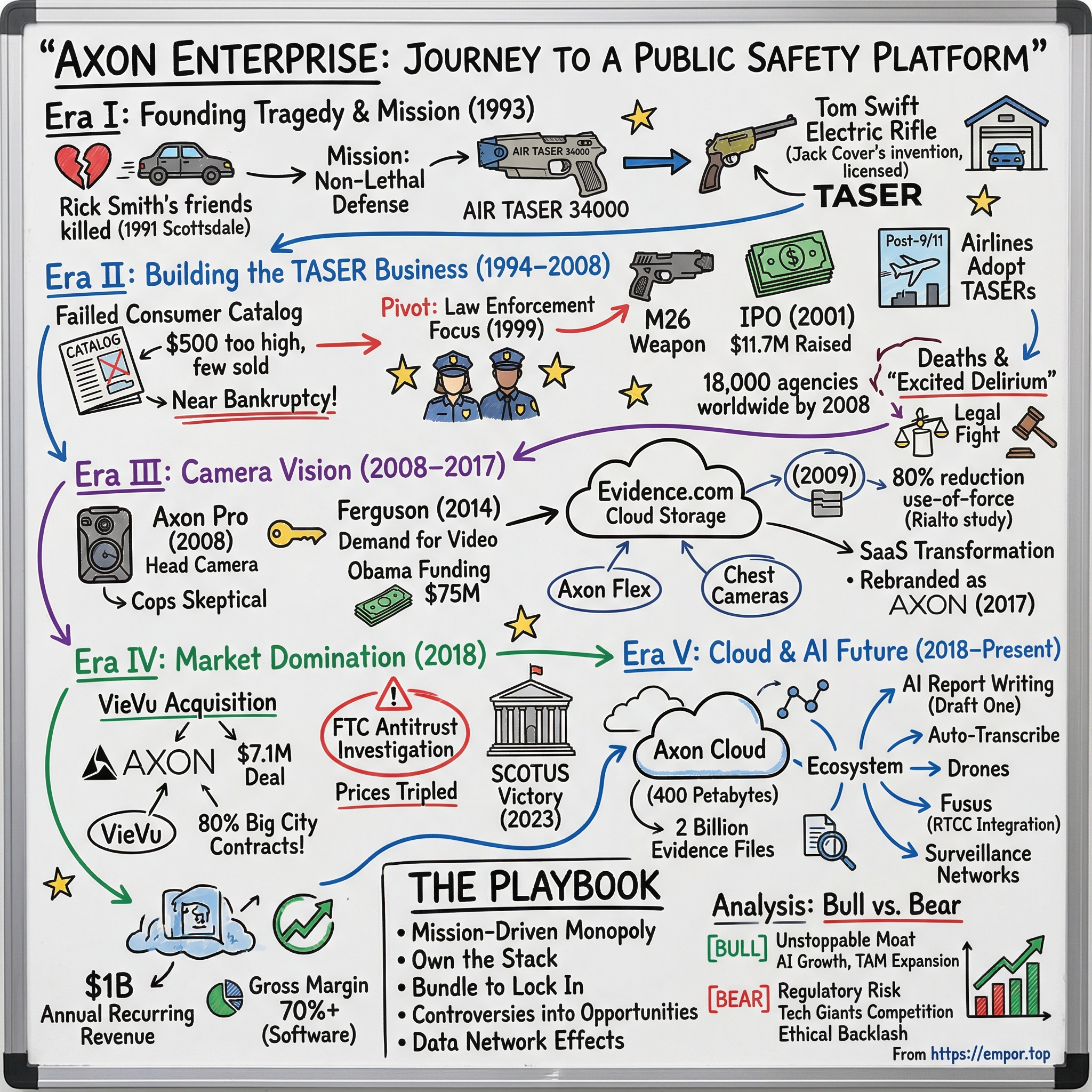
Axon Enterprise: From Garage Startup to Public Safety Platform Monopoly
I. Introduction & Episode Roadmap
On the afternoon of August 5, 2026, Rick Smith opened Axon's second-quarter earnings call by describing his commute. His Cybertruck had driven him to work without his hands on the wheel. Two days earlier, an unreleased artificial intelligence model had solved ten open problems in mathematics for a compute cost he estimated at roughly $200 per problem. "The impossible becomes remarkable," he told analysts, "and then it becomes Tuesday."1
It was an unusual opening for a hardware earnings call. Yet Smith has spent 33 years arguing that the middle phase of that transition—the point where a novel technology turns routine—is where sustained profit lies. He built a business on that premise twice: first selling electrified darts to police departments that initially viewed stun guns as a gimmick, and later selling cloud video storage to municipal IT departments that had never purchased software subscriptions.
As of August 2026, Axon Enterprise (NASDAQ: AXON) traded around $606 per share, yielding a market capitalization near $49 billion on trailing twelve-month revenue of $3.22 billion.2 Fiscal 2025 revenue reached $2.78 billion, representing a 33.5% year-over-year increase.3 For the quarter ending June 2026, revenue hit $904 million, marking Axon's tenth consecutive quarter of revenue growth above 30%. Annual recurring revenue reached $1.6 billion, up 39%; net revenue retention stood at 126%; and future contracted bookings—representing signed contracts awaiting delivery—totaled $15.1 billion.4
While those figures reflect substantial expansion for a company that originated with a plastic handheld device firing wire-tethered probes, they offer an incomplete picture. Over the preceding 52 weeks, Axon shares traded between a high of $794.29 and a low of $339.01.2 The stock declined in calendar 2025, marking its first annual drop in a decade.5 In fiscal 2025, GAAP operating income was negative, and free cash flow came in at roughly $75 million against adjusted EBITDA exceeding $700 million.3 Up close, the image of an uninterrupted compounder gives way to active debates over earnings quality, stock dilution, tariffs, regulation, and the durability of an AI-era sensor network.
The analysis unfolds across five acts.
The first act details the company's origins and hardware crucible from 1993 to 2008: a personal tragedy, an ex-NASA physicist's abandoned patent, a consumer device launch that nearly caused bankruptcy, and a pivot to public safety buyers that preserved the business.
The second act covers the cloud pivot from 2008 to 2017: the realization that a body camera functions primarily as a data-ingest mechanism, and that controlling evidence storage creates long-term customer lock-in.
The third act examines consolidation and conflict from 2018 to 2023: acquiring its main competitor at a low price, then pursuing the resulting antitrust dispute to the Supreme Court rather than settling.
The fourth act addresses current operations: real-time situational awareness, counter-drone technology, generative AI report drafting, and a 911 dispatch unit built through more than $1.3 billion in acquisitions over 15 months.
The fifth act delivers the core analysis: segment economics, executive incentive structures, competitive dynamics, and an evaluation of key downside risks.
Why it matters to investors: Axon represents a rare example of a hardware manufacturer that transitioned into a high-margin software platform while retaining its physical product line, serving a customer base composed almost entirely of government agencies. Because both characteristics present distinct advantages and liabilities, the central analytical question is determining which force will drive long-term returns.
 Subscribe on LinkedIn
II. The Founding Tragedy & The Garage Years (1993–2001)
The company's origins trace to a personal tragedy. In the early 1990s, two of Rick Smith's high school teammates were shot and killed in a road-rage incident.6 Smith had no background in weaponry; he graduated cum laude from Harvard University in three years in 1991, earned a master's degree in international finance from the University of Leuven in Belgium, and completed an MBA at the University of Chicago in the top 5% of his class.7 In the summer of 1993, he left graduate school with a business concept, a personal motive, and a partner: his brother.
That September, Rick and Thomas P. Smith co-founded the entity that would eventually become Axon.7 The business began operations in Arizona in 1993 to develop and manufacture less-lethal self-defense devices.8
Buying a dead man's invention
The underlying technology already existed, but it had failed commercially. In the 1970s, Jack Cover, a former NASA physicist, invented an electroshock weapon named after the boyhood adventure novel Tom Swift and His Electric Rifle. Cover's device propelled its darts using gunpowder. That design choice proved commercially fatal: gunpowder classified the device as a firearm under U.S. law, subjecting it to strict gun regulations while lacking the stopping power associated with traditional firearms.
The Smiths' key contribution lay in changing the propellant rather than the core physics. Working alongside Cover, they redesigned the launch mechanism to use compressed gas instead of an explosive charge.6 By eliminating gunpowder, the device bypassed firearm regulation and was categorized legally as a consumer product—the market segment the founders initially targeted.
Commercially, the critical technical distinction lies between pain compliance and neuromuscular incapacitation. A conventional stun gun relies on pain via direct contact, which motivated or impaired individuals can often withstand. The Smiths instead developed a system that fires two barbed probes on conductive wires over several meters, delivering electrical pulses calibrated to override the neuromuscular signals that control skeletal muscle contraction. By causing involuntary muscle spasms rather than relying on pain tolerance, the device provided law enforcement with a reliable incapacitation tool—an engineering feat that took nearly a decade to refine.
The consumer business that nearly ended it
Axon's early history highlights an enduring vulnerability: attempts to market directly to consumers. From inception through 1994, the company operated as a development-stage enterprise.8 Its initial product, the AIR TASER, launched in 1994 targeting civilian self-defense. Throughout 1995 and 1996, management focused on establishing retail distribution channels.8 The retail strategy failed to generate sustainable demand, pushing the company near bankruptcy by the late 1990s.6
Corporate disclosures reveal that the shift to law enforcement was driven by contractual constraints as much as strategic insight. Company filings note that initial consumer marketing efforts "were limited by a non-compete agreement that prohibited the marketing or sale of our products to the U.S. law enforcement and military markets," a restriction that expired in 1998.8 The founders targeted retail buyers largely because legal agreements barred them from selling to institutional public safety agencies during the company's first five years.
Ahead of the agreement's expiration, management redirected research and development toward a law-enforcement-grade product. The company reasoned in regulatory filings that "the most effective method of penetrating the consumer and private security markets was through the de facto endorsement of the law enforcement community."8 What was originally intended as an institutional endorsement strategy for civilian sales ultimately became the company's core commercial focus.
Axon introduced the ADVANCED TASER to the law enforcement market in December 1999.8 In 2000, the company focused primarily on training and distribution rather than direct sales. Smith personally toured the country in a motorhome to conduct instructor certification courses, recognizing that law enforcement agencies required certified trainers before deploying new weaponry.6 This nationwide training effort established Axon's initial competitive moat: an embedded network of certified instructors across municipal police departments.
The 2001 listing
The company went public in 2001 through a modest initial public offering. Axon sold 800,000 units at $13.00 each—with each unit consisting of one and a half common shares and one and a half warrants—generating net proceeds of approximately $8.4 million to retire debt, build inventory, and fund sales and marketing.8 By comparison, that entire equity raise is less than Axon's current quarterly expenditure on cloud infrastructure.
A commercial turning point occurred shortly before the IPO, when the Sacramento Police Department contracted to equip every patrol officer.6 This contract established full agency-wide deployment—one device per officer rather than shared station equipment—as the primary unit of adoption in public safety hardware.
The garage years demonstrated that institutional customer alignment, rather than consumer appeal, drove the company's commercial viability. Axon spent five years near insolvency before finding rapid growth by shifting from retail consumers to municipal buyers. The operational capabilities built during this period—agency-wide deployment models, instructor certification programs, and direct relationships with law enforcement leadership—formed the playbook for Axon's subsequent enterprise growth, even as future expansion occasionally re-tested consumer markets.
III. Building the Hardware Monopoly & The Trial by Fire (2001–2008)
By late 2003, the company faced an operational challenge common to rapidly expanding technology startups: revenue growth was outstripping public and institutional credibility.
Revenue in 2003 reached $24.5 million, representing a 148% increase from $9.8 million the prior year.8 Annual weapon shipments more than doubled from 14,799 units to 32,235, while single-use cartridge sales—the high-margin consumable in the business model—more than doubled to nearly 400,000 units.8 By year-end, more than 4,300 U.S. law enforcement agencies were deploying TASER-brand weapons, with 506 having initiated or completed full one-device-per-officer rollouts.8
Three strategic moves in 2003 established the foundation of the company's hardware franchise.
Product, patent, and the elimination of the only rival
In May 2003, the company introduced the TASER X26 to its master instructors, and commercial shipping began that September.8 The X26 was smaller and lighter than predecessor models, featuring what management termed "shaped pulse" technology—an engineering refinement that delivered the same neuromuscular incapacitation using lower energy output. This enabled a compact form factor designed for daily duty-belt wear. For an enterprise selling one unit per officer, ergonomic wearability was critical to ensuring daily operational use rather than storage in patrol car trunks.
On June 26, 2003, the company acquired TASER Technologies and Electronic Medical Laboratory (doing business as Tasertron)—described in corporate disclosures as "its sole competitor in the manufacture and sale of TASER conducted energy weapons to law enforcement."8 The transaction secured clear title to the TASER trademark, expanded its patent portfolio, and eliminated active litigation alongside market confusion.
On October 21, 2003, the company was granted what it termed a fundamental patent on the ADVANCED TASER waveform, covering electrical impulses across a wide energy band around the M26 model's output.8 Management explicitly described the patent as part of a strategy "to build strong barriers to entry for new competitors."8
Together, these events established a pattern that recurred throughout the company's corporate history: develop a superior product, acquire the primary rival, and protect the category behind intellectual property. While effective commercially, the strategy eventually drew federal antitrust scrutiny fifteen years later.
The trial by fire
Rapid adoption of a novel weapon category brought intense public scrutiny. As agency deployments expanded, in-custody deaths following device use increased, triggering product liability lawsuits alleging design defects, manufacturing flaws, and failure to warn. Advocacy organizations such as Amnesty International campaigned against deployment, while medical examiners, plaintiffs' attorneys, and civil liberties groups debated causation.
Management responded by establishing an internal litigation defense and medical-science research infrastructure, opting to contest nearly every lawsuit rather than settle. That stance remains explicit in corporate disclosures: "As a general rule, it is our policy not to settle suspect injury or death cases."3 The defense strategy relied in part on the diagnosis of excited delirium—attributing deaths to acute physiological distress or severe drug intoxication rather than electrical current—a medical concept that subsequently lost support among major medical associations but influenced courtroom outcomes for over a decade.
The historical record presents nuances that challenge simplified bullish and bearish narratives alike.
On one hand, the litigation defense strategy proved durable. In its fiscal 2025 annual report, published more than two decades later, Axon disclosed being named as a defendant in just three product liability suits alleging wrongful death or personal injury, noted that it self-insures the first $5.0 million of any product claim made after 2014, and stated that no judgment or settlement has ever exceeded that amount in any product liability case.3 For a manufacturer selling millions of devices into high-liability law enforcement environments, this track record indicates that external markets have historically overstated catastrophic product liability risk.
On the other hand, the primary damage during the mid-2000s stemmed from regulatory scrutiny and stock volatility rather than courtroom verdicts. In December 2004, the company was informed that Securities and Exchange Commission staff had initiated an informal inquiry into public statements regarding product safety, disclosure issues, and accounting transactions; a formal investigation followed on June 20, 2005, expanding to examine potential unauthorized acquisition of confidential company information by third parties seeking to manipulate the stock. In December 2005, SEC staff advised that it had completed its review of medical-safety disclosures and accounting questions without recommending enforcement proceedings, while continuing to investigate share trading.9 Investors reacted sharply before the regulatory resolution: shares fell 18% upon the initial January 2005 announcement of the inquiry, and dropped an additional 30% days later following reports of potential order delays.10 Shareholder class-action lawsuits followed, which the company eventually settled for $20 million without admitting fault.10
The analytical conclusion from this period is more nuanced than typical bull or bear arguments suggest. The risk of catastrophic product liability—that device safety issues would generate company-threatening legal liabilities—has been tested across two decades without materializing. By contrast, regulatory disclosure and expectations-management risks proved real, causing substantial financial and market impact. Investors must distinguish between product safety litigation and disclosure governance rather than conflating them into a single litigation risk.
The consumer relapse
In July 2007, with its law enforcement position established, the company revisited the civilian consumer market. It launched the TASER C2, a personal safety device offered in various colors including metallic pink, which management framed as a major new growth vector.
The initiative failed to deliver meaningful scale. Consumer product sales accounted for approximately $7.6 million, or 8% of net sales, in 2008, and dropped to approximately $5.9 million, or 6%, in 2009.11 For a company generating over $100 million in annual revenue by 2009, a consumer segment that failed to exceed single-digit percentages of revenue across two major attempts demonstrated the limits of civilian market expansion.
This historical pattern remains relevant to Axon's current valuation. The contemporary bullish thesis relies significantly on expanding into commercial enterprise sectors—such as retail, healthcare, utilities, and data center security—as a secondary growth pillar comparable to public safety. Management highlighted on recent earnings calls that commercial enterprise pilots are converting, with enterprise bookings increasing approximately threefold year over year in the quarter ending June 2026.1 However, historical results show that adjacent non-law-enforcement markets have previously struggled to scale under the company's sales model. While commercial enterprise buyers differ from retail consumers, the burden of proof rests on management to demonstrate that enterprise expansion can become a disclosed, material revenue segment with distinct retention metrics rather than a narrative relying on bookings growth off a small baseline.
By 2008, the core hardware business faced a structural limit: domestic police departments were approaching saturation, reducing the pool of unequipped officers.
IV. The Great SaaS Pivot: Body Cams & Evidence.com (2008–2017)
The most consequential product decision in Axon's history was made in response to a growth problem, not a moral one.
By the late 2000s, the conducted-energy device business faced the classic limitation of single-product hardware operations: core market saturation. The customer base remained fixed, deployment models were established, and incremental sales relied primarily on replacement cycles and cartridge refills. Net sales in 2009 grew 12% to $104.3 million.11 The market valued the company accordingly—as a cyclical manufacturer of a controversial device, burdened by an unpredictable municipal order book and a recent SEC inquiry.
The camera that did not work
The initial attempt at a second product line was a wearable camera, though the hardware proved ahead of customers' operational capacity.
In 2009, the company devoted significant resources to designing an end-to-end digital evidence collection and management solution, pairing a wearable recorder with a hosted platform. Filings described the recorder as "a tactical networkable computer combining advanced audio-video record/capture capabilities worn by first responders," built around an earpiece integrated into the officer's communications loop.11 TASER announced the combined system publicly in March 2009 and targeted a commercial release for that third quarter.12
The physical device was not the primary barrier; downstream data management was. A body camera running across an entire shift generates hours of high-resolution video per officer daily. Multiply that volume across a department of 1,000 officers, and a municipal agency effectively becomes a video hosting enterprise—one required to store footage for statutory retention periods, redact faces and juvenile imagery prior to public release, maintain an auditable chain of custody to withstand evidentiary challenges in court, and deliver files in courtroom-compatible formats. In 2010, municipal IT infrastructure was ill-equipped for those demands. Local servers reached capacity, storage drives failed, and prosecutors routinely rejected unstructured video transfers.
Standalone camera hardware, in other words, was not just a standalone product; it represented an unmanageable liability transfer from vendor to customer.
The insight, and the model
Rick Smith's reframing—that the camera functions primarily as an ingest sensor and the true product is evidence management—became the operational pivot underpinning the modern business. The strategic shift appeared in corporate disclosures as early as the 2009 annual report, where management signaled plans to reduce investment in weapon hardware development for 2010 while increasing capital allocated to camera hardware and cloud services.11
The platform, eventually branded Evidence.com, operated less like a conventional video repository and more like a CJIS-compliant chain-of-custody system. To accept police data legally, the software had to meet the FBI's Criminal Justice Information Services security standards, which govern the storage, transmission, and access of law enforcement records across the United States. That stringent compliance barrier required substantial time and capital to satisfy, preventing generic cloud storage providers from easily capturing the market.
The commercial architecture formed the second half of the strategy. Rather than selling cameras through upfront capital purchases, Axon introduced a subscription model that bundled hardware, scheduled equipment refreshes, software licenses, and cloud storage into a fixed monthly rate per officer. By 2018, this packaging was formalized as the Officer Safety Plan 7 at $149 per user per month, bundling a TASER 7 weapon, a real-time body camera, an unlimited Evidence.com license, and five years of records management software; a Plus tier at $199 added automated redaction, auto-tagging, and performance analytics.13
Pricing hardware within a recurring subscription achieved three structural outcomes. First, it converted volatile equipment sales into predictable recurring revenue. Second, it shifted customer purchasing from municipal capital expenditure budgets—which require lengthy authorization cycles—to operating budgets, which are far easier to approve politically and administratively. Third, it enabled scheduled hardware upgrades on a predictable timeline, preventing the installed user base from aging into opportunities for emerging competitors.
Ferguson, and the myth of the federal mandate
A common narrative asserts that the August 2014 shooting of Michael Brown in Ferguson, Missouri, produced a federal body-camera mandate, prompting an influx of federal funding that drove Axon's expansion.
The historical record supports only the initial premise regarding heightened public attention. Federal funding remained minimal. The U.S. Department of Justice's Body-Worn Camera Pilot Partnership Program awarded approximately $19.3 million in its 2015 grant round across 73 agencies in 42 states, supporting the purchase of roughly 21,000 cameras—despite receiving requests for $56 million from 285 departments.1415 In a nation with nearly 700,000 sworn law enforcement officers, 21,000 cameras represented a small fraction of total demand. No federal mandate was enacted. Instead, events in Ferguson catalyzed political pressure at municipal and state levels, compelling mayors and city councils to approve technology procurement contracts that local officials had previously deferred.
A second widely cited narrative warrants similar scrutiny. Axon's sales teams heavily cited the Rialto experiment—a one-year randomized controlled trial conducted at the Rialto, California Police Department that reported roughly a 90% decline in citizen complaints and a 59% drop in use-of-force incidents.16 While those dramatic statistics proved highly persuasive in municipal procurement meetings, they failed to replicate in larger, independent studies. A comprehensive randomized trial involving 2,224 officers at Washington, D.C.'s Metropolitan Police Department, conducted from June 2015 through March 2017, found that body-worn cameras had negligible and statistically insignificant impacts on use of force, citizen complaints, and judicial outcomes.17
This discrepancy highlights a key analytical distinction between marketing claims and empirical outcomes. Body cameras achieved widespread adoption due to legitimate demands for accountability, evidentiary documentation, public transparency, and political credibility. However, the specific behavioral reductions initially used to market the technology did not hold up under broader clinical testing. That distinction remains relevant when evaluating current product claims, which continue to rely on single-agency case studies provided by the vendor and adopting departments.
In April 2017, the company formally renamed itself Axon Enterprise. The rebrand signaled a strategic transition: the conducted-energy weapon was now one physical sensor within a broader ecosystem, and the enterprise aimed to be valued primarily as a software provider.
Yet dominating a lucrative software niche inevitably invites competitive scrutiny.
V. The VieVu Roll-Up & The FTC Antitrust Showdown (2018–2023)
In May 2018, Axon acquired its primary rival in body-worn cameras for a purchase price that was modest by technology industry standards.
VieVu was the body camera division of Safariland, a major police equipment conglomerate. Although financially troubled and losing market momentum, VieVu held a critical strategic asset: primary supply contracts with major metropolitan police departments, including the New York City Police Department. Axon acquired the business for approximately $7 million in upfront cash and stock.18
For perspective, that purchase price represented roughly 1% of Axon's 2025 research and development expenditure of $684 million.3 At a fraction of a single year's R&D budget, the acquisition eliminated Axon's primary competitor in high-profile municipal procurement tenders across the United States.
How observers characterize the acquisition encapsulates the core antitrust dispute. In an administrative complaint, the Federal Trade Commission asserted that before the merger, Axon and VieVu "competed to sell body-worn camera systems that were particularly well suited for large metropolitan police departments," that the deal "reduced competition in an already concentrated market," and that it "allowed Axon to impose substantial price increases."19 Axon countered in regulatory disclosures, describing VieVu as merely "an insolvent body camera competitor."3
The two perspectives highlight contrasting interpretations of the transaction. The FTC framed the deal as the deliberate elimination of a viable rival, while Axon presented it as the absorption of a failing enterprise. Paying $7 million for a competitor rarely signals a thriving standalone business, yet a failing firm's existing municipal contracts can hold immense value for the sole remaining bidder—precisely the scenario targeted by federal antitrust legislation.
The decision not to settle
On January 3, 2020, the Commission voted 5-0 to issue an administrative complaint against Axon and Safariland.19 Safariland settled quickly, agreeing to terms in April 2020 that were finalized on June 11, 2020.20
Axon took a far more aggressive approach. Facing an internal FTC administrative proceeding—a forum in which the agency oversees the process, employs the administrative law judge, and hears initial appeals—Axon sued the FTC in federal district court. The company challenged the constitutional legitimacy of the agency's administrative structure, arguing that its administrative law judges lacked sufficient executive oversight under Article II of the U.S. Constitution.
Mounting a constitutional challenge required significant financial resources and executive attention from a mid-sized public safety vendor. The internal administrative trial was scheduled to begin on October 13, 2020, but was stayed after the Ninth Circuit Court of Appeals intervened.20
On April 14, 2023, the Supreme Court ruled unanimously in favor of Axon. Writing for the Court, Justice Elena Kagan held that the statutory review scheme in the FTC Act does not displace federal district courts' jurisdiction over constitutional challenges to the agency's structure or existence.21 Justice Clarence Thomas filed a concurring opinion, and Justice Neil Gorsuch concurred in the judgment.
The decision altered the trajectory of the regulatory action. The Commission withdrew the administrative matter from adjudication in June 2023 and officially dismissed its complaint on October 6, 2023.20 The outcome required no consent decree, no asset divestiture, and no operational restrictions.
What the record actually shows about pricing power
A superficial review suggests that Axon acquired market dominance for $7 million, successfully fended off federal regulators, and validated its competitive moat. A closer analysis of the legal and commercial record reveals a more complex reality.
First, the Supreme Court decision resolved a jurisdictional question regarding where constitutional challenges can be filed; it did not evaluate whether the VieVu transaction complied with antitrust laws. The FTC's allegations of price inflation were abandoned rather than disproven. The distinction between regulatory dismissal and legal vindication is reflected in corporate disclosures. Axon's fiscal 2025 annual report notes that despite the FTC dismissal, "other parties continue to allege that our May 2018 acquisition of an insolvent body camera competitor, Vievu LLC, was anticompetitive," acknowledging a pending class-action antitrust lawsuit in federal district court in New Jersey brought by three municipalities based largely on the FTC's unproven allegations.3 True to its long-standing legal strategy, management is contesting the suit rather than settling, leaving antitrust risk as an ongoing consideration for investors.
Second, empirical evidence on post-merger pricing remains inconclusive. While the FTC alleged post-acquisition price hikes and Axon denied anticompetitive practices, public filings document a substantial rise in total subscription bundle pricing. Management reported in February 2026 that its highest-tier officer subscription plans generate average annual revenue per user approaching $600, compared to less than $250 for its top plan five years prior.22 However, this expansion in realized revenue per user reflects expanded offerings rather than simple price inflation on legacy hardware. Contemporary tiers incorporate counter-drone integration, records management, real-time dispatch, virtual reality training, and generative AI features that were unavailable in 2020. The public record does not isolate how much of the revenue expansion stems from pricing power versus added software functionality.
Where the acquisition delivered undeniable value was in securing market architecture. By acquiring VieVu's municipal contracts in major metropolitan areas, including New York City, Axon established its cloud and evidence ecosystem as the de facto operational standard across police departments, prosecutors' offices, and judicial systems. Once deeply embedded within law enforcement and judicial workflows, digital infrastructure standards create high switching costs that are difficult for competitors to disrupt.
The transaction also illustrates an enduring pattern in Axon's capital allocation strategy. On two occasions—Tasertron in 2003 and VieVu in 2018—the company acquired its sole direct competitor in a key product category for purchase prices that were modest relative to the resulting strategic advantages. Acquiring distressed rivals allowed Axon to consolidate market share efficiently. However, repeating this playbook heightens regulatory scrutiny over future M&A activity, particularly as subsequent acquisitions have required far greater capital deployment.
VI. The Modern Axon Flywheel: Cloud, AI, & Strategic M&A (2018–Present)
Walk into a modern American real-time crime center, and the environment feels closer to an air traffic control tower than a traditional police precinct. A central wall of monitors displays a live city map populated by digital markers: active patrol cars, body camera video streams, license plate reads, airborne drones, and registered feeds from private commercial property. When a 911 call arrives, the location, transcript, automated translation, and nearest available sensors converge on a single operator screen within seconds.
Axon's strategic narrative for the coming decade rests on owning every link in that operational chain. On the company's June 2026 earnings call, Smith highlighted the etymology of the corporate name: an axon is the biological nerve fiber that transmits signals from sensory organs to the brain, and carries decisions back out to the body. "We didn't pick a name that just sounded good," Smith told analysts. "We picked a description of what we were building."1
Behind the metaphor, Axon's core business operates across three distinct functional layers.
The layers
The sensing layer encompasses physical hardware: TASER devices, body-worn cameras, in-car video systems, fixed license plate readers, drones, and counter-drone hardware. Reported under the Connected Devices segment, this hardware layer generated $1.58 billion in fiscal 2025 revenue. Within that total, TASER weapons accounted for roughly $914 million, personal sensors generated $397 million, and platform solutions added $266 million.3
The system-of-record layer consists of software: Axon Evidence for digital evidence management, Axon Records and Standards for report and incident handling, Axon Respond for real-time telemetry, and Axon Fusus for citywide operational mapping. This software segment produced $1.20 billion in fiscal 2025 revenue, growing 39.6% year over year—outpacing hardware expansion and serving as the primary growth driver behind the company's software valuation thesis.3
The intelligence-and-action layer represents Axon's newest operational tier, absorbing the majority of its capital deployment over the past two years.
Draft One, and what a pilot statistic is worth
Axon launched Draft One on April 23, 2024. The software extracts audio from body-worn cameras, generates a text transcript, and drafts the narrative section of an incident report, requiring mandatory review and signature by an officer before submission. Powered by Microsoft's Azure OpenAI Service, the product saved roughly one hour of paperwork per officer per day during agency field trials, according to company disclosures.23
For public safety administrators, that efficiency metric offers a compelling value proposition. Reclaiming an hour per shift across an eight-officer patrol team effectively creates an extra full shift of operational capacity without additional headcount—a vital benefit for law enforcement agencies facing chronic recruitment deficits. Draft One represents Axon's most immediate product-market alignment since the body camera.
However, the feature also introduces concentrated regulatory and evidentiary risks across the company's product line.
Legal and regulatory pushback materialized quickly. The prosecuting attorney's office in King County, Washington, notified law enforcement agencies that it would refuse AI-generated police reports, citing hallucination risks and potential credibility damage to officer testimony during prosecutions.24 In Utah, lawmakers passed SB 180, effective May 2025, requiring public safety agencies to establish formal generative AI policies, append disclaimers to AI-assisted documents, and enforce explicit officer accuracy certifications.25 California enacted stricter mandates under SB 524, requiring mandatory disclosure of AI usage, prohibiting vendors from monetizing or sharing agency data, and compelling the retention of original AI-generated drafts so defense attorneys and judges can audit modifications made by human officers.26
California's draft-retention mandate directly challenges Axon's product architecture. The Electronic Frontier Foundation reported that Draft One automatically overwrites initial AI drafts upon officer editing, citing an internal corporate rationale aimed at limiting disclosure burdens for municipal clients.2726 In jurisdictions requiring draft preservation, the platform cannot be deployed in its initial configuration without software modifications.
These regulatory responses indicate that AI-assisted reporting is unlikely to experience frictionless adoption across a uniform national market. Instead, Draft One is evolving into a complex state-by-state compliance tool requiring regional feature modifications, audit logging, and discovery safeguards. While these requirements increase ongoing support costs and moderate deployment speed, they also establish structural entry barriers for smaller AI startups lacking the compliance infrastructure to navigate fragmented state rules. For investors, the long-term viability of the product will hinge on judicial precedent: an appellate ruling affirming the admissibility of AI-drafted reports under standard review protocols would validate the bull case, whereas a high-profile prosecution failure caused by AI hallucination would confirm bear concerns.
The acquisitions, and what they cost
Axon's M&A strategy historically followed a consistent playbook: secure a minority venture position, evaluate operational performance over several years, and acquire the remaining equity.
On January 31, 2024, Axon completed the acquisition of real-time crime center platform Fusus, acquiring the remaining 79.7% equity interest for approximately $241.3 million in incremental consideration. Axon's pre-existing 20.3% stake was revalued to $63.3 million at closing, generating a non-taxable gain of $42.3 million.3
On October 1, 2024, the company acquired counter-drone technology provider Dedrone. Axon paid approximately $391.1 million in incremental consideration for the remaining 79.8% stake, revalued its prior 20.2% holding to $112.2 million, and recognized a $51.6 million gain.3
Subsequent transactions marked a major shift in deal scale. On October 1, 2025, Axon acquired the remaining 99.2% of Invictus Apps (operating as Prepared), an AI-enabled emergency communications business, paying $624.1 million in cash as part of $728.2 million in total incremental consideration.3 Five weeks later, on November 4, 2025, Axon agreed to acquire Carbyne, a cloud-native 911 dispatch platform serving public safety agencies covering over 250 million people, for a base cash purchase price of $625.0 million; the transaction closed in February 2026.283
This strategic shift carries two key financial implications. First, Axon committed roughly $1.35 billion to enter the 911 dispatch sector in roughly four months—more than double the combined incremental cost of Fusus and Dedrone. The expansion was funded in part by issuing $1.75 billion in senior notes in March 2025, moving the company beyond its historical pattern of minor tuck-in acquisitions.3 Second, the step-acquisition structure creates a notable accounting dynamic: because pre-existing minority stakes are remeasured to fair value upon closing, Axon reports non-cash accounting gains that increase GAAP net income during deal years, despite representing unrealized revaluations of prior venture positions.
Initial operational performance from earlier acquisitions shows measurable commercial progress. In May 2026, management disclosed that combined bookings tied to Fusus and Dedrone exceeded 1.5 times their aggregate purchase price.29 By the quarter ending June 2026, Dedrone achieved an annualized revenue run rate above $100 million, while the broader platform solutions line grew 123% year over year to $150 million.4 High-profile deployments further demonstrated product adoption: Dedrone provided airspace monitoring across eleven U.S. host cities and over fifty secondary venues during World Cup events, and Axon secured a spot among selected vendors in a $1.5 billion Department of Homeland Security counter-drone procurement program, though management noted that its precise revenue allocation remains undetermined.1
While early M&A integration has produced strong revenue conversion, total balance sheet goodwill rose to $1.37 billion by year-end 2025 without recorded impairment losses.3 The 911 dispatch expansion represents a higher-risk operational test, positioning Axon in direct competition with established legacy call-center vendors rather than entering unserved technology niches.
Whether this expanded product footprint yields compounding returns or capital inefficiency will depend on underlying unit economics and recurring revenue conversion.
VII. Business Model, Financial Architecture, & Segment Economics
Effective January 1, 2025, Axon reorganized its reporting structure into two primary segments—Connected Devices, and Software and Services—retiring its former division between TASER weapons and Software and Sensors.3 The realignment was more than cosmetic. It shifted the company away from treating weapons as standalone products, consolidating all data-capturing sensors and related offerings into a unified commercial framework that reflects how Axon packages its platform.
The engine
The underlying commercial model is straightforward. Axon sells per-officer, per-month subscriptions that bundle hardware devices, scheduled equipment refreshes, software licenses, cloud storage, professional training, and an expanding suite of artificial intelligence features. Public safety agencies enter into long-term commitments—often spanning five to ten years for U.S. state and local customers. While revenue recognition is split across hardware and service lines for accounting purposes, the customer receives a single unified subscription invoice.
Three structural consequences follow from this commercial model.
The first is revenue visibility. Future contracted bookings—representing signed contracts awaiting delivery—reached $15.1 billion for the quarter ending June 2026, marking a year-over-year increase of more than 40% against trailing twelve-month revenue of roughly $3.2 billion.4 This provides Axon with four to five years of contracted revenue visibility, a backlog rarely seen in commercial hardware or software enterprise models.
The second consequence is net expansion within existing accounts. Net revenue retention reached 126% in the June 2026 quarter, indicating that existing agency cohorts spent 26% more than in the prior-year period, excluding contributions from new agency clients.4 Achieving expansion of that magnitude alongside near-zero customer churn reflects cross-selling success rather than pure price realization. Management disclosed that products outside the core evidence management platform now account for more than a third of software revenue, expanding roughly 70% year over year, while revenue from its AI-driven features grew nearly 700% off a modest initial baseline.41
The third consequence is working-capital intensity: the subscription model consumes cash upfront before generating operational cash flow over time.
The cash flow problem
In fiscal 2025, Axon reported adjusted EBITDA exceeding $700 million, representing an adjusted EBITDA margin of 25.5%.22 However, operating cash flow reached $211.3 million while capital expenditures totaled $136.3 million, resulting in free cash flow of roughly $75 million.3 Relative to management's long-term financial target of converting approximately 60% of adjusted EBITDA into free cash flow, fiscal 2025 delivered a conversion rate of roughly 10%.22
The mechanical drivers are evident on the cash flow statement: accounts receivable growth absorbed $505.6 million in cash during the year, while inventory expansion consumed an additional $82.0 million.3 Delivering a ten-year subscription bundle requires upfront hardware shipments while cash collections occur over a decade; consequently, accelerating bookings growth expands the working capital requirement in the short term. Management has stated that it is also intentionally expanding inventory balances. In May 2026, President Josh Isner noted that management authorized a significant inventory investment in core hardware, citing TASER lifespans of ten to fifteen years and body camera refresh cycles of five years as justification for minimal inventory obsolescence risk.29
While logically consistent, that positioning establishes an operational test. Management guided to full-year 2026 free cash flow of approximately $450 million and reaffirmed that outlook in August, while acknowledging that first-half free cash flow was negligible and that cash generation is heavily back-half weighted with pronounced fourth-quarter seasonality.291 Achieving a sixfold year-over-year expansion in free cash flow—concentrated primarily in the final quarter—represents a key near-term execution metric for evaluating management's guidance discipline.
Earnings quality
Evaluating earnings quality also requires examining stock-based compensation. Total stock-based compensation expense reached $634.2 million in fiscal 2025, up from $382.6 million in 2024 and $131.4 million in 2023.3 On fiscal 2025 revenue of $2.78 billion, equity-based compensation represented approximately 23% of total revenue. Consequently, GAAP operating income for the year was negative $62.1 million, while GAAP net income of $124.9 million was supported by non-operating factors, including $186.4 million in realized and unrealized gains on strategic investments.3
While fully disclosed in corporate filings, these accounting adjustments create a substantial divergence between the adjusted performance metrics emphasized by management and reported GAAP results. As a result, a portion of the company's reported operating leverage is absorbed through equity dilution rather than cash expenses on the income statement. Management has committed to maintaining average annual dilution below 2.5% and projects that stock-based compensation dollars will remain roughly flat over the near term, decreasing as a percentage of overall revenue.2229 Both commitments serve as measurable benchmarks for future financial performance.
Margins, tariffs and memory
Adjusted gross margin reached 62.9% in the quarter ending June 2026, up 130 basis points sequentially, though the expansion was driven primarily by tariff refunds rather than core structural efficiency gains.1 Reuters reported that gross margin performance for the quarter was tempered by a higher proportion of lower-margin professional services and initial scaling costs for new hardware platforms.30 Looking ahead, management projected lower third-quarter margins due to rising memory component costs and the absence of one-time tariff refunds, before anticipating a fourth-quarter recovery to achieve its full-year adjusted EBITDA margin target of 25.5%.1
These cost dynamics highlight a key fundamental characteristic of Axon's business: despite its software transition, the company remains a hardware manufacturer with tangible component costs, subject to import tariffs, memory price fluctuations, and global supply chain constraints—exposures that have historically driven sharp short-term market volatility.
Throughout fiscal 2026, management raised full-year revenue growth guidance across consecutive quarters—increasing its target from an initial range of 27% to 30% in February, to 30% to 32% in May, and to 32% to 34% in August—while maintaining its full-year adjusted EBITDA margin target at 25.5%.22294 This sequence demonstrates a consistent guidance methodology of establishing achievable revenue expectations without adjusting profitability targets upward to match top-line revisions.
VIII. Competitive Landscape, Helmer's 7 Powers, & Porter's 5 Forces
Ask a police chief why an agency remains with Axon, and the explanation rarely centers on the cameras themselves.
Seven Powers, tested rather than asserted
Switching costs serve as Axon's primary strategic power and the most empirically supported. Replacing Axon Evidence requires exporting years of chain-of-custody-tagged video, re-establishing evidentiary integrity for ongoing court cases, retraining patrol officers, and re-orienting local prosecutors and judicial systems around a new file-sharing workflow. Customer behavior reflects these high switching friction points, evidenced by net revenue retention remaining above 120% alongside minimal customer churn.4 However, switching costs protect incumbency in both directions rather than creating an unassailable moat; Axon frequently wins municipal accounts from rivals when competing products fail on basic operational requirements, such as battery life across a full shift, prompting agencies to cancel contracts early.1
Network effects operate primarily at the regional perimeter rather than across a global user base. An agency using Axon can securely transfer evidence to local prosecutors via direct link, encouraging neighboring law enforcement bodies and district attorneys to standardize on identical workflows. The acquisition of Fusus extended this regional connectivity by integrating privately owned camera feeds, with management disclosing over 300,000 connected community cameras and more than one million monthly live video streams.22 Executive Vice President Jeff Kunins framed this architecture in August 2026 as a network effect operating within agencies, across neighboring jurisdictions, and into commercial market segments.1 However, this dynamic functions as a localized cluster network effect rather than a global network; a municipal police department in Manchester derives no operational benefit from a department in Memphis adopting the platform, constraining network-driven adoption in international expansion markets.
Cornered resource represents the weakest of the framework's powers in Axon's model. Although Axon hosts a vast repository of public safety data, the company acts as a custodian rather than an owner. CEO Rick Smith emphasized this boundary in August 2026, stating that customer trust remains "an incredibly valuable and fragile asset" and warning that compromising it "would be very damaging."1 Unilateral monetization or unapproved model training on agency-owned evidence would undermine the custodial relationship that underpins customer retention, narrowing Axon's data advantage relative to broader industry claims regarding proprietary data scale.
Counter-positioning proved decisive during Axon's initial SaaS transition but offers diminishing strategic protection today. In 2009, established public safety hardware vendors resisted cloud storage solutions due to legacy business models, allowing Axon to accept compressed initial hardware margins to secure high-margin recurring software subscriptions. Having demonstrated the viability of that commercial model, competitors across the sector have broadly adopted similar subscription structures.
Scale economies are most evident within Axon's operating cost structure. The company's six-year cloud hosting agreement, executed in June 2022, carries a total financial commitment of $425.0 million, including $110.6 million in annual storage fees for 2025.3 Amortizing cloud infrastructure commitments, regulatory compliance overhead, and specialized public safety sales channels across a broad agency base provides a clear unit-cost advantage against smaller entrants, though it offers limited cost differentiation against well-capitalized enterprise peers such as Motorola Solutions.
Process power—reflected in the institutional capability to deliver integrated hardware and software into complex, highly regulated public safety procurement systems—represents a durable operational advantage that emerging competitors frequently underestimate. Brand functions primarily as a risk mitigation mechanism for municipal procurement officers, establishing Axon as the default institutional selection.
Porter, briefly
Industry rivalry is intensifying across core software and sensor categories. Buyer power remains structurally significant, given that public safety clients operate under strict government procurement guidelines, municipal budget cycles, and political oversight. However, this power is counterbalanced by multi-year contract structures, substantial switching costs, and customer diversification, with no single agency accounting for more than 10% of net sales in 2023, 2024, or 2025.3 Supplier power exerted pressure during 2025 and 2026 through rising import tariffs and memory component price increases. The threat of substitutes remains low for comprehensive digital evidence repositories but elevated for discrete software capabilities, such as automated transcription, translation, and report generation, which specialized AI developers can replicate. Meanwhile, the threat of new entrants is actively reshaping competitive dynamics.
The rivals
Motorola Solutions represents Axon's most established competitor, holding a long-standing position in land mobile radio networks and emergency dispatch infrastructure. Motorola has expanded its video and artificial intelligence offerings, with video solutions accounting for 21% of its Software and Services segment net sales in 2025.31 Its core commercial strategy emphasizes bundling radio communication, emergency dispatch, records management, and video hardware into unified municipal contracts. Axon explicitly identifies Motorola in regulatory filings as a direct competitor across records management, real-time operational software, license plate recognition, and AI-assisted report drafting.3
Flock Safety emerged as a significant new competitor following the dissolution of a multi-year license plate recognition partnership with Axon. In February 2025, Axon terminated the partnership, with management alleging that Flock instituted technical barriers to integration; Axon subsequently introduced its own competing hardware lines, Axon Outpost and Axon Lightpost.32 Wall Street responded with concern over the creation of a well-capitalized rival: Northcoast Research downgraded Axon's stock, which dropped approximately 16% in a single trading session following the announcement.33 Flock subsequently raised $275 million at a $7.5 billion valuation in September 2025,34 reaching an estimated valuation near $8.4 billion by April 2026.35
Eighteen months after the separation, competitive dynamics have shifted toward Axon, driven largely by public policy and privacy oversight. As several municipalities paused or canceled Flock contracts in response to surveillance concerns, Axon designed its license plate recognition platform around strict data retention limits, auditable access logs, and query monitoring. President Josh Isner disclosed that combined bookings for Axon Outpost and Lightpost expanded from single-digit millions in the first half of 2025 to approximately $100 million over the subsequent twelve-month period.1 CEO Rick Smith added during the August 2026 earnings call that Axon is developing AI monitoring tools to detect anomalous database searches by law enforcement personnel, directly addressing public safety compliance concerns.1
This trajectory highlights a key operating reality in public safety technology: adoption is constrained less by technical capability than by political authorization and civil liberties compliance. Vendors that incorporate privacy protections directly into product design can capture market share when regulatory scrutiny intensifies across a hardware category. Whether Axon maintains these design constraints as its license plate recognition business expands remains a central operational question, as commercial incentives to expand data utilization typically increase alongside segment revenue.
Verkada competes primarily in commercial enterprise video environments that do not require specialized public safety compliance certification. Meanwhile, specialized software vendors such as Genetec, Mark43, Tyler Technologies, and CentralSquare compete across specific operational verticals, including dispatch, records, and municipal administration.
In counter-drone technology, Axon's risk disclosures identify a crowded competitive ecosystem that includes Anduril, DroneShield, D-Fend, and BlueHalo.3 Rather than seeking to manufacture proprietary hardware across every aerial threat vector, Axon's acquisition of Dedrone reflects an integration-focused platform strategy. Smith articulated this approach in August 2026, stating that no individual hardware manufacturer can match the pace of drone development, leading Axon to position its platform as the primary software integration layer across third-party sensors while manufacturing targeted first-party hardware.1 This positioning underscores that Axon's long-term counter-drone advantage relies on software integration rather than standalone hardware manufacturing dominance.
IX. Governance, Founder Capital Allocation, & Management Credibility
In fiscal 2025, Chief Executive Officer Rick Smith received a base salary of $31,201.7 Performance stock units accounted for 99.6% of his target total direct compensation of approximately $7.17 million.7 Smith beneficially owns 2,810,883 shares, representing a 3.5% equity stake in the company, while institutional investors hold larger positions led by Vanguard at 11.6% and BlackRock at 9.3%.7 Lacking dual-class shares or super-voting rights, Smith does not possess voting control; his executive authority relies entirely on operating performance and shareholder alignment, offering less founder insulation than typical dual-class technology firms while enforcing greater accountability to public markets.
At 55, Smith brings an unusual founder profile to a public enterprise: he has served as a director since 1993, holds 53 U.S. patents, and previously chaired Splunk's board from 2019 while serving as its interim chief executive from November 2021 to April 2022.7 He has framed Axon's long-term corporate mission around a "Moonshot" goal to halve gun-related deaths between law enforcement and the public in the United States by 2033. In February 2026, Smith cited preliminary data indicating that 2025 marked the first year of substantial decline in those fatalities, while explicitly cautioning that it was "too early to claim Axon had a direct causal impact."22 This attribution discipline underscores a deliberate effort to distinguish measurable social metrics from promotional claims.
The 2018 award, and what it proved
On May 24, 2018, shareholders approved a performance-based grant of 6.4 million stock options to Smith, structured across twelve equal tranches that required achieving both an operational milestone and a market-capitalization threshold alongside continued service.3 Modeled on Tesla's incentive framework, the program placed executive compensation entirely at risk, omitting guaranteed salary increments and time-vesting schedules.
The plan fully vested as of June 30, 2023, achieving in five years what was designed as a decade-long incentive structure.3 Whatever the debate over the ultimate payout magnitude, the plan established a clear governance precedent: founder wealth creation remained contingent upon substantial shareholder returns.
The 2024 successor, and the dissent
On May 10, 2024, shareholders approved two linked incentive structures: the Employee eXponential Stock Plan, extending performance units broadly across the workforce, and a new CEO Performance Award for Smith featuring identical financial milestones paired with extended service requirements.3
The performance award establishes seven explicit operational and market-capitalization rungs: - Tranche one: $1.834 billion in revenue or $382 million in adjusted EBITDA at a $247.40 stock price; - Tranche two: $2.293 billion in revenue or $497 million in adjusted EBITDA at $309.25; - Tranche three: $2.866 billion in revenue or $611 million in adjusted EBITDA at $386.56; - Tranche four: $3.583 billion in revenue or $801 million in adjusted EBITDA at $483.20; - Tranche five: $4.479 billion in revenue or $1.044 billion in adjusted EBITDA at $604.00; - Tranche six: $5.599 billion in revenue or $1.356 billion in adjusted EBITDA at $755.00; and - Tranche seven: $6.999 billion in revenue or $1.706 billion in adjusted EBITDA at a $943.75 share price.3
Tranches one and two vested in June 2025 and December 2025, respectively.3
This incentive architecture reveals two key structural characteristics. First, the top operational rung requires nearly $7 billion in revenue—substantially exceeding management's publicly stated 2028 revenue goal of $6 billion—calibrating peak executive rewards well beyond official corporate guidance. Second, because accounting standards require expense recognition once an operational milestone is deemed probable—regardless of whether stock price or service conditions have been satisfied—the plan generates volatile non-cash charges. Management highlighted this dynamic when projecting 2026 stock-based compensation of $590 million to $620 million, down from 2025, noting that equity compensation expense does not scale linearly with top-line growth.29
Despite the plan's growth alignment, institutional vote results revealed significant shareholder resistance. At the 2025 annual meeting, the advisory say-on-pay vote covering fiscal 2024 compensation received approval from just over 65% of the 61.3 million votes cast—a result the compensation committee nevertheless recorded as a favorable outcome conveying shareholder support.7 In U.S. large-cap governance, where say-on-pay approval typically exceeds 90%, a vote in the mid-60% range represents a clear institutional rebuke.
Following the vote, board responsiveness improved. Axon launched an expanded shareholder outreach effort, engaging with more than 30 institutional investors representing over 40% of outstanding shares,7 and subsequently tightened its annual equity dilution commitment from below 3% to below 2.5%.22 This response established a concrete mechanism for addressing investor feedback, though the say-on-pay vote highlights an ongoing tension between aggressive founder incentive structures and institutional dilution standards.
Capital allocation, honestly assessed
Axon's step-acquisition strategy—taking an initial minority venture stake before executing a full buyout—has avoided goodwill impairments to date while generating recognized bookings exceeding 1.5 times the combined purchase price of Fusus and Dedrone.29 Concurrently, internal innovation spending expanded, with organic R&D reaching 24.6% of net sales in fiscal 2025—well above historical baseline assumptions of 15% to 18%.3
However, three capital allocation risks warrant close evaluation. First, Axon has increasingly relied on external capital markets alongside operational cash flow: in March 2025, the company issued $1.75 billion in senior notes and raised $494.7 million in gross proceeds by issuing roughly 0.7 million shares through an at-the-market equity program while redeeming its 2027 convertible notes.3 Raising equity near historic valuation highs reflected favorable market timing, but demonstrates that platform expansion has consumed significant external funding. Second, committing approximately $1.35 billion to 911 dispatch platforms over four months marks a departure from Axon's historical focus on small tuck-in acquisitions, challenging management's long-term financial model which assumes no material M&A. Third, the resulting goodwill balance remains untested through a severe economic downturn.
Management's operational credibility was tested when financial results fell short in the third quarter of 2025. Rather than attributing the margin compression to shifting product mix or macroeconomic headwinds, leadership identified import tariffs on connected devices as the direct cause, accepted the immediate equity valuation drop, and outlined a specific operational recovery path.36 This transparency under pressure demonstrates an executive team capable of managing through operational disruptions without obscuring core execution drivers.
X. Bear vs. Bull Case & Skeptical Investor Stress Test
Myth versus reality
Three consensus beliefs about Axon deserve correction before evaluating the investment thesis.
Myth: Axon is a pure-play software company. Reality: In fiscal 2025, software and services generated 43.3% of total revenue while hardware accounted for 56.7%, with the Connected Devices segment carrying a GAAP gross margin of 48.7%.3 Axon remains a hardware manufacturer with an attached high-margin software business—which explains why memory prices and import tariffs directly impact the P&L.
Myth: Federal body camera mandates fueled Axon's initial growth. Reality: Federal grant programs provided minimal funding, and initial behavioral research suggesting body cameras significantly reduce officer use of force failed to replicate in the largest randomized controlled trial.1417 Adoption was driven instead by local political pressure and evidentiary utility, while Axon won market share by solving data storage and administrative workflows rather than relying on federal subsidies.
Myth: The U.S. Supreme Court validated the VieVu acquisition. Reality: The Court ruled only on where constitutional challenges to the Federal Trade Commission's administrative structure may be heard; the FTC subsequently dismissed its complaint without operational conditions, leaving the underlying antitrust merits unadjudicated alongside a pending municipal class-action lawsuit.21203
The bull case
The bull case rests on four primary structural pillars.
First, contracted revenue visibility provides downside protection. A contracted backlog representing four to five years of revenue, net revenue retention above 125%, customer diversification where no single agency exceeds 10% of total sales, and a public safety client base with politically resilient municipal budgets combine to form a durable operational foundation.43 Municipal public safety funding historically represents one of the last budget items local governments reduce during economic downturns.
Second, the account expansion engine retains substantial operational runway. Management disclosed in February 2026 that only about 30% of agency customers subscribe to premium software tiers, and that a portion of those legacy "premium" packages align with current entry-level feature sets.22 This gap indicates that the majority of the installed user base has yet to upgrade to top-tier offerings, providing a measurable path for ongoing expansion revenue.
Third, adjacent expansion verticals are scaling faster than internal models projected. International contracted bookings crossed $1 billion for the first time in 2025, with international sales exceeding 20% of total revenue in the first quarter of 2026—more than doubling year over year.2229 Concurrently, the counter-drone product line expanded from zero sales at year-end 2024 to an annualized revenue run rate exceeding $100 million in a single quarter following the Dedrone acquisition.4 Both expansion vectors relied on external acquisitions rather than internal development, offering tangible evidence of management's integration capability.
Fourth, performance against long-term financial targets continues to exceed initial planning assumptions. Axon's target of reaching approximately $6 billion in revenue by 2028 at a 28% adjusted EBITDA margin is being approached ahead of schedule: management raised full-year 2026 revenue growth guidance across consecutive quarters to a range of 32% to 34%, compared to initial baseline projections of 27% to 30%.224
The bear case, and the activist's version of it
Skeptical investors and potential activist short-sellers focus on five main operational and financial vulnerabilities.
Earnings quality and cash conversion present immediate friction. A critical evaluation highlights a distinct operational gap: fiscal 2025 adjusted EBITDA exceeded $700 million while free cash flow reached roughly $75 million, GAAP operating income was negative, and stock-based compensation totaled $634 million.3 Management's rationale—that working capital expansion reflects accounts receivable and inventory investments inherent to long-term subscription growth—is structurally logical, but converts a valuation metric into an execution promise: generating roughly $450 million in 2026 free cash flow, weighted heavily toward the fourth quarter.291 Delivering on that target would invalidate a core bear argument; missing it for a second consecutive year would likely force markets to price the stock against cash generation rather than contracted bookings.
Hardware cost exposures remain an active operational driver. On November 4, 2025, Axon reported third-quarter revenue of $711 million—a 31% increase—alongside adjusted earnings of $1.17 per share against a $1.63 consensus estimate, prompting an immediate 17% equity decline as import tariffs impacted the Connected Devices segment during its first full tariffed quarter.3637 This market reaction illustrates how tangible component costs can reprice a software-valuation narrative.
Core market saturation requires constant category expansion. Core state and local law enforcement adoption of TASER weapons and body-worn cameras in the United States is mature. Management counters that TASER 10 unit bookings have already surpassed total lifetime bookings for TASER 7, and that the single largest customer contract in company history originated from corrections rather than traditional law enforcement.122 While validating expansion into adjacent public safety sectors, this dynamic confirms that growth is now permanently dependent on developing new product categories and entering adjacent verticals.
Regulatory and political oversight creates structural operational risk. Compliance requirements surrounding Draft One, public privacy pushback against license plate recognition systems, and the pending municipal antitrust class action represent active external liabilities. CEO Rick Smith acknowledged on the June 2026 earnings call that privacy concerns and past misuse of license plate data carry merit, confirming that an agency's social license to deploy surveillance technology remains subject to local political revocation.1
Valuation multiple sensitivity elevates volatility. Axon's stock history demonstrates the valuation impact of shifting growth expectations: shares fell from a 52-week high of $794.29 to a low of $339.01—a drawdown exceeding 55% driven primarily by broad market de-rating of high-multiple growth equities during sector-wide AI disruption concerns.238 Calendar 2025 marked the stock's first annual decline in a decade.5 Even following a recovery in 2026, the valuation leaves minimal margin for operational execution errors.
The KPIs that actually matter
Evaluating Axon's operational trajectory requires monitoring three key performance indicators.
Net revenue retention. This metric serves as the primary gauge of account expansion economics. Net revenue retention held at 119% for an extended period before rising to 125% and subsequently 126%, a multi-quarter plateau that Smith highlighted on the June 2026 earnings call.1 A deceleration or decline in this figure would directly challenge the land-and-expand thesis.
Free cash flow conversion relative to adjusted EBITDA. This metric tests whether top-line expansion generates operational cash or consumes balance-sheet capital. Management established a long-term target of converting approximately 60% of adjusted EBITDA into free cash flow, supported by a full-year 2026 target of roughly $450 million.2229
Five-year normalized bookings growth. Introduced in 2026 to account for varying contract lengths—ranging from three-year commercial agreements to ten-year municipal rollouts—this metric isolates underlying growth trends across contract structures. Management reported that normalized bookings expanded over 30% in the June 2026 quarter and guided to full-year growth in the 30% range,1 explicitly noting that shorter-duration contracts are not grossed up to artificially inflate performance.1
XI. Epilogue: Playbook & "If We Were CEOs"
During Axon's February 2026 earnings call, Smith reflected on a strategic decision made a decade earlier that received little initial praise. As the software business gained momentum, the company faced pressure to divest hardware operations and pursue pure software margins. Smith resisted, driven by the conviction that addressing core public safety challenges required integrated solutions rather than standalone point products.22
That approach defines Axon's operational playbook, offering strategic lessons for broader enterprise technology.
Hardware is the entry point; the workflow is the business. Axon's durable asset is neither the camera nor the video itself, but the institutional reality that local prosecutors now expect digital evidence to arrive through a specific platform standard established by the vendor. For technology founders, owning the physical point of data capture provides the opportunity to define downstream workflows—provided the vendor prices the hardware for ubiquitous adoption. Accepting a 48.7% gross margin on hardware to capture substantially higher software margins represents a trade-off many traditional device manufacturers refuse.3
Contingent equity aligns incentives, but carries a governance cost. The 2018 CEO performance award achieved structural alignment by omitting guaranteed cash compensation and tying equity vesting strictly to operational and market-capitalization milestones. The 2024 successor plan extended this structure to the broader workforce. However, with roughly one-third of votes cast opposing the executive compensation program and the board framing a mid-60% approval result as favorable, governance capital was consumed.7 The strategic takeaway is that aggressive performance-based equity builds founder alignment at the expense of institutional dilution tolerance—a trade-off boards should acknowledge directly rather than framing institutional dissent as endorsement.
Fight from mission, but do not confuse procedural victories with legal vindication. Axon's Supreme Court victory altered administrative law while requiring years of executive focus and substantial legal capital. However, the ruling resolved only a jurisdictional question, leaving the underlying antitrust allegations unaddressed and subjecting the company to ongoing municipal class-action litigation.3 Corporate leaders viewing this outcome as a playbook template should recognize that the strategy succeeded because Axon possessed the balance sheet and patience to endure prolonged litigation, not because aggressive legal challenges are inherently less costly than regulatory settlements.
Certification does not guarantee commercialization. On two separate occasions—with the AIR TASER in the mid-1990s and the TASER C2 in 2007—Axon launched functional hardware into civilian markets without establishing commercial traction, leaving both initiatives constrained to single-digit percentages of total revenue. Today, management projects comparable confidence regarding counter-drone technology and commercial enterprise expansion. While the counter-drone unit has converted into a material revenue contributor, commercial enterprise expansion has yet to prove sustained scale as a separately disclosed reporting line.
If we were running Axon
Three operational priorities emerge from empirical evidence rather than industry consensus.
Close the cash conversion gap before pursuing additional platform acquisitions. Axon has committed to generating approximately $450 million in full-year 2026 free cash flow while integrating two major 911 dispatch acquisitions and expanding core inventory. Meeting that free cash flow target is critical to sustaining the company's valuation, as cash conversion remains the primary area where empirical evidence supports bear arguments. Temporarily moderating M&A activity to achieve stated cash conversion targets represents a prudent operational trade-off.
Embed AI governance directly into product specifications rather than relying on external communications. Axon's market share gains in license plate recognition resulted from incorporating privacy protections into product design while a primary competitor faced regulatory backlash. Applying that principle to generative AI requires addressing Draft One's audit-logging and draft-retention constraints proactively, rather than defending automated overwrite features that state legislatures have begun to restrict.26 Integrating draft retention, audit trails, and disclosure tools into core software across all jurisdictions converts regulatory compliance from an operational burden into a competitive advantage.
Demonstrate international retention metrics alongside contracted bookings growth. Securing over $1 billion in international contracted bookings and expanding overseas sales above 20% of total revenue highlights long-term market expansion.2229 However, the switching costs and localized network effects that anchor Axon's U.S. market position rely on interconnected domestic workflows across local police departments, prosecutors, and courts. Whether comparable ecosystem density can be replicated across European, Middle Eastern, and Asian jurisdictions—where evidentiary rules, data sovereignty laws, and procurement frameworks vary significantly—remains unproven. Disclosing international net revenue retention separately would provide empirical validation that global bookings are converting into durable, recurring software franchises.
XII. Recent News & Earnings Transcript Evidence
Evaluating management's execution requires examining four consecutive earnings calls to determine whether the executive narrative remained consistent when financial results varied.
November 4, 2025 — third-quarter results. Third-quarter revenue reached $711 million, up 31% year over year, but adjusted earnings of $1.17 per share fell short of the $1.63 consensus estimate as operating income was compressed by import tariffs during the first full quarter under the new trade policy. Shares dropped approximately 17%.3637 Rather than attributing the shortfall to general macroeconomic factors, management identified the Connected Devices segment as the primary cost pressure point and reaffirmed its outlook for a strong fourth quarter. On the same day, Axon announced an agreement to acquire 911 dispatch provider Carbyne for $625 million in cash—committing substantial capital during a sharp equity decline.28 The projected fourth-quarter performance materialised as planned.
February 24, 2026 — full-year results. Full-year 2025 revenue reached $2.78 billion, while contracted bookings surpassed $7 billion, representing a year-over-year increase of more than 40%. Fourth-quarter bookings alone expanded over 50%, following two years of growth in the high 20% range.223 President Josh Isner noted on the call that the company booked nearly as much business in a single quarter as it had during the entire full year two years prior.22 Annual bookings for newer product categories—including artificial intelligence tools and the Fusus platform—exceeded $1 billion, with the AI Era Plan contributing approximately $750 million, or roughly 10% of total annual bookings, in its first full year of deployment.22 Concurrently, management introduced fiscal 2028 targets of approximately $6 billion in revenue and a 28% adjusted EBITDA margin, pledged to limit annual equity dilution below 2.5%, and stated that no additional material acquisitions were included in its long-term forecast.22 The stock recovered a significant portion of its January decline following the announcement.
The call's most critical financial disclosure received minimal emphasis: management acknowledged that fiscal 2025 marked the low point for free cash flow conversion and projected a multi-year recovery toward its long-term target of 60% of adjusted EBITDA.22 This marked the second consecutive year in which cash generation lagged behind management's conversion benchmark.
May 6, 2026 — first-quarter results. First-quarter revenue grew 34% year over year to $807 million, supported by 35% growth in software and services and a 95% expansion in platform solutions. Dedrone revenue surged more than 300%, while AI-related bookings increased 140%, prompting management to raise full-year revenue growth guidance to a range of 30% to 32%.29 Isner reported that nearly all major domestic law enforcement agencies were incorporating AI capabilities into their procurement contracts, while disclosing a $40 million commercial enterprise deal with a major telecommunications provider covering Fusus software, Axon Body Mini sensors, and Axon Outpost hardware.29 CEO Rick Smith framed artificial intelligence as the company's central operational catalyst, highlighting accelerated adoption alongside software deployment.
August 5, 2026 — second-quarter results. Second-quarter revenue reached $904 million, leading management to raise full-year revenue growth guidance to a range of 32% to 34%. However, adjusted earnings of $1.88 per share came in one cent below consensus estimates, while software and services gross margins compressed due to a higher proportion of lower-margin professional services revenue, causing the stock to decline roughly 14% in the subsequent trading session before recovering over the following week.39302
The analyst Q&A session highlighted key operational execution questions. In response to Meta Marshall of Morgan Stanley regarding customer friction points, Smith cited privacy and data security concerns, acknowledging public anti-surveillance scrutiny and past instances of unauthorized database queries by police personnel.1 Addressing Michael Ng of Goldman Sachs on whether counter-drone demand was tied temporarily to World Cup hosting duties, Chief Product Officer Jeff Kunins clarified that deployed mobile units had already been redeployed by municipal clients, noting that demand was being driven across federal, enterprise, and international sectors rather than a single event.1 Asked by Jeremy Hamblin of Craig-Hallum whether platform solutions revenue would surpass TASER sales by 2028, management declined to forecast product mix, with Smith stating that leadership does not attempt to engineer financial returns around specific segment ratios.1
CFO Brittany Bagley provided additional context on segment economics, explaining that platform solutions revenue currently reflects upfront hardware deliveries, with attached recurring software revenue expected to build over subsequent quarters.1 This operational distinction creates a clear execution benchmark: if software revenue fails to scale behind hardware deployments, current margin compression will reflect a permanent mix shift rather than a temporary investment phase.
Across four consecutive quarters, management's core financial narrative has demonstrated consistency across key execution metrics. Full-year revenue growth guidance has been systematically increased. The 2026 adjusted EBITDA margin target has been maintained at 25.5% across three consecutive updates, absorbing import tariffs, memory component cost inflation, and acquisition dilution without revision.22291 Concurrently, management has reiterated its long-term free cash flow conversion commitment. Execution shortfalls have been confined to quarterly earnings estimates and working capital cash conversion rather than underlying customer demand—a secondary operational risk, provided operational cash generation eventually aligns with reported contracted bookings.
Smith concluded the August 2026 call by acknowledging that he could not define Axon's exact product footprint ten years out given the rapid pace of technological change.1 For a founder whose previous strategic pivots each required a decade to reach maturity, that statement reflects a practical assessment of long-term technology execution.
References
-
Axon Enterprise, Inc. (AXON) Q2 2026 Earnings Call Transcript — Seeking Alpha, 2026-08-05 ↩↩↩↩↩↩↩↩↩↩↩↩↩↩↩↩↩↩↩↩↩↩↩↩↩↩
-
Axon Enterprise, Inc. (AXON) stock quote, market capitalization and 52-week range — Stock Analysis, 2026-08-28 ↩↩↩↩
-
Axon Enterprise, Inc. Form 10-K for fiscal year 2025 — SEC EDGAR, 2026-02-24 ↩↩↩↩↩↩↩↩↩↩↩↩↩↩↩↩↩↩↩↩↩↩↩↩↩↩↩↩↩↩↩↩↩↩↩↩↩↩
-
Axon reports Q2 2026 revenue of $904 million, up 35% year over year — PR Newswire, 2026-08-05 ↩↩↩↩↩↩↩↩↩↩
-
Axon's 9-Year Winning Streak Just Snapped. Can It Get Back on Track in 2026? — The Motley Fool, 2026-01-27 ↩↩
-
How the billionaire Taser founder knew he had struck business gold — Yahoo Finance ↩↩↩↩↩
-
Axon Enterprise, Inc. Definitive Proxy Statement (DEF 14A) — SEC EDGAR, 2026-04-16 ↩↩↩↩↩↩↩↩↩
-
TASER International, Inc. Annual Report on Form 10-KSB, year ended December 31, 2003 — SEC EDGAR ↩↩↩↩↩↩↩↩↩↩↩↩↩↩
-
TASER International, Inc. Form 10-K for fiscal year 2005 — SEC EDGAR ↩
-
How Taser International wins in the courtroom — The Globe and Mail ↩↩
-
TASER International, Inc. Form 10-K for fiscal year 2009 — SEC EDGAR ↩↩↩↩
-
TASER AXON and EVIDENCE.com to Create a Revolution for Secured Digital Evidence Collection, Collaboration and Management Solutions — Police1, 2009-03-10 ↩
-
Axon Introduces Next-Generation Devices and Pricing — The Motley Fool, 2018-10-09 ↩
-
Body-Worn Camera Partnership Program overview — Bureau of Justice Assistance, U.S. Department of Justice ↩↩
-
US announces $19M in grants to expand use of body cameras — Phys.org / Associated Press, 2015-09 ↩
-
First scientific report shows police body-worn-cameras can prevent unacceptable use-of-force — University of Cambridge, 2014-12-24 ↩
-
A randomized control trial evaluating the effects of police body-worn cameras — PNAS, 2019 ↩↩
-
Profiting From Police Reform: Can the Feds Break up Axon's Body Camera Monopoly? — WhoWhatWhy ↩
-
FTC Challenges Consummated Merger of Companies that Market Body-Worn Camera Systems to Large Metropolitan Police Departments — Federal Trade Commission, 2020-01-03 ↩↩
-
Axon Enterprise and Safariland, In the Matter of — case summary and timeline, Federal Trade Commission ↩↩↩↩
-
Axon Enterprise, Inc. v. Federal Trade Commission, No. 21-86 — Supreme Court of the United States, 2023-04-14 ↩↩
-
Axon Enterprise Q4 and full-year 2025 earnings call and 2028 target model presentation — Axon Investor Relations, 2026-02-24 ↩↩↩↩↩↩↩↩↩↩↩↩↩↩↩↩↩↩↩↩↩
-
Axon reimagines report writing with Draft One, a first-of-its-kind AI-powered force multiplier for public safety — Axon Investor Relations, 2024-04-23 ↩
-
King County prosecutor tells police not to use AI for official reports for now — KOMO News ↩
-
Utah Bill Aims to Make Officers Disclose AI-Written Police Reports — Electronic Frontier Foundation, 2025-02 ↩
-
AI Police Reports: Year In Review — Electronic Frontier Foundation, 2025-12 ↩↩↩
-
Axon's Draft One Is Designed to Defy Transparency — Electronic Frontier Foundation, 2025-07 ↩
-
Axon to Acquire Carbyne, Uniting Cloud Infrastructure and AI to Redefine the 911 Experience — Axon Investor Relations, 2025-11-04 ↩↩
-
Axon Enterprise Q1 2026 earnings call — Axon Investor Relations, 2026-05-06 ↩↩↩↩↩↩↩↩↩↩↩↩↩↩
-
Axon posts lower quarterly gross margin on higher mix of services, new product scaling — Reuters, 2026-08-05 ↩↩
-
Motorola Solutions, Inc. Annual Report to Shareholders, FY2025 — SEC EDGAR ↩
-
Axon Vs. Flock: Two Policing Tech Giants Just Had A Big Falling Out — Forbes, 2025-02-07 ↩
-
Why Axon Enterprise's Stock Is Sinking Today — The Motley Fool, 2025-02-19 ↩
-
Flock Safety Raises $275M in New Funding at $7.5B Valuation — Flock Safety, 2025-09 ↩
-
Police Tech Startup Flock Safety Valued at $8.4 Billion Amid Civic Protests — The Information, 2026-04 ↩
-
Axon shares extend fall as tariffs hurt the Taser maker's quarterly profit — Reuters, 2025-11-05 ↩↩↩
-
TASER maker Axon plunges 17% after earnings fall short due to tariff hit — CNBC, 2025-11-05 ↩↩
-
Why Axon Enterprise Stock Plunged Week — The Motley Fool, 2026-01-30 ↩
-
Axon Just Delivered a Huge Beat-and-Raise. So Why Is the Stock Down? — The Motley Fool, 2026-08-06 ↩
 LinkedIn
 WhatsApp
 Reddit
 Hacker News
 Email
Email Kindle
 RSS Feed
 Spotify
 Apple Podcasts
 Amazon Music
 Audible
 YouTube