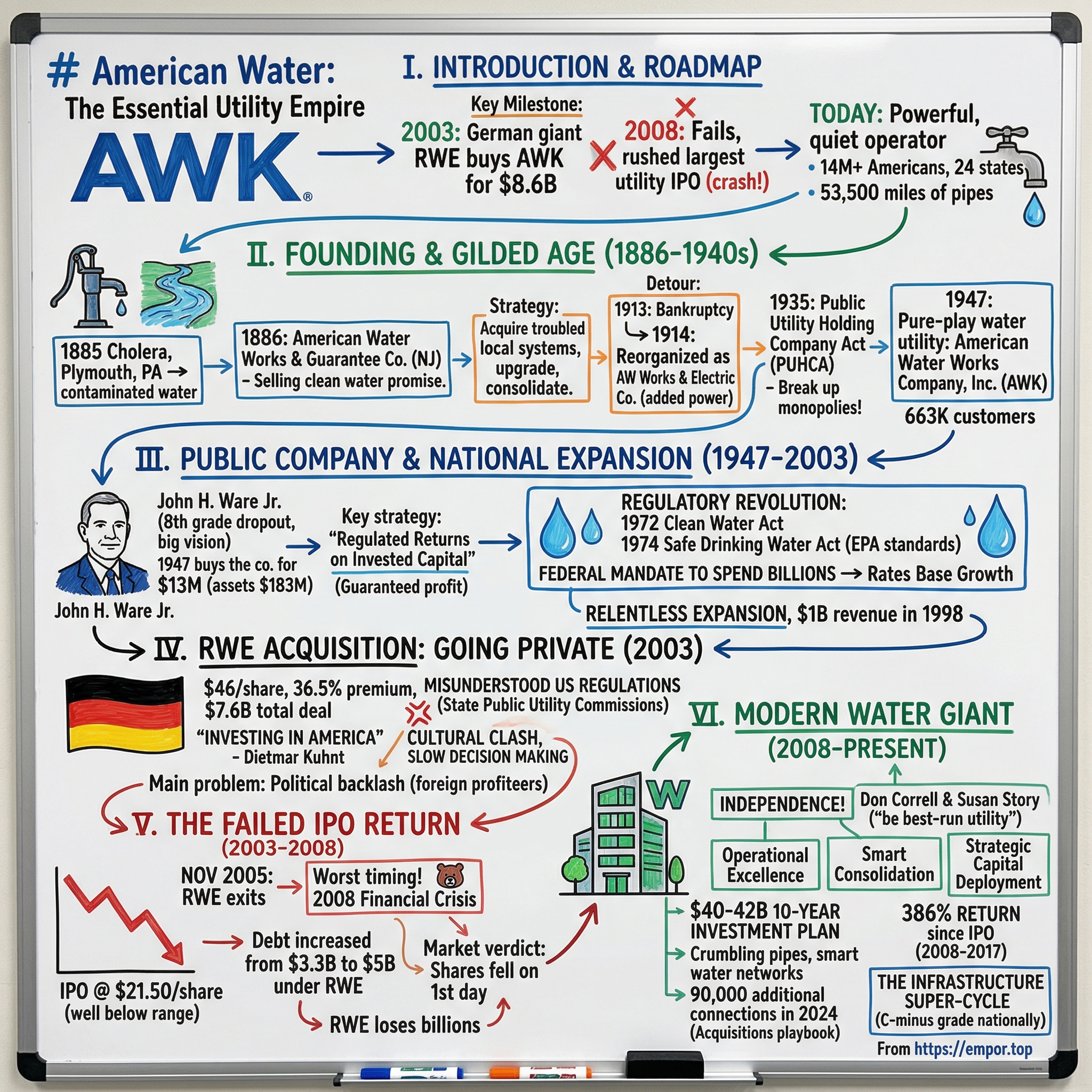
American Water Works Company: The Essential Utility Empire
I. Introduction & Episode Roadmap
There is a peculiar kind of company that almost nobody thinks about, yet almost everybody depends on. Customers do not choose it and cannot switch away from it. Most interact with it twice a year when a bill arrives, while the rest of the time it exists entirely underground — a few hundred thousand tons of ductile iron, cast iron, and, in some neighborhoods, pipe laid when Grover Cleveland was president.
American Water Works Company, Inc. is the largest of these utilities in the United States. As of its 2025 annual report, the company employed roughly 7,000 people and delivered drinking water and wastewater services to approximately 14 million people across 24 states — operating regulated utilities in 14 states alongside military installations and municipal contracts elsewhere.1 Its physical footprint is thoroughly unglamorous and nearly impossible to replicate: about 80 surface water treatment plants, 520 groundwater treatment plants, 170 wastewater treatment plants, 1,200 groundwater wells, 1,800 pumping stations, 75 dams, and roughly 55,000 miles of transmission, distribution, and collection mains — enough pipe to circle the Earth twice.1
That is the straightforward part of the story. The harder question has never had an obvious answer: should a private, profit-seeking corporation control public water infrastructure?
America has answered that question ambivalently for 140 years. Roughly six in seven U.S. community water systems remain in public hands. Every rate case serves as a localized referendum on whether private investors deserve a return on capital buried under public streets. The company at the center of that debate has itself been owned, at various points, by American railroad-era financiers, a German energy conglomerate, and — since April 2008 — public market investors.
The core tension of this episode rests on a specific, uncomfortable fact. In January 2003, a foreign acquirer paid $46.00 per share in cash for American Water Works.3 Five years later, the same asset returned to the New York Stock Exchange at $21.50 per share.5 Nothing about the underlying pipes had changed. What changed was ownership, along with how fifty state regulatory commissions setting consumer rates evaluated the enterprise.
How, then, did an 1886 Gilded Age consolidation vehicle survive a foreign acquisition disaster, two major goodwill write-offs, a credit downgrade, a failed venture into fracking water, a cyberattack, and persistent municipal resistance — and emerge as the largest regulated water compounder in America? More importantly for investors evaluating the company in 2026: is what management calls a durable growth machine genuinely durable, or is it a system whose essential fuel — regulatory permission — is growing more expensive every year?
Here is the roadmap. The story begins in the Gilded Age, when water works were a financing challenge rather than an environmental one, before moving through the mid-century era when federal environmental law rewrote industry economics. The analysis spends significant time on the RWE years as a natural experiment in whether utility scale travels across borders. It details the 2008 IPO and subsequent reconstruction, then examines the underlying mechanics: how a regulated utility earns returns and where that model breaks down. It evaluates business segments, military contracts, and divestitures, followed by modern inflection points — PFAS regulations, cyber vulnerabilities, and a proposed merger that would reshape the U.S. water industry. Finally, it assesses management, competitive moats, key risks, the bull and bear cases, and the core metrics worth tracking.
One note before the narrative begins, as it shapes everything that follows: the standard investor narrative — pure-play regulated water, disciplined capital allocation, clean divestitures, and predictable returns — is only partly accurate. Several foundational elements are contradicted by the company's own filings. This analysis addresses those contradictions directly alongside the claims they test, rather than deferring them to a summary risk section at the end.
 Subscribe on LinkedIn
II. Gilded Age Origins & Post-Civil War Consolidation (1886–1947)
Picture an American town in the 1880s. It has just gotten gas lighting and maybe a streetcar. It does not have reliable water. What it has is a well, a cistern, a creek, and a volunteer fire brigade that prays. A typhoid outbreak is a live civic risk, and the cure — a steam pumping station, a settling basin, cast iron mains under the main streets — costs more than the town's entire annual budget.
That gap between what a town needed and what a town could finance is the entire origin of American Water Works. The company was established in Pennsylvania in 1886 as the American Waterworks and Guarantee Company.2 The word in the middle of that name is the tell. "Guarantee" was a financing term. The business was not, at first, about water engineering. It was about underwriting: assembling capital in Pittsburgh, Philadelphia, and New York, deploying it into small municipal water franchises that could not raise it locally, and collecting a return on the resulting asset base.
This is the first thing worth internalizing about the company, because it never really stopped being true. American Water has always been, at its core, a capital aggregator that happens to own pipes. The engineering is real and non-trivial. But the durable competitive question has always been the same: who can raise money most cheaply, and who can get permission to earn on it.
From water to a holding-company empire — and back
The model worked well enough that in 1914 the enterprise reorganized into American Water Works and Electric, expanding into a sprawling public utility holding company.2 This was entirely conventional for the era. The 1910s and 1920s were the golden age of the utility holding company: pyramided structures stacking operating subsidiaries under intermediate holdcos under top holdcos, with a thin sliver of common equity at the summit controlling enormous asset bases below. Samuel Insull's empire was the most famous example. It was also, in retrospect, one of the great financial engineering disasters of the twentieth century.
The synergy story of the day was that water and electricity belonged together — both were networked, both were metered, both required central engineering, and both needed the same relationships with municipal officials. Congress disagreed. The Public Utility Holding Company Act of 1935 forced the simplification and geographic rationalization of these structures, and the American Water Works empire was among those unwound. In 1947, the pure water operations emerged as American Water Works Company, Inc., under the leadership of John Ware, serving roughly 663,000 customers.2
Testing the synergy claim. The proposition that combined water-and-electric holding structures produced genuine unit-cost advantages does not survive contact with the record. What the pyramided structures reliably produced was leverage and opacity — the capacity to move cash between subsidiaries in ways state regulators could not trace, and to service holding-company debt out of operating-company rates. When PUHCA forced separation, the pure-play water business did not collapse; it went on to become a Fortune-listed utility within eighteen years.2 The honest conclusion is narrower than "cross-utility synergy is fake": it is that in regulated network industries where returns are set jurisdiction by jurisdiction, the financial architecture above the operating company generates regulatory suspicion faster than it generates savings. That dynamic becomes acutely relevant twice more in this story — in 2003, and again in 2026.
For investors, the 1886–1947 stretch matters less for its detail than for the template it set: buy fragmented systems that cannot self-finance, put them under a single balance sheet, and earn a regulated return on the capital deployed. Everything after this is a variation on that theme, played in progressively more demanding regulatory conditions. The first of those demands arrived in the 1970s, and it changed what a water utility even was.
III. The Public Company Era & National Expansion (1947–2003)
The postwar decades brought the easiest capital deployment environment American Water would ever encounter. Subdivisions expanded across New Jersey, Pennsylvania, Illinois, Indiana, and Missouri. Developers built housing tracts, someone had to construct the water infrastructure underneath them, and a company with access to national capital markets could finance far more of that infrastructure than a local township could. By 1965, the company had earned a place among Fortune's 50 largest public utilities, and in 1994, it joined the S&P MidCap 400.2
Yet the transformation that truly shaped the modern business was not suburban growth; it was federal environmental law.
When water became a chemistry problem
Before 1974, managing a water utility was primarily a hydraulics challenge: moving water from a source to a tap at adequate pressure. The Safe Drinking Water Act of 1974 converted the business into a chemistry and compliance operation. Regulators began setting enforceable maximum contaminant levels across an expanding list of substances. Every new standard required updated treatment technology, expanded monitoring, dedicated laboratory capabilities, meticulous documentation, and added legal liability.
This shift reshaped the economics of the American water industry. Compliance costs are overwhelmingly fixed: a treatment facility designed to filter out a contaminant costs roughly the same whether it serves 2,000 households or 200,000. For a small municipal system, a single mandated upgrade can easily exceed the municipality's entire borrowing capacity. For a corporate utility with thousands of systems and investment-grade access to debt markets, that upgrade is simply a capital expenditure—one that gets added to the rate base and earns a regulated return.
Federal environmental regulation, in effect, became the industry's primary consolidation engine. It did not expand consumer demand for water; it created financial strain for small public operators. That distinction explains both the industry's consolidation opportunity and its structural limits.
Testing the privatization thesis. The bullish investment thesis—frequently emphasized in water-utility presentations over four decades—posited that mounting compliance costs would force widespread privatization. That mass shift never occurred, as the vast majority of U.S. community water systems remain publicly owned today. Municipalities retained two enduring structural advantages: access to tax-exempt municipal bond financing, which lowers borrowing costs relative to taxable corporate debt, and local political control, which allows city councils to defer rate increases. Furthermore, selling a municipal water system often triggers public backlash, carrying a political cost for local elected officials.
Consequently, industry consolidation has remained a slow, gradual process. Even in 2025, during what management described as a favorable M&A backdrop, American Water closed 18 regulated acquisitions across seven states, adding approximately 20,900 customers for an aggregate purchase price of $83 million.1 Relative to a base of roughly 3.6 million active customer connections, this represents incremental expansion rather than rapid market capture. While the company consistently buys smaller utilities, the idea that environmental regulations trigger sudden, step-change growth is unsupported by the historical record. Consolidation in regulated water remains a long-term grind.
By the turn of the millennium, American Water stood as the largest investor-owned water utility in the United States, defined by a repeatable playbook and a steady, predictable compounding profile. That combination of stable cash flows and essential infrastructure made it an attractive target for a corporate buyer harboring broader international ambitions.
IV. The RWE Privatization Disaster: Foreign Capital Meets American Rate Cases (2003–2008)
In the late 1990s, a theory took hold in European boardrooms: water was the next great global infrastructure asset class. Telecom had been deregulated and consolidated. Power had been deregulated and consolidated. Water — fragmented, essential, under-invested, and price-inelastic — was supposedly next, and the winners would be whichever firms assembled global scale first. Vivendi and Suez were building water empires out of France, while Thames Water was doing the same out of London.
RWE AG, the German electricity and multi-utility conglomerate, decided to buy its way to the front of that line. It acquired Thames Water, and then, in January 2003, completed the acquisition of American Water Works. Each share was converted into the right to receive $46.00 in cash.3 American Water disappeared from the New York Stock Exchange and became a subsidiary of a Ruhr Valley energy giant.
On paper, the strategy appeared elegant. RWE would own the largest water utility in the U.K. and the largest in the U.S., spread engineering, procurement, and technical expertise across both, and finance the combined operations off a large European balance sheet at attractive rates.
In practice, it collided with something RWE had not fully modeled: American state public utility commissions.
Why the deal broke
A U.S. water utility does not have a single national price. It has fifty-odd distinct prices, each set by a state commission in an adversarial proceeding, each subject to intervention by a consumer advocate, and each requiring a written order justified on the public record. Those commissions have one overriding statutory mandate: rates must be just and reasonable for customers in their specific state. Regulators are not indifferent to utility ownership, but their indifference to an owner's corporate financing needs is nearly total. The proposition that New Jersey ratepayers should help service acquisition debt raised in Essen, Germany was never a viable argument.
RWE spent the next two years discovering that the financial returns it had underwritten were unattainable at rates American regulators would approve. In November 2005, less than three years after closing, RWE announced it would divest both American Water and its U.K. water division.4 The planned exit evolved from a private trade sale into an initial public offering.
The number that settles the argument
The scale of the misjudgment was not a matter of interpretation; standard accounting forced it into the open. In the first quarter of 2008, ahead of the offering, American Water recorded a goodwill impairment of $750.0 million on its Regulated Businesses — an impairment triggered, in the company's own description, by the IPO price and subsequent trading levels of its stock.6 In the first quarter of 2009, after a sustained decline in market value, it took another $450.0 million.7 Driven by the 2008 charge, the company reported a net loss of $562.4 million for that year.6
That sequence stands out in corporate history as a clear case of an acquirer's thesis being marked to market in public accounting terms. Roughly $1.2 billion of the purchase premium RWE paid was written off within six years, benchmarked directly against what public equity investors were willing to pay for the assets.
The IPO itself, on April 23, 2008, was the largest utility offering in U.S. history and a stark loss for the seller. Fifty-eight million shares priced at $21.50 — below the marketed range — raising roughly $1.25 billion.58 Every share was sold by RWE Aqua Holdings GmbH; American Water received none of the proceeds.8 This distinction corrects a common narrative error: the 2008 IPO did not recapitalize American Water. It was an exit, executed during a financial crisis, at less than half the price per share RWE had paid five years earlier. RWE completed its full withdrawal through secondary offerings in June and August 2009.
Testing the global-scale claim. The thesis that conglomerate scale lowers a utility's cost of capital and lifts returns across jurisdictions was not merely unproven here; it was inverted. Foreign ownership added regulatory friction rather than removing it, and the public equity market valued the business at a fraction of its prior acquisition price. The clearer lesson is that in U.S. regulated water, competitive advantage is defined at the state jurisdiction level rather than at corporate headquarters. Scale above the state level yields modest procurement and financing advantages, but generates substantial regulatory scrutiny. Any evaluation of a water utility's strategic direction must be tested against that jurisdictional boundary — a test American Water continues to navigate at far larger scale in 2026.
The restructuring left behind a management team and board with a sharp, practical understanding of which capital strategies fail in regulated utility markets.
V. The Great Utility IPO & Modern Regulated Reconstruction (2008–2020)
A newly independent company emerging from a failed foreign ownership into the worst credit market since the 1930s does not have many strategic options. American Water's post-2008 leadership chose the narrowest one available, and in retrospect, that narrowness was the point: shrink the strategy until it fits entirely inside the regulated compact, then execute it relentlessly.
The decade that followed produced the version of American Water that modern investors recognize. Foreign ambition was abandoned, non-regulated contract operations were pruned, and capital was directed into pipe replacement and treatment facilities—the core asset base that yields a regulated return. Financial markets rewarded the pivot. The company joined the Dow Jones Utility Average in 2014, becoming the only water utility ever included in that index, and entered the S&P 500 in 2016 as its sole water utility constituent.2 These index inclusions did more than provide prestige: they converted a specialized holding into an automatic holding across passive funds, broadening the shareholder base and lowering the cost of equity—the essential input determining how much capital a regulated utility can deploy at a profit.
Two structural wins
Two policy developments during this period materially expanded management's capacity to deploy capital.
The first was fair market value legislation. Under the traditional utility accounting model, a utility acquiring a municipal system could add to its rate base only the system's depreciated original cost. For pipes installed in 1962 and depreciated over six decades, that valuation was often negligible, making it nearly impossible for a corporate acquirer to offer a purchase price a municipality could accept. Fair market value statutes authorized state commissions to establish rate base using independent appraisals of fair market value instead, allowing the utility to pay an attractive price for municipal assets while still earning a regulated return on the full purchase amount. By the end of 2025, twelve of the company's fourteen regulated state jurisdictions had enacted some version of this framework.1
The second structural development was the expansion of the Military Services Group—examined in detail in the next section—which served a distinct strategic role: it provided a vehicle to earn returns on large-scale infrastructure investments without requiring state utility commission approval.
The exception that tests the discipline
The narrative of unwavering operational focus was not without exception. In July 2015, American Water acquired Keystone Clearwater Solutions, a Pennsylvania-based water services provider to the oil and gas industry, in a transaction that valued Keystone at $130 million.10 Keystone sourced, transported, and managed water for shale gas producers across the Appalachian Basin—operating a commercial service business with no rate base, no franchise protection, no regulatory oversight, and a revenue stream tied to volatile energy commodity cycles and regional rig counts.
The venture failed to generate sustained value. On December 12, 2019, following a strategic review, the company sold its entire interest in Keystone to an energy investment firm for $31 million in cash, recording a pre-tax loss on sale of $44 million, or $35 million after tax.9
While the financial scale of the loss was modest relative to American Water's total balance sheet, the strategic departure remains instructive. At the midpoint of a decade routinely highlighted as a model of capital discipline, management purchased an un-regulated, commodity-cyclical asset near the peak of a regional shale boom and exited four years later at less than a quarter of the initial valuation. The transaction refutes any characterization of the company's capital allocation as flawless. Instead, it demonstrates a more practical trait: management's willingness to acknowledge a non-core mistake, write down the asset, and exit rather than absorb ongoing operational drag.
The financing reality
The post-IPO decade also challenged the assumption that pure-play regulated focus would permanently lower the company's cost of debt capital. On April 1, 2019, Moody's Investors Service downgraded American Water's senior unsecured debt rating from A3 to Baa1, maintaining a stable outlook.9 That rating adjustment took place in the middle of the company's regulated reconstruction and remained in effect years later: as of February 2026, the company's senior unsecured debt carried ratings of Baa1 from Moody's and A from S&P Global Ratings, both with stable outlooks.1
The credit rating pressure stemmed directly from the mechanics of utility growth. A regulated utility that expands its rate base faster than it generates internal cash flow must rely on external capital to bridge the deficit, creating continuous pressure on leverage metrics. The company's disclosure of its capital structure reflects this trend: common equity declined from 44.2% of total capitalization at year-end 2023 to 42.4% at year-end 2024, and reached 40.6% by the end of 2025, accompanied by a notable increase in short-term debt obligations over the same timeframe.1 In regulated utilities, rate base growth requires continuous security issuance to sustain capital programs.
Testing the FMV claim. The belief that fair market value legislation would enable seamless municipal consolidation has been tempered by regulatory and political friction. In June 2024, the Pennsylvania Public Utility Commission—overseeing the company's most critical FMV state—revised its procedural guidelines to expand public oversight of municipal acquisitions by introducing mandatory rate impact notices, public hearings, and enhanced review procedures.1 American Water's public filings explicitly acknowledge the resulting risk: the company may pay an acquisition price higher than the ultimate rate base valuation approved by a state commission, regardless of statutory fair market value provisions.1 While FMV legislation remains a functional consolidation tool, it has not eliminated local political resistance; rather, it has shifted political debate from municipal city halls to state rate case proceedings.
That structural tension—capital deployment driving growth while regulatory approval controls the throttle—defines the core utility business model, warranting detailed analysis in the section that follows.
VI. The Regulated Business Engine: Utility Economics, Rate Base & Public Utility Commissions
Strip away the infrastructure language and a regulated utility is a strikingly simple financial object. It is a pile of approved capital that earns an approved rate of return.
Here is the mechanism in plain terms. A commission determines the utility's rate base — the net capital it has prudently invested in useful plant, meaning gross plant minus accumulated depreciation, with various adjustments. It then determines a capital structure, the notional mix of debt and equity funding that rate base, and an allowed return on equity on the equity portion. Multiply the equity share of rate base by the allowed ROE and you get the utility's permitted profit. Add back the interest on the debt portion, plus operating costs, depreciation and taxes, and you get the total revenue requirement. Divide that by expected volumes and you get tariffs.
The strategic implication is the single most counterintuitive fact in utility investing: capital expenditure is not a drag on this business, it is the product. For an industrial company, spending a billion dollars on plant is a cost to be recovered through future sales. For a regulated utility, spending a billion dollars on approved plant is the mechanism by which future earnings are created. This is why American Water talks about capital plans the way a software company talks about bookings.
And the plans are large. The company has laid out roughly $19–20 billion of capital investment for 2026 through 2030, and $46–48 billion for 2026 through 2035, supporting a targeted rate base compound annual growth rate of 8–9% and long-term adjusted EPS and dividend growth of 7–9%.1215 For scale, the ten-year plan disclosed in the 2019 annual report covered 2020–2029 at $20–22 billion.9 The ambition has roughly doubled in six years. Rate base stood at approximately $25.3 billion as of the second quarter of 2026, against $24.3 billion a year earlier.15
Where does the money go? Over the 2026–2035 window, management allocates approximately 70% to infrastructure renewal, 10% to resiliency, 8% to water quality including PFAS treatment, 5% to operational efficiency and technology, 4% to system expansion, and 3% to other purposes.1 Renewal dominates because the underlying asset is old. The American Society of Civil Engineers graded U.S. drinking water infrastructure C- and wastewater D+ in its 2025 report card, with a national investment gap of $3.6 trillion over ten years.21 American Water's own target is to reach better than a 100-year pipe replacement rate within the next decade — which, phrased less charitably, means the company currently replaces its mains at a pace slower than one full cycle per century, and considers reaching that pace an achievement.1 That is not a criticism of this company specifically. It is the industry-wide condition, and it is the source of the multi-decade runway.
Where the machine actually breaks
Now the part that gets skipped in the elegant version. Rate base times allowed ROE is a formula for permitted profit, not realized profit, and the gap between what a utility asks for and what it gets is where the investment case lives or dies.
Consider the 2026 evidence, all of it from the company's most important jurisdictions.
In Pennsylvania — its largest state — the company filed on November 14, 2025 for approximately $169 million of additional annualized revenue, based on a proposed 10.95% return on equity and a 55.33% equity component, driven by an estimated $1.2 billion of capital investment.1 On July 16, 2026, the Pennsylvania Public Utility Commission approved $74.9 million: $45.3 million for water operations and $29.6 million for wastewater. The vote was 4–1, with the Vice Chair dissenting and a second commissioner issuing a separate statement. New rates took effect August 13, 2026.18 Management confirmed on the second-quarter call that the final order set an allowed ROE of 9.55% with a 54.2% equity component — 140 basis points below the request — and characterized the outcome as "constructive."14
Set aside the adjective and look at the arithmetic. The company received under half of the revenue it requested and an allowed return 1.4 percentage points below what it argued it needed, in the state where it has the deepest regulatory relationship and the largest capital program. That is the mechanism by which "guaranteed" returns become aspirational ones.
Pennsylvania is not an outlier. In Illinois, a December 2024 final order granted a $105 million annualized increase on an authorized ROE of 9.84%, an authorized rate base of $2.2 billion and a 49.00% equity component — a materially thinner equity layer than the roughly 52–55% the company typically requests.1 Kentucky's December 2025 order granted $18 million at a 9.70% ROE.1 Meanwhile the company's pending asks remain at 10.75% in New Jersey and Illinois and were 10.95% in Pennsylvania.1 The persistent spread between requested and authorized returns is the clearest single indicator of how much of the capital plan converts to earnings.
There is a second, subtler drag: timing. Because rate cases take roughly a year, capital deployed today earns nothing until an order arrives — the phenomenon known as regulatory lag. CFO David Bowler addressed this directly on the August 2026 call, noting that the company is exploring a broadening of its distribution system improvement charge mechanism, which allows interim recovery between full cases, and observing that water utilities currently qualify only about 40% of capital for such treatment versus roughly 90% for electric utilities.14 That comparison is worth pausing on. It is a candid admission from the CFO that water's regulatory recovery machinery is structurally slower than the machinery available to electric peers — and it is offered as a growth opportunity, which it may well become, but has not yet.
Testing the rate base claim. Does the history reject the proposition that capital deployment reliably converts into earnings growth? No — the company has in fact compounded adjusted EPS from $4.77 in 2023 to $5.18 in 2024 to $5.64 in 2025, and delivered 8.1% adjusted EPS growth in the second quarter of 2026.113 The claim survives. But it survives in a narrowed form: capital converts to earnings at a discount to the requested rate, on a lag, and the discount widens when household affordability is politically salient. The KPI that would confirm or falsify the revised claim is not the size of the capital plan. It is the authorized ROE and equity ratio the company actually receives in Pennsylvania, New Jersey and Illinois relative to what it files for — and, on that measure, the 2026 evidence trended against the company, not for it.
Which raises the natural question: is there anything in this business that escapes the state commission entirely?
VII. Segment Breakdown & Optionality: Regulated Dominance vs. Military Services Group (MSG)
There is, and it wears a uniform.
First, the core business. American Water reports its regulated utilities as a single operating segment, and that segment effectively constitutes the entire company. Regulated Businesses generated $4,723 million of operating revenue in 2025 out of $5,140 million total—approximately 92 percent.112 Everything else resides in a catch-all category the company calls "Other," which produced $417 million in 2025, or 8 percent of revenue, up from $388 million in 2024 and $314 million in 2023.1
The composition of regulated revenue runs counter to a common misconception. While residential customers dominate by sheer connection count, they do not account for the entire top line: in 2025, residential water service provided $2,557 million, or 54 percent of regulated revenue, with commercial accounts contributing 21 percent, wastewater generating 9 percent, public and other water systems accounting for 7 percent, industrial clients adding 4 percent, and fire service providing the remaining 4 percent.1 This breakdown matters analytically. A utility deriving 54 percent of its revenue from residential taps and roughly a quarter from commercial and industrial accounts carries more economic sensitivity than standard defensive narratives suggest—the loss of a major industrial facility represents a tangible revenue event, a risk the company explicitly notes in its filings.1 The revenue mix remains defensive, but it is not completely price- or volume-inelastic.
The military business
The Military Services Group represents the company's most distinct non-regulated asset, yet it receives minimal attention.
The framework dates to the Department of Defense's Utilities Privatization Program, built on the premise that military branches were ill-equipped to maintain aging water and wastewater networks on their bases and that specialized private operators could manage them more efficiently. MSG currently operates on 18 military installations under 50-year contracts with the U.S. government.1 The scope generally encompasses operating and maintaining base water and wastewater infrastructure alongside asset replacement programs. Capital upgrades are executed either as dedicated projects during the contract's first five years or through long-term recapitalization funded over time from contract fees. When mission requirements demand entirely new infrastructure, construction is funded directly by the U.S. government.1
The appeal is clear: 50-year agreements with periodic price redeterminations on infrastructure the company generally does not have to fund from its own balance sheet. American Water notes explicitly that businesses grouped under "Other" do not require significant capital investment.1 As a result, MSG generates steady cash flows and fee income without consuming the balance sheet capacity needed by the core regulated utility.
However, investors should be clear about the limits of this segment. MSG is not a rate-base business, nor is it a primary growth driver—accounting for 8 percent of revenue alongside corporate items—and it enjoys no franchise monopoly. Its sole counterparty is a single buyer with complete specification authority, strict procurement regulations, price redetermination rights, and the power to re-compete contracts. The company's own forward-looking statements highlight its ability to enter into new installation contracts, negotiate price redeterminations, and maintain government agreements as specific risk factors.1 Selling to a single sovereign buyer means that customer's bargaining power must be central to any moat analysis. MSG represents a compelling contract portfolio, but it is not a second utility monopoly.
The Homeowner Services divestiture, and what actually happened to the money
The cleanest test of management's capital allocation philosophy unfolded when the company sold a business.
On December 9, 2021, American Water completed the sale of its Homeowner Services Group—a retail home warranty and service plan unit operating under the American Water Resources and Pivotal Home Solutions brands, covering nearly three million customer contracts—to funds advised by Apax Partners for total consideration of approximately $1.275 billion.11 The strategic rationale was coherent: selling optional warranty products to captive utility customers invited regulatory scrutiny and complicated rate proceedings before state utility commissions.
The transaction structure, however, diverged significantly from the headline valuation. American Water received $485 million in cash at closing, inclusive of a $5 million working capital adjustment, along with a $720 million secured seller note bearing 7 percent annual interest over a five-year term, plus a contingent $75 million earn-out tied to performance milestones through 2023.11 Cash represented less than 38 percent of the total purchase price. The remainder was seller financing, with American Water effectively lending the buyer the funds to complete the purchase.
Subsequent developments further complicated the exit. On February 2, 2024, the seller note was restructured: principal increased from $720 million to $795 million in full settlement of the contingent payment, while the interest rate rose from 7.00 percent to 10.00 percent per year until maturity.1 As of December 31, 2025—more than four years after the sale—the note remained on the balance sheet as a current asset.1 Furthermore, American Water has consistently excluded incremental interest income generated by this amendment when calculating adjusted EPS: $0.13 per share in 2025 and $0.12 in 2024.1
Each modification can be defended individually, but together they describe an ongoing financial accommodation to a leveraged buyer rather than a clean exit. Expanding principal while raising the interest rate to 10 percent indicates financial concessions, and management's decision to strip the extra interest from adjusted earnings acknowledges that it represents non-recurring financial income rather than core operating earnings.
Testing the divestiture claim. Did selling Homeowner Services prove that non-regulated retail operations were successfully recycled into high-return rate base capital? Only in part. The strategic cleanup simplified the corporate narrative before state commissions. Yet the transaction did not yield $1.275 billion of immediate cash for rate base reinvestment. With less than 40 percent collected upfront, the balance converted into a concentrated private credit exposure to a private-equity-backed warranty firm—an asset that remained unliquidated at year-end 2025. The ultimate test of execution remains straightforward: full cash collection of the amended note at maturity. Until that occurs, the assertion that management converted a non-core retail business directly into regulated rate base capital remains a work in progress rather than a finished transaction.
That skepticism regarding how corporate proceeds are categorized is worth carrying forward, as the last five years have generated a great deal to characterize.
VIII. Modern Inflection Points & Capital Deployment (2020–Present)
The chemistry problem with a name nobody can pronounce
On April 10, 2024, the U.S. Environmental Protection Agency finalized the first national primary drinking water regulation for per- and polyfluoroalkyl substances — PFAS, the class of synthetic fluorinated compounds used since the 1940s in firefighting foam, nonstick cookware, stain-resistant fabrics and food packaging.19 The reason they are a problem is in their nickname: forever chemicals. The carbon-fluorine bond is among the strongest in organic chemistry, so these compounds do not break down in the environment or in the human body. They accumulate. The rule set enforceable limits at concentrations measured in parts per trillion — roughly the equivalent of a few drops in an Olympic swimming pool.
For a water utility this is a capital event, not an operating one. Removing PFAS to those levels generally requires granular activated carbon vessels or ion exchange resin — think of an enormous, very expensive Brita filter installed at the treatment plant, with media that must be periodically replaced and reactivated. American Water responded by locking in supply: a nine-year exclusive contract with a third-party vendor to supply granular activated carbon, equipment and reactivation services to more than 50 of its treatment sites across 10 states through 2033.1
Then the rule changed. In May 2025, EPA announced its intent to rescind the standards for four of the regulated substances — PFHxS, PFNA, HFPO-DA (GenX) and the hazard index mixture including PFBS — while retaining the maximum contaminant levels for PFOA and PFOS. A proposed rescission rule followed on May 18, 2026, alongside a separate proposal to extend the PFOA and PFOS compliance deadline.20
This is a genuinely important and underappreciated wrinkle. The PFAS capital wave is real but its size is now a moving political target, and the direction of movement since 2024 has been toward less mandated spending, not more. Water quality including PFAS represents 8% of the ten-year capital plan1 — meaningful, but not the load-bearing element that PFAS-focused narratives sometimes imply. Investors should treat regulatory-driven capex as a variable, not a floor.
There is a second PFAS story running in parallel: recovery. Several of the company's utility subsidiaries are parties to multi-district litigation filed December 7, 2018 in the U.S. District Court for the District of South Carolina against PFAS manufacturers. As of December 31, 2025, the company had received settlement payments from 3M and DuPont de Nemours totaling $159 million, net of legal fees and administrative costs and exclusive of interest, and intends to seek regulatory approval for how those proceeds are handled.1 Note the structure carefully: the money does not simply flow to shareholders. It flows into a regulatory proceeding that will determine how much benefits customers. Meanwhile, EPA's April 2024 designation of PFOA and PFOS as hazardous substances under CERCLA created a liability exposure running the other way, and the company has been lobbying for legislation shielding water systems as passive receivers.1 PFAS is simultaneously an asset, a liability and a lobbying campaign.
The week the bills stopped
On October 3, 2024, American Water became aware of unauthorized activity in its computer networks. It disclosed the incident to the SEC, took its MyWater customer portal offline and paused customer billing. By October 10 the company announced it was reconnecting and reactivating systems, that the portal was operational, that standard billing was resuming, and that no late charges would apply for the period the platform was unavailable. It maintained throughout that there was no indication water or wastewater facilities were affected and that water quality was not impacted.22
The financial outcome was benign — the FY2025 annual report states that the company has not experienced a cybersecurity incident resulting in a material impact to its financial condition, results, cash flows or business strategy.1 But the company's own risk language is more revealing than the reassurance: the October 2024 incident "demonstrated that those protections alone may not prevent a cyber attack."1 That is an unusually direct admission for a 10-K. Water utilities are designated critical infrastructure, they are increasingly named in federal advisories about state-linked intrusions, and the sector's operational technology tends to be old. A week without billing was the cheap version of this lesson.
Bolt-ons, and then something much bigger
The routine consolidation machine kept running. On June 1, 2026, American Water closed its acquisition of water and wastewater systems from a subsidiary of Nexus Water Group for approximately $315 million in cash, adding nearly 47,000 customer connections across roughly 60 systems in Illinois, Indiana, Kentucky, Maryland, New Jersey, Pennsylvania, Tennessee and Virginia.114 The deal closed ahead of the company's own schedule, and total regulated connections added in the first half of 2026 reached approximately 52,000.13
One detail from the Nexus disclosure deserves attention because it quantifies the FMV question raised earlier: the aggregate rate base expected to be acquired was estimated at approximately $200 million, subject to final determination by the respective commissions — against a $315 million purchase price.1 The roughly $115 million difference is acquisition premium whose recovery depends on eight separate state commissions agreeing. Separately, as of December 31, 2025, the company had 20 further agreements pending with an aggregate purchase price of $582 million to add approximately 104,300 customers.1 Paying above rate base is not inherently imprudent — it is how you convince a town to sell — but it is the point at which the acquisition playbook takes regulatory risk, and it should be tracked as such.
And then, on October 26, 2025, American Water did something that does not fit the bolt-on template at all.
The merger
The boards of American Water and Essential Utilities unanimously approved an all-stock, tax-free merger. Essential shareholders would receive 0.305 American Water shares per Essential share — a premium of approximately 10% based on 60-trading-day volume-weighted average prices through October 24, 2025. American Water holders would own approximately 69% of the combined company, Essential holders approximately 31%. Pro forma market capitalization was approximately $40 billion; combined enterprise value approximately $63 billion. The combined entity would serve 4.7 million water and wastewater connections across 17 states plus 18 military installations, on a combined water and wastewater rate base of approximately $29.3 billion, headquartered in Camden, New Jersey.16
Leadership: John Griffith as President and CEO of the combined company; Essential's Christopher Franklin as Executive Vice Chair of the board; David Bowler as CFO; Karl Kurz as independent board chair; a fifteen-member board split ten from American Water and five from Essential.16 Management guided to EPS accretion in the first year after close, maintained the 7–9% long-term growth targets, and indicated the combined company would adopt American Water's dividend policy.16 The combined ten-year capital plan was framed at $48–50 billion.25
Now the analytically loaded fact, which the transaction's framing tends to soften: Essential Utilities is not a pure water company. It operates the Aqua water utilities and Peoples Natural Gas, a gas distribution utility serving western Pennsylvania and Kentucky. Essential's regulated natural gas segment generated $1,117.9 million of revenue in 2025, up 32.6%.24 And the combined company intends to keep it.
This is not a small footnote. For fifteen years, the central strategic claim of American Water — the one that justified selling Homeowner Services and exiting Keystone — was that regulated water purity commands a valuation premium and a lower cost of capital. In October 2025, that same company agreed to acquire a natural gas distribution business as roughly a third of an acquired entity's revenue base, and to retain it. Management's justification is that the gas utility "provides optionality." That may prove correct — Peoples has grown rate base at above 10% annually under Essential's ownership. But investors should recognize the deal for what it is on the purity question: a reversal, executed by the same company that spent a decade telling the market purity was the thesis. The claim that focus drove American Water's rerating is now, at minimum, one the company itself no longer acts on.
On synergies, management has been notably restrained. Griffith stated plainly that "this is really not a cost savings-driven transaction," pointing instead to economies of scale in finance, legal, engineering and procurement.17 That candor is genuinely creditable — utility mergers justified on synergy numbers have a poor track record — but it removes the most quantifiable source of value creation from the deal's justification, leaving scale, capital markets access and acquisition capacity, all of which are harder to verify.
Not everyone is persuaded. Mary Grant of Food & Water Watch objected that "we are very worried about a future where there's one big water monopoly," noting that municipalities selling systems "already only get one or two bids, and it's going to typically Essential or American."17 That is a serious argument, and it aims precisely at the acquisition engine: if the two largest bidders for municipal systems become one bidder, the consolidation runway that anchors the growth story gets scrutinized by the same commissions that must approve every deal.
Approvals have nonetheless been accumulating. By the August 2026 earnings call the merger had cleared Kentucky, Ohio and Virginia, with a settlement in principle reached in Texas and the Pennsylvania case in settlement discussions; shareholders of both companies approved the transaction in February 2026; management maintained a target close by the end of the first quarter of 2027.141 Approval, Griffith noted, turns on demonstrating a "substantial affirmative public benefit" under state standards.14
The transaction is the defining act of a new chief executive's first year. Which makes the question of who that executive is, and how they have behaved, unusually load-bearing.
IX. Management Credibility, Governance & Capital Allocation
M. Susan Hardwick arrived at American Water as chief financial officer in 2019, was named President and CEO in February 2022, and retired on May 14, 2025, at the annual shareholder meeting.23 The Hardwick era served as the period in which the company converted its post-IPO discipline into a structured financial system: executing the Homeowner Services Group divestiture, accelerating the capital plan, and establishing the early architecture of the PFAS response.
The executive succession was well-telegraphed and clean by utility standards. John C. Griffith joined American Water as Executive Vice President and CFO in 2022, was named President in July 2024, and assumed the CEO role in May 2025—a two-step handoff with roughly ten months of overlap in the President position.23 While structured successions typically minimize strategic disruption, this transition produced an immediate pivot in corporate strategy, reflecting the new chief executive's background.
The banker in the CEO chair
Griffith's background is financial rather than operational. Prior to joining American Water, he served as a managing director in Bank of America Securities' mergers and acquisitions group, leading the firm's M&A practice for regulated utilities and renewable energy. Earlier in his career, Griffith was CEO of HighWave Energy, a renewable fuels start-up, following a fourteen-year tenure at Merrill Lynch that culminated as a managing director in M&A.23
This background makes Griffith a utility CEO whose primary professional expertise centers on transaction structuring and cost of capital. Viewed through that lens, the corporate timeline is coherent: Griffith became CEO in May 2025 and announced the largest transaction in the history of the U.S. water industry five months later. A utility whose growth relies on acquiring municipal systems and accessing capital markets has a rational basis for selecting an M&A specialist. However, placing a career investment banker at the helm increases the likelihood of further large-scale transactions and elevates the governance question of whether operational challenges might be met with balance sheet solutions.
Guidance discipline: the actual record
Management's track record on earnings guidance has been consistently solid. The company has affirmed 7–9% long-term adjusted EPS and dividend growth across the Hardwick and Griffith leadership tenures and through the merger announcement.121316 Financial delivery has matched that target: adjusted diluted EPS rose from $4.77 in 2023 to $5.18 in 2024 and $5.64 in 2025—representing 8.9% growth in 2025—alongside an 8.2% dividend increase.112 For 2026, management initiated adjusted EPS guidance of $6.02–$6.12 alongside third-quarter 2025 results and affirmed the target in subsequent quarters, delivering first-half adjusted EPS of $2.62 compared to $2.51 a year earlier, with management noting that earnings growth concentrates in the second half as state rate increases take effect.1314
Two analytical nuances temper this record. First, the composition of adjusted EPS warrants scrutiny. The 2025 reconciliation excluded a net $0.10 per share in interest from the seller note associated with the Homeowner Services transaction and added back $0.05 per share in merger transaction costs, after stripping out $0.12 to $0.17 per share of favorable weather impact in 2023 and 2024.1 While each adjustment is disclosed and individually defensible, a growth metric that relies on different adjustment definitions across three consecutive years requires careful underlying evaluation. Second, the company absorbed $13 million in merger-related costs within operation and maintenance expenses in 2025 alone1—an expense category expected to expand leading up to the targeted early 2027 transaction close.
How the capital plan gets paid for
The financing plan outlined alongside second-quarter 2026 results clarifies the capital structure requirements facing shareholders. To support approximately $29 billion in total capital needs from 2026 through 2030, management projects generating roughly $14 billion from operating cash flow, borrowing $11.8 billion in long-term debt, and issuing $2.5 billion in common equity.15 The company maintains long-term targets of a debt-to-capital ratio below 60% and a dividend payout ratio of 55–60%.15
In practical terms, operating cash flow covers less than half of the five-year investment plan. The remaining $14.3 billion—nearly half the total commitment—requires external capital markets issuance. The operational impact was evident in June 2026, when the company settled 3.4 million forward sale shares for $476 million, leaving 4.7 million shares available for settlement through year-end 2026, alongside a $500 million debt issuance carrying a 4.625% coupon.1314 Equity forward contracts allow the utility to lock in share prices and draw capital as needed, but the core economic reality remains unchanged: the growth model relies on ongoing share issuance. Consequently, the 7–9% annual per-share growth target is a net figure achieved after accounting for equity dilution, making performance highly sensitive to the market valuation at which new equity is issued.
The company's credit trajectory reflects these funding demands. A Baa1 senior unsecured debt rating from Moody's and a common equity layer that contracted for three consecutive years through 20251 represent the cumulative financial cost of expanding rate base faster than organic cash generation. While manageable under current credit conditions, these metrics would face heightened pressure if authorized returns on equity continue to compress while capital expenditures expand.
Compensation and governance
Executive compensation structures are tied directly to adjusted EPS growth, capital deployment execution, safety and water quality compliance, and customer service metrics—an incentive framework aligned with stated strategy that directly rewards capital deployment. When executive incentives prioritize capital execution, investors must look to authorized return-on-equity determinations rather than gross capital expenditure totals to verify whether capital deployment is creating shareholder value.
Over the next eighteen months, the primary governance benchmark will be the integration of Essential Utilities and the governance dynamics of the combined board—where American Water will hold ten seats to Essential's five.16 That board composition will ultimately determine which capital allocation philosophy governs the combined entity, raising the central question of what degree of competitive protection all this deployed capital actually secures.
X. Strategic Moats & Power Analysis (7 Powers & Porter's 5 Forces)
Consider a thought experiment: an entrant backed by unlimited capital attempts to compete with New Jersey American Water in Camden County.
The new entrant would need to acquire rights-of-way under streets already crowded with utility infrastructure. It would need municipal consent to tear up every road in the county. It would need a certificate of public convenience and necessity from the New Jersey Board of Public Utilities—which the board would decline to grant, because duplicating a water distribution network represents textbook economic waste. Even if the entrant cleared those hurdles, it would arrive with a brand-new asset base to depreciate against an incumbent's partially depreciated network, forcing its operational costs and consumer tariffs higher from day one.
A competitor cannot bypass those barriers. That is the physical and regulatory moat, and it is near-absolute.
Seven Powers
Cornered resource is the primary power, operating physically and legally at the same time. The company's 55,000 miles of mains, subterranean rights-of-way, and state-granted service franchises form an asset base that is not merely expensive to duplicate, but legally prohibited from replication. This protection is structurally stronger than typical software network effects, as it requires no ongoing customer preference to endure.
Scale economies are real, but must be evaluated in proper regulatory context. Spreading regulatory compliance staff, central engineering, laboratory facilities, procurement, cybersecurity, and capital markets access across fourteen states lowers per-customer overhead relative to a typical 4,000-connection municipal system. The company's nine-year granular activated carbon agreement covering more than 50 treatment sites across 10 states illustrates purchasing power an individual municipality cannot replicate.1 However, as shown during the RWE ownership era, these scale efficiencies operate below the level where consumer rates are determined. A commission in Missouri will not lower local rates simply because the corporate parent exercises buying power in Pennsylvania, and regulators frequently pass procurement savings directly to ratepayers. In regulated water, scale converts to shareholder value only to the extent regulators allow, making scale power meaningful but constrained.
Switching costs are effectively infinite for retail customers. A single utility pipe enters each property. Bottled water and private wells offer no viable substitute for municipal sanitation, fire suppression, or household appliances.
Counter-positioning is weaker than utility bulls suggest. Proponents argue that an investor-owned utility can finance infrastructure upgrades that election-sensitive municipalities routinely defer—a claim supported by widespread municipal underinvestment. Yet counter-positioning requires that incumbent public operators be structurally unable to respond without self-inflicted harm. Municipalities face no such structural barrier: they can raise rates, issue tax-exempt municipal bonds at lower yields than corporate debt, and draw from state revolving funds along with $15 billion in federal lead service line funding under the Infrastructure Investment and Jobs Act.1 When public entities defer capital spending, they exercise a political choice rather than a structural limitation—and political choices can reverse over time.
Process power and branding are virtually absent. Captive retail customers do not select their water utility based on brand equity or proprietary operational workflows.
Porter's Five Forces
Threat of new entrants: negligible. State franchise protections and network physics combine to block new market entrants.
Bargaining power of buyers: strictly bifurcated, forming the central analytical issue. Individual retail consumers hold zero bargaining power, while state public utility commissions command almost all of it. The Pennsylvania commission's decision to reduce a $169 million revenue request to $74.9 million on a 4–1 vote demonstrated buyer power exercised with decisive effect.18 A regulated water utility does not operate in a standard competitive market; instead, it faces a single, politically accountable monopsonist in each state jurisdiction that determines allowed tariffs in public proceedings. The moat protects the physical asset, but it does not guarantee the financial return.
Bargaining power of suppliers: low to moderate. Equipment, pipe, and water-treatment chemicals are supplied by fragmented industries. However, two operational areas warrant attention: specialty treatment media, where securing a nine-year exclusive activated carbon contract indicates perceived supply constraints,1 and skilled technical labor, where management explicitly cites employee retention and potential labor disputes among its operating risks.1
Threat of substitutes: negligible for core utility service. Water conservation represents the sole meaningful volume risk, though it is partially mitigated by regulatory decoupling and revenue-stabilization mechanisms in several jurisdictions. Nevertheless, the company explicitly acknowledges the risk of under-earning its authorized return if customer usage drops below levels assumed in approved rate structures.1
Competitive rivalry: low for retail customers, active for municipal acquisitions. Investor-owned utilities never compete for one another's captive retail end-users. Competition centers entirely on acquiring municipal water and wastewater systems. In its filings, the company identifies its primary acquisition rivals: Essential Utilities, American States Water Company, California Water Service Group, infrastructure investment funds, multi-utility operators, Algonquin Power and Utilities, and Nexus Water Group.1 The valuation gap among pure-play operators remains wide: American Water's market capitalization stood at approximately $27.4 billion in late August 2026, compared to roughly $11.6 billion for Essential Utilities, $3.5 billion for American States Water, $3.1 billion for California Water Service Group, and $1.9 billion for SJW Group. Combining American Water with Essential Utilities—the second-largest player—would grant the combined entity unprecedented scale relative to remaining peers. That market concentration explains why consumer advocacy groups are actively opposing the transaction, and why state commissions are expected to demand structural concessions before granting approval.
The composite verdict: while the physical asset moat ranks among the most durable in public equity markets, the return moat is materially weaker. Investors are not purchasing insulation from market competitors; they are acquiring a legally protected asset base whose financial productivity is renegotiated in public regulatory proceedings every eighteen months.
XI. Current Risk Radar & Skeptical Investor Stress Test
If a skeptical fund manager sat down with American Water, several core operational and financial vulnerabilities would quickly dominate the discussion.
Cost of capital is the first-order risk, and it is not hypothetical. This is a business that must raise roughly $14 billion of external capital over five years15 while earning an allowed return set in arrears by state public utility commissions. When market interest rates rise, the company's borrowing costs reprice quickly — as demonstrated by its June 2026 debt issuance priced at 4.625%14 — while authorized returns on equity move slowly and, as 2026 illustrated, sometimes downward. A utility whose allowed return contracts while its marginal cost of debt rises inevitably compresses its earned spread. That dynamic represents the single most critical macroeconomic sensitivity facing the business, operating through the precise arithmetic of rate case determinations and debt refinancings.
Affordability politics is the second major headwind, and it is intensifying. The July 2026 Pennsylvania rate order was fundamentally a political event rather than a routine accounting adjustment, decided on a 4–1 vote with a formal dissent and accompanied by mandated expansions to bill discount and arrearage forgiveness programs.18 Management is responding by seeking to broaden interim recovery mechanisms such as distribution system improvement charges.14 Yet the underlying structural tension remains unresolvable: a ten-year capital deployment plan of $46–48 billion must ultimately be funded by retail utility bills, which are expanding faster than household incomes in many of the company's service territories. Each incremental dollar added to the rate base makes securing the next requested rate increase politically more challenging — a fundamental boundary on the company's long-term growth algorithm.
Municipalization and eminent domain represent an active legal exposure rather than a theoretical threat. The most prominent example is unfolding in Monterey, California. In November 2018, local voters passed Measure J, instructing the Monterey Peninsula Water Management District to evaluate and, if feasible, acquire California American Water's Monterey assets — a system serving approximately 40,000 customers — without requiring a subsequent referendum. A 2019 district valuation pegged the system's total value plus adjustments at roughly $513 million and determined the purchase was economically viable. In December 2023, the district initiated condemnation proceedings. After the court denied Cal Am's motion to dismiss in November 2024, Cal Am filed for summary judgment on August 20, 2025, contending the district lacked eminent domain authority without approval from the local agency formation commission, prompting a cross-motion from the district. By orders issued December 29, 2025, the court denied both summary judgment motions, leaving the litigation pending.1
After seven years of legal dispute, the litigation remains unresolved, and the company explicitly acknowledges it cannot predict the final outcome.1 For equity investors, the key issue is not merely the probability of losing the Monterey system, but the broader precedent a successful condemnation would establish. The utility's core strategy relies on adding municipal assets into its regulated base; a high-profile precedent for forcibly extracting an asset alters political dynamics in every jurisdiction facing rising consumer rates. Meanwhile, related litigation in California with the Marina Coast Water District over Carmel River water supply matters also remains on appeal following a February 2025 notice.1
Cybersecurity represents a critical operational-technology risk, disclosed as such. While the October 2024 cyber incident produced minimal direct financial impact, it exposed systemic vulnerabilities. The primary risk going forward is not another temporary interruption to customer billing; it is a breach capable of compromising operational technology at physical treatment plants. Management's disclosure in filings that existing security measures "may not prevent a cyber attack"1 reflects a candid recognition of critical infrastructure exposure.
Merger execution is the near-term binary variable. A transaction of this magnitude, requiring regulatory approvals across multiple state commissions — including Pennsylvania, which recently granted less than half of the company's requested rate increase — carries substantial execution risk. American Water's public filings explicitly acknowledge that regulatory approvals could be conditioned on terms detrimental to the combined enterprise, including mandatory asset divestitures.1 Furthermore, the merger agreement contains a termination fee structure, and management has repeatedly committed to a target close by the first quarter of 2027.
Legal and accounting considerations warrant ongoing monitoring. West Virginia American Water remains subject to two ongoing general investigations by the state Public Service Commission, alongside class action litigation and a separate lawsuit filed by Mountaineer Gas; although a July 2024 Commission staff joint memorandum found no evidence of systematic failure and affirmed that operating procedures were adequate subject to three recommended improvements, both investigations remain open.1 Additionally, class action litigation in Dunbar, West Virginia, stemming from a 2015 transmission main failure continues.1 On the accounting side, three items require scrutiny: goodwill recognized on acquisitions where the purchase price exceeds the fair value of net acquired assets, the carrying value and collectibility of the amended Homeowner Services seller note, and the ultimate accounting classification of PFAS settlement proceeds pending regulatory review.1
The bear-case activist argument synthesizes these vulnerabilities. A skeptical activist case does not dispute the high quality of the company's physical infrastructure. Instead, it challenges the financial model: that issuing equity to fund capital programs while earning lower authorized returns forces the utility onto a capital treadmill controlled by external regulators; that sustaining the 7–9% annual growth target has become overly reliant on acquiring municipal systems at premiums to rate base; that leadership answered rate-case friction with a $63 billion mega-merger; and that the premium historically awarded to pure-play water utilities is being diluted to acquire natural gas distribution assets. While none of these points are individually decisive, each presents an empirical test that management must answer through operational delivery over the coming quarters.
XII. Playbook: Business & Investing Lessons
1. In a regulated natural monopoly, capex is the product — but permission is the constraint. The rate base model inverts the conventional relationship between spending and earnings, which explains why utilities present capital deployment plans as primary growth guidance. Yet that principle is incomplete without its counterpart: the financial return on deployed capital is determined by public utility commissions with fundamentally different incentives. Evaluating a utility requires looking beyond the gross size of its capital pipeline to measure the persistent gap between requested rates and authorized returns.
2. Utility moats are jurisdictional, not corporate. RWE paid $46.00 per share on a thesis of global operating scale, only to see public equity markets reprice the business at $21.50 per share alongside $1.2 billion in aggregate goodwill write-offs. The fundamental unit of competition in regulated utilities is the individual state public utility commission. Any strategy built on operational synergies that must cross regulatory boundaries warrants skepticism — including large-scale consolidation strategies today.
3. Focus is a claim, not an identity — verify whether it endures. American Water divested its retail home warranty operations and exited shale water services based on the argument that pure-play regulated water commands a valuation premium. Acquiring and retaining a natural gas distribution utility alters that narrative. Companies can shift strategic direction, but investors should adjust valuations when an enterprise no longer possesses the pure-play profile once used to justify its premium.
4. Inspect the consideration, not just the headline. A $1.275 billion divestiture that yielded $485 million in upfront cash alongside a seller note later expanded in principal and repriced to 10 percent interest represents a fundamentally different financial transaction than advertised. That same analytical rigor applies to expansion: a $315 million acquisition adding an estimated $200 million to rate base depends entirely on eight separate state commissions approving the resulting premium.
5. Environmental mandates act as capital catalysts, but remain political variables. Mandated PFAS compliance appeared to offer a predictable multi-year capital deployment runway in April 2024, yet federal proposals to narrow drinking water rules by May 2026 demonstrated how quickly regulatory spending targets can shift. Capital plans driven by environmental mandates should be evaluated across a range of potential regulatory outcomes rather than treated as guaranteed baseline spending.
6. Growth reliant on continuous capital market issuance is per-share growth net of dilution. When operating cash flow covers less than half of a five-year capital plan, the equity valuation at which new shares are issued becomes a core operational variable. High share prices lower the cost of equity and accelerate earnings compounding; depressed valuations increase dilution and slow per-share growth.
XIII. Bull vs. Bear Case
The bull case
The affirmative investment thesis rests on three core elements, listed in descending order of strength.
The first is the physical asset itself, which occupies as protected a market position as exists in U.S. public equities. A subterranean infrastructure network beneath public streets, secured by exclusive state franchises and delivering an essential service with no direct substitute, cannot be easily competed away. Whatever operational or regulatory friction emerges, the physical mains remain in place and retail customer demand persists.
The second is a long growth runway. With roughly six in seven U.S. community water systems still municipally owned, the national infrastructure deficit is measured in trillions,21 and American Water maintains a pipeline of more than 1.5 million potential customer connections against a target of 20 to 30 acquisitions annually and roughly 2% annual customer growth.1525 Unlike technology compounders that require continuous product breakthroughs or new market entry, the company's expansion relies on replacing legacy pipe and acquiring fragmented municipal systems over the coming decades.
The third is consistent financial execution. Adjusted earnings per share compounded from $4.77 in 2023 to $5.64 in 2025 alongside an 8.2% dividend increase,112 while management affirmed its 7–9% growth algorithm through both a chief executive transition and a major merger announcement.121316 Through mid-2026, execution has remained on schedule, with $1.8 billion of the $3.7 billion annual capital target deployed and $216 million of annualized revenue authorized since January 1, 2026.13
If the proposed merger closes on its original terms, the combined company would command an unprecedented scale advantage over remaining water peers, combining a $29.3 billion rate base with a $48–50 billion decade-long capital plan.1625
The bear case
The bear case does not contest these operational facts; instead, it questions the financial productivity of the deployed capital.
First is return compression. The company requested a 10.95% ROE in Pennsylvania and received 9.55%, while requesting rate relief of $169 million and receiving $74.9 million.118 Illinois authorized a 49.00% equity component against the roughly 52–55% typically sought.1 If authorized returns and equity ratios continue to compress while capital commitments grow, the expansion algorithm requires progressively more capital to generate each incremental dollar of earnings—capital that must be raised externally.
Second is the funding structure. Roughly $14.3 billion of external issuance over five years against $14 billion of operating cash flow,15 a Baa1 senior unsecured rating that has not recovered since the April 2019 downgrade,19 and an equity layer that has fallen for three consecutive years.1 Rather than a low-leverage fortress balance sheet, this structure operates near the lower bound of management's target capitalization ranges.
Third is political resistance and legal risk. Customer affordability constraints loom over rate proceedings, while municipalization is being litigated in California and has been unresolved for seven years.1 Concurrently, Consumer advocates are contesting the merger on competition grounds.17
Fourth is equity valuation. With shares trading around $137.64 in late August 2026, the company held a market capitalization of approximately $27.4 billion—valuing the enterprise at roughly 22 to 23 times the midpoint of 2026 adjusted EPS guidance. That premium multiple leaves little room for regulatory slippage.
Fifth is merger arbitrage and execution risk. Essential Utilities shares traded near $40.82 against an exchange ratio implying roughly $41.98 of American Water stock—a modest spread reflecting deal completion risks. Meanwhile, the combined market capitalization of roughly $40 billion in late August 2026 mirrored the pro forma figure cited at announcement ten months earlier, indicating that equity markets have not yet rewarded the transaction's strategic logic.
Where the two cases actually meet
The core synthesis is that American Water represents a high-certainty physical asset attached to a medium-certainty financial return, priced for asset certainty. The physical moat remains undisputed. What remains in question is whether the regulatory environment over the coming decade resembles the historical conditions that enabled 7–9% compounding, or the more restrictive framework reflected in the July 2026 Pennsylvania rate order.
The KPIs that decide it. Beyond capital plan totals and acquisition counts, three specific metrics will determine long-term performance:
- The authorized ROE and equity ratio granted in each major rate case, measured against what was requested. This serves as the clearest test of regulatory compact stability, with Pennsylvania, New Jersey, and Illinois carrying the greatest weight.
- The gap between purchase price and acquired rate base on acquisitions, and whether commissions allow recovery of the difference. This metric determines whether municipal expansion creates net per-share value or requires equity dilution to fund unrecoverable purchase premiums.
- The merger's closing terms and conditions. Beyond transaction closing, the specific structural concessions mandated by state commissions—such as rate freezes, capital commitments, or asset disposals—will determine whether the combination is accretive on the terms guided.
XIV. Epilogue & Recent Inflection Points (2024–2026)
Stand back from 140 years and the overarching pattern becomes clear. A financing vehicle assembled in 1886 to solve small towns' capital problems became a holding-company empire, was broken up by federal law, rebuilt itself as a pure-play water utility, was acquired by a German conglomerate that fundamentally misunderstood American rate regulation, returned to public markets at less than half its private acquisition price, and spent the following eighteen years methodically deploying capital into essential subterranean infrastructure.
What American Water has mastered is a specific operational capability: converting capital into regulated rate base at scale across multiple state jurisdictions while maintaining the political and regulatory compacts required to earn a return. That model is difficult to execute and rarely replicated at this scale.
What remains unproven is the company's next chapter, which represents a structural departure from its post-2008 pure-play strategy. A management team led by a former utilities M&A banker has proposed to merge with its largest competitor, absorb and retain a natural gas distribution business, and nearly double its asset base — at the same time its principal state regulator cut a core rate request by more than half and set an authorized return well below the company's request. Those two developments are linked: a utility facing tighter returns on organic capital deployment has a direct incentive to pursue growth through scale. Whether that transaction builds durable equity value or repeats the lessons of previous corporate expansions remains the central question for investors.
Three key variables warrant monitoring leading up to the targeted transaction close by the end of the first quarter of 2027:
The 2026 capital plan and its regulatory conversion. The $3.7 billion full-year capital target remains on track, with $1.8 billion deployed at mid-year,13 while second-half earnings rely heavily on rate adjustments taking effect, including Pennsylvania's August 13 rate order.14 Investors should track whether full-year adjusted EPS lands within the guided range of $6.02 to $6.12 without non-operational adjustments, while evaluating the quality and composition of those earnings.
The merger's regulatory conditions. Pennsylvania and New Jersey represent the critical regulatory approvals. The specific structural commitments and rate conditions mandated by state commissions will dictate the transaction's net financial productivity far more than the initial exchange ratio. Concurrently, progress on expanding distribution system improvement charge mechanisms14 will indicate whether the company can shorten the regulatory lag on capital investments.
PFAS regulatory and legal determinations. Pending federal rulemaking will establish the final scope of mandated treatment expenditures, while ongoing multi-district litigation will dictate how much of the $159 million in settlement proceeds already received — along with future recoveries — accrues to shareholders versus being credited to customers.120 Both outcomes remain subject to external regulatory and judicial authority.
The physical mains under the street remain permanent. The regulatory permission to earn on them must be continuously renewed.
References
-
American Water Works Company, Inc. — Annual Report on Form 10-K for the fiscal year ended December 31, 2025 — U.S. Securities and Exchange Commission, 2026-02-18 ↩↩↩↩↩↩↩↩↩↩↩↩↩↩↩↩↩↩↩↩↩↩↩↩↩↩↩↩↩↩↩↩↩↩↩↩↩↩↩↩↩↩↩↩↩↩↩↩↩↩↩↩↩↩↩↩↩↩↩↩↩
-
American Water Works announces completion of acquisition by Thames Water — WaterWorld, 2003-01 ↩↩
-
American Water IPO raises $1.25 bln, priced below range — Reuters, 2008-04-23 ↩↩
-
American Water Works Company, Inc. — Quarterly Report on Form 10-Q for the quarter ended March 31, 2008 — U.S. Securities and Exchange Commission ↩↩
-
American Water Works Company, Inc. — Quarterly Report on Form 10-Q, 2009 — U.S. Securities and Exchange Commission ↩
-
American Water Works Company, Inc. — Annual Report on Form 10-K for the fiscal year ended December 31, 2019 — U.S. Securities and Exchange Commission ↩↩↩↩
-
American Water Acquires Keystone Clearwater Solutions — Form 8-K Exhibit 99.1, U.S. Securities and Exchange Commission, 2015-07 ↩
-
American Water Announces Completion of Sale of Homeowner Services Group to Funds Advised by Apax Partners — Form 8-K Exhibit 99.1, U.S. Securities and Exchange Commission, 2021-12-09 ↩↩
-
American Water Reports Strong 2025 Results; Affirms 2026 EPS Guidance and Long-Term Targets — PR Newswire, 2026-02 ↩↩↩↩↩↩
-
American Water Reports Solid Second Quarter 2026 Results; Affirms 2026 EPS Guidance and Long-Term Targets — American Water Newsroom, 2026-07-29 ↩↩↩↩↩↩↩↩
-
American Water Works (AWK) Q2 2026 Earnings Call Transcript — The Motley Fool, 2026-08-07 ↩↩↩↩↩↩↩↩↩↩↩
-
American Water Q2 2026 slides: 8% EPS growth, merger on track — Investing.com, 2026-07 ↩↩↩↩↩↩↩
-
American Water and Essential Utilities to Merge as a Leading Regulated U.S. Water and Wastewater Utility — American Water, 2025-10-27 ↩↩↩↩↩↩↩
-
American Water, Essential Utilities to merge, creating $40B utility — WHYY, 2025-10-27 ↩↩↩
-
PUC Approves Smaller Than Requested Rate Changes for Pennsylvania American Water — Pennsylvania Public Utility Commission, 2026-07-16 ↩↩↩↩
-
Per- and Polyfluoroalkyl Substances (PFAS) — U.S. Environmental Protection Agency ↩
-
Proposed PFAS Rescission Rule — U.S. Environmental Protection Agency, 2026-05-18 ↩↩
-
2025 Report Card for America's Infrastructure — American Society of Civil Engineers ↩↩
-
American Water Reactivating Systems After Cyber Event — Form 8-K Exhibit 99.1, U.S. Securities and Exchange Commission, 2024-10-10 ↩
-
American Water Reports 2024 Results on Track; Affirms Long-Term Growth Targets; CEO Hardwick to Retire in May, Griffith to Assume CEO Role — American Water Investor Relations, 2025-02 ↩↩↩
-
Essential Utilities Reports Financial Results for Full Year 2025 — Essential Utilities, Inc., 2026-02 ↩
-
Essential Utilities, Inc. — Form 425 business combination communication: acquisitions, $48B–$50B capex and Essential Utilities merger — StockTitan ↩↩↩
 LinkedIn
 WhatsApp
 Reddit
 Hacker News
 Email
Email Kindle
 RSS Feed
 Spotify
 Apple Podcasts
 Amazon Music
 Audible
 YouTube