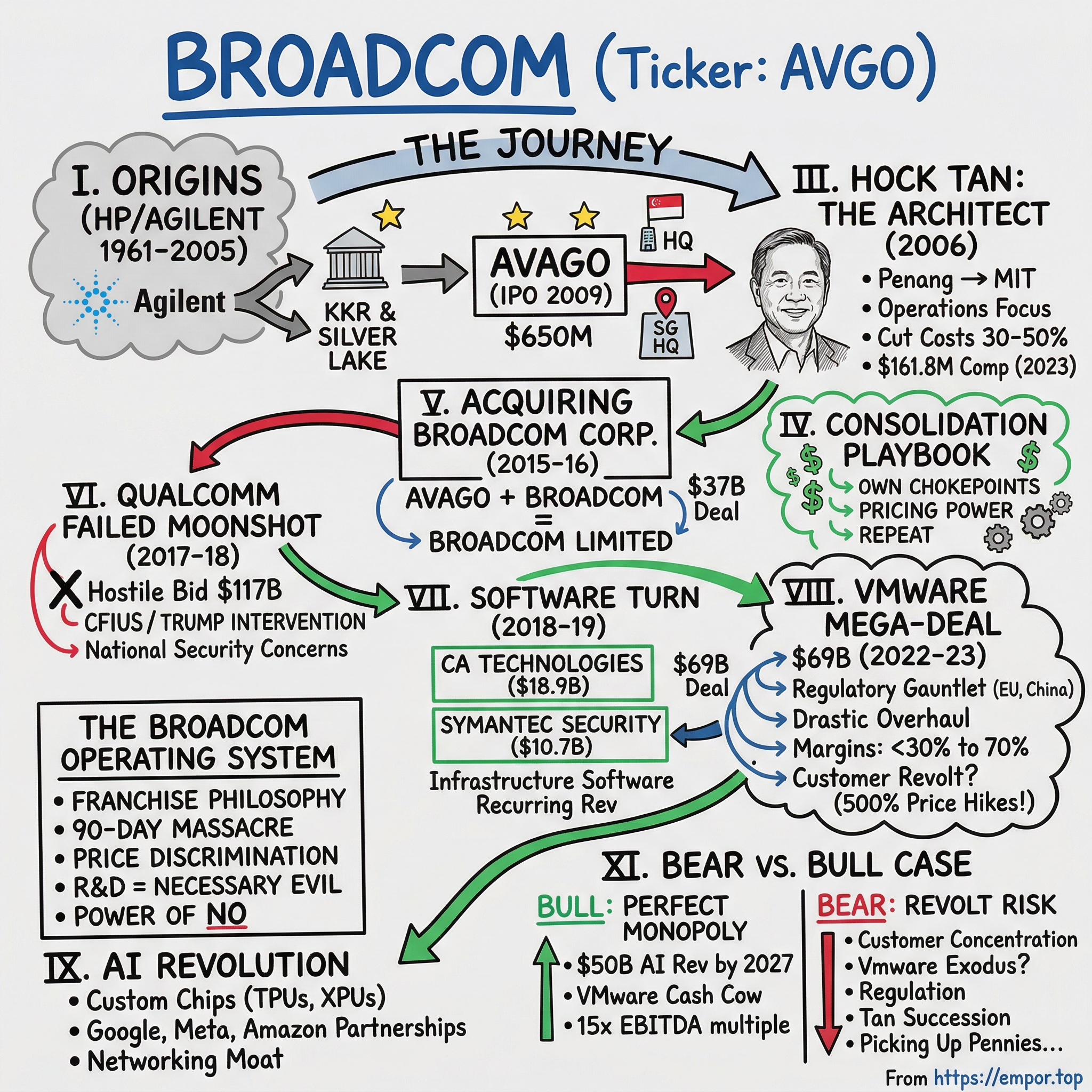
Broadcom: The Acquisition Machine That Ate Silicon Valley
I. Introduction & Episode Setup
On the afternoon of December 13, 2024, Broadcom experienced an unusual surge for a $700 billion enterprise: its stock closed up roughly 24% in a single session—the largest one-day gain in company history—pushing the market value of a firm with little consumer visibility past $1 trillion for the first time.2 The surge was not driven by a consumer device launch or product showcase. Instead, it followed a fiscal fourth-quarter earnings call where Chief Executive Officer Hock Tan detailed how custom data center chips were expanding the company's addressable market.
Twenty months later, the valuation is larger and the business backdrop is more complex. As of late August 2026, Broadcom carried a market capitalization of roughly $1.75 trillion—trading about a quarter below its 52-week high of $495, reflecting how public markets price future expectations rather than past performance.39 In fiscal 2025, which ended November 2, 2025, the company generated $63.9 billion of revenue and $26.9 billion of free cash flow, converting roughly forty-two cents of every revenue dollar into cash available to shareholders and creditors.1 For fiscal 2026, management guided to $56 billion in artificial intelligence semiconductor revenue alone—nearly matching total company revenue from two years prior—and projected AI revenue to exceed $100 billion in fiscal 2027.35
Those figures reflect a trajectory that contrasts with traditional mature-asset harvesting, marking rapid scaling for an enterprise hardware supplier of this magnitude. That contrast forms the central tension of Broadcom's current operating model.
The anti-hero. Broadcom has spent two decades operating counter to standard Silicon Valley conventions. It does not maintain a speculative research division, pursue consumer branding, or typically invent new product categories. Instead, its playbook centers on acquiring technology franchises that hold defensible lead market positions, eliminating non-essential costs, raising prices where switching costs are high, and directing the resulting cash flow toward subsequent acquisitions. Applied over twenty years, this strategy transformed a $2.7 billion carve-out of Agilent Technologies' chip division into one of the most valuable companies globally.8
The man in the middle. The architect of this strategy is Hock Tan, who was born in Penang, Malaysia, has served as president and chief executive officer since March 2006, and turned 74 during fiscal 2026.7 Tan's career path resembles that of a private equity operator more than a conventional semiconductor executive: managing director of Hume Industries in Malaysia, managing director of a venture fund, chief financial officer at Commodore International, and chief executive of Integrated Circuit Systems for ten years until its sale to Integrated Device Technology in 2005.7 Broadcom's board has compensated him in line with that financial orientation. His fiscal 2025 summary compensation totaled $205.3 million, driven almost entirely by a single front-loaded equity grant with an accounting valuation reaching up to $607.1 million at maximum performance attainment.7 The specific targets attached to that package—and whether its operational hurdles are as stringent as the board maintains—warrant closer examination against the underlying arithmetic.
Why this story is different. While much of the coverage surrounding artificial intelligence infrastructure focuses on architectural breakthroughs and frontier models, Broadcom's position rests on operational method. Broadcom did not secure its role in the AI supply chain by inventing custom accelerators; its cloud customers design those. Instead, the company spent two decades acquiring and defending physical-layer hardware capabilities—specifically the switching circuits that move data on and off silicon and the advanced packaging that integrates compute with memory—that became critical bottlenecks for AI cluster design. This represents a case where disciplined capital allocation compounded into technical leverage, an outcome that is both difficult to execute and sensitive to shifts in customer leverage.
The roadmap. The corporate sequence stretches from a Hewlett-Packard components division to Agilent, followed by a 2005 leveraged buyout by KKR and Silver Lake. From there, the company executed a series of major acquisitions: LSI, Broadcom Corporation, Brocade, CA Technologies, Symantec's enterprise security business, and VMware. It also included a failed $117 billion hostile takeover attempt for Qualcomm that a U.S. president personally terminated.12 Today, an enterprise originally structured to harvest mature tech assets has emerged as a primary hardware supplier in the AI expansion, serving a customer base that includes Google, Meta, OpenAI, Anthropic, Apple, and two customers it has declined to name.531
The thesis, stated neutrally. The established market view holds that Broadcom operates as a private-equity governance model within public technology markets—a vehicle designed to convert commoditizing hardware franchises and sticky enterprise software into pricing power. That description is mostly accurate regarding the past, but it incompletely captures the current business. Broadcom's valuation is now driven by a high-growth, customer-concentrated, and supply-constrained custom silicon business. This segment faces margin dilution as custom compute grows, relies on massive capital expenditure from hyper-scaler clients, and ties executive incentive compensation directly to AI revenue targets between fiscal 2028 and fiscal 2030.6 Evaluating whether the operating discipline of the legacy model can govern this new growth phase remains the central question for long-term investors.
It begins, unglamorously, inside a test-equipment company in Palo Alto.
 Subscribe on LinkedIn
II. The Pre-History & Agilent Spinoff: Avago's Origins (1961–2005)
In the 1960s, Hewlett-Packard's component operations were not built to create a corporate empire. Engineers produced the unglamorous underlying parts required to make HP's test and measurement instruments work: light-emitting diodes, optocouplers to isolate electrical circuits, photodetectors, and radio-frequency components. These were the plumbing of electronics—sold by the million for cents apiece and invisible inside finished products. HP manufactured them internally because a deep merchant component market did not yet exist.
Broadcom's corporate disclosures acknowledge this ancestry directly, tracing its product history back to origins at Hewlett-Packard Company, AT&T, LSI Corporation, Broadcom Corporation, Brocade and CA.40 That heritage matters because component businesses of this type carry distinct economics: while individual parts are low-cost, qualification cycles are long, customer switching costs are high, and incumbents accumulate process knowledge that competitors cannot easily replicate. A well-positioned optocoupler or RF filter line can generate steady cash flow for decades with modest reinvestment—operating more like a silicon-based bond than a high-growth tech asset.
A second critical inheritance lay in compound semiconductors. Among the component lines HP and later Agilent developed were analog products built not on silicon but on compound semiconductor materials—such as gallium arsenide, gallium nitride, and indium phosphide. These III-V materials conduct electricity faster than silicon and perform superiorly in radio-frequency and optical applications.40 That specialized manufacturing capability enabled a company better known for digital logic to eventually control key radio filters in premium smartphones and optical lasers in data centers—capabilities present in the original carve-out long before either market scaled.
The Agilent detour. By the late 1990s, HP separated its computing and printing business from its measurement instrument division. In 1999, it spun off its test-and-measurement, components, chemical-analysis, and medical operations into Agilent Technologies, marking what was then the largest initial public offering in Silicon Valley history. Inside Agilent, the Semiconductor Products Group occupied a familiar niche: generating predictable cash flow with low growth, commanding little strategic focus from the parent company.
The 2005 carve-out. That profile matched the classic private equity target. On December 1, 2005, a Singapore-organized entity acquired substantially all assets of Agilent's Semiconductor Products Group for $2.7 billion.8 Backed by Kohlberg Kravis Roberts and Silver Lake Partners, the business was renamed Avago Technologies.8 Avago acquired an extensive patent portfolio, an Asian manufacturing footprint, and product lines spanning wireless communications, wired infrastructure, industrial and automotive electronics, and computing peripherals.8
A detail that mattered twelve years later. The sponsors had organized the holding structure in the Republic of Singapore in August 2005.8 While initially an unremarkable tax and holding arrangement, it centered the company's operational gravity in Southeast Asia. Broadcom still recognizes revenue for most products when title transfers in Penang, Malaysia, where it continues to warehouse the majority of its product inventory there.4 In 2018, that corporate domicile ultimately blocked the largest acquisition attempt in company history, illustrating how structural tax engineering can become a geopolitical vulnerability.
The vehicle, not the company. Avago was designed from inception as a leveraged-buyout vehicle rather than an R&D incubator. Its objective was to acquire durable cash-flowing assets, service transaction debt, and redeploy capital into subsequent deals. Sponsor returns depended on deleveraging and cash generation rather than organic category creation. The core tenets of the enterprise—rigorous expense control, exiting non-leader product lines, and prioritizing operating margins over top-line growth—originated from this financial structure.
This model relies on high customer switching costs to sustain pricing power despite reduced reinvestment. While effective for capital efficiency, pushing this strategy aggressively can create regulatory and customer friction—a dynamic that intensified in subsequent decades. In late 2005, the vehicle lacked only an operator prepared to execute this strategy at scale, an executive who arrived three months later.
III. Enter Hock Tan: The Architect & Private Equity Operational Playbook (2006–2013)
In March 2006, Avago's private equity sponsors appointed Hock Tan as chief executive officer. Tan had spent much of his career on the finance side of industrial businesses.7 He had studied mechanical engineering in the United States and earned an MBA at Harvard before returning to Asia, where he ran Hume Industries in Malaysia from 1983 to 1988 and then managed venture fund Pacven Investment, until 1992.7 After holding senior finance positions at PepsiCo and General Motors, and serving as vice president of finance at Commodore International during its terminal decline, Tan built his executive reputation at Integrated Circuit Systems—serving as chief financial officer and chief operating officer starting in 1995, and then as chief executive from 1999 until the company was absorbed by Integrated Device Technology in 2005.7
That career background shaped his management strategy. Operating as a financially oriented executive in the semiconductor industry, Tan evaluated product lines strictly through a portfolio framework: every line had to defend a dominant franchise or face divestiture, discontinuation, or harvesting for cash flow.
The crisis IPO. Avago executed its initial public offering on the NASDAQ on August 6, 2009, in the aftermath of the global financial crisis, pricing at $15.00 a share.89 The offering comprised 21.5 million shares sold by Avago and 28.18 million shares sold by existing shareholders and employees, including the full over-allotment.8 Net proceeds to the company reached $296 million, with $54 million paid directly to KKR and Silver Lake to terminate the sponsors' advisory agreement.8
The 2009 listing functioned primarily as a liquidity event for private equity sponsors rather than a growth-capital raise, enabling them to monetize holdings while keeping the underlying operating model intact. Silver Lake's Kenneth Hao retained his seat on Broadcom's board into 2026, twenty-one years after the original carve-out, drawing fewer votes against him at the 2026 annual meeting than almost any other director.33 This capital discipline reflects the persistence of sponsor-style private equity governance within a public corporation.
The four rules. By the early 2010s, Avago's operating approach had solidified into a repeatable formula: identify product categories holding a defensible number-one or number-two market position—referred to internally as "franchises"; eliminate administrative overhead, duplicated management layers, and research that will not ship into a franchise within a defined timeframe; reinvest strictly in next-generation iterations of those leading products to protect socket positions; and direct the resulting cash flow toward debt service and subsequent acquisitions.
This framework redirected engineering rather than eliminating it outright. Broadcom's financial disclosures illustrate this focus: in fiscal 2025, the company spent $10.98 billion on research and development—an 18% year-over-year increase—with roughly 57% of its 33,000 employees in R&D roles.4 Rather than restricting R&D spending, the model concentrates engineering resources on defended sockets while defunding speculative projects.
The first proof point. Between its initial public offering and its major acquisition phase, Avago expanded an inherited product line organically. The radio-frequency filter business inherited from Agilent became critical to the smartphone build-out, as each additional cellular band required dedicated filtering to prevent signal interference. A premium handset that carried a handful of filters in 2009 contained dozens by the mid-2010s. Utilizing its III-V compound semiconductor manufacturing capabilities and strong positions with major handset makers, Avago converted that content expansion into one of the industry's highest-margin product lines—building a high-barrier component franchise rather than a consumer platform.
The dividend tell. Avago initiated a dividend in fiscal 2011—two years after listing, while still a sub-scale company seeking acquisitions—and has raised it every year since, reaching a fifteenth consecutive annual increase with the fiscal 2026 target of $2.60 per share.1 Raising a dividend while leveraging balance sheets for acquisitions ran counter to standard serial acquirer practices. The policy established cash returned to shareholders, rather than top-line revenue expansion, as management's primary benchmark for success.
Testing the "discipline" claim early. During this initial period, Avago systematically divested newly acquired or non-core product lines that failed to meet its franchise criteria, including image sensors and printer application-specific integrated circuits. While individual sales pruned lower-margin units, they slowed organic revenue growth. Company expansion depended primarily on acquisitions rather than organic market expansion, establishing a pattern where dealmaking served as the principal driver of top-line growth.
By 2013, Tan possessed a publicly traded equity currency, a proven operating methodology, and willing debt financing, setting the stage to execute acquisitions on a much larger scale.
IV. The Consolidation Machine: Scaling Semiconductor M&A (2013–2015)
By 2013, the semiconductor industry faced a structural shift. The cost of designing chips at each successive process node was rising faster than addressable market growth for most products, leaving hundreds of mid-sized chipmakers struggling as standalone entities. Industry boards and engineering leaders recognized the pressure, but the market lacked a corporate buyer willing to acquire these firms at fair valuations and execute sweeping operational cuts afterward.
Avago filled that role.
The LSI benchmark. In December 2013, Avago agreed to acquire LSI Corporation—a storage and networking chipmaker with roots tracing back to the 1980s—for $6.6 billion in cash, closing the transaction in May 2014.10 LSI supplied hard-disk-drive controllers, storage adapters, and RAID silicon embedded across enterprise server supply chains, where multi-year qualification cycles made component displacement slow and costly.
The transaction's financial structure signaled the type of acquirer Avago intended to become. Funded largely through new debt alongside an equity investment from Silver Lake, the deal represented a bold expansion.10 For an entity that had raised less than $300 million in net proceeds during its 2009 public listing, taking on billions of dollars in acquisition debt reflected deep confidence in LSI's cash generation and management's speed in restructuring the target.
Avago then established the core operating pattern of its M&A strategy. Rather than fully integrating the business, management pruned portfolio assets, selling LSI's flash-controller division to Seagate and its Axxia networking processor line to Intel. These sales lowered the net cost of the transaction while retaining LSI's primary franchises in storage connectivity and adapters, where the company held defensible market share. Broadcom subsequently applied this model of acquiring entire corporate entities, retaining high-margin core assets, and divesting remaining divisions across more than a dozen transactions. Targeted additions in storage networking and optical components followed, including the 2015 purchase of Emulex, which tightened the company's grip on host bus adapter and connectivity niches.
Beyond operational restructuring, these transactions altered market dynamics. Each deal removed an independent supplier from fragmented sectors like storage controllers and optical components, dampening price competition from sub-scale rivals. While this consolidation expanded operating margins through pricing discipline, it also reduced sourcing options for hardware clients—creating customer friction that eventually attracted regulatory scrutiny when Broadcom expanded into enterprise software.
Falsifying "the playbook always works." A common market narrative holds that Broadcom's M&A strategy extracts financial value without operational trade-offs. However, segment disclosures reveal a more complex record across the legacy semiconductor portfolio assembled between 2013 and 2019.
In fiscal 2025, Broadcom's semiconductor solutions segment generated $36.9 billion in revenue.4 Within that total, artificial intelligence sales reached $20.2 billion, which management stated represented 55% of segment revenue.7 The underlying math indicates that non-AI semiconductor revenue contracted to roughly $16.7 billion in fiscal 2025, down from approximately $17.9 billion the prior year, when segment revenue totaled $30.1 billion and AI revenue comprised $12.2 billion.202 Consequently, even as AI demand doubled, traditional hardware franchises in broadband, storage connectivity, wireless, and industrial applications experienced top-line declines.
Management attributed the fiscal 2024 contraction in legacy lines to cyclical downturns in broadband and server storage demand alongside broader enterprise spending weakness.20 By the second quarter of fiscal 2026, non-AI semiconductor revenue returned to growth, reaching $4.2 billion—a 6% year-over-year increase—supported by over $6 billion in bookings that Chief Executive Hock Tan cited as evidence of a full cyclical recovery.5
These financial results clarify the reach of the strategy. While harvested franchises maintained high operating margins and eventually recovered, the acquisition model did not generate consistent organic growth in mature assets. Across multi-year cycles, acquired semiconductor lines functioned more like cyclical cash-generating annuities than compounding growth engines, with overall expansion driven by subsequent acquisitions or emerging product categories. For investors, non-AI semiconductor performance serves as a key indicator of whether legacy cash flows remain stable enough to fund ongoing expansion.
Having validated its playbook at a $6 billion scale, Tan sought an acquisition an order of magnitude larger. He targeted a company located thirty miles away that held the corporate name Avago would ultimately adopt.
V. The Big Bang: Acquiring Broadcom Corporation & Retaining AVGO (2015–2016)
Broadcom Corporation represented a distinct operational contrast to Avago. Founded in 1991 in Los Angeles by UCLA professor Henry Samueli and his doctoral student Henry Nicholas, the company established a reputation for technical innovation. Its silicon powered cable modems, set-top boxes, Wi-Fi radios, and Ethernet switches. However, by the mid-2010s, it also carried a high cost structure, funding expansive research and development programs that did not consistently yield commercial returns.
That combination of defensible market franchises and elevated overhead made the firm an attractive acquisition target. Broadcom Corporation held leading product positions, but lacked the spending discipline to exit underperforming lines or curb speculative R&D.
The deal. On May 28, 2015, Avago Technologies announced an agreement to acquire Broadcom Corporation for approximately $37 billion—comprising $17 billion in cash and roughly 140 million Avago equity shares valued at $20 billion—implying an enterprise value of about $77 billion for the combined entity and combined annual revenue of roughly $15 billion.11 At the time, it was the largest transaction in semiconductor history. The deal closed on February 1, 2016.
The name. Post-merger branding reflected management's pragmatic approach to corporate identity. Although Avago was the legal acquirer, the combined enterprise adopted the globally recognized Broadcom name while retaining Avago's ticker symbol, AVGO. Henry Samueli remained on the board of directors, receiving the IEEE Medal of Honor in 2026.7
What actually changed. Operational integration put management's financial playbook to the test. Before the transaction, Broadcom Corporation operated with gross margins in the mid-50% range. Following the merger, management eliminated redundant corporate overhead and exited lower-margin product lines, lifting combined gross margins past 60% within two years. Financial disclosures trace this trajectory: by fiscal 2023—the final full fiscal year prior to the VMware acquisition—Broadcom generated $35.8 billion in revenue, achieving a 69% GAAP gross margin and $16.2 billion in operating profit, with its semiconductor solutions segment contributing $28.2 billion of that revenue.204 That performance yielded a GAAP operating margin of roughly 45%, well above the 20% to 30% range typical for merchant semiconductor peers.
This margin expansion did not stem from proprietary manufacturing advantages; Broadcom operates primarily as a fabless chipmaker, sourcing wafers from the same merchant foundries as its competitors. Instead, profitability improved by enforcing strict return thresholds across the product portfolio. Whereas independent Broadcom Corporation had cross-subsidized early-stage research using mature product cash flows, the restructured entity required every product socket to generate high margins independently or face exit.
The Brocade coda. Following the Broadcom Corporation integration, management executed the same portfolio pruning strategy with Brocade Communications Systems. On November 17, 2017, Broadcom acquired Brocade for approximately $5.3 billion in cash, plus $701 million to retire Brocade's term loan, funding the purchase with $4.0 billion in new debt.4041 Brocade maintained two principal businesses: a market-leading Fibre Channel storage area networking business—the specialized switching fabric connecting enterprise servers to storage arrays—and an Internet Protocol networking division that included Ruckus Wireless and the ICX switch line. Seeking only the Fibre Channel franchise, Broadcom sold the IP networking division to ARRIS International for $800 million on December 1, 2017, just fourteen days after closing the transaction.40
That rapid turnaround illustrated the core acquisition playbook: isolate high-margin franchises prior to closing and immediately divest non-strategic assets. Upon completing the purchase, Tan highlighted Broadcom's "track record of successfully integrating and growing companies we acquire" across "best-in-class franchises."41
However, this operating model introduced structural trade-offs. Rationalizing research spending prompted departures among engineering personnel focused on long-term development, while discontinuing product lines created friction with affected enterprise customers. Furthermore, because harvesting mature assets curtails organic revenue expansion, the company grew structurally dependent on ongoing acquisitions to sustain top-line growth. Having completed the largest semiconductor transaction to date, Tan soon sought an acquisition nearly three times larger.
That effort, however, encountered an obstacle the company's financial model had not yet faced: regulatory intervention by a national government.
VI. The Failed Moonshot: Qualcomm Hostile Bid, CFIUS & Redomiciling (2017–2018)
On November 2, 2017, Hock Tan stood in the Oval Office beside President Donald Trump to announce that Broadcom would redomicile its legal headquarters from Singapore back to the United States. Four days later, Broadcom launched an unsolicited $117 billion bid for Qualcomm.12 The timing was intended to address foreign-ownership concerns before pursuing the transaction, but the regulatory maneuver proved insufficient.
The logic of the bid. Qualcomm presented an ideal target under Broadcom's operating criteria: a business anchored by high-margin franchises in cellular modems and standards-essential patents, paired with an extensive research organization and a market valuation depressed by investor doubts over capital allocation. Tan's premise was that Qualcomm's patent licensing annuity could be managed with significantly lower administrative overhead and reduced speculative research. If completed, the deal would have represented the largest technology acquisition in history.
The counterattack. Qualcomm's board resisted the takeover on political rather than financial grounds. Rather than debating valuation, Qualcomm framed the acquisition around national security, questioning whether a Singapore-domiciled acquirer with a history of curtailing R&D spending would compromise U.S. leadership in 5G wireless technology at a time when wireless standards were becoming a central strategic contest with China. In January 2018, Qualcomm filed a unilateral notice with the Committee on Foreign Investment in the United States (CFIUS), placing the transaction under national security review.13
The order. On March 12, 2018, President Trump issued an executive order blocking the acquisition, instructing Broadcom and Qualcomm to "immediately and permanently abandon the proposed takeover" and disqualifying all fifteen of Broadcom's proposed director nominees from standing for election to Qualcomm's board.1213 The CFIUS assessment reasoned that an anticipated reduction in Qualcomm's research funding would weaken U.S. technological competitiveness relative to foreign rivals, specifically identifying Huawei as a potential beneficiary and citing Qualcomm's role as a key Department of Defense supplier.13
The intervention established a rare regulatory precedent: the U.S. government blocked a commercial transaction based not on the acquirer's ownership identity, but on its expected operational playbook. Broadcom's strategy of harvesting mature cash flows by reducing speculative R&D was explicitly identified as a national security risk.
What it cost. The failed takeover imposed significant financial and strategic costs. Broadcom had spent months and substantial advisory fees assembling financing for the unprecedented transaction, nominating a full director slate, and committing its growth strategy to wireless consolidation.1213 Beyond direct expenses, the failed bid consumed a year of capital deployment, forcing management to formulate a new acquisition thesis. The speed of the subsequent pivot—entering an entirely new enterprise software market four months later—reflected either operational adaptability or an institutional imperative to deploy capital.
The pivot. Broadcom moved quickly to complete its corporate restructuring. Redomiciliation shifted from a strategic gesture to an operational necessity. Shareholders approved the move at a special meeting on March 23, 2018, the High Court of Singapore confirmed the scheme of arrangement on April 2, and on April 4, 2018, Broadcom completed the transition, with shares of Broadcom Inc. trading as a Delaware corporation the following day under the ticker AVGO.14
What the episode proves, and what it does not. The transaction challenged the assumption that Broadcom's management team could execute any deal if the financial terms aligned. When an acquisition target intersects with national security and industrial policy, capital availability and financial logic cease to be the sole governing constraints.
While redomiciling to the United States resolved the specific foreign-ownership issue that triggered the CFIUS intervention, geopolitical exposure remains an ongoing factor. Broadcom's chip manufacturing relies heavily on foundries in Taiwan, its inventory warehousing remains concentrated in Malaysia, and its major AI customers operate compute infrastructure increasingly subject to policy attention.4 The Qualcomm intervention demonstrated that the binding constraint on Broadcom's expansion had permanently shifted from financial capability to state approval.
Restricted from acquiring major semiconductor competitors, Tan redirected the company's M&A strategy toward enterprise software.
VII. The Software Pivot: Mainframe Monopolies & Symantec (2018–2021)
Wall Street's initial reaction was skeptical. On July 11, 2018, Broadcom announced an agreement to acquire CA Technologies—a mainframe software provider widely viewed by technology investors as a mature, low-growth business—for $18.9 billion in cash.15 Broadcom's shares fell 2.8% during regular trading and another 5.2% after hours, prompting at least two analyst downgrades over the strategic logic of a semiconductor firm buying legacy mainframe tools.16 Meanwhile, CA shares surged 15%.16
The initial market skepticism overlooked the core economic alignment: management was not seeking software synergies, but rather a cash-generating annuity with high switching costs structurally similar to its legacy component franchises.
Why mainframe software. The operational logic rested on high customer switching costs. Large financial institutions run core transaction processing on IBM mainframes, using scheduling, security, and systems-management software deeply integrated into their proprietary IT architecture. Replacing those systems requires multi-year re-platforming initiatives involving significant operational risk. Consequently, enterprise clients routinely accept price increases rather than undertake costly migrations. That lock-in mirrors the qualification barriers that protected Broadcom's hardware lines, generating predictable cash flows through multi-year license renewals rather than component design wins.
Broadcom executed its standard restructuring playbook: concentrating sales coverage on major accounts with high renewal probabilities, cutting marketing and sales expenditures aimed at smaller accounts, and accepting modest top-line revenue declines to achieve higher operating margins. The transaction closed on November 5, 2018.17
Symantec, and the part that did not work. In August 2019, Broadcom agreed to acquire Symantec's enterprise security business for $10.7 billion in cash.18 The acquisition targeted infrastructure security products embedded within corporate networks, where management sought to lower operating overhead while harvesting recurring renewal revenue.
However, operational friction emerged quickly. Within months of closing, Broadcom divested Symantec's Cyber Security Services unit—including managed detection and response operations, threat intelligence capabilities, and global security operations centers—to Accenture in a transaction that completed on April 30, 2020, transferring over 300 employees.19 Financial terms of the sale were not disclosed.
The divestiture highlighted a structural boundary in Broadcom's software strategy. Unlike software code protected by high switching costs, managed security services rely on continuous technical labor and ongoing client relationships. Restructuring personnel in service-based units degrades the underlying product value. Broadcom's rapid exit illustrated operational discipline, but also demonstrated that its playbook applies effectively to code with lock-in rather than labor with relationships.
That transition from hardware to software was enabled by structural cost consolidation. Rather than operating acquired software entities as standalone subsidiaries with dedicated sales, marketing, and product development units, Broadcom integrates them into a centralized go-to-market structure focused primarily on top-tier enterprise accounts. This framework significantly reduces overhead relative to traditional software peers: in fiscal 2025, selling, general, and administrative expense across the entire company totaled $4.2 billion on $63.9 billion in revenue—representing less than seven cents of every revenue dollar, and declining 15% year over year even as overall revenue expanded 24%.4 By comparison, major enterprise software vendors typically allocate a substantially higher percentage of revenue to sales and marketing alone.
The narrowed claim. Across both transactions, Broadcom's software segment functioned primarily as a cash-harvesting model rather than an organic growth driver. By fiscal 2023—five years after acquiring CA Technologies and four years after purchasing Symantec—infrastructure software revenue reached $7.6 billion against a combined purchase price of nearly $30 billion for those two assets.20 While the segment generated substantial operating profit, top-line revenue remained flat without subsequent acquisitions, demonstrating that software expansion depended on inorganic dealmaking rather than internal compounding.
This dynamic shaped the context for Broadcom's next major software expansion. When the company subsequently acquired VMware and tripled its infrastructure software revenue, the core analytical question was not whether the segment had developed an organic growth engine, but rather how much pricing power could be exerted, how rapidly costs could be restructured, and what level of customer friction or regulatory scrutiny that process would generate.
The execution yielded substantial financial returns quickly, but also generated more customer pushback and regulatory oversight than management had anticipated.
VIII. The VMware Mega-Bet: Monopoly Rent-Seeking & Enterprise Lock-In (2022–2024)
For twenty years, VMware's hypervisor was the least controversial software in the enterprise data center. It did one thing — let a single physical server safely run many isolated virtual machines — and it did it so early and so well that "virtualized" and "VMware" became synonyms. By the early 2020s an estimated majority of the world's enterprise server workloads ran on it. It was infrastructure in the literal sense: nobody thought about it until it stopped working.
Then it was bought by a company that had spent fifteen years proving it would think about nothing else.
The transaction. Broadcom completed its acquisition of VMware on November 22, 2023.21 The consideration was approximately $30.8 billion in cash plus 544 million Broadcom shares with a fair value of $53.4 billion — roughly $84.2 billion in total consideration, against the headline enterprise value of about $69 billion that had been quoted when the deal was struck in May 2022, the difference reflecting the appreciation of Broadcom stock during an eighteen-month regulatory review.20 It was, by a wide margin, the largest acquisition in the company's history.
The playbook, at maximum intensity. What followed was the Broadcom method applied to a customer base of hundreds of thousands rather than hundreds. Perpetual licenses — the model under which a customer buys software once and pays annually for support — were terminated in favor of subscription-only terms. The product catalogue, which had sprawled into thousands of separately purchasable components, was compressed into a small number of bundles anchored on VMware Cloud Foundation, the full private-cloud stack. Customers who had bought only the hypervisor found that the renewal quote now included networking and storage virtualization they had not asked for, with minimum commitment sizes based on capacity they might use rather than capacity they did.
The financial results were unambiguous. Infrastructure software revenue reached $27.0 billion in fiscal 2025, up 26%, with segment operating income of $20.8 billion — a segment operating margin near 77%.4 By the second quarter of fiscal 2026, software gross margin ran at 93% and segment operating margin at approximately 79%.5 Total contract value booked in the fourth quarter of fiscal 2025 exceeded $10.4 billion against $8.2 billion a year earlier, and the infrastructure software backlog ended fiscal 2025 at $73 billion, up from $49 billion.26
Now the falsification, in the same breath. The moat claim here is stark: enterprise switching costs are absolute, so price can be raised almost without limit. The company's own record over the past two years narrows that claim in three specific ways.
First, the largest customers fought back and won concessions. AT&T sued Broadcom's VMware subsidiary in New York State Supreme Court in 2024, alleging breach of a pre-acquisition agreement entitling it to renewals of perpetual-license support, and seeking to avoid a forced migration to subscription terms. The parties informed the court of a settlement-in-principle on November 21, 2024; terms were not disclosed.22 A settlement is not a verdict, but a company confident that its contracts were airtight does not usually settle with its largest telecom customer weeks before a preliminary-injunction hearing.
Second, a court ordered Broadcom to keep supporting a customer that was leaving. On June 30, 2025, the District Court of The Hague ruled that VMware must continue providing support — maintenance, patches, upgrades — to Rijkswaterstaat, the executive arm of the Dutch Ministry of Infrastructure and Water Management, for at least two years while the agency migrated off the platform, on pain of fines up to €25 million.23 Rijkswaterstaat had rejected a new subscription scheme it said would cost 85% more for the same software.23 The significance is not the size of the customer. It is the precedent: a European court held that a customer with perpetual licenses cannot be forced to choose between a repricing and operational failure. Switching costs are high, but they are not legally unbounded.
Third, the channel and the regulator. Cloud Infrastructure Services Providers in Europe, a trade body representing roughly fifty suppliers, filed an appeal before the EU General Court in July 2025 seeking annulment of the European Commission's original approval of the acquisition, alleging that Broadcom had unilaterally terminated contracts on weeks' notice and imposed cost increases "sometimes exceeding tenfold."24 Broadcom said it strongly disagreed and noted that thirteen jurisdictions had cleared the deal.24
Then, in January 2026, Broadcom shut down the VMware Cloud Service Provider program in Europe outside a small group of selected partners, with all transactions required to complete by March 31, 2026 — a change that removed selling authorization from hundreds of European providers.25 CISPE filed a fresh antitrust complaint on March 19, 2026 and asked the Commission for interim measures to halt what its secretary general called "ongoing abuse."25
Weighing it. Does the evidence reject the moat? No. Price realization on this scale — a segment compounding to 79% operating margins while revenue grows — is only possible if the great majority of customers are, in fact, paying rather than leaving. The switching-cost claim survives.
But it must be narrowed on two axes. It is bounded by contract law and by courts, which have twice now constrained Broadcom's ability to convert legacy customers on its own timetable. And it is bounded by regulation, with an active European Commission complaint process and a pending General Court challenge to the merger clearance itself — a live overhang whose remedies, if any were imposed, would most plausibly target exactly the licensing and channel practices that generate the margin.
There is also an accounting judgment investors should understand, because it makes the segment look more volatile than it is. In fiscal 2025, Broadcom recognized $7.8 billion of upfront license revenue within products revenue — license value recognized immediately on contracts where the customer does not have a right to terminate, rather than spread across the subscription term.4 The prior year figure, reclassified for comparability, was $4.6 billion.4
This is permitted and disclosed, but it means reported software revenue in any quarter reflects contract timing as much as customer health. It is why the segment grew just 1% year over year in the first quarter of fiscal 2026, 9% in the second, and was guided to 31% growth in the third.275 The underlying measure management points to — annualized recurring revenue growth of 17% in the second quarter — is the more meaningful one, and the backlog is the better tell than the revenue line.5
One further gap deserves noting. Management has periodically described the progress of its largest accounts onto the VMware Cloud Foundation bundle, and on the June 2026 call Tan attributed accelerating software growth to strong server demand and the deployment of the VCF 9.1 release, which added support for running AI inferencing workloads across AMD, Intel and Nvidia platforms alongside traditional virtualized workloads.5 What Broadcom does not publish is a consistent, quarter-by-quarter conversion or retention statistic for the installed base — no disclosed logo churn, no net revenue retention, no seat or core-count trend. For a $27 billion segment whose entire investment case rests on customers renewing at higher prices, that is a material disclosure gap, and it means the regulatory and litigation record is currently the best available independent read on customer behavior.
The VMware chapter is, in the end, the purest expression of the old Broadcom. The chapter that is now driving the stock is something the company had never been before.
IX. The AI Megatrend: Custom Silicon (XPUs) & Hyperscaler Partnerships (2023–Present)
On the fiscal fourth-quarter call in December 2025, an analyst asked Hock Tan to characterize demand. His answer was a sentence that would have sounded absurd from any semiconductor executive in any prior cycle: "We have never seen bookings of the nature that what we have seen over the past three months."26 He then disclosed that Broadcom held more than $73 billion of AI-related orders scheduled for delivery over eighteen months — nearly half of a consolidated backlog of $162 billion.26 Six months later, on the second-quarter call, the figure that mattered was different and more startling: in a single quarter Broadcom booked over $30 billion of AI semiconductor orders against $10.8 billion shipped.5
To understand why a company built on harvesting mature franchises suddenly sat at the center of the largest capital-spending boom in technology history, you have to understand what an XPU actually is.
The technology, in plain language. A graphics processor of the kind Nvidia sells is a general-purpose engine. It is superb at the mathematics underlying neural networks, and it works for everybody's model, which is exactly why it commands premium pricing — the customer is paying for flexibility they may not need. A hyperscaler running one dominant workload, at enormous scale, on models it designed itself, faces a different calculation. If you know precisely which operations your model performs billions of times a second, you can build silicon that does only those things, and do them with less power and less silicon area per unit of useful work.
That is a custom accelerator — Broadcom's term is XPU. The catch is that designing one is brutally hard. It requires the physical-design expertise to lay out billions of transistors at leading-edge process nodes, the memory interfaces to attach high-bandwidth memory stacks, the advanced packaging to bond compute and memory dies together in a single module, and — critically — the SerDes.
SerDes deserves a sentence of its own, because it is the least-understood source of Broadcom's advantage. Serializer/deserializer circuits are the tiny analog engines that move data on and off a chip at extreme speed over a physical wire. Every bit that leaves a processor passes through one. They are analog design at the edge of physics, they take years and enormous accumulated know-how to perfect, and a customer building a chip cannot simply license a good-enough version. Broadcom's SerDes library is the reason that when a hyperscaler decides to build its own accelerator, the shortlist of partners who can actually deliver it is very short. On the June 2026 call, Tan described "at least one generation of technology and product leadership" in the 200G and 400G SerDes that enable copper connections inside a rack.5
The scale, and the speed of it. AI semiconductor revenue was $12.2 billion in fiscal 2024, grew 65% to $20.2 billion in fiscal 2025, and then accelerated rather than decelerating: $8.4 billion in the first quarter of fiscal 2026, up 106%; $10.8 billion in the second, up 143% and representing 49% of total company revenue; with third-quarter guidance of $16.0 billion, up more than 200%.272735 Full-year fiscal 2026 guidance stands at approximately $56 billion, with management reiterating an expectation of more than $100 billion in fiscal 2027.5
Networking — the switches, routers, optical components, and interconnect that stitch accelerators into clusters — represented almost 40% of AI revenue in the second quarter, a share Tan explicitly described as a high-water mark, saying he expects it to settle closer to 30%.5 Broadcom has been shipping the Tomahawk 6, which it describes as the industry's only 100-terabit Ethernet switch, for over a year, and was taping out a 200-terabit successor during the second quarter.5 The strategic point is that this is standards-based Ethernet, positioned as the open alternative to Nvidia's proprietary interconnect — which means Broadcom sells into AI clusters it does not otherwise supply.
The customers, named. The disclosure here has become unusually specific. Broadcom has six core custom-silicon customers.5 With Google, Broadcom entered a long-term agreement in April 2026 to develop and supply custom Tensor Processing Units across future generations, plus a supply assurance agreement for networking and other components in Google's next-generation AI racks running through up to 2031.29 With Meta, an April 14, 2026 partnership covers multiple generations of MTIA accelerators, with an initial deployment exceeding one gigawatt and roughly three gigawatts expected through the end of 2028; the first gigawatt order has been received and begins delivery in the second half of 2027.305
With OpenAI, an October 13, 2025 collaboration covers 10 gigawatts of OpenAI-designed accelerators through 2029, of which 1.3 gigawatts is contractually committed for 2027, with silicon already delivered and production on track for late 2026.285 With Anthropic, an expanded arrangement disclosed in April 2026 gives Anthropic access, through Broadcom, to approximately 3.5 gigawatts of next-generation TPU-based compute beginning in 2027.29 Two further customers remain unnamed, with shipments starting in late 2026 and purchase orders of $6 billion received to date.5
Falsification pass one: the margin claim. The bullish version says AI is simply Broadcom's old economics at a larger scale. It is not, and the company says so. Consolidated non-GAAP gross margin was 77.1% in the second quarter of fiscal 2026, down 230 basis points year over year, and management guided the third quarter to approximately 74% as AI became a larger share of the mix.5 Chief financial officer Kirsten Spears told analysts that ASICs and TPUs carry lower margins than the rest of the portfolio and that pressure would continue as they accelerated — while adding that the higher-margin AI networking business partially offsets it.5 Asked directly whether this was structural, both Spears and Tan insisted the semiconductor segment's own margin is stable and that the dilution is a mix effect between segments.5
The filings support the more nuanced reading. Semiconductor segment gross margin ran at approximately 70% in the second quarter while infrastructure software ran at 93%; as the semiconductor segment grew to 68% of revenue from 56% a year earlier, the blended number necessarily fell.53 Crucially, operating margin went the other way, rising 200 basis points to 67.3%, because operating expenses stayed roughly flat while revenue grew 48%.5 Spears's recommendation to investors was direct: model the two segments separately.5
The conclusion is that the "margin compression" thesis is half right. Gross margin dilution is real, ongoing, and mechanical — memory and other pass-through content carries little markup. But it has not translated into operating margin erosion, because Broadcom's cost base is fixed relative to the revenue ramp. The claim to watch is not consolidated gross margin. It is semiconductor segment gross margin, which is the only line that would reveal whether custom silicon economics are actually deteriorating rather than simply being diluted by mix.
Falsification pass two: the concentration claim. This is the more serious exposure, and the evidence turned against the company during 2026. Broadcom's fiscal 2025 annual report disclosed that its top five end customers accounted for approximately 40% of net revenue, unchanged from the prior year, and — more pointedly — that a single semiconductor customer, a distributor, accounted for 32% of net revenue, up from 28% and 21% in the two prior years.4 That same customer represented 44% of net accounts receivable at year-end, against 18% a year earlier.4 Receivables concentration of that magnitude is a genuine second-layer diligence item: it compresses the company's collection risk into one counterparty relationship.
Then Google began diversifying. In April 2026 — days after signing the long-term agreement with Broadcom — reports emerged that Google was in talks with Marvell to develop a memory processing unit and an inference-optimized TPU, adding a third design partner alongside Broadcom and MediaTek, which was already working on cost-optimized variants of Google's Ironwood generation.37 On August 18, 2026, that became concrete: Marvell agreed to co-design custom products for Google's TPU ecosystem and issued Google a stock warrant for up to 58,970,907 shares at $206.58 — worth roughly $12.2 billion if fully exercised.36
Tan had, to his credit, pre-empted this on the June call. Asked about share within Google, he said the commitment was "a very substantial dollar amount" but added that given the pace at which Google is consuming compute, "we fully expect that there will be some diversity of sources for them."5 That is management bounding its own claim, and it belongs next to the claim rather than in a footnote.
Falsification pass three: who is paying, and with whose money. The most consequential recent disclosure is not a chip. On June 9, 2026, Broadcom established what it called the AI XPV Platform with Apollo and Blackstone's credit and insurance business as initial anchor investors, designed to enable more than 20 gigawatts of compute capacity through 2028 for frontier labs including Anthropic and OpenAI, launching with an initial tranche of $35 billion led by Apollo to fund Anthropic's capacity expansion on Fluidstack-based sites from mid-2026.32
Read carefully, this is asset-backed financing for demand that the customers cannot fund from operating cash flow. Tan described it on the call as creating "a vehicle to basically have these chips funded for these LLM players, who otherwise might have difficulty getting access to our technology."5 That is an honest description of a real constraint — and also an admission that a meaningful portion of the fiscal 2027 and 2028 growth runway depends on credit markets remaining willing to underwrite AI infrastructure. Broadcom's own residual economic exposure to the platform has not been disclosed. Investors should also note the company's own contractual language: the April 8-K stated plainly that Anthropic's consumption of the expanded capacity "is dependent on Anthropic's continued commercial success."29 That sentence, written by Broadcom's lawyers, is the single best-calibrated risk disclosure in the file.
A narrative-consistency note. Investors reconciling management commentary against filings will find the Anthropic arrangement described two ways. The April 2026 8-K disclosed that Anthropic would access approximately 3.5 gigawatts of next-generation TPU-based compute from 2027, as part of a larger multi-gigawatt commitment.29 On the June call, Tan described the same April agreement as enabling "another 5 gigawatts" beginning in 2027, on top of the more-than-one gigawatt Anthropic was already accessing in 2026.5 The two framings are not necessarily contradictory — the call figure may aggregate arrangements the 8-K itemized separately — but the company has not reconciled them publicly, and gigawatts have become the unit in which this business is valued. When a metric moves the stock, the absence of a consistent definition is itself a disclosure issue.
One more inconsistency worth flagging. In December 2025, describing a $10 billion order from Anthropic for TPU-based systems, Tan called it "a system sale — a real system sale," and Spears explained that shipping racks meant passing through more third-party components at lower margin.26 Six months later, asked about rack versus chip economics, Tan said: "No racks. It is all a chip business only."5 The most plausible reconciliation is that the Apollo-funded structure changed who assembles and owns the systems. But the shift went unexplained on the call, and it matters, because the proportion of AI revenue that is pass-through content determines how much of the headline growth is genuine Broadcom value-add.
The AI chapter, then, is not a repudiation of the Broadcom method. It is an entirely different business bolted onto it — and understanding how the two fit together requires looking at the operating system that governs both.
X. Playbook & Strategic Powers: The Broadcom Operating System
Stripped of segment labels and product names, Broadcom operates fundamentally as a capital allocation framework attached to a semiconductor company. Evaluating its business model requires testing its strategic powers against empirical performance rather than corporate messaging.
Switching costs — strong, and now legally tested. High customer switching costs represent Broadcom's primary competitive advantage across mainframe software, hypervisors, storage networking, and custom silicon. In each domain, a client's cost to transition away significantly exceeds the price increases imposed. However, enforcement limits established by courts in The Hague in 2025 and ongoing regulatory inquiries in Brussels demonstrate that while switching costs remain monetizable, the pace of monetization faces legal and regulatory constraints that were absent in prior years.
Scale economies — genuine, and narrowly held. Broadcom's $10.98 billion in fiscal 2025 research and development spending is concentrated on core franchises rather than distributed across broad portfolios.4 In custom silicon, competitive scale stems from reusable intellectual property—including SerDes, memory interfaces, packaging methodologies, and validated design libraries. Industry estimates place Broadcom and Marvell together at approximately 95% of the custom AI application-specific integrated circuit co-design market, with Broadcom holding the dominant position.38 While this structure functions as a duopoly, customer arrangements such as Google's equity warrants with Marvell demonstrate that hyperscalers actively cultivate secondary suppliers.
Process power — the most durable and least copyable. Broadcom's organizational capability to acquire an enterprise, isolate its core franchises, eliminate non-essential operations within four quarters, and retain key client relationships remains difficult for competitors to replicate. Executing this playbook requires an institutional willingness to absorb short-term customer friction to secure structural operating margins. However, because this process power relies heavily on senior management's operational judgment, it connects directly to executive governance.
Cornered resource — and the succession problem. Broadcom's critical asset remains Chief Executive Officer Hock Tan. On September 3, 2025, independent directors granted Tan a performance stock unit award of 610,521 target shares, vesting at the end of fiscal 2030 and tied entirely to AI revenue performance between fiscal 2028 and fiscal 2030.6 The filing noted that stockholders "have also expressed support in securing the continued leadership of Mr. Tan."6 Under the arrangement, Tan agreed to hold after-tax shares from his 2023 award through November 3, 2030.6
The structure of the incentive package reveals modest operational hurdles relative to management's disclosed forecasts. The award pays zero if the highest four-consecutive-quarter AI revenue during the performance window is at or below $60 billion, 100% of target at $90 billion, 200% at $105 billion, and 300% at $120 billion or above.6 However, Broadcom had already guided to roughly $56 billion in AI semiconductor revenue for fiscal 2026 and projected over $100 billion for fiscal 2027—prior to the start of the measurement period.5 Furthermore, management's third-quarter fiscal 2026 projection of $16.0 billion represents an annualized run rate of $64 billion, indicating that baseline vesting hurdles sit below run rates expected before the performance period begins.3
Investor feedback reflected concern over these targets. At the April 20, 2026 annual meeting, advisory approval of executive compensation passed with 2.43 billion votes in favor and 1.23 billion against—a 34% opposition rate.33 By comparison, the prior year's compensation vote received 3.39 billion votes in favor and 275 million against, representing less than 8% opposition.34 Additionally, compensation committee chair Harry You drew 954.7 million votes against his re-election in 2026, up from 337.2 million in 2025.3334
A governance dynamic also accompanies key customer relationships: Tan serves on the board of Meta Platforms, which became a multi-gigawatt custom-silicon client in April 2026.730 While standard corporate governance protocols govern board recusal, the overlapping role remains relevant when evaluating commercial agreements across multi-year supply commitments.
Is there a bench? Broadcom has expanded its public leadership profile on earnings calls, featuring operating executives Charlie Kawwas, president of the Semiconductor Solutions Group, and Ram Velaga, president of the Infrastructure Software Group, alongside the chief executive.5 Kawwas has served as a named executive officer for several years, receiving a front-loaded equity award in fiscal 2023 structured to cover five years of grants.7
While this establishes a visible operating layer, the board has not designated a formal successor. Rather than naming an heir, the board's September 2025 retention package secured Tan's commitment through fiscal 2030.6 For an organization whose strategy depends on executive discipline in portfolio rationalization, the absence of a public succession plan represents a central governance consideration.
Capital allocation — better than the caricature, but not the legend. Market commentary often asserts that Broadcom funds major acquisitions through debt and rapidly de-levers below two times EBITDA within two years. Financial disclosures following the VMware transaction indicate a more nuanced pattern. Total outstanding debt principal stood at $69.8 billion at the end of fiscal 2024 and $67.1 billion at the end of fiscal 2025, representing a reduction of under 4%.4 Concurrently, Broadcom issued $5.0 billion in senior notes in September 2025 and $4.5 billion in January 2026, while conducting debt tender offers in June 2026.4
The decline in net leverage resulted primarily from earnings expansion rather than rapid debt paydown. Driven by fiscal 2025 adjusted EBITDA of $43.0 billion and year-end cash balances of $16.2 billion, net leverage dropped to approximately 1.2 times EBITDA.1 Capital allocation prioritized shareholder returns: management increased the fiscal 2026 quarterly dividend by 10% to $0.65 per share—marking a fifteenth consecutive annual increase—and returned $10.9 billion to shareholders in the first quarter of fiscal 2026 through $3.1 billion in dividends and $7.8 billion in share repurchases, supported by a new $10 billion buyback authorization.127
Broadcom's capital allocation record is strong on returning cash to shareholders and disciplined in transaction execution, but post-VMware leverage reduction was achieved through EBITDA growth rather than rapid debt paydown. The ongoing test of management's discipline will be whether future acquisitions maintain strict underwriting criteria, particularly when evaluating targets using equity valuations elevated by artificial intelligence growth.
XI. Skeptical Investor Stress Test, Risk Radar & Financial Mechanics
An examination of Broadcom's disclosures by a skeptical investor reveals several points of vulnerability beneath the primary growth narrative.
The shape of the business. In fiscal 2025, semiconductor solutions generated $36.9 billion in revenue and $21.2 billion in segment operating income, while infrastructure software generated $27.0 billion in revenue and $20.8 billion in operating income.4 This dual-engine structure produced nearly identical segment operating profits from two business units of significantly different revenue scale. However, the business mix shifted rapidly: by the second quarter of fiscal 2026, semiconductors expanded to 68% of net revenue, up from 56% a year earlier, with management guiding third-quarter semiconductor revenue to $20.5 billion compared to $8.9 billion for software.35 Consequently, the corporate entity that generated the margin profile of fiscal 2025 is not the entity that will generate results in fiscal 2027.
Cash conversion — the underlying economic driver. Free cash flow reached $26.9 billion in fiscal 2025 and $10.3 billion in the second quarter of fiscal 2026—representing 46% of revenue—against capital expenditures of just $231 million in the quarter.13 Broadcom operates on a fabless model, designing silicon while outsourcing manufacturing to merchant foundries, capturing leading-edge semiconductor economics without funding multi-billion-dollar fabrication plants. In an artificial intelligence investment cycle consuming hundreds of billions of dollars in physical capital, Broadcom's capital intensity remains minimal, making cash conversion its principal structural strength.
Competitive dynamics under Porter's Five Forces. Applying Porter's Five Forces highlights the structural pressures facing the business. Buyer power represents the primary pressure and continues to intensify: growth is concentrated across six core customers with deep capital resources, internal silicon capabilities, and a demonstrated willingness to multi-source through partners like MediaTek and Marvell.3736 Supplier power remains concentrated in Taiwan Semiconductor Manufacturing Company for leading-edge logic wafers and a tight group of high-bandwidth memory vendors; management noted that supply is secured through 2026, with planning underway for 2028 and 2029, while Broadcom expands internal advanced packaging capabilities in Singapore to mitigate bottleneck dependencies.526
Rivalry takes the form of a co-design duopoly in custom application-specific integrated circuits and an oligopoly in networking silicon, where Broadcom positions its open Ethernet standards against Nvidia's proprietary interconnect. Substitutes pose a longer-term structural threat: while custom accelerators displace graphics processing units, any normalization in merchant GPU pricing would narrow the economic justification for bespoke silicon. New entrants remain constrained by high technical barriers in SerDes design and advanced packaging, preventing broader competitive entry.
Competitive positioning across the chip sector. Set against industry peers, Broadcom occupies a distinct position. Nvidia supplies general-purpose hardware across the broader market and captures the industry's highest gross margins, but faces exposure as major clients develop custom alternatives. Broadcom provides those custom alternatives, but only to hyperscalers with the capital required to fund bespoke chip programs—capping its addressable custom compute client base at roughly six major accounts. Marvell operates in the same custom ASIC co-design market with a smaller share, but established a direct co-design foothold inside Broadcom's primary client relationship in August 2026.3638 MediaTek handles cost-optimized derivative design for Google.37 Meanwhile, internal hyperscaler engineering teams represent a fourth competitive vector; as clients internalize physical design, logic integration, and verification, their reliance on external partners diminishes, even if high-speed SerDes capabilities remain outsourced.
This structural dynamic indicates that Broadcom's competitive moat is strongest where physical engineering challenges are most acute—such as high-speed interconnects and advanced packaging—and weakest in logic design and integration. An investor evaluating long-term revenue durability must monitor the exact scope of engineering work Broadcom performs for each customer, rather than relying solely on headline partnership announcements. A customer can retain Broadcom for SerDes circuits and Ethernet switching while shifting primary accelerator design elsewhere, yielding significantly different financial returns.
Governance and financial scrutiny for activists. An activist or critical investor examining corporate governance and disclosures would focus on four areas:
Disclosure quality. Management's reported "AI semiconductor revenue" is a non-GAAP operational metric rather than a standalone reporting segment. Disclosures provide no detailed reconciliation linking the $73 billion backlog to quarterly revenue, no consistent book-to-bill reporting, and no segment breakdown separating custom XPUs, networking silicon, and lower-margin pass-through components. Consequently, market valuations for the long-term AI growth trajectory rely heavily on management commentary rather than audited segment breakdowns.
GAAP versus non-GAAP divergence. In fiscal 2025, GAAP net income totaled $23.1 billion compared to non-GAAP net income of $33.7 billion.1 The $10.6 billion bridge consists primarily of stock-based compensation and intangible asset amortization. Stock-based compensation represents a substantial ongoing expense: unrecognized compensation cost on unvested awards reached $23.8 billion at year-end, with $8.3 billion scheduled for recognition in fiscal 2026.4 In the second quarter of fiscal 2026, stock-based compensation ran at $2.09 billion, representing approximately 9% of total revenue.3 Valuing the business on non-GAAP figures excludes a recurring, shareholder-dilutive expense.
Working capital and inventory trends. Inventory increased to $4.3 billion in the second quarter of fiscal 2026, pushing days of inventory on hand from 68 to 86, which management attributed to securing components ahead of projected second-half demand.5 While consistent with the reported order book, elevated inventory levels also present balance-sheet risk if second-half delivery schedules slow.
Off-balance-sheet structures. The AI XPV Platform established with Apollo and Blackstone functions outside Broadcom's consolidated balance sheet while underpinning customer demand forecasts.32 The lack of disclosed residual economic exposure leaves investors unable to evaluate potential downside liabilities if underlying infrastructure projects underperform.
Risk radar across operational and macroeconomic vectors. A broader risk radar highlights several operational and macroeconomic vulnerabilities. Hyperscaler capital expenditure cycles represent the primary demand risk: fiscal 2027 projections assume continuous infrastructure deployment by frontier artificial intelligence laboratories, leaving revenue sensitive to capex deferrals by major clients. Customer insourcing remains an active operational trend. Key-person governance risk is concentrated in Chief Executive Officer Hock Tan, who turned 74 in fiscal 2026, with the board extending his employment package through fiscal 2030 rather than designating a formal successor.76 Financial leadership transition adds another layer of change: long-time Chief Financial Officer Kirsten Spears retired in June 2026 and was succeeded by Amie Thuener, Alphabet's former corporate controller—a transition bringing leadership from the company that is simultaneously Broadcom's largest customer.355
Geopolitical and trade exposure: China generated 17% of net revenue in fiscal 2025, down from 20% and 32% in preceding years, while undisclosed custom customer identities limit visibility into potential export-control impacts from disclosure alone.45 Tax mechanics: the effective non-GAAP tax rate is projected at approximately 16% for fiscal 2026, reflecting global minimum tax rules and geographic revenue distribution.5 Regulatory oversight: European proceedings and antitrust complaints surrounding VMware licensing structures remain unresolved.25
Conversely, workforce data provides a counterpoint to concerns regarding aggressive expense rationalization: voluntary employee attrition in fiscal 2025 was approximately 4.1%—below industry benchmarks—while 57% of Broadcom's 33,000 employees work in research and development roles.4 Maintaining low turnover across a research-heavy workforce underscores the company's ability to execute complex technical programs, such as taping out 200-terabit switch silicon alongside multiple concurrent custom accelerator designs.
XII. Epilogue, Strategic Position & What to Watch
Twenty-one years after two private equity firms bought a neglected chip division for $2.7 billion, the entity that grew out of it is worth roughly six hundred times that. The lesson usually drawn from this is that capital discipline beats innovation theater. That is true as far as it goes, but it does not go as far as the story now requires.
The uncomfortable fact for the tidy version of the thesis is that Broadcom's current valuation does not rest on the harvesting machine at all. It rests on a business—custom AI silicon—that is high-growth, supply-constrained, concentrated across six core customers, partly financed by third-party credit, and structurally lower-margin than everything the company built before it. The harvesting machine still runs. Infrastructure software still throws off cash at extraordinary margins. But those engines are not why the stock trades where it does, and an investor who buys Broadcom for its discipline is, in practice, buying its exposure to frontier-model compute demand.
The honest framing of the forward case is therefore two-sided. Why it wins from here: it holds the deepest reusable physical IP in high-speed interconnect, it is the default partner for any hyperscaler that wants to escape merchant GPU pricing, it converts nearly half of revenue to free cash flow with almost no capital intensity, and it has contracted multi-year, multi-generation commitments with the four best-funded AI developers on earth plus Apple through 2031.31 What breaks it: frontier-lab compute demand proves more cyclical than contracted, credit markets stop funding gigawatt deployments, Google's multi-sourcing spreads to other accounts, European remedies force a rewrite of VMware licensing terms, or the 74-year-old chief executive leaves before a successor has been demonstrated.
Myth versus reality. Three consensus statements about this company deserve correcting before anyone underwrites the next decade.
Myth: Broadcom doesn't spend on research. Reality: it spent $10.98 billion on R&D in fiscal 2025, more than most of its semiconductor peers spend in absolute terms, and the majority of its workforce sits in engineering roles.4 What it does not fund is research untethered from a defended socket. The distinction matters because the bear case that Broadcom will eventually be out-innovated assumes an underinvestment that the filings do not show.
Myth: Broadcom rapidly pays down the debt from every deal. Reality: in the two fiscal years after the VMware close, total debt principal fell from $69.8 billion to $67.1 billion while the company issued $9.5 billion of new notes and returned far more cash to shareholders than it retired in debt.4 Leverage came down because profits went up. That is a different—and more cyclically exposed—mechanism than deleveraging.
Myth: the AI business is a windfall the company stumbled into. Reality: the custom-silicon franchise rests on interconnect and packaging capability accumulated over two decades of component acquisitions, which is why the field of credible competitors is two companies wide.38 But it is equally true that the scale of the current opportunity was not forecast by management as recently as two years ago—Tan acknowledged on the December 2025 call that six months earlier the company had guided fiscal 2026 AI growth at 60% to 70%, against the doubling it actually delivered in the first quarter.26 Guidance that undershoots this badly in a good direction is still evidence about forecasting precision, and it should temper confidence in the fiscal 2028 numbers on which the chief executive's pay now depends.
The metrics that matter. Three, and only three, are worth tracking closely.
First, semiconductor segment gross margin. Not consolidated gross margin, which will keep falling for reasons that are purely arithmetic and which management has already explained. The segment line is the only place where a genuine deterioration in custom silicon economics—worse pricing, more pass-through content, or a shift in the value split with customers—would become visible.
Second, AI bookings relative to shipments. Broadcom disclosed over $30 billion booked against $10.8 billion shipped in the second quarter of fiscal 2026.5 That ratio, quarter by quarter, is the leading indicator of the fiscal 2027 and fiscal 2028 trajectory, and it will roll over long before revenue does.
Third, infrastructure software annualized recurring revenue growth and backlog. Reported software revenue is distorted by upfront license recognition and is close to useless as a health signal in any single quarter. Annualized recurring revenue growth and backlog are the measures that would reveal whether the VMware conversion is holding—or whether renewal-cycle churn, court rulings, and channel destruction in Europe are finally showing up.
What would genuinely change the analysis is not a quarterly miss. It is a named successor, a European remedy decision, or a large customer publicly moving a flagship program elsewhere.
XIII. Recent News & Earnings Highlights
The past two years compressed more corporate actions into Broadcom's calendar than the preceding decade.
Capital markets housekeeping. Broadcom completed a ten-for-one forward stock split on July 12, 2024, proportionately expanding authorized shares without altering its $0.001 par value, with all historical per-share figures retroactively adjusted.20 Management cited share accessibility and trading liquidity following sustained stock appreciation. Five months later, the company's market capitalization closed above $1 trillion for the first time.2 By late August 2026, shares traded around $369 against a 52-week range of $287 to $495, placing market value near $1.75 trillion — effectively doubling from its trillion-dollar milestone while absorbing a 25% drawdown from its peak.39
The earnings cadence. In the fourth quarter of fiscal 2025, reported December 11, 2025, Broadcom delivered record revenue of $18.0 billion — up 28% year over year — propelled by a 74% increase in artificial intelligence semiconductor sales, alongside a 10% dividend hike.1 The first quarter of fiscal 2026, reported March 4, 2026, brought $19.3 billion in revenue and a new $10 billion share repurchase authorization, while infrastructure software revenue remained flat year over year — illustrating quarterly lumpiness in software license recognition.27 The second quarter, reported June 3, 2026, produced $22.2 billion in revenue and $10.3 billion in free cash flow, with management guiding third-quarter revenue to approximately $29.4 billion.3
What analysts actually pressed on. Across recent quarterly earnings calls, analyst questioning centered on three operational themes: * Gross margin dilution: Ross Seymore of Deutsche Bank asked whether gross margin pressure stemmed from custom accelerators versus networking silicon and whether dilution would persist; Chief Financial Officer Kirsten Spears confirmed that custom application-specific integrated circuits, Tensor Processing Units, and wireless products carry lower gross margins than legacy lines.5 * Supply chain capacity: Timothy Arcuri of UBS asked whether Broadcom could secure sufficient silicon wafers and high-bandwidth memory or add secondary foundry partners; Chief Executive Officer Hock Tan stated that supply was committed through 2026 with 2028 and 2029 planning underway, without committing to a second foundry partner.5 * Fiscal 2027 revenue targets: Harlan Sur of JPMorgan pressed management to reconcile full-year fiscal 2026 guidance with second-half acceleration; Tan detailed the underlying delivery schedules and reiterated that fiscal 2027 AI revenue would easily exceed $100 billion.5
Commercial announcements. Broadcom issued a dense sequence of commercial disclosures beginning in late 2025: the OpenAI co-development collaboration in October 2025;28 the long-term Google supply agreement and expanded Anthropic commitment in April 2026;29 the Meta partnership announced April 14, 2026, covering multiple generations of custom MTIA accelerators built on an advanced 2-nanometer process node;30 the AI XPV financing platform established with Apollo and Blackstone in June 2026;32 and a July 6, 2026 agreement with Apple expanding a multi-generation custom ASIC collaboration through 2031 — de-risking a key wireless franchise long viewed as vulnerable to customer insourcing.31
And the open items. Legal and competitive friction remained active. The VMware licensing dispute with AT&T settled without disclosed terms.22 In Europe, legal challenges proceeded: the Cloud Infrastructure Services Providers in Europe trade group maintained an annulment action against merger approval before the EU General Court, alongside a March 2026 antitrust complaint with the European Commission seeking interim measures against partner program changes.2425 Concurrently, Marvell's August 2026 co-design agreement with Google — paired with a stock warrant valued at up to $12.2 billion — established that Broadcom's primary client relationship faces direct competition.36
What has not yet been published. Results for Broadcom's fiscal third quarter of 2026, which ended August 2, 2026, have not been released as of late August 2026, following the prior year's pattern of reporting in early September.3 The upcoming report serves as the initial test for management's $16.0 billion quarterly AI revenue guide and projected 74% gross margin, while marking the first period closed under new Chief Financial Officer Amie Thuener.335
Broadcom enters the second half of fiscal 2026 with a record order backlog, a chief executive contracted through 2030 on AI revenue milestones, a finance chief recruited from its largest customer, and an unresolved regulatory proceeding in Brussels. The enterprise has completed its transition from a quiet aggregator of mature franchises into a central, highly scrutinized hardware supplier for frontier artificial intelligence infrastructure.
References
-
Broadcom Inc. Announces Fourth Quarter and Fiscal Year 2025 Financial Results and Quarterly Dividend (Form 8-K, Exhibit 99.1) — US SEC, 2025-12-11 ↩↩↩↩↩↩↩
-
Broadcom stock closes up 24%, pushing company past $1 trillion market cap for the first time — CNBC, 2024-12-13 ↩↩↩↩
-
Broadcom Inc. Announces Second Quarter Fiscal Year 2026 Financial Results and Quarterly Dividend (Form 8-K, Exhibit 99.1) — US SEC, 2026-06-03 ↩↩↩↩↩↩↩↩↩↩
-
Broadcom Inc. Annual Report on Form 10-K for the fiscal year ended November 2, 2025 — US SEC, 2025-12-18 ↩↩↩↩↩↩↩↩↩↩↩↩↩↩↩↩↩↩↩↩
-
Broadcom (AVGO) Q2 2026 Earnings Call Transcript — The Motley Fool, 2026-06-03 ↩↩↩↩↩↩↩↩↩↩↩↩↩↩↩↩↩↩↩↩↩↩↩↩↩↩↩↩↩↩↩↩↩↩↩↩↩↩↩
-
Broadcom Inc. Form 8-K, Item 5.02 — 2025 Tan Performance Stock Unit Award — US SEC, 2025-09-09 ↩↩↩↩↩↩↩
-
Broadcom Inc. Definitive Proxy Statement (DEF 14A) for the 2026 Annual Meeting — US SEC, 2026-03-02 ↩↩↩↩↩↩↩↩↩↩↩↩
-
Avago Technologies Limited Annual Report on Form 10-K for the fiscal year ended November 1, 2009 — US SEC, 2009-12-18 ↩↩↩↩↩↩↩↩
-
Avago Technologies Limited Prices Initial Public Offering — Broadcom Inc., 2009-08-06 ↩
-
Avago Technologies to Acquire LSI Corporation for $6.6 Billion in Cash — Broadcom Inc., 2013-12-16 ↩↩
-
Avago Technologies to Acquire Broadcom for $37 Billion — Broadcom Inc., 2015-05-28 ↩
-
Trump blocks Broadcom-Qualcomm deal, citing national security concerns — CNBC, 2018-03-12 ↩↩↩↩
-
President Trump Blocks Broadcom's Bid to Take Over Qualcomm Upon Recommendation From CFIUS — Goodwin Procter, 2018-03-15 ↩↩↩↩
-
Broadcom Completes Redomiciliation to the United States — Broadcom Inc., 2018-04-04 ↩
-
Broadcom to Acquire CA Technologies for $18.9 Billion in Cash — Broadcom Inc., 2018-07-11 ↩
-
Broadcom reaches deal to acquire CA Technologies for $18.9 billion in cash — CNBC, 2018-07-11 ↩↩
-
Broadcom Inc. Completes Acquisition of CA Technologies — Broadcom Inc., 2018-11-05 ↩
-
Broadcom to Acquire Symantec Enterprise Security Business for $10.7 Billion in Cash — Broadcom Inc., 2019-08-08 ↩
-
Accenture Completes Acquisition of Broadcom's Symantec Cyber Security Services Business — Accenture, 2020-04-30 ↩
-
Broadcom Inc. Annual Report on Form 10-K for the fiscal year ended November 3, 2024 — US SEC, 2024-12-20 ↩↩↩↩↩↩
-
Broadcom Completes Acquisition of VMware — Broadcom Inc., 2023-11-22 ↩
-
Broadcom, AT&T reach settlement in VMware legal dispute — CIO Dive, 2024-11-25 ↩↩
-
VMware must support crucial Dutch govt agency as it migrates off the platform, judge rules — The Register, 2025-06-30 ↩↩
-
EU cloud gang challenges Broadcom's $61B VMware buy in court — The Register, 2025-07-24 ↩↩↩
-
'Death sentence': EU cloud lobby drags Broadcom to Brussels — The Register, 2026-03-19 ↩↩↩↩
-
Broadcom (AVGO) Q4 2025 Earnings Call Transcript — The Motley Fool, 2025-12-12 ↩↩↩↩↩↩
-
Broadcom Inc. Announces First Quarter Fiscal Year 2026 Financial Results and Quarterly Dividend (Form 8-K, Exhibit 99.1) — US SEC, 2026-03-04 ↩↩↩↩
-
OpenAI and Broadcom announce strategic collaboration to deploy 10 gigawatts of OpenAI-designed AI accelerators — Broadcom Inc., 2025-10-13 ↩↩
-
Broadcom Inc. Form 8-K, Item 8.01 — Google Long Term Agreement and expanded Anthropic collaboration — US SEC, 2026-04-06 ↩↩↩↩↩
-
Broadcom Announces Extended Partnership with Meta to Deploy Technology to Support Multi-Gigawatts of Meta's Custom Silicon, MTIA — Broadcom Inc., 2026-04-14 ↩↩↩
-
Broadcom Inc. Form 8-K, Item 8.01 — Expanded Apple collaboration through 2031 — US SEC, 2026-07-06 ↩↩↩
-
Broadcom, Apollo, and Blackstone Establish Landmark Strategic Platform to Accelerate More Than 20 Gigawatts of Global AI Deployments — PR Newswire, 2026-06-09 ↩↩↩
-
Broadcom Inc. Form 8-K, Item 5.07 — Results of 2026 Annual Meeting of Stockholders — US SEC, 2026-04-21 ↩↩↩
-
Broadcom Inc. Form 8-K, Item 5.07 — Results of 2025 Annual Meeting of Stockholders — US SEC, 2025-04-22 ↩↩
-
Broadcom Inc. Form 8-K, Item 5.02 — Chief Financial Officer Transition — US SEC, 2026-04-02 ↩↩
-
Marvell will co-design custom chips for Google's TPU ecosystem — RCR Tech, 2026-08-21 ↩↩↩↩
-
Google is in talks with Marvell to build custom AI inference chips as it diversifies beyond Broadcom — The Next Web, 2026-04-19 ↩↩↩
-
The custom AI ASIC state of play — Broadcom deals, Google TPUs, Meta MTIA & beyond — Tom's Hardware, 2026-05 ↩↩↩
-
Broadcom (AVGO) Stock Price, Statistics and Market Capitalization — StockAnalysis ↩↩
-
Broadcom Inc. Annual Report on Form 10-K for the fiscal year ended November 4, 2018 — US SEC, 2018-12-21 ↩↩↩↩
-
Broadcom Completes Acquisition of Brocade Communications Systems — Broadcom Inc., 2017-11-17 ↩↩
 LinkedIn
 WhatsApp
 Reddit
 Hacker News
 Email
Email Kindle
 RSS Feed
 Spotify
 Apple Podcasts
 Amazon Music
 Audible
 YouTube