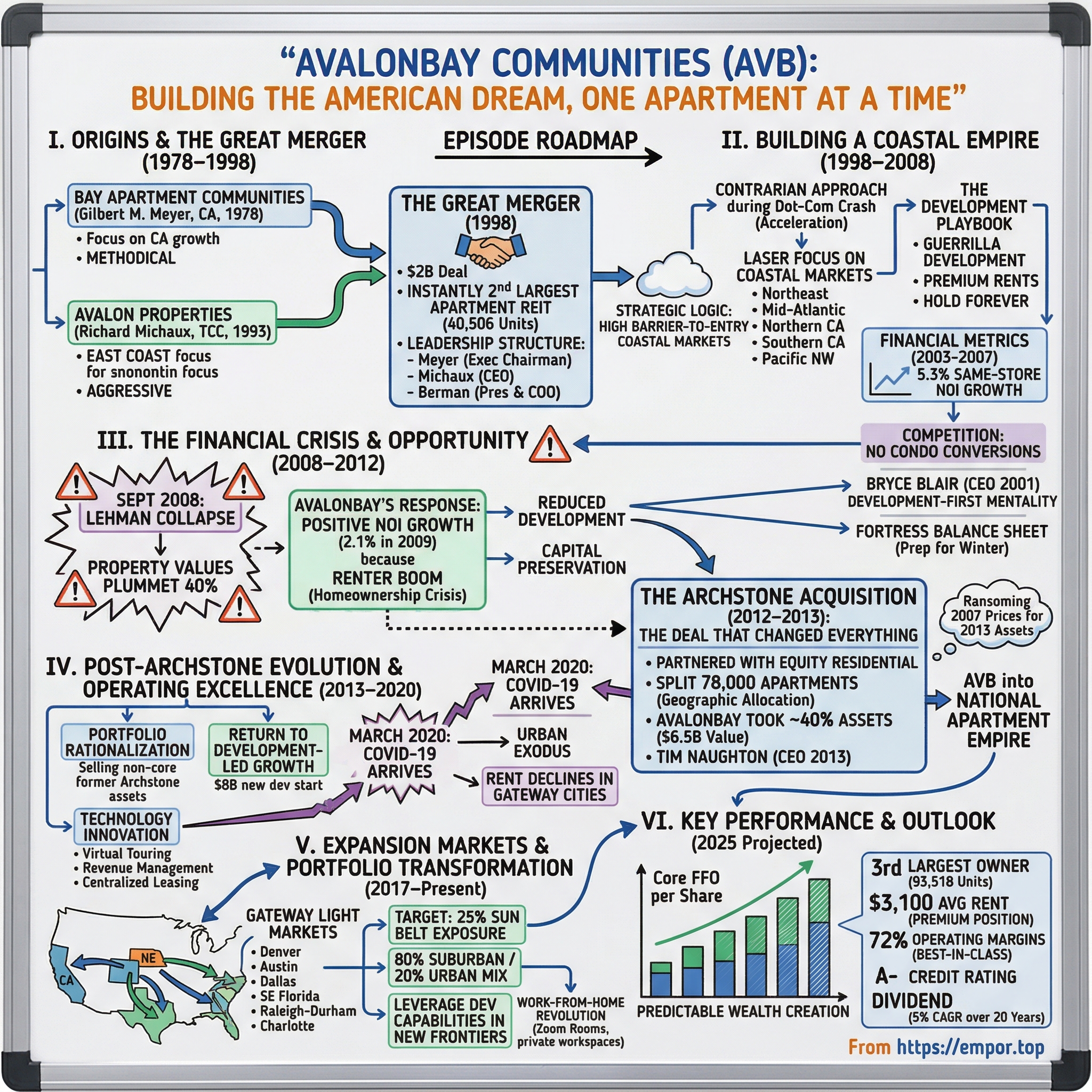
AvalonBay Communities: Building the American Housing Empire
I. Introduction & Episode Roadmap
On the morning of August 18, 2026, the ticker AVB stopped trading on the New York Stock Exchange. In its place appeared VMRK — Vivmark Residential — the entity created the previous day when AvalonBay Communities and Equity Residential completed an all-stock merger of equals, combining into a company with roughly $71 billion of enterprise value and more than 180,000 apartment homes.1 The two largest publicly traded apartment landlords in the United States, rivals for three decades, had become one balance sheet.
There is a symmetry to that ending that is hard to ignore. In late 2012, these same two companies sat on the same side of a negotiating table to carve up Archstone, the collapsed crown jewel of Lehman Brothers' real estate empire, in a $16 billion transaction that made them the twin titans of institutional multifamily housing.2 Fourteen years later, having spent that period competing for the same land parcels, the same entitlements, and the same coastal renters, they concluded that the better trade was to stop competing altogether.
That arc is the story of AvalonBay: a company that started life in 1998 as a marriage between a Silicon Valley apartment developer and an East Coast institutional landlord, spent twenty-eight years building one of the largest in-house development operations in American real estate, and then — with its stock down over the preceding year, its expansion markets underperforming, and its development spread narrowing — agreed to fold itself into its closest competitor.3
The core question. Everything about AvalonBay's investment case rested on one proposition: that owning a development capability inside a real estate investment trust is a durable competitive advantage rather than an uncompensated cyclical risk. Most REITs buy stabilized buildings at whatever cap rate the market clears. AvalonBay built them — sourcing land, navigating multi-year entitlement fights through hostile municipalities, and acting as its own general contractor — and argued that the resulting stabilized yields sat comfortably above what it would have cost to buy the same asset. That yield premium, typically framed as 100 to 200 basis points (one to two percentage points), served as the engine of net asset value creation.
The central analytical question is whether that spread represented a durable moat or a temporary cycle. A moat persists through downturns and cannot be easily replicated by rivals. A cycle looks like a moat right up until construction costs inflate, interest rates rise, or an entitlement pipeline funded five years earlier delivers into a supply glut. AvalonBay's record contains evidence for both interpretations, and the evidence points to a reality somewhere in between: real, narrower than management marketing suggested, and increasingly difficult to scale.
Episode structure. The narrative begins with the 1998 merger that created the company and the REIT modernization wave that made it possible. It traces the coastal barrier-to-entry playbook through the dot-com bust and the mid-2000s housing bubble. It examines the Archstone transaction — still the most consequential deal in modern apartment REIT history, and one whose reputation as a dealmaking masterclass deserves scrutiny. It follows the strategic pivot away from dense coastal urban cores toward suburban and Sunbelt expansion markets, examining what happened when that pivot collided with the largest apartment construction wave in forty years. It analyzes the four-brand strategy and the five-year operating-model transformation. Finally, it evaluates the business through strategic frameworks including Helmer's 7 Powers and Porter's Five Forces, conducts a historical falsification pass on key thesis claims, and presents a bull-versus-bear assessment accounting for why the story ended in a merger rather than a market re-rating.
Themes to hold onto. Capital allocation discipline inside an investment-grade balance sheet. Merchant-builder margins earned by a long-term landlord. The uncomfortable tension between demographic tailwinds and supply barriers — namely, that the markets attracting new residents are often the markets where competitors face fewer barriers to build. And the recurring question of whether operational excellence in a commodity business like apartment leasing can compound value or merely defend market position.
To understand why AvalonBay ended in a merger of equals, it helps to start with how it began: as one.
 Subscribe on LinkedIn
II. Origins: The 1998 East-Meets-West Mega-Merger
In 1978, Gilbert M. "Mike" Meyer began building apartments in Northern California. This was two decades before "Silicon Valley" became global shorthand for concentrated technology wealth, and a decade before local politics hardened into the stringent entitlement gauntlet that would later define the region. Meyer's insight was straightforward but early: in a market where every new apartment project required years of public hearings, environmental reviews, and neighborhood negotiations, the scarce asset was not capital—it was the building permit. His firm, later organized as Bay Apartment Communities and taken public in 1994, assembled a portfolio in the very submarkets where development faced the highest hurdles.
Three thousand miles east, a different firm was taking shape. In 1993, Avalon Properties was spun out of Trammell Crow Company—the Dallas development partnership that had spent the 1970s and 1980s as the most prolific builder in America before suffering through the late-1980s real estate credit contraction. Led by Chairman and Chief Executive Richard L. Michaux alongside President and Chief Operating Officer Charles H. Berman, Avalon focused on the suburban Northeast and Mid-Atlantic: Connecticut, New Jersey, Westchester County, suburban Boston, and the Washington, D.C., corridor. Where Bay was developer-led and entrepreneurial, Avalon was institutional and capital-markets-focused—built by executives who had seen overleverage devastate merchant builders and had designed a more defensive business model.
The deal. On March 9, 1998, the two firms announced a definitive merger agreement, closing the transaction on June 4 of that year.3 Under the terms, Avalon shareholders received 0.7683 Bay shares for each Avalon share. Renamed AvalonBay Communities, the combined company held 140 properties containing 40,506 apartment homes across 29 markets in 15 states and Washington, D.C. With an implied market capitalization of roughly $3.7 billion and a presence in the ten largest U.S. apartment markets, the company promptly raised its annual dividend 21 percent, from $1.68 to $2.04 per share.
The governance structure reflected a carefully balanced division of power. Meyer became executive chairman, Michaux served as chief executive officer, and Berman became president and chief operating officer. Lower down the executive roster was Bryce Blair, senior vice president for development and acquisitions—a key figure in the company's future leadership. Corporate headquarters was established in Alexandria, Virginia, supported by regional offices in San Jose, California, and Wilton, Connecticut.
The "merger of equals" label warrants scrutiny, as it resurfaces at the end of AvalonBay's story. Technically, Avalon—then the fifth-largest public apartment REIT—merged into Bay, the sixth-largest. Operationally, the two portfolios had virtually no geographic overlap, simplifying the combination: no properties needed to be sold, no submarkets rationalized, and few property management roles eliminated. That made for a far simpler integration than the one facing Vivmark in 2026, where the combined portfolios overlap directly in Boston, New York, Washington, Seattle, and California.
Why 1998 was the moment. Meyer's stated rationale was that larger national REITs enjoyed structural advantages: a lower cost of capital, broader operating efficiencies, and superior access to public debt markets.3 That argument reflected the prevailing industry consensus during a transformative period for commercial real estate. Throughout the 1990s, U.S. apartment ownership shifted from fragmented local partnerships to institutional public companies, accelerated by the creation of the Umbrella Partnership Real Estate Investment Trust, or UPREIT. The financial structure allowed private property owners to contribute real estate to a REIT's operating partnership in exchange for partnership units rather than cash, deferring the capital gains taxes triggered by a direct sale. For family owners holding legacy garden apartments at a minimal tax basis, the UPREIT structure transformed an illiquid, highly taxable asset into a liquid instrument, providing the tax plumbing that propelled industry consolidation.
Layered onto this financial mechanism was a demographic thesis that AvalonBay would champion for the next quarter-century: baby boomers would eventually downsize into high-end rentals, the echo-boom generation would enter its prime renting years, and home prices in coastal gateway markets would consistently outpace income growth. While the first two demographic trends materialized, the third—that soaring coastal home prices would permanently push prospective buyers into apartments—proved highly dependent on prevailing mortgage rates, a vulnerability exposed during the mid-2000s housing cycle.
The newly formed company faced an immediate strategic imperative: defining its core identity across two corporate cultures, two coasts, and twenty-nine distinct markets. Within a few years, management concluded that operating across twenty-nine markets diluted focus—and began narrowing its geographic footprint.
III. The Coastal Playbook & The Development Engine (1998–2008)
The strategy AvalonBay settled into after the merger can be stated in one sentence: own apartments only where it is extraordinarily difficult to build new ones, and be the company that builds them anyway.
The company concentrated capital into a short list of coastal regions—New England, the New York and New Jersey metropolitan area, the Mid-Atlantic around Washington, D.C., the Pacific Northwest around Seattle, Northern California, and Southern California. The logic was structural rather than cyclical. In these markets, land is physically constrained by water and topography, entitlement processes routinely consume three to seven years, and environmental review regimes—California's Environmental Quality Act (CEQA) being the archetype—give organized neighborhood opposition a procedural veto that can outlast a development budget. The result is a supply ceiling that resists expansion regardless of how attractive rents become. Demand can surge, but supply cannot respond quickly. Over a full real estate cycle, rents in such markets compound faster than in regions where a builder can acquire open land and open a leasing office eighteen months later.
The math of building versus buying. Here is the financial mechanism that underpinned the company's business model. Buying a stabilized apartment building functions much like buying a bond: an investor pays a set price to receive the property's net operating income, with the ratio between the two defining the capitalization rate, or cap rate. If prime coastal apartments trade at a 5 percent cap rate, $100 million of capital purchases $5 million in annual income. Development operates on different economics. A developer buys raw land, spends years and capital securing entitlements, funds construction, absorbs two to three years without rental income, and eventually stabilizes an asset that—when executed successfully—might generate $6.5 million on that same $100 million investment. Capitalized at market cap rates, that 150-basis-point yield spread creates immediate net asset value, making the completed building worth substantially more than its total development cost.
The trade-off is that the developer absorbs all execution risk along the way. Entitlements can be denied, construction costs can inflate between underwriting and completion, and market demand can soften during lease-up. An undercapitalized merchant builder can be ruined by any single headwind. AvalonBay's core thesis was that it could absorb development risk within an investment-grade REIT backed by recurring rental cash flow, allowing it to navigate downturns and capture profits in upswings. Combining merchant-builder development margins with a landlord's balance sheet became the central engine of the company's strategy.
Blair takes over, and the cycle bites. Bryce Blair became chief executive officer in 2001 and chairman in 2002, having joined the Avalon organization in 1993.4 He institutionalized what became the company's core capital allocation model: capital recycling. Rather than issuing new equity to fund construction, AvalonBay sold older, slower-growing properties in secondary submarkets and reinvested the proceeds into higher-yielding new developments. Executed systematically, this approach grew earnings power per share while pruning legacy assets, forcing a discipline that pure buyers rarely face—every new project required a corresponding disposition.
Blair's operational playbook faced a severe test almost immediately. The dot-com crash severely weakened Northern California's rental market, which had formed the core of Mike Meyer's original business. AvalonBay's financial results reflected the sharpness of the contraction: for full-year 2003, rental revenue across its Established Communities fell 4.3 percent, operating expenses climbed 5.2 percent, and same-store net operating income dropped 8.3 percent year over year, while total revenue slipped 1.0 percent to $633.5 million.5 The downturn highlighted a fundamental limitation of the company's thesis: strict entitlement barriers and high supply constraints cannot insulate a landlord from demand shocks. When tenants lose their jobs, supply barriers do not prevent revenue from falling.
The bicoastal footprint did, however, provide portfolio diversification. Mid-Atlantic and Northeast properties performed significantly better during this period than Northern California, validating the geographic rationale of the 1998 merger by preventing a single regional technology bust from threatening the entire company.
The 2003 downturn served as a clear case study in revenue drivers. AvalonBay's East Coast, Mid-Atlantic, and Northern California properties operated under identical national economic conditions—including interest rates, tax laws, and capital market access—yet yielded markedly different financial performance. The primary variable was local employment. The divergence demonstrated that an apartment portfolio's underlying returns depend primarily on local job growth and tenant income, with landlord operating strategies playing a secondary role.
The bubble years. The mid-2000s housing expansion introduced a different set of challenges. Easy access to subprime mortgages drove the U.S. homeownership rate to a record high of 69.2 percent in 2004, drawing prospective renters out of the tenant pool and into homeownership.6 Apartment rent growth stagnated across most domestic markets, yet property valuations continued to rise as heavily leveraged buyers priced in aggressive assumptions about condominium conversions and cap-rate compression. AvalonBay largely refrained from purchasing properties at these inflated valuations, maintaining conservative balance-sheet leverage and focusing capital on its internal development pipeline.
That capital discipline yielded little relative outperformance during the height of the real estate boom, as the company's stock lagged behind more aggressively leveraged peers. However, preserving balance-sheet capacity left AvalonBay uniquely positioned to deploy capital during the subsequent financial crisis—just as the largest overleveraged apartment transaction in industry history was taking shape.
IV. The Financial Crisis & The Lehman/Archstone Fire Sale (2008–2013)
In May 2007, at the peak of the credit cycle, Tishman Speyer and Lehman Brothers agreed to take Archstone-Smith Trust private for $60.75 per share in cash—a transaction valued at approximately $22.2 billion including debt, which closed that October.7 Archstone was no marginal portfolio. It owned or held interests in 344 communities comprising 86,014 apartment homes concentrated in Boston, New York, Southern California, San Francisco, and Washington, D.C.—the identical footprint AvalonBay had spent a decade assembling, at greater scale and, in many submarkets, higher quality.
The deal's capital structure proved to be its fatal flaw. Lehman arranged and retained enormous exposure to a transaction underwritten on assumptions that required rents to keep rising and credit markets to stay open. Sixteen months later, Lehman went bankrupt, and Archstone became the largest and most illiquid asset inside a bankruptcy estate tasked with converting assets into cash for creditors.
AvalonBay's own crisis. Before it could play the opportunist, AvalonBay had to navigate its own survival. Management took swift defensive measures: through the first nine months of 2009, the company started no new development projects, allowing its construction pipeline to shrink from 15 communities representing $1.61 billion in total capital cost in September 2008 to nine communities totaling $1.22 billion a year later.8 Over the course of 2009, AvalonBay raised more than $1.7 billion across secured debt, unsecured debt, and public and private equity—including its first unsecured bond issuance in more than three years—ending the year with $316 million in unrestricted cash and escrow.9
That capital raise complicates any narrative of non-dilutive balance-sheet stewardship. The company issued equity during the trough of the crisis, including through its continuous equity program, at valuations far below where its stock had traded two years earlier. Preserving access to debt markets and maintaining liquidity protected the firm, but it came at a real cost to existing shareholders—serving as a reminder that maintaining a fortress balance sheet during a credit crunch carries tangible friction.
Yet the crisis also delivered a long-term demand tailwind. With roughly five million American households losing homes to foreclosure, U.S. homeownership declined over the subsequent decade. Tighter mortgage standards effectively locked a cohort of financially capable adults out of homeownership, creating a structural shift toward renting that buoyed apartment fundamentals for most of the following decade.
The deal of the century. By 2012, Lehman's estate sought to monetize Archstone and initially pursued an initial public offering. An IPO would have recreated Archstone as a clean-balance-sheet public competitor without legacy liabilities—precisely the scenario AvalonBay and Equity Residential wanted to avoid. On November 26, 2012, the two REITs announced an agreement to acquire Archstone's assets and liabilities from Lehman Brothers Holdings for approximately $16 billion, splitting the portfolio with Equity Residential acquiring roughly 60 percent and AvalonBay roughly 40 percent.2 The total consideration comprised about $2.7 billion in cash, a fixed allocation of shares valued at $3.8 billion as of November 23, 2012, and the assumption of approximately $9.5 billion in debt alongside $330 million in preferred equity.
The joint bid offered clear strategic advantages: by partnering, the two largest apartment REITs eliminated a potential public rival, avoided a bidding war against one another, and bypassed a competitive auction against private equity buyers. Timothy J. Naughton—who had joined AvalonBay in 1989, served as president since 2005, and assumed the chief executive role on January 1, 2012—led negotiations for AvalonBay.10
When the transaction closed on February 27, 2013, AvalonBay acquired 60 apartment communities containing 20,089 homes, five communities under construction that would add 1,198 homes, five land parcels zoned for an estimated 1,414 homes, interests in joint ventures holding 12 communities with 2,851 homes, and a 40 percent stake in a residual joint venture with Equity Residential for non-core assets.11 In exchange, AvalonBay paid $669 million in cash, issued 14,889,706 shares valued at $1.9 billion, and assumed $3.9 billion of consolidated and unconsolidated debt. Naughton framed the acquisition as highly complementary in geographic concentration, submarket positioning, and price point.
Was it a masterclass? While the transaction secured irreplaceable assets below replacement cost and gave AvalonBay submarket scale that would have required a decade of development to build organically, its reputation as an unmitigated triumph deserves nuance. First, issuing nearly 15 million shares—expanding its share count by roughly one-sixth—diluted shareholders at a time when apartment REIT valuations had not fully recovered, prompting an immediate sell-off in both acquirers' stocks upon announcement. Second, assuming $3.9 billion in debt elevated balance-sheet leverage, requiring years of refinancing and deleveraging. Third, a significant portion of the acquired assets was designated non-core and subsequently sold—the residual joint venture was formed precisely to dispose of unwanted holdings. The acquisition was a major strategic victory, but executing it involved real trade-offs and extensive post-closing asset sales.
Integrating a portfolio of that magnitude became a multi-year effort that defined the middle of the decade.
V. Post-Archstone Digesting & Portfolio Rationalization (2013–2017)
The years immediately following the Archstone acquisition were among the least dramatic and most instructive in AvalonBay's history, demonstrating how its capital recycling engine functioned at scale under favorable market conditions.
The mechanics were repetitive by design. AvalonBay sold mature communities in submarkets where management saw limited future rent growth — often at capitalization rates in the low-to-mid 4 percent range, as institutional buyers paid aggressively for stabilized coastal real estate — and redeployed the proceeds into development projects delivering yields well above that baseline. Every such rotation converted a slower-growing asset into a higher-yielding one, capturing the yield spread without turning to the equity markets. Combined with the disposition of legacy Archstone assets it had not intended to hold long term, this recycling reshaped the portfolio's composition far faster than its overall footprint expanded.
Myth versus reality: the "never dilutes shareholders" story. A persistent piece of AvalonBay folklore holds that the company funded its expansion entirely through capital recycling and never relied on public equity markets. The historical record does not support that absolute claim. AvalonBay issued equity during the financial crisis, including through its continuous equity program, and issued nearly 15 million shares to fund its portion of the Archstone transaction.911 What is defensible is a narrower observation: over extended periods of favorable market conditions, AvalonBay funded development primarily through asset sales and debt rather than repeated equity offerings, avoiding the pattern — common among mid-cap REITs — of issuing stock below net asset value to sustain a construction pipeline. That reflected genuine balance-sheet discipline rather than total abstinence from equity issuance, a distinction that matters because the periods when a REIT most wishes to avoid selling equity are often when capital requirements leave it with little choice.
The other consensus narrative requiring scrutiny is that the post-Archstone era was a period of rapid portfolio growth. In reality, between the transaction's close in 2013 and the end of the decade, AvalonBay's total unit count grew modestly, because recycling through development disposes of roughly as many units as it constructs. What shifted was asset vintage and submarket positioning: newer construction, stronger locations, and a materially higher proportion of properties AvalonBay had designed and built itself rather than acquired. Evaluating an apartment REIT solely on unit growth misses the primary value driver, which was the rising average quality and yield profile of the remaining portfolio.
The urban chapter. Mid-2010s demographic trends favored dense city centers. As the millennial generation entered prime renting years, demand rose for walkable urban neighborhoods, public transit, and shorter commutes. AvalonBay followed this demand into urban submarkets — including Brooklyn, West Hollywood, and the inner rings of Boston, Seattle, and the San Francisco Bay Area. This shift required a fundamental operational upgrade. Constructing suburban, garden-style wood-frame apartments on lower-cost land involves relatively straightforward execution; building a 300-unit high-rise on a dense urban infill site presents far greater engineering and financial complexity, requiring concrete podiums, structured parking, ground-floor retail, union labor, and construction timelines extending to three years rather than eighteen months.
While this urban development strategy initially generated strong yields, it also introduced long-term structural risks into the portfolio. Urban high-rise projects tied up substantial capital in individual submarkets over multi-year timelines. Higher development costs per unit raised the rents required to achieve target yields, narrowing the potential tenant pool to high-earning renters — the precise demographic most capable of relocating when economic conditions or preferences shifted. AvalonBay was assembling a portfolio tailored to dense urban living and office-centric commuting patterns, operating on lead times of three to five years.
Concentrating pipeline activity in major urban developments also created concentrated input cost risks. AvalonBay increased its exposure to specialized labor and construction materials in a few expensive metropolitan areas, where union labor agreements, stringent building codes, and specialized subcontractors gave suppliers substantial pricing power. That cost exposure accumulated quietly on the balance sheet for years before the 2021–2023 construction cost surge exposed it, at which point committed projects could no longer be repriced. While development risk is frequently analyzed as market demand risk, in practice a significant portion represents supplier pricing risk with a multi-year lag.
The first cracks. By 2017, management began responding to a changing operational backdrop. Property tax burdens across coastal gateway markets were climbing, state legislatures were increasingly considering rent control measures, and migration patterns revealed a steady movement of residents from high-cost coastal metros toward the Sunbelt and Mountain West, driven by an expanding affordability gap. Simultaneously, AvalonBay's internal development economics were deteriorating at the margin: land prices in core coastal submarkets had risen, construction costs were inflating, and entitlement timelines were growing longer.
In response, AvalonBay began expanding into markets it had explicitly avoided for two decades — including Denver, Southeast Florida, and later the Carolinas and Texas. Under Benjamin W. Schall, who would later succeed Naughton as chief executive, these regions were formalized as "Expansion Regions," with a stated ambition of growing them to roughly 25% of the portfolio over time.12
That decision — to branch beyond the high-barrier coastal markets that had defined AvalonBay's core identity — represented the central strategic pivot of its modern era. It also introduced a fundamental strategic tension, as the lower barriers to entry that made land available in expansion markets also allowed competitors to build freely.
VI. The Great Pivot: Suburban Shifts & Expansion Markets (2017–Present)
Every strategic pivot has a slide, and AvalonBay's featured two target numbers: 75/25 and 80/20. Management set out to rebalance the portfolio to 75% Established Regions and 25% Expansion Regions, while shifting property types to 80% suburban and 20% urban.13 Established meant the historic coastal franchise, while Expansion encompassed Raleigh-Durham, Charlotte, Southeast Florida, Dallas, Austin, and Denver. The suburban tilt cut across both geographies.
The logic was defensible on paper. Coastal urban cores had delivered a decade of strong rent growth but carried rising regulatory risks, increasing property tax burdens, and, after 2020, a demonstrated vulnerability to remote work. Suburban properties offered lower capital costs per unit, stickier tenant bases, and larger floor plans tailored to families. Sunbelt markets offered strong population inflows. Blending the three was designed to yield a portfolio combining coastal pricing power with Sunbelt demand growth.
COVID as accelerant. The pandemic validated the suburban half of the thesis almost overnight. Occupancy and pricing in Manhattan, downtown San Francisco, and core Seattle dropped as tenants with remote work flexibility departed. Suburban garden and low-rise communities, by contrast, recorded the strongest rent growth in company history during 2021 and 2022. By 2024, roughly 73% of the portfolio sat in suburban submarkets, a mix management highlighted to explain how total revenue held firm while urban cores rebuilt.14
The supply collision. The geographic half of the strategy proved far more challenging, illustrating a fundamental structural reality of multifamily real estate. Sunbelt markets attract migration partly because housing is affordable, and housing is affordable because building is straightforward. Low land costs, permissive zoning, and rapid permitting mean that any demand surge triggers a rapid—and often excessive—supply response. Between 2023 and 2025, Austin, Dallas, Denver, and the Carolinas absorbed their heaviest apartment delivery volume in roughly four decades.
AvalonBay deployed capital into those markets just as that supply wave crested. The resulting divergence in reported financial results was stark. For full-year 2024, Southern California delivered same-store residential revenue growth of 4.5% and net operating income (NOI) growth of 4.9%, whereas the "Other Expansion Regions" segment posted a 0.8% revenue decline and a 0.9% NOI drop.15 Expansion markets grew from roughly 8% to 10% of the portfolio over 2024—making incremental progress toward the 25% target primarily by buying into weakness.14
That fundamental divergence persisted. Full-year 2025 same-store residential revenue rose 2.5% to $2.71 billion, with NOI up 1.9%, yet performance across regions continued to split.16 Heading into 2026, management guided Expansion Regions to same-store revenue growth of roughly negative 0.6% compared to positive 1.6% in Established Regions. Denver was singled out for ongoing rent declines due to flat job growth alongside another 9,000 units scheduled for delivery.17 By 2026, Established Regions still accounted for approximately 92% of projected same-store revenue—demonstrating that after nearly a decade of strategic rebalancing, the coastal franchise remained the core of the business.
How management framed it. On its fourth-quarter 2025 earnings call, management argued that the supply cycle had turned in its favor within core markets: new supply across Established Regions was projected at roughly 80 basis points of existing stock, levels not seen since the post-financial crisis recovery.17 While that low supply projection represented a genuine operational tailwind for the coastal portfolio, it effectively inverted the original expansion rationale. Where the 2017 pitch promised superior growth in Expansion Regions, the 2026 reality relied on Established Regions to carry performance while new markets worked through excess inventory.
The net result was that AvalonBay sought geographic diversification and absorbed cyclical dilution instead. In response, management adapted by capitalizing on developer distress—acquiring finished or near-complete assets from builders unable to refinance, and extending credit to third-party developers through a structured investment program rather than breaking ground on new projects in oversupplied markets. That pivot represented a sensible tactical adaptation, but it diverged significantly from the long-term growth model outlined at the start of the expansion.
Which raises the question of where the company found growth when its geography stopped providing it. The answer was inside the buildings it already owned.
VII. Under the Hood: Brand Segmentation & Modern Tech Operating Engine
                       ┌─────────────────────────────────────────┐
                       │        AvalonBay Communities, Inc.      │
                       └────────────────────┬────────────────────┘
                                            │
         ┌───────────────────┬──────────────┴───────┬────────────────────┐
         │                   │                      │                    │
┌────────┴────────┐ ┌────────┴────────┐    ┌────────┴────────┐  ┌────────┴────────┐
│     AVALON      │ │       AVA       │    │      EAVES      │  │     KANSO       │
│ Core Premium    │ │ Urban / Tech    │    │ Suburban Value  │  │ Automated /     │
│ Full-Service    │ │ Micro-units     │    │ Family-focused  │  │ Self-Service    │
└─────────────────┘ └─────────────────┘    └─────────────────┘  └─────────────────┘
Apartments are, at the property level, essentially commodity assets. A two-bedroom unit in suburban Boston competes directly with every other two-bedroom unit within a reasonable commute, and resident switching costs amount to little more than a security deposit and a weekend of moving. In such a market, operating margins depend on cost structure and on capturing incremental revenue that competitors leave on the table. That is precisely the efficiency play AvalonBay pursued throughout the 2020s.
Four brands, one platform. AvalonBay segmented its portfolio across distinct target categories. Avalon serves as the flagship brand, offering full-amenity, higher-finish properties in prime submarkets. AVA targets younger urban renters with smaller units, transit adjacency, and communal amenities prioritized over individual square footage. eaves by Avalon functions as a suburban value option, offering practical amenities and cost-conscious pricing in older-vintage properties. The fourth concept, Kanso, represents the most direct departure from traditional operations: a stripped-down model offering quality apartments with minimal community amenities and a low-touch, self-service operational framework reliant on technology and smart access.18
Brand tiering in multifamily housing functions differently than brand equity in consumer goods; prospective residents rarely select an apartment based on a parent company's logo. Instead, tiering allows a single operating platform to address three distinct price points without eroding the flagship brand's pricing power. In Kanso's case, it enables the company to deliver lower-rent housing profitably by eliminating amenity maintenance and on-site staffing costs rather than accepting thinner operating margins—a cost-structure innovation framed as product branding.
The operating model transformation. The larger structural project involved dismantling the traditional property-level staffing model. Historically, each apartment community operated its own on-site leasing office and administrative staff. AvalonBay replaced this decentralized setup with centralized regional teams handling customer service, leasing administration, and renewal processing. These hubs were integrated with self-guided touring technology, keyless unit access, automated scheduling, and centralized maintenance dispatch, effectively converting a network of isolated properties into a unified, scaled service operation.
Management provided specific financial benchmarks for this operational shift, offering clear metrics to evaluate progress. The initiative generated $19 million in incremental annual net operating income (NOI) in 2023—exceeding internal projections by roughly 60 percent—prompting management to raise the full-program target to $80 million in incremental annual NOI.14 By the end of 2025, management reported the program was approximately 60 percent complete toward that target, with an additional $7 million of incremental NOI planned for 2026.17
These disclosures suggest two distinct analytical conclusions. First, establishing public multi-year efficiency targets and reporting progress consistently demonstrates operational accountability. Second, the financial impact requires contextual perspective: fully realizing the $80 million target against a same-store NOI base of approximately $1.86 billion represents a mid-single-digit percentage margin improvement delivered over five to six years.16 While valuable and permanent, that gain is insufficient to offset a two-percentage-point shift in broader market rent growth, underscoring that operational optimization enhances margins rather than driving top-line growth.
Operational data from residents showed tangible gains. Resident turnover reached a historic low of 41 percent in 2025, alongside a mid-lease Net Promoter Score of 34.17 Reducing turnover generates direct financial savings by curbing vacancy loss, unit turnover expenses, and leasing concessions. However, part of this retention reflected broader macroeconomic conditions: elevated home purchase prices and high mortgage rates restricted homebuying, keeping tenants in the rental pool. Disentangling service-driven retention from housing affordability constraints remains difficult in the reported data.
The structured investment program. The company also established a capital deployment vehicle alongside its operating platform. Through its Structured Investment Program, AvalonBay provided mezzanine loans and preferred equity to third-party apartment developers. As of March 31, 2025, the company held eight commitments to fund up to approximately $211.6 million in aggregate at a weighted average rate of return of 11.6%, with a weighted average initial maturity in January 2027;19 a further commitment of up to $28 million for a Southeast Florida development followed in July 2025.20
This program functioned as a counter-cyclical capital allocation strategy. When bank construction lending tightened and merchant developers faced capital shortfalls, AvalonBay provided senior gap financing at double-digit yields, frequently securing options to acquire the completed properties. This structure generated yields above internal development returns while shifting construction execution risk to the third-party developer. However, scale remains a limiting factor: approximately $240 million in total commitments represents a modest allocation for a REIT investing over $1 billion annually. Furthermore, mezzanine positions in projects delivering into oversupplied Sunbelt submarkets carry capital risk if property valuations fall below the debt stack.
Which brings us to the economics of the whole enterprise, and to the question of how much of it constitutes genuine competitive advantage.
VIII. Business Model, Economics & Helmer/Porter Structural Analysis
Strip away the corporate narrative, and AvalonBay functioned as three distinct businesses stacked on a single balance sheet: a landlord collecting rent across roughly 98,700 apartment homes in 320 communities spanning 11 states and the District of Columbia as of year-end 2025; a developer converting land and capital into new buildings; and, at the margin, a lender to third-party developers.16
The landlord. This property portfolio serves as the core cash-flow engine that supports dividend distributions and services debt. Same-store residential revenue reached $2.71 billion in 2025, generating net operating income of $1.86 billion — an NOI margin in the high 60% range, typical of well-managed coastal apartment portfolios where high property taxes are balanced by controlled payroll and turnover expenses.16 The resident base is affluent by national standards: as of the first quarter of 2024, the median annual household income of new residents reached approximately $123,000, establishing a rent-to-income ratio of about 20.3%, up 80 basis points year over year.21
That rent-to-income metric requires context rather than uncritical praise. A 20% ratio indicates comfortable household finances, minimizing collection losses and leaving headroom for rent increases upon renewal. However, it also underscores the portfolio's exposure to high earners concentrated in a handful of technology-driven metropolitan economies. Rather than functioning as a defensive housing asset, the business operates as a proxy for high-earner discretionary income. As experienced during the 2003 contraction, when those incomes face pressure, rental performance quickly decelerates. The steady upward drift in rent-to-income ratios also signals that rent growth has outpaced income gains for incoming tenants — the exact mechanism by which pricing power turns into affordability pressure and, eventually, political friction.
The developer. The development pipeline represented the company's core value-creation thesis. In 2025, AvalonBay started $1.65 billion of new projects at a projected initial stabilized yield of 6.2%, against a funding cost of roughly 5%.17 For 2026, management guided starts down sharply to approximately $800 million, while targeting higher projected yields of 6.5% to 7.0%. As of June 30, 2026, the active development pipeline comprised 27 wholly owned communities representing 9,064 apartment homes at an estimated total capital cost of $3.53 billion.22
These figures illustrate a deliberate downshifting to preserve development spreads in a tightening market. Scaling back starts to capture higher yields reflects prudent capital allocation, but it also confirms a contracting opportunity set. Furthermore, the spread itself was narrower than historical claims suggested. A 6.2% development yield against a 5% funding cost yields a 120-basis-point margin prior to accounting for the two-to-three-year earnings drag during construction and lease-up. Relative to private-market cap rates for comparable stabilized coastal assets — illustrated by the eight communities AvalonBay sold in 2024 at a weighted average 5.2% cap rate — the value-creation spread on 2025 vintage starts was on the order of 100 basis points, not the 150 to 200 basis points assumed in long-standing investor marketing.15
During the fourth-quarter 2025 earnings call, analyst John Pawlowski pressed on this point, asking whether the 6.5% to 7.0% yield guidance on 2026 starts reflected broader market conditions or proprietary execution. Chief Investment Officer Matthew Birenbaum conceded that high-spread opportunities had become "more select," attributing the premium to multi-year entitlement work and deal-specific features — such as affordable-housing components and pilot programs — unavailable to newer competitors.17 Management's admission that high-yield opportunities were select rather than systematic provides an important qualification regarding the durability of its development moat.
A second exchange on the same call addressed accounting transparency. Analyst Nicholas Yulico asked whether the reduction in development starts was designed to flatter near-term funds from operations through capitalized-interest mechanics. Chief Financial Officer Kevin O'Shea rejected that framing, stating that the decision reflected the opportunity set and funding costs, and noting that capitalized-interest benefits wash out over time.17 The specific explanation provided clear operational context for the pipeline slowdown.
Hamilton Helmer's 7 Powers, applied honestly.
Process Power — real, but geographically constrained. Thirty years of institutionalized entitlement, design, and construction execution in procedurally hostile coastal municipalities cannot be replicated simply by hiring personnel. It relies on deep local relationships, an extensive library of pre-approved designs, and procedural expertise in public hearings. Historical results demonstrate that AvalonBay consistently delivered coastal projects at yields above prevailing market cap rates across multiple cycles. However, this power applies almost exclusively to Established Regions. In Sunbelt expansion markets like Dallas or Charlotte, where entitlement is a routine permit rather than a prolonged political campaign, this specialized capability offers minimal competitive advantage — precisely where the company sought to expand.
Scale Economies — present, modest, and mostly recent. Centralized operations across a portfolio approaching 100,000 homes lower per-unit administrative costs, while procurement scale provides modest savings on appliances and materials. The $80 million operating transformation reflects these gains. Yet apartment operations lack steep economies of scale: regional operators with 20,000 units in a single metro capture similar density advantages, while major private managers operate substantially larger portfolios without requiring equivalent balance-sheet scale. In multifamily housing, scale primarily lowers the cost of capital rather than expanding property-level operating margins.
Cornered Resource — narrow and depleting. The company's genuine cornered resource consisted of pre-entitled coastal land holdings acquired at lower historic cost bases. Land secured in prior cycles within supply-constrained submarkets represents a rare, non-replicable asset. However, a land bank depletes through development; every project start consumes inventory that must eventually be replaced at current market prices. This represents a finite optionality schedule rather than a permanent structural moat.
Counter-Positioning — weak and unpersuasive. While the four-brand framework allowed AvalonBay to target multiple tenant segments, counter-positioning requires an operating model that established peers cannot copy without damaging their core business. Competing REITs such as Equity Residential, Essex, UDR, and Camden can operate value-oriented or self-service property tiers without undermining their broader portfolios. Brand tiering reflects effective market segmentation rather than structural counter-positioning.
Switching Costs, Network Economies, Branding — essentially absent. Standard twelve-month residential leases create low switching costs, while brand awareness yields negligible pricing power in a market where renters evaluate specific locations and unit features over corporate parentage.
Ultimately, AvalonBay maintained one core structural power — coastal development process execution — complemented by a scale-driven cost-of-capital advantage. This edge remained concentrated in the high-barrier coastal markets from which the company spent a decade trying to diversify.
Porter's five forces.
Rivalry: high and structural. AvalonBay competed with public REIT peers including Equity Residential, Essex, UDR, Camden, and Mid-America, alongside large private operators like Greystar and institutional capital vehicles such as Blackstone. Apartment units lack meaningful product differentiation, making submarket pricing dependent on marginal market supply rather than operator tier.
Threat of new entrants: sharply bifurcated. In coastal Established Regions, high land costs and strict zoning create formidable entry barriers. In Sunbelt Expansion Regions, low regulatory hurdles allow rapid new supply additions. The company's expansion strategy explicitly shifted capital from protected markets into low-barrier environments.
Buyer power: moderate and politically expressed. While individual tenants possess limited pricing leverage during tight markets, renters collectively exercise power through legislative actions, including rent cap proposals, eviction restrictions, and fee regulations.
Supplier power: moderate to high. Construction labor and material costs feed directly into development yields. Specialized trade contractors in tightly regulated coastal markets hold substantial pricing leverage, as demonstrated during the 2021–2023 inflation spike, which compressed projected yields on committed developments.
Substitutes: moderate. Single-family homeownership serves as the primary alternative, though elevated mortgage rates during 2024 and 2025 temporarily limited buyer conversion and supported renter retention. Meanwhile, single-family rental communities represent a growing substitute for suburban renters seeking larger living spaces.
IX. Management, Governance, & Capital Allocation Audit
Benjamin W. Schall arrived at AvalonBay through a succession process that caught the commercial real estate sector by surprise. Announced in December 2020 as president with a clear path to the top role, he joined in January 2021 and assumed the chief executive seat on January 3, 2022. Timothy Naughton transitioned to executive chairman in a part-time role focused on strategic initiatives, technology, and expansion-market growth.2324
The surprise stemmed from his background. Schall had served as chief executive of Seritage Growth Properties, the REIT spun off from Sears Holdings in 2015 to redevelop distressed department store sites—a complex turnaround effort converting vacant retail boxes into mixed-use properties as Sears liquidated.23 Before Seritage, he was chief operating officer of Rouse Properties and a senior vice president at Vornado Realty Trust. He was an operations and redevelopment specialist rather than a traditional apartment executive. AvalonBay's board appeared to deliberately select a leader whose career centered on portfolio transformation rather than incremental management of a stabilized asset base.
Schall's tenure reflected that mandate. The centralized operating platform, the formalization of expansion regions, the structured investment program, and ultimately the merger with Equity Residential were all launched under his leadership. The operational outcomes proved mixed: while the technology transformation outpaced early targets and maintained transparent public milestones, the geographic expansion—intended to unlock new growth—dragged down portfolio performance for three consecutive years.
Schall operated alongside a stable executive team. Chief Financial Officer Kevin O'Shea brought two decades of balance-sheet and capital-markets management to the firm, while Chief Investment Officer Matthew Birenbaum directed the development pipeline and expansion market entries. Chief Operating Officer Sean Breslin led day-to-day operations and spearheaded the technology transformation. In a business where municipal entitlements and contractor relationships dictate execution, this executive continuity provided operational stability.
The balance sheet and leverage trends. AvalonBay maintained one of the strongest credit profiles in the REIT sector—rated A3 by Moody's and A- by S&P—backed by low leverage, broad capital market access, and an unencumbered property portfolio.25 Unencumbered assets generated roughly 95% of total net operating income, leaving nearly the entire portfolio available to back unsecured debt.16
The balance sheet leverage trend, however, steadily increased. Net Debt-to-Core EBITDAre expanded from 4.2 times at year-end 2024 to 4.7 times by the end of 2025, reaching 4.8 times in the first quarter of 2026 before settling at 4.6 times as of June 30, 2026.15162622 While these ratios remained conservative relative to apartment REIT peers, adding nearly half a turn of leverage over eighteen months coincided with a period when same-store net operating income growth was slowing toward zero. This debt expansion reflected the financial requirements of committing $1.65 billion to new developments and $842 million to property acquisitions in a single year while simultaneously repurchasing common shares.
Capital allocation tested against outcomes. The company's 2025 deployment illustrates its capital strategy. AvalonBay raised $2.4 billion at an initial capital cost of roughly 5%, started $1.65 billion in developments targeting 6.2% yields, and completed four communities comprising 1,320 apartment homes. Concurrently, it acquired 12 communities containing 3,378 homes for $842 million, while selling nine mature properties for $812 million in proceeds, realizing a GAAP gain of $337 million.1617 During the first quarter of 2026, management deployed $198.5 million to repurchase over 1.13 million shares at an average price of $175.59, leaving $914.4 million in remaining buyback authorization.26
The share buybacks highlighted a critical shift in management's capital allocation framework. On the fourth-quarter 2025 earnings call, management outlined the trade-off explicitly: with AvalonBay stock trading at an implied cap rate in the low 6% range against projected development yields of 6.5% to 7.0%, leadership evaluated where to direct its roughly $1.25 billion in annual flexible capital capacity.17 Repurchasing stock at an implied cap rate near internal development yields indicated that building new properties offered only a narrow premium over buying back existing shares. Management acknowledged this dynamic publicly and responded by cutting development starts in half, demonstrating that capital allocation was governed by yield math rather than an impulse to maintain pipeline volume for its own sake.
AvalonBay's governance structure eliminated a common REIT vulnerability by remaining internally managed. Without an external advisor collecting asset-based management fees, leadership faced no structural incentive to expand the balance sheet purely to grow fee streams. Board independence remained standard and uncontested, annual proxy votes reflected strong shareholder support, and audit filings across the period contained no material weaknesses or going-concern disclosures. While these items represent standard corporate baseline expectations, they distinguish the firm within a sector historically prone to external management friction.
Incentives and executive alignment. Executive compensation was tied primarily to Core FFO per share growth, operational milestones, and total shareholder return relative to the FTSE Nareit Equity Apartments index. Structuring relative returns against a peer benchmark is standard in interest-rate-sensitive sectors where macro trends dominate absolute returns. However, in a consolidating or broader sector downturn, benchmark-relative compensation can still reward management during periods of declining absolute equity value.
The final capital allocation decision. That capital allocation logic culminated in the decision to merge with Equity Residential. Having concluded in 2025 and early 2026 that its equity was priced comparably to new development yields, AvalonBay's board determined that combining balance sheets offered a superior strategic path. On May 20, 2026, the companies entered into a definitive merger agreement structuring an all-stock transaction where each share of AvalonBay common stock converted into 2.793 shares of Equity Residential, resulting in legacy AvalonBay shareholders owning roughly 51.2% of the combined entity and Equity Residential shareholders holding 48.8%.27 The transaction created a combined company with an enterprise value of approximately $69 billion and an equity market capitalization near $52 billion.
Under the agreed leadership structure, Schall assumed the role of chief executive officer of the combined entity, Vivmark Residential, while Equity Residential Chief Executive Mark J. Parrell retired upon closing. Steve Sterrett, Equity Residential's lead independent trustee, became chairman of the board, which was divided evenly with seven trustees from each company—including both Timothy Naughton and former Equity Residential CEO David Neithercut. Corporate operations were split between dual headquarters in Arlington, Virginia, and Chicago. Management projected $175 million in gross annual cost synergies, or $125 million net after accounting for property tax reassessments, and established an initial annualized dividend of $2.81 per combined share. At the 2.793 exchange ratio, this represented an effective payout of roughly $7.85 per legacy AvalonBay share, up from AvalonBay's previous annualized dividend rate of $7.12 based on its $1.78 quarterly distribution.2716
The market greeted the announcement with caution. AvalonBay shares declined modestly following the news, and Wall Street analysts reacted conservatively, with approximately three-quarters of covering firms maintaining neutral or hold ratings.28 Institutional analysts framed the combination as a defensive consolidation between two mature operators offering limited net operational synergies, noting that $125 million in net savings represented a modest gain relative to a $69 billion enterprise value. Shareholders of both REITs approved the transaction on August 12, 2026, with over 99% of votes cast in favor—representing approximately 90% of outstanding shares—and the merger officially closed on August 17, 2026.29
With the corporate merger complete and the legacy ticker retired, the analytical task shifts from tracing historical execution to evaluating the structural strength of the business model.
X. Historical Falsification Pass & Skeptical Investor Stress Test
Every core thesis underlying AvalonBay's valuation warrants rigorous testing against disconfirming evidence in the company's historical record. Evaluating each claim against past operational performance provides a clearer assessment of structural strength versus cyclical vulnerability.
Test 1: "The development yield spread is an unassailable value engine."
The affirmative case holds across extended periods: for most of two decades, AvalonBay completed coastal developments at stabilized yields comfortably above prevailing market capitalization rates, compounding net asset value over time.
The disconfirming evidence, however, demonstrates clear cyclical limits. During 2009, the company initiated no new developments for three consecutive quarters and reduced its construction pipeline by roughly a quarter in dollar terms—illustrating that a halted development platform generates carrying costs on undeveloped land rather than yield spread.8 During the 2021–2024 inflation surge, rising material and labor costs compressed underwritten yields on committed projects, with no ability to reprice active construction. Most tellingly, by 2025 the realized spread on new starts—initial stabilized yields of 6.2 percent against a funding cost near 5 percent and disposition cap rates averaging 5.2 percent—had narrowed to roughly 100 basis points, prompting management to reduce 2026 project starts by more than half.1517
Verdict: the claim survives only in a narrowed form. In-house development generated substantial value, but the yield spread is cyclical rather than structural, compressing precisely when capital costs rise and investment capacity is most needed. The designation "unassailable" is unsupported by the record. Falsifying KPI: the projected initial stabilized yield on new starts relative to AvalonBay's marginal cost of capital and implied equity cap rate. A yield spread remaining below 100 basis points indicates that capital is better deployed elsewhere rather than expanding the development pipeline.
Test 2: "Expansion market entry provides high-growth diversification."
This proposition is contradicted by recent performance reporting. AvalonBay committed capital to Denver, Southeast Florida, Texas, and the Carolinas immediately prior to the heaviest influx of new apartment deliveries in four decades. The operational impact appeared directly in segment results: the Other Expansion Regions category recorded negative same-store revenue and net operating income growth for 2024, while Southern California generated gains of 4.5 percent and 4.9 percent, respectively. Looking ahead to 2026, guidance projected Expansion Region same-store revenue to decline roughly 0.6 percent compared to 1.6 percent growth in Established Regions, with Denver facing an additional 9,000 incoming units alongside flat employment growth.1517
Management's defense offers a relevant distinction: geographic diversification represents a multi-decade strategy, and acquiring assets at distressed valuations during a supply crest can constitute prudent long-term capital allocation. Buying completed projects from developers facing refinancing shortfalls offers better risk-adjusted returns than initiating new construction. However, as a test of whether expansion delivered high-growth diversification, the record shows the opposite over a three-year period—delivering lower growth while exposing the firm to national supply concentration.
Verdict: rejected as stated; the surviving claim is substantially narrower. Entry into expansion markets provided geographic risk diversification rather than immediate growth, and occurred at an unfavorable point in the supply cycle. Falsifying KPI: rolling three-year same-store net operating income growth in Expansion Regions relative to Established Regions. The strategy will be validated only if that growth spread turns positive and remains elevated after excess regional inventory is absorbed.
Test 3: "Coastal markets possess impenetrable supply barriers."
Physical supply constraints remained intact: coastal apartment deliveries as a percentage of total inventory stood near post-financial-crisis lows heading into 2026.17 However, framing supply barriers as "impenetrable" overlooks how regulatory actions and demand contractions limit income realization behind those barriers.
Regarding regulation, California's AB 1482 statewide rent cap, ongoing municipal ballot initiatives, New York's 2019 Housing Stability and Tenant Protection Act alongside good-cause eviction rules, and legislative measures in Washington limit the degree to which theoretical pricing power translates into realized rental revenue. Regulatory constraints do not lower entry barriers; they diminish the financial value of operating behind them.
Regarding demand, the 2003 downturn remains a clear counterexample, when Established Communities revenue fell 4.3 percent and net operating income dropped 8.3 percent in a single year as regional tech employment contracted.5 High supply barriers provided little protection against a severe local job shock, a pattern replayed in urban cores during the 2020–2021 pandemic period.
A legal and political dimension also emerged. Both AvalonBay and Equity Residential were named in class-action litigation alleging that landlords utilized RealPage software to coordinate rental pricing. AvalonBay was dismissed from over thirty consolidated federal lawsuits based on the specific contractual structure of its agreement with Rainmaker—the software vendor acquired by RealPage—though the company continued to address claims brought by the District of Columbia attorney general.3031 Equity Residential agreed to pay $56 million to settle a tenant class action shortly before the merger was announced.3133 The U.S. Department of Justice resolved its civil action against RealPage in November 2025, establishing restrictions on how pricing software processes competitor data without requiring monetary damages or admissions of wrongdoing.32
Verdict: the claim survives, but offers less protection than advertised. Supply barriers remain structurally valid and provide a current operational tailwind, but they offer no immunity against demand contractions while attracting regulatory scrutiny that caps realized rent growth. Falsifying KPI: the variance between market rent growth and realized same-store revenue growth across California and New York portfolios, alongside the trajectory of uncollectible lease revenue, which measured 1.6 percent of residential revenue in 2025 with 1.4 percent projected for 2026.17
Test 4: "The Archstone acquisition was a seamless masterclass."
While previous sections outlined the strategic rationale, the exact transaction mechanics illustrate the trade-offs involved. AvalonBay assumed $3.9 billion of debt, issued nearly 14.9 million common shares valued at $1.9 billion, and paid $669 million in cash for an asset package that included five undeveloped land parcels and a residual joint venture established to dispose of non-core holdings.11 The equity issuance expanded the share count substantially before sector valuations had fully recovered, requiring several years of post-closing asset sales and portfolio pruning.
Verdict: the claim is narrowed but survives on core substance. The acquired properties were irreplaceable and secured below replacement cost, and pre-empting Archstone's public offering removed a major competitor. However, execution required a costly, dilutive, multi-year digestion process, contradicting characterizations of a seamless transaction. Confirming evidence: settled by historical record as a major strategic transaction executed with real friction.
Test 5: "The merger of equals creates a fundamentally stronger company."
As a recent transaction, this claim remains the least tested and requires rigorous evaluation. The supporting argument highlights $125 million in projected net annual synergies, a lower combined cost of capital, and the elimination of a primary competitor for land, acquisitions, and tenants across shared coastal markets.
The counter-arguments involve three key considerations. First, historical precedence shows that large REIT mergers of equals frequently encounter integration delays and operational friction. Unlike the 1998 merger of Bay and Avalon—which involved non-overlapping geographic footprints—the Vivmark transaction combines overlapping portfolios in major metropolitan areas, introducing integration complexity and management redundancy. Second, $125 million in net annual synergies represents a modest figure relative to a $69 billion enterprise value and remains a management projection until realized in financial filings. Third, the combination carries regulatory tail risks. Research by academic Renee Tapp indicated that the merged entity would exceed the 30 percent market share threshold that triggers antitrust scrutiny under federal merger guidelines in at least seven submarkets. Although real estate transactions have been exempt from mandatory federal premerger notification since 1976, regulatory agencies have publicly discussed reviewing this exemption for institutional residential landlords.31 A combined entity holding concentrated submarket positions remains visible to state attorneys general and local housing regulators.
Verdict: unproven, with market pricing reflecting caution. The transaction represents a defensive consolidation between mature operators adapting to slowing organic growth rather than an offensive combination unlocking new operational capabilities. Falsifying KPI: realized net cost synergies reported against the $175 million gross and $125 million net targets—targeting over 85 percent completion by year-end 2027—alongside combined same-store net operating income growth relative to apartment REIT peers.28
XI. Playbook: Business & Investing Lessons
1. A merchant developer inside a landlord's balance sheet is a real structure—but the balance sheet is doing more work than the development. The insight behind AvalonBay was that development margins and recurring rental cash flow have complementary risk profiles: rental income covers carrying costs while projects mature, and an investment-grade credit rating allows the firm to keep building when merchant competitors are shut out of debt markets. Yet the historical record reveals that the primary durable advantage in that pairing resides in the funding cost rather than the construction capability. When AvalonBay's cost of capital sat near 5% and project yields averaged 6.2%, the development platform generated roughly 120 basis points of spread. Investors evaluating any vertically integrated real estate developer must analyze which side of that balance sheet is truly driving the excess return.
2. Capital recycling is genuine discipline, and it has a hidden cost. Selling mature assets at low capitalization rates to fund development at higher yields creates a self-funding growth engine that minimizes equity dilution—a playbook AvalonBay executed for more than two decades. However, capital recycling carries a structural trade-off. Selling stabilized properties means divesting assets whose cash flows have already compounded. That explains why an operator can execute the strategy effectively for decades yet maintain a nearly static overall unit count. Capital recycling converts realized asset appreciation into higher initial yields; it does not expand total portfolio scale.
3. Cooperating with your closest competitor can be the highest-return move available—and it works twice. The 2012 Archstone transaction stands as a defining example of two rivals recognizing that bidding against each other would inflate acquisition costs, while a joint purchase prevented a potential public competitor from re-emerging. The 2026 merger with Equity Residential applied identical logic to the competitive landscape itself. In capital-intensive sectors with limited institutional buyers, the most consequential negotiation is frequently between industry peers rather than with the seller.
4. Operational transformation defends margins; it does not replace growth. AvalonBay's $80 million operating model transformation delivered measurable gains ahead of schedule, yet the fully realized target represented only a mid-single-digit percentage improvement in net operating income spread over five years. By contrast, regional market rent fluctuations moved by far larger magnitudes over the same period. Operational optimization improves cost structures, but investors should not confuse internal efficiency programs with top-line growth capacity—particularly when management emphasizes cost controls during broader market contractions.
Bonus lesson: watch what a management team does with its own stock. The clearest indicator of AvalonBay's underlying economics was not an executive presentation but its capital deployment choices. When management repurchased nearly $200 million of common stock in a single quarter while cutting development starts by more than half, the action signaled that the market price of existing assets offered returns comparable to new construction.1726 In asset-heavy industries, the relationship between a company's implied valuation and its internal reinvestment yield serves as a key diagnostic. When development yields and equity cap rates converge, an expansion model transitions into a value proposition, regardless of corporate messaging.
And a lesson about endings. Mergers in mature sectors seldom occur because a combination promises rapid top-line expansion. Instead, consolidation accelerates when organic growth decelerates and administrative synergies become the primary vehicle for near-term earnings growth. The public apartment REIT sector contracted from over twenty companies in the 1990s to a concentrated group by mid-2026, culminating in a transaction between two mature operators navigating narrowing development spreads.35 Industry consolidation typically serves as a lagging indicator of slowing growth rather than a harbinger of a new expansion cycle.
5. Geographic diversification must be underwritten against supply elasticity, not population growth. Real estate capital that flows toward high-migration regions with low barrier-to-entry dynamics faces inherent supply risks, as rapid construction deliveries can quickly absorb demand gains. Population growth drives tenant demand, but local entitlement regimes dictate structural supply volume. Net rent growth depends entirely on the balance between the two. The municipal flexibility that keeps housing affordable and attracts new residents simultaneously limits a landlord's long-term pricing power.
XII. Analysis & Bear vs. Bull Case
                            AVALONBAY COMMUNITIES (AVB)
                                 INVESTMENT CASE
                                        │
           ┌────────────────────────────┴────────────────────────────┐
           ▼                                                         ▼
     BULL CASE                                                   BEAR CASE
┌───────────────────────────────────────┐   ┌───────────────────────────────────────┐
│ • Coastal supply at post-GFC lows     │   │ • Expansion-region rents still        │
│   (~80bps of stock in 2026)           │   │   declining into 2026 deliveries      │
│ • A3/A- balance sheet, 95%            │   │ • Development spread narrowed to      │
│   unencumbered NOI                    │   │   ~100bps; starts cut by half         │
│ • Record-low 41% turnover; $80M       │   │ • Rent regulation in CA/NY/WA caps    │
│   operating program ~60% delivered    │   │   realized price growth               │
│ • Merger synergies of $125M net       │   │ • Merger integration + antitrust and  │
│   and reduced rivalry                 │   │   political scrutiny risk             │
└───────────────────────────────────────┘   └───────────────────────────────────────┘
The bull case, stated at its strongest. The supply argument is the real one and it is quantifiable: new deliveries in AvalonBay's Established Regions ran at roughly 80 basis points of existing stock heading into 2026, a level not seen since the aftermath of the financial crisis, in markets where nothing new can be entitled quickly.17 When supply is that constrained, even modest job growth converts into pricing power, and the operator with the largest high-quality portfolio in those submarkets captures a disproportionate share. Layer on a resident base with a 20% rent-to-income ratio that has demonstrated record retention, an A3/A- balance sheet with 95% unencumbered NOI providing access to debt when private competitors have none, an operating platform with roughly $32 million of identified NOI still to be delivered against its target, and a merger that removes the single most direct competitor for coastal land and residents — and the case is for a company positioned to compound through the next upcycle with less competition than it has ever faced.
The bear case, stated at its strongest. The value-creation engine has visibly weakened: development starts were cut from $1.65 billion to $800 million because the spread no longer justified the risk, and the company was buying its own shares at implied cap rates close to its own development yields — the market's way of saying the building business is worth roughly what the buying business is worth.1726 Same-store NOI growth guidance for 2026 spanned zero to 1.4%, meaning the base business was not reliably growing at all.22 Roughly a quarter of the intended portfolio sits in markets with negative rent growth and no structural protection against the next building cycle. In the protected coastal markets, the constraint is political rather than physical, and the political environment for large institutional landlords in California, New York, and Washington has been moving in one direction for a decade. And the strategic answer to all of this was to merge — which delivers cost savings but does not fix rent growth, and which introduces integration risk in overlapping submarkets plus a novel form of regulatory attention that neither company faced alone.
Competitive positioning against peers. Among public apartment REITs, Essex is the pure coastal California play with the most concentrated supply protection and the most concentrated regulatory and tech-employment risk. Mid-America and Camden are the Sunbelt operators that owned the supply glut directly and whose earnings have been most compressed by it. UDR sits between, with a more diversified footprint and a longer history of operating-technology investment. AvalonBay's differentiated claim was always the development platform rather than the portfolio; the portfolio itself was closest to Equity Residential's, which is precisely why the merger produced overlap rather than complementarity. Against private capital — Greystar as the largest operator by units, Blackstone's vehicles as the largest opportunistic buyer — the public REITs compete on cost of capital and lose on speed. That dynamic sharpens the assessment of the merger: two companies whose main structural advantage over private competitors was balance sheet decided to build a bigger one.
The activist's questions. A skeptical long/short investor examining AvalonBay in early 2026 would have pressed on four things. First: if development spreads have compressed to roughly 100 basis points, why maintain a development organization sized for a much larger pipeline, and what is the earnings drag from carrying land and overhead against $800 million of starts? Second: what is the marked value of expansion-market assets acquired in 2023-2025 against their acquisition basis, and at what point does persistent underperformance become an impairment question rather than a patience question? Third: leverage rose from 4.2x to as high as 4.8x within eighteen months while NOI growth approached zero — is the balance-sheet story a current fact or a legacy reputation? Fourth: relative-TSR compensation against a sector index pays management for beating peers in a sector that derated broadly; what portion of realized pay corresponded to absolute value creation for shareholders? None of these are disqualifying, and management addressed the first directly by cutting starts. They are the right questions.
The risks that actually matter. Refinancing and cost-of-capital risk is the dominant one — every element of the model, from development spreads to acquisition capacity to the value of the credit rating, is a function of where long rates sit. Regulatory and political risk is second, and it is asymmetric: rent regulation, fee restrictions, and now merger scrutiny can only cap the upside. Concentration in technology-heavy coastal employment markets is third, and 2003 is the historical proof of what it costs. Execution risk on the merger integration is fourth and newly relevant. Technology disruption is largely a non-issue at the property level, but algorithmic revenue management has already proven to be a legal and reputational exposure rather than an advantage.
One ownership signal is worth a brief aside. Apartment REITs are heavily held by index funds and dedicated real estate managers rather than by concentrated active holders, which means share prices in the sector move with rate expectations and index flows more than with company-specific execution. That has two consequences for anyone reading this business. It compresses the reward for operational outperformance, since a well-run apartment REIT and a mediocre one can trade within a narrow band through a rate cycle. And it makes consolidation more attractive to boards, because if the market will not differentiate on execution, cost synergies are one of the few levers that reliably show up in reported earnings.
The metrics that settle it. Three, and no more.
One: the spread between the projected initial stabilized yield on new development starts and the company's marginal cost of capital. This is the moat, expressed as a number. If it widens back toward 150-plus basis points, the development franchise is a genuine compounding engine and deserves to be scaled. If it stays near 100 or narrows further, the correct strategy is a smaller development book and more capital returned — and shareholders should want management to say so.
Two: the same-store revenue and NOI growth gap between Established and Expansion Regions. This single spread adjudicates the entire strategic pivot of the past decade. It has been sharply negative for three years. The expansion thesis requires it to invert and stay inverted once supply is absorbed.
Three, going forward: realized merger synergies against the $175 million gross and $125 million net targets, tracked alongside combined same-store NOI growth versus peers. Cost savings are the only part of the merger case that is specific and measurable. If they arrive on schedule and combined operating growth keeps pace with the sector, the defensive logic was sound. If they slip while operating performance lags, the merger will have been an expensive way to avoid answering harder questions.
XIII. Epilogue & "If We Were CEOs"
The long-run demand argument for American rental housing is not in dispute. Freddie Mac estimated the national housing shortage at approximately 3.7 million units as of the third quarter of 2024, against a housing stock of roughly 147 million units, and further estimated that affordability strain has delayed the formation of about one million households — young adults living with parents who would otherwise be renting.34 That is a demand reservoir, not a demand forecast. Layer in Gen Z entering prime renting years and an aging cohort increasingly willing to trade home maintenance for a lease, and the structural case for professionally managed rental housing remains as intact as it was at any point in AvalonBay's history.
The problem was never demand. It was that the places where housing is scarcest are the places where it is hardest to build, and the places where it is easiest to build are the places where scarcity does not persist. AvalonBay spent twenty-eight years on the profitable side of that paradox and the last decade discovering that the other side is not an escape from it.
Strategic priorities for Vivmark. Three decisions follow directly from the evidence rather than from corporate ambition.
First, resize the development platform to the spread rather than to the organization. The temptation after a merger is to point the combined balance sheet at a larger pipeline. The 2025–2026 evidence argues the opposite: cut starts to the select opportunities where entitlement work and deal-specific features produce yields above 6.5%, and let overhead follow the pipeline down. A development organization sized for $2 billion in annual starts producing $800 million of starts is a cost center pretending to be a moat. The discipline AvalonBay showed in halving starts should be institutionalized as a rule tied to the measured spread, and disclosed as such.
Second, buy distress rather than create more of it. The Sunbelt supply wave produced hundreds of newly built communities owned by developers unable to refinance them. Buying finished assets below replacement cost from forced sellers is a strictly superior risk-adjusted trade compared to starting greenfield projects in the same submarkets, as it eliminates construction risk, entitlement hurdles, and the two-year earnings drag while capturing eventual rent recovery. Scaling the Structured Investment Program — holding roughly $240 million in commitments earning around 11.6% with rights over finished assets — represents the highest-return use of incremental capital available, yet remains dramatically underweighted relative to its economics.19
Third, treat political exposure as a strategic challenge, not a legal one. A company holding more than 180,000 apartment homes, maintaining concentrated positions in specific submarkets, named in algorithmic pricing litigation, and having just completed the largest landlord combination in American history will serve as the primary case study in every rent-regulation debate for the next decade. The defensible response is not lobbying; it is supply. Positioned as the largest and most visible builder of new housing — including workforce and affordable components — in its core markets, Vivmark can offer an argument that withstands legislative scrutiny while continuing the core activity that generated the company's historical returns.
The irony of AvalonBay's conclusion is that a company built on the premise that scarcity is profitable spent its final years discovering that scarcity is also political. Vivmark inherits both halves of that lesson, alongside a premier coastal development capability and a shareholder base that voted overwhelmingly for a merger it had not initially sought. Whether the combination compounds value or merely consolidates operations will be determined by realized synergies and same-store growth, with initial evidence arriving in the combined company's first quarterly report.
XIV. Key Conference Calls & Earnings Transcripts Guide
For readers seeking to examine the primary record directly, five sources carry the majority of the analytical weight.
The fourth-quarter and full-year 2025 earnings call (February 2026) is the single most useful document in the file. It details the decision to cut 2026 development starts from $1.65 billion to roughly $800 million at higher targeted yields, the disclosure that Established Region supply had fallen to roughly 80 basis points of stock, the record-low 41% turnover figure, and operating-program progress toward the $80 million target. Most valuably, it features two analyst exchanges that test the moat directly: John Pawlowski questioning whether the 6.5%-to-7.0% development yields were market-driven or idiosyncratic, and Nicholas Yulico asking whether the reduction in starts was a form of earnings management.17 Management's responses offer a rare look at executive reasoning under direct pressure.
The merger announcement materials of May 21, 2026 establish the exchange ratio, ownership split, synergy targets, board and management composition, and dividend policy for the combined company.27 Reading them alongside reportage of preliminary talks from late April 2026 highlights how rapidly the transaction materialized, while sell-side commentary frames the deal as a defensive consolidation within an industry that has consolidated from more than twenty public apartment REITs in the 1990s to a concentrated handful.3528
The second-quarter 2026 results (July 2026) represent the final standalone AvalonBay disclosure. They show modest operating gains as the merger neared completion: Core FFO per share reached $2.86, same-store residential revenue grew 1.6%, net operating income rose 1.0%, the full-year same-store outlook was raised, and forward earnings guidance was suspended due to the pending transaction.22
The 2024 investor materials and third-quarter 2024 operating update formalized the 75/25 geographic and 80/20 suburban-to-urban portfolio targets alongside the $80 million operating transformation goal, establishing the baseline against which management's strategic pivot must be judged.14
The Archstone announcement of November 26, 2012, and the completion release of February 27, 2013 illustrate how a distressed mega-transaction was structured between two key rivals, including the precise allocation of cash, shares, and assumed debt.211
References
-
AvalonBay, Equity Residential complete their merger — Multifamily Dive, 2026-08-18 ↩
-
Equity Residential and AvalonBay Communities to Acquire Archstone — Equity Residential Form 8-K, 2012-11-26 ↩↩↩
-
Bay Apartment Communities and Avalon Properties Announce Merger — AvalonBay Communities Form 8-K Press Release, 1998-03-11 ↩↩↩
-
Bryce Blair Board Member Biography — Regency Centers Corporation ↩
-
AvalonBay Communities Announces Fourth Quarter and Full Year 2003 Operating Results — AvalonBay Communities, 2004-01-21 ↩↩
-
A History of the Rise of Homeownership in the United States — HUD USER, 2025-07-10 ↩
-
REIT Archstone-Smith to be Bought by Tishman Speyer, Lehman — CNBC, 2007-05-29 ↩
-
AvalonBay Communities Third Quarter 2009 Operating Results — AvalonBay Communities Form 8-K, 2009 ↩↩
-
AvalonBay Communities, Inc. Announces Fourth Quarter and Full Year 2009 Operating Results and Provides Initial 2010 Financial Outlook — AvalonBay Communities, 2010 ↩↩
-
AvalonBay Communities Inc. Announces CEO Succession Plan — AvalonBay Communities, 2011-06-06 ↩
-
AvalonBay Completes Archstone Acquisition — AvalonBay Communities, 2013-02-27 ↩↩↩↩
-
AvalonBay CEO Sees Expansion Regions Growing to About 25% of Portfolio Over Time — Nareit REIT Magazine, 2022-07 ↩
-
AvalonBay Communities, Inc. Provides Third Quarter 2024 Operating Update and Publishes Updated Investor Presentation — AvalonBay Communities, 2024-09-04 ↩↩↩↩
-
AvalonBay Communities, Inc. Announces 2024 Operating Results, Dividend Increase and Initial 2025 Outlook — AvalonBay Communities, 2025-02 ↩↩↩↩↩
-
AvalonBay Communities, Inc. Announces 2025 Operating Results, 1.7% Dividend Increase and Initial 2026 Outlook — AvalonBay Communities, 2026-02-03 ↩↩↩↩↩↩↩↩
-
AvalonBay (AVB) Q4 2025 Earnings Call Transcript — The Motley Fool, 2026 ↩↩↩↩↩↩↩↩↩↩↩↩↩↩↩↩↩
-
AvalonBay Communities 2025 Annual Report — AvalonBay Communities, 2026 ↩
-
AvalonBay Communities Form 10-Q for the quarter ended March 31, 2025 — SEC EDGAR, 2025 ↩↩
-
AvalonBay Communities, Inc. Provides Q2 2025 Results and Updates Full Year 2025 Outlook — AvalonBay Communities, 2025-07 ↩
-
AvalonBay Communities Investor Presentation, November 15, 2024 — AvalonBay Communities, 2024-11-15 ↩
-
AvalonBay Communities, Inc. Provides Q2 2026 Results, Increases Same Store Outlook, and Suspends EPS, FFO, and Core FFO Outlook Due to Proposed Merger — AvalonBay Communities, 2026-07-21 ↩↩↩↩
-
AvalonBay Communities, Inc. Appoints Benjamin Schall President and Announces CEO Succession Plan — AvalonBay Communities, 2020-12-10 ↩↩
-
AvalonBay Communities, Inc. Appoints Benjamin Schall as CEO and Timothy Naughton as Executive Chairman — AvalonBay Communities, 2021 ↩
-
Moody's announces completion of a periodic review of ratings of AvalonBay Communities, Inc. — Moody's Investors Service ↩
-
AvalonBay Communities, Inc. Provides Q1 2026 Results, Q2 2026 Guidance, Reaffirms Full Year Core FFO and FFO Outlook, Updates EPS Outlook — AvalonBay Communities, 2026-04 ↩↩↩↩
-
AvalonBay Communities and Equity Residential Announce Merger of Equals, Creating One of the Country's Leading Real Estate Companies — AvalonBay Communities, 2026-05-21 ↩↩↩
-
AvalonBay Communities Merges With Equity Residential in a $69 Billion Deal: What AVB Investors Need to Know in 2026 — TIKR, 2026 ↩↩↩
-
Equity Residential and AvalonBay Communities Announce Shareholder Approvals for Merger to Create Vivmark Residential — AvalonBay Communities, 2026-08-12 ↩
-
How AvalonBay Dodged The RealPage Antitrust Lawsuit — Bisnow ↩
-
Real Estate Merger Poised to Create Several Local Apartment Monopolies — The American Prospect, 2026-06-17 ↩↩↩
-
DOJ Settles Its Algorithmic Price-Fixing Case Against RealPage — Wilson Sonsini, 2025-11 ↩
-
Tracking algorithmic rent-pricing lawsuits — Multifamily Dive, 2026 ↩
-
Housing Supply: Still Undersupplied by Millions of Units — Freddie Mac ↩
-
AvalonBay, Equity Residential reportedly mull merger: Bloomberg — Multifamily Dive, 2026-04-29 ↩↩
 LinkedIn
 WhatsApp
 Reddit
 Hacker News
 Email
Email Kindle
 RSS Feed
 Spotify
 Apple Podcasts
 Amazon Music
 Audible
 YouTube