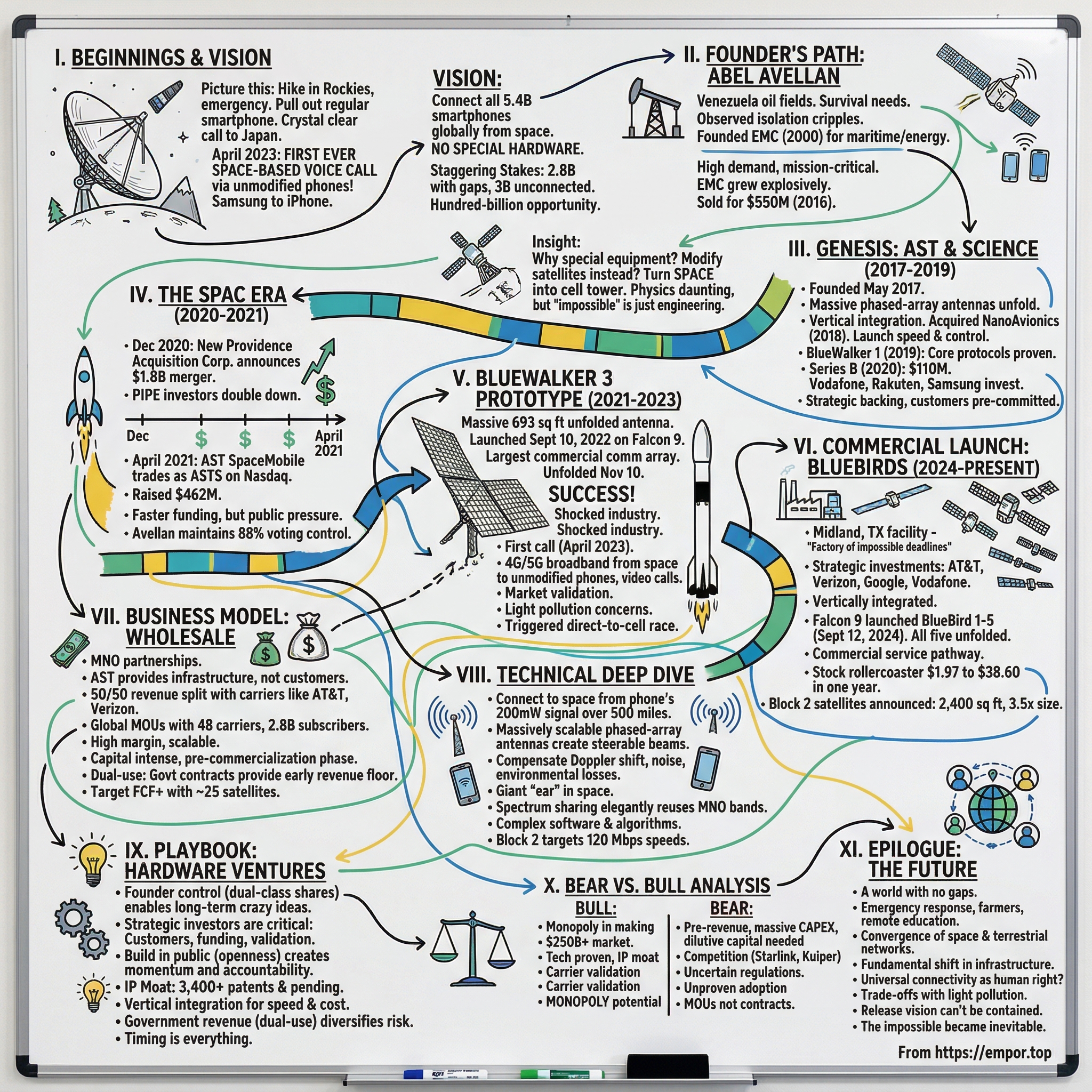
AST SpaceMobile: The Audacious Quest to Connect Every Phone on Earth from Space
I. Introduction & Episode Roadmap
Somewhere over international waters in the spring of 2026, an engineer held up an unmodified smartphone — without a dish, dongle, or custom chip — and downloaded data at 98.9 megabits per second from a satellite roughly 500 kilometers overhead.1 With no cell tower within hundreds of miles, the device received space-based data seamlessly, displaying standard cellular coverage bars.
That demonstration illustrates the core premise of AST SpaceMobile. Legacy satellite phone networks — such as Iridium, Inmarsat, Thuraya, and Globalstar — solved the engineering challenge by placing the hardware burden on the handset through high-gain antennas and specialized receivers. Abel Avellan's strategy inverted that model: leave the phone unchanged as a low-power device with a small internal antenna designed for short-range terrestrial cell towers, and instead deploy a massive phased-array antenna in low Earth orbit capable of detecting and transmitting those weak signals.
Management frequently highlights the scale of this addressable market. On its second-quarter 2026 earnings call, the company estimated that nearly 6 billion mobile phones globally experience coverage gaps, while billions of people remain entirely outside the cellular economy.1 Roughly 90% of the Earth's surface lacks terrestrial cellular coverage, including oceans, deserts, mountain ranges, and remote rural regions where building land-based towers is economically impractical.
AST SpaceMobile, Inc. trades on the NASDAQ Global Select Market under the ticker ASTS. As of late August 2026, the company carried a market capitalization of approximately $25 billion, compared to 2025 revenue of $70.9 million and a net loss attributable to common stockholders of $341.9 million.2 This valuation reflects the central analytical reality of the business: public markets are pricing a network that does not yet commercially exist, operated by a enterprise that has not recognized any subscriber service revenue.
Consequently, AST SpaceMobile remains an unproven commercial enterprise. The central question is whether an ambitious engineering model can translate into a viable economic business. At present, the technical feasibility is far better established than the commercial execution. While AST has achieved several notable technological milestones, it has also repeatedly delayed its operational timelines.
Myth versus Reality
Four common assumptions surrounding the stock warrant examination at the outset.
Myth: AST already sells satellite service to consumers. Reality: as of the second-quarter 2026 earnings call, commercial service revenue recognition had not begun; 2025's $70.9 million came from selling ground gateways to carriers and hitting U.S. government contract milestones, and management guided consumer service revenue to start in 2027.12
Myth: the sixty-plus carrier partnerships represent contracted demand. Reality: most remain non-binding memoranda of understanding. Definitive commercial agreements exist with only a handful of operators, and the roughly $1.3 billion revenue backlog is dominated by commercial infrastructure and government contracts rather than subscriber commitments.1
Myth: AST is capital-light because it borrows carrier spectrum. Reality: the company committed $550 million plus roughly $80 million annually for L-band rights, expended about $610 million of capital in a single quarter, and in August 2026 was bidding against SpaceX for a spectrum portfolio valued near $6 billion.134
Myth: the technology lead settles the competitive question. Reality: SpaceX has more satellites in orbit for direct-to-cell service, its own launch infrastructure, dedicated spectrum, and a live consumer offering — meaning AST's primary advantage is bandwidth speed per satellite rather than deployment scale.56
The road ahead traces the company's trajectory: from a Venezuelan engineer's initial $50,000 enterprise and subsequent $550 million exit; through an improbable satellite manufacturing facility in a Texas oil town; through the SPAC boom that funded the initial launch and the subsequent downturn; through stock price fluctuations from $1.97 to $133.86; through commercial agreements with AT&T, Verizon, and Vodafone; into direct competition with SpaceX; and ultimately to the fundamental metric of capital-intensive space infrastructure — matching technical physics against cash flow and operational timing.
 Subscribe on LinkedIn
II. The Founder's Journey: Abel Avellan & The EMC Origin
From Caracas to Ericsson
Abel Avellan grew up in Venezuela and trained as an engineer before joining Swedish telecommunications giant Ericsson — an apprenticeship that provided exposure to global standards bodies and the technical architecture linking handsets to terrestrial networks.7 While most founders targeting satellite-to-phone connectivity approached the problem from the aerospace sector, Avellan approached it from telecommunications, positioning his business model as a supplier to carriers rather than a competitor.
Building EMC: $50,000 and a Pregnant Wife
In 2000, he founded Emerging Markets Communications (EMC), by his own account, "with $50,000 and a pregnant wife."7 EMC focused on satellite connectivity for cruise ships, cargo vessels, offshore rigs, and remote government outposts across Africa and the Middle East, eventually adding the U.S. Department of Defense, the U.S. State Department, and the United Nations to its customer roster.8 These institutional clients prioritized reliable operational links in remote maritime and land environments over complex consumer features.
This enterprise background shaped AST’s commercial strategy. In maritime and remote-site connectivity, the institutional buyer is rarely the end user; a shipping line purchases bandwidth for its fleet, and the supplier operates transparently behind the customer's brand. Avellan spent 16 years selling backend infrastructure to third-party networks rather than establishing a direct consumer brand. His later insistence that AST would function strictly as a wholesale partner to mobile operators reflected this operational experience.
Through organic expansion and acquisitions, EMC grew into a major consumer of commercial satellite capacity. In May 2016, Global Eagle Entertainment acquired EMC in a transaction valued at approximately $550 million.9
The experience exposed Avellan to the structural constraints that historically limited satellite communications from expanding into a mass-market business — a phenomenon often described as the Iridium trap. Earlier satellite telephony systems required users to purchase specialized, high-cost equipment such as dedicated handsets, maritime terminals, or satellite dishes, alongside expensive per-minute or per-megabyte pricing plans. As a result, the addressable market was capped at specialized users willing to carry auxiliary hardware, keeping subscriber bases small, churn high, and commercial scale limited.
The Iridium Trap, and the Inversion
Avellan's core insight inverted this model: the primary market bottleneck was not satellite capacity, but handset hardware compatibility. Eliminating the requirement for specialized equipment expanded the potential market from niche satellite phone buyers to existing mobile device users worldwide.
Executing that concept required addressing significant physics and engineering challenges. Standard smartphones transmit at approximately 0.25 watts through small internal antennas designed to reach terrestrial cell towers a few miles away, rather than satellites orbiting hundreds of kilometers above Earth. Because standard phones cannot be altered, the satellite infrastructure must absorb the technical burden. To detect low-power signals against terrestrial radio noise, the orbital system requires an exceptionally large and sensitive receiver. Furthermore, the satellite must generate narrow, steerable beams to function as orbital cell towers targeting precise geographical regions. Achieving this capability requires a large-scale phased-array antenna in orbit.
Avellan brought more than 25 years of sector experience, holds over two dozen U.S. patents, and provided initial personal capital to launch the venture.8 This founder funding allowed the company to begin developing its architecture prior to securing institutional venture backing, while establishing the voting control structure that continues to govern AST SpaceMobile.
The next operational step required building one of the largest commercial satellite arrays ever deployed.
III. Genesis: AST & Science & The Phased-Array Breakthrough (2017–2019)
Why an Oil Town Became a Satellite Factory
Midland, Texas is an oil town. Situated in the Permian Basin, its economy has historically tracked the rise and fall of the rig count. It is an improbable location for an assembly facility building the largest commercial communications arrays ever placed in low Earth orbit. That was precisely why Avellan selected it: affordable industrial land, a skilled heavy-fabrication labor pool capable of constructing large steel structures to tight tolerances, an international airport, and no direct competition for engineering talent from major aerospace primes.
AST & Science LLC was established in May 2017, funded initially by Avellan's personal capital and supported over the next three years by approximately $121 million in private capital raised before entering public markets.10
Borrowing the Carrier's Spectrum
The technical hypothesis was specific and testable: deploy flat-panel phased arrays large enough to close the radio link budget with an unmodified consumer smartphone. By operating in low Earth orbit, the system minimizes signal travel distance. Rather than using proprietary satellite waveforms, the satellites transmit standard 3GPP LTE and 5G protocols, allowing standard mobile devices to recognize the signal as a conventional cell tower. Crucially, by broadcasting in mobile operators' existing licensed spectrum, the system requires no firmware modifications or hardware add-ons.
Managing signal dynamics from low Earth orbit introduces severe engineering challenges beyond array size. Unlike stationary terrestrial cell towers, a satellite in low Earth orbit travels at roughly 7.5 kilometers per second. This rapid velocity induces a pronounced Doppler effect—shifting frequency in the same way an approaching ambulance siren changes pitch—while continuously altering signal travel times. Standard LTE modems in commercial smartphones cannot process these extreme shifts. To overcome this, the satellite pre-compensates on the fly, shifting transmit frequencies and timing per beam and per user so the ground device perceives a stationary tower just miles away. Without precise compensation, handsets fail to attach to the network. AST treats these Doppler and delay compensation algorithms, along with its custom signal-processing chips, as core intellectual property.
The decision to use partner carrier spectrum represented a pivotal commercial strategy. Radio spectrum is among the most expensive and tightly regulated assets in telecommunications. Operating within partner carriers' low-band spectrum allowed AST to bypass billions of dollars in spectrum acquisition costs while positioning itself as an infrastructure partner rather than a retail competitor. For mobile operators, AST offered a way to expand advertised coverage without surrendering customer relationships to a competing satellite service.
NanoAvionics: A Bolt-On, Then a Source of Cash
Early operations also featured targeted vertical integration. In 2018, AST acquired a 51% stake in NanoAvionics, a Lithuanian small-satellite manufacturer, securing modular satellite buses, avionics, and flight software for rapid prototyping of the early BlueWalker demonstrators.11 Four years later, as capital demands for the main constellation intensified, AST sold the stake during Kongsberg's acquisition of NanoAvionics. The transaction closed on September 6, 2022, generating net proceeds of $26.6 million for AST at an enterprise valuation of roughly $68 million.1112
While the acquisition provided essential prototyping capabilities and eventually yielded a cash return, the divestment underscored a persistent financial reality: AST could not generate sufficient operational cash flow to fund its constellation, relying instead on asset sales and external funding to sustain development.
The Carriers Write the First Cheques
A major commercial validation occurred in March 2020, when AST completed a $110 million Series B funding round backed by Japan's Rakuten Group, Vodafone, and American Tower.10 The investor profile was more significant than the capital raised. Rather than traditional venture capital firms, the round was led by industry incumbents whose licensed spectrum, tower assets, and subscriber bases were central to AST's business model. Their balance-sheet investments provided early institutional validation that telecom operators viewed AST as a network multiplier rather than a competitive threat.
However, strategic funding did not equate to commercial service revenue, and $110 million remained far short of the capital required to build a global constellation. To fund full-scale deployment, AST needed public market scale—and by late 2020, equity markets were eager to provide it.
IV. The SPAC Era: Going Public in the Space Gold Rush (2020–2021)
The Blank-Cheque Window
Late 2020 represented one of the most permissive capital-raising environments for pre-revenue technology companies in a generation. Special purpose acquisition companies (SPACs) were raising billions of dollars without pre-identified targets. Space ventures in particular went public in rapid succession on the strength of long-range revenue projections that rarely materialized.
AST announced its merger with New Providence Acquisition Corp. in December 2020, valuing the combined enterprise at approximately $1.4 billion.13 When the transaction closed on April 6, 2021, it delivered $462 million in gross proceeds — comprising roughly $232 million from the SPAC trust and $230 million from private investment in public equity (PIPE) investors — before Class A shares began trading on the NASDAQ under the ticker ASTS on April 7, 2021.1415
The Up-C Structure and Permanent Control
When evaluated against its peer group, AST stands out from the 2020–2021 space SPAC cohort, which included Virgin Galactic, Astra, Momentus, Spire, Planet, and Rocket Lab. While several of those companies subsequently delisted, restructured, or underwent private buyouts following revenue shortfalls, AST remains one of the few survivors executing its original technical thesis at scale. Nevertheless, surviving a high-mortality vintage is distinct from achieving initial financial forecasts.
The corporate architecture established during the merger remains a central governance feature of the business. AST operates under an Up-C structure, where public holding company AST SpaceMobile, Inc. sits above the operating entity, AST & Science, LLC. Through Class C common stock carrying up to ten votes per share prior to a defined sunset, founder Abel Avellan maintains voting control.16 As of February 26, 2026, Avellan and his permitted transferees controlled approximately 72.0% of the combined voting power.2 As of mid-2026, he beneficially owned about 20.8% of the Class A shares while holding 71.6% of total votes.17
Under NASDAQ rules, AST qualifies as a controlled company, permitting it to opt out of certain governance requirements, including maintaining a majority-independent board.18 Five of its ten seated directors are independent.18 This voting concentration limits the ability of institutional investors or outside acquirers to alter management, strategy, or execution timelines, leaving public shareholders dependent on leadership's execution.
Testing the Promise
A lasting consequence of entering public markets via SPAC is the structure of AST's shareholder base. The stock has maintained high retail participation and pronounced price swings — moving from a low of $1.97 to a 2024 peak near $39, reaching an all-time high of $133.86 in May 2026, and subsequently surrendering more than half those gains by August.19 Executive leadership actively engages this audience, regularly opening quarterly earnings calls by answering pre-submitted questions from retail investors in New Zealand, New Jersey, and Vancouver before taking analyst questions.120 While this strategy builds strong individual investor engagement, it also leaves the share price sensitive to market sentiment rather than constellation deployment metrics, contributing to sharp valuation shifts between quarters.
The company's initial 2020–2021 public materials projected commercial service revenue beginning around 2023, supported by a rapid constellation expansion. Operational results diverged from that schedule. AST reported zero revenue in fiscal 2023.2 It recorded $4.4 million in fiscal 2024, with none generated from subscriber cellular service.2 In fiscal 2025, revenue reached $70.9 million, but that income was derived almost entirely from carrier ground gateway sales and U.S. government development contract milestones rather than consumer satellite connectivity.221 As of August 2026, commercial service revenue recognition had not yet begun, with management guiding to a start date in "next year."1
This timeline shift altered the company's capital strategy, converting a planned self-funding deployment into a process requiring ongoing market financing. The market responded accordingly: between its post-listing period and early 2024, the equity declined by roughly 90%, bottoming at $1.97 on April 2, 2024.19
Before addressing that capital challenge, however, AST needed to demonstrate that its technology could function in orbit — an operational test that depended on deploying a massive array in low Earth orbit.
V. BlueWalker 3: The 64-Square-Meter Proof of Concept (2021–2023)
The Unfolding
Every hardware company has a moment where the spreadsheet stops mattering and the metal either works or it doesn't. For AST SpaceMobile that moment came on November 10, 2022, roughly two months after launch, when a folded package the size of a small car began to unfurl in low Earth orbit into a flat panel of 64 square metres — about 693 square feet, or the floor area of a generous two-bedroom apartment.22
BlueWalker 3 had launched on September 10, 2022 aboard a SpaceX Falcon 9. It weighed roughly 1.5 tonnes and it was, on deployment, the largest commercial communications array ever placed in low Earth orbit.22 There is no way to test an unfolding mechanism of that scale on the ground; gravity will not permit it. The company had one shot, in vacuum, with the whole thesis riding on a sequence of hinges and tensioners.
A Sequence of Firsts
It worked. And then it kept working, in a sequence of firsts that the company has legitimately earned the right to be proud of.
On April 25, 2023, AST completed what it described as the first-ever two-way space-based voice call using everyday unmodified smartphones — a Samsung Galaxy S22 in Midland, Texas connecting to a Rakuten engineer in Japan over AT&T spectrum, with engineers from Vodafone, Rakuten, and AT&T participating in the test campaign.23 Two months later, in June 2023, the company confirmed 4G LTE capability directly to standard handsets.24 Then on September 8, 2023, an engineer standing in a known dead zone near Hana, Hawaii placed a 5G call to a Vodafone engineer in Madrid using AT&T spectrum, with Nokia involved in the testing — the first space-based 5G connection to an unmodified smartphone.25 Download rates climbed through the test campaign to roughly 14 Mbps and later to around 21 Mbps.25
Here is where a careful investor should slow down. Those milestones are real, they are hard, and no competitor had done them. They are also, categorically, not a business. A single prototype satellite passing overhead for a few minutes at a time, making choreographed calls with engineers on both ends, demonstrates that the physics closes. It says nothing about whether you can build ninety of them at industrial cadence, launch them on schedule, integrate them into a dozen national carrier cores, and get consumers to pay a monthly fee. The gap between "we proved it" and "we sell it" is where most deep-technology companies die, and AST would spend the next three years inside that gap.
The Brightness Problem
There is one more lesson in BW3 that the market took years to absorb. Building a single prototype and building a production line are almost unrelated disciplines. A one-off can absorb hand-fitting, rework, and heroic engineering; a constellation cannot. The unfolding sequence that worked once in November 2022 had to become a manufacturing process repeatable dozens of times at a target of six satellites a month, with supply chains for exotic composites, custom silicon, and thousands of radio-frequency elements — all sourced by a company that in 2022 had never manufactured anything at rate. The two-year gap between BW3's triumph and BlueBirds 1 through 5 reaching orbit was not a failure of physics. It was the industrialisation problem, and it is the reason the company later pushed vertical integration to roughly 95% and built its own factories rather than relying on suppliers who had repeatedly slipped.
BW3 also created problems that will follow the company for its entire operational life. On November 28, 2022 the International Astronomical Union's Centre for the Protection of the Dark and Quiet Sky issued a statement expressing serious concern about the satellite's unprecedented brightness and its use of terrestrial frequencies from orbit.26 Subsequent peer-reviewed measurements published in Nature found BlueWalker 3 peaking at apparent magnitude 0.4 — bright enough to rank among the ten brightest objects in the night sky, and roughly 900 times brighter than the threshold the IAU recommends to limit damage to astronomy.27
This is not a public-relations irritant to be waved away. It is a structural tension in the design. AST's entire competitive advantage is aperture — the arrays must be enormous to close the link to an ordinary handset — and large flat reflective surfaces in low orbit are, unavoidably, bright. Block 2 satellites are roughly 3.5 times larger than BW3.21 The company's radiated power in terrestrial bands is also, by construction, aimed at the ground in frequencies that sit near bands radio astronomers use. Any future regulatory tightening on optical brightness or radio-frequency interference lands directly on the mechanism that makes AST work, and there is no obvious engineering escape that does not also shrink the aperture.
Meanwhile, the Rulebook Was Being Written
Meanwhile the FCC was constructing the rules of the road. It adopted a Supplemental Coverage from Space framework in 2024 — a regime allowing terrestrial carriers to lease their licensed spectrum to satellite operators for supplemental coverage — and the first grant under that framework went not to AST but to SpaceX's Starlink direct-to-cell service with T-Mobile.28 AST would wait two more years for its own commercial authorisation.
By early 2024, the technical case was largely settled and the financial case was collapsing. The company had proved it could talk to a phone from space. It was much less clear it could survive long enough to do it at scale.
VI. Commercial Reality: BlueBirds, Launch Delays, & The 2024 Stock Rollercoaster (2024–Present)
April 2024: The Company Almost Ends
In the first quarter of 2024, AST SpaceMobile ended the period with $212.4 million in cash and a set of half-built satellites in a Texas hangar.20 Two critical suppliers had slipped. The five Block 1 BlueBird satellites — the first commercial units, each carrying a 693-square-foot array — had been promised, delayed, and re-promised. On April 2, 2024 the stock closed at $1.97, its all-time low, valuing the whole enterprise at a fraction of what a single year of its eventual capital programme would cost.19 Serious people questioned whether the company would make it.
What followed over the next five months is one of the more dramatic reversals in recent small-cap history, and it was driven by something specific: the company converted narrative into contract.
Turning Narrative Into Contract
It had started in January 2024, when AT&T, Google, and Vodafone put money in — a package of up to $206.5 million in gross proceeds, anchored by $110 million of ten-year subordinated convertible notes at 5.50% with a conversion price of $5.75, plus a $20 million revenue commitment from AT&T contingent on the first five satellites operating and a $25 million minimum revenue commitment from Vodafone.29 Note the conversion price. Strategic investors were writing a lifeline at a valuation that, in hindsight, transferred enormous economics away from existing shareholders — the cost of raising money when you have no leverage.
Then came the contracts. On May 15, 2024, AT&T and AST announced a definitive commercial agreement running through 2030, upgrading a memorandum of understanding that dated back to 2018 into a legally binding vehicle with service-level agreements and defined commercial terms; AT&T's head of network, Chris Sambar, joined AST's board.30 On the earnings call that same day, Avellan called it "the conclusion of all the tests, pricing, discovering, understanding of the usage," and Scott Wisniewski — then chief strategy officer, now president — described it as "the legal vehicle through which revenue will be brought in."20 Pressed by Deutsche Bank's Bryan Kraft on whether the agreement carried new money, Wisniewski was candid that it did not: "there's no new economics with this agreement right now."20 That was an honest answer, and it captures precisely what the deal was — a distribution agreement, not a cheque.
Two weeks later, on May 29, 2024, Verizon committed $100 million: $65 million in commercial prepayments, of which $45 million was conditional, plus $35 million of convertible notes.31 The strategic significance exceeded the dollars. With AT&T and Verizon both contributing 850 MHz spectrum, AST could target coverage of essentially the entire continental United States using premium low-band frequencies from two of the three national carriers.32 For a company whose model depends on borrowing other people's spectrum, having the two largest low-band holders in America aligned was the closest thing to a moat it had yet assembled.
The market re-rated violently. From $1.97 in April, ASTS reached a 2024 high of $39.08 — a move of roughly twenty times inside five months.19 Then, on September 12, 2024, at 4:52 a.m. Eastern, a Falcon 9 lifted off from Cape Canaveral carrying BlueBirds 1 through 5, deploying them over a fourteen-minute sequence beginning about fifty-four minutes after liftoff.33 AST finally had commercial hardware in orbit.
The launch itself, however, marked the start of a much longer wait than most investors expected. Getting five satellites to orbit is not the same as getting five satellites into commercial service: each array had to unfold, each spacecraft had to be commissioned, beams had to be pointed and cells provisioned, and carrier network cores had to be integrated market by market. Through all of 2025 and into 2026, the Block 1 BlueBirds served as testbeds and government assets rather than as a consumer network — which is exactly what a careful reader of the Q1 2024 call would have expected, given that management had already declined to guide to revenue from them.
The years since have been a study in scaling — and in the gap between plans and calendars.
2025: A Revenue Engine of an Unexpected Shape
2025 was the year the revenue engine started, at modest scale and in an unexpected shape. Revenue reached $70.9 million, at the top of guidance, but it came from selling ground gateways to carrier partners — fifteen delivered in the second half of the year across nine customers on five continents — and from executing milestones on ten U.S. government contracts, including a $30 million award from the Space Development Agency.212 Not one dollar came from a consumer paying for satellite coverage. Management was straightforward that these were leading indicators rather than the business itself; gateway sales, as Wisniewski put it, show partners "making investments ahead of that rollout."21 That framing is fair, but investors should hold it precisely: infrastructure sales to your own future customers are a demand signal, not demand.
The commercial and spectrum architecture deepened considerably. In June 2025 AST announced a settlement term sheet with Ligado Networks, Viasat, and Inmarsat giving it long-term usage rights — on the order of 80-plus years — to up to 40 MHz of L-band mobile satellite service spectrum in the U.S. and Canada plus 5 MHz in the 1670–1675 MHz band, in exchange for a $550 million payment at regulatory closing and minimum annual L-band payments of roughly $80 million.3 This was a genuine strategic shift: for the first time, AST would control spectrum rather than only borrow it. It also converted an operating model that was famously spectrum-light into one carrying substantial fixed annual obligations. In Europe, AST and Vodafone formed a joint venture — later unveiled as Satellite Connect Europe, headquartered in Luxembourg — to distribute the service exclusively to European carriers.3435 In the Middle East, a ten-year definitive agreement with الاتصالات السعودية stc Group came with a $175 million prepayment received during 2025.21 Verizon's memorandum became a definitive agreement. Partners including Orange, Telefónica, 長江和記實業 CK Hutchison, and 台灣大哥大 Taiwan Mobile were added to the roster.21
And on December 24, 2025, an Indian LVM3 rocket lifted BlueBird 6 — the first Block 2 satellite, with an array of roughly 2,400 square feet — from Satish Dhawan Space Centre, the heaviest payload that vehicle had ever carried.3637 Funding it all required more than $3.5 billion of capital raised during 2025 alone, including convertible notes issued in January and July and a further $1.15 billion offering in the autumn at a 2.00% coupon.2138
2026: Vindication and Reckoning, Six Weeks Apart
Then 2026 delivered both the vindication and the reckoning.
The vindication came on April 21, 2026, when the FCC granted AST authority to launch and operate a 248-satellite constellation and to provide direct-to-device service in 700 MHz and 800 MHz low-band spectrum coordinated with Verizon, AT&T, and FirstNet — the first major commercial SCS grant of its kind for the company, with milestones requiring 124 satellites by August 2, 2030 and the full constellation by August 2, 2033.3940
The reckoning came two days earlier. On April 19, 2026, BlueBird 7 rode a Blue Origin New Glenn — notably, the first New Glenn flight reusing a previously flown first stage — and was placed into a badly wrong orbit of roughly 154 by 494 kilometres after an upper-stage engine failed to fire correctly.4142 The satellite separated and powered on, but it could not raise itself with onboard thrust and had to be deorbited.41 AST recognised a $125.9 million loss on involuntary conversion in the second quarter; the satellite had been insured for approximately $30 million.142 Then, on May 28, 2026, a New Glenn exploded on the pad at Cape Canaveral during a static fire test, an event Blue Origin later traced to the main oxygen valve on a BE-4 engine.4344 One of AST's two heavy-lift paths to orbit was grounded.
Almost exactly as that rocket was burning, ASTS touched its all-time high of $133.86 on May 28, 2026.19 The subsequent unwind was severe: down 21.6% in June on intensifying Starlink competition fears, then down 33.6% in July after the company simultaneously announced a $1.15 billion convertible raise and pushed its 45-satellite deployment target from late 2026 into early 2027.4546 By late August 2026 the stock traded near $61, roughly 54% below the May peak.19
Execution, meanwhile, genuinely accelerated. BlueBirds 8, 9, and 10 launched in June 2026; BlueBirds 11, 12, and 13 followed on August 5, 2026, bringing thirteen spacecraft to orbit with roughly 20,000 square feet of combined aperture.47481 Production was running through BlueBird 46 at a target cadence of six satellites per month, with roughly 50 gateways across 20 markets in various stages of deployment and more than 3,000 of a planned 5,600 U.S. cellular cells deployed.1
That is the state of play: the hardware is flying, the regulatory door is open, the partners are signed — and the meter on the constellation's cost is running at a rate that dwarfs anything the company earns.
VII. Business Model & Economics: Wholesale MNO Revenue Share vs. CapEx Nightmare
Strip away the orbital logistics and AST SpaceMobile operates commercially as a wholesale infrastructure provider, characterized by an exceptionally streamlined customer acquisition model alongside substantial long-term capital costs.
The Elegant Half: No Stores, No Billing, No Churn
The commercial structure avoids traditional consumer-facing infrastructure. AST operates without retail storefronts, customer service organizations, proprietary billing platforms, subscriber acquisition expenses, or direct advertising budgets. Instead, mobile network operators integrate satellite connectivity into existing service plans as a line-item add-on, splitting gross proceeds with AST. Chief Executive Abel Avellan detailed the intended user experience on the first-quarter 2024 earnings call: "the user doesn't need any special phone. It doesn't need any special package. All he will see is a different symbol in the 5G icon with an S."20 This wholesale framework relies on zero-friction device opt-in and standard handset compatibility.
If implemented successfully, this framework offers high incremental operating leverage. Because the marginal cost of routing an additional subscriber across an active satellite is minimal, constellation revenue generates high contribution margins once capital expenditures are sunk. However, converting this operating leverage into sustained cash flow depends on two unproven variables: consumer opt-in rates across partner networks and the deployment of a fully operational satellite fleet.
The Brutal Half: What Ninety Satellites Cost
The underlying capital requirements remain substantial. Management estimates the average capital cost at $21 million to $23 million per satellite, covering direct manufacturing materials and launch services across a planned constellation exceeding ninety spacecraft—noting on the second-quarter 2026 call that these projections "are subject to fluctuations based on dynamic geopolitical factors."1 At that unit rate, a ninety-satellite constellation requires roughly $2 billion for hardware and launches alone, before accounting for ground gateway infrastructure, the $550 million closing payment for Ligado spectrum rights with its roughly $80 million in annual minimum obligations, and 2026 operating expenses approaching $400 million.13
Operational utility is strictly tied to satellite density. Management projects that continuous coverage across prime markets—including the U.S., Europe, and Japan—requires 45 to 60 BlueBird satellites, with global continuity requiring additional units.1 Below those levels, connectivity remains intermittent. Chief Strategy Officer Scott Wisniewski noted that a 25-satellite fleet delivers coverage for "about half the day."1 Thirteen satellites were in orbit as of August 2026.
These capital requirements shape the balance sheet. Capital expenditures reached approximately $610 million in the second quarter of 2026—up from $257 million in the first quarter—with third-quarter capital spending guided between $350 million and $425 million.1 Second-quarter revenue totaled $31.5 million, reflecting a ratio of roughly twenty dollars of capital deployed for every dollar of revenue recognized.1 Adjusted operating expenses excluding cost of revenues reached $95.9 million for the quarter, near the upper bound of guidance, driven by workforce expansion, facility build-outs, and what management described as "critical investments relating to artificial intelligence."1
The Dilution Record, Stated Plainly
Funding this build-out has required extensive equity and debt offerings. The resulting share dilution illustrates the scope of external capital reliance: weighted average shares outstanding grew from roughly 51.7 million in 2020 to 81.8 million in 2023, 154.5 million in 2024, and 256.0 million in 2025—a fivefold increase over five years, prior to 2026 issuances.2 This expansion was supplemented by at-the-market equity programs, warrant exercises, and convertible debt structures.
Two accounting items require context when analyzing these financial disclosures. First, AST capitalizes satellite construction into property, plant, and equipment—which expanded to $2.09 billion at June 30, 2026, from $1.42 billion six months earlier.2 Because manufacturing cash outflows appear under investing activities rather than operating expenses until recognized as depreciation, reported operating losses understate immediate cash burn. Second, under the Up-C corporate structure, a significant portion of net losses is assigned to non-controlling interest holders in the operating subsidiary. In fiscal 2025, the net loss from continuing operations reached $461.0 million, whereas the net loss attributable to common stockholders was reported at $341.9 million.2 The $119.1 million difference was absorbed by non-public unit holders, meaning headline net income per share reflects only a fraction of total enterprise losses. Additionally, non-current deferred revenue of roughly $252 million represents carrier prepayments for future service, providing current liquidity but creating a drag on future revenue quality as services are fulfilled.2 The company's independent auditor is KPMG, and its 2025 say-on-pay and auditor ratification proposals passed without incident.18
The July 2026 debt offering marked a shift in execution terms compared to earlier raises. AST issued $1.0 billion in 1.625% convertible senior notes due 2034, upsized to $1.15 billion following option exercises, and purchased a capped call that set the effective conversion price at $149.20 per share—above its historical peak—with management characterising effective dilution as less than 2%.4950 This pricing contrasted with the $5.75 conversion threshold accepted in January 2024, illustrating how higher equity valuations enabled substantial capital collection without immediate structural dilution.
On a pro forma basis including the July proceeds, AST held over $3.7 billion in cash, cash equivalents, and restricted cash as of June 30, 2026, against total debt of roughly $3.0 billion.12 Management asserts this capital position is sufficient to fund the deployment of more than 100 satellites.1 However, historical capital cycles warrant cautious evaluation: previous statements regarding balance-sheet sufficiency have routinely been followed by secondary capital raises within twelve months. While current liquidity is substantially greater than in prior periods, ongoing constellation construction costs require sustained execution to avoid further capital market reliance.
The Non-Dilutive Offsets
Two non-dilutive capital mechanisms provide partial offsets to equity offerings. First, carrier prepayments—including $65 million from Verizon and $175 million from stc Group—convert commercial partner commitments into immediate working capital. Second, AST secured a preliminary award under Japan's J-LEO low-Earth-orbit satellite infrastructure program, pending final documentation with partner Rakuten and government approvals. The program offers up to approximately $1 billion in what Avellan described as non-dilutive, non-debt government capital, intended to fund roughly half the hardware cost of designated satellites while maintaining global operational usage under a Japanese flag.1 While sovereign co-funding could alter long-term capital intensity if replicated in other jurisdictions, it currently remains a single preliminary award.
VIII. Competitive Strategy: Starlink, Apple/Globalstar, & The Battle for Spectrum
The Competitor That Owns the Rockets
The central structural dynamic hanging over AST SpaceMobile’s commercial outlook is that its primary competitor controls its own launch infrastructure.
SpaceX took a fundamentally different architectural path for its Starlink direct-to-cell network. Rather than deploying large, dedicated satellite arrays, SpaceX integrated compact direct-to-device payloads onto its existing v2 Mini satellites, launching hundreds of units aboard its own rockets at marginal cost. By early 2026, SpaceX had placed more than 650 direct-to-cell satellites into orbit, delivering live service in more than 20 countries.5 T-Mobile commercially launched its T-Satellite service on July 23, 2025, offering satellite texting before adding data capabilities by October 2025, with pricing set at $10 per month for users across carriers, including AT&T and Verizon subscribers.515
This architectural divergence creates distinct technical trade-offs. Starlink’s smaller payloads deliver narrowband connection speeds suitable for text messaging, location sharing, and basic application data. In contrast, AST’s large phased-array antennas deliver full cellular broadband—enabling voice-over-LTE, video calls, and streaming at speeds approaching 100 Mbps to an unmodified phone.1 While AST holds a clear capability lead per satellite, SpaceX maintains a decisive advantage in total satellite count, launch cadence, and cost of access to orbit—the specific operational area where AST suffered satellite loss and launch provider delays in mid-2026.
SpaceX Buys Its Way Out of the Carrier
SpaceX further altered the competitive landscape by acquiring dedicated spectrum rights. In September 2025, EchoStar agreed to sell its AWS-4 and H-block licenses to SpaceX for approximately $17 billion in cash and SpaceX stock, while SpaceX agreed to fund roughly $2 billion of EchoStar’s cash interest payments through November 2027; a subsequent agreement in November 2025 added EchoStar’s unpaired AWS-3 licenses for about $2.6 billion in stock.652 Equity markets reacted immediately to the threat of direct carrier disintermediation, driving down shares of T-Mobile, AT&T, and Verizon following the announcement.6 By acquiring nationwide spectrum, SpaceX reduced its reliance on mobile network operators to reach end users. This development directly challenged AST’s core strategic positioning as a non-competitive partner that extends terrestrial carrier networks rather than replacing them.
Three Rivals Form a Cartel of Convenience
Terrestrial operators responded with unprecedented structural cooperation. On May 14, 2026, AT&T, T-Mobile, and Verizon agreed in principle to form a joint venture pooling spectrum for direct-to-device satellite coverage, explicitly to accelerate American leadership in D2D.53 The agreement preserved existing carrier-vendor ties: T-Mobile retained Starlink, AT&T and Verizon maintained their agreements with AST, and Verizon preserved partnerships with Amazon Leo and Skylo.53 Addressing investor concerns during the second-quarter 2026 earnings call, President Scott Wisniewski contended that the joint venture "frees up a third and fourth customer for us in the United States," emphasizing that AST remains "carrier agnostic."1 However, while a unified spectrum pool could theoretically expand AST’s addressable carrier base, concentrating buyer power within a single negotiating entity could also reduce vendor leverage across contract renewals and pricing terms.
Narrow-scope providers round out the competitive field. Apple relies on Globalstar for emergency messaging and SOS features, having acquired a roughly 20% stake for approximately $400 million in November 2024.54 However, Apple enabled Starlink-based carrier messaging in iOS 18.3 in early 2025, with industry reporting through late 2025 indicating ongoing discussions between Apple and SpaceX regarding deeper direct-to-cell integration.54 Legacy mobile satellite service operators—including Iridium and Viasat/Inmarsat—remain constrained by narrow legacy spectrum allocations and specialized terminals, while smaller entrants like Lynk Global pursue direct-to-standard-phone connectivity at a far smaller scale and with far less capital.
The Grain Auction Reframes Everything
Geopolitical considerations also shape international market access, particularly in Europe, where government procurement favors sovereign connectivity solutions and localized infrastructure. This preference drove AST to structure its joint venture with Vodafone—Satellite Connect Europe—with European executive management headquartered in Luxembourg. During the second-quarter 2026 earnings call, Wisniewski pointed to the trend of states "prioritizing certain types of providers who have European operations," arguing that partnership access and local alignment are essential for securing state contracts.1 This dynamic highlights how international expansion depends as much on local corporate structure and carrier partnerships as it does on orbital capability.
A major shift in domestic spectrum strategy emerged in August 2026. Private equity firm Grain Management put a portfolio of 800 MHz spectrum licenses spanning 3,224 counties—covering nearly the entire United States and valued at roughly $6 billion—up for bid after an FCC-approved spectrum swap with T-Mobile obliged it to find a developer. Bloomberg reported on August 20, 2026 that both SpaceX and AST SpaceMobile were among the interested parties, with preliminary offers due in the first week of September and the FCC seeking a conclusion by November 5.4
This auction participation reframes AST’s business model. Previously positioned as a spectrum-light partner riding on carrier licenses, AST’s pursuit of direct spectrum holdings—alongside its $550 million commitment and roughly $80 million in annual payments for Ligado L-band rights—aligns its asset strategy more closely with SpaceX. While owning spectrum provides long-term operational autonomy that carrier partners cannot revoke, it also erodes the capital-light distinction that historically separated AST from Starlink, signaling the potential for another major financing if AST succeeds in the auction.
IX. Strategic Frameworks: 7 Powers & Porter's 5 Forces Analysis
Analytical frameworks are only useful when allowed to deliver uncomfortable conclusions. Applied rigorously to AST SpaceMobile, Hamilton Helmer’s 7 Powers and Michael Porter’s 5 Forces reveal a business with two emerging operational strengths, several claimed strategic advantages that buckle under scrutiny, and an industry structure considerably more demanding than popular narrative suggests.
Seven Powers, Honestly Applied
Counter-positioning remains the strongest of Hamilton Helmer’s framework concepts that AST SpaceMobile can claim. By operating as a wholesale partner to terrestrial telecom operators rather than a direct-to-consumer rival, AST offered incumbents a solution SpaceX initially could not: space-based coverage that enhances carrier subscriber retention rather than threatening it. That strategic alignment drove early investments from AT&T, Google, Vodafone, Rakuten, and American Tower. However, counter-positioning relies on an incumbent’s structural unwillingness or inability to respond. SpaceX demonstrated the opposite by purchasing $17 billion in dedicated spectrum to bypass carrier dependency, gradually weakening AST's counter-positioning advantage.
Scale economies remain theoretical rather than operational. Management notes that spreading fixed constellation costs across more than 60 carrier partners covering over 3 billion addressable subscribers implies significant long-term marginal economics.1 However, addressable users are not paying subscribers, and AST currently lacks commercial subscriber scale to match against a competitor's cost curve. On input costs, SpaceX maintains a structural advantage by launching its own satellites at internal cost, whereas AST must purchase launch capacity on commercial markets. To mitigate supply-chain bottlenecks, AST added 400,000 square feet of manufacturing space in Texas toward a target exceeding 900,000 square feet nationwide, while discussing potential acquisitions to "secure additional access to orbit."1 While 95% vertical integration protects against supplier bottlenecks, it does not inherently guarantee a unit-cost advantage over an integrated launch competitor.
Cornered resource claims warrant careful scrutiny due to inconsistent executive disclosures. On the second-quarter 2026 earnings call, prepared remarks cited "over 3,900 patents and patent pending claims," while founder Abel Avellan referenced "over 3,600" during the same call's shareholder Q&A.1 On the fourth-quarter 2025 call, management had cited "over 3,100."21 Aggregate patent counts represent an imprecise metric because pending claims do not constitute granted intellectual property rights. A more durable advantage lies in demonstrated operational execution: AST has proven in orbit that it can deploy and steer phased arrays of unprecedented physical scale. The specialized engineering expertise required to construct those arrays reflects tacit operational knowledge rather than a purely legal cornered resource.
Process power represents AST's most compelling emerging strength. Between June and August 2026, the company launched six satellites across three missions, advanced assembly through BlueBird 46, and targeted a production rate of six spacecraft per month using a stackable composite architecture that fits multiple multi-ton payloads inside a standard five-meter rocket fairing.14748 No other entity manufactures commercial communications arrays of this dimension at a comparable volume. The specialized techniques involved—laminating structural composites, verifying deployment mechanisms in vacuum simulations, and manufacturing high-yield radio-frequency elements—reside within institutional engineering teams rather than published documentation. However, process power must be sustained over time; until AST maintains its monthly production target across multiple consecutive quarters, high-volume assembly remains an operational objective rather than a fully established moat.
Switching costs are moderate but notable. Mobile operators that integrate AST into their core network infrastructure, construct dedicated ground gateways, and provision cellular sites make substantial financial and technical commitments. However, carrier multi-sourcing strategies—such as Verizon concurrently partnering with AST, Amazon LEO, and Skylo—indicate that operators are actively preserving supplier optionality rather than accepting single-vendor lock-in.53 Network effects and branding remain minimal; by operating as a wholesale white-label provider, AST explicitly avoids establishing a consumer-facing brand.
Five Forces: A Structure More Demanding Than the Narrative
An evaluation under Michael Porter’s Five Forces highlights a challenging operational environment. Barriers to entry represent AST’s primary structural defense, reinforced by multi-billion-dollar capital requirements, complex phased-array engineering, global regulatory licensing hurdles, and constrained launch availability. Conversely, buyer power is high and expanding. The customer base consists of a small group of Tier-1 telecom operators controlling critical low-band spectrum, with U.S. carriers establishing joint arrangements that increase collective bargaining leverage. Government agencies provide expanding revenue but exert significant procurement leverage and carry project cancellation risks. Substitutes are widespread, encompassing terrestrial tower densification, expanding direct-to-cell satellite offerings, high-altitude platform systems, and basic consumer tolerance for temporary coverage gaps. Rivalry is intense and structurally asymmetric, pitting AST against a direct competitor with internal launch capabilities and a far larger balance sheet. Finally, supplier power remains a critical vulnerability: AST depends on third-party launch providers, as highlighted in 2026 when launch vehicle anomalies and pad failures disrupted deployment schedules.
In summary, AST SpaceMobile’s strategic defense relies on proprietary engineering expertise that is difficult to replicate and commercial relationships with carriers seeking alternatives to single-vendor dominance. Neither factor constitutes an immutable economic moat under formal strategic frameworks. Whether these operational advantages sustain long-term enterprise value depends on AST's ability to achieve full constellation deployment before competitive pressure and capital intensity erode its market window.
X. Historical Falsification & Management Credibility Audit
Any investment case worth holding should be tested against the strongest evidence in the company's own record that would break it. AST SpaceMobile is unusual in that its record is short but unusually dense with testable promises.
Claim one: the phased-array moat delivers first-mover advantage. The affirmative evidence is strong — the first space-based voice call, the first 4G, the first 5G, the first arrays of this scale, the highest demonstrated speeds. The disconfirming evidence is equally clear: technical primacy did not translate into commercial primacy. While AST was manufacturing its first five commercial satellites, SpaceX deployed direct-to-cell payloads by the hundreds and launched a commercial consumer service with T-Mobile in July 2025.51 SpaceX also received the FCC's first SCS grant; AST received its own commercial authorisation in April 2026, roughly two years later.2839 Assessment: the claim survives in a narrowed form. AST leads on capability per satellite and is the only operator demonstrating true broadband to an unmodified handset. It does not lead on deployment, on time-to-market, or on consumers served. The KPI that would confirm the narrowed claim is simple: satellites operational in orbit against the roughly 45 required for continuous coverage in key markets, tracked quarter by quarter. The event that would falsify it is Starlink achieving comparable broadband speeds to standard handsets using its acquired spectrum before AST reaches continuous coverage.
Claim two: capital allocation is becoming disciplined and non-dilutive. Test it against the longest relevant record. The 2020–2021 SPAC pitch implied commercial revenue from 2023; actual revenue was zero in 2023 and $4.4 million in 2024.2 The equity fell roughly 90% to $1.97 by April 2024.19 Financing came at whatever price was available — a $5.75 conversion price in January 2024, and continuous at-the-market issuance that helped drive weighted average shares from roughly 52 million to 256 million in five years.229 Then, when confidence returned, the company did not slow down; it accelerated, adding roughly $3.5 billion of capital in 2025 and $1.15 billion more in July 2026, while simultaneously committing $550 million plus annual minimums to Ligado spectrum, funding a 400,000 square foot factory expansion, entering a multi-billion-dollar spectrum auction against SpaceX, and discussing acquisitions to secure launch access.2134914
Assessment: the record rejects the strong version of this claim and supports a weaker one. This is not a disciplined capital allocator; it is a company that raises whatever it can whenever markets allow, and spends it on an expanding rather than a contracting set of objectives. What has genuinely improved is the terms — 1.625% coupon and a $149.20 effective conversion price in July 2026 versus 5.50% and $5.75 in January 2024 — and the growing share of non-dilutive capital from carrier prepayments and the preliminary Japanese J-LEO award.49291 The falsifying event to watch is straightforward: another equity or equity-linked raise before commercial service revenue is being recognised at scale would confirm that the pattern is structural, not situational. The confirming event would be reaching continuous coverage in key markets funded entirely from the existing $3.7 billion plus non-dilutive sources.
Claim three: MNO partnerships constitute contracted demand. For years the headline was subscriber reach — first "around 50 operators" with memoranda of understanding, as Avellan put it in May 2024, then over 50 covering nearly 3 billion subscribers by early 2026, and over 60 covering more than 3 billion by August 2026.20211 Most of these were, and many remain, non-binding letters of intent without minimum revenue commitments. The conversion record is the test, and it is genuinely mixed. On the positive side: AT&T signed definitively in May 2024, Verizon and stc in 2025, a European joint venture with Vodafone was formed and staffed, and total contracted revenue backlog reached approximately $1.3 billion by mid-2026.30211 On the sceptical side: after eight years of partnership-building, four definitive commercial agreements out of sixty-plus partners is a low conversion rate, and management confirmed that the majority of the $1.3 billion backlog is commercial while the recent additions driving its growth were government.1 Assessment: the claim is narrowed rather than rejected. Real binding demand exists, it is concentrated in a handful of counterparties, and it has not yet been tested by a single consumer choosing to pay. The KPI is the ratio of definitive agreements to MoUs, and — once service begins — the take rate on carrier add-on tiers.
Claim four: execution cadence is now reliable. Test against 2026's own guidance history. In March 2026, management targeted 45 to 60 satellites in orbit by year-end 2026, with expectations "closer to 60 satellites ready to ship and 45 satellites in orbit."21 By May, the target was approximately 45 by end-2026.55 By August, it was approximately 45 "by early 2027."1 That is roughly a two-quarter slip announced in stages across two calls — the same pattern of incremental timeline erosion that characterised the Block 1 programme. To management's credit, the explanations were concrete rather than evasive: the loss of BlueBird 7, the grounding of New Glenn, and launch-provider dependency. Asked directly by Bank of America's Michael Funk about the launch manifest, Wisniewski was refreshingly plain about Blue Origin — "we're not betting on that in our numbers" — and disclosed ten booked launches across two providers.1 Assessment: the claim is not yet supportable. Cadence has genuinely improved — three launches in roughly ten weeks between June and August 2026 — but guidance reliability has not. The relevant discipline for an investor is to treat management's satellite-count dates as aspirations with a historical slippage of one to three quarters, and to track satellites actually operating rather than satellites promised.
Claim five: the government and defence business is a durable second engine. This is the newest thesis and therefore the least tested, which is precisely why it deserves the falsification treatment rather than the benefit of the doubt. The affirmative evidence is real: ten government contracts executed during 2025, a $30 million Space Development Agency award for the Europa Track 2 programme, prime contractor status, an IDIQ under the Missile Defense Agency's SHIELD programme, and three new awards in mid-2026 with funded near-term value above $100 million.211 Radar — exploiting the same enormous aperture built for phones — has been the majority of government revenue to date.1 The disconfirming considerations are structural rather than historical, because there is not yet enough history. Development contracts are the easiest tier of defence work to win and the hardest to scale; the transition to a programme of record is where most commercial space companies stall, and it is controlled entirely by a single buyer with absolute specification and budget authority. Management has been explicit that scaling into "a recurring multibillion dollar a year opportunity" starts in 2027 — a forecast, not a contract.1 Assessment: the claim is intact but unproven, and it should be valued at the funded backlog rather than at the addressable market. The confirming event is a named programme of record with multi-year funded value; the falsifying event is a second consecutive year in which government revenue arrives as development milestones rather than operational contracts.
Governance and Management Credibility
Avellan's ~72% voting control is permanent for practical purposes and eliminates external accountability mechanisms entirely.2 The company uses the NASDAQ controlled-company exemption, with five of ten seated directors independent, though it has voluntarily kept the compensation committee fully independent.18 Say-on-pay support in 2025 was approximately 99.2%, which in a controlled company reflects the controller's vote more than shareholder sentiment.18 Executive base salaries are notably modest — $250,000 for named officers, with Avellan taking no salary — and compensation is weighted to equity.18 That is genuine alignment.
Two items belong in the same passage as the alignment story rather than in a distant risk list. First, on June 22, 2026 — roughly three weeks after the all-time high — Avellan entered a variable prepaid forward through a wholly owned entity covering up to 2,500,000 Class A shares, receiving approximately $146.7 million in upfront cash, with settlement in March 2028 between a floor of $59.58 and a cap of $111.72, and retaining voting rights throughout; he stated the purpose was personal financial planning including liquidity for taxes.17 This is a legitimate and disclosed instrument used by many founders. It is also, economically, a hedged partial monetisation executed near a peak by the person with the most information about the constellation schedule, and it reduces his downside exposure below the floor without reducing his control. Investors should weigh it as information, not as an accusation.
Second, the pattern that runs through the whole record: consistently high technical credibility, consistently optimistic timelines. Avellan has delivered every capability he said the technology could deliver. He has rarely delivered it on the date he said. In a business where the cost of a quarter's delay is measured in hundreds of millions of dollars of capital carrying no revenue, that distinction is not a stylistic quirk — it is the investment risk.
XI. Bull vs. Bear Case: The Ultimate Space Risk-Reward
The Bull Case
The bull case begins with a structural observation: if AST SpaceMobile reaches continuous coverage, it establishes a position that is difficult for competitors to displace. A subscriber add-on priced as a modest monthly fee, distributed through carrier partners who manage customer relationships and billing, with negligible incremental cost per user, offers software-like operating leverage on a physical communications network. Management has outlined an ambition of reaching nearly $1 billion in revenue during its first full year of commercial service, projecting that government contracts could account for approximately half that total.1 Sustained at scale on a sunk-capital asset base, such an operating structure would yield high contribution margins.
The second pillar of the bull case rests on capability expansion: the orbital platform is proving versatile beyond standard consumer handsets. During 2026, AST disclosed three new U.S. government contract awards with a combined funded near-term value exceeding $100 million spanning 2026 and 2027, noting that non-communications work — primarily radar applications leveraging its large phased-array aperture — has comprised the majority of government revenue to date using government spectrum.1 The company serves as a prime contractor, holds an indefinite-delivery/indefinite-quantity (IDIQ) contract under the Missile Defense Agency's SHIELD programme, and executes development work under the Space Development Agency linked to the Golden Dome initiative.211 Additional optionality includes sovereign constellations modeled on Japan's J-LEO program, federal emergency services using 700 MHz frequencies, Internet of Things applications over controlled mobile satellite service spectrum, and space-based edge computing — with processing hardware planned for integration starting around satellite 47.1 Management characterizes each of these vectors as a potential multi-billion-dollar annual addressable market.
Investors should evaluate these expansion claims with analytical discipline. Defense work generates immediate revenue and does not require full constellation density, making it a reliable near-term financial bridge. However, AST has historically converted technical milestones into commercial revenue at a measured pace, and a multi-front total addressable market expansion presented within a single quarter warrants careful verification. Sound analysis requires weighting defense opportunities strictly by contracted and funded backlogs, while treating concepts such as space-based AI compute as unproven long-term options.
The Bear Case
The bear case relies on straightforward financial arithmetic and orbital mechanics.
Operational risk begins with launch and deployment. Every spacecraft must endure launch stresses and successfully unfurl a 2,400-square-foot array in space. The loss of BlueBird 7 demonstrated that a launch failure results in a direct book-value write-down — in that instance, a $125.9 million loss against roughly $30 million in insurance recovery.142 A single deployment failure on a production Block 2 satellite or a launch provider grounding would delay revenue recognition while increasing capital requirements.
Competitive pressure presents a second major challenge. Following its acquisitions of AWS-4, H-block, and AWS-3 spectrum licenses, SpaceX can offer direct-to-cell services to consumers independently of carrier spectrum, backed by lower internal launch costs.652 If Starlink's next-generation direct-to-cell payloads narrow the bandwidth gap before AST achieves continuous coverage, AST's strategic advantage would compress to a speed differential in a market where basic text and voice connectivity may satisfy average consumer demand.
Balance-sheet sustainability poses a third key constraint. Pro forma cash reserves of approximately $3.7 billion appear substantial, but must be measured against ongoing cash burn: $610 million in quarterly capital expenditures, nearly $400 million in annual operating costs, a $550 million closing payment for Ligado spectrum rights accompanied by roughly $80 million in annual minimum fees, facility expansions, potential multi-billion-dollar spectrum auction bids, and prospective acquisitions to secure launch capacity.134 Set against roughly $3.0 billion in total debt and an operational model unlikely to generate meaningful subscriber cash flow before 2027, available liquidity provides an adequate runway rather than an indefinite buffer.
Finally, underlying consumer demand remains untested. Financial projections assume subscribers will pay a recurring monthly fee for supplemental coverage used periodically. Starlink and T-Mobile are running a real-world test of consumer willingness to pay at a $10 monthly price point.51 Verified adoption rates from that live market deployment will provide empirical data on broader consumer demand.
The KPIs That Matter
Three specific metrics dictate the enterprise trajectory.
First, operational satellites in orbit relative to the continuous-coverage threshold. Deploying 45 to 60 spacecraft enables continuous service across key geographies, compared to thirteen in orbit as of August 2026.1 This figure directly gates commercial service revenue, conditions government contract scaling, and serves as the primary benchmark of management's deployment schedule.
Second, revenue composition, specifically recurring commercial service revenue as a percentage of total income. Current revenues consist primarily of carrier gateway hardware sales and government development milestones — legitimate income, but non-recurring and distinct from subscription model valuation assumptions. Disclosed commercial subscriber service revenue and its quarterly growth rate will mark the transition from initial build-out to commercial execution.
Third, quarterly capital expenditure relative to total cash liquidity. This ratio defines the operational capital runway. Tracking capital deployment rates against cash balances will highlight whether AST requires additional external financing before achieving positive operational cash flow.
XII. Epilogue & Forward Watchlist
Two Futures
There is a scenario in which mobile dead zones largely disappear — where a vessel off West Africa, a rancher in the Australian outback, a first responder in a mountain canyon, and a resident in a remote village all connect using an unmodified smartphone. That outcome would carry clear implications for emergency services, maritime operations, rural connectivity, and infrastructure resilience. With thirteen spacecraft in LEO as of August 2026, the basic technical mechanism for that service has already been demonstrated in orbit.
There is also a scenario in which AST SpaceMobile expends upwards of $5 billion only to arrive second behind a better-capitalized competitor possessing dedicated launch infrastructure and owned spectrum. In that outcome, a technically ambitious engineering effort becomes another case study in the divide between technological capability and industrial execution.
The Forward Watchlist
Both trajectories remain open, and the next 18 months will largely clarify the outcome. Key operational and financial metrics to monitor include:
Launch cadence and operational deployment. AST has ten launches booked across two providers, targeting a cadence of one mission every one to two months while explicitly excluding Blue Origin's New Glenn until that vehicle returns to flight.1 The critical metric remains operational satellites delivering coverage in orbit, rather than units produced or shipped.
Commercial service transition. Management has targeted initial consumer-facing capability in late 2026, with subscriber service revenue recognition tied to the start of commercial operations.1 Key indicators will include disclosed subscriber metrics, adoption rates, and revenue-sharing terms across primary carrier partners AT&T and Verizon.
Conversion of international partnerships. Beyond its initial binding deals, AST maintains active engagement with more than 20 operators across over 50 national markets, alongside major international partners such as Vodafone in Europe via Satellite Connect Europe, Rakuten in Japan, and stc in the Middle East.1 The key factor is how many of these non-binding arrangements translate into definitive commercial agreements with enforceable revenue commitments.
Funding spectrum strategy while maintaining balance-sheet integrity. The bidding process for Grain Management's 800 MHz spectrum portfolio — with preliminary offers due in early September 2026 and an FCC resolution target of November 5 — serves as a near-term test of AST's competitive position against SpaceX and its capital allocation discipline.4
Government revenue durability. Three defense-related awards with near-term funded value exceeding $100 million, a growing radar and secure-communications footprint, and a preliminary $1 billion Japanese sovereign award represent the company's most tangible near-term revenue pipeline. If these awards transition into permanent defense programs of record, government contracts could provide a substantial financial buffer. If they remain limited to early-stage development milestones, the business model will remain entirely reliant on consumer subscription adoption.
Abel Avellan spent his early career examining why legacy satellite networks failed to achieve mass-market scale. With AST SpaceMobile, he has demonstrated that the orbital link budget can close with standard smartphones. The central operational challenge now shifts from satellite physics to manufacturing scale: whether the company can manufacture and deploy a 90-satellite constellation on schedule before a vertically integrated launch competitor establishes market dominance with a comparable service.
References
-
AST SpaceMobile (ASTS) Q2 2026 Earnings Call Transcript — The Motley Fool, 2026-08-10 ↩↩↩↩↩↩↩↩↩↩↩↩↩↩↩↩↩↩↩↩↩↩↩↩↩↩↩↩↩↩↩↩↩↩↩↩↩↩↩↩↩↩↩↩↩↩↩
-
AST SpaceMobile, Inc. Form 10-K for Fiscal Year Ended December 31, 2025 — SEC EDGAR, 2026-03-02 ↩↩↩↩↩↩↩↩↩↩↩↩↩↩↩
-
AST SpaceMobile announces settlement term sheet facilitating long-term access to up to 45 MHz of premium lower mid-band spectrum in North America for D2D apps — SatNews, 2025-06-15 ↩↩↩↩↩
-
SpaceX, AST Said Seeking Grain Spectrum Valued at $6 Billion — Bloomberg Law, 2026-08-20 ↩↩↩↩↩
-
Starlink Direct to Cell Status and Phones 2026 — KeepTrack ↩↩↩
-
EchoStar Announces Spectrum Sale and Commercial Agreement with SpaceX — PR Newswire, 2025-09-08 ↩↩↩↩
-
This Billionaire Immigrant Is Racing Elon Musk To Connect Your Phone From Space — Forbes, 2025-05-21 ↩↩
-
Mr. Abel Avellan, Commissioner Profile — Broadband Commission for Sustainable Development ↩↩
-
Global Eagle Entertainment Agrees to Acquire Emerging Markets Communications — GlobeNewswire, 2016-05-09 ↩
-
AST & Science to go public via special purpose acquisition — SpaceNews, 2020-12-16 ↩↩
-
Kongsberg to acquire majority stake in NanoAvionics — SpaceNews, 2022-07-05 ↩↩
-
AST SpaceMobile, Inc. Form 10-Q for the quarter ended June 30, 2023 — SEC EDGAR, 2023-08 ↩
-
New Providence Acquisition Corp. Form 8-K announcing business combination with AST & Science — SEC EDGAR, 2020-12 ↩
-
New Providence Acquisition Corp. Stockholders Approve Business Combination with AST & Science — Business Wire, 2021-04-01 ↩
-
AST SpaceMobile to Begin Trading on Nasdaq as "ASTS" — AST SpaceMobile, 2021-04 ↩
-
New Providence Acquisition Corp. Definitive Proxy Statement Form DEFM14A — SEC EDGAR, 2021-03 ↩
-
AST SpaceMobile CEO enters $146.7M prepaid forward on 2.5M shares, Schedule 13D/A — StockTitan, 2026-06-22 ↩↩
-
AST SpaceMobile 2026 Definitive Proxy Statement Form DEF 14A — StockTitan, 2026 ↩↩↩↩↩↩
-
Ast Spacemobile Inc (ASTS) Stock Price History — StockScan, accessed 2026-08-27 ↩↩↩↩↩↩↩
-
Q1 2024 AST SpaceMobile Inc Earnings Call Transcript — GuruFocus, 2024-05-15 ↩↩↩↩↩↩
-
AST SpaceMobile, Inc. Q4 2025 Earnings Call Transcript — Insider Monkey, 2026-03-02 ↩↩↩↩↩↩↩↩↩↩↩↩↩↩
-
BlueWalker 3, an enormous and bright communications satellite, is genuinely alarming astronomers — Space.com ↩↩
-
AST SpaceMobile Makes History in Cellular Connectivity, Completing the First-Ever Space-Based Voice Call Using Everyday Unmodified Smartphones — AST SpaceMobile, 2023-04-25 ↩
-
AST SpaceMobile Confirms 4G Capabilities to Everyday Smartphones Directly From Space — Business Wire, 2023-06-21 ↩
-
AST SpaceMobile Achieves Space-Based 5G Cellular Broadband Connectivity From Everyday Smartphones, Another Historic World First — Business Wire, 2023-09-19 ↩↩
-
IAU CPS Statement on BlueWalker 3 — IAU Centre for the Protection of the Dark and Quiet Sky, 2022-11-28 ↩
-
The high optical brightness of the BlueWalker 3 satellite — Nature, 2023 ↩
-
FCC Grants AST SpaceMobile Commercial Authorization for Direct-to-Device Service — Via Satellite, 2026-04-22 ↩↩
-
AST SpaceMobile Secures Strategic Investment From AT&T, Google and Vodafone — Business Wire, 2024-01-18 ↩↩↩
-
AT&T, AST SpaceMobile Announce Commercial Agreement — AT&T Newsroom, 2024-05-15 ↩↩
-
Verizon plots $100 million direct-to-smartphone satellite investment — SpaceNews, 2024-05-29 ↩
-
AST SpaceMobile, Verizon strike deal for direct-to-cellular using 850 MHz — RCR Wireless News, 2024-05-29 ↩
-
SpaceX launches five BlueBird satellites on Falcon 9 flight from Cape Canaveral — Spaceflight Now, 2024-09-12 ↩
-
Vodafone and AST SpaceMobile Choose Luxembourg as Joint Venture Headquarters to Drive European Wide Space Based Mobile Broadband Coverage — Business Wire, 2025-06-29 ↩
-
Vodafone and AST SpaceMobile Sign Agreement to Create European Direct-To-Device Satellite Service Provider — Vodafone Group ↩
-
LVM3-M6 / BlueBird Block-2 Mission — Indian Space Research Organisation, 2025-12-24 ↩
-
Indian rocket launches AST SpaceMobile's next-gen BlueBird 6 satellite — SpaceNews, 2025-12 ↩
-
AST SpaceMobile Provides Business Update and Third Quarter 2025 Results — Business Wire, 2025-11-10 ↩
-
FCC Grants AST SpaceMobile Authority for 248-Satellite Constellation and Direct-to-Cell Service — SatNews, 2026-04-21 ↩↩
-
Order and Authorization DA 26-391, AST & Science, LLC — Federal Communications Commission, 2026-04-21 ↩
-
AST SpaceMobile Addresses Today's Orbital Launch of BlueBird 7 on the New Glenn Launch Vehicle — Business Wire, 2026-04-19 ↩↩
-
New Glenn Grounded and AST SpaceMobile Satellite Lost After Launch Anomaly — Via Satellite, 2026-04-20 ↩↩↩
-
Blue Origin's New Glenn rocket explodes during prelaunch testing at Cape Canaveral — Spaceflight Now, 2026-05-29 ↩
-
Blue Origin identifies engine issue behind New Glenn explosion — Spaceflight Now, 2026-08-06 ↩
-
Why AST SpaceMobile Stock Fell 21.6% In June — The Motley Fool, 2026-07-02 ↩
-
Why AST SpaceMobile Stock Dropped More Than 33% In July — The Motley Fool, 2026-08-06 ↩
-
AST SpaceMobile Announces Successful Orbital Launch of BlueBirds 8, 9, and 10 — Business Wire, 2026-06-17 ↩↩
-
SpaceX launches 3 AST SpaceMobile BlueBird satellites on Falcon 9 rocket from Cape Canaveral — Spaceflight Now, 2026-08-05 ↩↩
-
AST SpaceMobile Announces Completion of Private Offering of $1.15 Billion of Convertible Senior Notes Due 2034 — Business Wire, 2026-07-21 ↩↩↩
-
AST SpaceMobile Announces Pricing of Private Offering of $1.0 Billion of Convertible Senior Notes Due 2034 — Business Wire, 2026-07-15 ↩
-
T-Mobile and Starlink Satellite Service to Officially Launch July 23 — Broadband Breakfast, 2025 ↩↩↩
-
EchoStar sells more direct-to-device spectrum for bigger SpaceX stake — SpaceNews, 2025-11 ↩↩
-
AT&T, T-Mobile, and Verizon Plan to Launch New Joint Venture that Helps End Dead Zones — AT&T Newsroom, 2026-05-14 ↩↩↩
-
Apple quietly adds Starlink support to iPhones — Mobile World Live, 2025 ↩↩
-
AST SpaceMobile (ASTS) Q1 2026 Earnings Transcript — The Motley Fool, 2026-05-11 ↩
 LinkedIn
 WhatsApp
 Reddit
 Hacker News
 Email
Email Kindle
 RSS Feed
 Spotify
 Apple Podcasts
 Amazon Music
 Audible
 YouTube