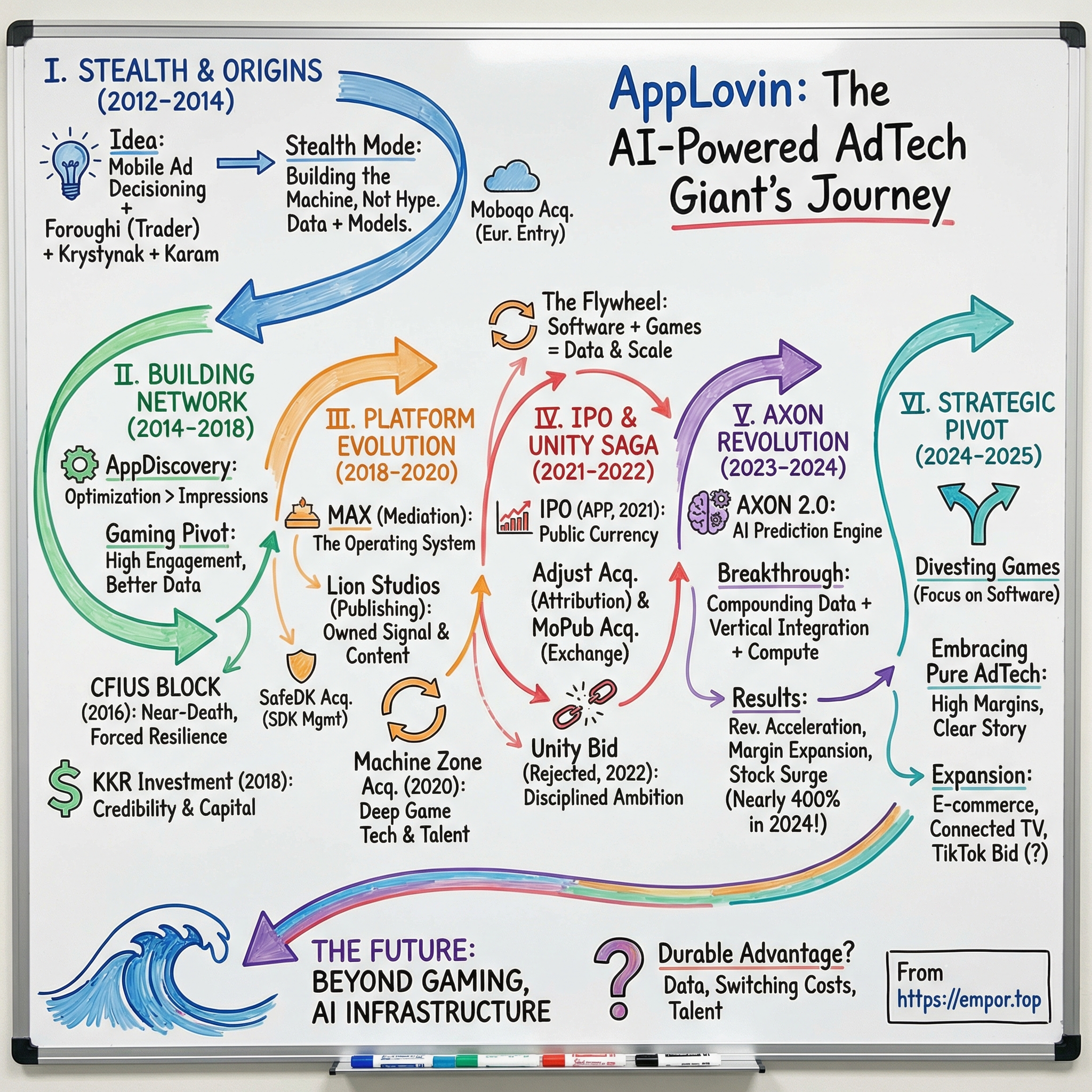
AppLovin: The AI-Powered AdTech Giant That Nobody Saw Coming
I. Introduction & Episode Roadmap
On the afternoon of August 5, 2026, AppLovin shares closed at $417.80. The company was set to report a quarter featuring 53% year-over-year revenue growth, 58% growth in adjusted EBITDA, and an operating margin exceeding 80%. By typical financial metrics for a firm of its scale, the performance was exceptionally strong. Yet the following morning, the stock closed at $335.67, falling nearly 20% in a single trading session.1
The catalyst was a slight missed expectation. Revenue reached $1.92 billion, landing just below the midpoint of the company's guided range of $1.915 billion to $1.945 billion. Meanwhile, adjusted EBITDA of $1.61 billion landed slightly below the bottom of its guided forecast band.2 Chief Executive Adam Foroughi addressed the misstep immediately on the earnings call: "This quarter, we fell short of that standard."3
By August 27, 2026, the stock traded around $310, giving AppLovin a market capitalization of roughly $104 billion—a decline of about 58% from its peak close of $733.60 on December 22, 2025.4 Despite rapid revenue growth over the preceding eighteen months, the company surrendered more than $140 billion in market value even as underlying operational metrics continued to expand.
This divergence between expanding financial results and a shrinking valuation multiple highlights the tension surrounding AppLovin's long-term business model.
The Silent AI Super-Cycle
For fiscal year 2025, AppLovin generated $5.48 billion in revenue, representing 70% year-over-year growth. Adjusted EBITDA reached $4.51 billion—an 82% margin—while free cash flow surged 91% to $3.95 billion.5 Net income from continuing operations totaled $3.43 billion, yielding diluted earnings per share of $9.75.6 These metrics resemble high-margin digital infrastructure more than traditional advertising technology, generated by a workforce of roughly 1,000 employees operating a central auction engine.
At the core of this operation is AXON, a suite of deep-learning models that determines in milliseconds which ad to place and how much to bid whenever a mobile game opens an advertising slot. While AppLovin remains largely invisible to consumers, its automated system reaches millions daily through thirty-second full-screen video ads embedded across thousands of mobile games.
The Central Question
The central analytical question is not how AppLovin scaled, but whether its core engine represents a durable competitive advantage: is AXON a defensible moat, or is it an optimized model in a narrow vertical whose quarterly growth depends on the steady arrival of research breakthroughs?
This distinction reflects management's own characterization of the business. When asked in August 2026 to explain the quarterly shortfall, Foroughi noted: "Look, it's R&D, right? Like there's no guarantee that we're always going to have lifts in every single period of 3 months."3 The statement acknowledges that a company valued as a compounding software platform operates with a revenue trajectory tied directly to the unpredictable timing of successful algorithm optimizations.
Roadmap
The subsequent sections trace AppLovin's path from a bootstrapped mobile ad network founded in 2012 through a series of key inflection points: an aborted sale to a Chinese private equity firm following a U.S. national security review, a challenging public debut, a 92% decline in market value after Apple revised its mobile privacy rules, a complete reconstruction of its targeting architecture around deep learning, the divestiture of its $1 billion game studio portfolio, its inclusion in the S&P 500, multiple short-seller campaigns and an SEC inquiry, and most recently, a $16 million guidance shortfall that erased one-fifth of its market capitalization.
The analysis evaluates several core investment premises: whether the company's position in mobile gaming is structurally protected, whether its proprietary studios functioned as valuable data sources rather than capital sinks, whether expansion into e-commerce effectively doubles its addressable market, and whether management's capital allocation aligns with its public narrative.
Underpinning this evaluation are two core questions. Why does AppLovin win from here? Proponents point to its control of mobile gaming auction infrastructure, algorithmic improvements that increase impression values, and an operating structure that converts incremental revenue into high free cash flow. What breaks that case? Potential risks include further policy shifts by mobile platform operators, research cadence variability that resets growth expectations, or an e-commerce initiative that fails to achieve material scale. Each assertion is evaluated against disclosed financial and operational evidence.
 Subscribe on LinkedIn
II. Stealth Mode, Bootstrapping, & Early AdTech (2012–2017)
In 2012, most venture capital in Silicon Valley was chasing consumer social networks and photo-sharing applications. Adam Foroughi focused on a simpler question: why was nobody applying derivatives trading logic to mobile advertising?
Foroughi's family had emigrated from Iran during the Iran–Iraq War; he grew up in Southern California, studied economics at UC Berkeley, and started his career as a derivatives trader before moving into performance marketing.7 That sequence shaped the company's operating model. Trading desks reinforce two core habits that map directly onto user acquisition: evaluating opportunities by expected value rather than raw impression volume, and recognizing that pricing inventory more accurately than a counterparty converts market inefficiency directly into revenue.
Before founding AppLovin, Foroughi worked at LifeStreet and Social Hour—small, unglamorous ad businesses where he learned the mechanics of buying and reselling digital attention.7 In 2012, he co-founded AppLovin with John Krystynak and Andrew Karam.8 While popular commentary often speculated that the name referenced the movie Superbad, it was actually adapted from the content-discovery service Bloglovin', with the domain purchased for eight dollars.7
Bootstrapping as strategy, not virtue
AppLovin raised roughly $4 million from angel investors, Streamlined Ventures, and the Webb Investment Network, and then stopped raising capital.6 It operated in stealth until 2014. Foroughi later argued that venture capital missed AppLovin because the company initially resembled an arbitrage firm rather than a software platform: it bought mobile ad inventory, ran predictive models on user monetization, and captured the spread.
In 2012, mobile real-time bidding was largely neglected. AdTech talent and capital concentrated on desktop display and early programmatic exchanges. In-app advertising relied on "waterfalls"—manual rankings where publishers called ad networks sequentially until one filled the slot. The process was slow, opaque, and inefficient, persisting primarily because few teams with advanced modeling capabilities targeted the mobile market.
AppLovin's initial product, AppDiscovery, addressed the demand side of that structure by connecting app developers seeking installs with inventory where those installs could be purchased efficiently. In October 2014, the company acquired Moboqo, a Berlin-based mobile ad network, to establish a European supply footprint.9 Though minor at the time, the transaction established a consistent pattern: AppLovin acquired distribution channels and underlying infrastructure rather than consumer brands.
The 2016 near-exit
This period included a pivotal transaction that is frequently omitted from optimistic narratives about the company's trajectory.
In September 2016, AppLovin agreed to sell a majority stake to 东方弘泰资本 Orient Hontai Capital, a Chinese private equity firm, at an enterprise value of about $1.42 billion.10 Four years after launch, management chose to surrender control to an outside buyer for a valuation representing roughly 1.4% of the company's market capitalization a decade later. The transaction was structured as an exit rather than a growth round.
The acquisition was ultimately blocked. The Committee on Foreign Investment in the United States (CFIUS)—the federal interagency panel reviewing foreign investments for national security implications—raised concerns regarding the transfer of U.S. user data to a Chinese entity. In November 2017, the parties abandoned the change-of-control structure.11 Orient Hontai had already completed a $140 million investment for a 9.98% stake, so the remaining commitment was restructured into an $841 million debt facility, keeping Foroughi and his co-founders in control while supplying growth capital.12 The companies notified CFIUS of the revised structure on the grounds that non-controlling debt did not pose the same security risks.13
This replacement facility introduced significant leverage that shaped subsequent operations. From 2017 onward, AppLovin carried debt into each major strategic initiative, including its subsequent acquisition expansion. Annual interest expense reached $172 million in 2022 and $317 million in 2024 before declining as earnings expanded and debt was paid down.6 Although the business later achieved a conservative balance sheet, it operated for years as a highly leveraged roll-up.
What it says about management. A favorable interpretation holds that Foroughi secured necessary capital while retaining voting control. A more critical assessment notes that in 2016, management's revealed preference was to sell the business rather than build an independent platform. Regulatory intervention, rather than long-term corporate conviction, preserved the equity value that later accrued to shareholders.
KKR's arrival
In July 2018, KKR invested $400 million for a minority stake at approximately a $2 billion valuation.14 Beyond capital, the investment brought Herald Chen, a KKR technology dealmaker who joined as Chief Financial Officer and later became President, introducing institutional financial discipline and a structured acquisition playbook.15
The KKR investment served as the bridge between early operations and scale. It transformed AppLovin from a profitable arbitrage business into an institutionally backed platform with balance-sheet capacity. Over the next five years, that balance sheet funded major acquisitions across gaming studios, measurement tools, and ad mediation—many of which would later be restructured or divested.
III. Vertical Integration: MAX, Gaming Studios, & MoPub (2018–2021)
In 2018, mobile advertising relied on sequential waterfalls: publishers called ad networks one by one in a fixed ranking until one filled an ad slot. If a network lower on the list was willing to pay triple for an impression, it never received the opportunity to bid because an earlier network filled the inventory first. This structure created significant market opacity and cost publishers substantial yield.
MAX provided a solution. Founded by veterans of MoPub, the platform introduced unified in-app auctions, enabling every demand source to bid simultaneously on each impression. The highest bidder won, allowing the publisher to capture the true market clearing price—adapting the header bidding model that had previously reshaped desktop display advertising. AppLovin acquired MAX in September 2018 for undisclosed terms.16 MAX Chief Executive Dan Sack became Vice President of Platform at AppLovin, while co-founder Jim Payne moved into an advisory role.17
The acquisition gave AppLovin a structural position in mobile advertising by making it the auctioneer. Competing ad networks seeking mobile gaming inventory had to submit bids into an auction operator controlled by AppLovin. Chief Executive Adam Foroughi later described the economic model, noting that when a rival wins an impression that AppLovin's own algorithms valued modestly, "instead of winning a low-value impression, we get to charge the winning bidder 5%."18 This structure allowed AppLovin to collect a transaction fee regardless of which network won the bid.
The shift to unified auctions quickly narrowed mobile mediation into a two-horse market, benefiting publishers through improved inventory yields. By operating a transparent auction while simultaneously competing as the largest buyer within that auction, AppLovin executed a counter-positioning strategy: legacy incumbents relying on waterfall opacity could not replicate the model without cannibalizing their existing revenue.
However, operating as both the auctioneer and the dominant buyer created inherent structural tensions. AppLovin gained visibility into full auction order flows while competing for the same inventory. Management maintained that its interests remained aligned with publishers, arguing that maximizing publisher revenue was essential to maintaining platform retention. Nevertheless, this dual role represented an operational design based on incentive alignment rather than strict structural segregation—a dynamic that later attracted scrutiny from short sellers.
The owned-content thesis
The second element of AppLovin's growth strategy involved direct content ownership. In 2018, the company launched Lion Studios to publish casual mobile games. In May 2020, AppLovin agreed to acquire Machine Zone, the studio behind Game of War: Fire Age and Mobile Strike, on undisclosed terms.19 The company subsequently took stakes in developers including PeopleFun, Belka Games, and Firecraft, eventually assembling a portfolio of ten gaming studios.
Management reasoned that owning games would secure first-party data on user installations, play duration, and in-app spending. In theory, this proprietary data stream would train AppLovin's advertising algorithms while providing guaranteed inventory and a controlled testing environment—creating a data moat that pure-play ad networks could not match.
Buying the measurement layer and the auction rival
Two acquisitions in 2021 expanded AppLovin's footprint across mobile infrastructure. In February 2021, AppLovin agreed to acquire Adjust, a Berlin-based mobile measurement partner, in a deal initially reported at approximately $1 billion; the transaction closed that April for total stated consideration of $980.0 million.206 Mobile measurement partners serve as independent attribution providers in mobile advertising, tracking which ad network delivers a specific app install. Owning Adjust provided AppLovin with visibility into market-wide advertising budget flows.
In October 2021, AppLovin agreed to buy MoPub from Twitter for $1.05 billion in cash, completing the purchase in January 2022.21 MoPub was the primary remaining independent mediation platform at scale. Combining MAX and MoPub brought a substantial portion of global mobile app advertising inventory under AppLovin's auction infrastructure.
Testing the vertical-integration claim
Subsequent performance challenged the premise that owned content would generate resilient cash flows and a durable data moat. Disclosed segment metrics showed that Apps segment revenue peaked at $2.12 billion in 2021 before declining to $1.77 billion in 2022, $1.44 billion in 2023, and $1.49 billion in 2024.6 Over the same period, Software Platform revenue expanded from $674 million to $3.22 billion. The gaming portfolio, intended to fund and feed the software engine, contracted while the software business grew nearly fivefold.
Furthermore, the gaming studios required substantial user-acquisition spending to maintain their player bases. Consolidated sales and marketing expenses reached $1.13 billion in 2021 and $920 million in 2022 against total revenue below $2.9 billion, creating a drag on blended gross margins and requiring significant management oversight.6
The data-moat hypothesis faced a direct test in 2021 when Apple restricted access to the Identifier for Advertisers (IDFA). Owning ten gaming studios failed to insulate AppLovin's targeting models from the platform policy change, contributing to a stock price decline exceeding 90%.
The calibrated verdict: The vertical-integration strategy proved effective primarily through its mediation assets. MAX and MoPub established structural control over mobile auction plumbing. In contrast, the gaming studios operated as capital-intensive assets with declining revenue, which management would later restructure. The outcome demonstrated that platform control over auction infrastructure provided a far more defensible advantage than owning consumer content.
IV. Public Listing, The IDFA Crisis, & The Rejected Unity Bid (2021–2022)
April 2021 appeared to offer an ideal window for an initial public offering. Growth-oriented software companies were trading at historically high valuation multiples, pandemic lockdowns had accelerated mobile gaming engagement, and AppLovin occupied a dominant position as an independent advertising infrastructure provider.
On April 14, 2021, AppLovin priced its initial public offering at $80.00 per share—the midpoint of its $75 to $85 target range—selling 25 million shares to raise $2.0 billion.2223 The public market reception, however, was immediately cool. The following morning, the stock opened at $70.00, down 12.5% from the offer price, before closing its first trading day at $65.20, representing an 18.5% single-day decline.24 For a company that had expanded profitably for nine years without institutional equity capital, the debut signaled investor skepticism toward its business mix, as roughly three-quarters of revenue originated from operating gaming studios rather than selling software.
The IDFA apocalypse
That valuation tension worsened significantly with a major platform policy change.
In April 2021, Apple released iOS 14.5, introducing its App Tracking Transparency framework. The policy required every application seeking access to the Identifier for Advertisers (IDFA)—a unique device code enabling cross-app user tracking—to prompt users for explicit permission. Most consumers opted out.
The change reshaped mobile ad mechanics. For a decade, mobile advertising functioned like a store where every shopper wore a badge detailing their complete purchasing history. Once users opted out, those identifiers disappeared. Advertisers could observe traffic volume within an app, but they could no longer identify individual user profiles or track activity across external properties.
The operational impact was immediate across the digital advertising sector. Targeting precision deteriorated, measured returns on ad spend dropped, and advertisers scaled back budgets as campaign performance became harder to verify.25 AppLovin's first-generation ad engine depended heavily on the deterministic, device-level signals that the new policy restricted.
Equity markets reacted aggressively. AppLovin shares peaked at $114.85 on November 11, 2021. Over the next thirteen months, the stock plummeted nearly 92%, closing at $9.30 on December 27, 2022.4 For full-year 2022, AppLovin reported a net loss of $192.7 million on revenue of $2.82 billion, while generating $413 million in operating cash flow against $1.35 billion deployed for acquisitions.6
What the crash proves, and what it doesn't. The collapse demonstrated that platform policy dependence represented a material risk rather than a theoretical concern. It did not prove management failure, as the disruption hit the entire mobile ad ecosystem. However, it disproved a core strategic premise: that owning gaming studios and first-party data would insulate the business from platform changes. A single permission prompt update by Apple erased over 90% of AppLovin's market value.
A closer examination of the 2022 financial results reveals important nuances beneath the stock decline. AppLovin did not face an immediate liquidity crisis: operating cash flow remained positive, and the net loss was driven primarily by $547 million in non-cash depreciation and amortization tied to its acquisition campaign.6 While public markets priced an existential threat to the core business model, the cash flow statement reflected a company handling significant purchase-accounting charges alongside margin contraction. That distinction eventually provided the foundation for recovery.
The $20 billion swing at Unity
Amid that valuation collapse, AppLovin attempted a major strategic consolidation. On August 9, 2022—with its shares down roughly 80% from their peak—AppLovin submitted an unsolicited all-stock merger proposal to Unity Software, valuing the combined enterprise at approximately $20 billion.2627 Under the proposed terms, Unity shareholders would have received 1.152 Class A shares and 0.314 Class C non-voting shares of AppLovin for each Unity share, contingent on Unity terminating its pending acquisition of ironSource.
The strategic rationale targeted a competitive threat: Unity controlled a dominant game development engine, while ironSource operated a competing mediation platform. A merged Unity-ironSource entity would form the only market competitor combining game creation software with a full monetization suite. AppLovin sought to neutralize that threat by acquiring Unity directly.
On August 15, 2022, Unity's board of directors unanimously rejected the offer, determining that it was not in the best interests of Unity shareholders and did not constitute a superior proposal relative to the ironSource agreement.26 In September 2022, AppLovin confirmed it would not revise its offer and formally withdrew the proposal.27
The activist read. Skeptics viewed the transaction as a defensive reaction rather than an aggressive expansion: a management team with complete confidence in its internal technology pipeline does not typically propose an all-stock merger using heavily depressed shares during an operational crisis. The failed bid ultimately protected AppLovin from severe equity dilution. While management prudently declined to pursue a bidding war, the favorable outcome stemmed from Unity's rejection rather than AppLovin's restraint.
Alongside the Unity proposal, AppLovin completed a smaller strategic acquisition. In February 2022, the company announced an agreement to acquire Wurl, a connected-TV distribution platform, for $430 million in a deal split between 55% cash and 45% stock; the transaction closed in April 2022.2829 By 2026, Wurl remained an unexercised strategic option rather than a primary growth driver.
With the Unity transaction off the table, management was left with a single viable strategy: rebuild its underlying machine-learning models.
V. The AXON 2.0 Engine: AI Machine Learning Super-Cycle (2023–2024)
The technical reconstruction of AppLovin's ad platform occurred quietly, remaining largely unnoticed by public markets for nearly a year.
The mechanics behind AXON 2.0 represented a fundamental departure from legacy targeting architectures. First-generation ad engines operated primarily as deterministic lookups, matching specific device identifiers to historical user activity across applications. When platform privacy changes restricted access to device identifiers, that lookup model failed.
AXON 2.0 replaced deterministic lookups with predictive deep learning. Rather than attempting to identify individual users, the engine evaluates real-time contextual signals—including the active application, geographic region, device class, session timing, ad creative, and outcomes from billions of historical auctions—to calculate the probability that presenting a specific advertisement will yield a paying user within twenty-eight days. Under this architecture, individual user tracking proved secondary to real-time probabilistic prediction.
AppLovin deployed AXON 2.0 in mid-2023, driving a rapid acceleration in financial performance.
The financial super-cycle
Software Platform revenue expanded from $1.05 billion in 2022 to $1.84 billion in 2023, reaching $3.22 billion in 2024—a 75% increase.6 Revenue surged further to $5.48 billion in 2025, up 70%.5 The underlying composition of this expansion was particularly revealing: in the third quarter of 2025, total app installations generated through the platform fell 1% year over year, even as net revenue per installation surged 75%.30
This divergence illustrates the core mechanism driving AppLovin's financial performance. Platform expansion resulted not from displaying higher ad volumes, but from capturing substantially greater value per impression—the operational signature of improved predictive accuracy rather than raw inventory expansion. As AXON's conversion estimates improved, advertisers achieved target returns at higher bid prices, lifting overall auction clearing values without requiring additional ad load.
Profit margins expanded in tandem. Adjusted EBITDA margin reached 82% for full-year 2025 and 85% in the first quarter of 2026, with incremental revenue converting to EBITDA at flow-through rates of roughly 95% in the fourth quarter of 2025 and 86% in the first quarter of 2026.518 This operating leverage reflected a fixed cost structure dominated by compute infrastructure and core research engineering, allowing incremental ad clearing volume to flow directly to operating profits.
The flywheel, stated precisely
Management characterizes this business engine as a self-reinforcing four-stage flywheel: superior predictive models yield higher return on ad spend for advertisers; improved returns encourage higher bidding and increased capital commitments; expanded spending attracts more auction participants to the MAX mediation platform; and denser auctions generate both higher payouts for publishers and larger volumes of training data to refine the models.
While financial results validate the operational presence of this feedback loop, the entire structure depends strictly on its initial trigger: continuous algorithmic enhancement. Every downstream economic benefit relies on the research engineering team delivering periodic model optimizations.
Testing the moat claim
Proponents contend that AXON represents a proprietary artificial intelligence moat that major platform competitors cannot easily replicate within mobile applications. Disclosed operational evidence, however, points to several structural limitations.
First, the competitive position remains concentrated. Gaming generated "the majority of our revenue" as of August 2026, and within gaming, AppLovin's advantage applies primarily to in-app performance advertising with short feedback loops.3 Foroughi acknowledged in 2026 that the platform optimizes against a 28-day window and that fewer than 10% of players monetize in most mobile games.18
Second, the model faces recurring platform vulnerability. As demonstrated during the 2021 IDFA transition, mobile operating system owners retain unilateral control over tracking rules and software development kit access. Google's ongoing Privacy Sandbox initiatives on Android and potential future iOS restrictions pose structural risks over which AppLovin exercises no governance.
Third, rivals are deploying targeted counter-architectures. Unity's Vector ad engine, developed specifically to challenge AXON, expanded its share of Unity's Grow segment revenue from 49% in the second quarter of 2025 to 56% in the fourth quarter, with Unity reporting that January 2026 marked Vector's highest-revenue month, up 72% year over year.3132 Unity contends that game-engine runtime telemetry offers behavioral signals that ad-network infrastructure cannot access directly. When questioned about this competitive threat in August 2026, Foroughi countered that the market is not zero-sum, arguing that overall model improvements across the industry increase total advertiser profitability and expand aggregate ad budgets.3
Fourth, algorithmic progress does not follow a predictable calendar. The second quarter of 2026 demonstrated this variability: despite stable auction mechanics and active advertiser participation, revenue growth moderated because R&D model enhancements did not materialize within the quarter.
The calibrated verdict: Disclosed evidence supports a narrowed framing of AppLovin's competitive position. The company maintains a quantified lead in mobile in-app performance advertising, anchored by its control of mediation auction infrastructure rather than an unassailable algorithmic moat. The evidence does not show that this advantage translates seamlessly to non-gaming surfaces or guarantees linear quarterly expansion. Falsifying or confirming this position requires monitoring whether the core business can achieve sustained sequential revenue growth across consecutive quarters without relying on discrete major model upgrades.
Before that competitive durability could be fully evaluated, management moved to finalize the balance sheet restructuring required after years of acquisition activity.
VI. Capital Allocation U-Turn: Divesting Games to Pure AdTech (2024–2025)
Reversing a core corporate strategy requires acknowledging that earlier capital allocation assumptions no longer hold.
By early 2025, the financial divergence between AppLovin's two operational segments had widened sharply. The Software Platform was generating more than 70% year-over-year revenue growth with adjusted EBITDA margins exceeding 80% and minimal working capital requirements. Conversely, the gaming studio business was flat, capital-intensive, margin-dilutive, and required managing hundreds of creative personnel across ten studios in a dozen countries. Executive attention spent on game live-operations diverted focus from the high-margin software platform generating nearly all of the company's profitability.
On May 7, 2025, AppLovin agreed to sell its entire Apps segment to Tripledot Studios, closing the transaction on June 30, 2025. The consideration comprised $400 million in cash plus equity representing approximately 20% of Tripledot's fully diluted shares at closing.33 Ten studios transferred in the deal—Athena Studio, Belka Games, Clipwire Games, Leyi, Lion Studios, Machine Zone, Magic Tavern, PeopleFun, Zenlife Games, and Zeroo Gravity—carrying popular franchises including Wordscapes, Hexa Sort, Clockmaker, and Project Makeover.33 Tripledot valued the combined transaction at approximately $800 million.34
What the exit actually cost
Management presented the divestiture as a strategic refocusing on software infrastructure. However, evaluating the move requires weighing its strategic rationale against its multi-year financial cost.
AppLovin's discontinued operations recorded a loss of $147.1 million in the first quarter of 2025 as assets were written down to fair value, a gain of $47.7 million in the second quarter upon closing, and a net loss of $99.4 million for the full year.6 Those figures followed substantial cumulative investment into the segment, including the undisclosed purchase price for Machine Zone, the internal build-out of Lion Studios, minority studio investments, and hundreds of millions of dollars in annual user-acquisition spending that failed to prevent segment revenue from contracting.
The honest conclusion: The divestiture was not entirely value-destructive; the assets were monetized rather than liquidated, and AppLovin retained a 20% equity stake in an ongoing gaming company. Nevertheless, the strategy absorbed significant capital and years of executive effort before being reversed by the leadership team that created it. Framing the sale as an act of disciplined capital allocation overlooks the fact that management actively built and defended the segment for five years. A more balanced assessment is that leadership recognized an underperforming strategy and corrected course decisively.
AppLovin retained a residual position, carrying its roughly 20% holding in Tripledot as a long-term investment valued at about $290 million as of June 2026.35 This non-core holding provides passive exposure to studio performance without operational overhead, though its ultimate value will depend on future monetization or revaluation.
The index coronation
Institutional validation followed in late 2025. S&P Dow Jones Indices announced on September 5, 2025, that AppLovin would be added to the S&P 500, effective before the market opened on September 22.36 The inclusion came after the company was passed over earlier in the year despite meeting quantitative eligibility criteria. Joining the index generated mandatory buying from passive index funds and elevated AppLovin into core institutional benchmarks.
However, index inclusion also altered the shareholder base. A significant portion of capital entering the stock between September 2025 and its December peak was driven by index mechanics and momentum trading rather than fundamental analysis of algorithmic development cycles. When AppLovin reported second-quarter 2026 results that fell slightly below high market expectations, this less committed investor base contributed to the sharp single-day selloff.
The buyback era
Following the divestiture, AppLovin shifted its capital allocation strategy from acquisition-led growth to large-scale share repurchases.
In 2025, AppLovin repurchased and withheld approximately 6.4 million shares for $2.58 billion, funded entirely from free cash flow, leaving roughly $3.28 billion under its remaining authorization.5 In the first quarter of 2026, the company bought back 2.23 million shares for $1 billion, followed by 1.14 million shares for $551 million in the second quarter, leaving approximately $1.8 billion authorized and 335 million shares outstanding.183 Weighted average diluted shares declined from 346 million to roughly 340 million across 2025 and reached 337.9 million by the second quarter of 2026.6
This repurchase program reflects contrasting financial dynamics. Unlike earlier acquisition sprees, the buybacks have been funded by operational cash generation rather than leverage; net leverage stood at approximately 0.1 times trailing adjusted EBITDA as of June 2026, supported by $3.05 billion in cash against $3.7 billion in total debt.3 At the same time, the pace of repurchases has been pro-cyclical. AppLovin deployed $1 billion in the first quarter of 2026 when the stock traded near record highs in the $500s, but scaled back to $551 million in the second quarter, leaving $1.8 billion authorized as the stock declined toward $310 following the August selloff. Chief Financial Officer Matt Stumpf attributed the second-quarter moderation to lower free cash flow stemming from the timing of international tax and interest payments, emphasizing that it did not signal a change in management conviction.3 Whether buybacks accelerate at lower valuation levels will serve as a key indicator of management's valuation discipline.
What the capital allocation record adds up to. Between 2018 and 2022, AppLovin deployed billions of dollars into acquisitions with mixed results: MAX and MoPub established the auction infrastructure that underpins the current business, Adjust provided valuable measurement capabilities, the gaming studio portfolio was eventually divested, and Wurl remains underutilized. Since 2023, the company has halted major M&A and returned billions of dollars to shareholders through cash-funded buybacks. This evolution reflects a management team that adjusted its capital allocation model based on operational performance. Evaluating AppLovin's current posture requires recognizing this shift as a recent strategic pivot rather than a long-standing corporate trait.
Meanwhile, the simplified adtech business faced its most serious credibility challenge almost immediately after its institutional coronation.
VII. Horizontal Expansion: E-Commerce, Web, & CTV (2025–2026+)
AppLovin's expansion thesis outside mobile gaming rests on a straightforward premise: an ad-targeting engine that converts ad spend into developer revenue should theoretically work for traditional online merchants as well. Applying the AXON engine to e-commerce could significantly expand the company's addressable market, which management estimates is five to ten times larger than the mobile gaming sector. However, while early performance data shows rapid initial spend growth, adtech history demonstrates that transitioning from mobile gaming to general web commerce presents substantial structural hurdles.
What has actually happened
The consumer vertical—AppLovin's term for e-commerce and web advertisers—launched in late 2024. On October 1, 2025, AppLovin rebranded its customer-facing platform as Axon and opened Axon Ads Manager, a self-service tool, on a referral-only basis ahead of the holiday season.37 In late June 2026, the tool opened for general availability under the reverted name AppLovin Ads Manager.3
Spend within the vertical expanded rapidly. In the first quarter of 2026, Chief Executive Adam Foroughi reported that March advertiser spend ran roughly 25% above January and that April set a record month, exceeding any peak fourth-quarter month.18 In the second quarter of 2026, consumer advertiser spend finished 28% above fourth-quarter 2025 levels.3 That trajectory is unusual because e-commerce advertising is heavily seasonal, with roughly half of annual spend concentrated in the fourth quarter. Expanding past fourth-quarter holiday peaks during the historically slower first half of the year indicates underlying adoption rather than seasonal demand.
Management also disclosed specific unit economics: new customers were projected to generate well over $70,000 in annual advertising spend each, with minimal churn after the first thirty days. On the first-quarter call, Foroughi illustrated the potential scale by noting that 100,000 new customers would generate roughly $7 billion in first-year ad spend, while framing the calculation as an illustration rather than guidance.18
However, e-commerce is structurally more challenging than mobile gaming for a predictive model like AXON due to differences in feedback loop dynamics. In mobile gaming, an ad leads directly to an install within seconds, engagement within minutes, and in-app purchases within days—all on a single device and directly observable through AppLovin's own software development kit. In e-commerce, advertising involves multi-step, cross-device attribution funnels—moving from website visits to shopping carts, delayed purchases, shipping, and potential returns. Consequently, conversion signals arrive with greater latency and incomplete visibility through third-party tracking infrastructure where established incumbents like Meta and Google hold deep advantages. Predictive ad engines depend on real-time outcome data, and in e-commerce AppLovin receives less data with longer delays.
Where the counterevidence lives
Four operational factors constrain the immediate upside of AppLovin's e-commerce expansion, several of which management acknowledged directly during its August 2026 earnings call.
One: the product does not work for the long tail yet. Asked directly in August 2026, Foroughi explained that small merchants often fail to reach their return goals before their test budget runs out, and that mid-market brands represent the "sweet spot" because they can absorb a learning cost.3 As a result, the platform currently struggles to serve small, long-tail advertisers—the broad segment that underpins the most optimistic addressable market estimates.
Two: creative is an unsolved bottleneck. AppLovin's primary ad format relies on a 30-second full-screen video paired with an interactive end card. While the platform can auto-generate end cards reliably, it cannot yet automatically produce high-converting video assets. "We're not at the point where we can get a high-quality video for 30 to 60 seconds in the hand of an advertiser out of the box," Foroughi noted in August 2026.3 Because most e-commerce merchants maintain static product images and catalog feeds rather than video assets, creative production remains a primary hurdle to self-service adoption.
Three: the general-availability launch has not moved the numbers. Management indicated that the general-availability rollout in June 2026 was not expected to yield immediate revenue spikes. Six weeks after launch, company commentary indicated that spend remained concentrated, with a few advertisers contributing a large portion of volume rather than many contributing a little.3 As a result, commercialization relies on partnerships with analytics vendors—such as Triple Whale, named on the August call as an active integration—rather than mass self-service adoption.3
Four: brand awareness is a real constraint, and management said so. When asked by a Wells Fargo analyst whether traditional e-commerce merchants were familiar with AppLovin, Foroughi acknowledged: "if you talk to 100 customers that don't use us in e-commerce today, there is going to be an awareness problem."3 Foroughi contended that brand credibility must be established through sustained performance over time, pointing to the multi-year arcs of Google and Meta. That response underscores that non-gaming expansion represents a long-term build rather than an immediate revenue catalyst.
The CTV asset that has sat idle for four years
AppLovin acquired Wurl in April 2022 to extend performance advertising into connected television, but as of August 2026, the asset has yielded minimal operational integration. When questioned about the platform, Foroughi outlined a strict prioritization sequence: expanding first into non-gaming mobile applications, then the open web, and finally connected television. His reasoning was that AppLovin's consumer advertisers remain budget-constrained rather than inventory-constrained, so launching CTV would reallocate existing dollars rather than attract new ones.3
While logical from a product sequencing perspective, Wurl represents a $430 million capital investment that has generated little visible strategic return over four years—a relevant factor in evaluating how efficiently AppLovin converts adjacent market opportunities into expanded revenue.
The calibrated verdict on e-commerce. Disclosed spend trends confirm that AppLovin has established initial product-market fit among mid-market direct-to-consumer brands. However, assertions that e-commerce will double the company's addressable market in the near term are constrained by management's own disclosures regarding creative tooling limits, small-merchant unit economics, brand awareness barriers, and deliberate deployment timing. The evidence supports a more measured conclusion: AppLovin has established an early, differentiated presence in non-gaming advertising, but will likely serve as a secondary or tertiary channel in merchant ad budgets for several years. Demonstrating a broader transformation would require a quarter where non-gaming revenue is sufficient to offset research-driven fluctuations in the core gaming business—a capability management explicitly noted the platform lacked in the second quarter of 2026.
VIII. Business Model, Segment Breakdown, & Strategic Frameworks
Strip away the AI narrative, and AppLovin is, mechanically, three core products built around a single auction engine.
AppDiscovery represents the demand side: advertisers—historically mobile game publishers and increasingly e-commerce merchants—specify their target return on ad spend, allowing AXON to bid on their behalf across available inventory. MAX serves as the supply side: a unified auction engine installed by publishers to monetize ad slots, charging the winning bidder roughly 5% whenever a third party wins an impression.18 Adjust provides the measurement layer, tracking attribution and campaign outcomes across channels.
Following the divestiture of its gaming studios, this adtech architecture constitutes the entire company, with revenue for fiscal year 2025 reported under a single operating segment.6 This structural simplification translated directly into significant operating leverage: in the second quarter of 2026, cost of revenue stood at $226 million against $1.92 billion in total revenue, yielding an 88% gross margin, alongside total operating expenses of $204 million.6 Quarterly research and development expenses totaled $100 million, while sales and marketing required just $63 million. Generating nearly $8 billion in annualized revenue, AppLovin spends less on its quarterly operating footprint than many software peers devote to sales alone.
Hamilton Helmer's 7 Powers, applied honestly
Network economies — present, and the strongest structural asset. MAX's value to a publisher increases with the number of participating bidders, while a bidder's valuation of inventory expands with publisher density. AppLovin controls both sides of this equation. Chief Executive Adam Foroughi's characterization of this mechanism reflects an important economic reality: because AppLovin operates the auction platform and collects a transaction fee when competitors win, heightened bidding intensity among rival ad networks directly enhances its own economics.18 This network effect represents the company's most durable structural advantage, originating from its 2018 acquisition of MAX rather than proprietary machine learning models.
Scale economies — present. Model training and inference function as fixed overhead spread across billions of daily auction requests. Disclosed capital commitments show a minimum compute obligation of $1.3 billion over three years with a primary cloud partner, of which $953.5 million had been paid as of June 30, 2026.35 Management guided that approximately ten cents of every incremental revenue dollar is dedicated to compute infrastructure.3 At an 88% gross margin, incremental revenue remains highly accretive, though compute represents a growing cost structure that did not exist at this scale three years earlier, contributing to initial margin compression in the second quarter of 2026.
Counter-positioning — historically present, but largely exhausted. MAX's unified auction represented genuine counter-positioning against legacy waterfall ad networks whose profits depended on inventory opacity. That transition is now complete; competing platforms operate unified auctions as well, meaning the initial architectural disruption no longer yields incremental market advantage.
Process power — contested. The core thesis holds that AXON's continuous optimization reflects a compounding organizational capability rather than a static, replicable algorithm. Supporting this view, the platform delivered twelve consecutive quarters of double-digit sequential revenue growth prior to the second quarter of 2026, powered by a compact research engineering team leveraging high talent density and automated model experimentation.3 The counterevidence materialized in the thirteenth quarter, when algorithmic lift failed to deploy within the three-month window. An R&D pipeline subject to ninety-day variance retains process value, but does not provide the predictable execution expected of a compound growth platform.
Cornered resource — weak. AppLovin possesses no exclusive data licenses, patent thickets, or restrictive publisher contracts. Data access is earned by repeatedly submitting winning bids—a market position rather than a cornered resource.
Switching costs and branding — weak. Mobile publishers routinely run multiple mediation setups, while advertisers reallocate campaign budgets monthly. Furthermore, management explicitly identified low brand recognition outside mobile gaming as an operational hurdle in expanding into broader e-commerce verticals.
Porter's Five Forces
Supplier power — extremely high, representing the primary structural risk. Apple and Google control mobile operating systems, device identifiers, software development kit rules, and application distribution. Platform policy shifts have previously disrupted AppLovin's targeting models. In August 2026, Foroughi acknowledged that Android presents a more competitive landscape because Google operates as both the underlying platform owner for Google Play and a direct competitor supplying application installs.3 This dual role underscores that AppLovin's primary operating system provider simultaneously acts as a key competitor in its core market.
Buyer power — moderate, but concentrated. Individual mobile game developers exercise limited pricing power against the dominant user-acquisition infrastructure in mobile app ecosystems. However, buyer concentration within mobile gaming exposes AppLovin to sector-wide dynamics outside its control. When industry analysts cited declining mobile app downloads and rising costs per install in August 2026, Foroughi argued that higher acquisition costs reflected game developers shifting toward deeper, higher-lifetime-value monetization funnels driven by AppLovin's ad spend.3 While logically consistent, this explanation remains difficult to verify independently from outside financial disclosures.
Threat of substitutes — moderate to high. Automated performance suites like Meta's Advantage+ and Google's Performance Max benefit from vastly larger identity graphs and compute capacity. While these platforms have not displaced AppLovin within in-app mobile gaming, they maintain dominant positions across the digital e-commerce markets AppLovin seeks to enter.
Rivalry — high and intensifying. Competition for mobile impression inventory remains active across multiple players, including Unity's Vector ad engine, ironSource within Unity, Digital Turbine, Moloco, and broad programmatic ad exchanges.
Barriers to entry — moderate. Capital requirements alone do not block new market entrants; rather, installed publisher integration and auction data density serve as the primary barriers. Well-capitalized competitors with advanced deep-learning models can successfully bid for inventory, as recent entrants have demonstrated. However, replicating MAX's established position as the central auctioneer remains substantially more difficult.
These strategic frameworks converge on the same conclusion demonstrated by AppLovin's financial performance: its most defensible asset is control of the central auction infrastructure. The company's most celebrated component—its deep-learning prediction engine—is operationally effective and highly profitable, but ultimately less structurally protected than public narrative suggests.
IX. Management, Governance, & Capital Allocation Audit
Adam Foroughi does not run AppLovin like most $100 billion companies, and several of those operational and governance differences cut directly against outside shareholders.
The founder
Foroughi holds the roles of Co-Founder, Chief Executive Officer, and Chairperson simultaneously. His base salary is $400,000; in 2021 and 2022, he received $100,000 in cash and no equity compensation.38 In 2023, he received a performance-based stock award valued at $82.9 million—tied to long-term share appreciation—followed by $10.8 million in 2024 and $12.6 million in 2025.38 Chief Technology Officer Vasily "Basil" Shikin received a $67.0 million stock award during that same 2023 compensation cycle.38
This executive pay structure can be defended on incentive grounds: minimal cash compensation, heavy equity alignment, and performance milestones tied directly to share price appreciation rather than corporate revenue or headcount expansion. However, the equity packages remain vast in absolute terms, and they were approved by a board on which Foroughi serves as Chairperson.
The voting structure
Corporate governance presents an even sharper conflict for public shareholders.
AppLovin operates a multi-class share structure in which Class B shares carry 20 votes each. As of the April 13, 2026 record date, the company had 306,053,394 Class A shares and 30,207,521 Class B shares outstanding, yielding 910,203,814 total votes.39 The Class B shares—held by Foroughi and Herald Chen alongside affiliated trusts—controlled approximately 604 million votes. That structure gave them roughly 66% of total voting power despite holding just 9% of the economic interest.39
At the annual shareholder meeting on June 3, 2026, all nine director nominees were elected, Deloitte & Touche was ratified as auditor with 853.7 million votes in favor versus 2.0 million opposed, and an amendment granting officer exculpation passed with 735.8 million votes in favor.40 The advisory say-on-pay measure passed with 752.96 million votes in favor and 63.07 million against.40
The most revealing item on the ballot was a shareholder proposal requesting that AppLovin disclose voting results broken out by share class. The proposal failed, receiving 119.1 million votes in favor and 696.9 million against.40 The vote totals demonstrate the extent of insider control: with roughly 306 million Class A shares outstanding, a proposal drawing 119 million favorable votes carried a substantial minority—and potentially a majority—of voting outside shareholders, only to be defeated by the supervoting Class B block. The outcome highlights how the multi-class structure shields management from investor accountability.
Narrative consistency across calls
Evaluating management credibility requires comparing executive commentary across consecutive earnings calls as market conditions evolved.
February 2026 (fourth-quarter 2025 call). Facing stock weakness driven by concerns over artificial intelligence disruption and market competition, Foroughi opened by asserting that "there is a real disconnect between market sentiment and the reality of our business," arguing that an influx of AI-generated game content would make discovery channels more valuable rather than less.18 Chief Financial Officer Matt Stumpf cited a "Rule of 40" score of 150, describing the company's combination of revenue growth and operating margin as "almost unheard of."18
May 2026 (first-quarter call). Foroughi opened by setting aside market noise, stating: "No preamble on stock price, no addressing short sellers, no reacting to noise." The company outperformed the high end of its guided ranges for both revenue and adjusted EBITDA.18
August 2026 (second-quarter call). Foroughi directly addressed the financial shortfall in his opening statement, identifying the research and development variance without attributing blame to market conditions: "What matters is that we know what happened, and it's already been addressed."3 Stumpf confirmed that the Securities and Exchange Commission had formally concluded its inquiry into the company with no recommended action.3
Assessed on process, this sequence demonstrates disciplined disclosure practices: executive leadership acknowledged the quarterly shortfall in the first sentence, detailed the underlying research variability, and constructed guidance for the subsequent quarter to exclude unreleased algorithmic enhancements.3 That framework represents a conservative forecasting approach, implicitly acknowledging that prior guidance had embedded assumptions regarding R&D output.
However, management's narrative consistency showed vulnerability on that same call. Foroughi introduced a long-term growth outlook, stating the business "can compound at roughly 30% annually."3 This marked the first time management anchored long-term expectations to a 30% rate—a noticeable step down for a company that had reported 53% year-over-year growth in that same quarter. Introducing a lower long-term target immediately after a quarterly miss represents a narrative adjustment that warrants careful investor scrutiny rather than uncritical acceptance.
The short-seller siege and what it did and did not establish
Between February 2025 and February 2026, AppLovin encountered four distinct short-seller campaigns challenging its operational practices. In late February 2025, Fuzzy Panda Research and Culper Research published reports alleging manipulative installation practices, causing AppLovin shares to fall more than 12%.41 Muddy Waters issued a report on March 27, 2025, alleging that AppLovin systematically harvested proprietary user identifiers from Meta, Snap, TikTok, Reddit, and Google in violation of platform terms, driving a single-day stock decline of roughly 20%.42 Foroughi publicly rejected the allegations, urged investors to "dig deeper," and retained litigator Alex Spiro.43 A securities class action lawsuit was filed on March 5, 2025, covering investors who purchased shares between May 10, 2023, and February 25, 2025.44
On October 6, 2025, news reports indicating that the SEC was examining AppLovin's data-collection practices sent the stock down 14%, erasing billions of dollars in paper wealth for executives and early shareholders.4546 In January 2026, CapitalWatch published allegations targeting two major shareholders; AppLovin demanded a retraction, dismissing the report as conspiratorial.47 On February 4, 2026, CapitalWatch formally apologized and retracted its money-laundering allegations, citing a lack of independent verification, which prompted a 14% stock rebound.48
What the record establishes. The SEC's conclusion of its inquiry with no recommended action provides a meaningful resolution of the specific regulatory matters reviewed.3 In addition, one short seller formally retracted its central allegations. While these developments resolved specific regulatory and media inquiries, pending civil class-action litigation remains open. More fundamentally, the episodes underscore a durable analytical reality: AppLovin's business model relies on data signals that major platform owners regard as proprietary, operating in an environment where rules are set by competing counterparties. That ongoing structural tension represents an inherent operational condition of the business.
X. Bull vs. Bear Case & Key Forward KPIs
At roughly $310 per share and a market capitalization of $104 billion—evaluated against trailing twelve-month revenue of approximately $6.8 billion and net income of $4.4 billion—public markets are pricing expected growth with far less confidence than during the stock's peak eight months earlier.46 The debate hinges on two competing investment cases.
The bull case
Exceptional unit economics and balance-sheet flexibility. The business operates with an 88% gross margin, an 83% to 85% adjusted EBITDA margin, minimal capital expenditures, and target free cash flow conversion of roughly 75% of EBITDA for full-year 2026.3 With net leverage around 0.1 times trailing EBITDA, capital allocation is unconstrained by debt obligations.
Structural auction position. Controlling MAX allows AppLovin to monetize rival bids, collecting a transaction fee when competing ad networks win inventory. New competitive entry into mobile ad networks partially accrues to the auctioneer.
Demonstrated algorithmic monetization. Delivering twelve consecutive quarters of double-digit sequential growth prior to mid-2026—punctuated by a 75% increase in net revenue per install while total install volume remained flat—indicates expanding algorithmic monetization rather than raw market share growth.30
Rapid expansion into e-commerce. Consumer advertiser spend in the second quarter of 2026 expanded 28% above fourth-quarter 2025 levels.3 Achieving sequential growth above holiday peak levels during a historically slower first half of the year provides empirical evidence of early non-gaming adoption.
Unexercised expansion options. Adjacencies in non-gaming app inventory, fintech lead generation, open-web distribution, and connected television via Wurl remain sequenced but largely unexploited. These areas represent long-term optionality, though markets remain cautious given that assets like Wurl have generated minimal integration over several years.
The bear case
Platform dependence remains a primary structural risk. Apple's App Tracking Transparency framework contributed to a 92% decline in AppLovin's stock price over thirteen months.4 Google's ongoing Android Privacy Sandbox initiatives and potential future iOS restrictions reflect the same underlying vulnerability: operating system owners retain unilateral control over tracking rules and data access.
Revenue trajectory depends on unpredictable R&D cycles. Second-quarter 2026 results demonstrated that revenue expansion relies on the timing of discrete algorithmic breakthroughs rather than linear compounding. Management subsequently constructed third-quarter guidance to explicitly exclude unreleased model updates—a prudent approach that underscores the inherent quarterly unpredictability of the research pipeline.3
Heavy concentration in mobile gaming. Gaming continues to generate the majority of revenue. If mobile user acquisition spending decelerates, the core business risks slowing before the consumer vertical reaches sufficient scale to offset the shortfall—a limitation management acknowledged during the August 2026 earnings call.3
E-commerce hurdles against dominant incumbents. Meta and Google maintain deep advantages in retail attribution, static creative workflows, and merchant ad budgets. AppLovin's core ad format—a 30-second full-screen video paired with an interactive end card—presents adoption friction in retail, where most merchants lack existing video assets.3
Rising compute expense introduces margin variability. Second-quarter 2026 results reflected incremental compute expenditures incurred for models scheduled to deploy in subsequent periods.3 Rising model training and inference requirements represent an expanding cost component for a platform that previously operated with low marginal infrastructure costs.
Insider voting control limits public shareholder recourse. Two insiders hold approximately 66% of total voting power while owning just 9% of economic equity.39 Demonstrating this concentration, a 2026 shareholder proposal requesting voting disclosures by share class was defeated by supervoting Class B stock despite drawing significant support from outside investors.40
Ongoing litigation and compliance exposure. Although the SEC concluded its inquiry with no recommended action, pending securities class-action litigation covering share purchases from May 2023 through February 2025 remains unresolved.44 Furthermore, verifying that signal collection practices comply with evolving platform terms remains a persistent operational requirement.
The three KPIs that matter
Evaluating AppLovin's trajectory reduces to three primary metrics.
1. Sequential revenue growth in the core business. Year-over-year comparisons reflect historical comparison bases, whereas quarter-over-quarter sequential growth directly measures research performance. Sustained sequential growth across consecutive quarters without requiring discrete major model releases would validate management's process-power thesis. Conversely, recurring sequential deceleration would confirm that revenue expansion remains tied to unpredictable R&D deployment cycles.
2. Adjusted EBITDA margin relative to compute expenditure. Management has guided to long-term adjusted EBITDA margins in the low-80% range while citing a compute cost ratio of roughly ten cents per incremental revenue dollar.3 Key monitoring centers on whether operating margins remain within this target band as model training and inference complexity increase, or if expanding compute costs erode flow-through profitability.
3. Consumer vertical scale relative to core gaming variance. Because AppLovin does not report e-commerce revenue as a separate reporting segment—citing competitive and operational reasons—progress must be evaluated behaviorally.18 The critical threshold will occur when non-gaming revenue achieves sufficient scale to offset research-driven quarterly fluctuations in the core gaming business, validating the broader revenue diversification thesis.
Notably absent from these indicators are total install volume, aggregate advertiser counts, and broad addressable market estimates—metrics frequently cited in industry commentary that have historically shown limited predictive value for AppLovin's financial performance.
XI. Lessons for Founders & Investors
Lesson 1: Know when your strategic thesis has become a balance sheet problem
AppLovin spent roughly five years and substantial capital building a gaming studio portfolio on the premise that content ownership would generate a proprietary data moat. That thesis was structurally coherent, widely accepted, and ultimately flawed in the one area that mattered: when Apple introduced platform-level privacy changes in 2021, owned games offered no meaningful protection.
What is instructive is not that management miscalculated, but the delay between evidence and execution. Segment revenue began contracting in 2022, yet the divestiture did not close until mid-2025.633 Three years elapsed between the initial data and the corrective action. For founders, the lesson is that the hardest capital allocation decision is unwinding an initiative that leadership personally built and publicly championed. For investors, the lesson is to monitor segment-level revenue trends rather than corporate narrative, as financial metrics typically shift before management strategy changes.
Lesson 2: Rebuild the foundation rather than patch the symptom
The 2021–2022 downturn presented AppLovin with two choices. The conventional path was to apply temporary fixes: adopt Apple's aggregated measurement framework, construct workaround heuristics, and wait for advertisers to adjust to reduced targeting precision. Instead, AppLovin rebuilt its underlying ad stack around deep-learning models that did not require device identifiers.
As a result, an operational constraint became a competitive advantage. While rivals optimized around missing identity signals, AppLovin reframed the targeting model from identifying individual users to predicting contextual outcomes. That architectural pivot, rather than any single model iteration, constituted the core technical achievement.
However, the corresponding lesson for investors is that surviving a major platform shift through structural redesign does not eliminate future platform risk. Demonstrating adaptability during one regulatory or policy change does not confer permanent immunity from subsequent operating system updates.
Lesson 3: In marketplaces, own the auction, not just the algorithm
The most impactful strategic decision in AppLovin's history was not the launch of AXON, but the acquisition of MAX in 2018 for an undisclosed sum, which converted sequential waterfall mediation into a unified auction.16 Operating MAX enables AppLovin to capture transaction fees whether its own network or a rival wins the bid, while providing visibility across market-wide bidding activity. This structural role explains why intensifying competition among mobile ad networks does not directly compress AppLovin's core transaction economics.
Algorithms can be replicated, talent can depart, and compute capacity gradually commoditizes. Operating the central auction between buyers and sellers creates a position that is substantially more difficult to dislodge.
This dynamic offers a broader lesson for technology investors. When evaluating companies marketed around artificial intelligence, analysis must distinguish between the predictive model and the market position in which that model operates. Machine learning models represent the visible, highly publicized layer of a platform, but they remain vulnerable to rival research breakthroughs and capital expenditure competition. Market positions—such as unified auctions, clearing mechanisms, and default integrations—provide structural durability. AppLovin maintains both assets, though market valuations in 2025 reflected appreciation primarily for its algorithmic layer rather than its auction infrastructure.
A closing observation on narrative and price
In December 2025, public markets valued AppLovin as a $250 billion leader in applied artificial intelligence. By August 2026, trading around $310 per share, its market capitalization stood at $104 billion—even as the company reported 53% quarterly revenue growth, generated $863 million in quarterly free cash flow, and guided to 46% to 48% growth for the subsequent quarter.3 The underlying operations did not alter fundamentally between these periods; rather, investor sentiment adjusted regarding the consistency and predictability of that expansion.
This contrast outlines the analytical framework for evaluating the company. AppLovin operates with strong, demonstrated unit economics and maintains a defensible position in mobile auction infrastructure. At the same time, its algorithmic advantage remains more variable than market expectations assumed in 2025, while its key platform providers double as direct competitors with the power to modify ecosystem rules. Meanwhile, its expansion into general e-commerce remains in an early stage, and executive leadership retains roughly two-thirds of voting control while holding less than one-tenth of economic equity.
Determining whether this valuation offers an attractive risk-reward balance depends on the price investors are asked to pay for established operational cash flows relative to unproven growth initiatives.
References
-
AppLovin stock tanks on Q2 revenue miss — CNBC, 2026-08-06 ↩
-
AppLovin Announces Second Quarter 2026 Financial Results — AppLovin Investor Relations, 2026-08-05 ↩
-
AppLovin Second Quarter 2026 Earnings Conference Call — AppLovin Investor Relations, 2026-08-05 ↩↩↩↩↩↩↩↩↩↩↩↩↩↩↩↩↩↩↩↩↩↩↩↩↩↩↩↩↩↩↩↩
-
AppLovin Corporation (APP) Stock Chart, Price History and Market Data — Nasdaq ↩↩↩↩
-
AppLovin Fourth Quarter and Full Year 2025 Earnings Conference Call — AppLovin Investor Relations, 2026-02-11 ↩↩↩↩
-
AppLovin Corp Form 10-K for the fiscal year ended December 31, 2025 — U.S. Securities and Exchange Commission, 2026-02-19 ↩↩↩↩↩↩↩↩↩↩↩↩↩↩↩
-
'That shaped me': How an Iranian immigrant and tech CEO built his American Dream — Yahoo Finance ↩↩↩
-
AppLovin CEO followed a tangled path to become the newest tech billionaire — CNBC, 2021-04-15 ↩
-
AppLovin to Be Acquired by Chinese Investor for $1.4 Billion — Fortune, 2016-09-26 ↩
-
AppLovin drops sale to Orient Hontai, opts for debt deal — Reuters, 2017-11-21 ↩
-
AppLovin's acquisition by Orient Hontai is off, accepts $841 million investment instead — VentureBeat, 2017-11-21 ↩
-
CFIUS Filing: Orient Hontai Capital/Orient Securities and AppLovin — The Trade Practitioner, 2017-12 ↩
-
KKR Acquires Minority Stake in AppLovin — Business Wire, 2018-07-24 ↩
-
AppLovin Picks Up $400M In PE Investment, Plans Acquisitions And Potential IPO — AdExchanger, 2018 ↩
-
AppLovin Acquires MAX In A Bid To Spur In-App Header Bidding Adoption — AdExchanger, 2018 ↩↩
-
AppLovin acquires in-app header bidding solution Max — Mobile Marketing Magazine, 2018 ↩
-
AppLovin First Quarter 2026 Earnings Conference Call — AppLovin Investor Relations, 2026-05-06 ↩↩↩↩↩↩↩↩↩↩↩↩
-
AppLovin to Acquire Machine Zone to Expand Leadership Position in Mobile Gaming — Business Wire, 2020-05-14 ↩
-
AppLovin To Buy Mobile Measurement Startup Adjust — AdExchanger, 2021-02 ↩
-
AppLovin Completes Acquisition of MoPub from Twitter — AppLovin, 2022-01 ↩
-
App marketing and monetization company AppLovin prices IPO at $80 midpoint — Renaissance Capital, 2021-04-14 ↩
-
Mobile gaming company AppLovin raises $2 billion in IPO — CNN Business, 2021-04-15 ↩
-
AppLovin Closed at $65.20 in Stock Market Debut — TheStreet, 2021-04-15 ↩
-
How Apple's Privacy Changes Scrambled the Mobile Ad Market — The Wall Street Journal ↩
-
Unity Board of Directors Reaffirms Commitment to ironSource Transaction and Rejects Unsolicited Proposal from AppLovin — Unity Software, 2022-08-15 ↩↩
-
AppLovin Confirms It Will Not Submit a Revised Proposal to Combine With Unity Software — AppLovin Investor Relations, 2022-09 ↩↩
-
AppLovin to Acquire Connected-TV Platform Wurl for $430 Million — Variety, 2022-02-28 ↩
-
AppLovin Completes Acquisition of Wurl to Extend Reach into Connected TV Market — AppLovin Investor Relations, 2022-04 ↩
-
AppLovin Announces Third Quarter 2025 Financial Results — AppLovin Investor Relations, 2025-11-05 ↩↩
-
Unity to introduce new AI ad platform Vector to keep pace with AppLovin — Mobilegamer.biz ↩
-
AppLovin Completes Sale of Mobile Gaming Business to Tripledot Studios — AppLovin Investor Relations, 2025-07-01 ↩↩↩
-
Tripledot completes $800m acquisition of AppLovin game studios — PocketGamer.biz, 2025 ↩
-
AppLovin Corp Form 10-Q for the quarterly period ended June 30, 2026 — U.S. Securities and Exchange Commission, 2026-08-05 ↩↩
-
AppLovin, Robinhood Markets and Emcor Group Set to Join S&P 500 — S&P Global Press Release, 2025-09-05 ↩
-
AppLovin rebrands its ad platform as Axon, launches ads manager on referral-only basis — Modern Retail, 2025-10 ↩
-
AppLovin Corp Definitive Proxy Statement (DEF 14A) — U.S. Securities and Exchange Commission, 2026-04-21 ↩↩↩
-
AppLovin Corp Preliminary Proxy Statement (PRE 14A) — U.S. Securities and Exchange Commission, 2026-04-10 ↩↩↩
-
AppLovin holders approve directors, officer exculpation and pay — StockTitan (Form 8-K summary), 2026-06 ↩↩↩↩
-
Breaking down short-sellers' claims about AppLovin — Marketing Brew, 2025-04-23 ↩
-
AppLovin plunged 20% as short-seller Muddy Waters goes after company — CNBC, 2025-03-27 ↩
-
AppLovin CEO urges investors to 'dig deeper' after short-seller report — CNBC, 2025-03-28 ↩
-
AppLovin Faces Securities Class Action Over AI Ad Platform Claims — The National Law Review, 2025 ↩↩
-
AppLovin stock tanks on report SEC is investigating company over data-collection practices — CNBC, 2025-10-06 ↩
-
Reported AppLovin SEC Probe Wipes Out $8.65 Billion For Its Top Executives And Early Investors — Forbes, 2025-10-06 ↩
-
AppLovin demands short-seller CapitalWatch retract 'conspiratorial' report — CNBC, 2026-01-27 ↩
-
AppLovin's stock pops 14% after short seller CapitalWatch apologizes, retracts report on shareholder — CNBC, 2026-02-09 ↩
 LinkedIn
 WhatsApp
 Reddit
 Hacker News
 Email
Email Kindle
 RSS Feed
 Spotify
 Apple Podcasts
 Amazon Music
 Audible
 YouTube