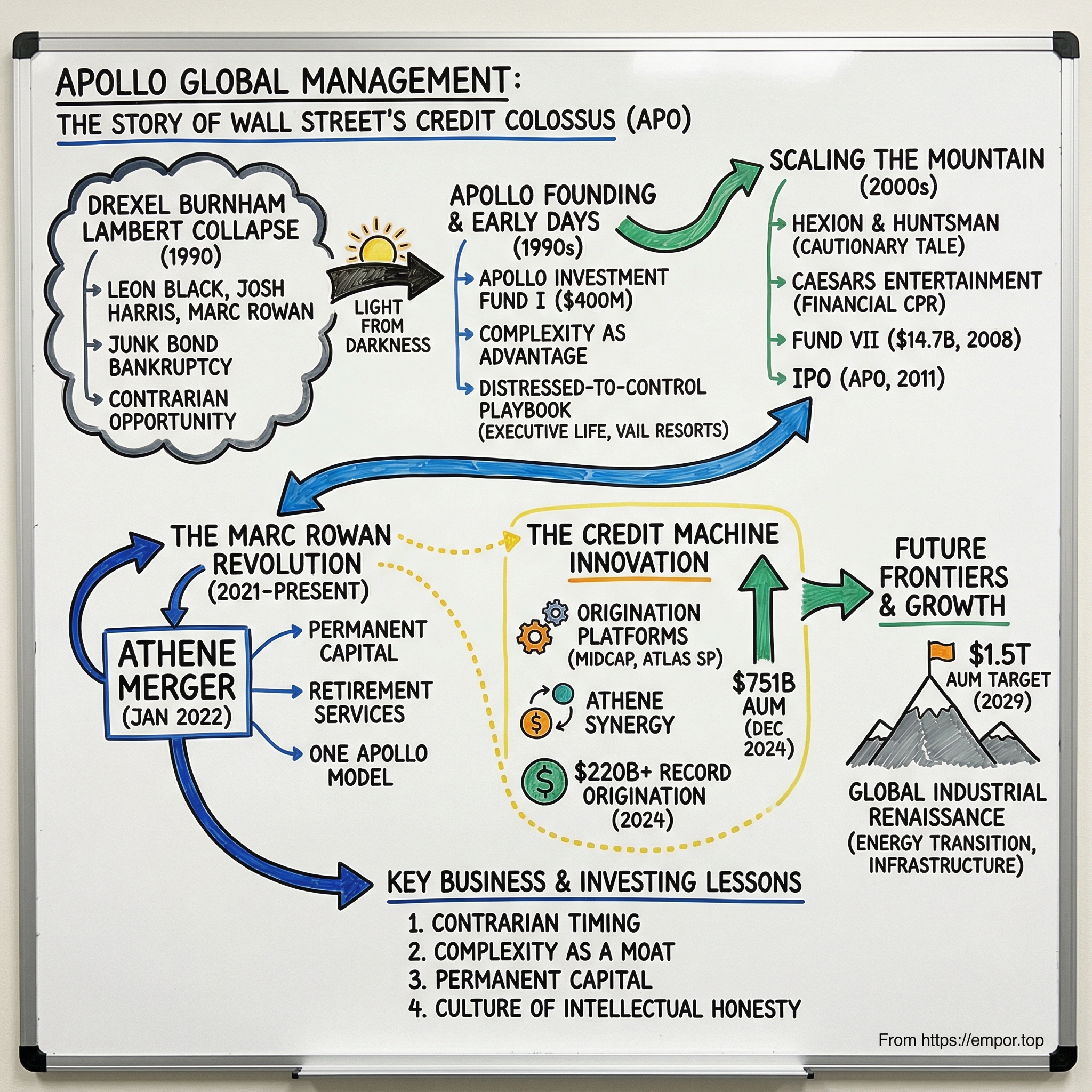
Apollo Global Management: The Story of Wall Street's Credit Colossus
I. Introduction & Episode Roadmap
In February 1990, Drexel Burnham Lambert — then among the most profitable and controversial investment banks in America — filed for bankruptcy. Within days, several of its senior executives regrouped in borrowed New York offices with no balance sheet, no established franchise, and a damaged reputation that led many institutional investors to decline their calls. Thirty-six years later, the successor firm manages more capital than the entire high-yield bond market Drexel pioneered.
Apollo Global Management closed the second quarter of 2026 with approximately $1.05 trillion in assets under management, up 25% year-over-year, and paid a quarterly dividend of $0.5625 a share.1 Fee-generating assets — the segment producing recurring management revenue — reached $858 billion, up 34%.2 During the quarter, Apollo generated a record $785 million in Fee Related Earnings and a record $877 million of Spread Related Earnings.2 Notably, these operational records occurred while Apollo's equity traded roughly a third below its 52-week high, reflecting market debate over earnings durability rather than current operating performance.
The firm operates a dual-engine business model. The first engine, Fee Related Earnings (FRE), functions as traditional asset management by earning fees on third-party capital. The second engine, Spread Related Earnings (SRE), operates similarly to a bank: Athene, Apollo's retirement services arm, sells annuities to policyholders, taking in long-dated liabilities to fund investments in Apollo-originated credit assets. Apollo captures the net spread between asset yields and funding costs. In the June quarter, that net spread was 1.14%, and 98% of Athene's fixed income sat in investment-grade paper.2
In short, Apollo originates loans historically provided by commercial banks, funded by retirement assets once held in bank deposits, capturing both management fees and interest spreads. While this structure yields strong current performance — full-year 2025 generated $938 billion in AUM, over $300 billion in origination, and more than $225 billion of inflows 3 — its long-term test lies in how the business performs through a severe credit cycle, and whether permanent capital, proprietary origination, and retail distribution remain stable under stress.
The company's evolution spans six major phases: the Drexel crucible, which established a focus on capital structure dynamics; the distressed-to-control playbook and the 1991 Executive Life transaction, which established Apollo's reputation while triggering sixteen years of litigation; the megafund era, which yielded top-performing vintage funds alongside the Caesars leveraged buyout, demonstrating the risks of financial leverage during revenue declines; the Athene transformation, which fundamentally altered Apollo's capital model; the governance meltdown of 2021, when leadership conduct forced institutional restructuring; and the credit architecture of today, built on sixteen origination platforms that originated roughly $309 billion of assets in 2025 alone.5
Ultimately, this is less a standard private equity narrative and more a study of structural credit migration — tracing how systemic lending risk moved from deposit-funded, federally backstopped banks to asset managers supported by annuity holders. That transformation began in the collapse of a bankrupt investment bank.
 Subscribe on LinkedIn
II. The Drexel Burnham Lambert Crucible & The 1990 Founding
On the trading floor at 9560 Wilshire Boulevard in Beverly Hills in 1986, Michael Milken sat at the center of an X-shaped desk, orchestrating high-yield debt issuance for non-investment-grade companies. At its peak, Drexel Burnham Lambert generated more profit than any other Wall Street bank by challenging a fundamental assumption of corporate finance: that access to capital markets belonged exclusively to investment-grade borrowers.
Milken's strategy rested on an empirical premise: historical data indicated that while non-investment-grade bonds defaulted at higher rates, their higher yields offered more than enough premium to compensate a diversified investor. By marketing this concept to savings and loan institutions, insurance companies, and mutual funds, Drexel enabled mid-tier industrial firms and corporate acquirers to raise substantial capital quickly, fueling the 1980s leveraged buyout boom through Milken's institutional distribution network.
In New York, Leon Black — a Dartmouth and Harvard Business School graduate and son of a food industry executive — headed Drexel's mergers and acquisitions practice as a well-connected dealmaker.6 Working alongside him were two younger bankers who would become central to Apollo's trajectory: Marc Rowan, a Wharton graduate skilled at structuring complex corporate liabilities across debt tranches, and Josh Harris, a Wharton and Harvard graduate focused on operational execution and portfolio management.
The model unraveled when Milken was indicted and Drexel filed for bankruptcy in February 1990. Drexel's inventory of high-yield paper hit the market alongside portfolios from failing savings and loan institutions. With regulators compelling thrifts and insurers to divest high-yield assets rapidly, market liquidity evaporated, creating a wave of forced selling across distressed debt markets.
That dislocation created Apollo's founding opportunity. Black and his partners recognized that viable companies' debt was trading at fifty cents on the dollar not due to operational failure, but because the holders faced regulatory and balance-sheet constraints. Forced liquidation by institutional sellers presented a classic market inefficiency driven by holder constraints rather than underlying credit fundamentals.
Apollo was established in 1990, initially as Apollo Advisors, by Black together with former Drexel colleagues.46 Raising the inaugural vehicle presented significant hurdles, as institutional investors were hesitant to back executives associated with a bankrupt investment bank under criminal scrutiny. Nevertheless, within months the firm secured roughly $400 million of seed capital for Fund I.6
That initial vintage established an investment pattern that recurred throughout Apollo's history. By purchasing senior debt claims on operating companies across industries like steel, retail, gaming, and packaging at deeply discounted prices, the firm secured a margin of safety derived from capital structure seniority and forced-seller timing. As high-yield spreads normalized over the subsequent three years, returns expanded significantly. The strategy relied not on macroeconomic forecasting, but on identifying price-insensitive sellers.
This principle became core to Apollo's strategy. When CEO Marc Rowan refers to sourcing opportunities where "the seller is constrained," he reflects the strategy forged in 1990 under different market conditions. Rather than waiting for broader market dislocations to create mispriced assets, Apollo has since built its own origination platforms to generate opportunities directly — a shift rooted in the lessons of its initial trade.
III. The Distressed-to-Control Playbook & Early Disasters vs. Victories
The playbook Apollo developed in its first decade is simple to state but difficult to execute: avoid buying the equity of a troubled company and instead purchase its debt — ideally the most senior tranche trading at a distressed discount. If the company recovers, the debt is repaid at par, yielding bond-like downside protection alongside equity-like upside. If the company fails, the bankruptcy process converts the debt claim into equity ownership. In the industry's vocabulary, the strategy targets the fulcrum security — the specific layer of the capital structure where value breaks and reorganization transfers corporate control to debt holders.
This structure creates upside potential under both outcomes. Rather than betting on a traditional operational turnaround, the investor acquires the right to execute a restructuring at a price established during market panic.
The Executive Life trade. In April 1991, the California Insurance Commissioner seized Executive Life Insurance Company, a Los Angeles insurer whose general account was heavily exposed to Milken-originated high-yield bonds that imploded when liquidity froze.7 Its portfolio — the largest concentrated block of distressed high-yield paper ever auctioned at one time — required liquidation to cover policyholder claims. Apollo's acquisition of Executive Life's bond portfolio in 1991 established the firm's credit platform and, by Apollo's own account, served as the foundational transaction of the firm.4
The mechanics were unusual. The buyer of record was Altus Finance, a subsidiary of French bank Crédit Lyonnais, with regulators approving the $3.25 billion portfolio sale in December 1991.7 Apollo managed the underlying assets. As high-yield debt prices recovered, the trade established Apollo's reputation as a prominent distressed investor.
The legal fallout: what the trade also produced. Apollo's early reputation rested on combining sharp credit analysis with complex legal and structural engineering. While the credit thesis proved sound, the legal structuring triggered extensive regulatory challenge and state prosecution.
In January 2002, California Attorney General Bill Lockyer expanded a civil lawsuit stemming from the Executive Life sale, naming Leon Black and Apollo as co-defendants alongside Crédit Lyonnais and Altus.7 State prosecutors alleged that Altus had secretly arranged fronting agreements with French insurer MAAF Assurances and other entities to circumvent federal banking and California insurance laws, which prohibited a foreign state-owned bank from owning a domestic insurer. The complaint stated that regulatory approval would have been denied had the full structure been disclosed, pointing to more than $450 million routed through secret side agreements.7
The resulting litigation spanned sixteen years, concluding in 2015 when Artemis S.A. agreed to pay $200 million in addition to $110 million paid previously, bringing total recoveries across all defendants to over $930 million. Earlier settlements included $516.5 million from Crédit Lyonnais and Altus in 2005, $78.75 million from the successor insurer, and more than $25.5 million from other defendants.8 The California Department of Insurance's summary of the final settlement did not disclose a specific payment amount for Apollo or Black.
For institutional investors, this history serves less as a single verdict on Apollo — which was one defendant among many in a case where French institutions paid the largest recoveries — and more as an illustrative structural pattern. Apollo's strategy has frequently operated at the outer boundaries of legal and regulatory frameworks, capturing economic value at those margins and navigating extended litigation when boundaries were contested. This dynamic introduces a legal and regulatory tail risk not captured in traditional internal rate of return metrics. As Apollo today operates a state-regulated retirement insurance business alongside retail distribution channels, analyzing whether this legal risk profile has evolved remains a central underwriting question.
Victories and institutional separation. Throughout the 1990s, Apollo expanded its franchise through notable corporate restructurings, including Vail Resorts, Culligan, Samsonite, and Walter Industries. Each deal followed the core blueprint: purchasing debt claims at deep discounts, restructuring corporate balance sheets, and monetizing the equity post-reorganization.
A major structural shift occurred internally in 1997, when founding partner Tony Ressler departed to co-found Ares Management.9 Ares absorbed a significant portion of Apollo's credit investing strategy, eventually expanding into one of the global market's largest direct lenders. The spin-off highlighted a fundamental reality of asset management: key intellectual capital and talent can easily depart to create competing platforms. Apollo spent the subsequent two decades building proprietary institutional structures — including origination platforms and permanent capital vehicles — designed to retain asset scale independent of individual key personnel.
Before achieving that institutional scale, however, the firm first had to navigate the risks created by its own rapid expansion.
IV. The Megafund Era, LBO Hubris, & The Caesars / Huntsman Crises
By 2006, Apollo faced a fundamental strategic dilemma created by an overheated credit market. Credit spreads reached historical lows, commercial banks offered cheap leverage against modest corporate cash flows, and private equity firms were raising record-setting funds. Having built its reputation on buying discounted assets during market dislocations, Apollo held billions of dollars in committed capital at a time when asset prices were elevated across all sectors.
Firms in that environment faced a choice: return uninvested capital or adjust their investment mandate. Apollo expanded into full-scale leveraged buyouts. Fund VI, raised in 2006, and Fund VII, raised in 2008, marked this shift, concentrating capital in cyclical sectors — such as chemicals, hospitality, gaming, and industrials — that carried high sensitivity to economic downturns and heavy debt loads.
Two major transactions from this period illustrated the structural risks of that transition.
Hexion and Huntsman: the deal Apollo tried to walk away from. In 2007, Apollo portfolio company Hexion Specialty Chemicals agreed to acquire Huntsman Corporation, a Utah-based chemicals manufacturer, in a leveraged transaction struck near the peak of the chemical cycle. When credit markets froze and chemical demand fell, the combined entity's projected debt burden became unsustainable. Seeking to terminate the transaction, Apollo and Hexion petitioned the Delaware Court of Chancery, arguing that Huntsman had suffered a Material Adverse Effect and that the merged business would be insolvent.
On September 29, 2008 — two weeks after the collapse of Lehman Brothers — Vice Chancellor Stephen Lamb ruled against Hexion and Apollo. The court rejected the Material Adverse Effect claim, determined that Huntsman remained entitled to a $325 million break-up fee, and concluded that Hexion had breached its obligations under the merger agreement "knowingly and intentionally" at Apollo's direction, ordering specific performance.10
The judicial finding that Apollo had engineered a deliberate breach carried significant legal and financial consequences. On December 14, 2008, Huntsman terminated the merger agreement and reached a $1 billion settlement. The package comprised the $325 million break-up fee, $425 million in cash from Apollo affiliates, and $250 million in ten-year convertible notes issued by Apollo affiliates.11 Apollo paid approximately $675 million of that total directly.
The primary takeaway of the Huntsman transaction was not merely overpaying at the top of the market, but the risk of the exit strategy. When the economic thesis broke, Apollo attempted to litigate its way out of the deal, resulting in legal liabilities that ultimately exceeded the cost of the original valuation error.
Caesars: the largest lesson. In January 2008, Apollo and TPG Capital completed the leveraged buyout of Harrah's Entertainment, the world's largest casino operator, in a transaction valued at roughly $31 billion.12 The investment thesis assumed that steady gaming cash flows and underlying real estate assets would comfortably support the debt load.
However, the 2008 financial crisis severely depressed discretionary consumer spending and convention travel in Las Vegas. The primary operating subsidiary, Caesars Entertainment Operating Company (CEOC), was left with a debt load calibrated to pre-crisis revenue. In response, the sponsors executed aggressive liability management, moving valuable properties — including the Linq — out of CEOC into affiliated entities and restructuring debt guarantees. Apollo and TPG defended these moves as legitimate corporate reorganizations, while creditors challenged them as asset stripping.
CEOC filed for Chapter 11 bankruptcy in January 2015 in the Northern District of Illinois. An independent examiner appointed by the court, Richard Davis, released a report on March 15, 2016, identifying up to $5.1 billion in potential legal claims against Caesars and its private equity sponsors. The report detailed asset transfers designed to remove prime properties from creditors' reach and concluded that the operating unit had been insolvent as early as 2008, shortly after the buyout closed.12 Caesars Entertainment's stock fell 18% the following day.12
The final bankruptcy settlement reflected a major shift in creditor leverage. Second-lien noteholders — who had initially been offered a recovery of roughly 9%, or $487 million — ultimately received a restructuring package valued at approximately $3.62 billion, representing roughly 65.5 cents on the dollar. The payout consisted of $1.43 billion in cash, $899 million in principal of convertible notes, and 19.07% of the reorganized parent's equity.13 That $3.1 billion increase over the initial proposal directly reduced the value retained by the sponsors.
The falsification pass: does distressed expertise protect you on the way down? Apollo's central marketing premise has long been that its capital-structure fluency provides downside protection during market downturns. Fund VI served as a direct empirical test of that claim, deployed by the same investment team just prior to the 2008 financial crisis.
The historical record challenges the assertion that capital structure expertise guarantees downside protection. Fund VI, which began investing in 2006 and held positions in Caesars, Realogy, and Momentive, generated annual gross and net internal rates of return of only about 6% and 5% respectively from inception through the end of 2011, before recovering to roughly 13% gross and 10% net by March 2013. In contrast, Fund VII — raised in 2008 and deployed after the market collapse — generated approximately 31% gross and 22% net IRR over the same initial timeframe. That outperformance was driven by distressed debt trades like LyondellBasell, where Apollo bought senior claims at deep discounts during panic selling and captured gains as markets recovered.
These contrasting results, achieved by the same deal team just two years apart, demonstrate that entry price and vintage dominated skill. Distressed expertise generated exceptional returns when Apollo provided liquidity to forced sellers, but provided limited protection when the firm acted as a high-multiple buyout bidder at market peaks. As Apollo's capital scale grew, requiring continuous deployment across market cycles, its operational profile shifted closer to the conditions of Fund VI than the distressed buying opportunities of Fund VII.
Co-founder Marc Rowan drew a structural conclusion from this experience: if traditional private equity returns remain dependent on cyclical deployment windows, the long-term solution is to move beyond episodic fundraising and secure permanent capital.
V. The Strategic Transformation: Athene & Permanent Capital Insurance Engine
In 2009, while much of Wall Street was recovering from the financial crisis, Marc Rowan began analyzing a structural vulnerability in the traditional private equity business model.
A traditional buyout fund operates on a ten-year life cycle: managers raise capital, invest it over five years, harvest investments over the subsequent five, and return to institutional investors to raise a successor vehicle. The fee base remains tied to the fundraising calendar, which depends heavily on broader market cycles — capital is easiest to raise when asset valuations are elevated. Every alternative manager operated under these cyclical constraints.
Rowan sought a pool of capital that would never require re-raising. The solution lay in fixed annuities.
The mechanics, in plain language. A fixed annuity is a contract in which a saver deposits a lump sum with an insurer in exchange for a guaranteed interest rate and eventual income payouts. For the insurer, this liability carries two key characteristics: it is long-dated, often spanning ten to thirty years, and contractually sticky. Surrender charges and tax penalties make early withdrawals costly, protecting the capital from rapid runs typical of bank deposits.
If an insurer invests those funds at yields exceeding its promised payout rate, it captures the net spread. This model reflects traditional insurance economics while operating structurally like a bank — but without the risk of immediate demand withdrawals.
Apollo backed the founding of Athene in 2009 as a retirement services company.413 The timing coincided with post-crisis capital rules that prompted European and American banks and insurers to divest long-duration liabilities. Athene acquired Liberty Life from a Royal Bank of Canada affiliate in 2011, followed by the acquisition of Aviva USA on October 2, 2013, for $1.55 billion, which expanded Athene's assets to roughly $60 billion and established it as one of the largest fixed annuity companies in the United States.14 Athene completed an initial public offering on the New York Stock Exchange in December 2016.4
Why the two halves fit together. The logic of combining asset management with retirement liabilities rests on complementary needs.
An insurer managing over $400 billion in liabilities cannot generate competitive returns by buying public corporate bonds alone, as market pricing reflects broad liquidity. To earn an attractive spread, Athene requires investment-grade assets that offer an illiquidity or complexity premium rather than taking on higher default risk.
Conversely, building specialized loan origination platforms — across aircraft financing, equipment leasing, fleet loans, and securitized warehouses — requires significant capital and guaranteed distribution. Originators cannot build permanent underwriting capacity without predictable asset demand.
The combined model addresses both constraints: Apollo builds origination platforms, Athene serves as the primary buyer, and the resulting assets are structured as secured, investment-grade paper. Apollo's target spread is designed to compensate for complexity and illiquidity rather than credit risk — a thesis central to the firm's long-term underwriting.
The 2022 merger. On March 8, 2021, Apollo announced an all-stock agreement to acquire the remaining equity of Athene it did not already own, valuing the target equity at approximately $11 billion based on an exchange ratio of 1.149 Apollo shares per Athene share; the merger completed on January 1, 2022.[^16][^17]
The transaction altered Apollo's corporate model. Previously, Apollo managed Athene's assets under contract while holding a minority equity stake — a structure that drew ongoing scrutiny over fee arrangements and potential conflicts of interest. By consolidating Athene onto its balance sheet, Apollo transformed from a fee-for-service asset manager into a hybrid firm combining fee revenue with balance-sheet credit risk.
This shift introduced new return drivers and balance-sheet exposure. While retirement capital provides a continuous inflow independent of fundraising cycles, it exposes Apollo directly to asset-liability matching risk and spread fluctuations. Unlike traditional asset managers that earn pure management fees, Apollo's earnings profile combines fee revenue with a levered credit portfolio.
As of March 31, 2026, Athene held approximately $447.8 billion in total GAAP assets, generated $719 million in spread-related earnings for the quarter, and carried $1.7 billion in excess equity capital, supported by financial strength ratings of A+ from AM Best, S&P, and Fitch, and A1 from Moody's.13 It ranked first in LIMRA's U.S. retail annuity survey for 2025 for the third consecutive year, recording nearly $33 billion in fixed annuity sales within a total industry market of $465 billion, while maintaining the leading market share in funding agreement-backed notes with $35.4 billion in new inflows.1513
These figures reflect a substantial distribution network of agents, product platforms, and pricing systems. However, Athene's continued growth remains tied to prevailing interest rates and increasing competition from more than thirty asset managers that have entered the retail annuity market — a dynamic Rowan addressed directly during the second-quarter 2026 earnings call.21
The merger also coincided with an unexpected structural challenge: it took place alongside the most significant governance crisis in Apollo's history.
VI. Governance Meltdown & The Marc Rowan Takeover (2020–2022)
On January 25, 2021, Apollo published the findings of an independent review conducted by the law firm Dechert. The board had commissioned the inquiry following press reports detailing founder Leon Black's relationship with Jeffrey Epstein, the convicted sex offender who died in federal custody in 2019. The board sought to answer a specific question: whether Apollo’s chief executive had engaged in any conduct that compromised the firm.
Dechert concluded there was no evidence that Black participated in Epstein's criminal activities. However, the report disclosed figures that ultimately ended his tenure at the firm. Between 2012 and 2017, Black paid Epstein $158 million in fees for tax, estate, and philanthropic advisory services, issued him more than $30 million in loans, and directed a $10 million charitable contribution at Epstein's request. Dechert estimated that Epstein's advice generated between $1 billion and $2 billion in value for Black.16
Although the review concluded that the payments represented legitimate services and were economically rational for Black personally, that distinction offered little comfort to institutional investors. Apollo’s primary clients — public pension funds accountable to public employees and state legislatures — faced intense public scrutiny. Pennsylvania’s Public School Employees' Retirement System halted new capital commitments to Apollo, citing reputational risk. For institutional allocators, reputational headlines alone were sufficient to freeze capital allocations.
Black announced he would step down as chief executive by July 2021 while remaining chairman, with Marc Rowan designated as his successor. At the same time, Apollo announced structural governance changes: adding two independent directors, elevating its co-presidents to the board, eliminating Class C voting shares, and evaluating a transition to a single class of common stock.16 Black subsequently accelerated his departure, resigning all roles earlier than planned. Josh Harris, Apollo’s third co-founder who was passed over for the chief executive role, left the firm in 2022 to establish a separate investment manager.
What the crisis actually changed. Beyond immediate reputation management, the crisis accelerated a structural reorganization that Rowan had long advocated.
Apollo had historically operated under a founder-centric architecture characterized by dual-class stock, super-voting control, and opaque economics. This structure carried a measurable market penalty: it excluded Apollo from major equity indices and constrained investment by large institutional asset managers. Collapsing the voting structure to a one-share, one-vote standard removed that governance discount. In 2024, Apollo joined the S&P 500 index, converting its equity from a specialized holding into an automatic component for index-tracking funds across the financial industry.4
The board was simultaneously restructured with outside directors. Jay Clayton, former SEC chairman, served as chairman and lead independent director from March 2021 until his resignation in April 2025 to become interim U.S. Attorney for the Southern District of New York. On his departure, Gary Cohn — vice chairman of IBM, former director of the National Economic Council, and former president of Goldman Sachs — became lead independent director, while Rowan assumed the dual role of chairman and chief executive.17 Apollo's 2026 proxy statement discloses a board of thirteen members, nine of whom are independent.20
Recombining the chief executive and board chairman roles four years after a major governance crisis marks a retreat from standard corporate governance recommendations, even with a designated lead independent director. Additionally, Rowan served on Athene's board and executive committee from 2009 until August 2025, spanning the entire timeline of related-party transactions between the asset manager and the insurer.20
Incentives. In January 2025, Rowan entered into a five-year employment agreement.18 The compensation structure closely aligns his financial outcomes with public shareholders: proxy filings show a $100,000 base salary with zero annual bonus and no new equity awards, deriving his compensation almost entirely from his existing share ownership and carried interest allocations.1920
This arrangement ties executive wealth directly to share performance and dividend payouts rather than guaranteed annual vesting. However, direct equity ownership aligns an executive primarily with share price appreciation rather than downside risk mitigation. High equity concentration incentivizes capital growth, which does not automatically translate to conservative risk management across market cycles.
The ultimate test of Apollo's restructured organization lies in execution against its stated strategy. That operational test began following the firm's October 2024 investor presentation, where management outlined its long-term growth targets.
VII. The Credit Machine Today: Segments, Origination Engine, & Economics
To understand Apollo's modern architecture, consider how a single loan moves through its system.
A mid-sized aircraft lessor needing $400 million to finance a fleet of narrowbody jets would historically have turned to a commercial bank like JPMorgan Chase or Citigroup. The bank underwrote the loan, retained a portion, and syndicated the remainder to other institutions, earning fees and an interest spread while holding regulatory capital against balance-sheet exposures.
In 2026, that borrower can bypass commercial banks entirely by contacting PK AirFinance, one of Apollo's dedicated origination platforms. Apollo underwrites the loan directly, structures it as investment-grade secured debt, and distributes it across its ecosystem — placing tranches into Athene's general account, third-party insurance mandates, managed funds, or syndicating slices through its capital markets desk. The process operates without deposit funding, bank capital constraints, or an external syndication desk.
This transaction encapsulates the structural disintermediation of corporate lending and explains Apollo's three reporting segments.
Asset Management (FRE). This segment functions as the fee engine, collecting management fees on assets under management, transaction and capital solutions fees for structuring deals, and other recurring income, minus compensation and operating costs.23 Fee Related Earnings reached $2.5 billion in 2025, up 23% year-over-year. In the second quarter of 2026, FRE grew 25.2% with a 58.5% margin — meaning roughly fifty-nine cents of every fee dollar converted into segment earnings.32 That margin highlights the operational leverage of asset management: incremental capital generates fees with minimal additional operating expense, supporting higher market valuation multiples.
Retirement Services (SRE). Representing the spread engine, this segment generates earnings from Athene by investing long-dated retirement liabilities into higher-yielding credit. It forms the larger portion of Apollo's earnings in absolute terms, generating approximately $3.36 billion in spread-related earnings in 2025 compared to FRE's $2.5 billion.3 Together, FRE and SRE produced nearly $5.9 billion in segment earnings for the year.3
Principal Investing. The third and smallest segment captures realized performance fees from private equity and credit funds alongside income on Apollo's own balance-sheet investments. It is also the most volatile segment: realized performance fees fell 40% year-over-year in the second quarter of 2026, reflecting broader headwinds in private equity exits amid elevated interest rates.36 Apollo's primary performance reporting emphasizes FRE and SRE combined, a presentation that shifts investor focus away from the segment most sensitive to exit market conditions.
The origination engine. Apollo operates an ecosystem of sixteen standalone origination platforms that generated approximately $309 billion in assets in 2025, focusing on private investment-grade credit suited for long-duration, principal-protected products.5 Rather than focusing on corporate leveraged buyout debt, these platforms finance real-economy operations: ATLAS SP in asset-backed warehousing, Wheels in commercial fleet management, MidCap Financial in middle-market lending, PK AirFinance and Perseus in aviation, Redding Ridge in collateralized loan obligations, Petros PACE in commercial property clean energy, Apterra in infrastructure, and MaxCap in Australian commercial real estate, alongside specialized consumer, equipment, trade finance, residential, and fintech originators.5
These platforms function as direct manufacturing assets rather than trading desks. Instead of purchasing secondary credit, Apollo originates and structures paper directly, anchored by ATLAS SP — built from Credit Suisse's former securitized products group acquired in 2023 — as its largest unit.4
What the Broadcom deal proved and what it didn't. In 2026, Apollo arranged a record $35 billion private credit facility tied to Broadcom and artificial intelligence developer Anthropic, structured through ATLAS SP alongside co-investors including Blackstone. A special purpose vehicle used the financing to purchase custom semiconductors developed by Google and Broadcom and lease them to Anthropic, with Broadcom guaranteeing senior debt payments while keeping the liability off its balance sheet. Apollo stated it was the only institution able to commit the full financing upfront, completing the transaction within weeks.22 Since 2022, Apollo has executed more than $100 billion in similar structured transactions with corporate counterparties including Air France-KLM, BP, and Anheuser-Busch InBev, while an $11.2 billion joint venture with Intel for a 49% stake in an Irish semiconductor facility generated a roughly $3 billion gain within two years.22
This capability demonstrates structural speed and balance-sheet scale that traditional bank syndicates struggle to match, as commercial banks must pre-market syndicate risk while Apollo can commit and hold large allocations. On Apollo's second-quarter 2026 earnings call, Chief Executive Marc Rowan identified origination as the foundation of the business model, reporting $74 billion in quarterly origination and approximately $50 billion in committed future pipeline, priced at an average spread of 340 basis points over Treasuries.21
However, transactions of this scale also highlight concentration risks. A $35 billion infrastructure financing ties returns to a single technology cycle, the counterparty risk of an AI tenant, and the creditworthiness of the backstop provider. While structured as investment-grade debt, its durability under a scenario of reduced technology capital expenditure remains untested by historical credit cycles.
The competitive board. Among peer asset managers, Blackstone remains the largest by total assets and leads in real estate, but manages third-party insurance capital rather than owning a consolidated insurer. KKR adopted Apollo's path, completing its acquisition of the remaining stake in Global Atlantic on January 2, 2024 to take ownership to 100%.24 Ares Management, founded by former Apollo executives, competes directly in private credit but without a comparable owned insurance balance sheet.9 Blue Owl operates as a pure-play credit and GP-stakes manager without insurance float; its shares declined 41% in 2026 through late March compared to a 22% decline for Apollo, reflecting market preference for asset managers backed by permanent insurance liabilities.35
The broader competitive challenge lies on the funding side. Rowan noted that 36 asset managers have entered the retail annuity market, increasing competition for policyholder capital.21 As capital flows into retail insurance, competition for liabilities may compress net interest spreads over time.
Buying what it could not build. Apollo has complemented organic origination with strategic acquisitions to build capacity where organic construction would require years. On February 24, 2025, the firm agreed to acquire Bridge Investment Group in an all-stock transaction valuing Bridge at approximately $1.5 billion, adding roughly $50 billion in real estate assets and, in partner David Sambur's framing, expanding "our origination base in areas of our business that are growing but not yet at scale"; the transaction closed in September 2025 and was projected to be immediately accretive to FRE.29 On the liability side, Apollo-backed Athora agreed in July 2025 to acquire the UK's Pension Insurance Corporation Group, extending Athene's retirement spread model to British corporate pension risk transfers. Rowan projected Athora would achieve mid-teens returns on equity post-integration, citing a subsequent $6 billion UK pension transaction as evidence of organic expansion.21
Both acquisitions expand origination and distribution channels, but using equity when share prices trade below prior highs transfers value from existing shareholders if acquired growth fails to meet targets. Apollo's track record on these acquisitions remains early, with long-term performance dependent on whether Bridge delivers projected fee growth and whether Athora sustains mid-teens returns through European credit cycles.
This strategic expansion reflects Apollo's ongoing effort to secure proprietary funding and origination channels that competitors cannot easily duplicate.
VIII. Hidden Growth Vectors: Asset-Backed Finance (ABF), Capital Solutions, & Global Wealth
Every growth engine eventually confronts an arithmetic reality: the primary strategy that built scale attracts competition and experiences yield compression. Apollo's response relies on three distinct expansion vectors, each at a different stage of operational proof.
Asset-backed finance: the deliberate move away from the crowd. Corporate direct lending — floating-rate loans extended to private equity-backed companies — attracted heavy capital inflows after 2020. As competition expanded, credit spreads compressed, covenants loosened, and underwriting standards weakened across the marginal lending market. Apollo responded by emphasizing asset-backed finance, shifting capital toward loans collateralized by tangible cash flows or assets — such as consumer loans, equipment leases, aircraft, royalty streams, franchise fees, inventory, and trade receivables — rather than uncollateralized enterprise value.
The structural difference dictates recovery dynamics during market downturns. In corporate direct lending, recovery relies on restructuring or selling an operating business as a going concern — a process vulnerable to illiquid transaction markets. In asset-backed lending, recovery rests on repossessing equipment, re-leasing aircraft fleets, or collecting collateralized receivables. Because asset-backed claims carry lower correlation to broader equity cycles, a larger proportion can achieve investment-grade ratings, matching the structural yield requirements of insurance balance sheets.
Apollo has positioned asset-backed finance as central to its 2029 growth targets, a priority reflected in its origination architecture: most of its sixteen platforms originate asset-backed loans rather than traditional corporate debt.5 However, collateral-based lending presents specific operational risks, as demonstrated by high-profile market failures. The September 2025 bankruptcies of subprime auto lender Tricolor — where identical auto loan collateral was allegedly pledged to multiple institutions — and auto parts supplier First Brands, where creditors alleged double-pledged inventory and fabricated receivables, illustrated that collateralized lending exposes managers to asset-verification failures rather than standard corporate credit defaults.
Apollo Capital Solutions: the fee nobody expected. Apollo Capital Solutions (ACS) serves as the firm's internal capital markets and syndication arm. When Apollo originates a transaction exceeding its own balance-sheet allocation limits, ACS structures and syndicates the remaining debt to third-party institutions, generating structuring and placement fees. Functionally, ACS operates as an internal investment banking desk, capturing syndication fees that historically accrued to commercial and investment banks.
The business segment provides capital-light earnings that do not require balance-sheet equity. On Apollo's second-quarter 2026 earnings call, Co-President Jim Zelter noted that ACS generated over $200 million in quarterly fees for five consecutive quarters, reaching $277 million in the June quarter, while Chief Financial Officer Martin Kelly stated that the segment increasingly performs like a recurring, franchise-level revenue stream.21
That characterization warrants analytical scrutiny. Syndication revenue depends directly on deal origination volume and third-party institutional demand for syndicated paper — metrics that fluctuate across credit cycles. While five consecutive quarters of elevated fee income demonstrate execution during a favorable credit environment, it does not confirm earnings durability through market downturns. A sharp drop in ACS revenue during a period of sustained origination would indicate that investor syndication demand, rather than deal sourcing, represents the primary constraint.
Global Wealth: the growth vector under live stress. Because institutional pension allocations to alternative assets approach target caps, asset managers are expanding distribution into individual wealth channels. At its 2024 investor day, Apollo outlined a strategic target to expand wealth-channel assets from approximately $30 billion to over $150 billion by 2029. That goal forms part of a broader corporate plan to increase total assets under management from nearly $696 billion in June 2024 to $1.5 trillion by 2029, supported by $275 billion in annual origination.25
Distribution relies primarily on semi-liquid structures, including non-traded business development companies (BDCs), interval funds, exchange-traded funds, and retirement products. In February 2025, State Street launched the State Street IG Public & Private Credit ETF, in which Apollo sources private debt assets and provides daily liquidity support by standing ready to purchase holdings at firm bid prices. The fund allocates between 10% and 35% of its portfolio to private credit and held approximately $815 million as of August 26, 2026.28 Additionally, State Street introduced a target-date fund allocating roughly 10% to Apollo-managed private credit through select managed account services on the Empower platform, establishing an entry point into defined-contribution retirement plans.
The stress test arrived early. The structural model faced immediate operational testing in retail distribution channels.
Apollo Debt Solutions BDC (ADS), a $26 billion retail credit vehicle launched in January 2022, caps quarterly share repurchases at 5% of outstanding shares. In the first quarter of 2026, investor redemption requests reached 11.2% of outstanding shares, leading Apollo to fulfill approximately 45% of requests and return $730 million to investors. During the second quarter of 2026, redemption requests rose to 16.8% of shares — totaling roughly $2.4 billion, the highest level since fund inception — prompting Apollo to enforce the 5% quarterly cap again. Geographically, domestic U.S. redemption requests moderated to 4.3% of shares, whereas offshore investor redemption requests rose to 12.5%.26
Management argued that the redemption limits functioned as designed. At a financial conference on June 10, 2026, Co-President John Zito stated that the fund performed as intended by controlling capital outflows rather than liquidating assets prematurely, noting that the vehicle experienced no run while cautioning that redemption requests could escalate if investors attempted to game the withdrawal mechanism.27 For the second quarter, Apollo projected net ADS outflows of approximately $400 million — representing about 3% of net asset value — comprising $700 million in gross redemptions offset by $300 million in new capital inflows.26 On the second-quarter earnings call, Zelter reported $3 billion in broader Global Wealth inflows during the period despite weaker retail investor sentiment, adding that ADS redemption trends were normalizing in the third quarter.21
These dynamics highlight two complementary operational realities. While contractual liquidity gates successfully prevented forced asset sales, redemption requests exceeding three times available quarterly capacity — driven primarily by offshore investors — demonstrated that retail wealth allocations do not provide the permanent capital characteristics of long-dated insurance liabilities. Equity markets reflected these structural concerns when Apollo's stock fell 6.13% on June 24, 2026, closing at $122.60.27
The divergence between functional gate mechanisms and retail capital stability underscores the central strategic challenge of expanding credit distribution into wealth channels.
IX. Strategic Analysis: 7 Powers, 5 Forces, & Management Credibility Audit
Stripping away corporate storytelling reveals the fundamental question for long-term investors: what structural barriers prevent competitors from replicating Apollo's model?
Myth versus reality, three consensus narratives.
Myth: Apollo is a private equity firm. In reality, private equity represents the smallest and most volatile of Apollo's three earnings legs. Although the flagship buyout franchise remains significant — with Fund XI drawing roughly $12 billion toward a $25 billion target as of early August 2026, described by Chief Financial Officer Martin Kelly as "a very healthy first close" — the Principal Investing segment that generates realized performance fees fell 40% year-over-year in the June quarter.36 Valuing Apollo on traditional private equity metrics mischaracterizes its primary business drivers.
Myth: Private credit is unregulated shadow banking vulnerable to a 2008-style collapse. In reality, this comparison misconstrues the underlying mechanics. The financial system failure in 2008 was driven by maturity mismatch — funding thirty-year mortgages with overnight repurchase agreements. In contrast, Athene's liabilities consist of long-dated annuities protected by contractual surrender penalties, operating under state insurance supervision with risk-based capital rules that were tightened in 2026.30 The principal risk facing private credit is not a sudden run on liabilities, but asset valuation: unquoted assets are marked by internal models, creating structural incentives for optimistic pricing.
Myth: Permanent capital ensures complete capital lockup. In reality, permanence varies across capital channels. While annuity liabilities and traditional closed-end funds are contractually locked, the retail wealth channel — a primary engine targeting Apollo's 2029 expansion plan — relies on semi-liquid structures where investors exercised redemption options heavily in 2026.26 Consequently, "permanent capital" accurately describes Athene's liability structure, but serves as a marketing term for retail vehicles.
Hamilton Helmer's 7 Powers, applied honestly.
Cornered resource represents Apollo's strongest competitive claim, though its scope is narrower than commercial marketing suggests. Athene's balance sheet cannot be duplicated simply by deploying capital; establishing it required fifteen years of building distribution channels, regulatory licenses, credit ratings, and actuarial infrastructure, creating the largest retail fixed annuity seller in the United States.15 Similarly, Apollo's sixteen origination platforms function as dedicated operating companies with proprietary underwriting and servicing capabilities. However, these assets are not strictly cornered: competitors such as KKR acquired comparable scale through Global Atlantic,24 while more than thirty asset managers have entered the retail annuity market.21 Apollo holds a multi-year lead in scale and execution rather than an unreplicable resource.
Scale economies are clearly visible in operating metrics. Generating a 58.5% FRE margin on a fee base expanding at 25% demonstrates that platform fixed costs — including compliance, risk infrastructure, and technology — are being leveraged across a growing asset base.2 Kelly noted that Apollo targets 20% compound annual FRE growth over the cycle, supported by mid- to high-teens revenue growth — a goal implying continued margin expansion.21 This benchmark provides a clear metric to evaluate against cost pressures from tech investments and geographic expansions.
Counter-positioning provides a distinct yet policy-dependent advantage over traditional commercial banks. Because Apollo avoids deposit-funding requirements and operates outside bank capital reserve mandates, it can profitably hold long-duration structured assets that commercial banks must shed. Banks cannot mirror this structure without fundamentally altering their business models. However, this power remains vulnerable to regulatory shifts: it exists because bank capital rules are strict while insurance frameworks evaluate structured credit more favorably. Regulatory adjustments to either framework would compress this arbitrage.
Switching costs operate unevenly across segments. Fixed annuity policyholders face surrender charges and tax penalties for early withdrawal, while institutional private fund LPs commit capital for ten-year cycles. Conversely, the retail wealth channel features low switching costs by design to attract individual investors. The redemption volume recorded in 2026 illustrates the structural trade-off between expanding retail distribution and maintaining capital stability.26
Apollo does not possess meaningful network economies, as additional policyholders do not increase product utility for existing ones, nor does it rely on consumer-facing branding power.
Porter's five forces.
Threat of new entrants: Moderate. While insurance licensing, rating agency requirements, and actuarial scale present real entry barriers, established managers have repeatedly entered the market through acquisitions, offshore reinsurance arrangements, and distribution partnerships.
Bargaining power of buyers: Rising. Institutional LPs continue to press for fee concessions across private markets, annuity policyholders evaluate competing yield rates across dozens of issuers, and retail wealth investors exercise power through redemption queues.
Bargaining power of suppliers (borrowers): Low for mega-cap transactions, high in middle markets. For jumbo corporate financings — such as the $35 billion structured credit facility arranged in 2026 — corporate borrowers have few alternative institutions capable of underwriting full commitments upfront, giving Apollo pricing power.22 Conversely, in middle-market direct lending, abundant lender capital has compressed spreads and weakened borrower constraints.
Threat of substitutes: High. Public bond markets remain the primary alternative. While Chief Executive Marc Rowan maintains that Apollo competes on execution speed, transaction certainty, and structural flexibility rather than pure yield pricing, liquid public markets offer cheaper financing whenever corporate bond spreads tighten.
Competitive rivalry: High and intensifying. Major alternative asset managers — including Blackstone, KKR, Ares, Brookfield, and Blue Owl — are actively competing for the same private credit originations and insurance capital pools.
Management credibility. An audit of management commitments reveals a balanced record of operational delivery and selective framing.
On execution, Apollo set a five-year strategic plan in October 2024 targeting $1.5 trillion in AUM, $275 billion in annual origination, and roughly $150 billion in wealth assets by 2029. By the first quarter of 2026, total AUM crossed $1 trillion, placing results ahead of the trajectory required by the 2029 targets.2533 Furthermore, Apollo substantially achieved the $1 trillion AUM target it set in 2021 for 2026.25 Meeting long-term targets provides a strong track record of operational execution.
Conversely, management's primary performance metric — combining FRE and SRE — systematically excludes Principal Investing, the firm's most cyclical earnings segment. Management emphasized this combined metric precisely as realized performance fees declined 40%.36 Rowan's public statements have also drawn scrutiny when contrasted with operational developments. In November 2025, he dismissed private credit critics as having "lost their minds" and stated that a rival executive was "just wrong" regarding systemic risk.34 In April 2026, he asserted that a first-lien credit manager unable to meet 5% quarterly redemptions was an "idiot."33 Weeks later, Apollo's retail BDC experienced redemption requests exceeding three times its 5% cap, forcing the firm to enforce the quarterly limit.26 While Apollo satisfied its contractual obligations, the confidence of management's rhetoric contrasted sharply with retail redemption demand.
As a counterweight to market scrutiny, Apollo chose expanded disclosure over deflection, pledging to introduce daily valuations across its roughly $800 billion credit business by September 30, 2026 — a notable shift from quarterly industry norms — while partnering with ICE to assign standard identifiers to private credit instruments.3321 If fully implemented, this daily valuation initiative directly addresses a core critique of private credit asset marks while creating a competitive hurdle that few industry rivals can easily match.
X. The Skeptical Investor Stress Test & Falsification Matrix
Every investment thesis relies on a set of underlying claims. For Apollo, three key assumptions support its valuation, each tested against the strongest disconfirming evidence available.
Claim 1: Athene provides a durable cost-of-capital advantage through insurance asset management.
The mechanism that would break it: Regulators deciding that insurers holding manager-originated structured credit must hold more capital against it, directly reducing return on equity and shrinking the arbitrage spread.
The evidence. Regulatory scrutiny has been a live issue since 2021, with the National Association of Insurance Commissioners methodically reviewing private credit within insurer portfolios.31 Concrete policy updates arrived in mid-2026. On June 11, 2026, the NAIC's Life Risk-Based Capital Working Group replaced the flat 6.8% charge on collateral loans with a tiered, asset-specific model effective at year-end 2027. Under the new framework, mortgage factors range from 0.14% to roughly 13%, partnership and LLC interests carry a 30% base charge reducible to 15% to 30% based on overcollateralization, and residual tranches carry a 45% charge reducible to 22.5% to 45%. On June 23, 2026, the RBC Investment Risk and Evaluation Working Group adopted updated collateralized loan obligation rules for year-end 2026 reporting. The framework maintained the 45% pre-tax charge on CLO residual tranches, evaluated debt tranches on credit rating plus tranche thickness, and introduced an 11.77% surcharge for thin below-investment-grade broadly syndicated tranches. To qualify for lower capital charges, insurers must document independent verification of fair value.30
The verdict: The claim survives in a narrowed form, as regulatory outcomes proved more calibrated than bear-case assumptions. The regulatory trajectory points toward higher capital requirements for complex structures, mechanically lowering return on equity for the most structured portfolio assets. However, the framework rewards genuine overcollateralization with lower capital charges, favoring institutions whose assets carry verifiable security over those relying on optical credit grades.30 This model functions more as a quality test than a simple penalty. The revised thesis holds that Athene's advantage persists, but depends directly on asset quality matching management assertions. What would confirm or falsify it: Athene's risk-based capital ratio and excess capital reserves through year-end 2026 and 2027 reporting, along with whether its net investment spread remains near the recent 1.14% level after higher capital charges take effect.213
Claim 2: Private credit is safer than bank lending because it is better secured and better underwritten.
The mechanism that would break it: A multi-year credit downturn revealing that mark-to-model valuations concealed underlying stress or that physical and financial collateral was overstated.
The evidence. Apollo's track record highlights previous cycle challenges. Fund VI's lower returns and the Caesars debt restructuring demonstrated that structural engineering alone does not protect levered positions when corporate revenues decline sharply. More recently, the 2025 bankruptcies of Tricolor and First Brands demonstrated collateral verification risks in asset-backed lending — the core market segment Apollo is expanding. A broader challenge for private credit portfolios is that borrower operational performance remains unobservable to outside market participants between restructurings because loans do not trade publicly.
The verdict: Unproven, as conclusive evaluation requires a full credit cycle. Private credit has not been tested across a prolonged default cycle at its current trillion-dollar scale. Apollo's core defense relies on three elements: holding 98% of Athene's fixed income in investment-grade paper, securing origination against hard or contractual assets, and implementing daily asset valuations.2533 Daily pricing represents a verifiable operational commitment rather than a policy statement. However, an investment-grade rating on a private instrument reflects an internal model output rather than a liquid market price. What would confirm or falsify it: Realized net loss rates on Apollo's originated credit — particularly MidCap Financial and ATLAS SP holdings — compared against syndicated bank loan and public asset-backed default rates during an economic downturn, alongside whether published daily valuations accurately mirror observable credit conditions.
Claim 3: The global wealth channel provides a large and reliable new pool of capital.
The mechanism that would break it: Liquidity mismatch, where semi-liquid retail investment vehicles offer periodic redemption options on underlying illiquid loans.
The evidence. Peer precedent illustrates the operational risk: Blackstone's non-traded real estate trust restricted investor redemptions in December 2022, requiring roughly fifteen months and over $15 billion in returned capital before fulfilling all withdrawal requests in February 2024.32 Apollo experienced a similar dynamic in 2026 within its retail credit business development company, as offshore investors led elevated redemption requests that triggered quarterly withdrawal caps.26
The verdict: The claim is narrowed and subject to market conditions. While the wealth channel generates meaningful inflows — demonstrated by $3 billion in Global Wealth capital raised during a quarter when the flagship retail fund enforced redemption limits, alongside $60 billion in total firmwide quarterly inflows driven by institutional and insurance accounts — retail capital in semi-liquid structures remains procyclical.212 Inflows expand during periods of stable asset marks and contract when market headlines create concern. What would confirm or falsify it: The ratio of redemption requests to the 5% quarterly limit in Apollo Debt Solutions BDC over upcoming quarters, and whether net wealth-channel inflows remain positive during periods of broader credit stress rather than market stability.
A fourth stress test involves related-party dynamics across Apollo's integrated model. Apollo sets the management fees Athene pays, selects the assets the insurance balance sheet purchases, and consolidates the insurer's financial statements. Although the 2022 merger eliminated conflicts between separate public equity bases, it preserved the structural tension between generating fee income for the manager and protecting assets for policyholders. This governance structure remains a central area for regulatory oversight and ongoing disclosure evaluation.
XI. Bull vs. Bear Case & What to Watch (KPIs)
Why Apollo wins from here.
The bullish investment thesis does not rely on Apollo outsmarting rivals; it rests on a structural shift in where lending risk resides. Strict capital rules make holding long-duration, illiquid debt expensive for commercial banks, whereas insurance balance sheets are structured for those exact obligations. As long as this regulatory asymmetry persists, credit capital will continue migrating from banks to asset managers. Apollo holds an established infrastructure lead to capture this flow, supported by sixteen origination platforms, the nation's largest retail annuity franchise, and an internal capital markets desk capable of syndicating loans it does not retain.51521
The second pillar is demographic and structural. With millions of Americans retiring without traditional defined-benefit pensions, total U.S. annuity sales reached $465 billion in 2025 alone.15 In this environment, Athene can expand simply through broader market growth rather than taking market share from competitors.
The third pillar is operational leverage. If Fee Related Earnings margins expand beyond the recent 58.5% as Capital Solutions and global wealth channels scale, earnings can grow faster than total assets under management.221 The fourth factor is technical: adopting single-class governance and entering the S&P 500 permanently broadened institutional demand for Apollo's common shares.416
What breaks it.
Regulatory compression represents the most significant under-modeled risk. Apollo's investment spread relies in part on insurance regulations treating structured credit more favorably than banking rules do. While the NAIC's 2026 capital framework adjustments proved manageable, they established a clear precedent for tranche-level scrutiny, asset-verification requirements, and higher capital charges on complex assets.30 Future regulatory actions targeting affiliate-managed vehicles or offshore reinsurance could compress unit economics directly. Chief Executive Marc Rowan addressed offshore regulation on Apollo's second-quarter earnings call, arguing against regulatory arbitrage and emphasizing that international policy reciprocity is needed to prevent a race to the bottom — a position reflecting how Apollo's scale helps it absorb regulatory compliance costs better than smaller competitors.21
Credit cycle contagion presents an immediate cyclical hazard. A deep recession would increase default rates across middle-market and asset-backed debt, force Athene to increase capital reserves, and test whether privately structured paper maintains its investment-grade profile through realized losses. As recent industry asset-backed defaults demonstrated, risk in collateralized lending often stems from asset verification failures rather than conventional corporate defaults.
Asymmetric rate sensitivity adds further operational vulnerability. Athene's annuity payout obligations are contractually fixed, whereas its newly invested assets reprice alongside prevailing yields. Rapid rate cuts compress net spreads because incoming cash yields less while legacy policy commitments continue paying higher promised rates.
Liquidity and brand confidence risks surfaced during the 2026 retail redemption episode. The primary danger is not that fund redemption caps fail to protect balance sheets, but that gating vehicles damages brand reputation, hindering future fundraising in retail wealth channels.
Valuation and market expectations reflect ongoing investor skepticism. Through late March 2026, Apollo's stock fell roughly 22% year-to-date despite the firm generating record 2025 revenue of about $32 billion and raising its 2026 dividend by 10% to $2.25 a share.35 By late August 2026, the stock traded in the mid-$130s with a market capitalization near $78 billion, within its 52-week trading range of $100 to $153.37 Rather than questioning current operating earnings, public markets are debating the valuation multiple that levered credit spread revenue deserves — a debate unlikely to be resolved until tested across a full credit downturn.
The activist critique summarizes the principal governance and structural concerns: Apollo combined its chief executive and chairman roles four years after a major governance crisis, emphasizes primary performance metrics that exclude its most volatile earnings segment, maintains complex related-party economics between the asset manager and insurer, and relies on retail channels where investor liquidity demands under stress have proven volatile. While none of these factors are individually fatal, together they constitute a meaningful risk profile.
The three KPIs that matter.
-
Combined FRE and SRE growth. This metric serves as Apollo's core operating engine, requiring mid-teens compound annual growth to achieve management's 2029 targets.25 Beyond top-line growth, the composition of earnings remains critical: Fee Related Earnings driven by contracted management fees offer higher stability than deal-dependent capital solutions and transaction fees.
-
Annual origination volume and net spread over Treasuries. Origination drives the entire platform, supplying assets for Athene, third-party funds, and syndication desks. However, volume alone can be expanded by relaxing credit standards. The key metric is total origination volume paired with its pricing spread over Treasuries — which averaged 340 basis points in the second quarter of 2026.21 A persistent contraction in spread alongside expanding volume would signal eroding underwriting discipline.
-
Athene's net investment spread. This figure reflects the core performance of the insurance model each quarter. Net investment spread stood at 1.14% in the second quarter of 2026.2 Any sustained compression toward historical lows — particularly during declining interest rates or intensifying annuity competition — would indicate that Apollo's funding cost advantage is being eroded.
XII. Epilogue: The Re-intermediation of Global Capital Markets
There is a version of this story that is about a single firm, and a broader version that is about systemic migration.
The firm's arc alone is notable. A group of bankers whose employer collapsed in bankruptcy built, over thirty-six years, an institution that manages more than $1 trillion, is a required holding in S&P 500 index funds, and can commit $35 billion to finance artificial intelligence infrastructure in weeks.1422 Along the way, the same organization produced both top-performing vintage buyout funds and historic equity losses.
The systemic arc is what will matter over the coming decades. For most of the postwar era, America's credit risk sat on the balance sheets of regulated commercial banks, funded by insured deposits and backstopped by federal guarantees. That framework was engineered after the 1930s to ensure stability, and post-2008 bank capital rules reinforced those constraints — prompting commercial lenders to pull back from long-duration corporate financing. The underlying credit demand did not disappear; it migrated.
It moved to institutions funded by long-term retirement liabilities rather than liquid deposits, supervised by state insurance regulators rather than the Federal Reserve, and valued by internal models rather than public market pricing. That structural shift is not inherently inferior — matching long-dated liabilities against long-dated credit assets offers better asset-liability alignment than funding long-term loans with overnight deposits. Silicon Valley Bank collapsed from precisely that maturity mismatch. Yet this private insurance model remains untested at trillion-dollar scale through a prolonged credit cycle.
Marc Rowan anticipated this migration in 2009, building the underlying architecture: a permanent liability engine in Athene, a manufacturing foundation across sixteen origination platforms, and a distribution network spanning sovereign wealth funds down to 401(k) target-date funds. Whether this model endures through economic downturns depends on a question market participants have yet to test in earnest — what these private assets are actually worth when market liquidity evaporates.
Apollo has offered to test that question by committing to daily valuations across its credit book.33 It is a strategic calculation: an institution inviting operational transparency on the theory that legible pricing serves as a competitive advantage. If those marks remain reliable through a severe credit downturn, Apollo will have established a new benchmark for private credit valuation. If they fail to hold up, the daily pricing mechanism will track the portfolio's deterioration in real time.
Either way, the era of unobservable private credit pricing is coming to an end. That structural shift, far more than any asset target, remains the defining metric to watch.
References
-
Apollo Reports Second Quarter 2026 Results — Apollo Global Management, 2026-08-04 ↩↩
-
Apollo Global Management, Inc. Reports Material Event — Form 8-K summary, StockTitan, 2026-08-04 ↩↩↩↩↩↩↩↩↩↩
-
Apollo Reports Fourth Quarter and Full Year 2025 Results — Apollo Global Management, 2026-02 ↩↩↩↩
-
The Formation Of Leading Private Equity Firm Apollo Global Management — Bisnow ↩↩↩
-
Attorney General Lockyer Expands Lawsuit Alleging Conspiracy to Raid Executive Life — California Department of Justice, 2002-01-30 ↩↩↩↩
-
Settlement Ends 16 Years of Executive Life Litigation — California Department of Insurance, 2015 ↩
-
Huntsman Wins Decisively in Delaware Trial — Huntsman Corporation, 2008-09-29 ↩
-
Huntsman Terminates Merger Agreement and Settles With Hexion and Apollo for $1 Billion — Huntsman Corporation, 2008-12-14 ↩
-
Caesars bankruptcy examiner's report — Fortune, 2016-03-16 ↩↩↩
-
Athene Holding Ltd. Completes Acquisition of Aviva USA — Athene Holding Ltd., 2013-10-02 ↩
-
Athene Tops Annual Annuity Sales for Third Consecutive Year — Athene Holding Ltd., 2026-03-24 ↩↩↩↩
-
Billionaire Leon Black To Step Down From Private Equity Giant Apollo After Release Of Jeffrey Epstein Investigation — Forbes, 2021-01-25 ↩↩↩
-
Apollo Announces Changes to its Board of Directors — Apollo Global Management, 2025-04-17 ↩
-
Form 8-K — Executive Compensation & CEO Employment Agreement — Apollo Global Management / SEC, 2025-01-30 ↩
-
Definitive Proxy Statement DEF 14A — Apollo Global Management / SEC, 2025-04-15 ↩
-
Definitive Proxy Statement DEF 14A — Apollo Global Management, 2026-04-24 ↩↩↩
-
Apollo (APO) Q2 2026 Earnings Call Transcript — The Motley Fool, 2026-08 ↩↩↩↩↩↩↩↩↩↩↩↩↩↩
-
Apollo Lands Record $35 Billion AI Credit Deal, Challenging Wall Street Banks — Bloomberg via Yahoo Finance, 2026 ↩↩↩↩
-
Form 10-K Annual Report 2024 — Apollo Global Management / SEC ↩
-
KKR Completes Acquisition of Global Atlantic — Global Atlantic, 2024-01-02 ↩↩
-
Apollo Aims to Double AUM by 2029 — Chief Investment Officer, 2024-10 ↩↩↩↩
-
Apollo throttles withdrawals from $26B private credit fund after exit requests rise to 17% — InvestmentNews, 2026-06-23 ↩↩↩↩↩↩
-
Apollo Stock Fell 6% After Capping Private Credit Withdrawals — TIKR, 2026 ↩↩
-
State Street IG Public & Private Credit ETF (PRIV) — State Street Global Advisors ↩
-
Apollo to Acquire Bridge Investment Group — Apollo Global Management, 2025-02-24 ↩
-
Regulatory Update: NAIC Adopts New Risk-Based Capital Charges for Collateral Loans and CLOs — Sidley Austin LLP, 2026-07 ↩↩↩↩
-
Private Credit — NAIC Center for Insurance Policy and Research ↩
-
Blackstone's BREIT Fulfills 100 Percent of Redemption Requests for First Time Since Late 2022 — Commercial Observer, 2024-03 ↩
-
Apollo to Provide Investors With Daily Private Credit Pricing in Transparency Push — The Daily Upside, 2026-04 ↩↩↩↩↩
-
Rowan Says People 'Lost Their Minds' Over Private Credit Fears — WealthManagement.com, 2025-11-25 ↩
-
Apollo Stock Is Down 22% This Year as Private Credit Cracks Show — 24/7 Wall St. via Yahoo Finance, 2026-03-25 ↩↩
-
Apollo Draws $12 Billion So Far for Flagship Private Equity Fund — Bloomberg via Yahoo Finance, 2026-08-04 ↩↩↩
-
Apollo Global Management Inc. (APO) market data — The Wall Street Journal ↩
 LinkedIn
 WhatsApp
 Reddit
 Hacker News
 Email
Email Kindle
 RSS Feed
 Spotify
 Apple Podcasts
 Amazon Music
 Audible
 YouTube