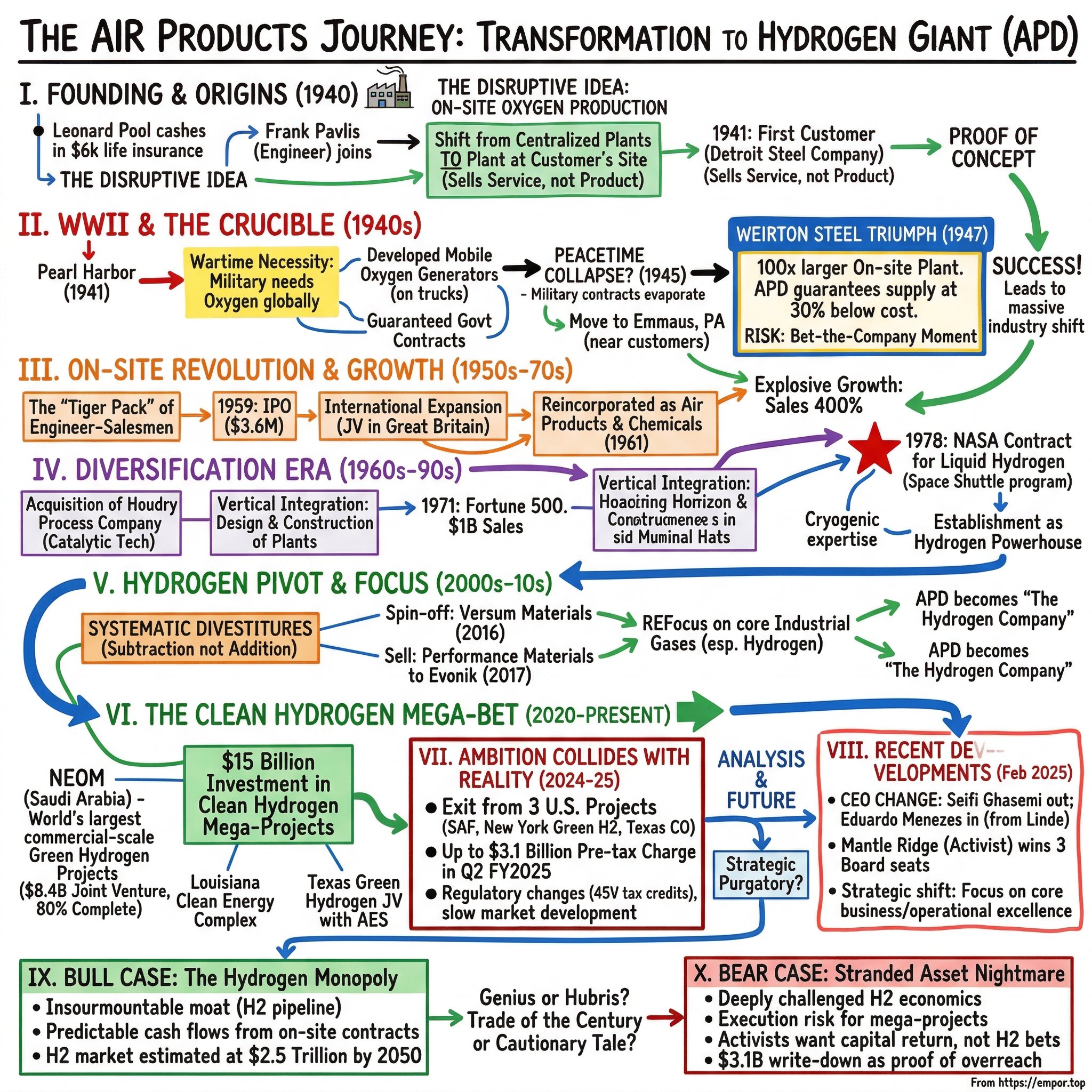
Air Products and Chemicals (APD): The Industrial Gas Giant's Capital Reset & Clean Energy Bet
I. Introduction & Episode Roadmap
On the morning of June 30, 2026, Air Products issued a press release running barely two pages. It announced that the company would not proceed with the Louisiana Clean Energy Complex — a blue hydrogen and ammonia megaproject in Darrow, Louisiana, that represented the single largest capital commitment in the company's eighty-six-year history. The stated rationale was clinical: "expected financial returns not meeting stringent return criteria."7
The financial impact was substantial. One month later, Air Products reported a quarterly operating loss of $2.1 billion and a loss per share of $6.47, absorbing roughly $2.9 billion of pre-tax charges to write down assets and terminate contracts.1 The project, originally announced in 2021 with a $4.5 billion price tag, was expected to consume as much as $9 billion by the time it was canceled.19
What turns this write-off into a broader corporate study is that during the very same quarter, the core underlying business performed exceptionally well. Adjusted operating income rose 9%, adjusted earnings per share increased 12% to $3.47, operating margins expanded, and management raised full-year guidance.1 The contrast highlights two distinct ledgers within one company: a traditional business that processes air and natural gas into contracted, inflation-indexed cash flows with toll-road predictability, alongside a decade of capital deployed into a clean-hydrogen economy that failed to materialize on schedule.
That divergence frames the primary investment question. Air Products carries a market capitalization of roughly $68 billion as of late August 2026, compared to roughly $225 billion for Linde and $106 billion for Air Liquide. Although all three sell substantially identical molecules to similar industrial customers, the market values them dramatically differently — reflecting differences in capital allocation rather than basic chemistry.
The central question: How does a business with one of the most durable contract structures in industrial history — fifteen- to twenty-year supply agreements with energy costs passed straight through to the customer2 — end up requiring activist intervention to restore capital discipline?
Three main threads define this story:
The physics of moats. Industrial gas is less about branding or proprietary technology than geography. An industrial gas plant built on a customer's fence line, connected by pipeline under a twenty-year contract, creates a formidable competitive moat — until the customer's end market shrinks, or if the plant was never backed by a firm contract to begin with.
The trap of uncontracted speculation. Air Products' FY2025 annual report acknowledged a sharp departure from its traditional model, disclosing that its large-scale clean hydrogen projects "are being built before finalization of offtake agreements for a substantial percentage of expected production."2 This risk-factor disclosure lies at the core of the company's recent capital allocation challenges.
Activism, twice. Seifollah "Seifi" Ghasemi joined the Air Products board in 2013 as one of three directors installed under pressure from Bill Ackman's Pershing Square Capital Management.16 He departed in January 2025 after shareholders declined to re-elect him during a proxy contest launched by Mantle Ridge.5 His arrival and departure offer a clear case study in the mechanisms and outcomes of public-market governance.
The analysis that follows examines how on-site gas economics function, why "take-or-pay" provisions can prove more fragile than assumed, how Air Products compares to Linde and Air Liquide across key operational metrics, and what indicators will signal whether the capital reset is succeeding.
 Subscribe on LinkedIn
II. The Business Model Engine: The Industrial Gas Machine
Stand at the fence line of a Gulf Coast refinery and look for the industrial gas provider. There is no logo on the refinery gate. Instead, tucked against the property boundary sits a steel tower wrapped in insulation, a bank of compressors, and a pipe that crosses the fence line into the customer's facility. That pipe is the business: Air Products owns the tower, the refinery owns the property, and the pipe represents the contract.
What the company actually sells. The product portfolio splits into two distinct families. The first consists of atmospheric gases — oxygen, nitrogen, and argon — separated directly from ambient air. The production method is cryogenic distillation: air is chilled until it liquefies at temperatures near minus 190 degrees Celsius, then boiled off in a distillation column to capture each gas as it evaporates at its specific boiling point. Operating much like a refinery's distillation column run several hundred degrees colder, an air separation unit (ASU) relies on electricity as its primary operating cost.2
The second family comprises process gases — primarily hydrogen and carbon monoxide — which cannot be extracted from air and must be synthesized. The dominant production method is steam methane reforming, reacting natural gas with high-temperature steam over a catalyst to strip hydrogen atoms from methane molecules. Air Products' FY2025 annual filing candidly describes its baseline production: "We primarily produce gray hydrogen"2 — hydrogen derived from fossil methane with the carbon dioxide byproduct vented into the atmosphere. The company's recent strategic initiatives in blue and green hydrogen represent attempts to shift away from that legacy baseline.
Three ways to deliver a molecule, three different businesses. Delivery economics dictate profitability far more than the chemical composition of the molecule itself.
On-site and pipeline operations form the core of the business. Air Products constructs dedicated facilities adjacent to major, steady industrial consumers — such as refineries, chemical complexes, steel mills, and semiconductor fabrication plants — or supplies them through regional pipeline networks. These arrangements operate under long-term contracts lasting fifteen to twenty years for major hubs, or ten to fifteen years for smaller on-site units, featuring fixed monthly facility fees, minimum purchase commitments, and price escalation clauses tied to inflation metrics.2 Crucially, volatile raw material inputs — including electricity and natural gas — are passed through directly to customers via contractual formulas, surcharges, and tolling structures.2 Under this framework, the company functions more like an infrastructure landlord receiving predictable rents than a commodity producer. On-site delivery accounts for roughly half of total company sales.2
Merchant liquid represents the intermediate business tier. Gases are liquefied, transported via cryogenic tank trucks, and stored in insulated vessels at customer locations. Margin performance in this segment depends heavily on route density — the concentration of customers per delivery route. Contracts are shorter, generally capped at five years, and lack minimum purchase commitments.2 Consequently, merchant liquid is structurally exposed to broader macroeconomic cycles.
Packaged gases — cylinders distributed to smaller workshops, medical facilities, and laboratories — represent the highest-touch, most operationally fragmented segment. Air Products maintains packaged gas operations across Europe, Asia, and Latin America.2 However, the company lacks significant packaged gas infrastructure in the Americas. Management explicitly acknowledged this limitation during the third-quarter FY2026 earnings call, when Chief Financial Officer Melissa Schaeffer noted that the absence of a substantial Americas packaged gas business limits the company's ability to implement broad price increases to offset rising regional costs, leaving it reliant on liquid bulk pricing actions.8 This structural gap creates a competitive disadvantage relative to Linde and Air Liquide, both of which maintain dense distribution networks in the region.
The oligopoly and what it is worth. In its FY2025 Form 10-K, Air Products identifies three major global peers — Air Liquide, Linde, and Messer Group — alongside smaller regional producers, describing its core competitive advantage directly: "We derive a competitive advantage in locations where we have pipeline networks."2 Advantage stems not from proprietary technology or consumer brand equity, but from physical pipeline infrastructure. Regional industrial gas sales generated over 90% of consolidated revenue in FY2025, with atmospheric gases contributing approximately half of that total.2
Customer concentration remains relatively low for a heavy industrial supplier: no single client accounts for more than 10% of consolidated revenue, though sales are concentrated across the refining, chemical, and electronics sectors under long-term agreements.2 Physical operational density is reflected across its global footprint, comprising roughly 445 production and distribution facilities in the Americas, 300 in Asia, 245 in Europe, and 20 across the Middle East and India.2 Rather than sprawling manufacturing plants, these facilities primarily function as compact, highly automated nodes stationed near end-demand centers.
Helium represents an exception to standard industrial gas economics and has driven significant earnings volatility over recent quarters. Because helium is extracted as a byproduct from natural gas and carbon dioxide deposits rather than drawn from the atmosphere, production cannot simply be built adjacent to customer facilities. Air Products must procure crude helium at its geological sources and manage inventory through pressurized container fleets and underground storage caverns in Amarillo and Beaumont, Texas.2 While serving high-margin end markets like semiconductor manufacturing, MRI cooling, fiber optics, and rocket-fuel systems,2 helium carries a far more complex and volatile supply chain.
Stress-testing the moat. A common narrative holds that long-term take-or-pay contracts render on-site industrial gas insulated from economic downturns. Air Products' operational record offers a more nuanced reality.
In the fourth quarter of FY2025, Air Products classified two major coal gasification plants in China as assets held for sale, recording a $425 million impairment charge citing "customer-related challenges."2 On the FY2025 earnings call, management clarified that while the facilities experienced "no operating issues," the company had been recognizing revenue only up to the amounts the counterparty was actually able to pay, eventually opting to write down the assets after months of working the problem before giving up.9 Long-term contracts cannot guarantee cash flow if the counterparty experiences fundamental financial distress; when customer economics collapse, contractual guarantees revert to legal claims.
Furthermore, contractual protections vary across delivery modes. Between FY2025 and FY2026, the merchant helium business created a substantial earnings headwind, reducing earnings by approximately $0.49 per share in FY2025, with management guiding for a similar impact in FY2026 as market tightness eased and spot prices loosened.9 Because helium operates primarily on a merchant basis rather than under on-site contracts, it remains subject to market price fluctuations.
The actual reach of the business model is specific: on-site agreements effectively secure capital recovery against volume fluctuations and shield margins from energy price volatility. They do not, however, eliminate counterparty insolvency risk, insulate against merchant market cyclicality, or protect capital deployed into facilities built without signed offtake agreements. That structural distinction lies at the heart of Air Products' recent capital allocation challenges — a dynamic rooted in how management shifted away from traditional contract discipline.
III. The Founding Vision & The On-Site Revolution (1940–1970s)
The origins of Air Products are often recounted through familiar corporate folklore — a six-thousand-dollar initial investment, a Detroit garage, and a cashed-in life insurance policy. The documented record is more nuanced. In 1940, Leonard Parker Pool incorporated the business as Industrial Gas Equipment Co., funding the venture by selling his own life insurance policy and borrowing the savings of his wife, a schoolteacher. Early operations were set up in a former mortuary.15
Pool was not an engineer. Holding a high school education, he began selling oxygen to industrial customers as a teenager and advanced to district manager at Compressed Industrial Gases by age thirty.15 His core insight was recognizing an economic inefficiency in how industrial gas was delivered. At the time, oxygen was distributed in heavy steel cylinders, with the container weighing far more than the gas inside. Because suppliers shipped these cylinders long distances by rail and truck, customers were effectively paying heavy freight charges on containers rather than the molecule itself.
Pool's solution was to invert the model: build the production generator directly on the customer's site rather than shipping gas from a distant plant. Partnering with engineer Frank Pavlis, he developed a compact oxygen generator to make on-site production commercially viable.15 This shift represented a fundamental change in business architecture. While packaged cylinder distribution operated as a high-variable-cost model with minimal customer switching barriers, on-site generation turned industrial gas into an infrastructure asset. The supplier assumed significant up-front capital expenditure in exchange for long-term, annuity-like cash flows. The core structural advantages Air Products maintains today descend from this initial trade-off.
Initial commercial adoption was slow, but World War II provided an essential growth catalyst. Air Products pivoted to manufacturing mobile oxygen generators for the military, supplying portable units for armed services operating across global theaters.15 This wartime demand gave the company necessary manufacturing scale, cryogenic expertise, and financial runway.
A major commercial breakthrough followed the war through targeted sales expansion in heavy industry. Pool focused on Pittsburgh's steel mills, securing Weirton Steel as an anchor client. For Weirton, Air Products constructed an oxygen generator described as one hundred times larger than any of its previous units.15 The project served as a proof of concept, demonstrating that on-site generation was not merely a niche solution for modest users, but an efficient architecture for heavy industrial production.
In the 1970s, Air Products secured a defining contract: a twelve-year, $281 million agreement to supply liquid hydrogen to NASA's space shuttle program, which significantly expanded company earnings.15 Managing liquid hydrogen presents major engineering hurdles: the gas must be maintained below minus 253 degrees Celsius, leaks through standard containment materials, and requires precise delivery timing tied to launch schedules. Successfully fulfilling these requirements established Air Products as a premier global hydrogen engineering specialist.
Two structural features forged during these decades remain central to the company. The first is an in-house engineering and construction organization. By designing, building, owning, and operating its production facilities, Air Products functions as an engineering contractor alongside its role as a gas supplier — an operational capability reflected in its selection as main contractor and systems integrator for the NEOM green hydrogen project rather than hiring an external engineering firm.2 The second is an equipment manufacturing division. Air Products continues to design and produce equipment for air separation, hydrocarbon recovery, and liquid helium and hydrogen transport and storage, selling cryogenic processing equipment to third parties, though equipment sales have represented less than 10% of consolidated revenue in each of the last three fiscal years.2
That specialized aerospace reputation remains active. In April 2026, Air Products disclosed that it supplied liquid hydrogen and liquid helium — using its proprietary liquid helium pumps — for NASA's Artemis II mission, while announcing a new air separation unit in Cocoa, Florida, to support commercial launch demand.11 During the second-quarter FY2026 earnings call, Menezes framed aerospace as a bright spot alongside electronics, while cautioning that commercial launch forecasts range from "extremely high to out of this world" and noting that the company needs to see how the segment actually develops.10
The historical lesson of the founding era highlights a discipline the company later strayed from: Pool accepted substantial upfront capital risk, but always against a signed contract with a committed customer. Plant construction followed the commercial agreement. Eight decades later, departing from that sequence became a central catalyst for activist proxy intervention.
Before confronting that speculative risk, however, Air Products spent several decades contending with a different failure mode.
IV. The Conglomerate Era & The Chemical Diversification Trap (1970s–2010s)
For a business with steady cash flows, capital deployment is the primary strategic challenge. Air Products' answer, for roughly four decades, was to acquire chemical companies.
The expansion began early. Houdry Chemicals joined in 1962, followed by Escambia Chemicals, known for its DABCO catalyst, in 1969.15 Over the next several decades, the portfolio accumulated polymer emulsions, surfactants, epoxy additives, and electronic materials. By the early 1990s, chemical operations generated roughly one-third of total sales, evolving from a secondary line of business into a major standalone segment.15
The initial strategic rationale appeared reasonable: several chemical products used industrial gases as feedstocks, diversification was meant to dampen cyclical swings in steel and refining demand, and specialty chemicals theoretically offered higher margins than selling bulk oxygen.
In practice, however, chemical diversification diluted the structural advantages of the core gas franchise. A specialty chemical is an uncontracted product; an on-site gas plant is a contracted asset. The chemical division had to win individual purchase orders, defend unit pricing, and continually reinvest to stave off competitive substitutes. It enjoyed none of the fifteen-to-twenty-year demand visibility, automatic energy cost pass-throughs, or physical switching barriers that protect a fence-line gas unit. Consequently, capital allocated to chemicals earned lower risk-adjusted returns and exhibited greater cash-flow variance, leading public markets to apply a conglomerate discount to the consolidated business.
The unwinding of this strategy provided a clear test of market valuation. In 2016, Air Products spun off its electronic materials business as Versum Materials, and in January 2017, it sold its performance materials division to Evonik for $3.8 billion in cash.17 Value creation became even clearer in April 2019, when Merck KGaA acquired Versum for $53 per share in cash following a competitive bidding process that saw Versum terminate a prior merger agreement with Entegris. Ghasemi, serving as Versum's chairman, described the acquisition as delivering "compelling and certain value."18
This operating history demonstrates that capital markets valued these specialty chemical assets more highly as independent entities than as divisions within an industrial gas conglomerate. The diversification strategy failed not because the acquired chemical businesses were inherently weak, but because they absorbed capital that could have compounded within a higher-return core business, while adding structural complexity that obscured underlying corporate returns.
Beyond capital allocation, conglomerate structures create operational complexity by diluting executive focus. Managing an on-site industrial gas network requires different operational metrics, commercial customer relationships, and investment cycles than operating a specialty surfactant business. The portfolio simplification initiated in the 2010s effectively reallocated executive focus back to core operations. Yet that focus soon shifted toward a new class of large-scale initiatives that carried structural risks distinct from the legacy gas business.
A final portfolio adjustment underscored this strategic pivot. For years, Air Products maintained a leading proprietary position in coil-wound heat exchangers for liquefied natural gas processing. On September 30, 2024, the company completed the sale of that business to Honeywell International for approximately $1.8 billion, generating a pre-tax gain of roughly $1.6 billion after the division delivered $135 million in operating income in FY2024.2
This systematic portfolio pruning was executed rapidly under executive leadership backed by activist shareholders, setting up the strategic shift that followed.
V. The Seifi Ghasemi Era: Ackman, Activism & The Great Focus (2014–2020)
In July 2013, Pershing Square Capital Management disclosed a stake of nearly 10% in Air Products.16 Industrial gas suppliers were rarely targeted by activist investors; they were typically viewed as steady, cash-generative compounders rather than candidates for corporate restructuring.
By late September 2013, Air Products announced that chairman and chief executive John E. McGlade — who had led the company since 2007 — would retire in 2014. Three new directors supported by Bill Ackman's hedge fund joined the board immediately, replacing three incumbent members. Among the new directors was Seifi Ghasemi, then chief executive of specialty chemical maker Rockwood Holdings.16 Nine months later, Ghasemi assumed the CEO role.
Ghasemi brought an engineering background, extensive industrial experience, and a reputation for direct management, centralized authority, and strict corporate focus. The operational strategy was straightforward: eliminate redundant management layers, sell or spin non-core chemical divisions, and direct capital strictly into the core industrial gas franchise.
Execution moved rapidly. Beyond the divestitures of Versum Materials and the performance materials business, Ghasemi targeted legacy corporate overhead. Reducing cost in a fixed-asset business backed by long-term customer contracts flowed directly to operating margins, yielding immediate profit improvements.
For roughly six years, the strategy delivered what shareholders sought: expanding operating margins, a rising dividend, and a pure-play industrial gas focus.
Two aspects of this initial turnaround, however, warrant deeper scrutiny.
First, activist firm Mantle Ridge later challenged the company's historical performance claims. During a subsequent proxy contest, Mantle Ridge alleged that Air Products' retrospective marketing materials overstated its operational progress — arguing that actual margin expansion since 2014 was roughly half the amount claimed, and that the earnings-per-share growth rate presented for 2014 through 2025 was overstated by about 25%, compounding into a cumulative gap of roughly 50% over the decade.12 While these assertions represented an activist's claims during a proxy battle rather than adjudicated findings, they raised specific arithmetic questions regarding how management presented its historical record.
A second issue involved governance. Ghasemi served simultaneously as chairman, president, and chief executive. The board reconstituted under activist pressure in 2013 remained largely unchanged a decade later as the company embarked on its clean energy investments. Mantle Ridge later charged that the board lacked independent industrial gas operating expertise and had allowed ten years to pass without establishing a credible succession plan.12 Concentrated executive authority proved effective when streamlining legacy operations under predictable contracts, but it created structural vulnerability when management shifted toward higher-risk capital deployment.
Finally, capital allocation discipline during this period was tested primarily on traditional, contracted industrial gas assets. Acquiring refinery hydrogen plants backed by long-term supply agreements carried minimal commercial risk. The true test of capital discipline would occur when management directed capital toward large-scale, uncontracted speculative projects.
That test arrived around 2020.
VI. The $15 Billion Clean Hydrogen Mega-Bet & Strategic Drift (2020–2024)
The strategic case for clean hydrogen around 2020 appeared compelling, and Air Products possessed distinct capabilities to pursue it. Decarbonizing heavy industry, transportation, and heating required zero-carbon energy vectors, and Air Products had accumulated decades of experience producing, liquefying, storing, and transporting hydrogen since its work with the U.S. space program in the 1960s.
Ghasemi committed the company to this thesis. After six years of reassuring investors that Air Products would focus strictly on core industrial gas operations, management began approving multi-billion-dollar energy transition projects across three continents.
The centerpiece was the NEOM Green Hydrogen Project on Saudi Arabia's Red Sea coast. Air Products became an equal one-third partner alongside ACWA Power and NEOM Company in a joint venture, NEOM Green Hydrogen Company (NGHC), to construct a green ammonia facility powered by dedicated solar and wind energy. In May 2023, NGHC finalized a $6.7 billion engineering, procurement, and construction contract naming Air Products as primary contractor and system integrator, while securing approximately $6.1 billion in non-recourse project financing expected to cover about 73% of total project costs. The facility sits on land secured under a fifty-year lease from the NEOM partner.2
This corporate structure was unusual and central to the strategic risks that followed. Although Air Products holds only one-third of the voting rights, it acts as the exclusive offtaker for the plant's output under a long-term "take-if-tendered" agreement. Because substantially all joint venture activities are conducted on its behalf, Air Products consolidates NGHC onto its balance sheet as a variable interest entity within its Middle East and India reporting segment.2 Consequently, Air Products carries the joint venture's assets and multi-billion-dollar project debt on its balance sheet, while committing to purchase all production from the facility — at a price management repeatedly described as essentially fixed — for thirty years.8
The second major pillar was the Louisiana Clean Energy Complex in Darrow, Louisiana. Designed as a blue hydrogen facility, it was planned to produce 1,700 metric tons of hydrogen per day by reforming natural gas and capturing byproduct carbon dioxide, with carbon sequestration wells beneath nearby Lake Maurepas designed to store five million tons of carbon dioxide annually.19
Alongside these major developments sat a portfolio of smaller energy-transition projects. These included a green liquid hydrogen facility in Massena, New York, designed to produce 35 metric tons per day alongside distribution and dispensing operations; a sustainable aviation fuel expansion with World Energy in Paramount, California; a carbon monoxide project in Texas; a zero-carbon liquid hydrogen facility in Casa Grande, Arizona; a hydrogen project in Edmonton, Alberta; and a joint venture in China formed to develop clean hydrogen infrastructure.472
In aggregate, this portfolio transformed the company's financial footprint. Across fiscal years 2024 and 2025 combined, Air Products spent approximately $13.8 billion on capital expenditures — a two-year outlay approaching the company's total net plant and equipment balance from a few years earlier. Over that same two-year period, the business generated about $6.9 billion in operating cash flow while paying out roughly $3.1 billion in dividends.3 This capital deployment marked a departure from the business model of an infrastructure landlord collecting contracted fees, shifting the company into the higher-risk role of a speculative project developer.
The structural shift was also evident in how these exposures were financed and accounted for. While NEOM's debt appears on Air Products' consolidated balance sheet, it is non-recourse to the parent company, meaning joint venture assets can only be used to settle joint venture obligations.2 Meanwhile, the World Energy exposure was structured not as equity, but as a financing receivable. Air Products extended credit to an entity whose key operational decisions — including feedstock procurement and customer contracting — Air Products did not control, having determined it was not the primary beneficiary of that business.2 Although each accounting arrangement was legitimate, collectively they exposed significant capital to project risks before securing firm customer commitments.
Where the thesis cracked. Traditional industrial gas development follows a strict sequence: secure long-term customer contracts first, then construct the facility. Air Products inverted that sequence. In its FY2025 Form 10-K, management acknowledged this shift directly within its risk factor disclosures, noting that its large-scale clean hydrogen projects "are being built before finalization of offtake agreements for a substantial percentage of expected production," creating uncertainty regarding future demand, pricing, and commercial terms, with corresponding risks to project returns, share price performance, and credit ratings.2
Building without signed offtake agreements fundamentally altered the company's risk profile. Without contracted end-users, facilities lack fixed monthly facility charges, minimum take-or-pay volume commitments, inflation-indexed escalators, and automatic input cost pass-throughs. Instead of operating as a low-risk infrastructure owner, Air Products became exposed to merchant commodity market risks.
Commercial demand failed to materialize on schedule due to three compounding factors.
First, the market encountered a classic structural deadlock: potential industrial adopters hesitated to invest in hydrogen-compatible equipment before reliable supply existed, while producers faced high costs building supply without committed buyers. As Lux Research analyst Cansu Doganay noted following the Louisiana cancellation, "There is no demand, especially in the US, for low-carbon hydrogen."19
Second, regulatory parameters shifted. Rules governing the U.S. clean hydrogen production tax credit under Section 45V established strict power-sourcing requirements, disqualifying certain low-carbon electricity sources. Air Products detailed the impact in its financial disclosures, noting that the Massena project was canceled because "recent regulatory developments" rendered its planned hydroelectric power supply ineligible for the tax credit, alongside slower-than-expected regional hydrogen mobility adoption.4 Policy uncertainty intensified further as subsequent political shifts led to proposed restrictions and rescissions of federal hydrogen subsidies.19
Third, construction costs escalated rapidly. Capital estimates for the Louisiana facility roughly doubled from an initial $4.5 billion toward an expected $9 billion.19 On the FY2025 earnings call, Chief Executive Officer Eduardo Menezes explained that while major equipment and engineering work were largely complete, field construction costs surged as U.S. craft labor became severely constrained, with data center construction and heavy industry competing for the same specialized labor force.9 Consequently, industrial hydrogen facilities were forced to bid against the artificial intelligence infrastructure buildout for skilled craft labor.
By late 2024, these compounding pressures were clearly reflected in the company's financial statements. During fiscal year 2024, Air Products generated approximately $3.6 billion in operating cash flow while allocating roughly $6.8 billion to capital expenditures and paying $1.6 billion in dividends.3 A business long valued for capital discipline was spending billions of dollars beyond its organic cash generation to fund uncontracted mega-projects, filling the cash deficit with debt.
This expanding disconnect between cash generation and capital deployment set the stage for renewed activist intervention.
VII. Mantle Ridge Activism & The Eduardo Menezes Reset (2024–2025)
In October 2024, news broke that activist investment firm Mantle Ridge LP had accumulated a stake of more than $1 billion in Air Products.21 By the time it filed its definitive proxy materials, the firm held approximately $1.3 billion in stock and nominated a slate of four directors: Andrew Evans, Paul Hilal, Tracy McKibben, and Dennis Reilley — the last a former chairman, president, and chief executive of Praxair.[^13]12 Placing a former Praxair CEO on the ballot was not a subtle tactical choice; it encapsulated Mantle Ridge's entire thesis in a single candidate.
The case. Mantle Ridge's shareholder letter, published on December 19, 2024, leveled three core charges against incumbent management.
The first was relative underperformance. Over a five-year period, Air Products generated a total shareholder return of roughly 50%, far trailing Linde's 171%, Air Liquide's 93%, and the S&P 500's 111% — delivering what Mantle Ridge characterized as industry-worst performance among industrial gas majors.12
The second was capital misallocation. Mantle Ridge argued that management had diverted capital into high-risk, uncontracted energy transition projects rather than optimizing the core industrial gas franchise. Incremental returns on growth capital expenditure had lagged below the company's internal 10% hurdle rate, while a $270 million loan extended to World Energy raised explicit questions regarding capital discipline.12
The third was corporate governance. The letter cited a decade-long failure to establish a credible succession plan for the 80-year-old chairman and CEO, quoting Seifi Ghasemi's own declaration: "As long as I'm vertical, I'm going to be Chairman."12 To anchor its campaign, Mantle Ridge asserted that under improved operational stewardship, the stock could reach $425 per share.12 That figure reflected campaign advocacy rather than a formal valuation forecast, but it underscored the scale of the activist's ambition.
The vote. Shareholders gathered for the annual meeting on January 23, 2025, representing roughly 79.44% of outstanding shares. The vote delivered a decisive mandate.
Shareholders elected three of Mantle Ridge's four nominees — Paul Hilal, Andrew Evans, and Dennis Reilley — while rejecting Tracy McKibben. On the company side, three incumbent directors lost their seats: Charles Cogut, Edward L. Monser, and, most consequentially, Ghasemi himself, who drew roughly 76.2 million votes in favor against nearly 100.0 million withheld.5 The executive who had led the company's decade-long margin expansion was voted off his own board. Yet the proxy contest was targeted rather than indiscriminate: shareholders approved executive compensation on an advisory basis with 93.73% support and ratified Deloitte & Touche with 99.50% of the vote.5
The financial cost of the proxy fight was substantial. Air Products recorded $86.3 million in activism-related expenses during FY2025. This included $31.9 million for its own legal, professional, and advisory fees; $29.7 million in executive separation costs following the CEO transition — including $22.4 million in non-cash accelerated equity vesting — and $24.7 million to reimburse Mantle Ridge for its proxy campaign expenses, approved unanimously by the board with Hilal abstaining.2
The new operator. On February 4, 2025, the board named Eduardo F. Menezes as chief executive, effective February 7. At 61, Menezes brought an operational background tailored to address shareholder concerns: over three decades of leadership at Praxair and Linde, including serving as executive vice president for Europe, the Middle East, and Africa following the 2018 Praxair-Linde merger. In that role, he managed operations spanning more than forty countries, $8 billion in revenue, and 18,000 employees. Concurrently, the board separated Ghasemi's dual roles, appointing Wayne T. Smith as chairman and Reilley as vice chairman.6
The kitchen sink. Twenty days into his tenure, on February 24, 2025, Menezes initiated a sweeping capital reset. Air Products disclosed that following a strategic review, it would exit three major U.S. clean-energy projects: the World Energy sustainable aviation fuel expansion in California, the Massena green hydrogen facility in New York, and a carbon monoxide project in Texas. The company estimated pre-tax write-downs of up to $3.1 billion and cash exit costs capped at $800 million.4
That initial disclosure included a reassuring commitment that would prove short-lived: management noted it did "not currently expect any additional material cancellations going forward."4
By the close of FY2025, total impairment and restructuring charges reached approximately $3.7 billion pre-tax, or $3.0 billion after tax — equivalent to $13.68 per share. The final tally comprised roughly $2.4 billion for the three U.S. project exits, $755 million for smaller energy-transition developments across the global portfolio, and $425 million for the two Chinese coal gasification facilities.2 The World Energy exit alone accounted for nearly $1.9 billion, consisting of a $1.6 billion equipment write-down and a $300 million credit loss provision on a non-accrual financing receivable.2
These charges heavily impacted GAAP results. For FY2025, Air Products reported a GAAP operating loss of $877.0 million and a net loss of $1.74 per share, compared to operating income of $4.5 billion and earnings per share of $17.24 in FY2024.3 Underneath the write-downs, however, the core gas franchise remained cash-generative: adjusted operating income reached $2.86 billion, adjusted EBITDA totaled $5.08 billion, and adjusted EPS landed at $12.03 — down 3% year-over-year, but exceeding the midpoint of management's prior guidance.32
During the November 2025 earnings call, Menezes outlined a measured operational discipline. He noted that the company was setting achievable targets, pointing to a 10.1% return on capital and an operating margin of 23.7% in line with earlier commitments.9 His strategic plan emphasized three clear targets: sustaining high single-digit annual EPS growth, reducing annual capital expenditures to roughly $2.5 billion once remaining mega-projects wrap up, and capturing $250 million in annual savings by trimming 3,600 positions — roughly 16% of the workforce — since 2022.9
That plan marked the formal shift back toward core operational discipline. Whether that operational reset can endure through the remainder of 2026 remains the central test for Air Products' leadership.
VIII. Financial Architecture, Segment Breakdown & Comps Benchmarking
An inspection of the fiscal year 2025 income statement reveals two distinct financial profiles separated by a single line item. Above the line for business and asset actions sits a steady, high-margin industrial gas franchise. Below it lies the substantial financial fallout from the clean-hydrogen program. Evaluating Air Products requires assessing both ledgers simultaneously, and the regional segment details clarify how the core business actually generates cash.
The base, in FY2025. In fiscal year 2025, baseline sales reached $12.04 billion, a 1% decline as a 4% dip in volumes was partially offset by pricing gains and energy cost pass-throughs. Adjusted EBITDA edged up 1% to $5.08 billion, while the adjusted operating margin contracted 70 basis points to 23.7%. Operating cash flow totaled $3.26 billion, of which dividends absorbed $1.58 billion, marking the company's 43rd consecutive year of dividend growth — a streak extended to 44 years when the board raised the quarterly payout to $1.81 per share in January 2026.3220
Contrasting with that operational cash generation were additions to plant and equipment of $7.02 billion in fiscal year 2025, following $6.80 billion in fiscal year 2024.3 For two consecutive years, capital expenditures outstripped operating cash flow by more than $3 billion annually. To fund this deficit, long-term debt rose to $16.77 billion by the end of fiscal year 2025, up from $13.43 billion a year earlier.3 This cash gap provided the core quantitative justification for the activist campaign.
Segment by segment. A segment breakdown illustrates where earnings originate. In fiscal year 2025, the Americas generated $5.13 billion in sales and $1.52 billion in segment operating income. It remains the company's largest and most profitable region, anchored by a Gulf Coast network that Air Products describes as the world's largest hydrogen pipeline system, serving major refinery hubs across Texas and Louisiana.27 Asia contributed $3.27 billion in sales and $851 million in operating income, driven primarily by semiconductor and electronics demand. Europe delivered $2.98 billion in sales and $845 million in operating income. The Middle East and India segment operates under a fundamentally different model, generating $136 million in direct sales alongside $341 million in equity affiliates' income, driven largely by Saudi joint ventures.2
The Corporate and Other segment — encompassing equipment operations such as Rotoflow turbomachinery and Gardner Cryogenics transport containers — recorded $520 million in sales and a $367 million operating loss, a deficit expanded by the divestiture of the liquefied natural gas heat exchanger business.2
The accounting structure of the Middle East and India segment requires careful examination. The Jazan gasification complex is owned through JIGPC — a joint venture with Saudi Aramco Power Company, ACWA Power, and Air Products Qudra — which supplies electricity, steam, hydrogen, and industrial utilities to Aramco's refinery and terminal complex under a 25-year agreement initiated in early fiscal year 2022. Air Products accounts for its 55% stake via the equity method, carrying a book value of approximately $3.1 billion. Crucially, the joint venture recorded financing receivables upon acquiring the assets and recognizes financing income across the contractual term.2 As Chief Financial Officer Melissa Schaeffer noted during the third-quarter fiscal year 2026 earnings call, these earnings contributions naturally decline over the contract life as the financing receivables amortize.8 Consequently, treating Jazan's earnings as a steady perpetual annuity misunderstands the amortizing structure of its underlying cash flows.
Equity affiliates' income across the global footprint has trended higher, with the Middle East and India segment generating $101 million in the third quarter of fiscal year 2026, an 18% year-over-year increase.1 Schaeffer clarified during the earnings call that the quarter benefited from a temporary contractual timing preference tied to joint venture preferred dividends, cautioning that the run rate would normalize in the fourth quarter.8 Explicitly contextualizing temporary accounting bumps reflects management's commitment to transparent reporting under the new leadership.
The FY2026 recovery, and what drove it. Beneath the non-cash restructuring charges, operational performance across fiscal year 2026 has shown clear improvement. Adjusted earnings per share rose 10% in the first quarter, 19% in the second, and 12% in the third, prompting management to raise full-year guidance twice to a range of $13.39 to $13.49, representing 11% to 12% annual growth.111 By the third quarter of fiscal year 2026, the adjusted operating margin expanded 110 basis points to 25.6%, return on capital reached 11.7%, and leverage stood at a net debt-to-EBITDA ratio of 2.1 times.18
The underlying drivers of this growth are more revealing than the headline numbers. Earnings gains were driven by expanding on-site production volumes — as new facilities commissioned in Asia and the Americas, while U.S. Gulf Coast refineries operated at high utilization — along with pricing discipline and structural productivity, including roughly $75 million in headcount savings realized over the first nine months of the fiscal year.8 In addition, Asia results benefited from two non-operational factors: the cessation of depreciation on Chinese gasification assets reclassified as held for sale, and the collection of previously reserved past-due receivables, each contributing approximately 1.0% to 1.5% to regional performance.8 While providing immediate cash benefits, management noted that these accounting tailwinds do not represent recurring operational expansion.
Reflecting capital discipline, management reduced full-year capital expenditure guidance from approximately $4.0 billion to $3.5 billion, citing project cancellations, lower maintenance spending, and adjusted payment schedules.1 Over the first nine months of fiscal year 2026, the company approached free cash flow breakeven after capital outlays, generating $3.31 billion in operating cash flow against $3.35 billion in capital additions and $1.20 billion in dividend payouts, with the remaining gap funded by drawing cash balances down from $1.86 billion to $981 million.1
The peer comparison, honestly framed. Comparing these metrics against global peers highlights the operational gap Air Products is working to close.
In calendar year 2025, Linde reported sales of $34.0 billion, an adjusted operating margin of 29.8%, adjusted earnings-per-share growth of 6%, operating cash flow of $10.4 billion, a project backlog of $10.0 billion, and a return on capital of 24.2%. Over the same period, Linde returned $7.4 billion to shareholders through dividends and share repurchases while allocating $5.3 billion to capital expenditures.13 Air Liquide reported 2025 revenue of €26.94 billion — representing 2% comparable growth — an operating margin exceeding 20%, a recurring return on capital employed of 11.2%, and a project backlog of €4.9 billion, while completing an approximate €3 billion acquisition of South Korea's DIG Airgas and raising its dividend by 12.1%.14
Evaluating these comparative figures requires three accounting and structural caveats. First, operating margin metrics are not strictly identical: Linde's 29.8% adjusted operating margin, Air Products' 23.7%, and Air Liquide's margin above 20% reflect differing accounting definitions and regional segment mixes. Second, return-on-capital calculations vary across reporting frameworks; Air Products' reported 11.7% return on capital aligns closely with Air Liquide's 11.2% recurring return on capital employed, whereas Linde's 24.2% metric reflects specific purchase-accounting adjustments stemming from its merger with Praxair. Third, business portfolios differ significantly: both Linde and Air Liquide maintain far higher exposure to dense, high-margin packaged gas distribution networks.
Even after accounting for structural differences, the overall performance gap remains clear. Linde generates higher returns per dollar of invested capital, produces roughly three times Air Products' operating cash flow on less than three times the revenue, and consistently returns excess capital to shareholders while Air Products has been absorbing capital to fund major project builds. Equity markets reflect this divergence: Air Products carries a market capitalization of approximately $68 billion compared to Linde's $225 billion, despite generating revenue equal to roughly 35% of Linde's total.
Ultimately, Air Products' core physical assets and fence-line pipeline infrastructure remain highly competitive with global peers. The primary source of historical underperformance stems not from basic operational quality, but from capital allocation decisions made between 2020 and 2024. This distinction encapsulates both the bull case for operational recovery under new leadership and the bear case for persistent capital risk.
IX. Moat Analysis: 7 Powers & Porter's Five Forces
Here is a thought experiment. Suppose a well-capitalized newcomer decided to take a specific refinery's hydrogen supply away from Air Products on the Gulf Coast. What would it actually have to do?
It would need to build a steam methane reformer at a cost running into hundreds of millions of dollars. It would need land adjacent to a refinery in one of the most congested industrial corridors in North America. It would need air permits in a jurisdiction where such permits take many months — Menezes noted that Louisiana's major source air permit alone was expected to run into mid-2026.9 It would need to persuade a refinery manager to accept construction risk and start-up risk on a molecule whose interruption shuts the plant. And it would need to do all of this to win a contract priced against an incumbent whose existing pipeline lets it serve the same customer at near-zero incremental distribution cost.
That is the moat, and it is worth naming its components precisely.
Scale economies and density. This is the primary power, and it is regional rather than global. The Gulf Coast network means that adding one more customer along the route requires a lateral pipe rather than a new plant. This is why Air Products' 10-K locates its competitive advantage specifically "in locations where we have pipeline networks" rather than in the business as a whole.2 The corollary is that density is not fungible — being strong in Texas does nothing for competitiveness in Scandinavia, a point Menezes made explicitly when pressed on Europe, arguing that Iberia, Italy, the UK and Scandinavia function as separate island markets and that margin differences versus Linde partly reflect which islands each company occupies.9 That was a defensive answer to a pointed analyst question about whether Air Products had simply handed price back to European customers, and it deserves to be read as such — but the underlying geography claim is sound.
Switching costs. A semiconductor fab or a refinery cannot tolerate an hour of supply interruption. Combine that with a physical pipe across the fence and a fifteen-to-twenty-year contract, and switching is not a procurement decision — it is a construction project. The evidence that this power is real and current sits in the FY2026 order book: on the Q3 call, Air Products described a Taiwan project that began around 2022 and involves more than five large air separation plants across multiple phases, three now complete.8 Customers do not enter four-year, multi-phase construction relationships with vendors they intend to switch.
Process power. Decades of cryogenic and hydrogen engineering are genuinely hard to replicate — proprietary liquid helium pumps for launch customers being one small, verifiable example.10 But this power should be sized carefully rather than celebrated. The company's most distinctive proprietary equipment franchise, LNG heat exchangers, was sold. And process expertise did not prevent Louisiana's cost from roughly doubling.
Cornered resource. Pipeline rights-of-way through built-up industrial corridors are close to irreplaceable under modern permitting. So, in a different way, is the helium storage cavern in Texas. On the Q3 FY2026 call, Menezes disclosed that roughly 40% of all helium volume sold in the quarter came out of that cavern, and framed the company's position candidly: with the U.S. Bureau of Land Management reserve gone, industrial gas players have become "a middleman" in helium, subject to being squeezed by customers when the market is long and by suppliers when it is short — with the cavern as the buffer that makes long-term supply commitments credible.8 That is a cornered resource honestly described, including its limits.
The five forces, and where the framework flatters the industry.
New entrants face the barriers described above. The threat is genuinely low — but note that the binding constraint is capital and permitting, both of which a sovereign wealth fund or a national oil company possesses.
Buyer power is the force most often understated. No single customer accounts for more than 10% of consolidated sales, which is real diversification.2 But concentration hides inside segments. Middle East and India earnings depend heavily on Saudi joint ventures, where the counterparty is أرامكو السعودية Saudi Aramco. On the Q3 FY2026 call, an analyst asked about the Jazan complex following an attack on the site; Menezes said the company could not comment in detail "for contractual reasons with Aramco," that there were no injuries to employees or joint venture employees, and that no financial impact was expected — while noting that Aramco itself had not yet commented.8 Whatever one concludes about the incident, the exchange illustrates the dynamic: when the customer is a sovereign-scale entity, it controls the disclosure, the contract terms, and the timetable.
Supplier power is genuinely low for energy inputs, because contracts pass those costs through.2 Helium is the conspicuous exception, and 2026 proved it: a Middle East conflict curtailed Qatari supply — Menezes noted the specific plant Air Products draws from had been down since December — forcing the company onto its cavern and container fleet.108
Substitutes barely exist. Oxygen for steelmaking and nitrogen for inerting have no chemical alternatives.
There is one more buyer-power channel that the framework tends to miss in this industry: multi-phase construction relationships give the customer optionality the supplier does not have. When a fab operator awards phase one of a five-phase site, it acquires a credible threat for phases two through five, and the incumbent's sunk position argues for accepting thinner terms to keep the site. Menezes described exactly this dynamic in reverse when explaining the Samsung award — Air Products had supplied phase one of the site, the phases have grown, and the volumes under the new agreement are roughly three times phase one.10 That is a good outcome for Air Products. It is also a reminder that in electronics, unlike a Gulf Coast refinery pipeline, the relationship is re-tested at every expansion.
Rivalry is disciplined. The competition happens at the bid, not in the market, and the FY2026 electronics wins show what that looks like: Air Products announced a Samsung project in South Korea it described as its largest-ever electronics investment, and a Taiwan agreement to build, own and operate four large air separation units with underground pipeline systems, part of over $1.5 billion of electronics project wins in six months.111 Menezes was refreshingly unwilling to take credit, saying the market is in a "super cycle" and the company is "working very hard to get our fair share."8
The calibrated verdict: the moat is real, durable, and asset-specific — it protects existing contracted positions extremely well. What it does not do, and never did, is protect capital deployed outside contracted positions. Every dollar of the write-downs sat in assets to which none of these five powers applied.
X. Historical Falsification & The Bear vs. Bull Case
Testing claim one: clean hydrogen was near-term optionality.
The strongest disconfirming evidence is not the FY2025 write-down itself, but the sequence of events that followed.
Consider the February 2025 management statement indicating that no additional material cancellations were expected.4 Tested against the subsequent record, that assumption proved overly optimistic. In the fourth quarter of FY2025, Air Products impaired two Chinese gasification plants for $425 million and recorded roughly $755 million of additional smaller-scale energy transition exits during the year.2 Then, in June 2026, the company canceled both the Louisiana and Casa Grande megaprojects, absorbing approximately $2.9 billion in further charges.71 Across two fiscal years, pre-tax business and asset restructuring charges totaled roughly $6.6 billion.
The trajectory of the Louisiana project provides the clearest test of management's guidance discipline under Chief Executive Officer Eduardo Menezes. On November 6, 2025, Menezes committed to providing a full project update "before the end of this year," stating that if he did not believe there was a reasonable chance of a resolution, "it would be much easier for me to say that today."9 In December 2025, Air Products and Yara previewed a preliminary transaction under which Yara would acquire the project's ammonia assets and take 80% of its low-carbon hydrogen over twenty-five years.19 By the April 2026 earnings call, management pushed the decision timeline to "the middle of this calendar year," while Chief Financial Officer Melissa Schaeffer stated plainly that the baseline assumption was not to proceed.10 On June 30, 2026, the project was officially terminated, and the proposed Yara asset sale was replaced by a marketing arrangement for Saudi ammonia instead.719
What does this operational record establish? It refutes the near-term optionality thesis outright. Air Products' hydrogen program converted zero of its speculative megaprojects into contracted, return-generating assets; every uncontracted unit was ultimately canceled. The record also narrows, without invalidating, the argument that new leadership offers superior forecasting. While Menezes met quarterly earnings commitments three consecutive times, his project-timeline guidance slipped by roughly six months and a commercially previewed transaction collapsed. A fair characterization is a management team that has demonstrated operational accuracy across the core business while remaining overly optimistic regarding legacy megaprojects — an improvement over prior leadership, but not yet fully proven.
Myth versus reality.
Three common market narratives about Air Products warrant evaluation against disclosed facts.
Myth: the write-downs were an accounting event, not an economic one. Mostly false. The FY2025 project exit charges were overwhelmingly non-cash — roughly $3.28 billion of the $3.62 billion total, including about $2.5 billion of plant and equipment write-downs.2 However, the underlying cash was spent years earlier during construction, and the February 2025 regulatory filing estimated direct cash exit costs alone at up to $800 million.4 A non-cash write-down of previously spent capital is not a bookkeeping detail; it is the formal recognition of economic loss.
Myth: management is now cutting everything speculative. Inaccurate as stated, and corporate disclosures have been explicit on this point. Air Products is deliberately completing select projects that management admits will not contribute materially to operating income, simply because binding contractual obligations require completion.9 The capital reset represents a stop on new uncontracted commitments, rather than a total unwinding of legacy liabilities.
Myth: the on-site model insulated the company throughout. Partially true, and an essential distinction. Adjusted operating income fell only 3% in FY2025 even as GAAP net income turned negative3 — demonstrating that long-term contracted gas agreements effectively absorb operational shocks. Yet during that same year, a Chinese joint venture established for clean hydrogen infrastructure was written off entirely, and coal gasification assets were impaired after a counterparty faced financial distress.2 The core model is resilient, but it is not immune to counterparty failure, and it never extended protection to uncontracted speculative builds.
Testing claim two: the capital allocation reset is real.
The evidence here is encouraging, though accompanied by a material qualification. Annual capital expenditure guidance dropped from roughly $4.0 billion to $3.5 billion for FY2026, aligned with a long-term target of spending $1.5 billion annually on traditional industrial gas projects and capping total capital outlays between $2.0 billion and $2.5 billion once legacy builds conclude.18 Furthermore, management tightened its project backlog criteria: inclusion now requires a final investment decision backed by verified risk-adjusted return hurdles, a long-term contract, and a creditworthy counterparty. Under this stricter standard, the traditional industrial gas backlog stands at roughly $3 billion — compared to a total backlog of about $9 billion cited by Schaeffer in April 2026, with NEOM and legacy projects accounting for the $6 billion difference.810
The qualifying factor is that Air Products continues to deploy capital into projects acknowledged to yield sub-par returns. Management disclosed that approximately $2.5 billion remains to be spent from 2026 through 2028 on underperforming legacy projects that must proceed due to commercial agreements and construction status, confirming these assets are not expected to contribute materially to operating income.9 The Edmonton hydrogen project in Alberta illustrates the issue: when asked why the company did not cancel the project following cost overruns, Menezes explained that a long-term contract covering nearly 50% of target production volume to a anchor customer rendered completion a legally binding obligation.9 That represents a necessary commercial compromise, but it underscores that a strategic reset cannot retroactively wipe away past capital commitments.
The bull case.
Air Products' underlying franchise generates approximately $5 billion in annual adjusted EBITDA from infrastructure assets protected by structural geographic moats, featuring automatic energy cost pass-throughs and inflation-indexed price escalators.23 The electronics segment — representing roughly 17% of total sales — is benefiting from a multi-year semiconductor capital expansion cycle. The company has secured over $1.5 billion in electronics commitments over a six-month span, with management projecting that helium delivery volumes to major Asian semiconductor clients will more than double between 2026 and 2030 under signed contracts.9110 Aerospace provides an additional steady growth driver backed by six decades of supply partnerships.
On the operational side, the cost-reduction program is quantifiable and largely executed. Management identified 3,600 position reductions since 2022 to capture approximately $250 million in annualized savings, with roughly $75 million recognized in the first nine months of FY2026.98 Financial leverage has normalized to a net debt-to-EBITDA ratio of 2.1 times, and executive guidance indicates share repurchases could resume by late FY2027 or early FY2028 after funding high-return organic projects and the dividend.8
Finally, project risk at NEOM has been partially mitigated. The Yara marketing and distribution agreement, finalized in the third quarter of FY2026, transfers what Menezes termed "volume risk" — the operational burden of taking delivery of every ton of ammonia from a continuous-run plant — to an international partner equipped with specialized shipping fleets and global distribution infrastructure.8
The bear case.
The primary risk centers on what the Yara agreement did not resolve. Menezes addressed the distinction directly: "you should see that as a way to eliminate the volume risk. We still retain the price risk."8 Air Products remains obligated to purchase NEOM's green ammonia at a fixed contractual price for thirty years while selling the output into volatile global commodity markets. When pressed by analysts to quantify the financial impact at full production in 2027, Menezes declined three times, stating only that no earnings impact is expected in FY2027 due to initial plant commissioning, with formal guidance provided annually starting in FY2028.8 Investors are effectively underwriting a thirty-year commodity price exposure whose net return profile remains undisclosed. This represents the largest unquantified financial exposure on the balance sheet, alongside roughly $4.9 billion in consolidated joint-venture project debt that remains on-balance-sheet until plant commissioning permits deconsolidation.28
Second, asset recovery estimates carry execution risk. Management intends to redeploy equipment from the canceled Louisiana site across internal air separation and hydrogen networks while attempting to sell the two 4,000-ton-per-day ammonia trains as packaged units. While Menezes noted that a 50% capital recovery estimate was "not a bad estimate," he cautioned that any historical figure was preliminary and declined to provide a recovery schedule.89 Financial models should not treat those proceeds as realized.
Third, geopolitical risk directly impacts operations. During 2026 alone, Middle East conflicts disrupted Qatari helium supplies; regional shipping risks in the Strait of Hormuz entered corporate guidance assumptions; global ammonia prices surged near $1,000 per ton; and the Jazan infrastructure complex — an equity-method investment carried at a $3.1 billion book value — sustained a military attack.1082
Fourth, regional merchant markets remain sluggish. Menezes characterized Europe as a difficult operating environment hampered by a stagnant industrial base, while describing China as structurally oversupplied despite modest demand recovery, operating in a broader market where industrial producer prices have trended negative for years.89
Fifth, balance sheet flexibility remains constrained. CFO Schaeffer reiterated on consecutive earnings calls that management remains committed to restoring the company's credit rating to the A/A2 tier over the long term — an explicit acknowledgment that current leverage metrics remain elevated relative to corporate targets.108
The KPIs that matter.
Evaluating the capital reset requires tracking two core metrics and one specific watch item:
Return on capital (ROC). As reported by management, return on capital represents the central benchmark of the activist campaign. The metric expanded from 10.1% in FY2025 to 11.7% by the third quarter of FY2026, offering the cleanest quantitative indicator of operational efficiency.98
Annual capital expenditure versus the $2.0–2.5 billion target. If annual outlays stabilize within this guided range while the contracted traditional backlog expands, capital discipline is intact. If capital spending drifts upward without a corresponding expansion in signed, pass-through customer contracts, legacy capital allocation patterns have re-emerged.8
Watch item: NEOM annual earnings disclosures. Management has committed to providing annual earnings guidance prior to the start of each fiscal year.8 The initial projection — expected for FY2028, given zero guided contribution in FY2027 — will provide the market's first verified financial look at a thirty-year off-take commitment currently valued largely on management assurances.
XI. Playbook: Business & Investing Lessons
Five strategic lessons emerge from Air Products' capital cycle that apply broadly across heavy industry and infrastructure investing.
Lesson 1: The contract is the asset, not the plant. Physical production facilities carry minimal structural advantage without contractual backing. The true economic value of an industrial gas plant stems from the underlying agreement specifying fifteen- to twenty-year terms, minimum purchase commitments, inflation-indexed escalators, and automatic energy cost pass-throughs.2 Without those protections, an industrial gas provider becomes a commodity producer with an exceptionally capital-intensive balance sheet — precisely the risk profile created by Air Products' uncontracted clean hydrogen portfolio. When a business relies on contract architecture rather than product differentiation for its returns, departing from that structure transforms an infrastructure compounder into a speculative commodity developer with a higher cost of capital.
Lesson 2: Regional density trumps global scale. Competitive moats in heavy industry are built on local pipeline density within specific basins rather than overall balance sheet size. Chief Executive Officer Eduardo Menezes highlighted this reality when defending European operating performance, describing Europe not as a single integrated market but as a collection of separate island markets where competitive position varies by geography.9 The same logic applies to waste management, bulk distribution, and last-mile logistics. Aggregate revenue figures obscure whether a company maintains true physical density where its assets operate.
Lesson 3: Capital discipline is a governance property, not an executive trait. Management discipline appeared robust for six years while capital was deployed exclusively into core, contracted assets. However, when executive leadership pivoted toward speculative megaprojects, concentrated authority, a passive board, and the absence of a succession plan eliminated critical operational guardrails. Strategic discipline cannot depend on a chief executive's self-restraint. Sustainable capital allocation requires structural governance mechanisms, as demonstrated by the installation of an independent chairman, a vice chairman, and directors with direct operating experience.6
Lesson 4: Activism recurs where governance structures decay. Air Products underwent two major activist interventions eleven years apart, in 2013 and 2024–2025, with Seifi Ghasemi arriving through the first and departing after the second.165 Public market activism is rarely a one-time reset; it is a recurring response to persistent capital misallocation, unaddressed succession planning, and a widening performance gap relative to direct peers. For long-term shareholders, persistent underperformance is a leading indicator of governance intervention, which brings substantial operational disruption and direct expense. The $86.3 million Air Products spent on proxy defense and executive separation costs represented only the immediate administrative friction.2
Lesson 5: Premature commercial positioning is economically indistinguishable from being wrong. Strategic foresight regarding the energy transition proved costly without synchronized market demand. Air Products correctly anticipated long-term decarbonization trends but misjudged the commercial adoption timeline, funding the expansion with balance sheet debt rather than firm customer commitments. In capital-intensive industries, sustainable growth requires not only identifying future market shifts, but refusing to deploy capital without signed offtake agreements.
XII. Epilogue & "If We Were CEOs"
Eduardo Menezes inherited a company in the middle of a major capital restructuring. Eighteen months into his tenure, the core business is performing, the write-downs are largely recorded, and balance sheet leverage is improving. What remains is a specific and finite list of strategic priorities.
First, quantify NEOM. The single largest gap in the investment case is that external investors cannot size a thirty-year fixed-price ammonia obligation. Management's stated approach — providing annual guidance prior to each fiscal year8 — is understandable given commercial confidentiality and first-of-a-kind plant commissioning. However, as long as the net exposure remains unquantified, the market is likely to apply a heavy discount to the stock. Passing quarters with guidance indicating "no financial impact expected" buy time, but they also consume management credibility.
Second, monetize the canceled Darrow assets without over-promising expected proceeds. The project's two 4,000-ton-per-day ammonia trains rely on proven technology and retain real value. The ideal path would involve selling the ammonia units as a package to a third party that subsequently contracts Air Products for industrial hydrogen and nitrogen supply, transforming a failed megaproject into a traditional on-site contract.8 That scenario represents the most productive outcome available, but it remains a potential transaction rather than a signed deal, as management has explicitly acknowledged.
Third, maintain discipline on the share buyback timeline. Management has placed share repurchases at the end of fiscal year 2027 or the start of fiscal year 2028, prioritizing high-return projects and dividend growth.8 That capital allocation hierarchy is logical for a company seeking to restore its credit rating after two years of substantial asset write-downs. Yet an ongoing electronics supercycle will continue to present growth opportunities, and justifying capital expansion over shareholder returns is precisely how the previous decade's strategic drift began. The true test of capital discipline is not merely stopping uncontracted hydrogen spending, but demonstrating the resolve to reject conventional industrial gas projects whenever marginal returns fall below internal hurdle rates.
Fourth, preserve the governance reforms that enabled the capital reset. Separating the chairman and chief executive roles, establishing a vice chairman with deep operating expertise, and maintaining board members with direct industrial gas management experience are vital structural guardrails rather than symbolic gestures.6 They serve as the primary mechanism for preventing future strategic drift.
The final reflection. Leonard Parker Pool's core insight in 1940 was that a supplier should not ship heavy steel cylinders across long distances when it could construct a production plant directly at the customer's site — and that the customer would execute a long-term contract for the privilege.15 Eighty-six years later, after a decades-long chemical diversification, a conglomerate unwinding, an initial activist turnaround, a $6.6 billion clean-hydrogen retreat, and a second proxy contest, Air Products has returned to that foundational principle: build where the customer operates, and build only after a binding contract is signed. Production technologies have evolved and the clean-energy transition may still materialize, but the fundamental economics of contract discipline remain unchanged.
XIII. Recent News & Catalysts
October 2024. Mantle Ridge's stake of more than $1 billion became public, initiating the proxy contest.21
January 23, 2025. Shareholders elected three of Mantle Ridge's four board nominees and declined to re-elect Chief Executive Officer Seifi Ghasemi, ending his eleven-year tenure.5
February 4, 2025. The board named Eduardo Menezes chief executive, effective February 7, while appointing Wayne Smith as chairman and Dennis Reilley as vice chairman.6
February 24, 2025. Air Products disclosed exits from three U.S. clean-energy projects, taking a pre-tax charge capped at $3.1 billion while assuring investors that no further material cancellations were expected.4
November 6, 2025. Reporting fiscal year 2025 results, Air Products posted adjusted earnings per share of $12.03 — above the midpoint of guidance — alongside a GAAP loss per share of $1.74.3 Management reported a return on capital of 10.1% and committed to delivering a strategic decision on the Louisiana complex before year-end.9
January 27, 2026. The board raised the quarterly dividend to $1.81 per share, marking the company's 44th consecutive annual increase.20
April 30, 2026. For the second quarter of fiscal year 2026, Air Products reported adjusted earnings per share of $3.20 — up 19% year-over-year — while raising full-year guidance, announcing a major Samsung electronics contract in South Korea, and highlighting its role supplying NASA's Artemis II mission.11 Management also noted that Qatari supply curtailments were being offset using its Texas helium storage cavern.10
June 30, 2026. Air Products formally canceled the Louisiana project and discontinued the Casa Grande facility, taking up to $2.9 billion in pre-tax charges while redirecting its preliminary agreement with Yara to off-take green ammonia from NEOM.7
July 30, 2026. In third-quarter fiscal year 2026 results, the company absorbed a $2.1 billion GAAP operating loss while generating 12% adjusted earnings-per-share growth, securing a four-unit air separation award in Taiwan, lowering annual capital expenditure guidance to roughly $3.5 billion, and raising full-year adjusted EPS guidance to between $13.39 and $13.49.1 Return on capital expanded to 11.7% as management finalized the NEOM off-take distribution agreement with Yara.8
Ahead. The fourth-quarter fiscal year 2026 results and initial fiscal year 2027 outlook will indicate whether the core business can sustain double-digit growth once non-recurring Asian accounting benefits roll off, while progress on selling the Chinese gasification units and the Darrow ammonia trains will test management's asset-recovery targets.8 Meanwhile, NEOM's commissioning timeline and its first quantified financial guidance will resolve the balance sheet's largest unpriced exposure, even as Middle East operating conditions — spanning Qatari helium flows, the Jazan joint venture, and Red Sea shipping routes — remain active operational variables.10
XIV. Outro & Links
Air Products enters the final stretch of fiscal year 2026 as a structurally transformed enterprise compared to the prior year — narrower in strategic focus, streamlined in asset mix, and more transparent in corporate disclosures. The core industrial gas franchise continues to expand at a low-double-digit pace driven by volume, pricing discipline, and structural cost reductions, supported by robust demand across the electronics sector. Meanwhile, a decade of speculative capital deployment has been narrowed to a single thirty-year, unquantified off-take commitment on the Red Sea alongside legacy builds that management has classified as non-contributing.
The central question for the next five years is not whether Air Products holds high-quality physical assets. Rather, it is whether an organization that absorbed roughly $6.6 billion in pre-tax restructuring charges to learn the distinction between a signed customer contract and speculative market demand has internalized that discipline deeply enough to resist future strategic drift — and whether its thirty-year Red Sea off-take obligation proves to be a predictable annuity or a long-term anchor.
The primary regulatory and corporate record offers detailed context for independent evaluation: the FY2025 Form 10-K risk disclosures and Note 5, which detail the financial impact of project exits; the February 2025 impairment filing outlining initial capital revisions; the January 2025 proxy vote tally detailing shareholder voting allocations; and fiscal 2025 and 2026 earnings call transcripts documenting management execution under the capital reset.
References
-
Air Products Reports Fiscal 2026 Third Quarter Results (Form 8-K, Exhibit 99.1) — U.S. Securities and Exchange Commission, 2026-07-30 ↩↩↩↩↩↩↩↩↩↩↩↩
-
Air Products and Chemicals, Inc. Annual Report on Form 10-K for fiscal year ended 30 September 2025 — U.S. Securities and Exchange Commission, 2025-11-20 ↩↩↩↩↩↩↩↩↩↩↩↩↩↩↩↩↩↩↩↩↩↩↩↩↩↩↩↩↩↩↩↩↩↩↩↩↩↩↩↩↩↩↩↩↩
-
Air Products Reports Fiscal 2025 Full-Year and Fourth Quarter Results (Form 8-K, Exhibit 99.1) — U.S. Securities and Exchange Commission, 2025-11-06 ↩↩↩↩↩↩↩↩↩↩
-
Air Products and Chemicals, Inc. Form 8-K, Item 2.06 Material Impairments (World Energy, Massena and Texas carbon monoxide project exits) — U.S. Securities and Exchange Commission, 2025-02-24 ↩↩↩↩↩↩↩
-
Air Products and Chemicals, Inc. Form 8-K, Item 5.07 Submission of Matters to a Vote of Security Holders (2025 Annual Meeting results) — U.S. Securities and Exchange Commission, 2025-01-27 ↩↩↩↩↩
-
Air Products and Chemicals, Inc. Form 8-K, Item 5.02 (Eduardo F. Menezes appointed Chief Executive Officer) — U.S. Securities and Exchange Commission, 2025-02-04 ↩↩↩↩
-
Air Products Will Not Proceed with Louisiana Clean Energy (LCEC) Project; Finalizing Agreement with Yara for Renewable Ammonia from NEOM (Form 8-K, Exhibit 99.1) — U.S. Securities and Exchange Commission, 2026-06-30 ↩↩↩↩↩↩
-
Earnings call transcript: Air Products tops Q3 2026 EPS view, lifts outlook — Investing.com, 2026-07-30 ↩↩↩↩↩↩↩↩↩↩↩↩↩↩↩↩↩↩↩↩↩↩↩↩↩↩↩↩↩↩↩↩
-
Earnings call transcript: Air Products Q4 2025 sees modest EPS beat, stock surges — Investing.com, 2025-11-06 ↩↩↩↩↩↩↩↩↩↩↩↩↩↩↩↩↩↩
-
Earnings call transcript: Air Products tops Q2 2026 forecasts, shares dip — Investing.com, 2026-04-30 ↩↩↩↩↩↩↩↩↩↩↩
-
Air Products Reports Fiscal 2026 Second Quarter Results (Form 8-K, Exhibit 99.1) — U.S. Securities and Exchange Commission, 2026-04-30 ↩↩↩↩
-
Letter to Shareholders — Mantle Ridge LP (Refreshing Air Products), 2024-12-19 ↩↩↩↩↩↩↩
-
Linde Reports Full-Year and Fourth-Quarter 2025 Results (Form 8-K, Exhibit 99.1) — U.S. Securities and Exchange Commission, 2026-02-05 ↩
-
2025: With a record performance and confident in its transformation dynamic, Air Liquide confirms its growth outlook — Air Liquide, 2026-02-20 ↩
-
History of Air Products and Chemicals, Inc. — FundingUniverse (International Directory of Company Histories) ↩↩↩↩↩↩↩↩↩
-
Air Products Bows To Pershing Square — Chemical & Engineering News, 2013-09-30 ↩↩↩↩
-
Air Products Completes $3.8 Billion Performance Materials Division Sale to Evonik — PR Newswire, 2017-01-03 ↩
-
Merck KGaA, Darmstadt, Germany, Signs Definitive Agreement to Acquire Versum Materials for $53 per Share (Versum Materials Form 8-K, Exhibit 99.1) — U.S. Securities and Exchange Commission, 2019-04-12 ↩
-
Air Products cancels blue hydrogen project in Louisiana — Chemical & Engineering News, 2026-07-01 ↩↩↩↩↩↩↩
-
Air Products Increases Quarterly Dividend to $1.81 Per Share — PR Newswire, 2026-01-27 ↩↩
-
Mantle Ridge Builds Over $1 Billion Stake in Air Products — Bloomberg, 2024-10-06 ↩↩
 LinkedIn
 WhatsApp
 Reddit
 Hacker News
 Email
Email Kindle
 RSS Feed
 Spotify
 Apple Podcasts
 Amazon Music
 Audible
 YouTube