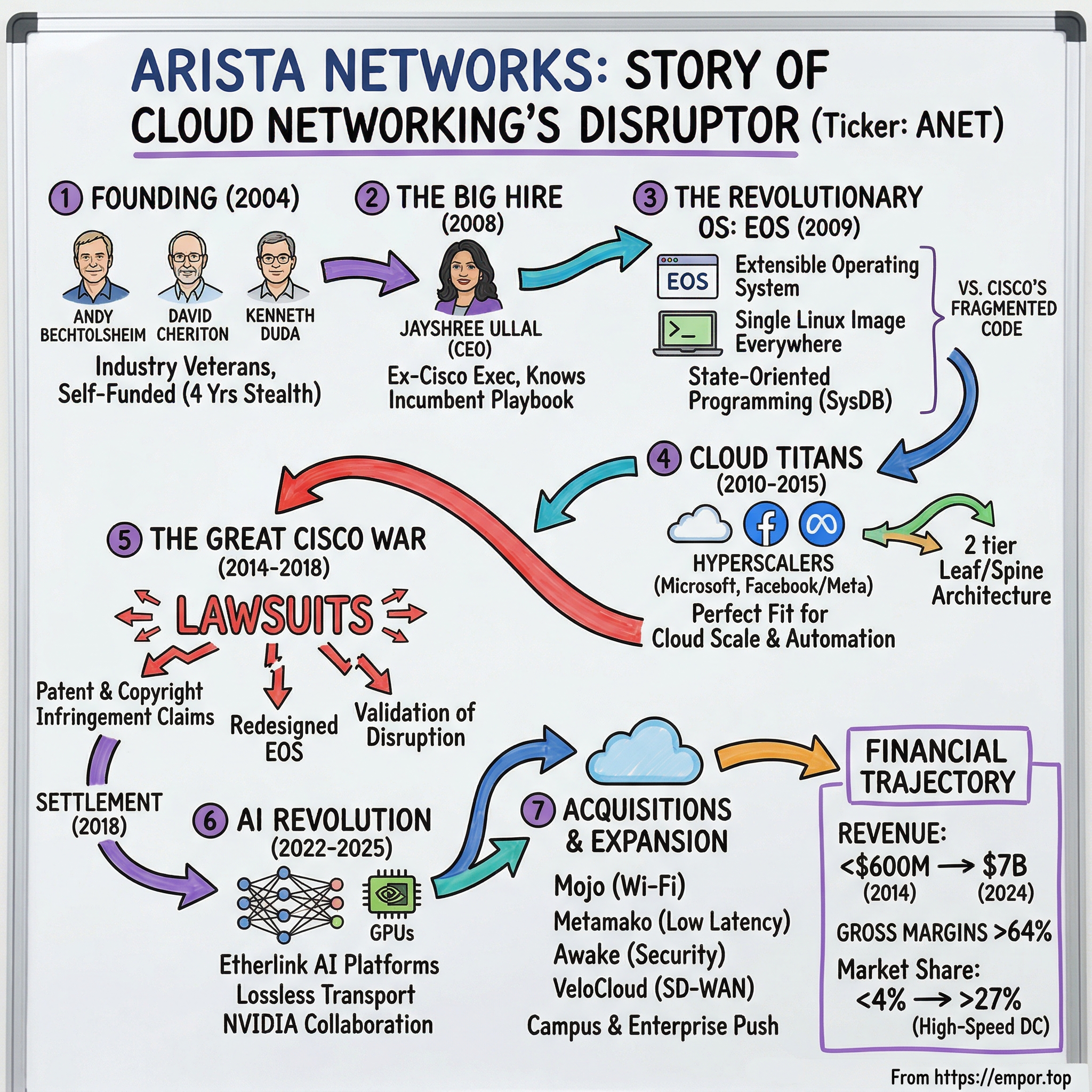
Arista Networks: The Story of Cloud Networking's Disruptor
I. Introduction & Episode Roadmap
On the afternoon of August 4, 2026, Arista Networks opened its quarterly conference call with Head of Investor Relations Rudolph Araujo reading the standard disclaimer before passing the call to Chief Executive Officer Jayshree Ullal. She immediately focused on a financial milestone: "Arista is experiencing significant demand to achieve our first $3 billion quarter in revenue," she said, adding context to the expansion: "To put this in perspective, just 5 years ago, our entire year was $2.9 billion in 2021."2
That comparison captures the scale of the company's recent expansion. A business that required an entire fiscal year to generate $2.9 billion in 2021 produced more than that amount in ninety days by mid-2026. Revenue for the second quarter of 2026 reached $3.036 billion, up 37.7% year over year.1 That performance built on full-year 2025 revenue of $9.006 billion—a 28.6% increase over the $7.003 billion generated in 2024.34 By late August 2026, public markets valued Arista at approximately $254 billion.
The central question of Arista's history is how a challenger scaled inside a market dominated by a single legacy giant. In 2004, three founders launched the business in stealth to enter a sector where Cisco Systems held near-monopolistic share. Twenty-two years later, Arista's annual report still opens its competition discussion by acknowledging that "the data center and campus networking markets have historically been dominated by Cisco."3 Yet Arista's two largest end customers—identified on earnings calls as Microsoft and Meta—together generated 42% of its 2025 revenue.322 The transformation raises an essential business question: how did an outsider capture critical market share in the infrastructure supporting hyperscale computing?
The underlying dynamics were structural rather than legendary. Arista expanded not through tactical superiority, but by taking a core architectural gamble: that merchant switching silicon would advance faster than any single vendor's internal chip design team. The company spent four years in stealth writing the specialized network operating system required to capitalize on that hardware shift. Over the subsequent decade, concentration among a small set of massive customers delivered both rapid revenue expansion and severe structural vulnerability.
This story unfolds across twelve sections. The narrative begins with the founding team and four initial years in stealth under the name Arastra. It continues with the hiring of Jayshree Ullal and the strategic counter-positioning designed to exploit Cisco's cost structure. The third section examines the initial public offering and the subsequent intellectual property litigation, which cost Arista $405 million and threatened its access to the U.S. market. The fourth section details the hyperscale expansion cycle, including a single procurement shift in November 2019 that wiped out a quarter of Arista's market capitalization in a single trading session.
Subsequent sections evaluate modern structural challenges: the artificial intelligence build-out and the competitive rivalry between open Ethernet protocols and NVIDIA's integrated architecture; governance and executive allocation practices, including an SEC insider-trading settlement involving a company founder and a say-on-pay vote that fell to 62% support; the delayed commercial impact of the enterprise campus initiative; key revenue-recognition accounting judgments; strategic frameworks analyzing competitive moats; a stress-tested bull and bear case; and the core operational metrics that will determine future performance.
Three myths worth retiring before we start
Because Arista occupies a central position in enterprise technology investing, several simplified narratives obscure its actual operational mechanics. Each myth relies on a factual core paired with an inaccurate conclusion.
Myth one: Arista won because Cisco was slow. Reality: Cisco was not slow, but structurally constrained. Its silicon cost structure and legacy software base made imitating Arista's model economically self-destructive. That constraint was specific to Cisco and does not characterize Arista's contemporary competitors.
Myth two: Ethernet beating InfiniBand means Arista wins AI networking. Reality: While Ethernet gained dominant market share, the primary immediate beneficiary was NVIDIA, which developed its own competing Ethernet platform alongside InfiniBand. According to IDC, NVIDIA secured the top market position in data center Ethernet switching in the first quarter of 2026.17
Myth three: Arista's software moat guarantees customer retention. Reality: Arista's chief executive has acknowledged that an ultra-low-price commodity segment exists "in every large market" and will manifest in AI deployments as well.2 The software moat protects market share where operational reliability governs purchasing decisions, but it offers limited defense against customers prioritizing low unit costs.
These three structural realities frame the company's evolution.
The analysis begins with the origin of the firm and a founding team whose prior financial successes shaped its initial strategy.
 Subscribe on LinkedIn
II. The Founding Trio & Stealth Genesis (2004–2008)
In 2004, the post-dot-com networking industry had settled into a predictable oligopoly. Cisco Systems set pricing, Juniper Networks targeted the carrier edge, and prevailing industry logic held that enterprise switching was a solved problem. Into this market stepped three founders with distinct technical backgrounds, substantial personal capital, and minimal financial pressure to launch a standard venture-backed startup.
Andy Bechtolsheim was a prominent hardware architect who had co-founded Sun Microsystems in 1982 and designed its initial workstation. In August 1998, he provided $100,000 in seed funding to Google prior to its legal incorporation. Bechtolsheim's approach combined component-level technical insight into silicon development with an impatience toward legacy engineering constraints. On Arista's first-quarter 2026 earnings call, Chief Executive Officer Jayshree Ullal credited him with driving the company's extended pluggable optics roadmap "from OSFP 10 years ago to this next-generation XPO."18
David Cheriton, a Stanford University computer science professor, had previously partnered with Bechtolsheim to co-found Granite Systems, a Gigabit Ethernet switching enterprise that Cisco acquired in 1996. Cheriton was also a co-investor in Google's initial seed round. His focus at Arista centered on distributed systems architecture, specifically how network devices maintain synchronized state across multiple concurrent software processes.
Kenneth Duda led the core software engineering effort. After earning bachelor's and master's degrees in computer science and electrical engineering from the Massachusetts Institute of Technology and a doctorate from Stanford, Duda managed software development for Cisco's switch kernel within its Gigabit System Business Unit from 1996 to 1999. Following four years as chief technology officer at There, Inc.,21 he joined the founding team to architect the network operating system. Duda subsequently served as Arista's chief technology officer and senior vice president of software engineering from September 2011 onward, joined the board of directors in December 2023, and became president in September 2025.21
The four silent years
Founded under the name Arastra in 2004, the company was self-funded by Bechtolsheim and Cheriton rather than backed by traditional venture capital. This capital structure eliminated institutional pressures to meet short-term fund cycles, allowing the engineering team to spend four years developing software before launching a commercial switch.
The company's strategy targeted an impending shift in hardware economics. In the mid-2000s, incumbents such as Cisco and Juniper relied on proprietary application-specific integrated circuits (ASICs) tightly integrated with proprietary operating systems. Bechtolsheim anticipated that merchant silicon manufacturers, such as Broadcom, would eventually reach production volumes enabling them to out-invest proprietary chip design teams, shifting value from proprietary hardware to the operating system.
This dynamic mirrored the personal computer industry decades earlier, where standardized microprocessors reduced hardware differentiation and elevated software as the primary product differentiator. Arastra bet that switching hardware would undergo a similar transition.
Duda's software architecture resulted in the Extensible Operating System (EOS), built around a centralized state database known initially as SysDB and later evolved into NetDB. Rather than relying on direct process-to-process communication, every process wrote state updates to the database and subscribed to relevant system state. In traditional network operating systems, a failure in a single routing process could collapse the entire switch; in EOS, process state was decoupled from execution. If a process failed, it could restart, re-synchronize state from the database, and resume operation without network interruption. When Arastra formally introduced the 7100 Series on November 5, 2007—featuring the 24-port 7124S and 48-port 7148S 10-Gigabit Ethernet switches—the announcement highlighted EOS as "the first switch operating system designed specifically to meet the needs of data center networks," emphasizing modular memory, process monitoring, and in-service software updates.5
Testing the founding myth
While the standard founding narrative credits self-funding with enabling pure architectural execution, the historical record presents a more nuanced operational timeline.
Following its 2004 founding, Arastra announced its first products in late 2007, with field trials underway and commercial units scheduled for shipment in the first quarter of 2008.5 This three-year development cycle elapsed while merchant silicon capabilities advanced on an 18-month cycle. Furthermore, the company's initial commercial deployment targeted high-frequency trading firms requiring sub-microsecond latency rather than hyperscale data centers, which were not yet major infrastructure buyers.
Self-funding did not remove product-market fit risk; rather, it allowed the company to absorb early iteration cycles internally. Unlike venture-backed peers compelled to deliver rapid commercial traction, Arastra had the financial runway to refine its software architecture prior to broad market entry. This structural flexibility provided risk tolerance rather than faster execution speed, securing an architectural foundation without automatically guaranteeing customer adoption.
To translate that architecture into enterprise market share, the company required executive leadership capable of competing directly against Cisco's established commercial organization.
III. The EOS Revolution & Counter-Positioning Cisco (2008–2014)
In May 2008, Jayshree Ullal left Cisco Systems after fifteen years. She had arrived in September 1993 through Cisco's initial acquisition of Crescendo Communications, where she served as vice president of marketing, and rose to senior vice president of the data center, switching, and services group.21 Her earlier career included product and engineering roles at Ungermann-Bass, Advanced Micro Devices, and Fairchild Semiconductor.21 This background combined leadership experience inside the market incumbent with a practical understanding of semiconductor development.
In October 2008, Ullal joined the company as chief executive officer and a member of the board of directors, positions she has retained since.21 That same month, Arastra rebranded as Arista Networks.
Ullal's appointment brought commercial strategy to complement Kenneth Duda's software architecture. The strategic focus centered on identifying the economic constraints that prevented Cisco from mounting an immediate competitive response.
The incumbent's dilemma, in plain terms
In 2008, Cisco faced two structural commitments that Arista lacked.
The first was reliance on custom silicon. Cisco had spent decades investing in internal ASIC design teams, generating high hardware gross margins that formed the foundation of its corporate profitability. Broad adoption of merchant silicon would have required Cisco to concede that a substantial portion of its chip engineering investments and price premiums were no longer necessary.
The second commitment was software fragmentation. Cisco's operating systems had split across multiple product lines and acquisitions, creating distinct codebases derived from legacy IOS alongside separate operating environments for specialized platforms. Each branch required dedicated engineering teams, qualification cycles, and bug maintenance. Consequently, Cisco's software R&D spending was divided across isolated platforms, whereas Arista's R&D yielded improvements across its entire product line through a single codebase.
This dynamic illustrates counter-positioning, a model in which an entrant adopts a business strategy that an incumbent cannot replicate without damaging its existing core operations. Matching Arista's approach would have required Cisco to compress its hardware gross margins and abandon its internal silicon roadmap—a trade-off established market leaders rarely accept voluntarily.
Arista's response was a single binary image: one EOS build running unmodified across every switch in its portfolio, from top-of-rack units to modular chassis. The company has maintained this architectural commitment throughout its expansion. On Arista's second-quarter 2026 earnings call, Ullal noted that "the Arista EOS architecture" continues to perform through "its inherent state sharing, programmability and single binary," while Duda explained that this single OS allows Arista to extend new SRv6-based load-balancing capabilities "all the way from the scale-out fabric to the long-distance scale across routing."2
Where the single-binary story breaks
Despite its architectural advantages, the single binary image faced clear operational boundaries. EOS was engineered specifically for data center environments, optimizing for high-throughput Layer 2 and Layer 3 forwarding, low latency, programmatic management, and hitless software updates. It was not initially designed to serve enterprise campus networks, which require Power over Ethernet, legacy access-control protocols, wireless controller integration, and extensive compliance feature sets.
Company disclosures reflect this deliberate scope limit. Arista did not explicitly frame itself as a competitor in 1-gigabit enterprise campus switching and cloud-managed wireless until its 2020 annual report, expanding into the segment partly through acquisitions.13 Although management set a 2025 campus revenue target of $800 million and later highlighted exceeding that figure as a key milestone, the campus segment represented a modest fraction of the company's $9.006 billion total revenue in 2025.22 The enterprise campus and branch market remains an ongoing expansion target, with management setting a 2026 revenue goal of at least $1.25 billion.2
The single-binary architecture provided a decisive advantage in data center environments and adjacent routing applications, where network buyers prioritized operational simplicity and unified software maintenance. However, it offered less leverage in the enterprise campus market, where incumbent advantage depended primarily on established reseller channels, installed equipment bases, and existing building wiring. Although Arista spent nearly a decade building a presence in campus networking through internal development and acquisitions, the segment remains a secondary contributor to total revenue.
This distinction between architectural differentiation in data centers and conventional competitive dynamics in campus environments established a pattern that reemerged in subsequent growth phases. The strategic tension became fully visible in 2014, when Arista completed its initial public offering and Cisco shifted its competitive strategy from product comparison to legal challenge.
IV. The Great Cisco Litigation War & Initial Public Offering (2014–2018)
On June 5, 2014, Arista priced 5,250,000 shares at $43.00 apiece and listed on the New York Stock Exchange under the ticker ANET the following day, raising $226 million and granting underwriters an option on a further 787,500 shares.6 The pricing landed above the marketed range. Behind the listing was a business generating $584 million in annual revenue—having grown 62% in 2013 and on track for another 44% expansion that year—while maintaining gross margins in the high 60s.3
Six months later, on December 5, 2014, Cisco filed two complaints against Arista in the U.S. District Court for the Northern District of California.7 The first asserted twelve patents. The second asserted two additional patents alongside claims of copyright infringement over Arista's command-line interface—the text commands network engineers use to configure a switch.8 Ten days later, Cisco escalated the conflict at the U.S. International Trade Commission, seeking a limited exclusion order to bar Arista's 7000 Series switches from entering the United States at all.8
That regulatory filing represented an existential threat rather than a standard commercial dispute. Unlike a district court lawsuit seeking cash damages, an ITC exclusion order directs U.S. Customs and Border Protection to halt infringing products at the border. For a networking vendor that relied on contract manufacturers in Asia and sold primarily across the Americas, an import ban threatened the company's core operating model.
What actually happened
The subsequent legal proceedings unfolded across multiple regulatory and judicial fronts.
Cisco secured an initial victory on the patent front. On June 23, 2016, the ITC issued a Final Determination finding violations across three asserted patents while clearing Arista on two others, resulting in both a limited exclusion order and a cease-and-desist order.8 The presidential review period expired on August 22, 2016, without an executive veto, allowing the exclusion orders to take full effect.8
Arista responded by redesigning the affected features and petitioning U.S. Customs and Border Protection for a Section 177 ruling confirming that the modified products complied with the order. On November 18, 2016, Customs granted the approval.8 However, on January 13, 2017, following a petition by Cisco, Customs revoked the ruling—an action Arista noted in corporate filings occurred "without our input."8 The engineering workaround faced continued regulatory friction and legal challenge.
Arista prevailed entirely on the copyright claims. Following a trial that began on November 28, 2016, the jury returned a verdict on December 14 finding that Arista had established its scènes à faire defense regarding command-line interface syntax, while also finding Cisco had failed to prove infringement on the remaining patent. The court entered final judgment favoring Arista on all counts on December 19, 2016.8 The ruling affirmed that established industry-standard command syntax cannot be restricted under copyright law by the originating vendor.
Arista simultaneously pursued counterclaims, filing antitrust and unfair-competition lawsuits against Cisco, which were stayed pending the outcome of the copyright trial.8 That antitrust challenge ultimately proved decisive in shaping the final settlement terms.
On August 6, 2018, the parties executed a binding settlement. Arista paid Cisco $400 million on August 20, 2018, yielding a comprehensive dismissal of all pending district court and ITC proceedings. Cisco released Arista from past patent infringement claims, while Arista released Cisco from all antitrust and unfair-competition claims.910 The mutual release reflected a balanced outcome in which both competitors negotiated relief from substantial legal exposures.
What it cost — and what that says
While popular accounts often treat the litigation as evidence of incumbent vulnerability that validated Arista's business model, corporate disclosures reveal significant financial and operational strain.
The direct financial impact was immediate and substantial. Arista recorded a $405.0 million legal settlement expense in the second quarter of 2018, covering the $400 million payment and $5.0 million in associated legal costs.10 The charge reduced Arista's 2018 GAAP operating income to $273.3 million on $2.151 billion in revenue, compared to $470.3 million in operating income on $1.646 billion in revenue in 2017.3 Although annual revenue grew by 31%, GAAP operating profit fell by 42%. These expenses culminated years of rising overhead; general and administrative costs had already surged 134% in 2015, driven by a $39.8 million increase in legal fees connected to the litigation.8
The indirect operational costs created lasting friction. Arista established domestic manufacturing capacity in 2016 to mitigate import ban risks—a restructuring Ullal cited on the second-quarter 2026 earnings call when detailing historic supply chain disruptions: "During the lawsuit crisis, we had to build a manufacturing site in the United States in 2016, during COVID challenges in 2021, and here we are back again in 2026."2 Furthermore, regulatory uncertainty delayed customer acceptance and revenue recognition. On the third-quarter 2019 earnings call, Chief Financial Officer Ita Brennan noted that Arista recognized $80 million and $38 million in deferred product revenue during the first and second quarters of 2019, respectively, for hardware shipped and billed in earlier periods but deferred "pending customer acceptance of legal redesigns and features."11 Revenue recognition for shipments originating in 2016 extended into 2019.
The financial evidence complicates simple narratives of disruptive triumph. The outcome illustrates a broader structural dynamic: an incumbent cannot litigate away an architectural shift, but it can impose years of cost, distraction and customer delay on the disrupter — and a disrupter without a credible counterclaim would have had far less leverage to end it. Arista's antitrust suit, rather than product engineering alone, provided the leverage necessary to convert a potential import ban into a manageable settlement. Notably, Arista absorbed the financial penalty without diluting equity or taking on debt, funding the entire $400 million settlement from existing cash reserves.
By the time the settlement closed in August 2018, the litigation had ceased to be the central operational variable for Arista. A far larger market shift was already reshaping the company's trajectory.
V. Cloud Titans & The Hyperscale Gold Rush (2018–2022)
Understanding Arista’s growth between 2018 and 2022 requires examining a fundamental shift in data center design.
For decades, enterprise networks resembled pyramids: access switches at the base connecting end-user devices, aggregation switches in the middle, and a pair of high-cost core switches at the top. Network traffic moved vertically—or "north-south"—between users, central servers, and the external internet.
As cloud providers constructed hyperscale facilities, traffic patterns inverted. Data center communications shifted primarily to "east-west" traffic—server-to-server exchanges generated thousands of times per user query as distributed services assembled web pages. The legacy pyramid structure created severe bottlenecks, forcing horizontal traffic to traverse the core switch.
Cloud architects resolved this by adopting the leaf-spine, or Clos, fabric: a flat, two-tier mesh where every leaf switch connects directly to every spine switch. In this model, any server sits a predictable two hops from any other, allowing networks to scale horizontally by adding identical switches rather than upgrading to larger core chassis. This design required large volumes of high-speed, uniform, and programmable switches.
Arista spent a decade developing hardware and software tailored for leaf-spine environments before hyperscale demand materialized. Chief Executive Officer Jayshree Ullal highlighted this timing on the second-quarter 2026 earnings call, noting, "Over a decade ago, we pioneered the use of leaf and spine topologies in the data center and cloud networks."2
Why open software mattered more than fast hardware
A critical operational distinction separated hyperscale buyers from traditional enterprise accounts. Hyperscalers manage infrastructure through software automation rather than manual configuration, using internal management platforms to deploy, monitor, and update thousands of network devices automatically.
Consequently, a switch's application programming interface (API) surface became as vital as its raw port speed. Equipment requiring proprietary management consoles could not integrate into automated cloud environments. EOS, designed on a Linux foundation around a central state database accessible via software APIs, matched this automated operating model natively. Rather than developing features reactively for cloud clients, Arista's underlying software architecture—designed by Kenneth Duda in 2004—aligned directly with emerging hyperscale requirements.
This architectural fit resulted in high customer concentration. Two end customers accounted for over 10% of Arista's annual revenue in 2023, 2024, and 2025—reaching 26% and 16% in 2025, 20% and 15% in 2024, and 18% and 21% in 2023.3 While annual filings omit client names, Ullal confirmed their identities on the first-quarter 2026 conference call: "Microsoft and Meta, they're all-time favorites. They've been on 10% and greater customers for over a decade."18 By 2025, approximately 42% of Arista's $9.006 billion in total revenue depended on just two customers.
The November morning
This customer concentration culminated in the most volatile trading session in Arista's history as a public company.
Through late 2019, market consensus framed hyperscale capital expenditure as a consistent driver of high-margin growth. Third-quarter results appeared to support that thesis, with revenue reaching $654.4 million—up 16% year over year—alongside non-GAAP gross margins of 64.4%, record new customer additions, and spending from both Microsoft and Facebook exceeding the 10% revenue threshold.11
During the October 31, 2019 earnings call, Ullal issued forward guidance that disrupted market expectations, explaining: "After we experience the pause of a specific cloud titan's orders in Q2 2019, we were expecting a recovery in second half 2019 for cloud titan spend. In fact, Q3 2019 is a good evidence of that. However, we were recently informed of a shift in procurement strategy with a material reduction in demand from a second cloud titan, reducing their forecasts dramatically from original projections for both Q4 2019 and for calendar 2020."11
The reduction stemmed neither from broad macroeconomic contraction nor product failures, but from an abrupt shift in procurement policy at a single key customer. Chief Financial Officer Ita Brennan subsequently guided fourth-quarter revenue down to between $540 million and $560 million—compared to the $654.4 million generated in the third quarter—and projected operating margins to compress from 39.4% to approximately 36%, while advising analysts to project flat-to-declining cloud titan revenues for 2020.11
On November 1, 2019, Arista's stock fell 24% in a single session, closing at $11.58 on a split-adjusted basis down from $15.29 the previous day, accompanied by trading volume exceeding five times its average.12
Financial results confirmed the severity of the concentration risk. Full-year revenue fell 3.9% from $2.411 billion in 2019 to $2.318 billion in 2020.3 After compounding annual revenue at over 40% throughout the preceding decade, Arista recorded a full year of contraction due to inventory adjustments by two major buyers.
This outcome disproved the premise that hyperscale capital expenditure represents an uninterrupted growth driver. Instead, the evidence points to a more nuanced reality: Arista maintains a defensible architectural advantage with customers whose capital allocation remains highly concentrated, volatile, and independent of vendor control. Management acknowledged the shift directly during the call and instructed analysts to adjust projections downward. Because customer concentration remains high, future performance continues to depend on procurement decisions made at a handful of hyperscale accounts.
Arista subsequently resumed expansion, generating revenue of $2.948 billion in 2021, $4.381 billion in 2022, and $5.860 billion in 2023.3 However, that next growth cycle originated from a new architectural transition.
VI. The AI Gold Rush & Ethernet vs. InfiniBand Battle (2023–Present)
Start with the physics, because the business follows directly from it.
When you train a large AI model, you split it across thousands of accelerator chips. Those chips do not work independently. At the end of every step, they must all exchange results and agree on a new set of weights — an operation called a collective. And a collective is only as fast as its slowest participant. If one packet in one flow is delayed, every other chip in the cluster waits. Tens of thousands of processors, each costing tens of thousands of dollars, sit idle because of one congested link.
This is why AI networking is a different business from ordinary networking. In a normal data center, a dropped packet is an inconvenience that TCP quietly retransmits. In an AI fabric, it is money burning. Ullal's framing on the Q4 2025 call captured the two metrics customers actually optimize: for training, job completion time — how long from admitting a job to finishing the run; for inference, time to first token — how long a user waits for the first word of a response.22
For the first phase of the AI build-out, the default answer to this problem was InfiniBand, the proprietary interconnect NVIDIA acquired with Mellanox. InfiniBand was designed for supercomputers and handled congestion by never allowing it: a sender cannot transmit until the receiver grants credit for buffer space. Elegant, effective, and single-vendor.
Ethernet's counter-argument was economic and ecosystemic. Ethernet is made by everyone, deployed everywhere, and improves on a brutally competitive cost curve. The technical gap was closed with RDMA over Converged Ethernet — letting one machine write directly into another's memory over standard Ethernet — plus a set of congestion-control and load-balancing techniques to keep the fabric from ever needing to drop a packet.
Arista's build
Arista's product answer was the Etherlink family. The flagship moment came on October 15, 2024, when Meta deployed the Arista 7700R4 Distributed Etherlink Switch in its Ethernet-based AI cluster — a multi-chip system that scales past a thousand 400G ports and behaves as a single logical switch, co-developed with Meta's input.14 It was a genuine proof point: the largest open-Ethernet AI deployment in the world, at a customer with the engineering capability to build its own alternative.
Arista also helped organize the standards fight. In July 2023 it was among the founding members of the Ultra Ethernet Consortium alongside AMD, Broadcom, Cisco, Eviden, Hewlett Packard Enterprise, Intel, Meta and Microsoft; the group published its 1.0 specification in June 2025 — a 560-page transport stack spanning NICs, switches, optics and cables.15 Arista also became a founding member of ESUN, the Ethernet-for-scale-up-networking effort.22
The engineering has kept moving. On the Q2 2026 call Duda walked through three innovations: Smart System Upgrade, which patches switch software with no reboot; Multipath Reliable Connection, which lets a sender spray a single flow across many paths with the receiver reassembling out-of-order data, eliminating the performance penalty when two flows collide on the same link; and the use of SRv6 segment routing to dictate each packet's exact path, with real-time congestion signaling shifting traffic away from hotspots.2 Arista's newest platform, the 7060XE7, carries 100 terabits of capacity, 1.6-terabit throughput and the company's first liquid-cooling options.2
Commercially, the scale-up is real. Etherlink customers went from the four Ethernet AI training deployments Ullal described in 2024 to more than 100 cumulative customers by mid-2026, and she noted that the fourth of those original four "has officially moved from InfiniBand to Ethernet at production scale over the last 2 years."182 Arista now segments the opportunity three ways — scale-up (inside a rack), scale-out (across a cluster), and scale-across (between data centers) — and management sizes the scale-across switching and routing market at roughly $15 billion to $20 billion by 2030, versus perhaps $3 billion to $4 billion today, with Arista expecting scale-across to be about 30% of its 2026 AI revenue.2 The 2026 AI fabrics goal, as guided by CFO Chantelle Breithaupt, is at least $3.5 billion.2
Where the "Ethernet wins, therefore Arista wins" thesis breaks
Now the disconfirming evidence, and it is substantial enough that it belongs right here rather than in a risks appendix.
The bull case usually runs: open Ethernet displaces proprietary InfiniBand, therefore Arista takes the AI networking market. The first half has largely happened. The second half has not followed, because NVIDIA did not defend InfiniBand — it built its own Ethernet.
Spectrum-X is NVIDIA's Ethernet platform, sold as an integrated system with its own switches, BlueField DPUs and cables, by the company that also allocates the accelerators every buyer is desperate to obtain. And the customer list is the problem. In its third-quarter fiscal 2026 results, released November 19, 2025, NVIDIA disclosed that "Meta, Microsoft and Oracle will boost their AI data center networks with NVIDIA Spectrum-X Ethernet networking switches."16 Two of those three names are Arista's only 10%-plus customers.
The market-share data confirms it is not just an announcement. According to IDC's Ethernet switch tracker, NVIDIA became the number one vendor in datacenter Ethernet switching in the first calendar quarter of 2026, with $2.1 billion of revenue and 21.5% segment share on 192.7% year-over-year growth, against Arista's 20.7% segment share on 37.3% growth. IDC described Spectrum-X as having "emerged as the preferred network interconnect" for large-scale GPU clusters.17
Arista's own management does not dispute the shape of this. Asked on the Q2 2026 call about scale-up opportunities, Ullal was candid in a way that should be read carefully by anyone modelling AI market share: "we live in an NVIDIA world," she said, and where NVIDIA provides the full vertical stack through NVLink, "there's very little participation from Arista or anybody else in scale up." Her stated path forward runs through non-NVIDIA accelerators — AMD's MI series, Google TPUs, and the growing field of custom inference silicon — and she conceded the timeline honestly: moving from proprietary scale-up to open alternatives "will take time," analogous to the two-to-three years it took the industry to move from InfiniBand to Ethernet.2
So the calibrated verdict: the claim that Ethernet displaces InfiniBand is confirmed; the claim that this hands the AI networking market to Arista is rejected in its strong form. What the record supports is a narrower version — Arista is the leading independent vendor in AI scale-out and the clear leader in scale-across, in a market growing fast enough that a shrinking share can still produce spectacular absolute growth, which is precisely what 37.7% quarterly revenue growth alongside a lost share crown looks like. The event that would falsify the narrower version is not an NVIDIA product launch; it is evidence that Arista's back-end AI wins are concentrated in customers who lack NVIDIA allocation leverage, or the disappearance of the 1.6-terabit and scale-across design wins management says are coming in 2027.
There is a second, more immediate problem, and it is not competitive. It is physical.
VII. Management, Capital Allocation & M&A Strategy
Every quarter for the past six, Arista's most interesting disclosure has not been about competition. It has been about whether the company can get parts.
"While the industry-wide supply tightness and rising component costs persist," Ullal said on the Q2 2026 call, "Arista has taken individual and aggressive proactive steps." Asked whether the problem was solved, she refused the easy answer: "I don't want you to believe that suddenly, we waved the magic wand and all our problems have gone away. The industry is going to have a 2-year problem. I don't think we get out of it as an industry until 2028."2 A quarter earlier she had been blunter still: Arista would "do everything, including hurt our gross margins to supply to that demand this year and next year because we believe that we certainly don't want to keep GPUs idle."18
The financial fingerprint of that stance is one of the most striking numbers in the filings. Arista's multi-year purchase commitments — contractual obligations to buy components, mostly chips — stood at approximately $9.7 billion at the end of the second quarter of 2026, up from $8.9 billion a quarter earlier, $6.8 billion at the end of 2025, $4.8 billion a quarter before that, and roughly $3.6 billion a year prior.21822 A company guiding to $12.6 billion of annual revenue has committed to buy nearly $10 billion of components. That is a deliberate, aggressive, and genuinely risky capital-allocation decision: it converts a supply problem into an inventory-and-obsolescence problem, and it is the single largest bet on the durability of AI demand that Arista's balance sheet contains.
The operational response has been to rebuild the organization around it. Todd Nightingale — previously chief executive of Fastly and before that the leader of Cisco's enterprise networking and cloud business — joined as President and Chief Operating Officer effective July 1, 2025.21 Ken Duda was named President in September 2025, giving Arista two co-presidents.21 Ullal relinquished the President title she had held since October 2008.21 A senior global operations executive, Eugenia Corrales, was hired to run manufacturing, supply chain and logistics.2 Arista now runs three contract manufacturers and three distribution facilities across the United States, Asia and Mexico.2 Its named manufacturing partners are Jabil, Sanmina and Foxconn Hon Hai, building in Malaysia, Vietnam, Mexico and elsewhere.3
The people, and the governance record
Jayshree Ullal is, by any conventional measure, one of the most successful operating CEOs of her generation. She is also, unusually, cheap. Her fiscal 2025 total compensation was $2.87 million — a $300,000 salary, a $300,000 bonus and $2.26 million of stock awards.21 The reason is that her incentive is already on the balance sheet: she beneficially owned 29,300,817 shares, or 2.3% of the company, as of April 2026.21 She has served as Chairperson of the board since December 2023 and sits on Snowflake's board as chair of its compensation committee.21
Chantelle Breithaupt became CFO in 2024, succeeding long-serving CFO Ita Brennan. Her disclosure practice deserves credit on one specific point discussed below.
Andy Bechtolsheim is where the governance story turns uncomfortable. On March 26, 2024, the Securities and Exchange Commission announced settled insider-trading charges against him.1920 According to the SEC, Bechtolsheim — then Arista's chair — learned on July 8, 2019 of the impending acquisition of Acacia Communications through his and Arista's longstanding relationship with another technology company that was itself considering acquiring Acacia, and immediately traded Acacia options in the accounts of a close relative and an associate. The next morning, Cisco announced it would acquire Acacia at $70 per share; Acacia's stock rose 35.1% that day, generating $415,726 of illegal profits in those accounts. Without admitting or denying the allegations, Bechtolsheim agreed to a five-year bar from serving as an officer or director of a public company and a civil penalty of $923,740.19
The operational impact was minimal — he was not running the company. The signal was not. This is a founder-chair, on the SEC's account, misusing information obtained through his corporate role, for the benefit of accounts held by others. As of the 2026 proxy he no longer sits on Arista's board, which comprises Ullal, Duda, Kelly Battles, Charles Giancarlo, Daniel Scheinman and Yvonne Wassenaar.21 He remains, through the Bechtolsheim Family Trust, the company's largest shareholder with 183,799,896 shares, or 14.6%.21 He also remains Arista's Chief Architect and continues to drive technical roadmap work, as Ullal noted on the Q1 2026 call.18 Investors should hold both facts simultaneously: the technical contribution is real and ongoing, and so is the governance record.
The second governance datapoint is more recent and, in some ways, more telling. At the 2025 annual meeting, only approximately 62% of votes cast approved Arista's executive compensation — against roughly 94% in 2023 and 93% in 2024.21 Both Institutional Shareholder Services and Glass Lewis recommended voting against, and their objection focused on a single item: the 2024 equity grant to Ken Duda, whose total 2024 compensation reached $35.2 million, including $34.4 million of stock awards.21 Arista's response is instructive on both sides. The company engaged extensively — soliciting feedback from 18 stockholders representing over a third of shares outstanding before the meeting and running a second round afterward. But the proxy also records the board's view in plain language: "We believed that this low support was unjustified."21 That is a defensible position, honestly stated. It is also not the language of a board that has changed its mind. Whether the 2026 vote recovers is a live governance test.
The capital-allocation record
Arista has never paid a dividend and states it does not intend to in the foreseeable future.3 Capital return runs entirely through buybacks — and here the recent record is worth flagging. Arista repurchased $1.6 billion of stock during 2025 at an average price of $100.63, including $620.1 million in the fourth quarter at an average of $127.84.22 It then bought back nothing in the first or second quarters of 2026, leaving $817.9 million available under the $1.5 billion program approved in May 2025.218 Cash and marketable securities nonetheless climbed to approximately $13.3 billion.2 The straightforward reading is that management chose to hold liquidity against a $9.7 billion purchase-commitment stack rather than buy shares at prices roughly double the 2025 average — a defensible, arguably admirable, sequencing decision. It also means shareholders have received no capital return for two consecutive quarters while cash built.
On mergers and acquisitions, the record is genuinely restrained relative to peers, and the numbers support the characterization. Arista bought Mojo Networks and Metamako in 2018; Big Switch Networks and Awake Security in 2020, for $227.4 million combined; Untangle and Pluribus Networks in 2022; and the VeloCloud SD-WAN business from Broadcom, completed in June 2025 for $300.0 million in cash, of which $268.4 million was allocated to intangibles and $148.0 million to goodwill.133 Total goodwill on the balance sheet stood at $416.1 million at the end of 2025 — roughly 2% of total assets of $19.4 billion.3 For contrast, Cisco's own acquisition of Splunk was an order of magnitude larger than Arista's entire M&A history combined.
Two caveats keep this from being an unqualified endorsement. First, Arista's 2025 annual report states there were no goodwill, intangible or long-lived asset impairment charges in any period presented in those financial statements — a bounded statement covering 2023 through 2025, not a lifetime guarantee.3 Second, and more substantively, the enterprise-facing acquisitions have been slow to convert. Mojo, bought in 2018 to seed campus wireless, and Pluribus and Untangle in 2022, fed a campus business that only cleared $800 million of revenue in 2025 — seven years after the first of them.22 The capital at risk was small, which is the point. But "small bets that took a long time to matter" is a more accurate description than "disciplined tuck-in M&A."
Which raises the obvious question about the enterprise business itself.
VIII. Enterprise Push & Adjacent Optionality: Sizing the "Dark Horses"
Infrastructure companies frequently present a familiar long-term thesis to investors: an adjacent, non-cyclical market that will eventually diversify customer concentration risk. For Arista, that candidate is enterprise campus networking—the switches and wireless access points deployed across corporate offices, healthcare facilities, manufacturing plants, and retail branches.
Examining the figures clarifies the strategic frame. In 2025, Arista derived 48% of its revenue from cloud and AI titans, 32% from enterprise and financial accounts, and 20% from AI and specialty providers—a category encompassing Apple, Oracle, and emerging neoclouds.22 By product category, core cloud, AI, and data center switching accounted for 65% of revenue, campus and routing adjacencies represented approximately 18%, and network software and subscription services contributed roughly 17%.22 Within those adjacencies, campus and branch revenue reached $800 million in 2025,22 with management targeting at least $1.25 billion in 2026 out of roughly $12.6 billion in total guided revenue.2
Campus networking is on track to represent roughly a tenth of overall revenue. While the segment is expanding faster than the core business, it does not constitute a near-term hedge against a potential pullback in hyperscale capital expenditure.
What Arista is actually selling into buildings
The commercial proposition relies on operational architecture rather than hardware pricing. CloudVision serves as Arista's unified management platform, allowing network administrators to provision, monitor, and secure infrastructure from data center racks to wiring closets and branch offices through a single interface. The model provides enterprises with consistent telemetry, automation, and software upgrade workflows across their entire footprint. Arista reported adding approximately 350 CloudVision customers per day in 2025, reaching more than 3,000 deployments over the preceding decade and a cumulative customer base exceeding 10,000.22
On the first-quarter 2026 earnings call, Chief Operating Officer Todd Nightingale outlined a representative deployment involving a global manufacturer operating more than 100 factory sites. The customer's legacy campus network had created production bottlenecks due to limited visibility into microbursts and packet drops. Arista secured the contract over two established incumbents by deploying a universal leaf-spine campus architecture running a single EOS binary across campus, data center, and wide-area networks, incorporating 100-gigabit campus spines, high-power Power over Ethernet access switches, and Wi-Fi 7 infrastructure managed via CloudVision.18 The win hinged on operational capabilities adapted from data center environments—including hitless software upgrades, microburst visibility, and packet-drop forensics.
This dynamic defines the enterprise opportunity. Arista competes in campus networking not through aggressive pricing or product bundling, but in accounts where operational reliability is paramount and IT organizations possess the technical expertise to evaluate architectural claims—such as financial institutions, technology firms, advanced manufacturers, and multi-cloud enterprises. However, large segments of the broader enterprise market remain heavily defended by incumbent vendor relationships, established reseller channels, and ingrained certification ecosystems that architectural differentiation alone cannot quickly displace.
The acquisition of Broadcom's VeloCloud SD-WAN portfolio represented an effort to broaden channel reach. In addition to adding software-defined branch connectivity, the transaction provided what Chief Executive Officer Jayshree Ullal described on the first-quarter 2026 call as "a new channel motion with managed service providers."18 While the acquisition targeted reseller and service provider distribution rather than underlying technology, whether the $300 million purchase price will materially alter Arista's enterprise growth trajectory remains undetermined. The transaction closed in mid-2025, and service revenues for the year reflected temporary noise from non-recurring VeloCloud contract renewals.22
Testing the hedge against the record
Evaluating the enterprise narrative requires comparing management's historic projections against actual execution. During the October 2019 conference call in which Chief Executive Officer Jayshree Ullal disclosed a spending pause among cloud titans, management highlighted the enterprise campus as a key diversification vector, noting that Arista had completed its first quarter of Cognitive Campus shipments and was "on track for $100 million in the first full year of shipments."11 Six years later, in 2025, campus and branch revenue reached $800 million.22
That performance represents consistent compounding from a small starting base within a sector dominated by incumbent competitors. However, the figures also demonstrate that campus networking remains insufficient to offset potential hyperscale volatility. When cloud titan demand contracted in 2019, campus products generated less than 5% of total revenue. By 2026, the target of at least $1.25 billion in campus revenue represents approximately 10% of total guided revenue,2 while cloud, AI, and specialty customers account for roughly two-thirds of the business.22 Although the enterprise segment has expanded, the core concentration it was intended to balance has grown even faster.
Operational efficiency metrics further highlight this structural tension. Arista ended 2025 with approximately 5,115 full-time employees,3 reflecting the mid-year addition of VeloCloud personnel.22 Revenue per employee reached nearly $1.8 million in 2025 and continued to rise in 2026—a metric enabled by reliance on contract manufacturing and architecture-led sales. Expanding direct enterprise sales, which requires broader channel coverage than servicing major hyperscale accounts, presents an operational challenge that could compress this revenue efficiency over time.
The analytical conclusion is that enterprise campus networking represents a credible growth vector that is not yet a credible hedge. The initiative functions as an ongoing strategic investment rather than an established revenue defense. Corporate disclosures indicate that customer concentration has intensified rather than diminished: revenue from Arista's single largest customer rose from 18% in 2023 to 20% in 2024, and reached 26% in 2025.3
IX. Financial Mechanics, Segment Breakdown & Core Economic Drivers
Beyond the narrative of hyperscale expansion, Arista operates an exceptionally lean financial model—one with a specific accounting mechanism that materially affects how its reported results should be interpreted.
The engine
In 2025, product revenue reached $7.577 billion, representing 84.1% of total revenue, while service revenue accounted for $1.429 billion, or 15.9%.3 These two segments carry distinct economics: product gross margin hovered near 61%, while service gross margin reached nearly 82%.3 Combined, they yielded a GAAP gross margin of 64.1% for the year and a non-GAAP gross margin of 64.6%.34
The company's operating leverage illustrates its architectural sales model. Arista allocated $1.237 billion to research and development in 2025—equal to 13.8% of revenue and up 24.1% year over year—while sales and marketing consumed just 5.9% of revenue and general and administrative expenses required 1.6%.3 Spending more than twice as much on engineering as on sales reflects a commercial strategy dependent on product capabilities rather than expansive sales teams. Non-GAAP operating margin reached 48.2% in 2025 on $4.3 billion of operating income.22 By the second quarter of 2026, non-GAAP operating margin expanded to 49.9%, with operating expenses declining to 13.5% of revenue.2
Cash generation is robust, though it is flattered by a specific accounting dynamic. Operating cash flow reached $4.4 billion in 2025 against $3.5 billion in net income, but $2.5 billion of that total stemmed from an increase in deferred revenue.3 Capital expenditures totaled $119.5 million, or roughly 1.3% of revenue, because Arista relies on contract manufacturing rather than owning fabrication facilities.3 An ongoing expansion of its Santa Clara facility is projected to raise capital spending to approximately $180 million in 2026—still barely exceeding 1% of guided revenue.18 In a business with minimal physical assets, return on invested capital can exaggerate operational efficiency; the more relevant metric is Arista's ability to expand revenue by double digits while committing minimal capital to physical plant.
The accounting judgment worth understanding
The timing of revenue recognition requires close attention. Arista's total deferred revenue balance reached approximately $6.9 billion at the end of the second quarter of 2026, up from $6.2 billion a quarter earlier and $5.4 billion at the end of 2025—driven by product deferred revenue rising roughly $600 million sequentially in the second quarter and $643 million in the first quarter.21822
Chief Financial Officer Chantelle Breithaupt has explained the underlying cause on recent earnings calls, noting that as Arista ramps new products and expands into new use cases like AI, these deployments "have resulted in increased customer-specific acceptance clauses and an increase in the volatility of our product deferred revenue balances."2 She explicitly cautioned that "the deferred balance can move significantly on a quarterly basis, independent of underlying business drivers."2
For an increasing portion of shipments, Arista cannot recognize revenue when hardware leaves the warehouse. Instead, recognition occurs only when the customer formally accepts the installation, which for complex AI clusters can occur months later. This accounting structure creates two distinct effects. First, reported revenue lags actual shipment volume during initial deployment phases and can overstate performance during digestion periods—resembling the accounting lag that generated $80 million and $38 million in catch-up recognitions in 2019. Second, cash collections precede revenue recognition, inflating operating cash flow relative to net income. While financially sound and clearly disclosed, this dynamic means reported revenue functions as a lagging performance indicator, whereas the deferred revenue balance serves as a leading one.
The stack, from the buyer down
Analyzing the value chain clarifies how Arista generates its margins and where structural vulnerabilities lie.
At the top sit the buyers—cloud and AI titans generating roughly half of revenue, enterprise and financial accounts contributing about a third, and specialty AI providers and neoclouds representing a fifth.22 Below the customer layer sits Arista's proprietary software suite: EOS centered on NetDB, with specialized AI feature sets, CloudVision management, and NetDL diagnostics. Beneath the software rests merchant silicon—supplied predominantly by Broadcom, which Arista's annual report identifies as its primary switching chip supplier, while noting that neither Arista nor its contract manufacturers hold written supply guarantees with component vendors.3 At the base sit contract manufacturers Jabil, Sanmina, and Foxconn, which assemble systems in Malaysia, Vietnam, and Mexico.
Across this stack, Arista owns only the software layer while outsourcing silicon development and hardware assembly. This structure explains why gross margins hover in the mid-60% range rather than higher software levels, why capital intensity remains near zero, and why primary business risks are concentrated at opposite ends of the chain: customer concentration at the top and component dependency at the bottom.
What the margin trend is telling you
Recent financial results indicate that rising input costs are pressing against gross margins. Non-GAAP gross margin stood at 63.4% in the second quarter of 2026, down from 65.6% on $2.205 billion of revenue in the prior-year period, though up from 62.4% in the first quarter.[^9] Management attributed 20 to 30 basis points of the sequential margin improvement to tariff refunds, with customer mix accounting for the remainder.2 When asked whether price increases were offsetting cost pressures, Breithaupt stated she "wouldn't put anything in there yet due to a price increase," while Chief Executive Officer Jayshree Ullal noted that pricing actions "will really help or affect us only towards the end of the year or more like next year because we're still going through a lot of backlog sales."2
This lag reveals an operational constraint: Arista is fulfilling backlog priced under earlier contracts while absorbing higher costs for memory and silicon. Full-year 2026 gross margin guidance of 62% to 64% explicitly incorporates these anticipated supply-chain cost increases.2 Concurrently, management raised its 2026 operating margin target to 48%–49%, up from the 43%–45% range outlined at its prior analyst day, demonstrating that operating leverage from revenue growth continues to offset gross margin compression.2 Whether operating efficiency can continue to outpace cost inflation remains a key variable for 2027.
X. Playbook: Strategic Moats & Durable Business Lessons
A broader evaluation of Arista reveals a case study in a focused, powerful, and evolving set of competitive advantages.
Helmer's powers, tested rather than asserted
Counter-positioning served as Arista's primary strategic lever, though its efficacy depends heavily on the specific incumbent's structural constraints. Against Cisco, the strategy succeeded: an incumbent bound to proprietary silicon margins and a fragmented operating system codebase could not adopt merchant silicon and a single binary without cannibalizing its own business model. Against NVIDIA, however, counter-positioning offers limited leverage. NVIDIA carries no legacy switching margins to defend, maintains an integrated software base, and holds hardware allocation power that Cisco never possessed. Counter-positioning is effective only against specific corporate constraints, and as Arista's primary opponent shifted, that strategic advantage failed to transfer.
Process power represents a more durable operational foundation. Twenty-two years of refining a unified state-database architecture cannot be readily replicated merely by hiring software engineers. The underlying architectural design is public knowledge; the barrier lies in two decades of accumulated handling of operational edge cases across a broad product portfolio. The customer-visible proxy for this refinement is network reliability: Arista cites the lowest security vulnerability count in the industry and reported raising its Net Promoter Score from 87 to 89, corresponding to a 94% customer approval rating.18 While these remain company-reported metrics, behavioral evidence supports the claim: Chief Executive Officer Jayshree Ullal noted that certain neocloud clients initiating deployments on white-box hardware eventually transition to EOS because "they don't have to put a lot of staff" on operational oversight, observing that "even if they're paying a little more for the CapEx, it more than makes up for the operating cost."2 Customers paying a premium for lower operational overhead provides direct evidence of process power.
Scale economies in R&D reinforce this operational efficiency. Maintaining a single codebase across every switch allows each engineering dollar to amortize across the entire product line. Allocating 13.8% of revenue to research and development in 2025 represents high absolute spending, but yields strong functional efficiency because a single software development cycle serves the full portfolio. This efficiency remains the most durable of Arista's competitive advantages.
Arista conspicuously lacks traditional switching costs of the kind common in enterprise software. Chief Executive Officer Jayshree Ullal has acknowledged this dynamic, noting that customers prioritizing minimum unit price can readily select commodity alternatives: "such a market exists in every large market. It's there in campus, it's there in data center, and it will be there in AI, too."2 Nor does the firm possess consumer branding power or cornered resources—it functions primarily as a customer of Broadcom's merchant silicon.
Porter's five forces, honestly scored
Buyer power is high and expanding. Two hyperscale customers accounted for 42% of 2025 revenue, up from 35% in 2024, with the single largest customer representing 26%.3 Furthermore, both customers have publicly committed to deploying a competing vendor's Ethernet switches.16 As demonstrated during the 2019 procurement pause, a spending adjustment by a single major customer can alter the company's annual financial trajectory.
Supplier power is high and increasingly costly. Arista explicitly discloses its reliance on Broadcom as an operational risk factor;3 securing component supply in the current market environment has required nearly $10 billion in forward purchase commitments alongside explicit gross-margin sacrifices.2 Broadcom acts simultaneously as a key supplier, a standards partner in the Ultra Ethernet Consortium, and an ecosystem participant with independent commercial interests.
Threat of new entrants is low for full-stack deployments—given that building an enterprise-grade network operating system requires a multi-year engineering commitment—but moderate for specialized use cases, where commodity white-box hardware paired with open network operating systems provides a viable alternative for high-volume, software-intensive environments.
Threat of substitutes represents a significant force operating across two primary vectors. The open-source SONiC operating system, developed within the hyperscaler community, offers large cloud operators an in-house alternative precisely where Arista's revenue concentration is highest. Arista has responded pragmatically through its "Blue Box" initiative, offering enhanced NetDL hardware diagnostics designed to run across both EOS and open operating environments.22 This initiative functions as an operational hedge while acknowledging that a segment of the market will opt out of proprietary operating systems. The second major substitute is NVIDIA's integrated networking stack.
Rivalry is intense across two distinct fronts. In campus and enterprise markets, Arista competes against Cisco, which expanded its data center Ethernet switch revenue by 43% year over year in the first quarter of 2026 while holding 29.3% of the total switch market. In artificial intelligence fabrics, Arista faces NVIDIA, which has captured the leading position in data center Ethernet switching.17
Five lessons that generalize
One: an unfragmented codebase yields compounding operational leverage. The structural efficiency reflected in Arista's financial results stems directly from an architectural commitment made at its founding to maintain a single operating system image.
Two: outsource the commoditizing layer. Arista's decision to forgo proprietary ASIC development ran counter to prevailing industry practice in 2004. The broader strategic principle is to identify which hardware layer faces industrialization by higher-volume component suppliers and pivot away early.
Three: litigation can impose friction, but cannot alter underlying architectural shifts. Cisco's multi-year legal campaign failed to derail Arista's market expansion, yet it exacted $405 million in direct settlement costs, consumed extensive management focus, and delayed customer revenue recognition.1011
Four: customer concentration accelerates growth during expansion cycles but amplifies downside volatility. High customer concentration accelerated Arista's revenue growth, but the same dynamic triggered a severe stock sell-off in 2019 and currently exposes the company to procurement shifts among its largest accounts.
Five: architectural advantages remain domain-specific. EOS was architected specifically for data center environments and maintains strong market positioning there. Translating that advantage into campus networking has proven far more challenging, where purchasing decisions depend less on network operating system architecture than on established channel relationships and legacy infrastructure.
XI. Bear vs. Bull Case & Skeptical Investor Stress Test
Set the two cases against each other, and then ask what would actually settle them.
The bull case
The demand picture is the strongest in Arista's history, forcing management to raise its annual revenue outlook three times in 2026. Management increased its full-year revenue target from an initial $10.5 billion set at its prior analyst day to approximately $11.25 billion in February 2026, $11.5 billion in May, and roughly $12.6 billion—representing about 40% annual growth—in August 2026.22218 Rather than routine expectation management, the upward revisions reflect a company repeatedly uncovering demand that exceeded its projections just two quarters earlier. Chief Executive Officer Jayshree Ullal described customer demand as "the best I've ever seen in my Arista tenure."18
The opportunity in artificial intelligence networking is expanding beyond core data center clusters. Arista claims the top market share position in high-speed switching above 10 gigabits, having "overtaken many incumbent vendors" according to 2025 industry analyst data.18 In scale-across networking—which links distributed AI clusters between separate data centers when single facilities hit power limitations—management projects the total addressable market will reach $15 billion to $20 billion by 2030.2 Arista's 7800 platform holds an established position in this market, where competition remains less crowded than in scale-out networking. As Ullal noted regarding power constraints across distributed sites, "we're going to be in a constant state of scarcity for power, space and compute."2
Supporting this growth is a capital-light operational model that converts expanding revenue into cash reserves. Arista ended mid-2026 with $13.3 billion in cash and marketable securities and no meaningful debt, while its enterprise campus business continues to expand from a modest base alongside new reseller channel partnerships.2
The bear case
Customer concentration is intensifying, while key accounts adopt competing platforms. Customer concentration remains Arista's primary structural vulnerability. As demonstrated in 2020 following the late-2019 procurement shift, spending pauses from top customers can trigger annual revenue contractions. Today, major accounts Meta and Microsoft have deployed a direct Ethernet alternative in NVIDIA's Spectrum-X platform, an option that did not exist during the previous cycle.1617
Component supply limits shipping volume and pressures gross margins. Management has acknowledged a willingness to absorb gross-margin dilution to fulfill customer demand.18 The company's $9.7 billion in purchase commitments represents a significant capital commitment through 2028; if demand slows unexpectedly, those obligations create inventory obsolescence risks. By the second quarter of 2026, inventory reached $2.5 billion with annual inventory turns slowing to 1.7, alongside explicit management warnings of elevated inventory balances in coming quarters.2
Software disaggregation threatens higher-margin software revenue. Hyperscale customers deploying the open-source SONiC operating system can separate hardware procurement from proprietary network software. While Arista's Blue Box initiative offers hardware diagnostics for open operating systems as a strategic hedge, it does not fully insulate software revenue from disaggregation.
Concentrated supplier power limits pricing control. Because Arista relies primarily on merchant silicon from Broadcom without formal long-term supply guarantees, its gross margins remain exposed to component price increases during industry-wide shortages.
Governance practices introduce valuation friction. An SEC insider-trading settlement involving a company founder, a 62% say-on-pay approval vote driven by substantial executive equity grants, both major proxy advisory firms recommending against approval, and a board that publicly characterized shareholder dissent as "unjustified" present ongoing governance scrutiny.1921
The activist's questions
A skeptical investor evaluating Arista's current valuation would focus on four core operational questions:
First, why has a company holding $13.3 billion in cash and $817.9 million in remaining buyback authorization paused share repurchases for two consecutive quarters?2 Holding cash against $9.7 billion in supply commitments is a rational risk-management choice, but it represents a deliberate capital allocation pause.
Second, what portion of the $6.9 billion deferred revenue balance is tied to customer acceptance clauses, and how would deployment delays affect reported revenue during a digestion period?
Third, given that IDC ranks NVIDIA ahead of Arista in data center Ethernet switching revenue, what specific parameters and product categories define management's claim to top market share in high-speed switching?1718
Fourth, can the enterprise campus business scale into a meaningful revenue hedge, or will it remain a secondary adjacency within the broader corporate portfolio?
The verdict, calibrated
The historical record supports a specific, bounded conclusion. Arista maintains a verified operational advantage in large Ethernet fabric deployments, supported by customers willing to pay premium prices for network reliability and an operating model that allocates more than twice as much capital to research and development as to sales and marketing. This competitive position is strongest in scale-out and scale-across AI networking and core data center switching, less pronounced in enterprise campus environments, and absent in scale-up GPU interconnects, where Chief Executive Officer Jayshree Ullal acknowledged "there's very little participation from Arista."2
Conversely, empirical data refutes two common assumptions: that Ethernet's market expansion automatically guarantees Arista's dominance in AI networking, and that hyperscale capital expenditure provides steady, uninterrupted growth. The 2020 revenue contraction disproved the assumption of smooth hyperscale compounding,3 while NVIDIA's emergence as the revenue leader in data center Ethernet switching refutes the claim of uncontested AI dominance.17 The remaining thesis is a middle case: that rapid market expansion allows a leading independent networking vendor to generate substantial absolute revenue growth even while operating alongside a powerful vertical competitor.
XII. Epilogue, Key KPIs & What to Watch
Arista's history offers a compelling narrative, but the simplified version understates its operational complexity. That conventional story suggests three founders anticipated the rise of merchant silicon, wrote superior software, and quickly unseated an industry leader. The historical record reveals a more intricate sequence: a self-funded startup made a single architectural bet on hardware migration, spent four years building Extensible Operating System, brought in executive leadership to exploit Cisco's economic constraints, survived a legal battle that cost $405 million and compressed profit growth, capitalized on a hyperscale expansion, endured severe customer concentration volatility in 2019, and subsequently achieved rapid absolute revenue expansion in artificial intelligence while losing the data center Ethernet market share lead to a newly arrived competitor.
Three core metrics will dictate Arista's trajectory over the next five years.
First: customer concentration — the percentage of revenue derived from the two largest end customers, disclosed annually in the Form 10-K. This represents the central structural metric in Arista's financial disclosures. The ratio expanded from a combined 39% in 2023 to 42% in 2025, with the single largest customer rising from 18% to 26%.3 Management has stated for two consecutive years that it anticipates adding one, "maybe two," additional customers exceeding the 10% threshold.222 If those accounts materialize, customer concentration will decline and the risk of severe procurement swings will diminish. If the concentration ratio continues to climb while both primary customers deploy NVIDIA's Spectrum-X platform, revenue performance will remain heavily tied to procurement decisions at two accounts.
Second: non-GAAP gross margin performance relative to the guided 62% to 64% range. Gross margin serves as the clearest operational measure of whether EOS commands a persistent price premium or whether Arista operates primarily as a hardware provider. Non-GAAP gross margin compressed from 65.6% to 63.4% year over year due to customer mix and component inflation, with management explicitly acknowledging a willingness to absorb margin pressure to secure inventory.218 A critical factor to monitor is when price adjustments flow through backlog, which Chief Executive Officer Jayshree Ullal projected for late 2026 into 2027.2 If margins stabilize within the guided range as pricing catches up to costs, software pricing power remains intact. If gross margins drop below the band despite revenue growth, hardware unit costs are driving performance.
Third: AI fabrics revenue relative to the target of at least $3.5 billion in 2026, with management projecting roughly 30% from scale-across deployments.2 This figure measures Arista's capacity to translate its architectural positioning into revenue within high-growth AI infrastructure markets. It is also the metric most exposed to competition from integrated solutions. A key secondary indicator is whether 1.6-terabit platforms transition from single-digit customer trials in the second half of 2026 to the broader production ramp projected for 2027.2
Secondary operational data—including campus expansion, CloudVision deployment counts, port milestones, and Net Promoter Scores—provides context, but these three metrics will define the company's financial direction.
The enterprise that emerges from this evolution is neither an invincible market compounder nor a basic hardware vendor benefiting from temporary industry demand. Arista is an efficient engineering organization with a distinct technical advantage in data center fabrics, operating under significant customer concentration where key clients also partner with direct rivals. Supply constraints and component availability remain managed under terms set by third-party chip suppliers. Whether Arista sustains its performance or faces structural headwinds depends on execution across upcoming artificial intelligence capital-expenditure cycles.
References
-
Arista Networks, Inc. Reports Second Quarter 2026 Financial Results — Arista Networks Investor Relations, 2026-08-04 ↩
-
Arista Networks Q2 2026 Earnings Call Transcript — Arista Networks Investor Relations, 2026-08-04 ↩↩↩↩↩↩↩↩↩↩↩↩↩↩↩↩↩↩↩↩↩↩↩↩↩↩↩↩↩↩↩↩↩↩↩↩↩↩↩↩↩↩↩
-
Arista Networks, Inc. Form 10-K for the Fiscal Year Ended December 31, 2025 — SEC EDGAR, 2026-02-17 ↩↩↩↩↩↩↩↩↩↩↩↩↩↩↩↩↩↩↩↩↩↩↩↩↩↩
-
Arista Networks, Inc. Reports Fourth Quarter and Year End 2025 Financial Results — Arista Networks Investor Relations, 2026-02-12 ↩↩
-
Arastra Launches 10 Gigabit Datacenter Ethernet Switch Family — Arista Networks, 2007-11-05 ↩↩
-
Arista Announces Pricing of Initial Public Offering — Arista Networks, 2014-06-06 ↩
-
Cisco Sues Arista Networks Alleging Patent, Copyright Infringement — Wall Street Journal, 2014-12-05 ↩
-
Arista Networks, Inc. Form 10-K for the Fiscal Year Ended December 31, 2016 — SEC EDGAR, 2017-02-17 ↩↩↩↩↩↩↩↩↩
-
Cisco and Arista Settle Patent Litigation; Arista to Pay $400 Million — Reuters, 2018-08-06 ↩
-
Arista Networks, Inc. Form 10-K for the Fiscal Year Ended December 31, 2018 — SEC EDGAR, 2019-02-15 ↩↩↩
-
Arista Networks Q3 2019 Earnings Call Transcript — Arista Networks Investor Relations, 2019-10-31 ↩↩↩↩↩↩
-
Arista Plunges After Forecast Misses on Cloud Customer Pause — Bloomberg, 2019-10-31 ↩
-
Arista Networks, Inc. Form 10-K for the Fiscal Year Ended December 31, 2020 — SEC EDGAR, 2021-02-19 ↩↩
-
Meta and Arista Build AI at Scale — Arista Networks Blog, 2024-10-15 ↩
-
Ultra Ethernet Consortium (UEC) Launches Specification 1.0 Transforming Ethernet for AI and HPC at Scale — Ultra Ethernet Consortium, 2025-06 ↩
-
NVIDIA Announces Financial Results for Third Quarter Fiscal 2026 — NVIDIA Corporation via SEC EDGAR, 2025-11-19 ↩↩↩
-
NVIDIA Becomes #1 in Datacenter Ethernet Switching as 1Q26 Market Surges 39.8% to $15.4 Billion — IDC, 2026-06-17 ↩↩↩↩↩↩
-
Arista Networks Q1 2026 Earnings Call Transcript — Arista Networks Investor Relations, 2026-05-05 ↩↩↩↩↩↩↩↩↩↩↩↩↩↩↩↩↩↩
-
SEC Charges Former Arista Networks Chairman Andy Bechtolsheim with Insider Trading — U.S. Securities and Exchange Commission, 2024-03-26 ↩↩↩
-
SEC Charges Arista Networks Founder with Insider Trading — Reuters, 2024-03-26 ↩
-
Arista Networks, Inc. Definitive Proxy Statement (DEF 14A) — SEC EDGAR, 2026-04-16 ↩↩↩↩↩↩↩↩↩↩↩↩↩↩↩↩↩
-
Arista Networks Q4 2025 Earnings Call Transcript — Arista Networks Investor Relations, 2026-02-12 ↩↩↩↩↩↩↩↩↩↩↩↩↩↩↩↩↩↩↩↩↩
 LinkedIn
 WhatsApp
 Reddit
 Hacker News
 Email
Email Kindle
 RSS Feed
 Spotify
 Apple Podcasts
 Amazon Music
 Audible
 YouTube