American Tower: Renting the Real Estate of the Wireless World
I. Introduction & Episode Roadmap
Drive any American interstate long enough and you will pass one. A galvanized steel lattice on a scrubby hillside, a fenced compound the size of a tennis court, a gravel access road, a padlocked gate, a small equipment shelter humming beside a diesel generator. There is no logo. Nobody stops to look at it. It is the least interesting structure in the landscape.
It is also, in a very literal sense, where your phone call lives.
American Tower Corporation owns roughly 148,824 of these towers, spread across a portfolio of 149,686 communications sites — 42,224 in the U.S. and Canada, 47,081 in Latin America, 32,524 in Europe, and 27,857 across Africa and Asia-Pacific — plus 30 operating data center facilities in eleven U.S. markets totaling 3.7 million net rentable square feet.1 On August 26, 2026, that collection of steel, concrete, land rights, and server halls carried a market capitalization of about $82.0 billion against a share price of $176.05.2 Add roughly $35.4 billion of net debt as of June 30, 2026, and the enterprise value sits near $118 billion.3
Here is the paradox that makes the company worth an episode. American Tower invents nothing. It manufactures no chips, writes no code, owns no spectrum, and has no consumer brand. The core product is vertical space — a slot on a tower, thirty or eighty or a hundred and fifty feet off the ground, where a carrier bolts its antennas. And yet almost every mobile bit that moves in the United States passes through equipment sitting on somebody's tower, and this company owns more of those American sites than any other independent operator. It is a toll road built out of the most boring materials available.
The economics are, at the surface, close to perfect. Tenant leases run five to ten years, non-cancellable, with multiple renewal terms and annual escalators averaging about 3% in the United States, or an inflation index in most international markets.4 As of December 31, 2025, the company had over $54 billion of contracted, non-cancellable future tenant lease revenue already signed — a backlog more than five times its annual revenue.4 Adding a second or third tenant to a tower that already exists costs very little; the ground lease, the property tax, and the steel are already paid for. That is where the operating leverage lives, and it is why the property business ran a 75.0% gross margin in 2025.5
So the framing question for this episode is not whether the tower model works. It plainly does. The question is what happened when a company with a near-perfect core business decided that a near-perfect core business was not enough.
Between January and December of 2021, American Tower committed roughly $19 billion of capital across two transactions — a European and Latin American tower portfolio bought from Telefónica, and a U.S. data center REIT — and funded the bulk of it with debt, in the last months before the sharpest interest-rate tightening cycle in four decades. Net leverage peaked at 6.4x in the first quarter of 2022.6 Three years later, the company had paused its dividend growth, sold its 17-year-old Indian business, and pulled leverage back to 4.9x.5 Today, a different tailwind — artificial-intelligence workloads landing in the data centers it bought in 2021 — is doing a great deal of the narrative work.
The roadmap: a brisk origin story, because the 1990s matter mainly as a source of institutional memory; then the playbook years, when the REIT conversion and the smartphone boom turned this into one of the great compounding machines of the 2010s; then 2021, the year the balance sheet was bet; then the reset under a new chief executive; then a deep look at the business itself — the U.S. towers that still carry the company, the international portfolio that has repeatedly disappointed, and the data centers that are growing fastest; then capital allocation, management credibility, and an honest accounting of what could break the case.
One more thing to hold onto before we start. The tower business is defended by physics, zoning boards, and contract law. The company built around it is defended by neither. Those are different things, and the gap between them is where this story lives.
 Subscribe on LinkedIn
II. Origins: Radio Spinoff to Near-Death (1995–2003)
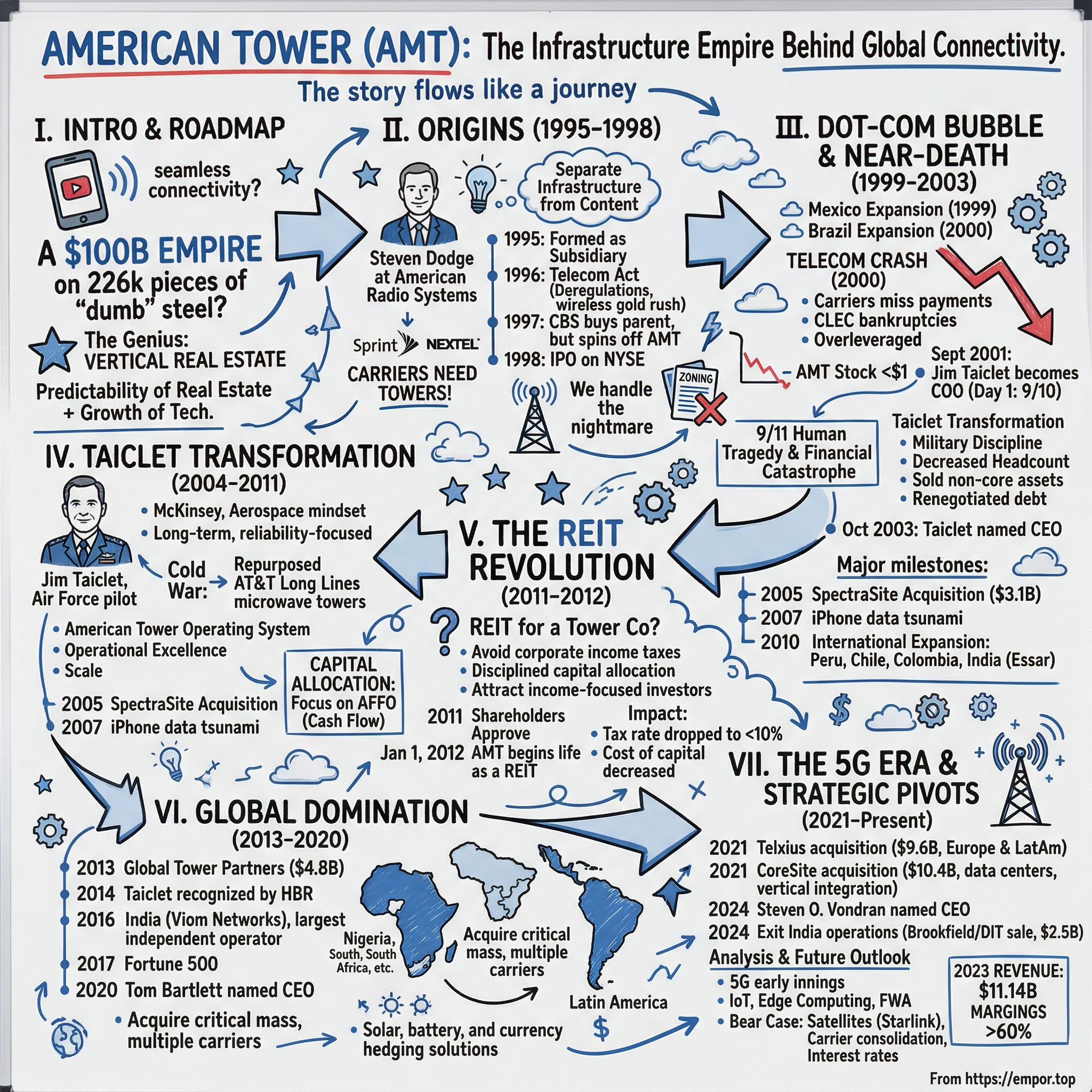
In July 1995, in Boston, a radio executive named Steven B. Dodge did something that looked, at the time, like housekeeping. Dodge had founded American Radio Systems Corporation two years earlier, a roll-up of radio stations in an industry that was about to be deregulated into a feeding frenzy. Radio stations need transmission towers. American Radio owned a lot of towers. Dodge and his partners formed a subsidiary — American Tower Systems Corporation — to hold and operate them.7
The insight underneath the housekeeping was that a tower is a landlord asset dressed up as an engineering asset. A radio station uses one tower for one purpose. But a tower has vertical real estate all the way up, and if you can rent the other slots to somebody else, the second tenant is nearly all margin. Dodge had spent his career in leveraged media roll-ups; he understood that the value was not in the broadcasting but in the scarcity of the structure.
The timing was extraordinary. The mid-1990s were the moment U.S. wireless licensing exploded — new PCS carriers, all of them needing national coverage, none of them owning any infrastructure. When CBS acquired American Radio Systems, the tower business was separated out, and in June 1998 American Tower began life as a standalone NYSE-listed company under the ticker AMT, with Dodge as chairman and chief executive.8
What followed was a land grab. Towers were bought and built in the United States, then in Mexico and Brazil, on the theory that emerging markets would follow the same adoption curve a few years behind. The financing was debt, because the assets were long-lived and the cash flows looked contracted, and because that was how everyone in telecom financed everything in 1999.
Then the music stopped. The telecom bust of 2000 through 2002 hit tower companies from both ends at once. Customers — the very carriers whose leases were supposed to be riskless — went bankrupt or stopped spending. Meanwhile the credit markets that had funded the tower build shut entirely. Tower stocks, American Tower's very much included, lost the overwhelming majority of their value in that stretch. This was not a valuation drawdown; it was an existential question about whether a company with a highly leveraged balance sheet and a customer base in distress could survive to collect its contracted rents.
Into that came James D. Taiclet, Jr. He was an unusual hire for a REIT-to-be: a U.S. Air Force Academy graduate and former officer who had run engine services at Pratt & Whitney and then led Honeywell Aerospace Services.
He joined American Tower in September 2001 as President and Chief Operating Officer, responsible for the tower and services business.9 It is a detail worth correcting against the popular retelling — Taiclet did not become chief executive on the eve of September 11. He arrived as the operator, and the board did not hand him the top job until October 10, 2003, when he succeeded Dodge as CEO while Dodge remained chairman.9
That two-year apprenticeship is the point. Taiclet spent it inside a company doing debt restructuring, asset sales, and cost discipline under genuine duress, and he learned the lesson the hard way rather than the theoretical way: in a business where revenue is contracted and capital is not, the balance sheet is the only variable that can actually kill you.
That lesson became institutional. For most of the next two decades, American Tower ran a stated net leverage target of 3 to 5 times adjusted EBITDA and treated it as a promise rather than an aspiration. Which is exactly what makes the 2021 chapter so interesting — and why the near-death experience of 2002 is worth remembering as more than trivia. The company that nearly died of leverage would, nineteen years later, choose to test the limit again.
III. Building the Playbook: Taiclet, the REIT Conversion, and the Global Build-Out (2004–2020)
The recovery years have a particular texture: a company that had been fighting for survival suddenly discovered that the world had reorganized itself around its assets.
The catalyst was the smartphone. When Apple launched the iPhone in 2007 and 3G gave way to 4G LTE, wireless networks stopped being voice systems with a data feature and became data systems with a voice feature. Data traffic requires two things a tower company sells: more antennas on more towers (coverage), and more equipment on the towers you already have (capacity). Both show up in the same place — as rent.
The scale-up came first. In August 2005, American Tower completed a merger with SpectraSite that created a combined portfolio of over 22,000 owned communications sites, including more than 21,500 wireless towers, over 400 broadcast towers, and nearly 100 in-building sites.10 It was a consolidation play in a fragmented industry, and it established the pattern the company would repeat for fifteen years: buy portfolios at a price justified by the tenants you can add later, not the tenants on them today.
Then came the structural masterstroke. American Tower's stockholders approved a merger to convert the company into a real estate investment trust, effective for the tax year beginning January 1, 2012.11 The logic is worth explaining plainly, because it is easy to mistake for accounting trivia.
A REIT pays essentially no U.S. federal corporate income tax on its qualifying real estate income, provided it distributes the bulk of that income to shareholders. Tower cash flow is contracted, high-margin, long-duration, and secured by physical property — as close to a rent roll as any non-building asset gets. Converting removed an entire layer of tax leakage from a business whose economics were already unusually clean.
The conversion did something subtler too. It changed who owned the stock. A taxable growth company with a debt-heavy balance sheet attracts one kind of investor; a dividend-paying REIT with an escalator-driven rent roll attracts another — pension funds, income mandates, long-duration holders who value the predictability of the distribution as much as the growth rate. That investor base is patient. It is also, as the company would discover in 2023 and 2024, extremely sensitive to any interruption in dividend growth.
With the tax structure fixed and the U.S. cash flow compounding, management turned to geography. The thesis was elegant on a whiteboard: emerging markets were roughly a decade behind on mobile penetration, carriers there owned their own towers and were capital-starved, and selling those towers to an independent operator was a way for them to fund network upgrades. American Tower would buy the steel, sign the anchor lease, and then spend the next decade adding second and third tenants exactly as it had in Texas and Ohio.
It executed that thesis aggressively. Mexico and Brazil deepened. Africa opened up across Ghana, Nigeria, South Africa, Uganda, Kenya, and francophone West Africa. And India became the single largest emerging-market commitment: in April 2016, the company closed the acquisition of a 51% controlling interest in Viom Networks, an owner and operator of more than 42,000 communications sites, for 76.4 billion rupees in cash (about $1.1 billion at the time) plus the assumption of roughly 52.3 billion rupees (about $0.8 billion) of existing debt.12 At a stroke, India became the company's largest market by site count.
Domestically, consolidation continued. On October 1, 2013, American Tower acquired Global Tower Partners' parent company for an initial purchase price of approximately $4.8 billion, further concentrating the U.S. macro-site market into three public owners.13
By the end of the decade the machine was humming, and Taiclet's reputation was made. In 2020 he left to become chief executive of Lockheed Martin — an unusual destination for a REIT CEO, and a reminder that his background was aerospace operations, not real estate. Thomas A. Bartlett, the long-serving chief financial officer, stepped up to run the company.
The scorecard by 2020 read well: a globally diversified landlord, a REIT structure, a decade of dividend growth, and the most defensible position in an industry with three real players. But look at the sequence honestly and a second pattern is visible alongside the first. Every leg of the build-out — SpectraSite, Global Tower Partners, Africa, Viom — was an acquisition. The company's operating skill was real, but its growth engine was acquisitive, and an acquisitive growth engine has an appetite that does not switch off when prices get high.
In January 2021, that appetite met a seller's market.
IV. The 2021 Pivot: Two Bets, One Balance Sheet — Telxius and CoreSite
There is a specific kind of corporate announcement where the seller's press release tells you more than the buyer's. On January 13, 2021, Telefónica issued one.
The Spanish telecom group announced it had agreed to sell the tower division of its Telxius subsidiary to American Tower for €7.7 billion in cash — approximately 30,722 sites across Spain, Germany, Brazil, Peru, Chile, and Argentina. Telefónica valued the transaction at a proforma multiple of 30.5 times EBITDA, expected a capital gain of roughly €3.5 billion, and headlined the release with the phrase "at record multiples."14 Telefónica's president framed the proceeds as funding for the O2–Virgin Media integration in the U.K., the purchase of Oi's mobile business in Brazil, and debt reduction.14
Read that again from the buyer's side. The seller announced, on the day of signing, that it had achieved a record price. Sellers do not usually say that unless it is true.
American Tower's rationale was scale and scarcity. European tower assets rarely trade; carriers there had been slower to spin off their infrastructure than U.S. carriers, and Germany and Spain represented developed markets with strong tenant credit and low currency risk. Buying 30,000-plus sites in one transaction bought a decade of organic European expansion in a single afternoon. The counter-argument is equally simple: 30.5 times EBITDA is a price that assumes a great deal of future lease-up must happen, and the multiple is set by the level of interest rates prevailing when the check is written.
Ten months later came the more consequential decision. On November 15, 2021, American Tower announced a definitive agreement to acquire CoreSite Realty Corporation for $170.00 per share in cash, total consideration of approximately $10.1 billion including the assumption or repayment of CoreSite's debt.15 CoreSite was not a tower business at all.
As of the third quarter of 2021 it operated 25 data centers, 21 cloud on-ramps, and over 32,000 interconnections across eight major U.S. markets, generating annualized revenue and adjusted EBITDA of $655 million and $343 million respectively.16 The tender offer completed and the acquisition closed on December 28, 2021.
Do the arithmetic on the multiple and the tension becomes obvious. Ten and a tenth billion dollars against $343 million of annualized adjusted EBITDA is roughly 29 times — essentially the same multiple the company had just paid for European towers, but for an asset class with shorter contract durations, higher maintenance capital intensity, real technology-obsolescence risk, and no operating history inside American Tower whatsoever.
The market's verdict was immediate. Shares fell more than 3% on the announcement.17 Analysts were pointed. Cowen's Colby Synesael wrote that while he believed in the future of edge computing, "AMT will face investor doubt for some time," and expected the deal to be received as modestly negative. Others, including MoffettNathanson and Wells Fargo, questioned whether operating under the American Tower umbrella would help or hinder CoreSite's ambitions and argued that "the strategic justification for such a large acquisition at a very full multiple remains somewhat questionable."18
The strategic case management made was about convergence: that compute was moving toward the edge of the network, that interconnection-dense facilities sitting where many networks converge were a scarce real-asset class, and that a company already in the business of owning distributed physical infrastructure with recurring rent had an adjacency here rather than a diversification. That case was not absurd. It was, however, unproven, and unproven cases are cheaper to test with $1 billion than with $10 billion.
What made 2021 a single decision rather than two is the balance sheet. Both transactions were funded substantially with debt, and the CoreSite debt repayment specifically drew on the company's $6.0 billion multicurrency revolving credit facility and cash on hand. By March 31, 2022, total debt stood at $43.5 billion, net debt at $41.5 billion, and the net leverage ratio at 6.4 times annualized adjusted EBITDA — far outside the stated 3-to-5x target range. Total liquidity had fallen to approximately $4.2 billion.6
And then rates went up. The Federal Reserve began raising in March 2022 and did not stop for eighteen months. A REIT that had just levered itself to a record to buy assets priced off near-zero discount rates now faced a refinancing environment in which every maturity repriced upward and every dollar of deleveraging competed directly with the dividend.
The honest reading of 2021 is not that the assets were bad. Telxius towers are real towers with real tenants; CoreSite has turned out to be the fastest-growing thing the company owns. The honest reading is about sizing and sequencing: a company whose founding trauma was over-leverage chose to make two full-price, debt-funded acquisitions in the same twelve months, at the top of a cycle, in two different asset classes, one of which it had never operated. Whatever the assets became, that was a decision about risk appetite — and the next three years were spent unwinding it.
V. The Reset: New CEO, the India Exit, and Deleveraging (2023–2025)
Boards facing a strategic mess have two options: bring in an outsider with a mandate to break things, or promote an insider with a mandate to fix them. In November 2023, American Tower's board chose the second, and it chose someone whose entire adult career had been spent inside the company.
Steven O. Vondran joined American Tower in 2000 — the year before Taiclet arrived, in the depths of the era that nearly ended the company. He came from the law: an associate at a small firm, a telecommunications consultant, a clerk on the Arkansas Court of Appeals. Inside American Tower he moved from the corporate legal team to Senior Vice President of U.S.
Leasing Operations in 2004, then to Senior Vice President and General Counsel of the U.S. Tower Division from 2010 to 2018, then to Executive Vice President and President of the U.S. Tower Division. The board appointed him Global Chief Operating Officer effective November 1, 2023, and he succeeded Bartlett as President and Chief Executive Officer effective February 1, 2024.19
That résumé is worth pausing on, because it is a lawyer-operator's résumé, not a dealmaker's or a financier's. The person who ran U.S. leasing and then U.S. legal is the person who knows what is actually in the master lease agreements — a skill set that would prove startlingly relevant.
The first visible act of the reset was not an announcement but an absence. For the full year 2023, American Tower declared distributions of $6.45 per share, up 10.1% over the prior year.20 For 2024, it declared $6.48 — growth of 0.5%, and in the fourth quarter of 2024 the per-share distribution was actually 4.7% below the year-earlier quarter.21 For a REIT whose shareholder base had been assembled specifically around compounding distributions, a flat dividend year is not a rounding error. It is a signal.
To management's credit, the company did not disguise it. The dividend pause was presented as a deliberate choice to prioritize the balance sheet, and the numbers show that is what actually happened: net leverage fell from 6.4x at the 2022 peak to 5.2x at the end of 2023 and 5.1x at the end of 2024.2021 The less flattering way to describe the same sequence is that a company only has to stop growing its dividend if it previously committed capital it did not have. Both readings are true. What matters analytically is that the correction was explicit, quantified, and completed rather than quietly deferred.
The second act was surgical, and it closed a seventeen-year chapter. On January 4, 2024, American Tower agreed to sell 100% of ATC Telecom Infrastructure Private Limited — its Indian operations — to Data Infrastructure Trust, an infrastructure investment trust sponsored by an affiliate of Brookfield Asset Management.
Total aggregate consideration was up to approximately 210 billion Indian rupees, roughly $2.5 billion, a figure that included the value of Vodafone Idea convertible debentures and shares, payments on certain existing customer receivables, repayment of intercompany debt, and the repayment or assumption of the Indian term loan. The transaction closed on September 12, 2024, with total consideration received of 182 billion rupees after interim distributions.122 American Tower recorded a loss on the sale of $1.2 billion.5
Why did India fail? Not because Indians did not adopt mobile phones — they adopted them faster than almost anyone in history. India failed on the credit and market-structure side of the underwriting, and the company's own disclosures make the mechanism unusually legible.
The 2024 outlook, published in February 2024 while the sale was pending, showed the Indian business contributing about $1,165 million of property revenue and $360 million of adjusted EBITDA — but also carrying approximately $65 million of incremental revenue reserves, a $0.14 per-share drag on AFFO, because of collection uncertainty at a single customer.20 That customer was Vodafone Idea, a carrier in chronic financial distress. American Tower had extended it convertible debentures — a tower landlord effectively financing its own tenant, which is what happens when the alternative is watching that tenant fail.
The structural problem sat underneath the credit problem. India consolidated to three viable operators, all of them ferociously price-competitive, with aggressive site-sharing economics and no meaningful pricing power available to the landlord. The lease-up curve the U.S. delivered in the 2000s — more tenants, more amendments, escalators compounding on top — never arrived in the same form. Add currency depreciation over a seventeen-year hold, and a business with genuine scale produced a return that management ultimately judged worse than the alternative use of the capital. The proceeds went to debt.
The third act was arithmetic, and it worked. Net leverage reached 4.9x at the end of 2025, back inside the stated 3-to-5x target range, on total debt of $37.2 billion and net debt of $35.7 billion, with total liquidity of approximately $11.1 billion and floating-rate debt exposure of only about 4%.523 On the fourth-quarter 2025 call, chief financial officer Rodney Smith put it flatly: "We brought leverage back down into our target range of 3 to 5 times, and we ended the year at 4.9 times."24 S&P Global upgraded the company's credit rating during 2025.23 By the second quarter of 2026, net debt stood at $35.4 billion, leverage remained at 4.9x, and liquidity was approximately $9.9 billion.3
The portfolio kept getting simpler alongside the balance sheet. During the second quarter of 2026 the company completed the sale of its Philippines subsidiary for $75.6 million and its controlling interest in Kirtonkhola Tower Bangladesh for $6.9 million.3 Small transactions individually; collectively, the continued retreat from subscale emerging-market positions.
So has the strategy actually changed under Vondran, or only the leverage? The evidence points to a genuine change in capital allocation posture without a change in stated strategy. The company still describes itself as a global communications real estate business with a data center segment; it has not exited Africa or Latin America; it has not written down CoreSite. What it stopped doing is buying scale in markets where tenant credit is weak. Capital now goes to CoreSite construction and developed-market sites.
There is a fair skeptical counter, and it deserves to be stated. Deleveraging into a period when the Sprint-related churn overhang was rolling off, when AI demand was arriving unbidden at CoreSite, and when a $2.5 billion India check landed is the easy part of the cycle. Discipline that has not yet been tested by a genuinely attractive, genuinely large acquisition opportunity is not yet proven discipline.
And in May 2026 the company amended its revolving facilities specifically to add limited-conditionality provisions permitting it to borrow up to $5.0 billion in connection with certain acquisitions.3 That is not a commitment to spend. It is, unambiguously, the plumbing you install when you might want to.
It is also worth noting what did not happen here. Elliott Management ran a public campaign at Crown Castle in 2023, pressing for board and strategy changes at a peer whose diversification into fiber and small cells had disappointed.25 No comparable activist campaign has targeted American Tower, despite American Tower having taken on more balance-sheet risk in the same window. That asymmetry may reflect better execution. It may also reflect that American Tower's problems were self-corrected before an outsider had to force them — or simply that a company delivering acceptable AFFO growth attracts less scrutiny than one delivering none.
Which brings us to the business that has been quietly carrying all of this.
VI. The Core Business, Deep Dive: U.S. & Canada Towers
Picture the actual transaction at the center of this company. A carrier's radio-frequency engineer identifies a coverage hole or a congested cell. She pulls up a map of available structures. There are, realistically, three or four candidate towers in the search ring — the ones tall enough, in the right place, with the right zoning already in hand. She files an application. Ninety days and a structural analysis later, a crew climbs the tower and bolts on an antenna array, and a monthly rent begins that will escalate about 3% a year for the next decade.
That is it. That is the whole business. And its quality is best understood by asking why the carrier does not simply build her own tower.
She does not, for reasons that are structural rather than habitual. Getting a new macro site approved means municipal zoning boards, environmental review, historic-preservation review, FAA and FCC clearances, and neighbors who reliably do not want a hundred-foot steel lattice near their houses. That process takes many months and frequently fails.
Then there is the capital: a carrier building its own site pays the full cost to serve one network, while a tower company spreads that same cost across two or three tenants. And then there is speed, which in a competitive network arms race is worth more than either. A tower company that has already fought the zoning fight and already owns or leases the land is selling a permit as much as a platform.
The financial signature of this model shows up in the margins and the contract book. Of the 148,824 towers in the portfolio at the end of 2025, approximately 80% sat on leased land, with 56% of those ground leases running to 2035 or beyond — meaning the largest cost line is locked down for a decade past most tenant renewals.1 On the revenue side, approximately 48% of current tenant leases have a renewal date of 2031 or beyond.1 The U.S. and Canada segment produced $5,249 million of property revenue in 2025 — 50.9% of the company's $10,305 million total — at a segment operating profit margin of 80%, the highest in the portfolio.5 Everything else American Tower owns is, in cash-flow terms, an appendage to this.
Now the flip side, which is the most important structural fact about the company. That same segment's revenue comes overwhelmingly from three counterparties. Across the whole company in 2025, T-Mobile accounted for 18% of total revenue, AT&T 17%, Verizon Wireless 14%, and Telefónica 10% — four customers, 59% of revenue. Within the U.S. and Canada segment specifically, the three American carriers together represented 85% of segment property revenue.1
Eighty-five percent from three customers is not a footnote; it is the whole risk profile. It cuts both ways. On the one hand, these are investment-grade counterparties on long non-cancellable contracts who cannot practically move their equipment. On the other, when three buyers control that much demand, they have real leverage at renewal, and the landlord's pricing power is bounded by the carriers' willingness to sign comprehensive master agreements rather than by any theoretical scarcity value.
And then there is what happens when a fourth customer disappears — which is the live story right now, and it is not the one the consensus narrative expects.
For years, the drag on U.S. organic growth was Sprint churn: the multi-year decommissioning of redundant sites following T-Mobile's absorption of Sprint, which suppressed tenant billings growth for the better part of half a decade.26 That overhang did substantially work through the book. In the third quarter of 2025, the U.S. and Canada segment grew organic tenant billings approximately 4%, and more than 5% excluding remaining Sprint churn, with leasing applications up roughly 20% year over year and colocation applications up roughly 40%.27 That is what a densification cycle looks like beginning.
Then DISH happened. Under a Strategic Collocation Agreement signed in March 2021, DISH Wireless had committed to a long-term buildout on American Tower's sites. On September 24, 2025, DISH delivered a notice purporting to excuse it from its contractual obligations following EchoStar's spectrum sales. American Tower filed a complaint seeking a declaratory judgment that the agreement remains in full force and that DISH remains obligated to perform.
DISH failed to meet its payment obligations and, as of January 2026, was in default.1 Management disclosed the exposure at roughly 4% of U.S. and Canada revenue — approximately $200 million a year — with obligations that ran through the mid-2030s.2428 American Tower subsequently terminated the agreement, and beginning January 1, 2026, 100% of DISH revenue has been reflected in churn.29
The consequence is stark and it is the single most important number in the 2026 story. For full-year 2026, management guided U.S. and Canada organic tenant billings growth to approximately 0.5% — or approximately 4.5% excluding DISH churn — comprising colocation and amendment growth of about 2.5%, escalators of about 3%, DISH-related churn of about 4%, and normal churn of about 1%.24 Segment property revenue was guided to decline about 3.0% year over year, a figure that also includes an estimated negative impact of over 3% from lower non-cash straight-line revenue recognition.5
The second quarter of 2026 tracked that script. Consolidated organic tenant billings growth was 1.7%; the U.S. and Canada contribution was approximately 0.5%; segment revenue fell to $1,274 million from $1,307 million a year earlier, while segment gross margin declined to $1,054 million from $1,085 million.3 On the call, Smith reported organic tenant billings growth of about 1.9%, roughly 4% excluding DISH churn, with new business contribution steady at 2.5% year over year.30
Here is what that evidence actually means, and it is more interesting than either the bull or bear framing. Underlying demand is fine — new business at 2.5% and escalators at 3% is a healthy 5.5% gross growth engine, and the application data from late 2025 suggests carriers are genuinely densifying again.
But the reported number is being swamped by the loss of a single distressed tenant. In other words, the moat is doing its job on the customers that remain, and the concentration risk is doing its job on the customer that didn't. Investors evaluating "growth inflection" claims for 2026 should be clear about which of those two forces they are underwriting.
The competitive picture reinforces how narrow this market is. American Tower's own filing lists Crown Castle, SBA Communications, Vertical Bridge, Telesites, and Cellnex as competitors, alongside carrier consortia and private-equity-backed owners.1 At current prices, Crown Castle carries a market capitalization of about $33.0 billion and SBA Communications about $19.7 billion, against American Tower's $82.0 billion.2 Crown Castle spent 2025 and 2026 unwinding its own diversification, completing the $8.5 billion sale of its fiber and small cell businesses to Zayo and EQT on May 1, 2026, and re-emerging as a U.S.-only pure-play tower company that intends to repurchase $1.0 billion of stock and reduce debt by more than $7.0 billion.[^31]31
That comparison is genuinely useful and slightly uncomfortable for the bull case. Both large U.S. tower REITs diversified away from towers in the last decade. One was forced by an activist to reverse course entirely; the other reversed course voluntarily in emerging markets while doubling down on its data center adjacency. Whether American Tower's diversification produces better long-run returns than Crown Castle's simplification is an open question that the next five years will answer, not one the current multiple settles.
For the core U.S. business, the number that tells you whether the moat is compounding is organic tenant billings growth net of churn — and specifically the gap between the headline figure and the ex-DISH figure. When those two converge, the digestion is over.
VII. The International Portfolio: What's Left After India
There is a version of the international story that management tells, and there is a version the segment disclosures tell, and in 2026 they have started to diverge.
After the India exit, the international footprint resolves into three books. Latin America generated $1,643 million of property revenue in 2025 across 47,081 sites. Africa and Asia-Pacific generated $1,423 million across 27,857 sites. Europe generated $938 million across 32,524 sites, most of it the Telxius portfolio in Spain and Germany.15 Together they represented roughly 39% of property revenue.
The growth rates in 2025 looked like vindication. Africa and Asia-Pacific delivered 12.9% organic tenant billings growth and 17.8% total revenue growth; Europe grew organic tenant billings 5.1% and revenue 12.3%; Latin America grew organic tenant billings 3.0% but saw revenue decline 4.4% on currency and pass-through effects.5
Africa is the segment that most closely resembles the original thesis working. Population growth, low starting penetration, and 4G densification with early 5G upgrades produce genuine lease-up. But look at who is paying the rent: Airtel and MTN together accounted for 81% of Africa and Asia-Pacific segment revenue in 2025.1 The concentration is worse than in the United States, the counterparties are weaker credits, and the revenue is denominated in currencies — Nigerian naira, Ghanaian cedi, Kenyan shilling — that have repeatedly repriced against the dollar.
A large fraction of the segment's reported revenue is pass-through: for 2026, the company guided approximately $382 million of international pass-through revenue in Africa and Asia-Pacific out of a segment total near $1.63 billion, which is power and fuel cost recovery rather than landlord economics.5 Growth in pass-through revenue is not growth in earning power.
Latin America is where the thesis is currently under the most visible strain, and the mechanism is instructive. In 2025, one of the company's Mexican customers, AT&T Mexico, sought a rent abatement both retroactively and prospectively and withheld tower rents. A September 23, 2025 interim agreement restored payment of the majority of withheld and ongoing rents, with the disputed remainder deposited into an escrow account under an independent trustee pending a final arbitration ruling.
American Tower recorded approximately $30 million of reserves in 2025 related to this customer and expects to record further reserves until the arbitration settles.1 Management guided to $8 million to $10 million of reserves per quarter until resolution.27 Separately, elevated churn in Brazil — the aftermath of carrier consolidation there — pushed the segment backwards: in the second quarter of 2026, Latin America organic tenant billings declined roughly 3%.3
Set the two disputes side by side and a pattern emerges that is more important than either. In India, the problem was a tenant that could not pay. In Mexico, it is a tenant that would rather litigate than pay the contracted escalation. In Brazil, it is consolidation removing tenants outright. None of these is a demand problem. All of them are contract-enforcement-and-counterparty-quality problems — precisely the variable that separates a U.S. lease from an emerging-market lease, and precisely the variable that is hardest to see in a spreadsheet built off subscriber growth curves.
Europe is the cleanest of the three. Telefónica accounted for 70% of European segment revenue in 2025 — extreme single-tenant concentration, but a European incumbent rather than a distressed challenger, on contracts that Telefónica publicly confirmed would be maintained without all-or-nothing renewal clauses.114 Europe grew organic tenant billings roughly 4% in the second quarter of 2026 and was guided to about 10.9% revenue growth for the year, helped substantially by currency.35
So does the international portfolio compound the way the United States did? The honest answer, based on eleven years of evidence across four continents, is: sometimes, unevenly, and with a wider distribution of outcomes than the underwriting assumed. Africa is delivering unit growth with weak counterparties and volatile currency. Europe is delivering stable cash flow with almost no tenant diversification. Latin America is currently going backwards on organic billings. And the one market where the demand thesis was most spectacularly correct — India — is the one the company sold at a $1.2 billion loss.
The relevant investor question is not whether these assets are worth something. They are. It is whether capital tied up in structurally lower-quality cash flow earns its cost, and whether management's revealed preference — Philippines out, Bangladesh out, India out, capital redirected to CoreSite and developed markets — tells you more about the answer than the segment growth rates do.
VIII. The Second Engine: CoreSite and the AI Data-Center Bet
Walk into a CoreSite facility and the thing that strikes you is not the servers. It is the cables.
A hyperscale data center — the kind built for a single cloud provider on a greenfield site outside Phoenix — is essentially a warehouse full of racks with a very large power feed. A carrier-neutral interconnection facility is a different animal. It sits inside a metropolitan area, at a point where many networks physically converge, and its value is the meet-me room: the place where a bank's private network can plug directly into Amazon Web Services, Microsoft Azure, and Google Cloud without ever touching the public internet.
Those direct plugs are called cloud on-ramps, and the cross-connects between tenants are the closest thing the data center industry has to a network effect. Every tenant that joins makes the building slightly more valuable to the next one, because there is one more counterparty to plug into.
That is what American Tower bought in 2021, and it is a genuinely different business from renting antenna space on steel. Which makes the 2026 results awkward for both the bulls and the bears, because they are very good.
The Data Centers segment produced $1,053 million of property revenue in 2025, roughly 10% of total property revenue, up 13.9% year over year, with a segment operating profit margin of 53% — well below the tower segments, which is what you would expect from a business with meaningful power costs and higher maintenance capital intensity.5 For 2026, the company initially guided the segment to $1,175 million to $1,195 million, a midpoint growth rate of 12.5%.5 By the second-quarter report on July 28, 2026, that guidance had been raised to $1,200 million to $1,220 million — a midpoint growth rate of 14.9% — with the release explicitly naming "Data Center outperformance" as one of the drivers of a company-wide outlook raise.3
Guiding a segment up twice inside six months is not a rounding adjustment. It means demand arrived faster than the people closest to it expected.
The AI claims deserve scrutiny rather than acceptance, because they are the kind of claim that is easy to make and hard to falsify. On the second-quarter 2026 call, chief executive Steven Vondran stated that "nine of the top 10 AI companies and three of the top five neoclouds are deployed" at CoreSite, and that the segment added more new business in the quarter than during all of 2021.30 Both statements are unverifiable from the outside: the company does not disclose tenant names, and "top ten AI companies" is not a defined universe. A deployment could be a single cabinet or an entire hall.
What is checkable is the operating trail underneath the rhetoric, and it is more persuasive than the rhetoric. In the third quarter of 2025, management disclosed 42 megawatts under construction, described as the highest in CoreSite's history, and reiterated an expectation of mid-teens or higher stabilized yields on new data center deployments — a return threshold that, if achieved, comfortably exceeds the company's cost of capital.27 Management also addressed a decline in pre-leasing to 6% by attributing it to projects moving from construction into service rather than to softening demand, which is a specific and falsifiable explanation rather than a deflection.27 The proxy statement records a second consecutive year of double-digit revenue growth in the segment and notes the acquisition during 2025 of DE1, a multitenant Denver data center in which the company had previously been a tenant.23
Also worth noting for what it says about discipline: on the second-quarter call, Vondran drew an explicit line, saying the company is "not interested in going into hyperscale or undifferentiated colos."30 That is the correct boundary if the goal is tower-like returns. Hyperscale build-to-suit is a capital-intensive, thin-margin, single-tenant business with concentration risk that looks nothing like a multi-tenant rent roll. Whether that line holds when a hyperscaler offers a very large check is exactly the kind of promise investors should hold management to.
Now size it honestly, because this is where enthusiasm and arithmetic diverge. At roughly a tenth of property revenue, the data center segment cannot yet offset a stumble in U.S. towers. Consider the actual 2026 guidance: the Data Centers segment is expected to add roughly $150 million of revenue at the midpoint, while the U.S. and Canada segment is expected to shed roughly $160 million.35 The fast-growing engine is currently, almost exactly, filling the hole left by one departed tower tenant. That is useful. It is not yet transformational.
Competitively, CoreSite is a specialist inside a market with much larger generalists. Equinix carries a market capitalization of about $106.5 billion and Digital Realty about $71.4 billion — both larger than the entire data center opportunity American Tower has purchased, and both with decades of dedicated operating history.2 CoreSite's defensible position is narrower and more specific: dense interconnection in a limited number of U.S. metros, where the scarcity is not floor space but the accumulated set of networks already terminating in the building. That is a real moat, and it is not one a hyperscale developer can replicate by pouring more concrete.
The falsifiable question for the next several years is whether the AI demand currently filling these halls is structural or cyclical. Inference workloads — running trained models to answer queries — genuinely favor distributed, low-latency, interconnection-rich facilities near users, which is precisely CoreSite's product. Training workloads do not, and those go to the hyperscale campuses American Tower says it will not chase.
If the current leasing surge is disproportionately inference and enterprise hybrid-cloud migration, it should persist. If it is spillover from a training-capacity crunch that eventually clears, stabilized yields on the newest capacity will compress and the guidance raises will stop. The disclosure that would settle it — signed backlog by workload type and realized stabilized yields on vintages already in service — is not disclosed at that granularity.
Which means the CoreSite question folds directly into a larger one: whether this management team allocates capital well enough to be trusted with an adjacency that is finally working.
IX. Capital Allocation & Management Credibility Scorecard
Every management team says it is disciplined. The interesting exercise is to read the proxy statement, because a proxy is a contract about what behavior actually gets rewarded.
American Tower's 2026 proxy shows a compensation structure that is heavily at risk: 93% of the chief executive's target compensation and 88% for other named executives consists of at-risk pay.23 Vondran's 2025 package carried a target annual incentive of 200% of a $1.0 million base salary and a target equity value of $11.0 million, up from $10.0 million in 2024. Chief financial officer Rodney Smith's target equity value was $4.5 million, with a target annual incentive of 125% of base salary equal to $825,000.23 The annual incentive paid out at 114% of target for 2025, down from 118% for 2024 — the committee did not exercise discretion to adjust either figure.23
The long-term plan is where the real signal sits. Performance share units granted in March 2025 vest on three-year performance: 50% on cumulative attributable AFFO per share, 30% on average return on invested capital, and 20% on relative total shareholder return.
For grants made beginning in March 2026, the committee reweighted to 40% AFFO, 30% ROIC, and 30% relative TSR.23 Increasing the weight on relative shareholder return is a meaningful change: it makes it harder to earn a full payout by growing AFFO per share while the stock underperforms peers. Given that the stock traded at $176.05 against a 52-week range of $160.06 to $208.03 in August 2026, that reweighting arrived at a moment when it had teeth.2
Including ROIC at all is genuinely to the company's credit. A REIT that only pays on AFFO per share can manufacture the metric by buying assets with debt — precisely the failure mode of 2021. Requiring a return threshold on invested capital is the specific antidote. The company reported ROIC of 9.3% for 2025.23
And now the part an activist would circle in red.
The 2023 performance share units, covering the three years to December 31, 2025, paid out at 157% of target — 153% on cumulative attributable AFFO per share of $31.17 against a target of $28.87, and 166% on average ROIC of 9.3% against a target of 8.7%. The proxy discloses that the AFFO target "was adjusted for material divestitures, including our sale of ATC TIPL, and both targets were adjusted for deviations in collections from one of our former customers in India, Vodafone Idea Limited, due to uncertainty surrounding such customer."23
Read that carefully. The targets were adjusted to neutralize the financial consequences of the India business — both its divestiture and the collection shortfall from the distressed tenant that was the central reason the India investment underperformed. There are defensible technical arguments for such adjustments; comparing performance against a target set for a company that still owned India is not apples to apples.
But the effect is that the underwriting error was normalized out of the payout calculation. Executives were held harmless for the specific outcome that the divestiture existed to correct. That is a governance fact, and a skeptical investor is entitled to weigh it against the "disciplined course correction" narrative.
Insider ownership tells a similar story about alignment. As of March 23, 2026, all directors and executive officers as a group — 19 people — beneficially owned 365,212 shares, less than 1% of shares outstanding. Vondran personally held 72,785 shares and Smith 73,477.23 At the prevailing share price these are meaningful personal stakes in absolute dollars, but they are compensation-derived rather than purchased conviction, and the group total is immaterial relative to The Vanguard Group's 13.08% and BlackRock's 9.23%.23 This is a professionally managed REIT, not an owner-operator, and investors should not pretend otherwise.
On the sequencing of cash, the record since 2024 is legible and mostly consistent with what was said. Debt reduction came first and was completed. Then the dividend resumed growing: full-year 2025 distributions of $6.80 per share, up 4.9%, with the fourth-quarter 2025 call guiding to approximately 5% growth in 2026 and roughly $3.3 billion of distributions, subject to board approval.524 The second-quarter 2026 declaration of $1.79 per share, up 5.3% year over year, was consistent with that.3 Buybacks came third and stayed modest: over $350 million repurchased across 2025, including $365 million in the fourth quarter — described on the call as the largest quarterly and annual buyback since 2017 — with approximately $1.6 billion remaining as of February 2026.524 Through the second quarter of 2026, only about $200 million had been repurchased year to date, leaving roughly $1.4 billion of authorization.30 In the second quarter itself, the company bought back just $19 million.3
The stated logic for that restraint was explicit and is worth crediting: on the third-quarter 2025 call, management framed buybacks as opportunistic and prioritized against M&A, noting that private tower multiples remained elevated relative to public valuations.27 That is a coherent position. It also sits somewhat awkwardly against the observation that the stock spent much of 2026 near the lower end of its own 52-week range while the company deployed only $19 million in a quarter. A skeptic would ask whether the $5.0 billion acquisition-borrowing capacity added in May 2026 is the real reason the repurchase pace slowed.3
On willingness to own mistakes, the record is mixed rather than damning. Management has never, in the material reviewed, blamed "macro" for the India outcome; the divestiture itself was the admission, and the disclosures around Vodafone Idea reserves were specific and timely.
On the fourth-quarter 2025 call, when Raymond James analyst Richard Prentiss pressed on DISH exposure, Vondran answered with a concrete number rather than a deflection — roughly 4% of U.S. revenue, approximately $200 million a year, with obligations running to the mid-2030s.24 When Goldman Sachs analyst James Schneider challenged whether a 200-to-300-basis-point margin improvement target represented genuine incremental gains or repackaged business-as-usual, Smith gave a specific answer about a new global operating structure rather than retreating into adjectives.24
Where the narrative has been less consistent is on DISH itself, and the sequence is instructive. In the third quarter of 2025, management disclosed the notice but emphasized that DISH "remains current on payments" and had taken no reserves.27 One quarter later, the customer was in default and 100% of its revenue was in churn.29 The company did not mislead — the facts changed and were disclosed as they changed — but it is a reminder that a landlord's assessment of tenant credit can move very quickly, and that "current on payments" is a statement about the past.
Taken together, the credibility picture is neither a whitewash nor an indictment. Guidance discipline has visibly improved: the 2026 outlook was raised twice in the first seven months of the year, in February and again in July.3 Leverage promises were met. Portfolio simplification has been executed rather than announced. Against that, the incentive plan neutralized the India outcome, insider ownership is nominal, and the restraint on the balance sheet has not yet been tested by temptation.
X. Bull vs. Bear, Risk Radar, and What to Watch
Time to war-game it. Put the company on a board and ask what actually determines the outcome.
Start with Porter, because the tower business is a rare case where the five forces are unusually easy to score. Barriers to entry are high and getting higher — nobody is permitting a competing macro site next to an existing one, and the land under the good locations is already spoken for. Threat of substitutes was historically low, and is now the single most debated force. Buyer power is high and is the structural weakness: three American carriers control the overwhelming majority of U.S. demand.
Supplier power is moderate — steel, equipment vendors, and, increasingly, electric utilities on the data center side. Rivalry among existing competitors is muted for existing assets, because towers do not compete on price once a tenant is installed, but is genuinely fierce for acquisitions, where private capital has bid multiples to levels management itself has called unattractive.
Through Hamilton Helmer's 7 Powers, the picture sharpens further. American Tower has clear switching costs: once a carrier's antennas, radios, and fiber backhaul are installed and the site is integrated into a live radio-frequency plan, moving to a neighboring tower means truck rolls, new permits, re-optimization, and a coverage gap. It has cornered resource in the literal sense — irreplaceable, entitled locations. It has scale economies in ground lease management, land purchase programs, and shared overhead.
It has a modest process power in permitting and construction management speed. What it does not have is network economies in towers — a tower is not more valuable to Verizon because AT&T is on it; if anything, capacity is finite — and it has no meaningful branding power. Interestingly, the one asset in the portfolio that does have network economies is CoreSite, through interconnection density. That is a real argument for the adjacency, and it was rarely made this clearly in 2021.
The bull case, stated at its strongest. The densification cycle in developed markets is real and observable: application volumes rose roughly 20% year over year in late 2025, with colocation applications up roughly 40% — leading indicators that precede revenue by several quarters.27 Underlying U.S. growth ex-DISH is running near 4% to 4.5%, which combined with escalators produces a durable mid-single-digit engine once the churn washes through.2430 CoreSite is compounding at mid-teens with stabilized yields management describes as mid-teens or better.
Leverage is back inside target with 96% of debt at fixed rates, an S&P upgrade in hand, and roughly $9.9 billion of liquidity — meaning refinancing risk is now a manageable cost item rather than a solvency question.323 And the contracted backlog of over $54 billion provides a floor that very few businesses of any kind can match.
The bear case, stated at its strongest. Start with the concentration arithmetic, because DISH just demonstrated the mechanism in public: a single tenant representing about 4% of U.S. revenue walked away, litigated, and erased an entire year of segment growth. Three customers remain at 85% of U.S. segment revenue. Any further consolidation, any carrier capital-expenditure pause, or any renegotiated master agreement lands directly on the rent roll with no offset.
Second, the litigation itself is a live overhang: the declaratory judgment action against DISH remains pending, and the company's own filing warns that adverse rulings in that matter or the AT&T Mexico arbitration "could have a material negative impact on our results of operations and financial condition."1 The Mexican arbitration was scheduled for August 2026 — meaning a ruling is plausibly imminent as of this writing.27
Third, the emerging-market risk that ended the India bet has not been eliminated, only reduced. Latin America organic billings went negative in the second quarter of 2026, and the segment's problems are counterparty and consolidation problems rather than demand problems — the category that is hardest to underwrite and slowest to fix.
Fourth, the accounting deserves a flag. A meaningful portion of the reported revenue decline in the U.S. segment is non-cash straight-line revenue recognition rolling off — over 3% of the segment's 2026 growth rate.5 Straight-lining averages contracted escalators across a lease term, which flatters early years and drags later ones. It is entirely standard and entirely disclosed, but it means GAAP property revenue and cash rent are telling different stories right now, and investors comparing headline growth across years should be aware of which one they are looking at.
Separately, the 2024 outlook incorporated an estimated $750 million reduction in depreciation and amortization from a review and possible extension of the estimated useful lives of tower assets.20 The company depreciates towers over thirty years.1 Extending useful lives is a legitimate judgment for assets that plainly last longer than their book life — but it flows straight into reported net income, and it is a judgment, not a fact.
Fifth, the technology question. Direct-to-cell satellite service moved from demonstration to commercial reality during 2025 and 2026: SpaceX's Starlink constellation partnered with T-Mobile in the United States, while AST SpaceMobile signed agreements with AT&T, Verizon, and Vodafone, though its commercial rollout slipped toward 2027 on launch availability.32 American Tower's own risk factors now name satellite technology explicitly alongside RAN sharing and spectral efficiency as potential demand reducers.1
Here is the honest technical framing, in plain terms. A cell tower serves a coverage area a few kilometers across and can dedicate its full spectrum to the handful of users inside it. A satellite passing overhead covers an area hundreds of kilometers across and must share its spectrum among everyone beneath it. That is a capacity difference of orders of magnitude, and it is a consequence of geometry rather than engineering effort.
Satellite direct-to-cell is therefore extraordinarily well suited to the problem it is actually solving — eliminating dead zones where building a tower makes no economic sense — and extraordinarily poorly suited to carrying urban traffic, which is where essentially all of the revenue is.
The near-term effect on tower demand is more likely to be neutral or slightly positive, since satellite coverage removes the least profitable rural sites from the carriers' build plans while doing nothing about the dense urban capacity that drives amendments.33 The genuine risk is longer-dated and would require a step change in orbital capacity that does not currently exist. It belongs on the watch list, not in the base case.
Sixth, and most immediate: execution risk in the CoreSite growth rate as AI capital expenditure normalizes, discussed above.
Where an activist would press. Three places. First, portfolio complexity: why does a company that just sold India, the Philippines, Bangladesh, and its South African fiber business still own subscale positions across a dozen frontier markets, and what is the plan for the ones with the weakest counterparties?
Second, the durability of capital discipline: the company installed $5.0 billion of acquisition-borrowing capacity in May 2026 while buying back only $19 million of its own stock in the same quarter, at a price near the bottom of its 52-week range. That is a revealed preference, and it deserves an explanation. Third, disclosure: for a segment now driving guidance raises, CoreSite's signed backlog, lease expiration schedule, and realized yields on delivered capacity are disclosed far less granularly than the tower segments' tenant billings components.
The three KPIs that matter. First, U.S. and Canada organic tenant billings growth, watched specifically as the gap between the reported figure and the ex-DISH figure — when those converge, the digestion is genuinely over and the densification claim is testable on its own merits.
Second, net debt to adjusted EBITDA against the stated 3-to-5x range — the single number that tells you whether the 2021 lesson stuck, and the one that would move first if discipline lapsed. Third, Data Centers segment revenue growth alongside any disclosure of stabilized yields on newly delivered capacity — growth alone is not the test; growth at declining yields would be the tell that the AI cycle is being chased rather than harvested.
XI. Durable Lessons for Investors & Operators
Strip away the specifics and this story yields four lessons that travel well beyond one REIT.
A great asset does not protect you from a bad price. The tower model is one of the most structurally advantaged businesses in public markets — contracted, escalating, non-cancellable revenue against a fixed asset base with negligible incremental cost to serve the next tenant. None of that prevented the company from paying north of 29 times EBITDA in two separate transactions in the same year.
Contracted cash flow reduces operating risk; it does nothing about valuation risk. The escalator that makes a tower lease beautiful also makes it easy to justify almost any purchase multiple by extending the projection horizon far enough. Disciplined underwriting on the acquisition side is not optional in this model. It is the model's only real vulnerability.
Geographic diversification only works if you underwrite the counterparty as carefully as the demand curve. India was, by the demand metrics, the single most correct macro call the company ever made — a billion people adopting mobile data on a timeline nobody outside the country believed. And it produced a $1.2 billion loss on sale after seventeen years. What failed was not the forecast of subscribers; it was the assumption that subscriber growth would translate into collectible, escalating rent from creditworthy tenants operating in a market that preserved landlord pricing power.
The same failure mode is visible right now in Mexico, where a well-capitalized tenant chose to withhold contracted rent and litigate, and in Brazil, where consolidation removed tenants outright. Diversification across geographies is only diversification if the risks are actually different. When every emerging market shares the same vulnerability — weak tenant credit, currency mismatch, and uncertain contract enforcement — you have not diversified. You have concentrated.
A dividend-growth pause is information, and the timing of it tells you what kind of management you have. For an income-oriented REIT, holding the distribution flat is among the most expensive signals available; it directly antagonizes the shareholder base the structure was designed to attract. American Tower paused in 2024, said plainly that the balance sheet came first, hit the leverage target, and resumed growth in 2025.
That sequence functioned as an early, honest signal rather than a distress signal — the difference being that it was voluntary, quantified, bounded in time, and followed by the promised recovery. The pattern to fear is the opposite one: a REIT that maintains dividend growth by funding it with incremental leverage or asset sales while insisting nothing is wrong. Investors should treat a well-explained pause as considerably better news than an unexplained continuation.
Adjacency M&A is a bet on structural similarity, not on narrative excitement. The right test for CoreSite in 2021 was never "is edge computing the future." It was: does this asset share the economic anatomy of the core business — long-duration contracts, multi-tenant operating leverage, high switching costs, an irreplaceable physical position? On several of those dimensions the answer is genuinely yes, and interconnection density gives it something towers lack entirely.
On others — technology obsolescence, power cost exposure, shorter contract terms, capital intensity per dollar of revenue — the answer is no. That mixed answer justified a position. It did not obviously justify a ten-billion-dollar position funded with debt in the same year as a nine-billion-dollar tower deal. The lesson is about sizing more than selection: an adjacency you have never operated deserves a position you can be wrong about.
XII. Epilogue
What kind of company is this, really?
Five years of evidence support a fairly specific answer. This is an organization that owns a genuinely excellent core asset, understands that asset better than almost anyone, and has repeatedly demonstrated that its judgment about the core does not automatically extend to everything adjacent to it. It overreached in 2021, in two directions at once, using the balance sheet its own history should have made it most cautious about.
It then corrected — visibly, at real cost to its shareholders' income stream, and without pretending the correction was something else. And then it was handed a demand tailwind, in the form of AI workloads landing in data centers it had bought for a completely different reason, that it did not engineer and could not have forecast.
The uncomfortable framing is worth stating directly, because it is the question a careful investor should sit with. Is American Tower today a fundamentally more disciplined business than the one that signed the Telxius and CoreSite agreements — or has it been rescued by timing? Both descriptions fit the facts.
Leverage is inside the target range, the emerging-market portfolio is smaller and better, guidance has been raised twice this year, and the incentive plan now weights relative shareholder return more heavily. Those are choices. But the India proceeds, the end of the Sprint overhang, and an AI capital-expenditure boom all arrived within roughly eighteen months of each other, and each of them made the deleveraging arithmetic easier. Discipline exercised while the wind is at your back is real but untested.
The test is coming, and its shape is already visible. A company with $9.9 billion of liquidity, an investment-grade rating, newly installed capacity to borrow $5.0 billion for acquisitions, and a data center business that is suddenly the most exciting thing it owns will eventually be presented with a very large, very expensive, very compelling opportunity. What it does then will say more about whether 2021 taught anything than any quarterly leverage ratio.
Set all of that aside, though, and one thing survives every version of the argument. The underlying business — renting vertical space on structures that cannot be easily replicated, to counterparties who cannot easily leave, under contracts that raise the rent every year whether or not anything happens — remains one of the more structurally advantaged models available in public markets.
The DISH episode is a reminder that "cannot easily leave" is not the same as "will always pay." But the tower still stands on the hillside, the antennas are still bolted to it, and the rent still goes up about 3% in January. Whatever else changes, that part has been true for a very long time.
XIII. Recent News
The most recent reported quarter was the second quarter of 2026, announced on July 28, 2026. Total revenue rose 4.7% to $2,749 million and total property revenue rose 6.3% to $2,688 million. Net income of $888 million more than doubled year over year, though the comparison is distorted by foreign currency: the quarter included approximately $42.1 million of currency gains against $484.0 million of losses in the year-earlier period. Adjusted EBITDA rose 3.2% to $1,808 million and AFFO attributable to common stockholders rose 3.8% to $1,264 million, or $2.71 per share. Free cash flow rose 19.6% to $1,158 million.3
Management raised the full-year 2026 outlook for the second time in 2026, lifting the midpoints for property revenue by $110 million, adjusted EBITDA by $45 million, AFFO by $45 million, and AFFO per share by $0.09 — attributing the raise to favorable currency movements, data center outperformance, and one-time expense benefits. The revised range put full-year property revenue at $10,695 million to $10,845 million and AFFO per share at $11.00 to $11.17. The net income midpoint rose $255 million, driven primarily by unrealized currency gains rather than operations — a distinction worth preserving when reading the headline.3
On portfolio changes, the company completed two small divestitures during the quarter, exiting the Philippines on June 15, 2026 and selling its controlling interest in its Bangladesh tower business on June 29, 2026 — continuing the retreat from subscale frontier positions.3 No new acquisitions were announced.
On the financing side, the company repaid $700.0 million of 1.600% notes at maturity in April and €500.0 million of 1.950% notes in May, issued €750.0 million of 4.000% notes due 2033 in May, and partially redeemed €250.0 million of its 4.125% notes due 2027 in June. It also amended its revolving credit facilities and term loan on May 7, 2026 to extend maturities and add limited-conditionality provisions permitting up to $5.0 billion of acquisition borrowing.3
On capital returns, the second-quarter distribution was declared at $1.79 per share, and share repurchases in the quarter totaled approximately $19 million against roughly $1.4 billion of remaining authorization.330
On the data center side, management characterized second-quarter leasing at CoreSite as a record, stating that new business signed in the quarter exceeded the full-year 2021 total, and raised segment revenue growth guidance to approximately 15% from 13%. Management also reiterated that it does not intend to enter hyperscale or undifferentiated colocation.30
Two legal matters remain unresolved and material. The declaratory judgment action against DISH Wireless over the Strategic Collocation Agreement was still pending, with DISH in default and 100% of its revenue recognized as churn from the start of 2026.129 The AT&T Mexico rent arbitration was scheduled for August 2026, with disputed amounts continuing to accrue in escrow and quarterly reserves guided at $8 million to $10 million until resolution.127 No public developments in either matter had been disclosed as of August 26, 2026.
On the competitive landscape, the most significant structural change was Crown Castle's completion on May 1, 2026 of the $8.5 billion sale of its fiber and small cell businesses, receiving aggregate cash proceeds of $8.4 billion after preliminary adjustments and re-emerging as a U.S.-only pure-play tower company.31 No comparable satellite or direct-to-cell development materially affecting tower demand had been disclosed in the period, and American Tower has announced no satellite partnerships of its own.
References
-
American Tower FY2025 Form 10-K — U.S. Securities and Exchange Commission, 2026-02-24 ↩↩↩↩↩↩↩↩↩↩↩↩↩↩↩↩
-
American Tower (AMT), Crown Castle (CCI), SBA Communications (SBAC), Equinix (EQIX), Digital Realty (DLR) market data — Financial Modeling Prep / StockAnalysis, 2026-08-26 ↩↩↩↩
-
American Tower Corporation Reports Second Quarter 2026 Financial Results (8-K Exhibit 99.1) — U.S. Securities and Exchange Commission, 2026-07-28 ↩↩↩↩↩↩↩↩↩↩↩↩↩↩↩↩↩↩↩
-
American Tower FY2025 Form 10-K, Item 1 Business — Products and Services — U.S. Securities and Exchange Commission, 2026-02-24 ↩↩
-
American Tower Corporation Reports Fourth Quarter and Full Year 2025 Financial Results (8-K Exhibit 99.1) — U.S. Securities and Exchange Commission, 2026-02-24 ↩↩↩↩↩↩↩↩↩↩↩↩↩↩↩↩
-
American Tower Corporation Reports First Quarter 2022 Financial Results (8-K Exhibit 99.1) — U.S. Securities and Exchange Commission, 2022-04-27 ↩↩
-
American Tower Systems Corporation Form S-1 Registration Statement — U.S. Securities and Exchange Commission, 1998 ↩
-
American Tower Systems Corporation Form S-4/A — U.S. Securities and Exchange Commission, 1998 ↩
-
American Tower Corporation Names James D. Taiclet Chief Executive Officer (8-K Exhibit 99) — U.S. Securities and Exchange Commission, 2003-10-10 ↩↩
-
American Tower and SpectraSite Complete Merger (8-K Exhibit 99.1) — U.S. Securities and Exchange Commission, 2005-08 ↩
-
American Tower Corporation's Stockholders Approve Merger Agreement in Connection with Proposed REIT Conversion — American Tower, 2011 ↩
-
American Tower Corporation Announces Acquisition of Controlling Interest in Viom Networks — American Tower, 2015-10-21 ↩
-
American Tower Corporation Form 424B5 (Global Tower Partners acquisition disclosure) — U.S. Securities and Exchange Commission, 2014-01 ↩
-
Telefónica sells Telxius' tower division to American Tower Corporation at record multiples for 7.7 billion euros — Telefónica, 2021-01-13 ↩↩↩
-
American Tower CoreSite Acquisition Announcement (8-K Exhibit 99.1) — U.S. Securities and Exchange Commission, 2021-11-15 ↩
-
American Tower Slips After Deciding To Buy CoreSite — Nasdaq, 2021-11-15 ↩
-
Analysts question American Tower's $10B CoreSite deal — Fierce Network, 2021-11 ↩
-
American Tower Names Steven O. Vondran to Succeed Thomas A. Bartlett as President and CEO — American Tower, 2023-11 ↩
-
American Tower Corporation Reports Fourth Quarter and Full Year 2023 Financial Results (8-K Exhibit 99.1) — U.S. Securities and Exchange Commission, 2024-02-27 ↩↩↩↩
-
American Tower Corporation Reports Fourth Quarter and Full Year 2024 Financial Results (8-K Exhibit 99.1) — U.S. Securities and Exchange Commission, 2025-02-25 ↩↩
-
American Tower Closes the Sale of Operations in India to Brookfield — American Tower, 2024-09-12 ↩
-
American Tower Corporation 2026 Definitive Proxy Statement (DEF 14A) — U.S. Securities and Exchange Commission, 2026-04-08 ↩↩↩↩↩↩↩↩↩↩↩↩
-
American Tower (AMT) Q4 2025 Earnings Call Transcript — The Motley Fool, 2026-02-24 ↩↩↩↩↩↩↩↩
-
Activist investor Elliott pushes for changes at Crown Castle — Investing.com, 2023 ↩
-
Sprint churn creeps into American Tower's near-term outlook — Fierce Network ↩
-
American Tower (AMT) Q3 2025 Earnings Call Transcript — The Motley Fool, 2025-10-28 ↩↩↩↩↩↩↩↩↩
-
American Tower's exposure to Dish default is about $200M/year — Light Reading ↩
-
American Tower terminates Dish tower agreement amid ongoing dispute — Data Center Dynamics ↩↩↩
-
Earnings call transcript: American Tower tops Q2 2026 estimates, lifts outlook — Investing.com, 2026-07-28 ↩↩↩↩↩↩↩
-
Crown Castle Announces Closing of Sale of Fiber and Small Cell Businesses and Updates Full Year 2026 Outlook — Crown Castle, 2026-05-01 ↩↩
-
Summer 2026 Satellite Mobile Internet Update: Starlink Mobile Targets Cell Carriers, AST SpaceMobile Slips — Mobile Internet Resource Center, 2026 ↩
-
No, satellites aren't going to make terrestrial towers obsolete — Fierce Network ↩
 LinkedIn
 WhatsApp
 Reddit
 Hacker News
 Email
Email Kindle
 RSS Feed
 Spotify
 Apple Podcasts
 Amazon Music
 Audible
 YouTube