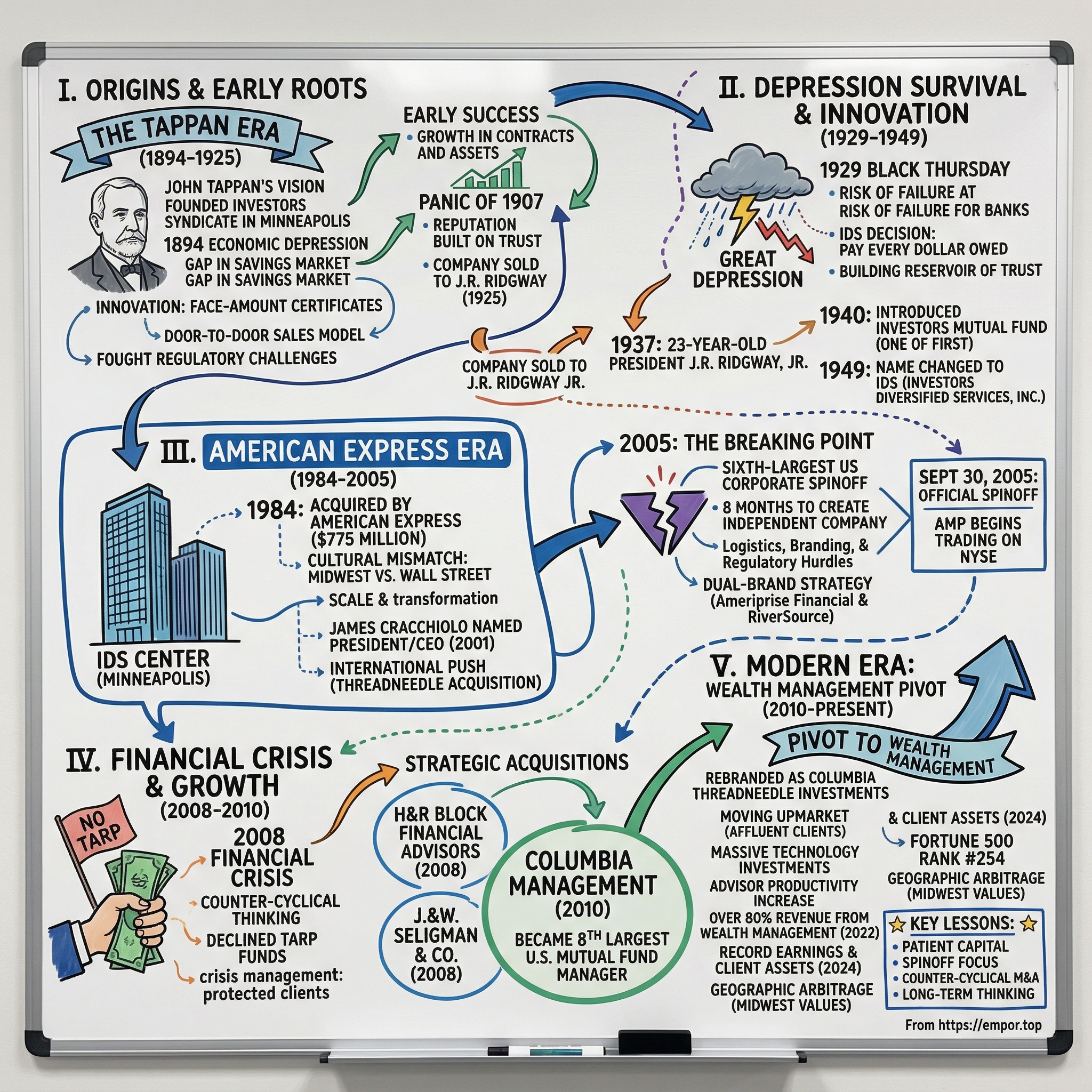
Ameriprise Financial: The Spinoff That Out-Ran Its Parent
I. Introduction & Episode Framing
On the morning of October 3, 2005, a new ticker appeared on the New York Stock Exchange. It closed its first day at $34.70.1 Nobody threw a party. There was no founder in a hoodie ringing a bell, no oversubscribed book, no roadshow buzz. This was not an IPO at all. It was a corporate divorce — American Express had handed its shareholders one share of a Minneapolis financial-planning business for every five shares of Amex they already owned, and washed its hands of the thing.4
Wall Street's read at the time was straightforward. Amex was keeping the good business: the closed-loop card network, the affluent cardholder base, the spend-centric economics that Warren Buffett had been quietly compounding into for years. What it was shedding was the awkward part — a sprawling collection of insurance agents, proprietary mutual funds with mediocre performance, variable annuities loaded with guarantees nobody fully understood, and a regulatory record that had recently produced settlements in two states. The spinoff was, in the company's own telling, the sixth-largest in U.S. history.4 It was also, in the market's telling, mostly a way for Amex to get cleaner.
Twenty-one years later, the scoreboard reads differently than either side expected.
American Express did fine. Very fine, in fact — its shares went from roughly $50.75 on the day of the split to about $337.50 today, a bit under sevenfold.1 But the discarded stepchild went from $34.70 to roughly $563, better than sixteenfold on price alone, before a single dividend is counted.1 Over the same stretch the S&P 500 went from about 1,227 to roughly 7,688 — a little over sixfold.1 Ameriprise Financial has compounded at something like two and a half times the rate of the index that carried it, and roughly two and a half times the rate of the parent that let it go.
A necessary correction to the folklore, though, because this story gets told sloppily: Ameriprise is not bigger than American Express. Amex carries a market value of roughly $228 billion; Ameriprise carries roughly $51 billion.1 The spinoff did not overtake the parent. It out-returned the parent — a different and, for investors, more interesting claim, because it is a statement about capital allocation and business-mix migration rather than about size.
So what actually happened here? How does a company founded in 1894 to sell savings certificates to Minnesota schoolteachers — a business model roughly as exciting as a Christmas club account — end up as one of the better-performing financial stocks of the twenty-first century? And, far more important for anyone underwriting the shares from today's price rather than 2005's: is the machine that produced those returns still running, or has the market already paid for it?
The central question of this story is not whether Ameriprise has been a good business. The record answers that. The question is whether a mid-sized wealth manager — roughly $1.2 trillion in client assets, meaningful but not dominant — can keep winning a fight in which LPL Financial custodies more than twice its assets, Edward Jones advises more than twice its assets, and Morgan Stanley, Merrill, Schwab and Fidelity all bring balance sheets Ameriprise cannot match.21819 Management's answer is that the fight is not about size. That answer deserves testing rather than applause.
The path runs like this. First, the long prologue: a savings-certificate company that survived the Depression by paying everyone on time, invented one of America's early mutual funds, and eventually got absorbed into Amex. Then the 2005 separation and the 2008 crisis that became the company's founding myth — including one number in that myth that is routinely misquoted. Then the decade-long, deliberately boring pivot out of capital-hungry insurance and into capital-light advice, which is the single most important thing that happened to this company's earnings quality. Then the engine room: Advice & Wealth Management as it operates today, where two-thirds of the revenue and essentially all of the growth narrative live. Then the smaller pieces that management would rather you not dwell on. Then capital allocation, executive pay, and the governance question that hangs over a company run by the same person since the day it was born.
The people matter here more than they usually do in financial services, because the entire thesis rests on one man's twenty-one-year run and on roughly 10,000 advisors who could, in principle, walk out the door tomorrow. Which is where the story properly begins — with a 24-year-old lawyer in Minneapolis who had noticed that ordinary Americans had nowhere safe to put their savings.
 Subscribe on LinkedIn
II. Origins & the Long Prologue (1894-2005)
Minneapolis in 1894 was a city with sawdust in the air and fear in the banks. The Panic of 1893 had torn through the American financial system the year before, and the wreckage was still smoking: railroads in receivership, banks shuttered, savings that had felt permanent revealed as anything but. If you were a wage earner in the upper Midwest — a farmer, a millhand, a schoolteacher — you had two options for your money. You could put it in a bank and pray. Or you could put it under the mattress and accept that it would never grow.
John Elliott Tappan was 24 years old, a lawyer, and apparently unable to leave that problem alone. In 1894 he founded Investors Syndicate in Minneapolis with $2,500 in assets — a sum so small it is difficult to render as a serious business.4 What he had instead of capital was a product idea: the face-amount certificate.
Strip away the archaic name and the mechanism is simple, and worth understanding because its logic still shapes the company. A customer committed to paying in a fixed amount every month for a fixed number of years. In return, Investors Syndicate contractually guaranteed to pay out a specific dollar figure — the "face amount" — at the end of the term. It was neither a bank deposit nor an equity investment. It was a disciplined-savings contract, enforced by habit and backed by a promise. The customer was not asked to have a view on markets. The customer was asked to be consistent, and to trust the counterparty.
That second requirement — trust the counterparty — is the whole business, and it got stress-tested almost immediately and then repeatedly. Investors Syndicate passed $1 million in assets by 1914.4 It survived the Panic of 1907. In 1925 a West Coast entrepreneur named John R. Ridgeway acquired the firm.4 And then came the event that the company has been dining out on for ninety years.
The Depression as Marketing Asset
When the Depression arrived, the face-amount certificate business faced the precise scenario it was structurally worst equipped for: mass simultaneous demand for cash from customers who had lost their jobs, at a moment when the assets backing the promise had collapsed in value. Thousands of American financial institutions simply did not pay. Investors Syndicate did. According to the company's own history, it paid every dollar on its due date to certificate owners — a total of $101 million.45
Take that number seriously in context. A hundred and one million Depression-era dollars, paid on schedule, by a firm whose customers were exactly the people least able to absorb a loss and least equipped to sue. There was no federal deposit insurance backstopping this. There was no bailout facility. The company either had the assets and the liquidity management to honor the contract, or it did not.
It is worth being precise about what this proves and what it does not. It does not prove anything about the firm's underwriting in 2026. Institutional memory is not a moat, and no current Ameriprise client chose the firm because of what it did in 1932. But it does explain something durable about positioning. Ameriprise has never been, and has never tried to be, a firm for the very rich. Its ancestral customer was the person for whom the money genuinely mattered — where a 3% loss was not an annoyance but a crisis. That inheritance shows up today in the brand, in the advisory model built around comprehensive financial planning rather than portfolio management, and in a target market that skews mass-affluent rather than ultra-high-net-worth. It also shows up as a strategic constraint, because the highest-fee, fastest-growing segment of wealth management today sits above where Ameriprise has historically played.
From Certificates to Funds to Amex
The company kept adding products as American savers got more sophisticated. In 1940 it entered the mutual fund business with Investors Mutual Fund, one of the early open-end funds in the country, with more strategies following in 1945.4 In 1949 the name changed to Investors Diversified Services — IDS — reflecting a business that was no longer a single-product shop.4 In 1957 it added life insurance and annuities through a subsidiary that eventually became IDS Life.4 And in 1975, by its own account, it pioneered financial planning as a delivered service rather than a sales pretext.4
That 1975 move is the one that matters most for understanding the modern company. Selling a product is a transaction. Delivering a plan is a relationship, and relationships have retention characteristics that transactions do not. Every strategic claim Ameriprise makes today about client stickiness traces back to the decision to organize the business around planning.
Then, in 1984, American Express bought IDS.4 In 1995 it was renamed American Express Financial Advisors.4 And in 2003, AEFA made the acquisition that would matter most to the eventual company: Threadneedle Asset Management, the London-based manager, announced on June 16, 2003 and bought from Zurich Financial Services for approximately £340 million — around $570 million — in cash.7 Threadneedle brought over £44 billion of assets under management as of March 31, 2003, and something Ameriprise otherwise entirely lacked: a European institutional footprint.7 Two decades later, that purchase supplies the "Threadneedle" half of Columbia Threadneedle Investments.
The Baggage
The Amex years were not a story of unbroken excellence, and the ugly parts are directly relevant to why the spinoff happened. On July 13, 2005, weeks before the separation, American Express Financial Advisors settled an enforcement action brought by New Hampshire's securities regulator for $7.4 million — a $5 million fine, up to $2 million in investor restitution, and $375,000 in investigation costs.8 The allegation was that AEFA had pushed clients into its own proprietary mutual funds without disclosing conflicts, using model portfolios containing only AEFA funds, many of which underperformed available alternatives. The state had found emails pressuring advisors to sell house product, covering the period from January 1999 through March 2003.8 New Jersey had settled a similar matter for $5 million the prior month.8
This is the reputational hole the company was climbing out of on day one of independence: a firm whose entire ancestral claim was that it could be trusted by people who could not afford to be wrong, caught steering those people into its own mediocre funds. The regulatory settlements were modest in dollar terms. The strategic implication was not, because "conflicted distribution of proprietary product" is precisely the accusation that a planning-led brand cannot survive long-term.
Which is a useful frame for what came next. The man tapped to run the newly independent company had spent his career inside the parent's financial services arm and knew exactly what he was inheriting: a strong distribution network, a weak product reputation, an under-invested technology stack, and a balance sheet full of long-dated insurance guarantees. What he did with it over the following two decades is the actual story.
III. The 2005 Spinoff and the 2008 Stress Test
Building a public company from the inside of another public company is an underrated feat of plumbing. On September 30, 2005, American Express completed the tax-free distribution, and three days later the shares began trading and Ameriprise entered the S&P 500.4 But a stock ticker is the easy part. What the company actually had to construct from nothing, on a deadline, was everything a standalone financial institution requires and a divisional subsidiary never needs: its own brand, its own technology infrastructure, its own treasury and capital structure, its own regulatory licenses and relationships, its own board, its own audit function, its own credit ratings.
Running that construction project was James M. Cracchiolo — Jim to essentially everyone, including analysts on earnings calls two decades later. Cracchiolo was not a celebrity hire, and he was not a wealth-management lifer parachuted in from a wirehouse. He was a finance guy who had come up through American Express's own ranks, moving from comptroller-type roles into running Amex's global financial services operations, and he had been running the AEFA business before the separation.30 The profile matters: this was a numbers-and-controls executive taking over a sales organization, not a rainmaker taking over a balance sheet. The instincts that produced twenty-one years of grinding margin expansion, relentless expense reengineering and aggressive share repurchase are visible in that biography.
He became Chairman and CEO at the separation. He still holds both titles today. In an industry where the average large-cap financial CEO gets six or seven years, that is an extraordinary run — and, as the governance section will argue, an increasingly loaded fact.
September 2008
The company's real founding moment came three years after the spinoff, and it did not happen in Minneapolis. It happened at a money market fund in New York.
On Tuesday, September 16, 2008 — the day after Lehman Brothers filed — The Reserve's Primary Fund reported a net asset value of $0.97 per share.9 It had "broken the buck," the first major money market fund in American history to do so. Money market funds were not supposed to be able to do this. They were the thing you owned when you wanted to own nothing. For millions of retail investors, including a great many Ameriprise clients, the fund was where the emergency cash lived, and now the fund was frozen and the emergency cash was inaccessible.
Ameriprise's response is genuinely instructive about the firm's operating philosophy, and it is also the single most commonly garbled fact in the Ameriprise story, so it is worth getting exactly right, because two different actions get conflated into one.
The first action was liquidity. With client money locked inside a frozen fund, Ameriprise used its own balance sheet to front clients the cash they needed to pay their bills — advancing roughly $700 million to clients during the crisis period, subsequently recovered as the fund liquidated.5 This was not a gift. It was a bridge loan to its own customer base, made at a moment when the interbank market had stopped functioning.
The second action was loss absorption, and it was much smaller. On September 24, 2008, the company announced it would commit up to $33 million of its own capital to protect clients holding the Primary Fund, covering losses of up to three cents per share should the fund pay out below a dollar on liquidation.9 Ameriprise disclosed that the commitment would cost roughly ten cents per share in third-quarter earnings.9 Cracchiolo's public framing was pointed — he called the situation one that "has caused significant anxiety and hardship for individual investors," said the firm had taken "extraordinary actions on our clients' behalf," and then turned the pressure outward, demanding that regulators and legislators "expedite the liquidation of the Reserve funds in a fair and equitable manner."9
So: roughly $700 million advanced as liquidity, and up to $33 million committed as loss coverage. Anyone who tells the story as "$700 million of losses absorbed" has merged two different things. The distinction matters analytically, because advancing recoverable cash is a demonstration of balance-sheet strength, while absorbing losses is a demonstration of willingness to eat a hit for reputational reasons. Ameriprise did both, at very different magnitudes.
Declining the Bailout
The second crisis-era decision has become the load-bearing beam of the company's self-image. Ameriprise applied for the Treasury's Capital Purchase Program — the equity injection arm of TARP — and was granted preliminary approval as one of a small group of life insurers offered federal capital in May 2009. It then declined the money.5
The bull-case version of this is that Ameriprise did not need Washington. The skeptical version is worth stating too: the company applied, which means that at some point in late 2008 management thought federal capital might be necessary, and only declined once markets had begun to stabilize and the stigma of accepting had become obvious. Both readings are defensible. What is not in dispute is the outcome — the company came through the worst financial crisis since its Depression-era proving ground without taxpayer capital, and its senior debt today carries investment-grade ratings across all four major agencies, at A- from S&P, A3 from Moody's, A- from Fitch and a- from AM Best, all with stable outlooks, with RiverSource Life carrying A+ financial strength ratings.24
Buying the Wreckage
Here is the part of 2008 that best predicts how this management team behaves, and it is not the defensive part. While most of American finance was hoarding capital, Ameriprise went shopping — twice, in five weeks, from motivated sellers.
On July 7, 2008, it agreed to acquire J. & W. Seligman & Co. for $440 million.10 Seligman was a genuinely storied firm, founded in 1864, managing roughly $18 billion — small, but it came with about $3 billion in hedge fund assets and a technology investment team led by Paul Wick that Ameriprise explicitly wanted.10 Cracchiolo's stated logic was to "grow our higher-margin businesses."10 Eighteen years later, on the second-quarter 2026 call, management was still singling out Seligman by name as a source of "strong asset growth and flows" across mutual funds and its technology and healthcare hedge funds — one of the rare acquisitions that is still producing identifiable alpha nearly two decades on.2
Then, on November 3, 2008 — roughly six weeks after Lehman, at the absolute nadir of financial-sector sentiment — Ameriprise completed the purchase of H&R Block Financial Advisors.11 The deal brought more than 950 advisors in 135 offices, approximately 365,000 client accounts, and $27.5 billion in client assets, pushing the firm past 12,000 total advisors.11 H&R Block, a tax-preparation company that had wandered into brokerage and wanted out, was exactly the kind of seller Ameriprise likes: strategically motivated, time-constrained, and not running a competitive auction.
The pattern is the point. Ameriprise's best-priced acquisitions have consistently come when the seller needed to sell rather than when the asset came to market. That is a repeatable behavioral edge, not a one-off. It also carries an uncomfortable corollary for anyone underwriting the stock today: the playbook requires dislocations, and there has not been a serious one in wealth management for a long time. A company whose M&A skill is counter-cyclical is, in a long bull market, a company that mostly buys back its own shares — which is precisely what it has been doing.
The crisis established the operating temperament. What established the earnings quality was a slower, less dramatic decision made over the following decade.
IV. The Pivot: From Insurance/Annuities to Fee-Based Wealth Management (2010-2020)
In September 2009, Bank of America was in an unusual position: it owned too much. Having swallowed Merrill Lynch and Countrywide, it was carrying a capital hole, a regulatory microscope, and a portfolio of businesses it could no longer justify funding. One of them was Columbia Management, its long-term asset management arm.
Ameriprise bought it. The agreement was announced on September 30, 2009 at approximately $1 billion in cash — with a contractual range of $900 million to $1.2 billion depending on net asset flows before closing — and it transferred roughly $165 billion of long-term assets under management, split about $93 billion equity and $72 billion fixed income as of June 30, 2009.12 The transaction closed in May 2010 and vaulted Ameriprise to nearly $400 billion in global assets under management and the position of eighth-largest manager of long-term U.S. mutual fund assets.124 It also came with a five-year distribution agreement giving access to Bank of America's clients and projected annual net synergies of $130 million to $150 million.12
Consider the price. Roughly $1 billion for $165 billion of long-term AUM works out to about 61 basis points of assets. For a scaled, diversified, largely active U.S. fund complex in 2009, that is a distressed-seller price, not a strategic-auction price. It is the Columbia Management deal, more than any other, that establishes the counter-cyclical acquisition pattern as deliberate policy rather than coincidence — Seligman and H&R Block Financial Advisors were opportunistic, but this one was a top-eight U.S. asset manager assembled for the price of a mid-cap acquisition, purely because the seller had a capital problem. In 2015 the acquired business was combined with the 2003 London purchase under a single brand, Columbia Threadneedle Investments.4
The Quieter, More Important Decision
The Columbia deal got the headlines. The strategy that actually re-rated the stock got almost none, because it consisted of doing less of something.
Understand the problem Ameriprise inherited. A variable annuity with living-benefit guarantees is, in plain terms, a mutual fund wrapped in a promise. The client invests in markets, and the insurer guarantees a minimum income stream regardless of what markets do. The insurer has effectively written a very long-dated put option on equities, and the customer often has decades to exercise it. To back that promise, the insurer must hold regulatory capital, hedge the equity and interest-rate exposure, and carry the accounting volatility on its balance sheet. When markets fall, the liability grows precisely when the assets backing it shrink. When rates fall, the present value of the guaranteed payments rises. It is a business that consumes capital, produces earnings that swing with variables management does not control, and requires the market to trust actuarial assumptions it cannot verify.
Now consider the alternative. In fee-based advisory — the "wrap" business — the client pays an annual percentage of assets for advice and management. The firm holds essentially no market risk on its own balance sheet, deploys little capital, and collects a recurring fee that scales with the client's portfolio. If markets fall, revenue falls proportionally, and that is the extent of the damage. No guarantee, no hedge program, no capital charge, no actuarial judgment for auditors to question.
Same customer. Same advisor. Radically different earnings quality — and radically different multiples, because equity markets pay far more for recurring fee streams than for leveraged insurance liabilities.
Ameriprise spent the 2010s methodically shifting weight from the second business to the first. Not by selling the annuity book in a dramatic transaction, but by growing advice faster than everything else and letting the legacy guarantees run down. The segment revenue tells the story with unusual clarity. In 2012, Advice & Wealth Management produced $3.87 billion of revenue against $2.52 billion from Annuities and $2.09 billion from Protection combined — advice was smaller than the insurance complex.6 By 2019, advice had reached $6.74 billion.6 By 2025 it reached $12.17 billion, against $3.96 billion for the combined Retirement & Protection Solutions segment.6 Advice roughly tripled in thirteen years while the insurance side grew at a fraction of that rate.
The result is a company whose sensitivity profile has fundamentally changed. Pre-pivot Ameriprise was a levered bet on equity markets and interest rates and actuarial assumptions and policyholder behavior. Post-pivot Ameriprise is primarily a bet on the level of client assets and on advisor productivity, with a residual insurance book attached. The first is a business the market will pay a wealth-management multiple for. The second is a business the market pays an insurance multiple for. Moving the mix moved the multiple.
The Honest Caveat
Two things should temper the applause.
First, this was not a uniquely brilliant insight. Essentially every insurance-adjacent financial company in America spent the 2010s trying to pivot toward fee income, because the entire industry could read the same math. What distinguishes Ameriprise is not the idea but the execution — it had a captive, high-quality distribution network of advisors to migrate assets through, which most insurers attempting the same pivot did not. The strategic lesson is less "have a good idea" and more "have distribution."
Second, a shift in mix is not a shift in market exposure. Fee-based advisory revenue is a fixed percentage of a variable number, and that variable number is set by equity markets. Ameriprise did not reduce its equity-market beta by pivoting to advice. It reduced its convexity — the nonlinear, guarantee-driven pain that shows up in a crash — while keeping the linear exposure. That is a genuine improvement in earnings quality. It is not a hedge, and any investor treating the current earnings base as market-independent is misreading what happened.
By 2020, the transformation had gone far enough that the company was no longer usefully described as an insurer with a distribution arm. It was a wealth manager with a legacy insurance book. Which means everything that matters now happens inside one segment.
V. Advice & Wealth Management Today — the Core Engine
On the second-quarter 2026 earnings call in July, an analyst from BMO named Brennan Hawken asked Cracchiolo whether the recruiting market for financial advisors was showing any signs of rationality returning. The answer was not the usual measured CEO deflection.
"The paybacks are as high as 8 years on a cash basis, which is crazy," Cracchiolo said, describing the transition packages competitors were dangling in front of advisors to get them to switch firms. "Some of them have gotten really aggressive." Later in the same call, pressed by Evercore's Tom Gallagher on whether chasing that money would be worth it, he reached for a comparison that told you exactly how he sees the moment: "It's like the eyeballs be on the Internet back in 2000, what really survives."2
That exchange is the best available window into the central strategic question at Ameriprise right now. The company is deliberately declining to match the market price for advisor talent, accepting visibly weaker asset flows as a consequence, and asking shareholders to believe that the discipline is worth more than the assets. Whether that judgment is correct is the single largest open question in the investment case. Let us look at what the engine actually produces first, and then at the fight it is in.
The Scale of the Thing
Advice & Wealth Management generated $12.17 billion of revenue in fiscal 2025 against total company revenue of $18.9 billion — roughly two-thirds of the whole — and $3.57 billion of pretax adjusted operating earnings.63 It is not merely the biggest segment. It is the segment that determines whether the equity story works.
The current momentum reads well. In the second quarter of 2026, the segment produced $3.2 billion of adjusted operating net revenue, up 16% year over year, and $939 million of pretax adjusted operating earnings, also up 16%, at a margin of roughly 29%.2 Total client assets reached a record $1.2 trillion, up 15% — an increase of $164 billion in twelve months.2 Wrap assets, the fee-based advisory balances that sit at the center of the whole strategic pivot, reached a record $732 billion, up 19%, or $116 billion.2
The composition of that growth is where the analysis lives. Wrap assets grew faster than total client assets — 19% against 15% — which means fee-based balances continue to take share from brokerage balances inside the same client relationships. That mix shift is worth more than it looks, because advisory assets carry recurring, contractually-scheduled fees while brokerage assets generate revenue only when something happens. Every point of mix shift toward wrap makes next year's revenue more predictable than this year's. It is the same trade the company made at the segment level in the 2010s, running at the account level today.
But there is a large asterisk, and management put it there itself.
The Flow Problem
Underneath the record asset totals, net flows have been visibly soft. Client net inflows in the second quarter were $3.1 billion and wrap net inflows $6.9 billion — respectable absolute numbers, but CFO Walter Berman conceded directly that "all flows are below our normal historic range."2 Compare that to the fourth quarter of 2025, when the company reported total client inflows of $13.3 billion at a 4.7% annualized rate and wrap net inflows of $12.1 billion at a 7.4% annualized rate, and described flow rates building every month of the quarter.13 In the space of two quarters the flow picture went from one of the best in recent memory to below-range.
Management attributes the gap to three specific causes, and they are worth separating because they have different durations.
The first is Comerica. Ameriprise runs an institutional channel — internally, AFIG — in which it provides the retail investment platform for banks and credit unions. Comerica was one such partner, and following its acquisition it exercised an early-termination option. Berman disclosed in the first quarter of 2026 that the termination produced a one-time $25 million make-whole payment covering onboarding costs and future earnings.14 Roughly $19 billion of client assets will have exited by the end of the third quarter of 2026, and Cracchiolo confirmed on the second-quarter call that departures "accelerated significantly" in the quarter.2 This is a known, bounded, disclosed headwind with a hard end date — and it is being more than replaced. Huntington National Bank signed a multi-year agreement in the first quarter of 2026 to make Ameriprise its retail investment program provider, bringing approximately 260 advisors and $28 billion of client assets, with onboarding beginning in the fourth quarter of 2026 and the economics of the full book accruing from that quarter.142
The second is seasonality — elevated client tax payments in the second quarter, a recurring pattern management has flagged consistently across years.2
The third is the real one: competitive advisor attrition, driven by recruiting packages Ameriprise is choosing not to match.
The Advisor as Supplier
To understand why this is the strategic crux, you have to see the industrial structure clearly. In independent and affiliated wealth management, the financial advisor is simultaneously the salesperson, the product, and the customer relationship. The advisor typically owns the client relationship in practice, and often contractually. When an advisor moves firms, a large fraction of their book moves with them.
That makes advisors the key supplier input, and it makes advisor recruiting a competitive market with a spot price. That price is the transition package — an upfront payment, usually structured as a forgivable loan, sized as a multiple of the advisor's trailing revenue. When Cracchiolo says paybacks run as long as eight years on a cash basis, he means the acquiring firm will not recover its upfront outlay from that advisor's economics for the better part of a decade.
Ameriprise's position is that these packages destroy value, and its behavior matches the rhetoric — 79 experienced advisors joined in the second quarter of 2026, against 61 in the first quarter and 91 in the fourth quarter of 2025.21413 Berman was explicit that the firm has "selectively adjusted" its programs and will "assess the trade-offs between sustained profitability versus flow."2
Here is the honest analytical read. Ameriprise's stated logic — that paying eight-year paybacks for assets is bad business — is arithmetically sound in isolation. But it is also exactly what a firm that cannot afford to compete on price would say, and the two hypotheses are difficult to distinguish from outside. The falsification test is straightforward and worth watching: if the discipline story is true, Ameriprise should sustain margins and productivity while flows are soft, and flows should recover when the recruiting market cools. If the constraint story is true, the firm will show persistent share loss in net new assets and eventually margin compression as it is forced to pay up anyway. The second quarter of 2026 is one data point, not a trend, and management has been telling this same story since at least the first quarter — the language is consistent across calls, which counts for something.
Productivity: The Metric That Actually Tests the Claim
Which brings us to the number that matters most, and the reason this is one of the KPIs to track.
Adjusted operating net revenue per advisor — advisor productivity — reached a record $1.2 million on a trailing basis in the second quarter of 2026, up 12% year over year, following 10% growth in the first quarter and 8% growth in the fourth quarter of 2025.21413 Berman noted the firm has "demonstrated sustained advisor productivity growth of 10% annually over the past five years."2
Why this metric and not assets or flows? Because it is the cleanest available read on whether the platform genuinely helps advisors, as distinct from whether markets went up. Total assets rise when the S&P rises. Advisor productivity rises when each individual advisor generates more revenue — which happens when they serve more clients, serve them more deeply, or spend less time on administration. It is not immune to markets, but it is far more diagnostic of platform quality than headline AUM.
And the productivity figure is where the "why Ameriprise wins" argument has actual evidence behind it rather than assertion. If the firm's platform were mediocre, you would expect that with recruiting suppressed and competitors paying up, the advisors staying at Ameriprise would be the ones with the least attractive alternatives — and productivity would stagnate. It has instead accelerated, from 8% to 10% to 12% growth across three consecutive quarters. That is a genuine, verifiable proof point, and it is the strongest single piece of evidence in the bull case.
The counter-evidence deserves equal weight: productivity per advisor can rise because the platform is better, or because low-producing advisors are leaving faster than high producers. Total advisor count was up 1% year over year as of the fourth quarter of 2025 against roughly 10,000 advisors, so the denominator has not been shrinking meaningfully — but Ameriprise does not disclose productivity distribution, which is precisely the disclosure that would settle the question.132
The Bank: A Quiet Second Engine
Sitting inside the wealth segment is a business most people miss entirely. Ameriprise Bank held $25.5 billion of assets as of the second quarter of 2026, up 6%, with lending up 61% year over year driven by pledged-asset loans and mortgages, and a newly complete product suite including HELOCs and checking accounts.2
The mechanism here is worth explaining plainly. When clients hold cash at a brokerage, that cash gets "swept" somewhere overnight. Most independent broker-dealers sweep it to third-party banks and collect a fee. Ameriprise sweeps it to its own bank, which means it captures the full spread between what it pays clients and what it earns on the invested portfolio, rather than sharing it. Berman made the strategic point directly: because the firm owns a bank, "we don't have to swap and we keep the premium."2
The firm has also been deliberately extending duration to insulate that income from rate cuts. The bank portfolio carried a 4.7% yield with a 4.2-year duration at the second quarter, with only 6% in floating-rate securities, down from 7% in the first quarter and under 9% at the end of 2025.21413 New purchases in the quarter ran $1.1 billion at a 5.2% yield.2 This is a conscious bet: by locking in fixed-rate assets, the firm sacrifices upside if rates rise and protects earnings if they fall. Given that the Federal Reserve has been cutting, the positioning has been directionally right.
There is also a large embedded option sitting off the balance sheet. Client cash totaled $84 billion in the second quarter, of which $46.6 billion sat in third-party money market funds — money earning attractive yields elsewhere.2 Management has argued across multiple calls that when short rates fall meaningfully, a chunk of that cash migrates into products on the Ameriprise platform. Cracchiolo made the case explicitly on the fourth-quarter 2025 call.13 If it happens, it is a revenue tailwind requiring no new clients. If rates stay elevated, the money stays put. This is optionality, not a plan, and should be valued accordingly.
The AI Question
On July 27, 2026, Ameriprise put out a release stating it spends approximately $1 billion annually on technology, including AI capabilities, platform enhancements and supporting infrastructure.16 Cracchiolo's framing was that "rapid advances in AI are reshaping expectations for what a premium client and advisor experience should be."16
Strip away the vocabulary and the claimed applications are mostly workflow automation rather than anything exotic: meeting preparation, meeting summarization, service resolution, fraud detection, voice authentication, and "insights" tools that flag growth opportunities inside an advisor's existing book.1617 The productivity claims are specific. On the second-quarter call, Cracchiolo said e-meeting automation saves advisors 10 to 20 hours per week, meeting summarization another 5 to 10 hours, and a third tool roughly 2.5 hours — a practice using all three could reclaim more than 30 hours per week.2 He also said roughly 6,000 of the firm's advisors were already using the meeting capability.2
Those numbers should be read with care. They are company-reported, unaudited, and self-selected — advisors who adopt new tools fastest are plausibly the ones already growing fastest, which makes attribution genuinely hard. More pointedly, Ameriprise told InvestmentNews that advisors using its insight tools saw a "meaningful lift in net new asset flows" but declined to disclose the actual figures.17 An undisclosed number attached to a strong adjective is a marketing claim, not evidence. If the effect were large and clean, disclosing it would be the obvious move.
The strategic question is also harder than the announcement implies, because Ameriprise is not the only one spending. Raymond James spends approximately $1.1 billion annually and has built a proprietary AI assistant and an internal AI academy; LPL partnered with Anthropic to deploy Claude-based tools across more than 30,000 advisors; Edward Jones is embedding AI to automate repetitive work.17 If everyone deploys broadly similar capability at broadly similar cost, the result is not competitive advantage — it is a raised table stake, where the spending is mandatory and the benefit accrues to clients and advisors rather than shareholders. That is the base case for most enterprise software cycles, and investors should treat it as the default assumption until productivity data proves otherwise.
The genuine, defensible version of Ameriprise's technology argument is not about AI at all. It is about integration. Cracchiolo has argued consistently — on the fourth-quarter 2025 call and again in 2026 — that the platform is designed "around how advisors work, not individual tools," connecting CRM, meeting workflow, insights and practice management into one ecosystem.1413 Berman added the scale-economics point: Ameriprise can spread platform investment across all three segments.13 That is a real argument, and it is the one thing genuinely hard for a smaller regional competitor to replicate. It is not, however, hard for LPL, Schwab, Fidelity or Morgan Stanley to replicate, all of whom have more capital.
Who They Are Actually Fighting
The competitive picture, sized honestly, is less flattering than the productivity numbers suggest — and the outline's working figures understate the gap.
LPL Financial reported total client assets of $2.56 trillion in the second quarter of 2026, up 34% year over year, split $1.55 trillion advisory and $1.01 trillion brokerage, on revenue of $5.05 billion for the quarter — more than double Ameriprise's client assets, and quarterly revenue above Ameriprise's entire company total.18 Edward Jones reported more than $2.6 trillion in client assets under care as of June 30, 2026, with more than 20,000 advisors serving over 9 million clients, on 2025 net revenue of $17.9 billion, and a branch network covering 68% of U.S. counties.19 Raymond James and Stifel contest the same regional and mid-market advisor recruiting. Morgan Stanley Wealth Management, Merrill, Schwab and Fidelity compete from above on brand, banking integration and price. And at the low-complexity end, robo-advice and direct indexing continue to compress fees for anything resembling commoditized portfolio management.
Ameriprise is, plainly, not the scale leader and not the low-cost provider. Its entire competitive claim rests on advisor experience, service quality and relationship depth — which is a claim about intangibles that resists external verification. The productivity data supports it. The flow data currently does not. Both are true simultaneously, and any honest assessment has to hold both.
Moving Upmarket
One more strategic thread. Ameriprise has been pushing toward more affluent households, and the vehicle is Signature Wealth, a unified managed account platform launched at mid-year 2025 that Cracchiolo has called the firm's fastest-growing platform launch.213 A UMA, in plain terms, is a single account that can hold mutual funds, ETFs and separately managed accounts together, with automated rebalancing, centralized trading and consolidated reporting — the kind of infrastructure that wealthier clients with more complex situations expect as standard.
The strategic tension is real and unresolved. Ameriprise's brand equity was built serving people for whom the money mattered enormously and the amounts were modest. Moving upmarket means competing directly against Morgan Stanley and Merrill on their turf, where the brand advantage inverts. Management reports that a significant portion of Signature Wealth assets is new money to the firm, which would be the strongest evidence that the upmarket push is additive rather than cannibalistic.14 That claim is not independently verifiable from public disclosure.
The wealth engine is running hot on productivity and margin, and cool on flows. The other third of the company is a different story entirely.
VI. Asset Management (Columbia Threadneedle) & Retirement/Protection — the Smaller, More Cyclical Pieces
Every diversified financial company has a segment that management discusses with slightly more adjectives than the numbers warrant. At Ameriprise there are two, and they are interesting for opposite reasons: one is a good business fighting a structural headwind, and the other is a shrinking business that quietly funds the buyback.
Columbia Threadneedle: Excellent Margins, Stubborn Outflows
Asset Management produced $3.62 billion of revenue in fiscal 2025 — roughly 19% of the company — and $1.17 billion of pretax adjusted operating earnings.63 Judged purely on profitability, it is performing extremely well. In the second quarter of 2026, segment pretax adjusted operating earnings rose 23% to $274 million on revenue of $947 million, up 14%, at a 43% margin — comfortably above the firm's own stated target range of 35% to 39%, and up from 39% a year earlier.2 The underlying fee rate has held steady at approximately 47 basis points across both quarters of 2026, which is genuinely notable in an industry where fee compression is the defining trend.214
Investment performance is also solid on the numbers the firm publishes: 69% of funds above median over one year, 75% over three and five years, 87% over ten, with 97 Columbia Threadneedle funds globally carrying four- or five-star Morningstar ratings.2
And yet the business is in persistent net outflow. Second-quarter 2026 net outflows were $6.5 billion — an improvement, management emphasized, from prior periods, but still deeply negative.2 First-quarter 2026 outflows were $5.9 billion.14 For context on how good conditions have to get for this to turn, the fourth quarter of 2025 produced $1.9 billion of net inflows, helped by higher reinvested dividends — an exception that management flagged proudly at the time.13
This is the structural reality of active asset management, and it has nothing specific to do with Ameriprise's execution. Money has been migrating from actively managed mutual funds to passive index vehicles and ETFs for two decades, and the migration does not care about three-year performance rankings. Columbia Threadneedle is a well-run active shop in a category that is shrinking. It is gaining ground in the places where active management still sells — active ETFs, where the platform passed $10 billion in assets, separately managed accounts and models where the firm is a top-ten provider, and alternatives including the Seligman technology and healthcare hedge funds.142 But those are small bases growing against a large base declining.
The margin outperformance, then, requires an honest interpretation. The 43% margin is not primarily evidence of competitive strength. It is evidence of successful cost extraction plus a strong market. Management has been running a multi-year transformation program — back-office outsourcing scheduled to complete at the end of the third quarter of 2026, offshoring, front-office automation — and guided to flat general and administrative expenses for the full year excluding performance-fee compensation.2 Cracchiolo said on the fourth-quarter 2025 call that the firm is in "the later innings" of that transformation.13 That framing cuts both ways: most of the cost benefit has therefore already been harvested, which means future margin depends on markets and flows rather than on further efficiency.
There is also a strategic question management has been notably non-committal about. Asked directly on the fourth-quarter 2025 call about consolidation opportunities in asset management, Cracchiolo said the industry would keep consolidating, that there was "an opportunity in that regard as we think about it, to partner," but that the firm was focused on getting its own position "in a very good state."13 That is a carefully hedged answer, and it is consistent with a company positioning an asset to be transacted eventually without committing to it. Investors should note that Ameriprise's counter-cyclical instincts historically make it a buyer in dislocations — but a business in persistent outflow with declining strategic fit is also, in principle, a source of portfolio simplification.
RiverSource: The Cash Machine Nobody Discusses
Retirement & Protection Solutions produced $3.96 billion of fiscal 2025 revenue and $943 million of pretax adjusted operating earnings.63 In the second quarter of 2026 it generated $975 million of revenue, up 4%, and $202 million of pretax adjusted operating earnings at a 21% margin, with earnings down year over year on continued variable annuity net outflows and higher distribution expense from stronger sales.2 Berman has guided to roughly $800 million of annual earnings from this business over time.14
The strategic role of this segment is widely misread, so it is worth being direct about it. RiverSource is not a growth vector and is not managed as one. It is a mature, high-return book that throws off free cash flow — statutory dividends up to the holding company — which then funds buybacks and dividends. Berman confirmed on the second-quarter call that statutory earnings "will support what our expected dividend coming from the RPS," with "no denigration of that cash flow."2 Cracchiolo has described the segment as "another example of the earnings diversity and free cash flow generation across Ameriprise."2
Current sales are actually strong — up 20% in the second quarter, led by structured products, variable universal life, and, tellingly, variable annuities without living-benefit riders.2 That last detail is the entire de-risking strategy in one phrase. The firm continues to sell annuities; it has largely stopped selling the version that embeds a long-dated equity put option on its own balance sheet. New business is being written in forms that generate fees without generating the tail liability. The legacy guaranteed book continues to run off.
That said, this segment remains the company's principal source of non-linear risk, and investors should hold two specific concerns. First, the remaining living-benefit block is genuinely sensitive to a simultaneous equity drawdown and rate decline — the scenario in which guarantees move into the money while the discount rate on future payments falls. Second, insurance accounting involves material management judgment. Reserve adequacy, market risk benefit valuation and long-duration assumption updates all rest on estimates that outside investors cannot independently verify. The company's GAAP earnings swing meaningfully on derivative and market-risk-benefit valuation — first-quarter 2026 GAAP EPS of $9.68 against $5.83 a year earlier was driven substantially by those effects rather than operations.14 This is the reason the company reports adjusted operating results, and the reason those adjustments are legitimate. It is also the reason "adjusted" earnings warrant scrutiny rather than automatic acceptance.
There was a small, honest exchange on the fourth-quarter 2025 call worth noting for what it says about disclosure culture. Asked about elevated mortality in the quarter, Berman answered that it was "more frequency," then corrected himself mid-answer to say it was a balance of both frequency and severity, "nothing exceptional in either way."13 A CFO visibly reasoning rather than reciting is a modest positive signal about candor.
The net read across both segments: roughly two-thirds of Ameriprise is a growing wealth manager and roughly one-third is a mature asset-management and insurance complex generating cash. Blending the two into one multiple obscures more than it reveals. What ties them together is what management does with the money.
VII. Capital Allocation, Management Credibility & Financial Performance
In the second quarter of 2026, Ameriprise repurchased 1.7 million of its own shares at an average price of $459.2 The stock trades today at roughly $563.1 For the first half of the year the firm bought 3.3 million shares at an average of $467, against 2.3 million shares at an average of $507 in the first half of 2025 — 43% more shares for a comparable outlay.2
That is not a footnote. It is the clearest available evidence about how this management team thinks. Buying more stock when the price falls is the textbook behavior and the rarest in practice, because most corporate buyback programs are procyclical — they run hardest when cash is abundant and the stock is expensive, and shut down when the stock is cheap and the board gets nervous. Ameriprise did the opposite, and it did so deliberately. Cracchiolo said on the first-quarter 2026 call that "given this performance and our current valuation, we continue to view our shares as an attractive buying opportunity."14 Berman described the fourth-quarter 2025 acceleration as taking advantage of a "discount in the share price," and the first-quarter repurchase as opportunistic given "the decline in our PE multiple in the quarter."1314
The Arithmetic of the Shrinking Share Count
Here is what a decade of that behavior does. Diluted shares outstanding fell from 147.7 million in 2018 to 125.7 million in 2020, 113.7 million in 2022, 102.9 million in 2024 and 96.3 million in 2025 — roughly a 35% reduction in seven years.6 The firm returned $3.4 billion of capital in 2025, equal to 88% of adjusted operating earnings, and stepped it up in the fourth quarter to $1.1 billion, or 101%.313 Through the first half of 2026 capital return rose 25% year over year to $1.9 billion, with $932 million returned in the second quarter at 91% of operating earnings.2 Over the trailing twelve months the figure was $3.8 billion; over five years, $14 billion.2 The board also raised the quarterly dividend 6% in the first quarter of 2026, to a rate of $1.70 per share paid on August 21, 2026.141
Now watch what that does to the headline growth rate, because this is the single most important thing to understand about Ameriprise's reported numbers. Over five years, Berman cited 9% compound annual revenue growth and 17% compound annual adjusted EPS growth.2 Roughly half of the EPS growth, in other words, came from having fewer shares rather than from earning more money.
That is not a criticism. Retiring shares below intrinsic value is real value creation, and doing it consistently for a decade is genuinely hard. But it changes what an investor is underwriting. If capital markets turn and net income growth stalls, the buyback can hold EPS up for a while — and then it cannot, because the cash generation funding it is itself market-dependent. The bear case here is not that the buyback is bad. It is that the buyback makes the business look less cyclical than it is.
The underlying earnings, to be fair, have genuinely stepped up. Revenue went from $12.0 billion in 2020 to $18.9 billion in 2025, and net income from $1.53 billion to $3.56 billion — a 2.3x increase over five years.6 Fiscal 2025 GAAP diluted EPS was $36.28 with adjusted operating EPS of $39.29, and return on equity excluding accumulated other comprehensive income reached 53.2%, the firm's highest ever at the time.3 By the second quarter of 2026 that ROE had reached 55%, up from 51.5% a year earlier.2
A word on that ROE figure, because it gets quoted without qualification. A mid-50s return on equity is genuinely exceptional and is the strongest single number in the bull case. But it is partly a consequence of the buyback — retiring equity shrinks the denominator. A company that returns roughly 90% of earnings while growing is mechanically going to post a high ROE. The right way to read it is that the business generates high returns on incremental capital and the company refuses to accumulate idle equity. Both are good. Neither is quite as miraculous as the raw number implies.
Twenty-One Years of One Man
Which brings us to Cracchiolo himself, and to the governance question this company has not answered.
The credibility case, argued on behavior rather than rhetoric, is strong. He said in the 2010s that Ameriprise would shift toward fee-based advice, and the segment revenue proves he did it. He said the firm would buy during dislocations, and the Seligman, H&R Block and Columbia transactions prove he did. He said capital return would run at a differentiated pace, and the share count proves it. Berman guided to 85-90% capital return for 2025 and delivered 88%; guided to mid-single-digit AWM general and administrative expense growth for 2026 and delivered 6% in the second quarter; guided distribution expense to roughly 66% of relevant fees and reported 65.8%.132 Guidance discipline is not glamorous. It is, over long periods, the most reliable available signal about whether a management team understands its own business.
The narrative has also stayed consistent across calls in a way that is easy to verify and surprisingly rare. The recruiting-market critique, the core-versus-cash earnings argument, the technology-integration framing and the counter-cyclical buyback logic all appear in materially the same language across the fourth-quarter 2025, first-quarter 2026 and second-quarter 2026 calls.13142 Management is not reinventing the story to fit the quarter.
Now the pressure points, and there are three.
Pay. Cracchiolo's 2025 compensation was approximately $31 million — $1.25 million in salary, $7.75 million in cash incentives and $22 million in long-term incentives — an 8% increase from $28.75 million in 2024, and 216 times the median pay of Ameriprise employees outside India, which was $142,997.20 For comparison, LPL's CEO Rich Steinmeier was paid $14.6 million and Edward Jones' Penny Pennington $28 million.20 Cracchiolo is therefore the highest-paid executive among his closest structural peers while running the smallest of the three firms by client assets. Longer term, summary-compensation-table totals ran roughly $20.8 million in 2020, $22.8 million in 2022 and $28.1 million in 2024 — pay has risen meaningfully, though over a period in which shareholders did very well.2122 A skeptical investor would note that a 21-year CEO who also chairs his own board is in an unusually strong position in a pay negotiation.
Board independence. Cracchiolo holds both Chairman and CEO titles. In 2026 that combination draws governance scrutiny by default, and the specific concern is not abstract: the person setting board agendas and the person being evaluated by the board are the same. The proxy is the place to check for lead-independent-director powers and say-on-pay support.2122
Succession. This is the live one. As of this writing, no public succession signal has surfaced. The closest recent leadership change came on February 12, 2026, when the company announced that Joseph E. Sweeney — President of Advice & Wealth Management Products & Service Delivery since 2017 — would retire effective April 3, 2026, with no successor named in the announcement.23 Sweeney ran product and service delivery for the segment that is two-thirds of the company; his departure is meaningful but is not a CEO signal. Walter Berman, meanwhile, has been CFO for essentially the entire independent life of the company.
The concentration risk is straightforward. If a 21-year CEO and a similarly long-tenured CFO both departed within a short window without a visible, credible internal successor, the market would have to reprice execution risk on a strategy that has been substantially defined by two people. That is not a prediction. It is an unhedged exposure that the company has not publicly addressed.
The activist question. No activist campaign currently targets Ameriprise, which is itself analytically interesting given how many wealth and asset managers have attracted one. The likely explanation is that the standard activist playbook has already been run voluntarily: capital is returned at near-100% of earnings, the share count shrinks relentlessly, ROE is best-in-class, and margins are at or above target in every segment. The obvious remaining activist angles would be portfolio simplification — separating the persistently-outflowing asset manager or the runoff insurance book from the growing wealth business — and governance, specifically the combined chair/CEO role and pay-versus-peers. Neither has attracted a public campaign to date.
One further balance-sheet note. AM Best assigned an "a-" rating to $300 million of 4.8% notes due 2031 and $450 million of 5.35% notes due 2036 on June 11, 2026, observing that adjusted financial leverage stood at 37% and was expected to fall to roughly 33% as September 2026 notes mature.25 Ameriprise carries $2.1 billion of excess capital and $2.8 billion of holding company liquidity as of the second quarter.2 This is a conservatively financed company, and the leverage is being managed down rather than up.
The twenty-one-year record is unusually clean. The next question is what, if anything, in it generalizes.
VIII. Playbook: Durable Business & Investing Lessons
Strip away the specifics and Ameriprise offers a set of transferable lessons — some genuinely durable, one of which deserves more skepticism than it usually receives.
Trust compounds, but it compounds slowly and depreciates quietly. Paying every certificate holder on time through the Depression is still doing brand work ninety years later, and the firm cites it in its own materials. But note what nearly destroyed that inheritance: the proprietary-fund sales practices of 1999-2003, which took four years to build and cost eight figures in settlements plus a decade of brand repair. Trust assets are slow to build and fast to impair, which is exactly why they are undervalued by markets — the payoff period exceeds most investors' holding period. The practical investing lesson is to look for firms whose historical conduct under stress was better than their competitors', and then check whether current conduct still matches.
Counter-cyclical capital deployment is a repeatable edge, but it requires patience the market punishes. Three of Ameriprise's four best acquisitions came from sellers who needed to sell — a tax preparer exiting brokerage, a bank plugging a capital hole, a boutique caught in a downdraft. None came from a competitive auction. The uncomfortable implication is that this edge sits idle for years at a time. A firm with this skill will look capital-inefficient during long bull markets, precisely because it refuses to overpay, and will only be vindicated when everyone else is distressed. Investors who demand deployment every year will select against exactly the discipline they should want.
Business-mix migration is a more powerful re-rating lever than operational improvement. The most valuable thing Ameriprise did in the 2010s was not cut costs or gain share. It was change the kind of earnings it produced — swapping capital-intensive, guarantee-laden insurance income for capital-light recurring advisory fees. Markets pay different multiples for different earnings qualities, and moving a business from one bucket to another can re-rate the equity without any change in growth rate. The template has been widely attempted across insurance-adjacent financials with mixed results, and the differentiator is almost always distribution: you need somewhere to migrate the assets to, staffed by people the clients already trust. Ameriprise had that. Most attempted copies did not.
Buybacks are capital allocation, not financial engineering — but only conditionally. Retiring more than a third of the share count in seven years created substantial value here because the underlying business kept compounding intrinsic value and because management bought more aggressively when the price fell. Flip either condition and the same policy destroys value. The diagnostic question is not "does the company buy back stock" but "does it buy more when the stock is cheaper, and is intrinsic value per share actually rising?" Ameriprise passes both tests on the current record. Investors should keep testing rather than assume.
Scale is necessary but not sufficient — and the exception is narrower than it sounds. Ameriprise is roughly half the size of LPL and Edward Jones in client assets, yet posts strong margins and rising advisor productivity. The lesson is that in a business where the key input is human and mobile, the quality of the operating environment can matter as much as raw asset scale. But hold this one loosely. It is exactly the lesson a firm with strong current results and a scale disadvantage would want investors to draw, and it is contradicted the moment technology spending becomes the primary competitive axis — because that is a pure scale game. If AI capability becomes the deciding factor in advisor choice, the sub-scale player loses regardless of service quality.
Finally, a lesson about disclosure. Ameriprise discloses advisor productivity, wrap flows, client flows, bank yields and portfolio duration in useful detail — genuinely above average for the sector. It does not disclose the productivity distribution across its advisor base, the quantified impact of its AI tools, or the split between core and cash earnings within wealth management. On the second-quarter call, Jefferies' Suneet Kamath pushed directly on that last item, arguing the core/cash split was "a real differentiation" and asking for disclosure; Cracchiolo volunteered "more like 70%" core, Berman immediately hedged to "somewhere in between," and the firm committed only to "look at doing that."2 What a company chooses not to quantify is usually as informative as what it does.
Those lessons describe how Ameriprise got here. The competitive structure determines whether it stays.
IX. Competitive Position: Porter's Five Forces & 7 Powers Lens
War-game the industry properly and the picture is more uncomfortable than the return history suggests.
Rivalry: intense and structurally fragmented. There is no dominant player in U.S. wealth management and no prospect of one. LPL, Edward Jones, Raymond James, Stifel, the wirehouses, the RIA aggregators and the direct platforms all compete for the same advisors and the same household wallets. Critically, they do not compete on product — every firm can offer essentially the same funds, ETFs, SMAs and annuities. Competition therefore concentrates on service quality, technology, payout economics and brand, which are exactly the dimensions on which differentiation is hardest to sustain and easiest to copy. This is the defining feature of the industry: high rivalry, low product differentiation, and a competitive axis that resets every technology cycle.
Supplier power: high, and rising — this is the critical force. In most industries, "suppliers" means vendors. Here it means the advisors, and they are unusually powerful because they typically control the client relationship, can move firms, and take most of their book with them. The eight-year-payback transition packages Cracchiolo described are the visible market price of that power.2 When your key input can auction itself annually and the auction price is rising, margin is structurally under pressure regardless of how well you operate. Ameriprise's response — refusing to pay the clearing price and betting on platform quality instead — is a coherent strategy but an unproven one, and its cost is currently visible in soft flows.
Buyer power: rising steadily. Clients have more fee transparency, more comparison tools and more credible low-cost alternatives than at any prior point. Regulatory disclosure requirements have made advisory fees legible. The result is persistent downward pressure on the advisory fee rate at every level of complexity, which is why Columbia Threadneedle's stable 47 basis points is genuinely noteworthy rather than routine.2
Threat of new entry: low at scale, real at the edges. Nobody is building a 10,000-advisor branded wealth manager from scratch — recruiting relationships, brand, compliance infrastructure and regulatory licensing are genuine barriers, and the crisis-era consolidation shows that sub-scale players get absorbed. But entry at the technology layer is entirely live. A fintech-native platform does not need advisors to attack the fee pool; it needs software that makes the advisory function cheaper. That is a flanking attack rather than a frontal one, and incumbents historically defend it poorly.
Substitutes: real but bounded. Self-directed investing, robo-advice and direct indexing substitute effectively for portfolio construction, and they have already taken the low-complexity end. What they substitute for poorly is comprehensive planning under uncertainty — estate structuring, tax coordination, retirement income sequencing, and the behavioral function of stopping a panicked client from selling at the bottom. Ameriprise's planning-led model, inherited from 1975, sits deliberately in the part of the value chain hardest to automate. This is the strongest structural argument in the company's favor, and it is also the argument most vulnerable to a genuine step-change in AI capability.
Through Helmer's 7 Powers
Of Hamilton Helmer's seven durable power types, Ameriprise plausibly holds two, partially.
Switching costs are the best fit and the most real. For clients, moving means re-papering accounts, potentially realizing capital gains, and abandoning a relationship with a person who knows their circumstances — friction that is emotional as much as financial. For advisors, leaving means rebuilding workflows, migrating client data, explaining the move to every household, and risking attrition in their own book. These costs are genuine. But they are not unique to Ameriprise — every competitor benefits from identical friction, which means switching costs raise the industry's aggregate stability without giving any single firm an edge. And the transition packages exist precisely to buy the friction down. When a competitor will write a check large enough to cover eight years of payback, switching costs stop being a moat and become a price.
Scale economies apply to technology spending, and this is where the argument is most interesting. Roughly $1 billion of annual technology investment is a fixed cost spread across the revenue base. Against a regional broker-dealer, that is decisive. Against Raymond James at $1.1 billion, LPL with more than double the assets, or Schwab, Fidelity and Morgan Stanley, it is not — those firms can spend the same or more across a larger base, giving them better unit economics on identical capability.1718 Ameriprise has scale economies relative to firms below it and scale diseconomies relative to firms above it. That is a middle position, and middle positions in scale-driven industries are historically the least comfortable place to stand.
What Ameriprise does not have, and investors should be clear-eyed about it: no network economies (an additional Ameriprise client makes the service no better for existing clients), no counter-positioning (its model is not something incumbents are structurally unable to copy — it is the incumbent model), no cornered resource (no exclusive asset, technology or talent), and no process power in the Toyota sense of an organizational capability competitors cannot replicate over years. Brand is real but is a preference asset rather than a power in Helmer's strict sense.
The honest conclusion: Ameriprise's competitive position rests on execution quality within a structure that grants no durable moat to anyone. That is compatible with excellent returns — the record demonstrates it — but it means the returns must be re-earned continuously rather than defended. Which is exactly the fault line between the bull and bear cases.
X. Bull vs. Bear Case
The Bull Case
The bull case begins with a simple observation: this is a company where nearly every operating metric is at a record simultaneously, and the records are being set in the segments that matter most. Client assets, wrap assets and advisor productivity all hit new highs in the second quarter of 2026, and firm-wide assets under management, administration and advisement reached $1.81 trillion, up 14%.2 The fee-based mix shift that drove the last decade of re-rating is still running, not stalling — wrap balances are compounding faster than total client assets, which means the revenue base is getting more recurring, not less.
Second, returns on capital are genuinely exceptional. A 55% ROE places Ameriprise at the top of diversified wealth and asset managers, and the pretax adjusted operating margin of 27% firm-wide with 29% in wealth management sits at or above the firm's own targets.2 Whatever one makes of the buyback's contribution to that figure, the business is not consuming capital to grow.
Third, the capital return discipline is multi-decade and behaviorally proven, not a recent conversion. Buying more shares at lower prices is the rare countercyclical instinct, and the share count reduction has been relentless across market environments.
Fourth, demographics point the right way. The largest intergenerational wealth transfer in American history is underway, and it favors advice-led models over purely self-directed platforms — because inheritance, estate planning, tax coordination and retirement income sequencing are exactly the complex, emotionally-loaded problems people hire humans for. Ameriprise's planning-first model, unusually, is positioned for the part of the market least susceptible to automation.
Fifth, resilience through cycles is documented rather than asserted. The firm came through 2008 without federal capital and carries investment-grade ratings across all four agencies with declining financial leverage.2425
Sixth, and least quantifiable: strategic consistency. Twenty-one years of one CEO executing one strategy, with guidance that has generally been met and language that stays consistent from call to call, is genuinely rare in financial services and reduces the risk of the strategic whiplash that destroys value at competitors.
The Bear Case
The bear case starts where the bull case is quietest: net flows.
The scale gap is real and widening. LPL grew client assets 34% year over year to $2.56 trillion while Ameriprise grew 15% to $1.2 trillion.182 Edward Jones sits above $2.6 trillion.19 Ameriprise is not merely smaller — on recent trajectory it is falling further behind, and in an industry where technology spending is the emerging competitive axis, relative scale compounds.
The flow softness may not be a choice. Management frames below-range flows as deliberate discipline in an "irrational" recruiting market.2 That may be entirely true. But the alternative hypothesis — that Ameriprise cannot economically match competitor packages and is describing a constraint as a strategy — fits the same facts. The distinguishing evidence would be a flow recovery once Comerica's $19 billion runoff completes in the third quarter and Huntington's $28 billion onboards in the fourth. If flows remain below range in 2027 with those items behind it, the discipline narrative weakens materially.
Buyback-supported EPS masks cyclicality. With roughly half of five-year EPS growth coming from share count reduction, a market downturn would compress the earnings base and the buyback capacity simultaneously — asset-based revenue falls, cash generation falls, and the mechanical EPS support fades exactly when it is most wanted.2
Asset Management is a structural drag. Persistent net outflows in an industry-wide migration to passive is not a fixable execution problem, and the cost transformation that has been holding margins up is, by management's own description, in its later innings.13
RiverSource retains tail risk. The legacy guaranteed annuity block remains sensitive to a combined equity drawdown and rate decline, and the reserve and market-risk-benefit assumptions underlying it require judgment that outside investors cannot verify.
Key-person and governance concentration. A 21-year combined Chairman and CEO with no public succession plan, a similarly tenured CFO, pay above larger peers, and no independent chair is a concentration of both execution dependency and governance authority.2023
Fee compression and technology disruption are secular. Neither reverses with the cycle. And the AI arms race has an uncomfortable property for a middle-scale player: if the tools work, everyone gets them, and the benefit flows to advisors and clients rather than to shareholders; if the tools work unusually well for someone, it is likelier to be a firm spending the same dollars across twice the asset base.
What Would Actually Settle It
The bull and bear cases are not evenly matched on evidence — they are matched on timeframe. The bull case is supported by everything currently measurable: margins, productivity, returns on capital, capital discipline. The bear case is supported by structural trends whose effects are not yet visible in the numbers: relative scale loss, fee compression, technology commoditization, key-person concentration.
The resolution therefore turns on three specific KPIs, and an investor tracking this company needs only these.
First, adjusted operating net revenue per advisor. This is the cleanest test of whether the platform genuinely helps advisors rather than merely riding markets. If it keeps compounding at high single digits or better while flows are soft, the quality-over-price strategy is working. If it flattens, the differentiation claim is failing.
Second, wrap net flows as an annualized percentage of beginning wrap assets. Management has historically framed 4-5% as the normal organic range for the wealth business.13 This is the number that will reveal whether the recruiting discipline costs Ameriprise permanent share, and it is the number to watch specifically in the first half of 2027, once Comerica is fully out and Huntington fully in.
Third, capital returned as a percentage of adjusted operating earnings, read alongside the average repurchase price. The percentage alone says little. The percentage combined with whether the firm buys more shares when the price falls is the running test of whether capital allocation discipline is intact or has decayed into autopilot.
XI. Epilogue: What to Watch
Five open questions will determine how this story reads five years from now.
Can the wealth engine's records survive a normal market? Much of the 2025-26 performance coincided with strong equity markets, and asset-based revenue is arithmetically levered to index levels. The genuine test of the platform thesis is not what productivity does in a rising market — it is what happens in a flat or falling one, when advisor productivity can no longer borrow from market appreciation. That test has not yet been administered.
Does a succession plan emerge, and on what terms? After twenty-one years, this is the largest unpriced governance risk. What investors should watch for is not an announcement of retirement but the intermediate signals: elevation of a clear operating deputy, separation of the chair and CEO roles, or explicit succession language in the proxy. The February 2026 departure of the wealth segment's product and service delivery president, without a named successor in the announcement, removed a senior figure rather than clarifying the picture.23
Does the $1 billion technology investment produce measurable competitive separation? The falsifiable version of this question is specific: does Ameriprise's advisor retention rate improve relative to peers, and does it eventually quantify the flow impact of its insight tools rather than describing it as "meaningful"?17 With Raymond James spending comparably and LPL deploying frontier AI across a larger advisor base, the null hypothesis is that this becomes a cost of doing business rather than an edge.17
Does Columbia Threadneedle stabilize, or does it become a portfolio-simplification candidate? With the back-office transformation completing at the end of the third quarter of 2026 and the cost program in its later innings, the segment's margin story is largely told.213 What remains is flows. Management's carefully hedged language about industry consolidation and partnering is worth re-reading each quarter for a change in tone.13
Does the capital return pace hold, or does M&A appetite return? This management team has a documented history of buying aggressively during dislocations. Excess capital of $2.1 billion and holding company liquidity of $2.8 billion give it room.2 A large acquisition would not be out of character — but it would be the first genuine test of whether the counter-cyclical discipline that produced Seligman, H&R Block Financial Advisors and Columbia Management still applies at today's asset prices, or whether two decades of success have made the bar lower.
The through-line of this company's history is that it has repeatedly been underestimated by people who mistook its unglamorous positioning for a lack of quality. Amex thought it was shedding baggage. The market thought a Minneapolis financial planner spun out into a housing crisis would struggle. Both were wrong. Whether the third act rhymes depends on something narrower than history, though: whether an advisor sitting in an office somewhere in America, holding a check from a competitor that would pay them eight years forward, decides that the platform is worth more than the money.
XII. Recent News
The most consequential recent development was the second-quarter 2026 result reported on July 23, 2026, which combined strong profitability with visibly soft flows — adjusted operating earnings of $1.028 billion, up 14%, adjusted operating EPS up 22% to $11.07, GAAP net income of $1,113 million, and revenue up 13% to $4.9 billion, against client net inflows well below the firm's historic range.2 The market's reaction was constructive, with the shares holding near their one-year high in the weeks following, though the stock's recent strength should be read against a market where the S&P 500 has itself been setting records.1
On July 27, 2026, the company published its most detailed public statement yet on artificial intelligence, disclosing approximately $1 billion of annual technology spending and describing deployment across meeting preparation, service resolution, virtual assistance, fraud detection and voice authentication, with Executive Vice President Gerard Smyth framing the goal as helping advisors "reduce friction, scale their practices and deliver more personalized advice."16 Industry coverage placed that spending in competitive context, noting Raymond James at approximately $1.1 billion annually and LPL's Anthropic partnership across more than 30,000 advisors.17
On the institutional distribution front, the Comerica relationship is scheduled to conclude with conversion in September 2026, completing approximately $19 billion of client asset outflows, while the Huntington National Bank platform — roughly 260 advisors and $28 billion of assets — is scheduled to onboard beginning in the fourth quarter of 2026, with the economics of the full book accruing from that quarter and app migration extending into early 2027.2 Management has stated the pipeline of additional institutional partnerships remains active.2
In capital markets, AM Best assigned an "a-" rating on June 11, 2026 to $300 million of 4.8% notes due 2031 and $450 million of 5.35% notes due 2036, with adjusted financial leverage of 37% expected to decline toward 33% as September 2026 maturities roll off.25 The board declared a quarterly dividend of $1.70 per share paid on August 21, 2026, following the 6% increase approved in the first quarter.114
On leadership, the February 12, 2026 announcement of Joseph E. Sweeney's retirement, effective April 3, 2026, from the presidency of Advice & Wealth Management Products & Service Delivery remains the most significant executive change of the year to date, with no successor identified in the announcement.23 No activist campaign has been disclosed against the company.
XIII. Links & Resources
For investors following Ameriprise, the primary materials are unusually accessible and worth going to directly rather than through intermediaries.
The company's investor relations site hosts quarterly earnings releases, statistical supplements and presentations.28 The fourth-quarter and full-year 2025 release is the best single document for the annual picture, containing segment revenues, pretax adjusted operating earnings, ROE excluding AOCI and the full-year capital return figures.3 The first-quarter 2026 release covers the Huntington announcement, the dividend increase and the Comerica make-whole payment.14 The second-quarter 2026 earnings presentation carries the current segment detail.15 Earlier 2025 quarterly releases provide the comparison base.2629 The 2025 annual report microsite offers management's own framing of the year.27
Earnings call transcripts are where the analytical value concentrates, particularly the Q&A. The fourth-quarter 2025 call is essential for expense guidance, the 4-5% organic growth target and the asset management consolidation exchange.13 The second-quarter 2026 call contains the recruiting-market commentary, the AI productivity claims and the core-versus-cash earnings exchange with Jefferies.2
For governance and compensation, the 2026 proxy statement is available both from the company and through SEC EDGAR.2122 Historical filings, including the segment revenue detail underlying the multi-decade business-mix analysis, are accessible through EDGAR's company search.6
On company history, Ameriprise's own timeline and the RiverSource history page are the primary sources for the founding narrative, the Depression-era record and the crisis-period actions — with the caveat that both are company-authored and should be cross-checked against contemporaneous filings, such as the September 2008 Form 8-K exhibit describing the Reserve Primary Fund commitment.459
For competitive context, LPL's quarterly reporting and Edward Jones' periodic disclosures provide the scale comparison, and the credit ratings page consolidates agency views on the balance sheet.181924
References
-
Ameriprise Financial, Inc. (AMP) Stock Price, News, Quote & History — Yahoo Finance ↩↩↩↩↩↩↩↩↩
-
Ameriprise Financial, Inc. (AMP) Q2 FY2026 Earnings Call Transcript — Yahoo Finance / Motley Fool, 2026-07-23 ↩↩↩↩↩↩↩↩↩↩↩↩↩↩↩↩↩↩↩↩↩↩↩↩↩↩↩↩↩↩↩↩↩↩↩↩↩↩↩↩↩↩↩↩↩↩↩↩↩↩↩↩↩↩↩↩
-
Ameriprise Financial Reports Fourth Quarter and Full Year 2025 Results — Ameriprise Financial Investor Relations, 2026-01-29 ↩↩↩↩↩↩
-
The Ameriprise Financial history and evolution — Ameriprise Financial ↩↩↩↩↩↩↩↩↩↩↩↩↩↩↩↩
-
Ameriprise Financial, Inc. SEC Filings Company Search (10-K) — SEC EDGAR ↩↩↩↩↩↩↩↩↩
-
American Express Buying Threadneedle — PLANSPONSOR, 2003-06-16 ↩↩
-
Amex Advisors settles New Hampshire action — WealthBriefing, 2005-07-13 ↩↩↩
-
Ameriprise Financial Supports Clients Holding Investments in The Reserve's Primary Fund (Form 8-K, Exhibit 99.1) — SEC EDGAR, 2008-09-24 ↩↩↩↩↩
-
Ameriprise Financial To Acquire J. & W. Seligman & Co. — Ameriprise Financial Investor Relations, 2008-07-07 ↩↩↩
-
Ameriprise Financial Completes Acquisition of H&R Block Financial Advisors — Ameriprise Financial Investor Relations, 2008-11-03 ↩↩
-
Ameriprise Financial to Acquire Long-Term Asset Management Business of Columbia Management for Approximately $1 Billion — Ameriprise Financial Investor Relations, 2009-09-30 ↩↩↩
-
Ameriprise (AMP) Q4 2025 Earnings Call Transcript — The Motley Fool, 2026-01-29 ↩↩↩↩↩↩↩↩↩↩↩↩↩↩↩↩↩↩↩↩↩↩
-
Ameriprise Financial Reports First Quarter 2026 Results — Ameriprise Financial Investor Relations, 2026-04-23 ↩↩↩↩↩↩↩↩↩↩↩↩↩↩↩↩↩↩
-
AMP Q2 2026 Earnings Presentation — Ameriprise Financial Investor Relations, 2026-07-23 ↩
-
Ameriprise Advances AI Innovation Across the Advisor and Client Experience with $1B Annual Spend on Technology and AI Capabilities — Business Wire, 2026-07-27 ↩↩↩↩
-
Ameriprise boasts $1B AI spend as rivals race for tech leadership — InvestmentNews, 2026 ↩↩↩↩↩↩↩
-
LPL Financial Q2 Earnings Beat on Revenue and Advisory Asset Growth — Zacks via TradingView, 2026-07 ↩↩↩↩↩
-
Edward Jones: Client Assets Reach $2.6 Trillion As More Than 20,000 Advisors Serve 9 Million Clients — Pulse 2.0, 2026 ↩↩↩↩
-
Ameriprise CEO gets big raise to cap record revenue year — Financial Planning, 2026 ↩↩↩
-
2026 Ameriprise Financial Proxy Statement — Ameriprise Financial Investor Relations, 2026 ↩↩↩
-
Ameriprise Financial, Inc. DEF 14A (2026 Proxy Statement) — SEC EDGAR, 2026 ↩↩↩
-
Ameriprise Financial Announces Retirement of Key Wealth Executive — TipRanks, 2026-02-12 ↩↩↩↩
-
Ameriprise Financial, Inc. — Financials — Credit Ratings — Ameriprise Financial Investor Relations ↩↩↩
-
AM Best Assigns Issue Credit Ratings to Ameriprise Financial, Inc.'s New Senior Unsecured Notes — AM Best via Yahoo Finance, 2026-06-11 ↩↩↩
-
Ameriprise Financial Reports Second Quarter 2025 Results — Ameriprise Financial Investor Relations, 2025-07-24 ↩
-
Ameriprise Financial Reports Third Quarter 2025 Results — Business Wire, 2025-10-29 ↩
-
James M. Cracchiolo — Ameriprise Financial Newsroom, Corporate Leadership ↩
 LinkedIn
 WhatsApp
 Reddit
 Hacker News
 Email
Email Kindle
 RSS Feed
 Spotify
 Apple Podcasts
 Amazon Music
 Audible
 YouTube