Amgen: Biotech's First Giant, Betting Big on Its Next Act
I. Introduction & Episode Roadmap
On a Saturday morning in late June 2025, in a cavernous hall at Chicago's McCormick Place, an Amgen scientist clicked to a slide that the company had spent roughly a decade and several billion dollars to earn the right to show. It was the 52-week data from the Phase 2 study of MariTide — maridebart cafraglutide — an injectable obesity medicine designed to be taken monthly rather than weekly. The numbers were, by any historical standard, remarkable. Patients with obesity and without type 2 diabetes lost between 16.3% and 19.9% of their body weight on average, against 2.6% for placebo. Patients who also had type 2 diabetes lost 12.1% to 17.0%, with hemoglobin A1c falling by as much as 2.2 percentage points. And critically, the weight-loss curves had not flattened at one year.1
Amgen's stock fell about 4%.2
That single day contains most of what a long-term investor needs to understand about Amgen in 2026. This is a company that does hard science extremely well, at scale, and has done so for four decades. It is also a company that, in the two therapeutic areas the market cares most about right now, is arriving second — and second in biopharma is a very different economic proposition than second in software. The vomiting rate in the dose-escalation arms of that Phase 2 study ran between 22.5% and 24.4%, with up to 7.8% of patients in those arms discontinuing because of gastrointestinal side effects.1 Baird analyst Brian Skorney was blunt about what that did to the pitch: "What was billed originally as the drug with the most convenient dosing has now turned into a complicated dance," he wrote, one that made the commercial profile less attractive.2
Step back from that one day and the enterprise looks formidable. Amgen closed 2025 with total revenues of $36.8 billion, up 10% year over year, non-GAAP earnings of $21.84 per share, and $8.1 billion of free cash flow.3 Eighteen products set record sales; fourteen crossed a billion dollars.4 By the second quarter of 2026 the company was running above a $40 billion annualized revenue rate, posting $10.1 billion in quarterly revenue and raising full-year guidance to $38.2–$39.4 billion.5 As of August 26, 2026, the market valued the whole thing at roughly $238.7 billion, with shares around $441.6
And yet the same quarter that produced that guidance raise also showed Prolia down 32% and XGEVA down 34% year over year — Amgen's single largest franchise shrinking by a third, in real time, because biosimilar competitors finally arrived.5 Management did not dispute the mechanism. Murdo Gordon, who runs the oncology and inflammation business, told analysts flatly that the decline "is in line with our expectations given several biosimilar competitors have now launched."7
Here is the tension that animates this story. Amgen is simultaneously the most mature large-cap biotech in the world — a company managing patent cliffs and biosimilar erosion on franchises that are, in some cases, older than the analysts covering them — and a company committing tens of billions of dollars of enterprise value to the proposition that a monthly obesity shot will reinvent its growth algorithm. It is also, uniquely among originators, a large and fast-growing seller of biosimilars of other companies' drugs. Amgen helped write the rules of biologic exclusivity. It is now being tested on both sides of the table.
The central question of this episode: can the company that effectively invented the biosimilar threat to its own industry out-innovate its way through the biosimilar threat to itself?
Three themes to track. First, the patent thicket as a business strategy — how well it actually works, and what it protects when it works. Second, capital allocation discipline at scale: Amgen has done a $16 billion deal, a $13.4 billion deal, and a $27.8 billion deal, each under a different logic, and the record is more mixed than the smooth narrative in the shareholder letter suggests. Third, whether Robert Bradway's fourteen years of execution have earned the company the benefit of the doubt on a bet the size of MariTide.
To understand any of it, you have to start in a Thousand Oaks industrial park in 1980, with a chemist, a venture capitalist, and no products at all.
 Subscribe on LinkedIn
II. Origins: How a VC-Funded Startup Invented the Biologic Blockbuster
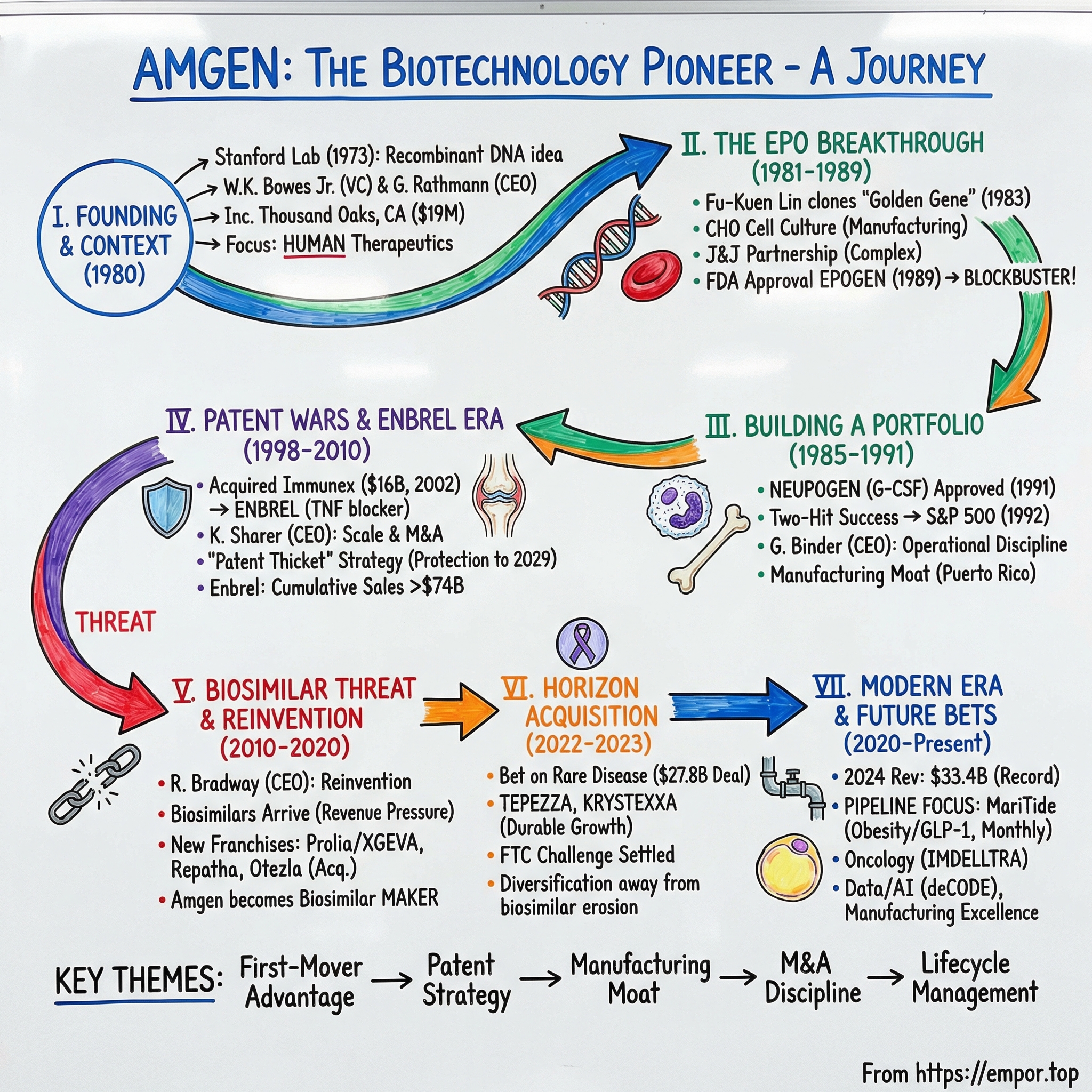
The company was incorporated on April 8, 1980 as Applied Molecular Genetics, in Thousand Oaks, California — a suburb chosen less for its scientific gravity than for the fact that it was affordable and nobody else was there. The founding capital was roughly $19 million, assembled by a group of venture investors led by William K. Bowes.8 Bowes had made his name in West Coast venture capital and would later help found Amgen's board culture of scientific independence; the money he raised bought a lab, a handful of researchers, and time.
The first chief executive was George B. Rathmann, a physical chemist who had spent years at Abbott Laboratories and 3M before jumping to a startup with no product, no revenue, and a name most people mispronounced. Red Herring would later call him "Mr. Biotech."8 Rathmann's operating philosophy was unusual for the era and, in retrospect, foundational: rather than spreading capital across a dozen shots on goal, he concentrated resources on a small number of proteins with clear biology and clear unmet need — and he was willing to bet the company on them.
The bet was erythropoietin. EPO is a hormone the kidneys secrete to tell bone marrow to make red blood cells. Patients on dialysis, whose kidneys have failed, become profoundly anemic; before EPO, the standard of care was transfusion, with all the risk and misery that implied. The scientific problem was that nobody had isolated the gene. The task fell to a young Taiwanese researcher named Fu-Kuen Lin, who spent two years hunting for it. In 1983, Lin's team found it — among roughly 1.5 million fragments of the human genome.8 It is worth pausing on that number, because it is the entire origin myth in one statistic: a small, underfunded company found one specific needle in a haystack of a million and a half needles, using the molecular biology tools of the early 1980s.
The same year, on June 17, 1983, Amgen went public under CFO Gordon Binder, raising close to $40 million.8 The company still had nothing to sell. It would be six more years before EPOGEN was approved in 1989 — and when it arrived, it did something no biologic had done before: it became a multi-billion-dollar product. That single fact reframed the entire industry. Until EPOGEN, the investment case for biotechnology was essentially venture-style option value. After EPOGEN, it was a demonstrated business model with pharmaceutical-grade economics.
There was a catch, and it shaped Amgen's institutional personality for the next forty years. To fund and commercialize EPO, Amgen had licensed rights outside dialysis to a Johnson & Johnson affiliate — a deal that seemed sensible when Amgen was a cash-poor startup and looked considerably less sensible once EPO became a franchise. The relationship curdled into years of arbitration and litigation over the boundaries of the split. The lesson Amgen took from it was not "avoid partners." It was: control your intellectual property, define your rights precisely, and never be the party with less leverage in a courtroom.
The platform proved repeatable. In 1985, a team under Larry Souza identified granulocyte colony-stimulating factor, the signal the body uses to produce infection-fighting white blood cells — the biological answer to chemotherapy's most dangerous side effect. NEUPOGEN was approved in 1991.8 Two blockbusters from one company inside a decade was, at the time, unprecedented outside of Big Pharma. On January 2, 1992, Amgen joined the S&P 500 and debuted on the Fortune 500 list in the same stretch.8 Rathmann had handed the CEO job to Binder in 1988; Binder would hand it to Kevin Sharer in 2000, and Sharer to Robert Bradway in 2012.8
Why does any of this matter to someone underwriting the stock today, rather than to a museum curator? Because the template Amgen built in the 1980s is still the template it runs. Discover or acquire a biologic with a clean mechanism. Build a manufacturing process nobody can easily copy. Wrap it in the densest patent estate the law will tolerate. Litigate aggressively against anyone who approaches. Defend exclusivity long after the underlying science has stopped being novel. That playbook produced extraordinary returns for three decades. It is also, precisely, the playbook now being tested to destruction by a biosimilar industry that has grown up, gotten capitalized, and learned to litigate back.
The clearest place to watch that test — the case study Amgen itself would probably prefer we skip — is a drug it did not discover at all.
III. The Patent-Thicket Playbook: Enbrel's Three-Decade Moat
In the summer of 2002, Amgen wrote the largest check in biotechnology's history to that point. On July 16, it completed the acquisition of Immunex, the Seattle company that had developed Enbrel, in a stock-and-cash transaction valued at roughly $16 billion — each Immunex share converting into 0.44 Amgen shares plus $4.50 in cash.9 Kevin Sharer framed it as consolidating leadership: Amgen would emerge with "a wide range of important drugs," combining its own EPOGEN and NEUPOGEN franchises with Enbrel, Kineret, and the next-generation follow-ons Aranesp and Neulasta.9
Enbrel was the prize. Approved in 1998, it was one of the first TNF inhibitors — a class of drugs that works by intercepting an inflammatory signalling molecule before it can reach its receptor, effectively muting the immune system's shouting in rheumatoid arthritis and psoriasis.8 The analogy that helps: if inflammation is a fire alarm stuck in the on position, a TNF blocker doesn't repair the wiring, it wraps the bell.
What happened next is the part worth studying. Amgen did not simply hold the patents it acquired. It licensed additional patents originally held by Roche, prosecuted continuation applications off them, and used the resulting estate to push Enbrel's US exclusivity out to April 2029 — three full decades after launch, and well beyond what the original filings would have supported on their own.10 Challengers came and lost. Sandoz, whose etanercept biosimilar Erelzi has been approved for years, could not clear the estate. 삼성바이오에피스 Samsung Bioepis was blocked on the same grounds, in a decision that Fierce Pharma described as Amgen's second patent win of the year on the product.11 Appellate courts sided with Amgen, and the Supreme Court declined to take the case.10
Then Sandoz changed weapons. In April 2025, rather than attacking the patents, it filed an antitrust suit in the Eastern District of Virginia alleging that Amgen had unlawfully monopolized the etanercept market — that acquiring the Roche patent rights and prosecuting continuations off them was itself anticompetitive, that the infringement suits were a "patent thicket," and that Amgen's contracting practices amounted to "rebate traps," where payers received discounts on Enbrel only if they excluded biosimilars from formularies. On February 17, 2026, the court dismissed the complaint under Rule 12(b)(6), holding in substance that Sandoz should have brought the antitrust claim as a compulsory counterclaim back in the 2016 patent litigation.12
So Amgen has won, repeatedly, comprehensively, and now on procedural grounds as well as substantive ones. Enbrel's US market is legally sealed until 2029.
Now the uncomfortable part. Enbrel's sales fell from roughly $3.3 billion in 2024 to $2.226 billion in 2025 — a 33% decline in a single year, with zero biosimilar units on the US market.3 The moat held perfectly. The castle emptied anyway.
The mechanism matters, because it generalizes. Enbrel's decline was driven by price and mix, not by copycat competition: pharmacy benefit managers extracting deeper rebates, formulary positions lost, and steady clinical share migration toward newer mechanisms — IL-17 and IL-23 inhibitors, and oral JAK inhibitors — that simply work better for many patients than a drug designed in the 1990s. Then, in 2026, a second force arrived. Enbrel was among the first products subject to Medicare Part D price setting under the Inflation Reduction Act, with negotiated prices effective at the start of the year. CFO Peter Griffith attributed Enbrel's continued Q2 2026 decline directly to that: "The decline in net selling price reflects the impact of U.S. Medicare Part D price setting under the Inflation Reduction Act."7 The good news, such as it is, is that the rate of decline slowed sharply once the price reset was absorbed — Enbrel was down only 4% year over year in the second quarter of 2026, to $580 million.5
For the bull-versus-bear spine of this story, Enbrel is the single most instructive data point Amgen has. It demonstrates that a legally bulletproof patent estate protects the right to be the only seller. It does not protect demand, it does not protect price, and it does not protect against a better molecule. Any investment case that treats Amgen's patent litigation record as evidence of a durable growth moat is conflating two different things. Exclusivity is a floor on competition, not a floor on revenue.
It is also worth naming the cost side of the ledger honestly. Three decades of exclusivity on a product Amgen bought rather than invented has made the company a recurring exhibit in the political argument about US drug pricing, and it invited the antitrust theory Sandoz tried. Amgen won that round. The reputational and regulatory bill for patent-thicketing has not necessarily been paid in full.
Which raises the obvious question: what happens when Amgen is on the receiving end? It already knows. It has been there twice.
IV. The Biosimilar Reckoning and Portfolio Diversification (2000s–2020)
There is a particular kind of corporate vertigo that comes from watching your own invention become a commodity. Amgen experienced it twice over roughly a decade, on the two products that made it famous.
EPOGEN and NEUPOGEN were, at their peak, the definition of a biotech franchise: novel biology, no substitutes, near-total pricing latitude. Then the ground shifted. Safety concerns and reimbursement changes clipped the anemia market's growth in the mid-2000s. And when the Biologics Price Competition and Innovation Act created a US pathway for biosimilars in 2010, filgrastim — NEUPOGEN's molecule — became one of the first targets, because it is a relatively small, well-characterized protein that a competent manufacturer can copy. Through the 2010s, both franchises eroded from blockbuster status toward the back pages of the product table. By 2025 neither warranted individual discussion in the growth story at all.
The strategic response, executed across Kevin Sharer's tenure and then Robert Bradway's, was diversification into therapeutic areas where Amgen's manufacturing and commercial scale could be redeployed. Two legs mattered most. In 2010, the FDA approved denosumab in two presentations: Prolia for osteoporosis and XGEVA for skeletal complications in cancer patients.8 Denosumab is an elegant piece of biology — an antibody that blocks RANK ligand, the molecular instruction that tells bone-dissolving cells to get to work. Turn off the instruction, and bone stops being resorbed. It became, in time, Amgen's largest franchise.
In 2015 came Repatha, an antibody against PCSK9.8 The mechanism is worth explaining plainly because it sets up a later section: the liver clears LDL cholesterol from the blood using surface receptors, and PCSK9 is a protein that drags those receptors off for destruction. Block PCSK9 and the receptors survive longer, so the liver vacuums up more cholesterol. The LDL reductions were dramatic from day one. The commercial results, for nearly a decade, were not — a mismatch we will return to.
Then, on August 26, 2019 — seven years ago to the day as this is written — Amgen announced it would acquire worldwide rights to Otezla for $13.4 billion in cash, or roughly $11.2 billion net of $2.2 billion in anticipated future cash tax benefits.13 Otezla is an oral, non-biologic treatment for plaque psoriasis and psoriatic arthritis that had generated about $1.6 billion in 2018 sales.13 The important context is why it was available: Celgene was compelled to divest it as a condition of its merger with Bristol Myers Squibb. This was not a target Amgen stalked and won. It was an asset that came onto the market because a regulator forced it there, and Amgen was among the few buyers with the balance sheet and the inflammation salesforce to absorb it quickly.
That distinction matters for judging Amgen's M&A record, and we will hold it in reserve for the Horizon discussion. A forced-sale asset bought at a full price is a different act of capital allocation than a competitive auction, and both are different from a strategic combination like Immunex.
The through-line for investors is this: by 2020, Amgen had already lived two complete biosimilar cycles on its own products. It knew exactly what the erosion curve looks like — the timing, the price cascade, the formulary mechanics, the way volume holds up for a while and then doesn't. That institutional memory is directly relevant to how the company should be judged today, because the third cycle is happening right now on denosumab, and management cannot claim to have been surprised.
But before the current cycle, Amgen made the biggest financial commitment in its history — and it did so in a way that drew the Federal Trade Commission's first litigated pharmaceutical merger challenge in more than a decade.
V. The Horizon Therapeutics Acquisition: Amgen's Biggest Bet (2022–2023)
A December auction nobody expected Amgen to win
In late 2022, Horizon Therapeutics — an Irish-domiciled specialty biopharma with an unusual portfolio of drugs for diseases most physicians rarely see — put itself in play. Multiple large-cap buyers were reported to have circled.
Amgen won it. On December 12, 2022, the companies announced a Rule 2.7 offer under Irish takeover law: $116.50 per share in cash, valuing Horizon at approximately $27.8 billion including debt.14
It was, by a wide margin, the largest transaction in Amgen's history — bigger than Immunex in nominal dollars, and bigger still in balance-sheet consequence, because it was funded entirely with cash and debt rather than stock.
What Amgen actually bought
Three assets carried the deal. TEPEZZA, an antibody for thyroid eye disease — a disfiguring and sometimes sight-threatening complication of Graves' disease that previously had no approved drug treatment at all.
KRYSTEXXA, an enzyme therapy for chronic refractory gout, aimed at patients whose uric acid crystals no longer respond to conventional treatment.
And UPLIZNA, an antibody for neuromyelitis optica spectrum disorder, a rare autoimmune attack on the optic nerves and spinal cord.
The common thread was not mechanism or biology. It was market structure: small patient populations, no competing approved therapy, physician prescribing concentrated among a few hundred specialists, and pricing power that follows from all three.
Amgen's stated logic was that its global infrastructure and regulatory experience could take drugs that had been sold mostly in the United States and turn them into worldwide franchises.14
The FTC's novel theory
In May 2023, the Federal Trade Commission sued to block the deal. This was not a routine overlap challenge — Horizon's drugs did not compete with anything Amgen sold.
Instead the FTC advanced a bundling theory: that Amgen could leverage its portfolio of blockbusters to pressure insurers and pharmacy benefit managers into favoring TEPEZZA and KRYSTEXXA, or into disadvantaging any future rivals to them. It was the agency's first litigated pharmaceutical merger challenge in more than a decade.
The theory is worth understanding because it is a direct descendant of the Enbrel rebate mechanics discussed above. The regulator had noticed that a company with many must-stock products can, in effect, rent its leverage across a formulary.
The parties settled in September 2023 through a consent order that prohibited Amgen from bundling any of its products with the two Horizon monopoly drugs, and from conditioning rebates in ways that disadvantaged competing products. Attorneys general from six states joined the resolution and dismissed the related injunction action.15
The deal closed on October 6, 2023.16 Amgen established a distinct Rare Disease business unit — the first meaningfully new commercial organization it had built in years.
Was the price right?
At roughly $27.8 billion against Horizon's trailing revenue of a little over $3.6 billion, Amgen paid in the neighborhood of eight times sales.
That is not cheap, but it is not an outlier for the vintage. Pfizer paid about $43 billion for Seagen in a comparable window; Johnson & Johnson had paid roughly $30 billion for Actelion in 2017 for a similarly structured rare-disease pulmonary franchise. Eight times sales for assets with monopoly positions and international expansion runway sat inside the range large-cap acquirers were paying for durable specialty revenue.
The harder question is what the multiple reveals about intent. Amgen was, at the time of signing, staring at the Enbrel decline and the approaching denosumab cliff. Buying $3.6 billion of high-margin, patent-protected, competition-free revenue solves a near-term topline problem regardless of whether the assets compound.
A skeptical reading: this was defensive diversification dressed as strategy, financed with leverage, at a price that required the international expansion thesis to work.
A fairer reading requires looking at what happened next.
The integration scorecard
Management set two testable promises. At least $500 million in annual pre-tax cost synergies by the third year after close, and a return to pre-deal leverage levels — which the company framed as rapid deleveraging toward roughly 3x EBITDA — by the end of 2025.14
Start with the balance sheet, because it is the harder promise. At December 31, 2023, Amgen carried $64.6 billion of debt against $10.9 billion of cash, and debt leverage of approximately 4.4 times EBITDA. Share repurchases were effectively suspended, capped at $500 million for 2024 against the $6.3 billion Amgen had spent in 2022.17
Two years later, at the end of 2025, total debt stood at $54.6 billion and leverage at approximately 3.2 times EBITDA. Amgen retired $6.0 billion of debt during 2025 alone.3
That is the promise, delivered roughly on the stated schedule. Ten billion dollars of gross debt reduction in two years, with the dividend still rising, is a genuine execution data point — and it is the kind of promise that is easy to verify and impossible to spin.
One asterisk, worth stating rather than burying: total debt ticked back up to $57.3 billion by the second quarter of 2026, though cash and equivalents also rose to $14.0 billion, leaving net debt lower.5 Amgen has also resumed buybacks in principle, guiding to no more than $3.0 billion for 2026 — though it repurchased nothing in the second quarter.5 The deleveraging is real; it is not finished, and the trajectory is no longer purely downward.
Do the assets work?
In 2025, TEPEZZA generated $1.903 billion, up 3%. KRYSTEXXA reached $1.340 billion, up 13%. UPLIZNA delivered $655 million, up 73%.3
By the second quarter of 2026 the momentum had broadened: TEPEZZA at $576 million (+14%), KRYSTEXXA at $400 million (+15%), and UPLIZNA at $335 million — up 90% year over year, following label expansions into additional rare autoimmune indications.5
Read that carefully. The two "monopoly" assets the FTC worried about are growing at a mid-teens rate — respectable, not spectacular. The asset nobody focused on at signing, UPLIZNA, is nearly doubling.
The analytical conclusion: the Horizon deal is working, but not for the reason it was underwritten. The value is coming disproportionately from indication expansion on a smaller asset rather than from international scaling of the headline drugs. That is a better outcome than a static annuity, and it is also a reminder that acquirers frequently pay for one thesis and get paid by another.
What it has not yet done is answer the growth question. Rare disease adds roughly $3.6 billion of pillar revenue to a $38 billion company. It replaces what Enbrel lost. It does not, by itself, make Amgen a growth company again.
For that, you have to look at the rest of the portfolio — where the picture is far less uniform than a single reporting segment suggests.
VI. Inside the Business Today: A Franchise-by-Franchise Tour
Amgen reports as one segment. That accounting convention conceals at least six businesses with genuinely different economics, growth rates, and competitive threats. Walk them in order of what actually moves the stock.
Bone health: the fight happening right now
Denosumab is Amgen's biggest franchise and its most immediate problem. In 2025, Prolia contributed $4.414 billion and XGEVA $2.084 billion — roughly $6.5 billion combined, with Prolia essentially flat and XGEVA down 6%.3
Then the wall arrived. On June 2, 2025, Sandoz launched Jubbonti and Wyost, the first — and at the time only — interchangeable denosumab biosimilars in the United States, under an April 2024 settlement in New Jersey federal court that set the launch date.18
"Interchangeable" is the word that matters. It is an FDA designation permitting a pharmacist to substitute the biosimilar without the prescriber's involvement, subject to state law. For a retail-dispensed product like Prolia, it removes the friction that has historically slowed biosimilar uptake.
The field filled in fast. 삼성바이오에피스 Samsung Bioepis won approval in February 2025; Fresenius Kabi and 셀트리온 Celltrion followed in March 2025, with Fresenius Kabi securing a global settlement with Amgen in July 2025 clearing its own launch path.19 Amneal also carries FDA approval.
The result is visible immediately. In the second quarter of 2026, Prolia fell 32% to $759 million and XGEVA fell 34% to $352 million, with the combined franchise down roughly a third to about $1.1 billion in the quarter.57
That is a genuinely steep curve — steeper than the multi-year grind that eroded NEUPOGEN. Multiple approved entrants, interchangeability, and a physician-administered/retail hybrid distribution model together compress what used to take five years into something closer to eighteen months.
There is one meaningful offset inside the same franchise. EVENITY, Amgen's bone-building antibody for high-risk osteoporosis, grew 34% to about $2.1 billion in 2025 and 38% to $714 million in the second quarter of 2026 — and it faces no near-term biosimilar.45 Bone health is not disappearing; it is being reconstituted around a newer, still-protected asset.
The investor conclusion: this is not a future risk to be discounted. It is a live, quantifiable erosion event, and the honest way to model Amgen is to assume the denosumab contribution keeps falling toward a low-price commodity floor while EVENITY absorbs part of the patient pool.
Cardiovascular: the decade-late inflection
Repatha is the most interesting operational story in the portfolio, because it is a lesson in how long a genuinely good drug can take to find its market.
Launched in 2015 with striking LDL-lowering data, it spent years fighting payer restrictions, prior-authorization burden, and a price point that made insurers reflexively defensive. Adoption crawled.
Then it broke open. Repatha grew 36% in 2025 to $3.016 billion, and another 37% in the second quarter of 2026 to $953 million.35
Two things changed. Amgen took price down and traded margin for access, dismantling the reimbursement friction. And the evidence base expanded into a much larger population.
On November 8, 2025, at the American Heart Association Scientific Sessions and simultaneously in the New England Journal of Medicine, Amgen reported VESALIUS-CV: 12,257 high-risk patients who had not previously had a heart attack or stroke, followed a median of 4.6 years. Repatha cut the primary composite of coronary death, heart attack, or ischemic stroke by 25%, and heart attacks specifically by 36%, taking median LDL to 45 mg/dL versus 109 mg/dL on placebo.20
That converts Repatha from a secondary-prevention drug — for people who have already had an event — into a primary-prevention drug, which is a vastly larger addressable population. By the second quarter of 2026 Amgen was presenting further analyses showing benefit in post-procedure and diabetic subgroups.5
The caution: Repatha's own US patent estate is finite, and the class now includes Regeneron and Sanofi's Praluent plus Novartis's twice-yearly siRNA agent Leqvio, which competes precisely on the dosing-convenience axis Amgen is trying to win with elsewhere. Growth at this rate is unlikely to persist indefinitely, but the runway is real and evidence-backed rather than promotional.
Inflammation and respiratory: new engine, old engine
TEZSPIRE, partnered with AstraZeneca, is an antibody for severe asthma that acts upstream of the usual inflammatory cascade — meaning it works across asthma subtypes rather than only in patients with a specific biomarker profile. It grew 52% in 2025 to $1.478 billion and 42% in the second quarter of 2026 to $486 million.35
Otezla, by contrast, is under pressure. After growing 7% in 2025 to $2.265 billion, it fell 21% in the second quarter of 2026 to $491 million.35 Gordon attributed that partly to price: "We are seeing definitely some pressure on price... given some 340B exposure on that product."7
That is a candid answer, and it points at a structural issue rather than a one-off. The 340B drug discount program has expanded steadily, and for products dispensed heavily through covered entities, it functions as a permanent margin tax that is largely outside the manufacturer's control.
Net: the inflammation portfolio is being rebuilt around TEZSPIRE while its two older assets — Enbrel and Otezla — both shrink for policy-driven pricing reasons. Two of the three moving parts are exposed to government price mechanisms rather than competitive dynamics, which is a meaningfully different risk to underwrite.
Oncology: a platform with real optionality
Amgen's innovative oncology portfolio generated $8.7 billion in 2025, up 11%.3 The intellectual core is the BiTE platform — bispecific T-cell engagers.
The concept, in plain terms: a BiTE is a molecule with two grabbing hands. One hand latches onto a marker on a cancer cell; the other latches onto a T cell, the immune system's assassin. The molecule physically drags the killer to the target and forces an introduction the cancer would otherwise avoid.
BLINCYTO, the first approved BiTE, treats a form of acute leukemia and grew 28% in 2025 to $1.559 billion, then 23% in the second quarter of 2026 to $472 million.35
The harder problem has always been extending the approach from blood cancers — where targets float freely — into solid tumors, where the tumor builds physical and chemical defenses against immune infiltration. IMDELLTRA (tarlatamab) is Amgen's answer, targeting DLL3 in small-cell lung cancer, one of the most lethal and least improved cancers in oncology.
The FDA granted it full approval in extensive-stage small-cell lung cancer in November 2025, converting an accelerated approval into a confirmed one.21 It generated $627 million in its first full year and then $288 million in the second quarter of 2026 alone — up 115%.35
Sized honestly, IMDELLTRA is still under 3% of revenue. Its importance is as evidence that the BiTE platform generalizes beyond hematology. If it does, the option value is large; if tarlatamab proves to be a one-off in a uniquely DLL3-rich tumor, it is a good drug rather than a platform.
Biosimilars: Amgen on the other side of the trade
Here is the genuinely distinctive part of the business, and the one most often missed.
Amgen sells biosimilars of other companies' biologics. That portfolio generated $3.0 billion in 2025, up 37%, and by the second quarter of 2026 was running at $855 million a quarter, up 29% — roughly 8–9% of revenue.47
PAVBLU, its version of Eylea for retinal disease, more than doubled to $287 million in the quarter. WEZLANA, its Stelara biosimilar, contributed $273 million across 2025.35
Gordon told analysts in August 2026 that since the first approvals in 2018, the portfolio has cumulatively generated more than $15 billion in sales.7 CFO Peter Griffith has held to a target of roughly $4 billion in annual biosimilar revenue by the end of the decade — an ambition management has now carried consistently across several years of calls, which is itself a small credibility marker.22
The next wave targets Opdivo, Keytruda, and Ocrevus — three of the largest biologics in the world.4
The strategic point is not the revenue line. It is the structural hedge. Amgen is the rare originator that profits directly from the same industrial capability — large-molecule manufacturing at scale, plus regulatory fluency — that is currently eating its denosumab franchise. When Prolia loses a dollar to Sandoz, Amgen's biosimilar unit is somewhere else taking a dollar from Regeneron or Johnson & Johnson.
That hedge is partial, not symmetrical: biosimilar economics carry structurally lower margins than originator economics, so a dollar lost is not a dollar replaced. But it does mean Amgen is not purely short the biosimilar trend, which distinguishes it from essentially every other large-cap originator.
Where Amgen genuinely differentiates — and where it doesn't
Across these franchises, the honest competitive read is uneven.
In large-molecule manufacturing and regulatory execution, Amgen's advantage is real and demonstrable — the biosimilar business is the proof, because you cannot build one without it. Only a handful of companies globally can do this at Amgen's scale and quality.
In cardiovascular and inflammation, Amgen competes on roughly even terms with Novartis, Regeneron, AbbVie, and others; its wins come from data and pricing, not from any structural edge.
In oncology, it faces Roche and AstraZeneca with far deeper solid-tumor franchises, and its BiTE differentiation is technological rather than commercial.
And in obesity — the market that will determine the multiple — it is arriving third, against two competitors with more capital deployed, more manufacturing built, and a several-year head start.
That is the fight worth spending real time on.
VII. MariTide and the Obesity Arms Race
The molecule
MariTide is not a conventional peptide drug. It is what Amgen's R&D chief James Bradner calls "an antibody peptide conjugate" — and, in his framing, "truly a singularity... the only of its kind."7
The plainest analogy: most GLP-1 drugs are small messenger molecules that the body clears within days, which is why they must be injected weekly. Amgen bolted the messenger onto an antibody scaffold — a much larger, slower-clearing protein — so the body disposes of it over weeks rather than days.
MariTide also does two things at once. It stimulates the GLP-1 receptor, which suppresses appetite and slows stomach emptying. And it blocks the GIP receptor, rather than stimulating it — the opposite of what Eli Lilly's tirzepatide does. That both approaches produce weight loss is one of the genuine open puzzles in metabolic biology, and a reminder that the field's mechanistic understanding lags its clinical results.
The practical claim is dosing. Monthly, or in Amgen's more aggressive framing, as few as four to six injections per year against the 52 required by weekly incumbents.5
What the Phase 2 data actually showed
The 52-week results presented at the American Diabetes Association's 85th Scientific Sessions in June 2025 are the entire evidentiary basis for the bet, so they deserve precision rather than enthusiasm.
Efficacy was strong and, importantly, still climbing at one year with no plateau.1 Continued weight loss at 52 weeks matters because durability — not peak effect — is what determines long-term value in a chronic-therapy market.
Tolerability was the problem. Vomiting in the roughly 22–24% range in dose-escalation groups, and GI-driven discontinuation of up to 7.8% in those arms, with materially worse results in the arms that did not escalate dosing.1
The market's reaction was not about the weight loss. It was about the arithmetic of convenience. Amgen's Phase 3 design responds to the tolerability signal with a gentler three-step escalation — 21 mg, then 35 mg, then 70 mg over eight weeks.1
Skorney's critique lands precisely there: a drug sold on simplicity that requires a multi-step titration has surrendered part of its own pitch. Jefferies' Michael Yee read the same design more favorably, arguing the slower ramp could preserve tolerability while maintaining the dosing advantage at maintenance.2 Both readings remain live; only Phase 3 resolves them.
The MARITIME program
Amgen moved to Phase 3 in 2025 with an unusually broad program.23
MARITIME-1 enrolls roughly 3,500 participants with obesity or overweight without type 2 diabetes over 72 weeks, with a primary readout expected at the beginning of 2027. MARITIME-2 enrolls 999 participants with type 2 diabetes on a similar timeline.
The most strategically revealing study is MARITIME-Switch, initiated in the first quarter of 2026, which enrolls patients already on weekly GLP-1 therapy and tests whether they will move to MariTide.
That trial exists because Amgen understands its actual commercial problem. By the time MariTide could reach market, the incumbents will have millions of patients established on therapy. Winning naive patients is a share-of-growth fight; winning switchers is a share-of-installed-base fight, and it is much harder. Running the study is a sign management is being realistic rather than optimistic about the competitive position.
Beyond weight management, Amgen has extended MariTide into heart failure and obstructive sleep apnea, with cardiovascular outcomes work as well — nine Phase 3 trials running concurrently.523
The financial commitment is visible in the P&L. R&D expense rose 22% in 2025 to $7.272 billion, roughly a fifth of revenue.3 That is a large step-up for a company simultaneously deleveraging, and it is being spent substantially on a single, binary program.
Why win, why not
The why-win case rests on one differentiator and one market observation.
The differentiator is dosing burden — if, and only if, tolerability at maintenance holds. The market observation is that discontinuation is the central unsolved problem in obesity pharmacotherapy: a large share of patients stop within a year, and Amgen's own shareholder communications lean on this, arguing that "treatment discontinuation has been a persistent challenge with existing therapies."4 A drug that is easier to stay on could capture value even with slightly less peak efficacy.
The why-not case is more concrete, and an investor should weight it accordingly.
Amgen is not first. Novo Nordisk's Wegovy and Eli Lilly's Zepbound have years of prescriber habit, payer contracts, and patient experience. Both have spent tens of billions building manufacturing that Amgen would need to match.
Amgen is not fastest. Lilly's oral orforglipron attacks convenience from a different direction — a pill, not an injection — and a pill beats a monthly shot on convenience by most patient measures.
The efficacy delta is not obviously in Amgen's favor. The Phase 2 numbers looked inferior to tirzepatide and only modestly better than semaglutide.2
And the tolerability question is unresolved. When Evercore ISI's Umer Raffat pressed management in August 2026 on whether Phase 3 vomiting rates would come in at "mid-20s or better," Bradner declined to give a number, saying only that the team was "noses down delivering a very compelling Phase III data package" and that they remained "very confident in the profile of this medicine."7
That is an honest non-answer, and it should be read as one. Management is not going to pre-announce a safety endpoint. But an investor should note that the single most important uncertainty in the thesis is one the company will not quantify until the data arrive.
The disciplined way to hold MariTide is as optionality with an unusually large notional and an unusually late resolution date. Phase 2 data is not an approved product, and the gap between the two has ended more programs than it has launched.
Which brings the story to the person who authorized the spending.
VIII. Management, Incentives & Capital Allocation Under Bradway
The banker who became a biotech lifer
Robert Bradway is an unusual figure to be running a science company. He came up through Morgan Stanley's healthcare investment banking practice in London and New York, joined Amgen in 2006 as a strategy executive, ran the commercial organization, became CFO, then president and chief operating officer, and took the CEO job in May 2012.8
That resume shapes the company. Bradway is not a scientist evangelist in the mold of George Rathmann. He is a capital allocator who happens to run a research organization — and his tenure reads like a series of portfolio decisions rather than scientific bets.
Fourteen years in, he is among the longest-serving chief executives in large-cap biopharma. That tenure spans three distinct chapters: the managed decline of EPOGEN and NEUPOGEN, the buildout of inflammation and cardiovascular, and now the leveraged pivot into rare disease and obesity.
Testing credibility against behavior, not language
The useful way to assess management is to check what they promised against what happened, using their own prior statements as the benchmark.
On deleveraging, the promise was explicit and the outcome is measurable: leverage down from approximately 4.4x to approximately 3.2x EBITDA in two years, with $6.0 billion of debt retired in 2025 alone.173 Amgen paid for its acquisition rather than refinancing it indefinitely. That is a genuine mark in the company's favor.
On guidance, the pattern through 2025 and into 2026 has been consistent upward revision. Amgen entered 2026 guiding to $37.0–$38.4 billion of revenue and $21.60–$23.00 of non-GAAP EPS.3 By August 2026 it had raised both, to $38.2–$39.4 billion and $22.30–$23.50.5 Griffith framed it simply: "We are pleased with our strong execution in the first half of the year."7
Raising guidance is not by itself a virtue — a company can guide low deliberately. What makes it meaningful here is that the raise came while the largest franchise was collapsing by a third, which means the growth drivers genuinely over-delivered rather than merely offsetting a conservative base.
On candor about bad news, the record is better than average. Amgen did not bury denosumab erosion in an "other products" aggregation; Gordon named the mechanism and the magnitude on the call.7 Griffith attributed Enbrel's price decline to a specific policy — Medicare Part D negotiation — rather than to vague "market dynamics."7 Otezla's 340B exposure was volunteered rather than extracted.
Where management is less forthcoming is precisely where it matters most. On MariTide tolerability, the answers are confident in tone and empty of numbers. That is defensible practice for a blinded Phase 3, but investors should not mistake conviction for evidence.
Incentives
Bradway's 2025 total compensation was approximately $24.7 million, a modest increase on roughly $24.4 million in 2024.24
The structure is more informative than the number. More than 75% of CEO pay sits in long-term equity, and the performance units for the 2023–2025 cycle were measured on non-GAAP EPS growth and return on invested capital, with a total-shareholder-return modifier.25
ROIC as a metric is well matched to the actual strategic question at Amgen. A company that has spent $27.8 billion on an acquisition and is spending over $7 billion a year on R&D should be judged on whether that capital earns a return, and tying the CEO's equity to that measure at least aligns the arithmetic.
The proxy also documents anti-hedging and anti-pledging policies, meaning executives cannot neutralize their exposure with derivatives or borrow against their stock.25 Bradway holds roughly half a million shares directly, worth over $200 million at the current price, alongside additional shares held through family trusts.25
That is not founder-level alignment — it is roughly a tenth of a percent of the company — but it is a real personal stake, and the anti-hedging policy means it is genuinely exposed.
Capital return alongside the deleveraging
Amgen raised its quarterly dividend 6% to $2.38 per share for 2025, then another 6% to $2.52 for 2026 — a fourteenth consecutive annual increase.45
Raising the dividend while paying down acquisition debt and stepping up R&D is a deliberate signal. It says management believes the cash generation is durable enough to fund three claims at once.
It is also a constraint worth naming. A dividend that has been raised every year for fourteen years is very difficult to cut without a severe signalling penalty, which means it functions as a fixed charge on future capital allocation. If MariTide's Phase 3 program requires more spending, or if bone-health erosion runs faster than modelled, the dividend is the last thing to flex.
Capital expenditure has also been rising: roughly $1.9 billion in 2025, with announced commitments including $1.0 billion in North Carolina, $900 million in Ohio, $650 million in Puerto Rico, and a $600 million innovation center in Thousand Oaks — and 2026 capex guided to approximately $2.6 billion.45
Some of that is manufacturing capacity for a potential obesity launch, which is a capital commitment made before the science is proven. Some is a response to US tariff and onshoring politics. Either way, it consumes free cash flow that would otherwise accelerate deleveraging.
The activist question
No active activist campaign against Amgen has been publicly identified as of mid-2026. That absence is itself a data point worth stating rather than assuming.
The plausible explanation is that the two things activists typically attack — an unkept deleveraging promise and inconsistent guidance — are the two things Amgen has done well. There is limited leverage in demanding a company do what it is already doing.
But the profile is one that attracts attention if either pillar cracks. A skeptical long/short investor already has a coherent bear script: a single reporting segment that obscures wide dispersion in franchise health; net debt still elevated years after the deal; rising R&D concentrated in one binary program; a rare-disease acquisition whose headline assets grow at mid-teens rates while the balance sheet carries the full purchase price; and roughly a fifth of revenue exposed to government price setting through the IRA and 340B.
None of that is a scandal. All of it is the raw material for a campaign if the MARITIME readouts disappoint in early 2027 and the stock derates.
Which is a good reason to look past company-specific execution and ask what the industry structure itself permits.
IX. Industry Structure: Porter's Five Forces and Amgen's Durable Powers
Buyers hold more power than the science suggests
The single most underappreciated fact about US biopharma is that the customer is not the patient and often not even the physician. It is a small number of pharmacy benefit managers and integrated payers who decide which drugs appear on a formulary and at what net price.
Enbrel is the case study, and it is stark: a product with legally guaranteed monopoly status until 2029 lost a third of its revenue in one year, largely because buyers demanded more of it.3
That is buyer power in its purest form. When three PBMs control the overwhelming majority of covered lives, exclusivity buys you a seat at the table, not the terms of the deal.
Government has now joined the buyer side directly. Medicare Part D price setting under the Inflation Reduction Act is not negotiation in the commercial sense; it is administered pricing with a statutory backstop, and Amgen has already absorbed its first product through that process.7
Add 340B, which forces discounts to a widening universe of covered entities, and a material share of Amgen's revenue base is priced by mechanisms the company cannot contest commercially.
Substitutes are now industrialized
The threat of substitutes in biologics used to be theoretical. It is now an industry with dedicated capital, purpose-built manufacturing, and litigation departments that know the Biologics Price Competition and Innovation Act better than most originators do.
Denosumab demonstrates the mature version: four or more approved entrants arriving within roughly fifteen months of one another, at least one carrying interchangeability, following coordinated global settlements.1819
The second substitution vector is more dangerous because it cannot be litigated at all. A better mechanism simply replaces an older one. Enbrel lost share to IL-17 and JAK drugs. Injectable GLP-1s may in time lose share to oral ones. No patent estate defends against a superior molecule.
Rivalry, entrants, and suppliers
Rivalry among established players is intense but rational — competition happens through clinical data and rebate negotiation, not price wars in the commodity sense.
The threat of new entrants into originator biologics is genuinely low. The capital, time, and regulatory expertise required to bring a novel biologic through Phase 3 remain enormous, which is why the same fifteen or so companies have dominated for decades.
Supplier power is modest in the traditional sense, though single-source inputs, specialized bioreactor capacity, and increasingly geopolitics — where active ingredients and fill-finish operations are located — have made supply chain a board-level topic rather than an operations one. Amgen's announced US manufacturing investments should be read partly in that light.4
Which of Helmer's powers does Amgen actually hold?
Applying Hamilton Helmer's 7 Powers with some discipline rather than as a checklist:
Scale economies — yes, and this is the strongest claim. Amgen manufactures large molecules at a scale and consistency that very few can match, and the proof is not a management assertion but a business: its own biosimilar unit, which requires exactly that capability and has now cumulatively sold more than $15 billion of product.7
Process power — yes, in the specific sense that biologic manufacturing and regulatory execution are accumulated organizational knowledge that cannot be bought. The Immunex integration, where Amgen resolved Enbrel's chronic supply constraints by bringing large-scale capacity online, was the early demonstration.
Switching costs — partial. Physicians who have prescribed a biologic for years and have established patients on it are slow to move, and titration and monitoring protocols create real friction. But interchangeability designations are designed precisely to dissolve that friction, and denosumab shows they work.
Branding — weak. In a rebate-driven, formulary-mediated market, brand loyalty is a rounding error next to net price.
Cornered resource — largely absent, and this is the crux. Amgen does not own a repeatable discovery engine of the kind Regeneron has in VelocImmune, its transgenic-mouse antibody platform, or Moderna has in mRNA. BiTE is a real platform, but it has produced two commercial products in a decade.
Counter-positioning — arguably present in one narrow place. Amgen's willingness to sell biosimilars of competitors' drugs is something a pure originator like Regeneron would struggle to imitate without cannibalizing its own identity and payer relationships.
Network economies — not applicable in any meaningful sense.
What that means
The composite picture: Amgen's durable advantages are industrial and commercial rather than scientific. It is very good at making, approving, and selling complex proteins at scale, and that capability is genuinely hard to replicate.
What it does not obviously possess is a defensible engine for generating the next molecule faster or more reliably than competitors. Its two largest recent revenue additions — Otezla and the Horizon portfolio — were bought, not discovered.
That distinction is precisely why MariTide matters beyond its own economics. It is a test of whether Amgen can win a scientific race against two companies with deeper platform commitment in that specific biology. Manufacturing scale helps enormously after approval. It does not generate the approval.
X. Playbook: Durable Business & Investing Lessons
Exclusivity and demand are different assets
The most transferable lesson from this story is the one Amgen would least like framed as a lesson: a patent protects the right to sell alone. It does not protect the willingness of buyers to pay, or the preference of physicians to prescribe.
Investors habitually treat "loss of exclusivity date" as the cliff and everything before it as a plateau. Enbrel demonstrates that the erosion can begin years before the legal cliff and be driven entirely by rebate pressure and clinical obsolescence.
The practical implication for any patent-protected business: model the demand curve and the price curve separately from the exclusivity date, and do not let the strength of the legal position substitute for evidence about either.
Litigation as a capital allocation decision
Amgen's patent strategy has been extraordinarily effective on its own terms — three decades of exclusivity on a product it acquired in 2002, and a successful defense against both patent and antitrust attacks.101112
But it is a strategy with a full cost accounting. Decades of legal spend. A permanent position in the political debate about American drug pricing. An antitrust theory built specifically around its contracting practices. And a regulator, the FTC, that arrived at the Horizon deal already primed to worry about how Amgen uses portfolio leverage.15
The lesson is not that the litigation was wrong. It is that aggressive IP defense generates regulatory attention that compounds, and that attention eventually gets priced.
M&A logic is not a single playbook
Amgen's three largest deals reflect three incompatible logics, and treating them as one "Amgen approach" would be an analytical error.
Immunex in 2002 was a strategic combination: a scarce asset, bought with stock, where the acquirer's manufacturing capability was the value-creating input.9
Otezla in 2019 was opportunistic: a regulator-forced divestiture, bought with cash at a full multiple, where speed and salesforce fit were the differentiators.13
Horizon in 2023 was defensive diversification: a competitive process, funded with debt, where the strategic purpose was to replace revenue Amgen knew it was about to lose.14
Each should be judged on its own economics. The Immunex asset is now in terminal decline but delivered twenty-plus years of cash. Otezla is shrinking under 340B pressure. Horizon is growing, but from a source management did not headline. Averaging these into a single verdict about "M&A discipline" tells you nothing useful.
Sitting on both sides of a disruption
The most genuinely distinctive structural feature of Amgen is that it is simultaneously the victim and the beneficiary of biosimilar competition.
Almost no other large-cap originator has built this hedge — most treat biosimilars as a threat to be litigated rather than a business to be entered. Amgen did both, and the second decision has produced a fast-growing, structurally advantaged unit.
The general principle for investors: when a company's core capability enables it to participate in the force disrupting it, that is a meaningfully different risk profile than a pure incumbent. Not a solution — biosimilar margins are lower, and the offset is partial — but a real reduction in the variance of outcomes.
The three things worth tracking
Rather than a dashboard, three metrics carry most of the information about whether this story goes right.
First: the combined bone-health revenue trajectory — Prolia plus XGEVA plus EVENITY, quarter by quarter. This measures the erosion rate of the largest franchise net of its own internal replacement, and it is the cleanest read on how fast a mature biologic franchise decays under multi-entrant interchangeable competition.
Second: MariTide's Phase 3 tolerability and discontinuation rates, when MARITIME-1 and MARITIME-2 read out. Not the weight-loss headline — the dropout rate. Efficacy determines whether the drug works; tolerability determines whether it sells.
Third: biosimilar segment revenue against the roughly $4 billion end-of-decade ambition. This is the cleanest single test of whether Amgen's manufacturing and regulatory scale is a real economic moat or merely a description of its factories.
XI. Analysis: Bull vs. Bear Case
The bull case
Start with what is already proven rather than what is hoped for, because the bull case here is unusually well evidenced in its first several steps.
Amgen has replaced a decaying revenue base with a genuinely diversified one. Six growth drivers accounted for nearly 70% of product sales in the second quarter of 2026 and grew 26% collectively.5 That is not a company living off legacy annuities.
Repatha's transition from secondary to primary prevention is a durable, data-backed expansion of addressable population, not a pricing trick.20 TEZSPIRE is compounding at 40%-plus with a partner absorbing part of the cost.5 UPLIZNA is nearly doubling on label expansion.5
The biosimilar business is a quantifiable new growth line with a structural rationale, not a sideline.7
Deleveraging happened roughly as promised, restoring optionality to a balance sheet that had none in 2024.317
And MariTide is genuine optionality on a market growing faster than anything in Amgen's core, with a differentiator — dosing burden — that addresses the incumbent class's single biggest real-world weakness.4
Layer on consistent guidance raises, fourteen straight years of dividend increases, and a compensation structure tied to ROIC, and the bull case is essentially: a well-run industrial biologics company with a free call option attached.
The bear case
The bear case is not the mirror image. It is more specific, and it starts with a number already on the tape.
Amgen's largest franchise is shrinking by roughly a third year over year, right now, with the erosion curve steepening rather than flattening.57 Denosumab was approximately $6.5 billion of high-margin revenue in 2025.3 Multi-entrant interchangeable biosimilar competition does not partially erode a franchise; it resets its price level permanently.
Second, Enbrel proved that Amgen's most celebrated defensive capability does not defend revenue.3 A bear extends that logic: if the best-protected product in the portfolio still lost a third of its sales, what exactly does the patent estate buy?
Third, roughly a fifth of the revenue base now faces administered rather than negotiated pricing, through IRA Part D setting and 340B expansion — a headwind that grows as more products age into eligibility.7
Fourth, MariTide is a genuinely binary bet against better-resourced competitors, on data that already disappointed once.2 R&D at over $7 billion and rising is being concentrated into an outcome that resolves in early 2027.323
Fifth, net debt remains well above pre-Horizon levels, capex is stepping up toward $2.6 billion, and the dividend is functionally uncuttable.5
The bear's synthesis: Amgen is a company using an acquired rare-disease franchise and a lower-margin biosimilar business to paper over structural decay in its originator base, while spending its incremental capital on a late entry into the most competitive market in pharmaceutical history.
Where the evidence actually points
Both cases are honestly held, and the evidence resolves some of the disagreement.
On diversification, the bulls have the better of it. The growth drivers are real products with real data, and the second-quarter guidance raise happened despite a one-third decline in the largest franchise. That is arithmetic, not narrative.
On the patent moat, the bears are correct and the bulls are usually vague. There is no credible evidence that Amgen's IP position generates growth; it generates delay.
On MariTide, neither side has evidence. Anyone claiming confidence in either direction is extrapolating from Phase 2 across the exact gap where obesity programs historically fail.
On management, the record supports moderate credibility: promises made about leverage were kept, disclosures about bad news have been specific, and the areas of vagueness are the areas where vagueness is standard practice rather than evasion.
Valuation and peers
Amgen trades at roughly $238.7 billion, having risen about 34% year to date in 2026 after gaining 26% in 2025 against the S&P 500's 16%.64
Against peers, the framing question is which comparison set applies. Measured against Regeneron and Vertex — companies with platform-driven pipelines and cleaner growth profiles — Amgen carries more mature-franchise decay and more leverage. Measured against Novartis, Roche, and Gilead — diversified large-caps managing their own patent cliffs — its growth-driver mix and biosimilar hedge compare favorably.
The uncomfortable observation is that a stock which has risen roughly a third in eight months, while its largest franchise shrank by a third, is not being valued primarily on its current earnings power. Some portion of the move reflects the growth drivers genuinely outperforming. Some portion reflects the market's willingness to pay for an obesity option.
Disentangling those two is the central valuation exercise, and the honest answer is that it cannot be done precisely from the outside. What can be said is this: the more of the current multiple that rests on MariTide, the more violent the repricing if MARITIME-1 merely matches Phase 2 rather than beating it — because "matches Phase 2" is already a profile the market found underwhelming once.
XII. Epilogue: The Next Decade's Verdict
Forty-six years after a chemist and a venture capitalist rented lab space in a Thousand Oaks industrial park, Amgen's story has arrived at a symmetry that is almost too neat.
The company that proved a biologic could be a blockbuster is now watching its biggest biologic get copied by four competitors at once. The company that spent three decades perfecting the defense of exclusivity is discovering that exclusivity was never the same thing as demand. And the company that built its reputation on being first to a molecule is betting its next chapter on being third.
Two data streams will settle the argument, and both are observable rather than speculative.
The first is the pace of denosumab erosion, quarter by quarter, and how much of it EVENITY recaptures. This determines the depth of the trough Amgen's core has to climb out of, and it is being reported in real time.
The second is the MARITIME Phase 3 package, with primary readouts expected around the beginning of 2027.23 Specifically: whether the gentler titration holds vomiting and discontinuation rates low enough that "four to six injections a year" becomes a real clinical proposition rather than a marketing line.
What would tilt the balance toward the bulls: MariTide demonstrating durable weight loss with tolerability meaningfully better than the Phase 2 escalation arms, combined with a bone-health decline that stabilizes at a higher floor than feared as EVENITY and international markets absorb patients.
What would tilt it toward the bears: a Phase 3 tolerability profile no better than Phase 2 — which would concede the convenience argument to Lilly's oral candidate — arriving alongside continued 30%-plus annual declines in denosumab and further IRA-driven price resets across aging products.
There is a third possibility, less discussed and arguably most likely: MariTide works, gets approved, takes a respectable minority share of an enormous market, and Amgen becomes a solidly profitable third player in obesity while its biosimilar unit and rare-disease portfolio grind out mid-single-digit growth. That outcome is neither a triumph nor a disaster. It is what most late entrants into large markets actually achieve, and it is probably not what the current multiple assumes.
Amgen wrote the rules that every originator and every biosimilar challenger now uses against each other — the patent continuations, the rebate architecture, the settlement-driven launch dates, the manufacturing scale as a barrier. The next several years test something the company has never had to prove before: whether the author of the rulebook can still win playing under it, from second position, against opponents who read it just as carefully.
References
-
Results from Amgen's Phase 2 Obesity Study of Monthly MariTide Presented at the American Diabetes Association 85th Scientific Sessions — Amgen, 2025-06 ↩↩↩↩↩
-
New Amgen obesity drug data disappoint Wall Street — BioPharma Dive, 2025-06 ↩↩↩↩↩
-
Amgen Reports Fourth Quarter and Full Year 2025 Financial Results — Amgen, 2026-02 ↩↩↩↩↩↩↩↩↩↩↩↩↩↩↩↩↩↩↩↩
-
Amgen CEO Bob Bradway's 2025 Letter to Shareholders — Amgen, 2026-03 ↩↩↩↩↩↩↩↩↩↩
-
Amgen Reports Second Quarter 2026 Financial Results — Amgen / PR Newswire, 2026-08-04 ↩↩↩↩↩↩↩↩↩↩↩↩↩↩↩↩↩↩↩↩↩↩↩↩↩
-
Amgen (AMGN) Market Cap & Net Worth — Stock Analysis, 2026-08-26 ↩↩
-
Amgen (AMGN) Q2 2026 Earnings Call Transcript — The Motley Fool, 2026-08-11 ↩↩↩↩↩↩↩↩↩↩↩↩↩↩↩↩
-
Amgen Completes Acquisition of Immunex — Amgen, 2002-07-16 ↩↩↩
-
NJ Court Decision Means Three Decades of Product Exclusivity for Enbrel — Center for Biosimilars ↩↩↩
-
Amgen stalls Samsung's Enbrel biosimilar until 2029 in second patent win of the year — Fierce Pharma ↩↩
-
Court Dismisses Sandoz's Enbrel (etanercept) Antitrust Lawsuit — Venable's BiologicsHQ, 2026-02 ↩↩
-
Amgen to Acquire Otezla for $13.4 Billion in Cash, or Approximately $11.2 Billion Net of Anticipated Future Cash Tax Benefits — Amgen, 2019-08-26 ↩↩↩
-
Rule 2.7 Announcement: Amgen Inc. to Acquire Horizon Therapeutics plc — Amgen IR, 2022-12 ↩↩↩↩
-
FTC Consent Order in Horizon Therapeutics Acquisition — Amgen ↩↩
-
Amgen Completes Acquisition of Horizon Therapeutics plc — Amgen, 2023-10 ↩
-
Amgen Reports Fourth Quarter and Full Year 2023 Financial Results — Amgen, 2024-02 ↩↩↩
-
Sandoz Launches Jubbonti / Wyost (denosumab-bbdz) as First Prolia / Xgeva Interchangeable Biosimilars — Venable's BiologicsHQ, 2025-06 ↩↩
-
Fresenius Kabi Receives FDA Approval for Denosumab Biosimilars and Secures Global Settlement Agreement with Amgen — Fresenius Kabi, 2025 ↩↩
-
Amgen's Repatha Cuts Risk of First Major Adverse Cardiovascular Events by 25% in Landmark Phase 3 VESALIUS-CV Trial — Amgen, 2025-11-08 ↩↩
-
FDA Grants Full Approval to Amgen's IMDELLTRA in Extensive-Stage Small Cell Lung Cancer — Amgen, 2025-11 ↩
-
Inside Amgen's Phase 3 MARITIME Program: Advancing the Future of Obesity Care — Amgen, 2025-06 ↩↩↩↩
-
Amgen awards Bradway with $24.7M pay package in '25 — Fierce Pharma ↩
-
Amgen DEF 14A Proxy Statement, FY2026 — SEC EDGAR, 2026-04-07 ↩↩↩
 LinkedIn
 WhatsApp
 Reddit
 Hacker News
 Email
Email Kindle
 RSS Feed
 Spotify
 Apple Podcasts
 Amazon Music
 Audible
 YouTube