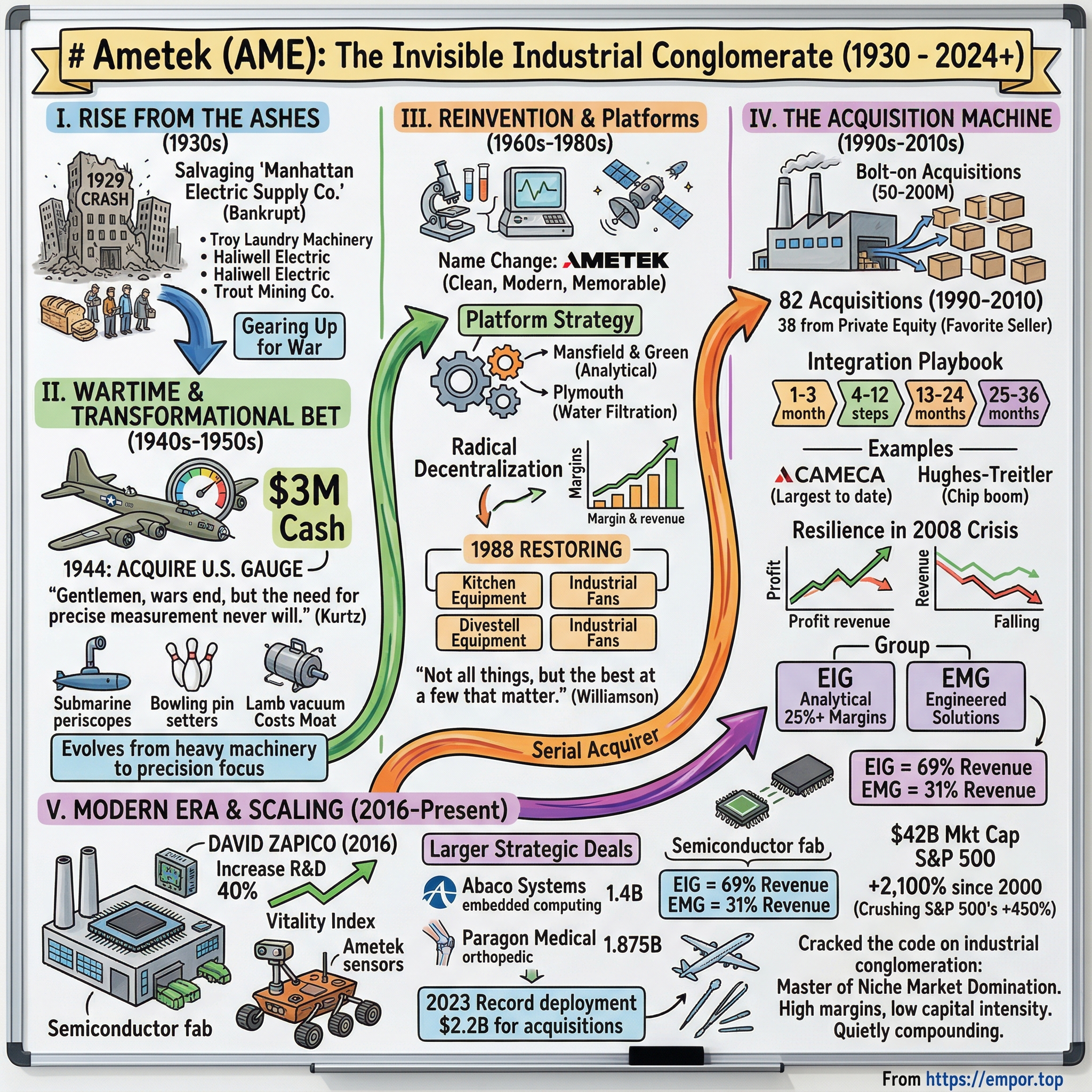
AMETEK: The Compounding Machine Nobody Talks About
I. Introduction & Episode Roadmap
There is a particular kind of company that sophisticated investors love and nobody else can name. It has no consumer brand. It sponsors no stadiums. Its products are, almost by design, invisible — a sensor buried inside a jet engine, an optical flat used to qualify the lens stack in a semiconductor lithography tool, a ruggedized computer bolted into the belly of a drone, a heat exchanger the size of a shoebox that keeps a fighter jet's avionics from cooking themselves.
AMETEK is that company. It is a component of the S&P 500 and the Russell 1000, headquartered in the leafy Philadelphia suburb of Berwyn, Pennsylvania, and it employs roughly 22,500 people across manufacturing operations in 22 countries outside the United States.1 In 2025 it did $7.40 billion of revenue and earned $6.40 per diluted share.1 By late August 2026, the market valued it at roughly $56 billion.2 Ask a hundred people on a busy street what AMETEK makes and you will get a hundred blank stares. Ask a hundred industrial analysts and you will get a knowing nod.
The thesis, compressed into a sentence: AMETEK does not invent categories. It buys the number one or number two player in dozens of markets too small for a mega-cap to bother with, applies a standardized operating playbook, harvests the cash, and buys the next one. Do that for thirty years and the arithmetic becomes remarkable. Do it badly for three years and the arithmetic becomes a cautionary tale. The whole investment question is which of those two stories is currently being written.
Which brings us to why this is an interesting moment rather than a routine one.
On May 6, 2026, AMETEK announced that it had agreed to acquire a portfolio of instrumentation businesses from Indicor, LLC for approximately $5.0 billion in cash.4 To understand how large that is by AMETEK's own historical standards, consider that the company's previous largest deal — Abaco Systems in 2021 — cost $1.35 billion.7 The Indicor transaction is roughly 3.7 times bigger. It is being funded not from the balance sheet but from a newly arranged $4.0 billion term loan facility and an enlarged revolver.13 And it will push the company's leverage from what has historically been near-zero to roughly 2.3 times EBITDA at closing.15
For a company whose entire cultural identity is built on discipline — on small, digestible, self-funded bolt-ons — this is not a footnote. It is the story.
Here is where the next several thousand words are going. First, a compressed origin: how a Depression-era grab-bag of laundry machinery and mining assets became a precision instruments company, and what the painful 1988 unwind taught the organization about focus. Then the modern machine as it was built and operated under David Zapico from 2016 through 2023 — the era of restraint that earned the company its reputation. Then the two operating segments, sized to their actual economic weight: the Electronic Instruments Group, which is roughly two-thirds of revenue and where the investment case genuinely lives, and the Electromechanical Group, which is smaller, more cyclical, and quietly improving.
From there, the heart of it: a deal-by-deal walk through what AMETEK has actually paid for things, benchmarked against its own history and against the asset it is now buying — an asset with a genuinely unusual provenance that most coverage has glossed over. Then the people: Zapico's incentives, a new CFO still building his own stake, and what the last four earnings calls reveal about whether this management team explains itself honestly when the numbers wobble. Then the demand surge of 2025 and 2026 — record orders, record backlog, and a management narrative about artificial intelligence infrastructure that is partly verifiable and partly not. Then the competitive map, the risk radar, and the bull and bear cases argued at full strength.
One framing note before the story starts. AMETEK is a company that has earned a great deal of trust from public-market investors, and trust is exactly the thing that makes a business hardest to analyze. The temptation with a long-record compounder is to grade the current decision by the historical record — to assume that because the last eighty deals worked, the eighty-first will too. That is not analysis; it is extrapolation wearing analysis as a costume. The useful question is narrower and harder: what specifically has changed about the size, funding, and complexity of what AMETEK is doing, and what evidence over the next four to six quarters would confirm or refute that the playbook still applies at this scale?
To answer that, it helps to know where the playbook came from.
 Subscribe on LinkedIn
II. Origins: From Depression-Era Roll-Up to Precision Instruments
Picture Manhattan in 1930. The crash is eighteen months old, the credit markets are frozen, and a company called Manhattan Electric Supply has gone into bankruptcy. Its stockholders — facing the choice between total loss and a salvage operation — chose salvage. They incorporated a new entity in Delaware called American Machine and Metals, Inc., listed it on the New York Stock Exchange, and gave it a three-letter ticker that has outlived nearly everything else about the original enterprise: AME.16
What they actually owned was not a business so much as a collection. A laundry machinery operation. An electrical business. A mining company. It was the kind of portfolio that gets assembled by a receiver rather than by a strategist — assets that happened to be adjacent on a balance sheet rather than adjacent in any market. For fourteen years the company operated this way, and it is not obvious that anyone had a theory about what it was supposed to become.
Then, in 1944, came the transaction that historians of the company treat as the hinge. American Machine and Metals paid $3 million in cash for U.S. Gauge.6 Gauges are unglamorous. They are also, in an important sense, the ancestor of everything AMETEK sells today: a small, precise device whose only job is to tell an operator the true state of something they cannot see directly. U.S. Gauge went on to become the world's largest manufacturer of gauges, and it planted the instrumentation DNA that still runs through the company eighty years later.
The 1950s and 1960s brought the roll-up instinct that would eventually become a formal system. Lamb Electric arrived in 1955, Mansfield and Green in 1965, Plymouth Products in 1967.6 Somewhere in the 1960s, management concluded that "American Machine and Metals" no longer described a company making smaller, more technologically refined products, and renamed it AMETEK — a contraction that kept the ticker and shed the heavy-industry connotation.6 By 1980 sales had reached $400 million. In 1983 the company appeared in the Fortune 500 rankings for the first time.6
And then came the reckoning that matters most to a modern investor, because it is the one that produced the operating philosophy.
By the late 1980s AMETEK had accumulated the classic conglomerate problem: a dozen businesses with no shared logic, competing for the same capital, managed by a corporate center that could not possibly understand all of them. In 1988 the company executed a major restructuring, divesting roughly a dozen unrelated businesses and reorganizing what remained into three principal entities — electro-mechanical, precision instruments, and industrial materials.6 It was, in effect, a decision to stop being a conglomerate and start being a focused industrial technology company.
That distinction sounds semantic. It is not. A conglomerate diversifies to smooth earnings and ends up owning things it cannot improve. A focused acquirer buys only what it can make better, which means it needs a specific, teachable notion of "better." AMETEK spent the following decade developing one.
The person who systematized it was Frank Hermance, who ran the company from 1999 to 2016. The Hermance-era formula is still recognizable in the language of the current annual report, which describes the AMETEK Growth Model as the integration of four growth strategies — Operational Excellence, New Product Development, Global and Market Expansion, and Strategic Acquisitions — with a disciplined focus on cash generation and capital deployment.1 The mechanics are almost boringly simple. Buy a business that already holds the leading position in a niche small enough that large strategics and mega-funds do not prioritize it. Apply a standardized set of operating disciplines: lean manufacturing, global sourcing, consolidation of back-office functions into low-cost shared-service hubs. Free up cash. Use the cash to buy the next one.
Two features of that formula deserve emphasis because they explain later decisions.
First, the model deliberately does not require AMETEK to be good at inventing new categories. It requires AMETEK to be good at identifying already-dominant small businesses and removing cost from them. That is a fundamentally different skill from technological visionary work, and it scales differently — it scales with the number of targets you can absorb, not with the brilliance of any single insight.
Second, the model is self-limiting by design. If cash generated funds the next acquisition, then acquisition size is naturally capped by cash generation. For most of the company's modern history that constraint held, and it functioned as a governor on ambition. Every deal was small enough that a mistake would be embarrassing rather than existential.
The 1988 unwind is the reason that governor existed at all. An organization that has personally lived through the experience of owning a dozen businesses it could not improve tends to develop an allergy to owning things it cannot improve. That institutional memory — decentralize operations, centralize capital discipline, never buy more than you can integrate — is the inheritance every subsequent CEO has managed.
The question, ninety-six years after a bankrupt electrical supplier was reorganized into a new Delaware corporation, is whether that inheritance still binds.
III. The Zapico Era: Continuity, Discipline, and the Machine at Cruising Speed (2016–2023)
When a company with a highly systematized operating model changes CEOs, the interesting variable is not the new person's vision. It is whether they have one.
In May 2016, David Zapico became AMETEK's chief executive; in June 2017, he added the chairmanship.19 He was not an outside change agent brought in to shake things up. He had joined the company in 1990 as a product engineer — a job that involves designing actual objects that actual customers complain about — and had spent the following twenty-six years working through the organization: Division Vice President of Process Instruments in 1996, Vice President and General Manager of the Aerospace and Power Instruments Division in 1999, President of Electronic Instruments from 2003 to 2013, and then Chief Operating Officer.19 He holds an electrical engineering degree from Case Western Reserve and an MBA from Carnegie Mellon.19
That biography is the strategy. An engineer who has run the largest segment and then the whole operation is, almost by construction, a continuity hire. And continuity is exactly what a company whose competitive advantage is a repeatable process should want. The risk of the outsider-visionary CEO at a serial acquirer is that they mistake the process for a constraint and try to transcend it.
For the first seven years, Zapico did not. The public model stayed remarkably stable: organic growth in the mid-single digits over a cycle, double-digit total earnings growth with acquisitions layered on top, operating margins in the mid-to-high twenties, and leverage kept low enough to be almost invisible on the balance sheet.
The most interesting internal metric of this period is one that most investors ignore, and it deserves a plain-English explanation because it is the closest thing AMETEK has to a lie detector.
Serial acquirers have a structural credibility problem: acquisitions can mask organic decay. If you buy enough revenue every year, headline growth looks fine even if the businesses you already own are quietly losing relevance. AMETEK's counter-disclosure is what it calls new product vitality — the share of revenue generated by products introduced within the past three years. In 2025 that figure was approximately 27%.1 The way to read that number is not "27% is good." It is: roughly a quarter of what AMETEK sold last year did not exist three years earlier, which is difficult to fake and hard to achieve by acquisition alone, since acquired revenue is mostly mature revenue. It is genuine evidence that the niche businesses are still engineering rather than harvesting.
That renewal is not free. Research, development and engineering costs were $351.7 million in 2023, $371.9 million in 2024, and $382.8 million in 2025 — a rising absolute commitment that has held at roughly 5% of sales.1 For a company whose margins depend on cost discipline, choosing to keep spending on engineering through the cycle is a real allocation decision, and it is the mechanical explanation for why the vitality number stays where it does.
The other structural feature of this era is organizational, and it is more unusual than it sounds. AMETEK runs a decentralized model with a deliberately small corporate center. On the Q2 2026 call, discussing the Indicor transaction, management described the company as operating roughly 40 profit-and-loss units.15 Forty separate businesses, each with a general manager who owns their own income statement, each held accountable for organic growth and margin, with corporate providing capital allocation, global sourcing leverage, shared-service infrastructure, and the operating playbook — but not day-to-day direction.
This is the mechanism that lets a company integrate dozens of acquisitions without becoming unmanageable. It is also the mechanism that most obviously strains as deal size grows, a point worth holding for later.
The acquisition cadence through this stretch was almost metronomic. From the beginning of 2021 through the end of 2025, AMETEK completed 15 acquisitions with annualized sales totaling approximately $1.8 billion.1 That is an average of roughly $120 million of acquired revenue per deal — genuinely small relative to a company doing over $7 billion. The one step-up was Abaco Systems, acquired for $1.35 billion in cash and completed on April 29, 2021, adding a business with approximately $325 million of annual sales in mission-critical embedded computing for aerospace and defense.7 At roughly 4.2 times revenue, Abaco was expensive by AMETEK's historical standards, but it was still a bolt-on in the sense that mattered: if it had failed, the company would have absorbed it and moved on.
What is the honest read on this era? The evidence supports the claim that AMETEK ran a disciplined, repeatable system rather than a lucky streak. Organic product renewal held up. Leverage stayed low. Deal sizes stayed within the organization's absorption capacity. Margins expanded.
But the evidence also supports a less flattering reading, which a skeptical investor should hold alongside the first: a period of restraint is not proof of a permanent temperament. It can also be a period in which nothing large enough to tempt you happened to be for sale. Discipline that has never been tested by a genuinely attractive large asset is, strictly speaking, untested discipline.
In May 2026, a genuinely attractive large asset came up for sale. Before getting to what AMETEK did about it, it is worth understanding what the company actually owns — because the case for the deal rests entirely on how well the acquired businesses fit the existing machine.
IV. Segment Deep Dive I — Electronic Instruments Group: The Core Engine
Imagine you are building a chip fab. Not the marketing version — the physical version, where a lithography machine costs more than a commercial airliner and its optical assembly must be figured to a flatness measured in fractions of a wavelength of light. Somebody has to measure that surface. The measuring instrument has to be more precise than the thing it is measuring, which is a genuinely hard engineering problem, and it has to be qualified — meaning the fab has validated it, written it into procedures, trained people on it, and would face real cost and real risk in swapping it out.
That instrument, quite often, comes from an AMETEK business called Zygo.3
This is the Electronic Instruments Group, and it is where the investment case lives. EIG generated net sales of $4,919.1 million in 2025 — roughly two-thirds of company revenue — with segment operating income of $1,447.1 million.1 It employed approximately 12,800 people at year-end 2025, and 52% of its sales went to customers outside the United States.1
What is actually inside
The segment splits into two rough halves by disclosure. Process and analytical instrumentation accounted for 70% of EIG's 2025 net sales.1 These are the businesses that measure and monitor things in industrial and scientific settings: process analyzers, emission monitors, spectrometers, elemental and surface analysis instruments, level, pressure and temperature sensors and transmitters, and instrumentation for laboratory, research, ultra-precision manufacturing and metrology, optics, medical, and test-and-measurement markets.1 The remaining 30% is power and industrial plus aerospace — power quality monitoring and metering, uninterruptible power systems, programmable power, electromagnetic compatibility test equipment, gas turbine sensors, dashboard instruments for heavy trucks, and for aerospace, aircraft and engine sensors, monitoring systems, embedded computing, power supplies, and fuel and fluid measurement.1
If that list reads as sprawling, that is the point. There is no single EIG product. There are dozens of small franchises, each of which happens to be very good at one narrow thing.
The moat claim, and what actually supports it
AMETEK's stated competitive advantage rests on four pillars, per its own annual report: strong market share in targeted niche markets, technological and development capabilities, efficient and flexible manufacturing, and an experienced management team.1 The first of these is the one that matters and the one that is hardest to verify, because AMETEK does not publish product-line market share data. The "number one or two in our niches" claim is, in the filings, self-reported.
So what independent evidence exists?
The strongest is behavioral. AMETEK's customers are, in large part, operating in environments where changing a qualified instrument is expensive. A pharmaceutical manufacturer that has validated an analytical instrument into a regulated process does not swap vendors to save 8% on the purchase price; the revalidation cost swamps the savings. An aerospace supplier whose sensor is certified into an engine program is locked in for the life of that program, which in commercial aviation runs decades. This is a switching-cost mechanism, and it is real — but note that it is a mechanism the customer's regulator enforces, not one AMETEK created.
The second piece of evidence is pricing behavior. On the Q2 2026 call, asked directly whether strong inbound demand improved AMETEK's ability to capture price, Zapico gave an unusually specific answer, connecting the company's R&D intensity to its product vitality, then to niche leadership, then to customer environments with "high switching costs and regulatory-driven markets" where "the price of failure is high" — and concluded that in the quarter the company more than offset inflation and tariffs with price.3 That last clause is the falsifiable part. A company that genuinely holds pricing power in an inflationary, tariff-affected environment should be able to demonstrate it in the margin line rather than assert it in the narrative.
In Q2 2026, EIG's core operating margins were 30.1%, up 40 basis points year over year.3 That is consistent with the claim but not overwhelming proof of it — 40 basis points of expansion in a quarter with high-single-digit organic growth is decent, not spectacular.
The third piece of evidence is the one an investor should weigh most heavily, and it is a disclosure gap. AMETEK does not break out recurring, aftermarket, or consumables revenue for its own businesses. It knows how to disclose that number when it wants to: in describing the Indicor portfolio it is acquiring, the company explicitly stated a roughly 50% recurring aftermarket mix.5 The fact that AMETEK discloses recurring revenue for a business it is buying but not for the businesses it owns is a legitimate thing for a skeptical investor to notice. It does not mean the installed-base tail is weak. It means the reader is being asked to take it on faith.
The margin story, honestly told
EIG's reported operating margin in 2025 was 29.4%, down from 30.7% in 2024.1 That looks like deterioration. The company's explanation is mechanical: recent acquisitions diluted margins by 100 basis points and acquisition-related integration costs cost another 50 basis points; excluding both, EIG margins rose 20 basis points.1
This is worth sitting with, because it is the central accounting tension in any serial acquirer's segment reporting. Acquired businesses arrive with lower margins than the parent — that is the whole point, since the value creation comes from raising them. So a company that is acquiring aggressively will always show reported margin pressure and always have an adjusted number that looks better. Both numbers are true. The reported number tells you what shareholders actually earned this year; the core number tells you whether the underlying machine is working. An investor should track the second to judge the model and the first to judge the result, and should be suspicious of any period in which the two diverge for more than about eight quarters.
There is a live example of the reconciliation in progress. Asked on the Q2 2026 call about FARO Technologies, acquired in mid-2025, Zapico noted the business had just passed its one-year ownership anniversary and would move into core margin calculations, adding that there was "a lot of opportunity there."3 That is a testable statement with a near-term deadline: FARO's dilution moves from excluded to included, and EIG's core margin will either absorb it or not.
Where the AI story physically lives
The businesses generating the most narrative energy in 2026 sit inside EIG, and it is worth explaining what they actually do, because the "AI exposure" framing can obscure a fairly concrete mechanism.
Zygo, mentioned above, makes advanced metrology systems and optical components designed into semiconductor platforms used to manufacture advanced chips.3 The connection to artificial intelligence is second-order but genuine: training and inference demand more advanced chips, more advanced chips require tighter manufacturing tolerances, and tighter tolerances require better measurement. Zygo sells the ruler, not the chip.
RTDS Technologies makes real-time digital simulators for power systems — essentially a flight simulator for an electrical grid, letting engineers test how a power architecture will behave under stress before building it. On the Q2 2026 call, management disclosed that RTDS had received an order from a data center hyperscaler to help de-risk the power profile of a broader data center build-out.3 The mechanism there is that hyperscalers building their own local power infrastructure face a problem utilities have spent a century solving slowly, and they are unwilling to wait.
Alphasense, part of the Process and Analytical Instruments division, makes advanced sensors for environmental, health and safety applications; its A2GLF oxygen sensor, described as the world's first galvanic lead-free oxygen sensor, won AMETEK's 2026 internal innovation award.3 That is a smaller story, but it illustrates the pattern: a regulatory driver — lead-free compliance — creating a replacement cycle across an existing installed base.
And in metrology, AMETEK has assembled a cluster: Creaform, Virtek, and now FARO, sitting alongside Zygo and Kern Microtechnik under the Ultra Precision Technologies umbrella.1011 Building a cluster rather than owning one asset is a specific strategic choice — it creates cross-selling and shared-channel opportunities that a single business cannot generate.
The fair conclusion on EIG is this: the switching-cost and pricing-power mechanisms are real and evidenced, but they are business-unit-level advantages replicated many times rather than one enterprise-wide moat, and the company's own disclosure makes it difficult for an outsider to size them independently. The segment's margin profile, its international mix, and its exposure to secular capital-spending themes all support the bull case. The absence of share and recurring-revenue disclosure is the honest limit on how confidently anyone outside the company can hold it.
The other third of AMETEK gets less attention, deserves somewhat less, but has quietly done something interesting.
V. Segment Deep Dive II — Electromechanical Group: Smaller, Still Real
For most of the last decade, the Electromechanical Group was the part of AMETEK that investors mentally discounted. Lower margins, more industrial cyclicality, and a portfolio that in places edges toward commodity engineering: motors, blowers, connectors, specialty metals.
Then in 2025 it did something unexpected. EMG net sales reached a record $2,482.0 million, up 8.8%, with the entire increase coming from organic growth rather than acquisitions. Segment operating income rose 26.8% to $578.9 million, and operating margins climbed from 20.0% to 23.3%.1 Strip out the $29.2 million of Paragon-related integration costs that had depressed 2024, and margins still expanded 200 basis points.1
Then it did it again. In the second quarter of 2026, EMG sales rose 17% to a record $723 million with organic growth of 15%, operating income rose 32% to $191 million, and core operating margins expanded 290 basis points to 26.2%.3 Organic orders were up 35%.3
A 290-basis-point core margin expansion in a quarter is not a mix accident. Something structural happened, and management's explanation is worth examining because it is the most concrete case study available of the AMETEK playbook actually working.
The Paragon story, as management tells it
AMETEK announced the acquisition of Paragon Medical on October 31, 2023, for approximately $1.9 billion in cash, buying a Pierceton, Indiana business with roughly $500 million in annual sales making highly engineered medical components and surgical instruments — orthopedic implants, single-use and consumable surgical instruments, components for minimally invasive and robotic surgery, and drug delivery.9 The deal closed in December 2023.26
Then the timing went wrong. On the Q2 2026 call, Zapico described what happened next with unusual candor: soon after the acquisition, the business ran into a pandemic-driven inventory destock that was "a little more significant than we modeled."3 Translated: AMETEK bought a medical components business at the top of a customer inventory cycle and the volume promptly fell.
What the company did about it is the interesting part. Rather than defer integration until volumes recovered, management used the downturn to accelerate it — restructuring while the plants were running below capacity, on the logic that integration friction is cheaper to absorb when there is less volume to disrupt. Meanwhile it kept funding new product development. When volume returned, the business had a leaner cost structure and a pipeline of new design wins in orthopedics, drug delivery, and highly engineered components arriving simultaneously.3
That sequence — buy, get surprised by a demand air pocket, use the air pocket to do the hard work early, then capture outsized operating leverage on recovery — is a genuinely instructive piece of evidence about operating capability. It is also a partial explanation for why EMG's margin expansion has been so lopsided, and a caution: expansion driven by a single business normalizing off a depressed base will not repeat indefinitely.
The rest of the segment, and one structural detail
Automation and engineered solutions accounted for 70% of EMG's 2025 net sales: precision motion control, brushless motors, blowers and pumps, heat exchangers, and other electromechanical systems.1 The remainder spans engineered electrical connectors, specialty metals — high-purity powdered metals, strip and foil, clad metals, metal matrix composites — thermal management for military and commercial aircraft, and a global network of aviation maintenance, repair and overhaul facilities.1 In 2025, 42% of EMG sales went outside the United States, notably lower than EIG's 52%.1
One disclosure deserves a mention because it explains part of the historical margin gap. At the end of 2025, EMG employed approximately 9,400 people, of whom approximately 2,300 were covered by collective bargaining agreements. EIG employed approximately 12,800, of whom approximately 900 were.1 Roughly a quarter of EMG's workforce is unionized versus about 7% of EIG's. That is not a value judgment; it is a structural fact about labor cost flexibility that partly explains why the two segments have historically converted revenue to profit differently.
The MRO bolt-on
On May 26, 2026, AMETEK completed the acquisition of First Aviation Services, a provider of engineered defense and aviation maintenance, repair and overhaul services and a manufacturer of related proprietary components, with approximately $80 million in annual revenue and six centers of excellence across the United States.12 The purchase price was not disclosed separately; the company's Q2 2026 filing reported a combined total purchase price of $435.6 million for First Aviation and LKC Technologies, which it acquired in January 2026.13
The strategic logic is simple and worth naming because it recurs: MRO revenue is aftermarket revenue, which arrives on a different cycle than original equipment revenue and tends to be higher-margin and more durable. Bolting an MRO network onto a business that already sells thermal management and power systems into aircraft is a way to capture more of the lifetime value of platforms AMETEK is already on.
The honest framing for EMG is that it is the part of AMETEK being steadily upgraded rather than the part making the biggest bets. Its recent results are genuinely strong, but a meaningful share of that strength traces to one acquired business recovering from a self-identified modeling error. Whether the segment has structurally re-rated or simply had two very good years is a question that another eight quarters will answer.
Which brings the story to the thing AMETEK has always been graded on: what it pays.
VI. The M&A Machine, Benchmarked: From Bolt-Ons to a $5B Bet
Here is a fact that almost every account of the Indicor transaction has left out, and it reframes the entire deal.
On June 1, 2022, Roper Technologies announced it was selling a majority stake in its industrial businesses — its entire Process Technologies segment plus the industrial businesses within Measurement & Analytical Solutions — to Clayton, Dubilier & Rice. Roper received approximately $2.6 billion of upfront pre-tax cash proceeds and retained a 49% minority interest. The businesses transferred were Alpha, AMOT, CCC, Cornell, Dynisco, FTI, Hansen, Hardy, Logitech, Metrix, PAC, Roper Pump, Struers, Technolog, Uson, and Viatran, which together generated approximately $940 million of revenue and $260 million of EBITDA in 2021.14 Roper's CEO Neil Hunn described it as "the final step in Roper's divestiture strategy to reduce the cyclicality and asset intensity of our enterprise."14 The standalone entity took the Indicor name in January 2023.
So the asset AMETEK is buying in 2026 is, in substantial part, the portfolio that Roper Technologies deliberately shed in order to become a pure vertical-software compounder.
That is not automatically damning. Roper's exit was a portfolio-strategy decision about asset intensity and cyclicality, not a verdict that these were bad businesses — Hunn's own language was about what Roper wanted to become, not about what the businesses were worth. But it is exactly the kind of provenance a skeptical investor should weigh, because it means AMETEK is paying a full price for assets whose previous sophisticated owner concluded they did not fit a compounder's profile.
Now the multiples, deal by deal, so the reader can judge for themselves.
The benchmark ladder
Abaco Systems, completed April 2021: $1.35 billion for approximately $325 million of annual sales — roughly 4.2 times revenue.7 Embedded computing for aerospace and defense, folded into EIG.
Paragon Medical, closed December 2023: approximately $1.9 billion for approximately $500 million of sales — roughly 3.8 times revenue.926 EBITDA margin at acquisition was not disclosed by the company.
Kern Microtechnik, February 2025: a business with approximately €50 million in annual sales making ultra-precision machining and optical tool inspection systems with sub-micron accuracy, serving medical, semiconductor, research and space markets.11 Price not disclosed. This is the classic AMETEK bolt-on — small enough that the number does not matter to the consolidated financials, strategic enough to strengthen an existing cluster.
FARO Technologies, announced May 2025 and completed July 2025: $44.00 per share in cash, an enterprise value of approximately $920 million, for a business with roughly $340 million of annual revenue — about 2.7 times revenue — at a premium of approximately 40% to FARO's May 5, 2025 closing price.1025 This one was different in kind: a public-company take-private rather than a quiet carve-out from a private equity seller. Public deals are more exposed — there is a proxy, a fairness opinion, a disclosed premium, and an audience. That AMETEK paid the lowest revenue multiple of any recent large deal for a public asset is worth noting, though a lower multiple on a lower-margin business is not automatically a better price.
In 2025 as a whole, AMETEK spent $933.2 million in cash net of cash acquired across Kern and FARO.1
And then Indicor
The transaction announced on May 6, 2026: approximately $5.0 billion in all-cash consideration for a portfolio of instrumentation businesses generating approximately $1.1 billion in annual sales — roughly 4.5 times revenue and, per AMETEK's own investor presentation, approximately 14 times EBITDA.45
The investor deck laid out the case in unusual detail. Recurring revenue of roughly 50% of sales from consumables, services and aftermarket support.5 Profitability in line with AMETEK's own.5 Annualized cost synergies targeted at 10% to 12% of sales.5 Cash earnings accretion in year one.5 Ten businesses in total, of which roughly 80% will fold into EIG and 20% into EMG, adding ten profit-and-loss units to AMETEK's existing forty.15 Zapico characterized the portfolio as carrying gross margins above 50%, calling it "a premium business with premium gross margins."15
The businesses themselves, as described in the deck without brand names: sample preparation solutions for quality control and research; remote monitoring and control for utilities and critical infrastructure; laboratory and process analytical instruments; actuation solutions for emissions and safe operations; safety control for food processing and pharmaceutical applications; materials analysis instruments; process control instrumentation with aftermarket services; monitoring and sensing for gas turbines; in-line and laboratory inspection for food, beverage and packaging; and precision flow measurement.5 Notably, the pumps businesses that were part of the original Roper carve-out do not appear in this list — AMETEK is buying the instrumentation portion, not the whole of Indicor.
The pro forma end-market mix barely moves, which is the deck's central argument for low integration risk: medical goes from 21% to 20%, aerospace and defense from 18% to 17%, semiconductor from 5% to 4%, oil and gas from 4% to 6%, food and beverage from 3% to 4%, with power, research, and general industrial unchanged.5
Is the price defensible?
Run the arithmetic against the asset's own history. CD&R took its majority stake at a valuation implying roughly $3.6 billion of enterprise value for a portfolio doing $260 million of 2021 EBITDA — call it around 14 times.14 AMETEK is paying approximately 14 times EBITDA in 2026.5 The multiple has not expanded. What has changed is the earnings base underneath it: $5.0 billion at 14 times implies roughly $360 million of EBITDA on $1.1 billion of revenue, or about a 32% margin, on a smaller portfolio than the original sixteen businesses.
The reading that follows is genuinely two-sided. The bullish version: CD&R materially improved these assets over three and a half years, AMETEK is paying the same multiple for a better business, and the private equity owner captured the improvement rather than AMETEK overpaying for a re-rating. The bearish version: AMETEK is paying a full private-equity exit price at the end of a private-equity value-creation cycle, which means the easy cost has already been taken out — and if CD&R already ran the global sourcing and facility rationalization playbook, then 10% to 12% of sales in incremental synergies is a demanding target rather than a conservative one.
Management's answer to that objection, offered by Zapico on the Q2 2026 call, was specific enough to be testable. The businesses, he said, are "run very independently without an overriding business system." The synergy sources he named were AMETEK's global sourcing scale, consolidation of international sales and service facilities into single shared AMETEK locations per region, and access to AMETEK's shared-service infrastructure in India, Malaysia, Mexico, Serbia and Poland — capabilities he stated Indicor does not have.3 That is a coherent argument: a private equity owner optimizing for a three-to-five-year hold has different incentives around building permanent global infrastructure than a strategic acquirer with a forty-unit shared-services backbone already paid for.
Whether it is true is an empirical question that the 2027 and 2028 margin bridges will answer.
The funding, which is the actual departure
This is where the story genuinely breaks from precedent.
AMETEK has historically funded acquisitions from cash flow and modest debt. At June 30, 2026 — before the deal closes — total debt net was $2,036.2 million against $495.4 million of cash, for net debt of $1,540.8 million, or 12.0% of capitalization.13 Gross debt to EBITDA was 0.8 times and net debt to EBITDA 0.6 times.3 That is a balance sheet with essentially no leverage.
To fund Indicor, on June 9, 2026 AMETEK amended and restated its revolving credit agreement, increasing aggregate commitments from $2.3 billion to $3.5 billion and extending maturity to June 9, 2031, with up to $1.0 billion of it usable for the acquisition. Simultaneously it entered a separate senior unsecured term loan facility of up to $4.0 billion in three tranches — $1.625 billion maturing three years after funding, $1.625 billion at four years, and $750 million at five years — available in a single borrowing on the closing date and usable solely to finance the acquisition. A $5.0 billion bridge financing commitment obtained when the purchase agreement was signed was terminated in full upon execution of these facilities. At quarter-end, $545.0 million was outstanding under the commercial paper program.13
Borrowings under both facilities bear interest at variable rates tied to SOFR or an alternate base rate plus a margin determined by AMETEK's credit rating or leverage.13 That is worth flagging as a mechanism rather than a footnote: a floating-rate structure means the cost of this deal is not fixed at signing. If rates rise while AMETEK is delevering, the interest burden rises with them — and the margin steps up if leverage does.
CFO Dalip Puri stated that leverage would be roughly 2.3 times debt to EBITDA at closing, and that the company expected to "delever quickly, at a pace of about 0.2 to 0.3 of a turn each quarter, while maintaining capacity for additional acquisitions."15 On the Q2 call he added that after closing, AMETEK would retain approximately $2.5 billion of cash and available credit facilities.3
That guidance is admirably specific, and specificity is a gift to investors because it creates accountability. Between roughly 0.8 and 1.2 turns of deleveraging per year, a company starting at 2.3 times returns to roughly one turn within two years — if free cash flow holds and no further large deals intervene. Both conditions are doing real work in that sentence.
Here is the uncomfortable observation. On the August 2026 earnings call — the first after the largest transaction in company history was announced — not one analyst asked about the deleveraging path, the integration cost, the interest expense trajectory, or what happens to the delever schedule if another attractive asset appears. The single Indicor question came from Scott Graham of Seaport Research Partners, and it was framed as an invitation: whether the company had identified new synergies and whether excitement was higher.3 Management, unsurprisingly, said yes.
That is not a management failing. It is a sell-side coverage gap, and it means the burden of pressure-testing this deal falls on investors rather than on the call.
VII. Current Management: Zapico, Puri, and the Credibility Test
There is a specific way to evaluate management that does not require knowing them: watch what they promise, then watch what happens, then watch how they describe the gap.
The guidance record
In April 2026, reporting first-quarter sales of $1.93 billion and adjusted earnings of $1.97 per share, AMETEK raised its full-year adjusted EPS guidance to a range of $7.94 to $8.14 and guided Q2 to $1.96 to $2.00.22 In August, it reported Q2 adjusted earnings of $2.09 — above the top of that range — and raised full-year guidance again, to $8.20 to $8.30.83
Two consecutive raises inside four months, with a quarter that beat its own guidance range, is genuine evidence of forecasting discipline. It also invites a fair counter-question, which analyst Nicole DeBlase of Deutsche Bank asked directly on the Q2 call: given two quarters of exceptional orders, why guide third-quarter organic growth down to high single digits? Zapico's answer was refreshingly unguarded — the second-half guide was raised by 1.5 to 2 points versus prior, and yes, "it has a bit of AMETEK prudence or conservatism built into it."3
Sandbagging is not a scandal. But an investor should understand what it means: a company that consistently guides conservatively and consistently beats is producing a beat streak that is partly manufactured, and the beat streak should therefore carry less weight as evidence of business momentum than the orders and backlog data underneath it.
The margin miss, and how it was handled
In the same quarter, AMETEK's reported operating margin of 26.63% came in about 10 basis points below the consensus estimate of 26.73%, with the gap attributed to the Electromechanical Group contributing a smaller share of the mix than expected relative to the higher-margin Electronic Instruments Group.23
Ten basis points is noise. What is analytically interesting is the framing. Management led with core margins of 27.1%, up 110 basis points — a genuine and impressive number — and did not volunteer the reported-versus-consensus gap.3 No analyst raised it. That is entirely normal corporate behavior, and on a miss this small it is defensible. But it is a data point on disclosure posture: this is a management team that leads with the adjusted figure. Investors who want the reported figure will need to compute the comparison themselves.
When pressed on the margin drivers, however, the answer was concrete rather than evasive. Zapico attributed the core expansion to incremental margins near 40% in both groups, an enterprise-wide productivity target raised to $160 million from $155 million during the quarter, and positive price more than offsetting inflation and tariffs.3 Specific, decomposed, and checkable. That is the behavior investors should want.
Incentives, and a correction to the consensus number
Zapico's alignment with shareholders is frequently cited, and the underlying fact is real but often overstated. AMETEK's 2026 proxy statement disclosed that, as of December 31, 2025, the stock ownership requirement for Zapico was six times base salary and his actual standing was 46.5 times.16 That is a very large multiple — nearly eight times the requirement — and it means the CEO's personal wealth outcome is dominated by the share price rather than by his cash compensation.
The CFO's position is different and more interesting. Puri's guideline is three times base salary; his standing as of the same date was 2.5 times, still below requirement, with five years from his April 2024 appointment to reach it.16 He is not out of compliance — the rule allows the ramp — but it means the two executives making the largest capital allocation decision in company history have materially different personal exposure to its outcome. That is a normal consequence of a recent internal promotion, not a governance failure, but it belongs in an honest assessment.
The long-term incentive design is the more revealing detail. Performance-based restricted stock units make up 55% of Zapico's target long-term award and 50% for other named executives, with two equally weighted measures: Return on Tangible Capital and relative total shareholder return against the S&P 500 Industrials.16
Return on Tangible Capital as a metric is significant for a serial acquirer, because it measures returns against the hard assets in the business rather than against the goodwill and intangibles that acquisitions create. On the Q2 2026 call, Zapico noted the company runs a return on tangible capital of about 100% — "kind of unique in the industrial world."3 The upside of this design is that it rewards capital efficiency. The limitation, which a skeptical investor should note, is that a metric measured on tangible capital is structurally insensitive to whether the company overpaid in goodwill. An acquirer can destroy substantial shareholder value through overpayment while ROTC stays pristine.
The performance record on that metric is worth reading closely. For the 2023-2025 period, AMETEK's target average ROTC was 107% and the actual was 100%, producing a vested percentage of 91% — below target. Relative TSR of +50.7% placed the company at the 53.9th percentile of its comparator group, vesting at 113%. The blended payout was 102%.16 So the operating metric came in slightly light and the market metric slightly ahead, netting to roughly target. That is not a company gaming its own scorecard.
Governance hygiene supports this: no hedging or pledging of company stock by officers or directors, no single-trigger equity vesting on change of control, no excise tax gross-ups, a clawback policy covering current and former executive officers, and say-on-pay support of 94% for fiscal 2025 with a ten-year average of roughly 95%.16
The insider trading pattern
The outline for this piece flagged a Zapico share sale as worth checking against Form 4 filings, and the check is instructive.
On November 25, 2025, Zapico sold 88,000 shares across three tranches at prices between $194.89 and $196.86 — roughly $17.3 million — retaining 348,955 shares held directly.20 Taken alone, a CEO selling $17 million of stock roughly five months before announcing a $5 billion acquisition invites a raised eyebrow.
The pattern data dissolves most of that concern. Zapico sold a comparable block in late November 2024 at similar prices, and multiple other executives cluster their sales in the same November window.20 This is the signature of a routine, calendar-driven diversification program rather than opportunistic timing — and the sale predated the Indicor announcement by nearly half a year. His remaining direct stake, several hundred thousand shares, is the number that matters, and it is intact.
More interesting is a purchase. On August 11, 2026 — three months after the Indicor announcement and a week after the Q2 results — director Nick L. Stanage bought 4,000 shares in the open market at $255.85, taking his holding to 4,760 shares.21 Open-market director purchases at all-time-high prices are rare and are among the few insider signals with any real information content, precisely because there is no tax or diversification rationale for making one.
The CFO transition
The Puri appointment was, by the standards of CFO changes, unusually clean. AMETEK announced in January 2024 that William J. Burke, a 36-year company veteran who had served nearly eight years as CFO after rising through investor relations, treasury and the controller's office, would retire effective April 2, 2024, remaining as senior advisor through April 2025 to hand over.18 Puri, who joined AMETEK in 2017 as Vice President and Treasurer after serving as VP, Treasurer and Investor Relations at Chemtura and earlier roles at Delphi and Hewitt Associates, moved through group controller and operational finance roles before taking the seat.1719
A telegraphed transition with a fifteen-month overlap is the opposite of a red flag. And Puri's disclosure style on calls has been notably granular — on the Q2 2026 call he led with operating working capital at 16.4% of sales, a 220 basis point improvement, attributing it to inventory discipline and improved turns.3 Working capital efficiency is an unglamorous metric that finance chiefs volunteer when they are proud of operating execution rather than financial engineering.
The test ahead is different from anything either executive has faced. Managing a company with essentially no debt is a different job from managing one with 2.3 turns of leverage and a floating-rate term loan. The specific thing to watch on the next several calls is whether the delevering commentary stays as precise as Puri's initial framing, or whether it softens into generalities the moment a quarter comes in below plan.
VIII. The 2025–2026 Inflection: AI, Data Centers, and a Genuine Demand Surge
Something unusual happened to AMETEK's order book starting in early 2026, and the shape of it is more informative than the headline.
In the first quarter, orders reached a record, up 23% overall and 22% organically, producing a backlog of $3.87 billion.22 In the second, orders hit $2.3 billion, up 28% with organic orders up 25%, driving backlog to a record $4.11 billion — up roughly 21% from the $3,581.5 million recorded at the end of 2025.31 Book-to-bill was 1.12, positive in both groups, and June was the single strongest order month in company history.3
Two consecutive quarters of orders growth in the mid-twenties, organically, at a $7 billion-plus industrial company is not normal. For context, the company's full-year 2025 orders were $7,579.4 million, up 11.3% — itself a good year.1 The 2026 run rate roughly doubles that pace.
What management says is driving it
Zapico's framing on the second-quarter call was the most expansive strategic statement he has made in years: "I believe we're in the beginning stages of a multiyear infrastructure build-out, and we're incredibly well positioned."3 Pressed on durability, his argument was that the underlying driver is customer capital spending on physical infrastructure — new semiconductor fabs, new power generation, defense modernization — rather than a discretionary spending cycle that can be switched off.3
The end-market walk supports breadth rather than concentration. Process businesses grew sales in the high teens with high-single-digit organic growth, strongest in semiconductor and energy-related instrumentation. Aerospace and defense grew organically in the mid-teens with strength in both commercial original equipment and commercial aftermarket. Power grew mid-single digits organically with strong order momentum tied to grid build-out. Automation and engineered solutions grew in the mid-teens organically. Geographically, the United States and Asia were up low double digits and Europe mid-single digits.3
That distribution matters analytically. A demand surge concentrated in one end market is a bet. A surge appearing simultaneously in semiconductors, defense, commercial aerospace, medical technology, life sciences automation and power infrastructure is more likely to reflect a genuine multi-sector capital cycle — and correspondingly harder to attribute to any single narrative.
The disclosure problem, stated plainly
Asked directly by Matt Summerville of D.A. Davidson how much of AMETEK's business is tied to data center and AI build-out, Zapico gave an answer that deserves to be quoted carefully because the aggregate figure has been circulating without its qualifier. He put the combined bucket — data center and AI, plus military modernization, plus commercial aerospace, plus power infrastructure — at "about half of our business." Then he added the qualification: "In terms of data center, in the data center, it's actually smaller, but in all the related parts of it in terms of semiconductor, in terms of the power grid, in terms of the items that I talked about, it's actually quite broad and broadening. But in the data center, it's not big enough to report on a specific segment."3
Read that carefully. The 50% figure is a bundle of four secular themes, at least two of which — commercial aerospace and defense — have nothing to do with artificial intelligence. Direct data center exposure is, by the CEO's own account, too small to warrant separate reporting. AMETEK does not break out AI or data-center revenue as a line item in its filings, and until it does, the magnitude of that specific opportunity cannot be independently verified.
This is not an accusation of misleading disclosure — Zapico volunteered the limitation without being pushed. It is a caution about how the number travels. An investor who hears "half of AMETEK's business is AI" has been given a materially different claim from the one management made.
The backlog quality question
Backlog is only as good as its conversion. On this, management offered two useful data points. Approximately 80% of the $4.11 billion backlog is expected to ship within the next twelve months, with the second half of 2026 filling in and 2027 beginning to fill.3 And the mix has shifted: Zapico acknowledged that recent acquisitions have given AMETEK a somewhat more mid- and long-cycle portfolio than it carried before.3
Longer-cycle backlog is a double-edged property. It provides visibility, which is why the guidance raises have been confident. It also means that if orders turn down, revenue keeps flowing for several quarters — which delays both the pain and the signal. Investors relying on revenue to detect a cycle turn at AMETEK will be looking at a lagging indicator. Orders are the leading one.
The internal AI story
Separately from the demand narrative, AMETEK has been deploying artificial intelligence inside its own operations, and management's account of it is unusually candid about failure. Zapico described a first wave of roughly 50 projects across functions — automating document processing, improving customer service, predicting supply delays, accelerating custom engineering design — noting that "we've had some things that have worked. We have some things that haven't. So we've learned to, when something has not worked, just move on to the next thing." A second wave has since begun.3
The single most striking claim was a product line where custom design time fell from about one year to about one month.3 If that were representative across the portfolio, it would be transformative for a business whose competitive advantage is application-specific engineering — faster custom design means more addressable opportunities per engineer. But it is one anecdote, unquantified in the financials, and management has not disclosed aggregate productivity attributable to AI separately from the $160 million enterprise-wide productivity target.3
Zapico also made a claim about AI as a threat rather than a tool, arguing AMETEK's products carry "low obsolescence risk" because they are mission-critical, differentiated, specification-driven, and designed into long-cycle platforms.3 The logic is sound as far as it goes — software does not replace a physical sensor in a jet engine. The unexamined edge is measurement: as machine learning improves at inferring physical state from cheaper sensor data, the premium for the most precise instrument in some applications could compress. That is a long-dated risk, not a current one, but it is the specific form technological disruption would take here.
The timing of all this is what makes the Indicor decision so consequential. AMETEK announced its largest deal ever into a demand environment of record orders and record backlog — precisely the moment when paying up feels least risky and, if the cycle turns, looks most reckless in hindsight.
IX. Competitive Landscape and the Moat, Tested
Run the war game. Who actually competes with AMETEK, and where would an attacker aim?
The honest answer is that almost nobody competes with AMETEK as a whole, because AMETEK as a whole is not a market. It is roughly forty businesses, and each faces a different competitive set. The companies that show up in the same conversations are larger or more focused: Danaher, at a market capitalization several times AMETEK's, spanning life sciences and diagnostics; Keysight Technologies, a pure-play test and measurement business of comparable overall scale and considerably larger within that specific niche; Roper Technologies, the closest philosophical analog; Teledyne Technologies, more concentrated in imaging and sensing; and Fortive, IDEX and Mettler-Toledo occupying adjacent industrial-technology territory.
AMETEK's own proxy is revealing on this point. Its 2025 compensation peer group included Agilent, Dover, Emerson Electric, Fortive, Howmet, IDEX, Illinois Tool Works, Ingersoll Rand, Keysight, Otis, Parker-Hannifin, Rockwell Automation, TE Connectivity, TransDigm, Xylem, Hubbell, Mettler-Toledo, Snap-On and Teledyne.16 In August 2025 the compensation committee removed Hubbell, Mettler-Toledo, Snap-On and Teledyne and added Motorola Solutions and Vertiv Holdings, stating the changes positioned AMETEK "closer to the peer group median revenue and market capitalization."16 Vertiv, notably, is a data center infrastructure company — a small governance detail that says something about how the board now frames the company's comparable set.
Porter's five forces, applied
Buyer power: genuinely low, and this one is documented. AMETEK's annual report states that no single customer comprises greater than 5% of net sales.1 For an industrial supplier, that is an unusually fragmented customer base. Combined with the regulatory qualification dynamic described earlier, it means individual customers have limited leverage to demand price concessions.
Supplier power: mixed, and concentrated in one segment. AMETEK sources raw materials from multiple suppliers generally, but the filings acknowledge that for EMG, certain items including various base metals and specific steel components are available from only a limited number of suppliers.1 That is a real, disclosed concentration in the lower-margin segment.
Threat of new entrants: low in the niches, structurally. The barrier is not capital — it is qualification time. A new entrant into an aerospace sensor niche faces years of certification before a first sale, during which the incumbent keeps iterating. This is the single most durable feature of AMETEK's position.
Threat of substitutes: low but not zero. The filings note competition from alternative materials and processes in EMG's markets.1 Where AMETEK sells a physical property rather than a measurement — specialty metals, clad materials — substitution risk is materially higher than in instruments.
Competitive rivalry: high, and increasingly so in the market that matters most. Not in products, where niche positions are defensible, but in acquisitions. AMETEK, Roper, Teledyne, Danaher, Fortive, IDEX and every industrial-focused private equity fund are hunting the same pool of niche leaders. That is the force that has been intensifying, and it is the mechanism by which good returns get competed away — not through price wars on products, but through auction dynamics on targets.
Seven Powers, applied
Of Hamilton Helmer's seven sources of durable advantage, AMETEK plausibly holds two and clearly lacks the rest.
Switching costs are the strongest fit, for reasons already established: qualification, certification and validation create real costs to changing suppliers in regulated environments.
Process power — an advantage embedded in an organization's way of operating that competitors cannot copy quickly even when they can see it — is the second, and it is the more interesting claim. AMETEK's integration playbook has been refined across decades and dozens of transactions. A rival cannot buy it; they would have to build it. The evidence for it is indirect but real: the company's ability to raise acquired-business margins to group levels, and the Paragon episode as a worked example.
The absences are as informative. There are no network economies — an AMETEK sensor does not become more valuable because another customer bought one. There is no meaningful scale economy at the enterprise level, since the businesses are separate and manufacturing is not shared; sourcing leverage is the exception, and it is a real but modest one. Cornered resource applies weakly, if at all, through patents — and the annual report is explicit that AMETEK "does not consider any single patent or trademark, or any group of them, essential either to its business as a whole or to either one of its reportable segments."1 Branding is nearly irrelevant. Counter-positioning does not apply; AMETEK is not doing something incumbents cannot copy for structural reasons.
The synthesis is important: AMETEK's advantage is business-unit-level, replicated forty times, plus a corporate-level process capability. It is not a single wide moat. It is forty narrow ones and a good bricklayer. That structure is more resilient than a single moat to any one competitive attack, and more vulnerable to a systematic decline in the quality of the bricklaying.
Where the claim is thinnest
AMETEK asserts strong market share in targeted niche markets.1 It does not publish product-line share figures, does not name specific competitors by market in its filings, and does not disclose recurring or aftermarket revenue mix for its own businesses. An outside investor therefore cannot independently verify the central claim of the investment thesis.
This is not unusual for a multi-niche industrial. It is a genuine analytical limitation, and it means the moat argument ultimately rests on inference — from margins, from pricing behavior, from vitality, from customer concentration — rather than from direct measurement. Investors should hold it with corresponding confidence.
X. Risk Radar: What Could Break the Model
Not every risk deserves discussion. These do, because each has a specific mechanism.
Leverage and integration risk, which are the same risk
The mechanism is straightforward. Indicor takes AMETEK from roughly 0.6 times net leverage to roughly 2.3 times, funded with floating-rate debt in three tranches maturing three, four and five years after funding.31315 Simultaneously, it asks the organization to integrate ten businesses split across two reporting segments — the most complex integration in company history — while capturing cost synergies equal to 10% to 12% of acquired sales by year three.5
If synergy capture slips, three things happen together. Deleveraging slows, because the EBITDA denominator grows more slowly than planned. Interest expense stays elevated for longer on floating-rate debt whose margin steps up with leverage. And acquisition capacity narrows precisely when a demand cycle that has driven record orders may be nearer its peak than its trough. That is a chain reaction, not an isolated setback.
The mitigating evidence is real: free cash flow was $1,671.6 million in 2025 and $877.7 million in the first half of 2026, with conversion guided at 110% to 115% of net income.113 A company generating over $1.6 billion of annual free cash flow can service $5 billion of acquisition debt comfortably in a normal environment. The question is what happens in an abnormal one.
Cyclicality, and the "durable not cyclical" claim
Semiconductor capital expenditure has historically been among the most volatile spending categories in the industrial economy. Aerospace and defense demand is politically determined. Management's framing that current demand is structural rather than cyclical is a claim being tested in real time, not an established fact.
The specific mechanism of harm is that a semiconductor capital spending air pocket would hit the fastest-growing and highest-margin part of EIG hardest — the metrology and precision optics businesses now driving the narrative. The backlog provides a buffer of roughly a year, which is genuinely useful, but a buffer delays impact rather than preventing it. And because approximately 80% of backlog converts within twelve months, the buffer is finite and measurable.3
Valuation, which compounds every other risk
With a market capitalization of approximately $56 billion and net debt of roughly $1.5 billion at mid-year, AMETEK's enterprise value sits near $58 billion against 2025 EBITDA of $2,296.9 million — roughly 25 times trailing earnings before interest, taxes, depreciation and amortization, or somewhat lower against an annualized run rate of first-half 2026 EBITDA of $1,245.7 million.1213
That is a full multiple for an industrial company, and it reflects a stock that has performed strongly — up roughly 32% over the trailing twelve months by late August 2026.2 The mechanism of risk is not that the multiple is objectively wrong; it is that a business priced for continued execution has no cushion. A single disappointing quarter on organic growth or synergy capture can produce a valuation reset far larger than the earnings shortfall itself.
Tariffs and input costs
Tariff exposure has been a recurring line of analyst questioning across recent calls, and on the Q2 2026 call Christopher Glynn of Oppenheimer asked specifically whether tariff refunds had flattered margins. The answer was no.3 Management's position is that pricing has more than offset inflation and tariffs.3
This is worth tracking rather than treating as settled. AMETEK derives 48.2% of consolidated sales from international customers, with $2,041.2 million of that representing export shipments from the United States, and operates manufacturing in 22 countries outside the US including China, Mexico, Serbia, Poland and Malaysia.1 A company with that footprint has meaningful trade-policy exposure in both directions, and the ability to price through it is a quarter-by-quarter empirical question, not a structural guarantee.
Accounting judgments worth naming
Two deserve flagging. First, AMETEK's adjusted earnings exclude after-tax acquisition-related intangible amortization, which the company expects to be approximately $210 million in 2026, or roughly $0.91 per diluted share.3 Against full-year guidance of $8.20 to $8.30, that add-back represents about 11% of adjusted earnings.8 This is a standard and disclosed practice among serial acquirers, and there are defensible arguments for it — but it is not free. Amortization of acquired intangibles is the accounting recognition that acquired customer relationships and technology decay, and a company adding roughly $5 billion of purchase price will add substantially to it. Investors should decide for themselves how much weight to give the adjusted figure.
Second, the company recorded $12.5 million of top-up tax in income tax expense for the first six months of 2026 under the enacted Pillar Two global minimum tax framework, in jurisdictions where its effective rate falls below the 15% threshold.13 AMETEK's effective tax rate was 17.7% in 2025 and is guided to 18.5% to 19% for 2026.13 The rising trajectory is partly structural, and it is a modest but real headwind to earnings growth for a company with significant low-tax-jurisdiction operations.
Execution risk in scaling the playbook
The final and most fundamental risk is conceptual. AMETEK's model is built on decentralized integration of small, digestible businesses into a forty-unit structure. Indicor increases the unit count by 25% in a single transaction.15 The company has never done this before.
The bull rebuttal is that AMETEK is integrating ten separate businesses rather than one $5 billion business, and that ten distributed integrations are more like the historical pattern than the headline suggests — a point the investor deck makes explicitly, describing "distributed integration" as risk-reducing.5 The bear rejoinder is that ten simultaneous integrations, across two segments, in a company already integrating FARO, LKC and First Aviation, is a demand on management attention that has no precedent in the record being used to justify it.
Neither position can be settled today. Both will be settled by 2028.
XI. Bull vs. Bear: The Investment Case, Argued Both Ways
Every serial acquirer eventually faces the same test. The model works because deals are small enough that mistakes are survivable. Then the company gets big, small deals stop moving the needle, and management faces a choice: accept decelerating growth, or make bigger bets. Companies that have handled this well and companies that have destroyed themselves both started at exactly this fork.
The bull case, stated at full strength
The multi-decade record is real and is not primarily a valuation artifact. Revenue rose 6.6% in 2025 to $7,401.1 million with a 2% organic contribution, net income rose 7.6% to $1,480.1 million, and the company generated $1.67 billion of free cash flow while spending $933.2 million on acquisitions, $443.0 million repurchasing approximately 2.3 million shares, and $285.3 million on dividends.1 That is a business converting earnings to cash at a very high rate and redeploying it across three channels without straining.
The demand inflection is broad-based and evidenced in orders rather than asserted in narrative. Record orders across both segments, with EMG organic orders up 35% and EIG organic orders up 20% in the second quarter, are not the signature of a single-theme bet.3
Incentive alignment is documented and substantial, with the CEO's stake at nearly eight times his requirement and long-term pay tied to capital returns and relative market performance.16
And on the deal itself: even at a full multiple, AMETEK is buying assets that fit the existing model rather than diversifying away from it. Roughly 50% recurring revenue with gross margins above 50%, profitability in line with the acquirer, ten separate niche businesses with strong intellectual property, and a pro forma end-market mix that barely moves.515 Compare that to the classic serial-acquirer failure mode — a large deal into an unfamiliar end market to buy growth — and Indicor looks like more of the same thing, just bigger.
The synergy argument has a specific, coherent mechanism: businesses run independently without a common operating system, no access to low-cost shared services, no consolidated regional sales and service footprint, no global sourcing scale.3 Each of those is a cost that AMETEK has already paid for and can extend at near-zero marginal cost.
The bear case, stated at full strength
Every element of the trust that built this company is being tested simultaneously by one transaction. Small deals became a $5.0 billion deal. Self-funding became a $4.0 billion term loan. Near-zero leverage became 2.3 turns. And the price sits at the high end of AMETEK's own recent multiple range — roughly 4.5 times revenue versus 2.7 times for FARO and 3.8 times for Paragon Medical.5109
The asset's provenance cuts against the "premium business" framing. These are, substantially, businesses that Roper Technologies chose to exit and that a private equity firm has already owned and optimized for three and a half years.14 The easiest synergies — the ones a competent PE owner takes first — are gone. AMETEK's incremental 10% to 12% depends on capabilities it says Indicor lacks, which is a testable claim, but the burden of proof sits with the acquirer.
The timing is uncomfortable. The deal was announced into record orders and record backlog, at a valuation of roughly 25 times trailing EBITDA for the acquirer itself, into an artificial intelligence capital cycle whose durability is the entire market's open question. Companies do not usually overpay in downturns.
The disclosure gaps compound the difficulty. No product-line market share. No recurring revenue disclosure for owned businesses. No AI or data-center revenue breakout — with the CEO himself confirming the direct exposure is too small to report separately.3 An investor cannot independently size either the moat or the opportunity being cited to justify the price.
And there is an activist-style question that nobody on the sell side is asking: if the AMETEK Growth Model reliably creates value, and if the company runs roughly 100% return on tangible capital, why is the answer to every capital allocation question another acquisition? Dividends consumed $285.3 million in 2025 against $1.67 billion of free cash flow, and the quarterly dividend of $0.34 declared in August 2026 remains a modest payout.124 Low dividend and high reinvestment is a legitimate choice for a compounder — but it raises the bar on capital allocation quality, because nearly all excess cash is being wagered on the next deal rather than returned. A company that returns capital gets graded on operations. A company that reinvests everything gets graded on judgment.
The unresolved question
Does Indicor represent the playbook maturing to match the company's size, or the first appearance of the pattern that has undone other serial acquirers — years of promised discipline followed by one transformative, debt-funded deal at a cycle peak?
The intellectually honest answer is that it cannot be determined today, and anyone claiming otherwise is pattern-matching rather than analyzing. What can be determined is the evidence that would resolve it, over roughly four to six quarters after closing.
The three things worth tracking
Organic order growth and book-to-bill. This is the leading indicator for a company whose backlog now provides roughly a year of revenue visibility. Revenue will lag any turn by several quarters; orders will not. Watch the organic figure specifically, since acquisitions will inflate the headline through 2027.
Core operating margin expansion excluding acquisitions. This is the direct test of whether the operating playbook still works. Reported margins will be depressed by Indicor dilution and integration costs by construction, and management will present a core figure. The core figure is the honest one — and if it stalls while the reported figure is being explained away, that is the signal.
Net debt to EBITDA against the stated 0.2 to 0.3 turns per quarter pace. This is the accountability metric on the largest decision in company history. It has been publicly committed to by the CFO with unusual specificity.15 Either the company hits it, or it does not, and the explanation for any miss will be at least as informative as the number.
XII. Playbook: Durable Lessons from a Serial Compounder
Strip away the specifics and there are transferable principles here — some of which AMETEK is currently testing against its own limits.
Buy the leader in a market too small to attract better-capitalized buyers. The strategic insight is not that niche businesses are inherently better; it is that they are systematically less competed for. A $200 million-revenue business with 60% share of an obscure category is invisible to a mega-fund and immaterial to a mega-cap. That is where the pricing inefficiency lives — and it is precisely the inefficiency that disappears as deal size grows toward the range where everyone bids.
Decentralize operations, centralize capital allocation. This split is the reason a company with roughly forty autonomous business units and $7.4 billion of revenue can run a general and administrative expense line at 1.5% of sales.3 Business unit managers know their customers; corporate knows the cost of capital. Confusing those competencies is how conglomerates die.
Measure organic health with something acquisitions cannot fake. New product vitality is the discipline that keeps a serial acquirer honest with itself. Headline growth can be bought. Revenue from products that did not exist three years ago cannot.
Size acquisitions to what the integration organization can absorb — and pay attention when a company breaks its own rule. This is the lesson currently in the balance. AMETEK's constraint was never a written policy; it was a practice that emerged from the 1988 restructuring and hardened into culture. The Indicor transaction is a deliberate departure from that practice, executed by a management team that knows exactly what it is departing from. Whether that reads as evolution or drift is the single most important judgment an investor can make about this company today.
Low dividend and high reinvestment is a legitimate choice that raises the bar. When nearly all excess cash is deployed into acquisitions, capital allocation is not one input to returns — it is essentially the whole of them. That model produces extraordinary compounding when judgment is good and destroys value quickly when it is not, with very little in between.
XIII. Epilogue: The Invisible Giant, Making a Visible Bet
There is a particular irony in AMETEK's obscurity. The company has no consumer brand, no flagship product, and revenue spread so thinly across end markets that no single customer accounts for even 5% of sales.1 Its most important products are ones the end user never sees — the instrument that qualified the lens, the sensor that certified the engine, the simulator that de-risked the substation. Invisibility is not an accident of marketing. It is a structural consequence of a strategy built on owning small, essential positions rather than large, visible ones.
For ninety-six years that invisibility has been an asset. It kept competitors from noticing the niches. It kept the company off the radar of activists and away from the narrative cycles that punish industrial firms for being unfashionable. A business that nobody talks about can compound quietly for a very long time.
And now the same company, whose entire identity is built on being unremarkable, has done the single most remarkable thing in its history — committing $5 billion of debt-funded capital to an asset a more famous compounder deliberately let go, at the peak of the loudest capital cycle in decades.
The 96-year-old company built on Depression-era salvage, whose current growth story is being written by hyperscaler power architectures and advanced-node lithography, now has to prove that two descriptions can coexist: the boring, disciplined compounder, and the company that just made its largest and most leveraged bet ever.
They can both be true. Historically, at most companies, they have not been for long. AMETEK's next several years will determine which of those descriptions stops applying — and the answer will show up first in the orders line, then in the core margin, and finally in the leverage ratio, in roughly that order.
XIV. Recent News
The Indicor Instrumentation transaction remains pending as of late August 2026, subject to customary closing conditions and regulatory approvals, with management reaffirming on the August 4 earnings call that it continues to expect a second-half 2026 close and that integration planning is underway.34 The term loan facility funds in a single borrowing on the closing date, so the balance sheet impact will appear abruptly rather than gradually.13
Third-quarter 2026 results are expected in late October or early November. Guidance calls for sales up high single digits and adjusted earnings of $2.08 to $2.10 per share, against full-year guidance of $8.20 to $8.30.8
On August 7, 2026, the board declared a regular quarterly dividend of $0.34 per share for the third quarter, payable September 30, 2026 to shareholders of record on September 15, 2026.24 That compares with the $0.31 quarterly rate set in February 2025, itself an 11% increase over the prior $0.28.1
On August 11, 2026, director Nick L. Stanage disclosed an open-market purchase of 4,000 shares at $255.85.21
The items to watch from here are the closing of the Indicor transaction and the initial leverage figure disclosed at close, the pace of deleveraging against the stated 0.2 to 0.3 turns per quarter, whether organic order growth holds after two exceptional quarters, whether FARO's margins support EIG's core margin now that it has entered core calculations, and whether AMETEK announces further bolt-on acquisitions while integrating its largest deal.
XV. Links & Resources
Primary company filings: AMETEK's Form 10-K for fiscal 2025, filed February 17, 2026, remains the single most useful document for understanding segment composition, competitive positioning, human capital, and capital allocation history.1 The Form 10-Q for the quarter ended June 30, 2026 contains the full debt note describing the Indicor financing structure.13 The 2026 definitive proxy statement covers executive ownership, incentive design, and governance provisions.16
Transaction materials: the May 6, 2026 announcement of the Indicor agreement and the accompanying investor presentation filed as an exhibit to the Form 8-K are the primary sources for deal terms, synergy targets, and pro forma end-market mix.45 Roper Technologies' June 1, 2022 announcement of the original carve-out to Clayton, Dubilier & Rice provides the asset's provenance and prior financial profile.14
Earnings materials: the second-quarter 2026 results release and the accompanying earnings call transcript together provide the most current picture of demand, margins, guidance philosophy, and management's framing of the AI and infrastructure narrative.83 The first-quarter 2026 release provides the comparison point for guidance progression.22
Deal-specific releases: Abaco Systems, Paragon Medical, Kern Microtechnik, FARO Technologies and First Aviation Services each have dedicated announcements with revenue, strategic rationale and segment assignment.79111012 AMETEK's investor relations site hosts filings, presentations and webcast replays.27
References
-
AMETEK, Inc. Annual Report on Form 10-K for the fiscal year ended December 31, 2025 — SEC EDGAR, 2026-02-17 ↩↩↩↩↩↩↩↩↩↩↩↩↩↩↩↩↩↩↩↩↩↩↩↩↩↩↩↩↩↩↩↩↩↩↩↩↩↩
-
Ametek (AME) — Market capitalization — CompaniesMarketCap, 2026-08 ↩↩↩
-
AMETEK (AME) Q2 2026 Earnings Call Transcript — The Motley Fool, 2026-08-11 ↩↩↩↩↩↩↩↩↩↩↩↩↩↩↩↩↩↩↩↩↩↩↩↩↩↩↩↩↩↩↩↩↩↩↩↩↩↩↩↩↩↩↩↩↩
-
AMETEK Announces Agreement to Acquire Indicor Instrumentation — AMETEK Newsroom, 2026-05-06 ↩↩↩↩
-
AMETEK's Strategic Acquisition of Indicor Instrumentation — investor presentation filed as Exhibit 99.2 to Form 8-K, SEC EDGAR, 2026-05-06 ↩↩↩↩↩↩↩↩↩↩↩↩↩↩
-
AMETEK Completes Acquisition of Abaco Systems — Exhibit 99.1 to Form 8-K, SEC EDGAR, 2021-04-29 ↩↩↩↩
-
AMETEK Announces Record Second Quarter 2026 Results and Raises Full Year Guidance — PRNewswire, 2026-08-04 ↩↩↩↩
-
AMETEK Announces Agreement to Acquire Paragon Medical — AMETEK Newsroom, 2023-10-31 ↩↩↩↩
-
AMETEK to Acquire FARO Technologies — AMETEK Newsroom, 2025-05 ↩↩↩↩
-
AMETEK Acquires Kern Microtechnik — AMETEK Newsroom, 2025-02-04 ↩↩↩
-
AMETEK Completes Acquisition of First Aviation Services — PRNewswire, 2026-05-26 ↩↩
-
AMETEK, Inc. Quarterly Report on Form 10-Q for the quarter ended June 30, 2026 — SEC EDGAR, 2026-08 ↩↩↩↩↩↩↩↩↩↩↩
-
Roper Technologies To Sell Majority Stake In Its Industrial Businesses To CD&R — Exhibit 99.1 to Form 8-K, SEC EDGAR, 2022-06-01 ↩↩↩↩↩
-
AMETEK Bets $5 Billion on Indicor Deal to Boost Industrial Tech Portfolio — The Globe and Mail, 2026-05 ↩↩↩↩↩↩↩↩↩
-
AMETEK, Inc. Definitive Proxy Statement (Schedule 14A) — SEC EDGAR, 2026-03-11 ↩↩↩↩↩↩↩↩↩
-
AMETEK Promotes Dalip M. Puri to Executive Vice President and Chief Financial Officer — AMETEK Newsroom, 2024-01 ↩
-
AMETEK Executive Vice President and Chief Financial Officer William J. Burke to Retire — AMETEK Newsroom, 2024-01 ↩
-
Form 4 — Statement of Changes in Beneficial Ownership, David A. Zapico — SEC EDGAR, filed 2025-11-26 ↩↩
-
Form 4 — Statement of Changes in Beneficial Ownership, Nick L. Stanage — SEC EDGAR, filed 2026-08-12 ↩↩
-
AMETEK Announces Record First Quarter 2026 Results and Raises Full Year Guidance — PRNewswire, 2026-04-30 ↩↩↩
-
AMETEK's Q2 Earnings Absorbed a Margin Miss. Orders Went Up 28% Anyway. — TIKR, 2026-08 ↩
-
AMETEK Declares Quarterly Dividend — PRNewswire, 2026-08-07 ↩↩
-
AMETEK Completes Acquisition of FARO Technologies — AMETEK Newsroom, 2025-07 ↩
-
AMETEK Completes Acquisition of Paragon Medical — AMETEK Newsroom, 2023-12 ↩↩
 LinkedIn
 WhatsApp
 Reddit
 Hacker News
 Email
Email Kindle
 RSS Feed
 Spotify
 Apple Podcasts
 Amazon Music
 Audible
 YouTube