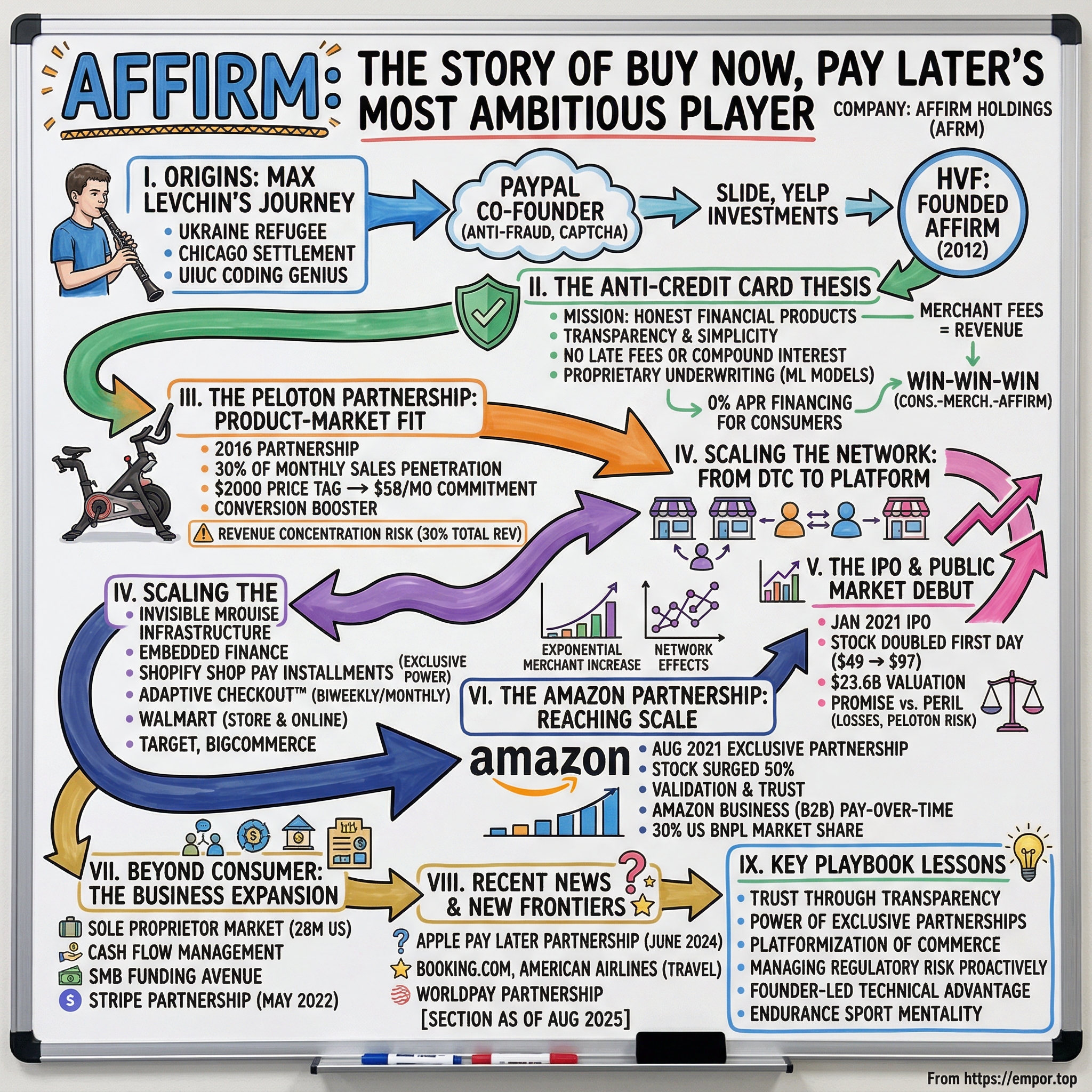
Affirm: Can the Anti-Credit-Card Lender Survive the Credit-Card-ification of BNPL?
I. Introduction & Episode Roadmap (6–9 min)
On the afternoon of May 12, 2026, Max Levchin stood in front of a room of institutional investors in New York and did something founders of consumer lenders almost never do: he told them exactly how big he thinks the company gets, and then he told them what the margins have to look like when it gets there. One hundred billion dollars of annual volume. Revenue at seven and a half to eight and a half cents on every dollar financed. GAAP operating margins of twenty to twenty-five percent. GAAP earnings per share of three to four dollars.1
It was a strikingly precise set of promises from a company that, five years earlier, had been a poster child for the everything-bubble — and that, three years earlier, had been laying off a fifth of its staff while its founder publicly admitted he had moved too slowly.2
Here is Affirm Holdings as it exists today. In the twelve months through March 2026 it processed roughly $46 billion of consumer purchases.1 In its most recently reported quarter it did $11.6 billion of gross merchandise volume, grew 35%, earned $103 million of GAAP net income, and served 26.8 million active consumers across 515,000 active merchants.3 Its market capitalization sat near $25.8 billion in late August 2026.4 It is, by most measures, the largest pure-play buy-now-pay-later franchise in the United States.
And here is the tension that makes it interesting. Affirm was built on a moral argument: that the American credit card — with its revolving balances, compounding interest, and late fees that punish exactly the people least able to pay them — is a product designed to profit from customer mistakes. Affirm's founding promise was the opposite. No late fees. No compounding. No deferred interest. Fixed payments, disclosed up front, decided one purchase at a time.5
Fifteen years later, the industry Affirm invented has been colonized by the very institutions it set out to disrupt. Banks and card networks bolt pay-over-time features onto existing plastic. Apple built its own BNPL product, then killed it and rented Affirm's instead.6 Walmart, one of Affirm's marquee enterprise wins, walked away and took its business to Klarna.7 And Affirm itself now issues a debit card, reports loans to the credit bureaus, and is fastest-growing precisely in the product that most resembles — in form if not in economics — a card in a consumer's wallet.38
So the question this story answers is not "is BNPL a real business." That has been settled: it is. The question is narrower and harder. Does Affirm have a durable competitive advantage, or is it a very well-run lender in a category where the barriers to entry are lower than the story suggests? Can a company that does not take deposits, whose growth ceiling is set by how cheaply it can borrow, compound through a genuine consumer credit downturn? And is the recent surge in profitability the product of structural operating leverage — or of an unusually benign funding market that has been handing Affirm cheaper money for two straight years?
The path runs through eight acts: the origin story of a PayPal alumnus who decided consumer credit was morally broken; the Peloton years, when a single exercise-bike company generated nearly a third of Affirm's revenue; the platform build-out that turned a bespoke lender into checkout infrastructure; the January 2021 IPO and the mania that surrounded it; the 2022 unwind, when rising rates did to Affirm's cost structure what no competitor could; the grinding multi-year march to GAAP profit; the 2025 distribution wars that cost Affirm Walmart and won it Amazon for another five years; and the Affirm Card, which is either the company's escape hatch from platform dependency or its most expensive experiment. It begins, as these things often do, with a founder who had already made his money and did not need to do this again.
 Subscribe on LinkedIn
II. Origins: Max Levchin's Second Act in Consumer Finance (18–22 min)
Max Levchin arrived in the United States in 1991, a sixteen-year-old from Kyiv whose family had been granted political asylum, landing in Chicago with almost nothing and a facility for mathematics.9 He went to the University of Illinois at Urbana-Champaign, took a computer science degree in 1997, and drifted west with the specific intention of starting companies.9 The one that worked was PayPal, where he served as chief technology officer and co-invented one of the first commercially deployed CAPTCHA systems — a small but telling detail, because the problem Levchin solved at PayPal was fraud, and fraud is fundamentally a data and pattern-recognition problem.9
That is the through-line. Levchin is not a banker who learned software. He is a systems engineer who came to believe that consumer credit is an information problem that the incumbent industry solves badly on purpose.
After eBay bought PayPal in 2002, Levchin did what successful founders do: he built a studio. First MRL Ventures in 2004, out of which came Slide, the personal media-sharing service Google acquired in 2010, and out of which he also helped create Yelp, where he chaired the board from its 2005 founding until July 2015.5 Then, in 2011, he founded HVF — an "exploration company," in the S-1's phrasing, chartered to create and fund businesses that leveraged large data sets in new ways.5 Affirm was spun out of HVF in 2012, alongside Glow, a women's health company.5
The thesis, stated bluntly. The founding argument was not that Americans needed more credit. It was that they needed honest credit. A revolving credit card does not tell you what a purchase costs. It gives you a line, charges compounding interest on whatever balance survives the month, and adds a late fee when you slip — which means the issuer's profit pool is at least partly a function of customer error. Affirm's design inverted the incentives: underwrite each transaction individually, quote a fixed total in dollars before the customer commits, take the money from the merchant wherever possible, and — the line the company has repeated since inception — charge zero in late fees, ever.5
That last commitment is not marketing filigree; it is a structural constraint. It means Affirm cannot earn its way out of a bad underwriting decision by taxing the borrower's distress. If Affirm approves a loan that goes bad, Affirm eats it. Which forces the entire business onto a single competency: pricing risk correctly, in under a second, at the moment of checkout, for a customer it may never have seen before. The S-1 named this directly, arguing that "technology, underwriting, and managing risk are collectively our key competitive advantage."5
Why this was a contrarian bet. In 2012, point-of-sale installment lending in America was a backwater. It existed as store cards, as layaway, as the financing desk at a furniture retailer — low-growth, low-prestige, and associated with the least sophisticated corner of consumer finance. To fund Affirm, an investor had to underwrite two separate leaps of faith at once: that a generation of consumers would prefer a fixed-payment installment product to a credit card, and that a company could build a lending business without a deposit base, funding itself entirely in wholesale capital markets. Neither was obvious. Both were eventually right, but the second one nearly broke the company a decade later.
Affirm's early capital came from a long private run led by Khosla Ventures, Lightspeed Venture Partners and others, and the consumer lending product shipped in 2014.5 The rebrand from an earlier working name settled the company on "Affirm" — a verb chosen for its connotation of confirmation and endorsement rather than obligation.
The merchant-pays argument. The economic keystone of the model is easy to state and surprisingly hard to prove: that a merchant will voluntarily pay a fee — sometimes a large one — to offer a customer 0% APR financing, because the financing raises conversion and average order value by more than the fee costs. If true, Affirm has something better than a lending business; it has a marketing business that happens to settle in loans, with the merchant absorbing the customer-acquisition cost.
The company still leans on this claim, and by fiscal 2026 it had accumulated real evidence for it. During Affirm's October 2025 "Big Nothing" promotional event — a three-day, industry-inverted answer to Black Friday in which merchants funded blanket 0% offers — participating merchants saw roughly a 5% lift in volume, rising to about 27% when Affirm actively promoted them on its own surfaces.10 More tellingly, over 95% of Affirm's 0% APR monthly installment volume at integrated merchants was funded by the merchant rather than subsidized by Affirm — merchants voting with their budgets, quarter after quarter.1110
But evidence accumulated in 2025 and 2026 does not retroactively justify the 2012 bet. For most of the intervening decade, the proof was thin, concentrated, and dependent on one very specific customer selling one very specific product.
III. Finding Product-Market Fit: The Peloton Concentration Years (22–28 min)
Picture the arithmetic that made Affirm's first real business. A Peloton bike cost more than $2,000. As a lump sum, that is a purchase most households postpone indefinitely — a decision to be revisited after the next bonus, or never. Stretch it across up to 39 months at zero percent interest and it becomes roughly fifty-eight dollars a month, which is not a capital allocation decision at all. It is a gym membership. The product did not change. The frame did.
That reframing is the entire mechanism of point-of-sale financing, and Peloton was the purest demonstration of it that the industry has ever produced. Affirm-financed sales climbed to a substantial share of Peloton's online volume, and the relationship became so central that Affirm had to disclose it as a standalone risk factor in its IPO prospectus.
The numbers are worth sitting with, because they are extreme even by the standards of early-stage concentration. Peloton represented approximately 20% of Affirm's total revenue in fiscal 2019, then approximately 28% in fiscal 2020.5 In the three months ended September 30, 2020 — the pandemic home-fitness peak — it was roughly 30%.5 Affirm's top ten merchants together were about 35% of revenue in fiscal 2020, which means the single largest relationship was nearly as large as the next nine combined.5
What Peloton proved, and what it disguised. The proof point was real: merchant-subsidized 0% financing works spectacularly for considered, big-ticket, emotionally-charged purchases where the barrier is the sticker price rather than the desire. Affirm learned how to underwrite that customer, how to price the merchant fee, and how to make the checkout experience fast enough that it did not leak conversion. That capability was transferable.
What the relationship disguised was fragility. Affirm's fiscal 2020 economics were, in effect, a leveraged position on one company's product cycle, one merchandise category, and one interest-rate regime. Home fitness in 2020 was the single most pandemic-inflated category in American retail. Zero-rate monetary policy made 39-month 0% financing cheap to fund. And a business model in which the merchant pays works beautifully right up until the merchant's own margins compress and the finance line becomes the obvious thing to cut.
Affirm knew this. The S-1 said so, in the flat language of securities disclosure: the significance of Peloton had increased because of consumer spending trends on home fitness equipment, and "there can be no assurance that such trends will continue."5 Management renewed the Peloton agreement in September 2020 with a three-year initial term running to September 2023, auto-renewing annually thereafter, with either party able to walk on 90 days' notice after the initial term.5 Ninety days' notice, on a relationship generating a third of revenue.
The unwind, and what it taught. Peloton's post-pandemic collapse is one of the better-documented demand air-pockets in recent consumer history, and it took Affirm's most important revenue line down with it. The residue is visible in Affirm's disclosures to this day: the company still reports its headline monthly-installment delinquency rate excluding Peloton, a carve-out that has survived into fiscal 2026 filings six years after the fact.3 That is not an accounting quirk. It is a scar.
The analytical lesson generalizes, and it is the spine of everything that follows in this story. Affirm's revenue is generated at other companies' checkouts. Its unit economics depend on those companies' willingness to pay. Its volume depends on their demand cycles. And its contract terms — 90-day outs, renewal windows, warrant negotiations — mean the relationship can be repriced or terminated on a timeline far shorter than the investment horizon of a shareholder. Peloton was the first version of that lesson at a scale of tens of millions of dollars. Walmart would deliver it again at a scale of billions, and Amazon has, so far, delivered the opposite.
To escape the trap, Affirm had to stop being a bespoke lender to a handful of direct-to-consumer brands and become something closer to plumbing — a button that any merchant could switch on. That transformation is where the company spent the second half of the 2010s.
IV. Building the Network: From Single Merchant to Platform (20–25 min)
There is a specific moment when a fintech stops being a vendor and starts being infrastructure, and it is rarely dramatic. For Affirm it arrived in November 2016, when the company made its financing available through Salesforce Commerce Cloud, Magento, and — most consequentially — Shopify. Overnight, the sales motion changed from "negotiate a bespoke agreement with a direct-to-consumer brand" to "appear as an option in a merchant's existing checkout settings."
This is a strategic chess move disguised as an integration announcement. Bespoke enterprise deals scale linearly with headcount: each one requires a salesperson, a legal negotiation, a technical implementation. Platform integrations scale with the platform. Affirm stopped selling and started being distributed.
The underwriting stack is the actual product. It is worth pausing on the technology, because it is the part of Affirm most often waved at and least often explained.
A credit card issuer makes one decision about a customer, once: what line to extend. After that the customer draws down that line at will, and the issuer manages risk through pricing and after-the-fact collections. Affirm makes a fresh decision on every single transaction. It sees the merchant, the category, the basket, the price point, the customer's history on the network, and it prices that specific loan — term, rate, approval or decline — in the time it takes a checkout page to load.
The analogy that works: a credit card is a standing invitation to a party, handed out once and rarely revoked. Affirm is a bouncer at the door who looks at you fresh each time and decides whether tonight, for this room, at this cover charge, you are a good bet. The bouncer sees more, decides more often, and can be wrong less catastrophically — but only if the bouncer is genuinely good at the job, because there is no late fee to catch the mistake.
The data advantage this generates is real but bounded, and it is important to be precise about which. Every transaction produces a labelled outcome: this customer, buying this thing, at this price, on these terms, repaid or did not. Over hundreds of millions of transactions that becomes a training set no new entrant can replicate quickly. Levchin has been consistent on this point for years, telling analysts on the fiscal Q3 2026 call that Affirm has "built some very, very sophisticated underwriting capabilities" and that "underwriting is actually very, very difficult."12 He said essentially the same thing on the fiscal Q4 2025 call — "underwriting is hard, we're good at it, others aren't."13 The consistency is a point in his favor. But consistency of assertion is not the same as proof, and the honest test is whether Affirm's realized loss rates beat peers on comparable books — a comparison the industry's disclosure standards make genuinely hard to run.
By fiscal 2026 the company had begun layering commercial machine learning on top of the credit models. Two internally-built systems, which management calls AdaptAI and BoostAI, optimize which offer a consumer sees rather than whether they are approved. AdaptAI selects the financing offer most likely to convert without adding unacceptable risk, and management attributed roughly a 10% year-over-year improvement in end-to-end checkout conversion to its deployment across nearly all Affirm surfaces. BoostAI runs automated A/B tests at merchants, introducing new financing programs and merchant-funded incentives, and management reported average GMV lifts of 5–15% at participating merchants, with 47 enterprise merchants live within months of launch.10
That is the more interesting claim, strategically. If Affirm can demonstrably raise a merchant's sales, the fee stops being a payment-processing cost and becomes a performance-marketing spend — a much stickier budget line. Whether merchants ultimately credit Affirm with that lift, or treat it as incremental volume they would have captured anyway, is the sort of thing that only becomes visible in renewal pricing.
Walmart, and the virtual card. In February 2019 Affirm went live with Walmart — in stores via kiosks as well as online — its first genuinely mass-market, non-e-commerce-native distribution deal. It mattered less for the volume than for the proof: Affirm could work at the physical point of sale, in the highest-traffic retail environment in America, for a customer base far broader than Peloton's.
The mechanism that made offline work — and that later became the seed of the Affirm Card — was the virtual card. Rather than requiring every merchant to integrate Affirm's API, Affirm could issue a single-use card number funded by an approved loan. To the merchant it looks like an ordinary card transaction. To the consumer it is an Affirm installment plan. It let Affirm reach merchants who had never heard of it, and it quietly established that Affirm's underwriting could be decoupled from Affirm's checkout button.
The Shopify relationship, meanwhile, was structured with equity warrants — Shopify received the right to buy Affirm stock as the partnership scaled.14 This is a recurring feature of Affirm's deal-making, and investors should read it clearly: warrants are a real economic cost, recognized in the income statement as enterprise warrant and share-based expense, and they are the price Affirm pays for distribution it does not own. In the March 2026 quarter alone, warrants granted to two enterprise partners cost $44 million of operating income.3
By 2020, Affirm had assembled the pieces: a differentiated underwriting engine, platform distribution, offline reach, and a brand built on a genuine consumer grievance. What it had not yet assembled was public-market capital. That arrived in the most favorable window imaginable.
V. The IPO and the 2021 Peak (18–22 min)
January 2021 was, in retrospect, the most forgiving moment to sell fintech equity in living memory. Retail brokerage accounts were multiplying, e-commerce penetration had jumped years forward in months, benchmark rates were pinned near zero, and public investors were paying growth multiples that made no reference to profitability.
Affirm priced its IPO at $49 per share on January 12, 2021 — above the marketed range of $41 to $44 — selling 24.6 million Class A shares for gross proceeds of approximately $1.2 billion.15 The next morning the stock opened at $90.90 and closed at $97.24, a first-day gain of 98%.1617
A near-doubling is usually described as a triumph. It is more accurately described as a transfer. Every dollar between $49 and $97 was value that accrued to the investors allocated shares in the book rather than to Affirm's balance sheet, and the gap represented well over a billion dollars of capital the company did not raise.17 Affirm's bankers priced a growth-stage lender into the most speculative tape of the cycle and still left that much on the table, which tells you less about Affirm's business than about how thoroughly the market had stopped anchoring fintech valuations to fundamentals.
The Amazon trade. If the IPO established the multiple, one announcement seven months later established what the market thought Affirm actually was. On August 27, 2021, Affirm disclosed a non-exclusive partnership to offer installment payments on Amazon.com for U.S. purchases of $50 or more. The stock jumped roughly 47% in after-hours trading, reaching around $100.18
Sit with that reaction. A single distribution agreement — non-exclusive, initially a limited test — added something on the order of half the company's value in an afternoon. That is not a market pricing incremental revenue. That is a market pricing existential validation: the belief that if Amazon had chosen Affirm, Affirm must be the category winner, and category winners in 2021 were worth whatever the tape said.
In November 2021 the relationship deepened, with a transaction agreement under which Affirm issued Amazon a warrant to purchase up to 7,000,000 Class A shares, and with Affirm becoming Amazon's exclusive third-party pay-over-time option through January 2023.18 The warrant structure is the tell. Amazon did not merely agree to distribute Affirm; Amazon extracted equity for doing so. That is what buyer power looks like when the buyer is one of the largest commerce platforms on earth.
What the tailwind actually was. It is worth naming the three forces that made 2021 look like proof of a durable business, because all three were temporary.
The first was forced e-commerce adoption. Categories that had resisted online purchase for a decade converted in eighteen months, and Affirm's volume grew into a market expanding for reasons entirely unrelated to Affirm.
The second was the interest-rate environment. Affirm's flagship product is a merchant-subsidized 0% loan. Someone has to fund that loan, and Affirm funds it in wholesale markets. When the risk-free rate is near zero, the gap between what Affirm pays for money and what it earns on a 0% loan — the merchant fee — is wide. That gap is the business. Near-zero rates were not a nice tailwind; they were an input cost subsidy.
The third was the multiple regime itself. In 2021 a company could report an operating loss of hundreds of millions of dollars and be valued on revenue growth. Affirm's fiscal 2023 operating loss would reach $1.2 billion.14 In 2021 that was a feature. Within eighteen months it would be treated as an existential flaw.
None of this means the 2021 enthusiasm was baseless. Affirm was genuinely growing, genuinely winning distribution, and genuinely building something the incumbents had not. But the stock had been repriced as though the tailwinds were the business rather than the weather. When the weather changed, the repricing was violent — and the mechanism by which it happened is the single most important thing to understand about how this company actually works.
VI. The Unwind: Rate Hikes, Growth-Stock Repricing, and the 2022 Reset (20–26 min)
At approximately 1:30 p.m. Eastern on February 10, 2022, Affirm's official Twitter account posted a fragment of its fiscal second-quarter results — several hours before the scheduled release. The tweet highlighted a 77% increase in volume. The stock rose as much as 10%. Then someone noticed, the tweet was deleted, and the company was forced to publish the full results immediately, into the middle of a trading session, with no prepared context. Shares fell as much as 21% on the day.19
The company attributed the leak to human error.19 It was a small operational embarrassment. But it functions almost too neatly as a metaphor for what happened to Affirm in 2022: a business whose headline growth numbers were genuinely spectacular, colliding with a market that had abruptly decided to look at a different line of the income statement.
Because the growth was spectacular. Active consumers had grown roughly 150% year over year, and volume was compounding.20 The stock fell anyway, and kept falling — by late June 2022 it had lost roughly 93% from its high, one of the sharper drawdowns in a sector full of them.21
The mechanism, in plain English. This is the part that most casual coverage of Affirm gets wrong, and it is the single most important structural fact about the company.
Affirm is not a bank. It does not take deposits. When a consumer finances a couch, the money does not come from someone else's checking account paying 0.5%. It comes from wholesale capital markets — from warehouse credit facilities extended by large banks, from forward-flow agreements under which institutional buyers commit to purchase loans as Affirm originates them, and from asset-backed securitizations in which pools of loans are packaged and sold to bond investors.3
Think of Affirm as a manufacturer whose only raw material is money. It buys money wholesale, converts it into consumer loans, and sells the output — either the loan itself or the interest stream. Its gross margin is the spread between what the loan earns and what the money cost.
Now apply a rate shock. Through 2022 and 2023 the Federal Reserve raised benchmark rates at the fastest pace in four decades. Affirm's input cost rose immediately and mechanically. Its output price did not. Loans already on the books were fixed-rate, originated at yields set in a zero-rate world. Merchant fees on many existing agreements were contractually fixed. Affirm was, for a period, buying expensive money to fund cheap loans under contracts it could not reprice.
This is worth emphasizing because it reframes what kind of risk investors are actually taking. The 2022 problem was not a demand problem — consumers kept transacting. It was not primarily a credit problem. It was an input-cost problem, of the sort a chemicals company faces when natural gas prices triple. No amount of product excellence offsets it in the short run.
Management's response was to change the mix. Affirm pivoted origination toward interest-bearing loans, whose yields could be reset with the market, and away from the long-duration 0% APR loans that had defined the Peloton era. It repriced merchant agreements where it had the leverage to do so. And it began the slow work of diversifying and repricing its funding channels — work that would take three years to fully pay off.
February 2023: the reckoning. On February 8, 2023, Affirm cut 19% of its workforce — roughly 500 people against a base of about 2,550 the prior June — and its shares fell hard on an earnings miss.2 What Levchin wrote in the accompanying shareholder letter is, from a governance standpoint, the most interesting document of this period. He called the layoffs "the single most difficult" decision the company had made. He named the cause — Federal Reserve policy had "dampened consumer spending and increased Affirm's cost of borrowing dramatically." And then he added a sentence most CEOs would have had edited out: "The root cause of where we are today is that I acted too slowly as these macroeconomic changes unfolded."2
Founders rarely assign themselves the blame in writing. It does not make the decision better, and it does not compensate shareholders for a 90% drawdown. But as a data point on management character it is worth logging, and it should be weighed against the counter-evidence in the same period: Affirm had hired aggressively into a bubble, run enormous stock-based compensation, and set expectations it then had to walk back. Levchin was accurate about the diagnosis and late to the treatment, which is a fair summary of most management teams in 2022 and a slightly better one than average.
The stock-based compensation argument. One structural complaint from this era never went away, and investors should keep it live. Affirm's stock-based compensation has been large in absolute and relative terms. In fiscal 2025 — a year of $3.2 billion of revenue — total stock-based compensation was $499.9 million, of which $321.4 million ran through operating expenses and $178.5 million was capitalized into internally-developed software.14 That capitalized portion matters: it does not hit the current-period operating expense line, but it amortizes later, and it is real dilution today.
This is the crux of every argument about Affirm's "adjusted" metrics. The company steers on adjusted operating income, which excludes stock-based compensation, enterprise warrant expense, and depreciation and amortization.3 Those exclusions are conventional, and the gap between adjusted and GAAP has narrowed materially. But an investor evaluating whether Affirm earns a genuine economic profit has to decide whether roughly half a billion dollars a year of equity issued to employees is a real cost. It is.
For most of 2022 and 2023, the bear case was simple: this company may never earn a GAAP profit. Proving otherwise took the better part of three years.
VII. The Long Road to GAAP Profitability (20–25 min)
There is no single dramatic scene in this section, and that is the point. Affirm's turn to profitability was not a product launch or an acquisition. It was four consecutive years of the same unglamorous arithmetic, executed quarter after quarter while the stock did whatever it was going to do.
The framework management set out and then had to defend on call after call had four parts: grow volume; hold credit losses inside a guided band; shift the origination mix toward products with better unit economics; and grow operating expenses more slowly than revenue. Every one of those is easy to say and hard to do simultaneously, because the first tends to break the second.
The metric that actually matters. Affirm steers on a number most investors outside the sector have never encountered: revenue less transaction costs, or RLTC. It is worth explaining carefully, because headline revenue is close to meaningless for a lender.
Affirm's revenue includes interest income, merchant fees, gains on selling loans, and servicing fees. But three costs sit directly against that revenue and vary with it: the provision for credit losses (what Affirm expects to lose on the loans), funding costs (what the money cost), and processing and servicing expenses. Subtract those and you get RLTC — the money left over to pay for engineers, marketing, and everything else. It is Affirm's true gross profit.
Management expresses it as a percentage of volume financed, and has long guided to a 3–4% long-term range. In the March 2026 quarter, RLTC was $498 million, or 4.31% of volume — above the top of that range, and 19 basis points better than a year earlier.3
Here is where the analysis has to be careful, because why it improved matters more than that it improved. Affirm's own bridge attributes the 19-basis-point gain to a 27-basis-point improvement in funding costs, partially offset by a 17-basis-point decline in revenue yield.3 In other words, the entire margin expansion — and then some — came from cheaper money. Average annualized cost of funds fell approximately 126 basis points year over year to 5.8%, the lowest in three and a half years.3
That is the single most important caveat in the bull case. Affirm's recent margin story is substantially a funding-cost story, and funding costs are a macro variable Affirm does not control. Management has been transparent about the sensitivity: on the fiscal Q4 2025 call, Michael Linford quantified it — roughly a one-point move in reference rates translates to about a 40-basis-point change in funding cost, phasing in over one to two years as the portfolio turns.13 Investors should hold that number. It cuts both ways.
The milestones. The first GAAP-profitable quarter arrived in the December 2024 quarter, with net income of $80.4 million.10 Fiscal 2025, ended June 30, 2025, delivered the first profitable full year: revenue of $3.22 billion on volume of $36.7 billion, and net income of $52.2 million.14
Note the asymmetry hiding in those two figures. Full-year net income was lower than the single strong December quarter, because Affirm's operating line was still negative for the year — an operating loss of $87.3 million — and the company was pushed into the black by $148.7 million of other income, largely interest earned on its own cash.14 Fiscal 2025 was not, strictly speaking, an operationally profitable year. It was a year in which operations roughly broke even and the treasury department carried the P&L.
That is precisely why fiscal 2026 was the more meaningful proof. In the March 2026 quarter, operating income was $88.4 million — an 8.5% operating margin, versus a 1.1% operating loss a year earlier — and net income was $102.9 million.3 The profit now comes from the business.
The operating leverage is real, and measurable. In that same quarter, RLTC dollars grew $146 million year over year while non-GAAP operating expenses excluding transaction costs grew $39 million.3 Levchin's framing on the call was that "over 70% of RLTC dollar growth flowed to Adjusted Operating Income."3 Sales and marketing spend grew 9%; general and administrative grew 18%; technology and data analytics grew 29% — the last driven by infrastructure costs scaling with a 45% increase in transaction count, plus deliberate investment in the Card, wallet partnerships, and international expansion.3
The composition matters. Affirm is not generating leverage by starving investment; it is generating leverage because customer acquisition has largely stopped being a cash expense. Levchin has been explicit that the company does not run performance marketing to grow the Card, relying instead on re-engaging existing users.12 Over 90% of transactions now come from returning users.12 A lending business that acquires most of its volume from customers it already underwrites has a structurally different cost curve than one buying growth.
Credit: steady, but drifting. The KPI that determines whether growth is being bought with worse underwriting is the loss rate, and here the picture is stable rather than pristine. Thirty-plus-day delinquencies on monthly installment loans, excluding Peloton and Pay-in-X, rose 29 basis points year over year to 2.8% in the March 2026 quarter, after sitting at 2.7% the prior quarter.310 The allowance for credit losses as a percentage of loans held for investment rose to 6.0%, from 5.7% a year earlier and 5.4% two quarters before.3
Management's explanation was specific rather than hand-waving: roughly half the increase came from a shrinking denominator caused by unusually strong tax-refund repayment seasonality, and Affirm chose to take incremental risk because unit economics gave it room — "credit continues to be a setting we choose for our business."3 Recent monthly-installment cohorts continue to track toward approximately 3.5% ultimate net charge-offs as a percentage of cohort volume, in line with historical vintages, and Pay-in-4 vintages are tracking below 1%.3
That is a defensible answer, and the vintage disclosure is genuinely good practice — it lets outsiders check the claim. But "we chose to loosen because the economics were attractive" is exactly what every lender says at the top of a cycle. The rising allowance ratio is the number to watch, not the delinquency rate, because the allowance is where management's own forward-looking judgment lives.
VIII. Capital Allocation and the Funding Machine (18–24 min)
For most companies, a section on capital allocation covers dividends, buybacks, and acquisitions. For Affirm it covers something more fundamental: the company's growth ceiling is not set by consumer demand or merchant appetite. It is set by how much money Affirm can raise, how cheaply, and how reliably.
This is the closest thing Affirm has to a factory, and it is worth walking the floor.
Three channels, deliberately. Affirm funds itself through warehouse facilities, forward-flow agreements, and securitization — and it has been methodical about never letting one dominate.
Warehouse facilities are revolving lines from banks, secured against the loans. As of the March 2026 quarter, Affirm had roughly 15 such lenders, primarily major U.S. and international banks.3 Forward flow is a standing commitment from an institutional buyer to purchase loans as they are originated, at pre-agreed pricing — roughly 20 counterparties, spanning insurers, pension funds, asset managers and global banks.3 Securitization pools loans into bonds sold to capital-markets investors.
Why three? Because each fails differently. Warehouse capacity contracts when bank balance sheets tighten. Securitization windows slam shut during market stress, regardless of collateral quality. Forward flow is stable but priced in advance, which is painful when rates move. A lender dependent on any single channel can be shut down by a market event that has nothing to do with its loan book. Affirm's insistence on all three is not diversification theater; it is the difference between a business that survives a credit event and one that stops originating.
By the March 2026 quarter, total funding capacity reached $28.2 billion, up from $23.3 billion a year earlier — enough, management estimated, to support more than $65 billion of annual volume given a weighted-average loan duration of roughly five months.3 That last figure deserves emphasis: Affirm's book turns over more than twice a year. Short duration is a double-edged property. It means the portfolio reprices to prevailing rates quickly — painful in 2022, helpful in 2025 — and it means Affirm is perpetually in the market raising money.
The Sixth Street deal, and what it actually changed. On December 13, 2024, Affirm and Sixth Street announced a long-term capital partnership under which Sixth Street would purchase up to $4 billion of Affirm loans through a three-year forward-flow agreement structured via a dedicated "AssetCo" vehicle. Management characterized it as the largest capital commitment in the company's history, enabling up to $20 billion of loan originations over three years.22
Affirm subsequently branded the approach "capital strategy 2.0," framing it as a Silicon Valley approach to building a funding platform.23 Stripped of the branding, the substance is this: rather than warehousing loans on its own balance sheet and periodically selling them, Affirm secured a committed, multi-year, off-balance-sheet buyer at scale. That reduces the equity Affirm must hold against a given volume of originations, insulates growth from securitization-market timing, and converts a recurring financing scramble into a contract.
The proof shows up in a metric Affirm reports and few investors watch: equity capital required as a percentage of total platform portfolio. At March 31, 2026 it stood at 4.5%, against a total platform portfolio of $18.4 billion.3 In plain terms, Affirm was supporting eighteen billion dollars of consumer loans with roughly eight hundred million dollars of its own equity at risk. Management guides to keeping that ratio below 5%.3 It is the clearest single expression of why this is a capital-efficient lender rather than a bank.
The funding market's verdict through fiscal 2026 was, by Affirm's account, emphatic. The company priced three consecutive revolving securitizations below a 5% blended yield, upsized its 2026-2 transaction from $500 million to $750 million while remaining more than twice oversubscribed, and extended the term to three years — with credit spreads tightening slightly even amid broader funding-market volatility.3 It also launched an inaugural U.K. warehouse partnership as international expansion began requiring local funding.3 Linford's characterization on the Q3 call was that Affirm sees "a market that's very deep."12
Investors should read those securitization outcomes as the most credible third-party validation available of Affirm's credit quality. Bond buyers subordinating themselves to a consumer loan pool are not doing brand marketing; they are pricing risk with their own capital, and they have been getting more aggressive, not less. That is meaningful evidence. It is also, by construction, a coincident indicator — securitization markets are enthusiastic right up until they are not.
Everything else about capital allocation is quiet, and deliberately so. Affirm has made essentially no acquisitions as a growth lever. It has grown organically and through partnerships. That is a genuine contrast with Klarna, which built an app-first, quasi-bank footprint across Europe with a far more acquisitive posture.
On the balance sheet, Affirm ended March 2026 with roughly $2.5 billion of total liquidity against approximately $1.1 billion of convertible debt, a net cash position of about $1.4 billion that grew by $373 million year over year.3 The company generated roughly $230 million of incremental net cash in a single quarter.3 In December 2025 the board authorized repurchasing up to $176 million of the $221 million of outstanding 2026 convertible notes through November 2026, though none had been repurchased as of the March quarter.3 Retiring converts rather than buying back stock is the correct priority for a lender whose equity is its risk buffer.
The alignment question. A skeptical investor will note that management's stake has been steadily diluted by post-IPO issuance, and that Levchin has sold. On September 22, 2025, he sold 651,713 Class A shares for approximately $58.2 million at weighted average prices between $88.46 and $90.98.24 After those sales he held no Class A shares directly, retaining 735,294 shares indirectly through a family trust.24
Two readings are available, and both are legitimate. The generous one: Levchin controls the company through super-voting Class B stock, has held essentially undiversified for over a decade, and diversification after fifteen years is unremarkable. The skeptical one: half a billion dollars a year of stock-based compensation flowing to employees, combined with founder selling into strength, means shareholders are funding growth through dilution while insiders monetize. Neither reading is dispositive. Both belong in the file.
What made 2025 uncomfortable was not the capital structure. It was watching a marquee customer walk out the door.
IX. Losing Walmart, Winning Amazon: The Distribution Wars of 2025–2026 (28–35 min)
On March 17, 2025, the news broke that Walmart would replace Affirm with Klarna as the buy-now-pay-later provider for its majority-owned fintech venture, OnePay.7 The timing was not coincidental. Klarna was weeks away from filing publicly for a U.S. listing, and there is no better line in a prospectus than "exclusive pay-later provider to the largest retailer in the United States."
Affirm's stock fell. The narrative wrote itself: the incumbent had been outbid, and by the competitor it had spent a decade defining itself against.
Management's account, and whether it survives scrutiny. Three days later, at a question-and-answer session hosted by William Blair, Affirm's Chief Operating Officer Michael Linford gave the company's version. Walmart, he said, had represented roughly 5% of Affirm's volume and about 2% of adjusted operating income in the back half of the prior year — real, but a long way from existential.25 Then he gave the number that made the argument concrete: "We think that Klarna was offering something on the order of $200 million to $300 million of equity in warrants, and that was a deal that just didn't make sense for something that had so little contribution to us." His summary: "We felt like it was important to draw the line and not do deals that we thought were uneconomic."25
This is exactly the kind of claim that deserves an activist's skepticism, because "we walked away on discipline" is what every losing bidder says. So test it.
The first test is internal consistency. Affirm's disclosure of Walmart's contribution was specific and made under conditions where being wrong would be costly. The 5%-of-volume figure is consistent with the top-five concentration disclosures in the fiscal 2025 filings.14
The second test is the counterfactual. If Affirm had been outcompeted on capability rather than price, its volume growth should have decelerated as Walmart rolled off. It did the opposite. In the September 2025 quarter — with the enterprise transition underway — volume grew 42%.11 In the December quarter it grew 36%, accelerating from 35% a year earlier.10 By the March 2026 quarter Affirm had strung together ten consecutive quarters of 30%-plus growth.3 Meanwhile top-five partner concentration fell from 47% to 44% to 42% across those three quarters.11103 Affirm replaced the volume and reduced concentration at the same time.
The third test is behavioral. Did Affirm subsequently pay up elsewhere, revealing the discipline as situational? Enterprise warrant expense remains a real line item — $44 million in the March quarter — so Affirm has not stopped issuing equity for distribution.3 But it has not disclosed anything approaching a $200–300 million warrant grant.
On the evidence available, management's account holds up better than the initial market reaction implied. That is a meaningful, if narrow, credibility win — and worth remembering the next time management explains a disappointment.
Klarna's IPO, and the reversal nobody scripted. On September 10, 2025, Klarna priced its NYSE listing at $40 per share, above its $35–37 range, raising roughly $1.4 billion at about a $15 billion valuation. The shares opened around $52 and closed at $45.82, up about 15%.26
For a moment, the competitive narrative looked settled: a scaled global rival, freshly capitalized, having just taken Affirm's most visible enterprise account, entering the public market with momentum.
What followed is one of the more instructive comparisons in recent fintech. By August 26, 2026, Klarna traded at $14.29, with a market capitalization of approximately $5.4 billion and a 52-week range running from $57.20 down to $12.06.27 On August 18, 2026, Klarna reported second-quarter volume of $36.6 billion, up 18%, and revenue of $1.04 billion, up 27% — and cut its full-year volume guidance to $149–151 billion, citing softening discretionary spending in Germany, its largest market. Chief Financial Officer Niclas Neglén described "a softening in the consumer discretionary spend in Germany."28 The stock fell 21%.28
Set the two side by side without editorializing. Klarna moves roughly three times Affirm's volume and generates comparable quarterly revenue — which tells you its take rate is a fraction of Affirm's, a direct consequence of a business skewed to small-ticket, thirty-day, low-yield transactions. Klarna grew volume 18% in its June quarter; Affirm grew 35% in its March quarter.328 And the market now values Affirm at roughly five times Klarna's capitalization.427
The strategic point is not that Affirm won. It is that scale in BNPL turns out not to be the relevant variable. Take rate, credit performance, funding cost, and geographic mix matter more than raw volume — and a business built on tiny-ticket, near-zero-yield transactions has a thinner buffer when a major market's consumer softens. Klarna's German exposure did to Klarna in 2026 something structurally similar to what Peloton did to Affirm in 2021.
Amazon, renewed. On November 6, 2025, Affirm disclosed a Second Amended and Restated Installment Financing Services Agreement with Amazon.com Services and Amazon Payments, effective February 1, 2026, extending the U.S. relationship five additional years through January 2031, alongside amended warrant terms.11 The stock rose sharply on the news — roughly 12% in a single session.29
Read the reaction, not the announcement. Five years after the 2021 Amazon trade, the market still repriced Affirm by double digits on a single contract renewal. That is not sentiment; it is an accurate assessment of the underlying dependency. Amazon accounted for 22% of Affirm's volume in fiscal 2025, up from 21% in fiscal 2024.14 Walmart at 5% was survivable. Amazon at 22% is a different category of exposure entirely.
The structural point. Affirm's top five merchants and platform partners have accounted for somewhere between 42% and 51% of volume in every recent period.310 The concentration is falling, which is genuinely good. But it remains high, and the counterparties are among the most sophisticated commercial negotiators on earth. When Amazon comes back to the table in the early 2030s, it will hold the same leverage it held in 2021 and 2025 — with more alternatives.
In Porter's language, this is buyer power, and it is the most acute of the five forces acting on Affirm. It cannot be engineered away by better underwriting. It can only be diluted — by having so many other sources of volume that no single renewal is a referendum. Which is precisely the strategic logic behind the product Affirm has been building since 2021.
X. Owning the Consumer Relationship: The Affirm Card and Direct-to-Consumer Pivot (20–25 min)
On February 25, 2021 — six weeks after the IPO, with the stock near its euphoric peak — Affirm announced something that got far less attention than it deserved: plans for a debit card with pay-over-time functionality built in.30 Not a credit card. A debit card, drawing on the consumer's own bank account by default, with the option to convert an eligible transaction into an installment plan after the fact, in a couple of taps.
At the time it read like a feature. In retrospect it was the most important strategic decision Affirm made in the 2020s, because it addressed the one weakness that no amount of underwriting skill could fix.
The logic, which is really a defensive logic. Everything described so far — the merchant integrations, the platform deals, the enterprise partnerships — puts Affirm on someone else's checkout page, at someone else's invitation, on terms that come up for renegotiation. The consumer's relationship is with the merchant. Affirm is a button.
A card inverts that. The consumer carries Affirm in a wallet, uses it wherever cards are accepted, and returns without Affirm having negotiated anything. Volume that arrives through a card requires no merchant deal, no integration, and no renewal cycle. It is the only structural answer to the buyer-power problem.
It also, notably, requires Affirm to compete on ground the incumbents own. The card in your pocket is the most contested real estate in consumer finance.
The growth, which is genuinely unusual. The Card became broadly available in 2023 and then compounded at rates that are hard to find elsewhere in payments at scale. Through fiscal 2026 the trajectory ran roughly like this: Card volume grew 135% year over year in the September 2025 quarter, with active cardholders adding 500,000 sequentially to reach 2.8 million.11 In the December quarter, Card volume grew 159% and cardholders grew 121%, with 0% APR volume on the Card up 190% to nearly 20% of the Card mix — almost a threefold increase in that mix over two years.10 By the March 2026 quarter, Card volume reached $2.1 billion, up 146%, with active cardholders more than doubling year over year to 4.4 million and the "attach rate" — cardholders as a share of total active consumers — reaching approximately 17%, up eight points in a year.3
Direct-to-consumer volume overall, of which the Card is the engine, reached $3.7 billion in that quarter and grew 48% — comfortably ahead of the 35% company average.3 Roughly a third of Affirm's total growth in recent quarters has come from the direct-to-consumer channel.310
There is a second-order effect worth naming: in-store volume on the Card runs more than an order of magnitude higher than in-store spend on Affirm's non-Card surfaces.3 The Card is how Affirm reaches physical retail without building physical retail relationships — a far cheaper path than the kiosk-by-kiosk approach of the late 2010s.
What management is claiming, and what would falsify it. At the May 2026 Investor Forum, management put a number on the ambition: 20 million active cardholders spending $150 billion annually, against the current base of 4.4 million cardholders spending roughly $2,400 each per year.1 That is not an incremental target. It implies both a fivefold increase in cardholders and a roughly threefold increase in spend per cardholder — the second being the harder half, since it requires the Card to become a primary payment method rather than an occasional one.
Levchin has framed the Card as evidence of network effects, arguing that Affirm's data-rich transaction messages compound in value with each new connection in a way that legacy, data-light payment rails do not.1131 That is a real argument and a genuinely differentiated one. It is also, so far, an argument rather than a demonstration — the kind of claim that is comfortable to make while a product is growing 146% and considerably less comfortable to test when growth normalizes.
Here is what an investor should actually watch, because the disclosure has real gaps. Affirm does not break out the Card as a standalone reporting segment. It does not disclose Card-specific loss rates, Card-specific funding costs, or Card contribution margin. It reports volume, cardholder count, attach rate, and mix — the growth metrics — without the profitability metrics. The company has begun experimenting with cash-flow underwriting specific to the Card, which management described as still experimental.11
That asymmetry deserves to be named plainly. A debit card with post-purchase installment conversion is a genuinely different credit product from a merchant-integrated point-of-sale loan. The purchase is not pre-underwritten in the same way; the consumer decides to finance after the fact, which is a selection dynamic that could cut either way. Affirm reports that roughly 65% of Card activations during the 2025 holiday weekend came from near-prime or better borrowers, which is reassuring as far as it goes.10 But until Affirm discloses Card economics with the rigor it applies to its core installment book — vintage charge-off curves, funding cost, contribution — investors are extending management credit on the fastest-growing part of the business.
The reasonable posture is neither dismissal nor enthusiasm. The Card is real, it is large enough to matter, and it is structurally the right answer to Affirm's most serious competitive vulnerability. It is also the part of the business where the gap between what is claimed and what is proven is widest.
Affirm Edge, and the next iteration. In May 2025, Affirm announced a further step: bringing its pay-over-time functionality to consumers' existing bank debit cards rather than requiring an Affirm card at all.32 Branded Affirm Edge and presented at the 2026 Investor Forum as one of five growth drivers, it partners Affirm with banks and credit unions — Old National Bank appeared alongside Stripe, Fiserv and Shopify as partner representatives at the forum.1
The strategic elegance is obvious: instead of persuading consumers to adopt a new card, Affirm rents its underwriting to institutions that already have the cards. The strategic risk is equally obvious: it hands banks a pay-over-time capability without requiring them to build one, which is a fine trade only if Affirm's underwriting edge is durable enough that renting it never becomes cheaper than replicating it.
Which raises the question that has hung over this industry since 2021: what happens when the regulators, the bureaus, and the scoring models finally decide what BNPL actually is?
XI. Credit Reporting, the CFPB, and BNPL's Regulatory Arc (18–24 min)
In December 2021, the Consumer Financial Protection Bureau sent orders to Affirm, Klarna, Afterpay, and their peers, opening an inquiry into a product category that had scaled to tens of billions of dollars without ever quite fitting the regulatory architecture built for it. The Bureau's concerns were three: that consumers were accumulating debt across multiple providers with no visibility into the total; that standard credit-card protections such as dispute rights and billing statements did not apply; and that BNPL firms were harvesting consumer data for commercial purposes.33
Affirm's response was notably cooperative rather than combative — consistent with a company whose entire brand rests on being the honest actor in a category with a reputation problem. When your marketing is "no late fees, no hidden interest," regulatory scrutiny of hidden fees is not an existential threat. It is a competitive opportunity.
The rule that arrived, then vanished. In May 2024 the CFPB issued an interpretive rule holding that BNPL providers issuing "digital user accounts" to access credit were "card issuers" under the Truth in Lending Act's Regulation Z, and therefore owed consumers a set of credit-card protections: dispute investigation rights, refund handling, periodic billing statements.[^34]
The industry's objection was substantive rather than merely self-interested. Regulation Z's open-end credit provisions were written for revolving accounts, where a consumer draws down and repays a line over time and a monthly statement is the natural unit of communication. A four-payment, six-week, fixed-amount installment loan is closed-end credit. Requiring monthly periodic statements for a loan that ends in six weeks is not consumer protection; it is a category error.
The Financial Technology Association sued in October 2024.[^34] Then the administration changed, and so did the Bureau. On May 12, 2025, the CFPB formally withdrew the interpretive rule as part of a broad rescission of guidance documents, stating that the interpretation had applied "ill-fitting open-end credit regulations to BNPL products, which are generally structured as closed-end loans."[^34] In June 2025 the Bureau confirmed it would not issue a revised rule.34 The litigation was rendered moot.
The right lesson is not "regulation went away." It is that U.S. fintech regulatory risk is a political variable with a swing amplitude of roughly one presidential term. An overhang that had weighed on BNPL valuations for two years evaporated in a single Federal Register notice — and could, on the same timeline, reappear. Affirm remains subject to CFPB supervision and examination regardless of the interpretive rule's fate, a point its own annual report makes explicitly.14 Investors modeling this sector should hold scenario ranges rather than point estimates, and should treat any period of regulatory quiet as a rental rather than a purchase.
The bureau shift, which matters more. Meanwhile, something structurally more consequential happened with almost no fanfare.
Affirm had long reported its longer-term monthly installment loans to Experian. On April 1, 2025, it began reporting all pay-over-time loans, including Pay-in-4 — the short-term, four-payment product that had historically lived entirely outside the credit reporting system.8 Affirm also worked with FICO for roughly a year on a joint study of half a million consumers who had opened at least one Affirm BNPL loan, examining how BNPL data affects score accuracy. The study found that consumers with five or more BNPL loans generally saw higher scores or minimal change, with over 85% of participants moving within ten points in either direction.835
Consider what this does, because it cuts in two directions at once and the tension is genuine.
On the consumer side, it is straightforwardly aligned with Affirm's stated mission. A young borrower with no credit file who repays twelve Affirm loans on time has, historically, built no credit history from that behavior. Reporting converts responsible BNPL usage into a durable asset. That is a real argument for the "honest financial products" positioning, and it is the argument Affirm makes.
On the competitive side, it is more double-edged than the company acknowledges. Affirm's most-cited advantage is proprietary transaction-level data — the labelled outcomes that let it price risk better than someone starting from scratch. Universal bureau reporting of BNPL loans does not eliminate that advantage, but it erodes the informational asymmetry at the margin. Once every lender can see a consumer's BNPL obligations in a standard credit file, and once scoring models incorporate BNPL behavior natively, a new entrant's cold-start problem gets meaningfully smaller.
It is worth noting that Klarna, reporting to TransUnion since November 2024, explicitly declined to report Pay-in-4 loans, arguing that existing scoring frameworks would penalize consumers for responsible short-term borrowing.8 Two competitors, two opposite conclusions about the same disclosure question. Industry consultants quoted at the time framed the lender-side challenge bluntly: underwriting models will have to be rebuilt to ingest and interpret data the industry has never had.8
The honest read is that transparency and moat are, in this instance, in tension. Affirm chose transparency, which is consistent with fifteen years of brand-building and probably correct on the merits. But an investor who counts "proprietary underwriting data" as a durable competitive advantage should discount it somewhat for the fact that the company is actively contributing that data to the industry commons.
Which brings the analysis to the field itself — who else is playing, what they bring, and where the real barriers sit.
XII. Competitive Landscape and Industry Structure (20–26 min)
Start with the most instructive competitive event of the decade, which was a competitor deciding not to compete.
In June 2024, Apple shut down Apple Pay Later after roughly a year. The product had let qualifying customers split an Apple Pay purchase into four payments over six weeks, with no interest or fees — a straightforward Pay-in-4 clone from a company with the strongest distribution in consumer technology, a fortress balance sheet, and no need to raise wholesale funding. Then on September 16, 2024, with iOS 18, Apple made Affirm available as an installment option inside Apple Pay instead.6
That sequence is the single best evidence available about where the barriers in this industry actually sit. Apple had unlimited distribution and unlimited capital. What it did not have — and evidently concluded it did not want to build — was a consumer lending operation: underwriting models, servicing infrastructure, collections, state-by-state lending licenses, and the balance-sheet and regulatory apparatus that goes with extending credit to millions of people. Distribution turned out to be the easy part. Being a lender was the hard part.
The field, briefly. Affirm sits at roughly $25.8 billion of market value, U.S.-centric, skewed to larger tickets and longer terms, with a take rate near nine cents per dollar of volume.34 Klarna is global, skewed to small-ticket and short-duration, with roughly triple Affirm's volume and comparable revenue — and a market value now a fraction of Affirm's.2827 PayPal offers Pay-in-4 and Pay-Monthly with the structural advantage of an enormous pre-existing wallet base and no customer acquisition problem. Block's Afterpay has been absorbed into the Cash App ecosystem, where BNPL functions as an engagement feature rather than a standalone franchise. And the incumbent banks and card networks continue bolting pay-over-time conversion onto existing cards — the "credit-card-ification" of the category, in which the disruptor's product feature becomes the incumbent's retention tool.
Porter's five forces, applied honestly.
Buyer power is high, and it is the binding constraint. Large commerce platforms hold genuine leverage, extract equity warrants, and can switch providers. The Walmart and Amazon episodes are two expressions of the same force. This is the force most likely to compress Affirm's economics over time.
Supplier power is moderate and improving. Affirm's suppliers are capital providers, and its multi-channel funding architecture combined with the Sixth Street-style committed structures has materially reduced dependence on any one of them. But suppliers of money are cyclical suppliers. A genuine credit event would restore their power quickly.
Threat of substitutes is high. Credit cards, debit, bank installment products, and card-issuer conversion features are all substitutes, and most are offered by institutions with deposit funding — a structurally cheaper input than anything Affirm can access. Affirm's defense is not price; it is product design and brand.
Threat of new entrants is moderate, and the Apple episode explains why. The barrier is not technology or capital. It is the operational and regulatory apparatus of being a lender, plus the labelled-outcome data that only accumulates with time. Real, but narrowing as bureau reporting standardizes.
Rivalry is intense but less symmetric than it looks. The 2026 divergence between Affirm and Klarna suggests the two are competing in adjacent rather than identical markets — one monetizing larger, longer, higher-yield transactions, the other volume at minimal take rate.
Through Hamilton Helmer's 7 Powers. Which of Helmer's seven durable advantages does Affirm plausibly hold?
Process power is the strongest candidate. Years of transaction-level underwriting data, the machine-learning yield-optimization stack, and the operational muscle to price risk in under a second constitute know-how that is genuinely hard to replicate and slow to transfer. The supporting evidence is real: RLTC running above the long-term target range, vintage loss curves tracking to expectation, and securitization investors accepting tightening spreads.3 The caveat is that process power decays if the inputs commoditize, which is exactly what bureau reporting does at the margin.
Switching costs exist on the merchant side and are underrated. Ripping out a checkout financing provider means re-integration, settlement and reconciliation changes, and retraining. It is not trivial. It is also not prohibitive, as Walmart demonstrated when the price was right.
Scale economies are partially present. Affirm's fixed technology cost is amortized over a rapidly growing transaction base, and its funding costs improve with size and track record. But the marginal cost of a loan is dominated by the cost of money and the cost of credit, neither of which falls indefinitely with scale.
Network economies are the claim management makes most often and the one that stands up least well to scrutiny. Affirm's argument — that data-rich transaction messages compound in value with each connection, unlike data-light legacy rails — is intellectually coherent.11 But a classic network effect means each additional user makes the product more valuable to other users. A consumer joining Affirm does not make Affirm more valuable to another consumer. It makes Affirm's models better, which is process power wearing a network-effects costume. The distinction matters because process power is defensible but decays; network effects, when genuine, are close to permanent.
Branding is a genuine, if modest, asset. Fifteen years of never charging a late fee is a real, verifiable commitment, and in a category with a predatory reputation it earns trust that competitors cannot buy quickly.5
Counter-positioning was Affirm's original power and has largely been spent. Banks have now adopted pay-over-time features. The incumbents' unwillingness to cannibalize revolving interest — the asymmetry Affirm exploited — has eroded.
Cornered resource does not apply.
What "does Affirm win" actually requires as evidence. Not assertions about network effects. Four observable things: RLTC as a percentage of volume holding at or above the target range as the funding-cost tailwind fades; credit losses staying within guided vintage curves through a genuine consumer downturn; volume growth ex-Amazon demonstrating that concentration keeps falling; and Card cohort retention and spend-per-cardholder proving the direct-to-consumer engine is durable rather than promotional. Three of those four are currently trending favorably. The fourth has not been disclosed.
XIII. Business & Investing Lessons (15–20 min)
Strip away the specifics and Affirm's fifteen years produce a handful of transferable lessons, most of them uncomfortable.
Merchant-subsidized financing is a real conversion lever, and it comes with a landlord. The mechanism works — a merchant funding a 0% offer genuinely sells more, and Affirm has now measured the lift repeatedly.10 But a business whose revenue is generated inside other companies' checkouts inherits those companies' negotiating leverage. Peloton taught this at the scale of one product category. Walmart taught it at the scale of a marquee logo. Amazon has, so far, taught the happy version — and will get another turn in the early 2030s. The pattern is the lesson: distribution you rent is distribution that reprices.
Capital-light is not risk-light. Affirm holds remarkably little equity against its loan book, which is a genuine structural achievement.3 But a non-bank lender's growth rate is gated by funding-market access and cost, and both move with macro variables no operating team can offset. The 2022 drawdown was not caused by bad products or bad execution. It was caused by the price of money. Any lender without deposits should be underwritten as a business with a cyclical input cost, not as a software company with recurring revenue.
"We walked away on discipline" is a claim that requires receipts. Every company that loses a contract says it chose to. The way to test it is to watch the subsequent four quarters: did volume growth hold, did concentration fall, and did the company avoid paying up elsewhere? Affirm's Walmart explanation passed that test.11103 Many will not. The general principle is that management's characterization of a loss should be treated as a hypothesis with a stated expiry date.
Regulatory tailwinds in fintech are rented, not owned. A rule that took two years to build was withdrawn in a single administrative action, and the litigation around it became moot overnight.[^34]34 Building a thesis on a favorable regulatory posture is building on a variable with a four-year cycle.
Transparency and moat can point in opposite directions. Affirm's decision to report short-term BNPL loans to the bureaus is good for consumers, consistent with its brand, and mildly corrosive to its own informational advantage.8 Companies whose stated mission conflicts with their competitive interest will occasionally choose the mission. That is admirable and should be modeled as a real, if modest, cost.
Demand the same disclosure rigor for the new engine as the old one. Affirm publishes vintage charge-off curves for its core installment book. It does not publish equivalent economics for the Card.3 When the fastest-growing product is the least-disclosed one, that gap is not a rounding error in the analysis — it is the analysis.
XIV. Bull vs. Bear Case & What to Watch (18–24 min)
Myth versus reality. Three consensus narratives about Affirm deserve correction before the cases are laid out.
Myth: Klarna's IPO proved Affirm was losing the BNPL war. Reality: eleven months after that listing, Klarna traded near $14 against a $40 offer price, guided volume growth down on German consumer softness, and carried a market capitalization roughly a fifth of Affirm's.262827 Scale in BNPL turned out to be a weaker predictor of value than take rate, credit performance, and geographic concentration.
Myth: Affirm's profitability arrived and the debate is settled. Reality: fiscal 2025's net income was carried by non-operating interest income against a still-negative operating line.14 Only in fiscal 2026 did the operating line itself turn convincingly positive.3 The profitability is one to two years old, not five.
Myth: Affirm's edge is network effects. Reality: the evidence supports process power and data accumulation, which are defensible but decay. A genuine network effect would mean each new consumer makes Affirm more valuable to other consumers, and that mechanism is not clearly present.
The bull case. It rests on four legs, and each has evidence behind it.
First, the growth is unusually consistent and increasingly self-funded. Ten consecutive quarters above 30% volume growth, with more than 90% of transactions coming from returning users and no performance-marketing engine driving Card adoption, describes a business whose customer acquisition cost is falling toward zero at the margin.312 Transactions per active consumer rose 20% year over year to 6.7, meaning existing customers are getting more valuable without additional spend.3
Second, the operating leverage is arithmetic rather than aspiration. Roughly seventy cents of every incremental gross-profit dollar reached adjusted operating income in the March 2026 quarter.3 If that ratio holds even partially, the medium-term framework management laid out — 20–25% GAAP operating margins at $100 billion of volume — is not a heroic extrapolation.1
Third, the two most acute concentration risks have been addressed. Amazon is contracted through January 2031, removing the single largest renewal overhang for five years.11 Top-five concentration has fallen roughly five points in a year while the absolute business grew.311
Fourth, the second engine is real. The Card is growing at triple digits off a base large enough to matter, attach rate is climbing steadily, and it structurally reduces dependence on merchant goodwill.3 Add a funding market granting Affirm cheaper capital each quarter, a diversified base of roughly 35 institutional lenders and loan buyers, and a regulatory environment that has quieted, and the setup is favorable.
The bear case. It is not a mirror image; it is a different set of mechanisms.
The most serious is that recent margin expansion is macro, not management. The company's own bridge shows funding costs contributing more than the entire year-over-year RLTC improvement.3 If benchmark rates rise, roughly 40 basis points of funding cost arrives per point of rate move, phasing in over one to two years.13 That would compress the metric management steers on, without any operational failure.
The second is that credit is untested at this scale. Affirm has never underwritten a $46 billion annual book through a genuine consumer recession with rising unemployment. The allowance ratio has risen three quarters running, delinquencies have drifted up year over year, and management has explicitly said it chose to accept more risk because economics allowed.3 That is a reasonable decision in a benign environment and a familiar prelude in a deteriorating one. Vintage curves tracking to expectation is comforting only until the vintages that matter are originated into a downturn.
The third is that the disruptor's advantage is being commoditized from two directions at once — banks adding pay-over-time features to cards they already issue, and bureau reporting standardizing the data that underpinned Affirm's underwriting edge.8 Affirm's own Edge product accelerates the first by handing banks the capability.32
The fourth is governance and dilution. Roughly half a billion dollars a year of stock-based compensation against a business earning a few hundred million of GAAP operating income is a large transfer from shareholders, and a meaningful portion is capitalized rather than expensed currently.14 Founder selling into strength does not settle the question either way, but it belongs in the ledger alongside the compensation.24
The fifth is the one an activist would press hardest: disclosure asymmetry. Affirm discloses beautifully where the news is good — vintage curves, funding capacity, equity capital required — and not at all where it would be most revealing, namely standalone Card economics.3 A management team confident in the Card's profitability would likely show it.
Second-layer items worth flagging. Affirm's fiscal 2026 guidance embedded the possibility of releasing a significant portion of its U.S. deferred tax valuation allowance by year-end if the earnings trajectory continued — a non-cash benefit that would flatter reported net income without reflecting any operating improvement.3 Investors should mentally strip it out if it lands. Separately, management's outlook assumed short-term benchmark rates staying stable, and assumed international expansion would not be a material growth contributor in fiscal 2026 — two assumptions worth checking against reality each quarter.3 Finally, the enterprise transition of a partner that moved its pay-later volume to its own wallet solution was substantially completed during the September 2025 quarter, so its drag is now in the base.3
The three KPIs that matter. Everything above compresses into three numbers an investor should track quarter by quarter.
RLTC as a percentage of volume. This is Affirm's true gross margin and the metric management steers on. Management's long-term target range is 3–4%, and the medium-term framework calls for 3.75–4% at $100 billion of volume.1 It has recently run above that. Watching whether it holds as the funding tailwind fades is the single cleanest test of whether the margin story is structural or cyclical.
Volume growth and its composition. Not the headline rate alone, but the mix: 0% APR and Pay-in-X versus interest-bearing, and direct-to-consumer versus merchant point-of-sale. Zero-percent products carry less revenue per dollar but also less credit cost. A shift toward direct-to-consumer reduces platform dependency but also reduces network revenue per dollar.3 The mix tells you what kind of company Affirm is becoming.
Credit performance against guided vintage curves. Delinquencies, the allowance ratio, and cumulative net charge-offs by origination cohort against the roughly 3.5% expectation for monthly installments and sub-1% for Pay-in-4.3 This is the number that determines whether growth was earned or borrowed.
What would change the thesis materially. In the negative direction: a renewal loss at Amazon scale; loss rates breaking decisively from guided vintage curves; or RLTC margin falling back through the target range as funding costs normalize. In the positive direction: the Card scaling into a separately disclosed, demonstrably profitable segment; international volume becoming a material contributor rather than an investment line; or the company delivering through a genuine consumer credit downturn with losses inside guidance — which would settle the durability question in a way no benign-environment quarter can.
XV. Recent News (current as of 2026-08-26)
Affirm enters the final week of August 2026 in an unusual position: highly profitable, growing above 30%, and trading roughly 23% below its 52-week high.
The most recent reported results, for the fiscal third quarter ended March 31, 2026 and released on May 7, 2026, were strong across essentially every line — volume, revenue, gross profit, operating income and net income all growing faster than the prior year, with adjusted operating margin reaching 27% of revenue, up five points.3 Management raised full-year guidance to $49.3–49.6 billion of volume, $4.18–4.21 billion of revenue, and $2.03–2.05 billion of RLTC, with adjusted operating margin of 28.2–28.8%.3 The fourth-quarter guide called for $13.15–13.45 billion of volume.3
Five days later, on May 12, 2026, Affirm held an Investor Forum in New York and published the most specific long-range framework in its history: $100 billion of annual volume as the medium-term destination, at least 25% annual volume growth to get there, and, at that scale, revenue of 7.5–8.5% of volume, RLTC of 3.75–4%, GAAP operating margins of 20–25%, adjusted operating margins of 30–35%, and GAAP earnings per share of $3 to $4.1 Management expanded its framework from three growth drivers to five: merchant point of sale — still 76% of transactions — plus the Card and direct-to-consumer, wallet partnerships, international expansion, and agentic AI commerce.1
Chief Revenue Officer Wayne Pommen told the audience that merchant point-of-sale volume had compounded at 32% annually over the prior three years, with 157,000 merchants added in the past year; Chief Financial Officer Rob O'Hare noted revenue had compounded at roughly 40% annually over three years.1 Levchin's framing centered on Affirm having become a network with more than 500,000 online checkouts and 70 million underwritten Americans.1 Partner representatives from Stripe, Fiserv, Old National Bank and Shopify appeared alongside management — a deliberate signal that the distribution story now extends beyond individual merchant logos.1
On international, the Shopify partnership remains the vehicle. Affirm and Shopify took the relationship global in February 2025, making Affirm the exclusive pay-over-time provider for Shop Pay Installments in the U.S. and extending that into Canada with a path into further markets.36 The U.K. launched during the December 2025 quarter, along with the Affirm app.11 At the May forum, management named Australia, Germany, France and the Netherlands as the next targets.1 Guidance has consistently treated international as an investment rather than a contributor, which is the appropriate posture and also a reminder that none of it is yet in the numbers.3
On the competitive front, the most significant development came from outside Affirm. On August 18, 2026, Klarna reported second-quarter results showing decelerating volume growth and cut its full-year outlook on German consumer softness, and its shares fell 21%.28 The company also disclosed 6.5 million card users across 16 countries, up from 1.3 million a year earlier — evidence that the card-as-second-engine strategy is being pursued on both sides of the Atlantic.28
Affirm's own shares closed recent sessions near $76.90, with a market capitalization of approximately $25.8 billion and a 52-week range of $42.10 to $100.00 — a reminder that even a company delivering consistent 30%-plus growth and expanding margins has traded across a more-than-twofold range in twelve months.4
The next catalyst arrives immediately. Affirm announced on August 6, 2026 that it will publish its fourth-quarter and full-year fiscal 2026 shareholder letter after market close on August 27, 2026, with Levchin, Linford and O'Hare hosting the call.37 That report will close out the first fiscal year in which Affirm was operationally profitable throughout, will show whether the funding-cost tailwind persisted into the June quarter, will reveal whether the credit drift observed in March continued, and may include the deferred tax valuation allowance release management flagged as possible by fiscal year-end.3
XVI. Links & Resources (primary sources for further reading)
For readers who want to work the primary documents rather than the commentary, the following are the highest-value starting points.
The fiscal 2025 Form 10-K is the single best document for understanding Affirm's revenue architecture, merchant concentration disclosures, credit accounting policies, and risk factors.14 The 2020 Form S-1 remains the clearest statement of the founding thesis and the Peloton-era economics.5
Quarterly shareholder letters are unusually substantive by the standards of the sector, combining Levchin's discursive commentary with detailed operating disclosure including funding-channel breakdowns and vintage loss curves — the fiscal first, second and third quarter fiscal 2026 letters together cover the most recent full year.11103
Earnings call transcripts add what the letters omit, principally analyst pushback: the fiscal fourth quarter 2025 call for the funding-cost sensitivity discussion, and the fiscal third quarter 2026 call for management's answers on credit, AI-driven engineering productivity, and capital markets depth.1312
Affirm's investor relations site hosts the full archive of quarterly results, SEC filings, press releases, and the webcast replay of the May 2026 Investor Forum.383940 For the regulatory arc, the CFPB's own BNPL compliance resource page documents the Bureau's evolving position.33
References
-
Affirm Maps Road to $100B GMV With Card, AI Commerce and Global Expansion — MarketBeat via Yahoo Finance, 2026-05-13 ↩↩↩↩↩↩↩↩↩↩↩↩
-
Affirm layoffs: Company cuts 19% of workforce; shares tank on earnings miss — CNBC, 2023-02-08 ↩↩↩
-
Affirm Holdings FQ3'26 Shareholder Letter (Form 8-K, Exhibit 99.1) — SEC EDGAR, 2026-05-07 ↩↩↩↩↩↩↩↩↩↩↩↩↩↩↩↩↩↩↩↩↩↩↩↩↩↩↩↩↩↩↩↩↩↩↩↩↩↩↩↩↩↩↩↩↩↩↩↩↩↩↩↩↩↩↩↩↩↩↩↩↩
-
Affirm Holdings (AFRM) Stock Price & Overview — StockAnalysis, accessed 2026-08-26 ↩↩↩↩
-
Affirm Holdings Form S-1 Registration Statement — SEC EDGAR, 2020-11-18 ↩↩↩↩↩↩↩↩↩↩↩↩↩↩
-
iOS 18 Now Offers Financing via Affirm After 'Apple Pay Later' Discontinued — MacRumors, 2024-09-16 ↩↩
-
Klarna, nearing IPO, plucks lucrative Walmart fintech partnership from rival Affirm — CNBC, 2025-03-17 ↩↩
-
Affirm to report BNPL loans to Experian following FICO study — American Banker, 2025 ↩↩↩↩↩↩↩
-
Max Levchin: The Making of a Tech Mogul — The Grainger College of Engineering, University of Illinois ↩↩↩
-
Affirm Holdings FQ2'26 Shareholder Letter (Form 8-K, Exhibit 99.1) — SEC EDGAR, 2026-02-05 ↩↩↩↩↩↩↩↩↩↩↩↩↩↩
-
Affirm Holdings FQ1'26 Shareholder Letter (Form 8-K, Exhibit 99.1) — SEC EDGAR, 2025-11-06 ↩↩↩↩↩↩↩↩↩↩↩↩↩
-
Affirm (AFRM) Q3 Fiscal 2026 Earnings Call Transcript — The Motley Fool, 2026-05-08 ↩↩↩↩↩↩
-
Affirm (AFRM) Q4 Fiscal 2025 Earnings Call Transcript — The Motley Fool, 2025-08-28 ↩↩↩↩
-
Affirm Holdings Form 10-K for fiscal year ended June 30, 2025 — SEC EDGAR, 2025-08-28 ↩↩↩↩↩↩↩↩↩↩↩
-
Affirm announces pricing of initial public offering — Affirm Holdings, Inc., 2021-01-12 ↩
-
Affirm hits $100 on opening day after listing at $49 — Fortune, 2021-01-13 ↩
-
Affirm IPO leaves $1.23 billion (at least) on the table as Wall Street wins again — Fortune, 2021-01-13 ↩↩
-
Affirm stock soars on Amazon installments deal — Fortune, 2021-08-27 ↩↩
-
Affirm shares plummet 21% after company releases financial results early — CNBC, 2022-02-10 ↩↩
-
Affirm reports fiscal year 2022 second quarter results — Affirm Holdings, Inc., 2022-02-10 ↩
-
Stock Down 93%, Affirm's BNPL Model Suffers As Funding Costs Rise — Forbes, 2022-06-22 ↩
-
Affirm and Sixth Street announce long-term capital partnership to invest up to $4 billion in Affirm loans — Affirm Holdings, Inc., 2024-12-13 ↩
-
Affirm's capital strategy 2.0: a Silicon Valley approach to building — Affirm Holdings, Inc., 2025-03-12 ↩
-
Affirm Holdings CEO Levchin Sells Over $58 Million in Class A Common Stock — TradingView News, 2025-09 ↩↩↩
-
Affirm COO: Walmart deal was 'uneconomic' — Payments Dive, 2025-03 ↩↩
-
Klarna shares jump 15% in NYSE debut after pricing IPO above range — CNBC, 2025-09-10 ↩↩
-
Klarna Group (KLAR) Stock Price & Overview — StockAnalysis, accessed 2026-08-26 ↩↩↩↩
-
Klarna Card Users Hit 6.5 Million but Stock Plunges on Lower Outlook — PYMNTS, 2026-08-18 ↩↩↩↩↩↩↩
-
Affirm (AFRM) Soars 11.8% on Amazon Contract Renewal — Yahoo Finance, 2025-11 ↩
-
Affirm announces plans for its first card with access to buy now, pay later functionality — Affirm Holdings, Inc., 2021-02-25 ↩
-
Levchin Touts 'Network Effects' as Affirm Card Volumes Surge — PYMNTS, 2025 ↩
-
The pay-later opportunity for banks, and why we're bringing Affirm to existing debit cards — Affirm Holdings, Inc., 2025-05-22 ↩↩
-
Buy Now, Pay Later (BNPL) products — Consumer Financial Protection Bureau ↩↩
-
CFPB will not issue revised BNPL rule — Consumer Finance Monitor, 2025-06-20 ↩↩
-
FICO and Affirm Unveil Industry-Leading Analysis of 'Buy Now, Pay Later' Loans — FICO ↩
-
Affirm and Shopify take multi-year partnership global — Affirm Holdings, Inc., 2025-02-20 ↩
-
Affirm to announce fourth quarter fiscal year 2026 results on August 27, 2026 — Business Wire, 2026-08-06 ↩
 LinkedIn
 WhatsApp
 Reddit
 Hacker News
 Email
Email Kindle
 RSS Feed
 Spotify
 Apple Podcasts
 Amazon Music
 Audible
 YouTube