AECOM: The De-Risking That Wasn't Finished
I. Introduction & Episode Roadmap
On the morning of August 10, 2026, AECOM's finance team pushed a press release onto the wire that contained two stories which did not belong in the same document.
The first story was about winning. The company had booked $4.2 billion of new work in a single quarter. Backlog had climbed 13% to an all-time high of $27.8 billion, and for every dollar of revenue burned in the period, AECOM had signed $1.60 of new business — a book-to-burn ratio of 1.6x, and 1.8x in its home Americas market.1 Its water pipeline was up roughly 30%. Its pipeline with the U.S. Department of War, its single largest client, was up about 30%. Management had spent three straight quarters telling investors that demand for infrastructure design far exceeded the money available to fund it, and the bookings numbers said they were right.
The second story was a $337 million pre-tax charge on one construction management project.2
The charge did not just dent the quarter. It erased it. Revenue of $3.59 billion turned into an operating loss of $76 million and a net loss of $84 million — a loss of $0.65 per diluted share against $1.32 of earnings in the same quarter a year earlier.3 Full-year adjusted earnings guidance, which the company had raised twice during the year to a midpoint near $5.95 a share, was cut to a range of $3.95 to $4.15.1 Free cash flow guidance dropped from about $400 million to about $300 million. The stock, which had traded as high as $135.52 in the prior twelve months, fell to $60.35 by the Friday of that week.45 By late August 2026 it sat near $65, a market capitalization of roughly $8.4 billion against a company that had booked $16.1 billion of revenue in fiscal 2025.6
Here is what makes this more than an ordinary bad quarter. AECOM is not supposed to be a company that loses $337 million on a building. It is supposed to be an advisor. It employs roughly 51,000 people out of a Dallas headquarters and sells engineering judgment — bridge design, water treatment plants, environmental permitting, program management for the LA28 and Brisbane 2032 Olympic Games. Engineering News-Record ranks it the number one design firm in the United States and number one in the transportation, water and facilities markets.67 Since 2019 the company has told investors, repeatedly and specifically, that it exited the business of standing behind construction outcomes. It sold its government services arm for $2.4 billion. It sold its power construction business. It sold its civil construction business. It said, in writing, that it intended to exit all self-perform construction exposure.
And yet in the summer of 2026, a contract bid in late 2018 or 2019 — management's own two executives gave different years on the same call — took a bite out of the company larger than a full quarter of profit.
So the question this story turns on is uncomfortable and worth sitting with: can a company that spent five years and an activist-forced boardroom coup converting itself from a risky builder into an asset-light advisor still be blown up by a legacy construction bet — and what does that tell us about how complete the transformation actually was?
The answer is not obvious in either direction, which is what makes it interesting. The bull reading is that this is precisely what a legacy problem looks like: an old contract, signed under old rules, by old leadership, working its way out of the system while the new business underneath compounds at record margins. The bear reading is that a firm which announced a strategic review of this exact business in November 2025, decided in February 2026 to keep it because it was "exceptionally well positioned," and then in August 2026 took a nine-figure charge inside it, has a disclosure and risk-assessment problem that no amount of backlog growth fixes.
To get there we will trace four threads: how a spun-out oil company subsidiary became the largest design firm in the world by buying dozens of others; how that roll-up logic culminated in a $6 billion merger that imported exactly the risk profile AECOM has spent a decade shedding; how an activist campaign turned a scale story into a margin story; and how the economics of engineering services actually work — because unless you understand what net service revenue and book-to-burn mean, you cannot tell whether the $27.8 billion backlog or the $337 million charge is the more important number.
It starts, improbably, with an oil refinery in Kentucky.
 Subscribe on LinkedIn
II. Origins: From an Oil Company to an Architecture Firm (1910–1990)
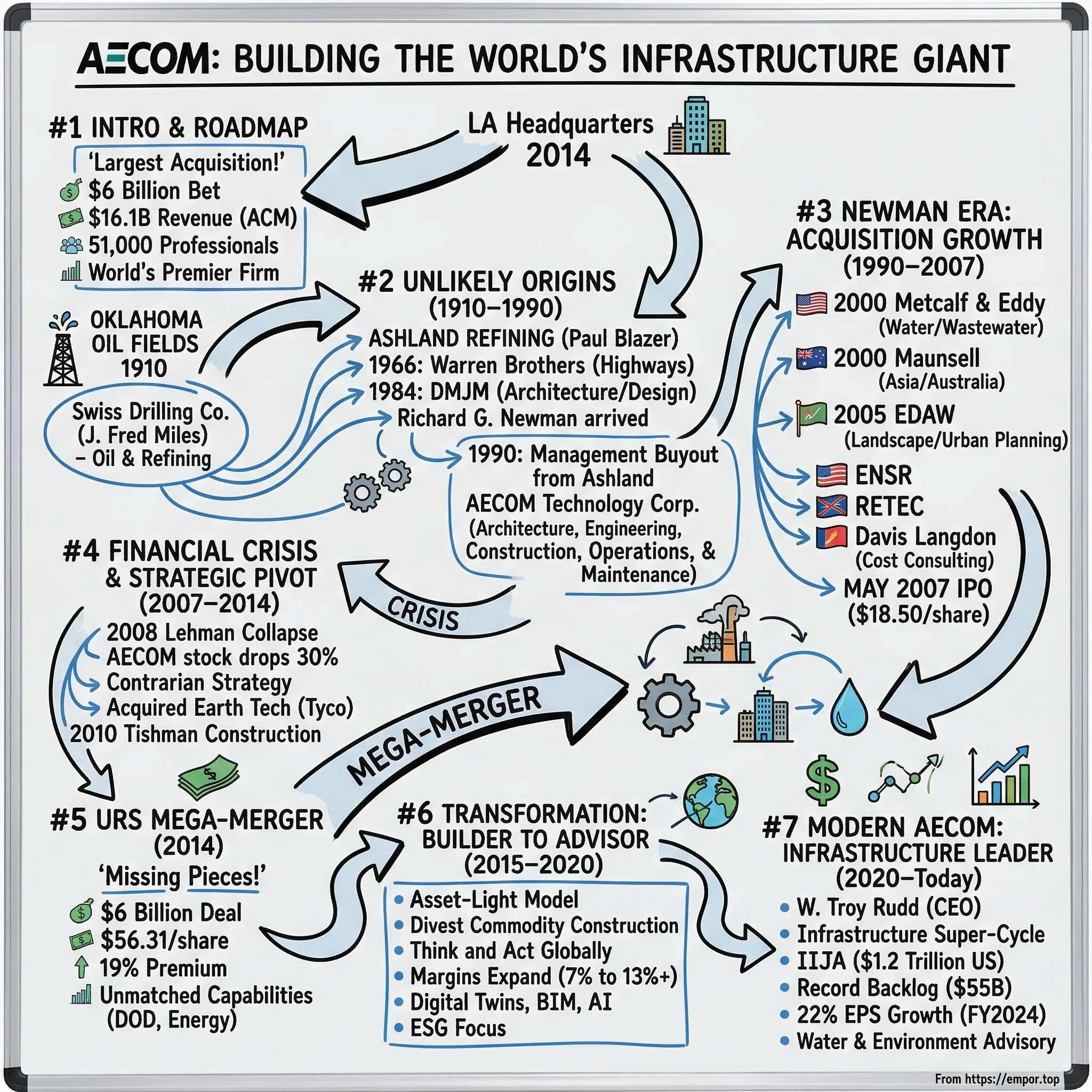
The lineage runs back to a wildcatting outfit called Swiss Drilling Company, formed in Oklahoma in 1910 and relocated to the Kentucky oil fields five years later. Out of that came Ashland Refining, and out of Ashland Refining came Ashland Oil & Refining — a mid-century American energy conglomerate with refineries, gas stations, and a chronic problem: what to do with the leftovers.8
The answer, in 1966, was Warren Brothers. Ashland bought the highway construction and materials firm partly because asphalt is a refinery byproduct, and if you already make the black stuff, you may as well own the company that lays it on roads. It worked well enough that Ashland became one of the larger road-construction firms in the country. That is the first strand of AECOM's DNA and it matters: the company's earliest commercial instinct was not design. It was building things for a fixed price.
The second strand arrived in 1984. Ashland, looking to reduce its dependence on petroleum cycles, bought Daniel, Mann, Johnson & Mendenhall — DMJM — a Los Angeles architecture and engineering firm with deep relationships across government and defense work.8 The acquisition came with its president, Richard G. Newman, and Newman turned out to be the most consequential thing in the transaction.
Newman was a civil engineer by training, with a bachelor's degree from Bucknell in 1956 and a master's in hydraulics from Columbia in 1960. His track record before DMJM was not that of a caretaker: he had taken a firm called Cahn Engineers from sixteen employees to two hundred and fifty, and had run Genge, Inc. into what was then the third-largest engineering firm in the country.8 He was, in other words, a builder of firms rather than a builder of bridges — and the distinction shaped everything AECOM later became.
In 1985 DMJM was folded into a new holding entity, Ashland Technology Corporation. Two years later Newman was named its president. Then in 1989, Ashland's board made the strategic decision that created AECOM: it would refocus on petroleum refining and shed the technical businesses.
The management buyout closed in April 1990. Newman and his colleagues acquired Ashland Technology for a package of cash, stock and subordinated debt valued at roughly $97 million, financed substantially through an employee stock ownership plan.8 The renamed AECOM Technology Corporation set up in Los Angeles with Newman as president, CEO and chairman.
Two features of that founding moment echo through the entire subsequent story.
The first is the name itself: Architecture, Engineering, Construction, Operations, Maintenance. It is not a brand so much as a table of contents. From day one the ambition was to sell the whole lifecycle of an asset — to be the firm a client calls at concept and does not stop calling until the thing is being maintained decades later. That ambition is genuinely valuable when it produces cross-sold, high-margin advisory work. It is genuinely dangerous when the "C" in the middle means signing up to deliver a finished building.
The second is the structure. AECOM did not launch as a company. It launched as an umbrella over five independently operating subsidiaries: DMJM in Los Angeles, Consoer Townsend Envirodyne Engineers in Chicago, Frederic R. Harris in New York, Holmes & Narver in Orange County, and Turner Collie & Braden in Houston.8 Some of these traced their founding back more than a century. Each kept its own name, its own client list, its own culture, its own risk instincts.
That decentralized model was an advantage in the 1990s. It let AECOM buy firms without destroying what made them valuable, and by fiscal 1997 revenue approached $725 million; by fiscal 1998 the company had reached full employee ownership with revenue near $860 million.8 But a confederation of acquired firms under a shared brand has a structural weakness that only reveals itself under stress: risk standards are only as strong as the weakest constituent unit's willingness to apply them. When AECOM later found itself explaining that a project had been bid under "terms and conditions that would not be acceptable" today, it was describing a governance problem that is the direct descendant of its founding architecture.2
For investors, the useful takeaway from the pre-1990 history is narrow but real: AECOM's origin gave it a portfolio of hundred-year-old client relationships and a habit of growing by purchase rather than by hiring. Both of those show up on today's income statement — the first as an unusually durable revenue base, the second as $3.77 billion of goodwill sitting on a balance sheet with roughly $2.2 billion of shareholders' equity.6
Newman spent the next fifteen years proving the acquisition machine could scale.
III. Building Scale Through Acquisition: The Newman Era to the 2007 IPO
If you want to understand how AECOM thinks, look at what it bought between 1999 and 2005, and notice that almost none of it was in the same business.
The pace picked up in 1999 with three deals totaling about $35 million — Day & Zimmermann's infrastructure arm, W. F. Castella, and the Miami architecture firm Spillis Candela & Partners.8 Then came the year that changed the company's self-image. In April 2000, AECOM spent roughly $145 million to buy two firms in the same month: Metcalf & Eddy, an American water and wastewater pioneer founded in 1907, and Guy Maunsell International, a London infrastructure firm founded in 1955 and known for bridge design.8
Metcalf & Eddy gave AECOM a brand in water that clients recognized without being told. Maunsell gave it something rarer: a genuine platform outside the United States. Newman described the Maunsell merger as "a significant turning point" and said the combination would let AECOM "compete effectively and grow across the globe" as "the preeminent infrastructure engineering firm in the world."8 The ambition was not subtle, and it was not wrong — water and international exposure remain two of the three or four things that actually differentiate AECOM's franchise today.
The subsequent purchases followed a legible logic. KPMG Consulting's transportation planning practice added advisory capability. Oscar Faber and the Warren Group added British engineering. ENSR and later RETEC added environmental remediation. EDAW added landscape architecture and planning. Davis Langdon, acquired later, added cost consulting. Ellerbe Becket added healthcare and sports architecture. Each deal bought a discipline, a geography, or a client list that AECOM could then sell across the rest of the federation.
The economics of this are worth spelling out plainly, because the same math still governs the business. An engineering services firm is a collection of licensed professionals whose time is sold by the hour. There is almost no operating leverage in the traditional sense — you cannot serve twice as many clients without roughly twice as many engineers. What you can do is (a) raise the price of an hour by selling scarcer expertise, (b) raise the utilization of the hours you have already paid for, and (c) win larger, longer programs where you also charge for coordinating everyone else's hours. Acquisitions help with all three, because scale buys you access to programs a smaller firm cannot bid at all, and because a broader capability set lets you sell more scope to a client you already have.
That is the honest case for the roll-up. The dishonest version — the one AECOM later got punished for — is that acquisitions grow revenue, revenue is what trade publications rank you on, and rankings feel like victory.
By 2005 the machine had produced a $2.4 billion revenue company with 24,000 employees. Newman, then 70, handed the CEO title to John D. Dionisio and stayed on as chairman.8 The company had tried to go public once, filing in 2002 for an offering of roughly $473 million, and had shelved it indefinitely when markets turned.8 It came back in 2007 and got a very different reception.
AECOM priced 35.15 million shares at $20.00 on May 9, 2007, and began trading on the New York Stock Exchange under the ticker ACM. When the offering closed on May 15 with the over-allotment exercised, 40.42 million shares had been sold, and net proceeds to the company after underwriting discounts came to roughly $472.3 million — a further $286.5 million went to selling shareholders, which is to say, to employees cashing out part of a seventeen-year experiment in staff ownership.9
The IPO mattered for reasons beyond the money. Employee ownership had been a genuine competitive advantage in the 1990s — it aligned the engineers who generated the revenue with the equity that captured it — but it was also a financing constraint. Every acquisition had to be paid for out of cash flow, debt, or private stock with no market price. A listed currency changed that. From 2007 onward, AECOM could buy firms with a share that Wall Street priced daily.
What it chose to buy with that currency is where the story turns.
IV. Doubling Down Through the Cycle: Earth Tech, Tishman, and the URS Mega-Merger (2008–2014)
Consider the timing. In February 2008, with the U.S. housing market already unwinding and Bear Stearns weeks from collapse, AECOM announced an all-cash $510 million deal to buy Earth Tech from Tyco International. It closed on July 28, 2008, six weeks before Lehman Brothers failed.10 Earth Tech brought consulting, engineering, and — the phrase that matters — design, build and operate services across water, environmental, transportation and facilities markets.
Two years later, in July 2010, with the American construction industry still flat on its back, AECOM bought Tishman Construction Corporation in a $245 million cash-and-stock transaction, funding the cash portion partly with a $250 million debt issuance.11 Tishman was not a design firm. It was one of the most storied construction managers in the United States, the family business behind some of New York's most recognizable towers, with operations extending to the United Arab Emirates.
Buying counter-cyclically is, in principle, exactly what a well-capitalized firm should do. Assets are cheap, sellers are motivated, and competitors are retrenching. AECOM's leadership deserves credit for the nerve. But look carefully at what was actually being bought: not more engineers, but more delivery obligation. Design-build. Construction management. Businesses where the firm's compensation is tied not to hours worked but to an outcome delivered — on a schedule, at a price, with subcontractors it does not employ doing most of the physical work.
Then came Michael Burke.
Burke was not an engineer. He had spent fifteen years at KPMG, rising to western area managing partner, before joining AECOM in October 2005 and becoming chief financial officer in 2006 — meaning he ran the IPO. He became president in October 2011 and chief executive in March 2014, and colleagues described him as strategically minded rather than personally grandiose, a man more interested in a unified corporate culture than in his own profile.12
Which makes what he did next more striking. Within days of becoming CEO, over the Easter holiday of 2014, Burke approached Martin Koffel, the chief executive of San Francisco-based URS Corporation, and pitched him on a merger. Both men had reached the same read of their industry: the middle was disappearing. Mid-sized engineering firms were being squeezed out, and the future belonged to a handful of megafirms with something like 100,000 employees and $20 billion of revenue.12
The deal was announced on July 13, 2014. AECOM would pay $56.31 per URS share — $33.00 in cash plus 0.734 AECOM shares — valuing the equity at roughly $4 billion and the enterprise at roughly $6 billion including assumed debt. The price represented a 19% premium to URS's trailing 30-day average, and management targeted $250 million of annual cost synergies by the end of fiscal 2016.13 It closed on October 17, 2014.14
The scale was extraordinary. URS brought about $10.5 billion of revenue and 55,000 employees to AECOM's $8.4 billion and 45,000.12 The combined company would operate in around 150 countries. AECOM's reported revenue went from $8.36 billion in fiscal 2014 to $17.99 billion in fiscal 2015 and $18.20 billion in fiscal 2017.6 On the ENR rankings that the industry cares about, AECOM was now unambiguously the largest firm in the world.
Was the price rich? On the headline, no. A 19% premium to a 30-day average is unremarkable for a large public deal, and Burke's team argued the combination was immediately accretive. But premium is the wrong lens. The question that mattered was what came inside the box.
URS was not a purer version of AECOM. It was a conglomerate in its own right: oil and gas services, power services, federal services, and — critically — at-risk government and industrial construction work. Burke's stated ambition was vertical integration, a firm that could take a client from concept through engineering, financing, construction and maintenance, and he had assembled the pieces through something like 47 acquisitions over his tenure.12 The strategic logic was that owning the whole chain would let AECOM capture more of a client's spend and differentiate against pure design firms.
The strategic reality was that AECOM had just bolted a large, cyclical, capital-hungry, low-margin, high-variance construction business onto a professional services firm, and had financed a meaningful part of it with debt. In the years that followed, interest expense ran between roughly $185 million and $300 million annually — a real claim on cash flow for a business whose entire equity story rests on converting profit into cash.6
Here is the honest verdict, with the benefit of a decade's hindsight. The URS deal delivered exactly what it promised on revenue and exactly nothing on shareholder returns. Fiscal 2016 net income was $96 million on $17.4 billion of revenue — a net margin under six-tenths of one percent.6 Fiscal 2017 was better at $339 million. Then fiscal 2019 produced a net loss of $261 million and fiscal 2020 a net loss of $186 million, both driven by enormous losses in discontinued operations as the company began dismantling what it had built.6 The largest engineering firm in the world had spent five years demonstrating that in this industry, revenue scale is not the same thing as value.
Someone was going to notice. In June 2019, someone did.
V. Scale Without Returns: The Burke-Era Reckoning and the Starboard Campaign (2015–2020)
By the spring of 2019, AECOM had a peculiar distinction. It was the biggest firm in its industry and one of the least loved by the people who owned it.
The pattern was consistent enough to be diagnostic. Revenue was enormous and profits were not. Individual projects would blow up without warning, taking a quarter's earnings with them. The Management Services segment — the government-contracting business inherited largely from URS — consumed capital and management attention while trading at a valuation the market clearly assigned to a different, worse business than design. And every so often a fixed-price, self-perform construction job would go wrong, and shareholders would be told it was an isolated event.
On June 20, 2019, Starboard Value LP, holding approximately 4.0% of the shares, sent a letter to Burke and the board.15 Starboard's argument was not complicated, and its power came from its simplicity. AECOM's disappointing shareholder returns, it said, were the product of poor execution rather than a hostile market. Given AECOM's scale relative to competitors, there was no reason it should not be able to match peer margins — and Starboard pointed at Jacobs Engineering's own turnaround as the template. It urged the board to consider selling the construction services unit outright, citing earnings volatility and exposure to cost overruns and schedule delays, and argued that doing so would streamline the portfolio and let investors focus on the design and consulting business underneath.16
Read that last clause again, because it is the entire thesis of the next seven years, and it was written by an outside investor rather than by management.
AECOM's response was, to its credit, substantive rather than defensive. The company pointed to a planned separation of Management Services, a $225 million reduction in general and administrative expense, ongoing margin reviews, a $1 billion buyback authorization — and, most importantly, an explicit statement of intent to exit all self-perform construction exposure by the end of the fiscal year.16
That commitment is the hinge of this entire story. It is also, six years later, the sentence a skeptical investor should hold up against the August 2026 charge.
The campaign escalated through the autumn and resolved in November 2019 with a governance agreement. AECOM would appoint three new independent directors recommended by Starboard, including Starboard's managing member Peter A. Feld, alongside Robert G. Card and Jacqueline C. Hinman, expanding the board to eleven. And Michael Burke notified the board that he intended to retire; he would remain chairman and CEO until a successor was identified by or before the 2020 annual meeting.1718
This is what a successful activist campaign looks like when it works properly. Starboard did not win a proxy fight. It did not seize control. It made an argument about capital allocation that was factually correct and difficult to rebut, and the board acted on it — first by changing the portfolio, then by changing the person running it.
The portfolio moves came fast. On October 14, 2019, AECOM agreed to sell the Management Services business to affiliates of Lindsay Goldberg and American Securities for $2.405 billion; the deal closed on January 31, 2020, and the business was rebranded Amentum.19 Beginning in the first quarter of fiscal 2020, the at-risk, self-perform construction businesses were classified as held for sale and reported in discontinued operations. The power construction business was sold in October 2020. The civil construction business, including Shimmick Construction, was agreed for sale to affiliates of Oroco Capital on December 10, 2020, and closed on January 4, 2021.2021
Note the sequencing carefully, because it is the crux of the bear case. AECOM stated its intent to exit self-perform construction in mid-2019. It substantially completed those exits between October 2020 and January 2021. But construction management — the Tishman business, where AECOM manages the build rather than performing it — was never part of that exit. It stayed. And the two design-build public-private-partnership contracts that eventually produced the 2026 charge were bid, according to the company's own chief financial officer, in December 2018 and March 2020.2
The second of those dates deserves a moment. March 2020 is nine months after the company publicly committed to shedding construction risk. Management's framing has consistently been that both projects predate the current risk regime, and that is defensible — the risk-matrix overhaul and the leadership change in that business came later. But an investor is entitled to observe that the company signed the second of these two contracts after it had already told the market that this category of exposure was the problem.
The leadership change arrived in June 2020, when the board named chief financial officer Troy Rudd as chief executive, effective that August, and separated the roles of chairman and CEO.22 Rudd was, like Burke, a finance person rather than an engineer — a KPMG partner for a decade before joining AECOM in 2009, with a bachelor's degree from the University of British Columbia and a master's in taxation from Golden Gate University.23 Promoting the CFO to run a company whose problem was that it had grown without regard to returns was not a subtle signal.
What the Starboard episode should teach a long-term investor is not that activists are always right. It is that the specific mechanism matters. Starboard's insight was that AECOM contained two businesses with completely different economics — a good one and a volatile one — bolted together, and that the market was pricing the whole thing at the worse multiple. That is a structural argument, not a management-competence argument, and structural arguments are the ones that produce durable change.
The change it produced was real. Whether it went far enough is the subject of everything that follows.
VI. The Rudd Transformation: Building an Asset-Light Professional Services Model (2020–2025)
Troy Rudd inherited a company in the middle of an amputation. His job was to explain what the patient was supposed to become.
The answer was branded "Think and Act Globally," launched alongside an increase in the board's repurchase authorization to $1 billion, and the phrase was less about geography than about internal politics.24 For thirty years AECOM had operated as Newman's confederation — regional firms with regional P&Ls, regional cost structures and regional standards. Rudd's proposition was that a design firm with 50,000 professionals should be able to staff a project in London with an engineer in Manila and a specialist in Denver, run one back office instead of forty, and apply one risk policy everywhere. The strategy was as much about erasing the founding structure as about pursuing global growth.
The financial logic was straightforward, and it is worth translating out of industry jargon because everything else depends on it.
AECOM reports two revenue lines. Revenue includes everything the company bills, including "pass-through" costs — subcontractors, materials, third-party work that AECOM coordinates but does not perform and on which it earns essentially nothing. Net service revenue, or NSR, strips that out. NSR is the money that actually belongs to AECOM's own people. In fiscal 2025 the company reported $16.14 billion of revenue and $7.573 billion of NSR — meaning that more than half of the headline number was money flowing through the firm rather than to it.25 This is why management talks about NSR almost exclusively, and why an investor who anchors on revenue growth will consistently misread the business.
Against that NSR base, the margin story is the whole game. In fiscal 2025 AECOM's segment adjusted operating margin reached 16.5%, up 70 basis points, and adjusted EBITDA margin hit 16.8%, up 80 basis points — both full-year records, and enough for the company to blow through its prior long-term target of 17%-plus adjusted EBITDA margin five quarters ahead of schedule.25 Adjusted earnings per share rose 16% to $5.26. Free cash flow was $685 million on adjusted EBITDA of $1.203 billion.
Break that down by segment and the shape of the company becomes clear. The Americas produced $12.5 billion of revenue but only $4.6 billion of NSR — the gap is the pass-through cost of construction management and large program work — and delivered a record 19.8% adjusted operating margin on that NSR. International produced $3.6 billion of revenue, $3.0 billion of NSR, and an 11.5% margin.25 In other words, the Americas design business is where roughly all the profit lives, and International is a lower-margin, higher-variance operation that has been in repair mode for years.
The portfolio pruning continued throughout. AECOM Capital — a legacy real-estate co-investment vehicle in which the company put its own balance sheet alongside developers — was wound down to immateriality, an entirely appropriate ending for a business that had nothing to do with selling engineering hours and everything to do with the pre-2020 instinct to own outcomes rather than advise on them.
By November 18, 2025, management felt confident enough to raise its long-term targets: organic NSR growth of 5% to 8% annually, a segment adjusted operating margin exit rate above 20% by fiscal 2028, adjusted EPS compounding at 15%-plus, and cumulative free cash flow conversion of 100% or more of adjusted net income across fiscal 2026 through 2029.2526 The stated engines were two: a proprietary artificial-intelligence programme built around a technology acquisition completed in September 2025, and an advisory practice targeting what management sized as roughly $50 billion of annual addressable client spend, with an internal goal of doubling advisory NSR within three years and eventually having advisory plus program management represent about half the business.27
The AI claim deserves scrutiny rather than applause, because "we are using AI" is the least differentiated sentence in corporate America in 2026. What AECOM has disclosed is at least specific. It spent roughly $13 million on the programme in its fiscal second quarter, about 66 basis points of margin, against a full-year plan of 60 to 70 basis points.28 And it has pointed to a concrete commercial proof point: a decade-long Scottish Water engineering contract — the largest that client had ever awarded — won against an incumbent and every major competitor, where the client signed a non-disclosure agreement specifically to understand AECOM's technology roadmap, and where the contract includes a pain-share mechanism tied to delivery efficiency.2728
The mechanism management describes is worth understanding in plain terms. In engineering services, the traditional bargain is that the client pays for hours. If technology lets a firm do the same work in fewer hours, the naive conclusion is that revenue falls. Rudd's argument on the second-quarter call was that this is not how his clients behave: demand for infrastructure design chronically exceeds available funding, so a firm that can deliver more per dollar does not get paid less — it gets asked to do more, and increasingly gets contracted on a fixed-fee rather than cost-plus basis so that efficiency gains accrue to the provider.28
That is a coherent theory. It is not yet a proven one. The falsification test is simple and investors can run it themselves over the next several quarters: if the theory is right, NSR per employee and EBITDA per employee should rise measurably while headcount growth lags revenue growth. Management has begun disclosing exactly those metrics, which is either admirable transparency or a well-chosen scoreboard, depending on your disposition.
On capital allocation, the record through fiscal 2025 was genuinely disciplined. Since initiating repurchases in September 2020, AECOM had bought back $2.2 billion of stock by November 2024 — roughly a third of its market capitalization at the time the programme began — and raised the quarterly dividend by 18% to $0.26 a share while reiterating a policy of double-digit annual dividend growth and returning substantially all available free cash flow to shareholders.29 In November 2025 the dividend went up another 19% to $0.31.25 By the first quarter of fiscal 2026 the buyback authorization had been reset to $1 billion, more than $300 million was repurchased in a single quarter, and cumulative returns since 2020 passed $3.3 billion.30
Now hold that against the governance data. Rudd's fiscal 2025 pay package totaled about $15.9 million: roughly $1.38 million of salary, $2.40 million of bonus, $12.07 million of stock, and about $114,000 of other compensation, with the compensation committee citing free cash flow of $685 million, design backlog and win rates.7 The equity weighting is appropriate. The question a skeptic asks is about accumulated ownership rather than annual grant: Rudd's directly held stake stood at roughly 142,000 shares after an open-market purchase in May 2026, with a further quarter of a million shares held indirectly — call it $25 million to $30 million of stock at prevailing prices against a company with a multi-billion-dollar market capitalization.31 That is meaningful money to an individual and modest skin in the game relative to the enterprise. Reasonable people weigh that differently; it belongs in the file either way.
The insider trading pattern is more nuanced than the headline usually suggests. In December 2025, with the stock near $97 to $99, president Lara Poloni and chief legal officer David Gan sold shares in transactions clustered around annual vesting — routine, but sold rather than held. Then in May and June 2026, with the stock in the low $70s and already well off its highs, Rudd, chief financial and operations officer Gaurav Kapoor and Poloni each made small open-market purchases at $70 to $71.31 Those purchases came after the second-quarter call at which analysts had already begun probing a rising claims balance. They are small — a few thousand shares each — but they cut against the simplest bearish reading, which is that insiders knew and left.
The macro backdrop under all of this was the 2021 Infrastructure Investment and Jobs Act, which set multi-year U.S. federal funding for exactly the transportation and water markets where AECOM ranks first. What makes IIJA analytically interesting in 2026 is not that it passed but that it has not been spent: management has said repeatedly that less than half the funding in its core markets has been drawn down, and that the House's initial proposal for the next surface transportation authorization runs to $580 billion.2 That is a genuinely unusual demand setup — a funded backlog of public works with a second authorization already in motion behind it.
So through fiscal 2025 the scorecard read as follows: portfolio simplified, margins at records, cash conversion strong, capital returned aggressively, targets raised and beaten early. If the story ended in November 2025 it would be one of the cleaner activist-to-execution case studies in American industrials.
It did not end there. To understand what happened next, you first have to understand how the business actually earns its money.
VII. How AECOM Actually Makes Money: Segments, Competitors, and Industry Structure
Picture a state transportation department that needs to replace an interstate bridge. Before a single girder is poured, someone has to run the traffic modelling, the hydrology, the geotechnical survey, the environmental impact statement, the public consultation, the seismic design, the cost estimate, and the procurement strategy. That work takes years and costs tens of millions of dollars, and almost none of it involves owning equipment. It involves licensed professionals billing time.
That is AECOM's core product, and the Brent Spence Bridge in Ohio is a real example of how it compounds: the firm performed well enough on Phase 1 that it won a sizable Phase 2 contract in 2026.28 Perform, get rehired, expand scope. Repeat across thousands of public agencies.
The two segments, and where the money really is
The Americas segment covers the United States, Canada and Latin America and does the design, program management and construction management work for transportation, water, environment and facilities clients. It is where the profit lives, and its margin advantage over International is not a rounding error — it has run roughly eight percentage points wider on net service revenue.25 The International segment spans the UK and Europe, the Middle East and Asia-Pacific, and has spent the last two years being repositioned rather than harvested.
By the third quarter of fiscal 2026 that repositioning was visibly working on the leading indicator even while it lagged on the reported one. International backlog rose 28% year over year to $8.5 billion and International NSR grew 4% with an adjusted operating margin of 14.3% — a large step up, driven by Australia, which is both the fastest-growing and highest-margin market in the segment, and the United Kingdom, where utilisation improved.12 Americas backlog stood at $19.3 billion, up 8%.
Underneath the segment labels sit some structural quirks worth knowing. In Saudi Arabia and the United Arab Emirates, local-partner requirements mean AECOM consolidates joint ventures it does not wholly own, so a revenue shortfall in the Middle East hits the top line much harder than it hits profit — the difference flows through non-controlling interests.28 That is why the ongoing regional conflict, which management has said continues to depress tourism- and hospitality-linked work, has been a bigger drag on reported growth than on earnings.
AECOM Capital, the legacy real-estate co-investment vehicle, is now essentially wound down and immaterial to the investment case. It is worth one sentence only as a marker of how much the pre-2020 company liked owning things.
How the contracts work — and why one type broke
Most of AECOM's design work is cost-plus or time-and-materials: the client pays for hours plus a fee, and the firm's risk is limited to whether it staffed the job efficiently. That is the low-variance business.
Construction management is different, and Kapoor explained the current mechanics with unusual precision on the third-quarter call. The predominant structure today is a guaranteed maximum price, or GMP, contract — but crucially, AECOM does not sign the GMP on day one. For the first twelve to eighteen months it works on a time-and-materials agency basis alongside the client and developer, helping finish the design to somewhere between 70% and 95% complete and getting subcontractor costs scheduled and bid out. Only once the design risk has largely drained out of the project does it convert to GMP — and by then the cost obligations have been passed down to the subcontractors who actually perform the work. Management's characterization is that AECOM's residual risk on such jobs is generally limited to its own fee.2
That structure explains two things at once. It explains why construction management can be a genuinely good business — Rudd has said that excluding the two problem projects, the unit has produced strong cash flow, high returns on capital, and margins consistent with the broader Americas business.2 And it explains the shape of the accident, because the projects that blew up were not GMP jobs. They were design-build contracts for public-private-partnership clients, a structure in which the firm takes on both the design and the delivery obligation. AECOM decided years ago to stop bidding that structure entirely.2
There is also a timing characteristic of this business that investors consistently misread. Because the agency phase precedes the GMP phase, a construction management win takes twelve to eighteen months to convert into meaningful revenue. That lag was a live issue in fiscal 2026: new CM wins ramped more slowly than planned, a convention centre project in Texas slipped by a few months, and a large share of the unit's people were tied up finishing the two troubled jobs rather than starting new ones.2 Construction management represents only about 6% to 8% of net service revenue, but its revenue timing has an outsized effect on reported growth.2
The competitive set
The industry has four or five firms that can credibly bid the largest global programs, and they are converging on each other's territory.
Jacobs remains the closest structural comparison — the firm Starboard explicitly held up as the turnaround template in 2019 — and has itself been reshaped by divesting its government services business. Tetra Tech is smaller and deeper, with the strongest position in water and environment. WSP is the aggressive consolidator. Stantec has leaned into energy transition.
The most consequential recent move was WSP's agreement on December 15, 2025 to acquire TRC Companies from funds managed by Warburg Pincus for $3.3 billion in cash — a price representing about 14.5 times TRC's estimated calendar 2026 EBITDA before synergies, roughly 12.5 times after. WSP financed part of it with an equity raise including a private placement from La Caisse, and expected the deal to make it the largest engineering and design firm in the United States on closing in the first quarter of 2026.3233
Note what WSP bought: power and energy. Not transportation, not water design. The competitive war in this industry is currently being fought over which firm owns the grid-and-generation build-out that data centres and electrification require — a market where AECOM participates through transmission, environmental permitting and site work, and where Poloni has pointed to fusion programs including the UK's STEP project and work with Type One Energy and the Tennessee Valley Authority as evidence of positioning.28
Now the myth worth puncturing. The popular narrative is that the big firms are relentlessly consolidating the market and that scale is therefore a compounding advantage. The data is more equivocal. In U.S. environmental and sustainability consulting — a market of more than $25 billion in 2024 — the four largest firms together held a little over 40% of the market, and that combined share actually fell about two percentage points from 2023. Over the three years to 2024 the Big Four gained only about 1.3 percentage points, after a burst of roughly seven points during the 2021–2022 M&A boom. Tetra Tech held the largest single share; AECOM's share rose into double digits; WSP's held steady; Jacobs' fell following a divestiture.34
The honest reading: consolidation is real over a decade but has plateaued since 2022, and the top four do not dominate their market the way a duopoly dominates. AECOM is a leader in a fragmented industry, not an oligopolist. Any thesis that relies on inexorable share gain to the largest players needs better evidence than the last three years provide.
Where the advantage actually comes from — and where it doesn't
Four candidate moats deserve individual treatment, because they are not equally strong.
Prequalification and past performance. Public agencies award work partly on demonstrated experience delivering similar assets. A firm that has designed a state's last four interchange reconstructions is genuinely advantaged bidding the fifth. This is a real switching cost, and it shows up in AECOM's recompete win rate, which Poloni has put in excess of 90%, with two marquee environment recompetes in the third quarter of fiscal 2026 won outright rather than through joint ventures — and with expanded scope.282 That last detail is the strongest single piece of evidence in the bull case: winning a renewal is table stakes, winning it with more scope against consortium bids suggests the client sees differentiated capability.
Scale and bonding capacity. Large programs require balance sheet strength and the ability to post surety. This raises the entry barrier meaningfully but is shared with three or four peers, so it is a barrier against new entrants rather than a source of pricing power against incumbents.
Talent. Licensed, registered engineers are scarce, and having 51,000 of them is a genuine asset. But scarcity cuts both ways: it is a cost pressure as much as a moat, and wage inflation in engineering labour is one of the more persistent threats to the 20% margin target.
Technology. This is the newest claim and the least proven. If AECOM's proprietary tooling genuinely lets it deliver more per engineer-hour and it can contract to keep part of that gain, it becomes a cost-position advantage that compounds. If competitors deploy comparable tooling within two years and clients simply demand the savings, it becomes table stakes. The Scottish Water contract is one data point, not a trend.
Run Porter's framework across the industry and the picture is coherent rather than exceptional. Rivalry is high among a handful of very large firms, moderated by the fact that clients often want different specialists on different assets. Supplier power is meaningful and concentrated in labour. Buyer power is real — public agencies are sophisticated, price-sensitive and procedurally rigid — but blunted by multi-year framework agreements and the switching costs of past-performance requirements. Threat of new entrants is low, because a firm cannot manufacture a thirty-year track record. Threat of substitutes is low, because someone with a professional stamp must sign the drawings.
The three numbers to watch
Everything above compresses into three KPIs that a long-term holder should track quarter by quarter, and no more than three.
Organic NSR growth by segment. This is the real revenue line. The management algorithm is 5% to 8% organic growth across the whole business including construction management, and Rudd confirmed on the third-quarter call that construction management is inside that number rather than excluded from it — a clarification an analyst had to ask for, because the framing at the prior investor day had been different.2
Book-to-burn and backlog growth. Book-to-burn has now exceeded 1.0x for more than twenty consecutive quarters.2530 This is the demand signal, and it leads reported revenue by a year or more.
Segment adjusted operating margin against the 20% fiscal 2028 exit target. This is the entire transformation thesis expressed as one number. If it stalls in the 16% to 17% range, the AI and advisory story is not working regardless of what management says about it.
Which brings us to the quarter where two of those three numbers looked excellent and the third briefly went negative.
VIII. The Fiscal 2026 Crisis: When a Legacy Contract Meets a "De-Risked" Story
Troy Rudd did not wait. Three sentences into his prepared remarks on the morning of August 11, 2026, before any of the record bookings, he went straight at it: "Before getting into the details of our results, I'd like to address the $337 million pretax charge included in the quarter."2
What followed was a masterclass in controlled disclosure, and it is worth taking apart carefully, because the gap between what management said and what it did not say is where the analytical work lives.
The mechanics
The charge came from a single large construction management project. The cause, Rudd said, was "a delay in delivering a large construction management project due to several factors, the largest of which is overall productivity of subcontractors on the last phase of this project."2 The building itself was essentially up; what was dragging was systems testing, integration and commissioning — the unglamorous final 20% where a structure becomes an operating facility. Substantial completion, previously expected in the first quarter of fiscal 2027, moved to near the end of the second quarter.
The financial damage landed in three places. Net service revenue and adjusted EBITDA each absorbed the full $337 million, turning a quarter that would have produced roughly $1.95 billion of NSR and $329 million of adjusted EBITDA into $1.61 billion and negative $8 million.35 Earnings per share took a $1.99 hit.2 And cash flow absorbed a $185 million use in the quarter — though remarkably, AECOM still generated $55 million of positive free cash flow despite it.21
That last number is easy to skip past and shouldn't be. A company that can absorb a $185 million project cash drain in a single quarter and still print positive free cash flow has a working capital engine that functions. It is the strongest evidence in the quarter that the underlying business is what management says it is.
The forward cash picture is uglier. Because the accounting impairment was taken up front but the physical work still has to be paid for, AECOM must fund completion out of cash over the following three quarters. Rudd quantified the fiscal 2027 impact at "about $0.5 billion," concentrated in the first two quarters.2 Interest expense will rise by an estimated $30 million to $35 million year over year as a result of higher average debt balances.2 Net leverage stood at 1.5x at quarter end, with $2 billion of undrawn borrowing capacity — not a solvency question, but not nothing either.35
Understanding the accounting matters here, so it is worth stating plainly: the income statement has already absorbed the expected loss through completion. The cash flow statement has not. Rudd made the distinction explicitly when Goldman Sachs' Adam Bubes pressed on it, noting that the financial statements now reflect the impact of these projects through delivery, while the $500 million is simply what has to be spent to get there.2 Investors should therefore expect the next two quarters to look bad on cash and, absent a new surprise, no worse on earnings.
The second project, and the date that doesn't match
The disclosure contained a detail that had not previously been prominent: there were two of these contracts, not one.
Both were design-build projects for public-private-partnership clients, and Rudd stated they are the only two of their kind in the construction management portfolio. The second remained on schedule for substantial completion of its first phase in the first quarter of fiscal 2027 and also carries a significant claim position for delays management attributes to others.2
Then came a discrepancy that a careful listener would have caught. Rudd said in prepared remarks, "This project was bid in 2019." Kapoor, answering Citi's Andy Kaplowitz an hour later, said the charged project "was bid in December of 2018" and the second "was bid in March 2020."2 The gap between 2018 and 2019 is immaterial to the economics. It is not immaterial to the framing, because "2019" is the year AECOM publicly committed to exiting construction risk, and a contract bid in December 2018 predates that commitment while a contract bid in March 2020 postdates it by nine months.
Both executives are describing contracts that predate the current risk regime, and that is true. But the tidy narrative of "one legacy contract from the old era" is doing more work than the underlying facts support.
The claims
AECOM is pursuing recoveries from third parties on both projects, and the balance has been sitting on the books for some time. Kapoor put the combined claims position in the $600 million to $650 million range and said it would not change materially through completion, since both projects are already 80% to 85% complete.2 He described the working capital AECOM has funded for scope changes as "far in excess of the claims on our books," and said what is recorded represents "a fraction of the total amounts that we're claiming against third parties."2 Asked how the recovery process would be run, he declined to elaborate, saying the company wanted to remain tactical.
The evidentiary basis for confidence is thin but not absent. Back on the second-quarter call in May 2026, Kapoor told Baird's Andrew Wittmann that four individual claims across these two clients had already gone through the dispute resolution process and AECOM had been successful on every one — while acknowledging that "it's just been very slow and dragged out," and that the length of the process "is what has surprised us."28 Rudd echoed in August that confidence in recovery "has been validated by our success in the dispute resolution process to date," while conceding that resolving the remainder "will take some time."2
For an investor, this is a live legal overhang with no disclosed timetable and no disclosed counterparties. The company has said the clients have strong creditworthiness. It has not said who they are, what the projects are, or what recovery it has assumed. Construction Dive reported that analysts believe the charged project involves the JFK Airport modernization program; AECOM has not identified it.36 Any model that books a claims recovery is making an assumption the company itself has declined to quantify.
The bifurcation
Strip the charge out and the quarter was, on management's own numbers, fine. Adjusted EBITDA and adjusted EPS would each have grown — 5% and 11% respectively — with margin expansion in International. Segment adjusted operating margin excluding the charge was 16.5%.2 Americas margin excluding the charge was 18%, which was down year over year, but for a reason management explained specifically: roughly 140 basis points of the decline came from record business development spending on large pursuits, the same pursuits that produced the 1.8x Americas book-to-burn.2
Kapoor's defence of that trade-off was the most confident thing he said all call: asked by UBS's Steven Fisher when the extra business development cost would convert to bookings, he answered that the return "is immediate, as you saw in the quarter."2 He has a point — spending margin to win a 1.8x book-to-burn is a good trade if the backlog converts. He also noted that similar business development convergence had compressed margins in fiscal 2022 and fiscal 2024 without derailing annual targets, and guided Americas margin to normalise in the fourth quarter.
So the underlying design and advisory business was healthy, and one legacy contract was the entire story. That is management's framing, and on the reported numbers it is defensible.
The trust test
Here is where a skeptical investor has to push, and the sequence matters more than any single number.
On November 18, 2025, AECOM announced it was reviewing strategic alternatives for the construction management business, including a possible sale, with the unit expected to be classified as held for sale and reported in discontinued operations.25 On February 9, 2026, it announced the review was complete and it would keep the business, describing it as "exceptionally well positioned for the future," citing strong backlog, a great cash flow profile, and the collaboration opportunity with program management on the LA28 and Brisbane 2032 Olympic programs.30 The same morning it raised the buyback authorization to $1 billion, having already repurchased more than $300 million of stock during the quarter.30
Six months later it took a $337 million charge inside that business.
Truist's Jamie Cook asked the question directly: construction management "was for strategic review just 6 months ago" — had management scrubbed the rest of the backlog, and why is this a good business to be in? Rudd's answer was substantive. Yes, the backlog and pipeline had been scrubbed; these two projects were the only ones with that profile; the rest is predominantly fee-based or GMP work; and excluding the two, the unit's returns and margins are consistent with the Americas business.2
That is a specific, falsifiable answer rather than a deflection, and it deserves credit as such. But it does not resolve the underlying discomfort. A company that ran a full strategic review of a business unit — with Goldman Sachs and Wachtell, Lipton engaged, according to the fiscal 2025 disclosure — and concluded three months later that the unit was exceptionally well positioned, either did not identify the deterioration on its largest legacy project or did not consider it material enough to change the conclusion.25 Neither possibility is comfortable. And the alternative reading — that the productivity collapse genuinely happened in the intervening months — sits awkwardly against the fact that the claims balance had been building sequentially for four or five quarters, which is precisely what Wittmann flagged in May.28
The capital allocation consequence is the cleanest evidence that something was not anticipated. Management had committed to returning substantially all available free cash flow to shareholders. In August, buybacks were effectively paused: Rudd said the near-term focus would be organic growth and the dividend, with repurchases resuming once leverage returns to historical levels after the projects complete — adding, pointedly, "certainly at our stock price where it is today."2 A company that had just bought back more than $300 million of stock in a single quarter at prices near $97 stopped buying at $65. That is not a scandal. It is, however, the opposite of what a disciplined repurchase programme is supposed to do, and it is the direct consequence of a cash outflow the company did not see coming.
What the call did not settle
Three questions remain genuinely open after August 11, and they are the ones to carry forward.
First, whether the completion schedule holds. Rudd said the reforecast was based on the last six weeks of production rates, that the project was running slightly ahead of the rebuilt schedule, and that slack had been built in.2 That is more disclosure than most companies offer. It is still a forecast of subcontractor productivity, which is exactly the variable that has already been forecast wrong once.
Second, how much of the $600 million to $650 million claims position converts to cash, and when. Management has said resolution takes years.
Third, whether the fiscal 2027 growth algorithm holds while construction management is effectively out of action in the first half. Rudd conceded that CM growth will come in the second half of fiscal 2027 rather than the first, and that people currently finishing the two projects will be redeployed once they complete.2 He declined to give fiscal 2027 guidance, which is reasonable in August, but it means the 15%-plus EPS growth algorithm has not yet been tested against a year that starts with a half-billion-dollar cash headwind.
IX. Playbook: Lessons on Roll-Ups, Activism, and What "De-Risking" Really Requires
Step back from AECOM specifically and three transferable lessons fall out of this history, each of which applies well beyond engineering services.
The first is about what actually compounds in a services roll-up. Between fiscal 2014 and fiscal 2017, AECOM more than doubled reported revenue and became the largest firm in its industry. Over that same stretch it earned net margins that rounded to less than one percent in one year and produced multi-hundred-million-dollar losses shortly after.6 Between fiscal 2020 and fiscal 2025 it grew reported revenue far more slowly — and adjusted earnings per share compounded to records while the share count shrank.
The difference is not effort or market conditions. It is which variable the company optimised. Revenue scale in a professional services business buys you the right to bid large programs, and nothing else. What compounds is the spread between what you charge for an engineer-hour and what it costs you, multiplied by how many hours you can keep billable, extended by how far into the future your backlog gives you visibility. Backlog, book-to-burn and NSR margin are the compounding variables. Revenue is a vanity variable that also happens to carry risk, because the fastest way to grow revenue in this industry is to take on pass-through-heavy delivery work where you are responsible for outcomes you do not control.
Anyone evaluating a serial acquirer in a people business should ask which of those two things management is being paid to grow.
The second is about activism. The conventional criticism of activist investors is that they extract short-term gains through financial engineering and leave. Starboard's AECOM campaign is a counterexample worth studying because the intervention was structural rather than financial. It did not demand a special dividend or a leveraged recapitalisation. It identified that two businesses with incompatible risk profiles were housed in one entity, that the market was applying the worse multiple to the whole, and that separating them would let the good business be valued as what it was. Then it took board seats and let the company execute.
But notice the second-order effect, which is the genuinely uncomfortable part of this story. The activist campaign directly produced both the protection and the vulnerability. The exit from self-perform construction is why AECOM's fiscal 2026 problem was one project rather than five. The timing of that exit — announced in 2019, executed through early 2021 — is also why a contract bid in December 2018 was still capable of doing this much damage in 2026. Strategic change in a long-cycle business does not take effect on the day it is announced. It takes effect as old contracts complete, which in construction can be seven or eight years.
The third lesson follows directly and is the one most likely to be useful elsewhere. A transformation story should be tested against its own legacy tail, not only against its forward guidance.
The practical version of that test is a set of questions an investor can ask of any company claiming to have de-risked: What is the longest-duration contract signed under the old regime, and when does it complete? What is the maximum loss embedded in it if execution goes badly? Has the company disclosed the count of such contracts, or only asserted that they are few? Does the disclosure appear in the risk factors, in the claims balance, in the backlog composition — or nowhere?
In AECOM's case, the answer to the last question was "in the claims balance, if you were watching it grow sequentially and asked why." One analyst did ask, in May 2026, and got a confident answer.28 Three months later the charge arrived. That is not proof of anything improper. It is a reminder that the most useful disclosures are often the ones the company does not consider headline material, and that a growing receivable you have to litigate for is a receivable worth asking about twice.
X. Analysis: Bull vs. Bear Case
Why AECOM wins from here
The bull case does not depend on the charge being forgotten. It depends on four claims, of which three are supported by evidence and one is not yet.
Demand is structural rather than cyclical. This is the strongest leg. The infrastructure AECOM designs is being funded by legislation already passed and by geopolitics already in motion: less than half of the 2021 infrastructure act's funding in AECOM's core markets has been spent; the House's opening proposal for the next surface transportation authorization runs to $580 billion; global defence budgets are rising, with defence representing roughly 10% of NSR and the U.S. Department of War the single largest client; Canada has committed to more than doubling defence spending toward 5% of GDP by 2035; and the electrification and data-centre build-out is generating design work across water, power and permitting simultaneously.227 None of this is a bet on GDP.
Demand visibility is unusually good and getting better. A record $27.8 billion backlog on a business with roughly $7.6 billion of annual NSR is more than three years of work already contracted, and book-to-burn above 1.0x for more than twenty consecutive quarters is a long enough series to be a pattern rather than a run of luck.
The margin story has an operating mechanism, not just a target. International's step-up to a 14.3% margin came from an identifiable mix shift toward Australia and the UK plus utilisation gains — not from cost cuts that reverse. The 90%-plus recompete win rate with expanded scope is evidence of pricing and positioning power rather than assertion.
The technology claim is unproven. It may well be the largest source of upside, and the Scottish Water contract with its efficiency-linked mechanism is a genuine proof point. But one contract does not establish that a firm can capture productivity gains rather than pass them to clients, and a competitor with comparable tooling in eighteen months would collapse the advantage. Treat this leg as optionality, not as a base case.
Layer Hamilton Helmer's 7 Powers over that and the picture is honest rather than flattering. AECOM has scale economies in bidding and back office, though shared with three or four peers. It has meaningful switching costs through prequalification, past-performance scoring and multi-year framework agreements — the single most durable power in the portfolio. It has a real brand in the narrow sense that matters in procurement: an ENR number-one ranking is a credential that a public agency's selection committee can point to. Counter-positioning is absent — there is no structural reason a peer cannot copy anything AECOM does. Network economies are absent. Cornered resource is arguable only if the AI tooling proves proprietary and durable. Process power is the most interesting open question: a genuinely superior global delivery model, where work moves to the lowest-cost qualified engineer anywhere in the network, would be hard to replicate, and it is precisely what "Think and Act Globally" was designed to build. The evidence for it is the margin trajectory, which is why that KPI carries so much weight.
What could break the case
The de-risking claim was narrower than the marketing. This is the core bear argument, and August 2026 is its proof point. AECOM told investors it was exiting construction risk. What it exited was self-perform construction risk. It kept construction management, kept two design-build P3 contracts inside it, ran a strategic review of the unit, decided to keep it, and then took a charge larger than a quarter's profit within six months. An investor is entitled to conclude that the language of "asset-light professional services" was doing more work than the balance sheet supported.
The forward promises are now in tension with each other. Management has committed to 100%-plus cumulative free cash flow conversion across fiscal 2026 through 2029, double-digit annual dividend growth, and returning substantially all available cash to shareholders. It is simultaneously funding roughly half a billion dollars of project completion in the first half of fiscal 2027, absorbing $30 million to $35 million of incremental interest expense, and has paused buybacks. Something has to give, and the honest answer is that the cumulative four-year conversion target could still be met while any single year misses badly — which is exactly the kind of target that is easy to hit and hard to falsify.
Disclosure and anticipation. A skeptical activist would focus less on the loss than on the sequence: a claims balance that grew for four or five quarters, an analyst question in May that was answered with confidence, a strategic review that reached a favourable conclusion, aggressive buybacks near the highs, and then a nine-figure surprise. Each element is individually defensible. Together they describe a management team that was not close enough to its largest legacy exposure.
Government dependency. The demand tailwind is also the concentration risk. A 43-day U.S. federal government shutdown in the first quarter of fiscal 2026 measurably delayed award activity, and the follow-on effect lingered into the second quarter because clients feared another shutdown in February.27 Appropriations risk is not theoretical for this business; it is an operating variable.
Competitive pressure. WSP's TRC deal makes a direct competitor the largest U.S. engineering and design firm and dramatically strengthens it in the power and energy market that is currently the industry's fastest-growing. Jacobs continues to operate at comparable scale. Meanwhile the E&S consulting data suggests the largest firms are not reliably taking share.
Talent cost inflation. In a business whose cost base is almost entirely people, and whose product requires licensed professionals in chronic short supply, wage inflation is the quietest threat to a 20% margin target. Technology is management's answer. It has not yet been tested through a full hiring cycle.
Risk radar
The material risks, stated as mechanisms rather than a checklist. Execution risk in construction management is proven rather than hypothetical, and the remaining exposure is the completion schedule on two projects plus whatever the claims process yields. Government funding and political risk transmits directly through appropriations timing to award activity and therefore to backlog conversion. Refinancing and rate exposure is modest — net leverage at 1.5x with no near-term maturities and cost certainty on the majority of debt, per management — but it rises mechanically as the project cash burn draws down cash.352 Geopolitical and FX exposure concentrates in the Middle East, where conflict has suppressed tourism- and hospitality-linked work and where the joint-venture structure distorts the revenue-to-profit relationship. Restructuring execution is a live item: AECOM guided to $150 million to $200 million of restructuring costs in fiscal 2026 and had booked only $54 million through three quarters, meaning the bulk was still to come in the fourth quarter with benefits deferred into future years.2 That is a large planned charge whose payoff investors will have to take on trust for at least a year.
XI. Epilogue & Reflections
There is a symmetry to this story that is hard to miss.
AECOM began as the part of an oil company that the oil company no longer wanted — a collection of engineering subsidiaries bought out by their own employees for less than a hundred million dollars, held together by a name that was really a list of services. It spent three decades buying other firms until it was the largest of its kind in the world, and then discovered that being the largest was worth remarkably little to the people who owned it. An activist pointed this out, the board agreed, the chief executive left, and his successor spent five years selling off the parts of the company that generated revenue without generating value.
By late 2025 that project looked finished. Margins were at records, the balance sheet was clean, the backlog had never been bigger, and management had raised its long-term targets rather than lowered them. And then a contract signed seven years earlier — before the activist, before the divestitures, before the current chief executive — reached its final phase, the subcontractors slowed down, and the company discovered that the past had one more claim on it.
The specific lesson is narrow and useful. In businesses with long contract durations — construction, aerospace programs, long-cycle capital equipment, insurance underwriting — a change in strategy is not a change in exposure. It is a change in new exposure. The old book runs off at its own pace, and the worst contract in it is by definition the one that takes longest to close out, because bad projects are late projects. A company that announced a de-risking in 2019 and completed its divestitures by early 2021 could still, in 2026, be carrying its single largest concentrated loss inside a business it never actually exited.
The broader lesson is about how to read management narratives. AECOM's leadership has been, by most measures, credible. It set targets and beat them, including hitting a long-term margin goal five quarters early. It gave specific rather than evasive answers when analysts pushed. It disclosed the second problem project on the same call rather than letting it emerge later. It quantified the cash impact, the interest impact and the completion timeline. When Jamie Cook asked why construction management was a good business to be in at all, Rudd answered the question rather than reframing it.
And still the sequence — strategic review, favourable conclusion, aggressive buyback, nine-figure charge, buyback pause — describes a company that was closer to its bookings than to its biggest exposure. Both things are true simultaneously. Credibility is not a binary; it is a running score, and August 2026 was a debit against an account that had been in surplus.
What should a long-term investor actually watch from here? Three things, in order of information value.
The first is whether the two projects complete on the revised schedule, and what the cash actually looks like through the first half of fiscal 2027. This is a falsifiable prediction with a near-term deadline, and it tests the one thing the company got wrong.
The second is whether the claims position converts. AECOM says it has won every claim that has reached resolution so far and that its recorded balance is a fraction of what it is pursuing. If material recoveries land, the economic loss will end up meaningfully smaller than the accounting loss. If they drag for years, the working capital stays locked up and the free cash flow conversion target gets harder every quarter.
The third is the margin line, tracked against the fiscal 2028 exit target. That single number carries the weight of both the technology thesis and the advisory mix shift, and it is the cleanest available test of whether AECOM has actually built a better professional services firm or merely a smaller version of the old one with the worst parts sold off.
The company that emerged from Ashland Oil in 1990 was defined by a decision about what to keep. So was the company that emerged from the Starboard campaign in 2020. What 2026 established is that the second decision was not quite as complete as the marketing suggested — and that in a business measured in decades, the last bad contract gets a vote.
XII. Recent News
The past several weeks have compressed a lot of information into a short window, and the market's reaction has been unusually clean to read.
August 10–11, 2026 — the disclosure. AECOM released third-quarter results after the close on August 10 and held its call the following morning. Alongside the charge and the guidance reset, the company reported record quarterly wins and a fourth consecutive quarter of double-digit backlog growth.12 The immediate reaction was a mid-single-digit decline; the deeper damage came over the following days as investors worked through the cash flow implications.4
August 14, 2026 — the low. Shares fell to $60.35, a 52-week low and a decline of nearly 18% from where they had traded before the release.4 The stock has since recovered modestly, trading in the mid-$60s in late August — still roughly half its 52-week high and a market capitalisation of about $8.4 billion.5
Capital returns re-prioritised. The most concrete operational consequence is that share repurchases are on hold pending completion of the two projects and a return of leverage to historical levels, while the dividend and organic growth investment continue.2 For a company that had returned roughly $3.5 billion to shareholders since September 2020 and had repurchased more than $300 million in a single quarter earlier this fiscal year, that is a material change in the near-term equity story.3530
Commercial momentum has continued after the quarter closed. AECOM disclosed a ten-year program management role for a highway and bus transit project in Canada that ranks among its largest ever wins in that market, and a large rail project award in Saudi Arabia that improves its position in an expanding regional rail market.2 Within the quarter, the firm also won a major highway contract tied to Hong Kong's 北部都會區 Northern Metropolis development — the first significant transportation project under an initiative the Hong Kong government has made a top priority.2 The pattern in these wins is consistent: large, multi-year, publicly funded programs rather than discretionary private work.
The competitive landscape has shifted underneath. WSP's $3.3 billion cash acquisition of TRC Companies was expected to close in the first quarter of calendar 2026 and to make WSP the largest engineering and design firm in the United States, with a substantially strengthened power and energy franchise.3233 Separately, industry data published in April 2026 showed the four largest U.S. environmental and sustainability consultancies collectively holding a little over 40% of a market exceeding $25 billion, with combined share slightly lower than the prior year — a reminder that scale leadership in this industry is not the same as market control.34
Insider activity has been modest and, notably, directional. Following December 2025 sales by senior executives at prices near $97 to $99 that were tied to annual equity vesting, Rudd, Kapoor and Poloni each made small open-market purchases in May and June 2026 at prices of roughly $70 to $71 — before the charge was disclosed, and after analysts had begun questioning the rising claims balance.31
What is still pending. Fiscal fourth-quarter and full-year results are due in November, and they will carry three items of unusual weight: the first fiscal 2027 guidance, which will show whether the 5% to 8% organic growth and 15%-plus EPS algorithms survive contact with a construction management business that will contribute little in the first half; the bulk of the fiscal 2026 restructuring programme, guided at $150 million to $200 million with only $54 million booked through three quarters; and any update on the completion schedule and claims recoveries for the two design-build projects.2 Until those land, the gap between AECOM's record backlog and its collapsed share price is essentially a market judgment about how much of the past is still on the books.
References
-
AECOM reports third quarter fiscal 2026 results — AECOM Investor Relations, 2026-08-10 ↩↩↩↩↩
-
AECOM (ACM) Q3 2026 Earnings Call Transcript — The Motley Fool, 2026-08-17 ↩↩↩↩↩↩↩↩↩↩↩↩↩↩↩↩↩↩↩↩↩↩↩↩↩↩↩↩↩↩↩↩↩↩↩↩↩↩↩
-
AECOM Form 8-K, Exhibit 99.1 — third quarter fiscal 2026 results — SEC EDGAR, 2026-08-10 ↩
-
Why Aecom Stock Crashed to a 52-Week Low This Week — The Motley Fool, 2026-08-14 ↩↩↩
-
AECOM Investor Relations — Overview and stock information ↩↩
-
AECOM annual and quarterly reports on Form 10-K and 10-Q — SEC EDGAR (CIK 0000868857) ↩↩↩↩↩↩↩↩
-
AECOM CEO Rudd Earned 2025 Pay Package of $15.9M — Engineering News-Record, 2026 ↩↩
-
AECOM Technology Corporation — Company History — International Directory of Company Histories / Reference for Business ↩↩↩↩↩↩↩↩↩↩↩
-
AECOM Announces Closing of Initial Public Offering — AECOM Investor Relations, 2007-05-15 ↩
-
AECOM to Acquire Earth Tech from Tyco — AECOM Investor Relations, 2008-02-12 ↩
-
AECOM acquires Tishman Construction Corp. in US$245-million transaction — AECOM Investor Relations, 2010-07-14 ↩
-
All About Strategy: How Aecom's Michael Burke Built a Behemoth — Los Angeles Business Journal ↩↩↩↩
-
AECOM to acquire URS Corporation for US$56.31 per share in cash and stock — AECOM Investor Relations, 2014-07-13 ↩
-
AECOM completes acquisition of URS Corporation — AECOM Investor Relations, 2014-10-17 ↩
-
Starboard Delivers Letter to AECOM CEO and Board of Directors — PR Newswire, 2019-06-20 ↩
-
Investor urges AECOM to sell construction unit — Construction Dive, 2019-06 ↩↩
-
AECOM announces governance agreement with Starboard Value — AECOM Investor Relations, 2019-11-22 ↩
-
AECOM Announces Governance Agreement With Starboard; CEO Michael Burke To Retire — Nasdaq, 2019-11-22 ↩
-
AECOM accelerates value creation strategy with sale of its Management Services business for $2.405 billion — AECOM Investor Relations, 2019-10-14 ↩
-
AECOM announces agreement to sell its Civil construction business to Oroco Capital — AECOM Investor Relations, 2020-12-10 ↩
-
AECOM completes sale of its Civil construction business — AECOM, 2021-01-04 ↩
-
AECOM Names CFO Troy Rudd to Replace Michael Burke as CEO — Engineering News-Record, 2020-06-15 ↩
-
AECOM launches its Think and Act Globally strategy and increases Board repurchase authorization to $1 billion — AECOM Investor Relations ↩
-
AECOM reports fourth quarter and full year fiscal 2025 results — AECOM Investor Relations, 2025-11-18 ↩↩↩↩↩↩↩↩↩
-
AECOM announces increased financial targets built on further extending its competitive advantage and accelerating operating leverage — AECOM Investor Relations, 2025-11-18 ↩
-
Aecom (NYSE:ACM) Q1 2026 Earnings Call Transcript — Insider Monkey, 2026-02-10 ↩↩↩↩
-
Aecom (ACM) Q2 2026 Earnings Call Transcript — The Motley Fool, 2026-05-12 ↩↩↩↩↩↩↩↩↩↩
-
AECOM reiterates its capital allocation policy, increases its share repurchase authorization to $1 billion and increases its quarterly dividend by 18% — AECOM Investor Relations, 2024-11-18 ↩
-
AECOM reports first quarter fiscal 2026 results — AECOM Investor Relations, 2026-02-09 ↩↩↩↩↩
-
Form 4 — Troy Rudd, AECOM common stock purchase — SEC EDGAR, 2026-05-14 ↩↩↩
-
WSP to acquire TRC, supercharging its leading position in the Power & Energy sector — WSP Global, 2025-12-15 ↩↩
-
WSP Aims for Power Market Boost in $3.3B Deal to Buy Sector Design Leader TRC Cos. — Engineering News-Record, 2025-12 ↩↩
-
Tetra Tech, AECOM, WSP and Jacobs still dominate US E&S consulting — Environment Analyst Global, 2026-04-16 ↩↩
-
AECOM Q3 FY2026 slides: record backlog amid $337M project charge — Investing.com, 2026-08 ↩↩↩↩
-
AECOM touts data center pipeline amid fiscal Q3 loss — Construction Dive, 2026-08 ↩
 LinkedIn
 WhatsApp
 Reddit
 Hacker News
 Email
Email Kindle
 RSS Feed
 Spotify
 Apple Podcasts
 Amazon Music
 Audible
 YouTube