Union Bank of India: The Merger That Had to Prove Itself
I. Gandhi’s Bank, Reopened as an Investor Question
On Monday, October 19, 2026, Union Bank of India put out a set of numbers that would have been hard to believe eight years earlier. For the three months to September, the bank earned ₹5,537 crore of standalone profit, about 30% more than a year before.[^1] Its gross non-performing assets, the loans on which borrowers had stopped paying, had fallen to 2.42% of the book.[^1] Its gross advances had reached about ₹11.56 lakh crore.[^1] Coverage of the print mostly focused on the profit jump and the rise in net interest income.[^2]
Now rewind to the spring of 2018. The same bank had just reported a full-year loss of ₹5,247 crore, and almost one rupee in every six it had lent was classified as bad.1 That loss was the first of three straight loss years. Then came a merger the government ordered, folding two other struggling state-owned lenders into Union Bank in April 2020, just as India went into pandemic lockdown.2 A rerated bank with a ₹1.39 lakh crore market value is what came out of that run of bad years.[^5]
The story goes back much further. The bank was registered in Bombay on November 11, 1919, and Mahatma Gandhi inaugurated its head office in 1921.[^6] The detail is worth getting right because it is often blurred. Gandhi did not bless the bank's founding. He opened a building two years later and gave a speech about what Indian banking might become. That speech carried a challenge that still fits: could an Indian institution be trusted to handle very large sums of money well?
A century on, the challenge is less romantic and much more measurable. Union Bank today is one of India's large public-sector lenders. The Government of India owns 74.76% of it.[^1] It runs about 8,700 branches and employs about 74,000 people.[^1] Its business is the oldest one in finance: take deposits from households and companies, lend that money out at a higher rate, and keep enough of the spread after costs and bad loans to reward the people who own the equity. It also has some subsidiaries and joint ventures in asset management, life insurance and overseas banking. Next to the core spread business they are small. This story is about the bank.
So the profit print on October 19 is not the end of the story. It reopens the case. The obvious reading is that a broken bank was repaired, merged into scale and is now earning its keep. The skeptical reading is that a cyclical bank has caught the best part of the credit cycle, with low provisions, recoveries from old bad loans and a balance sheet sweated harder than before. Both readings fit the headline. They differ in the details.
Four questions decide which reading is right, and they set the course of this episode. The first is whether the 2020 merger created lasting value or just a bigger balance sheet. The second is whether today's returns can survive once credit costs rise from their current lows, which they usually do. The third is whether Union can raise enough deposits to fund its loan growth without giving up its margin, at a time when advances are growing almost three times as fast as deposits.[^1] The fourth is whether Union has any real edge against State Bank of India, the other large public banks and the private-sector giants that compete for the same borrowers and savers.
Judging a bank on one quarter's net profit is like judging a farmer on one good harvest. The better tests are slower. Is core interest income rising? Are funding costs under control? Are fresh bad loans staying low as the book grows? Are returns holding up without one-off help? Is capital building or being used up? Those are the measures this story uses. On those measures, the recovery is real. But the test has moved on from "has the bank been repaired" to "can it keep earning as provisions normalize and loans run ahead of deposits." To see why that test is so demanding, it helps to see what kind of institution Gandhi was opening a door for in 1921.
 Subscribe on LinkedIn
II. One Head Office, Four Branches
In 1921, Bombay was the commercial capital of a colony starting to imagine itself as a nation. Gandhi had launched the non-cooperation movement the year before. A bank set up by Indian merchants opening its own head office was a small act of economic self-assertion. Standing at the inauguration, Gandhi said Indians should be able to run a big bank, and that the country, though it had few banks, could manage large sums of money well.3
The founder was Seth Sitaram Poddar, and the bank he started served the people he knew: small traders and businessmen in Bombay's markets.[^6] It was a merchant's bank, built on personal relationships and the reputation of its promoters, in a city where finance had long been dominated by British exchange banks and old indigenous banking houses. Gandhi's words gave it a public mission. Its balance sheet stayed small.
The early decades show how small. When India became independent in 1947, Union Bank had four branches: three in Bombay and one in Saurashtra.3 It was a regional institution that had survived the Depression and the war, and in banking survival counts for something. But it was not yet a national franchise.
The real expansion came under the pressure of national policy. The bank grew through the 1950s and 1960s, opened its hundredth branch in Irinjalakuda in Kerala in 1964, and absorbed several small lenders along the way.[^6] By the time the government nationalized it in 1969, along with India's other large private banks, it had 240 branches.3 Nationalization changed the bank's purpose. A private lender optimizing for its shareholders became a public institution that had to open branches in villages, lend to priority sectors and serve the state's development goals. Later acquisitions, including Belgaum Bank in the 1970s and Sikkim Bank in 1999, the latter taken over at the Reserve Bank of India's request after irregularities, extended its reach.[^6]3
This is where the history stops being a prologue and starts to matter for investors. The national network Union built under public ownership is the source of its main competitive claim today: a household in a semi-urban town in Andhra Pradesh or rural Uttar Pradesh is more likely to find a Union branch nearby than a branch of many private banks. About 60% of its branches are in rural and semi-urban India.[^1] Those branches collect savings that cost less than wholesale money, and they give the bank a presence with farmers, small businesses and government accounts that would be expensive to build from scratch.
But a branch is not a free asset. It needs staff on bank-wide wage settlements negotiated through the Indian Banks' Association, rent or owned property, security, cash logistics and technology. A merchant's bank in 1921 could win a customer on trust alone. A national bank in 2026 has to show that each branch gathers enough cheap, stable deposits and enough sound lending to cover its fixed costs. History shows that Union can build reach. It does not show that the reach earns an adequate return, and in the decade before the merger, the record pointed the other way.
That tension, between a network that builds trust and a network that carries cost, runs through the rest of the story. In the 2010s it got swamped by a bigger problem: the loans the bank had made to India's infrastructure boom stopped being repaid.
III. When the Bad Loans Came Due
The reckoning began in a governor's office on Mint Street. In late 2015, Raghuram Rajan's Reserve Bank of India ran an Asset Quality Review of the country's banks. Inspectors went loan by loan through the books and told lenders to recognize as bad many accounts they had been carrying as standard. Rajan said publicly that he expected a full clean-up of bank balance sheets by March 2017.4 Across the system, reported bad loans surged. Union Bank, like every other public lender, now had to show what it had been carrying.
To see why this hurt so much, think about what an Indian public bank did in the years after 2008. The government pushed infrastructure: power plants, roads, steel mills, ports. Private companies borrowed heavily to build them, and public banks lent heavily because the projects looked like national priorities and the borrowers looked like blue chips. Many projects stalled on land acquisition, coal allocation, environmental clearances or plain overleverage. Borrowers could not pay. Instead of recognizing the losses, banks often restructured the loans, extended deadlines and kept them classified as standard. The losses were real; they just had not been booked.
The AQR ended that. And Union Bank's own figures show why "accounting clean-up" understates what happened. In the year to March 2018, the bank made an operating profit of about ₹7,540 crore before provisions.[^9] In a normal year that would have been a respectable profit. But it had to set aside about ₹12,787 crore of provisions and tax adjustments, so the operating profit turned into a loss.[^9] Provisions for bad loans alone came to about ₹13,500 crore. A tax credit of about ₹1,394 crore softened the total charge.[^9]
The movement of the bad-loan pool is even more revealing. Over FY2018, gross NPAs rose from about ₹33,700 crore to about ₹49,400 crore.[^9] Roughly ₹21,400 crore of new bad loans were added in a single year, and the bank cut the pool by only about ₹5,700 crore. Write-offs accounted for more of that reduction than cash recoveries did.[^9] By March 2018, gross NPAs had reached about 16% of advances, and net NPAs, after provisions, were about 8%.[^9] The bankruptcy route explains why so much provisioning landed in one year. By March 2018, the bank had exposure to 27 large accounts the RBI had directed into the new Insolvency and Bankruptcy Code process, with about ₹12,129 crore outstanding. It had provided for only about 60% of that amount, and the provisions had been front-loaded into FY2018.[^9] Bankruptcy courts take years to resolve cases, so this provisioning did not mean the money was lost forever. It meant the bank had to admit that the value of these loans was uncertain, and had to hold capital against that uncertainty. All of this was happening at a bank with about 4,300 branches, half the network it would run after the merger.[^9]
The bank's capital was thin. Its total capital ratio was 11.5%, and Tier 1 capital was barely above 9%.[^9]
Then came a detail that weakens any story of a clean, one-off reckoning. When the RBI later inspected the FY2018 books, it found the bank had under-reported bad loans by about ₹867 crore and under-provisioned by about ₹2,287 crore. On the regulator's numbers, the FY2018 loss would have been about ₹6,770 crore, not ₹5,247 crore.5 Divergences like this were common across public banks then, but they matter here. Even in the year of maximum recognition, the bank's own count of its problems fell short of the regulator's.
The year before also looks different under a closer look. In FY2017, the bank reported a small profit of about ₹556 crore, but that included a tax write-back of about ₹204 crore inside its provisions line.[^9] Without it, profit would have been closer to ₹350 crore on a balance sheet of several lakh crore. And in November 2017, when the September-quarter loss was announced, the bank warned that more provisioning pain was coming on accounts the RBI had sent to the bankruptcy courts.6 The pain arrived in stages. Its size was clear only afterwards.
Losses also continued after the peak. Union reported losses in FY2019 and FY2020 as well, three straight loss years in its consolidated record.[^12] Consolidated and standalone figures differ slightly because of subsidiaries and associates, but the direction is the same: the bank destroyed equity for three years.
How did it come back? Not mainly because troubled borrowers repaid in full. Recovery depended on a mix: write-offs that removed fully provided loans from the books, resolutions through the Insolvency and Bankruptcy Code that recovered part of what was owed, upgrades of accounts that started paying again, and heavy provisioning that pushed coverage up until the remaining bad loans were mostly reserved against. The government also kept injecting capital. Between FY2018 and FY2021, Union and the two banks it later absorbed received about ₹41,597 crore of equity support from the state.7 Those were taxpayer funds put into the hole.
So the verdict on the crisis is clear. It was a severe failure of underwriting and risk control, worsened by a policy environment that encouraged concentrated lending to large projects, and made worse by late recognition. It was not a small accounting detour. The clean-up reset the earnings base, and that matters for today's investor, because any good year now has to be measured against this record of how fast losses can build in a public bank's corporate book.
That left the government with a harder question in 2019. If Union, Andhra Bank and Corporation Bank were each weak, would combining them produce better underwriting and lower costs, or just put three sets of problems under one roof?
IV. Three Banks, One Balance Sheet
On August 30, 2019, Finance Minister Nirmala Sitharaman stood before cameras in New Delhi and redrew India's banking map. Ten public-sector banks would become four. Andhra Bank and Corporation Bank would be merged into Union Bank of India, creating what the government described as the fifth-largest public bank, with about ₹14.59 lakh crore of business (deposits plus advances) and 9,609 branches.8 Union, the largest of the three, was named the anchor. The other two would disappear.
The policy logic was straightforward on paper. India had too many mid-sized public banks competing for the same customers, each with its own head office, treasury, technology spending and overlapping branches. Fewer, larger banks could, in theory, close duplicate branches, negotiate better technology contracts, lend to bigger borrowers without breaching concentration limits, and make capital go further. The government pointed out that all three banks already ran on the same core banking software, Infosys's Finacle, which would make integration easier.8 It also had a less public motive: consolidation let the state recapitalize fewer, bigger institutions, and possibly someday reduce its role in them.
Policy intent is not achieved benefit. The cabinet approved the scheme on March 4, 2020, and the government notified the Amalgamation of Andhra Bank and Corporation Bank into Union Bank of India Scheme the same day, effective April 1, 2020.2[^15] Three weeks before that date, the World Health Organization declared a pandemic. On April 1, the merged bank came into existence in a country under one of the world's strictest lockdowns.
The terms of the deal show who paid what. Andhra Bank shareholders received 325 Union shares for every 1,000 they held. Corporation Bank shareholders received 330 for every 1,000.910 No cash changed hands. In a private acquisition, analysts would compare the purchase price with the target's earnings or book value. Here that comparison does not work, because the government owned a large majority of all three banks and was mostly moving its own holdings around. The exchange ratio was the capital-allocation decision: it set how much of the combined bank Union's minority shareholders would give up to the minority holders of the other two.
The other mergers announced that day were also share swaps. Punjab National Bank issued 1,150 shares for every 1,000 Oriental Bank of Commerce shares. Canara Bank issued 158 for every 1,000 Syndicate Bank shares. Indian Bank issued 115 for every 1,000 Allahabad Bank shares.10 These ratios mostly reflected relative share prices and book values, not negotiated takeover premiums, so comparing them across banks says little about overpaying. What can be said is that Union absorbed two banks whose combined size was about as large as its own, and its shareholders were diluted accordingly.
The integration years
Then the work started. Three banks meant three cultures. Andhra Bank had deep roots in the Telugu states. Corporation Bank, founded in coastal Karnataka, brought a second southern franchise. Union was a Mumbai-headquartered bank with a stronger presence in the west and north. Employees had different promotion histories, different branch practices and different loan books. Customers had different account numbers, cheque books and apps.
The technology migration went faster than many expected. Union completed Corporation Bank's IT integration in November 2020 and Andhra Bank's in January 2021, moving all customers onto Union's core banking system with help from Infosys, EY and BCG.11 That was a real achievement during a pandemic. But IT integration is the visible part. Underwriting habits, credit monitoring and culture are harder, and they show up only years later, in which loans go bad.
The financial strain showed immediately. In October 2020, S&P Global Ratings said the merger had "eroded" Union's capital buffers. Its Tier 1 ratio had fallen from 10.7% to 9.5% in one quarter, and S&P warned that the combined bank might take more than two years to realize the benefits of scale.12 The inherited books brought a large pile of stressed assets just as the pandemic was stressing borrowers further.
Capital came from two places. The government kept injecting equity through FY2021.7 Then the bank went to institutional investors. In August 2023, it raised ₹5,000 crore through a qualified institutional placement at ₹86.55 a share, about 5% below the floor price.13 In February 2024, it raised another ₹3,000 crore at ₹135.65.[^21] The second issue took the government's stake to 74.76%, just under the 75% ceiling that India's minimum public shareholding rules require.[^21] Each QIP diluted existing shareholders. The merger's scale was not free. It was paid for with taxpayer capital first and minority dilution after.
Did it work?
The evidence is mixed but increasingly positive. The proposed combined bank had 9,609 branches. Today Union runs 8,713.8[^1] That reduction of roughly 900, about a tenth of the network, is the clearest physical sign that overlapping branches were closed. Its cost-to-income ratio, the share of operating income consumed by operating expenses, was about 47% in the September 2026 quarter, down from about 51% a year earlier.[^1] Gross NPAs have fallen from merger-era levels to under 2.5%.[^1] And the bank did not raise any equity in FY2026, saying internal accruals were sufficient.[^22]
There is also one piece of evidence that the footprint itself added something. When analysts on the October 2026 call asked about drought risk and state-level exposures, management pointed to a strong loan book in Andhra Pradesh and Telangana, the home ground Andhra Bank brought into the merger.14 Union had been a western and northern bank; the merger made it a southern one too, and today more than 3,500 of its branches, about two-fifths of the network, are in the southern region.[^1] That is a real change in reach, not just an enlarged balance sheet. Whether the south's borrowers and depositors are more profitable for Union than they were for the banks that originally served them is something the bank does not disclose.
What the record cannot show is the counterfactual: whether Union, Andhra and Corporation Bank would have recovered just as well alone, as the whole public-banking sector did between 2021 and 2026. Much of Union's improvement matches the sector's. That points to the credit cycle, not merger synergies, as the main driver. A fair verdict is that the merger delivered scale and a wider footprint, especially in the south, and the integration was carried out competently. Whether it created value beyond what the cycle would have delivered anyway is unproven. The answer depends on whether the bigger bank can earn a durable spread on its much bigger balance sheet. That spread is the next part of the story.
V. The Spread Between a Deposit and a Loan
Picture a shopkeeper in Vijayawada with ₹5 lakh sitting in her Union Bank savings account. For years she left it there because it was convenient: the branch was down the road, the staff knew her, and the money was available whenever stock arrived. Then term-deposit rates went up, and her nephew showed her a mobile app offering a better rate at another bank. She moved half of it into a one-year fixed deposit. Union lost nothing in volume terms if she chose a Union term deposit. But the money now costs the bank several percentage points more. Repeat that decision across millions of customers and you have the central fact about bank funding: savers decide what a bank's money costs.
Union's business can be explained in one sentence. It borrows from depositors at one rate and lends to borrowers and the government at a higher rate. The difference, net interest income, is its main source of revenue. Divide that by the assets that earn interest and you get the net interest margin, or NIM. In the September 2026 quarter, Union's NIM was 2.86%.[^1] For every ₹100 of earning assets, it kept about ₹2.86 a year after paying for funds, before operating costs and bad loans. Management presented an adjusted margin of 3.03% that strips out a tax-refund effect.[^1] The reported number is the safer anchor.
Why do margins move? Because loans and deposits reprice at different speeds. Most of Union's loans float. They are linked to the RBI's repo rate or to the bank's own marginal-cost lending rate, so when the RBI cuts rates, loan yields fall quickly. Deposits reprice slowly. A fixed deposit taken at 7.5% keeps that rate until it matures, so after a rate cut, a bank's income falls before its costs do. That is what happened through 2025. NIM fell from 2.91% in FY2025 to 2.70% in FY2026 as rate cuts reached loan yields first.[^22] When rates go up, the lag works in the bank's favor for a while, and on the October 2026 call management said it expected the rate-hike cycle to support margins.14
Beyond interest, the bank earns fees: loan processing charges, trade finance, foreign exchange commissions and the sale of insurance and mutual funds through its branches. In the September 2026 quarter, fee-based income was about ₹3,210 crore, against net interest income of about ₹10,583 crore.[^1] Fees matter, but they supplement the spread. Bancassurance is a good example of scale: Union earned about ₹475 crore from selling life, general and health insurance in FY2026, a small fraction of a year's net interest income.[^22] Other income also includes two less durable items: treasury gains on bond trading and recoveries from loans already written off. In the September quarter, treasury income fell about 35% from a year earlier and recoveries from written-off accounts fell about 19%.[^1] Both lines are cyclical, and a skeptical investor should treat them as such. A third item is easy to miss. Indian banks that over-achieve their priority-sector lending targets can sell certificates to banks that fall short, earning a commission. Union earned about ₹955 crore that way in FY2025 but only about ₹134 crore in FY2026, which helps explain why its full-year other income disappointed.[^22] In the June 2026 quarter, such sales brought in about ₹217 crore; in the September quarter, management said it had chosen to protect its own priority-sector position rather than sell more.[^24]14 Fee lines that swing by hundreds of crore on a policy choice are not the kind of earnings an investor should capitalize at a full multiple.
The bank's segment reports show where money is made. In the September quarter, the corporate and wholesale segment and the retail segment each brought in about ₹12,500 crore of revenue. Corporate and wholesale generated a segment result of about ₹2,849 crore, retail about ₹2,515 crore, and treasury about ₹1,300 crore.[^2] The corporate result roughly doubled from a year earlier, while treasury's fell.[^2] Banks allocate shared costs to segments using their own assumptions, so precision should not be read into these splits. But they show that Union's profit pool is still heavily corporate, even as management talks up retail, agriculture and small business lending.
Now the competition. Union holds roughly 4% of India's deposits and 4% of its advances.15 State Bank of India is several times larger, and its size gives it lower funding costs and first claim on many of the country's best borrowers. Bank of Baroda, Canara Bank and Punjab National Bank are public banks of comparable size, chasing the same government accounts, the same large corporates and the same rural savers. HDFC Bank and ICICI Bank have stronger technology, deeper retail franchises and higher returns, and they compete hard for affluent urban depositors.
Apply the competitive forces once, and the picture is a hard business. Rivalry is intense because public banks offer very similar products and price close to one another. Borrowers have strong bargaining power: a highly rated company can borrow from a dozen banks or go straight to the bond market, so pricing on the best corporate loans is thin. Depositors have growing power too, because moving money between banks now takes a few taps, and alternatives such as mutual funds, small-savings schemes and listed bonds compete for household savings. Non-bank lenders offer substitutes for many retail and small business loans. New entry is limited by licensing and capital requirements, but regulation also shapes pricing through priority-sector targets and directed lending. The government's ownership adds a strategic overlay that private rivals do not face.
So is the branch network a funding edge? The evidence is mixed. On the positive side, Union's deposit base is granular. Its twenty largest depositors accounted for about 5.2% of deposits at March 2026, down from about 6.7% a year earlier.[^22] Granular deposits are less likely to leave suddenly than a few large institutional balances. Its CASA ratio, the share of deposits in low-cost current and savings accounts, was about 34.9% in September 2026, up from about 32.6% a year earlier.[^1] Low-cost CASA money is the cheapest funding a bank has, and an improving ratio matters.
How the bank funded the gap in FY2026 shows the pressure. Total deposits rose less than 3% that year. Management said it raised about ₹46,000 crore from other sources: roughly ₹25,000 crore by shrinking its bond portfolio and moving the money into loans, about ₹18,000 crore through refinance from development institutions, and ₹3,000 crore from infrastructure bonds.[^26] Each of these is legitimate, and each has limits. A bank can only sell down its surplus bonds once. Refinance lines come with conditions and purposes attached. Bond markets charge what they charge. None of them is a substitute for a household that keeps its savings at the branch.
On the negative side, 35% CASA is middling, not dominant. CRISIL called Union's deposit franchise adequate but behind some large peers.15 The bank's cost of deposits was about 5.0% in the latest quarter.[^1] That is not the profile of a lender with a structural funding advantage.
The most important fact is the gap between the two sides of the balance sheet. Over the year to September 2026, advances grew about 18.5% and deposits grew about 6.9%.[^1] The ratio of loans to deposits jumped from under 80% to about 88%.[^1] A bank in that position has three choices. It can win more CASA, which is slow. It can pay up for term deposits and wholesale money, which squeezes margins. Or it can slow lending, which hurts growth. Union's management says it can manage the gap, and what it has said on recent calls is part of the evidence. Before that, though, one more question needs answering: how much of today's profit growth comes from the spread and how much from the shrinking bad-loan bill?
VI. The Clean-Up That Made Profits Look Different
When the September 2026 numbers came in, the asset-quality line looked like the end of a long journey. Gross NPAs were 2.42%, down from 3.29% a year earlier.[^1]16 Net NPAs, what is left after provisions, were 0.42%.[^1] The provision coverage ratio, the share of bad loans already reserved against, was about 95%.[^1] For a bank whose gross NPA ratio was above 15% in 2018, the turnaround is large by any standard.
But to read these numbers properly, you have to know how a bad loan moves through a bank's books. When a borrower misses payments for 90 days, the loan becomes a non-performing asset. The bank then sets aside provisions, an expense in the profit and loss account that builds a reserve against the expected loss. Over time, the loan is resolved one of four ways. The borrower can repay or settle. The account can be upgraded if payments resume. The bank can sell it to an asset-reconstruction company. Or the bank can write it off once it is fully provided. A write-off removes the loan from the gross NPA ratio but does not mean the money was recovered. The bank can still pursue the borrower, and when it later recovers cash from a written-off account, that money shows up as other income.
So a lower gross NPA ratio can mean three different things: real cash recovery, write-offs of loans already provided for, or a growing denominator as new loans are added faster than old ones go bad. Union's improvement involves all three. With advances growing about 18.5% a year, the denominator is doing some of the work.[^1]
Look at flows instead of ratios, and the picture is healthier. In the September quarter, fresh slippages, new loans turning bad, were about ₹1,856 crore, and the slippage ratio was 0.72%, down from 0.91% a year earlier.[^1] Recoveries and upgrades of about ₹3,086 crore exceeded new bad loans.14 Credit cost, provisions as a share of loans, was about 0.21%, a very low level for an Indian public bank.[^1] When new bad loans are fewer than recoveries, the bad-loan pool shrinks by itself, and that is the real sign of repair.
Where the next problems would come from
The composition of the book has changed. Retail, agriculture and small and medium enterprise lending, which the bank calls RAM, made up about 57% of domestic advances in September 2026.[^1] That shift was deliberate: after the corporate debacle of the 2010s, management wanted a more granular book. But granular is not the same as safe. Within RAM, the gross NPA ratio was about 6.9% for agriculture and about 3.7% for MSME loans, against under 1% for retail and about 1.1% for large corporates.[^1] Small business lending grew about 22% in the year, and the corporate and other book grew about 24%.[^1] Fast-growing books look clean in their first two years because loans take time to go bad. Credit people call this seasoning, and much of Union's recent growth has not seasoned yet.
CRISIL had already flagged this. In December 2025, it noted that slippages in the first half of FY2026 had risen to about 1.4% of advances, driven by stress in MSME and agriculture.15 The improvement since then is encouraging. It is also only a few quarters old.
Concentration has moved in a direction investors should notice. The bank's twenty largest borrowers, measured by credit exposure, accounted for about 12.9% of advances at March 2026, up from about 11.8% a year earlier.[^22] That is well below the 16.5% recorded at March 2023, so the long-term trend is toward a less concentrated book.[^28] But the recent rise coincides with fast corporate growth, a reminder that the crisis of the 2010s began with large corporate exposures.
The profit bridge
A word on cash flow is needed here, because conventional tools mislead for banks. For an industrial company, free cash flow is a good test of earnings quality. For a bank, operating cash flow mixes in deposits coming in and loans going out. A year of strong deposit growth looks like a cash windfall, and a year of strong lending looks like a cash drain, though neither says anything about profitability. That is why Union's reported operating cash flow swings wildly from year to year.[^12] The better earnings-quality test is the bridge from pre-provision operating profit to net profit: how much the bank earns before bad loans, how much it sets aside, and how much is left.
In the September quarter, that bridge looked like this. Operating profit before provisions rose about 19% to ₹8,108 crore.[^1] Net interest income rose about 20%.[^1] Provisions, excluding tax, fell from about ₹1,397 crore to about ₹700 crore.[^1] Put those together and the extra pre-tax profit came about two-thirds from higher operating profit and one-third from lower provisions. So the improvement is not only a provision story. But the lower provision bill contributes materially.
There is a nuance that a careful reader should catch. The year-ago quarter included about ₹882 crore of standard-asset provisions, which management said was partly preparation for new accounting rules.[^1][^29] Provisions on actual bad loans rose slightly, from about ₹526 crore to about ₹596 crore.[^1] So the halving in total provisions is a comparison against an unusually heavy base, not a sign that bad loans got cheaper. The bank's own adjusted measure makes the point. Excluding treasury income and recoveries from written-off accounts, its core return on assets was about 1.03%, against the headline 1.38%.[^1]
Liquidity and capital frame the rest. The bank's liquidity coverage ratio, which measures whether it holds enough liquid assets to survive a month of stressed outflows, averaged about 120% in the quarter, above the 100% minimum but down from an average of about 123% a year earlier.[^1][^26] Common equity Tier 1 capital, the highest quality of capital, was about 16.1% of risk-weighted assets.[^1]
The falsification test for the asset-quality story is clear. If fresh slippages and RAM net NPAs stay contained while advances grow at double-digit rates, the clean-up is durable. If slippages start rising as the new loans season, today's 0.21% credit cost will turn out to be the trough of a cycle, not a new normal. Management's defense of the book rests on underwriting data. On the April 2026 call, Pandey said that more than 95% of exposures above ₹25 crore were rated BBB or better, and that about 99% of retail borrowers had bureau scores of 700 or more.[^26] He also said loans in the early-warning categories of special mention accounts were stable.[^26] Those are meaningful numbers, and the bank's stock of its twenty largest bad loans has fallen from about 22% of gross NPAs to about 18% in a year, a sign that legacy corporate problems are being worked out.[^22] But high ratings at origination are exactly what the corporate book looked like before the 2010s crisis. The test is not the score at the start of a loan but its behavior three years later.
A quarter from late 2025 shows how a single account can move the numbers. On the October 2025 call, an analyst asked about an unusually large upgrade. Management confirmed that one account of close to ₹600 crore had been upgraded, with an equal amount of provisions reversed.[^29] Nothing about that was improper; it is how bank accounting works. But it is a reminder that quarterly credit costs at a bank of Union's size can be flattered or hurt by a handful of large names, and that one quarter's low credit cost is weak evidence on its own.
In the meantime, management has been betting heavily on another tool to make the bigger bank cheaper and safer to run: technology.
VII. Digital Banking Without the “Tech Giant” Shortcut
On November 11, 2022, the bank's 104th foundation day, Union Bank launched a super-app called Vyom, a single app for loans, credit cards, mutual funds, insurance and even travel bookings.17 Then-CEO A. Manimekhalai described the launch as ushering the bank into a digital transformation era.17 By 2026 the bank had revamped its mobile platform again as Union Ease, with more than 350 features covering payments, deposits, loans, investments and service requests.[^22] The app is a good starting point because it holds both the promise and the limits of public-sector digital banking.
A customer opening the app on a phone in Pune and a farmer walking into a branch in rural Telangana are both Union customers, and the bank has to serve both. That is the strategic problem. Union cannot become a digital-only bank, because much of its deposit base and its priority-sector lending depends on physical presence. But it cannot ignore digital either, because customers who can move money with a few taps will leave a bank that makes them queue.
The bank's technology work has several layers. Some of it is plumbing: its core banking system runs on Infosys Finacle, and in FY2026 it upgraded its treasury software and continued cybersecurity and data investments.[^22] Some of it is customer-facing: more than fifteen end-to-end digital lending journeys, including digital Kisan Credit Cards for farmers and digital loans for rooftop solar under the government's PM Surya Ghar scheme.[^22] And some of it is volume. In the September 2026 quarter, digital channels generated about ₹740 crore of retail loans, about ₹490 crore of MSME loans and about ₹7,100 crore of term deposits, and opened about 9.4 lakh CASA accounts.[^1]
The physical network has also been extended by people who are not on the payroll. Alongside its branches and about 8,800 ATMs, Union works with about 28,700 business-correspondent points, local agents who open accounts and handle small cash transactions in villages where a full branch would not pay.[^1] Digital transaction volumes kept rising through FY2026, reaching about 3.7 billion transactions in the March quarter.[^22] That combination, cheap agents at the edge and digital rails underneath, is how a public bank tries to keep rural reach without carrying rural branch costs everywhere.
These numbers need proportion. A ₹740 crore quarter of digital retail lending is small against a retail book of about ₹2.65 lakh crore.[^1] Digital deposits of about ₹7,100 crore in a quarter are well under 1% of a deposit base of about ₹13.2 lakh crore.[^1] Digital channels are growing fast from a small base, as quarter-on-quarter growth of 23% to 79% across categories shows.[^1] But they are not yet a separate profit pool, and the bank does not report revenue or profitability for them separately except as a sub-segment of retail banking required by RBI rules.[^2]
What would show that technology is becoming an operating advantage? The measurable outcomes are cost per transaction, customer acquisition cost, loan turnaround time, fraud losses and complaints. The bank publishes some proxies. Business per employee rose to about ₹29 crore in FY2026 from about ₹28 crore a year earlier.[^22] Business per branch has also risen.[^1] Cost-to-income has improved. But the bank does not separate how much of that improvement comes from digital automation, how much from branch rationalization after the merger, and how much from simple balance-sheet growth outpacing a fixed cost base.
Technology also cuts both ways. More digital activity means more exposure to outages, fraud and data breaches. The bank's FY2026 auditors flagged IT systems and controls as a key audit matter, because asset classification and provisioning depend heavily on the core banking system.[^22] Every new digital journey adds a surface where fraud can occur and where an outage can lock out customers. Those costs fall on the bank in remediation, compensation and reputational damage, and they rise with digital volume.
The most realistic verdict is that technology at Union is a necessary operating investment, not yet a measurable moat. It has helped the bank integrate two acquired banks, serve customers more cheaply and keep up with private competitors. But no evidence in the bank's disclosures shows that Vyom or Union Ease has improved customer retention, pricing or loan economics enough to give Union an edge that rivals cannot match. Every large Indian bank, public or private, is building the same apps on similar platforms. Digital tools matter for Union if they help it gather cheap deposits, underwrite better and cut costs. The person now responsible for showing that they do arrived in late 2025.
VIII. The New CEO Inherits the Old Questions
On September 30, 2025, the government named Asheesh Pandey Managing Director and Chief Executive Officer of Union Bank of India for three years.18 He took charge the same day. The appointment ended a gap at the top: his predecessor, A. Manimekhalai, had left at the end of her tenure on June 2, 2025, and the bank ran for nearly four months without a permanent chief executive.[^22]
Pandey was, in a sense, coming home twice. He began his career at Corporation Bank, at its industrial finance branch in Mumbai, one of the banks later merged into Union.19 He later worked at Union itself as a chief general manager and chief operating officer, where he worked on integrating and harmonizing the processes of the merged bank.19 Then he spent almost four years as an executive director at Bank of Maharashtra, a smaller public lender.19 A mechanical engineer by training with a management degree, he was 54 when he took charge.[^22] Shareholders approved his appointment at the bank's 24th annual general meeting in July 2026.20
The résumé gives him credibility on integration and operations. It does not give him the freedom a private-sector CEO would have. Public-sector bank chiefs are appointed by the government on the recommendation of the Financial Services Institutions Bureau, serve fixed terms and are paid on government scales. In FY2026, Pandey received about ₹22 lakh for his six months in office, and the bank's four executive directors received between about ₹16 lakh and ₹56 lakh each.[^22] The bank does not grant stock options. For a bank that earned about ₹18,700 crore that year, that is a rounding error.21 The structure has one benefit, low pay overhead. Its cost is weak alignment: the chief executive's wealth does not depend on the share price, and the tenure is too short for long-cycle decisions to be judged on his watch.
Promises and outcomes
So the best way to judge management is what it says on earnings calls and what happens afterwards. Union's recent calls provide an unusually clear record.
On October 30, 2025, a month into the job, Pandey was asked when Union's loan growth, then about 5%, would catch up with the banking system's 11%. He said the bank aspired to grow at about 9% to 10% on both the asset and liability side and wanted to keep its credit-to-deposit ratio between about 78.5% and 80%.[^29] In April 2026, after the full-year results, the guidance had moved: management now wanted 13% to 14% credit growth, and the credit-to-deposit ratio had risen to about 80.4%.[^26] By July 2026, the ratio had reached 86%, and Pandey said advances would grow about 12% to 13% "or plus", with deposits growing about two percentage points slower.[^24] By September 2026, advances were growing about 18.5%, deposits about 6.9%, and the ratio was about 88%.[^1]
This sequence is the most important piece of management evidence in the story. In under a year, the bank went from targeting balanced 9% to 10% growth on both sides to loan growth nearly three times deposit growth, and the credit-to-deposit ratio moved well above the range management called comfortable. Pandey's explanation, given at length on the April and July calls, is that the bank had been carrying too much liquidity and too many low-yielding bonds. Moving money from treasury to loans, running down excess liquidity and cutting expensive bulk deposits was, in his view, optimization rather than strain.[^26][^24] He has a point: bulk deposits fell from about 27% of total deposits to about 19%, and lower reliance on expensive wholesale money supports margins.[^24] On the April call, he compared the approach to spending the money in your wallet before going to an ATM.[^26]
But a wallet is finite. The levers Pandey described, shrinking treasury, drawing down liquidity and raising infrastructure bonds, can be pulled only so far. Analysts pressed the point on every call: if deposits do not catch up, the bank must either pay more for funds or slow lending.[^26][^24] The answers were confident but mostly not quantified with a deposit-growth target the bank could be held to. The evidence supports a narrower claim than management makes. The rebalancing has worked so far. Whether it can keep working at an 88% credit-to-deposit ratio is the open question.
The market noticed the tension. After the full-year results in April 2026, the shares fell about 8% intraday, even though quarterly profit had risen.22 Full-year profit grew only about 4%, net interest margin fell to 2.70% from 2.91%, and deposits grew less than 3% for the year.21[^22]
The state as owner
The ownership structure explains a lot. The President of India holds 74.76% of the bank; domestic institutions hold about 11%, foreign portfolio investors about 9.4%, and the public about 4.7%.[^1] Government ownership is a backstop: rating agencies give Union top-tier ratings largely because they expect the state to support it in a crisis.15 It is also a steering wheel. The government appoints the leadership, sets public-policy lending targets and decides on consolidation. On the October 2026 call, asked about possible further public-bank mergers, management said it had no specific information.14 For a minority shareholder, that is a real uncertainty, because the last merger was decided in New Delhi, not in Union's boardroom.
Capital allocation over the past five years has been reasonable but not heroic. The bank issued shares in the merger, raised ₹8,000 crore through two QIPs in 2023 and 2024, and has since built capital from profits.13[^21] Dividend payout returned to about 21% in FY2026 on a ₹5 dividend per share.[^26] CET1 rose from about 14.4% to about 16.1% in a year.[^1] Investors who bought the 2023 QIP at ₹86.55 have roughly doubled their money. But those years of strong book-value growth followed a long period in which the bank needed repeated rescues.
The biggest regulatory change on the horizon is expected credit loss provisioning. In April 2026, the RBI issued final directions moving Indian banks from provisioning only after losses occur to provisioning for losses expected over time, effective April 1, 2027.23 Loans will be sorted into three stages: performing, significantly deteriorated and impaired. Stage 2 loans, those that have weakened but not defaulted, will need lifetime-loss provisions. CRISIL estimated the one-time net capital impact across banks at up to 120 basis points of CET1, with transition relief spread over several years.24 The question for Union was never whether ECL would arrive, a question the RBI had been signaling since its 2023 discussion paper.25 It is how big the bank-specific burden will be.
Management has given numbers, though they have shifted. In July 2026, Pandey estimated the total requirement at about ₹11,300 crore, of which about ₹5,500 crore was already covered by existing provisions, leaving about ₹6,000 crore.[^24] In October 2026, management put the one-time impact at about ₹5,500 crore, said it had built a ₹1,000 crore contingency buffer since March, and said a single quarter's profit would be enough to absorb it.14[^2] With quarterly profits above ₹5,000 crore and CET1 above 16%, the claim is plausible. But ECL will also raise the ongoing cost of provisioning for a growing book, and management conceded that the industry-wide impact was still being worked out.14
The FY2026 audit was unmodified, with no qualified opinion.[^22] The joint statutory central auditors listed income recognition, asset classification and provisioning as key audit matters, which is standard for an Indian bank.[^22] The Companies (Auditor's Report) Order, known as CARO, does not apply to banking companies, so its absence is a legal exemption, not an extra endorsement.
Related-party dealings are proportionate. The government is the controlling shareholder and a large customer, and Union deals routinely with its subsidiaries and joint ventures, including asset manager Union AMC and life insurer Star Union Dai-ichi. Income from distribution through these channels is small. Bancassurance brought in under ₹500 crore and mutual fund distribution about ₹30 crore in FY2026.[^22]
Contingent liabilities look huge but need translation. At March 2026, the bank reported about ₹6.37 lakh crore of contingent liabilities, up from about ₹5.09 lakh crore a year earlier.[^22] About ₹5.02 lakh crore of that was outstanding forward foreign-exchange contracts, and about ₹73,800 crore was guarantees issued on behalf of customers.[^22] These are gross notional amounts, not debts due. A forward contract is a promise to exchange currencies at a set rate. The bank's real exposure is the change in value of the contract and the risk that the counterparty defaults, which is a small fraction of the notional, and its open currency positions are limited by RBI-approved caps. The line that deserves more attention is about ₹24,200 crore of disputed tax demands under appeal.[^22] The bank does not expect large cash outflows, but the amount is meaningful against a year's profit.
The credit-rating view sums up the balance. CRISIL rates Union's Tier II bonds AAA and its Additional Tier 1 bonds AA+, citing government support, scale and capital, while flagging average profitability and the vulnerability of MSME and agriculture loans.15 Those ratings say bondholders are very likely to be repaid. They say little about whether equity holders will earn a good return. That is the question the market is pricing.
IX. Analysis & Bear vs. Bull Case
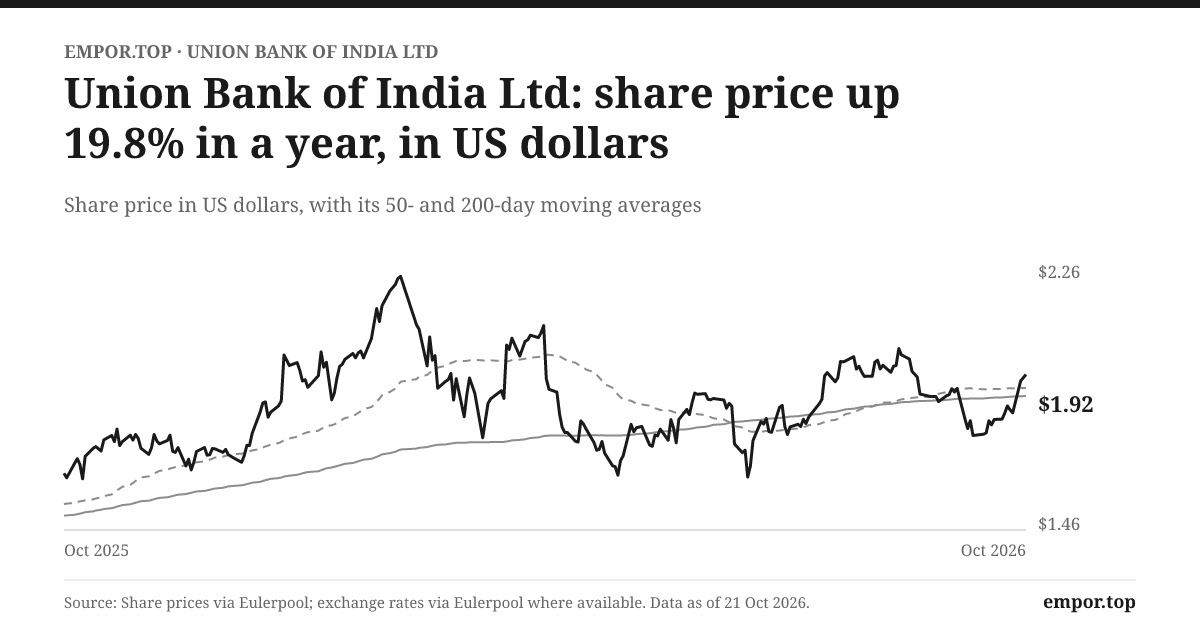
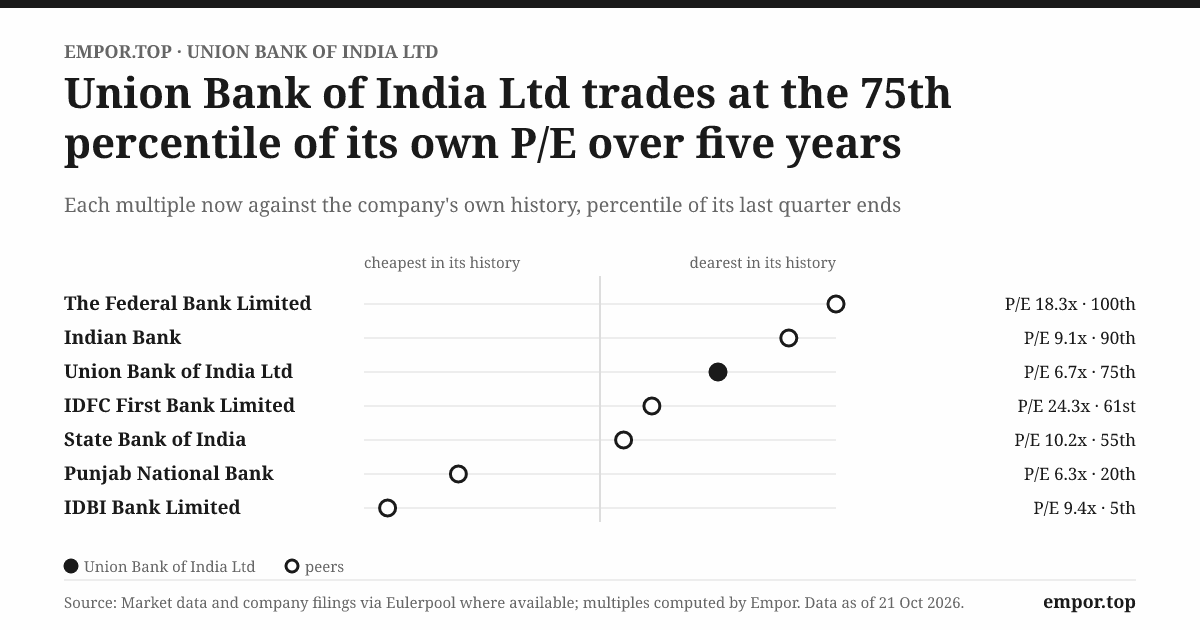
On October 21, 2026, Union Bank's shares closed around ₹181.60, about 10% below their 52-week high.[^5] At that price, the market valued the bank at about ₹1.39 lakh crore, about 6.7 times its trailing twelve months of earnings and roughly one times its consolidated book value per share of about ₹188.88.[^5] Its five-year median P/E is about 6.2 times.[^5] Trailing return on equity was about 15.3%, and the dividend yield about 2.8%.[^5]
What does a price of one times book mean for a bank earning 15% on equity? A simple rule of thumb helps. If a bank can earn a return on equity equal to its cost of equity forever, it should trade at about one times book. If it earns more, it should trade above book. A 15% ROE at one times book implies the market either thinks the cost of equity for Union is unusually high or doubts that 15% is sustainable. Most likely it is both. The market is pricing Union as a cyclical bank at a good point in its cycle, not as a franchise that will earn mid-teens returns indefinitely. On standalone book value per share, about ₹168.61, the multiple is slightly higher, around 1.1 times.[^1]
Ignore some of the other ratios floating around. EV-to-EBITDA, for example, means little for a bank, because deposits are its raw material, not debt in the usual sense, and interest is its cost of goods. The useful comparisons are P/E, price-to-book and ROE, adjusted for asset quality and capital. On those, Union trades in the same broad range as other large public banks such as Bank of Baroda, Canara Bank and Punjab National Bank. It trades at a steep discount to HDFC Bank and ICICI Bank, which have long histories of low bad loans and higher returns, and below State Bank of India, which has scale and a stronger deposit franchise. The discount to private banks reflects real differences in track record and governance. It is not just a pricing error waiting to be fixed.
The bull case starts with returns. The bank earned a return on assets of about 1.38% and an ROE of about 17.2% in the September quarter.[^1] After a decade of losses and rescues, the post-merger balance sheet is producing returns that cover the cost of capital. Asset quality is the best it has been in over a decade, with net NPAs under 0.5% and coverage near 95%.[^1] Capital is strong, with CET1 above 16%, which leaves room to grow and to absorb the ECL transition.[^1] India's credit demand is growing faster than nominal GDP, and Union's national footprint, especially its rural and semi-urban branches, positions it to grow with it. Government ownership caps downside risk to depositors and bondholders and, indirectly, to the bank's survival. And the valuation, at about one times book, does not require heroic assumptions.
The bear case starts with funding. Advances are growing almost three times as fast as deposits, and the credit-to-deposit ratio has risen far above the range management targeted a year ago.[^1][^29] If deposit growth does not pick up, the bank must pay more for term deposits or wholesale funds, which will squeeze margins, or it must slow lending, which will slow earnings growth. Credit costs of about 0.2% are far below the bank's historical average and below management's own general guidance of about 1%.[^1][^26] Even a move back to half that guidance would take a large bite out of profits. The RAM book, which management sees as its future, includes agricultural and small business loans with high existing NPA ratios and vulnerability to drought and economic downturns.[^1] The corporate book is growing faster than any other, which is what happened before the last crisis.[^1] And government control limits strategic freedom: the state could direct another merger, lean on the bank to support policy lending or pressure pricing.
Porter's five forces describe a hard industry. Barriers to entry are high, but they protect the industry, not Union in particular.
Hamilton Helmer's seven powers framework asks which, if any, durable advantages Union holds. Scale economies exist but are not unique: State Bank of India is far larger, and private peers spend more on technology. Network effects barely apply to deposit banking. Switching costs are modest and falling, as digital account opening and instant transfers make it easy to move money. Counter-positioning does not apply; Union is not doing anything rivals cannot copy. Brand matters, but mainly as a signal of safety, and that safety comes from the government guarantee implicit in ownership, which Bank of Baroda, Canara Bank and PNB share. A cornered resource could be the rural branch network and government accounts, but other public banks have similar networks. Process power, a cost or quality advantage built into operations, is not evident in Union's numbers: its cost-to-income ratio is improving but is not better than peers in a way that would indicate superior process.
The verdict, stated once: Union's distribution network and sovereign backing are real advantages that make it resilient. There is limited evidence of switching costs or pricing power strong enough to amount to a proprietary moat. Union's returns depend on the credit cycle and on execution, not on a structural edge.
A skeptical investor, the kind who shorts stocks or pushes boards, would focus on a few specific failure points. Rising slippages as the fast-grown loan book seasons. Falling CASA ratios if depositors move to higher-yielding products. NIM compression if deposit costs rise faster than loan yields. Cost creep from the next wage settlement. And the need to raise capital again if growth keeps outpacing profit retention. Any one of these would weaken the case. Several together would recreate the pattern that led to the crisis of the 2010s.
So the story comes down to three numbers. First, deposit growth and the CASA ratio, now about 6.9% and about 35%.[^1] They show whether the funding base can carry the loan book. Second, NIM and core return on assets without provision releases, now about 2.86% and about 1.03%.[^1] They show whether the spread business earns its keep. Third, RAM slippages and net NPAs, with the overall slippage ratio now about 0.72% and net NPAs about 0.42%.[^1] They show whether the new loans are as good as they look. Watch these three, and you will know which reading of the October 19 print was right.
X. Playbook: Lessons for Builders & Investors
A merger creates a bank with nearly 10,000 branches on paper overnight. Then comes the slow work: closing about 900 of them, moving tens of millions of customers onto one system, merging three sets of employees, and deciding loan by loan which borrowers to trust. Union's long story offers five lessons that apply well beyond Indian public banking.
The first lesson: a merger is a balance-sheet event on day one and a culture project every day after. On April 1, 2020, Union got Andhra Bank's and Corporation Bank's deposits, loans and branches in an instant. It did not get a common underwriting culture, a single way of monitoring borrowers or a shared sense of identity. The IT integration took less than a year. Five years later, the question of whether the merged bank lends better than its parts did is still open. For builders, the lesson is that mergers compress the time it takes to buy scale but not the time it takes to build an institution.
The second lesson: a clean-up can reveal profit; it cannot guarantee the next cycle. Union's profits today are partly the reward for the painful provisioning of 2016 to 2020, which pushed bad loans out of the system and left the remaining book heavily reserved. But a clean balance sheet is a starting point, not a moat. A bank that went from a 0.2% credit cost to a 3% credit cost once can do it again, and the next problem will come from whatever is growing fastest now.
The third lesson: a branch is an option only if deposits pay for it. Union's network is its most visible asset and its biggest fixed cost. In 1947 the bank had four branches; today it has more than 8,700. Each one is a bet that the deposits it gathers will be cheap and stable enough to justify the rent and salaries. When deposits grow at a third of the pace of loans, as they did over the past year, that bet looks weaker.
The fourth lesson: for a bank, cash is a customer relationship before it is a line on a cash-flow statement. An industrial company's cash comes from selling products. A bank's cash belongs to its depositors, and its ability to fund loans depends on their willingness to keep it there. That is why conventional free-cash-flow analysis misleads for banks and why liquidity coverage and deposit stability matter more. Union's swing from comfortable liquidity to an 88% credit-to-deposit ratio in about a year shows how quickly that buffer can be used.
The fifth lesson: public ownership is both ballast and steering wheel. The state's 74.76% stake keeps Union safe in a crisis, keeps its bond ratings at AAA and assures depositors that their money will be there. The same stake gives New Delhi the power to order mergers, appoint leadership on fixed terms and set policy priorities. For investors, the lesson is to price both sides: the safety and the constraints come together.
XI. Epilogue
Tonight, Union Bank of India stands at a point that looks like success and feels like a test. Profits are at record levels, bad loans are at decade lows, capital is strong and the share price has risen from merger-era lows to about book value. On paper, the turnaround is complete.
The next chapter will be written in a few specific moments. The next earnings call, for the December 2026 quarter, will show whether the stronger net interest income and margins of the September quarter can hold without a further decline in provisions. If NII keeps rising and core return on assets moves above 1%, the case for recurring earnings gets much stronger. If profit growth depends on lower provisions or treasury gains, the skeptics will have a point.
Deposits are the second test. Watch whether deposit growth starts catching up with advances and whether the CASA ratio holds near or above 35%. If it does, Pandey's rebalancing story will look like prudent liquidity management. If the credit-to-deposit ratio keeps rising toward 90%, the bank will face the funding squeeze its critics have warned about, and it will have to choose between margin and growth.
April 1, 2027, is the third moment. When the ECL rules take effect, Union will have to show its actual transition burden, how it plans to spread it and how it affects provisions, retained earnings and CET1. Management has said one quarter's profit can absorb the one-time hit. The first ECL quarters will show whether the ongoing cost of provisioning under the new rules is closer to the old 0.2% credit cost or to something higher.
And there is a fourth, less predictable moment: the government's next decision about public-sector banks. Another round of consolidation, a further stake sale or a change in policy priorities could reshape Union's story faster than anything management does.
Through all of this, watch whether management updates guidance consistently and explains misses with numbers. The past year showed a bank that changed its growth targets as conditions changed. That flexibility can be sound management. It can also be a sign that the targets were never firm. The next few quarters will show which, and they will show whether growth, returns and asset quality can coexist in a bank that has rarely managed all three at once.
XII. Outro
In 1921, Gandhi stood in Union Bank's new Bombay head office and said Indians could be trusted to run a big bank and manage large sums of money for national activity. In October 2026, on a conference call, analysts asked that bank's chief executive how he planned to fund loan growth running far ahead of deposits, and how much of his profit would survive new provisioning rules.
Between those two scenes lie four branches at independence, 240 at nationalization, losses that forced taxpayers to refill its capital, a merger decided in New Delhi and launched in a pandemic, and a recovery that turned it into a bank earning more than ₹5,500 crore a quarter. Gandhi's question was whether an Indian bank could be big. Union has answered that. The question it faces now is harder and more ordinary: whether a big bank can also be a better one, quarter after quarter, for the shareholders who own the quarter of it the government does not.
References
-
Union Bank Q4 net loss at Rs 2,583 cr on higher provisions — Business Standard (PTI), 2018-05-10 ↩
-
Government Announces Consolidation of Ten Public Sector Banks into Four — Press Information Bureau, 2020-03-04 ↩↩
-
RBI, govt steps to help banks end NPA woes by Mar'17: Rajan — Business Standard (PTI), 2015-12-01 ↩
-
Union Bank under-reported NPAs, made less provisioning: Report — DNA India, 2019-05-16 ↩
-
UBI reports Rs 1,531 cr loss as NPAs spike; warns of more pains — Business Standard (PTI), 2017-11-03 ↩
-
ICRA Rating Rationale: Union Bank of India — ICRA Limited ↩↩
-
Union Bank of India, Andhra Bank, Corporation Bank to amalgamate — Business Standard, 2019-08-30 ↩↩↩
-
Andhra Bank Board Approves Share Exchange Ratio — Andhra Bank filing to NSE, 2020-03-05 ↩
-
8 state-owned banks announce share swap ratios for mergers — Business Standard (PTI), 2020-03-05 ↩↩
-
Union Bank of India concludes IT integration with Andhra Bank — Retail Banker International, 2021-01-26 ↩
-
Union Bank of India's Capitalisation under Strain after Merger with Andhra Bank and Corporation Bank: S&P — Moneylife, 2020-10-15 ↩
-
Union Bank prices equity share at Rs 86.55 for QIP; raises Rs 5,000 crore — Business Standard, 2023-08-24 ↩↩
-
Union Bank of India (Q2 2027) Earnings Call Highlights: Profit Jumps 30% as Asset Quality Strengthens — GuruFocus, 2026-10 ↩↩↩↩↩↩↩
-
Rating Rationale — Union Bank of India — CRISIL Ratings, 2025-12-11 ↩↩↩↩↩
-
Union Bank of India Q2 FY2027 Profit Rises 30% as NII Grows — Business Standard, 2026-10-19 ↩
-
Union Bank Of India Launches Super App – Union Vyom App — Indian PSU, 2022-11 ↩↩
-
Govt appoints Asheesh Pandey as MD of Union Bank, Kalyan Kumar as head of Central Bank of India — The Week (PTI), 2025-09-30 ↩
-
Asheesh Pandey appointed MD & CEO of Union Bank of India — exchange4media, 2025-09 ↩↩↩
-
Union Bank Shareholders Approve Asheesh Pandey's Appointment As CEO & MD — Board Stewardship, 2026-07 ↩
-
Union Bank of India FY26 Net Profit Hits ₹18,697 Cr; Board Recommends ₹5 Dividend, NPAs Fall to 2.82% — Indian PSU, 2026-04-23 ↩↩
-
PSU Bank Stock Falls Over 8% After Q4 Results; Profit Rises 6% QoQ — DSIJ, 2026-04-23 ↩
-
RBI Overhauls Loan Norms: Banks To Shift to Expected Credit Loss Model from April 2027 — Moneylife, 2026-04 ↩
-
For banks, ECL norms to have one-time net impact of up to 120 bps — CRISIL Ratings, 2026-04 ↩
-
RBI Discussion Paper on Expected Loss-Based Provisioning for Banks — Reserve Bank of India, 2023-01-16 ↩
 LinkedIn
 WhatsApp
 Reddit
 Hacker News
 Email
 Kindle
 RSS Feed
 Spotify
 Apple Podcasts
 Amazon Music
 Audible
 YouTube