State Bank of India: The Story of India's Financial Colossus
I. The Sovereign Balance Sheet
On July 1, 1955, a bank that had spent a century and a half serving British merchants, colonial treasuries and the trading houses of Calcutta, Bombay and Madras woke up with a new owner and a new name. Parliament had passed the State Bank of India Act that spring, and on the appointed day the Imperial Bank of India ceased to exist as a private joint-stock company.[^1] Its offices, its ledgers, its government business and its depositors passed into a statutory corporation controlled by the Reserve Bank of India. The young republic, barely eight years old, had decided that the largest pool of commercial banking in the country could not be left to serve only the people who already had money.
That decision is still the single most important fact about State Bank of India. Seventy-one years later, SBI holds roughly a quarter of India's banking system. The bank's own reports put its share of deposits and advances at about 23%, and India's credit raters cite a similar figure when they explain why they rate it like the sovereign itself.16 By March 2024 its customers had parked more than ₹49 lakh crore with it, a sum north of $590bn, spread across roughly 22,500 branches and something like 500 million account holders.1 In the year to March 2024 the standalone bank earned ₹61,077 crore, then the largest annual profit any Indian lender had ever reported, and it went further the following year, to about ₹70,900 crore.12
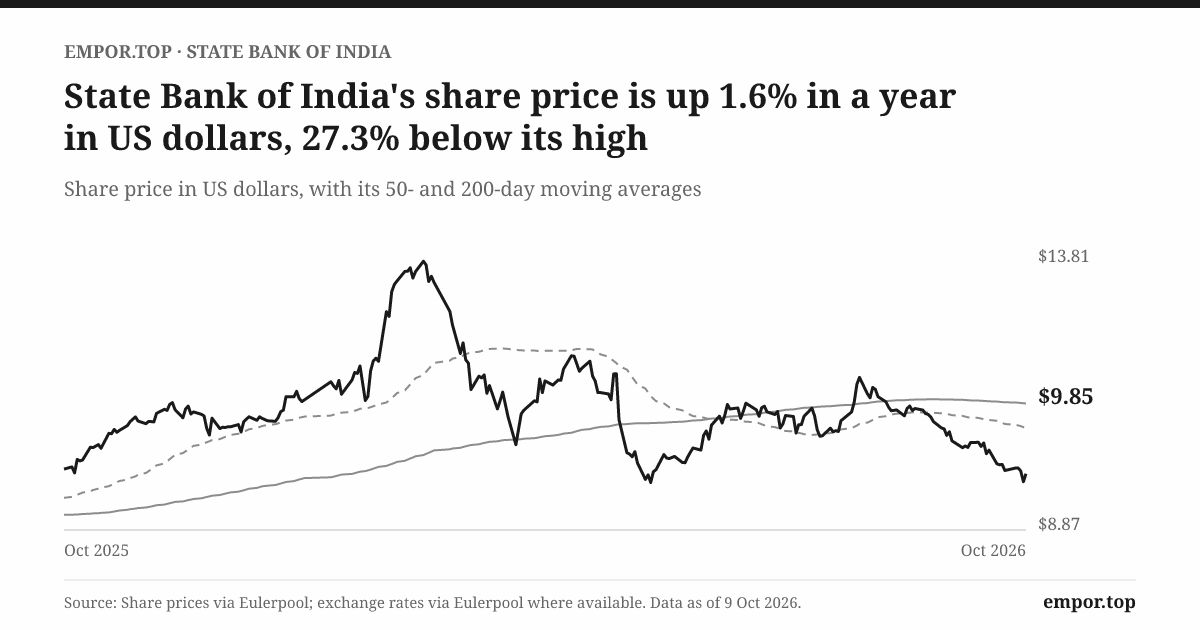
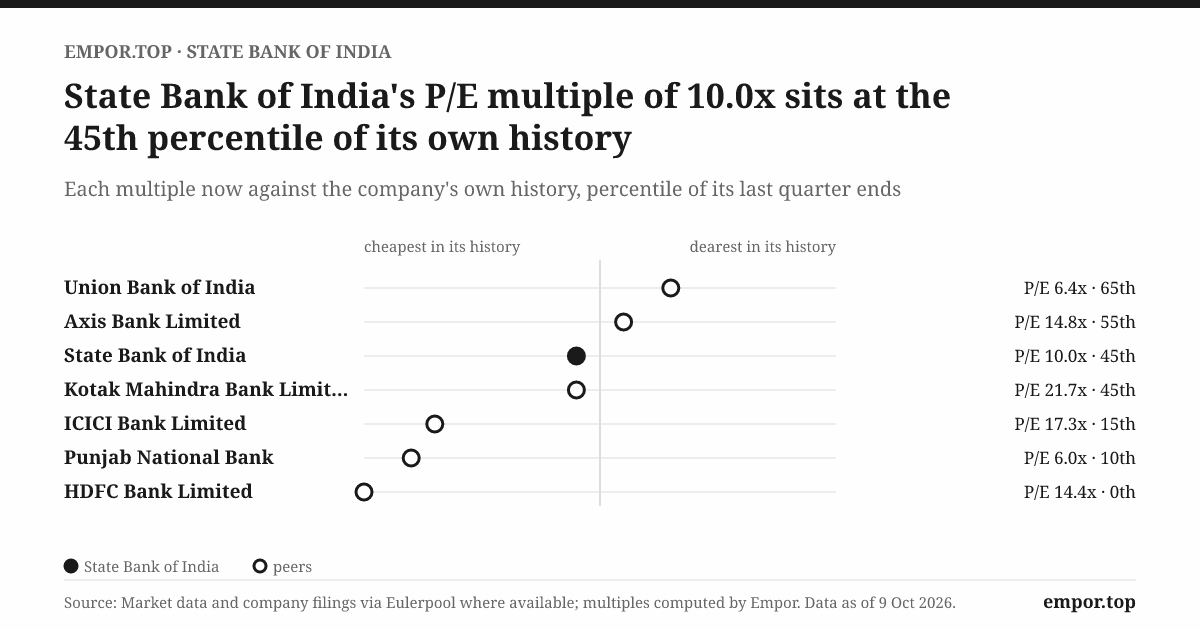
And yet the stock market prices all of this as though it were a little suspect. On October 9, 2026, SBI was worth about ₹850,695 crore, roughly $88bn, at a share price of ₹953.3 That is about ten times the last twelve months of earnings and 1.4 times book value, almost exactly where the multiple has sat for five years.3 The private banks that grew up in its shadow, HDFC Bank and ICICI Bank, have typically commanded around twice the price for each rupee of book.14 Something in the SBI story makes investors hesitate, and that hesitation is the subject of this episode.
The hesitation has a history. A decade ago, this same institution was the chief financier of an infrastructure boom that went sour. Power plants without fuel, steel mills without margins and toll roads without traffic turned into bad loans, and when the regulator forced banks to stop pretending, SBI's gross non-performing assets climbed past 10.9% of its loan book.2 In the year to March 2018 it lost money, about ₹6,547 crore on a consolidated basis, and its return on equity sank from about 10.5% three years earlier to slightly below zero.2 A bank that "underwrites India" also underwrites India's mistakes.
So this is not the story of an ordinary commercial bank, and it is not the story of a typical government enterprise either. The better description is that SBI is India's sovereign credit utility: a balance sheet the state uses to collect the savings of the nation and push them back out as loans, payments and subsidies. Its power comes from a deposit base no competitor can replicate. Its discount comes from the same source, because a bank that belongs to the state can be asked to do things for the state.
Three questions run through everything that follows. The first is whether SBI can keep earning a return on equity in the mid-teens without asking shareholders for fresh capital, now that savers have learned to demand more for their deposits. The second is whether its digital platform, YONO, is a real defense against fintech and a real improvement in lending, or whether fast-growing personal loans simply have not had time to go bad. The third is whether public-sector governance, with its capped salaries and policy mandates, permanently limits how efficient this bank can become compared with its private rivals.
To answer them, the story has to begin long before 1955, with three colonial banks that printed money, because the institutional habits they formed are still visible in SBI's funding costs today.
 Subscribe on LinkedIn
II. Three Presidencies and an Empire (1806–1955)
On June 2, 1806, the Bank of Calcutta opened for business in the capital of British India. It was not born from a merchant's dream. It was born from a government's cash-flow problem: the East India Company was fighting expensive wars, and Governor-General Richard Wellesley's campaigns against the Maratha confederacy needed a steady supply of credit. In 1809 the bank received a charter and a grander name, the Bank of Bengal. The Bank of Bombay followed in 1840 and the Bank of Madras in 1843.1
These three "presidency banks," named for the three administrative presidencies of British India, were peculiar hybrids from the start. They were owned by private shareholders, but the government held stakes, appointed directors and parked its own balances with them. For decades they also had the right to issue paper currency in their regions. A merchant in Calcutta carrying a Bank of Bengal note was carrying the bank's promise and, implicitly, the empire's. That privilege ended with the Paper Currency Act of 1861, which moved note issuance to the colonial government, but the banks kept the treasury business, and with it a flow of public money that cost them almost nothing.1
That is the first piece of DNA worth noticing. From its earliest days, the institution that became SBI was funded by money that came to it because of who it was, not because of what it paid. Government balances, official accounts and the confidence that a state-linked bank would not fail were a cheaper source of funds than anything a competitor could buy. Two centuries later, the same logic explains why a pensioner in Patna or a district treasury in Kerala keeps money at SBI rather than at a bank offering a slightly better rate.
On January 27, 1921, the three presidency banks merged into the Imperial Bank of India.1 The new bank was still a commercial joint-stock company, but in the absence of a central bank it did much of a central bank's work: it held government balances, acted as a bankers' bank and managed the movement of money around a vast country. When the Reserve Bank of India was established in 1935, it took over the central-banking role, and the Imperial Bank became the RBI's agent in places the regulator had no office. In practice it remained the backbone of the country's payments.
What it did not do was lend to farmers. When independence arrived in 1947, the Imperial Bank was an urban, mercantile institution whose customers were traders, British firms and the Indian business elite. The countryside, where most Indians lived, borrowed from moneylenders at ruinous rates. The All India Rural Credit Survey, whose committee was chaired by A. D. Gorwala and reported in the early 1950s, delivered a blunt verdict: commercial banking had largely bypassed rural India, and the one bank with the reach to change that should be brought under state control and given a mission.
That recommendation became the State Bank of India Act of 1955. The Reserve Bank acquired a controlling interest of about 60% in the Imperial Bank, and the new State Bank was handed an explicit target to open several hundred branches, the commonly cited figure being 400, in semi-urban and rural centers within five years.[^1]1 It inherited roughly 480 offices on day one. The point was not profit maximization. It was to put a bank within reach of places where none existed, so that credit for seeds, fertilizer and small businesses could replace the moneylender.
Was the takeover inevitable? Given the politics of a newly independent socialist-leaning state, probably. But the more interesting lesson is about the shape of the advantage it created. The Imperial Bank brought a national payments network, government business and a reputation for safety. The state added a mandate to go everywhere. Combine those and you get the outline of the modern SBI: a bank whose cost of money is low because it is trusted, and whose reach is wide because it was ordered to be.
The question for the next three decades was whether those two gifts could coexist with running a bank well. The state was about to add eight more banks to the family and a great many more instructions.
III. The State as Banker: Subsidiaries, Social Banking, and Stagnation (1959–1991)
In 1959 Parliament passed the State Bank of India (Subsidiary Banks) Act, and with it SBI acquired a constellation of banks that had once belonged to India's princely states.1 The State Bank of Hyderabad, the State Bank of Mysore, the State Bank of Patiala, the State Bank of Saurashtra, the State Bank of Bikaner, the State Bank of Jaipur, the State Bank of Indore and the State Bank of Travancore had served maharajas and nizams. Now they became associates of a national bank, each keeping its own name, board, balance sheet and regional identity. Bikaner and Jaipur were later combined, and over the following decades the family would shrink by merger, but for most of SBI's history the "SBI Group" meant a parent bank and a ring of semi-independent regional siblings.
The arrangement had a certain logic. Each associate understood its region, its languages and its local business families. Merging them outright in 1959 would have been an administrative nightmare in a country where banking was still done in handwritten ledgers. But it also meant running eight separate treasuries, eight personnel systems and eight sets of credit committees under one brand. The costs of that duplication would sit quietly on the group's books until 2017.
Then came the larger political wave. In 1969 Prime Minister Indira Gandhi nationalized fourteen major private banks, and in 1980 six more followed. Those banks were taken over under the Banking Companies (Acquisition and Transfer of Undertakings) Acts. SBI was different: it had its own statute from 1955 and remained a separate creature, governed by its own Act, with the RBI rather than the government as its majority owner.[^1] It also kept growing by acquisition, absorbing the Bank of Bihar in 1969 and the National Bank of Lahore in 1970.1
The era's defining idea was "social banking." Banks were told to lend a fixed share of their money to priority sectors such as agriculture and small industry, to open branches in unbanked villages before opening more in cities, and to accept that some loans were instruments of policy. For SBI this meant a branch network that swelled from about 480 offices to many thousands over a few decades. It also meant politically directed loan melas, waivers that taught some borrowers that repayment was optional, unions with considerable power over postings and work practices, and an operational culture built around paper and rules rather than speed.
The consensus story about this period is that it was simply stagnation, and in terms of returns on capital that is fair. Indian state-owned banks of this era earned thin margins, carried bad loans that were rarely recognized honestly, and lagged international banks in technology by decades. But the consensus misses the asset that was being built underneath. Every branch planted in a small town in Uttar Pradesh or Odisha in the 1970s became, decades later, a deposit-gathering outpost with customers who had banked there for two or three generations. A private bank in the 1990s could build a slick branch in Bandra or Connaught Place. It could not economically recreate thousands of branches in places whose deposits were too small to justify the cost at the time they were opened. SBI did not build that network because it was a good business. It built it because it was told to. The network turned into a good business later.
SBI also began to look outward. It opened offices to serve trade finance and the Indian diaspora, and in 1982 it set up State Bank of India (California) to serve Indian-American customers.1 These outposts never became a large part of the economics. Foreign branches and overseas subsidiaries today account for only a small slice of the balance sheet, on the order of 2.5–3%.1 What they did was give the bank a window onto global markets and a funding channel in foreign currencies.
By the end of the 1980s, the verdict on SBI's first decades as a state bank was split down the middle. It had built the most extensive banking footprint in India and a deposit base anchored in trust. It had also become heavy, slow and expensive to run, at precisely the moment India was about to let nimble competitors in. The balance of payments crisis of 1991 would force the country to open up, and SBI would have to find out whether its footprint was a fortress or a museum.
IV. Liberalization, RBI's Exit, and the Twin Balance Sheet Crisis (1991–2016)
Late in 2015, Raghuram Rajan, the former chief economist of the International Monetary Fund who had become Governor of the Reserve Bank of India in 2013, set in motion an exercise that the banking industry came to fear. It was called the Asset Quality Review. RBI inspectors went through the loan books of the major banks and identified accounts that were obviously in trouble but were still being classified as standard, often because the bank had quietly lent the borrower more money to pay its interest. The practice had a name, evergreening, and the Review ordered banks to stop it and to recognize the losses within a few quarters.1 For SBI, the consequence over the next two years was a cascade of bad-loan recognition that dragged the bank into a loss.
How it got there begins with 1991. Liberalization licensed a new generation of private banks. HDFC Bank, ICICI Bank and what became Axis Bank built themselves on modern core banking software, branch-light designs and hiring practices that paid for talent. They took the most profitable urban customers, corporate salary accounts and high-margin retail lending first. SBI, still carrying the cost structure of social banking, responded slowly but did respond: it computerized branches, moved onto a centralized core banking platform in the 2000s and began selling insurance and mutual funds through its network.
In 2008 the ownership question was finally fixed. The Reserve Bank, which had owned the majority of SBI since 1955, was both the regulator and the controlling shareholder of the country's biggest bank, an obvious conflict. That year the Government of India bought the RBI's 59.7% stake for about ₹35,531 crore, taking direct ownership.[^1]2 It was a tidy solution in governance terms, but it also placed SBI more directly in the line of sight of the finance ministry, at the moment when the ministry wanted banks to finance growth.
And growth was what the 2000s demanded. India's government pushed public-private partnerships to build power plants, highways, ports, airports and telecom networks, and state-owned banks were expected to fund them. The syndicated loans were large and the promoters were well connected. Much of the lending was project finance that assumed coal would arrive, tariffs would be paid and land would be acquired on time. After 2011, many of those assumptions failed at once. Coal block allocations were cancelled after a court ruling, environmental clearances stalled, state electricity boards did not pay, commodity prices fell and steelmakers drowned in debt. Economists began to talk about a "twin balance sheet" problem: overleveraged companies on one side and the banks that had lent to them on the other.
For several years the losses were hidden in plain sight. Restructuring schemes allowed banks to keep loans classified as standard if they were rescheduled. The Asset Quality Review closed that door. SBI's gross bad loans climbed to more than 10.9% of its book by March 2018, and the consolidated income statement shows what that cost: operating profit evaporated, and the year ended with a net loss of roughly ₹6,547 crore.2 Return on equity, which had been about 10.5% in FY2015, turned slightly negative.2 In 2016 Parliament passed the Insolvency and Bankruptcy Code, giving creditors, for the first time, a credible threat to take control of defaulting companies from their promoters. It became the tool that banks would use to work through the wreckage.
There is a flattering version of SBI's corporate lending story, which is that its size and government relationships give it superior insight into the best credits in the country. The record from 2008 to 2018 rejects that version. SBI was not a smarter underwriter of infrastructure risk than its private competitors; it was a larger and more compliant one, and when the cycle turned, the losses were proportional to its enthusiasm. The fairer reading is narrower: SBI can price prime corporate credit cheaply because its money is cheap, but its corporate book is cyclical and politically exposed, and nothing in its structure prevents a repeat if the state wants another lending boom.
That lesson matters for the investor today, because Indian corporate capital expenditure is picking up again. Before that, though, SBI had to digest something else entirely: in the middle of its worst credit crisis, it agreed to swallow six banks at once.
V. The Great Consolidation: Swallowing Six Banks at Once (2017–2018)
On April 1, 2017, six banks stopped existing. The State Bank of Bikaner & Jaipur, the State Bank of Hyderabad, the State Bank of Mysore, the State Bank of Patiala and the State Bank of Travancore merged into their parent, along with Bharatiya Mahila Bank, a small state-owned bank created in 2013 to serve women.8 The Union Cabinet had approved the plan only weeks earlier, in February.8 Overnight, SBI took on tens of thousands of additional employees and thousands of additional branches, and the combined entity counted roughly 24,000 branches, a network unlike anything else in Indian banking.
The thesis behind the merger was straightforward. Each associate bank was too small to absorb a regional industrial shock on its own, because a bad cycle in, say, Punjab's agriculture or Kerala's remittance economy could hit its whole balance sheet. Each ran its own treasury, its own technology and its own administrative layers, duplicating what the parent already did. And all of them shared the SBI brand, so customers already treated them as one institution. Merging them would eliminate overlapping branches, pool capital and treasury management, and put everything on one core banking platform, TCS BaNCS, which the group already used.
The integration was harder than the logic. Pension liabilities differed between the associates and the parent. Employee seniority lists had to be reconciled, a sensitive matter in a unionized workforce where postings and promotions follow seniority. Some branches sat across the street from each other and had to be closed or relocated. And the technology migration, moving millions of accounts into a single system, had to happen while the branches stayed open.
The sharpest pain came from the loan books. The associate banks had, on average, recognized bad loans less aggressively than the parent, so when their loans were brought under SBI's stricter classification and provisioning standards, slippages and provisions jumped at once. That is a big part of why FY2018 was the trough: a merger and a regulatory cleanup arrived in the same year, and the consolidated operating line went negative.2 Investors who saw only the headline loss saw a bank in crisis. A closer reading showed a bank taking most of a decade's accumulated losses in one go.
The capital to absorb that shock came from two places. In June 2017 SBI raised ₹15,000 crore through a qualified institutional placement, selling new shares to institutional investors.12 The government, meanwhile, injected capital into public sector banks through recapitalization bonds. What happened next is notable. That June 2017 placement was the last time SBI sold common equity, and in the nine years since, it has funded a balance sheet that roughly doubled, from about $513bn in total assets in March 2017 to $943bn in March 2026, from retained earnings and periodic issues of subordinated bonds.12
Did the merger create scale or concentrate toxicity? In the short run, both. The associate loan books carried weaker real estate, SME and corporate exposures, and the merger brought those onto SBI's balance sheet in the worst possible year. But the toxicity was a one-time recognition, and the scale benefits proved durable: a single treasury, a single technology stack, a single brand and a network that put SBI's assets among the world's fifty largest banks. The honest verdict is that the merger was expensive and well timed, because doing it during the cleanup meant SBI only had to confess once.
Once the cleanup was done, the question became what kind of bank had survived it. The answer lies not in its loans, but in where its money comes from.
VI. The Liability Fortress: Anatomy of the Core Business
Picture a district in rural Bihar. The nearest SBI branch is a concrete building with a queue of people at the door on the day pensions and government transfers land. In the villages around it, local business correspondents, shopkeepers and agents authorized by the bank, use biometric devices to let farmers withdraw small sums, check their balances and receive direct benefit transfers. SBI runs more than 85,000 such business correspondent outlets alongside its roughly 22,500 branches and 65,000 ATMs and cash machines.1 For many of the people in that queue, SBI is not one bank among several. It is the bank.
That is where SBI's competitive power really lives: on the liability side of the balance sheet. A bank's raw material is money, and the cheapest money in banking is in current and savings accounts, known in India by the acronym CASA. Current accounts pay nothing, and savings accounts pay little. SBI's CASA ratio has held around 40–42% of total deposits, on a deposit base of more than ₹49 lakh crore.1 To put that in plainer terms, roughly two-fifths of the bank's enormous funding pool costs it far less than a fixed deposit would, and those balances do not flee when a competitor offers a promotional rate, because they belong to salaried workers, pensioners, small businesses and government departments who use SBI for daily life.
The analogy is a reservoir fed by thousands of small streams. A wholesale-funded lender lives off a pipeline from the bond market and pays whatever the pipeline demands. SBI's reservoir fills by itself. That is why, when India's shadow lenders were hit by a funding freeze in 2018 after the collapse of infrastructure financier IL&FS, deposits flowed toward SBI rather than away. And it is why its liquidity coverage ratio, the regulator's measure of whether a bank can survive a month of stressed outflows, has run at roughly 130–140% against a requirement of 100%.113
On the asset side, SBI makes money the oldest way in banking: by lending at a higher rate than it borrows. Most retail and small-business loans are priced off an external benchmark, the RBI's repo rate, so they reprice quickly when policy rates move. Corporate loans are mostly priced off the bank's own marginal cost of funds lending rate, which moves more slowly.1 The difference between the interest the bank earns and pays, as a share of its interest-earning assets, is its net interest margin. SBI's whole-bank margin has run around 3.0–3.3%, with the domestic margin a bit higher.14
That margin is the place where the fortress has been tested. As interest rates rose in 2022 and 2023, Indian savers did what savers everywhere did: they moved money out of savings accounts and into fixed deposits, which pay more. SBI's domestic margin, which was about 3.47% in the first quarter of FY2024, slipped to around 3.35% a year later.14 That is a small move in percentage terms and a large one in money, because twelve basis points on a balance sheet this size is thousands of crores of income. The lesson from that episode is that the liability moat is strong but not frozen. Trust keeps the money at SBI. It does not guarantee the money stays cheap.
Then there is the treasury book. Indian banks must hold a minimum share of their deposits, currently 18%, in government securities under the statutory liquidity ratio. SBI holds far more than the minimum in central government bonds and state development loans, which yield somewhere in the region of 6.6–6.8%.1 Critics call this lazy money; defenders call it ballast. In practice it does two jobs. It gives SBI a large, liquid, low-risk income stream, and it makes SBI one of the biggest buyers of government debt in the country, which is part of what makes the bank a sovereign utility rather than simply a large lender.
Finally, the concentration question. RBI rules under the Large Exposure Framework cap what any bank can lend to a single counterparty at 20% of its eligible capital, extendable to 25% in some cases, and to a group of connected companies at 25%.10 SBI reported no breaches of those limits in FY2024.1 On the deposit side, concentration barely exists: the money is spread across hundreds of millions of accounts.
So the core business is a low-cost deposit engine turning sovereign trust into a funding advantage. The question that the 2015–2018 crisis forced was what that engine should feed. Funding infrastructure had nearly broken the bank. What came next was a deliberate turn toward the household.
VII. The Asset Turnaround: From Corporate Wreckage to Retail Dominance
In the aftermath of the cleanup, the credit committees at SBI's Corporate Centre on Madame Cama Road in Mumbai's Nariman Point faced a strategic choice. They could keep lending to large corporations, where SBI's cheap funding gave it pricing power but where the scars were still fresh, or they could tilt the bank toward households and small businesses, where loans are smaller, more numerous and, if underwritten well, more predictable. They did some of both, but the direction was unmistakable.
Today SBI's loan book is roughly a third retail personal loans, about another third large corporate loans, around 15% small and medium enterprises, and somewhat over a tenth agriculture.1 Within retail, the centerpiece is housing. SBI's home loan book reached about ₹7.26 lakh crore, giving it more than a quarter of India's mortgage market, and it holds close to a fifth of the auto loan market.1 Mortgages suit SBI almost perfectly: they are long, secured, and won mainly on price, and SBI's cost of funds lets it price aggressively and still earn a spread.
The more controversial growth engine is Xpress Credit, SBI's unsecured personal loan product. It has grown at double-digit rates, and unsecured personal lending is exactly the kind of credit that looks clean in the early years and turns ugly when the economy slows. SBI's answer is that it lends almost entirely to customers whose salaries already land in SBI accounts, many of them government employees and staff of large corporations, so the bank can see income, verify employment and, in many cases, recover dues directly from the payroll credit.15 That is a genuine underwriting edge. Government jobs in India are rarely lost, and a lender that sits in the salary flow is first in line.
The cleanup numbers are stark. Gross bad loans fell from more than 10.9% in FY2018 to about 2.24% in March 2024 and 2.21% in June 2024.14 Net bad loans, after provisions, dropped to about 0.57%.1 The provision coverage ratio, the share of bad loans already set aside against, reached about 74%, and about 92% once written-off loans tracked in a separate account are included.1 Credit costs, the annual charge for bad loans as a share of the book, fell below half a percent.1 Fresh slippages, loans newly going bad, ran below roughly 0.7–0.8% annualized.1 By any measure, this is the cleanest SBI's balance sheet has been in a generation.
The consensus reading is that SBI has fixed its underwriting culture. The record supports a narrower verdict. The bank genuinely changed its mix, its provisioning discipline and its recognition practices, and the Insolvency and Bankruptcy Code gave it tools it did not have a decade ago. But part of the improvement is the cycle: Indian corporate balance sheets deleveraged sharply, interest rates were low for several years, and retail books grew fast enough that new loans diluted old problems. Fast-growing loans always look healthy at first, because borrowers do not default in their first year. The real test of the retail turn will come in a downturn when unemployment rises, and SBI's retail book at this size has not yet been through one.
There are also chronic soft spots. Agricultural advances of roughly ₹3 lakh crore remain vulnerable to state-level farm loan waivers, which teach borrowers to wait for forgiveness.1 Small-business lending has historically produced spikes in slippages whenever growth slows sharply. CRISIL, in rating SBI at its top grade, names agricultural and MSME stress as one of the bank's few constraints.6 These are not hidden risks; they are the structural cost of being India's bank.
One curiosity in the cash flow statement is worth explaining because it confuses many readers. SBI's reported cash from operations swung from a negative $10.7bn in FY2023 to a positive $18.5bn in FY2026.2 For an industrial company that would be a dramatic story. For a bank it mostly means that loans, which count as operating outflows, grew faster than deposits, which count as inflows, in one year, and that the relationship reversed later. It says little about profitability. A better measure is pre-provision operating profit, which ran above ₹90,000 crore a year, enough to absorb provisions and still retain capital.1
The turnaround, then, is real but not yet proven through a full retail cycle. Much of the bet rests on a claim that SBI's digital platform lets it underwrite and serve these customers better than before. That platform has a name every Indian banking customer knows.
VIII. The Digital Super-App: YONO and the Modernization Blitz
In November 2017, months after the associate merger and in the depths of the bad-loan cleanup, SBI launched an app called YONO, short for "You Only Need One."1 The name was a statement of ambition. It was not meant to be just a mobile banking app; it was meant to bundle banking, investments, insurance, loans and a marketplace of merchant offers into one place, so that a customer would never need to visit a branch for routine business. For a bank known for queues and paperwork, it was a strange and slightly audacious bet.
The architecture is worth understanding in simple terms. Underneath sits SBI's core banking system, the giant ledger that records every account and transaction, built on TCS BaNCS.1 YONO is a layer on top of that ledger that lets customers open accounts with video-based identity checks, book fixed deposits, buy mutual funds from SBI's asset manager and policies from its insurers, and take pre-approved loans. The pre-approved part is the clever piece. Because SBI already knows a customer's salary, balances and repayment history, it can offer a personal loan that is decided before the customer asks, then disbursed in a handful of taps without documents.
The adoption figures are large by any standard. SBI reports that more than 60% of new retail savings accounts and a similar share of fixed deposits and retail asset accounts are now originated digitally, and YONO registrations run to tens of millions of users.15 In payments, SBI handles a large share of India's UPI transaction volume, the real-time payments system that has made QR codes ubiquitous at tea stalls and pharmacies across the country.1 Payments themselves earn almost nothing, but they keep customers inside SBI's ecosystem and bring merchants into its orbit as potential borrowers.
Here the consensus says YONO is SBI's moat against fintech. The evidence supports part of that. Fintechs in India have mostly ended up partnering with banks rather than replacing them, because a bank's balance sheet and deposit license are what customers ultimately trust. YONO kept SBI's customers from needing to go elsewhere for digital convenience, and that defensive value is real.
What the evidence does not support is the idea that YONO has turned SBI into a lean, private-style operator. Operating costs remain heavy. In FY2024, SBI booked large provisions for the 12th Bipartite wage settlement with bank employees and for pension liabilities, and those charges weighed visibly on profit that year.15 The quarterly figures show the moment: the December 2023 quarter's operating margin fell to about 10%, against the high teens in surrounding quarters, as those one-off staff charges hit.2 Spending on property and technology has also risen, with fixed assets on the consolidated balance sheet growing from about $5.4bn in FY2024 to $6.5bn in FY2026.2 Digital adoption has not reduced the branch network, the headcount, or the pension obligations that come with a public-sector workforce. It has made them more productive, not smaller.
There is also a reliability question. YONO and SBI's online channels have faced outage complaints on peak days, such as salary credits and month-ends, and management has been rebuilding the platform as YONO 2.0 on more modern, cloud-native infrastructure.412 Management describes this as a step change. The evidence that would confirm it is simple and public: fewer outages, faster transactions and digital origination shares that keep climbing.
The fair verdict is that YONO is a genuine distribution success, one that worked because it digitized hundreds of millions of existing relationships rather than buying new ones with marketing spend. But digital efficiency at SBI is bounded by the institution around it. The app can open an account in minutes; it cannot renegotiate a wage settlement. And that brings the story to the institution itself, and to the paradox of who runs it and how they are paid.
IX. The Public Sector Discount: Governance, Leadership, and the Sovereign Web
In August 2024, Dinesh Kumar Khara completed his term as Chairman of State Bank of India, and Challa Sreenivasulu Setty, a career SBI banker who had been the managing director overseeing international banking, global markets and technology, was appointed to succeed him for a three-year term.9 Setty took charge on August 28, 2024.9 He was chosen through the Financial Services Institutions Bureau, the government body that recommends top appointments at state-owned banks, and his appointment was announced by the Ministry of Finance.9 He had joined SBI as a probationary officer decades earlier and worked his way up through corporate credit and stressed assets, the classic route to the top of the bank.
And here is the detail that makes foreign investors blink. The chairman of a bank that earns about $9bn a year and holds a quarter of a trillion-dollar-plus country's deposits is paid in the range of ₹35–40 lakh a year, roughly $40,000–45,000, with no stock options and no profit-linked bonus.1 The chief executives of the large private banks earn many crores a year and hold significant stock option grants. By any market logic, SBI's top job is wildly underpaid.
So how does SBI attract leaders at all? Through the career structure. SBI's chairmen are almost always lifers who joined young, rotated through branches, regions and head office, and reached the top in their late fifties. The prestige of running the country's largest bank, and the culture of a civil-service institution, substitute for money. The succession from Rajnish Kumar to Dinesh Khara to C. S. Setty has been smooth and predictable, and that predictability is itself a governance asset. The cost is that the tenure is short, three to five years at most, and the incentives are about not making mistakes rather than about creating shareholder value.
Ownership explains the rest. The President of India, on behalf of the government, holds about 58% of SBI.7 The SBI Act requires government ownership to stay above 51%.[^1] Domestic institutions, led by Life Insurance Corporation of India with a stake above 8%, hold roughly a quarter, foreign portfolio investors about a tenth, and retail and other shareholders the remainder.7 With a majority guaranteed, the government wins every shareholder vote, and minority investors have essentially no power to change the board or the strategy.
What does the state ask in return? Some mandates are modest and even useful: SBI is the government's banker, it runs much of the plumbing for direct benefit transfers, and it opened tens of millions of zero-balance accounts under the Pradhan Mantri Jan Dhan Yojana financial inclusion scheme. Some mandates are bigger. In March 2020, when Yes Bank collapsed, the government and the RBI designed a reconstruction scheme in which SBI led a consortium that injected fresh equity and took a large stake in the failed lender.2 It worked out reasonably well for SBI, but it was a reminder that the bank's capital can be called upon to stabilize the system.
There is an activist's case to be made here. A skeptical investor would ask why a bank this size should be run by executives paid less than mid-level managers elsewhere, why minority shareholders should accept that policy priorities can override returns, and why SBI pays out only about 17% of its profit as dividends.2 SBI's answer, implicit in its record, is that low payout funds growth without dilution. Since the June 2017 placement, the bank has not sold new shares, and internal capital accretion took its common equity tier one ratio to about 10.4% and its total capital adequacy to about 14.3% by March 2024, even as loans grew at 15% or more a year.1 Subordinated bonds, including a ₹10,000 crore Tier II issue in FY2024 and additional tier one bonds in 2024, have supplemented that.1 That record is a real counterweight to the governance discount.
Other diligence items are less alarming than they sound. SBI's off-balance-sheet contingent liabilities run to ₹18–20 lakh crore, mostly forward foreign exchange contracts, guarantees and letters of credit issued for customers, which is normal for a bank of its size.1 Disputed tax demands exceed ₹35,000 crore, which management and counsel consider unlikely to result in material outflows.1 The joint statutory auditors issued an unqualified report for FY2024.1 None of these is a red flag, though the tax disputes are large enough to watch.
The verdict on governance is that SBI combines private-sector profits with civil-service pay and sovereign priorities. That combination is stable, but it explains why the market applies a discount. One way to measure what the bank could be worth with fewer constraints is to look at the subsidiaries it already owns and lists.
X. The Subsidiary Conglomerate: Value Creation or Capital Drag?
Walk into a typical SBI branch and the walls tell a story. There are posters for SBI Life policies, leaflets for SBI Card credit cards, and fliers for SBI Mutual Fund schemes. A depositor who comes to update a passbook may leave with an insurance quote. That cross-selling, repeated across thousands of branches every day, is the engine behind a group of subsidiaries that have each become leaders in their markets.
The family is large. SBI Life Insurance, listed on the stock exchanges, is one of India's biggest private life insurers. SBI Cards and Payment Services, also listed, is the country's second-largest credit card issuer. SBI Funds Management, which runs SBI Mutual Fund in partnership with France's Amundi, is India's largest asset manager by assets under management. SBI General Insurance, SBI Capital Markets and a payments venture with Jio round out the group.1 SBI Life has been valued in the market at well over ₹1 lakh crore and SBI Cards at many tens of thousands of crores, while SBI Mutual Fund manages well over ₹9 lakh crore.14
The mechanism behind their success is not complicated. The parent bank is a near-zero-cost customer acquisition machine. An insurer elsewhere pays agents and brokers handsomely to find customers; SBI Life has branch staff speaking to depositors who already trust the brand. A credit card issuer pays for marketing; SBI Card sees the bank's salary-account holders. In exchange, the bank earns distribution commissions and, as the shareholder, dividends.
The obvious worry with a group like this is related-party abuse: a parent quietly shifting value to or from its subsidiaries. SBI's disclosures say that transactions with group entities, from interbank deposits to fee sharing and premises rental, are conducted in the ordinary course of business on arm's-length terms under RBI rules, and that no materially significant related-party transactions prejudicial to the bank were reported in FY2024.1 Because SBI Life and SBI Cards are themselves listed, they have their own minority shareholders and boards who would object to unfair arrangements, which adds a check.
There are two caveats. The first is that some subsidiaries carry their own risks. SBI Cards lives on unsecured consumer credit, which has seen rising stress in India, and its returns have softened compared with its earlier years. The second is that, because the parent bank is valued on its consolidated earnings at about ten times, the subsidiaries' value is partly obscured within the group's low multiple. Many analysts run "sum of the parts" calculations to argue that the listed subsidiaries alone account for a meaningful fraction of SBI's market value, which would imply the core bank trades at an even lower multiple. That arithmetic depends on the listed prices of SBI Life and SBI Cards on any given day, which move independently.
The unlisted optionality is real. SBI Funds Management and SBI General Insurance are both plausible candidates for public listings, which would let SBI monetize part of its stake without issuing new shares of its own. Until such a listing actually happens, though, it is optionality rather than value delivered, and SBI's history suggests these decisions move at a government pace.
So the subsidiaries are genuine value creation, built on the parent's distribution. They also highlight the moat question at the center of the case: if distribution plus trust is what makes SBI's businesses win, how durable is that combination against private banks and technology giants determined to break it?
XI. Strategy & Moat Breakdown: Powers, Forces, and the Sovereign Utility
Imagine a war-game table with two maps. On one, SBI's roughly 22,500 domestic branches are scattered across every district of India, thickest in the towns and villages where its history put them. On the other, HDFC Bank, newly enlarged by its 2023 merger with parent mortgage lender HDFC, is opening branches at a rapid clip, trying to gather the deposits it needs to fund a loan book that suddenly outgrew its funding. The race between these two maps is the clearest test of SBI's moat.
The valuation gap frames the stakes. SBI trades at about 1.4 times book value; the large private banks have typically traded at around 2.2–2.8 times.314 SBI's return on equity was about 14% in FY2026 and 13.6% over the twelve months to June 2026, and its debt-to-equity ratio sits at about 1.3, low for a bank because deposits rather than borrowings fund most of its assets.23 The question is whether the discount reflects weaker economics or merely weaker governance.
Hamilton Helmer's framework of seven strategic powers helps. The first power SBI clearly holds is scale economies. Its cost of deposits is among the lowest in India, which lets it underprice home loans and prime corporate credit and still make money. A rival trying to match SBI on price would have to accept a thinner spread on a smaller base. The second power is a cornered resource: the sovereign backing embedded in the SBI Act and in the RBI's designation of SBI as a domestic systemically important bank.[^1]11 CRISIL explicitly builds a very high expectation of government support into its top rating.6 No private bank can acquire that resource at any price. A third, weaker power is a form of counter-positioning: SBI happily serves zero-balance Jan Dhan accounts and low-ticket UPI customers whom private banks with minimum-balance requirements are reluctant to touch, and those customers become depositors for life.
Run Porter's five forces and the picture sharpens. Buyer power is low among hundreds of millions of retail depositors, who rarely switch banks, but moderate among large corporate borrowers, who can tap the bond market or turn to private lenders for better terms. Supplier power in the industrial sense does not exist; the "supplier" that matters is the regulator, which sets reserve requirements, liquidity ratios and priority-lending targets, and the regulator's power is very high. The threat of substitutes is real: Indian households have shifted savings into mutual funds and equities in a historic way, and every rupee that goes into a systematic investment plan is a rupee not in a savings account. SBI partly hedges that through SBI Mutual Fund, which captures some of the flow. The threat of new entrants is minimal at national scale; small finance banks and payments banks lack the capital and reach to challenge systemic lending. Rivalry, however, is intense, and it is concentrated in exactly the profitable segments: salary accounts, mortgages, affluent customers and well-rated corporates.
The weakness in SBI's moat is margin. Its whole-bank net interest margin of roughly 3.0–3.3% sits well below the roughly 3.8–4.3% at the leading private banks.1 Part of that gap is structural and benign, because SBI holds more government bonds and lends more to cheap-priced prime borrowers. Part of it is the cost of mandate, because priority-sector and agricultural lending is priced for policy as much as for risk. And part of it is operating cost, which SBI cannot cut as freely as a private bank.
So why does SBI win from here? Because it has the widest distribution in the country, the strongest sovereign safety, the lowest cost of funds at scale and unmatched capacity to syndicate large corporate loans. Why might it not? Because it cannot shed legacy labor cost, its lending margins are structurally lower, and the government can at any time ask it to absorb a problem. Weighing the history, the claim that SBI's funding moat is durable survives intact: it held through the bad-loan crisis, the IL&FS funding freeze and the pandemic. The claim that SBI can match private-bank profitability does not: its best years, FY2023 to FY2025, delivered returns on equity of about 15.5–16.2%, comparable to private peers only in a period of unusually low credit costs.2 The KPI that will confirm or reject the moat's pricing power is the net interest margin, and whether it holds above roughly 3% through the current deposit cycle.
That framing sets up the debate investors are actually having, which is less about whether SBI is a good bank than about what it is worth.
XII. Bull vs. Bear Case & Skeptical Investor Stress Test
Picture the debate in a Mumbai conference room. On one side, a long-only fund manager points at the numbers: a bank earning about 14% on equity, trading at 1.4 times book and ten times earnings. On the other, a skeptic replies that SBI has looked cheap for most of the last two decades and that cheap stocks are often cheap for a reason. Both are right, which is what makes the stock interesting.
The market's current verdict is visible in the price. On October 9, 2026, SBI traded at ₹953, about 22% below its 52-week high of ₹1,229.3 The price-earnings ratio of 10.0 sits almost exactly on the five-year median of 10.1, and the dividend yield is about 1.8%.3 Book value per share has reached about ₹697.3 Put plainly, the market is paying for SBI's current earnings and assuming no improvement in quality or multiple. It is pricing the bank as a well-run cyclical, not as a compounder.
The bull case starts with asset quality. Net bad loans of about 0.57% and provision coverage above 90% including written-off accounts mean that a normal downturn would hurt earnings far less than the last one did.1 The bull's second point is self-funded growth. A bank earning 13.5–15% on equity and paying out under a fifth of it can grow its book in the low teens without asking for capital, which is exactly what SBI has done since 2017, with shareholders' equity compounding at about 17% a year over five years.2 The third point is the cycle: if Indian corporate investment and small-business lending accelerate, SBI is the natural financier, with SME lending already growing faster than the book.4 The fourth is the subsidiaries, especially the possibility of a public listing for SBI Funds Management.
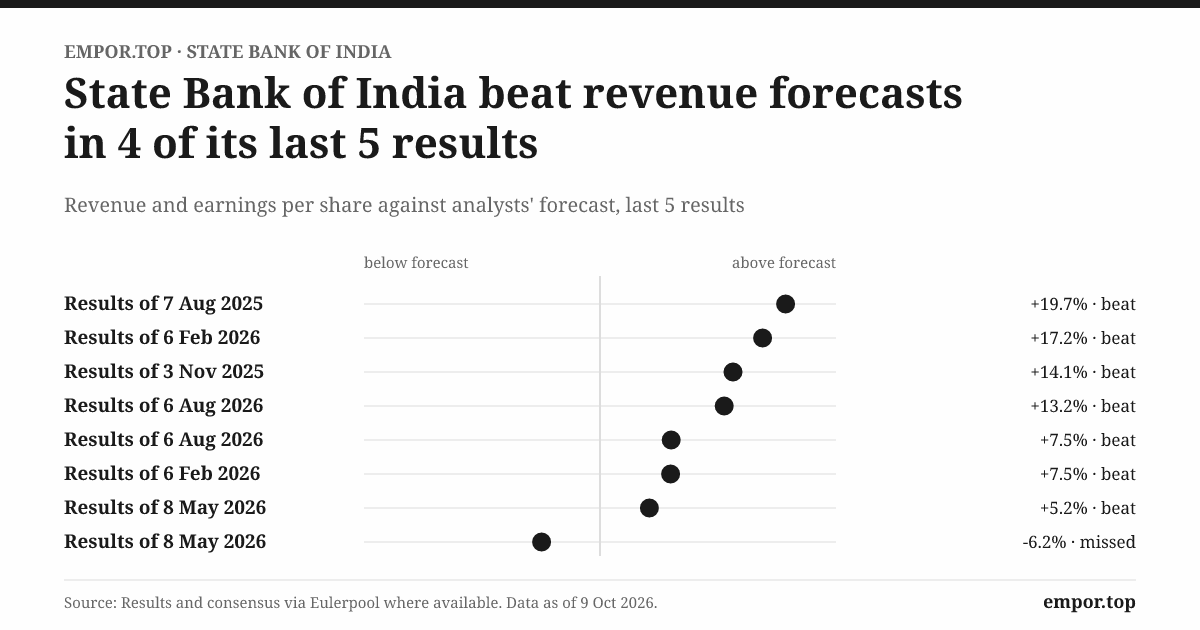
The bear case starts with the margin. The domestic margin has already given back some ground as depositors moved to higher-yield fixed deposits, and every rate cut by the RBI reprices SBI's benchmark-linked loans faster than its deposits.4 The quarterly figures show the slowdown: revenue growth decelerated from double digits in 2024 to single digits through 2025 and 2026, and return on equity eased from about 16% in FY2024 to about 14% in FY2026.2 The second bear point is retail seasoning: unsecured personal loans have grown fast and have not yet been tested by an Indian recession. The third is governance: wage settlements, pensions and pay caps limit how efficient the bank can become and how well it can compete for scarce technology and risk talent. The fourth is the ceiling: as long as the government owns about 58%, the bears argue, investors will not pay private-bank multiples.7
An activist-style stress test would push further. Why does a bank with record profits pay out only about 17% of earnings while its retained capital earns 14%? Because growth requires capital, the bank would say, and the record of no dilution since 2017 supports that answer. Why should minority shareholders accept rescue duties like Yes Bank? Because sovereign backing is the source of the cheap deposits, which is the honest answer and the core trade-off. What happens to the 2015–2018 lessons when the government next wants an infrastructure push? That question has no answer in the filings, and it is the one the market is pricing.
Weighing it all, the evidence points to a narrower conclusion than either side's slogan. SBI is not a value trap in the sense of a business slowly destroying capital; its book has compounded steadily and its funding moat has proven durable. Nor is it obviously mispriced: its multiple has stayed within a tight range for years, which suggests the market already understands the trade-off between sovereign safety and sovereign obligations. The multiple is unlikely to stray far from that range without a change in ownership, margin or credit performance.
Three measures will tell investors which way the case is breaking. The first is the whole-bank net interest margin, which has drifted toward the 3.0–3.3% band; a sustained break below 3% would signal the deposit moat is losing pricing power.14 The second is the fresh slippage ratio, particularly in unsecured retail and SMA-1/2 early-delinquency balances; it has been running below about 0.8%, and a rise would be the first sign that retail seasoning is turning.113 The third is organic common equity tier one capital, which reached about 10.4% in March 2024; staying above 10% without new shares is the proof that growth remains self-funded.1
Beneath these numbers sit a handful of lessons that belong to SBI and no other bank.
XIII. Playbook: Business & Investing Lessons
The first lesson comes from the queue outside the branch in rural Bihar. When IL&FS collapsed in 2018 and wholesale funding vanished across Indian finance, the money in that queue did not move. SBI's savings and current accounts, built over decades in places no one else wanted to bank, turned out to be the most valuable asset the bank owned, worth more than any loan book. The lesson for investors in any lender is that the asset side of a bank is where it earns money, but the liability side is where it survives. A bank is only as strong as the cheapest, stickiest rupee it can raise on its worst day.
The second lesson comes from FY2018, when SBI recognized a decade of bad loans and merged six banks in the same year and reported a loss. It would have been easy to spread the pain, to let associate loans keep their gentler classifications and stretch provisioning over several years. Instead the bank took the hit at once, and the following years of record profit were built on that confession. For founders and investors, the principle is that a balance sheet cleaned completely is worth more than one cleaned slowly, because markets forgive a single bad year faster than they forgive a decade of doubt. Confess once, and then compound.
The third lesson comes from YONO. Plenty of incumbents launched apps; most of them were expensive brochures. YONO worked because it sat on top of hundreds of millions of existing relationships, salary credits and repayment histories, which let SBI offer pre-approved loans to people it already knew. Fintechs spent heavily to acquire customers; SBI already had them. Distribution plus trust beats a better interface, and the incumbents who lose to disruptors are usually those who forget what they already own.
The fourth lesson is about the statute itself. The SBI Act of 1955 is why depositors treat SBI like the state, and why its funding is cheap. It is also why the government can ask SBI to rescue Yes Bank, open zero-balance accounts by the tens of millions, and run its welfare transfers, and why investors will not pay HDFC Bank's multiple for SBI's book. A sovereign mandate is a moat and a tax at the same time, and the investor's job is not to wish one side away but to price both.
The fifth lesson is the quietest. Since June 2017, SBI has not sold a single new common share, and its balance sheet has nearly doubled. In a sector where state-owned banks spent the 2010s waiting for government recapitalization, SBI showed that a public bank can fund its own growth if it keeps credit costs low and retains enough of its earnings. Internal capital is independence, and for a bank owned by the state, it is the only independence available.
These lessons describe the bank as it stands. The decade ahead will test whether they hold.
XIV. Epilogue: The Next Decade of the Colossus
In the Chairman's office at the Corporate Centre in Mumbai, C. S. Setty's agenda reads like a map of India's economic ambitions. On one side sits the rebuild of the digital platform, YONO 2.0, on cloud-native infrastructure that should not buckle on salary day.412 On the other side sit corporate loan proposals for renewable power, transmission, data centers, manufacturing plants supported by the government's production-linked incentive schemes and, eventually, semiconductor projects. These are exactly the kinds of long-gestation, policy-backed projects that nearly broke SBI a decade ago.
The bank enters this period from strength. Its consolidated assets reached about $943bn in March 2026, its return on equity was about 14%, and its bad-loan ratios are the cleanest in a generation.2 India's ambitions, stated repeatedly by its government, include becoming a $5 trillion economy, and SBI's balance sheet will inevitably be one of the main channels through which that investment is financed.
The decisive moments ahead are concrete. The first is each quarterly results day, where the net interest margin will show whether SBI's deposit franchise can hold its pricing as interest rates move. If the margin stabilizes around 3.2% or above, the bull case on earnings holds; if it settles below 3%, the bears' view of a slowly eroding moat gains weight. The second is the retail credit cycle. Unsecured personal loans and small-business lending will eventually face a slowdown, and how slippages behave then will show whether salary-linked underwriting was a genuine edge or simply a product of good years. The third is the listing of SBI Funds Management or SBI General Insurance, which would turn subsidiary value into visible, non-dilutive capital. And the fourth is succession: Setty's three-year term means the government will choose SBI's next chairman around 2027, and the smooth handovers of the last decade will either continue or not.
Behind all of these sits the central question that the last two decades raised. When India's next investment boom arrives in force, will SBI lend to it with the discipline it learned in 2015–2018, or with the enthusiasm it showed in 2008–2014? The difference will not show up for years, because bad project loans look perfectly healthy until construction stalls. Investors watching the corporate book should watch concentration in the new sectors, the structure of the project loans and whether cash flows are ring-fenced, rather than headline asset quality, which will lag.
The tension that remains is the one that has always defined SBI. The state that gave it a deposit base no rival can match will also be the one asking it to finance the nation's bets. Whether the next decade belongs to the agile SBI of the last five years or the burdened SBI of the decade before depends less on the bank's technology than on how firmly its leaders say no.
XV. Outro
In 1806, a bank opened in Calcutta to fund a colonial general's wars. In 1955, a young republic took that bank over to finance its five-year plans and plant branches in villages that had never seen one. Today, tens of millions of Indians open the same institution's app on their phones to check a salary credit, buy a mutual fund or take a loan decided before they asked for it. The uniforms and the masters changed. The function never did. Whoever governed India needed a balance sheet, and this was it.
That is the paradox at the heart of State Bank of India. It is too large to fail, too public to command a luxury valuation, and too woven into the daily life of the country to ever be displaced. Investors can debate its margin and its multiple every quarter, but they cannot debate its place. State Bank of India is not just a lender; it is the balance sheet of the Indian republic.
References
-
State Bank of India Annual Report 2023-24 — State Bank of India, 2024-07-10 ↩↩↩↩↩↩↩↩↩↩↩↩↩↩↩↩↩↩↩↩↩↩↩↩↩↩↩↩↩↩↩↩↩↩↩↩↩↩↩↩↩↩↩↩↩↩↩↩↩↩
-
SBI Annual Report Financial Statements Archive — State Bank of India, 2024-07-22 ↩↩↩↩↩↩↩↩↩↩↩↩↩↩↩↩↩↩↩
-
State Bank of India Company Factsheet — Reuters, 2026-10-09 ↩↩↩↩↩↩↩
-
SBI Q1 FY2025 Financial Results & Earnings Transcript — State Bank of India, 2024-08-03 ↩↩↩↩↩↩↩↩
-
SBI Q4 FY2024 Results Conference Call Transcript — State Bank of India, 2024-05-09 ↩↩↩
-
CRISIL Ratings Rationale: State Bank of India — CRISIL Ratings, 2025-06-30 ↩↩↩
-
SBI Shareholding Pattern Disclosures (Regulation 31 LODR) — State Bank of India, 2024-06-30 ↩↩↩
-
Cabinet Approves Merger of Associate Banks with SBI — Press Information Bureau, Government of India, 2017-02-15 ↩↩
-
Appointment of Challa Sreenivasulu Setty as SBI Chairman — Ministry of Finance, Government of India, 2024-08-28 ↩↩↩
-
RBI Master Direction – Large Exposure Framework (LEF) — Reserve Bank of India, 2019-06-03 ↩
-
RBI Identification of Domestic Systemically Important Banks (D-SIBs) — Reserve Bank of India, 2024-01-12 ↩
-
SBI Investor Presentations & Analyst Transcripts — State Bank of India, 2024-08-03 ↩↩
-
SBI Basel III Pillar 3 Regulatory Disclosures — State Bank of India, 2024-06-30 ↩↩
-
State Bank of India Corporate Profile & Financials — Bloomberg, 2026-10-09 ↩↩↩
 LinkedIn
 WhatsApp
 Reddit
 Hacker News
 Email
 Kindle
 RSS Feed
 Spotify
 Apple Podcasts
 Amazon Music
 Audible
 YouTube