SBI Life Insurance: Building India's Insurance Giant
I. The Elephant's Teller Window
Mumbai, late 2000. The new private life insurers that would soon carry famous names were all doing the same thing: hiring. They hired agents by the thousand, put them through licensing courses, handed them rate cards and commission schedules, and sent them into neighbourhoods where nobody had ever bought a policy from anyone except the Life Insurance Corporation of India. The model was expensive, slow and loud, but it was the only way anyone in India had ever sold life insurance.
State Bank of India chose not to play that game. India's largest bank already had what every new insurer wanted to build: a counter in almost every district of the country, a clerk behind it, and a queue of customers in front of it who trusted the State Bank more than almost any institution in their lives. So SBI partnered with the French insurer BNP Paribas Cardif, a specialist in selling insurance through banks, and created a company whose plan was almost insultingly simple.1 Do not build an army. Sell through the teller window.
That company, SBI Life Insurance, is today one of the most valuable financial firms in India. On October 8, 2026, the stock market valued it at roughly ₹1,74,000 crore, about $18 billion.14 Its balance sheet held about $57 billion of assets at the end of March 2026, and those assets had compounded at close to 20% a year for a decade.1 It had never borrowed a rupee of funded debt in the twelve years on record.1 And by the company's own actuarial measure, its Indian Embedded Value, a figure that tries to capture what the existing book of policies is worth to shareholders, stood at about ₹70,250 crore at the end of FY25.1
Those are the numbers of a winner. But this is a story about how the winning happened, and the winning came from one source more than any other. The company's great advantage has never been a clever product or a famous actuary. It has been cost. Selling a policy to a customer who is already standing at a branch counter is far cheaper than finding that customer on a street corner, and that cheapness compounded, year after year, into the lowest-cost distribution machine in Indian private life insurance.
That raises three questions that run through everything that follows. The first is about margins. Insurers measure the profitability of a year's sales with a number called the Value of New Business margin, or VNB margin, which is roughly the present value of future profits on the policies sold that year, divided by the premiums. SBI Life has held that number around 27% to 28%.1 But the margin depends on what customers buy, and when Indian stock markets boom, customers want unit-linked plans, which earn the insurer much less. Can the margin hold when the product mix turns against it?
The second question is about dependence. The teller window that made SBI Life belongs to someone else: its parent, which still owns about 55% of it.6 Every rupee of advantage flows through a relationship the insurer does not control. Is that a moat, or a leash?
The third question is about the float. A life insurer lives on customers who keep paying. SBI Life's customers have been unusually loyal, but India's regulator has rewritten the rules on how much money a customer gets back when they walk away early, making walking away cheaper.9 Will the loyalty survive once leaving stops hurting?
To answer any of that, the story has to begin long before a teller ever sold a policy, in a Parliament that had decided, half a century earlier, that selling life insurance was a job only the state could be trusted to do.
 Subscribe on LinkedIn
II. Dismantling the 1956 Fortress
In 1956, independent India nationalised life insurance. Jawaharlal Nehru's government, with Finance Minister C.D. Deshmukh carrying the legislation, took over roughly 245 private insurers and provident societies and folded them into a single state-owned corporation, the Life Insurance Corporation of India.8 The reasons were partly ideological and partly practical. Several private insurers had failed or misused policyholder money, and the young republic wanted household savings channelled into national development rather than into private hands.
For the next four decades, LIC was not merely the leader in Indian life insurance. It was the industry. If a family in Lucknow or Coimbatore owned a policy, it was an LIC policy, sold by an LIC agent, backed by the sovereign. That monopoly built a remarkable institution with a vast agency force, but it also left India badly underinsured, because a monopoly has little reason to chase the customers who are hardest to reach.
Then came 1991. India ran so short of foreign exchange that it pledged gold to borrow abroad, and the crisis forced a generation of reforms. Insurance was on the list. In 1993 the government appointed a committee under former Reserve Bank governor R.N. Malhotra, and its 1994 report recommended something radical by Indian standards: let private companies back into insurance, and create an independent regulator to supervise them.8
It took five more years and several governments for that recommendation to become law. Unions at LIC and at the state-owned general insurers protested, warning that foreign capital would raid Indian savings. When the Insurance Regulatory and Development Authority Act finally passed in 1999, it carried the scars of that fight.8 The most important scar was a cap: foreign investors could own no more than 26% of an Indian insurer.
That cap shaped every private insurer that followed, SBI Life included. A global insurer that wanted to enter India could not come alone. It needed an Indian partner willing to own at least 74%, which meant an Indian partner with a large balance sheet, patience for losses, and ideally something the foreigner could not buy: access to Indian customers. So the private life insurance industry was born as a series of marriages. ICICI paired with Prudential of Britain. HDFC paired with Standard Life. And State Bank of India, the biggest prize any foreign insurer could hope to court, chose Cardif, the insurance arm of France's BNP Paribas.4
Each side wanted something different, and understanding that difference explains the company that resulted. SBI wanted fee income and stickier customers. A depositor who also holds a life policy and perhaps a home loan from the same bank is a customer far less likely to drift to a rival. Cardif wanted a distribution channel in a giant, underinsured market, and it brought exactly the expertise SBI lacked: product design, underwriting, and the mechanics of selling insurance through a bank branch, including credit-protection policies that pay off a borrower's loan if they die.4
SBI Life was incorporated in October 2000 and received its registration from the regulator in March 2001, with SBI holding 74% and Cardif 26%.4 It entered a market where, for every Indian who had ever bought life cover, the word for "insurance" was effectively "LIC". The private entrants were not fighting for share in a mature industry. They were trying to persuade a country that a policy could come from somewhere else.
The question for the new joint venture was how to do that persuading without bleeding to death. Every rival had the same answer. SBI Life had a different one.
III. The Counter-Intuitive Architecture (2001–2006)
Picture the economics of a new life insurer in 2002. An agent sells a policy with an annual premium of, say, ₹10,000. In the first year, the agent's commission can eat a large share of that premium, and the company also has to pay to recruit, train and supervise agents, many of whom quit within a year. Meanwhile the insurer must set aside reserves for the promise it has just made. The result is that every new policy loses money on day one, sometimes a lot of money, and only earns it back over many years of renewals. Insurers call this "new business strain". For a young company growing quickly, it means the faster you grow, the deeper your accounting losses.
That was the trap ICICI Prudential and HDFC Life accepted. Both built large tied-agency forces, along with bank partnerships of their own, and both reported losses for years as the upfront cost of acquiring customers overwhelmed the revenue those customers had yet to pay.16 It was a rational bet, because the renewals would eventually come, but it required parents willing to keep writing cheques.
SBI Life's bet was that it could skip most of that strain. Its salespeople already existed, were already paid, and already sat across a desk from customers who trusted them. SBI's branch managers and relationship officers could offer a depositor a savings-cum-protection plan in the same conversation in which they renewed a fixed deposit. The insurer still paid the bank commission, within limits set by the regulator, but it did not have to recruit, house or train an army from scratch.4 The cost of reaching a customer, which for a start-up insurer is the single biggest number in the business, collapsed.
It was not frictionless. A career State Bank officer had joined to lend money and take deposits, not to explain mortality charges. The bank's culture was hierarchical and process-bound, the culture of a public-sector institution. Cardif's people brought insurance discipline that sat awkwardly in that world: proper disclosure, proper proposal forms, proper medical underwriting. Getting thousands of branch staff to sell a product they had never been trained on, and to do it correctly, was the real operational problem of the early years. Selling insurance through a bank is easy to describe and hard to do well, which is precisely why Cardif's experience in doing it in Europe was worth a 26% stake.
Then the market handed the company a tailwind. Indian equities took off in the mid-2000s, and unit-linked insurance plans, known everywhere in India as ULIPs, became the product of the moment. A ULIP is part life cover and part investment fund: most of the premium is invested in equity or bond funds chosen by the customer, and the policy's value rises and falls with the market. To a depositor watching the Sensex climb, a ULIP sold at the bank counter looked like a way into the stock market with insurance thrown in. SBI Life's assets under management grew quickly through this period as branch customers piled in.4
The combination of low acquisition costs and rapid ULIP growth produced something unusual for an Indian private insurer of its age. SBI Life turned an accounting profit within its first five years of operation, at a time when agency-heavy peers were still deep in the red.4 The early profit was small, and in insurance an early profit can partly reflect accounting rather than economics. But the direction was the point. The company had proven that a new insurer did not have to buy its customers with years of losses if it could borrow someone else's trust.
For investors, the lesson of those first years is narrow and important. SBI Life's founding advantage was not that it priced risk better or invested better. It was that its cost of distribution was structurally lower than its rivals', because a large part of that cost was already being paid by its parent. That advantage would be tested within a few years, when the regulator decided that the whole industry had been paying distributors too much.
IV. The ULIP Whiplash and the Cost Moat (2006–2015)
The ULIP boom of the mid-2000s had an ugly side, and by 2009 everyone in Indian finance knew it. Many ULIPs carried heavy front-end charges, so that in the first year or two a large part of a customer's premium went to the insurer and the distributor rather than into the fund. Distributors, paid handsomely on first-year premiums, had every reason to sell policies to people who would stop paying after a year or two, and many customers did exactly that, losing much of what they had paid. Retail investors had treated ULIPs as mutual funds with a life cover attached. They discovered, often painfully, that the fees were nothing like a mutual fund's.
The reckoning came in 2010. After a public turf war between the securities regulator SEBI and the insurance regulator over who should supervise ULIPs, settled in the insurance regulator's favour by government ordinance, the IRDA issued sweeping new rules that took effect in September 2010.8 They capped the charges an insurer could deduct, spread those charges more evenly over the life of a policy, lengthened the minimum lock-in to five years, and required a meaningful amount of life cover. The effect on distributor economics was brutal. Commission-heavy ULIP selling stopped making sense almost overnight.
For the agency-built insurers, this was a crisis. Their armies had been built around ULIP commissions, and new business volumes for the private industry fell sharply as agents left and products were redesigned.16 Companies that had spent a decade building branch offices and agent networks found that the economics supporting those costs had vanished.
SBI Life felt the shock too, because ULIPs had been a large part of its growth. But its cost structure meant it had far less to lose. Its branches belonged to the parent and required no capital spending by the insurer. Its sellers were bank staff, not commission-dependent agents who would quit when payouts shrank. Over the long run the company kept its operating expense ratio, the cost of running the business as a share of premiums, around 4.5% to 5.5%, among the lowest in the private industry.2 When the regulator cut the rents that distributors could charge, the company that paid the least rent lost the least.
That is the verdict of the 2010 episode, and it is worth stating plainly. The ULIP reforms did not create SBI Life's advantage, but they revealed it. In good times, a low-cost producer and a high-cost producer can both make money. When an industry's pricing is forcibly compressed, only the low-cost producer is still standing comfortably. The insurers that came out of the early 2010s strongest were the ones whose cost to serve a customer was lowest, and SBI Life emerged near the front of the private pack.
The company did not, however, bet everything on the bank. Through these years it built a second engine, an individual agency force of its own that grew past 100,000 agents.2 The agency channel was more expensive per policy than bancassurance and less productive than the agency forces of pure-play rivals. But it served a strategic purpose. It gave the insurer some distribution it owned outright, and some reach in places and among customers the branches did not serve well.
The balance sheet in this period was conservative by design. SBI Life carried no borrowings, financed its growth from internal capital, and received a top-tier rating from CRISIL that it still holds today.5 Its premium receivables were tiny relative to its size and turned into cash within a couple of weeks, because most premiums arrived through bank debits and routine clearing.1 There was no credit risk to speak of in collecting premiums: when a customer stops paying a life policy, the policy lapses or becomes paid-up, and the insurer's reserves adjust. Nothing goes uncollected in the way a manufacturer's unpaid invoice does.
By the middle of the 2010s, the shape of the company was clear. It had a low-cost engine that had survived the industry's worst regulatory purge, a second engine it was slowly building, and a balance sheet with no debt. What it did not yet have was a public market price. That was about to change, and the way it changed would reveal something about who was really in control.
V. The Clean Listing and the French Exit (2017–2021)
On October 3, 2017, SBI Life's shares began trading on the National Stock Exchange and the BSE.4 The initial public offering, which had been priced at the top of its ₹685 to ₹700 band, raised about ₹8,400 crore, then one of the largest IPOs in Indian history.4 By listing day it valued the company at around ₹70,000 crore.15
But here is the twist that most coverage of the IPO glossed over. SBI Life itself received none of that money. The offer was entirely an Offer for Sale: 120 million existing shares sold by State Bank of India and BNP Paribas Cardif.4 The insurer issued no new shares and raised no primary capital. The IPO was a liquidity event for the owners, not a funding event for the business.
That detail matters because it says something unusual about the company. Growing life insurers usually need capital. Every new policy creates reserves and solvency requirements, and the faster an insurer grows, the more capital it must hold against its promises. Many Indian insurers have had to raise fresh equity repeatedly. SBI Life did not need to. Its existing book of policies was generating enough surplus each year to fund its own growth while keeping its solvency ratio, the regulator's measure of capital cushion, comfortably above the required minimum of 1.5 times. In recent years that ratio has sat around 1.96 times.5 A company that can grow its balance sheet from about $19 billion of assets at listing to about $30 billion three years later without borrowing or issuing shares is a company whose back book is doing the heavy lifting.1
The IPO also began the end of the French partnership. Cardif had been the foreign half of the founding bargain, but by 2017 its role was diminishing. The bancassurance machine ran on SBI's branches, and the company's leadership came from SBI. Starting in March 2019, Cardif sold its remaining stake in a series of block trades and open-market sales, and by March 2021 its holding had fallen from the original 26% to a fraction of a percent.13 India had by then raised its foreign ownership cap in insurance, so the exit was not forced by regulation. It was a choice: Cardif took its gains on two decades of investment and left.
What is striking is how little changed when it did. Joint-venture exits are often messy, with disputes over brand, technology, or valuation. Cardif's departure, spread over two years and absorbed by domestic mutual funds and foreign institutions, cleared an ownership overhang without disturbing the distribution that drove the business.13 The episode confirmed what the founding years had suggested. The strategic asset was always SBI's counter. The French partner had supplied know-how at the start, but once that know-how was absorbed, the company did not need it.
The shareholding that emerged was simple. SBI settled as the sole promoter at about 55.4%, foreign institutions owned roughly a quarter, domestic institutions about 16%, and the public held the rest.6 The promoter's shares carry no pledges, and across the years on record there has been no encumbrance on them.6 For outside investors, that is a clean register.
But the clean listing raised a sharper governance question than the one it settled. With Cardif gone, there was no second shareholder at the table with the weight to push back on the parent. SBI controlled the board, appointed the chief executive, and owned the branches through which most of the company's new business flowed. The minority investors who now owned 45% of the company had bought into a business whose most important commercial relationship was with its own majority owner. That tension would matter more as the decade went on.
First, though, the company faced a test that no governance structure could manage away.
VI. Underwriting the Pandemic and Digital Scale (2020–2024)
In the spring of 2021, the Delta wave of COVID-19 tore through India. Hospitals ran out of oxygen. Cremation grounds worked through the night. For life insurers, the human tragedy arrived as a surge of death claims unlike anything their actuaries had modelled in a normal year.
Every life insurer prices its policies on mortality tables, estimates of how many policyholders will die each year. A pandemic breaks those assumptions all at once. Insurers responded by paying claims, strengthening reserves, and drawing on reinsurance, the insurance that insurers buy for themselves. SBI Life's reinsurance arrangements with global and domestic reinsurers, including Swiss Re, Munich Re and the state-owned GIC Re, spread part of the mortality shock beyond its own balance sheet.1
The numbers that emerged were reassuring. SBI Life's net profit barely moved during the pandemic years, rising by low single digits in FY21 and FY22 rather than collapsing.1 Its solvency stayed well above the regulatory floor throughout.5 It paid no dividend in FY21, a prudent pause in the worst year, and resumed payouts the following year.1 Over the five years to FY26, net profit compounded at a little over 11% a year.1 For a business that had just been hit by the largest mortality shock in modern Indian history, that is a record of resilience, though not of spectacular growth.
A word of caution on reading those profits. A life insurer's reported net profit is a slender line at the bottom of very large accounts. SBI Life's operating margin, on the accounting definition, has hovered around 2% of revenue, and its "revenue" swings wildly from quarter to quarter because it includes the market gains and losses on policyholders' investments.1 In the March 2026 quarter, for instance, reported revenue collapsed because falling markets reduced the value of policyholder funds, while profit was largely unaffected. The profit that reaches shareholders is mostly what the actuaries release from the policyholder account once reserves are set. It is real money, but it moves on a different rhythm from the headline numbers.
The same caution applies to cash flow. SBI Life's operating cash flow has run between roughly $3 billion and $4 billion a year, more than ten times its net profit.1 That is not because the business is ten times more profitable than it looks. It is because premiums come in as operating cash, while the money invested to back those premiums goes out as investing cash, almost dollar for dollar. Free cash flow, in the sense that a manufacturer would use the term, does not mean much here. The real measure of what the business generates for shareholders is the growth of its embedded value and the dividends it can afford to pay.
The pandemic did something else that may matter more over time. It changed how the company sold. Lockdowns made face-to-face underwriting impossible, so insurers moved to remote onboarding, tele-underwriting and digital proposals. For SBI Life, the most important digital front was its parent's: SBI's YONO app, which put banking and the bank's group products in tens of millions of customers' phones. Integrating insurance into that flow meant the teller window could follow the customer home.2
Not every friction in this period was medical. Like most Indian insurers, SBI Life faces a steady trickle of tax disputes and contested claims. The largest category is indirect tax, including state-level demands over input tax credits on goods and services tax. In September 2026, for example, Rajasthan tax authorities raised a demand of about ₹1.1 crore including interest and penalty, which the company has appealed.7 Amounts like that are immaterial against a company with about $2.2 billion of shareholder equity.1 A broader change helped more: in September 2025 the GST Council exempted individual life insurance policies from GST, removing a cost that had sat on customers' premiums.17
The pandemic also changed customers. Having watched friends and relatives die, many Indian households took the idea of pure life protection more seriously than before, and demand rose for term cover, pensions and guaranteed-return savings plans.16 Guaranteed plans, known in the industry as non-participating or non-par savings, became especially popular as interest rates moved. And renewal premiums, the money existing customers pay to keep policies alive, had grown to roughly ₹36,400 crore by FY23, a sign that the book built in the previous decade was now its own engine of growth.2
So the pandemic answered one question decisively. SBI Life's balance sheet could absorb an extreme mortality shock without breaking. What it did not answer was the question that matters most for valuation: how does the business actually make money today, and how much of that money is really the insurer's to keep?
VII. The Machine Today: Anatomy of the Core Business
Every quarter, SBI Life's management sits down to explain the same thing in different words: what customers bought, through which channel, and how profitable each slice was. The analysts on the other side of the call are not mainly interested in revenue or net profit, because both say little about an insurer's economics. They want the product mix, the VNB margin, and the persistency numbers. To understand SBI Life, it helps to see the business the way they do.
Start with the money coming in. An insurer's premiums fall into two buckets. First-year premiums come from new customers. Renewal premiums come from existing ones who keep paying, and at SBI Life they make up more than half of total collections.2 That renewal stream is what gives a life insurer its annuity-like character. The measure of its health is persistency: the share of policies still paying after 13 months, after 61 months, and at points in between. SBI Life's 13th-month persistency is above 85%, and its 61st-month persistency is around 58%.2 In plain terms, about six in seven customers keep paying past the first year, and more than half are still paying five years in. In an industry where early lapses once destroyed customers' savings, those are strong numbers.
Now the money going out. Reported profit is not the right measure of whether a year's selling created value, because new business strain means good sales can depress current profits. So insurers use Value of New Business: the present value of all the future profits expected from the policies sold in a year. Divide VNB by the new premiums and you get the VNB margin. SBI Life's has held at about 28.1% in FY24 and 27.8% in FY25.1 Add up the value of the existing book and the shareholders' net worth, and you get the Indian Embedded Value: about ₹58,300 crore in FY24 and ₹70,250 crore in FY25, a rise of roughly a fifth in a year.1
Those margins are a blend, and the blend is where pricing power lives. A ULIP passes most of the investment risk to the customer and earns the insurer mostly fees, so its margin is thin, typically in the mid-teens. A non-par savings policy guarantees the customer a return, so the insurer keeps the spread between what it earns on its investments and what it promised; margins can run into the high 30s, but the insurer carries interest-rate risk. Pure protection, term life, is the most profitable in principle, but depends on careful underwriting and on what reinsurers charge. Annuities and pensions earn moderate margins but lock in very long-duration money.12 So when management talks about protecting the VNB margin, what it really means is steering the mix toward non-par and protection whenever customers will accept it.
The weakness in this machine is that customers do not always accept it. SBI Life's product mix has historically been heavy on ULIPs, because its branch customers are savers who like market-linked products in rising markets.10 Its share of pure protection is lower than at some private peers. That keeps its blended margin below what a protection-heavy competitor might earn, and it makes the margin hostage to the stock market.
Then there is the question of who gets paid for distribution. SBI is not just SBI Life's shareholder. It is its main corporate agent, its brand licensor and its banker. In FY24, SBI earned about ₹2,232 crore in commission and fees from SBI Life, up from about ₹2,040 crore the year before.3 That is roughly $268 million, comparable to SBI Life's entire net profit for that year. The commission is paid under a regulated arrangement and within caps set by the regulator, but the size of the cheque makes the point: the cheapest distribution in Indian insurance is not free. A meaningful slice of the value created at the teller window flows back to the bank that owns the window.
Leadership reflects the same parentage. SBI Life's managing director and chief executive has traditionally been seconded from SBI. The current CEO, Amit Jhingran, took office on September 30, 2023, succeeding Mahesh Kumar Sharma.2 He is a career State Bank banker, and his annual pay of about ₹2.1 crore is tiny next to what private-sector insurance chiefs earn. In February 2026, shareholders approved a revision to his pay effective April 2026, subject to the regulator's approval.6
There are two ways to read that arrangement. The favourable reading is that modest pay and rotating bank appointees limit the agency problems that come with entrenched, highly paid executives, and keep the insurer tightly aligned with the bank that feeds it. The unfavourable reading is that a chief executive who expects to return to the parent may naturally put the parent's interests first, and that a short tenure is a poor fit for a business whose decisions play out over twenty years. The record so far supports the first reading more than the second, but the second never goes away.
The verdict on today's machine is clear. SBI Life is India's most cost-efficient life insurance compounder, with a durable renewal float and solid margins. But its lifeblood runs through a contract with its own controlling shareholder, and that contract sets the terms on which minority shareholders participate. Whether that arrangement is a fortress or a dependency is the question of moats.
VIII. Moat Architecture & Historical Stress Tests
When India's insurance regulator moved toward open architecture in bancassurance, the prediction from rivals and many analysts was straightforward. Banks would be allowed to act as corporate agents for several life insurers at once, up to nine under the current rules, and so the most valuable branch network in India would surely open its doors to competitors.9 Private insurers with better products or richer commissions would set up in SBI branches, and SBI Life's captive distribution would gradually erode.
That prediction is the cleanest test of SBI Life's moat, and the record has largely rejected it. SBI's branches continue to route the overwhelming majority of their life insurance business to SBI Life.10 The reason is not mysterious. The bank owns more than half the insurer, so every rupee of value the insurer creates partly belongs to the bank, on top of the commission it collects. Branch staff are trained on SBI Life products, run on SBI Life systems, and measured within a group that benefits when SBI Life wins. A rival insurer in an SBI branch is a guest in someone else's house.
To understand what kind of advantage that is, it helps to borrow the language of Hamilton Helmer's "7 Powers", a framework that asks which kinds of advantage let a company earn more than its cost of capital for a long time.
SBI Life's strongest power is scale economies, tied closely to process power. Its operating expenses run at about 4.5% to 5.5% of premiums, among the lowest in the industry.2 That cost advantage comes from spreading fixed costs, systems, compliance, actuarial teams and a brand, over a very large premium base, and from processes refined over twenty-five years for selling through a bank. A newcomer cannot buy that cost structure. It would need the same volume first, which it cannot get without the cost structure. That circularity is what makes scale a real power.
The second power looks like a cornered resource: privileged access to SBI's network of more than 22,000 branches and its hundreds of millions of account holders.3 But this is where the moat needs a careful description, because the resource is cornered by ownership, not by law. Regulation no longer guarantees exclusivity. What protects it is that SBI has every economic reason to keep favouring its own subsidiary. If those incentives ever changed, through a stake sale, a regulatory rule on group distribution, or political pressure on a state-owned bank, the resource would be far less cornered than it appears.
The third power, switching costs, is real but modest. Customers who surrender a life policy early lose money, so many keep paying, which is part of why persistency is high.2 But the regulator has been deliberately reducing that penalty, so this is the power most clearly being eroded by policy.
Michael Porter's five forces tell a consistent story. The bargaining power of buyers is low in retail life insurance, because individual customers cannot negotiate terms, though digital comparison sites are making prices more visible. The bargaining power of suppliers is concentrated in two places: SBI, which controls distribution, and the global reinsurers who provide capacity for large risks. Substitutes are strongest when stock markets boom, because mutual funds and direct equity platforms compete directly with ULIPs for the same savings. The threat of new entrants is low, since starting a life insurer in India requires a large minimum capital and, much harder, a distribution network. And rivalry is intense among the large private players, ICICI Prudential, HDFC Life and others, and against LIC, which remains much larger in total.
Against its peers, SBI Life's position is strong. Its share of individual rated premium, the industry's measure of individual new business, has been around a fifth of the private sector's.8 That makes it the largest private life insurer by that measure, ahead of HDFC Life and ICICI Prudential.
But a second thesis claim, that non-par savings can deliver permanently high margins, has already been tested and narrowed by the company's own record. When the government's Union Budget for 2023 removed the tax exemption on maturity proceeds from high-value traditional policies with annual premiums above ₹5 lakh, demand for those products across the industry dropped sharply once the change took effect.16 SBI Life leaned back toward ULIPs, and its margin came under pressure, slipping to about 26.2% in the June 2026 quarter, the first quarter of FY27, when ULIPs dominated the mix.1 The lesson is that SBI Life's margin is not a fixed property of the company. It is a function of what customers want and what the tax code favours, and both can change in a single budget speech.
So the moat survives, but in a smaller form than the bull story usually describes. Scale and process are genuine powers that rivals would find very hard to replicate. Branch access is real but depends on the parent's continued alignment rather than on any legal protection. Switching costs are fading by regulatory design. The most useful single number to watch for the moat is the share of individual new business that comes through SBI branches compared with other channels, because it tells you both how dependent the company is and how much of its growth it can generate on its own. Bancassurance currently supplies more than 60% of individual new business premium.10 If that share falls because other channels grow strongly, the moat is broadening. If it falls because SBI branches sell less, it is cracking.
That distinction sits at the heart of the debate in which every SBI Life investor eventually finds themselves.
IX. Bull vs. Bear Case & Activist Stress Test
Imagine a room in Mumbai with two investors who both know SBI Life well. One believes it is one of the best ways to own India's long rise in household savings. The other believes it is a mature savings product seller whose best years of margin expansion are behind it. Both can cite the same numbers.
The bull begins with the size of the opportunity. Life insurance premiums in India amount to only about 3% of GDP, a fraction of the level in developed Asian markets, while India's formal middle class is growing quickly.8 Much of that growth is happening in smaller towns and semi-urban districts where private insurers have few offices but SBI has branches everywhere. The bull argues that SBI Life is uniquely placed to capture that wealth creation, because its distribution reaches places its rivals cannot.
The bull points next to the float. Total investments reached about ₹5,34,000 crore, roughly $55 billion, by March 2026.1 That money sits overwhelmingly in government securities, state loans and top-rated corporate bonds, under strict regulatory investment rules, with equities held mainly on behalf of ULIP customers.1 There is very little credit risk in that portfolio, and it grows every year as premiums come in.
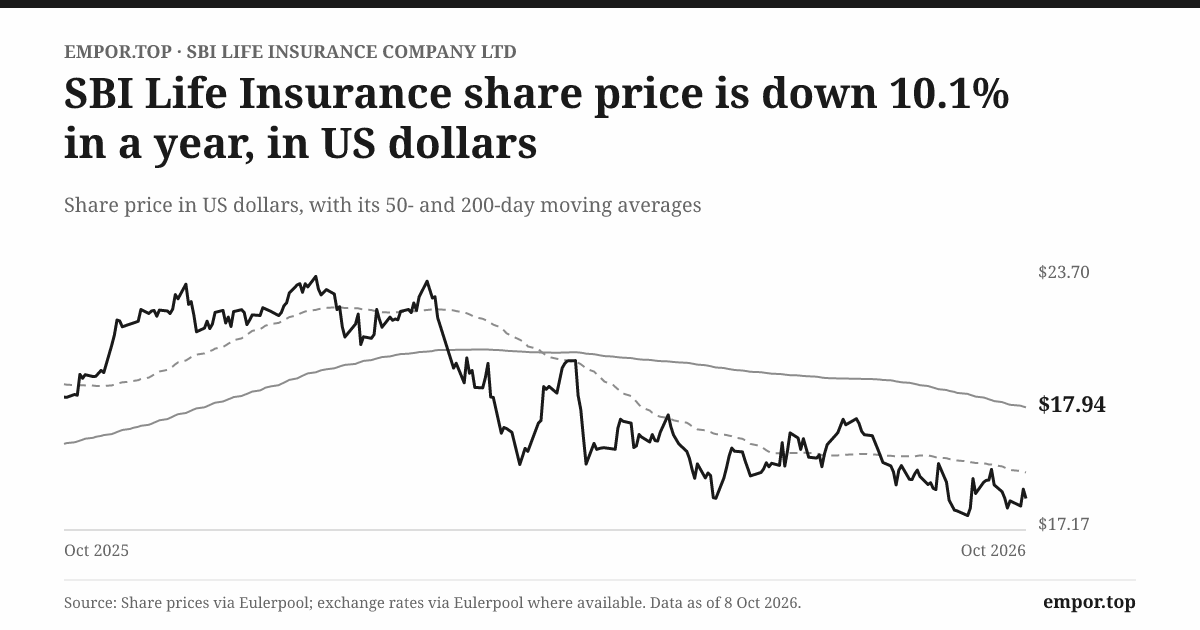
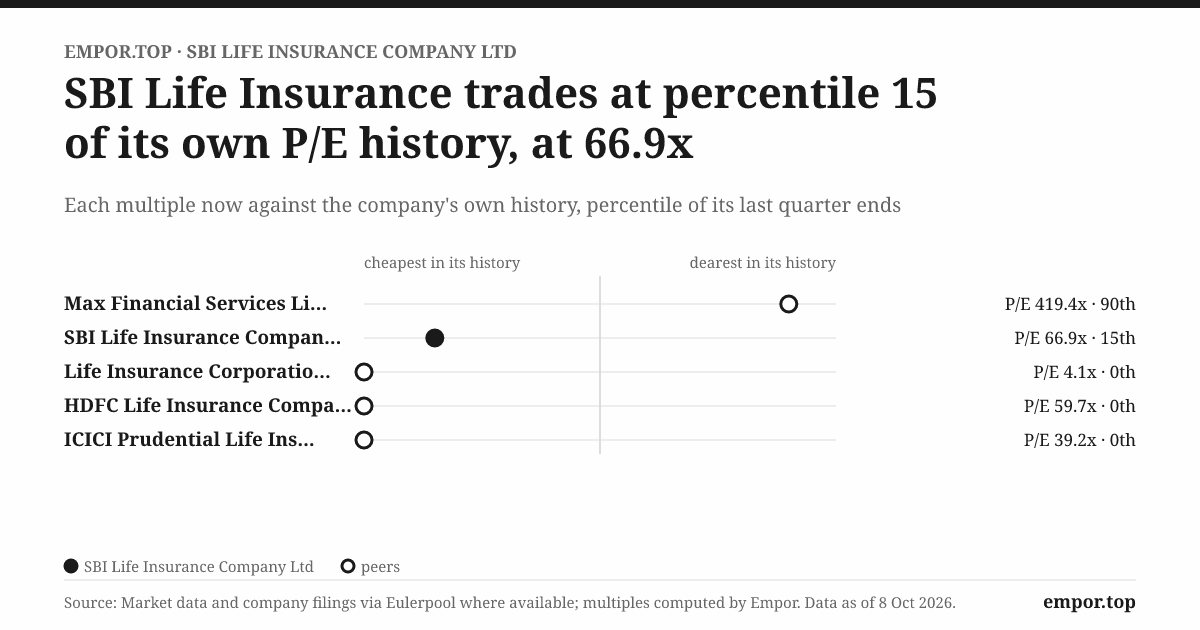
Finally, the bull points to valuation. At about ₹1,735 a share, SBI Life trades at roughly 67 times trailing earnings, below its five-year median of about 74 times, and about 17.7% below its 52-week high.14 On the more relevant measure for insurers, the stock trades at about 2.4 to 2.5 times its embedded value.1 The price is still rich, but on the company's own history it is less rich than usual. The market appears to be assuming that embedded value will keep compounding in the mid-teens or better for many years, with margins roughly where they are.
The bear starts from exactly that assumption and asks what could break it. The first threat is regulatory. The surrender value rules that took effect in October 2024 require insurers to pay customers more when they surrender traditional policies early.9 That is good for consumers. But part of an insurer's profit on traditional products has historically come from customers who lapse, and if more customers can leave cheaply, the profit retained on those policies falls. Insurers have responded by adjusting commissions and product design, but the bear's point is that the regulator has decided, deliberately, to make insurers earn less from customers who give up.
The second threat is product mix. In a strong equity market, branch customers want ULIPs, and every percentage point of mix shifted toward ULIPs drags the blended margin down. A sustained bull market could push SBI Life's margin from the high 20s toward 25%, which would mean the company grows volumes without growing value as fast.10
The third threat is channel dependence. With more than 60% of individual new business coming through SBI branches, SBI Life's growth depends on the energy of bank employees whose main job is banking.10 Bank staff in India have been criticised repeatedly for mis-selling insurance to depositors who wanted a fixed deposit, and regulators have grown more alert to that practice. Any crackdown on branch selling, or simple fatigue among staff juggling sales targets, would hit SBI Life directly.
The fourth threat is that pure protection remains a smaller part of the business than at some peers, which limits how far margins can expand even in good years.12
Now consider the case a skeptical activist investor would make. The sharpest challenge is not about products at all. It is about the relationship with the parent. SBI owns 55% of the insurer and collects more than ₹2,200 crore a year in commission from it.3 An activist would ask whether those commissions are set at arm's length, whether minority shareholders benefit from the parent's control, and what would happen if the regulator forced stricter open architecture or capped the fees that group banks can earn. If SBI were made to give rival insurers genuinely equal access to its branches, SBI Life would lose a real advantage. If the fees were capped, SBI Life's costs would fall, but the bank's incentive to push its products might weaken.
The activist would also question capital allocation. SBI Life pays out only around 11% to 15% of its profits as dividends and holds a solvency ratio well above the required minimum.1 Is the extra capital a prudent buffer, or idle money that shareholders would rather receive? Management's answer is that growth absorbs the capital and that the regulator's risk-based capital regime is coming, which may raise requirements. That answer is reasonable, but it is also unproven until the new regime arrives.
Weighed together, the bull case is anchored in the strongest fact about SBI Life, its cost leadership, and in a large, under-insured market. The bear case rests on risks that are real but slow-moving: mix, regulation and the parent relationship. Neither side can claim to have won. The bull's case is more grounded in the long-run record; the bear's is more grounded in the direction of policy. The questions that will settle the argument are the ones the company itself reports each quarter, and they turn the debate into a set of lessons that apply far beyond this company.
X. Playbook: Business & Investing Lessons
The first lesson is that in retail financial services, the counter beats the algorithm. When SBI Life turned an accounting profit within its first five years, while rivals with more sophisticated sales forces were still burning money, it proved that the scarcest asset in Indian insurance was not underwriting talent or product design but a trusted place where customers already stood.4 Every founder building a financial product in an emerging market should take that seriously. You can copy a product in a quarter. You cannot copy twenty thousand branches and a century of public trust. If you do not own distribution, your first strategic question is whose distribution you can borrow, and on what terms.
The second lesson is that a regulatory purge is a gift to the cheapest producer. The 2010 ULIP rules cut distributor commissions across the industry, and the insurers built on expensive agency networks suffered most, while SBI Life, which had never depended on rich commissions, was far less affected.8 When a regulator decides an industry's middlemen are earning too much, the business with the lowest cost to serve inherits the market. Investors who own high-cost producers in a heavily regulated industry are always one circular away from a bad year.
The third lesson is that an insurer with loyal customers can fund its own growth. SBI Life listed in 2017 without raising a rupee of primary capital and has carried no borrowings throughout the years on record, even as its assets grew more than fourfold.4 That is what high persistency means in practice: customers who keep paying provide a growing pool of money from which the insurer can meet its capital needs without diluting its shareholders. The best compounding machines in finance are often the most boring ones, the ones whose customers simply do not leave.
The fourth lesson is that when your parent owns your moat, it will charge you rent. SBI collected more than ₹2,200 crore from SBI Life in a single year, a sum comparable to the insurer's own profit.3 That arrangement is not sinister; it is the price of access to the most valuable distribution network in India. But it means minority shareholders own a business whose most important cost is set inside the family. The governance of a captive moat is not about whether a toll exists. It is about whether that toll stays regulated, visible and aligned with the interests of everyone who owns the company, not just the shareholder who owns the branches.
XI. Epilogue & If We Were CEOs
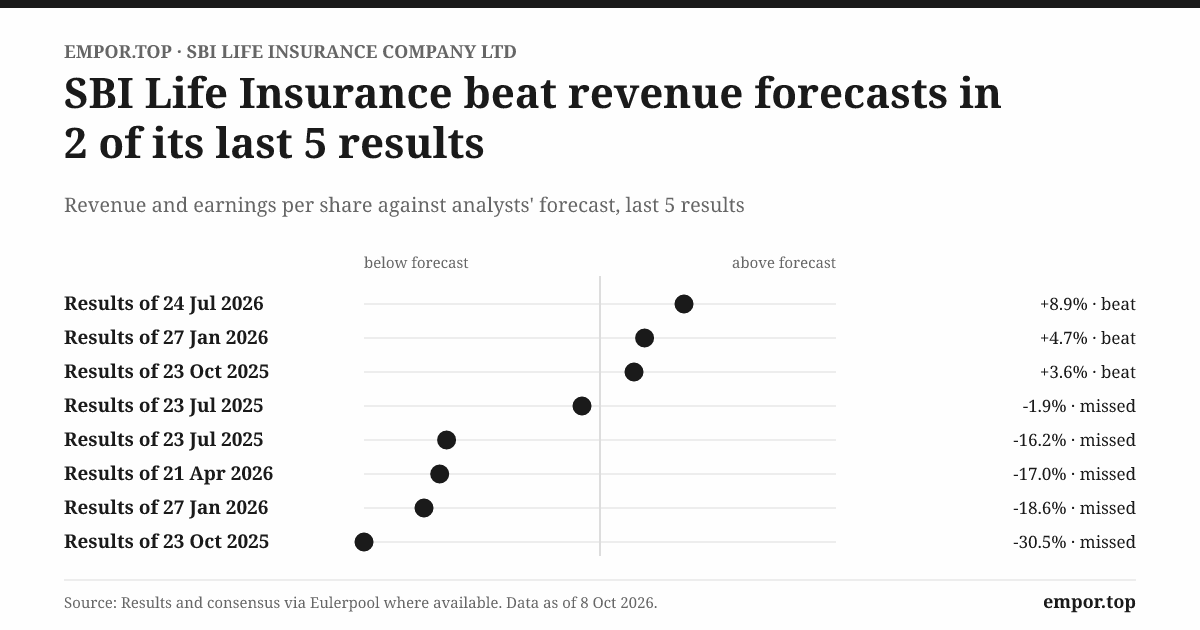
Tonight, SBI Life stands where it has stood for most of its life: at the top of the private life insurance industry, with a low-cost machine, a deep float and a parent that controls both its greatest strength and its greatest risk. Its share price is about 18% below its 52-week high, after a year in which the market has worried about margins, regulation and the shift toward lower-margin ULIPs.14 Its net profit for FY26 was about ₹2,400 crore, roughly $280 million, little changed from the year before.1 And the June 2026 quarter showed profit rising again, by about 22% from a year earlier, while the VNB margin slipped toward 26%.1
The next chapters of the story will be written in two numbers. The first is persistency. The FY26 annual report and the quarterly disclosures that follow will show whether 13th-month persistency holds above 85% now that customers can leave traditional policies more cheaply.9 If it holds, the float that underpins the entire business is sturdier than the bears fear, and the surrender reforms will have changed the rules without changing customer behaviour. If it slips, the company will have lost some of the stickiness that made it so capital-efficient.
The second is channel mix. If non-SBI channels, the company's own agency, its digital channels and its partnerships with other banks, can grow toward 45% of individual new business, SBI Life will have shown that it can grow on its own and not merely through its parent.10 If they cannot, the company will remain a powerful but dependent subsidiary, with growth set by the energy of SBI's branch staff.
If we were running the company, three priorities would stand out. The first would be to keep building direct digital and agency channels, with the explicit goal of reducing dependence on parent-bank branches below half of new business over time. That would not mean abandoning the bank; it would mean making the insurer less fragile to anything that changes the bank's incentives. The second would be to grow protection, health riders and annuities, the products whose margins depend less on whether customers want stock market exposure this year. That would make the VNB margin less hostage to equity cycles. The third would be to raise agent productivity rather than agent headcount, because an agency force that is large but unproductive is a cost, not a channel.
None of those priorities is new. Management has spoken about channel diversification and protection growth for years.11 The test is whether the numbers ever move enough to change the company's character. Until they do, SBI Life will remain what it has always been: a magnificent cost machine whose most important switch sits in someone else's hands.
XII. Outro
Go back to where this story began, but move the scene out of Mumbai and into a district town in Uttar Pradesh. A farmer or a small shopkeeper walks into the local State Bank branch to deposit the season's savings. The clerk behind the counter is the same person who handled his father's account. Before he leaves, the clerk mentions a savings plan with life cover, and he walks out with a policy bearing the name SBI Life.
That moment, repeated millions of times across India, is the whole company. While global financial firms spent two decades and enormous sums trying to build direct relationships with Indian consumers, the most successful private life insurer in the country was built on a counter that already existed. SBI Life did not reinvent financial distribution. It simply owned the place where the nation's savings were kept, and charged less than anyone else to put a policy there.
References
-
Integrated Annual Report 2024-25 — SBI Life Insurance Company Limited, 2025-06-10 ↩↩↩↩↩↩↩↩↩↩↩↩↩↩↩↩↩↩↩↩↩↩↩
-
Integrated Annual Report 2023-24 — SBI Life Insurance Company Limited, 2024-05-15 ↩↩↩↩↩↩↩↩↩
-
Annual Report 2023-24 — State Bank of India, 2024-06-01 ↩↩↩↩
-
Red Herring Prospectus — SBI Life Insurance Company Limited, 2017-09-11 ↩↩↩↩↩↩↩↩↩↩↩
-
Rating Rationale: SBI Life Insurance Company Limited — CRISIL Ratings, 2024 ↩↩↩
-
Shareholding Pattern and Corporate Disclosures — National Stock Exchange of India, 2024-06-30 ↩↩↩↩
-
Corporate Announcements and Regulatory Filings — BSE India ↩
-
IRDAI Annual Report and Statistical Handbooks — Insurance Regulatory and Development Authority of India ↩↩↩↩↩↩↩
-
Master Circular on Life Insurance Products and Surrender Regulations — IRDAI, 2024 ↩↩↩↩
-
Earnings Call Transcript Q1 FY25 — SBI Life Insurance Company Limited, 2024-07-24 ↩↩↩↩↩↩
-
Earnings Call Transcript Q4 & FY24 — SBI Life Insurance Company Limited, 2024-04-26 ↩
-
Investor Presentation FY24 & FY25 — SBI Life Insurance Company Limited ↩↩
-
BNP Paribas Cardif Divestment Disclosures — BNP Paribas Group, 2021-03-12 ↩↩
-
Life Insurance Industry Analysis and Peer Comparison — Economic Times ↩↩↩↩
-
Life Insurance Regulatory and Surrender Value Analysis — Mint ↩
 LinkedIn
 WhatsApp
 Reddit
 Hacker News
 Email
 Kindle
 RSS Feed
 Spotify
 Apple Podcasts
 Amazon Music
 Audible
 YouTube