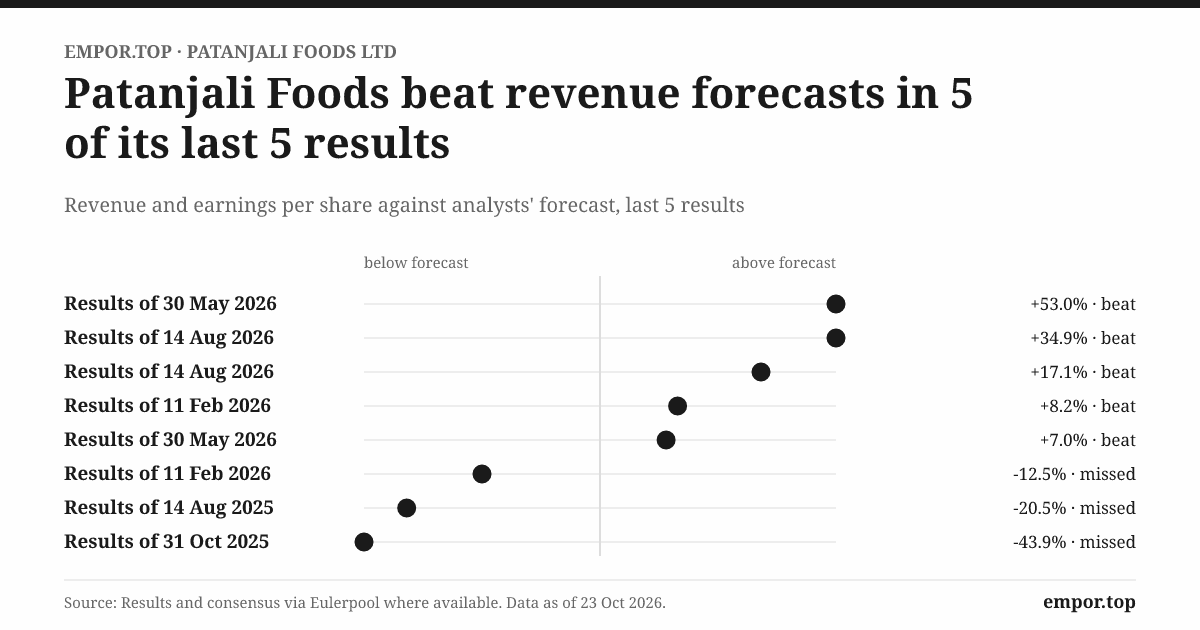
Patanjali Foods: The Rescue That Became a Consumer-Goods Bet
I. The Oil Company Behind the Yoga Brand
Walk down the aisle of almost any Indian grocery store and the name is everywhere. Patanjali toothpaste sits beside the soaps, Patanjali ghee beside the butter, Doodh biscuits in five- and ten-rupee packs near the till. The packaging speaks the language of Ayurveda, yoga and purity, and the face most shoppers associate with it belongs to Swami Ramdev, the yoga teacher who helped build the Patanjali group into a household name.
Now look at the shelf two rows down, where the cooking oil is stacked in pouches and tins. Ruchi Gold, Mahakosh, Nutrela.[^1] Those brands carry less spiritual branding and a great deal more of the money. They belong to the same listed company, Patanjali Foods Ltd, and in the year to March 2026 edible oils supplied about 72% of its revenue.1
That is the first surprise in this story. The company investors can actually buy on the National Stock Exchange is not the Ayurvedic empire of the advertisements. It is a refiner, crusher and seller of edible oil that was called Ruchi Soya Industries until 2022, went bankrupt in 2017, and was rescued by the Patanjali group in 2019.2[^1]
Patanjali Ayurved Ltd, the private company most people mean when they say "Patanjali", is its largest shareholder and its most important counterparty. It is not the listed company, and its revenues are not Patanjali Foods' revenues.
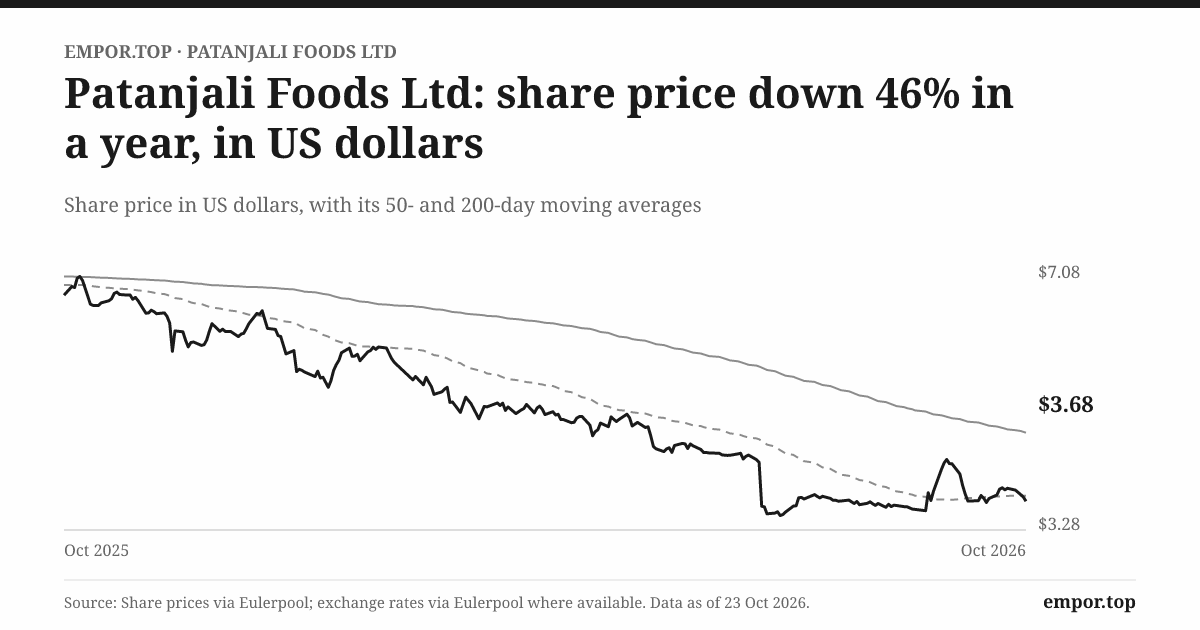
On 23 October 2026, the market valued Patanjali Foods at about ₹38,000 crore, with the shares at roughly ₹350, more than 40% below their high of the previous year.1 For that price an investor gets a business that sold about ₹40,000 crore of goods in FY2026.[^1] Most of those goods were oil. Most of the profit, at least in that year, was not.
Here is the tension in one pair of numbers. Food, FMCG and home and personal care products brought in about 28% of FY2026 revenue, yet the company said they produced about 61% of segment EBITDA.1 A dollar of shampoo or biscuits earns many times what a dollar of palm oil earns.
If that part of the company keeps growing, the listed business slowly turns from a commodity processor with a famous name into a consumer-goods company with an oil refinery attached. That is the bet the market has been asked to make.
The bet comes with four questions, and this story is organised around them. Where is growth actually created: inside Patanjali Foods, or by moving businesses into it from the parent? Can the higher-margin consumer business turn its profits into cash, rather than into receivables and inventory? Are the transfers and services that flow between the listed company and the group priced fairly for the third of shareholders who are not in the group? And does today's valuation pay an outside investor enough for commodity swings and governance risk?
The long view gives a first, sobering clue. Over the ten years from FY2016 to FY2026, revenue grew by less than 3% a year.31 Over the five years from FY2021, it grew by about 20% a year.31 The gap between those two numbers is the whole saga in miniature.
The first figure starts from a bankrupt company that was shrinking, and the second covers a period in which three businesses were moved over from Patanjali Ayurved. Neither tells you, on its own, how fast the business grows when nobody is adding to it.
So the honest way to read Patanjali Foods is as a company with two identities, a commodity identity and a consumer identity, where the second has been partly bought from its own owner. The consumer-goods promise is real enough to show up in segment profit. Whether it is durable, and whether it reaches minority shareholders as cash, is what the rest of the story has to establish, starting with what Patanjali actually bought when it took over a broken oil company.
 Subscribe on LinkedIn
II. The Company Patanjali Took Over
Long before the yoga brand, there was soya. Ruchi Soya was established in 1986 around edible oils and oilseeds, and over three decades it built some of India's most familiar kitchen names.[^1] Its Nutrela brand pioneered soya chunks in the 1980s and became so dominant that the brand turned into a generic word; the company claimed about 40% of India's market for textured soya protein.2
It ran crushing plants in the soybean and mustard belts, refineries at the ports where imported crude palm oil arrived, and palm plantations worked by thousands of farmers. By 2021 it described itself as having the largest oilseed crushing capacity in the country, about 11,000 tonnes a day.2
Scale did not save it. Ruchi Soya's sales fell from about ₹31,500 crore in FY2015 to about ₹12,000 crore in FY2018, while it carried roughly ₹12,000 crore of accumulated debt.4 The edible-oil business runs on borrowed money, because a refiner must buy months of imported oil before it sells a single pouch, and when commodity prices and receivables moved against it the company had no cushion left. On 15 December 2017, a bankruptcy petition was admitted against Ruchi Soya under India's new Insolvency and Bankruptcy Code.2
What followed was one of the early test cases of that code, and it was messy. The company attracted more than two dozen bids, from names including KKR, ITC, Godrej Agrovet, Emami, Adani Wilmar and Patanjali.4 Adani Wilmar, the most natural industrial buyer, was declared the highest bidder, and Patanjali objected.
Then, in January 2019, Adani Wilmar withdrew, citing the delay.4 Patanjali was left as the serious suitor. In March 2019 it raised its offer from about ₹4,100 crore to ₹4,350 crore in upfront cash to banks, a deal that meant lenders would write off about 60% of what they were owed.4
The structure of that rescue matters for everything that comes later. Patanjali Ayurved did not buy Ruchi Soya alone. It acquired the company through the insolvency process together with group entities: Patanjali Gramudyog Nyas, Patanjali Parivahan and Yogakshem Sansthan.[^1] The resolution plan was approved and implemented on 18 December 2019.2
In the accounts that followed, the company repaid about ₹3,977 crore of borrowings pursuant to the completion of the process, and replaced it with new borrowings of about ₹3,480 crore.2 In plain language, the group paid creditors largely with borrowed money placed inside the very company it had bought. That is a common way to finance a leveraged rescue, and it meant the listed company itself would carry the acquisition debt until something else paid it down.
It is worth separating three sums that are often blurred together. The ₹4,350 crore was what creditors received under the plan. The roughly ₹12,000 crore was what Ruchi Soya owed when it failed. The ₹4,300 crore that the company would raise in 2022 was new capital from public investors, a different event with a different purpose. Patanjali's rescue was not a start-up investment in a blank-slate company. It bought an established processor with plants, brands and distribution, at a heavy discount to what lenders had lent against it.
The accounts of those years are a minefield for anyone who wants to compute long-run returns. In FY2018, the resolution professional booked a one-time provision of about ₹5,029 crore for doubtful debts and advances, which drove a reported EBITDA margin of minus 42%.2
In FY2020, the opposite happened: profit was inflated by a large exceptional gain from derecognising liabilities that creditors had written off.2 So the ten-year record runs straight through a bankruptcy provision on one side and a debt-forgiveness gain on the other. Any ratio that spans FY2018 to FY2020 is measuring an accounting reset as much as a business.
The same caution applies to the share price. When Ruchi Soya's shares resumed trading in January 2020, only about 1.1% of the company was in public hands.5 A stock with almost no float can be pushed up by very small amounts of buying, and it was. The rally that followed was a lesson in market plumbing, not proof that Patanjali had created thousands of crores of operating value in a few weeks.
The new owners moved quickly to put their own people in charge. Acharya Balkrishna, Swami Ramdev's long-time partner at Patanjali Ayurved, became managing director, and then in August 2020 stepped down from that role "due to his pre-occupation", staying on the board as a non-executive director.6 Ram Bharat, a whole-time director, succeeded him as managing director.
The operating job went to Sanjeev Asthana, a professional manager trained at the Institute of Rural Management Anand and the Indian Institute of Foreign Trade, whose career had run through the State Trading Corporation, Britannia, ITC, Cargill, Reliance Retail and, earlier, Ruchi Soya itself.6 That background is a clue to how the group saw the asset. They hired a commodity-and-consumer operator, not a brand evangelist.
The first year under new owners was an exercise in grafting. Between February and July 2020 the company launched premium edible oils, honey and a high-protein atta under the Nutrela name, and by March 2021 it had gained access to Patanjali's distribution network of about 3,400 distributors, some 1,300 Patanjali Chikitsalaya clinics and more than 3,300 Arogya Kendra wellness stores.2
Revenue for FY2020, the year that straddled the takeover, was about ₹13,100 crore at an EBITDA margin of about 3.5%, which is roughly what a mid-sized refiner earns in an ordinary year.2 The brand had arrived; the economics were still those of oil.
What Patanjali bought, then, was a big, broken but functioning oil company. It came with scale in crushing and refining, a famous soya brand and a plantation network, but also with a capital structure that the group had loaded with fresh debt and a share register in which almost nobody outside the group owned anything. Neither condition could last. India's market rules would not let a listed company stay 99% owned by its promoters forever, and that requirement set up the next chapter.
III. The Float Had to Be Made
By early 2022, Ruchi Soya had an awkward problem for a listed company: hardly anyone could buy it. Before its follow-on public offer, the promoter group owned about 98.9% of the shares.5 Indian rules require listed companies to bring public shareholding up to at least a quarter over time, and a company that had re-emerged from insolvency with a sliver of float was on the clock.
The group could have sold some of its own shares, which would have put cash in the promoters' pockets. Instead, it chose to have the company issue new shares, which put the cash into Ruchi Soya.
That choice shaped the economics. Eight months earlier, in its July 2021 roadshow, the company had told investors how a ₹4,300 crore raise would be spent: about ₹2,664 crore to repay or prepay borrowings, about ₹593 crore for working capital, and the rest for issue expenses and general purposes.2 In other words, the public offer was designed to retire the debt that had been placed inside the company to pay the insolvency creditors. Public investors would, in effect, be refinancing the rescue.
The offer opened on 24 March 2022 at a price band of ₹615 to ₹650 a share.78 That was a steep discount to where the thinly traded stock had been sitting, and the market noticed: the shares fell sharply on the day the band was set.8 Anchor investors took about ₹1,290 crore before the issue opened to the public.7 When bidding closed on 28 March, the issue had drawn bids for about 3.6 times the shares on offer, although the retail portion was only about 90% subscribed.9
Then came the strangest scene in the company's capital-markets history. Text messages had circulated promoting the issue as a chance to buy shares at a discount to the market price. Ruchi Soya said it had not sent them and filed a police complaint in Haridwar.79 On 28 March, the Securities and Exchange Board of India told the bankers to give all non-anchor investors a window, from 28 to 30 March, to withdraw their bids, and to publish newspaper cautions about the unsolicited messages.7
The board meeting to fix the issue price was pushed from 29 to 31 March.9 The offer survived and the money arrived, but the episode left a mark. A company trying to prove it belonged in the institutional mainstream had its first big fund-raise interrupted by the regulator.10
The market structure around the deal deserves a moment, because it explains a lot of the share-price drama investors remember. With only a sliver of shares available, the stock had run far ahead of anything its earnings could justify, and the new supply of shares was always going to test that price. Scarcity can make a stock look like a success story. Once the scarcity ends, the price has to stand on the business.
What the offer did achieve is measurable. Debt to equity fell from about 0.9 in FY2021 to 0.07 by FY2025.3 The company went from a rescue vehicle carrying its buyers' acquisition debt to one of the least indebted large food processors in the country. That repair is genuine, and it was paid for by public shareholders who bought new shares, not by the promoters.
Four years on, the ownership picture looks like this. At the end of September 2026, the promoter group held about 68.25% of Patanjali Foods, down slightly from about 68.8% a year earlier.11 Patanjali Ayurved held about 29.6% directly, with Yogakshem Sansthan at about 14.1%, Patanjali Parivahan at about 13.5% and Patanjali Gramudyog Nyas at about 11.0%.11
The public owned the remaining 31.75%, spread across 235,088 shareholders, with insurers holding nearly 10%, foreign institutions about 7% and domestic mutual funds less than 3%.11 The September 2026 filing reported no pledge of promoter shares.11
That last point is a real comfort. Pledged promoter shares are a classic Indian warning sign, because a falling share price can force a lender to sell and a control fight can follow. There is none of that here.
The float, though, is still modest by the standards of large consumer companies, and mutual funds, the most active domestic stewards of minority interests, own very little. The FY2026 annual report also records a 2:1 bonus issue in 2025, which tripled the share count and means pre-2025 share prices must be divided by three to compare with today's.1
So the float was made, the debt was paid, and control stayed exactly where it had been. Four affiliated entities, all part of one group, hold more than two-thirds of the votes. A minority shareholder can watch, vote on related-party resolutions and sell, but cannot direct anything. That would matter less if the listed company dealt with its owner only at a distance. It does the opposite. Almost as soon as the offer closed, the growth story began to move across the group boundary.
IV. The Growth Moved Across the Group Boundary
On 18 May 2022, less than two months after the offer, the board of Ruchi Soya met and approved two things at once.12 The first was a business transfer agreement to acquire Patanjali Ayurved's food retail business, including the manufacture, packaging and retail trading of certain food products and plants at Padartha near Haridwar and at Newasa in Maharashtra, as a going concern on a slump-sale basis.
The second was a change of name, from Ruchi Soya Industries to Patanjali Foods.12 The name change was confirmed in June 2022.[^1] The listed company had just raised money as an oil company with consumer ambitions. Now it was renaming itself after its parent and buying the parent's food business.
The price for the food business was ₹690 crore.[^1] It followed a smaller step taken in May 2021, when the company bought Patanjali's biscuits, cookies and rusk business for about ₹60 crore, along with the transfer of noodles and breakfast cereals.2[^1] The pattern was established early. Businesses that had grown up under the Patanjali Ayurved umbrella were moved, one by one, into the listed company, with a royalty paid back to the group for the use of the brand.[^1]
The biggest move came on 1 July 2024. Patanjali Foods' board approved buying Patanjali Ayurved's home and personal care business, which covered dental care, skin care, home care and hair care, for a lump sum of ₹1,100 crore.13 Alongside it, the two companies agreed a 20-year licensing arrangement with a fee of 3% of turnover.13 The deal closed on a slump-sale basis in November 2024.[^1]14 FY2026 was therefore the first full year in which the toothpaste and shampoo business sat inside the listed company.1
The scale this added is not trivial. In FY2026, the FMCG segment, including home and personal care, brought in about ₹11,200 crore of revenue, around 28% of the company's total.[^1] On the August 2026 call, the chief executive said the home and personal care business delivered about ₹629 crore of revenue in the June quarter alone, with dental care the largest piece at about ₹325 crore.14 ICRA, raising its rating that June, credited the "acquisition and integration of various FMCG and HPC businesses" from Patanjali Ayurved with diversifying the business meaningfully.[^1]
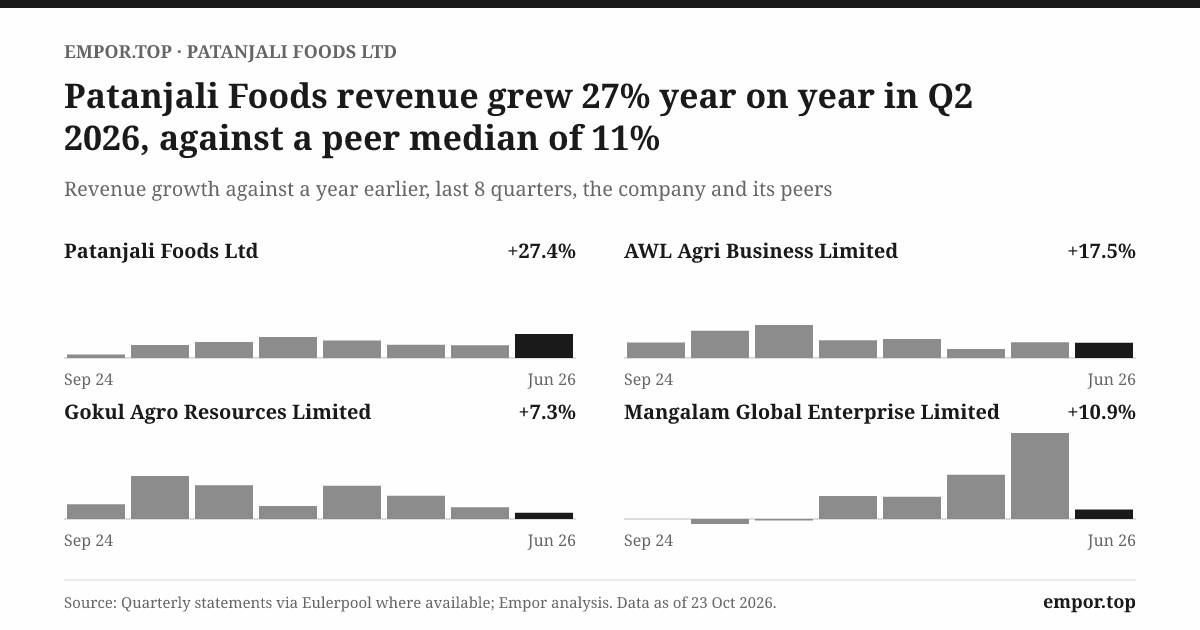
That phrase is the key to reading the growth record correctly. Part of that growth came from businesses that already existed and were simply moved under a new roof.1 The company does not publish a like-for-like figure that strips them out. So the honest version of the five-year growth claim is narrower than the headline: Patanjali Foods has grown its reported revenue fast, and some unknown share of that growth is consolidation rather than new customers.
The boundary also cuts the other way. Patanjali Ayurved's own revenues, its past growth and its broader brand portfolio belong to Patanjali Ayurved. When a newspaper reports that "Patanjali" grew, it is not reporting on the company in an investor's portfolio. For a minority shareholder, the only numbers that count are those audited inside Patanjali Foods, and the price paid to move each business across.
That price is where the story becomes contentious. On the August 2026 call, an analyst raised what they called "some misgiving in the market that we have overpaid" for the home and personal care deal, and asked for the valuation methodology and the earnings multiple.14 Sanjeev Asthana's answer was striking. "There is no earning multiple or nothing," Asthana said; the business had "almost come free" to the listed company.14
Asthana described a business with about ₹2,900 crore of revenue that was generating about ₹600 crore of EBITDA, bought for ₹1,100 crore, a price Asthana called "less than 18, 19 months of profitability".14 All three transfers, he said, were done on a slump-sale basis, paying for the assets and the inventory, with "no valuation methodology", and the business had been "almost gifted by the parent".14 The finance chief, Kumar Rajesh, added that the deals had been explained to the exchanges and approved by shareholders.14
Asthana went further. The biscuit business, the CEO said, had "paid multiple times of its acquisition cost", the food business had "already paid off completely" and home and personal care had "already paid up".14 Those are claims about payback, and they may be true. The company, however, does not publish standalone audited earnings for each transferred business since its transfer, so an outside shareholder cannot check them.
Read that answer carefully, because it contains both a reassurance and a problem. If the numbers are right, the listed company bought a high-margin business for under two years of its operating profit, which would be a very good deal for minority shareholders. But a ₹600 crore EBITDA on ₹2,900 crore of revenue implies a margin of about 20%, and the June 2026 quarter's ₹122 crore of home and personal care EBITDA on ₹629 crore of revenue is consistent with roughly that level.14
What the purchase price does not capture is the 3% royalty on turnover that runs for 20 years.13 A business that "came free" still pays its former owner a share of every rupee of sales for two decades. On revenue of about ₹2,500 crore a year, that is in the region of ₹75 crore annually, an ongoing claim that a lump-sum comparison leaves out.
The other half of the problem is the phrase "no valuation methodology". For a transaction between a listed company and its controlling shareholder, an independent valuation is precisely what protects the outside investor. Management's claim may well be correct. But "the parent gifted it" is a statement of the seller's goodwill, and minority investors are being asked to take that on trust rather than on an audited, benchmarked basis.
So the transfers have added real operating scale, and on management's own numbers the home and personal care purchase looks cheap relative to its earnings. The record does not reject the growth story. It narrows it.
What has been proven is that Patanjali Foods can absorb businesses from its parent and report them; what has not been isolated is how fast those businesses and the oil company underneath them grow on their own. The test of that question is not the deal rationale. It is the segment economics, which is where the oil and the toothpaste meet.
V. Oil Sells the Scale; FMCG Has to Earn the Premium
Start at a port on India's coast, where a tanker of crude palm oil from Indonesia or Malaysia ties up beside a refinery. Two of the company's port refineries are connected to the docks by direct pipelines.2 The oil is bought in dollars, weeks or months before it is sold, refined, packed into pouches and tins under names like Ruchi Gold and Mahakosh, and pushed out through thousands of distributors to shops across the country.
Inland, crushing plants in the soybean and mustard belts squeeze seed into oil and meal, and the meal is sold as animal feed or turned into Nutrela soya chunks.2 That is the machine that produces most of Patanjali Foods' revenue.
It is a machine with very thin margins and very large flows. In FY2026 the edible-oil segment sold about ₹29,000 crore of product, roughly 72% of company revenue.[^1] Because the price of the oil is set largely by world markets, the refiner earns a spread, not a premium.
ICRA describes the segment's profitability as susceptible to swings in crude and refined oil prices, inventory losses, import-duty changes, currency moves and supply disruptions, given India's heavy dependence on imports.[^1] Management itself frames its target edible-oil margin as somewhere between 2% and 4%, with an ambition to move "consistently" above 5%.14
Now picture the other machine. A toothpaste, a packet of biscuits or a bag of soya chunks carries a brand, a fixed pack price and a margin that does not reset every time palm oil moves.
In FY2026, food, FMCG and home and personal care accounted for about 28% of revenue but, by the company's own segment reporting, about 61% of EBITDA.1 ICRA put the same point slightly more cautiously: the FMCG and HPC businesses "collectively contributed a sizeable share of around 60%" of operating profitability.[^1] On the face of it, the consumer half of the company already carries the profit.
Here is where the story gets more interesting than the headline. That 61% figure was the product of a particular year, and specifically a year in which oil margins were squeezed. ICRA noted that FY2025 had benefited from inventory gains in a rising price environment, followed by "normalisation of margins in FY2026".[^1] When oil earns less, the consumer business's share of profit rises automatically, even if the consumer business has not changed at all.
The June 2026 quarter showed how quickly that ratio can flip. Edible oils delivered record quarterly revenue of about ₹8,500 crore, at an EBITDA margin of about 5.2%, while the FMCG segment produced about ₹2,900 crore of revenue at an EBITDA margin of about 6.5%.14 Management said FMCG contributed nearly 26% of revenue but only nearly 30% of EBITDA, excluding unallocable income, in that quarter.14
In one quarter, the consumer business went from carrying most of the profit to carrying less than a third of it. Nothing about toothpaste collapsed; oil simply had a good quarter, helped, as Asthana explained, by the company's long positions in edible oils as prices rose with a delayed monsoon and conflict in West Asia.14
This is the most important analytical point in the business, and it cuts against the simple version of the transformation story. The mix shift is real in the sense that Patanjali Foods now owns a large, higher-margin consumer business. But the share of profit that business represents is not a structural constant that rises year after year.
It swings with the oil cycle, so it can look like a transformation in a bad oil year and a footnote in a good one. The right way to judge the consumer business is by its own absolute profits and margins, not by its share.
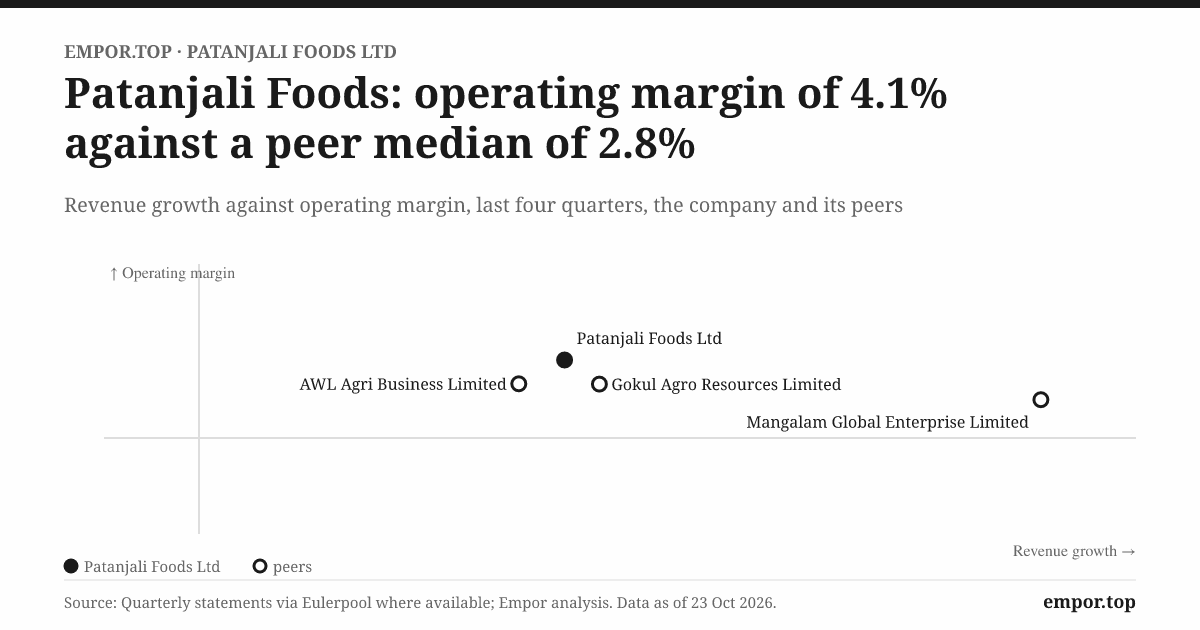
On those terms, the record is mixed. FMCG margins of about 6.5% in the June 2026 quarter are well above oil, but they are not the 15% to 25% margins of India's leading branded consumer companies.14 The averages conceal very different businesses. Biscuits earned an EBITDA margin of about 15.4% in that quarter, up from about 9.4% a year earlier, and Asthana said the Doodh biscuit brand alone does almost ₹1,300 crore of business a year.14
Textured soya products earned more than 18%.14 Home and personal care, as already seen, earned close to 20%. Against that, staples, the commodity-like foods such as pulses and flour, posted negative EBITDA of about ₹59 crore in the quarter, a loss that management attributed partly to an inventory markdown after quality issues in pulses and to packaging and commodity inflation.14 Ghee sales were soft, at about ₹219 crore, with summer off-take in export markets in the Middle East disrupted by geopolitical tension.14
So the consumer business is really three businesses wearing one segment label. There are genuinely branded franchises with strong margins: biscuits, Nutrela, toothpaste and soaps. There are mid-margin categories like ghee and honey. And there is a staples business that behaves more like oil than like toothpaste, adding reach and kitchen presence at thin or negative margins. Asthana was candid about that trade-off on the call, saying staples "generates lesser margin" but builds reach and "completes our presence in the kitchen".14
How much of the growth is volume and how much is price? That question matters, because inflation can flatter revenue without adding a single customer. An analyst asked it directly in August 2026. Asthana first estimated food volume growth at around 7% to 8%, then corrected the figure with the actual numbers: volumes had grown by 5%, and price inflation added almost 12%.14 That answer is more revealing than any guidance. In the food business, roughly two-thirds of the quarter's growth came from higher prices, not more stuff sold.
The levers management talks about are the familiar ones for a consumer company that also owns a commodity book. In the June 2026 quarter it took "calibrated price increases" in edible oils, used targeted discounts in FMCG to stay competitive, and introduced smaller pack sizes.14
It flagged rising costs for milk, sugar, packaging, freight and logistics.14 It pointed to e-commerce and quick commerce, which together with modern trade made up close to 15% of sales, up from about 12% fifteen months earlier, with a target of 20% within 18 months.14 And it pointed, above all, to oil palm.
The plantation business is the part of the company that most resembles a long-term asset rather than a trading operation. Patanjali Foods works with farmers under India's public-private model for oil palm, buying the fresh fruit bunches they grow and processing them in its own mills.2 By 2026 it was working with about 57,000 farmers and buying all the palm fruit they produced.[^1] In FY2026 ICRA estimated the plantation business contributed EBITDA of about ₹357 crore, roughly half the operating profit of the edible-oil segment.[^1]
By June 2026, cultivated area stood at about 115,861 hectares, with nearly 37% of it in the prime yielding phase, against a total allocated area of 6.63 lakh hectares.14 In 2021 the company had cited an allocated area of about 255,000 hectares.2 The allocation has grown enormously; the cultivated area remains a fraction of it. Oil palm takes years to mature, so this is a slow-burning lever, and its value depends on how much of the allocated land farmers actually plant.
Management's guidance for FY2027, reaffirmed in August 2026, was growth of 8% to 10% in food and FMCG, about 15% in beauty and personal care, FMCG EBITDA growth of 12% to 15%, and edible-oil volume growth in the low single digits.14
Asthana also pointed to about ₹2,500 crore of annualised EBITDA over the next 18 months, a destination the CEO described as one the company was "reasonably confident" of heading towards.14 Those are specific and testable numbers, which is to management's credit. They also lean heavily on price inflation, on oil margins staying near the top of their range, and on the plantation business compounding.
Then there is the competition, which is formidable on both sides of the business. In edible oils, the closest listed rival is AWL Agri Business, formerly Adani Wilmar, the company that had once been declared highest bidder for Ruchi Soya itself.4 Marico competes in edible oils and branded foods, while Hindustan Unilever, ITC and Dabur compete across food and personal-care categories.
In its 2022 prospectus the company cited estimates that put Ruchi Soya at about 12% of the branded palm-oil market by value and Adani Wilmar at about 11%, but those are historical figures, not today's market shares.5 ICRA's 2026 view is that Patanjali Foods is the second-largest player in India's branded edible-oil market, with an estimated 9% to 10% share, and the leader in palm oil.[^1]
Run Michael Porter's five forces across this business once and the picture is clear. The suppliers of the most important input, imported crude oil, are global commodity markets, and a concentrated set of trading houses accounted for about 78% of the company's trading-house purchases in FY2026.1 Buyers are fragmented: no customer exceeded 10% of revenue and the top ten distributors made up only about 16% of dealer and distributor sales.1
That gives distributors little leverage, but it also means the end consumer, choosing between pouches on a shelf, holds the real power. Substitutes are everywhere, from other oil brands to loose unbranded oil. Rivalry is intense, which ICRA flags explicitly for Nutrela, ghee, biscuits and herbal care.[^1] The threat of new entrants is lower in refining, which needs scale and port access, and higher in consumer goods, where quick commerce has lowered the cost of launching a brand.
The filings do not establish switching costs, sustained price premiums or repeat-purchase rates. A famous brand and two million retail touchpoints are assets, but they are not, by themselves, a moat.[^1] A moat shows up as pricing that holds when costs fall, share that holds when rivals discount, and returns on marketing and capacity that stay above the cost of capital. Those are the numbers that would turn "higher-margin segment" into "durable franchise", and the company does not yet publish most of them.
The verdict on the operating model, then, is narrower than the marketing. Patanjali Foods has a set of strong branded franchises inside a business that is still dominated by the oil spread, and the apparent shift in its profit mix is partly the oil cycle in disguise. The consumer business has to prove itself on its own absolute margins and volume growth. And it does so while carrying a feature unusual for any listed consumer company: its most valuable brand is owned by its controlling shareholder.
VI. The Group's Name Is an Asset—and a Counterparty
Open the FY2026 annual report to the related-party note and a second company appears inside the first. There, alongside the ordinary costs of running a food business, are payments to Patanjali Ayurved, to Patanjali Parivahan, to Parakram Security India, and an advance of ₹600 crore to a company linked to a director.1 Each line is disclosed, as Indian rules require. Together, they describe a listed company whose brand, logistics, security and part of its future factory capacity are tied to entities controlled by the same group.
The royalty comes first, because it is the price of the name. In FY2026, Patanjali Foods paid Patanjali Ayurved about ₹123 crore in royalty, almost double the roughly ₹67 crore of FY2025.1 The increase tracks the first full year of the home and personal care business and its 3% turnover fee.13
On the scale of the company's profits, ₹123 crore is about a tenth of FY2026's pre-tax profit, a meaningful claim on earnings that grows with sales, not with profit.1 ICRA has named "elevated royalty payments" as a monitorable that could weigh on its view of the company.[^1]
The services are larger. Freight paid to Patanjali Parivahan came to about ₹366 crore in FY2026, and security and manufacturing charges paid to Parakram Security India to about ₹236 crore.1 ICRA noted that the company buys some raw and packaging materials from group entities, uses group companies for logistics and security, and shares a food park with other group facilities.[^1] There are plausible commercial reasons for that.
A group that already runs trucks and security for its own plants can offer them to a sister company at scale. The question an outside investor must ask is not whether the services exist, but whether their prices are what an unrelated logistics firm or security contractor would charge. The board describes the transactions as ordinary-course and arm's-length.1 It does not publish third-party benchmarks that would let a minority shareholder check.
The flows do not all run one way. At year end the company also had trade receivables outstanding from Patanjali Ayurved, because it sells to the group as well as buying from it.1 The net direction is nonetheless clear from the scale of the lines: royalties, freight and manufacturing charges flowing out to group entities run to several hundred crore a year, and the businesses moved in from the parent were paid for in cash.
Then there is the advance. In FY2026 the company recorded a ₹600 crore capital advance to a director-linked company for machinery for a biscuit plant, with a condition that approval from YEIDA, the Yamuna Expressway industrial authority, be obtained within six months.1 ₹600 crore is more than two and a half times the company's entire FY2026 capital expenditure of about ₹236 crore.1
ICRA attributed the jump in FY2026 debt partly to "elevated inventory and advances".[^1] For a minority shareholder, an advance of that size to a related party, for equipment that has not yet been delivered and a plant subject to an outside approval, is the single most important item to track. The questions are simple. Was the approval granted on time? Was the machinery delivered, independently valued and commissioned? And if not, was the money returned?
A separate disclosure adds texture to the governance picture. The FY2026 annual report notes that a subsidiary made a related-party advance without prior audit-committee approval; the amount was later repaid, and the company filed a settlement application with SEBI.1 That is a different transaction from the ₹600 crore machinery advance, and it was remedied.
But it sits uncomfortably beside the 2021 roadshow's promise of "strong governance" and supervision by independent directors with backgrounds in vigilance, finance and the judiciary.2 A control lapse that needs a regulatory settlement is exactly the kind of event that promise was meant to rule out.
Who runs the company inside this web? Swami Ramdev and Acharya Balkrishna sit on the board as non-executive directors and are also the founders and key figures of other group entities.[^1] Ram Bharat, the managing director, drew disclosed remuneration of one rupee in each of FY2025 and FY2026.1
The professional managers are paid more conventionally. Sanjeev Asthana's remuneration was about ₹2.1 crore in FY2026, unchanged from the year before, but the company also booked about ₹5.2 crore of ESOP expense for the chief executive.1 The CFO, Kumar Rajesh, received about ₹1.1 crore, with about ₹1.4 crore of ESOP expense.1
Those numbers are modest by the standards of Indian consumer companies, and nobody is getting rich at the expense of shareholders through salaries. The more interesting point is the asymmetry. The managing director's reported pay is essentially zero, so the managing director's economic interest in the company runs through the group's shareholding and its commercial relationships, not through a salary that minority shareholders can judge. The chief executive's incentive is weighted towards share options, which reward share-price gains. Neither structure ties pay directly to cash conversion or to the returns earned on businesses bought from the parent.
There is also a reputational counterparty in the brand itself. In April 2024 India's Supreme Court warned Swami Ramdev and Patanjali Ayurved of "stern legal action" in contempt proceedings over advertisements claiming that traditional medicines offered a "permanent solution" for conditions such as blood pressure and asthma; Justice Hima Kohli called the apology "lip service".15 That case concerned Patanjali Ayurved and its leaders, not Patanjali Foods' own operations, and it is not a liability on the listed company's balance sheet.
ICRA, however, flags exactly the channel through which it matters: litigation involving the parent and key group personnel "could affect the overall Patanjali brand and, thereby, PFL in an unforeseen manner".[^1] When you license your name from your owner, you also license its controversies.
An activist reading this note would not demand that Patanjali Foods sever its ties with the group. The ties are, after all, part of how it gets distribution, brands and plants. The demand would be for transparency proportionate to the scale of the dealings.
That means an annual schedule of every affiliate payment and balance, with the contract terms, an independent benchmark for each major service, a valuation for each business or asset bought from the group, and a progress report against the plans that justified each transfer. Without that, the board's arm's-length statement is a conclusion offered without the working.
The group's name is therefore both the company's most valuable asset and its most complicated relationship. The brand helps sell biscuits and toothpaste, and it also takes a cut of every rupee of sales, sends work to sister companies and occasionally drags the listed company into controversies it did not create. All of that would be easier to judge if the profits were flowing back to shareholders as cash. They have not been, and that is the next puzzle.
VII. The Profit Is Not All in the Cash
In FY2026, Patanjali Foods reported its best profit since the rescue, about ₹1,800 crore after tax.[^1] In the same year, its operating activities consumed cash: operating cash flow was negative by about ₹333 crore.1 A company can be profitable and still burn cash in a single year, especially one that buys commodities and sells on credit. The question is whether this was a single year.
Start with the bridge for FY2026, because the mechanism is visible in the cash-flow statement. An increase in trade and other receivables absorbed about ₹1,028 crore of cash, and lower payables used up another ₹244 crore.1 In plain terms, customers took longer to pay, or simply bought more on credit, while the company paid its own suppliers faster. That combination will drain cash from any business, and in a low-margin business it can wipe out a year's profit.
Now step back to the longer record. Across the twelve years from FY2015 to FY2026, the company's cumulative net profit came to about ₹6,100 crore, while its cumulative operating cash flow came to about ₹3,050 crore.31 For every rupee of reported profit, half a rupee arrived as cash from operations.
It is tempting to dismiss that ratio because it crosses the insolvency years, and that period did distort the profit line. But the distortions roughly cancel. The large losses of FY2016 to FY2019, including the FY2018 provision, are offset by the FY2020 gain from writing off liabilities. Take the post-rescue years alone, FY2021 to FY2026, and the picture gets worse, not better.
Reported net profit across those six years was roughly ₹6,200 crore; operating cash flow was roughly ₹2,200 crore, about a third of it.31 Only two years, FY2022 and FY2024, produced operating cash that came close to or exceeded profit. Three of the six years produced little or negative operating cash.
Where did the cash that was generated go? Over the twelve years, free cash flow, operating cash less capital expenditure, totalled about ₹1,400 crore, while dividends paid came to about ₹1,180 crore, about 84% of it.31 Cash and short-term investments actually fell slightly over the period, by about ₹180 crore.31 Almost all of those dividends were paid from FY2023 onwards, which means that since the rescue the company has paid out more in dividends than the free cash it generated over the same years.
The gap, along with the ₹1,790 crore paid to the parent for the food and home and personal care businesses, was effectively funded from the public offer and from working-capital borrowing. About two-thirds of every dividend rupee goes to the promoter group, because that is how much of the company it owns.
The receivables deserve their own inspection. Debtor days, the number of days of sales tied up in unpaid bills, rose from about 17 in FY2025 to about 22 in FY2026.31 That is still low for a consumer business and far below the 101 days of FY2017, when Ruchi Soya was heading into bankruptcy.3 But the direction is the wrong one in a year when sales rose about 17%.[^1]
The company discloses an average customer credit period of anywhere between zero and 180 days, a range so wide it says little about actual practice.1 It also still carries an old disputed receivable of about ₹1,106 crore, aged more than three years and substantially covered by an impairment allowance.1 That balance is largely already written down, so it is not a fresh threat to the income statement. It is a reminder that receivables in this business have gone bad before, on a very large scale.
Inventory is the bigger lever. Inventory days reached about 74 in FY2026, up from around 48 in FY2024, and the cash-conversion cycle, inventory plus receivables less payables, lengthened from about 44 days to about 73.31 For a commodity buyer, holding more oil can be a deliberate bet on rising prices, and the company says its long positions paid off in the June 2026 quarter.14
But a bet that pays off in profit still ties up cash, and a bet that goes wrong turns into an inventory loss. ICRA attributes the rise in FY2026 debt to "elevated inventory and advances" and expects it to normalise.[^1] That is a reasonable expectation, but it is an expectation.
The profit line has its own subtleties. FY2026 other income was about ₹178 crore, roughly 13% of standalone pre-tax profit of about ₹1,354 crore.1 That included about ₹65 crore of interest on tax refunds, about ₹21 crore of interest on fixed deposits and about ₹40 crore of realised fair-value gains.1 In a business whose operating margin was below 4%, treasury and refund income is not a rounding error. Nearly an eighth of pre-tax profit did not come from selling oil, biscuits or toothpaste.
Then there is tax. In three consecutive quarters of FY2026, from September 2025 to March 2026, the company reported a negative tax rate, so net profit exceeded profit before tax.3 For the full year, net profit of about ₹1,814 crore was well above pre-tax profit of about ₹1,350 crore, because of a tax credit linked to the company's refund position.[^1]1
That credit is real accounting income, and the refund may well arrive as cash one day. It is not, however, recurring operating cash generation, and it should not be capitalised as if it were. By the June 2026 quarter, the tax rate had returned to a normal level of about 26%.3
Put those clues together and a clear conclusion emerges. FY2026's weak cash flow has identifiable causes, chiefly receivables and inventory growing with a bigger, more consumer-oriented business, and part of FY2026's strong profit came from tax and treasury items. Neither fact alone would be alarming.
What makes cash conversion a structural question rather than a one-year blip is that the post-rescue record shows the same pattern: profit has run well ahead of cash in most years. The company's credit metrics remain strong, but the minority shareholder's return ultimately depends on cash that can be distributed or reinvested, not on profit that sits in receivables, inventory and tax refunds.
If the consumer business is the transformation, it should, over time, make this record better. Branded goods typically need less inventory than a commodity book and get paid faster. That is precisely the trend investors should look for, and it depends on how well management handles a business that remains exposed to forces it does not control.
VIII. A Brand Promise Meets a Commodity Cycle
On the morning of 17 August 2026, Sanjeev Asthana opened the first-quarter call with a record: a fourth consecutive quarter of the highest revenue in the company's history, about ₹11,300 crore, up 29% from a year earlier.14 Within minutes Asthana was describing the weather. A delayed monsoon and conflict in West Asia had pushed commodity prices up.
That inflation, Asthana said, "cuts both ways for us": it helped the edible-oil book, where the company held long positions, and it hurt the FMCG businesses, whose input costs rose.14 Asked later why the company sounded more cautious than other staples companies, he pointed to an unclear El Niño, possible stress in rural incomes and the risk of government intervention in essential commodities.14
That is the operating reality of Patanjali Foods in a single exchange. A consumer company wants stable input costs and steady demand. A commodity processor lives on volatility. This company is both, and its results are set as much by monsoons, palm-oil futures and the rupee as by marketing.
Reinvestment is modest relative to that scale. Capital expenditure was about ₹236 crore in FY2026, up from about ₹122 crore the year before, which is less than 1% of revenue in both years.1 ICRA expects annual capex of about ₹150 crore to be funded from internal cash.[^1] Research and development is not separately quantified; the company charges it to the relevant expense lines.1
The company reported 6,359 employees in FY2026, but the expanded business makes that an imperfect yardstick for productivity over time.1 None of this suggests a company starving its plants. It also does not suggest one building heavy new capacity, which is why the ₹600 crore biscuit-machinery advance stands out so sharply against the normal capex budget.
Currency is the quiet variable. Because most crude edible oil is imported and priced in dollars, a weaker rupee raises the cost of every tanker. The company hedges part of that exposure with forward contracts. At March 2026 it had 58 forward contracts with a notional value of about ₹3,327 crore, up from 47 contracts worth about ₹2,726 crore a year earlier, and it reported a net foreign-currency gain of about ₹27 crore for FY2026, against nil the year before.1 ICRA describes the hedging as partial.[^1]
On the August 2026 call, Asthana said domestic prices had been supported by a rupee depreciation of about 2.5% during the quarter, and credited a "physical-oriented hedging strategy" and timely imports for improving margins.14 The quarter showed how violent the swings can be.
Palm-oil prices began firming in March 2026, and soybean-oil futures rose by about 40% towards the end of that month before stabilising by late June.14 Hedging can smooth the ride. It cannot remove it, and the company does not disclose how much of its import exposure is left unhedged at any moment.
The largest recent legal scare turned out to be a false alarm. Tamil Nadu tax authorities had raised a GST demand of about ₹1,353 crore relating to FY2022–23. In June 2026, the company told the exchanges that the demand had been dropped after the authority accepted its reply and found no short payment.16
That removed the single biggest stated contingent exposure from the balance sheet. Smaller disputed tax and GST demands remain, as is normal for an Indian manufacturer of this size, and they are worth monitoring but not dramatising.1
The auditor's signals are similarly reassuring with small caveats. The statutory auditor's opinion on the FY2026 accounts was unmodified, and the companies-act audit report noted some delays in depositing statutory dues without raising any material uncertainty about the company as a going concern.1 For a company that emerged from bankruptcy seven years earlier, a clean opinion is a meaningful marker of how far its financial controls have come.
The credit market's view is the strongest external endorsement the company has. On 30 June 2026, ICRA upgraded Patanjali Foods' long-term rating to AA− with a stable outlook, from A+, and reaffirmed its top short-term rating of A1+.[^1] It cited the growing scale of the FMCG and plantation businesses, strong brands and distribution, and robust coverage, with total debt of 1.6 times operating profit and interest cover of 13.5 times.[^1]
In the same document it listed what could go wrong: edible-oil margin volatility, inventory losses, import-duty changes, currency moves, intense FMCG competition, litigation involving the parent and its leaders, and any shift in financial policy towards "excessive dividend distribution or higher royalty payouts".[^1] A rating agency is paid to worry about getting its money back, and it is reassured. It also wrote down, in plain language, the risks equity holders bear on top of that.
The verdict for this chapter is that the main near-term risks to Patanjali Foods are operational and financial, not existential. Commodity swings, import duties, the rupee, inventory judgment and execution in FMCG will decide each year's result. The biggest tax threat has gone, the auditor is satisfied, and lenders are comfortable. What those comforts do not tell you is whether the people running the company will spend the cash it generates wisely. That depends on the record of their capital decisions.
IX. Management's Scorecard: From Debt Paydown to New Transfers
Lay the company's own statements side by side and the plot of the last five years is easy to follow. In July 2021, the roadshow deck promised investors three things above all: use the money from the coming offer mainly to repay debt, leverage the Patanjali brand and distribution, and push "backward integration" by expanding the palm plantations.2
It described the new parentage as an advantage because Swami Ramdev and Acharya Balkrishna had "steered a leading FMCG group in less than 7 years", and promised access to Patanjali's network of distributors, health centres and stores.2
The debt promise was kept, and decisively. The offer proceeds retired the acquisition-era borrowings, and debt to equity fell from about 0.9 in FY2021 to about 0.07 in FY2025.3 That is identifiable financial repair, and management deserves credit for it.
The brand promise turned into something more specific than a 2021 investor might have pictured: the listed company did not simply use the Patanjali name, it bought the businesses that carried it. The biscuit transfer, the food transfer and the home and personal care transfer together cost about ₹1,850 crore, and each came with brand royalties back to the parent.[^1]
That is a coherent strategy, and it has made Patanjali Foods a much broader business. It is also a strategy whose success depends on the terms set by the seller, which happens to be the controlling shareholder.
The plantation promise is a work in progress. The allocated area has grown from about 255,000 hectares in 2021 to 6.63 lakh hectares by mid-2026, but the cultivated area of about 116,000 hectares is still a fraction of that, and only about 37% of it was in the prime yielding phase.214 The plantation business now earns real money, about ₹357 crore of EBITDA in FY2026 according to ICRA.[^1] Its next stage depends on farmers planting and the trees maturing, which is measured in years, not quarters.
In FY2026 the capital story shifted again. Borrowings rose to about ₹2,784 crore, almost all of it working-capital debt, and debt to equity climbed back to about 0.21.13 The company had no term loans and lease liabilities of only about ₹5 crore, so this is not a balance sheet carrying long-term obligations.1 ICRA reported unused working-capital limits of about ₹376 crore and no near-term refinancing concern.[^1]
Debt to operating profit, though, went from 0.4 times in FY2025 to 1.6 times in FY2026, and interest cover fell from about 21 times to 13.5 times.[^1] Those are still comfortable numbers. They are also a sign of how quickly working capital, inventory and the machinery advance can absorb the balance-sheet strength the public offer created.
The finance chief sits at the centre of that balance-sheet story. Kumar Rajesh has been CFO through the period of debt repayment and the transfers, and on the August 2026 call Asthana paused the business update to congratulate the CFO on a "Best CFO of the Year" award.14 The moment was a small one, but it captured a management team that sees financial repair as its signature achievement, which, on the debt numbers, it is.
How does management handle tough questions? The August 2026 call is a useful test, because analysts asked several. On the food business, Asthana gave a concrete volume-versus-price split after correcting a first estimate, which is the kind of answer investors need.14 He gave segment EBITDA figures when asked, including the loss in staples.14
On the home and personal care acquisition, however, Asthana dismissed the request for a valuation note as unnecessary, calling the market's concern "a complete misconception or complete wrong piece of information", and the CFO said no further clarification was required.14 On a legal matter an investor raised, Asthana declined to comment because it was sub judice.14 The tone is confident and, on operations, reasonably specific. On the questions that matter most to minority shareholders, the related-party terms, it is defensive.
The forward promises are now clear enough to hold management to. In August 2026, Asthana reaffirmed full-year guidance of 8% to 10% growth in food and FMCG, about 15% in beauty and personal care, 12% to 15% growth in FMCG EBITDA, and low-single-digit volume growth in edible oils, and pointed to about ₹2,500 crore of annualised EBITDA within 18 months.14
The CEO also told investors that between 30% and 35% of new product launches typically do not do well and need to be reworked, a rare and useful admission of the hit rate in consumer innovation.14
The scorecard, then, gives management a clear pass on financial repair and a provisional mark on everything else. The debt was paid. The portfolio was broadened. But the broadening came largely from the parent, the cash conversion has not improved, and the largest new capital commitment, the ₹600 crore machinery advance, sits with a related party. Three measures will settle the execution question.
The first is organic volume growth by segment, which the company has started to describe on calls but does not publish systematically. The second is segment EBITDA, especially in FMCG and home and personal care, measured in rupees and margin, not share. The third is operating cash flow after working-capital movements, which turned negative in FY2026. With those in view, the question becomes what the market is paying for all of this.
X. Analysis & Bear vs. Bull Case
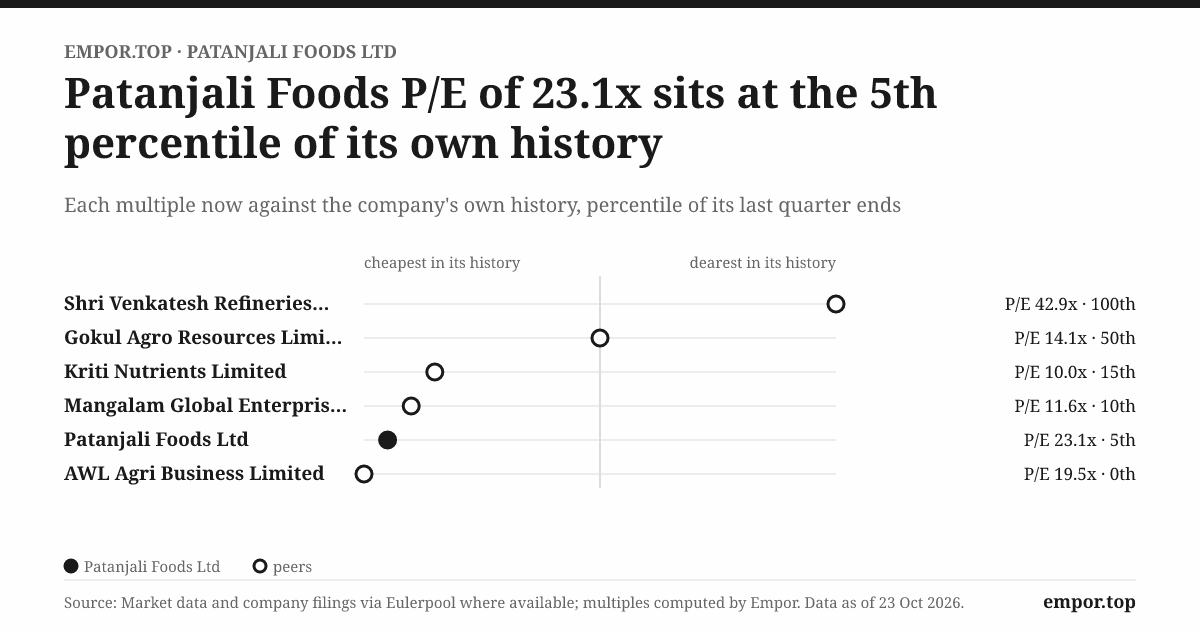
On 23 October 2026, Patanjali Foods traded at about 23 times its trailing earnings, less than half its own five-year median of about 50 times.1 On that measure alone the stock looks cheaper than it has for most of its post-rescue life. Look at other measures and the picture changes.
The enterprise value was about 19 times EBITDA, and the free-cash-flow yield was about 0.1%, which means investors were paying ₹1,000 for roughly a rupee of free cash.1 AWL Agri Business, the closest listed edible-oil peer, traded at about 20 times earnings but only about 12 times EBITDA and 0.4 times revenue, against Patanjali Foods' 0.9 times revenue.17
The puzzle is why the same company looks cheap on one metric and expensive on two others. The answer lies partly in the earnings line. Trailing earnings include the FY2026 tax credit, which pushed net profit above pre-tax profit for three quarters. A rough adjustment shows its size. Over the twelve months to June 2026, pre-tax profit was about ₹1,550 crore.
Taxed at a normal rate of about 25%, that would leave roughly ₹1,170 crore of net profit, against reported trailing profit of nearly ₹2,000 crore. Divide a market value of about ₹38,000 crore by the normalised figure and the price-to-earnings ratio is in the low thirties, not 23.13 The apparent discount to history shrinks considerably once the tax credit is set aside.
The five-year median itself is a weak anchor. It was set during a period when the float was tiny, the share count was different before the 2025 bonus issue, and the business mix had not yet absorbed home and personal care.1 Comparing today's multiple with a median from a different company, with a different shareholder base and different earnings regime, tells you more about how far the scarcity premium has deflated than about whether the shares are now cheap.
The comparison with AWL also needs care. The two companies differ in mix: Patanjali Foods has a much larger branded consumer business and a meaningful plantation operation, so a premium to a more oil-heavy rival is not irrational. The question is whether the premium is earned. At roughly 19 times EBITDA, the market is pricing Patanjali Foods closer to a consumer company than to a refiner, while its revenue, and in good oil years most of its profit, still comes from refining.
The bull case is easiest to state in its strongest form. Patanjali Foods owns brands that sell—Nutrela, Doodh biscuits and Dant Kanti—and a distribution network that ICRA counts at over two million retail touchpoints.[^1] Its consumer segments earn margins far above oil, with biscuits, soya chunks and toothpaste at levels that look like genuine branded franchises.14
The plantation business is a slow-maturing source of backward integration that already contributes meaningfully to oil-segment profit.[^1] The balance sheet has no term debt and an AA− rating, so it can carry the company through a bad commodity year.[^1] And management has given specific, checkable targets. If the consumer business compounds at the guided rates and oil margins stay in their range, earnings could grow faster than the market's current multiple implies.
The bear case is equally concrete. The business remains exposed to oil-cycle swings, which also make the consumer transformation harder to assess.[^1] Cash conversion remains weak, with operating cash flow negative in FY2026.1 A meaningful share of recent profit came from tax credits and treasury income. Growth since 2021 includes businesses bought from the parent, so the organic rate is unknown. Related-party dealings remain a risk for minority shareholders.1
Hamilton Helmer's framework of seven powers sharpens the moat question. Scale economies are the most credible power: the company's crushing and refining scale, port-linked refineries and plantation network are hard to replicate, but scale in a commodity business protects volume more than margin. Branding is a real power in specific categories, where Nutrela and Doodh biscuits appear to command loyalty, but it is borrowed: the Patanjali brand belongs to the parent and is licensed back for a fee.
Counter-positioning, the "Indianness" and Ayurvedic positioning Asthana called the company's "right to win", may once have been powerful against multinational rivals, but it is a positioning that large incumbents can imitate with natural and herbal ranges, so it protects less than it once did.14 Network effects, switching costs and a cornered resource are hard to find; a shopper can switch toothpaste brands at the next visit. Process power, in commodity trading and hedging, exists but is also possessed by AWL and the global traders.
So the moat is narrower than the brand recognition suggests. The record supports a smaller claim: Patanjali Foods has scale in oil and a handful of strong branded franchises, and it has not yet shown pricing power that survives a commodity downturn.
The historical market-share figures in edible oils are dated, and ICRA's current estimate places the company second in branded edible oils with 9% to 10%, not in a dominant position.[^1] The company does not publish repeat-purchase rates, retailer retention or price realisation by brand, the data that would test the moat directly.
What would change the verdict? Several years of organic volume growth in FMCG, published separately from acquired businesses, would establish that the consumer engine grows on its own. Stable or rising FMCG margins in a year when oil margins are also healthy would show that the consumer business's profit is genuine, not a ratio flattered by a weak refining year.
Measurable returns on the transferred businesses, net of royalties, would answer the related-party question with numbers. And operating cash flow that tracks profit for more than one year would settle the cash-conversion doubt. Each of these is observable in the company's own disclosures. None of them has yet been delivered on a sustained basis.
Some shareholders have made that doubt explicit. On the August 2026 call, one investor recalled the shares falling 14% in a single day in July, the day before Swami Ramdev presented at the Bombay Stock Exchange, and described the slide from about ₹415 to about ₹340 as "quite disconcerting".14 The investor asked for a valuation note on the home and personal care deal to reassure the market. Management declined.14 Investors were telling the company that the related-party question was now part of the share price, and the company's answer was that it had nothing further to add.
The market, by pricing the company near 19 times EBITDA and a sub-1% free-cash-flow yield, appears to be assuming that most of those things will happen. Recent price weakness suggests some investors have started to doubt it. Either way, the investment case rests on cash and segment profit, not on the brand or the rescue.
XI. Playbook: Business & Investing Lessons
The first lesson begins in a bankruptcy court. Patanjali's discounted rescue of Ruchi Soya was only a starting point.4 But the discount was only a starting point.
What the group actually bought was a thin-margin oil processor that still had to earn its keep, and every year since has been spent proving it can. A cheap rescue is only cheap if the rescued company can earn its keep. For investors, the price paid by the acquirer tells you about the creditors' loss, not about the shareholders' future return.
The second lesson is about names. The 2022 public offer was followed within weeks by the rename and approval of a parent-business transfer.12 The rename changed how the market described the company long before it changed how the company earned money. A new label can move the story faster than the economics. Founders and investors should notice when a rebrand arrives before the numbers that would justify it, and judge the company by the numbers.
The third lesson sits in a single exchange on a conference call. Asked how the home and personal care business was valued, the chief executive said there was no valuation methodology, that the business had been almost gifted by the parent.14 Asthana may well be right that the price was low.
But when the seller controls the buyer, the generosity of the price is not the only term that matters; the 20-year royalty, the services contracts and the future transfers are part of the bargain too. When the seller controls the buyer, the price is part of the story, not the end of it. The wider lesson for minority investors in any controlled company is to read related-party notes as carefully as income statements.
The fourth lesson is the one the accounts teach most patiently. Since the rescue, profit has repeatedly run ahead of operating cash.31 FY2026, its most profitable year, ended with operating cash flow below zero.
Profit is a promise; cash is the receipt. In a business that buys commodities months before selling them, extends credit to distributors and books tax credits, the receipt can lag the promise for years. Investors should build their view of value on the receipts.
The fifth lesson concerns float. Ruchi Soya's post-2020 share-price surge came when almost no shares traded; the public offer and subsequent price drift brought the business underneath into greater focus.57 A price without a float is an opinion, not a valuation. It is a lesson that applies to every tightly held stock that looks expensive and keeps rising.
XII. Epilogue
Tonight, Patanjali Foods sits at an awkward midpoint. It is no longer the bankrupt oil company Patanjali bought, and it is not yet the consumer company its name suggests. Its consumer businesses still carry a disproportionate share of profit, though that share swings with oil margins.114 Cash conversion remains strained, and its shares trade more than 40% below their high.31 Management is promising faster growth and about ₹2,500 crore of annualised EBITDA within eighteen months.14
The next scenes are already scheduled. The September-quarter results, due in the coming weeks, will show whether the inflation tailwind in oil held and whether the staples losses of the June quarter narrowed. The full FY2027 accounts will show whether receivables and inventory eased as sales grew, and whether operating cash flow returned towards profit after the negative turn of FY2026.
The same annual report will show what happened to the ₹600 crore biscuit-machinery advance: whether YEIDA approval was obtained within the six-month period, whether the machinery was delivered and independently valued, and whether the plant is producing. Each of those is a fact, not a forecast.
What would each outcome mean? If FMCG margins hold or rise in a year when oil also does well, the consumer engine is earning its own place, independent of the oil cycle. If operating cash flow catches up with profit, the cash-conversion doubt fades, and the dividend stops depending on the balance sheet.
If the advance results in a working plant at a benchmarked price, the related-party question gets an answer in steel and output. If, instead, cash keeps lagging profit, staples keep losing money and the advance remains an advance, the transformation story weakens into what it might always have been: an oil refiner with a licensed brand and an owner on the other side of the table.
The central questions have not changed since Patanjali took control. Where is growth created? Does profit become cash? Are the transfers fair? Does the price compensate for the risk? The difference now is that every one of them can be answered from the company's own disclosures, in the next few reports.
XIII. Outro
Go back to the shop shelf. A pouch of cooking oil carries oil that was most likely bought on world markets in dollars, then refined and packed by a company that went bankrupt in 2017. Above it, a tube of toothpaste carries a yoga teacher's brand, licensed from a private company that owns nearly a third of the listed one. The two products sit in the same accounts and are sold by the same distributors, yet they earn completely different margins.
That is what makes Patanjali Foods unlike any other listed oil company. Its scale comes from a commodity, its premium from a brand it does not own, and its future from businesses bought from its own controlling shareholder.
In FY2026 edible oils brought in about 72% of the revenue and the consumer business about 61% of the EBITDA.1 The wellness promise is on the packet. Whether it can earn its place in the oil company's cash flows, without leaving working capital, royalties and related-party balances behind, is the one test the brand cannot pass for it.
References
-
Patanjali Foods Limited Integrated Annual Report 2025–26 — FinancialFilings, 2026-09-05 ↩↩↩↩↩↩↩↩↩↩↩↩↩↩↩↩↩↩↩↩↩↩↩↩↩↩↩↩↩↩↩↩↩↩↩↩↩↩↩↩↩↩↩↩↩↩↩↩↩↩↩↩↩↩
-
Ruchi Soya Roadshow — Patanjali Foods, 2021-07-21 ↩↩↩↩↩↩↩↩↩↩↩↩↩↩↩↩↩↩↩↩
-
Patanjali Ayurved revises offer for bankrupt Ruchi Soya — Rediff, 2019-03-13 ↩↩↩↩↩↩
-
Ruchi Soya Industries Limited Red Herring Prospectus — Patanjali Foods, 2022-03-11 ↩↩↩↩
-
Acharya Balkrishna steps down as Ruchi Soya MD — Business Today, 2020-08-19 ↩↩
-
SEBI asks Ruchi Soya to permit FPO investors to withdraw bids — Free Press Journal, 2022-03-29 ↩↩↩↩↩
-
Ruchi Soya plunges as FPO price band set at ₹615–650 — The Economic Times, 2022-03-21 ↩↩
-
Ruchi Soya FPO: Company postpones board meeting to fix issue price — Business Today, 2022-03-29 ↩↩↩
-
Ruchi Soya Industries Limited — SEBI public issue filing, 2022-04-04 ↩
-
Patanjali Foods Shareholding Pattern — KK Securities, 2026-09-30 ↩↩↩↩
-
Outcome of Board Meeting held on May 18, 2022 — Ruchi Soya Industries, 2022-05-18 ↩↩↩
-
Patanjali Foods to acquire Patanjali Ayurved's home, personal care biz for Rs 1,100 crore — Business Today, 2024-07-01 ↩↩↩↩
-
Patanjali Foods Limited Q1 FY27 Earnings Conference Call Transcript — Patanjali Foods, 2026-08-17 ↩↩↩↩↩↩↩↩↩↩↩↩↩↩↩↩↩↩↩↩↩↩↩↩↩↩↩↩↩↩↩↩↩↩↩↩↩↩↩↩↩↩↩↩↩↩↩
-
India's top yoga guru faces judges' ire in misleading ads case — Reuters via Investing.com, 2024-04-02 ↩
-
AWL Agri Business Valuation Multiples — Multiples.vc, 2026-10 ↩
 LinkedIn
 WhatsApp
 Reddit
 Hacker News
 Email
 Kindle
 RSS Feed
 Spotify
 Apple Podcasts
 Amazon Music
 Audible
 YouTube