Maruti Suzuki: The ₹3.6 Trillion Fortress on Four Wheels
I. Introduction & Episode Setup (10-15 min)
On December 14, 1983, in New Delhi, Prime Minister Indira Gandhi handed a set of car keys to an Indian Airlines employee named Harpal Singh. The car was small and white. It had a 796cc engine, weighed about as much as a large motorcycle with a sidecar, and cost ₹47,500. Singh had won it in a draw. The car was a Maruti 800, and for millions of Indian families it was the first car they could realistically own.
The ceremony had a sad side. The project had belonged to Indira Gandhi's younger son, Sanjay, who died in a plane crash three years earlier. A car company that began as a family's grief became a national project, and later one of the most dominant carmakers any large economy has produced. Tonight it is worth about ₹3.6 lakh crore, roughly $37 billion3.
Here is the twist this story keeps coming back to. Maruti Suzuki India Limited is not really an Indian national champion that happens to have a Japanese partner. It is controlled by Suzuki Motor Corporation (スズキ Suzuki) of Hamamatsu, which owns about 58% of the equity[^5]. India is where most of Suzuki's cars are made and sold. By volume, the listed Indian subsidiary is the center of the Japanese group's car business, not an outpost of it6.
Three numbers set the stage. Maruti sold more than 2.1 million vehicles in FY2024, about 1.85 million at home and roughly 280,000 abroad[^2]. It holds about ₹1.03 lakh crore (about $10.7 billion) in cash and financial investments and has essentially no debt[^2]2. And its parent takes a technology royalty that the company's own disclosures put at around 3.5% of net sales, which is billions of rupees sent to Hamamatsu every year[^2].
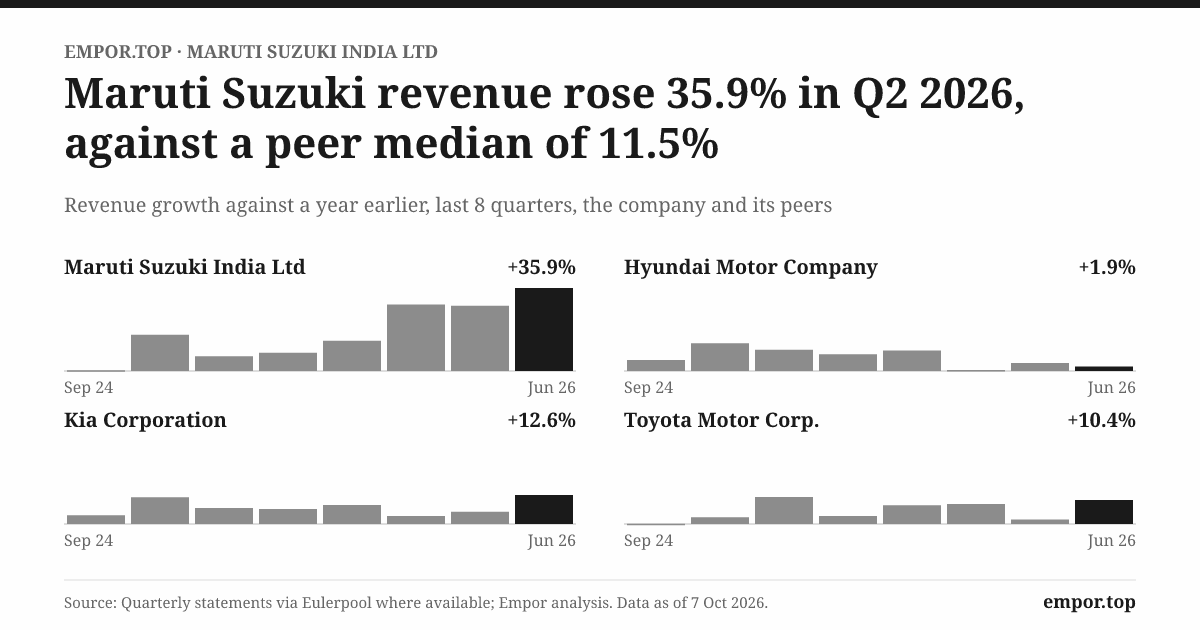
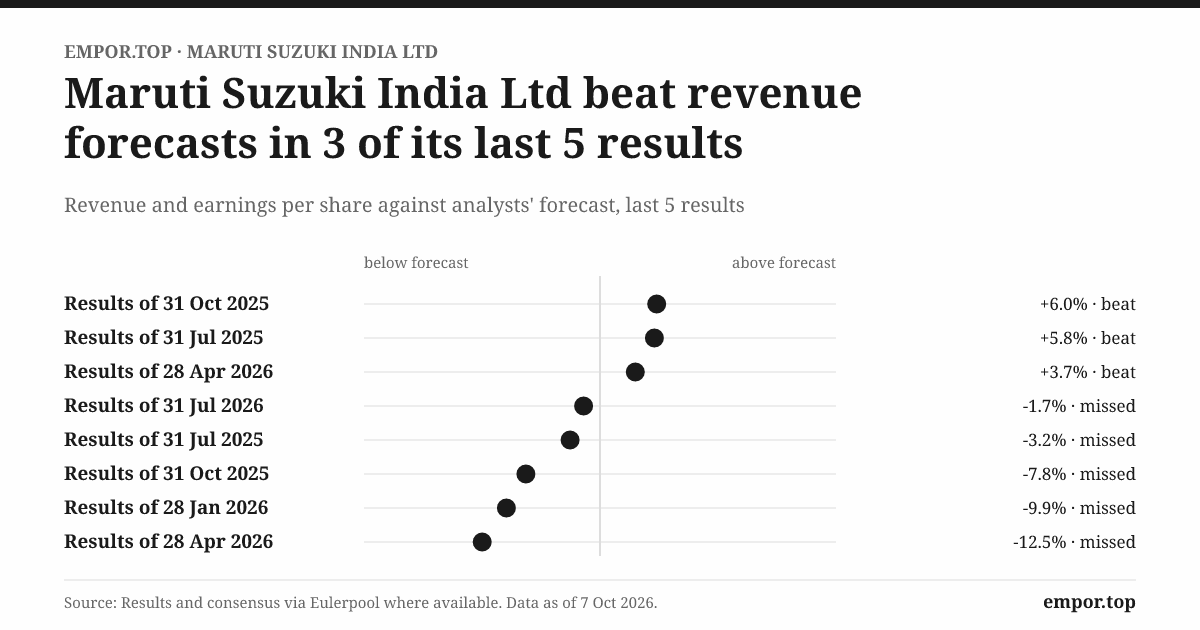
That sets up the question for this episode. Is Maruti a manufacturing and distribution flywheel that no rival can copy? Or is it a cash-extraction machine run for a foreign parent, sitting on a huge pile of idle cash while the world's cars switch to batteries? The recent figures make the question urgent. In the June 2026 quarter, revenue rose about 36% year on year, yet net profit fell about 9% and the reported operating margin dropped to single digits3.
The roadmap: Sanjay Gandhi's failed prototype and the 14-month factory built with Osamu Suzuki; the 1990s fight between Hamamatsu and New Delhi for control; the privatization and IPO; the Manesar riot; the Gujarat plant controversy; the SUV squeeze; the cash pile; and the "Maruti 3.0" plan to reach 4 million cars a year. Like most Indian origin stories, it starts with a politician and a dream that failed before it worked.
 Subscribe on LinkedIn
II. The Sanjay Gandhi Dream & The 14-Month Gurgaon Miracle (1970–1983) (35-45 min)
In the early 1970s, near Gurgaon on the dusty edge of Delhi, a young man with no engineering degree and plenty of political protection set out to build India's "people's car." Sanjay Gandhi got the licence and the land. What he never got was a car that worked. His company, Maruti Limited, produced prototypes, attracted accusations of favoritism, and went into liquidation in 1977 after the Emergency ended and his mother lost power1.
Then Sanjay died. On June 23, 1980, he crashed a Pitts S-2A aerobatic plane over New Delhi. Indira Gandhi, back in office, decided her son's project would not die with him. In 1980 and 1981 the state acquired the remains of the old company, and Maruti Udyog Limited was incorporated in February 1981 as a public-sector undertaking1. Turning a failed private venture into a state company in a dead son's memory looks like the opposite of good capital allocation. It worked anyway, mostly because of the people hired to run it.
The search for a partner
The government put V. Krishnamurthy in charge. He was a bureaucrat-technocrat who had already turned around the state-owned Bharat Heavy Electricals, and he was blunt and fast. R.C. Bhargava, an IAS officer, was his marketing chief and right hand, and he would stay with the company for more than four decades4. They had a political deadline, very little money, and a country that lacked the supply base to build a modern car.
They went to Europe first. Renault, Peugeot, Volkswagen and others looked at India's requirements, which were fast localization of parts, a minority stake, and a cheap small car, and said no or offered terms New Delhi would not accept. Suzuki was close to an afterthought. It was best known for motorcycles and Japan's tiny "kei" cars, the boxy minis that Japanese rules keep under strict size and engine limits.
The fit is clear in hindsight. Kei cars are built to be cheap, light and economical, which is what Indian roads and wallets needed. Suzuki was also the underdog at home, squeezed by Toyota and Nissan, and it needed a growth market far more than India needed Suzuki. Osamu Suzuki (鈴木修), the company's combative and famously frugal president, made the bet personally. The joint-venture agreement was signed in 1982, with Suzuki taking 26% of the equity16.
Fourteen months
What followed surprised the industry. At Gurgaon, Suzuki engineers and Indian managers built a car plant from scratch, and the first cars rolled out roughly 14 months later in December 1983. That is a fast schedule anywhere and a startling one for an Indian state company in the License Raj. Buyers had already shown up: advance bookings ran far ahead of what the plant could make1.
The less visible decision mattered more over time. Maruti had to localize, so it helped create its supplier base, often by co-investing in joint ventures with Indian business families and Japanese component makers. Names such as Subros (air conditioning), Krishna Maruti (seats) and Sona Koyo (steering) came out of this period. The cluster of suppliers around Gurgaon and Manesar became the base of India's modern auto-component industry[^2].
For investors, this is where the moat started. It was not a patent or a brand. It was a supply chain built in Maruti's image, with suppliers next door, sharing Japanese production habits, and tuned to Suzuki's designs. It also set up the tension that runs through the whole story: the designs were Suzuki's from the start. India supplied the market, the land and later the capital. Japan supplied the engineering. That split has never been undone. First, though, the small white car had to prove itself on the road.
III. The Maruti 800 Revolution & The License Raj Decimation (1983–1996) (40-50 min)
Picture a Delhi traffic light in the summer of 1985. On one side sits an Ambassador, a car built by Hindustan Motors on the 1950s Morris Oxford design: heavy, rounded, slow, prone to overheating, and so scarce that buyers had been on waiting lists for years. Next to it is a Premier Padmini, a licensed Fiat that was equally old. Then a Maruti 800 pulls up. It is small and quiet, it often has air conditioning, and its owner is buying far less fuel. When the light changes, it simply leaves the other two behind.
That is the 1980s in short. For thirty years, protected by import bans and licensing quotas, India's car market had been a sleepy duopoly that sold old designs to people with no choice. Maruti took that market apart in about a decade.
Why the 800 worked
The engineering is worth explaining, because it is the whole product idea. The 800 came from Suzuki's kei-class Alto/Fronte. Its engine sat sideways at the front and drove the front wheels, which frees cabin space in a short car. Its body was a monocoque, a single welded steel shell rather than a body bolted onto a heavy frame, so it was much lighter, at around 650 kilograms. Light weight plus a small three-cylinder engine meant fuel economy that Ambassador owners could only imagine. A good comparison is a modern smartphone set beside a rotary-dial phone: it did the same basic job, but differently enough that the old product suddenly looked silly.
More than 2.8 million 800s were built over a production run that lasted into the 2010s1. By the early 1990s Maruti controlled a large majority of India's passenger-car market1.
The portfolio and the service web
Maruti did not stop at one car. The Omni van followed in 1984 and became India's do-everything vehicle: school transport, ambulance, delivery van. The Gypsy, a sturdy four-wheel drive, became a mainstay of the army and police. The Maruti 1000 sedan arrived in 1990 and the Zen hatchback in 19931.
The less glamorous move turned out to be the more durable one. Maruti built authorized service workshops along national highways and into small towns where no other carmaker bothered to go[^2]. Its lesson was simple: in a country with bad roads and long distances, a car is only worth what it costs to keep running. A buyer in a hill town did not care about horsepower. They cared whether a mechanic in the next town had the part.
1991 and the newcomers
Then the walls came down. The 1991 liberalization under P.V. Narasimha Rao and Manmohan Singh let in foreign carmakers: Daewoo with the Cielo and Matiz, Hyundai with the Santro, Ford, and others. Many expected Maruti, a protected state company, to fold under real competition.
It did not. Maruti's market share fell from its monopoly peak, which was always going to happen, but it stayed by far the largest player. The main reason was cost. Its parts were made locally by suppliers it had built, while newcomers imported more parts and paid in foreign currency. Daewoo later left India after its parent collapsed. Ford stopped making cars in India in 2021 after years of losses[^2]. Hyundai, which localized hard and copied Maruti's approach, is the main survivor that thrived.
The historical test here is whether Maruti's dominance was only a product of protection that would vanish once the protection did. Mostly, it was not. The company kept its lead for three decades of open competition. But the version of the claim that holds up is smaller than the myth: the lead rested on cost and distribution in small, cheap cars, not on any special strength across the whole market. That limit matters a great deal later, when the market moved toward SUVs. Before then, though, the biggest threat to Maruti came from its own owners.
IV. The Ownership Civil War: Government Bureaucracy vs. Hamamatsu (1996–2003) (35-45 min)
In 1997 the Government of India and Suzuki Motor Corporation each owned half of Maruti, and they could not agree on who should run it. When the managing director's term came up, the industry ministry under Murasoli Maran pushed through its own choice, R.S.S.L.N. Bhaskarudu, over Suzuki's objection. Osamu Suzuki took the Government of India to international arbitration16. A Japanese company suing a sovereign government over its most visible industrial joint venture was an extraordinary step, and it showed how badly the partnership had broken down.
How it got there
Suzuki had been raising its stake steadily: from 26% to 40% in the late 1980s, and then to 50% in 19921. On paper, a 50-50 split looked balanced. In practice, neither side could make decisions. Suzuki wanted to reinvest in new paint shops, new models and upgraded powertrains. To a coalition government in the late 1990s, Maruti was a showcase public asset, a source of patronage and a political symbol. The government had neither the money nor the inclination to invest.
R.C. Bhargava, who had become managing director before Bhaskarudu, was caught in the middle. He was an Indian civil servant who had taken Japanese management habits seriously: open-plan offices, shared canteens, uniforms for everyone. That made him look like Suzuki's man to some in New Delhi. He left the managing director post in 1997 and returned in later decades as chairman4. This is where the culture that still runs Maruti took shape: Indian leadership trained in Japanese process, largely unwilling to let politicians decide plant investments.
The settlement and the exit
The dispute was settled in 1998, and the political climate shifted. The Vajpayee government set up a disinvestment ministry, and Arun Shourie, its minister, argued that the state had no reason to run car factories. In 2002, Suzuki subscribed to a rights issue and paid the government a control premium of about ₹1,000 crore, taking its stake to just over 54% and becoming the controlling shareholder16. The government became a minority investor in a company it had created.
The IPO came in June 2003. Investors wanted in, the book was oversubscribed many times, and the shares listed well above the offer price9. The government sold its remaining stake over the next few years and was fully out by 20071.
What it meant
The 50-50 structure did not work, and Maruti's commercial revival needed the state to step back. That is the right conclusion, but it comes with a catch that investors still deal with. The fix was not independence. It was handing control to a different owner. Before 2002, Maruti answered to bureaucrats. After 2002, it answered to Hamamatsu. A minority shareholder buying in 2003 traded political interference for something less visible: the risk that the controlling parent's interests and the listed company's interests would sometimes diverge. That risk would surface twice more, once violently and once in a boardroom. The violent one came first.
V. The Blood on the Shopfloor: The Manesar Labor Catastrophe (2011–2012) (30-40 min)
On July 18, 2012, at the Manesar assembly plant in Haryana, a dispute that began with an altercation between a supervisor and a worker turned into a riot. Fires were set in parts of the plant. When the violence ended, Awanish Kumar Dev, the plant's general manager for human resources, was dead. He was killed in a fire in a conference room, and many managers were injured7. India's most admired factory had become a crime scene.
How Manesar was built
Manesar was supposed to be the future. It opened in 2006/2007 to build newer models such as the Swift and the SX4, and it ran at a pace Maruti was proud of[^2]. Like much of the Gurgaon-Manesar belt, it used a two-tier workforce. Permanent workers had good wages and security. Next to them, on the same line doing similar work, were contract workers hired through agencies, paid much less, and easy to let go.
Workers had tried for more than a year before the riot to register an independent union. There were strikes and sit-ins in 2011. The complaints were familiar ones: the speed of the line, rigid break rules, wage deductions for absence, and above all the gap between permanent and contract workers7.
The aftermath
The company locked out the plant for about a month. Police arrested well over a hundred workers. Maruti dismissed hundreds of permanent workers and ended the contract labor at the plant7. In 2017 a Gurgaon court convicted 31 workers, 13 of them sentenced to life imprisonment, and acquitted the rest. Labor groups have called the case a miscarriage of justice, and the appeals process continued for years7.
Management's main response was structural. Maruti reduced its reliance on agency contract labor and moved temporary workers onto company-run programs with defined pay and paths into permanent work, while pay for permanent employees rose substantially7. Shinzo Nakanishi, then managing director, and Bhargava, as chairman, presented this as the lesson learned.
Testing "labor peace"
Has labor stayed calm? Since 2012, Maruti has not had a disruption of that scale, which is real progress7. But the claim is narrower than "solved." The intensity of production has not changed; it is the business model. Contract and temporary employment is still widespread across the supplier tier, outside Maruti's direct control, and an unrest-driven outage at a key supplier can stop the assembly line as easily as a strike inside the plant. The risk has moved upstream rather than disappeared. What would test this is any prolonged stoppage at a tier-1 supplier during a demand peak, or new organizing at the Gujarat or Kharkhoda plants as they hire.
The deeper lesson from Manesar is that Maruti's cost advantage had a human component the market had not priced. Lower costs were partly lower labor costs. Two years later the cost-cutting question returned, this time in a fight about who should own the factories.
VI. The Suzuki Motor Gujarat Controversy: Capital Extraction or Capacity Gift? (2014–2023) (45-55 min)
In January 2014, Maruti's board announced that its next big plant, in Gujarat, would be built and owned not by Maruti but by a new wholly owned subsidiary of Suzuki Motor Corporation. Maruti would buy the cars that plant produced. Investors reacted badly. The shares fell sharply, mutual funds and proxy advisers objected in public, and a fight over who owned Maruti's growth followed[^13].
Why investors were angry
The worry is easy to state. Maruti had spent thirty years building a manufacturing business, and its cash balance was large and growing. Under the Gujarat plan, the next increment of capacity, and potentially the one after that, would belong to the Japanese parent. The listed company risked becoming a distributor and marketer, buying cars from a related party at a price the related party could change. Institutional investors described it as a structure that could move value out of minority shareholders' hands without anyone breaking a rule[^13].
Suzuki's argument was that Maruti would keep its cash and avoid tying it up in capex, and that the cars would be supplied at cost with no profit margin for the parent. Under pressure, Maruti amended the agreement so the arrangement was close to a no-profit, no-loss structure. It also agreed that the deal would be put to a vote of minority shareholders, with Suzuki excluded from voting[^13]. The minority shareholders approved it.
What happened in practice
Suzuki Motor Gujarat (SMG) did supply cars to Maruti at cost[^4]. But in practice the setup created another problem. With capex off Maruti's books, its cash and treasury balance kept growing. Money that could have earned the returns of a car plant sat in debt funds and deposits. Over the following decade Maruti got the outcome investors had worried about from the opposite direction: it was capital-light, but its idle capital pulled down its return on equity.
The 2023 reversal
By 2023 the arrangement was being unwound. Maruti's board agreed to buy all of SMG from Suzuki for about ₹12,841 crore, paid entirely in new Maruti shares. About 12.3 million new shares were issued to Suzuki at about ₹10,421 each, lifting the parent's stake from about 56.5% to about 58.2%[^4][^5]. In the postal ballot, about 98% of votes cast backed the deal[^5].
Was the price fair? The consideration was set close to the net value of the plant's assets rather than a large premium for control or future profit, which made sense because SMG had been run to earn no profit[^4]. Paying in shares at a price near the stock's historical highs also preserved Maruti's cash[^4][^5]. The cost was paid in ownership: Suzuki's stake rose, and the minority's fell slightly. Investors accepted the trade-off by a wide margin.
The verdict is that the 2014 structure was a governance mistake that cost Maruti credibility with investors for nearly a decade, and the 2023 deal fixed it fairly. Now all the large car plants, Gurgaon, Manesar, Gujarat and in future Kharkhoda, sit inside the listed company[^2].
The friction that remains
One flow still goes to Suzuki: the royalty. Maruti pays Suzuki a technology royalty on car sales. Maruti's own disclosures put it at roughly 3.5% of net sales, which at current sales is several thousand crore rupees a year[^2]. Measured against operating profit before the royalty, that is a large share; in typical years it is plausibly a fifth to a quarter or more of what Maruti would otherwise earn from operations. Two developments help the minority's case: royalty agreements for newer models are denominated in rupees rather than yen, which removes the currency risk, and Maruti has said the royalty rate on newer models has tended to come down as more development work moves to India[^2][^10]. The test is straightforward to state: does the royalty as a share of sales trend lower over the next few years as the Rohtak R&D center takes on more work? If it does, the relationship is evolving fairly. If it does not, the parent is still the listed company's most important cost line. That question becomes more pressing as the market moves away from the cars Maruti built its business on.
VII. The Modern Battlefield: The SUV Squeeze & The Hatchback Collapse (2018–2026) (40-50 min)
At Auto Expo 2020, Maruti confirmed something that looked like surrender. With India's BS-VI emission norms making diesel engines more expensive, the company would stop selling diesel cars[^2]. That left the busy mid-size diesel SUV segment to Hyundai's Creta and Kia's Seltos, which Korean rivals 현대자동차 Hyundai Motor and 기아 Kia were already selling quickly. For a company that had defined the market for decades, it looked like a retreat.
The small car problem
Two things were happening together. First, the entry-level car became more expensive to make. Emission standards, mandatory airbags and safety features, and pricier materials raised the cost of the most basic hatchbacks. Second, the buyers themselves were squeezed. After COVID, India's recovery split: affluent urban buyers did well and traded up, while the first-time buyers in small towns who used to buy an Alto or a WagonR held back. The bottom of the market, Maruti's heartland, stalled.
The SUV counterattack
Maruti answered with a run of utility vehicles: an updated Brezza, the Grand Vitara, the Fronx, the Jimny, and seven-seaters. Some came through the alliance with トヨタ自動車 Toyota Motor: Maruti and Toyota sell rebadged versions of each other's cars, with the Grand Vitara and Toyota's Hyryder built at Toyota's Bidadi plant, while Maruti supplies cars such as the Baleno and Ertiga that Toyota sells under its own badges8. This let Maruti fill SUV gaps faster than it could have alone, and it gave Toyota cheap Indian volume.
It largely worked. Utility vehicles rose toward roughly half of Maruti's domestic sales, from a small share a few years earlier, and the company stayed around 40% of the passenger-vehicle market[^2][^10]. Average selling prices rose with the mix, which explains why revenue grew so fast from FY2021 onward.
The CNG play
The cleverest part of the diesel exit was CNG. Compressed natural gas is cheaper per kilometer than petrol in much of India, and Maruti sold factory-fitted CNG versions of most of its range, with the warranty and service network that aftermarket kits lacked. It became the clear leader in factory-fitted CNG cars, and CNG reached around a third of its sales[^2][^10]. It turned the absence of diesel into a cheaper alternative that its rivals had largely not matched.
What the margin collapse does and doesn't show
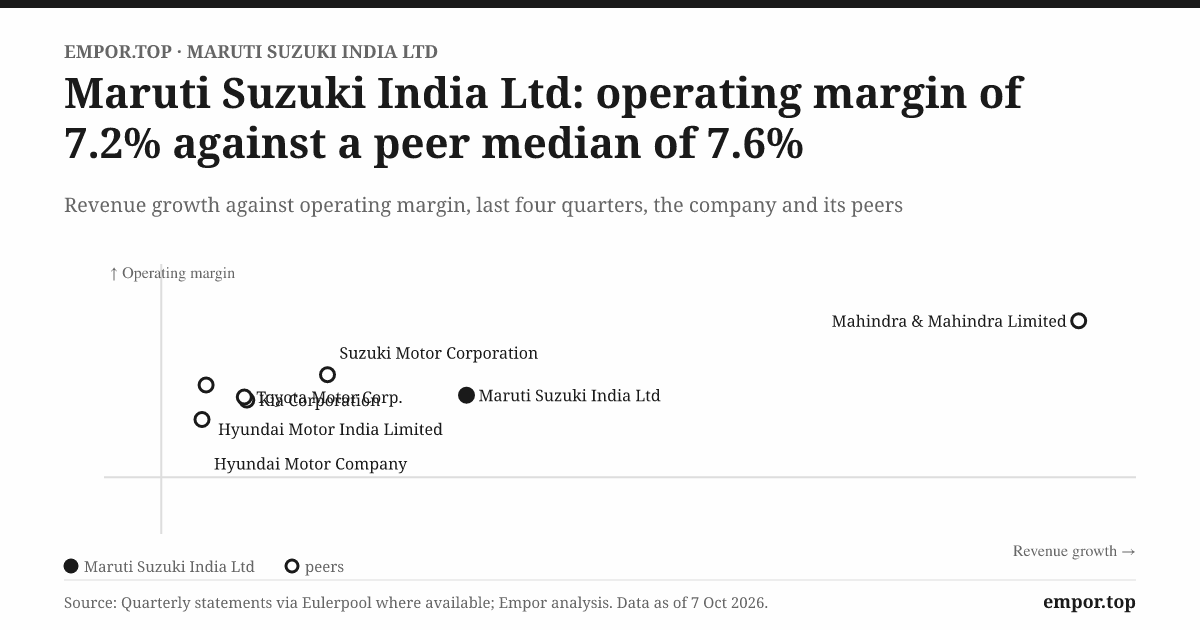
Now the June 2026 quarter, where the bear case begins. Revenue rose about 36% year on year to about $5.5 billion3. The reported operating margin, which had run in the mid-20s on the data provider's basis for years, fell to about 8% from September 2025 and to about 5% in the latest quarter3.
A careful reader should pause before accepting that as the whole story. Over the same period, profit before tax barely moved, and EBITDA on the same data set rose, which is impossible if operating profit truly collapsed by two-thirds3. The likeliest explanation is that the reclassification affects how the data provider splits costs, not the underlying business. The measure that does not depend on classification is net profit, and it tells a quieter but real story: net margin slid from roughly 10% a year earlier to about 6.6%, and net profit fell about 9% despite sales up by more than a third3. Maruti was moving many more cars and keeping less from each one.
The reasons management and the industry have discussed are familiar: heavy discounting to clear dealer stock, higher marketing spend, rising commodity and electronics costs, and a growing share of lower-margin exports and new launches[^3]5. The honest conclusion is that the margin squeeze is real but smaller than the reported "operating margin" line suggests. Maruti defended its share in SUVs, but at a cost in pricing. That defense was paid for, and the bill sits in the cash pile.
VIII. The Balance Sheet Fortress & The ₹1 Lakh Crore Question (30-40 min)
At Maruti's annual meetings in recent years, the question has come up repeatedly in some form: why does a company growing this steadily keep so much money in mutual funds? Chairman Bhargava's consistent answer has been that the auto industry is cyclical, that capacity expansion is expensive, and that Maruti will not borrow[^2][^10]. The figures behind both sides of the argument are striking.
The cash machine
Maruti's business model funds itself. Dealers pay for cars quickly, mostly through bank inventory financing, so Maruti collects in about 11 days. It pays its suppliers in around two months. Inventory turns over in roughly four weeks3. The result is negative working capital: suppliers effectively finance Maruti's operations, so more sales release cash instead of tying it up. It is like a restaurant that is paid at the table but settles with its farmers sixty days later.
Over the twelve years from FY2015 to FY2026, that meant about ₹1.2 lakh crore of operating cash flow against about ₹97,000 crore of net profit, a conversion rate around 124%[^2]3. Receivables are not a concern: debtor days stayed in a narrow range for over a decade, no customer accounts for a tenth of sales, and bad-debt provisions are negligible[^2].
Where the cash went
After capex, Maruti produced about ₹55,500 crore of free cash flow over those twelve years. It paid about ₹25,000 crore of that as dividends, about 45% of free cash flow and a median payout of about 28% of net profit3. Most of the rest stayed in the business, much of it in the treasury. Cash and investments now total about ₹1.03 lakh crore, roughly $10.7 billion[^2]3.
That treasury earns real money. In FY2024, other income, mostly treasury returns, was about ₹3,850 crore, close to a fifth of profit before tax[^2]. In a downturn, that cushion keeps profit up while car margins fall, as it did in the June 2026 quarter.
The skeptic's case
The cost shows up in returns. Return on equity is about 13–14%, though return on capital invested in the car business has historically been 30–40% on the data provider's basis3. Investors are effectively holding a strong car business and a large bond fund together, and the bond fund dilutes the result.
An activist would ask why Maruti has not bought back shares. The real reasons are part structural and part cultural. A buyback would raise Suzuki's stake further, unless Suzuki tendered its own shares, and Indian takeover and tax rules make large buybacks by a controlled company awkward. Suzuki also gets its cash in other ways: dividends on its 58% and the royalty, which is paid before profit is calculated and before minority shareholders get anything. From Hamamatsu's point of view, the current setup works.
The solvency side is beyond question. Borrowings are trivial, and CRISIL rates the company AAA with a stable outlook2. Enterprise value, at about $35.5 billion, is below market value of about $37.3 billion, because the cash exceeds the debt3.
The verdict: the fortress is real, and it has paid off in downturns. The record also shows that "conservative" has meant, in practice, "slow to return cash." The new spending plan offers Maruti its best justification yet for keeping the pile, since it is about to spend a lot of it.
IX. Maruti Suzuki 3.0: The 4-Million-Car Gigafactory Race (30-40 min)
At Kharkhoda in Sonipat district, Haryana, cranes are working over about 800 acres of former farmland. When fully built, Maruti says the site will make about a million vehicles a year, which would make it one of the largest single car manufacturing sites in the world[^14]. It is the centerpiece of a plan Bhargava announced in 2023: double capacity to about 4 million vehicles a year by FY2031[^14].
Paying for it
The scale is visible on the balance sheet. Property, plant and equipment roughly doubled from about $2.5 billion in FY2023 to about $4.9 billion in FY2026, partly from absorbing the Gujarat plant and partly from new construction3. Capital work in progress was already about ₹6,300 crore at the end of FY2024[^2]. All of it has been funded from internal cash, with no debt and no public equity raising[^2]2. That is the strongest response to the critics of the cash pile: the money is being put to use.
The EV question
The open question is what Kharkhoda and Gujarat will make. Maruti held off on battery-electric cars for years while Tata Motors and Mahindra spent heavily to build early EV share. Its first electric model, the e-Vitara, built in Gujarat, was designed for export, including to Europe and Japan, as well as for domestic sale6. Management's case is "powertrain pluralism": CNG for cost-conscious commuters, strong hybrids for the middle, and battery EVs for wealthier city buyers, and no premature bet on one technology in a market where charging is patchy and battery costs are high5[^10].
That position can be defended. India's EV share remains small, and a company that went all-in on batteries too early could have lost money. But it carries a hidden asymmetry.
Who owns the technology
Maruti spends less than 1% of revenue on its own R&D, about ₹900 crore in FY2024[^2]. The platforms, the hybrid systems and much of the battery work sit with Suzuki and Toyota in Japan, and battery cells come through ventures in which the parent and its Japanese partners hold the key positions6. If the EV plan works, Maruti makes and sells the cars and pays royalties on them. If it fails, Maruti owns the idle factories. Either way, the intellectual property sits in Japan.
The history does not offer much reassurance on one point: Maruti has never been an engineering company. Its record is one of turning someone else's designs into cheap, reliable cars at large scale, which is a real skill but a different one. The test for Maruti 3.0 is whether the e-Vitara sells in volume and at a profit over its first several quarters, and whether Kharkhoda's first phase ramps on schedule.
Exports as the bright spot
Exports are a clear success. Maruti shipped more than 280,000 cars abroad in FY2024, to Africa, Latin America, the Middle East and Southeast Asia, and has kept growing the business since[^2][^10]. Dollar earnings from exports partly offset imported parts costs, and they make Maruti Suzuki's global base for small cars. That is the strongest evidence that the parent sees India as its center rather than a satellite. With the history and the capital story told, the lessons follow.
X. Playbook: Business & Investing Lessons (25-35 min)
Lesson 1: The partner must need you more than you need them. In 1982, the European majors treated India as a sideshow. Suzuki, the small player at home, treated it as survival, and sent its best people to Gurgaon for a 14-month sprint. That difference in commitment decided the next four decades. For founders and governments choosing a partner, look for the one whose future depends on the deal. A partner with nothing to lose will give you everything, and a partner with everything to spare will give you nothing.
Lesson 2: Service is the showroom. Maruti did not win only because its cars were cheap. It won because a buyer in a small hill town could trust that a mechanic with a genuine part was nearby. That network of service and spare parts made a Maruti easier to own and easier to resell than anything else. In a poor country, you don't sell a car, you sell the certainty that it will be fixed tomorrow.
Lesson 3: Let suppliers and dealers fund the growth. Maruti grew to more than 2 million cars a year with essentially no debt, because dealers paid quickly and suppliers waited two months. Negative working capital is the closest thing in manufacturing to growth that pays for itself. When your suppliers lend you the money and your dealers pay you first, every extra car is a deposit, not a loan.
Lesson 4: In a controlled company, watch the pipes, not the payroll. The governance risk at Maruti was never executive pay; the CEO earns a tiny fraction of profit4. It was the structures: a Gujarat plant owned by the parent, a royalty taken before profit. The 2014 revolt showed minority investors can push back, and the 2023 reversal showed they can win. In a multinational's listed subsidiary, the money moves through contracts, not bonuses.
Lesson 5: Cost per kilometer beats specifications. When rivals spent heavily on diesel and electric bets, Maruti put factory-fitted CNG across its range and won the commuters who count every rupee of fuel. In an emerging market, the best technology is the one that makes each kilometer cheapest.
XI. Strategy Moat & Hamilton Helmer's 7 Powers Analysis (25-35 min)
Look outside India's largest cities. New entrants such as MG, Citroën and 比亚迪 BYD have had real difficulty building dealer networks that make money in smaller towns, where volumes are thin and service expectations high[^2]. Maruti has more than 3,500 sales outlets across about 2,000 towns and cities, and more service points[^2]. Moats in this industry tend to be visible on a map.
Scale economies: strong. Fixed costs for tooling, stamping and design are spread over about 2 million cars a year, more than any domestic rival. Maruti buys steel and parts in volumes that give it price leverage peers cannot match, and with localization of 85–90% on mature models, much of its cost base is in rupees[^2].
Network economies: moderate. This is not a social-network effect but a real-world version. The more Marutis on the road, the more independent mechanics know them and the more spare parts circulate, which raises resale values, which makes the next Maruti easier to sell. It is self-reinforcing, but it is weaker for new technologies where the ecosystem has not yet formed.
Counter-positioning: against Maruti. This is the vulnerability. Pure EV makers can attack Maruti's petrol and CNG profit pools without cannibalizing their own. Maruti cannot push EVs aggressively without hurting its own margins. That is the classic incumbent trap.
Switching costs: almost none. A Swift owner can buy a Tata Punch or a Hyundai Venue next time without friction. Loyalty depends on resale value and service convenience, both of which need constant maintenance.
Brand: moderate with a ceiling. "Kitna deti hai?" ("How much mileage does it give?") captures the Maruti brand: reliable and economical. But that image limits it above about ₹15–20 lakh, which is why it created the NEXA retail channel in 2015 for its premium models[^2].
Cornered resource: held by the parent. The engine, hybrid and EV technology belongs to Suzuki and Toyota, not to the listed company. Investors own the factories and the distribution; Hamamatsu owns the recipes.
Process power: strong. Four decades of Japanese production discipline in Indian plants and suppliers is hard to copy. Ford and General Motors both left Indian manufacturing after years of trying to match Maruti's costs[^2].
Porter's forces fill in the rest. Buyer power is fragmented across millions of households, but because switching is easy, buyers have pricing power in aggregate, as the discounting in FY2026 showed. Supplier power is low for local parts and higher for chips, electronics and battery components, as the chip shortage of 2021–22 showed when Maruti lost meaningful production[^2]. Rivalry is intense and getting more so. The threat of new entrants is moderate: capital-heavy, but with deep-pocketed Chinese and Korean players and Indian conglomerates willing to try. Substitutes, from two-wheelers to ride-hailing to the metro, cap the bottom of the market.
The overall verdict: Maruti's moat is scale, distribution and process, all strong in the market it has dominated. It has no moat from switching costs and none in owned technology, and the shift to electric is where those gaps matter. The market price reflects all of this, and the next section asks what that price is betting on.
XII. Bear vs. Bull Case & Skeptical Stress Test (20-30 min)
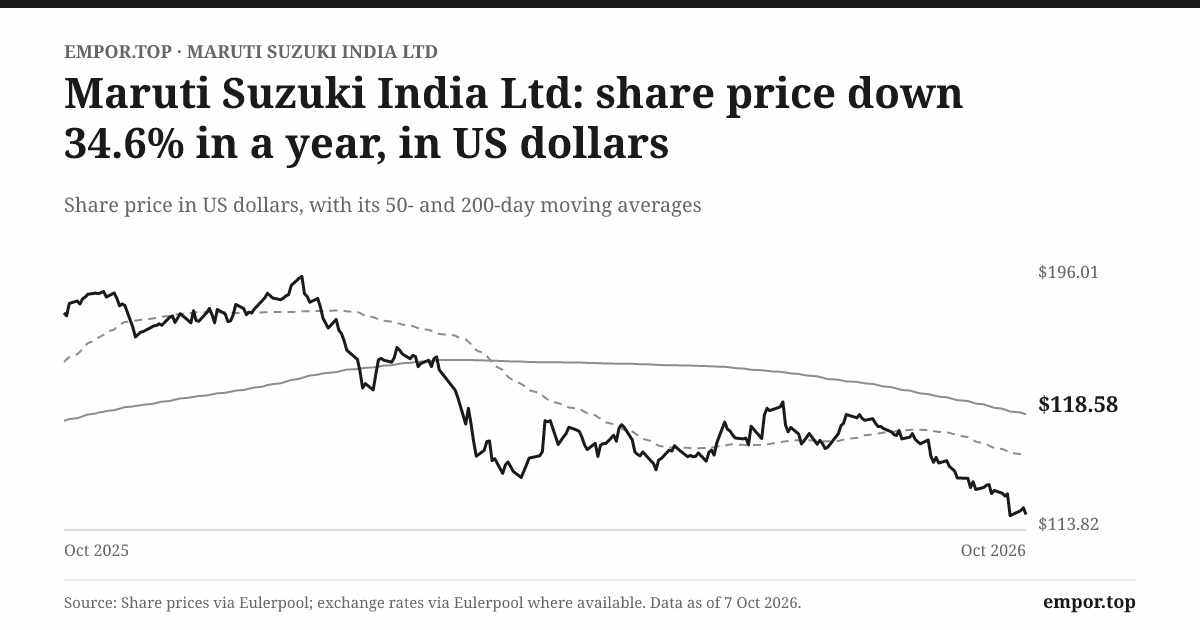
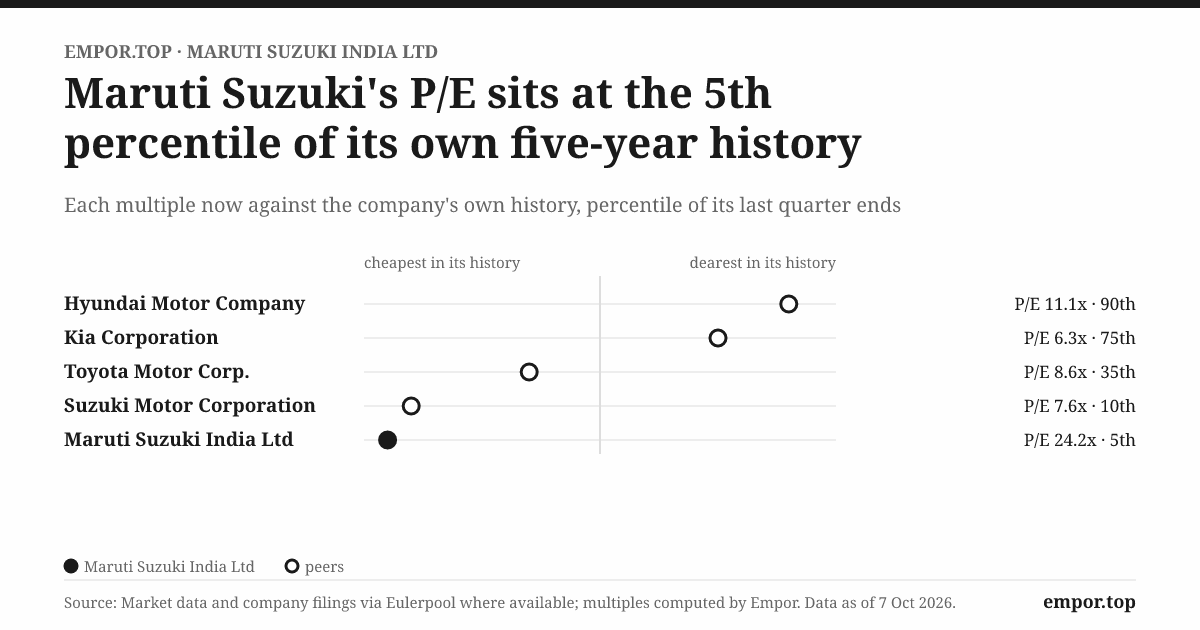
On Dalal Street, the Maruti debate today comes down to one chart. On the trailing twelve months of earnings, the stock trades at about 24 times, well below its own five-year median of about 31 times. It is down about a third from its 52-week high and close to its 52-week low3. The market has decided the old Maruti, with mid-20s operating margins and a dependable premium multiple, is not coming back soon. The question is whether that judgment is right.
Two KPIs will settle it more than any others. First is net profit margin, the cleanest measure given the classification issues in the operating line. It slid from about 10% a year earlier to about 6.6% in the June 2026 quarter3. Second is domestic passenger-vehicle market share, now around 40%[^2]2. Defending it is what has cost the margin. If share holds while margin recovers, the bulls are right; if margin recovers only by giving up share, the moat is smaller than it looks.
The bull case
- Kharkhoda brings operating leverage. New, highly automated capacity, funded without debt, lets volumes rise toward and past 2.5 million a year, and fixed costs per car fall[^14].
- India becomes Suzuki's global factory. Exports have grown steadily, and the e-Vitara gives Maruti a product for developed markets as well. Export growth softens domestic cycles[^10]6.
- Hybrids and CNG win if EVs are slow. If India's EV adoption stalls on charging and battery cost, Maruti's position in CNG and hybrids is where buyers end up.
- The cash floor. About $10.7 billion in liquid assets and no debt provides a cushion few industrial companies anywhere can match23.
The bear case
- Margins have reset. Even after stripping out the classification noise, net profit fell while revenue rose by more than a third. That is a pricing problem, not just a cost problem3.
- The first-time buyer is gone. If the entry-level hatchback does not recover, Maruti loses the segment where it faced the least competition and earned its scale.
- Technology dependence. Paying about 3.5% of sales to the parent while owning no core battery or software IP leaves Maruti exposed if 比亚迪 BYD, Tata or Hyundai start an EV price war[^2].
- Capital allocation as a drag. The cash pile keeps return on equity in the low-to-mid teens, which makes it hard to argue for the old 30x multiple.
Stress test
An activist would make three demands: a higher payout policy now that peak capex has a visible end; a published path for the royalty rate; and clearer disclosure of EV unit economics. A skeptic would add the contingent liabilities, about ₹30,600 crore at the end of FY2024 and mostly tax and duty disputes dating back decades. They have rarely turned into cash payments, but they are equal to roughly a quarter of net worth[^2].
The verdict: at 24 times earnings, the market is pricing Maruti as a mature, steady compounder, not a growth stock. That leaves downside if margins stay low, since the multiple has already contracted and earnings are falling. It leaves upside if margins recover even partly, because the balance sheet and the distribution are intact. Single-digit margins are not the business Maruti used to be, and until discounting eases and EV economics are proven, its days as a business with margins in the 20s should be treated as history rather than as a baseline.
XIII. Epilogue (10-15 min)
Tonight, Maruti Suzuki is a ₹3.6 lakh crore company with no debt and a cash pile larger than many Indian companies' market values, facing the biggest identity question in its history. The cheap small car that made it is fading. The SUVs that replaced it brought revenue but cost margin. The electric cars that may define the next decade run on technology that belongs to its parent.
Four moments will settle the story's three central questions.
The e-Vitara's first year. Bookings, deliveries and especially margins over the first four full quarters will show whether Maruti can sell EVs profitably at volume, or whether it becomes a contract manufacturer for its parent's technology. Strong numbers would answer the counter-positioning worry; weak ones would confirm it.
The margin rebound. If net margin recovers toward its prior range after the festival quarters of FY2027, the June 2026 slump was a cycle. If it stays near current levels, it was a reset, and the stock's lower multiple is correct.
Kharkhoda Phase 1. The speed with which the first block of about 250,000 units begins commercial production, and how efficiently it runs, will show whether Maruti 3.0 is a disciplined deployment or capacity built ahead of demand[^14].
The capital policy. Once the heaviest Kharkhoda spending is behind it, will the board raise the dividend payout well above the long-run median of about 28%? That would be the clearest sign that the cash serves all shareholders, not mainly the controlling one.
Each of these maps back to a central question: whether margins come back, whether the cash is used well, and whether the Suzuki relationship gives the listed company a fair share of the value it creates. None is decided yet.
XIV. Outro (5 min)
Go back to Harpal Singh in December 1983, taking the keys to a small white Maruti 800 from the Prime Minister. That car did more than move one family from two wheels to four. It created a supplier industry, taught a socialist economy what Japanese production discipline looked like, and gave the Indian middle class something it could own.
Forty years later, that company became so central to its Japanese parent that the parent depends on it as much as the other way around. That is the line that fits Maruti and no other company: it taught a socialist nation to drive, grew so large that its Japanese parent came to depend on it, and now has to show that the frugality that won the 20th century can build the electric cars of the 21st.
References
-
Investors Overview & Corporate Disclosures — Maruti Suzuki India Limited ↩↩↩↩↩↩↩↩↩↩↩
-
Rating Rationale: Maruti Suzuki India Limited — CRISIL Ratings, 2025-11-19 ↩↩↩↩↩
-
Maruti Suzuki India Ltd Financial Ratios & Shareholding Pattern — Screener.in, 2026-10-07 ↩↩↩↩↩↩↩↩↩↩↩↩↩↩↩↩↩
-
Financial Profile, Corporate Governance & Executive Remuneration — Trendlyne, 2026-10-07 ↩↩↩
-
Earnings Call Transcript: Q1 FY2025 Financial Performance & Outlook — ResearchBytes / Maruti Suzuki, 2024-07-31 ↩↩
-
Global Suzuki Integrated Report 2024 — Suzuki Motor Corporation, 2024-09-30 ↩↩↩↩↩↩↩
-
How Maruti Suzuki Overcame the 2012 Manesar Violence — Business Standard, 2017-03-18 ↩↩↩↩↩↩
-
Toyota-Suzuki Alliance: The Synergy Machine in Indian Auto — Reuters, 2023-09-01 ↩
-
Maruti Suzuki Shareholding & Capital History Disclosures — National Stock Exchange of India (NSE) ↩
 LinkedIn
 WhatsApp
 Reddit
 Hacker News
 Email
 Kindle
 RSS Feed
 Spotify
 Apple Podcasts
 Amazon Music
 Audible
 YouTube