IDBI Bank: The Turnaround Before the Handover
I. The Buyer Is Ready. Is the Bank?
On 14 October 2026, a committee of the Union Cabinet chaired by the Prime Minister did something that successive governments had promised, priced, shelved and revived for four years. It approved a Fairfax Financial Holdings subsidiary with a name only a company registry could love, 10955230 Canada Inc., as the strategic buyer of 60.72% of IDBI Bank.1
The price was ₹81 a share, or about ₹52,878 crore for the block.2 The government described the transaction as the largest foreign direct investment ever made in India's financial sector.3 The market cheered for an afternoon: IDBI's shares rose about 9% that day to ₹90.39, well above what Fairfax had agreed to pay.3 Eight days later they closed at ₹79.80, a little below it.4
That round trip tells you how unsettled the story still is. A buyer has been chosen, but the bank has not yet changed hands. The Reserve Bank of India still has to decide whether the buyer is "fit and proper" to control an Indian bank, the competition regulator and the securities regulator have their own steps to take, and the government expects completion only by the end of March 2027.3 Until then, IDBI Bank remains what it has been since January 2019: a lender controlled by the Life Insurance Corporation of India, with the Government of India standing right behind it.
Here is the paradox at the centre of this episode. On paper, IDBI has never looked healthier in its life as a commercial bank. Its capital adequacy ratio was 27.10% at the end of September 2026, roughly three times the regulatory minimum, and only 2.12% of its loans were classified as non-performing.5
Eight years earlier, more than a quarter of its loan book had gone bad. Yet when CRISIL reaffirmed the bank's AA+ rating in August 2026, the agency still wrote expected support from LIC and the government into its reasoning, "until the divestment is complete."6 The rescue scaffolding is still holding up part of the credit view, and the sale is about to remove it.
So the Fairfax deal is a change of owner, not yet a change in the bank's economics. The ₹52,878 crore goes to the selling shareholders, not into IDBI's capital.1 Whether the bank is worth what Fairfax is paying depends on questions that no Cabinet note can settle. Are the record profits of the last two years repeatable once recoveries from old bad loans fade?
Can a bank that grew its loan book at roughly 15% a year keep its new-found asset quality? Does IDBI have any edge of its own against much larger rivals, or only the comfort of powerful shareholders? And what changes, for depositors, borrowers and the five per cent of shareholders who are neither the government nor LIC, when control moves to Toronto?
It helps to be precise about who is who. LIC held 49.24% of IDBI at the end of September 2026 and the government 45.48%, which left only 5.29% in public hands, spread across roughly 731,000 shareholders.7 LIC is an insurance company with its own vast balance sheet, and the government is the government; neither one's revenue or assets belong in IDBI's accounts. They matter to this story as owners, as backstops, and in LIC's case as a depositor and counterparty, but the bank has to earn its own living.
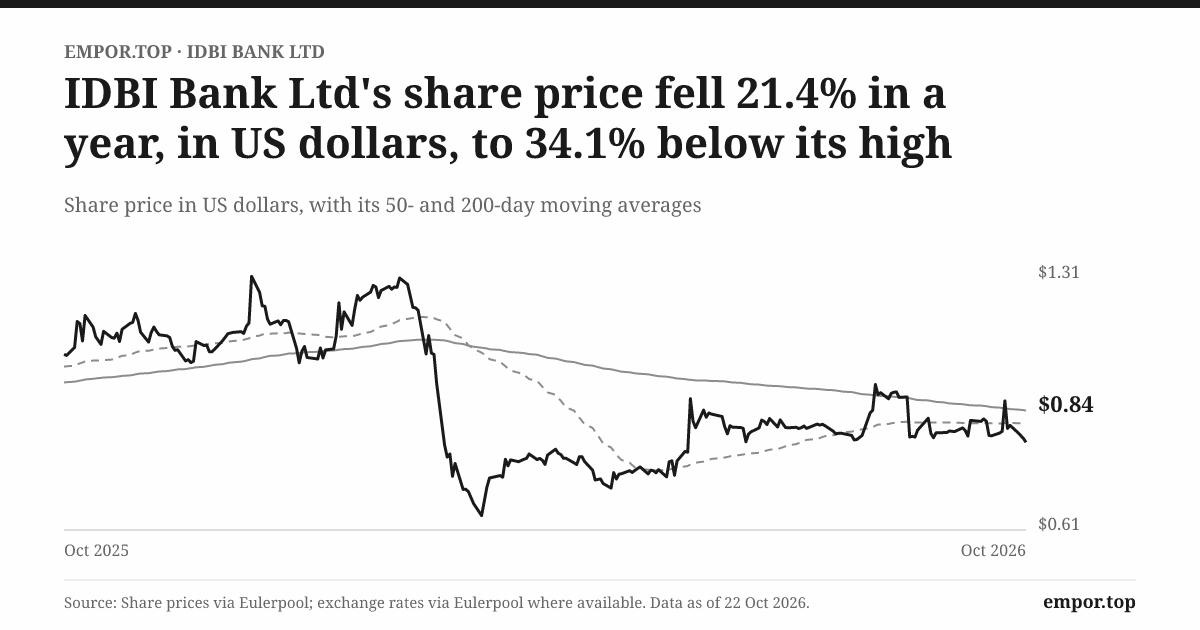
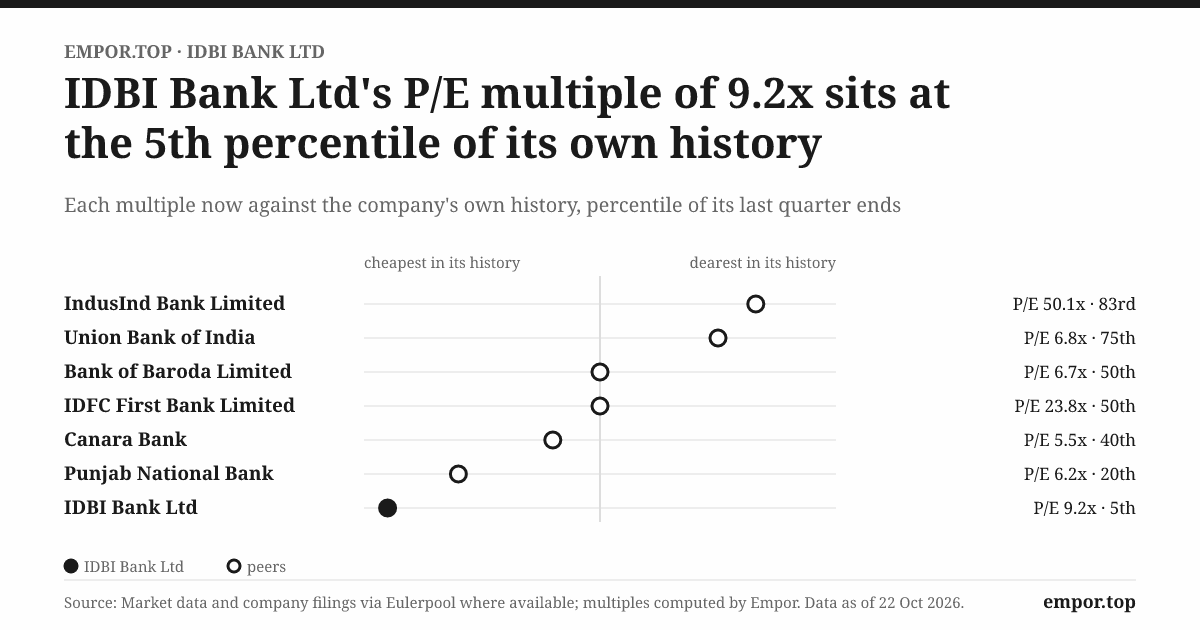
The stock market's verdict on that living is cautious. At ₹79.80, IDBI was valued at about ₹85,800 crore, or 1.2 times its book value and 9.2 times its trailing earnings, against a five-year median of 13.7 times.4 The shares sat about 31% below their 52-week high.4 Investors, in other words, are paying less per rupee of profit than they used to, at the very moment profits are at a record. Either the market is missing something, or it suspects that today's profits are not the kind that repeat.
To see why a bank this profitable still needs its rescuers' names in its rating report, you have to go back to an institution that was never designed to be a bank at all.
 Subscribe on LinkedIn
II. The Development Bank That Had to Become a Bank
In 1964, Parliament created the Industrial Development Bank of India as a subsidiary of the Reserve Bank of India, and in 1976 ownership passed to the central government.[^8] Its job was not to take deposits from households or lend for scooters and homes. It was a policy bank, built to finance industrial development: the factories, plants and infrastructure that a young, capital-starved republic wanted and that ordinary commercial lenders were not built to fund over ten or fifteen years.[^8]
For a long stretch of Indian economic history, IDBI was less a lender than a piece of national plumbing. By its own account, it played an apex role in building India's industrial and infrastructure base and helped create institutions that later became the backbone of the country's financial markets: the National Stock Exchange, the depository NSDL, the rating agency CARE, the Stock Holding Corporation, the small-business lender SIDBI, the Export-Import Bank and the asset reconstruction company ARCIL.[^8] Hold on to NSDL in particular. More than half a century later, selling part of that stake produced one of the one-off gains that complicate IDBI's earnings story.
A development finance institution works on a different logic from a bank. It borrows long, often with the implicit backing of the state, and lends long against projects whose cash flows arrive years after the money goes out. Its skill is appraising a project, not gathering millions of savings accounts. That model depended on cheap long-term funding that a liberalising India would no longer guarantee, and so IDBI began, step by step, to change what it was.
The ownership changed first. In the 1990s, the IDBI Act was amended to allow private ownership of up to 49%, and a domestic public offering in 1995 reduced the government's stake to 72%; a capital restructuring in 2000 took it down to 58.5%.[^8] Then came the decisive law. In December 2003, Parliament passed the IDBI Repeal Act to convert the institution into a banking company, with a requirement that government ownership would not fall below 51%.[^8]
Jaswant Singh, the finance minister of the day, told Parliament that the government would keep at least 51% "under all circumstances."8 Seven years later, IDBI's own analyst presentation still listed a minimum 51% government shareholding "at all times" among the reasons for its systemic importance.[^8] It is worth remembering that promise. The government's direct stake fell below 51% when LIC took control in 2019, and the Fairfax sale will be the moment that state ownership in any form loses control altogether.8
On 1 October 2004, IDBI was reconstituted as a banking company.6 On 2 April 2005, it absorbed its own commercial-banking subsidiary, IDBI Bank Ltd, which gave the merged entity a branch network and a deposit base to build on.[^8] In October 2006, it took over the troubled United Western Bank, an early sign that the converted institution would also be used as a safe harbour for weaker lenders.[^8] In 2008 it took the name IDBI Bank.6
What did the new bank carry with it? Above all, a habit. Its expertise, relationships and loan book were overwhelmingly corporate and project-based, and its deposit franchise was young. By October 2010, management was presenting analysts with a bold ambition: to become India's fifth-largest bank by assets and market capitalisation by 2012.[^8] The same presentation noted fresh government equity of about ₹3,119 crore that year to support capital ratios.[^8] A bank that needs state capital while promising to leap up the league tables is a bank growing faster than its own earnings can fund.
The fifth-largest goal was never reached; the opposite happened. Rakesh Sharma, who had been brought in to fix the bank, put the old mix bluntly in 2019: "earlier we were going mainly in corporate only, 80% was corporate, 20% was retail."[^10] As late as September 2018, infrastructure loans and guarantees made up almost a fifth of IDBI's total exposure.[^11] That is the inheritance of a development lender that became a bank: long-dated loans to big industrial projects, funded increasingly by deposits that could leave on short notice.
The development mandate explains where IDBI came from. It does not explain what happened next. For that, you need to see what a decade of rapid corporate lending looks like when India's great bad-loan cycle arrives, and why IDBI walked into that cycle more exposed than most.
III. The Loan Book Breaks
Picture the results season of May 2018. Across India, state-owned banks were reporting losses as the Reserve Bank forced them to recognise bad loans that had been rolled over, restructured or politely ignored for years. Even in that company, IDBI's numbers stood out. For the year to March 2018, it reported a net loss of ₹8,238 crore.[^11] Its gross non-performing assets had reached ₹55,588 crore, or about 28% of all its loans.[^11]
It is worth slowing down on what that ratio means. A non-performing asset is a loan on which the borrower has stopped paying interest or principal for more than ninety days. At 28%, more than one rupee in every four that IDBI had lent was no longer paying. The Indian Express headline spoke of an NPA "mountain," and that was not hyperbole.9 A bank can survive a bad year in which a few large borrowers default. It cannot easily survive a year in which the loan book itself has become doubtful, because the loans are the bank.
The worst was not yet over. By September 2018, gross NPAs had climbed further, to ₹60,875 crore and about 32% of advances.[^11] More alarming was capital, the buffer that absorbs losses before depositors' money is at risk. IDBI's capital adequacy ratio had fallen to 6.22%, and its highest-quality equity, after the mandatory conservation buffer, was down to 3.87% of risk-weighted assets.[^11] Both sat below the regulatory minimum. In the language of bank supervision, this was not an earnings problem. It was a solvency problem.
How did a bank built on project appraisal end up here? The exposure data gives a clue. In September 2018, IDBI's infrastructure exposure, across power, transport, telecom and water, stood at about ₹64,000 crore, almost 19% of total exposure, and more than ₹16,000 crore of it was already non-performing.[^11] Metals, mining, engineering and construction each added their own sizeable NPA pools.[^11] This was the book of a lender that had financed India's infrastructure boom of the late 2000s and then watched stalled projects and over-leveraged promoters turn those loans sour.
So was it simply the cycle? Partly. Nearly every public-sector bank lent into the same boom and suffered in the same bust. But IDBI entered the bust with a heavier corporate concentration than a conventional bank, a thinner retail deposit base and a history of using state capital to keep growing. The cycle supplied the storm; IDBI's legacy determined how much of its roof was missing.
Even the Reserve Bank's annual inspection found the bank had under-recognised bad loans: on the May 2019 call, an analyst asked about a provision "divergence" of around ₹4,000 crore that the RBI had identified, and Sharma acknowledged that the regulator had asked for certain accounts to be classified as NPAs with higher provisions.[^10] Treasury added its own pain, with mark-to-market losses on investments as bond yields rose.[^11]
The regulator's response came before the worst numbers did. In 2017, the RBI placed IDBI under its Prompt Corrective Action framework, a regime that would stay in place for roughly four years.10 Think of PCA as a hospital ward for banks. A bank that breaches thresholds on capital, bad loans, profitability or leverage is not shut, but it is put on a restricted diet: limits on new lending, especially to large corporate borrowers, curbs on branch expansion and dividends, and close supervision. By 2019, IDBI's own finance chief described the bank as "restricting lending only in retail segment."[^10]
PCA had a brutal arithmetic. A bank that cannot lend to corporates and cannot raise enough capital shrinks to protect what capital it has. IDBI's risk-weighted assets fell from about ₹2.69 lakh crore in March 2017 to about ₹1.92 lakh crore by September 2018.[^11] Deposits followed: they fell from about ₹2.47 lakh crore to ₹2.27 lakh crore by March 2019.[^10] Each turn of the crank reduced risk, but it also reduced the earning base from which the bank would have to pay for its old mistakes. Net interest margin, the spread between what the bank earned on loans and paid on deposits, was down to 1.80% in the September 2018 quarter.[^11]
There was one unintended gift in the shrinkage. Because PCA blocked new corporate lending while retail lending continued, the mix of the book changed almost by default. Corporate loans fell from about 61% of advances to 54% in the year to September 2018, while the retail share rose.[^11] The bank that later boasted of a retail-heavy book began building it under regulatory duress, not by strategic choice. That matters for how the later transformation should be judged: the shift was real, but its origin was a restriction, and the bank has not yet had to prove it would make the same choice with corporate lending fully open to it.
Leadership was in flux too. B. Sriram ran IDBI for only three months in mid-2018 before retiring, and the government then appointed Rakesh Sharma, initially for six months.11 A bank whose chief executive is appointed on a six-month horizon is a bank whose owner has not yet decided its fate.
That was the real dilemma facing the state, which owned almost 86% of IDBI in mid-2018.12 It had three options, none of them pleasant. It could let a large, interconnected bank shrink slowly under PCA, with depositors growing nervous and staff departing. It could keep writing cheques from the budget into a bank that had already consumed public capital through the 2010s. Or it could find a new controlling shareholder with deep pockets and a reason to say yes.
The year that followed made the scale of the hole plain. In FY19, IDBI's net loss ballooned to ₹15,116 crore as it recognised and provided for its bad loans.[^10] The crisis had damaged profits, capital and confidence all at once, and no amount of operating improvement could close that gap from the inside. The bank needed fresh capital and a new owner before it could even begin to prove that it could become a clean commercial bank. In June 2018, the outline of an answer emerged from an unlikely quarter: the country's largest insurer.
IV. LIC Takes Control, and the Rescue Gets a Price Tag
On 21 January 2019, IDBI Bank allotted a final tranche of about 82.76 crore shares to LIC at ₹60.73 apiece, completing the insurer's acquisition of a 51% controlling stake.12 The idea had been conceived the previous June, the Cabinet had approved it in August 2018, and LIC had made the open offer that Indian takeover rules required, with filings running from October 2018 to the end of January 2019.1213 All told, LIC put ₹21,624 crore into the bank.[^10]
The deal was, to put it gently, unusual. An insurance company that manages the savings of hundreds of millions of policyholders was buying control of a bank with a gross NPA ratio above 30%. IDBI's officers' association opposed it, arguing that it conflicted with insurance and banking ownership rules.12 The regulators allowed it with conditions. Sharma later explained that the RBI's approval required LIC to bring its shareholding down to 40% over twelve years and gave five years to resolve the overlap between IDBI's home loans and LIC Housing Finance.[^10] That housing-finance deadline was later extended by the RBI.6
Then came the reclassification that would shape the next seven years. On 14 March 2019, the RBI announced that IDBI Bank had been categorised as a private-sector bank for regulatory purposes, with effect from 21 January 2019, because LIC now held 51% of its equity.14 It was an odd label for a bank whose two largest shareholders were a state-owned insurer and the state itself, but it mattered. A private-sector bank sits outside the government's direct recapitalisation programmes for public-sector banks, which meant capital would have to come through shareholders acting, at least formally, as owners rather than as the budget.
That distinction was tested within months. In September 2019, the Cabinet approved a further one-time capital requirement of about ₹9,300 crore, with LIC contributing 51%, about ₹4,743 crore, and the government 49%, about ₹4,557 crore.1516 The government's share came through recapitalisation bonds that the bank bought back the same day, a cash-neutral device that left no immediate mark on the budget.16 Add it up, and LIC alone had committed more than ₹26,000 crore to IDBI in barely a year. That is the rescue's price tag, at least the part that is easy to count.
The man in charge of turning that capital into a bank was Rakesh Sharma. He had joined the State Bank of India and spent his career there before running Lakshmi Vilas Bank from 2014 to 2015 and then Canara Bank, as MD and CEO, from September 2015 to July 2018.11 He was, in other words, a career public-sector banker who had already run two lenders through difficult stretches. He took charge at IDBI on 10 October 2018.11
Sharma's style comes through clearly on the bank's post-results call of 30 May 2019. He arrived late from a press conference and took the questions himself. He was candid about the corporate book, saying the bank had "burnt our fingers" and revised its limits by sector, group and individual borrower.[^10] He was also specific in a way bank chiefs often are not.
He told analysts that net NPAs, then 10.11%, would fall below 6% by September or at the latest December 2019; that the bank would report a profit in the December 2019 quarter; that it should be out of PCA by the third quarter of that financial year; that retail, small-business and agricultural loans would make up 55% of the book by March 2020; and that the current-and-savings-account share of deposits would be at least 45%.[^10] When an analyst asked about a 1% return on assets, he declined: "it will be very little early to reply."[^10]
The repair was already visible in the March 2019 balance sheet. LIC's money had lifted the capital adequacy ratio to 11.58%, back above the regulatory requirement, and aggressive provisioning had pushed coverage of bad loans to about 83% and cut net NPAs to 10.11%, even though gross NPAs were still above 27%.[^10] By June 2019, net NPAs were down to about 8%.16 Sharma's plan for more capital was more ambitious than what followed.
He told analysts the bank intended to raise about ₹6,500 crore of core equity through a rights issue, a qualified institutional placement or a preferential allotment, alongside Tier 2 bonds and about ₹1,500 crore from selling non-core assets, with its life-insurance venture next in line for monetisation.[^10] In the event, the core equity came from the same two shareholders who had already paid for the rescue.
How did those promises age? This is the cleanest test of management credibility the record offers, and the answer is mixed but respectable. The profit arrived one quarter late: IDBI reported a net profit of ₹135 crore in the March 2020 quarter, helped by recoveries from bad loans, after thirteen straight loss-making quarters.1718 The PCA exit took far longer. The RBI lifted the restrictions only on 10 March 2021, after its Board for Financial Supervision found the bank no longer in breach on capital, net NPAs and leverage, and IDBI gave a written commitment to stay compliant.10 That was more than a year behind Sharma's timetable.
The structural targets fared better. The retail, agriculture and small-business share now stands at about 70% of advances, comfortably beyond the 55% he promised.6 The current-and-savings share reached about 47% by March 2025, past his 45% floor.6 And the return on assets that was "too early" to discuss reached 2.2% in FY26.6 Sharma's record, in short, is one of under-promising on direction and over-promising on timing, a pattern common in turnarounds where the bank controls its strategy but not the pace at which bad loans can be resolved.
That pattern also exposes what LIC's money did and did not do. Capital stopped the bleeding: it restored the ratios, reassured depositors and let the bank keep operating. It did not make bad loans good. The provisioning, the recoveries through insolvency courts, and the slow rebuilding of a retail book still had to run their course, and they took years. The market priced that uncertainty mercilessly. When IDBI finally announced its first profitable quarter, in June 2020, its shares jumped 20% to just ₹24.35, less than half the price LIC had paid eighteen months earlier.18
The more useful question is not whether IDBI survived; with LIC and the government behind it, survival was close to assured. It is whether the bank could rebuild a profitable loan book that would earn attractive returns on the capital poured into it. LIC paid ₹60.73 a share in 2019.12 Fairfax has agreed to pay ₹81. Measured that way, the rescue made money, though not much once time and the 2019 top-up are accounted for. To judge whether the turnaround is real, you have to open the income statement and ask where the profits are coming from.
V. The Recovery Is Real. The Earnings Mix Is the Test.
On the face of it, IDBI's results for the September 2026 quarter were a disappointment. Net profit fell 39%, to ₹2,205 crore from ₹3,627 crore a year earlier.19 Headlines could have written themselves. They would have been wrong. The year-earlier quarter included a one-off gain of about ₹1,699 crore from selling part of IDBI's stake in NSDL, the depository it had helped create decades earlier.19 Strip that out, and profit rose about 14%.19 Net interest income, the bank's core spread business, grew 29%.5
That single quarter is a miniature of the whole problem with reading IDBI's earnings. The headline numbers swing with events that have nothing to do with how well the bank lends and borrows. To know what the bank actually earns, you have to separate three things: the steady spread business, the one-off gains, and the money coming back from loans the bank had long since written off.
Start with the long view, because it is humbling. Over ten years to FY26, IDBI's revenue grew by about 1.2% a year.20 Over five years, it grew 7.6% a year, and over three years 12.3%.20 The early part of that decade includes the shrinking years under PCA; the later part includes the rebound.
Recent growth is well above the bank's own long-run base rate, which tells you the recovery is real but also that the bank is still regaining ground lost in the crisis rather than growing from a stable base. Profit growth over five years, at more than 40% a year, looks spectacular only because the starting point was a bank barely back in the black.20
How does a bank like IDBI make money? Think of it as a shop that rents money. It borrows from depositors, paying them interest, and lends to home-buyers, farmers, small businesses and companies, charging them more. The gap between the two, expressed as a share of the bank's earning assets, is the net interest margin.
On top of that, the bank earns fees for services, gains or losses from its treasury book of bonds, and miscellaneous income. Its costs are salaries, branches and technology, and its biggest swing factor is credit cost: the provisions it must set aside when borrowers stop paying. The unit of the business is not a seat or a contract but a relationship: a depositor who keeps money with the bank, and a borrower who repays.
IDBI's reported margin is impressive. It reached 4.11% in the September 2026 quarter, up from 3.71% a year earlier.5 But the reported figure flatters the core business. When CRISIL strips out interest on income-tax refunds and interest collected on loans already classified as non-performing or technically written off, the bank's core margin falls to 3.3% for FY26, down from 3.7% in FY25.6 Interest recovered on a dead loan is welcome cash, but it is the last instalment of the old book, not the first of the new one. The gap between the reported and core margin is a measure of how much of today's spread comes from the past.
The same pattern runs through the rest of the income statement. In FY26, IDBI earned a record net profit of ₹9,513 crore, a 2.2% return on assets.6 But its credit cost was negative 0.2% of average assets, meaning that recoveries from written-off accounts and releases of old provisions exceeded the new provisions it had to make.6 In a normal year, a bank pays a credit cost; in FY26, IDBI was paid one.
Other income was about ₹6,746 crore, against profit before tax of about ₹11,926 crore, so non-interest income was equivalent to more than half of pre-tax profit.20 That figure included ₹329 crore of interest on income-tax refunds, and the consolidated accounts recorded about ₹1,210 crore of gain from the NSDL sale.20 The effective tax rate also fell, to about 21% from 29% the year before, which added to the bottom line without any change in the business.20
Put those pieces together and FY26 looks less like a new run-rate and more like a peak. CRISIL's own trajectory confirms the drift. In the first quarter of FY27, the bank earned ₹2,115 crore, an annualised return on assets of 1.9%, and other income fell to 0.9% of assets from 1.5% in FY26.6 That 1.9% is still an excellent number for an Indian bank. It is also below the 2.0% that CRISIL names as the threshold for a possible upgrade, sustained while growing the loan book.6
The September quarter added a second data point. Other income fell to about ₹1,353 crore from ₹2,489 crore a year earlier, the difference largely that NSDL gain.5 Yet net interest income rose strongly, and the reported margin improved. The evidence therefore points both ways. The spread business is growing and earning more than it did a year ago. The extras that inflated FY26 are fading. The honest conclusion is that IDBI's underlying return on assets probably sits somewhat below its FY26 peak, and that the next year will show how far below.
A word on the numbers that do not help. Investors trained on industrial companies sometimes reach for free cash flow, cash conversion or debtor days. For a bank, those measures mislead. When IDBI lends more, cash flows out of operations; when depositors add money, cash flows in. A bank's operating cash flow is mostly a record of its balance sheet moving, not of its profitability. The right lenses are credit costs, liquidity, capital and asset quality. On liquidity, IDBI's coverage ratio was about 121% at June 2026, above the regulatory floor of 100%.6 On capital, it has more than it needs.
That surplus capital raises the question of what the bank does with its profits. Dividends tell a story of their own. IDBI paid nothing for years during the crisis, then resumed payouts as profits returned: about a quarter of FY26 profit went out as dividends.20 Across the bank's longer history, the payout has ranged from nothing in FY23 to 60% in FY14, with a median of about 13%.20 A rising dividend is a sign of restored health, not of growth; with capital adequacy above 27%, the bigger question is not whether IDBI can afford a dividend but whether it can find enough good loans to employ the capital it is retaining.
The scorecard for this chapter is clear. The recovery is real: the spread business is earning, asset quality is healthy and the bank is solidly profitable. But a meaningful slice of FY26's record profit came from the past, through recoveries and one-offs, and the core margin has been sliding. The next four quarters of core margin, credit cost and return on assets will tell how much of the recovery travels forward. And that depends on a harder question still: whether IDBI can grow its loans and deposits against India's biggest banks without walking back into the kind of book that broke it.
VI. Can IDBI Win Deposits and Loans Without Repeating the Old Book?
By the end of September 2026, IDBI held about ₹3.55 lakh crore of deposits and about ₹2.72 lakh crore of net advances, each up roughly 17% to 18% from a year earlier.5 The share of its gross advances coming from retail lending reached 69%.5 For a bank that once lent four rupees out of five to corporations, that is a different institution. The question this chapter has to answer is whether that different institution has anything that larger rivals cannot match.
Start with scale, because in Indian banking scale shapes almost everything else. The State Bank of India held about ₹60 lakh crore of deposits at June 2026, roughly seventeen times IDBI's.21 HDFC Bank reported about ₹33 lakh crore of deposits at the end of September 2026, growing almost 19% a year, about as fast as IDBI on a base nine times larger.22
Among the public-sector banks, Canara Bank's global deposits were about ₹16 lakh crore in June 2026 and Indian Bank's about ₹8.4 lakh crore.23 IDBI is a mid-sized bank competing against giants with deeper branch networks, bigger technology budgets and more cross-selling opportunities. Its growth rate is respectable, but it is not distinctive: when HDFC Bank can grow deposits at the same pace, IDBI's 18% is the market's tide as much as its own swimming.
Where IDBI does stand out is in the quality of its funding. Its current-and-savings-account ratio was about 44% in September 2026.5 These are the cheapest deposits a bank can gather, because savers keep transactional balances there for convenience rather than for yield. State Bank of India's equivalent ratio was about 39% at June 2026, and CRISIL describes IDBI's share as above the banking sector's average.216 More than half of IDBI's fixed deposits are in tickets below ₹1 crore, which means the bank relies on many small savers rather than a few large ones.6 That is the most concrete evidence of a franchise IDBI built for itself.
But even here the trend needs watching. The ratio has drifted down from about 47% in March 2025 to about 44%.6 Across Indian banking, savers have been moving money into higher-yielding term deposits, and IDBI is not immune. Its funding advantage is real but narrowing, and the bank does not disclose deposit retention or pricing data that would show customers paying for loyalty.
On the lending side, the shift has been deliberate and large. Retail, agriculture and small-business loans made up about 70% of advances in CRISIL's June 2026 assessment, much as they had for the previous two years, and home loans alone were about 41% of the retail book.6 Gross advances grew about 14% in each of FY24 and FY25 and about 15% in FY26.6 Home loans are among the safest assets in Indian banking, but they are also among the most competitive, with thin margins and powerful rivals. A bank that wins share there is often winning on price.
So is the mix shift producing sound returns, or just faster volume? The early evidence is encouraging. Fresh slippages into the bad-loan category fell to about 0.8% of advances in FY26 from about 1.0% in FY25, and ran at an annualised 0.7% in the first quarter of FY27.6
Loans in the early-warning categories known as SMA-1 and SMA-2, overdue by more than thirty days but not yet bad, were about ₹2,515 crore in June 2026, under 1% of gross advances.6 Those are healthy readings for a book growing at mid-teens rates. They are also readings taken in a benign credit environment, and a retail book that is two or three years old has not yet seen a downturn.
The bank's segment reporting gives a partial view of what drives profit. IDBI splits its business into treasury, corporate and wholesale banking, retail banking and other banking operations, and retail and treasury are the two largest sources of segment revenue.24 The treasury segment's prominence is itself a caution: a bank holding more than ₹1.2 lakh crore of investments, as IDBI did in September 2026, will see a large share of its revenue come from bonds rather than loans.24 Treasury income rises and falls with interest rates. It is a legitimate part of banking, but it is not evidence of a lending franchise.
Look at the market through the classic five forces, once. Rivalry is intense: every bank in India is chasing the same salaried home-buyer and the same current account. Depositors have real choice, and moving a savings account now takes minutes on a phone, so their bargaining power is high. Borrowers with strong credit can shop for the lowest rate.
Regulation makes new bank licences rare, which limits fresh entry, but fintech lenders and payment apps have raised customers' expectations of service. Substitutes for deposits, from mutual funds to small-finance banks, keep pulling money away from low-yield accounts. In that market, IDBI's granular deposit base is a genuine strength. What the bank does not show is evidence of switching costs or a brand premium: no disclosed retention data, no evidence of pricing power over peers.
Technology is where large banks often pull away, and IDBI's spending is modest. In FY26 it spent about ₹323 crore on fixed assets, including work in progress, down from about ₹343 crore a year earlier.20 Employee costs rose to about ₹4,358 crore, for a workforce of 20,693 that included 2,792 new recruits during the year.2025
The bank does not separate its technology spending from other capital expenditure, nor does it quantify what its digital or artificial-intelligence initiatives have done for costs or growth. For a bank of IDBI's size, AI is more likely to change fraud controls, customer service and back-office cost than to redraw the deposit-and-lending model; the bank has not shown which way that cuts for it.
Some operating signals do point in a healthy direction. Operating expenses fell to about 2.1% of average assets in FY26 from 2.2% the year before, so the bank is not buying its growth with runaway costs.6 Employee attrition was about 5%, and customer complaints per crore of loans fell at roughly 9% a year between FY24 and FY26.6 These are modest indicators, but they suggest an institution whose service quality is improving rather than eroding as it grows. They are not, on their own, evidence of a franchise that customers would pay more to stay with.
Then there is the question of who is running the bank and what they own. Sharma has led IDBI since October 2018, through the darkest part of the crisis and into the record profits.11 The board was about 55% independent in FY26.6 Executives hold no meaningful stake, so alignment with minority shareholders runs through pay and reputation rather than ownership.
At the July 2026 annual meeting, shareholders cast 38,128 votes against the resolution adopting the financial statements, out of more than 5.7 billion votes cast.26 That is a rounding error in percentage terms, and with two promoters holding almost 95% of the shares, the vote could never have been close. It is still a concrete record that some shareholders were dissatisfied, and in a bank where public holders own only about 5%, minority voices have few other outlets.
The verdict on competition is a qualified one. IDBI has room to grow, a substantial and granular deposit franchise, and credit metrics that are better than at any point in its banking history. That supports a recovery and a retail-heavy mix. It does not yet establish a durable moat against banks with deeper distribution, technology and scale. The test that matters is not how fast advances grow but what happens to slippages, early-warning loans and credit costs as they do. And there is one relationship that many investors have long assumed gives IDBI an edge the numbers do not show: its link to LIC.
VII. The LIC Relationship: A Funding Link, Not a Proven Revenue Synergy
During the September 2026 quarter, LIC's deposits at IDBI almost doubled, from about ₹3,325 crore at the start of the period to about ₹6,398 crore at its end.27 At the bank's scale, ₹6,400 crore was not trivial: it was close to 2% of total deposits. It was also exactly what bulls had long expected from the relationship, a powerful shareholder steering its cash toward the bank it owned.
The story of what LIC was supposed to bring goes back to the rescue. In May 2019, Sharma described a high-level task force that had framed "almost 111 action points" to bind the two institutions together: LIC's divisional and investment accounts, salary accounts for its staff, policy premium collection through IDBI's systems, and special loan packages for LIC's employees, agents and policyholders.[^10]
A colleague estimated LIC's average banking float at ₹8,000 crore to ₹10,000 crore and expected about ₹2,000 crore of it to reach IDBI over the following year.[^10] When the Cabinet approved the 2019 top-up capital, the government went further and projected revenue from LIC synergies of ₹500 crore in FY20 and ₹1,000 crore a year from FY21 onwards.16
The logic looked compelling on paper. IDBI brought about 1.5 crore retail customers and more than 800 branches that could sell LIC policies.12 LIC brought, by the government's count, 29 crore policyholders, 11 lakh agents and about 2 lakh employees who could be steered toward IDBI's home, auto and personal loans.16
IDBI began selling LIC insurance in March 2019, collecting about ₹160 crore of premiums in that first month, and the FY20 target was ₹2,000 crore of premiums and ₹200 crore of revenue.16 The bank offered LIC agents interest concessions on education and home loans and promised policyholders a discount on home-loan rates.[^10] It was the classic bancassurance play, the same one that India's large private banks run with their own insurance affiliates.
Seven years later, what does the record show? On deposits, the relationship has delivered something: the quarter-end LIC balance of about ₹6,400 crore was three times the 2019 expectation, although a single quarter's closing balance can be lumpy. On revenue, the evidence is thin. For the September quarter, IDBI reported approval limits of about ₹55 crore for service income from LIC and ₹5 crore for service expenses, but zero actual transactions in those lines during the period.27 An approval limit is permission to transact, not income earned. The bank does not publish how much of the projected ₹1,000 crore a year of synergy revenue ever materialised.
IDBI reported a closing receivable from LIC of about ₹1,178 crore.27 That is a balance owed to the bank by its promoter at the end of the quarter, a balance-sheet item, not a stream of revenue. It deserves monitoring because LIC is both IDBI's controlling shareholder and a counterparty, but it should not be read as evidence that LIC is a big customer in the income-statement sense.
How dependent is IDBI on any single source of funding? The bank's top twenty depositors held 12.02% of its deposits in March 2026, almost unchanged from 12.06% a year earlier.28 That is a meaningful but not alarming concentration for a bank of this size, and it has been stable through the period of strongest growth. LIC's deposits are part of that picture, but the franchise rests on millions of retail accounts rather than on a handful of related institutions.
So the LIC relationship is mainly about capital and confidence, with a funding link on top. What the evidence does not show is that LIC makes IDBI a more profitable operating business through distribution or service revenue. The synergy story should be treated as unproven unless the sale documents or future filings put a number on it.
That leaves an unusual tension. The shareholder whose support helped restore confidence in IDBI is preparing to give up control of it. After the sale, LIC will remain a sizeable investor, but no longer the owner whose reputation stands behind the bank. To understand what replaces it, look at who is buying, what they are paying, and what they appear to want.
VIII. The Fairfax Bid: A Premium, but Not a Blank Cheque
The road to 14 October was long and bumpy. The Department of Investment and Public Asset Management invited expressions of interest for up to 60.72% of IDBI in October 2022, covering both the government's and LIC's holdings.6 Five parties expressed interest and four qualified, but only two ever submitted final technical and financial bids.2 Lists of famous names that circulated in the press at various points are history now; by mid-2026, Reuters was reporting that Emirates NBD, which had separately bought control of RBL Bank, was not actively pursuing IDBI, and that Fairfax was the frontrunner.8
Price was the sticking point. The government set an earlier reserve price of ₹94.42 a share, and the first round of bids fell short of it.8 In March 2026, the sale was put on hold over valuation concerns.29 Fairfax, which had reportedly offered ₹75 a share the previous year, raised its bid to ₹81.29
By then the government's benchmark had been reset to ₹75.99, the average of two independent valuations, one based on comparable bank valuations and the other on an assessment of the bank's assets and liabilities.2 Fairfax's ₹81 beat the average and both individual valuations.2 The government explained that it had set aside IDBI's own share price because the stock was volatile and thinly traded; with about 95% of the shares in promoter hands, only a sliver ever changed hands on the exchange.27
The share price had its own drama along the way. In mid-July 2026, when reports first suggested the government had settled on Fairfax at ₹81, IDBI's shares closed at ₹86.50, above the reported offer.29 When the ₹81 figure resurfaced in early September, the shares fell more than 10% in a day, to about ₹81.12, as if the market had decided the offer price was now the anchor.8
That explanation matters, because on the day of the approval the market price was about 10% higher than Fairfax's. Commentators calculated that the gap, applied to the roughly 653 crore shares being sold, was worth about ₹6,100 crore.30 A week later the gap had closed and reversed: at ₹79.80, the market was valuing IDBI's shares slightly below Fairfax's price.4 The market price, it turns out, was a weak guide in both directions.
The seller split is simple. The government is selling 30.48% and LIC 30.24%; after the sale they are expected to keep 15% and 19% respectively, with LIC reducing to 15% within two years, and the government withdrawing its nominee directors on completion.31 The Cabinet also authorised a mechanism for future market sales of the government's remaining 15%.2 The conditions on the buyer are equally important. Fairfax already holds about 40% of the Kerala-based CSB Bank, which it took control of in 2018, and must either merge CSB into IDBI or exit within two years.293
RBI rules cap a promoter's long-term holding in a bank at 26%, so Fairfax will have up to fifteen years to come down from 60.72%, subject to a five-year lock-in, and it must keep the IDBI name, brand and customer relationships for at least three years.3 An open offer to public shareholders will also be required unless the securities regulator grants an exemption.3 The government has said that existing employees' service conditions and pensioners' benefits are protected in the share purchase agreement, but bank unions held a protest on 16 October.198
Now the most important point for the bank itself. This is a secondary sale. The ₹52,878 crore goes to the government and LIC, and nothing in the approval shows new capital flowing into IDBI at closing.1 The bank's capital ratios, its earnings and its asset quality on the day after completion will be exactly what they were the day before. Whatever value Fairfax creates has to come from changing how the bank operates.
Is Fairfax paying a fair price? Press reporting put Fairfax's offer at roughly 1.5 to 1.6 times book value, compared with about 1.3 times for Emirates NBD's deal for RBL Bank and about 1.4 times for the deal in which 三井住友銀行 Sumitomo Mitsui Banking Corporation bought into Yes Bank.31 Those multiples presumably rest on an adjusted measure of book value; against IDBI's reported book value of about ₹67 a share, ₹81 is closer to 1.2 times.4
Either way, the comparisons are reference points, not a verdict. RBL and Yes Bank were different franchises, bought on different terms, at different moments in their own recoveries. What the numbers do show is that Fairfax paid a premium to the government's benchmark without paying a rich multiple of the bank's equity.
Then, a day after the approval, came the twist that changed the conversation. Prem Watsa, Fairfax's founder and chairman, said the group would move its roughly 57% stake in the insurer Go Digit and Fairfax India's 30.5% holding in IIFL Capital into IDBI, at market valuations.8 Together those stakes were worth about ₹18,500 crore at the 19 October close.8 Watsa's stated ambition is to build "the world's finest financial institution from India," and Fairfax describes the target as a group spanning banking, insurance, investment banking and wealth management.819
A skeptical investor would ask some pointed questions, and the record does not yet answer them. No binding agreement for those transfers has been signed, and Fairfax has not said whether IDBI would pay in cash or in new shares.30 If cash, the bank's surplus capital would be used to buy assets from its new controlling shareholder. If shares, Fairfax's stake would rise above 60.72% and the government's and LIC's remaining 34% would be diluted.8
The government has not said whether the plan was part of Fairfax's bid or considered by its valuers, and the valuation reports have not been published.8 The critique that emerged, that Fairfax buys IDBI at a discount and sells its own holdings into it at full price, may prove unfair. But related-party transactions of that size, priced by the acquirer, are exactly where minority shareholders need independent valuation and a vote. Insurance holdings would also require the insurance regulator's approval.8
The NSDL sale belongs in the same frame, as capital allocation rather than strategy. IDBI's sale of part of its stake in the depository it had helped found produced a large one-off gain in the September 2025 quarter.19 That was a sensible realisation of a legacy holding, but it does not create a recurring earnings stream, and its absence explains most of the apparent profit decline in the latest quarter.
Finally, the support question. CRISIL's AA+ rating on IDBI's deposits explicitly factors in expected support from LIC and the government, both ongoing and in distress, until the divestment is complete.6 Among the triggers it lists for a downgrade is any change in that support stance before completion.6 ICRA rates the bank's long-term debt AA with a stable outlook.32 Once Fairfax is in control, the agencies will have to judge IDBI on its standalone strength plus whatever support a foreign financial group can credibly offer. The first rating action after completion will say more about how the market should view the transition than any press release.
Fairfax is paying for a bank that looks clean on its headline numbers. Before deciding whether it is clean, it is worth reading the parts of the accounts that headline numbers leave out.
IX. The Losses That Still Sit in the Notes
Deep in IDBI's FY26 notes sits a number that looks alarming at first glance: about ₹2.75 lakh crore of contingent liabilities, down from about ₹3.23 lakh crore a year earlier.3328 That is roughly four times the bank's net worth of about ₹67,600 crore.6 Read naively, it suggests a bank one bad day away from ruin.
It is not that, and understanding why is the first step in reading a bank's notes. Contingent liabilities are obligations the bank might have to honour if something happens. Most of IDBI's total consists of ordinary banking business: guarantees given on behalf of customers, letters of credit and acceptances, undrawn loan commitments and the notional value of foreign-exchange and derivative contracts.28
A guarantee becomes a cash claim only if the customer defaults; a derivative's notional value is many times larger than its actual exposure. The aggregate is a measure of activity, not an estimate of expected losses. The year-on-year decline is mildly reassuring, but neither figure tells you how much the bank might actually lose.
IDBI also faces pending litigation from customers and borrowers and appeals against tax demands.28 IDBI does not publish a case-by-case roll-forward of those disputes in its results, so investors cannot easily size the largest of them or track their resolution. That is a disclosure gap rather than evidence of a hidden loss, but in a bank with IDBI's history it matters.
A more specific item concerns two properties. IDBI reported that it continued to own and occupy them without interruption, but that both faced legal restrictions on sale, and it reduced their written-down value by about ₹2,122 crore, charging the reduction to its revaluation reserve rather than to profit.2820 That accounting choice is important.
A revaluation reserve holds past increases in property values; charging a write-down there avoids the income statement. It is permitted, but it means a loss of more than ₹2,000 crore in asset value never appeared in reported profit. Investors who use a valuation that counts property at full value, including one of the government's two benchmark methods, should remember that some of those assets cannot be freely sold.2
The legacy cleanup is also still under way. During the September 2026 quarter, IDBI transferred one stressed loan account, with principal outstanding of about ₹803 crore, to an asset reconstruction company for an aggregate consideration of about ₹30 crore, and reversed about ₹27 crore of provisions in connection with the sale.24 Recovering less than 4% of principal tells you how deep the loss on that loan was, and how fully it had already been provided for. It also shows that the bank's old book still contains accounts that end in near-total loss, even as headline asset quality has improved.
Those headline numbers are genuinely strong. Net NPAs were 0.17% in September 2026, and the provision coverage ratio, including technically written-off loans, was 99.24%.5 In other words, almost every rupee of bad loans is already covered by provisions. CRISIL calculates that the bank's net worth covers its remaining net NPAs about 164 times.6 That is why recoveries from old accounts can flow almost entirely into profit, and why the bank's reported earnings have such a large past-recovery component. The same high coverage is a defence against the past; it says nothing about how the new loans will perform.
Foreign exchange is a quieter part of the picture. IDBI conducts currency and derivative transactions for itself and for customers, monitors borrowers' unhedged foreign-currency exposure, and offsets many customer trades in the interbank market, which reduces its own net exposure.28 The bank does not separately disclose its annual foreign-exchange and derivative gains or losses in its results, so their contribution to other income cannot be isolated.
The auditors signed an unmodified opinion on the FY26 accounts.20 That is a necessary condition for confidence, not a sufficient one. An unmodified opinion says the accounts are fairly presented under the applicable rules; it does not say the restricted properties will be sold at book value, or that pending lawsuits will be resolved cheaply. For a bank whose rescue was partly a story of losses recognised late, the notes are where an investor should look first.
The overall reading is reassuring with caveats. The low NPA ratios and high coverage mean the old book is very largely provided for. The remaining questions are narrower: legal disputes that the bank does not size, restricted property whose value was cut outside the income statement, and a cleanup process that still produces occasional deep losses. None of them is large relative to IDBI's capital. All of them are reminders that the clean balance sheet was achieved by recognising losses, not by avoiding them. With that in mind, it is time to weigh the whole case.
X. Analysis & Bear vs. Bull Case
In FY26, IDBI earned the largest profit in its history and a return on assets of 2.2%, above the 2% that CRISIL names as the bar for a possible upgrade if sustained.6 In the same year, its core margin fell and its credit cost was negative because recoveries exceeded new provisions.6 Those two facts are the whole argument in miniature. The bull case reads the first; the bear case reads the second.
The bull case is straightforward and grounded in evidence. IDBI has capital adequacy above 27%, far more than it needs to grow.5 It has a current-and-savings deposit ratio around 44%, above the sector average, and a granular deposit base.56 Its asset quality is the best in its history, with net NPAs below 0.2% and provisions covering nearly all bad loans.5
Loans are growing at mid-teens rates with fresh slippages below 1% a year.6 And it is about to acquire a strategic owner with long-term capital, a stated ambition to build a large financial group, and the ability to bring insurance and capital-markets businesses alongside the bank. If Fairfax improves technology, cross-selling and risk management, a bank already earning close to 2% on assets could become a stronger franchise than it has ever been.
The bear case is equally grounded. A meaningful part of FY26's profit came from recoveries on written-off loans, provision releases, tax-refund interest and the NSDL gain.620 CRISIL's core margin fell from 3.7% to 3.3%, and the first quarter of FY27 already showed return on assets slipping to 1.9%.6 Larger banks remain formidable and are growing deposits as fast as IDBI on much larger bases.22 The deposit mix is drifting toward costlier term deposits.6 The rating still leans on promoter support that is about to be withdrawn.6 And the proposed transfer of Fairfax's own businesses into the bank introduces related-party risk at the very start of the new regime.8
There is also a historical test that the bull case must pass. IDBI's balance sheet shrank through the crisis and the PCA years, with deposits falling until 2019 and the bank only able to lend freely after March 2021.[^10]10 Since then, advances have grown at around 14% to 15% a year.6 The last time IDBI grew quickly, in the late 2000s and early 2010s, it was growing into the corporate and infrastructure loans that became the NPA mountain, while promising to become the country's fifth-largest bank.[^8]
Today's growth is in a very different book, retail-heavy and granular, and slippages are low. But no retail book of this vintage has been tested through a full downturn. The history neither rejects nor confirms the claim that IDBI can now grow safely; it narrows it to a claim that will be proven or falsified by slippages and credit costs over the next cycle.
Hamilton Helmer's framework of seven powers asks a sharper question: what lets a business earn returns above its cost of capital for a long time? Scale economies favour IDBI's larger rivals, not IDBI, since SBI and HDFC Bank spread technology and compliance costs over balance sheets many times larger.2122 Network effects are weak in deposit banking. Counter-positioning does not apply; IDBI is not doing something incumbents cannot copy. Switching costs exist in banking, because moving salary accounts, mandates and loans is a nuisance, but IDBI shows no evidence that its customers are stickier than others'.
Brand is a mixed asset: the IDBI name carries both the trust of a long public history and the memory of the crisis, and Fairfax is bound to keep it for at least three years.3 There is no cornered resource, unless one counts the decades-old corporate relationships. Process power, the hard-to-copy operational excellence that some banks build in underwriting or collections, is precisely what IDBI must now prove. The honest verdict is that IDBI today has no clear power in Helmer's sense. It has a clean balance sheet, a decent deposit franchise and a new owner. That is a good starting position, not a moat.
How does the market price all this? At 1.2 times book and 9.2 times earnings, IDBI trades well below its own five-year median earnings multiple of 13.7.4 Compared with public-sector peers, it is not obviously cheap: on the same day, Indian Overseas Bank traded at about 9.7 times earnings, Bank of Maharashtra at 8.0, Bank of Baroda at 6.7, Punjab National Bank at 6.2 and Canara Bank and Bank of India at around 5.3.4
IDBI's multiple sits near the top of that group, which suggests the market already gives it credit for clean asset quality and a strategic sale. The discount to its own history mostly reflects the fact that the five-year median was set when earnings were depressed and the stock traded on hopes of a sale. Neither comparison proves mispricing; both depend on how much of today's earnings the market believes are permanent.
Three measures will decide which case wins. The first is core net interest margin, which was 3.3% in FY26 and falling; a stabilisation would show the spread business can carry the bank without help from old loans.6 The second is credit quality as the book grows: fresh slippages, at 0.76% of advances in FY26 and slightly lower in the first quarter of FY27, and credit cost, which was negative in FY26 and will inevitably turn positive.6
The third is return on assets after separating recoveries and one-off treasury gains, which was 2.2% reported in FY26 and 1.9% annualised in the first quarter of FY27.6 If core margin holds, slippages stay below 1% and underlying ROA settles around the mid-1% range or better, the turnaround is real. If core margin keeps falling and credit costs rise as the new book seasons, FY26 will look like a peak built on the past.
Management's own record suggests reading guidance carefully. On the May 2019 call, Sharma set clear targets on asset quality, CASA and loan mix and largely met them, while the timing of profitability and the PCA exit slipped by one quarter and more than a year respectively.[^10]1710 That is the record of a management team better at setting direction than at predicting timelines. Under a new owner, the team itself may change, and the results release is not guidance; investors will need the next earnings calls to see whether the bank sets explicit targets for core margin, credit cost and returns, and whether Fairfax's priorities change them.
IDBI is stronger than at any point since it became a bank. The bull case needs proof that returns hold as recoveries fade and control changes, and the valuation discount alone does not settle that question.
XI. Lessons & Playbook
Go back to the September 2018 quarter: gross NPAs above 31% of loans, a capital ratio of 6.22%, and a bank allowed to lend only to retail customers.[^11][^10] Now look at September 2026: gross NPAs of 2.12%, capital adequacy above 27%, and a foreign financial group paying ₹81 a share for control.51 Few Indian banks have travelled that far, and the journey has lessons that belong to IDBI and no other.
The first lesson is that capital can stop the bleeding, but only better lending keeps the wound closed. The 2019 capital injections restored capital ratios almost overnight.[^10]15 They did not make a single bad loan good.
It took recoveries, provisions, insolvency resolutions and years of retail lending to turn that capital into earnings. For investors, the lesson is to measure a bank rescue not by the size of the cheque but by the quality of the loans written afterwards. IDBI's new loan book is now the test, and its slippage rate will say more about the rescue than any capital injection did.
The second lesson is that a clean balance sheet is an achievement, not yet a moat. IDBI has provisioned for almost all its bad loans and holds more capital than it needs.5 Those are the conditions for competing, not proof that it will win. A bank that once aspired to be the country's fifth-largest by 2012 learned that ambition without an edge produces growth that later becomes losses.[^8] Today it has a granular deposit base and a retail-heavy book, but it lacks the scale or proven process advantages of its largest rivals. Investors should be wary of confusing recovered health with durable advantage.
The third lesson is that when the backstop leaves, the rating becomes the story. CRISIL's rating still depends on LIC and government support until the divestment is complete.6 The first rating action after completion will be the market's best reading of how much of IDBI's credit strength was its own.
The fourth lesson is about time and recognition. IDBI's development heritage left it with long-dated industrial loans, while commercial banking demanded deposit discipline. The bank tried to carry both at once and recognised its losses late, as the RBI's divergence findings showed.[^10] Late recognition is expensive twice: once when the losses arrive, and again when investors discount every later recovery claim. The lesson for any bank built on long-horizon lending is that the cost of a bad loan rises the longer it is called good.
XII. Epilogue
Tonight, IDBI stands between two owners. The Cabinet chose its buyer, but the bank is still controlled by LIC and the government, its rating still leans on their support, and the share price, at ₹79.80, sits just below what Fairfax has agreed to pay.41 The next few months will answer questions that have hung over IDBI since the crisis.
The first event will be the RBI's fit-and-proper decision on Fairfax, followed by the competition regulator's review and, for any transfer of insurance assets, the insurance regulator's approval.38 Then will come the share purchase agreement and the clock on CSB Bank, which starts a two-year window to merge or exit.19 An open offer to public shareholders will follow unless exempted, and the board transition will come as government nominees step down.31 Completion is expected by March 2027.3 A smooth approval would confirm that Indian regulators are willing to let a foreign group control a large domestic bank. Delays or new conditions would signal that the state's grip has not fully loosened.
The second set of events will come in the first results after completion. Investors should watch for any capital infusion, any change in risk appetite or lending mix, and especially the terms of any transfer of Go Digit and IIFL Capital into the bank. Independently verified prices and minority approval could let those assets add value; a cash purchase on seller-set terms could revive the related-party concern.
The third set of answers will take four quarters to arrive. Core margin, credit cost and return on assets, measured after separating recoveries and one-off gains, will show whether IDBI's earnings stand on their own. The latest readings still show the tension between underlying returns and the fading contribution of the old book.6 If those measures stabilise, the turnaround will be complete. If they continue to fade, the bank's record profits will be remembered as the last dividend from the old book.
The deepest question remains open. Can IDBI fund its next phase through the confidence it has rebuilt with depositors and borrowers, without LIC's name, the government's shadow or a rating agency's assumption of support? For years the answer was not tested, because the backstop was always there. Soon it will be.
XIII. Outro
In 1964, India created an institution to finance the factories it hoped to build. Fifty-five years later, that institution's largest shareholder was an insurance company that had stepped in to save it. Now the insurer and the state are handing control to a Canadian financial group led by a founder who wants to build "the world's finest financial institution from India."8
The ownership has changed three times; the test has not changed at all. A public rescue gave IDBI time, capital and a clean balance sheet. What it could not give the bank was proof that it can stand without its rescuers. The next set of results will show whether Fairfax inherits a repaired institution, or a recovery still leaning on the old backstop.
References
-
Cabinet approval and transaction FAQ on IDBI Bank strategic sale — Ministry of Finance (PIB), 2026-10-14 ↩↩↩↩↩↩↩
-
Cabinet Clears ₹52,878 Crore Fairfax-Linked Bid for Control of IDBI Bank — The Policy Edge, 2026-10-14 ↩↩↩↩↩↩↩
-
Cabinet approves Fairfax's Rs 52,878-crore bid for IDBI Bank; largest FDI ever in India's financial sector — The Tribune, 2026-10-14 ↩↩↩↩↩↩↩↩↩↩↩
-
IDBI Bank P/E ratio and peer valuation data — WiseSheets, 2026-10-22 ↩↩↩↩↩↩↩↩
-
Q2 FY27 earnings release — IDBI Bank (filing mirror), 2026-10 ↩↩↩↩↩↩↩↩↩↩↩↩↩
-
IDBI Bank Limited rating rationale — CRISIL Ratings, 2026-08-20 ↩↩↩↩↩↩↩↩↩↩↩↩↩↩↩↩↩↩↩↩↩↩↩↩↩↩↩↩↩↩↩↩↩↩↩↩↩↩↩↩↩↩
-
IDBI Bank shareholding pattern, September 2026 — SRE, 2026-09-30 ↩↩
-
Sweet Deal: Fairfax Buys IDBI Cheap, Dumps Its Own Firms in at Full Price — BW Businessworld via TradingView, 2026-10 ↩↩↩↩↩↩↩↩↩↩↩↩↩↩↩
-
Rot in IDBI: losses up and up, NPA mountain — The Indian Express, 2018-06 ↩
-
RBI withdraws corrective restrictions on IDBI Bank with riders — Business Today, 2021-03-10 ↩↩↩↩
-
Rakesh Sharma takes charge as MD & CEO of IDBI Bank — Business Standard, 2018-10-10 ↩↩↩↩
-
LIC completes 51% controlling acquisition in IDBI Bank — Business Today, 2019-01-21 ↩↩↩↩↩↩
-
Re-categorization of IDBI Bank Ltd. as a Private Sector Bank — Reserve Bank of India, 2019-03-14 ↩
-
Cabinet approves infusion of capital by Government in IDBI Bank — Prime Minister's Office, 2019-09-03 ↩↩
-
Cabinet approves infusion of capital by Government in IDBI Bank — SCC Online, 2019-09-03 ↩↩↩↩↩↩
-
IDBI Bank posts Rs 135 cr profit in Q4 on account of bad loan recoveries — Business Standard, 2020-05-30 ↩↩
-
IDBI Bank turns profitable after 13 straight quarters of loss; stock up 20% — Business Standard, 2020-06-01 ↩↩
-
Fairfax's IDBI Bank Bet Faces Three Big Tests — Outlook Business, 2026-10-19 ↩↩↩↩↩↩↩
-
FY26 audited results and auditor reports — IDBI Bank (filing mirror), 2026-04-30 ↩↩↩↩↩↩↩↩↩↩↩↩↩
-
SBI profit rises to ₹21,121 crore; loan book crosses ₹50 lakh crore — Bhaskar English, 2026-08-08 ↩↩↩
-
HDFC Bank Q2 FY27: period-end advances cross ₹33 lakh crore, deposits rise 18.8% — PSU Connect, 2026-10-05 ↩↩↩
-
PSU banks off to a strong start: early Q1 updates from Canara Bank and Indian Bank — Upstox, 2026-07-02 ↩
-
Q2 FY27 interim results — IDBI Bank (filing mirror), 2026-10 ↩↩↩
-
IDBI Bank FY26 management discussion and analysis — India Infoline ↩
-
Q2 FY27 related-party transactions filing — IDBI Bank (filing mirror), 2026-10 ↩↩↩
-
Prem Watsa-led Fairfax set to deepen presence in India? Govt may sell IDBI Bank stake to Canadian firm — Business Today, 2026-07-15 ↩↩↩↩
-
Fairfax's IDBI Deal Raises Valuation & Capital Questions — TradingView News, 2026-10 ↩↩
-
Fairfax's IDBI deal premium justified by strategic fit, scale: analysts — The Economic Times, 2026-10 ↩
-
IDBI Bank balance sheet and contingent liabilities — IDBI Capital ↩
 LinkedIn
 WhatsApp
 Reddit
 Hacker News
 Email
 Kindle
 RSS Feed
 Spotify
 Apple Podcasts
 Amazon Music
 Audible
 YouTube