ICICI Prudential Life: The Insurance Franchise That Had to Reinvent Its Growth
I. The CEO Change at the High-Water Mark
On October 2, 2026, the board of India's oldest listed life insurer did something boards usually try to avoid: it changed the person at the top in the middle of a good run. Anup Bagchi, a three-decade veteran of the ICICI Group, had resigned as managing director and chief executive, effective at the close of business on October 13.1 In the same filing, the board named his successor. Sidharatha Mishra joined as chief operating officer on October 6 and was to take over as managing director and CEO from October 14, or from the day the insurance regulator approved him, whichever came later, for a five-year term.1
Eleven days after that announcement, Bagchi sat on his last earnings call as chief executive, with Mishra beside him. The numbers they presented were the best the company had shown in years. Value of new business, the profit the insurer expects to earn over the life of the policies it sold, was up 22.3% for the six months to September, to about ₹1,283 crore.2 The margin on that new business had reached 26%, about 1.3 percentage points above the full-year figure for the year before.3 And the solvency ratio, the regulator's measure of how much capital stands behind every promise, sat at 229.9%, comfortably above the 150% floor.2
So the handoff came at a high-water mark. That is exactly what makes it interesting. A leader who inherits a slump has an easy story to tell; a leader who inherits a record has to explain how the record continues. And on that same call, the company's own chief financial officer, Dhiren Salian, put a boundary on the best part of the story. Protection policies, pure life cover, had been growing at rates of 40% to 50%, and he said those growth numbers "should taper down" to more moderate levels.3
The size of the machine helps explain why the stakes are high. In those same six months, total premiums rose 15.3% to about ₹24,505 crore, new-business premium rose 25%, and assets under management reached about ₹3.29 lakh crore.3 Every one of those rupees sits against a promise, and a small change in how profitable each new promise is compounds across a very large book.
That one sentence frames the whole question this story has to answer. Margins rose in the first half largely because the mix of what the company sold tilted toward protection, which carries much richer economics than market-linked savings plans. Salian himself said that "a large portion of this movement fundamentally is the product mix."3 If the mix normalises, does the margin hold? Can the insurer keep growing profitable new business while its distribution advantages are tested by larger rivals? And can it preserve the trust and capital strength that a life insurer sells, through a wave of product rules, tax changes and commission reforms that are still in motion?
The new chief executive is not an insurance lifer. Mishra brings more than 26 years in banking, and at ICICI Bank he ran digital channels and partnerships, the voice channel, customer service, and the non-resident Indian business.1 He holds a science degree and a postgraduate diploma in management with a finance specialisation from Utkal University in Bhubaneswar.1 His first words to analysts were the ones every successor chooses: "our strategy remains unchanged," and "protection and annuities stay central to our strategy."3 Whether that continuity is a strength or a constraint is something the next few quarters will reveal.
Before going further, it is worth being precise about what this story covers, because the name on the door invites confusion. This is the story of the listed life insurer, not of ICICI Bank, the lender that is the insurer's controlling shareholder. The bank's loan book, branch count and profits are not the insurer's. Even the insurer's own consolidated accounts changed shape recently: ICICI Pension Funds Management ceased to be a subsidiary on January 12, 2026, so the FY2026 consolidated figures include it only until then, and from April 2026 the company says consolidated statements no longer apply.45
It is also worth setting the vocabulary, because ordinary corporate yardsticks fail badly here. A life insurer's "revenue" swings wildly with stock markets, because the investment gains on money held for policyholders flow through the income statement. Its operating cash flow can turn negative when customers withdraw their own savings. Its free cash flow is close to meaningless. So the measures that matter are different. Value of new business, usually shortened to VNB, tells you how much future profit the year's sales created. The VNB margin tells you how profitable each rupee of new business is. Persistency, the share of customers still paying premiums a year or five years later, tells you whether those sales were real. And solvency tells you whether the whole edifice can survive a bad year.
There is one more change of identity to note. In September 2026, shareholders approved a new name, and the company's second-quarter materials use ICICI Life Insurance Limited.52 For a quarter of a century, the public face of this business had carried both parents' names, the Indian bank and the British insurer Prudential. Dropping "Prudential" from the name is a small administrative act with a large symbolic meaning, and it lands in the same season that ICICI Bank bought more shares and Prudential sought to reclassify itself from promoter to ordinary investor.6
So the story opens with a strong half-year, a new chief executive, a new name and a joint venture quietly becoming something else. To understand whether the momentum is durable, it helps to go back to the moment when a private company was first allowed to sell life insurance in India at all.
 Subscribe on LinkedIn
II. The Private Insurer Built on a Bank's Reach
For more than four decades, buying life insurance in India meant buying it from one institution. The Life Insurance Corporation of India, created by nationalisation in 1956, was the market. Its agents were in every town, its brand was synonymous with the product, and the idea that a private company could compete with it would have sounded, to most Indian households, like competing with the post office.
That changed at the very end of the 1990s. The Insurance Regulatory and Development Authority Act of 1999 opened life insurance to private companies, created an independent regulator, and allowed foreign partners to take a minority stake, with foreign stakes then capped at 26%.7 The law did not merely permit competition; it invited the world's big insurers to find Indian partners, because the foreign ownership cap meant no global insurer could enter on its own.
ICICI, at the time a development finance institution rapidly turning itself into a retail bank, saw the opening clearly. It had something insurers could not easily build: a fast-growing base of urban middle-class customers and a branch network that could sell to them. What it lacked was insurance expertise, the actuarial science of pricing mortality risk, the discipline of reserving for promises that mature decades later. Prudential, the British insurer with a large Asian business, had exactly that, along with experience running agency forces in markets across the region.
The joint venture married the two. ICICI Prudential Life Insurance was incorporated in 2000, received its licence from the new regulator, and began operations in December 2000.7 The person chosen to build it was Shikha Sharma, an ICICI lifer who had joined the group in 1980 and had already built its personal financial services business. Narayanan Vaghul, the group's patriarch, picked her for the job; she took charge in December 2000.8 Vaghul later said of her, "She built an entire new business in insurance and became a leader in no time."8
Building from nothing meant building everything at once. The company had to design products that could be sold against LIC's familiar endowment policies, recruit and train an agency force, set up the bank channel inside ICICI's branches, and persuade customers that a brand-new private company would still be around to pay a claim in 2030. The early numbers suggest the approach worked: the insurer crossed 200,000 policies within two years of starting, with premium income of about ₹280 crore.8 Sharma ran it until April 2009, when she left to run Axis Bank.8
ICICI Bank's millions of account holders were not the insurer's customers; they were prospects, and every one of them still had to be persuaded to sign up for a policy. Prudential's global balance sheet did not back Indian policies; the Indian company had to hold its own capital under Indian rules. What the parents gave was access and know-how. What the insurer actually won, it won policy by policy.
By the time the company prepared to list in 2016, it could point to a substantial result. On a retail weighted received premium basis, the industry measure that adjusts single premiums so they are not overstated against regular ones, it held an 11.3% share of the Indian market.9 For years it had been the largest private life insurer by that measure, a lead built in the first decade and defended through the second.7
The early advantage, then, was real: first-mover timing among private players, a bank distribution partner with a fast-growing customer base, and an experienced foreign partner. But an early lead is evidence of a good start, not proof of a lasting moat. Banks can sign distribution deals with other insurers. Customers can let policies lapse. Regulators can rewrite the products. The real question, in an industry where a policy sold today may run for twenty years, is whether the customers and the distribution stayed.
The first serious test of that question came not from a competitor, but from the product that had powered the whole private-insurer boom.
III. The ULIP Boom—and the Reset That Followed
Imagine a young salaried professional in Mumbai in 2007. The stock market has been rising for years. A bank relationship manager slides a brochure across the desk: a life insurance policy that also invests your money in equities, with tax benefits on the premium and the comfort of a life cover. That was the pitch of the unit-linked insurance plan, the ULIP, and for the private life insurers of the 2000s it was the engine of growth.
A ULIP is easiest to understand as a mutual fund wrapped inside an insurance policy. The customer pays a premium; the insurer deducts charges for administration, for the life cover and for fund management; the rest buys units in an investment fund the customer chooses. When markets rise, the units rise, and the customer sees the gain. The insurer's own profit comes mainly from the charges, not from the investment returns, which belong largely to the policyholder.
For an insurer competing with LIC, ULIPs had obvious appeal. They rode a booming stock market, they were easy for bank staff to explain, and they did not require the insurer to guarantee long-term returns, which meant less capital tied up against promises. ICICI Prudential was well positioned for that wave.
But the economics that made ULIPs attractive to insurers and distributors were not always attractive to customers. Charges were often front-loaded into the first years of the policy, so a customer who stopped paying early could lose much of what they had put in. Commissions were generous, which encouraged mis-selling. And the line between insurance and a market bet had blurred.
In 2010, the regulator moved to redraw it. New rules that took effect that year lengthened the minimum lock-in period for ULIPs from three years to five, capped charges and spread them more evenly across the life of the policy, and raised the minimum amount of life cover attached.7 The effect was to make ULIPs better products for customers and much less lucrative to sell, both for the insurer and for the distributor collecting commissions. Industry new business fell, and private insurers had to rethink products, channels and costs at the same time.7
For ICICI Prudential, the reset was the first lesson in a theme that runs through this whole story: in Indian life insurance, the regulator can change the economics of a product overnight, and a franchise built on one product's economics is exposed to that pen stroke.
The long-run financial record tells the rest of the story with uncomfortable clarity. In FY2015, the company earned a return on equity of about 31%, an exceptional figure built on a mature, paid-up book of earlier ULIP business and a lean balance sheet.410 Over the following eight years, that return slid steadily, reaching about 8% by FY2023.410 It recovered to about 12% in FY2026, still far from where it began.4
Net profit tells a similar tale. Over the ten years from FY2016 to FY2026, shareholder profit declined by about 0.3% a year in rupee terms.4 It recovered to grow about 11% a year over five years and about 25% a year over the last three, but the decade as a whole was flat.4 Meanwhile, the line that data providers label as revenue grew about 12% a year over the decade.4
That gap needs care, because the revenue line is not what it seems. For a life insurer, "revenue" in a generic database adds premiums to the investment income and market gains earned on policyholder funds. In a year when equity markets surge, revenue balloons; in a year when they fall, it collapses. The company's reported revenue in FY2021 was roughly four times that of FY2020, and then fell sharply in each of the next two years, none of which said much about how many policies it sold.4 So twelve percent annual revenue growth is mostly a story about premiums growing and markets rising over a decade. It is not a verdict on the business.
The real verdict is the one the ten-year profit line delivers. The company's scale grew substantially, but that scale did not translate into steadily rising returns for shareholders. Part of that reflects a deliberate shift toward protection and guaranteed products that require more capital and recognise profit more slowly. Part reflects the strain of the pandemic years on life insurers' claims. And part reflects competition from better-performing private rivals. Whatever the mix, the claim that this is a steady compounder does not survive the record. The recent recovery has to be judged by VNB, by product economics and by persistency, not by a rebound in accounting profit from a low base.
Which raises an obvious question. If the company's returns had been sliding for years, what exactly were public investors buying when it listed?
IV. The IPO Sold Liquidity, Not a New Growth Engine
In September 2016, ICICI Prudential Life became the first life insurer to list its shares on India's stock exchanges.711 The ceremony carried the trappings of a milestone: a new sector opening to public investors, a household-name brand, and a price set at the top of its range. The details, however, tell a more specific story about who wanted what.
The offer was entirely an offer for sale. ICICI Bank sold about 18.13 crore shares at ₹334 each, raising roughly ₹6,057 crore.7 That was about one-eighth of the company. Not a single rupee went to the insurer itself. Prudential, the other partner, did not sell any shares or receive any proceeds; after the listing it still held about 25.8% of the company.9 Sandeep Bakhshi, then the managing director and chief executive, led the company through the process.7
Why would a bank sell part of its most valuable subsidiary? Because a listing does two things at once. It turns an illiquid stake into a marked-to-market asset, which, for a bank that has to hold regulatory capital of its own, is valuable on its own terms. And it hands the parent cash without diluting its control. The insurer gained visibility, a share price, and the discipline of quarterly scrutiny. It did not gain a new factory, a new channel or a new product line.
The price is the most revealing number in the whole episode. At ₹334, the offer valued the company at about £5.6 billion, or about 3.4 times its embedded value at March 2016.9 Embedded value, roughly ₹13,939 crore at that date, is the insurer's own estimate of what its existing business is worth: the net worth shareholders already own, plus the present value of the profits expected to emerge from policies already on the books.9
An analogy helps. Think of the in-force book as an orchard already planted, whose fruit will arrive over many years. Embedded value is the value of that orchard. Paying 3.4 times embedded value meant paying for the orchard and then more than twice as much again for all the orchards the company had not yet planted. In other words, IPO investors were betting heavily on the future value of new business, the very thing that VNB measures.
That bet sets up the comparison that will matter later in this story. In September 2026, the company's own reported embedded value stood at about ₹56,669 crore, up 12.2% in a year.3 On October 22, 2026, the market valued the whole company at about ₹62,637 crore. The multiple has compressed from 3.4 times embedded value to about 1.1 times. The orchard has grown about fourfold in a decade, but the market now pays only a sliver above its value for all the orchards yet to be planted.
There is a second lesson in the listing's timing. Being first to list conferred a certain prestige, and for a while ICICI Prudential was the sector's only listed proxy. Within a couple of years, however, larger private rivals such as SBI Life and HDFC Life had listed too, and investors could choose. Being first was a milestone. It did not create a durable advantage on its own.
So the listing changed the company's visibility, not its engine. Once public, it faced a harder question that no offer document could answer: could it turn its distribution reach into business that was more profitable and less hostage to the stock-market cycle? Answering that requires opening the product shelf itself.
V. What the Policy Book Actually Sells
Picture four customers walking into four different ICICI Bank branches, agency offices or partner outlets on the same morning. The first is a 32-year-old engineer with a home loan and a newborn, who wants a pure term policy: a modest annual premium, a large payout if he dies, nothing back if he does not. The second is a 45-year-old shopkeeper who wants a guaranteed savings plan to fund a daughter's wedding in fifteen years. The third is a young professional who wants equity exposure with a tax break, and buys a ULIP. The fourth is a 60-year-old retiree who hands over a lump sum in exchange for a monthly income for life.
Every one of those customers pays a premium today. But what the insurer has promised each of them, and therefore how it makes money, is completely different. That is the first thing to understand about this business: it is not one business. It is a shelf of products with very different economics, sold through channels with very different costs, and the mix on that shelf decides almost everything.
Start with how money comes in. Customers can pay once, in a single premium; every year for the life of the policy; or for a limited number of years. In FY2026 the company collected about ₹28,316 crore of renewal premiums from policies sold in earlier years, about ₹8,432 crore of first-year premiums from new regular-pay policies, and about ₹16,377 crore of single premiums.12 Renewals were therefore more than half of the total. That renewal stream is the closest thing an insurer has to a subscription business, and it is a genuine asset. But it is not guaranteed: policies lapse, customers surrender, and every renewal premium depends on the customer still choosing to pay.
Now look at what was sold. By business mix in FY2026, ULIPs made up 48%, non-linked savings about 21%, protection about 18%, group funds about 8% and annuities about 6%.126 Each of those slices earns money in its own way.
In a ULIP, the young professional's choice, the insurer earns charges on investment funds, so its margins are thinner but its capital requirement is light. In protection, the insurer is genuinely in the risk business. It prices the probability that a customer will die during the policy term, collects premiums that comfortably exceed expected claims if the underwriting is good, and keeps the difference. Protection margins are the richest on the shelf, but they depend directly on underwriting discipline and on mortality turning out as assumed. In non-linked savings and annuities, the insurer makes guarantees about future returns or income, so its profit depends on interest rates, on how long the policies run, on how well assets are matched to those promises, and on whether customers behave as the actuaries expected.
The group business adds a fifth layer. When an employer buys cover for its staff, or a lender insists that a borrower take a credit-life policy that repays the loan on death, the insurer is selling wholesale rather than retail. Group funds, at about 8% of the mix, are mostly employer retirement and gratuity money that the insurer manages for a fee.12 These products bring large volumes and thin margins, and because one corporate mandate can swing a quarter's premium, they can make total market share look better or worse than the retail franchise underneath.
That is why VNB, not revenue, is the right lens. Together, VNB and embedded value show whether the company is creating value with each new policy it writes, and how much.
Then there is distribution, which is where the popular story about this company and the actual evidence diverge. The popular version is simple: the insurer is ICICI Bank's captive insurance arm, selling through the bank's branches to the bank's customers. That version is out of date. ICRA, which rates the company's debt, estimates that ICICI Bank accounts for only about 12% to 15% of the insurer's annual premium equivalent, or APE, the industry measure of new business volume.6 The insurer also sells through 52 other banks and more than 1,500 non-bank partners, and its own agency and direct channels contributed 38.7% of APE in FY2026.6 On the October call, the CFO said ICICI Bank contributed about half of the bancassurance channel, at roughly ₹100 crore to ₹110 crore of new business a month.3
That breadth is a real strength. But breadth of distribution is not the same as a moat, and the strongest evidence on that point comes from the company's own market share. ICRA calculates that the insurer's share of the retail regular-premium market, the segment where long-term relationships and recurring premiums are built, fell from 15.8% in FY2020 to 8.6% in FY2026.6 It nearly halved in six years.
Measured against competitors, the picture is consistent. LIC remains far larger in total first-year premium than any private player. Among private insurers, SBI Life and HDFC Life are the main rivals, and both are larger by most new-business measures. Comparisons need care, because shares calculated on total premium, on retail regular premium, on APE or on VNB can tell different stories; a large single-premium group deal can inflate one measure and barely move another. But on the measure that best captures retail franchise strength, the record shows ground lost, not held.
It helps to look at the industry's structure through the eyes of the people on each side of the counter. Customers can compare products easily, and policy terms are increasingly standardised by regulation, so their bargaining power is meaningful. Distributors hold even more power: a bank or a large broker can sell policies from several insurers and steer volume to whoever offers the best product or commission. Rivals are numerous and well capitalised. And the regulator can change the economics of entire product categories, as the ULIP reset showed. The evidence supports scale and channel reach as the company's advantages. It does not show strong customer switching costs, since a customer can buy the next policy from anyone, or durable pricing power.
Which leaves a puzzle on the shelf itself. Even after years of company statements emphasising protection and annuities, nearly half of FY2026 business mix was still ULIPs, the product whose economics the regulator had squeezed and whose sales rise and fall with the stock market. If the company wanted to escape that cycle, what would replace it?
VI. Protection Becomes the Margin Repair Plan
The answer management chose was protection, and the timing turned out to be helpful. FY2026 began with volatile equity markets weighing on demand for market-linked products. Then, in September 2025, India's goods and services tax changes removed GST on individual life insurance premiums, making a term policy cheaper for the customer overnight.3 Demand for pure protection, long the most underpenetrated corner of Indian life insurance, accelerated.
Through FY2026 the shift showed up plainly. Retail protection grew 32.3%, while linked APE, the ULIP business, grew only 1.6% amid the market volatility.13 Non-linked savings and annuities provided other sources of value. For the full year, VNB rose 10.9% to about ₹2,629 crore, and the VNB margin expanded to 24.7%.134
Management attributed the margin improvement to several factors rather than one: a richer product mix, longer-duration savings policies, higher sum-assured multiples on protection, more rider attachments to base policies, and operating efficiencies.13 Each of those deserves a sentence of translation. Longer-duration policies spread the upfront cost of acquisition across more years of premiums. Higher sum-assured multiples mean more cover, and therefore more protection premium, per customer. Riders, the add-on covers for critical illness or accidental death, are small but high-margin. And lower costs mean more of each premium turns into value.
The first half of FY2027 accelerated the trend. Protection APE grew 39.5%, and its share of total APE rose from about 19% to about 23%.3 Retail protection grew 47.2%, and retail sum assured grew 34.9%.3 Total APE was up 15.1%, VNB up 22.3%, and margin reached 26%.26 Profit after tax rose 26.5% to about ₹760 crore.3
The cost side moved too. The company's cost-to-premium ratio, excluding GST, fell to 18.3%, and on savings products to 11.6%.3 Operating expenses, by the CFO's account, had grown only about 8% a year over three years.3 That is evidence of real operating discipline. It is also, however, measured on a basis that excludes the cost the GST change created on the other side of the ledger: when GST on premiums was removed, insurers lost the ability to claim credit for the GST they pay on their own costs. When an analyst asked why the cost ratio looked worse once GST was included, Salian explained that the company reports on an ex-GST basis because of that input-tax-credit challenge, and said the gross figures were something "we will obviously have to look at" by the year end.3
So how much of the margin gain is repeatable? The honest decomposition runs roughly as follows. A large part is mix: protection is the richest product, and it grew fastest, partly because of a one-time tax change that made it cheaper. Some is genuine operating improvement in costs and product design. And some sits in assumptions, about mortality, persistency and interest rates, that the market cannot fully see. Management's own guidance sets the limit on the first and largest of these: protection growth, the CFO said, would taper from 40% to 50% toward "more moderate levels."3 A margin built on the fastest-growing product is unlikely to keep expanding at the same pace once that product's growth normalises. It may hold; it is unlikely to compound.
The disconfirming evidence sits alongside the good news. ULIPs were still 48% of the FY2026 mix.12 The first half of FY2027 saw non-linked savings fall 4.5%, and linked business grow just 6.6%.3 Annuities grew about 50%, which is encouraging, but from a small base.3 And the near-halving of retail regular-premium share since FY2020 is a reminder that the shift toward protection has not yet reversed a longer slide in the company's core retail franchise.
Inside savings, the shape of the business also shifted. Savings APE as a whole rose 9.3% in the first half, and in the latest quarter the split between participating and non-participating savings policies was, in the CFO's words, "broadly in the range of 60/40, par to non-par."3 The distinction matters. A participating policy shares a portion of its investment surplus with the customer as bonuses, so the insurer's risk is cushioned. A non-participating policy locks in a guaranteed return, so the insurer keeps more upside but carries the interest-rate risk itself. Leaning toward par products is the more conservative choice in a market where rates may fall.
The agency channel tells a similar story of repair rather than triumph. Agency APE grew just 3.3% in the first half, to about ₹1,102 crore, while the direct channel grew 10.9%.3 Asked about agency, Salian described a "fair turnaround" from "deep negative numbers" to positive growth over the last few quarters.3 A turnaround from decline is welcome. But the channel that builds the stickiest customer relationships is growing well below the company as a whole.
The October call also revealed a management team declining to make promises. When an analyst asked about the direction of retail APE in the second half, Salian answered plainly: "we don't provide guidance."3 When pressed on non-par savings pricing, he said, "We have repriced. This is a continuous exercise."3 That reluctance can be read two ways. It protects credibility by not overpromising. It also means investors have little to hold management to beyond the reported numbers themselves.
Persistency, the measure of whether customers keep paying, offers the most direct test of whether recent growth is real. Thirteenth-month persistency, the share of policies still being paid in their second year, stood at 84.5% in the first half.3 One analyst pointed out that 25th-month persistency had dipped to 76.2% from 77% a quarter earlier; the CFO replied, "We are not seeing anything unusual there."3 A one-point dip is not a crisis. But persistency is the number that eventually reveals whether fast growth was sold to customers who wanted the product, and it is the one to watch.
Technology belongs in this story, but in proportion. The company describes digital tools and AI adoption in servicing, underwriting and agent productivity, and they may well help explain the falling cost ratios.2 But the company does not disclose a separate research and development budget, and nothing in its filings establishes technology as a standalone advantage over rivals who are making the same investments.4 It is better understood as table stakes than as a moat.
The verdict on the margin repair plan, then, is narrower than the headline numbers suggest. The product mix and operating efficiency have genuinely improved the economics of new business. But the evidence does not yet show that higher margins will persist through a full cycle, and management itself expects the fastest-growing piece to slow. That would matter less if the company's relationship with its biggest distributor and controlling shareholder were simple. It is not.
VII. The Bank Gets Paid—and the New CEO Inherits the Terms
Every year, money flows from the insurer to its controlling shareholder for two distinct reasons. The first is commission: ICICI Bank sells the insurer's policies through its branches and digital channels, and like any distributor, it is paid for each sale. The second is a trademark fee, paid for the right to use the ICICI name. In FY2026, the insurer paid ICICI Bank about ₹288 crore in commissions and about ₹12 crore in trademark fees.12
In context, those sums are modest. Against total FY2026 premiums of roughly ₹53,000 crore, the bank's commissions were about half a percent, and the trademark fee about two-hundredths of a percent.12 The related-party schedules also list securities transactions, bank balances, rent, IT and other services with group entities, but investment purchases and sales are not operating costs and should not be added to these fee figures. The schedules describe all of these arrangements as being in the ordinary course of business and at arm's length.12 What the company does not publish is the formula behind the trademark fee or the pricing basis for the bank's commissions. For an investor, that is the gap that matters: the amounts are small today, but the basis on which they could change is not visible.
The counterweight to any dependence worry is the channel's breadth, alongside the latest growth figures: the bank channel grew just 4.6% in the first half of FY2027, while partnership distribution grew 34.1% and group business 39.2%.63 When an analyst asked about the bancassurance slowdown, the CFO pointed out that ICICI Bank's contribution had been stable and that growth was coming from other partners.3 The insurer is, in practice, less dependent on its parent's branches than its name suggests.
But the ownership is moving in the opposite direction. At the end of June 2026, ICICI Bank held about 50.84% of the insurer and Prudential about 21.89%.14 By September, after the bank bought roughly another 2% in the market, its stake had reached about 52.8%.6 Prudential, meanwhile, had applied to be reclassified from promoter to ordinary public shareholder, a change that was still pending approval in ICRA's late-September rationale.6 Over the year to June 2026, foreign institutional investors cut their holdings from about 13.1% to 10.2%, while domestic mutual funds raised theirs from about 6.5% to 10.4%.14
Put those facts together and the shape of the company is changing. A joint venture with two strong parents, each watching the other, is becoming a subsidiary with one controlling parent and a former partner stepping back. That does not imply anything improper. But it does mean the classic check of a joint venture, where each partner polices the other's related-party dealings, is weakening. Transparent pricing of the bank's commissions and trademark fee, and continued diversification of distribution, become more important, not less, as the bank's control rises.
The management record deserves the same scrutiny. In FY2026, the outgoing CEO, Anup Bagchi, received total remuneration of about ₹10.04 crore, of which about ₹3.23 crore was variable pay, plus about ₹0.67 crore of deferred pay from earlier years.15 His total remuneration was 67 times that of the median employee.15 Set against a year in which VNB grew about 11% and profit rose sharply, that is not out of line with Indian financial-services pay. But the most meaningful test of a leader is not the pay; it is promises against outcomes, and Bagchi's tenure ended just as the improvement in margins became visible, before anyone could see whether it would last.
Shareholders, for their part, voiced little dissent. At the FY2026 annual general meeting, they approved the financial statements with essentially unanimous support and the dividend with 99.99%.16 The clearest dissent came on the reappointment of Sandeep Batra as a director, which passed with 98.14% support.16 The opposition was modest, but it was the one clear signal shareholders sent.
Now the new chief executive inherits all of this. Mishra's background fits a strategy of widening distribution. The appointment was subject to the regulator's approval.171 The central test of his tenure will not be a strategy announcement. It will be whether VNB, persistency, expense ratios and solvency hold up through the transition. When an analyst asked whether the new leader's digital background meant a change of direction, the CFO answered that there was "no change in our strategy" and that the focus would remain on proprietary channels.3
There is one capital decision in the recent record worth noting, because it clarifies what kind of company this is. In January 2026, the insurer sold its controlling stake in ICICI Pension Funds Management.4 The sale generated a gain of about ₹114 crore, which lifted FY2026 profit growth to about 34.6%; excluding the sale, profit grew about 25%.13 It was a tidy, non-core divestiture, not evidence of an acquisition-led strategy. Alongside the IPO, it describes an insurer whose growth has been almost entirely organic, financed by its own earnings and its policyholders' premiums.
Which brings the story to the line that looks most alarming on any screen of this company's financials: the cash flow statement.
VIII. The Cash Outflow That Looks Worse Than It Is
Run ICICI Prudential Life through a standard stock screener and one line flashes red. For three straight years, from FY2024 to FY2026, operating cash flow was negative, even as the company reported growing profits.4 In FY2026 alone, net cash used in operating activities was about ₹5,355 crore.4 A screener built for factories and software companies reads that as a business burning cash. A screener reading it that way is wrong, and understanding why is the key to understanding what an insurer's balance sheet actually is.
Start with the money that came in and went out. In FY2026, the company received about ₹54,320 crore in premiums.4 It paid out about ₹48,762 crore in policy benefits, the maturities, surrenders, death claims and annuity payments owed to policyholders, plus about ₹9,865 crore of other cash payments for commissions, salaries, expenses and taxes.4 Premiums in, benefits and costs out: on that arithmetic alone, the operating line was already negative before investment flows and other adjustments.
The crucial question is whose money the benefits were. A large share of those payouts were ULIP maturities and surrenders, customers taking out the value of units they owned. ICRA attributes the recent negative operating cash flow precisely to ULIP maturities and surrenders, and notes that the policy-linked assets backing them are liquid, with their investment returns passing to policyholders.6 When a ULIP customer withdraws, the insurer sells units in a fund that was always the customer's, and pays out. Cash leaves the operating line; the matching investment is sold in the investing line. Indeed, cash from investing activities was positive in each of the same three years, as the company liquidated holdings to fund those payouts.4
An analogy may help. Picture a bank deposit locker. If customers withdraw their jewellery, the vault gets emptier, but the bank has not lost money; it has returned what was never its own. A ULIP outflow is something like that. It does reduce the insurer's assets under management, and with them future fee income, so it is not costless. But it is not the kind of cash drain that threatens solvency.
That is why conventional profit-to-cash and free-cash-flow readings are not appropriate here. The screener's negative free-cash-flow yield of about 3.9% says nothing useful about the shareholders' economics. The relevant tests are different: whether assets are matched to liabilities in timing and nature, and whether capital is sufficient to absorb a shock.
It also matters to separate two kinds of obligations that a generic balance sheet lumps together. In FY2026, the company had about ₹2,595 crore of borrowings, all of it subordinated debt, a form of regulatory capital that ranks behind policyholders.124 That is the company's financial debt. Its policyholder obligations, the reserves held against all the promises it has made, are a separate and vastly larger number. Total assets were roughly ₹3.1 lakh crore at March 2026.4 The debt-to-equity ratio of about 0.19 says little about risk; the reserve adequacy and solvency ratio say much more.
The investment book makes the same point. At June 2026, ICRA counted about ₹88,934 crore in central and state government securities, equal to 54.8% of investments outside the ULIP funds, and about ₹16,322 crore in investments belonging to shareholders.6 Almost all the rest belongs, economically, to policyholders. So the cash on the balance sheet is not a measure of freely distributable cash. A reader who adds up investments and calls it a war chest has mistaken the vault for the bank's own money.
Even "other income" needs care. The company reported about ₹230 crore of other income in FY2026, about 12.7% of profit before tax of ₹1,807 crore.4 For an ordinary company, that might signal profits propped up by treasury gains. For an insurer, investment income is part of the core business, and the more relevant question is the mix, duration and mark-to-market exposure of the investment book.
The evidence of financial strength is real. ICRA reaffirmed the company's subordinated debt at AAA with a stable outlook on September 30, 2026, citing a strong parent, an established franchise, diversified distribution and liquid investments.6 The solvency ratio was 225% at June 2026 and 229.9% at September, against a regulatory minimum of 150%.62 ICRA also named the point where its view would change: a sustained fall in solvency below 170% is listed as a rating sensitivity.6 That gives investors a useful threshold. Today's buffer above that line is about 60 percentage points.
But a static ratio is a snapshot, not a stress test. The scenarios that matter for an insurer are a sharp market fall that cuts the value of assets backing guarantees, a wave of surrenders triggered by panic or by better alternatives, and a shift in interest rates that changes the cost of long-dated promises. Solvency at 230% provides a cushion against all three. It does not tell investors how thick a cushion each would consume.
The way the company has treated its own capital over time sharpens the point. In the years around the IPO, it paid out half or more of its profit as dividends, peaking at about 73% in FY2016.410 As it tilted toward protection and guaranteed savings, products that consume more capital up front and release profit slowly, the payout fell to roughly 7% to 10% of profit in recent years.4 That retention is the capital cost of the strategy. Each rupee of protection or annuity growth requires capital to be set aside today, which is why the company's solvency, and not its cash flow statement, is the real constraint on how fast it can grow the business that management most wants to sell.
Reinvestment in the business is modest, as one would expect of a capital-light distributor and risk manager. In FY2026, the company spent about ₹123 crore on property and equipment, a fraction of a percent of premiums, and reported no purchases of intangible assets.4 It employed 19,303 people at March 2026.12 The company does not publish a comparable multi-year headcount series or a research and development line, so there is no evidence of a rising reinvestment trend, only of steady operational spending.
So the balance sheet passes the first test. It looks adequately capitalised today, and the most alarming-looking line on a screener is largely a feature of the product. The longer test is different: whether new business earns enough value without steadily drawing down that capital. And there is a category of risk that neither the cash flow statement nor the solvency ratio fully captures, because it arrives from outside the company altogether.
IX. The Risks the Policy Book Cannot Diversify Away
Three moments can change the value of a life insurer's book, and none of them involve a bad quarter. A customer, three years into a savings policy, decides to surrender. A regulator publishes new rules on what that customer must be paid when they do. A tax officer sends a demand letter. Each of these arrives through a different mechanism, and each can alter cash, margins or capital in ways diversification cannot neutralise, because they hit every policy at once.
Regulation is the first and most important. Life insurance in India is a product that the regulator shapes almost line by line: how much a customer gets back on surrender, how much a distributor can be paid, how much life cover a savings product must carry. ICRA flags surrender-value rules and changes in GST input-credit treatment as live pressures on product economics.6 More generous surrender values protect customers who exit early, but they reduce what insurers can recover from policies that lapse, which squeezes margins on longer savings products. Commission reforms change what distributors earn, and so which insurers' products they push.
Consider how a surrender rule works in practice. A customer pays ₹1 lakh a year into a fifteen-year savings plan and walks away after the third premium. Under older rules, the insurer kept a large share of what had been paid, which compensated it for the commission and set-up costs it had spent in the first year. If the rules require a larger payout to that departing customer, the insurer must either recover those costs some other way, through lower commissions, higher charges or thinner guarantees, or accept a lower margin on every policy it writes. The rule protects the customer who leaves; the cost falls on the insurer and, through repricing, on the customers who stay.
The latest such shift is still taking shape. Most recently, the regulator issued a consultation paper on distribution economics, with industry feedback due by the end of October. Salian was careful to note on the call: "It is a consultation paper. It is not a draft regulation."3 On proposed caps on credit-life commissions, he said "it is a little too early to call."3 The company's history with the ULIP reset suggests investors should take such papers seriously; a consultation today can become a margin hit within a year.
Tax is the second exposure. In October 2026, the company reported a tax demand for assessment year 2023 of about ₹591 crore after rectification, and said it would appeal.18 Days earlier, a rectification order for assessment year 2024 had reduced a separate demand by about ₹216 crore.19 Neither development implies that a loss is likely. Indian insurers routinely dispute tax assessments, and demands are frequently cut on appeal. But the sums are not trivial: the AY2023 demand alone equals roughly a third of FY2026 profit before tax.418
To put all disputed items in scale: as of March 2026, the company disclosed contingent liabilities of about ₹826 crore, down from about ₹1,120 crore a year earlier.12 Statutory demands accounted for about ₹498 crore of that, and claims under policies the company had repudiated, where customers or their families dispute a rejected claim, accounted for about ₹259 crore.12 The year-on-year decline is a modest positive. But the October tax demand post-dates that schedule, so the March figure understates today's disputed exposure.
Receivables are a minor matter for an insurer, and treating them as a major one would be a category error. As of March 2026, other receivables were about ₹175 crore gross, against which the company held a doubtful-debt allowance of about ₹1 crore.12 The company does not provide a conventional ageing table of overdue customer balances, but that is not where an insurer's credit risk lives. Customers do not buy policies on credit; if they stop paying, the policy lapses. The numbers that matter are persistency, lapse rates, claims and settlement times. On the last of these, the company reported a claim settlement ratio of 99.3% in the first half of FY2027.3
Currency, likewise, is bounded. The business and its policy book are centred in India, and its premiums, investments and liabilities are overwhelmingly in rupees. The FY2026 cash flow statement shows only a small exchange-rate effect on cash, and the company does not publish a quantified foreign-currency exposure or hedge ratio tied to earnings.4 There is no evidence that currency is a material driver of value.
The auditors, for their part, issued an unmodified opinion on the FY2026 accounts, with no qualification.20 That is reassuring about the accounting, but it does not resolve the underlying exposures. An auditor's clean opinion says the books fairly reflect what is known; it does not predict how a tax tribunal will rule or what a regulator will write next.
So the risks that matter most here are not operational accidents. They are changes to the rules under which the entire industry writes business, and they can move the value of a VNB rupee more than any quarter's sales. Which brings the story to the question every investor ultimately has to answer: given all of this, what is the market paying for?
X. Analysis & Bear vs. Bull Case
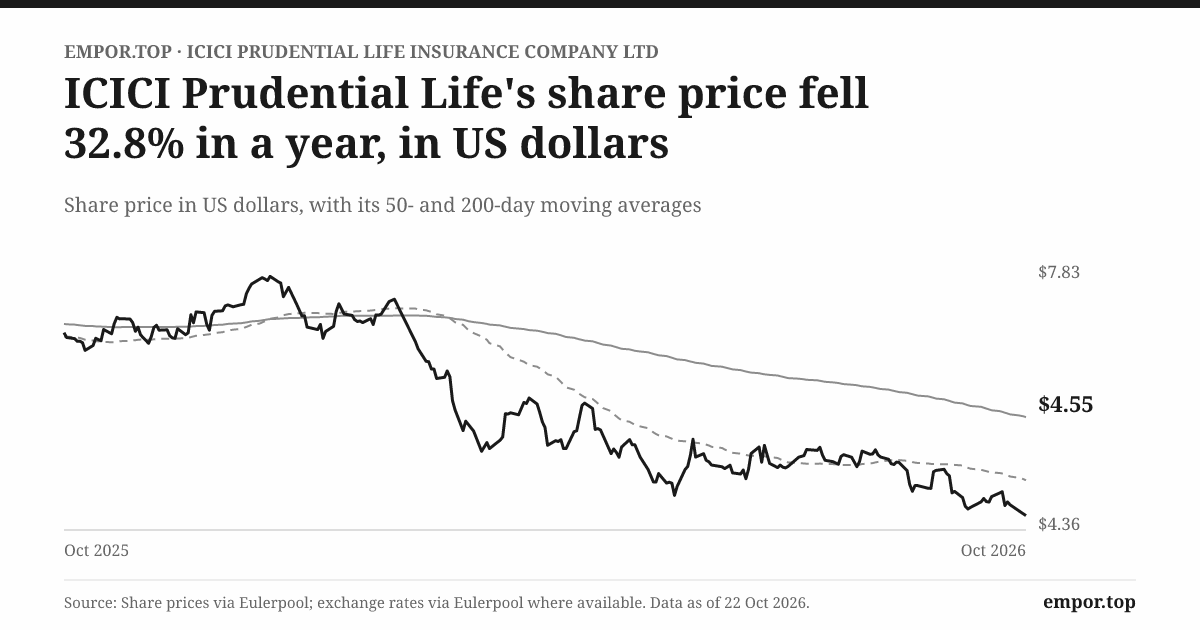
On October 22, 2026, ICICI Prudential Life's shares closed at about ₹431, the bottom of their 52-week range and about 37% below the year's high of roughly ₹688. The fall came in the same months that VNB growth accelerated to its fastest pace in years. That gap between operating momentum and share price is the whole investment debate in a single chart.
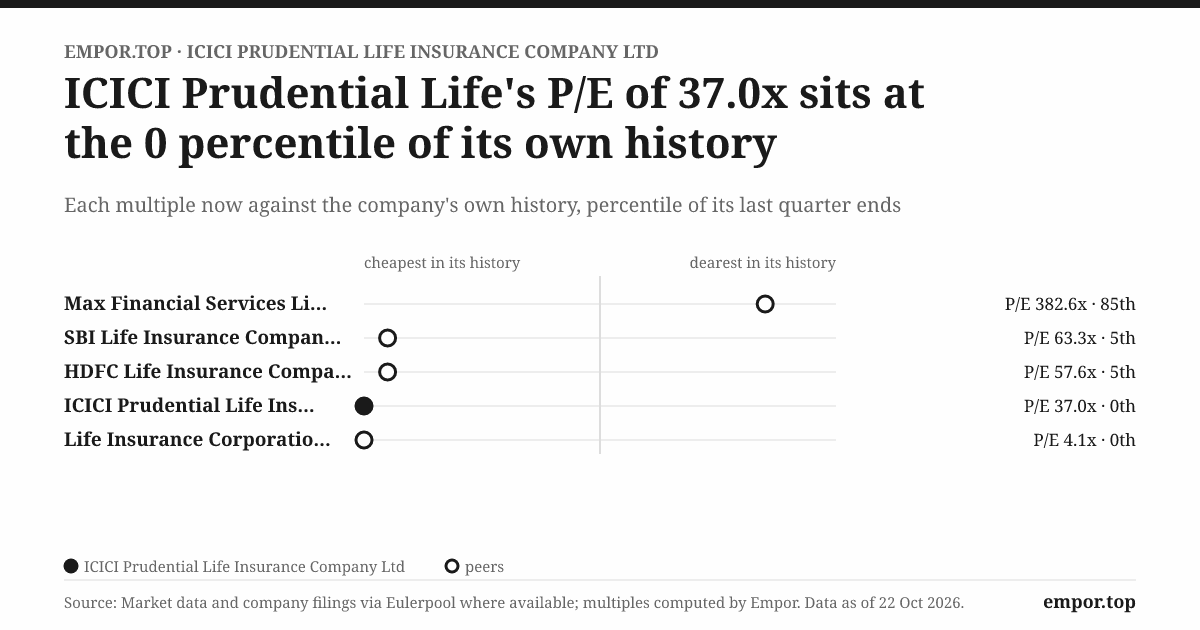
On trailing earnings, the stock traded at about 37 times, against a five-year median of about 87.5 times.4 The earnings yield, the inverse of that multiple, was about 2.7%. Measured by its own history, the shares look cheaper than they have been in years. Measured against the closest listed peers, they look cheaper too: SBI Life traded at about 64 times earnings and HDFC Life at about 57 times on the same date.2122
Both comparisons need a caveat before they mean anything. The five-year median was unusually inflated, because it was struck against the lean profits of FY2021 to FY2023, the bottom of the decade-long slide in returns. A multiple of an abnormally low profit is an abnormally high number, and comparing today's multiple with it flatters the present. Insurer P/E ratios are also notoriously poor guides, because accounting profit lags the value created by new business. The more meaningful yardstick is price to embedded value. At about 1.1 times its September 2026 embedded value, compared with 3.4 times at the IPO, the market is attributing little value to future new business beyond what is already on the books.39 Whether that is too pessimistic depends almost entirely on whether VNB can grow at attractive margins for years.
The bull case starts there. The company has a large in-force book, multiple distribution channels and a solvency ratio well above the regulatory minimum and ICRA's trigger. Its strongest recent growth has come from protection and annuities, and the GST change has made protection cheaper for customers. If pricing, persistency and claims experience hold, a higher-margin mix can lift VNB faster than APE for several years, and the embedded value will compound. At little more than embedded value, the market is barely paying for that possibility.
The bear case is rooted in the record. Shareholder profit was essentially flat over ten years. Retail regular-premium market share nearly halved from FY2020 to FY2026. ULIPs were still nearly half of FY2026 business mix, and management expects protection growth to slow. Regulatory changes to surrender values, commissions and tax credits could squeeze margins across the industry. And a new chief executive, a strengthening controlling parent and an opaque related-party pricing basis add governance questions at exactly the moment execution matters most.
To weigh those cases, it helps to test the competitive advantage through two frameworks. Michael Porter's five forces describe the pressures on the industry. Hamilton Helmer's seven powers ask which, if any, durable advantages a company has.
On Porter's forces, the picture is of a hard industry, with meaningful buyer and distributor power, intense rivalry and plentiful substitutes. High barriers to entry protect incumbents as a group rather than any one of them.
On Helmer's powers, scale economies and switching costs within a policy exist, but the evidence does not show meaningful network effects, counter-positioning or pricing power. The brand is a real asset, built partly on the ICICI name, but it is shared with a parent. Process power, in underwriting and claims, is plausible given the 99.3% claim settlement ratio, but it is not clearly superior to peers'. The closest thing to a cornered resource is the ICICI Bank relationship, and that resource represents only 12% to 15% of new business.
The evidence leaves the moat claim narrower than the brand suggests. The company has scale and distribution reach, which are real but contestable advantages. It does not have the kind of entrenched power that guarantees profitable growth. The retail regular-premium share decline is the strongest counterevidence, because it tests the claim through exactly the mechanism that would break it: customers and distributors choosing other insurers.
A skeptical long-short investor would sharpen the bear case with a few pointed questions. Why does a company with solvency near 230% pay out so little of its profit, and is that capital earning more inside the business than it would in shareholders' hands? Why does the cost ratio the company highlights exclude GST, when the lost input-tax credit is a real cost? Why is the formula behind the trademark fee paid to the controlling shareholder not published? And with the controlling bank raising its stake while foreign institutions sold down, are minority investors being given the information they need to judge the related-party terms?14 None of these questions implies wrongdoing. Each identifies a disclosure that would make the investment case easier to verify.
What would show the company is winning from here? Three numbers, above all. First, VNB growth and its margin, now about 22% and 26% for the first half of FY2027.2 Second, persistency, with 13th-month persistency at 84.5% and 25th-month at 76.2%.3 Third, solvency, at 229.9% in September.2 If VNB keeps growing in double digits with margins near current levels, persistency holds, and solvency stays comfortably above 170%, the bull case gains credibility. Continued market share loss, growth bought with weaker economics, or a material solvency decline would weaken it.
The investment spine can be stated in one sentence. This is a credible franchise with multiple channels and a strong balance sheet, but a durable edge from here remains to be earned, through profitable new business and customers who stay.
XI. Playbook: Business & Investing Lessons
The 2016 IPO framed the investment as a share of a long-duration book of promises and a bet that management would keep writing new ones at a profit. A decade later, that remains the right way to understand the business, and it carries a handful of lessons that belong to this company and no other.
The first lesson is that a bank can open the door, but it cannot make the customer stay. ICICI Bank gave the insurer its start: the branches, the customers, the brand. The bank's role in new business is now limited, while the insurer's retail regular-premium share has fallen sharply. Distribution brings a customer to the counter. Only a product that keeps earning its premium keeps them paying. For founders building on a partner's reach, the warning is that borrowed distribution is a launchpad, not an orbit.
The second lesson is that a premium is a promise before it is revenue. Every rupee the company collects is both income and an obligation, sometimes for decades. As the cash-flow line shows, conventional screens can misread this business. For investors, the discipline is to ask what each rupee of premium commits the company to, and how much capital stands behind that commitment, before asking how fast premiums grew.
The third lesson is that first to list is a milestone, not a moat. ICICI Prudential's first listing and early scarcity premium did not prevent rivals from catching up or its valuation from compressing. Being first gave it attention. It did not give it an advantage that rivals could not match.
The fourth lesson is the one that sums up the whole industry: in insurance, the best growth is the growth that survives the assumptions. The company's margin recovery, like its earlier return swings, depends on assumptions about mortality, persistency and interest rates, and on a protection boom management itself expects to cool. Growth that holds up only if every assumption breaks favourably is not growth; it is a forecast.
And there is a fifth, quieter lesson about joint ventures. Two parents can bring complementary strengths, local reach on one side, technical depth on the other, and this company is evidence of that. As the joint venture becomes a subsidiary, related-party pricing and channel diversification need more investor scrutiny, not less.
XII. Epilogue
Tonight, the company stands at an unusual juncture. Leadership and name changes coincide with a strong first half, while its share price sits near its 52-week low. Few companies enter a second half with so much changing at once.
The first moment that will decide the story is the full-year FY2027 result, due in the spring. It will show whether VNB keeps growing at double digits as protection growth moderates, and whether the 26% margin holds or slips back toward the previous year's level. Investors will need to separate the parts of any margin change that come from product mix, from operating improvement and from changes in actuarial assumptions, because only the middle one is clearly repeatable.
The second is protection itself. Management has said growth will taper from 40% to 50%. If it settles at, say, 20% to 25% while margins hold, the mix shift will have proved more durable than skeptics feared. If it falls sharply, the first half will look like the product of a one-time tax change, and the margin story will have to be rebuilt on something else, perhaps annuities, which grew about 50% in the first half from a small base.
The third is distribution. Agency's turnaround remains modest, while direct and partnership distribution are growing faster.3 A new CEO from the bank's digital and partnership businesses will be judged on whether the proprietary channels, the ones the company controls and that build the stickiest relationships, keep expanding. Watch whether the retail regular-premium share stabilises or keeps falling.
The fourth is the rulebook. The regulator's consultation paper on distribution economics may turn into rules, and those rules could reshape commissions across the industry. Surrender-value rules and the GST input-credit issue will continue to work through costs and margins. The tax appeals on the AY2023 demand will run their course. If Prudential's reclassification from promoter to investor is approved, it will complete the transformation of the joint venture into a bank-controlled insurer.
There is also the simplest milestone of all: the regulator's approval of the new chief executive. The board set his start for October 14, but made it subject to that approval.1 Until it is confirmed, the leadership transition is not fully complete.
Each of these outcomes points one way or the other. Steady VNB growth, stable persistency, falling costs and solvency well above 170% would say the recovery is real and the new chief executive has inherited an engine, not a sugar rush. Slowing VNB, slipping persistency or rising costs under new rules would say the first half was a high-water mark in more than one sense.
The story remains open because recent growth, however strong, has not yet crossed a full cycle under the new leadership and the new product mix. That is the tension that remains: whether this insurer can grow the value of each new policy while keeping the capital behind every promise intact.
XIII. Outro
Go back to the engineer with the newborn and the home loan, signing up for a term policy on an ordinary morning. He pays a premium today. In return, the company promises to be there, solvent and willing, if the worst happens in ten, twenty or thirty years. That premium is both a sale and a liability, and for an insurer, the two never fully separate.
Twenty-five years after it began selling policies, and in the month scheduled for its chief executive transition, ICICI Life's defining asset is neither its premium book nor its parents' names. It is the capacity to keep promises made long ago while finding the next generation of policies worth writing. The new CEO inherits a strong first half, a changing product mix and an old question. One premium today, decades of obligations ahead, and an insurer whose story will be measured by how well it carries both.
References
-
ICICI Life appoints Sidharatha Mishra as MD & CEO as Anup Bagchi steps down — Business Today, 2026-10-02 ↩↩↩↩↩↩
-
Life Investor Presentation, Quarter Ended September 30, 2026 — ICICI Life, 2026 ↩↩↩↩↩↩↩↩
-
Q2 FY2027 Earnings Call Transcript — Stock Analysis, 2026-10-13 ↩↩↩↩↩↩↩↩↩↩↩↩↩↩↩↩↩↩↩↩↩↩↩↩↩↩↩↩↩↩↩↩↩
-
Integrated Filing, Audited FY2026 Results — NSE, 2026-07-13 ↩↩↩↩↩↩↩↩↩↩↩↩↩↩↩↩↩↩↩↩↩↩↩↩↩
-
Red Herring Prospectus — ICICI Prudential Life Insurance Company Limited, 2016-09-07 ↩↩↩↩↩↩↩↩
-
Most Powerful Women in Business 2011: Shikha Sharma — Business Today, 2011-09-18 ↩↩↩↩
-
Prudential plc announces the successful domestic listing of ICICI Prudential Life Insurance Company Limited — Prudential plc, 2016-11-15 ↩↩↩↩↩
-
ICICI Prudential Life Insurance Company Limited RHP filing — SEBI, 2016-09-28 ↩
-
Consolidated Q4 FY2026 Public Disclosure — ICICI Prudential Life, 2026 ↩↩↩↩↩↩↩↩↩↩↩↩
-
FY2026 Earnings Call Transcript — ICICI Prudential Life via NSE, 2026-04-20 ↩↩↩↩
-
CEO Appointment Filing — ICICI Prudential Life via NSE/BSE, 2026-10-02 ↩
-
AY2024 Tax Rectification Announcement — StockFin, 2026-10-15 ↩
 LinkedIn
 WhatsApp
 Reddit
 Hacker News
 Email
 Kindle
 RSS Feed
 Spotify
 Apple Podcasts
 Amazon Music
 Audible
 YouTube