ICICI Lombard: The Price of the Float
I. The insurer that still loses money on insurance
On October 14, 2026, ICICI Lombard's managing director Sanjeev Mantri and chief financial officer Gopal Balachandran walked analysts through a set of numbers that, read together, describe one of the stranger business models in Indian finance.1 The company's investment portfolio had grown to ₹64,332 crore by the end of September, about ₹3,750 crore more than it had been just three months earlier.2 Its solvency ratio, the regulator's measure of how much capital it holds against the risks it has written, stood at 2.74 times, close to twice the 1.5 times the law requires.1 And its combined ratio for the first half of the fiscal year, the single number that tells you whether an insurer makes money on the policies it sells, had worsened to 105.2%, from 103.0% a year earlier.1
That last figure needs translating, because the whole story hangs on it. A combined ratio adds up what an insurer pays out in claims and what it spends running the business, and divides by the premium it has earned. Below 100%, the insurer makes money on insurance. Above 100%, it loses money on insurance and has to make it back somewhere else. At 105.2%, ICICI Lombard was paying out about ₹105 in claims and costs for every ₹100 of premium it earned in the first half of fiscal 2027. The company is India's largest private general insurer, it is profitable, it pays a dividend, and it still loses money on the insurance it sells.
The somewhere else is the float. Customers pay premiums upfront, and claims arrive later, sometimes years later. In the gap, the insurer invests the money. For ICICI Lombard, investment income in the first half came to ₹2,728 crore, while profit before tax was ₹1,921 crore.2 The arithmetic is simple and stark. Strip out the investment income and the rest of the business, mostly underwriting, lost roughly ₹800 crore in six months. The insurer did not make money despite the float. It made money because of it.
This is not a scandal. Most of the world's general insurers have lived this way for long stretches, and ICICI Lombard has done it better than its own industry. The company says that over ten years its combined ratio averaged 102.9% against 115.3% for Indian general insurance as a whole, and its return on equity averaged 19.1% against 4.0% for the industry.3 Those are the numbers of a disciplined operator in a market where discipline is rare. But they also frame the question that runs through this story. Can India's leading private general insurer make underwriting itself profitable, or will the investment portfolio always have to carry the business?
Four smaller questions sit inside that one. Does ICICI Bank's control of the insurer, regained in 2024, give it a durable distribution advantage, and at what price? Did the 2021 acquisition of Bharti AXA's general insurance business, paid for in shares, earn back what it cost existing owners? How much weight should an investor put on the company's description of itself as a digital pioneer? And at roughly 34 times trailing earnings, what is the market already assuming about all of the above?
Start with the scale of the thing. In fiscal 2026, the year to March 2026, ICICI Lombard wrote ₹28,712 crore of gross direct premium, the industry's standard measure of business written directly with customers, which gave it about 8.9% of the Indian market.4 Including reinsurance it accepted from other insurers, gross written premium reached ₹30,618 crore.3 That distinction matters, because headline figures for this company swing depending on which line someone quotes, and the data services that summarise listed companies use yet another definition of "revenue", built from earned premium and investment income, which put fiscal 2026 at about $3.1 billion. None of these is wrong. They simply measure different things, and only premium, claims and expenses measure the insurance business itself.
Motor insurance made up about 40% of that premium and health, travel and personal accident about 32%, with fire insurance close to 12%.4 Profit after tax for the year was ₹2,772 crore, return on average equity was 17.8%, and the combined ratio was 103.4%, slightly worse than the 102.8% of the year before.3 Solvency stood at 2.67 times at March 2026.3 The company carries no borrowings at all after redeeming its last ₹35 crore of subordinated debt in April 2024.5
Then came fiscal 2027, and a half-year that looked worse than its best quarter. In the April to June quarter, a Supreme Court ruling on how motor-accident compensation should value the work of homemakers forced the company to add ₹165 crore to its motor third-party reserves, and profit fell by almost half, to a little over ₹400 crore.6 In the July to September quarter, profit after tax rose 27.5% to ₹1,031 crore on the company's own presentation basis, while the statutory standalone accounts filed with the exchanges showed ₹946 crore, up about 15%.17 Over the half, profit fell 5.8%.1
So what changed between the quarter and the half? Not underwriting. The second-quarter combined ratio was still 104.5%, worse than the 103.9% of a year earlier, with floods adding about ₹118 crore of catastrophe losses.1 What changed was the portfolio. Realised capital gains in the quarter came to ₹453 crore, nearly double the ₹236 crore of a year earlier.2 That increase alone accounts for roughly three quarters of the rise in quarterly profit before tax. The good quarter, in other words, was a good quarter for the float. To understand why that pattern has persisted for a quarter of a century, the story has to go back to the moment India let private companies sell this kind of promise at all.
 Subscribe on LinkedIn
II. A license to build a private insurer
At the turn of the century, Indian general insurance was a closed room with four people in it. In fiscal 2001 there were four general insurers of any size, all owned by the state, and private companies held about 0.1% of the market.3 A factory owner insuring a warehouse, a family insuring a scooter, a hospital buying liability cover: all of them bought from the same public-sector institutions, on prices that were largely set by a tariff committee rather than by competition.
The opening of insurance to private capital changed that, and ICICI Bank moved early. The bank, then still transforming itself from a development-finance institution into a full-service lender, formed a joint venture with Fairfax Financial Holdings, the Toronto-based insurance group run by Prem Watsa, and ICICI Lombard was born in 2001.8 The logic was a straightforward trade of strengths. ICICI brought an Indian financial brand, a customer base and the beginnings of a nationwide network. Fairfax brought what a bank could not: decades of experience pricing insurance risk, and the willingness to put capital behind it.
The early years were a land grab, and the numbers show how easy it was to grow from nothing. Between fiscal 2001 and fiscal 2008, while India's general insurance market grew about 16.6% a year, ICICI Lombard grew at roughly 73% a year, from a tiny base.3 By fiscal 2008, private insurers held more than 37% of the market.3 Then the tariff era ended. With detariffing, insurers could price fire and motor own-damage cover themselves, and the market discovered what free pricing does to a crowded field. Discounts ran deep. The company's own account of that period is revealing: after fiscal 2008, it says, its growth slowed "owing to its focus on profitable growth", and from fiscal 2008 to fiscal 2026 its premium compounded at about 12.8% a year against 14.5% for the industry.3 Over the same stretch, it says, its profit compounded at about 20.7% a year against 9.4% for the industry.3
That pair of figures is the company's founding bargain in miniature. ICICI Lombard chose to grow a little slower than the market in exchange for earning much more than the market. Whether that bargain still holds is a question for later. What it established early was a culture of saying no to some premium.
The man most associated with that culture was Bhargav Dasgupta, who ran the company for 14 years from 2009.5 He took over a fast-growing insurer still scarred by the price wars of detariffing and left a listed, scaled franchise. Under his leadership, gross direct premium rose from about ₹13,300 crore in fiscal 2020 to about ₹21,000 crore in fiscal 2023, a period that included both the pandemic and the Bharti AXA merger.5 He left in 2023 to become a vice president of the Asian Development Bank, a departure that said something about the standing he had built.5
Building the insurer meant building plumbing that a licence does not provide. A general insurer needs agents and brokers to find customers, partnerships with banks and car dealers to reach them at the moment they buy a loan or a vehicle, surveyors and hospital networks to process claims, and technology systems to price, issue and service millions of small policies. By March 2026, ICICI Lombard had 341 branches, about 800 broker relationships, more than 157,000 individual agents including point-of-sale persons, and 326 corporate agents, served by 15,008 employees.3 It had issued more than 39 million policies and processed more than 3.4 million claims over the year.3
The public markets arrived in September 2017. ICICI Lombard became the first general insurer in India to list, through an offer priced at the top of a ₹651 to ₹661 range that raised about ₹5,700 crore.9 Every rupee went to the sellers. The offer was a pure sale of 86,247,187 existing shares by ICICI Bank and Fairfax's FAL Corporation, so the insurer itself raised nothing.105 Public investors were buying a stake in a business that had written ₹10,725 crore of gross direct premium in fiscal 2017, held about 8.4% of the market and about 18% of the private market, and was priced at about 46 times earnings.9 That was a rich multiple, and a signal that investors were already paying for a franchise rather than a balance sheet.
Fairfax did not stay for the ride. It had sold a block of shares to investors including Warburg Pincus in May 2017, sold more in the listing, and in October 2019 sold its last roughly 2.23 crore shares at about ₹1,178 each for about ₹2,627 crore, ending an 18-year partnership.8 By then Fairfax was backing a new digital insurer started by former Allianz executive Kamesh Goyal, a venture that became Go Digit and now competes with ICICI Lombard for the same customers.8 The partner that taught the company risk had become the funder of a rival.
The origin story explains the access ICICI Lombard had: a trusted name, a bank's customers, a risk partner and a head start of a few years. It does not explain whether the company is better than the market at the one thing that matters most in insurance. Once it had scale, could it price risk better than everyone else?
III. The premium is collected before the claim arrives
Picture a car owner in Pune renewing a policy in April. She pays her premium on the day she buys the cover, because Indian law requires it. Section 64VB of the Insurance Act says, in effect, that no insurer may take on a risk until it has been paid.5 For the next twelve months, the insurer holds her money and owes her a promise. If she dents her car in a monsoon flood, the insurer will learn the cost within weeks. If she injures a pedestrian, the insurer may not know the true cost for years, because the claim will travel through an accident tribunal and perhaps an appeals court before anyone agrees what the injury was worth.
That is the inverted cash cycle of insurance. A manufacturer buys raw materials, makes something, sells it, and then waits to be paid. An insurer is paid first and finds out its costs later. The money in between is the float.
The pricing unit is the policy premium, set against what the insurer expects to pay in claims, what it will spend acquiring and servicing the customer, and a margin for risk. Different products have very different shapes. Motor own-damage cover, which repairs the customer's own car, is annual and the claims arrive quickly. Health cover is also annual, renewed each year at a new price, with claims driven by hospital bills that tend to rise faster than general inflation. Fire and engineering policies for factories and infrastructure are low-frequency and high-severity: years of quiet, then a cyclone. And motor third-party liability, the cover the law requires every vehicle to carry against harm done to others, is sold for three years on new private cars and five years on new two-wheelers, with claims that can take a decade to settle.5
The business mix tells you which of those shapes dominates. Motor was about 40% of ICICI Lombard's fiscal 2026 premium, down from about half in fiscal 2021, while health, travel and personal accident rose to about 32% from about 22%.4 Within motor, third-party liability alone made up about 20% of the company's total premium.4 Fire, the largest commercial line, was about 12%.4 Two products, motor and health, account for nearly three quarters of the book. That concentration is not a weakness in itself, but it means the company's results move with two things it does not control: what Indian courts award in accident cases and what Indian hospitals charge.
Now look at what the float really is on a balance sheet. At March 2024, the company carried about ₹10,000 crore of unearned premium reserves, money received for cover not yet provided, plus about ₹3,400 crore of premium received in advance.5 Those are liabilities. They are promises to policyholders, not spare cash, and the investments that back them belong in the first instance to the people who will make claims. The company makes that division explicit by reporting a policyholders' investment account separately from the shareholders' account. At March 2024, policyholder-backed investments were about ₹37,300 crore and shareholder funds about ₹11,600 crore.5
The combined ratio is how you know whether the price was right. In fiscal 2026, ICICI Lombard's claims came to about 71% of earned premium.3 Its combined ratio was 103.4%, which means commissions and operating costs consumed roughly another 32 paise of every rupee of premium, measured on written premium as the company defines it.3 Claims of 71 plus expenses of 32 adds up to a loss on insurance of about three paise per rupee, before a single rupee of investment income.
A listener used to manufacturers or software companies might ask why anyone would run a business that loses money on its product. The answer is time. If an insurer collects ₹100 today, pays ₹103 over the next two or three years, and earns 7% to 8% a year on the money in between, it can still make a healthy return. That is why the length of the claim tail matters so much. A long tail gives the float more time to earn. It also gives the insurer more time to be wrong.
Motor third-party is where both effects are largest. It is a material share of premium, its price is set by the regulator rather than by the insurer, and ICRA noted in June 2026 that there had been no third-party price increases "in the last many years".4 Its ultimate cost depends on court awards, wage levels, medical inflation and legal precedent, all of which can change after the policy has been priced and sold. ICRA called the line a source of "reserving risk", while also noting that the company's loss triangles showed reserves had been adequate in the past.4
The company's own reserve disclosures show what "adequate" has meant. For the motor third-party policies of accident years 2017 through 2020, the estimated ultimate cost of claims has since fallen by between about 18% and 31% from where it was first set.3 Put plainly, the company reserved more for those years than it eventually needed, and as it lowered those estimates the difference flowed back into profit. That is the mark of a prudent reserver. It also means that some part of the combined ratios investors have seen in recent years has been flattered by releases from old years. The Supreme Court's homemaker ruling in 2026 was a reminder that the flow can run the other way.
So the promise is the product, and the product is only as good as its price. Once that is clear, distribution looks different. The question is not just who sells the most policies, but who keeps the good customers, sheds the bad ones, and can afford to walk away when rivals underprice. In 2020, ICICI Lombard decided that the fastest way to more customers was to buy someone else's.
IV. The Bharti AXA bet: scale bought with shares
On August 21, 2020, in the middle of the pandemic, ICICI Lombard's board approved a scheme of arrangement to absorb the general insurance business of Bharti AXA General Insurance.1112 Bharti AXA was a joint venture between Sunil Mittal's Bharti Enterprises, which owned 51%, and French insurer AXA, which owned 49%.12 It had about 152 branches and ranked as the eleventh-largest private non-life insurer in India.13 In fiscal 2020 it had written gross premium of about ₹3,157 crore, up 38% in a year.11
The price was paid entirely in paper. Bharti AXA's shareholders would receive two ICICI Lombard shares for every 115 of their own, which worked out to about 35.8 million new ICICI Lombard shares.1112 There was no cash. Bharti and AXA would become shareholders of the combined company, and the operating business would move into the listed insurer.
The deal needed approval from almost every financial regulator in India. The Competition Commission cleared it on November 2, 2020, finding that the two insurers overlapped in nearly every line but that the combined share was not large enough to harm competition, with the one notable overlap in health insurance by number of policies.14 The insurance regulator gave final approval on September 3, 2021, and the combination was completed on September 8.1516 ICICI Lombard issued 35,756,194 shares of ₹10 face value to Bharti and AXA.5
Headlines valued the deal in euros at whatever ICICI Lombard's share price happened to be on the day, which is why reports range from €521 million at announcement to €664 million at completion.1316 A better anchor is the company's own accounting. ICICI Lombard recorded the share consideration at ₹4,816 crore, against net assets of about ₹740 crore transferred at the appointed date.17 That is about 6.5 times the book value of what it acquired.
That multiple sounds alarming, and on its own it proves very little. Book value is a poor measure of what an insurance franchise is worth, because the valuable assets, the distribution relationships, renewal books and underwriting know-how, never appear on a balance sheet. The fairer tests are relative ones, and there are three.
The first test is what ICICI Lombard was itself worth at the time. At ₹4,816 crore for 35.76 million shares, the deal valued each ICICI Lombard share at about ₹1,347. On equity of roughly ₹7,300 crore at March 2021, that put ICICI Lombard at about eight times its own book.5 In other words, the company paid for Bharti AXA with a currency that the market priced even more richly than the price it paid. Paying 6.5 times book with stock valued at about 8 times book is not the same as paying 6.5 times book in cash.
The second test is what was bought for the shares. CRISIL calculated that Bharti AXA contributed almost one fifth of the merged entity's ₹17,504 crore of pro-forma fiscal 2021 gross premium.18 The new shares, meanwhile, represented about 7% to 8% of the enlarged company, enough to pull ICICI Bank's stake from about 51.9% to about 48.1%.18 On premium, existing shareholders gave up less than a tenth of the company to acquire about a fifth of the combined book.
The third test is quality, and here the deal looks worse. In fiscal 2021, ICICI Lombard on its own ran a combined ratio of 99.8%, a small underwriting profit. The merged entity, on a pro-forma basis, ran 101.2%, with the underwriting deficit roughly doubling from ₹192 crore to ₹406 crore.18 Solvency fell from 2.97 times on a standalone basis to 2.68 times for the merged company.18 AXA disclosed that its Indian non-life business had produced underlying earnings of about €1 million in 2019, close to nothing.13 ICICI Lombard was buying premium volume, not profit, and CRISIL warned that the benefits of scale "will materialize in the long run" while flagging the new crop insurance book as a risk that needed careful underwriting.18
The years after the merger supply the verdict, and it is a mixed one. Return on equity fell to about 13.8% in fiscal 2022, the merger year, from about 19% the year before, as integration costs and a weaker acquired book flowed through.5 It recovered to about 17% to 19% over the following four years.3 Market share is the more uncomfortable measure. CRISIL put the merged company's pro-forma share at 8.6% for fiscal 2021.18 ICRA put ICICI Lombard at 8.9% in fiscal 2026 and 9.0% in fiscal 2025.4 Five years after buying a fifth of its premium base, the combined company holds roughly the market share the two held together on the day they merged.
That is not failure. A flat share in a market that kept growing means the merged company kept pace, and premium has risen from about ₹17,500 crore pro forma to ₹28,712 crore.184 Crop insurance, inherited largely from Bharti AXA, became a meaningful line and then shrank again as the company stepped back from state tenders it judged mispriced; its crop premium fell by half in fiscal 2026.3 But the claim that the merger bought a lasting share gain is not supported by the record. What it bought was a step up in size that then had to be defended like any other.
The other thing it bought, by accident, was a question about control. ICICI Bank had been required by Indian banking law to hold either less than 30% or more than 50% of an insurance company.19 The share issue had pushed the bank to 48%, and the company had ceased to be its subsidiary.16 The bank had a decision to make.
V. The bank returns—and sends a bill
On May 29, 2023, ICICI Lombard's shares jumped more than 14% in a day.19 The news was not about insurance. ICICI Bank's board had approved buying up to 4% more of the insurer in tranches, with at least 2.5% to be bought before September 9, 2024, so that ICICI Lombard would become its subsidiary again.19 The bank had been given until that date by the Reserve Bank of India to resolve its in-between stake.19 It chose to buy rather than sell.
The purchases came through the market. ICICI Bank's holding went from about 48% at March 2023 to more than 50% on February 29, 2024, then about 51% at March 2024 and about 52% by June 2024.5 By September 2026, the promoter held about 51%, with foreign investors at about 18%, domestic institutions about 24% and the public about 6%.20 None of that money went to the insurer. It moved from selling shareholders to the bank, and its only effect on ICICI Lombard's economics was to re-establish who controls it.
Control matters for two reasons. The first is credit. Both CRISIL and ICRA cite ICICI Bank's ownership as a core support for their top ratings, with ICRA noting the shared brand, the bank's board representation and the expectation of "adequate and timely capital support if required".4 A weakening of that relationship is listed by ICRA as one of the triggers for a downgrade.4 The second reason is money flowing between the two companies, and that is where the investor's interest sharpens.
In fiscal 2024, ICICI Lombard paid ICICI Bank about ₹124 crore in bancassurance commission and brokerage, up from about ₹101 crore the year before.5 It paid about ₹17 crore in royalty for using the ICICI name and logo, up from about ₹13 crore, and another ₹19 crore or so in shared and establishment expenses.5 In the same year, it wrote about ₹313 crore of insurance premium from ICICI Bank as a customer, insuring the bank's own assets and staff.5
It would be easy to set ₹313 crore of premium against ₹141 crore of commission and royalty and conclude that the bank takes back almost half of what it sends. That would be wrong, because the two figures measure different things. The ₹313 crore is the bank buying insurance for itself. The commission is paid on policies the bank's branches sell to their own customers, such as home-loan borrowers insuring their houses or account holders buying health cover. Those customers' premiums do not appear in the related-party note at all.
The company gave a clue to their size on the October 2026 call. Asked how much premium came from banks, Balachandran said business sourced through banks, finance companies and other institutions via corporate agency was roughly 12.5% to 15% of premium for a full year, and that excluding ICICI entities the contribution was in single digits.21 On fiscal 2026 premium, that implies the ICICI group channel sources something in the low thousands of crores a year, far more than the ₹313 crore the bank buys for itself. Against that, ₹124 crore of commission looks like an ordinary distribution cost rather than an extraction. The precise ratio cannot be calculated from public filings, because the company does not publish premium sourced through ICICI Bank as a separate figure. That gap is the single most useful disclosure the company could add.
The royalty is a cleaner question, and a more uncomfortable one. A name-licence fee rising 28% in a year, faster than premium, is a transfer that requires no sales effort from the bank. At about ₹17 crore it is small against a profit of nearly ₹2,000 crore in fiscal 2024, but it is the kind of line that grows quietly and that independent directors exist to watch.5
The company's answer to all of this is certification. A chartered accountant firm independently confirms that related-party transactions are at arm's length and in the ordinary course of business.5 Shareholders have been overwhelmingly supportive: at the June 2024 annual meeting, every resolution on managerial pay, appointments and related-party limits passed with more than 99.8% approval.22 The board is chaired by an independent director, Lalita D. Gupte, herself a former ICICI executive.5
The bank channel also deserves its fair test against the alternatives. ICICI Bank has thousands of branches, but those are the bank's footprint, not the insurer's. The Competition Commission's 2020 order noted that certain ICICI group distribution entities sell only ICICI Lombard's general insurance products and no other insurer's.14 In September 2026, IRDAI published a consultation paper proposing that every distribution entity be eligible for open architecture, that related-party distribution arrangements require prior notice to the regulator and public disclosure, and that volume-linked incentives for bank staff selling insurance be prohibited.23 Comments are due by October 25, 2026.23 If those proposals survive, the bank's channel will look less like a private pipe and more like one shelf among several.
The man now running this relationship is Sanjeev Mantri, who became managing director and chief executive on December 1, 2023.24 He is a chartered and cost accountant who began his career at Bennett Coleman, the publisher of The Times of India, worked at BNP Paribas, and then spent two decades in the ICICI group, starting at ICICI Bank in 2003, where he ran the small-business and rural-banking groups.24 He joined ICICI Lombard in 2015 to run its retail business and was closely involved in the listing and the Bharti AXA integration.24 His background is distribution and banking, not actuarial science, which makes the bank channel and retail health, both distribution-led, natural places for him to push. In fiscal 2024 he received ₹5.25 crore in total pay, of which about ₹1.6 crore was variable.5
Capital has also flowed back to all shareholders, which is easy to miss because some data services record the company's dividends as zero. They were not. ICICI Lombard paid dividends that rose from ₹10 a share for fiscal 2023 to ₹13.50 for fiscal 2026, roughly 28% to 32% of earnings, and declared an interim dividend of ₹7 for the first half of fiscal 2027.531 ICICI Bank alone received about ₹248 crore in dividends in fiscal 2024.5 The bank, in other words, is paid three ways: commission for selling, royalty for its name and dividends as owner. The test of whether that bargain is fair to minority holders is whether the channel brings in business that would not otherwise come, at a cost no worse than the alternatives. The company has been strikingly quiet on the numbers that would prove it, and louder on another claim entirely.
VI. The digital claim meets the claims file
A car bumps a divider on a Bengaluru flyover. A decade ago, the owner would have waited for a surveyor to come, inspect the damage and approve the repair, a process measured in days. Today, at ICICI Lombard, the owner can open an app, point a phone at the dent, and have a surveyor assess the damage by video. By fiscal 2024, the company reported average claim settlement times of about six days in motor and five in health.5 By fiscal 2026, it said 96.8% of motor own-damage claims, excluding theft, and 98.8% of retail health claims were paid within 30 days.3
The company describes itself as a pioneer, and some of its claims are concrete. It says it was the first large insurer in India to move all of its core systems to the cloud.3 It says it issued 99.6% of its policies electronically in fiscal 2026.3 It says its customer app, IL TakeCare, passed 23 million downloads by September 2026, and that the share of customer interactions handled through do-it-yourself digital journeys rose from 39% to 73% in a year.1 Management said a generative AI tool for flagging fraud and claims leakage had improved its precision from about 45% to 60%, and that a WhatsApp-based assistant is used in more than 40% of agency health new business each day.2
Each of those tools changes a specific step in the process. Video surveys cut the time and cost of inspecting a motor claim. Electronic issuance removes paperwork and data-entry errors at the point of sale. Self-service journeys move routine questions, such as policy copies and claim status, from call centres to phones. Fraud analytics, if they work, change the claims number itself, because every fraudulent claim caught is money that stays in the float. That last one matters most, because it is the only one that touches the loss ratio directly.
The reinvestment behind it is real but modest. In fiscal 2024, the company added about ₹85 crore of software, bringing the gross block of its core software to about ₹814 crore, and spent another ₹21 crore or so on IT equipment, out of about ₹140 crore of total fixed-asset additions.5 Against premium of nearly ₹25,000 crore that year, that is well under 1% of revenue.5 General insurers do not run research laboratories, and the capital spending here is the cost of running a modern back office, not a moonshot.
The most interesting number is a quiet one. Total headcount was about 15,000 at March 2024, and 15,008 at March 2026.53 Over those two years, gross direct premium rose from about ₹24,800 crore to ₹28,700 crore, about 16%, while the branch network reached 341.3 More premium and more branches with the same number of people is what productivity looks like. It is the strongest evidence the company has that technology is doing work people used to do.
What the evidence does not show is a moat. Faster claim settlement is a service measure, not proof of higher retention, lower acquisition cost or better pricing. The company says renewal execution using digital and AI tools improved retention by about 4.8% in fiscal 2026, and by 3% to 5% across retail lines in the first half of fiscal 2027.321 It does not publish absolute renewal rates by product, so an outsider cannot compare those with peers. Its expense ratio, meanwhile, has not fallen. On the October 2026 call, Balachandran said commission and expense ratios had risen because retail business, which carries higher acquisition costs, was a larger share of the mix.21 Technology may be saving money in the back office, but the savings are being spent at the front door.
The test the company itself sets, "technology to optimise processes and better serve customers", is mostly being met.3 The test an investor should set is harder: does the digital investment show up as a lower combined ratio than rivals with similar mixes, or as customers who stay longer? The ten-year combined-ratio gap against the industry suggests the company has some operating edge.3 But that gap predates most of the generative AI tools now being promoted, and rivals such as Go Digit were built digital from day one. Digital capability has become the price of entry in Indian general insurance. Whether ICICI Lombard's version is better enough to matter is not yet in the numbers.
And all of that service depends on something less glamorous: claims being paid, and the money to pay them being where the balance sheet says it is. Some of the largest receivables on that balance sheet are owed not by customers, but by other insurers.
VII. ₹10,268 crore due from insurers
Run ICICI Lombard through a standard stock screener and it flashes a warning. Debtor days, the number of days of revenue tied up in money owed to the company, read 188 in fiscal 2026, having peaked at 222 in fiscal 2022.5 For a manufacturer, six months of sales sitting unpaid would signal customers who cannot pay, or a company that books sales too aggressively. For an Indian general insurer, it signals almost nothing about customers, because customers are not allowed to owe money. Under Section 64VB, cover cannot begin until the premium is paid.5
So where does the receivable come from? The answer sits in the notes to the balance sheet. At March 2024, outstanding premium owed directly by policyholders was about ₹814 crore, against which the company held about ₹123 crore of provisions, leaving about ₹692 crore, less than 3% of the year's premium.5 Those are mostly government and large corporate accounts, such as crop schemes and group health, where payment arrangements differ from retail. The giant line is different: "due from other entities carrying on insurance business", which stood at ₹10,268 crore gross, with a provision of just ₹59 crore against it.5
That balance is the price of reinsurance. Insurers pass part of the risks they write to reinsurers, which take a share of the premium and a share of the claims. When a cyclone flattens a factory, ICICI Lombard pays the factory owner and then collects the reinsurers' share. It also co-insures large risks with other Indian insurers, sharing premium and claims. The ₹10,268 crore is the sum of those recoveries and settlement balances still in transit. It is, in effect, the sum other insurers have promised to pay ICICI Lombard back.
Why so large? Because the company deliberately keeps some risks and passes on others. In fiscal 2024, it retained about 96% of its motor risk and 84% of its health risk, but ceded about 77% of fire, 69% of engineering, 70% of crop and 88% of marine hull.5 Overall it kept about 71% of the risk it wrote.5 That is a sensible design. Motor and health are high-volume, predictable books where the law of large numbers works in the insurer's favour. Fire, engineering and crop are exposed to single catastrophic events that could do serious damage to capital. The company says it uses only reinsurers rated A- or better, against a regulatory floor of BBB, and that its catastrophe protection is conservative.3
The company also shows how that protection has worked. In the Chennai floods of 2015, Cyclone Amphan in 2020 and the North India floods of 2023, its share of industry insured losses was broadly in line with or below its market share, and in several events well below its share of the property and casualty market.3 Reinsurance absorbed the excess.
The risk is not that the balance is fake. It is that it depends on counterparties paying on time and agreeing on what is owed. Treaty disputes, slow settlement after a big event, or a weakened reinsurer could leave the company waiting for money it has already paid out. The provision of ₹59 crore is about 0.6% of the gross balance, which is either evidence of good counterparties or of an optimistic view.5 The balance is about the same size as the company's entire net worth at the time, which is why it deserves to be followed in each annual report: does it grow faster than premium, does the share that is more than a year old rise, and do provisions move?5
The investment book has its own common misreading. Some data services show ICICI Lombard's "investments" collapsing from about $5.3 billion in fiscal 2023 to almost nothing in fiscal 2025. That is an aggregation error that drops the policyholders' investment schedule. The real figure kept growing: total investments rose from about ₹48,900 crore at March 2024 to ₹64,332 crore by September 2026.542 The money is invested conservatively. At March 2026, about 35% of the portfolio at cost was in government securities and 41% in corporate bonds, every debt security was rated AA or above, and about 88% of debt was sovereign or AAA.3 The company says it has never had a default in its debt portfolio.3
The portfolio is not entirely bonds, though, and that shift is worth noticing. About 9% of the book was in listed equities at March 2024; by March 2026, equity including equity funds, infrastructure trusts and AT1 bonds made up about 19% at cost.53 At March 2026, the portfolio carried about ₹1,008 crore of unrealised losses, of which about ₹774 crore was on equity.3 Mark-to-market losses on equities cost 14 basis points of solvency in the March 2026 quarter alone.3 A larger equity book raises the long-run return on the float. It also raises the volatility of profit and capital, and it makes the realised gains that flattered the second quarter of fiscal 2027 a choice as well as an outcome.
Two smaller exposures deserve proportionate mention. Disputed tax demands stood at about ₹554 crore at March 2024, mostly service tax and GST claims, and the company had paid about ₹154 crore under protest on GST questions involving motor salvage and input tax credits.5 An industry-wide show-cause notice from GST intelligence authorities in 2023 demanded about ₹273 crore from the company over intermediary commissions.5 Against a solvency surplus measured in thousands of crores, even an adverse outcome on all of these would dent capital rather than threaten it. Currency risk is limited: liabilities and investments are in rupees, foreign exposure is confined to reinsurance and some marine claims, and the company had no outstanding forward contracts at March 2024.5
Recoveries and reserves protect the capital. They do not create profit. For that, the investment portfolio still has to earn more than underwriting loses, every year, through cycles in claims and in markets.
VIII. The float earns the profit underwriting leaves behind
Think of ICICI Lombard as two businesses sharing one balance sheet. The first sells insurance and, on average, loses a few rupees on every hundred. The second is an investment firm that manages roughly ₹64,000 crore of other people's money, which the first business hands it for free, and keeps the returns. Investment leverage, the ratio of invested assets to shareholders' net worth, stood at 3.48 times at March 2026.3 For every rupee shareholders own, the company invests about three and a half.
That leverage is what turns a thin underwriting loss into a respectable return on equity. In fiscal 2024, the company earned about ₹2,776 crore of investment income in the policyholders' account and about ₹845 crore in the shareholders' account, while its combined ratio was 103.3%.525 The realised return on the portfolio was about 8.5% in fiscal 2026.3 Earning 8% on assets worth 3.5 times equity yields something like 28% on equity before underwriting, tax and expenses. Underwriting losses and tax bring it back down to the high teens. That is the engine.
The data services that summarise listed companies make this harder to see. They report an "operating margin" of about 13.5% and EBITDA for fiscal 2026, as if ICICI Lombard were a factory. Those figures are built from a definition of revenue that blends premium and investment income, and they tell an investor nothing about whether the insurance is profitable. The correct scorecard is the one the company uses: combined ratio for underwriting, investment income for the float, and return on equity for the result. Free cash flow yield is equally misleading, because operating cash for an insurer includes premium collected for claims not yet paid.
The underwriting trend over the past four years is, on the company's preferred basis, slowly improving and still loss-making. The combined ratio was 104.5% in fiscal 2023, 103.3% in fiscal 2024, 102.8% in fiscal 2025 and 103.4% in fiscal 2026.253 The direction from fiscal 2023 is better, but the last year moved the wrong way, and the first half of fiscal 2027 moved further, to 105.2%.1 Management's own target for fiscal 2027 had been a combined ratio of 102% to 103%.6 After the first half, reaching that would require a second half meaningfully better than any half-year in recent memory.
What explains the slippage? The first half had three distinct shocks, and management explained each one on the calls. The Supreme Court's homemaker ruling forced a ₹165 crore motor third-party reserve addition in the first quarter, which management said fully captured the judgment's effect.21 Mantri told reporters the ruling could push up the industry's motor third-party loss ratio by 12% to 15%, and the company has framed it as an argument for the regulator to raise third-party tariffs.6 Floods in the second quarter drove catastrophe losses of ₹118 crore, which management described as business as usual that should average out over four quarters.21 And group health, the employer-funded cover the company sells to large companies, ran a loss ratio of 97.9% in the second quarter, up from 93.7%, a book where claims nearly consume the entire premium before any expenses.21
Those explanations are specific, which is to management's credit. They also share a pattern: each is presented as a one-off. A one-off court ruling, a one-off flood, a group health book expected to improve. Over a long enough period, though, court rulings, floods and medical inflation are the business. Excluding catastrophes, the combined ratio for the first half was still 104.2%, worse than the 102.3% of a year earlier.1 That number has nothing to do with the weather.
The analyst questions on the October call pointed in the same direction. Analysts asked whether motor third-party and own-damage loss ratios would return to earlier ranges, whether commercial lines had peaked in deterioration, why commission and expense ratios were rising, and whether a regulatory cap on expenses would reduce irrational competition.21 Management reaffirmed a motor loss-ratio range of 65% to 67% and pointed out that its motor combined ratio of 108.3% in the first quarter compared with an industry figure of 131.4%.12 That comparison is real and important: in motor, the industry loses about 31 paise on the rupee and ICICI Lombard about 8. It is also a reminder that the company is losing money in its largest line, just much less than everyone else.
There is a further subtlety about reserves. Past combined ratios were flattered by reserve releases from older accident years, where ultimate costs fell by up to roughly a third.3 But releases from old years cannot be repeated forever, and the homemaker ruling showed that a new legal standard can apply to claims that are still open. A combined ratio that improves because old reserves are being released is not the same as one that improves because current pricing is better.
That leads to the decisive measure. Two consecutive quarters with a combined ratio below 100%, achieved without meaningful releases from prior-year reserves, would be stronger evidence of structural underwriting break-even than any premium-growth figure or single good quarter. The company has come close: its fourth-quarter fiscal 2026 combined ratio was 101.2% on its main basis and 100.5% on the older accounting basis.3 It has not crossed the line on the measure it reports in the last several years, and the first half of fiscal 2027 moved away from it.
Solvency gives the company time to keep trying. At 2.67 times in March 2026 and 2.74 times in September 2026, the company holds far more capital than the 1.5 times minimum, and ICRA does not expect it to need fresh capital in the medium term.41 ICRA's downgrade trigger is a sustained fall below 1.70 times.4 That cushion is why the dividend is safe and why the company can absorb a bad catastrophe year. It does not erase the need to price better, because capital that sits idle earns returns only through the same investment portfolio.
The float, then, is not a side benefit. It is half of how this company makes money, and in bad underwriting years it is all of it. The question for the next decade is whether underwriting can stop needing the help. And that depends less on what ICICI Lombard does than on how its competitors choose to price.
IX. The insurer's moat is tested at renewal
Every April, millions of Indian car owners receive a renewal notice, open a comparison website, and see a dozen insurers offering the same mandatory cover. Third-party liability is priced by the regulator, so on that part of the policy there is nothing to compare. Own-damage cover, add-ons and service quality are another matter. The insurer can match the cheapest quote and keep the customer at a thinner margin, or it can hold its price and let the customer go. That choice, made millions of times a year, is where any moat in this business is either proven or disproven.
Start with the field. India's general insurance industry wrote about ₹3.36 lakh crore of gross direct premium in fiscal 2026, spread across 34 insurers, with private multi-line insurers holding about 52% of the market.3 ICICI Lombard is the largest private insurer, at about 8.9% of the market.4 Around it sit the state-owned insurers led by New India Assurance, which the Competition Commission named first among the rivals when it cleared the Bharti AXA deal, and a pack of private rivals: Bajaj General, HDFC ERGO, Tata AIG, SBI General and the Fairfax-backed Go Digit.14 Standalone health insurers led by Star Health compete in the fastest-growing product. ICICI Lombard's share has drifted rather than climbed: 8.7% in fiscal 2024, 9.0% in fiscal 2025, 8.9% in fiscal 2026.34 In fiscal 2026 the company grew 7.0% against 9.2% for the industry, though the gap narrowed to 10.2% against 13.3% when crop and mass health are excluded.3
Run the industry through Michael Porter's five forces and the picture is tough. Rivalry is intense, especially in motor and health, where products are standardised and comparison is easy. Buyers have real power at renewal, because switching costs for a retail customer are close to zero, though health customers who have built up waiting-period credits are stickier. Intermediaries have even more power: brokers, car dealers and online aggregators control the customer moment, and the regulator's own analysis found new-vehicle own-damage commissions running at 27% to 38% of premium through carmaker-linked brokers and motor insurance service providers.23 Reinsurers are a concentrated supplier for catastrophe-exposed lines, with the state-owned GIC Re and a handful of global names setting capacity and price. And regulation shapes everything, from third-party tariffs to how much an insurer may spend on expenses. The threat of new entrants is moderate: licences are granted, but building a claims network and distribution at scale takes years.
Now apply Hamilton Helmer's seven powers, the sources of durable advantage. Scale economies are present but modest. A larger insurer can spread technology, reinsurance purchasing and claims infrastructure over more premium, which is consistent with the company's flat headcount on rising premium, but a ₹28,000 crore insurer does not have costs dramatically lower than a ₹20,000 crore one. Network effects are absent. Switching costs are weak for motor and moderate for retail health. Counter-positioning does not apply to an incumbent. Branding helps at the margin: the ICICI name carries trust when a customer is deciding whom to rely on in a hospital at midnight, but it is a borrowed brand, paid for in royalty and dependent on a parent relationship.
That leaves two powers worth arguing about. The first is a cornered resource, the ICICI group's captive distribution. It is real, it generates perhaps a single-digit percentage of premium, and it is exactly what IRDAI's September 2026 proposals for open architecture and related-party disclosure target.2123 The second is process power, the hardest advantage to copy: an organisation's accumulated habits in underwriting, reserving and claims handling. The best evidence for it is the ten-year combined-ratio gap against the industry, 102.9% against 115.3%, and the reserve triangles showing that past estimates proved prudent.3 That is a long record and it is the company's strongest claim to an advantage.
Test that claim against the strongest disconfirming evidence, which is that a large part of the industry's average is dragged down by state-owned insurers that have historically priced for market share rather than profit. Against well-run private peers, the gap is narrower and harder to measure. And ICICI Lombard's own combined ratio has stayed above 100% in every full year of the past five.4 The history therefore narrows the claim rather than rejecting it. The company is a consistently better underwriter than the Indian market, but not yet a profitable one, and its edge is relative rather than absolute.
Product economics sharpen the point. Motor is the largest line and the company's loss ratio there was about 66% in fiscal 2026, with third-party claims carrying the longest tail.3 Health is the fastest-growing: retail health premium rose 54% in fiscal 2026 and 66% in the first half of fiscal 2027, lifting retail health market share from 3.3% to 5.0% by September 2026.31 Retail health has a loss ratio in the mid-60s but a high acquisition cost; group health runs close to 100% on claims alone.21 Fire and engineering produce lower loss ratios in good years and violent swings in bad ones, and fire premium fell 21% in the second quarter of fiscal 2027 as the company refused to follow pricing it considered too thin.1 The mix is moving toward retail health, which management argues is more profitable over time. That argument depends on renewal rates the company does not publish in absolute terms.
The regulator may soon reshape the field. IRDAI's September 2026 consultation paper proposes cutting the expense limit for general insurers to 25% of premium within two years and 20% within five, starting in fiscal 2028, against an industry average of about 31% in fiscal 2026.23 It would reintroduce product-level commission caps, including a nil commission cap for distribution entities selling third-party cover on new vehicles.23 Mantri called the paper a "landmark recalibration" that should increase volumes once distribution costs fall.21 For an insurer with a lower expense ratio than most, lower caps could narrow the advantage held by rivals who outbid it for intermediaries. They could also compress the very channel advantages that come from paying a related party. It is too early to say which effect will dominate, and Mantri himself said so on the question of whether lower commissions would lead to lower third-party tariffs.21
The pricing choice at renewal sits under all of it. If ICICI Lombard holds price in a soft market, it will lose share, as it did in fire and crop. If it chases premium to protect its rank, it risks the underwriting record that is its main claim to being different. So far, its revealed preference has been to give up growth before giving up margin, which is what the fiscal 2026 numbers show. The market's question is how much that preference is worth.
X. Analysis & Bear vs. Bull Case
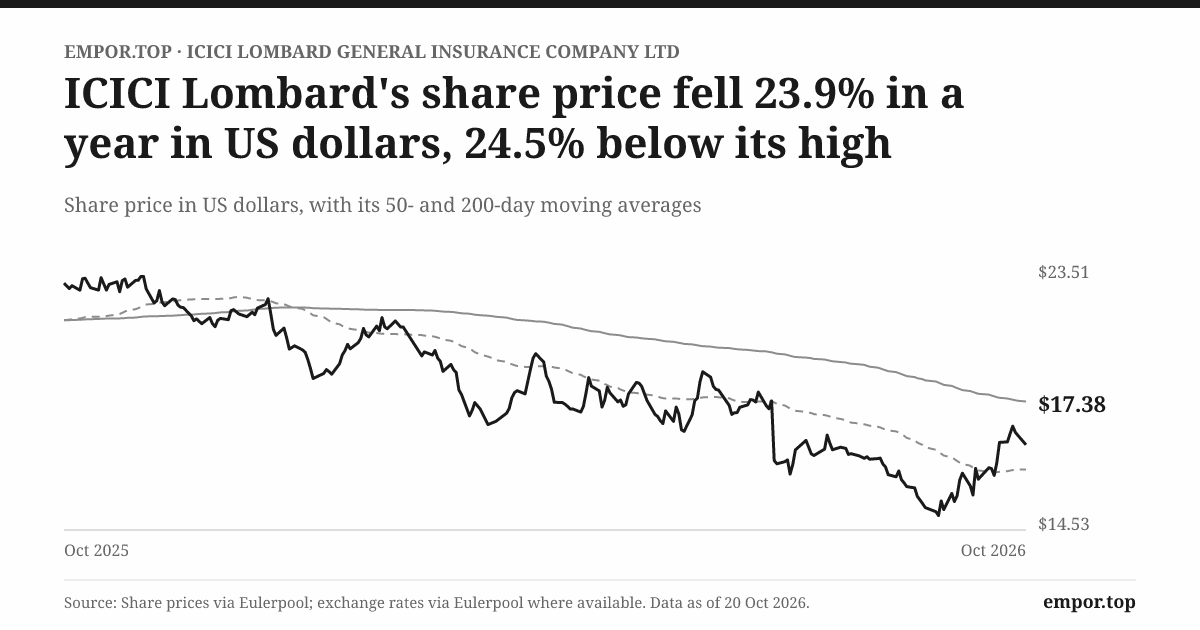
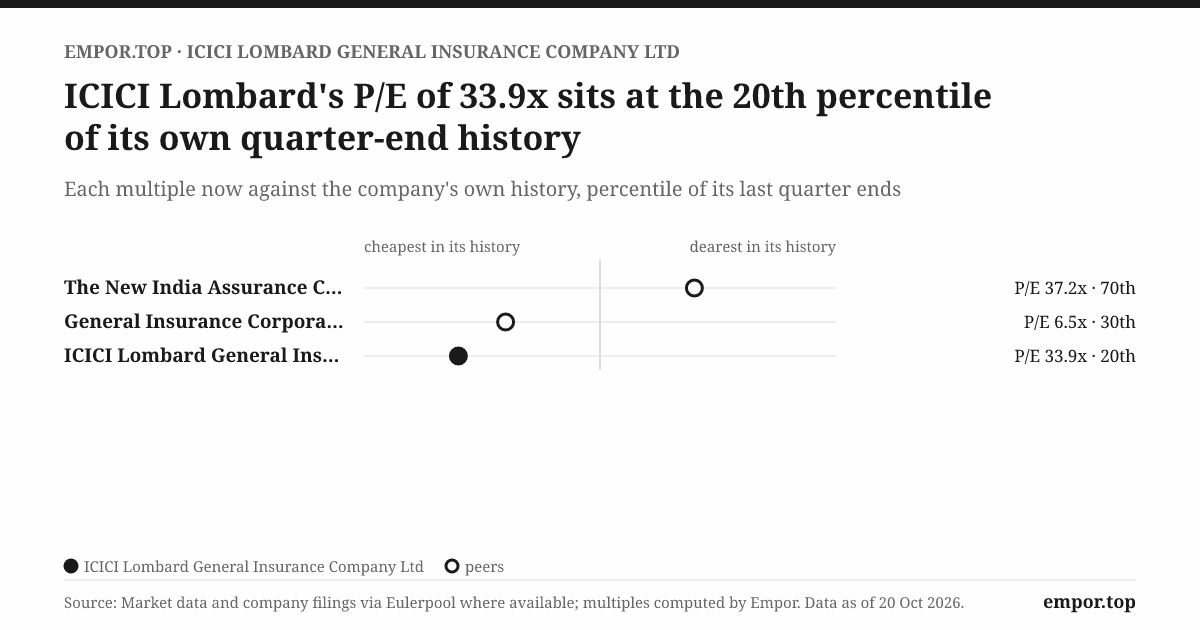
In late October 2026, ICICI Lombard's shares traded at ₹1,650, about a fifth below their 52-week high, valuing the company at roughly ₹82,400 crore.26 Against the last four reported quarters of earnings, that is about 34 times, below the stock's own five-year median of about 38 times.7 On book value, it is about 4.4 times, and on trailing return on equity of about 13.6%, depressed by the weak first half, it yields earnings of under 3% at the current price.7 The dividend yields under 1%. This is not a cheap stock by any conventional measure. The question is whether it is cheap relative to what it has been and what it could become.
The price says the market still believes in a franchise. A financial company earning about 17% to 19% on equity in normal years, as this one did from fiscal 2023 to fiscal 2026, would justify a price well above book if it could sustain those returns and grow.3 At 4.4 times book and a normalised return of 18%, the implied earnings multiple is about 24 times normal profit, and the remaining premium reflects expected growth. The derating from 38 times to 34 times reflects investors' discount for a weaker year, not a loss of faith.
The bull case is that India is early. Non-life insurance penetration in India in 2024 was about a quarter of the global average, according to Swiss Re data the company cites.3 As incomes rise, more cars are insured beyond the legal minimum, more families buy health cover, and more small businesses insure their premises. A scaled private insurer with multiple channels, a strong brand, solid claims service and a capital cushion of more than 2.7 times should compound premium and investment assets for decades. Retail health, growing at more than 50% a year, offers a richer mix. The regulator's expense caps, if enforced, could end the commission wars that rewarded the least disciplined insurers. And the underwriting record, while not yet profitable, is consistently better than the market's.
The bear case is that the business does not need to get worse to disappoint, it only needs to stay the same. Underwriting has not broken even on a full-year basis in the recent record. Motor third-party claims are long-tailed and exposed to court rulings that can rewrite what old policies cost. Health claims inflation and repair costs are rising. Catastrophe losses are becoming more frequent with climate change, and the reinsurance recoveries that cushion them depend on counterparties paying on time. The investment book has a larger equity component than it did three years ago, which makes profit more volatile. And the market share gained through Bharti AXA has not grown further.
A skeptical investor would also press on the bank relationship. Commission and royalty paid to ICICI Bank rose faster than premium in fiscal 2024, and the company does not disclose what premium the bank sources.5 The obvious question to put to the board is simple: what does each rupee paid to the parent bring in, and how does that compare with brokers and agents? If the answer cannot be published, the related-party flows are a cost minority holders must take on trust. IRDAI's proposed disclosure rules may force the answer either way.23
Capital allocation offers a split verdict. The Bharti AXA acquisition was paid in highly valued stock, bought premium rather than profit, and left market share roughly where the two companies stood together. It was not a disaster, and return on equity recovered, but it was a purchase of scale rather than advantage. The company has since returned roughly 30% of earnings as dividends while avoiding debt and new equity, apart from employee stock options.5 There have been no buybacks.5 For a business whose growth needs capital to back new premium, that is a reasonable posture.
Management behaviour is the hardest piece to judge. Mantri has kept the predecessor's language about profitable growth and has been specific about causes when results miss: the court ruling, floods, group health. The fiscal 2027 combined-ratio target of 102% to 103% now looks difficult, and the test of credibility will be how management describes the gap at year-end, whether as a series of one-offs again or as a reason to reprice.6 So far, the company has shown willingness to walk away from crop and fire business it considered underpriced, which is the behaviour of an underwriter, at the cost of falling behind industry growth in the first half of fiscal 2027, 5.4% against 8.9%.1
Three indicators matter more than all the others. The first is the combined ratio excluding catastrophes and reserve releases, which was 104.2% excluding catastrophes for the first half of fiscal 2027, worse than a year earlier; the company does not separately publish a figure excluding reserve releases.1 The second is premium growth and mix, ideally excluding crop and mass health, which was 13.9% in the second quarter against 13.2% for the industry, with retail health the fastest-growing piece.1 The third is solvency together with reinsurance recoverables, the capital cushion and the receivable that could erode it, with solvency at 2.74 times and rising.1
Valuation, finally, has to be done in insurer terms. Price to book, return on equity, combined ratio and investment leverage tell the story. Free cash flow yield, enterprise value to EBITDA and conventional operating margins do not, because they treat policyholder float as if it were the company's own cash. On the measures that apply, the stock prices in a franchise that keeps earning high-teens returns. The underwriting question decides whether that is a floor or a ceiling.
XI. Business & Investing Lessons
The first lesson is the one the Supreme Court taught in the summer of 2026. In insurance, the premium is the beginning of the promise, not the end of the sale. A motor third-party policy sold in 2022 is still being priced today, by tribunals deciding what a life or an injury is worth. ICICI Lombard's conservative reserving meant it had cushion when the homemaker ruling came, and still it had to set aside another ₹165 crore. Any business that collects money before delivering the service, from subscription software to airline tickets to education, should remember that what it has really sold is a liability, and that the liability can be revalued by someone else.
The second lesson concerns the engine itself. A float is powerful only when the underwriting gives it time to work. ICICI Lombard has turned roughly three and a half rupees of invested assets for every rupee of equity into high-teens returns, even while losing a little money on insurance. But that only works because the losses are small. An insurer running at 115%, the industry's ten-year average, cannot be rescued by an 8% portfolio. The lesson for investors is to value the two businesses together and never let investment gains disguise what is happening on the policies.
The third lesson belongs to ICICI Bank's return to control. A bank can open the door; the insurer still has to earn the renewal. The ICICI name and its branches give ICICI Lombard trust and reach that a newcomer would pay heavily to buy. But the same customer who bought a policy at a bank branch can renew it on a comparison website, and the regulator is now moving to make captive channels more open. A distribution advantage that depends on a parent relationship has to be proven by retention, not by ownership.
The fourth lesson is about the Bharti AXA merger. Scale bought with shares has to pay its way. Paying in an expensive currency made the price look cheaper than it was, and buying a fifth of the combined premium for under a tenth of the company was a reasonable trade on paper. Five years later, the combined company holds about the same share of the market it held on the day it merged. Acquisitions in commodity-like financial products buy a customer list and a cost base; they do not automatically buy a better business.
The fifth lesson is for every company calling itself a digital pioneer. A digital claim is a capability; a lower cost and a returning customer make it an advantage. ICICI Lombard's video surveys, cloud systems and AI fraud checks are real and they appear to have let premium grow faster than headcount. They have not yet produced a combined ratio below 100% or published proof of better renewal than peers. Technology that the competition can also buy is a requirement, not a moat, until it shows up in the numbers customers and rivals cannot copy.
XII. Epilogue
Tonight, ICICI Lombard stands where it has stood for most of its listed life: bigger than last year, better capitalised than the law requires, more profitable than most of its industry, and still losing a few paise on every rupee of insurance it sells. The investment book is the largest it has ever been. The combined ratio is worse than it was a year ago. And three forces outside the company's control, the courts, the weather and the regulator, are all in motion at once.
The next few months will tell more than the last few years. The first moment comes on October 25, when comments close on IRDAI's distribution reforms. If the expense caps and commission limits survive in something like their proposed form, the commission wars that have driven up costs across the industry could end, which would favour the more disciplined underwriters. If the related-party and open-architecture provisions survive too, the ICICI group channel will become more visible and less exclusive. The company will then have to show, rather than assert, that its parent's branches bring in business that pays its way.
The second moment is the third-quarter result in January. Management has said that the floods and court ruling of the first half were one-offs and that the motor loss ratio will stay within 65% to 67%.21 If the combined ratio for the second half comes in near 102% or better, the fiscal 2027 target will not be met but the narrative of steady improvement will survive. If it stays above 104%, investors will be entitled to ask whether the one-offs were really the business.
The third moment is slower: motor third-party tariffs. Mantri has argued that the Supreme Court ruling makes the case for higher regulated prices.6 A meaningful tariff increase would help every insurer, but the ones with the best reserving would gain most, because they would be pricing on accurate claims experience. Without one, the long tail will keep pulling the combined ratio up.
Beneath those milestones, a few longer threads deserve watching. The reinsurance recoverables and their provisions, which should grow no faster than the risks they cover. The commission and royalty paid to ICICI Bank, measured against whatever premium the company eventually discloses it sources through the bank. The equity share of the investment portfolio, and how much of each year's profit comes from realised gains rather than steady interest income. And the return on the enlarged equity base that the Bharti AXA share issue created, which is the only fair way to keep score on that deal.
The full-year fiscal 2027 profit will also say something about the company's character. The first half fell 5.8% even with a strong second quarter. If the second half recovers on underwriting rather than capital gains, the company will have answered the question that framed this story in the way it most wants to. If it recovers mainly on portfolio gains, the float will have carried the business one more year. Either way, the dividend will be paid and the solvency ratio will be comfortable. That is precisely why the question remains open: nothing forces ICICI Lombard to become a profitable underwriter except its own ambition.
XIII. Outro
The image that captures ICICI Lombard is a premium already invested and a claim still somewhere in the future. A car owner in Pune paid in April; the money is in a government bond, a corporate bond, perhaps a share in an Indian bank. The accident has not happened, and if it does, a tribunal will decide what it costs, years from now.
For a quarter of a century, ICICI Lombard has managed that gap better than almost anyone else in India. It has more capital than it needs, a portfolio that earns, a name customers trust and a record of reserving that has erred on the side of caution. What it has not yet done, on a full-year basis in the recent record, is earn money on the promise itself. The float can fund the story. Only underwriting can make it last.
References
-
ICICI Lombard General Insurance Co Ltd (NSE:ICICIGI) Q2 2027 Earnings Call Highlights — Yahoo Finance, 2026-10-16 ↩↩↩↩↩↩↩↩↩↩↩↩↩↩↩↩↩↩
-
ICICI Lombard Q2 FY2027: Retail Health accelerates, Motor discipline stands out, and distribution reforms loom — Multibagg, 2026-10 ↩↩↩↩↩↩
-
Performance for the quarter and year ended March 31, 2026: press release and investor presentation — ICICI Lombard via NSE, 2026-04-15 ↩↩↩↩↩↩↩↩↩↩↩↩↩↩↩↩↩↩↩↩↩↩↩↩↩↩↩↩↩↩↩↩↩↩↩↩↩↩↩↩↩↩↩↩↩
-
Rating Rationale: ICICI Lombard General Insurance Company Limited — ICRA, 2026-06-12 ↩↩↩↩↩↩↩↩↩↩↩↩↩↩↩↩↩
-
Integrated Annual Report 2023-24 — ICICI Lombard General Insurance, NSE, 2024-06-01 ↩↩↩↩↩↩↩↩↩↩↩↩↩↩↩↩↩↩↩↩↩↩↩↩↩↩↩↩↩↩↩↩↩↩↩↩↩↩↩↩↩↩↩
-
ICICI Lombard Aims for 102%-103% Combined Ratio as SC Ruling Backs Motor TP Hike — Sahi, 2026-07-16 ↩↩↩↩↩
-
ICICI Lombard General Insurance Company standalone net profit rises 15.48% in the September 2026 quarter — JM Financial Services, 2026-10-15 ↩↩↩
-
Prem Watsa's Fairfax sells remainder stake in ICICI Lombard ending 18 year run — MergersIndia M&A Critique, 2019-10-17 ↩↩↩
-
Prospectus — ICICI Lombard General Insurance Company Limited, SEBI, 2017 ↩
-
ICICI Lombard to acquire Bharti AXA General Insurance via share swap deal — Business Today, 2020-08-22 ↩↩↩
-
Indian insurers ICICI Lombard, Bharti AXA to merge — Insurance Business Asia, 2020-08-24 ↩↩↩
-
Bharti AXA and ICICI Lombard merger to create India's third largest general insurer — Intelligent Insurer, 2020-08-24 ↩↩↩
-
Fair Play, Volume 35 (October–December 2020): CCI approves acquisition of general insurance business of Bharti AXA by ICICI Lombard — Competition Commission of India ↩↩↩
-
ICICI Lombard, Bharti AXA merger completed — Insurance Business Asia, 2021-09-10 ↩
-
AXA and Bharti have completed the combination of their non-life operations in India into ICICI Lombard — AXA, 2021-09-08 ↩↩↩
-
Scheme consideration and share issuance disclosure under SEBI LODR — ICICI Lombard, 2022-01-19 ↩
-
Credit Rating Rationale: ICICI Lombard General Insurance Company Limited — CRISIL, 2021-09-24 ↩↩↩↩↩↩↩
-
ICICI Lombard shares rally 14% as ICICI Bank looks to increase stake — Business Today, 2023-05-29 ↩↩↩↩
-
ICICI Lombard General Insurance: shareholding pattern, September 2026 — Screener ↩
-
ICICI Lombard General Insurance Co Ltd (NSE:ICICIGI) Q2 2027 Earnings Call Highlights: Profit Jumps 27.5% as Retail Health Surges 66% — GuruFocus, 2026-10-16 ↩↩↩↩↩↩↩↩↩↩↩↩
-
Voting Results of the 24th Annual General Meeting — BSE, 2024-06-27 ↩
-
IRDAI proposes distribution reforms: Recalibrating Economics of Insurance Distribution — Khaitan & Co ERGO, 2026-09-29 ↩↩↩↩↩↩↩
-
ICICI Lombard elevates Sanjeev Mantri as managing director and chief executive officer — Storyboard18, 2023 ↩↩↩
-
Credit Rating Rationale: ICICI Lombard General Insurance Company Limited — CRISIL, 2024-07-31 ↩↩
-
ICICI Lombard General Insurance (NSE:ICICIGI) stock quote — Stock Analysis, 2026-10-19 ↩
 LinkedIn
 WhatsApp
 Reddit
 Hacker News
 Email
 Kindle
 RSS Feed
 Spotify
 Apple Podcasts
 Amazon Music
 Audible
 YouTube