Hindustan Unilever: The Soap Company That Had to Learn to Grow Again
I. Introduction & Episode Roadmap
In 1888 a crate of soap was unloaded on the docks of Calcutta. The bars were wrapped and stamped "Sunlight", made in Port Sunlight near Liverpool by William Lever's company, and shipped halfway round the world to a colony where most people washed clothes with ash, clay or soap nuts. Nobody on that dock could have guessed what the crate began. Lever was not opening a factory. He was testing a market.
Fast forward to a kirana store in a Pune suburb in 2026. The shelf behind the counter is a wall of strips of sachets: Surf Excel, Clinic Plus, Sunsilk, Lifebuoy, Brooke Bond. Almost all of them are made by Hindustan Unilever. But the shelf has neighbours that did not exist ten years ago. A phone on the counter takes orders for a quick-commerce app that delivers in ten minutes. A teenager in the queue uses a face serum her favourite creator sold her online. The habit that crate started is still there. The question is whether it is still growing.
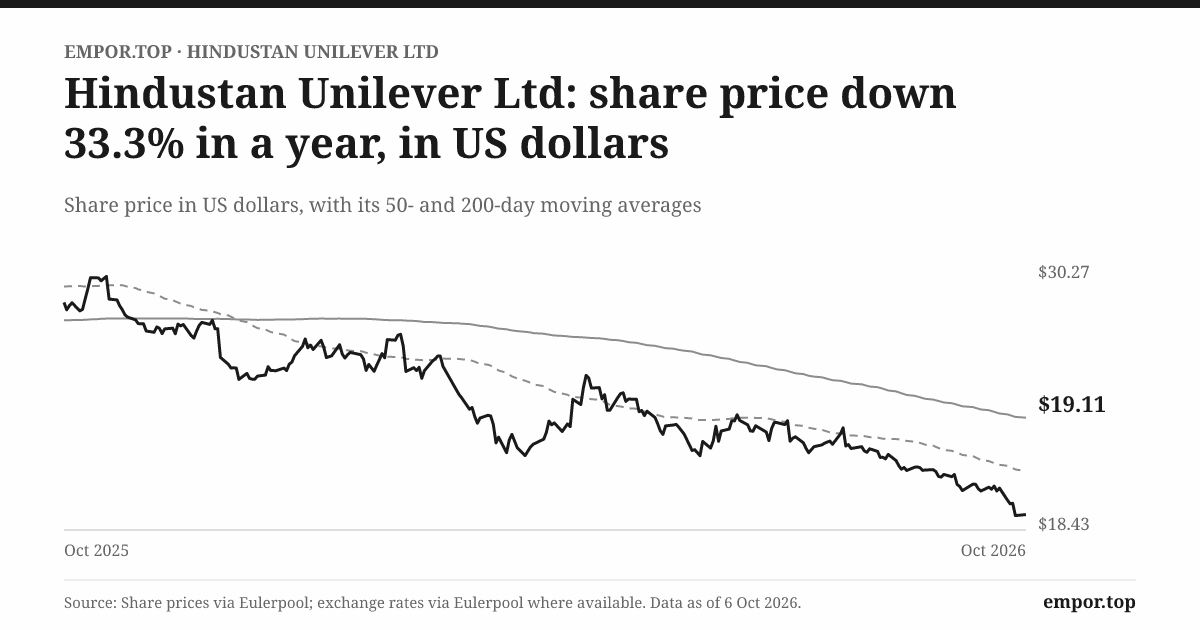
That is the puzzle at the heart of this story. Hindustan Unilever (HUL) sold ₹63,763 crore of goods in the year to March 20261. Its shares are worth about ₹4.3 lakh crore, roughly $45 billion, and on 6 October 2026 they traded about 29% below their high of the previous twelve months, almost at the year's low2. Over ten years revenue grew about 7% a year. Over the past three years it grew about 2% a year1. That gap is the whole story in two numbers. A company that reaches nearly every Indian home seems to have stopped getting bigger.
So is HUL still a compounder, or has it become a very profitable annuity, a business that throws off cash for its owners but no longer gets bigger in any way that matters?
This story works through four questions on the way to an answer:
- Is the growth recovery real? In July 2026 management reported 10% underlying sales growth, the best in 13 quarters, and the stock fell anyway3.
- How much of the profit is real? Reported profit for the year to March 2026 jumped about 41%. Most of that jump came from one-offs.
- What does Unilever's royalty cost minority shareholders? The parent takes a slice of turnover before anyone else is paid.
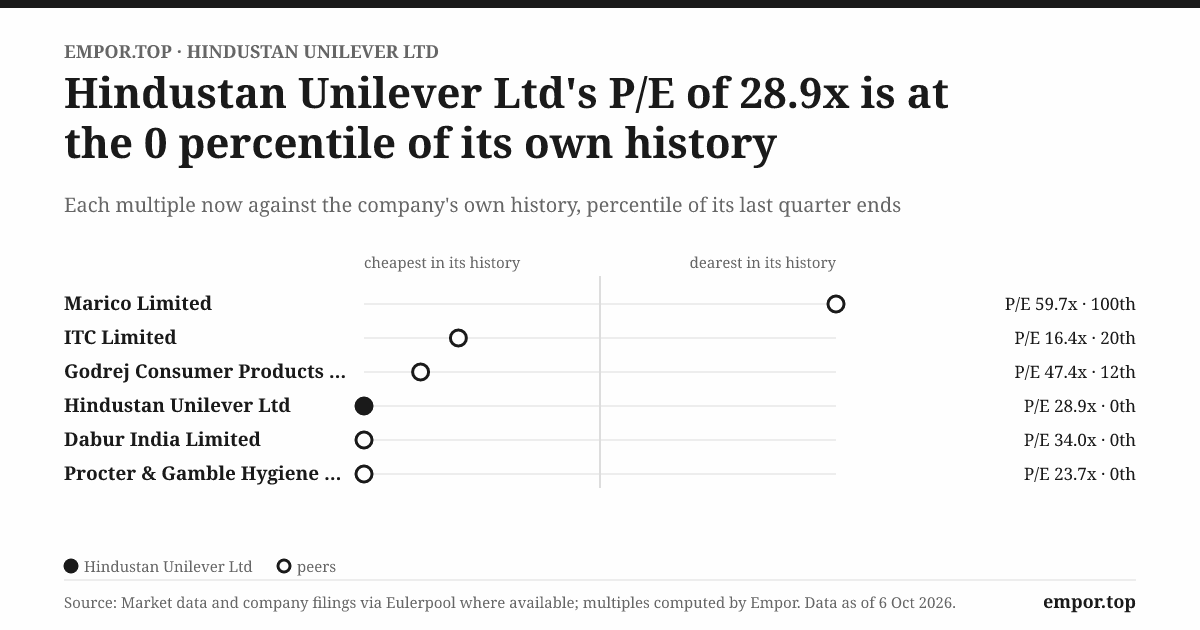
- Is the reset price an opportunity? The shares trade at about 29 times earnings, half their five-year median multiple4.
One boundary matters throughout. HUL is a listed Indian company in which Unilever PLC, the Anglo-Dutch giant, holds a majority5. Unilever's global decisions, from spinning off ice cream to choosing which brands to back, enter this story only where they change what an Indian minority shareholder owns. Unilever's growth is not HUL's growth, and Unilever's balance sheet is not HUL's.
To see why the question of growth carries so much weight, start where the moat came from. Part of it came from a government that kept HUL's competitors out.
 Subscribe on LinkedIn
II. How a Colonial Importer Became a Local Machine (1888–1991, compressed)
In 1956 three Lever companies in India became one. Hindustan Vanaspati Manufacturing, which made cooking fat, Lever Brothers India, which made soap, and United Traders, which handled the toiletries, merged into Hindustan Lever Limited6. On paper it was a corporate tidy-up. In practice it was the start of a bet that a foreign company could become Indian enough to survive independent India.
India in 1956 was not friendly ground for foreign capital. Nehru's government wanted factories at home, Indian managers in charge and Indian shareholders on the register. Hindustan Lever responded by offering a slice of its equity to the Indian public, about 10% at first, which made it one of the earliest Indian subsidiaries of a multinational with local shareholders6.
The man who personified the change was Prakash Tandon. A Punjabi trained in Britain as a chartered accountant, he joined Lever in the 1930s when Indian "covenanted managers" were rare and the boardroom was British. He wrote later about learning both cultures, the club manners of the expatriate managers and the bazaar logic of the Indian trader. In 1961 he became the first Indian chairman of Hindustan Lever6. Under him the company recruited Indian graduates, trained them hard and promoted them fast. In time Hindustan Lever became known as a "CEO factory", and its alumni went on to run large parts of corporate India. The talent machine he started is part of why HUL still runs a deep bench of Indian managers today.
The brands came in this era too. Lifebuoy, Sunlight and Lux crossed over from Britain. Surf came in the late 1950s, and Rin in the following decade6. These names matter in 2026 not as history but as habits. A household that bought Surf in 1975 often still buys Surf Excel, and that repeat purchase is the closest thing a soap company has to a contract.
Three legacies from this era still shape the investment case.
Distribution. Licensing rules and import controls pushed Hindustan Lever to build factories near its markets and a network of stockists that reached small towns. The reach was built over decades when no foreign rival could match it.
The parent relationship. Hindustan Lever licensed technology, formulations and brand names from Unilever. That licence is the origin of the royalty HUL still pays, discussed later in this story. The deal made sense in the 1950s, when the subsidiary needed know-how it could not develop alone. Whether it still makes sense at today's rate is a fairer question.
Policy protection. Under the License Raj, capacity was rationed, foreign entry was restricted and the Foreign Exchange Regulation Act of 1973 forced foreign parents to cut their holdings or lose rights. Hindustan Lever adapted, partly by moving into "priority" sectors such as chemicals, and kept its majority owner6. Procter & Gamble and Colgate had small or limited operations. Nirma, a home-grown upstart, did take a large share of cheap detergent in the 1970s and 1980s with a powder sold at a fraction of Surf's price, and Hindustan Lever's answer, Wheel, came only after years of losing share. That episode matters: even in the protected era, a local competitor willing to sell cheaper proved the moat could be breached.
The verdict on this period is uncomfortable for anyone who likes clean moat stories. Hindustan Lever's advantage was built partly by managers and partly by policy. The managers built the brands and the distribution. The policy kept well-funded rivals away while they did it. In 1991 the government opened the economy, and the rivals came.
III. Liberalisation and the Consolidation Machine (1991–2010)
The 1990s opened with a threat. Procter & Gamble formed a joint venture with Godrej in 1993. Colgate-Palmolive, already strong in toothpaste, could now expand freely. Global consumer giants with deeper pockets than any Indian rival were arriving in a market Hindustan Lever had had largely to itself.
Hindustan Lever's answer was not to fight them product by product. It was to buy the shelf.
The TOMCO move
In 1993 Hindustan Lever merged with Tata Oil Mills Company (TOMCO), the Tata group's soap and edible oil maker, the owner of brands such as Hamam and Moti. TOMCO shareholders received 2 Hindustan Lever shares for every 15 TOMCO shares6. It was the first big merger of two Indian consumer companies after liberalisation, and it was criticised at the time for the swap ratio and for concentration: critics argued the Tatas had sold cheap and that Hindustan Lever was buying out a competitor rather than outcompeting it. Under the Monopolies and Restrictive Trade Practices (MRTP) rules of the era, the deal was scrutinised in court before it went through.
The logic was obvious once the foreign rivals arrived. TOMCO gave Hindustan Lever factories, distributors and brands that would otherwise have been a ready-made platform for an entrant. Buying it denied P&G or Colgate a quick way in.
Tea, foods and beauty
The rest of the decade followed the same pattern. Brooke Bond and Lipton, both Unilever companies in India, merged into Hindustan Lever in 1996, creating the country's largest packaged tea business6. Kissan, the ketchup and jam brand, had come in from Unilever's purchases in 1993. Lakmé, the Tata-founded cosmetics brand, came first through a joint venture in 1996 and was fully absorbed by 19986. In 2000 Hindustan Lever bought a majority of Modern Foods, the government bakery, in one of India's first disinvestments of a state company6.
How good were these deals? The honest answer is that the record is mixed, and the evidence on price is thin. HUL never published the multiples it paid in a form that allows a clean return calculation. What the long run shows is this:
- Strong: Lakmé is still India's best-known beauty brand, and Beauty & Wellbeing is HUL's fastest-growing big segment today3. Brooke Bond is still the country's largest tea brand by HUL's own account. Hamam and the soap portfolio from TOMCO still sell.
- Weak: Modern Foods never became a winner. HUL sold the bread business in 2016, after about 16 years, to Everstone Capital. Ice cream, which Hindustan Lever had built up through purchases including Kwality's ice cream business in the mid-1990s, became a business big enough to matter but never profitable enough to keep in the HUL portfolio. In 2025 it was demerged7.
The verdict: HUL's consolidation machine bought brands that lasted in its core categories of home and personal care, tea and beauty. It did worse when it bought into categories with different economics, such as bread and frozen food, where cold chains, freshness and local competition ate the advantage of reach. Investors should hold that pattern in mind when HUL buys again, as it did in 2020 and 2025.
Holding share
The bigger achievement was defensive. P&G, Colgate and later a resurgent Nirma attacked detergents, shampoos and toothpaste. In 2004 HUL and P&G fought a detergent price war that cut prices of brands such as Surf Excel and Wheel sharply and squeezed margins for years. Hindustan Lever kept its leadership in most of its core categories. It did so with reach, with a price ladder that offered a brand at every rung, and with the willingness to cut its own price before a rival could. The company renamed itself Hindustan Unilever in 2007, bringing the parent's name into the Indian identity6.
The lesson of 1991–2010 is that HUL's moat survived its first real test without the policy that built it. It survived partly because the company was willing to buy its competitors and partly because it was willing to fight on price. Both cost money. And the next part of the moat, the one most often praised, was built not in boardrooms but in villages.
IV. Project Shakti and the Last Mile
Picture a village in Andhra Pradesh in the early 2000s, with fewer than 5,000 people and no shop large enough to interest a distributor's van. A woman from a local self-help group buys a stock of HUL products with a small loan, sells them door to door and from her home, and keeps the margin. She is a Shakti Amma, the name HUL gave the women entrepreneurs it recruited under Project Shakti, which began in 2000 and 20016.
The idea was elegant. Villages too small for HUL's trade network could still be reached if someone from inside the village became the store. HUL got distribution where it had none. The women earned an income. Microfinance groups got a borrower with a steady business. HUL has since described a network of many thousands of these entrepreneurs, and a direct reach claimed in the past at about 9 million retail outlets1. Those are company figures, and HUL does not split revenue by channel in a way that lets an outsider test how much of its sales the village network actually delivers.
The economics of a sachet
To understand why reach matters, look at the sachet. A ₹1 or ₹2 shampoo sachet, a ₹10 pack of detergent, or a small bar of soap lets a household with daily wages buy a brand without committing a week's cash to a bottle. HUL built a price-point ladder around this: the same brand sold at ₹1, ₹5, ₹10 and up. When costs rise, HUL often keeps the price and shrinks the grams, so the shopper sees the same coin and the company keeps its margin.
This is a scale business disguised as a cheap one. A sachet costs nearly as much to distribute as a bottle, so only a company with huge volumes through the same trucks and the same shops can make money on it. That is the real moat in the village: not the brand alone, but the density of distribution that makes tiny packs profitable.
How the channel is changing
The threat to this moat does not come from a rival with more trucks. It comes from shoppers who no longer need the truck to reach their street.
In the cities, modern trade (supermarkets), e-commerce and now quick commerce, which delivers in minutes from dark stores, take a growing slice of what used to be kirana sales. On these channels, shelf space is an algorithm, not a relationship with a shopkeeper, and a direct-to-consumer brand can buy visibility with advertising money rather than earning it over 40 years. HUL does not disclose what share of its sales goes through each channel, so investors cannot see how fast this shift is happening inside its own numbers.
In the countryside the moat holds better, though rural demand drove much of HUL's slowdown in recent years. On the Q1 FY27 call management described rural demand as recovering and growing ahead of urban, though it gave no precise split8.
There is also no customer concentration to speak of. HUL sells through thousands of distributors and does not name any customer large enough to matter, and its buyers have little power individually1. The more meaningful power sits with the new platforms, which aggregate millions of shoppers and can demand margins. HUL does not disclose its terms with them.
The verdict on reach: it is real, and it is the hardest part of HUL to copy. But the evidence that it still works as a moat is thinner than its reputation. The best proof would be share gains in quick commerce and modern trade, and HUL does not publish them. The worst disproof would be growth that lags while the shelf moves online, and that is roughly what three years of flat sales look like.
That brings the story to the deal that changed what HUL looks like on paper, and why so many of its ratios break in 2020.
V. The GSK Consumer Merger: The Deal That Reset the Balance Sheet (2020)
On 1 April 2020, as India entered its first Covid lockdown, Hindustan Unilever completed the biggest deal in its history. It merged GlaxoSmithKline Consumer Healthcare India (GSKCH), the maker of Horlicks and Boost, into itself through an all-share exchange: GSKCH shareholders received 4.39 HUL shares for each share they held6. Separately, HUL paid Unilever's affiliate for the Indian rights to the Horlicks brand, which Unilever had bought from GSK as part of the global deal9.
Watch what happened to the balance sheet. Shareholders' equity rose from about $1.2 billion in March 2020 to about $6.4 billion a year later1. HUL had paid with its own shares, so the merger added a large block of new equity and a large block of goodwill and brand value to the asset side. Return on equity collapsed from about 82% to about 17% in a single year1.
Why the ROE drop is an accounting fact, not a business failure
This is where an investor's ten-year chart lies. Before 2020 HUL was a business with almost no equity, because it paid out most of its profit and needed little capital. An 80% return on equity looked spectacular, but it was a ratio of a large profit over a very small book. After the merger the book included the price of Horlicks and Boost, set at market value. The business did not suddenly get worse. The denominator changed.
So ROE comparisons across 2020 are meaningless. The cleaner measure is return on invested capital in the years after the deal, which has risen from about 19% in FY21 to about 25% in FY261. That is a strong return on a large acquisition for a consumer business, and it says that HUL has earned more on the Horlicks purchase over time, partly because the earnings grew and partly because the asset base hardly did.
What did HUL buy?
Health food drinks, malted milk powders stirred into milk, are a peculiarly Indian category, sold to mothers as nutrition for children. Horlicks was the leader, with Boost and Bournvita, owned by Mondelez, as its main rivals. The category was big but slow, squeezed by changing views on sugar and by cheaper alternatives.
HUL's record here is mixed. Boost crossed ₹1,000 crore of annual turnover, HUL's measure of a large brand3. Horlicks has been repositioned toward lower-sugar and functional variants, but HUL does not disclose how the Horlicks business has grown against the price it paid, so investors cannot tell whether the deal has earned its cost of capital on its own. The rising return on invested capital is the best available clue, and it is a clue, not proof.
Bolt-ons since
The deal made HUL comfortable buying smaller brands. In 2025 it bought a majority of Minimalist, a fast-growing skincare brand born online, which now sits inside Beauty & Wellbeing3. That is a direct answer to the D2C threat in Section IV: if HUL cannot copy a brand born on Instagram, it can buy one. Whether HUL can keep such a brand growing once it sits inside a large company is a question its earlier deals answer only partly.
The verdict on the GSK deal: it was a sensible use of HUL's highly valued shares to buy a category leader, and the returns since look decent. It also made HUL's financial history impossible to read without a break in 2020. And it did not stop the slowdown that came next.
VI. The Plateau: Why Growth Stalled in FY24–FY26
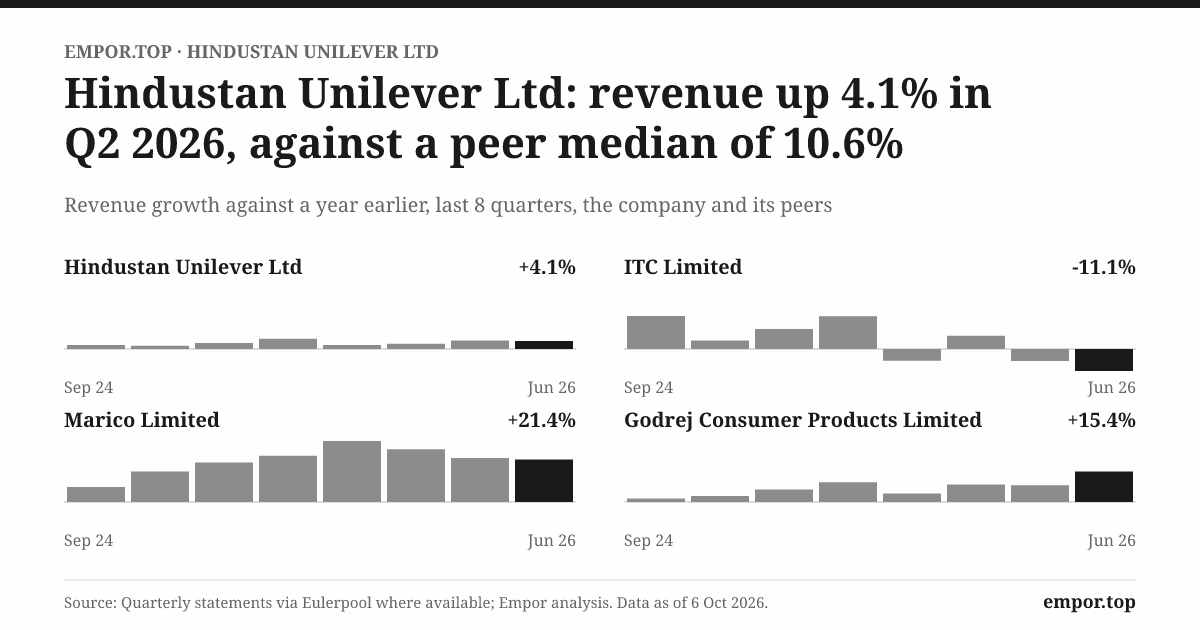
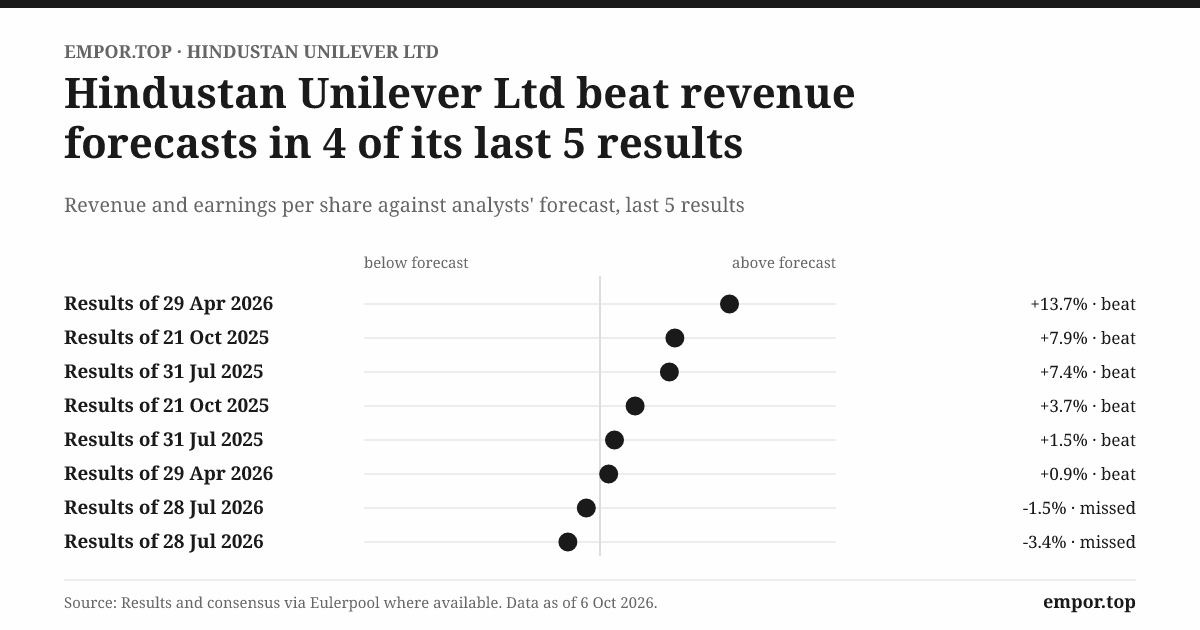
On 28 July 2026, HUL reported its results for the quarter to June. The headline was the best in more than three years: underlying sales growth of 10%, the highest in 13 quarters, split roughly equally between volume and price3. Underlying volume, the number of units sold, grew about 5%3. EBITDA rose about 8% to ₹3,947 crore at a 23% margin3.
The stock fell. Coverage put the decline on the day at between 3% and 7%4. Why would a market punish the best growth in three years?
The puzzle
The clue is in a second number. HUL's reported revenue in the June 2026 quarter was about 4% higher than a year before, not 10%10. The gap is the ice cream business, demerged in December 2025 and no longer in HUL's turnover. Management's "underlying" figure compares like with like, excluding ice cream from both years. The reported figure compares the old HUL with the new, smaller one.
Both numbers are legitimate. But they tell different stories. On a like-for-like basis HUL grew 10%. On what the shareholder actually owns now, turnover grew about 4%. HUL's results release does not set out the reconciliation between the two in one place, and until it does, investors are being asked to trust the bridge rather than see it.
Three years of standing still
The context makes the recovery look either impressive or fragile, depending on the eye. Revenue grew about 2% in FY24, about 2% in FY25 and about 2.5% in FY261. For a company that had grown at 7% a year over a decade, that is a plateau. Operating profit barely moved, growing less than 2% a year over the three years1.
Why? Three explanations fit the evidence.
First, price had done the work and then stopped. After the commodity spike of 2021–2022, HUL raised prices sharply. When commodities eased it cut them, so price growth turned negative or flat even as volumes recovered slowly.
Second, rural and mass demand weakened. HUL's core is the mass market, and India's low-income households were squeezed by inflation after the pandemic.
Third, competition intensified at both ends: local and regional brands at the bottom of the price ladder once commodities fell, and D2C and premium brands at the top.
Where the recovery comes from
The July 2026 quarter shows where growth returned3:
- Home Care (detergents, dishwash, household cleaners) grew about 14% to roughly ₹6,550 crore in the quarter. It is HUL's largest segment and the core of the franchise.
- Beauty & Wellbeing (skincare, haircare, Lakmé, Minimalist) grew about 12% to roughly ₹4,080 crore, with Minimalist helping.
- Personal Care (soaps, body wash, oral care) grew only about 4%. Palm oil, the main input for soap, got more expensive, and HUL could not pass all of it on.
- Foods (tea, Horlicks, Boost, Kissan) grew about 7%.
Home Care and Personal Care are the bread and butter. A recovery led by Home Care is the right kind. A Personal Care business stuck at low growth because of an input cost HUL cannot control is a reminder of how exposed the soap business is to a single commodity.
The competitors
HUL's rivals are not a single enemy but a crowd. Nestlé India and ITC compete in foods; ITC also competes in soaps and personal care. Dabur, Marico, Colgate-Palmolive India and P&G compete in haircare, oral care and detergents. Reliance Consumer Products, the consumer arm of Reliance Industries, has relaunched old brands at aggressive prices. Patanjali, which shook the market in the late 2010s, remains a factor. And hundreds of D2C brands chip away at premium beauty. HUL remains the largest by far, but the market share figures are not published in a form that allows a clean comparison of who gained in the plateau years.
What the analysts asked
On the July 2026 call, the prepared remarks stressed growth, volume and margins in the "guided range". The questions were sharper. Analysts pressed on how much of the 10% was price versus volume, on whether Home Care growth would last once a weak base dropped out, and on the cost of the rise in advertising8. Management's answer was that growth was broad-based and that the company intended to keep investing behind its brands8. That is a statement of intent, not evidence of durability.
The marketing bet
Here is the most telling number in the quarter. Advertising and promotion spending rose to about ₹1,657 crore, its highest level in 11 quarters and about 9.6% of turnover8. HUL is spending more to sell more. That can be read two ways. Optimistically, a confident company is investing behind brands to take share while demand recovers. Skeptically, a company is paying to defend share it would otherwise lose to cheaper and newer rivals, and the margin will show it later.
The verdict: the recovery looks real in volume terms, led by Home Care and beauty, but it is one quarter old and is being bought partly with marketing spending. The test is whether underlying volume growth holds near 5% in the September and December 2026 quarters. Until it does, the market is right to discount the headline.
And the headline profit figure needs even more discounting than the sales figure.
VII. The Ice Cream Demerger and the Profit That Isn't (FY26)
Look at the quarter to December 2025 and something seems to have gone very right. HUL's net profit that quarter came to about $743 million, more than double its usual quarterly figure, and its net margin reached about 41%10. A business that normally keeps 16 to 17 paise of profit from every rupee of sales appeared, for three months, to keep 41.
Nothing had changed in the soap business. The quarter's profit was swollen by the demerger of ice cream.
The demerger
HUL separated its ice cream business, which included Kwality Wall's, Cornetto and Magnum in India, into a new company, Kwality Wall's (India) Ltd. Shareholders received one share of the new company for each HUL share they held7. The demerger was cleared by the National Company Law Tribunal7, took effect around 1 December 2025, and the new company listed in February 20262. The Magnum Ice Cream Company, the global ice cream business Unilever spun off, is reported to hold about 61.9% of Kwality Wall's (India)2.
The logic belongs to the parent. Unilever separated ice cream worldwide because it needed cold chains, freezers and seasonal selling that sat badly with soap and shampoo. For HUL shareholders the effect was that they received shares in a separate ice cream company and HUL became a slightly smaller, slightly higher-margin business.
How much profit is real?
For the full year to March 2026, HUL's reported net profit rose about 41%1. Operating profit, which excludes such one-offs, rose by about 2% a year over the previous three years1. Those two numbers cannot both describe the same business. The difference is a combination of the accounting gain on the demerger and tax items, including a one-off tax credit that management referred to on the July 2026 call8. HUL's results filings carry the split in their notes on exceptional items10.
For an investor, the answer is simple. FY26 reported profit is not a base to grow from. The base is underlying profit: in the quarter to June 2026, profit before exceptional items was about ₹2,731 crore, up about 9%, while reported profit was about ₹2,680 crore, down about 2%3. The underlying number is the one that tells you how the business is doing.
The tax rate shows the same distortion. In the June 2025 quarter it fell to about 16%, against a normal rate of about 26%10. A quarter with an unusually low tax rate makes profit look better than the business earned. Investors who annualise any one quarter of FY26 will mislead themselves.
The good news: the cash is real
Where the profit is questionable, the cash is not. Over the twelve years to March 2026, HUL's operating cash flow came to about ₹99,400 crore against net profit of about ₹93,900 crore1. In other words, the company collected about 106% of its reported profit in cash. For a business with one-offs in its latest year, that is reassuring: over a long period, HUL's reported earnings turn into money.
The catch: suppliers are funding the business
The cash comes partly from an advantage in working capital. HUL's cash conversion cycle, the number of days between paying for raw materials and collecting cash for products, was minus 65 days in FY261. A negative number means HUL collects from its customers before it pays its suppliers. Suppliers wait about four months to be paid, while distributors pay within about three weeks1.
Think of it as a shopkeeper who sells your goods before you send the bill. It is a mark of bargaining power, and it is common in Indian consumer goods. But it also flatters operating cash in any year when payables rise. In FY24, cash from operations reached about 101% of EBITDA, well above the usual 70% to 75%, helped in part by longer payment terms with suppliers1. A year like that cannot be repeated forever: payables cannot rise faster than sales indefinitely. When growth is slow, the cash boost from stretching suppliers fades.
The verdict on profit: underlying profit is growing in single digits and is backed by real cash over time. FY26's reported figure is not. Investors should value HUL on profit before exceptional items, and should treat the cash conversion of the last few years as flattered by suppliers rather than earned entirely from the business.
But before minority shareholders see any of that profit, one shareholder takes its share first.
VIII. The Unilever Question: Royalty, Control and Management
In early 2023, HUL told shareholders that the royalty and central services fee it pays Unilever would rise. The rate, about 2.65% of turnover, would step up to about 3.45% over three years1. The increase was phased in through 2023, 2024 and 20251.
This is the most important related-party relationship in the HUL story, and it explains a puzzle in the numbers.
The arithmetic
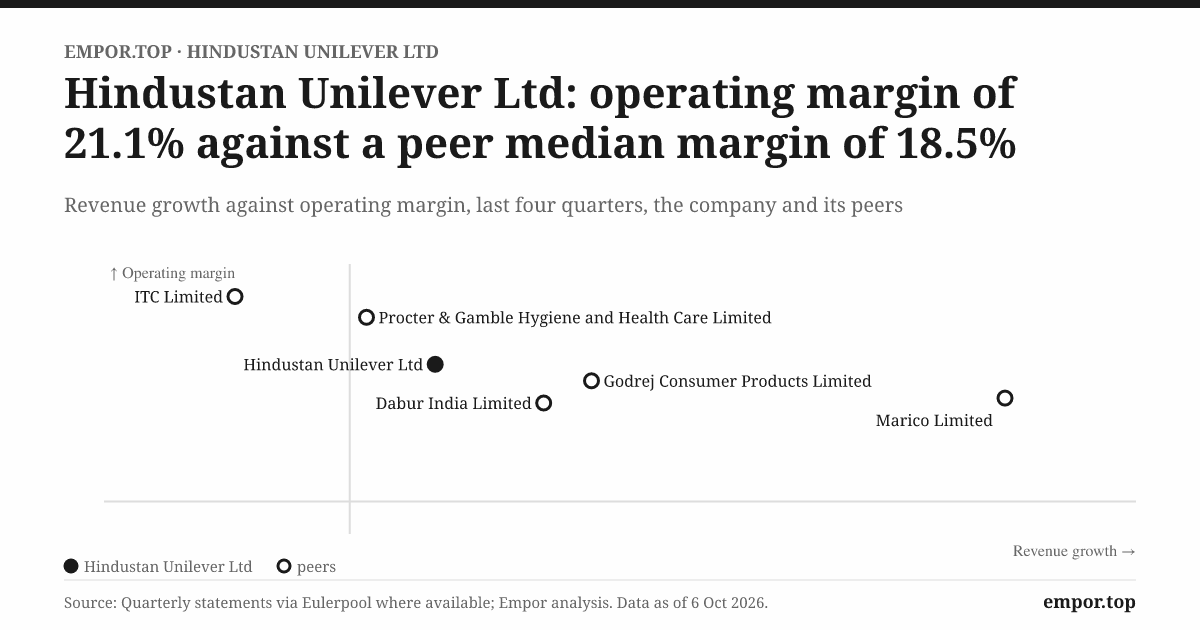
At 3.45% of FY26 turnover of ₹63,763 crore, the royalty comes to roughly ₹2,200 crore a year. That is an estimate, using the full rate on the whole turnover; HUL's annual report gives the exact figure in its related-party note1. Set that against operating profit of about ₹14,000 crore and the royalty is equivalent to roughly one rupee in every seven of operating profit.
Now look at the margin. Operating margin peaked at about 22.6% in FY21 and FY22 and fell to about 21.3% by FY261. The royalty step-up was about 0.8 percentage points of turnover. On its own it accounts for most of the decline. HUL was cutting costs throughout that period. The parent took a large part of the savings before minority shareholders saw them.
Unilever's argument and the minority view
Unilever's case is that the fee pays for real things: brands it owns globally, research and development, formulations, digital tools and management talent. A local company could not build Dove or Surf's technology alone. There is something to that. HUL's research spending is small, and it uses Unilever's labs.
The minority shareholder's case is that the fee is set by the majority owner on both sides of the table. Unilever's approximately 62% stake gives it control of HUL5, and when the royalty goes up, the parent wins twice: once through the fee, and again through its share of dividends. Indian rules require shareholder approval for material related-party transactions, with the related party barred from voting. HUL structured the increase so that it did not need such a vote, a choice that critics noted at the time. HUL also buys goods and services from Unilever group companies, which it says are at arm's length1.
The activist stress test
A skeptical investor would put the case this way. HUL pays out most of its profit as dividends, and the parent takes about 62% of them. On top of that the parent takes a royalty off the top line. Together, these flows send most of HUL's cash to Unilever. If the business grew at 10% a year, nobody would care. With growth at 2%, every basis point of royalty is a basis point that cannot fund lower prices, more advertising or more profit for minorities.
The counter-argument is that margins have held near the guided range despite the fee. Management guided to an EBITDA margin of about 22% to 23%, and the June 2026 quarter came in at about 23%3. The step-up has ended. If no further increase comes, the drag stops growing. The evidence that the royalty step was fully absorbed by cost cuts, though, is thin: margins did fall.
The verdict: the royalty plausibly explains why HUL's margin did not rise over the plateau. It is legal and disclosed. It is also the clearest reason a minority investor in HUL owns a smaller share of the franchise than the market value implies. The next AGM notice is where a further increase would appear.
The people in charge
Priya Nair became HUL's chief executive and managing director on 1 August 2025, the first woman to run the company11. She is an HUL lifer: she joined as a management trainee in the mid-1990s and ran sales, home care and beauty in India before moving to Unilever's global Beauty & Wellbeing business as its president11. Her background is in exactly the segments that are growing fastest. Her early message to investors focused on growth through volume, premium portfolios and investment behind brands, a message consistent with the advertising increase in her first full quarter8.
She inherited a margin guide of about 23% EBITDA from her predecessor, Rohit Jawa, and has held it so far3. Jawa, a Unilever veteran who had run the parent's transformation work, led HUL for about two years from 2023 through the plateau, focusing on cost cuts and portfolio reshaping, including the ice cream separation. His tenure was short by HUL's standards, and its growth record was weak, though much of that reflected the market.
Pay
Nair's pay for FY26 was about ₹18.2 crore, of which about ₹4.5 crore was a long-term incentive linked to performance11. Jawa received about ₹14.4 crore for his part of the year11. In FY25, Jawa's full-year pay was about ₹23.2 crore, up about 4%, and about 146 times what HUL's median employee earned12. Executive pay has been roughly flat while core profit has been roughly flat, which is at least consistent. HUL discloses the targets behind the incentive only in general terms.
Nair's shareholding in HUL is small, as is common for professional managers at Indian subsidiaries of multinationals. Her incentives come largely from Unilever's own share plans, which link her rewards to the parent as much as to HUL.
The headcount clue
One last number explains how the margin was defended. HUL's permanent employees fell about 8%, from about 7,200 in FY24 to about 6,600 in FY25, while revenue grew about 2%12. Automation and restructuring did the work that growth did not. That supports margins in the short run. It cannot be repeated forever.
The royalty, the dividend and the restructuring all point to the same model: a business run to harvest cash. The next section follows that cash.
IX. Where the Cash Goes: The Harvest Model
In FY25 HUL paid out more in dividends than it earned. Dividends came to about 117% of net profit that year1. It was not a sign of distress. It was a deliberate choice, made possible by a balance sheet with almost no debt and a business that needs very little capital.
The twelve-year ledger
Over the twelve years to March 2026, HUL generated about ₹83,400 crore of free cash flow, cash from operations after capital spending1. It paid about ₹80,400 crore in dividends1. That is about 96% of everything it made, returned to shareholders.
Put that in plain terms. For more than a decade, almost every rupee HUL generated beyond what it needed to keep its factories running went out of the door. Cash and short-term investments grew only modestly over the period1. The company did not hoard, did not lever up and did not buy back shares. It paid.
The payout ratio for FY26 was about 67%, the lowest in the period, but that is only because the reported profit was inflated by one-offs1. On underlying profit, the payout was roughly in line with history.
The balance sheet
HUL's debt-to-equity ratio is about 0.031. Its borrowings of about $170 million are tiny against equity of about $5.5 billion, and are probably mostly lease obligations on warehouses and offices rather than bank loans; HUL reports leases within its borrowings1. CRISIL rates HUL AAA with a stable outlook, its highest rating, last reaffirmed in October 2025, citing market leadership, strong brands and a robust financial profile, and naming intensifying competition as the constraint13. For a company that does not borrow, the rating is less about credit risk than about confirmation of the franchise.
The treasury shift
In FY26, cash and short-term investments fell from about $1.5 billion to about $850 million, while longer-term investments rose from about $100 million to about $580 million1. The money did not vanish. HUL moved part of its cash pile into investments with longer maturities, presumably to earn a better yield. Other income from this treasury is meaningful for HUL's pre-tax profit, which is another reason to watch operating profit rather than net profit.
Receivables
One small signal is worth noting. Debtor days, the number of days of sales owed by customers, rose from about 12 in FY15 to about 25 in FY25, before easing to about 21 in FY261. HUL still collects quickly by any standard, but it collects more slowly than it did a decade ago. The likeliest reason is the shift toward modern trade and e-commerce, where large retailers and platforms demand longer credit than small distributors. HUL does not break down its receivables by channel, so this remains an inference. It is worth watching because it is the first place channel power shows up in the accounts.
What the harvest costs
The weakness of the model is growth. Property, plant and equipment has been flat at roughly $1.0 to $1.1 billion since FY221. HUL is not building new factories at any scale. Its capital spending is maintenance plus modest expansion. With 96% of free cash going out as dividends, the company's growth depends almost entirely on what it can do with marketing, pricing and the occasional share-funded acquisition.
The verdict: the harvest model rewards holders with cash now and carries almost no balance-sheet risk. It is the right model for a business with nowhere better to reinvest. But it also tells you what management and the parent think the reinvestment opportunity is. And the share price, down nearly 30% from its peak, suggests the market agrees.
So what exactly protects this cash machine, and what might break it?
X. Frameworks: Moat, Industry Structure and Competition
Imagine a shopper in Bengaluru on a Saturday evening. She opens a quick-commerce app to buy laundry detergent. The first result is Surf Excel at the familiar price. The second is a brand she has never heard of, launched three months ago, offering a 40% discount on its first order and a "plant-based" formula. It arrives in ten minutes either way.
Which one she picks, again and again, is the whole moat question.
Porter's Five Forces
Rivalry: high and rising. India's consumer goods market has more serious competitors now than at any point in HUL's history: global players (P&G, Colgate, Nestlé), Indian conglomerates (ITC, Reliance Consumer), mid-sized specialists (Dabur, Marico) and hundreds of D2C brands. Rivalry intensified in the plateau years, as CRISIL itself flagged13.
Threat of new entrants: rising in premium, low in mass. In premium beauty and personal care, entry costs fell: a brand needs a contract manufacturer, an Instagram account and quick-commerce listings. In mass detergent and soap, entry still needs scale distribution and the ability to make money on a ₹10 pack. HUL's acquisition of Minimalist shows it takes the premium threat seriously3.
Buyer power: low for shoppers, rising for channels. Individual shoppers have no power; HUL has no customer concentration1. But quick-commerce platforms and large modern retailers aggregate demand and control the digital shelf. The rise in debtor days hints at their growing leverage.
Supplier power: significant on commodities. HUL's suppliers are paid slowly, so individual suppliers have little power. Commodities are different. Palm oil, crude-based chemicals, tea and milk are priced on world markets, and HUL takes their prices. The 4% growth in Personal Care in the June 2026 quarter, held back by palm oil, shows the exposure3.
Threat of substitutes: moderate. Private label from large retailers is still small in India compared with the West. D2C brands are substitutes in premium categories. In basic categories, the substitute is a cheaper local brand, which wins when commodity prices fall.
Hamilton Helmer's 7 Powers
Helmer asks a sharper question: what gives a company the ability to earn more than its cost of capital for a long time, and why can't rivals copy it?
Scale economies: strong. HUL's distribution reach and manufacturing scale lower its cost per unit, especially in sachets and mass packs. This is HUL's strongest power, and the most measurable.
Branding: strong but narrowing. Surf Excel, Lux, Dove, Lakmé and Brooke Bond command prices above rivals. The evidence is the margin: an operating margin above 21% and a return on invested capital of about 25% are not what commodity businesses earn1. But the slow growth is evidence that brand power alone no longer moves volume.
Counter-positioning: weak. Counter-positioning is when a new entrant's model is something the incumbent cannot copy without damaging itself. D2C brands counter-position against HUL: they sell premium products direct, with few distributors and heavy digital marketing. HUL cannot fully copy them without cannibalising its own premium brands and upsetting its distributors. Its answer is to buy them, which works only if it keeps buying.
Switching costs, network effects, cornered resources and process power: largely absent, except for some process power in HUL's supply chain and marketing operations. Shoppers can switch brands at no cost; there are no network effects in soap.
The verdict on the moat
HUL's moat is intact. Margins and returns on capital prove that. But it has not been tested by sustained price competition in the way the plateau years suggest it may be. A three-year revenue growth rate of about 2% is the clearest evidence of erosion: a strong moat should allow a company to grow at least in line with its market. The moat narrows from "dominant franchise that grows with India" to "dominant franchise that holds its margin but must buy or spend to grow".
What could break it
The risks that matter are specific:
- Input costs. A palm oil or crude spike squeezes Personal Care and Home Care margins until prices can be raised.
- Channel shift. If quick commerce takes a large share of urban sales, the distribution moat loses part of its value, and platforms gain pricing power.
- Rural demand. HUL's mass portfolio depends on village incomes, which depend on monsoons, food inflation and government spending.
- Execution on cost savings. Margins have been held by cost cuts and a smaller workforce. If savings dry up while advertising rises, margins fall.
The KPIs that matter
Three numbers will tell investors whether the moat is holding:
- Underlying volume growth. It was about 5% in the June 2026 quarter, up from low single digits3. Direction: improving.
- EBITDA margin against the 22–23% guide. It was about 23% in the June 2026 quarter3. Direction: stable.
- Advertising and promotion as a share of turnover. It was about 9.6% in the June 2026 quarter, an 11-quarter high8. Direction: rising.
If volume holds near 5% without A&P rising further and margins stay near 23%, the moat is working. If volume needs ever more advertising to hold, it is eroding.
Which leaves the question investors argue about every day: at today's price, which story is the market buying?
XI. Bull vs. Bear: Is the Reset an Opportunity?
On 6 October 2026, HUL shares closed at about ₹1,840, only a few rupees above their 52-week low of about ₹1,836, and nearly 30% below their peak of about ₹2,6004. For a company that had for a generation been treated as one of India's safest stocks, the fall was a statement.
The multiple
At that price HUL traded at about 29 times its trailing earnings, against a five-year median of about 56 times4. On the surface, that looks like a 50% discount to its own history.
It is not. The five-year median is inflated by the GSK merger era, when the shares were priced on a growth story and earnings were depressed by merger accounting. And today's 29 times is calculated on trailing earnings that include the demerger one-off. On underlying earnings, the multiple is meaningfully higher than 29. The real discount to history is smaller than the headline says.
Other measures confirm that HUL is still not cheap. Price to book is about 9 times. The PEG ratio, which divides the P/E by the earnings growth rate, is about 2, meaning investors pay twice as much per unit of growth as a "fair" PEG of 1 would imply4. The free cash flow yield is about 1.3%, and the dividend yield about 2.2%4. A government bond in India yields several times that.
Peer comparisons are harder to pin down. Nestlé India, Colgate-Palmolive India and other large Indian consumer companies have historically traded at similar or higher multiples than HUL, and have also seen their multiples fall as growth slowed across the sector. HUL's discount to its own past is partly a sector story, not just a company one.
The bull case
The bull sees a company priced for a decade of 2% growth just as growth returns. Underlying volume growth of 5%, led by Home Care, is the best in years. Margins are holding at the guided range. The royalty step-up is finished. The ice cream demerger leaves a cleaner, higher-margin business. Distribution reach is unmatched, and the brands are among the strongest in India. Return on invested capital is about 25%, the balance sheet is AAA, and the company returns nearly all its free cash. A new CEO from inside the company, with a background in the fastest-growing segment, is investing in brands. If volume growth holds near 5% and margins near 23%, earnings growth in high single digits plus a 2% dividend would deliver respectable returns from a lower multiple.
The bear case
The bear sees a franchise that has grown at about 2% a year for three years and is still priced at nearly 30 times earnings. The growth recovery is one quarter old and bought with advertising. Reported revenue grew about 4%, not 10%. The profit base is distorted by one-offs. The parent takes a royalty off the top line and controls the board, so minority shareholders have no say in how much of the franchise goes to Unilever. Quick commerce and D2C brands are attacking the premium end, and local brands the mass end. Palm oil is a margin risk HUL cannot control. In the bear's view, HUL is an annuity priced like a compounder, and the multiple has further to fall.
Weighing it
The honest reading is that the market has already moved from pricing HUL as a compounder to pricing it as something between the two. What the current price appears to assume is roughly mid- to high-single-digit earnings growth, held for many years, with no further royalty increases and no margin collapse. That is not a heroic assumption. It is also not a margin of safety. The bull case requires the June 2026 quarter's volume to be the beginning of a trend. The bear case requires it to be a blip. The next two quarters will decide which.
But whatever the answer, the HUL story carries lessons that go beyond the price.
XII. Playbook: Lessons from HUL
Sixty-four years separate two moments in this story. In 1956 three Lever companies merged into Hindustan Lever so that a foreign company could become Indian enough to survive a protectionist republic. In 2020 HUL merged GSK's Indian consumer business into itself with its own shares, buying a category in a single stroke. Each deal remade the company. Between them sits the full arc of a business that learned to win under protection, then had to keep winning without it.
1. Policy built the moat; execution had to keep it. Hindustan Lever's distribution and brands were built in decades when foreign rivals were kept out by law. The lesson is not that HUL's moat was fake. It is that a moat built under protection must be tested the moment protection ends. HUL passed its first test in the 1990s by buying TOMCO and fighting P&G on price. It is taking its second test now, against rivals no licence can keep out. For any investor in a company that grew up behind a wall: ask what the moat looks like without the wall.
2. A subsidiary's returns are shared with its parent. HUL earns about 25% on invested capital, a superb return. But the parent takes a royalty before the minorities see a rupee, and controls the dividend. The return the business earns and the return a minority shareholder earns are different numbers. When you buy a listed subsidiary, you buy the business and the parent's terms. The terms can change, and only one shareholder sets them.
3. Reach is a moat only as long as the shelf stands still. Project Shakti put HUL in villages no rival could reach economically. Sachets made the brands affordable to everyone. That is a moat built on the physical cost of moving goods to millions of small shops. When the shelf becomes an app and the shop becomes a dark store, the cost changes, and so does the moat. The asset that took a century to build can be routed around in a decade.
4. A one-off is not a base. FY26 profit rose about 41% on a demerger gain and a tax credit, while the business underneath grew by low single digits. The lesson applies to any company that separates a business: read the exceptional-items note before the headline.
5. A reset in the multiple is not a reset in the business. The share price fell nearly 30%. The brands, the distribution and the cash did not. Neither did the slow growth. A lower price changes what an investor pays for a business. It does not change what the business is.
XIII. Epilogue: The Next Moments That Decide It
Tonight, HUL is a company in between. Its shares sit near the year's low. Its latest quarter showed the strongest growth in three years. Its new CEO has been in the job for just over a year and has bet on spending more to sell more. The ice cream business is gone. The royalty step-up is done. And every one of the four questions this story opened with is still open.
The next scene is the results for the quarter to September 2026, due in the coming weeks10. That is where the first question will be tested.
If underlying volume growth holds near 5% for the September and December quarters, and the 10% underlying sales figure is reconciled to reported turnover in a way investors can see, the recovery will look real. HUL would then be growing in line with its own long-run base rate again, and the plateau would look like a cyclical dip rather than a structural one.
If volume slips back to 2% or 3%, the July quarter will look like a base effect paid for with advertising, and the bear case will gain ground.
The second question, about the profit, will be settled by HUL's own FY26 annual report and its notes on exceptional items, which separate the demerger gain from the tax credit1. Once that is clear, investors will have a clean base: underlying earnings, growing in single digits, backed by cash.
The third question lives in the next AGM notice. Any further royalty increase would tell minority shareholders that the parent's share of the franchise is still rising. No increase would mean the drag has stopped growing, and the margin story could finally belong to minorities.
The fourth question will be answered by the first three. If volume holds, margins stay near 23% and the royalty stays flat, today's price will look like a sensible entry into a slower but still excellent franchise. If any of the three fails, the multiple has room to fall further.
Two variables sit outside management's control and will move all of this: palm oil prices, which set the margin in Personal Care, and how fast quick commerce takes share in Home Care, which sets the value of the distribution moat. HUL does not publish the second number. Investors will have to read it in debtor days, in advertising spend and in the gap between urban and rural growth.
The tension that remains is the one at the centre of the story. HUL's franchise is still one of the strongest in Indian business. The question is no longer whether it can defend that franchise. It is whether it can grow it.
XIV. Outro
Go back to that crate on the Calcutta docks in 1888, and then to the kirana shelf in 2026. Between them lies 138 years in which a British soap became an Indian habit: a sachet of shampoo for a rupee, a bar of Lifebuoy in a village of 3,000 people, a packet of Surf Excel in almost every home in the country.
That habit is HUL's greatest asset. It is the reason the company earns a quarter of its capital back every year and returns almost all of it. And it is precisely what its rivals, from the ten-minute delivery app to the serum sold by a creator on Instagram, are trying to break. The company that reaches nearly every Indian home does not need to prove it can reach them. It needs to prove that, in a market where the shelf can move overnight, the habit still holds.
References
-
HUL Annual Reports — Hindustan Unilever ↩↩↩↩↩↩↩↩↩↩↩↩↩↩↩↩↩↩↩↩↩↩↩↩↩↩↩↩↩↩↩↩↩
-
HUL reports 10% revenue growth in Q1 FY27, EBITDA rises 8% — Adgully, 2026-07-28 ↩↩↩↩↩↩↩↩↩↩↩↩↩↩↩
-
Hindustan Unilever filings and shareholding pattern — BSE ↩↩
-
Hindustan Unilever investor relations — Hindustan Unilever ↩↩↩↩↩↩↩↩↩↩↩↩
-
Hindustan Unilever's ice cream division to operate as independent entity: NCLT clears demerger into Kwality Wall's India Limited — Mondaq ↩↩↩
-
Hindustan Unilever Limited Q1 FY27 earnings call highlights — Investywise ↩↩↩↩↩↩↩
-
HUL financial results and presentations — Hindustan Unilever ↩↩↩↩↩
-
HUL and Nestlé India chiefs see sharp pay rise in FY26 — Storyboard18 ↩↩↩↩
-
HUL MD's salary up 3.7 pc to Rs 23 cr in FY25 — The Week, 2025-05-30 ↩↩
-
CRISIL Ratings — company rating rationale, Hindustan Unilever — CRISIL ↩↩
 LinkedIn
 WhatsApp
 Reddit
 Hacker News
 Email
 Kindle
 RSS Feed
 Spotify
 Apple Podcasts
 Amazon Music
 Audible
 YouTube