Happiest Minds Technologies: The Born-Digital Moonshot and the Mid-Tier Crucible
I. Cold Open & Episode Roadmap
The 151x Euphoria
On September 9, 2020, while much of India was working remotely during pandemic lockdowns, the order book for a little-known Bengaluru IT services firm closed with demand that looked like a clerical error.
Happiest Minds Technologies had offered roughly 2.3 crore shares to the public. Investors placed bids for about 351 crore.1 Retail investors subscribed nearly 71 times their allocation, qualified institutional buyers 77 times, and the non-institutional category of wealthy individuals more than 351 times.1 In total, the offering was oversubscribed roughly 151 times.1
Eight days later, the stock debuted on the BSE at ₹351, a 111% premium over its ₹166 issue price, and finished its first trading session at ₹371.2 By the closing bell, a business that had reported negative net worth just two years earlier commanded a market value of about ₹5,448 crore.23
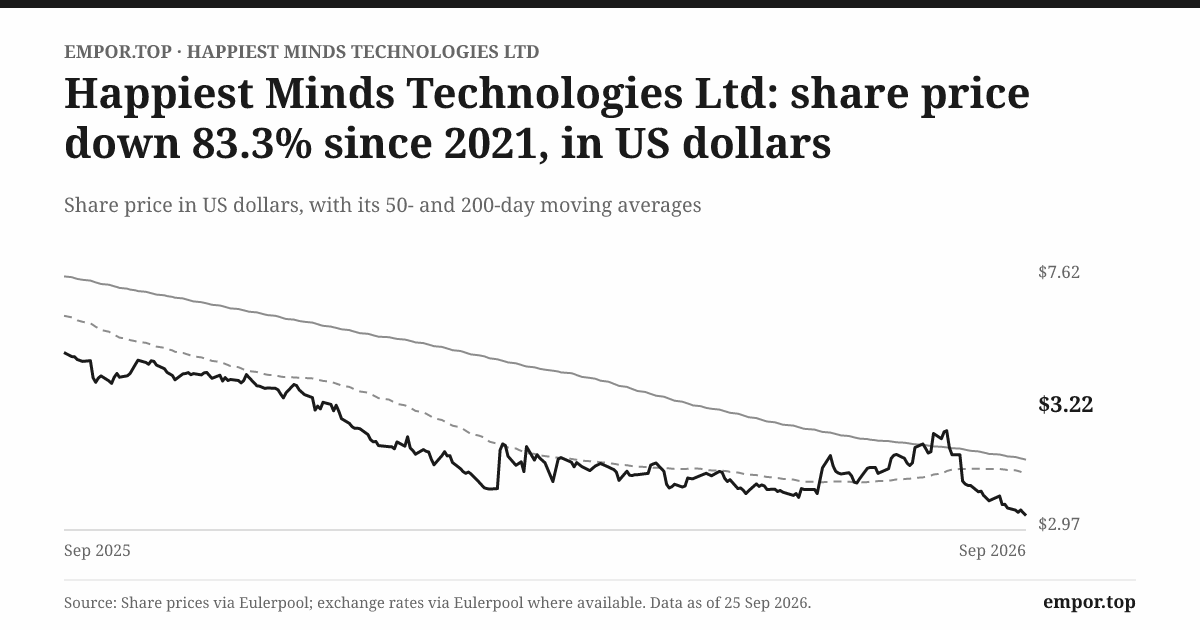
The rally gained further momentum over the following year. By July 19, 2021, the stock reached roughly ₹1,526, climbing more than ninefold from its IPO price.4 At that peak, Happiest Minds traded at close to 145 times trailing earnings, a valuation multiple typically reserved for high-growth software platforms rather than an IT services firm billing clients for engineer hours.5
The Pitch That Captivated India
The investment pitch rested on four words: "Born Digital. Born Agile." In its offer documents, Happiest Minds reported that about 97% of its revenue came from digital services.[^6] The implicit contrast was with India's legacy IT giants, which in 2020 remained tethered to multi-year contracts for traditional application maintenance, enterprise software packages, and infrastructure outsourcing. Happiest Minds positioned itself as an agile pure-play with no legacy contracts to protect and no traditional revenue streams to cannibalise.
That narrative was anchored by a proven industry leader. Ashok Soota had previously helped guide Wipro's transition from hardware into software services, co-founded Mindtree, and led it to an IPO in 2007.67 Following an acrimonious boardroom dispute, he departed Mindtree in 2011, at nearly 70 years of age, to build a new venture from scratch.8
The 2026 Climax
Six years after the IPO, the trajectory shifted. On August 31, 2026, Happiest Minds announced that ITC Infotech, the technology services arm of the diversified conglomerate ITC, would acquire approximately 22.1% of the company from Soota and his associated entity for about ₹1,330 crore, at an average price near ₹395 a share.9 Under the proposed merger, public shareholders would receive 25 shares of ITC Infotech for every 81 shares of Happiest Minds, leaving ITC Limited with an ownership stake of about 73.4% in the combined listed company.9
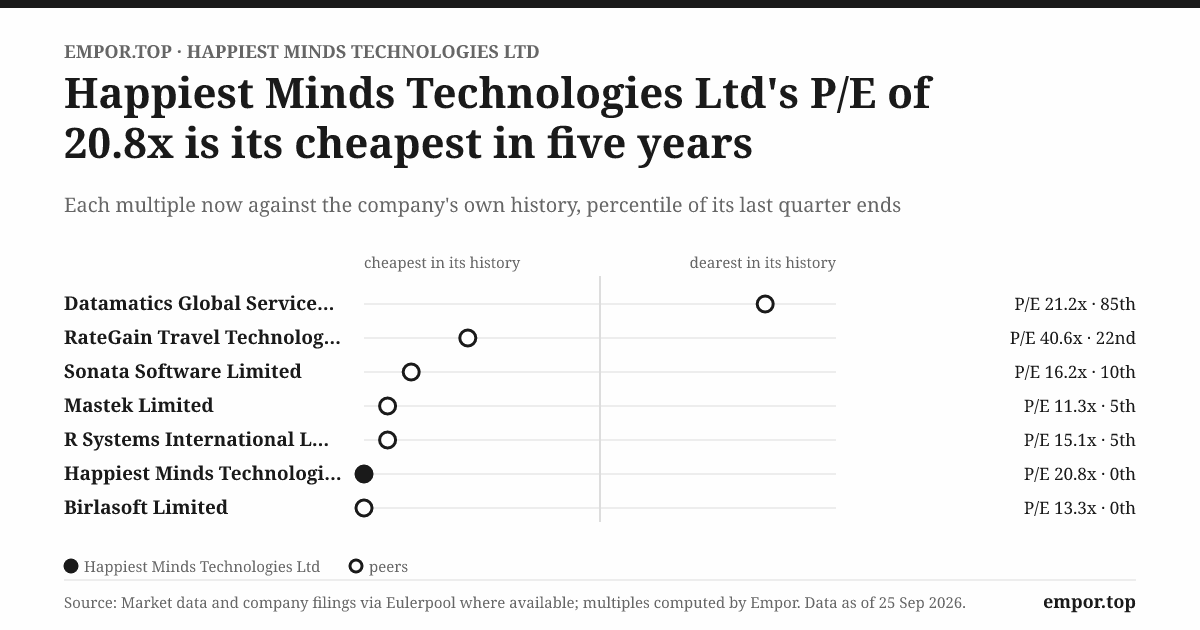
The ₹395 transaction price barely exceeded the stock's first-day opening level. As of September 25, 2026, the shares trade around ₹310—below their listing-day debut price—at roughly 21 times trailing earnings.5
Soota, now 83, has committed ₹600 crore to SKAN, a medical research trust he founded to investigate ageing and neurological disease.6
What This Story Is Really About
Three central questions define the company's fifteen-year trajectory.
First, can corporate culture serve as a durable moat? Happiest Minds built its brand around employee happiness, mindfulness, and a values framework branded as SMILES. Did that emphasis translate into sustainable competitive advantages, or does IT services ultimately reduce to client procurement pressures and utilisation spreadsheets?
Second, what happens when a counter-positioning strategy loses its novelty? Being "Born Digital" represented a genuine differentiator in 2011. By the mid-2020s, every major IT vendor pitched cloud architecture, data platforms, and artificial intelligence.
Third, why does the transition from roughly $250 million to $1 billion in revenue repeatedly stall Indian mid-tier IT services firms, including an enterprise Soota led once before? The answer traces through missed financial guidance, debt-funded acquisitions, and an eventual consolidation into a larger conglomerate. Understanding how Happiest Minds reached this inflection point requires looking back to the last time Soota pursued a billion-dollar target and fell short.
 Subscribe on LinkedIn
II. The Ashok Soota Legend: From Shriram to Wipro & Mindtree (1942–2011)
The Engineer-Manager
Ashok Soota began his career in the discipline of traditional Indian industry, long before software gained prominence. He trained as an electrical engineer at the University of Roorkee, now IIT Roorkee, and earned an MBA from the Asian Institute of Management in Manila.10 While his early industrial management career predated the information-technology boom, his reputation was forged by translating that operational discipline into technology services.
Colleagues described his management style not as visionary futurism but as "disciplined execution, rigorous reviews and accountability."6 That distinction proved fundamental. Across three enterprises, Soota's core competency was institution-building: standardising delivery processes, establishing corporate governance, managing recruitment, and cultivating credibility with public equity markets.
Wipro: Learning to Scale
Between 1984 and 1999, Soota helped guide the transition of Azim Premji's technology business at Wipro from hardware manufacturing toward software services.6 He eventually rose to vice chairman.8 Those fifteen years spanned India's pre-reform economy, the 1991 economic liberalisation, and the run-up to Y2K—the formative period when Indian IT established its global offshore delivery model.
The lessons of that era were foundational. Indian IT in the 1990s succeeded through process discipline rather than proprietary product innovation. Western clients were entrusting critical corporate systems to teams on the other side of the world. The service providers that scaled were those that could prove, through quality certifications, comprehensive documentation, and relentless project reviews, that work would be delivered on time and to specification. Soota's generation of leaders constructed that delivery machinery, creating an operational template that influenced the wider industry and the companies he subsequently established.
His public profile expanded in parallel. He served as president of the Confederation of Indian Industry and on the Prime Minister's task force on IT.10 By the late 1990s, he had become one of the sector's most visible senior executives.
Mindtree: The First Attempt at a Billion
In 1999, Soota departed Wipro to co-found Mindtree alongside a group of senior IT executives and consulting veterans, including Subroto Bagchi and Krishnakumar Natarajan. The enterprise crossed $100 million in revenue within six years and went public in 2007, completing an IPO that was oversubscribed 103 times.7 The transaction established a precedent that would recur thirteen years later at Happiest Minds: an established industry leader, broad institutional and retail demand, and an investment thesis centred on agility and a values-driven corporate culture.
Following the listing, however, revenue expansion stalled. Mindtree's annual sales hovered around $270 million between 2008 and 2010, plateauing well short of the $1 billion milestone management had publicly targeted.7
The Handset Bet and the Split
The strategic initiative that precipitated the endgame at Mindtree originated with Soota. As executive chairman overseeing strategy, he spearheaded the company's entry into mobile handset software, acquiring the Indian research-and-development centre of Kyocera Wireless in October 2009.8 Management projected that the product engineering business would generate $100 million in revenue before 2014.8
The venture failed to gain traction. The capital required expanded to roughly five times the initial $10 million budget, and in October 2010 Mindtree abandoned the product unit entirely, recording about $3.5 million in restructuring charges on top of its sunk investment.8 Soota later noted that the strategic pivot "was debated and became a board approved project."8
The handset setback intensified existing friction inside the leadership team. Bagchi had cautioned that Mindtree's six acquisitions between 2004 and 2011 were diluting executive focus and consuming management bandwidth.8 Other founder-directors subsequently stated that they had harboured reservations about the product expansion but stayed quiet out of deference to Soota.8 On January 28, 2011, Mindtree announced Soota's resignation, effective March 31.8
What the Record Says About the Founder
For investors evaluating Happiest Minds, Soota's tenure at Mindtree provided the clearest historical baseline of his capital allocation and operating preferences. That record demonstrated three consistent patterns: public billion-dollar revenue aspirations, an active appetite for mergers and acquisitions, and a willingness to invest in adjacent market opportunities. It also highlighted an undeniable capability: assembling an operating organisation with sufficient governance and credibility to earn exceptional demand from public markets.
The immediate structural lesson Soota took from the handset initiative was clear: Happiest Minds would remain strictly an IT services firm, augmenting client delivery with internal software frameworks and digital accelerators rather than commercialising standalone software products. Whether he had also internalised the operational risks of tethering aggressive revenue targets to debt- or equity-funded acquisitions remained an unresolved question as he began his next venture in 2011 with a blank sheet of paper.
III. Genesis: The "Born Digital" Architecture & SMILES (2011–2019)
A Blank Canvas at Seventy
In April 2011, just weeks after announcing his departure from Mindtree, Soota unveiled the founding team for a venture whose very name sounded like a provocation in an industry defined by night shifts and burnout: Happiest Minds.11 The company had been incorporated in Bengaluru on March 30, 2011.12
The leadership bench was experienced and deep. Vikram Gulati took the helm as chief executive and managing director. Joseph Anantharaju, who would still be helping guide the company fifteen years later, took charge of software product engineering. Prasenjit Saha headed infrastructure management and security, Salil Godika oversaw strategy and marketing, and Puneet Jetli and Ramakanth Desai shared executive responsibility for IT services.11
Happiest Minds launched commercial operations on August 29, 2011. That November, the company secured a $45 million Series A round led by Canaan Partners, Intel Capital, and Soota himself, with the other co-founders also contributing capital.13 For an Indian IT services start-up in 2011, this was an exceptionally large opening cheque, reflecting the market reputation of its founder rather than an existing operating track record.
Counter-Positioning, Explained
In business strategy, Hamilton Helmer defines counter-positioning as a newcomer adopting an operating model that incumbents cannot copy without damaging their core business. The classic parallel is a discount brokerage challenging full-service investment houses: established firms can cut commissions, but only by destroying their own margins.
In 2011, Happiest Minds applied that playbook against Indian IT. Legacy vendors generated the bulk of their revenue by maintaining aging enterprise software and implementing traditional software packages. Happiest Minds declined that work entirely, focusing from day one on cloud architecture, mobility, analytics, social platforms, and cybersecurity.1113 The pitch to enterprise technology buyers, particularly in the United States, was straightforward: building new digital products required software engineers untethered from legacy maintenance habits.
This was a sharp strategic insight. The hesitance of legacy vendors was real, since shifting their pricing structures and engineering pools threatened long-term annuity contracts. Yet counter-positioning carries an inherent shelf life. The newcomer's advantage endures only as long as the incumbents stay reluctant.
Happiness as a Business Model
Alongside its technical focus, Happiest Minds established an explicit cultural framework. Management codified the company's core values under the acronym SMILES: Sharing, Mindful, Integrity, Learning, Excellence, and Social Responsibility.14 The company appointed a dedicated Happiness Evangelist in 2011.14 By 2016, it had branded itself "The Mindful IT Company," formalising a commitment of 60 minutes a week for employee mindfulness practices, ranging from guided meditation to "desktop yoga."14 It later introduced internal sentiment tools, including a "Happometer" and a collaboration platform dubbed the Happiverse.12
Behind the benign terminology lay a pragmatic commercial calculation. In IT services, compensation is the largest operating expense, and voluntary attrition is the most disruptive leak in operating margin. Every departure brings replacement recruitment fees, non-billable bench time, and client continuity risks mid-project. If higher job satisfaction reduced turnover, Happiest Minds could sustain higher staff utilisation and project stability.
Operating data offered only partial validation for that thesis. Voluntary attrition stood at 12.4% in FY21 and 13% in FY24, both respectable levels against industry benchmarks.1516 However, during the post-pandemic talent squeeze in FY22, attrition surged to 22.7%, before settling back to 16.6% in FY25 and roughly 17% in FY26.171819 Culture helped keep Happiest Minds within normal industry bands, but it did not shield the business from broader labour cycles. The record suggests employee wellness served as a helpful operating lever rather than an impregnable economic moat.
Three Business Lines
The original organisation split across three operational units: IT services, software product engineering, and infrastructure management and security.11 Over the subsequent decade, these capabilities coalesced into the segments familiar to public investors. Product and Digital Engineering Services, or PDES, designs and builds custom software products and digital platforms, primarily for independent software vendors and technology companies. A digital business solutions group managed enterprise transformation projects before being consolidated into PDES. Meanwhile, Infrastructure Management and Security Services, known as IMSS, oversees cloud infrastructure, cybersecurity, and operations under multi-year support agreements.18
A simple physical analogy clarifies the distinction. If enterprise software were an office tower, PDES acts as the architectural and engineering crew erecting new floors. IMSS serves as the facilities, utilities, and security staff keeping the power running, the access gates locked, and surveillance active around the clock. Construction pays premium billing rates but concludes once the structure is completed; building maintenance yields lower rates but renews consistently year after year. An IT services firm's revenue durability depends on balancing the two, and Happiest Minds chose to tilt heavily toward construction.
The Long Road to Profit
The company's early trajectory was far from linear. Executive leadership saw meaningful churn; by 2016, Sashi Kumar had stepped in as chief executive, replacing the founding CEO.14 Financial results disclosed later in the IPO prospectus revealed that as late as FY18, Happiest Minds posted a net loss of approximately ₹22 crore, leaving the balance sheet with a negative net worth of roughly ₹109 crore.3 Operating performance improved over the next two years: annual revenue rose from ₹489 crore in FY18 to ₹602 crore in FY19 and reached ₹714 crore in FY20, while net profit rebounded from ₹14 crore in FY19 to ₹72 crore in FY20.3
By early 2020, early venture backers were seeking liquidity. CMDB II, an investment vehicle tied to JP Morgan Asset Management, held more than 2.7 crore shares.1 The stage was set for a public listing. Then the pandemic struck, unexpectedly delivering the most potent demand catalyst a born-digital services vendor could have encountered.
IV. The IPO Triumph & The 2021 Valuation Peak
The Pandemic Tailwind
In the spring of 2020, companies that had spent years debating cloud migrations were forced to execute them in weeks. Retailers needed e-commerce that worked; schools needed online learning platforms; banks needed digital onboarding. For a company whose whole identity was digital engineering, the timing was ideal.
Happiest Minds filed its offer documents and opened its IPO on September 7, 2020, at a price band of ₹165 to ₹166.1 The ₹702 crore issue was mostly a sale by existing holders: ₹110 crore of new shares for the company and about ₹592 crore in an offer for sale.3 CMDB II sold about 2.72 crore shares and Soota about 84 lakh.1 Anchor investors, including the government of Singapore, Goldman Sachs and the Kuwait Investment Authority, took ₹316 crore of stock before the public book opened.1
Here is the first investor-lens detail worth noticing: roughly 84% of the IPO proceeds went to sellers, not to the company. That is common in Indian IPOs and not a red flag by itself. It does mean the listing was, first and foremost, a liquidity event for early backers. Soota's own holding went from about 61.8% before the IPO to about 53.3% after.3
The Order Book
The subscription numbers described in the opening were not merely a sign of demand for Happiest Minds. They were a sign of the moment: a flood of new retail investors, low interest rates and a market hungry for anything labelled digital. The non-institutional bucket, oversubscribed 351 times, was the most speculative part of the book, often financed with borrowed money chasing listing gains.1
It helps to understand how Indian IPO allotment works. When a retail book is oversubscribed 71 times, most applicants receive nothing; shares are allotted by lottery in minimum lots. Those who miss out often buy on listing day instead, which is one reason heavily oversubscribed issues frequently open far above their price. The day-one pop, in other words, partly measured scarcity rather than a considered judgement about the company's value.
Anchor investors, by contrast, were locked in for a period after listing. Their presence gave the issue credibility, and their names, from sovereign funds to global banks, reinforced a sense that the smartest money in the world was buying the story.1
FY21: A Good Year, Misread
When the first full-year results arrived in May 2021, they showed something the stock price did not. FY21 revenue grew just 6.3% in dollars, to $104.6 million.15 What surged was profit. EBITDA reached 27% of total income and net profit more than doubled to about ₹162 crore.15 Utilisation hit 82.6%.15
That margin was flattered by the pandemic: no travel, no office costs, and engineers billed at unusually high utilisation. It was also flattered by something more permanent in the company's reporting. Happiest Minds reports EBITDA including "other income," most of which is interest on its cash pile. That habit will matter later.
Utilisation deserves a plain-English explanation, because it is the single most important dial in an IT services company. It is the share of engineers who are billed to a client rather than waiting on the "bench" between projects. At 82.6%, more than four out of five engineers were billable. That is excellent for margins, but it leaves little spare capacity to staff new projects quickly. Most companies target a band in the high 70s to low 80s and treat anything higher as a temporary gift.
The board also recommended the company's maiden dividend of ₹3 a share, and free cash flow of about ₹215 crore suggested the profits were real cash, not accounting.15 Return on equity was about 30%.15 By any sober measure, FY21 was a strong year for a small services firm. It simply was not a year that justified a valuation near 145 times earnings.
FY22: The Real Boom
The growth arrived in FY22. Revenue jumped 41.8% to $146.6 million, or 40.9% in constant currency, with EBITDA at 26.1%.17 Headcount grew by 940 to 4,168.17 This was the peak of the global digital spending wave, and Happiest Minds rode it with some of the fastest growth in Indian IT.
It was also the year attrition rose to 22.7%.17 The same boom that lifted revenue lifted salaries everywhere, and a mindful culture could not stop engineers from accepting 40% raises elsewhere.
The Billion-Dollar Vision
In September 2021, near the peak of the stock, management announced a long-term vision of reaching $1 billion in revenue by FY31. The target implied a compound annual growth rate of about 25.3%.16
Consider what that meant. A company of roughly $150 million would need to multiply itself nearly seven times in a decade, mostly organically, in an industry whose large players grow at single or low double digits. Soota had publicly aspired to $1 billion at Mindtree too, and watched revenue stall around $270 million.7
Myth vs. Reality: The Multiple Trap
The market's implicit thesis in 2021 was that Happiest Minds had found a formula for 25%-plus growth and mid-to-high 20s margins, sustainable for years. The company's own record already contained the counter-evidence. FY21's margin coincided with near-zero growth. FY22's growth coincided with record attrition. And a price near 145 times earnings left no room for the ordinary cyclicality of IT services.5
The history rejects the strong version of that thesis. What survives is narrower: Happiest Minds could grow quickly in a digital boom and run healthy margins, but neither was structural. The next three years would prove it.
V. The Mid-Tier Crucible: Organic Deceleration & Margin Squeeze (2022–2024)
The Weather Changes
In early 2023, the macroeconomic climate shifted abruptly. With global central banks raising interest rates at their fastest pace in four decades, corporate clients—particularly venture-backed technology firms—pivoted from growth at all costs toward cash preservation. Discretionary spending on outsourced engineering for non-essential software features was among the earliest budget items deferred or cancelled.
Happiest Minds was acutely exposed to that pullback. Its revenue was heavily concentrated in the sectors that had expanded fastest during the pandemic: technology product companies, education technology, and digital-first retail.
FY23: A Near Miss
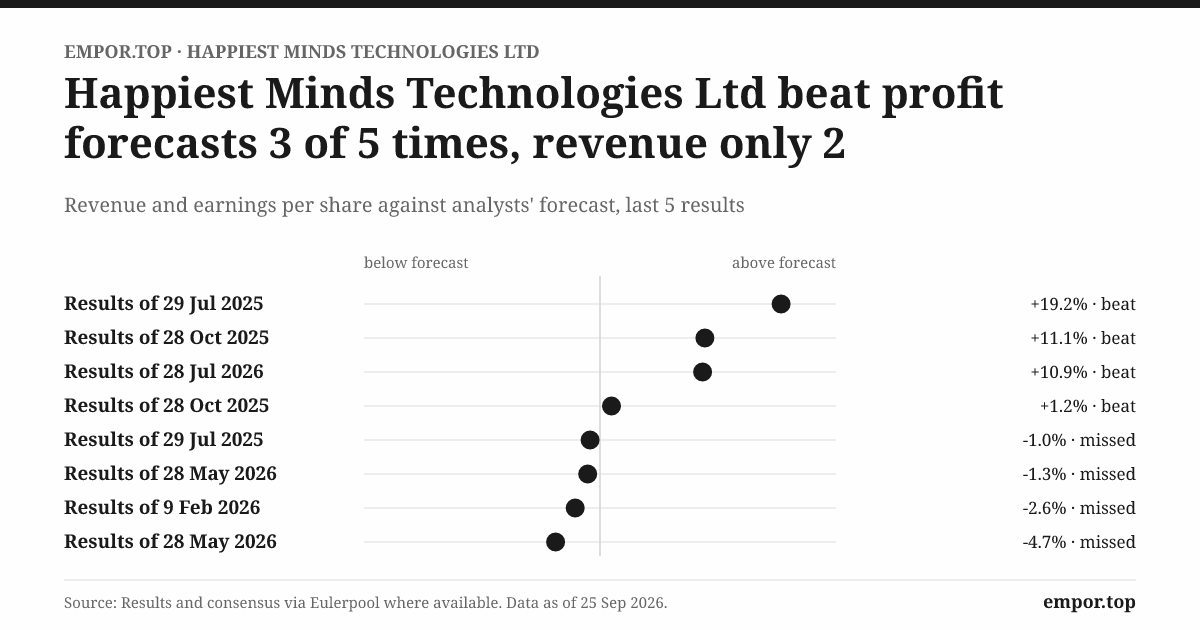
On the surface, financial year 2023 still looked healthy. Revenue reached $178 million, up 23.7% in constant currency, with EBITDA of 26.2% and net profit of about ₹231 crore.20 Yet it brought the first visible operational stumble. Soota acknowledged that the company had missed its revenue growth target by 1.3 percentage points "due to right-shifting of Q4 revenues."20
Management then guided for 25% growth in FY24, backed by plans to add 1,300 employees.20
FY24: The Real Miss
That target proved unrealistic. In FY24, constant-currency revenue growth slowed to 11%, bringing sales to $196.1 million.16 That outcome was less than half the projected 25% guidance, marking one of the widest gaps between a management forecast and execution in the company's public history. Utilisation fell to 75.1%.16 Headcount ended at 5,168, well short of the planned hiring.1620
Reported EBITDA held at 24.6%.16 But underneath, operating margin excluding other income was about 21.0%, and a growing share of reported profitability came from interest on the cash raised in the market.18
What Went Wrong
Management pointed to delayed client decision-making, paused discretionary projects, and elongated sales cycles across the industry. While those headwinds were real, they also highlighted the inherent risks of a services business concentrated in discretionary digital spending. The "Born Digital" counter-positioning that served as an advantage in 2021 meant having virtually no annuity-like legacy maintenance work to cushion the downturn in 2023.
The education vertical illustrates the structural challenge. Having boomed during pandemic lockdowns, it turned into an operational drag as schools and universities normalised. By the Q4 FY25 call, management was still describing headwinds in higher education and a strategic pivot "towards workforce development."21
The Response: Reorganise
Management responded with a structural overhaul. By May 2024, Happiest Minds had set up six industry groups, each led by an industry head, and a new Generative AI business unit.1612 It also created a separate "net new" sales team focused purely on hunting new clients, an admission that the old model relied too heavily on farming existing accounts.12 Concurrently, Digital Business Solutions was folded into PDES.
The same results announcement contained a telling revision. Happiest Minds said it was "back on course" toward $1 billion by FY31, but the required compound growth rate had been lowered to 22% from the original 25.3%.16 The ultimate revenue target had not moved; the underlying arithmetic had simply been relabelled.
What the Calls Revealed
Earnings calls during this period revealed a consistent pattern in management's investor communication. Prepared remarks opened with positive highlights: industry-leading growth relative to peers, operating margins within guided bands, and new client wins. Analyst questions then routinely circled back to sequential quarterly deceleration.
By the Q4 FY25 call, the questions had sharpened around modest sequential performance. Management's answer was specific rather than evasive: a $1.5 million revenue drop from one customer, plus a ₹12.5 crore provision for bad and doubtful debts from a US client, explained most of the gap.21 Healthcare had dipped temporarily on client ramp-downs, and education was being repositioned toward workforce development.21
That transparency helped clarify the quarterly shortfall, but it also exposed the client concentration risk typical of a mid-tier IT services firm, where a stumble at a single account can swing an entire quarter. Days sales outstanding, the average time it takes to collect an invoice, stood at about 88 days, meaning roughly three months of revenue was tied up in receivables at any moment.21 A bad debt of the Q4 FY25 kind is the direct cost of that credit exposure.
Assessing Management's Credibility
A fair assessment of this period presents two sides. Management did not conceal the misses; Soota acknowledged them in writing, and financial results were disclosed in detail. Furthermore, the growth slowdown affected the broader technology sector. At the same time, the company repeatedly established aggressive growth guidance that it missed by wide margins, and it responded not by resetting the long-term target, but by reaffirming it. When a revenue target is treated as fixed while the organic engine decelerates, only one strategic lever remains. The company was about to pull it hard.
VI. M&A and Capital Deployment: Buying Growth (2023–2025)
The Arithmetic of Urgency
The arithmetic confronting the board in 2023 was straightforward. A company generating roughly $180 million and expanding at an organic rate of 11% would reach approximately $500 million by FY31, falling well short of its publicly targeted $1 billion milestone. Closing that shortfall required purchasing revenue.
Happiest Minds had already tested the approach on a modest scale. In January 2023, it acquired Sri Mookambika Infosolutions (SMI), a Madurai-based firm with more than 400 engineers, an annual revenue run-rate of about $9 million, and an established healthcare practice, for roughly ₹111 crore in upfront and deferred consideration.22 The transaction established a working template: an offshore-heavy business in a resilient vertical, acquired at a price the balance sheet could comfortably absorb.
Yet SMI did not alter the broader trajectory toward the billion-dollar target. An asset generating $9 million adds approximately five percentage points of growth to a $180 million base for a single year before rolling into the baseline. Bridging a revenue gap measured in hundreds of millions of dollars demanded substantially larger transactions. Over the following two years, management pursued them.
The QIP: Raising the War Chest
In July 2023, Happiest Minds completed its first equity raise since going public, securing ₹500 crore through a qualified institutional placement of about 54.1 lakh shares priced at ₹924 each.23 The stated uses of the proceeds included working capital, capital investments in subsidiaries, and inorganic acquisitions.23
The placement price proved consequential in retrospect. Institutional investors paid ₹924 per share in 2023. By August 2026, the promoter agreed to sell a controlling stake to ITC Infotech at roughly ₹395 a share.9 On paper, the institutional investors who funded the company's inorganic expansion had lost more than half their capital.
The Flagship Deal: PureSoftware
On April 25, 2024, Happiest Minds announced the acquisition of PureSoftware Technologies, a Noida-based digital engineering firm, for $94.5 million, or about ₹779 crore.24 The transaction structure involved ₹635 crore paid upfront and up to ₹144 crore in deferred consideration, contingent on hitting performance milestones through FY25.24
PureSoftware generated $43 million in FY24 revenue and employed roughly 1,200 people, with delivery centres spanning the United States, the United Kingdom, Mexico, Singapore, Malaysia, and Africa, alongside client relationships in banking, insurance, and healthcare.24 The deal also brought Arttha, a banking-as-a-service platform covering core banking, digital lending, payments, and merchant management.24
At roughly 2.2 times trailing sales, the valuation appeared disciplined for an engineering firm of that scale, and the strategic rationale was coherent: banking and healthcare offered more defensive spending patterns than the discretionary tech and edtech accounts that had slowed Happiest Minds. EY advised Happiest Minds on the purchase, while Avendus advised the sellers.24
What Is Banking-as-a-Service?
Arttha represented the element of the acquisition most frequently highlighted by management as strategic optionality. Banking-as-a-service delivers modular, cloud-ready software components that permit banks, fintechs, and non-financial retailers to launch financial products without developing underlying infrastructure from scratch. Analogous to prefabricated building components that shorten construction timelines from years to months, Arttha supplies pre-built modules for customer deposit accounts, loan origination, digital payments, and merchant acquiring.24
The commercial appeal of platform software is straightforward: software licences and recurring subscriptions typically command higher gross margins than billable engineering hours, and they scale without requiring proportionate headcount additions. The execution challenge is equally pronounced. Core banking software is a mature market dominated by entrenched global vendors, corporate sales cycles are protracted, and financial institutions are cautious buyers. Credit rating agency CareEdge noted that the immediate commercial focus was expanding the platform in emerging markets such as India and the Philippines, which offer substantial transaction volumes but remain price-sensitive.12
In practice, Arttha was an operational product with commercial deployments acquired inside a broader IT services organisation, though Happiest Minds did not separately break out its standalone revenue. It functioned as a long-term strategic option rather than an immediate revenue engine.
The Earn-Out Detail
The structure of the deferred consideration also carried operational implications. While earn-out mechanisms align vendor incentives with post-acquisition performance, they introduce accounting estimates that must be reassessed over time. Across the four acquisitions completed in FY25, CareEdge reported that Happiest Minds paid approximately ₹712 crore upfront and deferred ₹103 crore, payable by FY26—a figure below the maximum potential earn-out figures outlined at signing.1224 The rating agency did not specify whether that variance reflected milestone shortfalls or standard settlement schedules.
Bolt-Ons: Aureus, Macmillan, GAVS
In May 2024, the company's US subsidiary agreed to acquire Aureus Tech Systems, a Denver-based Microsoft Azure specialist with an offshore development centre in Hyderabad, for $8.5 million upfront plus performance-linked earn-outs.2526 Aureus had recorded roughly $8.3 million in calendar 2023 revenue and employed around 150 professionals supporting insurance and healthcare clients.2526
Happiest Minds also acquired Macmillan Learning India and, in February 2025, the Middle East operations of GAVS Technologies for about ₹15 crore.12 In aggregate, CareEdge calculated a total acquisition outlay of roughly ₹727 crore across the four transactions completed in FY25.12
The Balance-Sheet Toll
The financial reality of this deal-making diverged from simplistic narratives of balance-sheet distress.
Gross debt rose sharply, climbing from about ₹512 crore at the close of FY24 to ₹1,306 crore by the end of FY25, which increased the debt-to-equity ratio from 0.35 to 0.83 times.12 Finance costs more than doubled, expanding from roughly ₹40 crore to ₹91 crore.18 Consequently, interest coverage deteriorated from about 8 times to 3.5 times.12
At the same time, the company held approximately ₹1,468 crore in cash and liquid equivalents at the close of FY25, and CareEdge noted that Happiest Minds remained net-debt-negative.12 Management had chosen to borrow substantial sums while preserving an even larger cash reserve.
Carrying substantial gross debt alongside a sizable cash balance can reflect prudent treasury management, such as funding overseas purchases directly in foreign currency to avoid cross-border tax frictions or maintaining an operational buffer. Yet the structure also flattered reported operating metrics: interest income earned on cash balances flowed into "other income," which Happiest Minds included in its reported EBITDA, whereas interest expenses on borrowing sat below the operating line.
Margins: The Number That Matters
Stripping out non-operating treasury income reveals the underlying operational shift. Operating margin, defined by the company as EBITDA excluding other income, declined from 21.0% in FY24 to 17.3% in FY25.18 Reported EBITDA margin contracted from 24.6% to 21.4%, remaining narrowly within management's guided 20% to 22% band.18
Further down the income statement, amortisation of acquired intangible assets and acquisition-related interest charges rose to approximately ₹52 crore from ₹22 crore, driving a 26% decline in net profit to ₹185 crore—a net margin of 8.5%, down from 14.5% in the prior year.18 CareEdge attributed the margin compression primarily to higher employee expenses, a shifting delivery mix, and regular compensation increments.12
Myth vs. Reality: Did the Acquisitions Buy Growth?
In reported terms, FY25 dollar revenue expanded 24.2%, rising from $196.1 million to $243.6 million.18 Based on their pre-acquisition run-rates, PureSoftware and Aureus accounted for virtually the entire incremental revenue increase.2425 CareEdge observed that "organic growth remained subdued" and confirmed that acquisitions accounted for "a significant portion of the incremental revenue."12
The aggressive thesis—that debt- and equity-funded acquisitions would prove margin-accretive and restore premium growth—found little support in the operating data. Underlying operating margins contracted by nearly four percentage points during the primary acquisition year. What survived was a narrower proposition: the transactions diversified Happiest Minds into more resilient verticals like banking and healthcare without compromising balance-sheet liquidity. Validating that repositioning would ultimately depend on whether those new practices could expand faster than legacy units, and whether operating profitability could recover toward historical levels without the aid of treasury income.
VII. Core Business Anatomy: Segments, Economics, & Competition
Inside the Engine Room
Consider the daily operating rhythm inside a Happiest Minds delivery centre in Bengaluru. A team of a dozen engineers builds software features for a US technology client, synchronising on an 8 a.m. Pacific stand-up, working across the Indian business day, and shipping code overnight. At its foundation, the commercial model remains straightforward: billable headcount multiplied by hours or developer-months at an agreed rate.
That labour-arbitrage arithmetic forms the core economic reality of the business, shaping its cost structure, operational leverage, and delivery margins.
The Segments
Product and Digital Engineering Services remains the primary growth engine, contributing 78.5% of FY25 revenue.12 The segment spans cloud-native software engineering, platform development, data analytics, and, following recent acquisitions, dedicated banking and healthcare transformation practices.
Infrastructure Management and Security Services provides stickier, contract-based engagements: administering cloud infrastructure and overseeing enterprise cybersecurity operations. It represents the closest equivalent the company has to annuity revenue, albeit at a lower portfolio share than at traditional IT peers.
A security operations centre, the core of that unit, functions as a continuous monitoring facility. Analysts track alerts across a client's networks, servers, and cloud environments, investigating anomalies and mitigating cyber incidents around the clock. Switching costs are high because transitioning operational oversight requires granting a new vendor comprehensive system access. That stability, however, carries a margin trade-off: maintaining 24/7 technical staffing and absorbing enterprise software licence fees keeps operating margins below those of specialised product engineering.
The Generative AI Business Services unit, launched in 2024, is the company's newest and smallest division. On the Q4 FY25 earnings call, management reported that generative AI accounted for roughly 2% of total revenue across 35 active projects, primarily executed as fixed-price engagements at premium billing rates.21 By October 2025, the company highlighted 22 "transformative use cases" representing an estimated $50 million in sales potential.27 Pipeline estimates do not equate to contracted revenue; the division represents an emerging initiative whose long-term commercial durability and margin profile remain unproven.
Geography and Clients
Geographically, the United States generates approximately 65% of revenue and India about 15%, up from 11.8% in FY21, with the remainder originating primarily from the United Kingdom, continental Europe, and the Middle East.12 Offshore delivery centres in India account for roughly 80% to 85% of total revenue.12
The client roster is broad rather than concentrated. Happiest Minds served 306 active clients at the close of FY26.19 As of September 2025, 58 accounts contributed more than $1 million annually, and average revenue per active client had expanded from roughly $774,000 in FY22 to about $906,000.12 While reflecting steady account mining, those metrics depict an organisation whose typical commercial engagement remains relatively modest. Expanding wallet share within enterprise accounts represents the company's primary commercial challenge.
The FY26 Snapshot
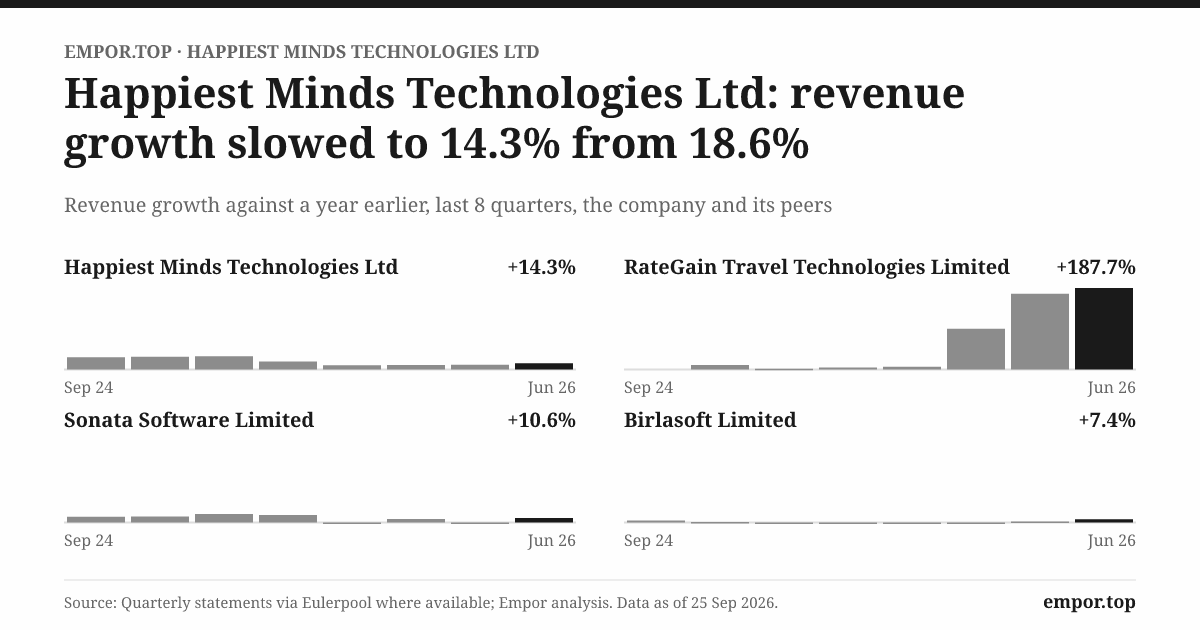
In FY26, revenue reached ₹2,315 crore, marking a 12.3% increase in rupee terms.19 In US dollars, however, revenue rose just 6.9% to $260.3 million, or 9.2% in constant currency.19 That divergence illustrates a critical financial dynamic: rupee depreciation flattered reported headline numbers while underlying constant-currency volume expansion slowed into single digits.
Utilisation increased to 81.4% from 77.4%, helping maintain an operating margin of approximately 17.4% in the fourth quarter.1918 Net profit expanded roughly 15% to ₹213 crore, even after absorbing a ₹22 crore exceptional charge linked to India's new labour codes.28
Operationally, FY26 represented a stabilisation phase rather than a return to the company's historical growth trajectory. Billable utilisation served as the primary lever defending profitability, but pushing engineer deployment above 80% left little operational slack to mobilise staff for sudden client demand.
The Competitive Arena
Happiest Minds competes across several distinct tiers in the IT services landscape. Against Indian digital-engineering peers such as Persistent Systems and Coforge, it operates at a fraction of their scale. Against LTIMindtree—created by the merger of Larsen & Toubro Infotech with Soota's previous venture—it is dwarfed. Against Western digital consultancies such as EPAM Systems and Globant, it lacks equivalent onshore consulting depth and premium pricing power. And against the tier-one Indian conglomerates like Tata Consultancy Services, Infosys, and Wipro, it lacks the massive engineering benches demanded by multi-hundred-million-dollar outsourcing tenders.
How It Wins and How It Loses
Happiest Minds wins engagements where executive attention matters more than sheer vendor headcount: mid-sized enterprises and software vendors that prioritise senior technical staffing and direct access to practice leaders, accounts that would rank as minor priorities inside a tier-one firm. A 93% repeat-business rate demonstrates that onboarded clients exhibit solid retention.12
The firm loses where scale operates as an entry barrier. Analyst commentary surrounding the ITC merger highlighted the structural reality: Fortune 500 procurement departments rarely award complex, multi-year digital transformation contracts to mid-tier vendors.29 That structural ceiling, far more than any single quarterly deceleration, explains the strategic pressures that shaped the company's trajectory—and provides the context for evaluating whether Happiest Minds ever possessed a durable competitive moat.
VIII. Strategy & Moat Stress-Test: 7 Powers & Porter's 5 Forces
A War-Game Exercise
Consider the position of a chief procurement officer at a US insurer in 2026. Managing seven digital engineering vendors on an enterprise roster, the corporate mandate requires a 10% budget reduction. At the same time, tools like GitHub Copilot and successor generative software models are accelerating in-house developers. Which service providers survive the cull?
That scenario provides an acid test for Happiest Minds' competitive durability. In the strategic framework articulated by Hamilton Helmer, an economic moat requires "power": a structural condition that allows a business to generate returns above its cost of capital over the long term, even against persistent competitor attacks. Competent operational execution does not constitute power, because rivals can replicate it. Testing Happiest Minds against Helmer's seven candidate powers illustrates where its defenses hold and where they falter.
The Seven Powers
Counter-positioning: largely eroded. In 2011, declining legacy application maintenance represented a genuine differentiator, as incumbent IT giants protected high-margin legacy books. Fifteen years later, every large global systems integrator pitches cloud architecture, data platforms, and artificial intelligence. The company itself pivoted toward marketing an "AI First" roadmap rather than its original "Born Digital" slogan.19 The initial strategic advantage was not disproved; its shelf life simply expired.
Switching costs: moderate at best. Engineers intimately familiar with a client's codebase and systems architecture provide meaningful continuity, and an annual repeat-business rate above 93% indicates customer inertia.12 Yet the enterprise client owns the underlying intellectual property, and enterprise work is routinely multi-sourced. The fourth quarter of FY25 demonstrated the vulnerability of that position, when a single US account's $1.5 million revenue decline alongside a ₹12.5 crore bad-debt provision noticeably impaired quarterly results.2118
Network effects: absent. The addition of an incremental enterprise client creates no direct operational or commercial utility for existing clients.
Scale economies: a persistent disadvantage. Larger IT services competitors spread sales overhead, recruitment pipelines, employee training, and technology investments across revenue bases ten to fifty times larger. That structural deficit represents the fundamental gap the proposed ITC Infotech merger was engineered to address.
Cornered resource: fading. For fifteen years, Soota's personal reputation opened doors with corporate buyers, attracted senior engineering leadership, and reassured institutional investors. Credit rating agency CareEdge explicitly highlighted "the strong promoter group backed by Ashok Soota" as a primary institutional strength.12 With his controlling stake agreed for sale to ITC Infotech, that cornered asset is transitioning out of the corporate structure.
Process power: modest. While an intentional corporate culture and disciplined delivery practices support project execution and workforce morale, voluntary attrition hovering between 16% and 17% across FY25 and FY26 reveals no structural retention advantage over industry peers.1819
Branding: recognized in talent markets, limited in enterprise pricing. While the Happiest Minds brand enjoys high visibility among Indian software engineers and mid-market enterprise buyers, there is little empirical evidence that it commands a pricing premium from global corporate procurement committees.
Porter's Five Forces
Bargaining power of buyers is exceptionally high. Corporate clients can re-tender multi-year engagements, split statements of work across competing vendors, and demand recurring productivity concessions. The enterprise adoption of artificial intelligence and automated code generation provides procurement teams with fresh leverage to negotiate lower billable-hour commitments.
Bargaining power of suppliers is moderate to high. In IT services, the core supplier is specialized technical talent. Engineers with expertise in cloud infrastructure, cybersecurity, and applied artificial intelligence remain highly mobile, a dynamic underscored by the FY22 industry talent crunch when voluntary attrition spiked sharply.17
Threat of new entrants is structurally high. Senior practice leaders departing tier-one IT firms can establish boutique software engineering consultancies with minimal upfront capital expenditure. Happiest Minds was itself founded on that exact pattern, launched when a group of veteran executives walked away from an established services firm armed primarily with market reputations and a Series A funding round.1113
Threat of substitutes is substantial and escalating. The proliferation of low-code development frameworks, commercial enterprise SaaS applications that eliminate custom software builds, and generative coding tools all compress the volume of outsourced engineering hours enterprise clients require.
Rivalry among existing competitors is intense. Happiest Minds contends simultaneously against Indian mid-tier engineering specialists, tier-one Indian conglomerates, and Western digital consultancies, frequently competing against all three tiers within the same enterprise procurement process.
The Verdict of the Frameworks
Synthesizing both strategic frameworks reveals a business with a real, but structurally thin, competitive edge. Its durability has rested on client responsiveness, senior executive relationships, and workplace culture rather than an unassailable economic moat that can reliably protect operating margins during sector downturns. That operational reality does not diminish the business; numerous profitable professional services organizations thrive without formal economic powers. It does mean, however, that financial performance remains tightly coupled to broader demand cycles and project-level execution. It also clarifies why achieving greater scale ultimately emerged as the founder's definitive strategic imperative—a transition that required fundamental decisions regarding executive succession and corporate ownership.
IX. Management, Governance, & The Succession Endgame (2025–2026)
The Handover
On March 19, 2025, Happiest Minds announced what it called apex-level organisational changes.30 Joseph Anantharaju, previously executive vice chairman and CEO of the PDES division, became co-chairman and chief executive, responsible for all business divisions: PDES, IMSS, the GenAI unit, analytics and people practices.30 Venkatraman Narayanan continued as managing director and CFO, overseeing finance and corporate functions.30 Soota took the title of chairman and chief mentor.30
Anantharaju had been on the founding team in 2011.11 Soota's endorsement was direct: "Joseph has been the key driver of Happiest Minds growth and profitability since inception."30 Both executives reported independently to Soota, with M&A and board matters shared.30
On paper, this was a clean succession within the company. In practice, it left a structural question unanswered. Soota held about 44% of the equity, 32.3% directly and 11.8% through Ashok Soota Medical Research LLP.12 There was no family successor, and the founder was in his eighties. The management succession was solved; the ownership succession was not.
The Promoter Starts Selling
The first sign came on June 25, 2024. Soota sold 6% of the company, about 91 lakh shares, in a block deal, reducing his stake from 50.13% to 44.13%.31 The shares fell 9.4% that day to about ₹830.31 The sale came barely a year after institutions had bought QIP shares at ₹924.23
By July 2026, reports indicated that ITC Infotech had emerged as the frontrunner to acquire a majority stake from Soota; at the time, the market value of Happiest Minds was about ₹6,183 crore.32
Governance Signals
Several governance markers are worth recording. Deloitte Haskins & Sells audits the company and was re-appointed in May 2026.28 CareEdge reaffirmed its AA- rating in December 2025 and noted that only 1.76% of Soota's shares were pledged.12 The company has also disclosed adjusted profit measures prominently alongside statutory ones; the adjusted figures exclude acquisition amortisation and exceptional items, which is common but flattering, and investors should keep both in view.18
The Transaction
On August 31, 2026, the deal was announced.9 ITC Infotech would buy about 22.1% of Happiest Minds from Soota and Ashok Soota Medical Research LLP in two tranches, at ₹390 and ₹400 per share, for about ₹1,330 crore.929 Happiest Minds would then merge into ITC Infotech, with shareholders receiving 25 ITC Infotech shares for every 81 Happiest Minds shares.9
After the merger, ITC Limited would own about 73.4%, other Happiest Minds public shareholders about 19%, and Soota's group about 7.6%, reclassified as public.29 The combined company would list on the NSE and BSE, and its registered office would move from Karnataka to West Bengal, ITC's home state.29 Approvals from the Competition Commission of India, the stock exchanges and the National Company Law Tribunal were required, with completion expected within about 15 months.9
On a pro forma FY26 basis, the combined business would have revenue of about ₹7,033 crore, more than 19,000 employees and over 800 clients, targeting $1 billion in revenue by FY28.9 ITC Infotech contributed about ₹4,718 crore of revenue and ₹510 crore of profit.33
Who Is ITC Infotech?
For most Happiest Minds shareholders, ITC Infotech is an unfamiliar name. It is the technology services subsidiary of ITC Limited, led by managing director and CEO Manas Chakraborty.33 Its strengths lie in enterprise platforms: SAP implementation, product lifecycle management software for manufacturers, supply-chain systems, cloud and managed services.3329 Europe accounts for a large share of its revenue, a useful counterweight to Happiest Minds' dependence on the US.29
Before the deal, ITC Infotech had set itself an ambition of ₹10,000 crore in revenue within two to three years, through organic and inorganic growth, with a focus on AI-led engineering.32 Happiest Minds is the inorganic part of that plan. Seen from Kolkata, the deal buys digital engineering, security and AI capabilities, a US client base and a stock-market listing in one transaction.
On FY26 figures, the two companies had similar EBITDA margins, around 18% each.29 That matters: the merger does not bolt a low-margin business onto a high-margin one, or vice versa. The value case rests on revenue synergies and cross-selling, which are historically the hardest merger benefits to deliver.
ITC chairman Sanjiv Puri described the merger as "an important milestone" toward "a future-ready technology services organization."9 Soota spoke of two organisations "aligned on values" with "very significant complementarity."9
What the Structure Reveals
The structure is revealing. By buying 22.1% rather than a majority stake, ITC Infotech stayed below the threshold that typically triggers a mandatory open offer under Indian takeover rules. Control would instead come through the merger itself. Commentators also noted that the merger gives ITC Infotech, which is unlisted, a public listing through Happiest Minds, effectively a back-door listing.33
The market's response was harsh. Happiest Minds shares fell about 11% on September 1, 2026, to around ₹363, close to their 2020 listing price.34 Part of the disappointment was that earlier reports had pointed to a majority stake sale.32
The Founder's Purpose
Soota's reasons have been framed openly in terms of his next chapter. He founded SKAN, a non-profit research organisation focused on ageing and neurological disorders, in April 2021, working across stem cells, the gut microbiome, molecular biology and bioinformatics.10[^36] He also founded Happiest Health, a health and wellness knowledge business, in April 2022.10 He has committed ₹600 crore to SKAN.6
The deal therefore solves three problems for the founder at once: liquidity for his philanthropy, a home for the company he built, and an exit from the role of controlling shareholder. Whether it solves the problems of the remaining shareholders is a different question, and the one a skeptical investor would ask first.
X. Activist & Skeptical-Investor Stress Test
The Room
Imagine a skeptical fund manager preparing questions for an upcoming Happiest Minds earnings call. The questioning would be polite but pointed. Three fundamental issues dominate that ledger, each testing the official corporate narrative against the underlying operating data.
Stress-Test 1: The Organic Growth Question
The charge: the post-FY24 expansion story has been built on debt-funded acquisitions and currency tailwinds rather than organic client demand.
The evidence largely supports that critique. In FY24, constant-currency organic revenue growth slowed to 11%, falling less than half of management's 25% guidance.1620 In FY25, reported dollar growth of roughly 24% to 25% stemmed almost entirely from acquired businesses, as rating agency CareEdge observed.1218 In FY26, constant-currency expansion reached 9.2%, while growth in US dollar terms slowed to 6.9%.19
There is a sharper operational contradiction. In October 2025, management publicly increased its commitment to deliver "four consecutive years of 10%+ growth" from FY26 through FY29, in an announcement that headlined constant-currency metrics.27 The first financial year under that commitment closed with constant-currency growth of 9.2%.19 While revenue expanded above 10% in rupee terms—allowing management to argue the benchmark had been satisfied on a reported basis—the episode reflected a familiar five-year pattern of resetting and reframing performance milestones.
The counter-argument rests on operational signs of stabilisation. Happiest Minds returned to sequential quarterly expansion, added 51 active clients in FY26, and reported a 27% increase in its sales pipeline.1935 Management has guided for 12.5% constant-currency growth in FY27, with 15% framed as an aspirational target.19 Delivering on that projection represents the immediate test of credibility.
Stress-Test 2: Margins and the Balance Sheet
The charge: management sacrificed a pristine balance sheet and premium operating margins in an aggressive pursuit of headline revenue scale.
The evidence presents a nuanced picture. Operating margins excluding non-operating treasury income contracted from roughly 21% in FY24 to around 17% and have not rebounded to historical levels.1819 Net profit margin was effectively halved in FY25.18 Concurrently, gross borrowings climbed to ₹1,306 crore.12
Yet the balance sheet was never compromised. Happiest Minds remained net-debt-negative, maintained an interest coverage ratio above 3 times, and preserved its AA- credit rating from CareEdge.12 The legitimate critique centres on capital allocation rather than credit solvency: why carry substantial gross borrowings alongside an even larger cash reserve, and why report headline EBITDA figures that include treasury interest income? The balance sheet proved resilient, but the premium margin structure that supported the company's early public valuation did not endure.
A parallel disclosure concern involves adjusted profitability metrics. Happiest Minds highlighted adjusted profit after tax, which strips out acquisition-related amortisation and exceptional charges, characterizing it as "a more reliable measure of performance."18 For FY25, adjusted net profit stood at approximately ₹255 crore compared with statutory net profit of about ₹185 crore.18 While adjusting for intangible amortisation is common corporate practice, that amortisation reflects real cash deployed on acquisitions. Evaluating an M&A programme exclusively through adjusted numbers obscures the true capital cost of purchasing growth. Both figures belong in a balanced assessment.
Stress-Test 3: The Swap and the Discount
The charge: the proposed merger resolves the founder's personal succession and philanthropic liquidity requirements at the expense of minority shareholders, who receive no mandatory open offer and will hold shares in an unlisted entity controlled by a conglomerate.
The structural mechanics give weight to that concern. Soota secured cash at ₹390 to ₹400 per share for his equity stake.29 Public shareholders, by contrast, receive equity in ITC Infotech, an unlisted company lacking an active secondary trading market. While the transaction implied a merger valuation of roughly ₹405 per Happiest Minds share, the stock trades near ₹310 as of September 2026, indicating that public markets are applying a steep discount to the value of ITC Infotech paper, the estimated 15-month closing timeline, or both.345
The strategic counter-argument, however, is grounded in industry realities. Happiest Minds had encountered the structural ceiling of a sub-scale IT services vendor. ITC Infotech contributes enterprise platform capabilities across SAP, product lifecycle management, and supply-chain systems, alongside a stronger European client footprint and the backing of a well-capitalized conglomerate parent.2933 Analysts at Choice Institutional Equities noted that the combination provided "greater scale and broader capabilities."34 In an industry increasingly dominated by massive delivery balance sheets, consolidation may represent the most pragmatic route to enterprise relevance.
A timeline comparison also challenges assertions of opportunistic market timing. In June 2024, Soota divested a 6% stake in the open market at approximately ₹830 per share.31 Barely two years later, he agreed to sell his remaining 22.1% holding to ITC Infotech at less than half that price.29 Those numbers do not suggest a founder timing market peaks to maximize personal proceeds; rather, the founder's realization value declined alongside that of all public shareholders. That trajectory tempers claims that the exit was engineered to capture a cyclical high.
The calibrated verdict is that while the merger is strategically defensible, public shareholders are being asked to absorb illiquid paper whose ultimate market valuation remains untested, even as the controlling seller received upfront cash. Key milestones for investors to monitor include the independent valuation reports, the statutory financial filings of ITC Infotech submitted with the scheme, and any formal interventions during the shareholder and National Company Law Tribunal approval proceedings.
XI. Risk Radar: Material Threats to Economics
A Different Kind of Weather Report
Every IT services business operates under routine commercial risks. Only a handful, however, pose a structural threat to the underlying operating model. Four vulnerabilities stand out.
1. AI-Driven Deflation of Billable Hours
The underlying mechanism is straightforward: most of Happiest Minds' revenue is generated by billing for engineering effort. If artificial-intelligence coding assistants make engineers 25% to 40% more productive, enterprise clients will demand fewer billable hours or lower fixed-bid contract values.
The dynamic resembles a law firm that bills by the hour discovering that automated software can draft first-pass contracts in minutes. The legal work still carries value, and senior partner oversight remains indispensable, but corporate clients will no longer pay for a junior associate's twenty billable hours. For an IT services firm, those junior engineering hours form the base of the delivery pyramid that drives operating margins. If that base compresses, revenue per client can contract even as software delivery volumes expand.
The primary escape route is shifting from time-and-materials billing to outcome-based pricing: a fixed fee for an operational product, shared cost savings, or subscription revenue from a managed software platform. That transition captures productivity gains for the vendor rather than passing them to the buyer. However, it also transfers execution risk back onto the service provider, and corporate clients typically entrust larger, outcome-contingent mandates to vendors with deep balance sheets, reinforcing the competitive advantage of scale.
Management's strategic response has been repositioning the firm as an "AI-first" vendor, backed by plans to build a team of 1,000 artificial intelligence and generative AI professionals by the end of FY27.35 Early commercial evidence remains modest: generative AI contributed approximately 2% of total revenue at the close of FY25, delivered primarily across fixed-price contracts at premium billing rates.21 The structural risk is that generative AI engagements expand while cannibalising higher volumes of traditional engineering hours than they replace. The vital operational indicators that will expose this compression are revenue per employee and constant-currency volume expansion.
2. Integration and Cultural Attrition
Happiest Minds is still working to fully integrate PureSoftware and Aureus while preparing for a merger into a company roughly twice its size—an unlisted entity that will relocate the combined corporate headquarters to West Bengal under the control of a diversified conglomerate. The principal organizational risk is cultural attrition: senior engineers, delivery architects, and account leaders who joined a founder-led, boutique digital-engineering specialist may choose to depart rather than assimilate into a traditional conglomerate structure. Voluntary attrition has already risen from 13% in FY24 to about 17% in FY26.1619 A renewed spike during post-merger integration would serve as an early operational warning.
3. Leverage and Cash Deployment
The balance-sheet risk is narrower than headline debt figures suggest. Happiest Minds remains net-cash, and its non-convertible debentures are scheduled for full redemption by September 26, 2026.1229 Nevertheless, annual finance costs of roughly ₹90 crore represent a material drag against annual net profit hovering around ₹200 crore.1828 If constant-currency revenue expansion remains confined to single digits, operating cash flow that could otherwise finance advanced artificial intelligence capabilities and proprietary platforms will instead be absorbed by debt service.
4. Geographic and Policy Concentration
The United States generates approximately 65% of total revenue.12 Credit rating agency CareEdge highlighted proposed US reciprocal tariffs as an emerging headwind, prompting enterprise clients across manufacturing, retail, and consumer verticals to adopt a cautious spending posture.12 Cross-border immigration restrictions pose a comparatively lower threat than for traditional Indian IT peers, given that only about 20% of the company's workforce is deployed onsite.12 However, any broader macroeconomic deceleration or procurement freeze in the US would directly compress the company's core digital-engineering order book.
Accounting Judgements to Watch
Two financial judgements warrant close monitoring. First is the settlement of contingent consideration and acquisition earn-outs: CareEdge recorded approximately ₹103 crore in deferred payments tied to FY25 acquisitions, payable by FY26.12 Second is the amortization and potential impairment testing of goodwill and acquired intangible assets, both of which will be restructured under purchase-price allocation rules once the ITC Infotech merger takes effect. While neither item signals distress today, both possess the accounting leverage to swing reported operating profitability and net margins.
These structural vulnerabilities establish the analytical boundaries for the bull and bear investment theses that follow.
XII. Bull vs. Bear Case
The Crossroads
The investment debate surrounding Happiest Minds has fundamentally shifted. It is no longer about whether the standalone business can reach $1 billion in revenue; that objective has been transferred to a merged entity. The debate now centres on what the combined enterprise can become, and how much value public shareholders will ultimately realise.
The Bull Case
Scale through ITC. The combined entity would command pro forma revenue of roughly ₹7,033 crore, establishing it as India's 11th-largest listed IT services provider, with a publicly stated target of $1 billion by FY28.933 That balance-sheet scale could qualify the firm for larger corporate tenders that neither partner could win independently. The industrial logic pairs Happiest Minds' "build" capabilities in digital engineering, artificial intelligence, and security with ITC Infotech's "run" strengths in enterprise platforms like SAP, product lifecycle management, and supply-chain systems.29
Geographic balance. ITC Infotech generates a substantial share of its revenue across Europe, whereas Happiest Minds remains heavily concentrated in the United States.29 The combined footprint diversifies exposure across regional corporate IT spending cycles.
Platform optionality. Management reports that Arttha, the banking platform acquired through PureSoftware, is gaining traction, while the company also operates an education platform, Eduweave, with active clients.19 If these platforms scale, they could introduce higher-margin, non-linear software revenue alongside billable engineering hours.
Operating leverage. Management has targeted approximately 100 basis points of margin improvement in FY27, while billable utilisation above 81% reflects an efficient delivery engine.19 Across the combined enterprise, leadership projects roughly 10% revenue expansion alongside 100 basis points of margin improvement from operational synergies.33
Valuation reset. Trading at roughly 21 times trailing earnings, the stock no longer reflects the aggressive growth multiples of the 2021 peak.5
The Bear Case
Still sub-scale. Even at $1 billion in revenue, the combined business remains modest alongside global system integrators and lacks the concentrated domain dominance of dedicated engineering specialists. It risks remaining caught in the crowded mid-tier.
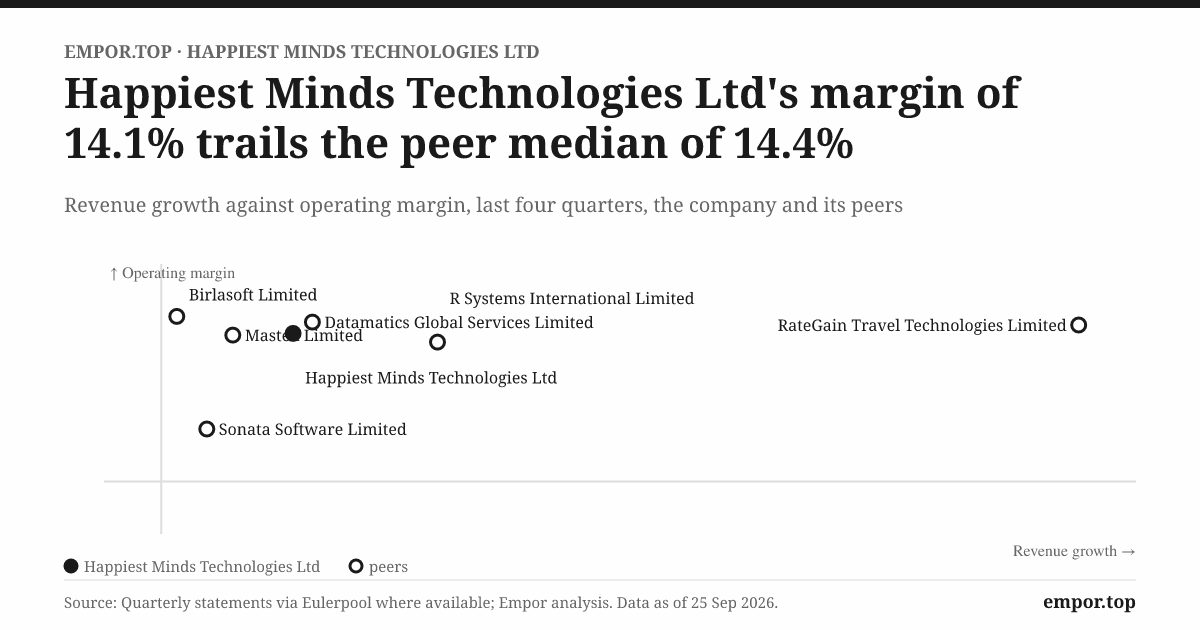
Margins reset lower. Operating margins in the high teens have persisted for two consecutive years, remaining well below the low-20s achieved during the early post-IPO period.1819 Because ITC Infotech generates a comparable EBITDA margin near 18.5%, the combination does not provide an immediate lift to the blended margin profile.29
Double integration risk. The operational assimilation of PureSoftware and Aureus remains ongoing, and executing a merger with a larger organisation under a new conglomerate parent introduces another layer of executive friction and delivery disruption.
Platform history. The historical record warrants caution: Soota's earlier handset software venture at Mindtree consumed five times its initial budget before being abandoned within a year.8 Arttha operates as a platform embedded inside a services firm rather than an independent software product, and management has not separately disclosed its standalone revenue run-rate. Until those numbers are broken out, it functions as strategic optionality rather than a proven commercial value driver.
Commoditisation. As cloud architectures mature and artificial-intelligence development tools spread across enterprise clients, bespoke digital engineering faces the risk of being priced like conventional offshore application maintenance.
How the Peers Frame the Debate
The peer group sharpens both sides of the ledger. Indian mid-tier IT firms that broke through the billion-dollar barrier—such as Persistent Systems and Coforge—generally did so by building deep vertical franchises in banking, insurance, healthcare, or travel, and then capturing progressively larger engagements within those domains. LTIMindtree achieved scale through the merger of two sizable operating companies under a conglomerate parent, offering a direct structural parallel to the path ITC and Happiest Minds are pursuing. Specialist engineering providers like Tata Elxsi and KPIT Technologies followed a different playbook entirely, dominating narrow technological niches such as automotive software where concentrated domain depth commands pricing power.
Happiest Minds, by contrast, spread its delivery organisation across six industry groups and three service lines on a revenue base of roughly $260 million.1912 The bull thesis contends that the ITC Infotech platform provides the enterprise scale needed to deepen those client relationships; the bear thesis argues that breadth without depth is precisely how mid-tier firms become stalled. The industry record suggests that breaking the crucible requires both operational scale and vertical focus—and the merger delivers only the first on its own.
The KPIs That Matter
Three operational metrics will determine which thesis prevails.
Organic constant-currency revenue growth. This provides the cleanest measure of underlying client demand. Management has guided for 12.5% constant-currency expansion in FY27.19 Once the transaction concludes, the organic growth rate of the combined entity will serve as the primary test of commercial momentum.
Operating margin excluding other income. Stripping out non-operating treasury income reveals the underlying profitability of project delivery. The critical test is whether operating profitability can recover toward 20%.
Number of $1 million-plus clients. This metric tracks whether the firm is expanding enterprise wallet share and moving upmarket—the core strategic premise of the transaction. The count stood at 58 accounts as of September 2025.12
These metrics distil the operational lessons of the past fifteen years, which are worth stating plainly.
XIII. Playbook: Business & Investing Lessons
1. Counter-Positioning Is a Melting Ice Cube
The "Born Digital" narrative succeeded because legacy IT incumbents were reluctant to cannibalise their high-margin traditional contracts. Yet once the tier-one vendors adapted and built their own cloud, data, and digital engineering practices, that initial advantage evaporated, returning the competitive contest to traditional imperatives: enterprise scale, delivery breadth, and procurement access. For investors evaluating any counter-positioned challenger, the strategic lesson is straightforward: the advantage endures only as long as the incumbents stay hesitant.
2. Public Targets Shape Private Decisions
Happiest Minds unveiled its $1 billion revenue target by FY31 near the 2021 market peak, when achieving it demanded a 25% compound annual growth rate.16 When organic expansion subsequently decelerated, management preserved the target, lowered the implied growth rate, raised equity, took on debt, and purchased revenue through acquisitions. Soota had navigated a similar arc at Mindtree, where an ambitious billion-dollar aspiration coincided with an active M&A programme and an expensive detour into mobile handset software.78 The lesson is not that corporate ambition is inherently flawed, but that once an arbitrary milestone becomes a public commitment, it risks dictating capital allocation rather than responding to underlying market realities.
3. Culture Is an Input, Not a Shield
Happiest Minds' corporate culture was genuine and consistently articulated, spanning the SMILES values introduced in 2011, weekly mindfulness sessions, and bespoke employee sentiment tools.111412 It supported talent recruitment and fostered internal cohesion. Yet voluntary attrition still rose and fell with broader industry hiring cycles, and workplace wellness could not prevent corporate clients from trimming discretionary engineering budgets during macroeconomic slowdowns.
That distinction extends well beyond technology services. A cohesive workplace culture influences how efficiently an organisation converts its inputs—talent, time, and capital—into productive output. It does not, however, dictate the pricing power a vendor commands, insulate against procurement cuts, or reduce the number of rivals competing for the same contract. Investors who treat an admirable internal culture as an economic moat confuse an efficient engine with a protected road.
4. Read the Margin Beneath the Margin
A crucial financial lesson concerns the quality of reported earnings. Happiest Minds' headline EBITDA routinely incorporated interest income from its cash reserves, which softened what was actually a contraction of nearly four percentage points in underlying operating margin during its primary acquisition year.18 Service enterprises carrying sizable treasury balances frequently structure their reporting this way. Disentangling the operating profits earned from client delivery from the passive yields generated on bank deposits is a fundamental analytical discipline. In this case, isolating core operating margins revealed the underlying operational deceleration well before public equity markets adjusted to that reality.
5. The Founder's Dilemma
An octogenarian founder without a family successor faces a narrow set of strategic choices: orchestrating a sale to private equity, finding an enterprise acquirer, or stepping away to leave governance to an independent board. Soota chose a strategic merger alongside partial cash liquidity to fund his philanthropic commitments in medical research.96 For the operating business, merging into a diversified conglomerate offered a pragmatic solution to the structural ceiling confronting mid-tier IT vendors. Yet it also demonstrates that founder-led enterprises operate along an implicit demographic timeline. Minority investors must evaluate how and when that ownership succession will resolve, and whether public shareholders will share equally in the exit. For Soota himself, the timeline resolved into something unexpected.
XIV. Epilogue: The Three Lives of Ashok Soota
A Career in Chapters
Few Indian executives have spanned as many distinct corporate eras. Soota learned industrial management in the pre-liberalisation manufacturing economy, helped guide Wipro's transition into a global software services exporter, co-founded Mindtree and took it public, and then, near age 70, launched Happiest Minds, leading it to a public listing nine years later in one of the market's most heavily subscribed offerings.81
That operating record reflects a dual legacy. It encompasses notable strategic miscalculations: an expensive mobile handset software venture that disrupted Mindtree, ambitious public revenue milestones that were repeatedly missed, and a share price that ultimately traded below its first-day debut level. Yet it also demonstrates an unusual entrepreneurial achievement: building two separate technology services firms from inception, each establishing sufficient credibility with public markets to see its initial public offering oversubscribed more than 100 times.71
From Software to Biology
The final strategic turn has moved beyond enterprise technology. SKAN investigates the biology of ageing and neurological disorders, conducting research across stem cells and the gut microbiome.10[^36] In parallel, Happiest Health operates as a media and knowledge enterprise focused on wellness and health literacy.10
There is an unmistakable symmetry to the transition. An executive who spent more than five decades constructing delivery systems and optimising human capital has redirected the financial returns of his final corporate venture toward researching the human body.
For Happiest Minds, the coming chapter unfolds under different corporate stewardship. Whether the born-digital engineering model preserves its distinct identity inside a diversified conglomerate, or gradually dissolves into it, will be determined by client retention, integration discipline, and billable delivery margins—not by the founder's legend.
References
-
Happiest Minds IPO subscribed 151 times on Day 3 — Business Today, 2020-09-09 ↩↩↩↩↩↩↩↩↩↩↩
-
Happiest Minds Tech share closes 123% higher to issue price on listing day — Business Today, 2020-09-17 ↩↩
-
Happiest Minds Technologies IPO: issue details, shareholding and restated financials — Chittorgarh ↩↩↩↩↩
-
Happiest Minds Technologies Ltd share price and all-time high — Ventura Securities, 2026-09-25 ↩
-
Happiest Minds Technologies Ltd share price, P/E and history — INDmoney, 2026-09-25 ↩↩↩↩↩
-
The MindTree Muddle — Forbes India via Forbes, 2011-02-24 ↩↩↩↩↩↩
-
Why Ashok Soota Quit MindTree — Forbes India, 2011 ↩↩↩↩↩↩↩↩↩↩↩↩
-
Happiest Minds Technologies announces merger with ITC Infotech to create a scaled, AI First Global Technology Services Enterprise with US$ 1 billion Revenue by FY28 — Happiest Minds, 2026-08-31 ↩↩↩↩↩↩↩↩↩↩↩↩
-
Ashok Soota: Chairman & Chief Mentor profile — Happiest Minds ↩↩↩↩↩↩
-
Ashok Soota announces founding team of Happiest Minds — Happiest Minds, 2011-04 ↩↩↩↩↩↩↩
-
Press Release: Happiest Minds Technologies Limited (Revised) — CARE Ratings, 2025-12-22 ↩↩↩↩↩↩↩↩↩↩↩↩↩↩↩↩↩↩↩↩↩↩↩↩↩↩↩↩↩↩↩↩↩
-
Happiest Minds Secures $45M Series A Funding Led by Canaan Partners, Intel Capital and Ashok Soota — Happiest Minds, 2011-11-16 ↩↩↩
-
Happiest Minds is the first Indian IT firm to be 'The Mindful IT Company' — Happiest Minds, 2016-08-29 ↩↩↩↩↩
-
Happiest Minds' FY21 Total income grows 11.7% to ₹798 Crores while PAT increases to ₹162 Crores and recommends maiden dividend — Happiest Minds, 2021-05-12 ↩↩↩↩↩↩
-
Happiest Minds reports industry leading growth and on track for vision of $1 Bn revenues by 2031 — Happiest Minds, 2024-05-06 ↩↩↩↩↩↩↩↩↩↩↩
-
Happiest Minds records industry leading Q4FY22 sequential revenue growth of 6.2%; full year FY22 growth at 41.8% — Happiest Minds, 2022-05-05 ↩↩↩↩↩
-
Press Release: Happiest Minds accelerates to 31% growth in Q4, reports revenues of ₹545 Crores — Happiest Minds, 2025-05-12 ↩↩↩↩↩↩↩↩↩↩↩↩↩↩↩↩↩↩↩↩
-
Happiest Minds Reports FY26 Revenues of ₹2,315 Crores, Growing 12.3% — Happiest Minds, 2026-05 ↩↩↩↩↩↩↩↩↩↩↩↩↩↩↩↩↩↩
-
Happiest Minds FY 23 net profit accelerates by 27.5% to ₹231 Crores — Happiest Minds, 2023-05-08 ↩↩↩↩↩
-
Happiest Minds Technologies Ltd Q4 2025 Earnings Call Highlights — Yahoo Finance, 2025-05 ↩↩↩↩↩↩↩
-
Happiest Minds Acquires Sri Mookambika Infosolutions "SMI" — Happiest Minds, 2023-01-25 ↩
-
Happiest Minds Technologies Successfully Completes Capital raise of ₹500 Crores through a Qualified Institutions Placement — Happiest Minds, 2023-07-18 ↩↩↩
-
Happiest Minds Technologies to acquire Digital Engineering & Transformation company PureSoftware Technologies — PR Newswire, 2024-04-25 ↩↩↩↩↩↩↩↩
-
Happiest Minds' US-Based Subsidiary to Acquire 100% Stake in Aureus Tech for USD 8.5 mn — Outlook Business, 2024-05-09 ↩↩↩
-
Happiest Minds Technologies to acquire USA based Azure native digital product engineering company Aureus Tech Systems LLC — Happiest Minds, 2024-05-09 ↩↩
-
Happiest Minds delivers H1 FY26 revenue growth of 11.8% in USD constant currency and EBITDA margin of 20.8%; increases commitment to 4 consecutive years of 10%+ growth — Happiest Minds, 2025-10-28 ↩↩
-
Happiest Minds Technologies FY26 Revenue Rises 12.3% to ₹2,315 Crore, Profit Up 15.1% — Whalesbook, 2026-05-28 ↩↩↩
-
Why ITC Infotech is buying into Happiest Minds: Key Details About The Merger — Share.Market, 2026-09-01 ↩↩↩↩↩↩↩↩↩↩↩↩↩↩
-
Happiest Minds announces apex-level organizational changes — Happiest Minds, 2025-03-19 ↩↩↩↩↩↩
-
Happiest Minds promoter Ashok Soota sold 6% stake via block deal; stock plunged 9% — Business Today, 2024-06-25 ↩↩↩
-
ITC Infotech is the frontrunner to acquire a majority stake in Happiest Minds from Ashok Soota — ICICI Direct, 2026-07-14 ↩↩↩
-
ITC Infotech: Happy with Happiest Minds — APAC News Network, 2026-09 ↩↩↩↩↩↩↩
-
Happiest Minds shares dive 11% to near listing price; ITC Infotech merger plan in focus — Business Today, 2026-09-01 ↩↩↩
-
Happiest Minds Technologies Q4 FY'26 Earnings Call Transcript Highlights — InvestyWise, 2026-05-29 ↩↩
 LinkedIn
 WhatsApp
 Reddit
 Hacker News
 Email
 Kindle
 RSS Feed
 Spotify
 Apple Podcasts
 Amazon Music
 Audible
 YouTube