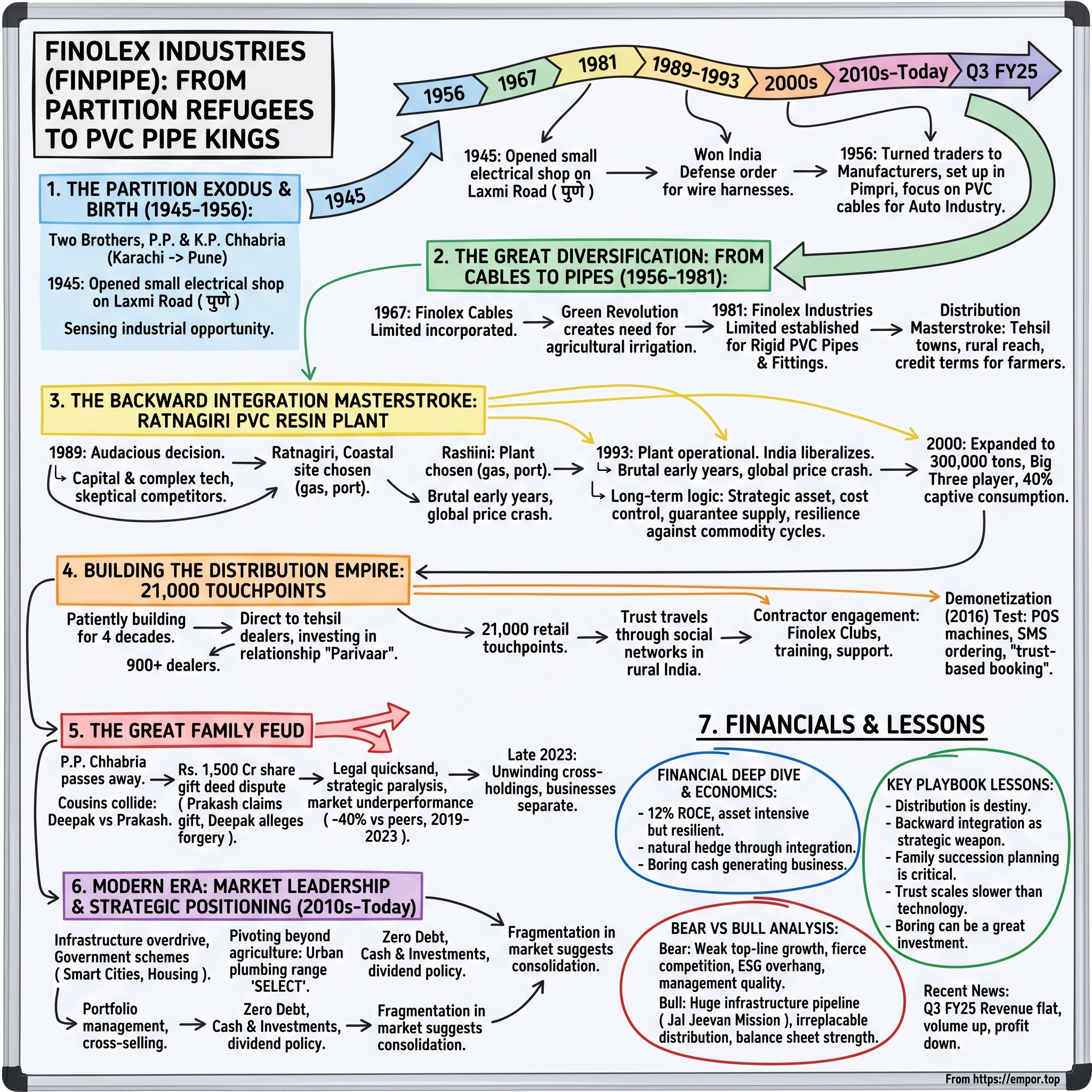
Finolex Industries: The Backward-Integrated Bet on India's Pipes
I. Introduction & Opening Hook
On a stretch of the Konkan coast about 350 kilometres south of Mumbai, a 650-acre industrial site features an asset almost no other Indian pipe manufacturer possesses: a private cryogenic jetty jutting into the Arabian Sea.1 Ocean vessels deliver refrigerated vinyl chloride monomer (VCM)—the foundational chemical feedstock for modern PVC manufacturing. The jetty pipes the liquid directly into a polymerisation plant, which processes it into PVC resin. Still warm in powder form, the resin moves a few hundred metres to extrusion lines that shape it into rigid pipe. That pipe is ultimately buried in agricultural fields across Maharashtra or Gujarat, delivering groundwater to sugarcane crops.
That single facility represents both the primary investment thesis for Finolex Industries and its greatest operational drag.
Finolex is the only PVC pipes-and-fittings manufacturer in India that produces its own PVC resin.2 Every major competitor—including Supreme Industries, Astral, Prince Pipes, and Ashirvad—purchases resin on the open market, primarily via imports. On paper, backward integration offers a clear structural advantage: control over raw material supply and input costs. In practice, over the past five years, it has yielded a company whose annual revenue compounded at roughly 4%, whose net profit compounded at a negative 4%, and whose return on equity reached about 10% in the most recent fiscal year against a three-year average closer to 8%.3 The company's market capitalisation, hovering around ₹9,961 crore in late August 2026, remains essentially unchanged from levels seen several years ago.3
That disconnect raises an uncomfortable, specific question. India has experienced a prolonged decade-long construction and irrigation boom, and Finolex manufactures a core essential component for that expansion: rigid pipe. The company built a brand trusted by farmers in western India for three decades, supported by more than 900 primary dealers and roughly 21,000 retail touchpoints,1 a low-debt balance sheet, and a captive resin plant unmatched by peers. Yet financial performance has stagnated.
Three distinct factors clarify this stagnation. First, backward integration has functioned as an earnings hedge rather than a growth engine—smoothing margin swings during commodity shifts without accelerating long-term earnings expansion. Second, while the distribution network is strong, it remains concentrated geographically in western India and product-wise in agricultural piping, leaving the company underrepresented in the faster-growing, higher-margin plumbing and CPVC segments. Third, governance is complicated by corporate structure: Finolex Industries operates within a cross-holding structure controlled by the Chhabria family, which has been locked in internal litigation for a decade over control of the ultimate holding entity.4
Compounding these structural dynamics, government policy heavily influenced recent quarterly performance. In July 2026, the Directorate General of Foreign Trade established a minimum import price of $0.766 per kilogram on suspension-grade PVC resin and reclassified the chemical from "Free" to "Restricted" import status for six months.5 Domestic PVC prices surged by approximately ₹12–13 per kilogram within three weeks.6 Consequently, despite reporting a 27% decline in sales volume for the June 2026 quarter, Finolex simultaneously posted a double-digit increase in quarterly net profit.7
This situation highlights the fundamental tension facing the company. Finolex operates an essential infrastructure business whose 2026 profitability was driven less by operational execution in Ratnagiri than by trade policy interventions in Delhi. Analyzing its trajectory requires examining the integration model, distribution network, governance structure, competitive positioning, management shifts, and cyclical commodity dynamics—and determining what changes would be necessary for the next five years to diverge from the past five.
 Subscribe on LinkedIn
II. Origins, Briefly: From Cable Traders to Pipe Makers (1956–1981)
The enterprise traces its origins to the post-Independence era, when two brothers displaced by Partition, Pralhad and Kishan Chhabria, started a modest business in Pune.8 The group dates its official founding to 1958, when Pralhad P. Chhabria established the business that became the Finolex Group on core principles of quality.1 Its initial enterprise focused on electrical cables, supplying a newly industrialising India with essential wiring.
The key strategic pivot for future pipe operations occurred decades later. Finolex Industries Limited was incorporated in 1981 as a PVC pipe manufacturer—distinct from the cables business, with an independent listing, separate management, and ultimately its own set of structural challenges.1
The timing aligned with macroeconomic tailwinds. By the late 1970s, India's Green Revolution had shifted agricultural economics toward assured irrigation, driving widespread groundwater extraction. Every new borewell required casing pipe, and fields converting from rain-fed to irrigated agriculture needed distribution networks. Rigid PVC offered clear advantages: it was cheaper than steel, easier to transport along rural roads, and resistant to soil corrosion. A pipe manufacturer with rural distribution was effectively supplying essential tools for a state-subsidised agricultural expansion.
Finolex initially entered the market as a converter—purchasing raw resin and extruding pipe, similar to its peers. Through the 1980s, it operated as an unintegrated player in a fragmented industry. However, the company's historical expansion trajectory highlights a clear capital allocation priority: PVC resin capacity grew from 130,000 metric tonnes in 1994 to 260,000 metric tonnes by 2006, emulsion PVC capacity doubled from 10,000 to 20,000 metric tonnes in 2013, and pipe capacity reached 370,000 metric tonnes per annum by 2019.1 Read in sequence, those figures reveal management's long-standing conviction: prioritizing upstream resin synthesis over downstream pipe processing.
That capital allocation choice remains the foundational decision shaping the company's financial profile today. It also established the dual-entity, cross-held corporate structure—Finolex Cables and Finolex Industries, linked by shareholding rather than product lines—that later became central to internal family governance disputes. This early history explains why a pipe producer owns a petrochemical facility and why a separate cable manufacturer holds a one-third stake in the pipe business. The operational realities that define its current performance unfolded after the Ratnagiri complex went operational.
III. The Integration Bet: Ratnagiri PVC Resin Plant
Understanding the mechanics of PVC manufacturing clarifies the logic behind Finolex's strategy. PVC pipe is produced from PVC resin, which is made by polymerising vinyl chloride monomer (VCM). VCM is synthesized from ethylene dichloride, derived from ethylene extracted from crude oil or natural gas. Every stage of this supply chain operates on its own global pricing cycle. Pure-play pipe converters sit at the end of the chain, purchasing resin at prevailing market prices. When resin prices fall, distributors defer purchases in anticipation of cheaper inventory. When resin prices rise, existing channel inventory appreciates, prompting distributors to build stock.
Finolex chose a different path: captive resin synthesis. The Ratnagiri complex—the 650-acre facility with its dedicated sea jetty—houses PVC resin production alongside pipe manufacturing, complemented by pipe plants at Urse in Maharashtra and Masar in Gujarat.1 Annual PVC resin capacity totals approximately 272,000 metric tonnes, making Finolex India's only backward-integrated PVC pipes and fittings manufacturer.2
That integration provides three distinct structural dynamics, supported to varying degrees by financial performance.
It buys supply security. When global VCM supply tightens—as occurred when Middle East disruptions constrained availability, an issue management highlighted on the Q1 FY27 call as an item requiring active monitoring6—a captive producer gains supply priority. This represents the most consistent operational benefit of integration.
It buys a second profit pool that is negatively correlated with the first. Finolex operates two reporting segments: PVC Resin and PVC Pipes & Fittings. Resin is partly consumed internally and partly sold to third parties. When global resin prices surge, the resin segment generates elevated profit margins while the pipe segment absorbs higher input costs. Conversely, when resin prices decline, pipe margins expand while resin profitability contracts. Because a substantial portion of resin transfers internally, reported segment margins fluctuate based on transfer pricing accounting rather than underlying operational shifts. Quarterly segment margin swings must therefore be interpreted primarily as accounting effects rather than standalone performance signals.
It is intended to provide a durable cost advantage. This core premise of the investment thesis receives the least support from the company's long-term financial record.
Consider the financial arc. In FY22, Finolex reported revenue of about ₹4,647 crore and net profit of about ₹1,053 crore.3 That performance reflected the post-COVID PVC price spike, when global resin prices surged and an integrated producer captured windfall gains on both inventory and resin spreads. By FY26, revenue stood at ₹4,113.43 crore and net profit was around ₹580 crore.39 Four years after that peak, top-line revenue had contracted and net profit had dropped by roughly half. Over a five-year period, revenue compounded at about 4% while net profit compounded at negative 4%; over three years, revenue compounded at about negative 2%.3
The historical record demonstrates that backward integration in this industry yields episodic windfalls rather than sustained compounding. It delivered an exceptional FY22 performance that the company has since struggled to replicate. Integration has not provided a structurally lower pipe production cost that translates into market share gains, because domestic pipe prices in India are set by marginal converters buying imported resin at prevailing global spot prices. When imported resin is inexpensive, Finolex's cost structure turns disadvantageous: competitors purchase feedstock at global market rates while Finolex carries a domestic resin manufacturing asset earning compressed spreads.
Recent quarterly disclosures highlight this balancing act. The PVC-VCM spread—a proxy for resin-manufacturing profitability—narrowed to 122 in Q1 FY27 from 163 a year earlier, while the PVC-EDC delta fell to about USD 503 per tonne from USD 532.610 These figures reflect compressing economics in the integrated resin arm during the same quarter that pipe segment margins expanded as raw material costs fell about 32% year on year.7 Integration functioned as an earnings hedge—one segment offsetting the other—rather than a growth driver, keeping net performance largely flat.
These dynamics require a narrowed view of backward integration as a competitive moat. The operational record demonstrates that integration dampens earnings volatility and secures raw material supply. However, it does not show that integration generates market share gains, sustained margin superiority, or revenue expansion. For integration to prove itself as a true competitive advantage, Finolex's pipe volumes would need to consistently outpace broader industry growth over multiple years.
This shifts the focus to the demand side: if backward integration does not provide a durable cost moat, any competitive advantage must stem from channel distribution. Finolex's primary asset on that front is its dealer network.
IV. The Distribution Moat: 900+ Dealers, ~21,000 Touchpoints
Picture the point of sale. A farmer in Maharashtra's Sangli district needs 200 metres of casing pipe for a borewell. He cannot measure wall thickness with precision, test the resin's K-value, or verify whether the pipe will become brittle after three summers in the sun. He can, however, walk into a local hardware shop he has relied on for 15 years and ask the owner which brand to buy. That shop owner's recommendation carries more weight than an advertising campaign—because if a pipe cracks prematurely, the farmer returns to the dealer, not the factory.
This dynamic makes distribution, rather than product differentiation, the decisive competitive variable in the Indian piping market. Rigid PVC pipe is largely a commodity—an extruded tube manufactured to standard Bureau of Indian Standards (BIS) specifications. Trust serves as the primary differentiator, and that trust is anchored within the distribution channel.
Finolex reports a network of more than 900 primary dealers and roughly 21,000 retail touchpoints nationwide, with many relationships spanning more than three decades—a network the company describes as its parivaar, or family.1 Its FY25 annual report framed this reach even more broadly, citing over 38,000 combined retailers and dealers.11 The company's marketing strategy reinforces this focus on channel partners over end consumers. In May and June 2026, Finolex distributed branded stationery to more than 34,000 retailers alongside a print campaign reaching a circulation of 10.8 million and an estimated readership of 27 million across 19 states.10 Providing branded stationery to shopkeepers functions as a tactical reminder right on the counter where purchasing recommendations occur.
Evaluating these distribution claims requires comparing company assertions against market metrics. Finolex does not publish comparative dealer metrics against peers such as Supreme Industries or Astral, nor do competitors provide directly comparable disclosures. Market share offers a clearer measure of reach. Management estimated Finolex's share at roughly 22% in FY26 among the top five reporting companies and reported that market share remained stable in Q1 FY27.610 Industry analysis also ranks Finolex as the leading player by revenue in India's organized PVC pipes and fittings market, ahead of Ashirvad, Supreme, and Astral.12 These metrics reflect market leadership, but they measure share within the organized corporate subset rather than across the broader, unorganized pipe market.
The resilience of this network faced a significant operational test in the June 2026 quarter. Finolex's sales volume fell 27% year on year to 67,699 metric tonnes from 92,129 metric tonnes, while declining approximately 33% sequentially from 101,772 metric tonnes in the March quarter.710 Management attributed the decline to subdued demand and PVC price volatility.7 While a distribution network with genuine pricing power and dealer lock-in can buffer against price swings, a channel distributing a commodity tends to destock rapidly when prices soften, as dealer inventory represents a direct exposure to underlying resin trends. During Q1 FY27, when domestic PVC prices dropped from roughly ₹96 per kilogram to ₹82 per kilogram intra-quarter, channel purchasing slowed sharply.6
This response does not render the network ineffective—three decades of channel relationships represent an asset that competitors cannot easily replicate. However, it clarifies the nature of the advantage. Finolex's distribution system generates dealer preference rather than captivity. While hardware owners may prefer Finolex over unbranded regional extruders at comparable price points, they do not hold depreciating inventory through a market downturn out of brand loyalty.
The network faces additional boundaries in geography and product mix. Finolex's distribution strength remains concentrated in western India, and its volume continues to lean heavily toward agricultural piping. Agricultural pipes accounted for 69% of sales volume in Q1 FY27, rising back up after shifting from 67% in FY25 to 63% in FY26 prior to the seasonality of the June quarter.6 A dominant dealer presence in Kolhapur does not translate into market access in Coimbatore or Ludhiana, where Supreme's nationwide footprint and Astral's plumber-focused marketing hold greater influence. Distribution advantages in India's piping sector are established district by district, making them defensible within existing strongholds but slow to expand into new territories.
Ultimately, the distribution advantage survives scrutiny in a specific, circumscribed form: it is authentic and regionally powerful, conferring dealer preference rather than absolute channel lock-in, yet it has not driven outsized market share gains. Demonstrating a broader competitive moat would require Finolex to consistently capture share in non-agricultural segments and non-western regional markets over multiple quarters—a shift that remains unverified in current performance data.
This structural limit brings the focus to the internal dynamics that explain why the enterprise may have lacked the institutional bandwidth required to extend that distribution network more aggressively.
V. The Chhabria Cross-Holding Structure & the Family Feud
Understanding the governance constraints at Finolex requires untangling a corporate structure that market coverage often conflates between the group's two listed entities.
The group comprises two listed operating entities—Finolex Cables and Finolex Industries—and an unlisted holding company positioned above both: Orbit Electricals Private Limited. Orbit holds roughly 30.7% of Finolex Cables and about 18.8% of Finolex Industries.4 Finolex Cables, in turn, serves as Finolex Industries' largest single shareholder with a stake of around 33%, while Orbit holds approximately 19% and SBI Funds Management holds roughly 6.6%.13 Overall promoter holding in Finolex Industries stood at 52.47%, with no pledged shares.3
That ownership web creates a precise leverage point: controlling Orbit Electricals—an unlisted private entity—effectively grants control over the promoter blocks of two listed companies with a combined market capitalization in the tens of thousands of crores. Orbit functions as the keystone, and for a decade, two cousins have been locked in litigation over its ownership.
The dispute began in 2016 following the death of group patriarch Pralhad Parasram Chhabria. His son, Prakash Chhabria, produced a gift deed dated 28 March 2016 transferring 100,300 equity shares—about 70.4% of Orbit Electricals—to himself, a transfer approved at a board meeting on 31 March 2016.414 His cousin Deepak Chhabria, son of co-founder Kishan Chhabria, challenged the transfer. The gift deed, alongside Pralhad Chhabria's will and associated trust deeds, became the subject of litigation in Pune civil court and before company law tribunals.4 Contemporary press coverage estimated the inheritance at stake at roughly ₹1,500 crore.15 Currently, Prakash is reported to hold approximately 78% of Orbit, while the K.P. Chhabria branch holds around 7%.4
The conflict evolved into a protracted corporate control battle. In an October 2023 note, proxy advisory firm IiAS documented a sequence of amendments to Finolex Cables' Articles of Association that restricted the rights attached to Deepak's position, culminating in shareholder votes to remove him.16 The decisive vote occurred at Finolex Cables' 2023 annual general meeting, where 72.34% of votes opposed his reappointment.16 Deepak challenged the meeting outcome, but the National Company Law Appellate Tribunal (NCLAT) declined to overturn it in an order reported in September 2024.17
However, the underlying ownership question remained unresolved. Within the same appellate proceedings, the tribunal directed the Mumbai bench of the National Company Law Tribunal (NCLT) to decide the nearly eight-year-old dispute over the 100,300-share transfer.4 In January 2026, Deepak moved to amend his petition, seeking rectification of the register of members, deletion of Prakash's name, and the return of share certificates.4 Prakash and Orbit appealed against that amendment. On 21 July 2026, the NCLAT dismissed those appeals in Company Appeal (AT) 236 and 237 of 2026, holding that subsequent developments arising during pending proceedings could be incorporated by amendment while leaving the issue of statutory limitation open for determination at final hearing.14
As of August 2026, the legal status remains clear on two distinct fronts. Resolved: Deepak Chhabria no longer serves on the board of Finolex Cables, a position the appellate courts have declined to restore. Unresolved: who lawfully owns the controlling block of Orbit Electricals and, by extension, who lawfully controls the promoter stakes in both listed operating entities. That central question remains before NCLT Mumbai under a petition initially filed in 2016, subsequently expanded to include events from 2019 and 2021, with the statutory limitation defense still subject to final adjudication.14
Evaluating the impact of this litigation on investors requires distinguishing ownership disputes from operational execution. The legal battle is not an activist campaign against Finolex Industries' commercial strategy, nor does either side advocate exiting agricultural piping or forcing a rapid pivot into CPVC. Instead, it represents a control dispute at the holding-company level whose practical effects on the listed operating company manifest in three distinct ways.
First, management bandwidth. A decade of litigation over the holding entity diverts executive and promoter attention toward legal strategy rather than category expansion. While that friction does not appear on income statements, its opportunity cost is evident in delayed strategic initiatives, such as the slow scaling of the higher-margin CPVC business.
Second, related-party scrutiny. A corporate structure where a cable manufacturing firm serves as the largest shareholder of a pipe company—with both controlled through a contested private entity—naturally invites governance scrutiny regarding transparency, director independence, and related-party disclosures, as highlighted by IiAS.16 Investment arguments premised on minority-aligned capital allocation must demonstrate how this structure satisfies those standards rather than assuming compliance.
Third, ownership overhang. An adverse ruling by the NCLT on the share transfer would leave physical manufacturing assets untouched, but it would immediately reopen the question of promoter control. Equity markets typically discount for that structural uncertainty until legal finality is achieved.
The key test for investors is not whether financial irregularity has occurred—no evidence of misappropriation at the operating level has been documented. Rather, the relevant question is whether this governance structure has delivered capital allocation that optimizes returns for minority shareholders. On that measure, the historical record shows mixed results: a substantial cash balance, a 29% dividend payout ratio, negative five-year net profit growth, and capital expenditures insufficient to alter the core product mix.36 This allocation pattern reflects a corporate strategy prioritizing balance-sheet stability over high-return growth capital deployment—an outcome consistent with a promoter group managing an ongoing ownership dispute at the holding level.
The true cost of that conservative posture becomes clear when examining how competitors navigated the same market context over the past decade.
VI. Industry Structure & Competitive Position Today
A comparison of the four primary listed players in India's piping sector highlights sharp differences in strategic positioning.
Supreme Industries is the largest and most diversified plastic products manufacturer in India, spanning pipes, industrial products, packaging films, and composites with a pan-India distribution network.18 Its piping business operates as one unit within a broader portfolio, allowing non-piping operations to buffer against downcycles in building materials.
Astral established an early lead in chlorinated polyvinyl chloride (CPVC) pipes used for hot-water plumbing in buildings, focusing its marketing on plumbers rather than agricultural end-users. Astral is recognized as the CPVC market leader with an estimated 50% category share, aligning its performance with urban real estate construction rather than seasonal monsoon cycles.18
Prince Pipes operates as a mid-cap challenger, expanding concurrently in both CPVC plumbing and agricultural piping.18
Finolex remains distinguished by its captive resin manufacturing and deep distribution presence in western India, but its product portfolio remains heavily weighted toward the slower-growing, lower-margin agricultural segment.
Operational metrics illustrate the effect of this positioning. In FY26, Finolex reported revenue from operations of ₹4,113.43 crore, down slightly from ₹4,141.97 crore in FY25, as sales volumes fell 4% from 347,982 metric tonnes to 332,736 metric tonnes.9 With an installed pipe capacity of approximately 520,000 metric tonnes per annum, the company operated at roughly two-thirds utilization for the full year.6 In the first quarter of FY27, agricultural pipes comprised 69% of volume, CPVC represented 7%, and higher-margin fittings accounted for 11%.6
Comparing Finolex's 7% CPVC mix to Astral's estimated 50% category share underscores the contrast in strategy. Management estimated CPVC at 7% to 8% of India's overall PVC pipe market, indicating that Finolex holds a market-weight position in the industry's fastest-growing, higher-margin segment while a key competitor holds half of it.6 Operating at market weight in a high-margin category entered late against an established market leader reflects a limited competitive presence rather than an established foothold.
This gap is particularly notable given broader market growth. India's plastic pipes and fittings sector is projected to reach approximately ₹80,000 crore by 2027, growing at an annual rate of 12% to 14%.18 Over a five-year period, Finolex compounded top-line revenue at roughly 4%.3 While short-term underperformance can stem from cyclical headwinds, sustained underperformance relative to industry growth over five years indicates a broader structural positioning challenge.
Running the five forces on a pipe factory
Rivalry: intense. PVC piping remains standardized to Bureau of Indian Standards (BIS) specifications, product switching costs are minimal, and industry capacity is substantial. When demand softens, price discounting is widespread, as evidenced by Finolex's 27% volume contraction in a single quarter.
Buyer power: moderate and asymmetric. While individual farmers possess limited bargaining power, distribution dealers exercise considerable influence because they determine stocking levels and adjust channel inventory based on pricing expectations. The primary decision-maker in building materials distribution is the channel partner, whose purchasing behavior responds directly to commodity price trends.
Supplier power: low for resin, but shifted to feedstock. Captive resin synthesis insulates Finolex from domestic resin supplier power, marking a structural difference from unintegrated converters. However, raw material exposure moves one step further upstream to vinyl chloride monomer (VCM), where Middle East supply disruptions constrained availability, with management projecting potential supply normalization only in the second half of FY27.6 Integration does not eliminate supplier power; it shifts vulnerability to the international VCM market, where supply is geographically concentrated.
Threat of substitutes: low to moderate. High-density polyethylene (HDPE) and composite piping compete at the margins of the sector, representing a portfolio gap for Finolex compared to more diversified peers.
Threat of new entrants: high at resin scale, low at pipe conversion. Capital requirements for a greenfield resin plant with cryogenic marine facilities create high barriers to entry upstream. Conversely, pipe extrusion lines require modest capital and minimal proprietary technology, sustaining an extensive unorganized market segment. Incumbents are insulated primarily by brand equity and distribution scale rather than technical barriers.
In summary, the sector remains a scale and distribution business for a standardized product. Captive integration addresses supplier power upstream, but does not directly address growth in downstream demand.
The policy layer, and its internal contradiction
In August 2025, the Directorate General of Trade Remedies issued its final findings in an anti-dumping investigation into PVC suspension resin imports from China, Indonesia, Japan, South Korea, Taiwan, Thailand, and the United States, recommending five-year duties ranging from approximately $22 to $284 per metric tonne.1920 Domestic PVC prices responded immediately, with trade reports noting price increases despite subdued underlying demand.21
Further trade policy interventions followed. On July 24, 2026, the Directorate General of Foreign Trade (DGFT) issued Notification No. 25/2026-27, imposing a minimum import price of $0.766 per kilogram on suspension-grade PVC resin under ITC (HS) code 39041020 and reclassifying import policy from "Free" to "Restricted" for six months.522 Imports priced at or below that threshold require specific licensing, while 100% export-oriented units, Special Economic Zone (SEZ) units, and imports under Advance Authorisation remain exempt.22 On its Q1 FY27 earnings call, management cited the removal of customs duty exemptions on PVC resin alongside the minimum import price as key measures stabilizing channel inventory and curbing price volatility.6
The economic mechanism of a minimum import price acts as an administrative border price floor. By restricting low-cost foreign supply, the policy elevates domestic prices toward the floor level plus freight and distribution margins. For a domestic resin manufacturer, higher realisations improve segment margins. However, independent trade analysts noted that domestic price increases inevitably pass higher input costs to downstream PVC consumers.23
As a backward-integrated producer, Finolex operates on both sides of this policy shift: it synthesizes resin, benefiting from higher prices, while consuming that resin to extrude pipe, where raw material costs rise. The net financial benefit depends on the company's ability to pass elevated resin costs through its pipe distribution channel without dampening volume.
In the immediate term, channel pass-through proved successful, with management confirming that virtually all of the recent ₹12 to ₹13 per kilogram price increase was passed on to customers.10 However, passing price hikes into a rising market—when dealers build inventory in anticipation of further increases—reflects standard channel dynamics during a price uptrend. Maintaining margins when policy protections expire and dealers expect price declines presents a more difficult test.
That operational vulnerability remains tied to policy timing. The minimum import price was enacted as a temporary six-month measure.22 Barring an extension, the policy expires in early 2027, leaving a notable portion of FY27 margin recovery dependent on a temporary trade intervention.
VII. New Leadership & Capital Allocation Test
Finolex executed a leadership transition in late 2025. Saurabh Dhanorkar served as managing director until October 25, 2025, before Udipt Agarwal assumed the role on November 1, 2025, after previously serving as chief executive officer.24 The 56-year-old Agarwal brings over three decades of experience across chemicals, bio-industrials, and advanced materials, holding a B.Tech from HBTI Kanpur and executive training from INSEAD, with a background focused on operations, business development, and Asian market expansion.2425 Concurrently, 63-year-old Rambabu Sanka succeeded the retiring Saumya Chakrabarti as technical director on August 2, 2025, bringing nearly 40 years of chemical manufacturing experience with specialized expertise in VCM and PVC operations.2426
Together, these executive appointments indicate clear operational priorities. Rather than recruiting consumer brand builders or channel expansion specialists to address the competitive gap in CPVC, the company appointed chemical operations and production veterans. This operational background aligns with optimizing upstream resin assets rather than rapidly repositioning the downstream product portfolio. While improving resin synthesis leverages the company's captive infrastructure, it also indicates that a swift strategic pivot into higher-margin piping segments remains unlikely.
This leadership team operates within a promoter-controlled structure: promoters hold 52.47%, foreign institutional investors hold 5.85%, domestic institutions hold 11.35%, and public shareholders hold 29.97%.3 Public float remains secondary to corporate governance dynamics, as ultimate control hinges on the unresolved ownership dispute at Orbit Electricals.
The capital allocation record, examined properly
Evaluating Finolex's financial record requires examining the composition of its reported earnings. In FY25, the company recorded an exceptional gain of ₹416.99 crore upon completing the transfer of leasehold rights over approximately 25.27 acres of land in Chinchwad, Pune, together with structures.27 This transaction boosted standalone net profit for FY25 to ₹777.86 crore from ₹455.30 crore in FY24—an apparent 71% jump, of which the land sale accounted for the majority.27 The transaction represented the partial execution of a plan approved by the board in September 2021 to transfer leasehold rights over roughly 70 acres of MIDC land at Chinchwad for consideration of not less than ₹725 crore.28
Monetizing non-core industrial land surrounded by urban development reflects prudent asset management. However, it does not represent core operational improvement. Multi-year earnings trends must be adjusted for this non-operating gain. Even with the land sale included, Finolex's five-year net profit growth is negative.3 Stripping out the exceptional gain reveals an underlying operating trajectory weaker than headline numbers suggest.
As a result of accumulated earnings and conservative capital deployment, Finolex sat on a free cash position of ₹2,636 crore as of the June 2026 quarter, against total borrowings of about ₹446 crore at FY26 year-end, with a dividend payout ratio around 29%.36 This represents a fortress balance sheet by Indian mid-cap manufacturing standards.
Against that cash pile, management set a capital expenditure plan of ₹125–200 crore for FY27, aimed principally at debottlenecking and replacing aging extruders, with no greenfield or brownfield projects announced. Management's stated rationale is that an existing installed capacity of 520,000 metric tonnes per annum against FY26 throughput of about 333,000 metric tonnes leaves headroom to grow 10–12% for roughly one to one-and-a-half years before new capacity is required.6
That rationale is internally coherent, yet it describes a conservative capital allocation strategy. The company maintains roughly ₹2,600 crore in cash within a sector projected to grow at 12–14% annually,18 while holding an underrepresented position in higher-margin CPVC and capping planned capital expenditure at ₹200 crore for equipment replacement. Furthermore, a 29% dividend payout ratio represents a modest return of capital for an enterprise with limited reinvestment commitments. Retaining capital without active deployment or aggressive distribution depresses return on equity, and the sub-10% ROE is where that shows up.3
A clear capital allocation framework would specify the strategic purpose of this cash reserve. If the cash is intended for a CPVC or HDPE build-out, an acquisition, or a defined commodity buffer, explicit planning and disclosure would clarify its utility. In the absence of a stated plan, the cash balance functions as an unallocated treasury reserve that lowers overall capital efficiency.
Testing management credibility, at three quarters in
Having completed roughly three quarters in leadership, Udipt Agarwal's initial operational guidance provides early benchmarks for evaluating management priorities. On the Q1 FY27 earnings call, management reaffirmed a full-year EBITDA margin target of approximately 15%, consistent with what had been guided at Q4 FY26, while declining to provide full-year volume guidance, citing excessive volatility.610 On first-half volumes, management's language was hedged—expressing hope for a slight year-on-year increase, conditional on August and September momentum, with a commitment to revisit after another quarter.6 Coverage of the slide deck read the margin framing as sub-15% for FY27.10
Reaffirming margin targets while withholding volume commitments is a defensible combination for a commodity converter, as margins can be influenced through pricing and product mix, whereas channel volume remains sensitive to destocking cycles. However, this approach anchors commitments to targets supported by current trade policy interventions. Achieving a 15% margin under minimum import price protections is a lower operational hurdle than maintaining margins without administrative trade barriers. The true test of management execution will be whether this guidance framework survives the expiry of trade protections with equal specificity.
Reported earnings also reflect non-operating treasury fluctuations. Other income of ₹75 crore in Q1 FY27 was mark-to-market driven, arising from bond yield movements on the company's treasury, with sustainability dependent on stable yields and no full-year guidance offered.6 Set against quarterly profit before tax of ₹147.80 crore,7 the ₹75 crore treasury gain accounted for roughly half of pre-tax earnings. Headline profit growth in the quarter was heavily influenced by treasury adjustments rather than operating recovery, illustrating how a large cash balance can introduce swing factors into reported results.
VIII. The Cycle in Real Time: FY25–FY27 Earnings Trajectory
The sequence of quarterly results from early 2024 through mid-2026 illustrates the earnings volatility inherent in Finolex's operating model.
In the March 2024 quarter, Finolex reported profit after tax of ₹161 crore on an EBITDA margin of 16.9%.29 Two quarters later, in the December 2024 quarter, net profit dropped to ₹71 crore,30 before recovering to ₹150.26 crore in the March 2025 quarter.9 Performance peaked in the March 2026 quarter, when net profit reached ₹250 crore—up 66.4% year on year—on revenue of ₹1,313 crore, up 12%, with EBITDA nearly doubling to ₹332 crore from ₹171 crore, operating margin reaching an all-time high of 25.27%, and quarterly earnings per share reaching ₹4.22.931 However, analyst commentary at the time noted that this strong quarter sat awkwardly against the company's lower multi-year growth trajectory.32
Three months later, in the June 2026 quarter, sales volumes contracted sharply, demonstrating how rapidly commodity price shifts impact operations. Realised PVC prices averaged around USD 875 per tonne in Q1 FY27, compared to USD 707 in the prior-year quarter.6 However, domestic PVC prices fell sharply intra-quarter, dropping from roughly ₹96 per kilogram to ₹82 per kilogram in April 2026.6 For distribution dealers holding inventory, this rapid decline created immediate inventory losses, causing channel partners to defer orders.
Consequently, sales volume for the June 2026 quarter fell to 67,699 metric tonnes—a 27% year-on-year decline and a sequential drop of roughly one-third from 101,772 metric tonnes in the March 2026 quarter.710 Agricultural pipe volumes fell 27%, while non-agricultural volumes dropped 24%—indicating that the construction-linked segment experienced a similar contraction.6 Overall revenue declined 15.3% to ₹883.58 crore.7
Yet despite lower volumes, consolidated net profit rose 16.7% year on year to ₹114.52 crore, profit before tax increased 12.9% to ₹147.80 crore, and EBITDA grew roughly 14% to ₹107 crore, with operating margin expanding by approximately 300 basis points from 9% to 12%.7610 This profit growth occurred because total operating expenses fell 18.2%, driven by a 32% year-on-year drop in raw material costs, alongside a 5.5% reduction in employee expenses and a 3.2% decline in other expenses.7
This dynamic reflects the mechanics of an integrated commodity converter. When raw material costs decline faster than finished goods realizations, unit margins temporarily expand even as physical volumes fall, as selling prices lag lower input costs. While this generates immediate cash earnings, it represents an accounting consequence of a softening feedstock market rather than an increase in commercial demand. Consequently, quarterly earnings expansion during a period of declining sales volume cannot be extrapolated into sustained operational momentum.
Subsequent trade policy interventions altered channel behavior in early Q2 FY27. Following the July 2026 minimum import price announcement, domestic PVC prices increased by ₹12–13 per kilogram within three weeks.6 Channel partners shifted from destocking to rebuilding inventory, making July the strongest month of the quarter for sales momentum.10 By August 2026, international PVC prices stood around USD 795 per tonne, below Q1 averages but recovered from earlier lows.6
Management also offered a measured assessment of government demand drivers on its Q1 FY27 earnings call. Addressing public irrigation spending, executives noted that the Jal Jeevan-linked allocation of ₹67,000 crore for the current year represented a lower outlay for the piping segment than previous programs, with demand reaching Finolex indirectly through retail channels rather than direct public tenders.6 This indicates that government infrastructure programs provide indirect channel demand rather than direct procurement volume.
The eight-quarter financial record demonstrates that quarterly profit movements are driven sequentially by international PVC price trends, domestic trade policy, treasury mark-to-market adjustments on cash reserves, and downstream dealer demand. Because short-term earnings fluctuations primarily reflect commodity and policy cycles, headline quarterly results offer limited insight into long-term competitive position. Sustained evaluation requires tracking underlying volume growth independent of price movements, changes in product category mix, and margin durability once temporary import protections expire.
IX. Playbook: Business & Investing Lessons
Vertical integration is a volatility instrument, not a growth instrument. Finolex demonstrates both dynamics. Captive feedstock synthesis provides supply security unmatched by pure-play converters, alongside a resin segment that partially offsets margin pressure in piping—benefits reflected in expanded first-quarter margins during a period of declining sales volumes. However, the company has also recorded five-year revenue growth of about 4% alongside negative net profit growth,3 illustrating the limitations of a defensive moat. The generalizable lesson: integration advantages must be evaluated by whether they yield market share gains or merely smoother earnings. When integration primarily dampens volatility, it justifies a lower valuation multiple than a true compounding engine.
In commoditized physical products, the primary customer is the channel—and the channel acts as a speculator. The 27% volume contraction in the June 2026 quarter stemmed less from underlying irrigation demand in Maharashtra than from distributor pricing expectations. Any building-materials business where distributors hold inventory carries an embedded commodity trading desk between the manufacturer and the end user. Brand equity generates dealer preference during purchasing decisions, but it does not eliminate channel destocking during market downturns.
Family cross-holding structures impose costs that never appear as explicit line items. No evidence of operational financial irregularity has been documented at Finolex Industries. However, the controlling promoter family spent a decade locked in litigation over holding-company ownership, coinciding with a period in which a primary competitor built an estimated 50% share of the industry's highest-margin category.18 The true cost of governance complexity is opportunity cost—unallocated capital and delayed market entry—which remains invisible unless explicitly evaluated against peer execution.
One-off asset monetization flatters single-year performance and obscures decade-long trends. The ₹416.99 crore Chinchwad land monetization made FY25 appear to be a step-change year.27 That surge reflected an asset sale rather than core operational expansion. Sound analytical discipline requires adjusting multi-year earnings for exceptional items. In this case, even after a substantial non-operating gain boosted reported results, five-year net profit growth remained negative.3
A very large cash balance can distort operational earnings signals. The ₹75 crore mark-to-market treasury gain in Q1 FY27 accounted for roughly half of pre-tax profit.67 Evaluating operational recovery strictly from headline net profit risks misinterpreting underlying business performance. Cash reserves represent strategic optionality only when actively deployed; uninvested, they function as a low-yielding treasury portfolio attached to an industrial asset, adding earnings volatility while depressing return on equity.
Trade policy can exert a larger short-term profit impact than commercial management. A six-month minimum import price restriction increased domestic resin prices by ₹12–13 per kilogram in under three weeks—delivering a larger profit impact than commercial initiatives within management's control achieved over an entire year.56 The investing lesson is not to avoid policy-supported sectors, but to recognize that in protected commodity markets, operational quality and predictable earnings are distinct variables, with policy support subject to sudden administrative revision.
Finally: maintaining market weight in a high-growth segment does not constitute a strategic moat. Finolex's 7% CPVC volume mix roughly matches CPVC's 7% to 8% share of the overall Indian market.6 Operating at market weight in a category where a key rival commands half the market reflects limited strategic penetration rather than an established competitive foothold. Evaluating long-term positioning requires tracking how a company's product mix evolves over multi-year cycles rather than relying on a static market snapshot.
These strategic dynamics provide the analytical baseline for evaluating the competing investment theses surrounding the enterprise.
X. Bear vs. Bull Case
Bear Case
The fundamentals describe a business that failed to compound during a decade of historic growth for Indian infrastructure. Revenue compounded at roughly 4% over five years and contracted by about 2% over three, while net profit compounded at negative 4% over five years; return on equity reached about 10% in the latest fiscal year against a three-year average near 8%, with return on capital employed around 12.3%.3 For a manufacturer carrying virtually no debt, a sub-10% return on equity means the business is earning close to—and arguably below—its cost of capital. That is the bear case in brief, with the remaining arguments serving as elaboration.
Agricultural concentration ties the income statement to monsoon volatility. With agricultural pipes accounting for 69% of first-quarter FY27 volume,6 demand remains tied to rural cash flows, groundwater levels, sowing patterns, and state irrigation outlays. Peers with higher exposure to plumbing and industrial segments track the broader construction cycle, which is less weather-dependent. While management's stated goal has been to diversify the product mix—with agricultural pipes declining from 67% of volume in FY25 to 63% in FY266—a single weak quarter pushed agricultural volume straight back to 69%. A mix shift that reverses during market stress does not signal durable diversification; it reflects the composition of a demand shock.
The category gaps are structural, not tactical. CPVC representing 7% of volume against a rival holding roughly half the category,618 alongside the absence of a meaningful HDPE presence, keeps Finolex under-indexed to the market's fastest-growing sub-segments. Closing that gap requires building a distinct distribution channel among plumbers and builders, establishing a new brand proposition, and committing substantial capital. The planned FY27 capital expenditure of ₹125–200 crore for equipment debottlenecking does not fund such a transition.6
Governance remains an active valuation discount rather than settled history. The Orbit Electricals share-transfer petition, first filed in 2016, remains pending before NCLT Mumbai with the statutory limitation question expressly left open following the July 2026 appellate ruling.14 Investors anticipating a valuation re-rating driven by improved capital allocation must address why a decade-long control battle at the holding level would suddenly yield greater alignment with minority shareholders.
Current earnings support carries a fixed expiration date. The minimum import price is a temporary six-month intervention.22 While anti-dumping duties recommended in August 2025 cover a longer horizon,19 administrative price floors drove the rapid ₹12–13 per kilogram domestic price increase. If the minimum import price expires in early 2027 without an extension and imported resin re-enters at global rates, domestic price floors will drop, channel partners will destock, and recent margin expansion will unwind through the same mechanism that created it. An earnings reversal does not require a collapse in end-user demand; the non-renewal of protective trade policy would be sufficient.
Earnings quality exhibits underlying softness. Headline results have been aided by non-operational drivers: a ₹416.99 crore land sale gain in FY25,27 a ₹75 crore mark-to-market treasury gain in a quarter with ₹147.80 crore of pre-tax profit,67 and margin expansion propelled by a 32% decline in input costs rather than commercial pricing power.7 Over three consecutive periods, reported net figures have appeared stronger than underlying operational performance.
Bull Case
The integrated manufacturing asset cannot be replicated within a reasonable timeframe. A captive resin plant paired with a private cryogenic marine jetty on the Konkan coast1 cannot be quickly duplicated by competitors. Constructing a comparable facility requires extensive land, environmental clearances, maritime infrastructure, complex feedstock logistics, and substantial capital. Regardless of historical asset returns, its scarcity value provides genuine supply security during periods of global vinyl chloride monomer disruption.6
The balance sheet provides tangible strategic flexibility. Holding ₹2,636 crore in free cash against modest borrowings36 allows Finolex to fund a CPVC or HDPE capacity build-out—or acquire a challenger brand—entirely from internal accruals, avoiding equity dilution or debt refinancing risks. Most peers would need external capital to fund similar initiatives. While skeptics highlight that this optionality remains unexercised, optimistic investors emphasize that the capital sits unencumbered and ready for deployment.
The regulatory framework signals sustained domestic protection. The five-year anti-dumping recommendation on suspension-grade resin across seven supplier countries1920 alongside administrative minimum import pricing5 demonstrate trade policy support for domestic PVC manufacturing. As one of India's few integrated producers, Finolex stands as a primary beneficiary. Should protective measures persist, baseline profitability for the resin segment will remain higher than in prior cycles.
The distribution network represents an entrenched competitive barrier. Established dealer relationships spanning more than 900 primary distributors and roughly 21,000 retail touchpoints1 cannot be rapidly duplicated with capital. While a competitor can construct an extrusion plant in eighteen months, developing comparable channel relationships requires decades. Although this network has not driven outsized market share gains, it protects existing market share; in a standardized commodity market, defending volume at viable margins represents a critical advantage.
New leadership introduces an unpriced operational catalyst. Managing Director Udipt Agarwal assumed office in November 2025 alongside a newly appointed technical director.24 While three quarters is insufficient to establish a complete track record, bringing in an executive with extensive Asian chemical operations and business development experience introduces new strategic direction for a firm historically managed around chemical asset utilization.
Underlying industry demand provides strong long-term tailwinds. Projections showing India's plastic pipes sector growing at 12% to 14% annually toward ₹80,000 crore by 202718—driven by residential construction, agricultural irrigation, and public water supply infrastructure—present a favorable market environment. Holding approximately 22% market share among the top five reporting companies,6 paired with an integrated cost structure and a low-debt balance sheet, positions Finolex to benefit if operational execution aligns with broader industry expansion.
Running the 7 Powers
Applying Hamilton Helmer's framework to evaluate durable competitive advantages yields a nuanced profile for Finolex:
Scale economies: Partial. Finolex maintains substantial scale upstream in resin manufacturing, where high fixed capital requirements make utilization rates critical. In downstream pipe extrusion, scale economies are weak because modern extrusion lines operate efficiently at modest volumes, allowing unorganized converters to persist. Verdict: Present upstream, limited downstream.
Network economies: Absent. Pipe manufacturing carries no network effects; additional end users do not increase the utility of the product for existing customers.
Counter-positioning: Absent and arguably inverted. Counter-positioning requires maintaining a business model that incumbents cannot adopt without harming their legacy operations. Competitors pioneering plumber-focused CPVC models executed counter-positioning against agricultural incumbents like Finolex.
Switching costs: Weak among end consumers, moderate at the dealer level. A distributor with three decades of channel alignment faces working capital and relationship costs when switching primary suppliers. However, channel destocking during pricing downturns highlights the limits of dealer switching costs.
Branding: Present and defensible. In a commodity market where end users cannot easily verify chemical composition, brand reputation supports pricing power. The effective pass-through of the recent ₹12–13 per kilogram price increase demonstrates brand strength,10 though brand equity did not prevent a 27% volume contraction during channel destocking.
Cornered resource: Present upstream. The Ratnagiri complex and its private cryogenic jetty represent a cornered resource in the Indian pipe industry.12 However, a cornered resource constitutes true competitive power only when it yields superior returns; Finolex's return on equity indicates that this asset has not yet generated outsized profitability.3
Process power: Absent. Published disclosures show no proprietary manufacturing methods or organizational processes that competitors cannot replicate.
Composite assessment: Finolex possesses partial attributes of three powers—branding, a cornered upstream asset, and selective scale economies—yet its primary physical asset has not translated into sustained excess returns. The enterprise holds the structural elements of a competitive advantage without consistently achieving the financial outcomes expected from one.
The activist's brief
An activist investor's challenge to management would center on capital allocation and strategic priorities: Finolex holds ₹2,636 crore in cash on a balance sheet lacking an aggressive expansion plan, earning treasury yields and keeping return on equity below 10%.36 Annual capital expenditure plans remain modest relative to total cash reserves.6 Management monetized ₹417 crore in land assets without deploying the proceeds into core growth capital.27 Higher-margin CPVC accounts for 7% of product volume while a primary competitor holds half the market.618 Controlling shareholders have spent a decade in holding-company litigation,14 while the largest corporate shareholder remains an affiliated listed cable producer.13 Finally, recent peak quarterly profits relied heavily on commodity price swings and temporary trade protection. The activist position calls for either deploying capital toward closing product category gaps or returning excess cash to shareholders.
The counter-argument holds that expanding aggressively into CPVC may not yield higher risk-adjusted returns than holding treasury cash, and that cyclical commodity processors require larger balance-sheet buffers. Both perspectives carry merit; however, maintaining substantial cash reserves without articulating a clear deployment strategy leaves a disclosure gap for institutional investors.
XI. What to Watch: KPIs & Risk Radar
Evaluating Finolex requires filtering out quarterly reporting noise to focus on three critical metrics.
KPI 1: PVC pipe volume growth, in tonnes, stripped of price. Physical tonnage provides the only clean metric for underlying customer demand and market share. Top-line revenue is distorted by volatile global resin prices, while operating margins are affected by channel inventory timing and mark-to-market treasury adjustments. Tonnage removes those financial distortions. Evaluating volume requires comparing quarterly figures against prior-year periods and peer performance. Full-year FY26 sales volume reached 332,736 metric tonnes, down 4% from 347,982 metric tonnes in FY25,9 before contracting 27% year on year in the June 2026 quarter.7 With installed annual pipe capacity hovering near 520,000 metric tonnes,6 the key question is whether physical volume begins climbing toward nameplate capacity or remains stuck roughly a third below it.
KPI 2: CPVC and non-agricultural share of volume mix. This quarterly metric tracks whether the company is successfully diversifying away from commoditized agricultural piping toward higher-margin building materials. In the first quarter of FY27, CPVC accounted for 7% of total sales volume, agricultural piping represented 69%, and fittings made up 11%.6 Portfolio diversification unfolds gradually, making multi-quarter trends over four to eight periods more meaningful than single-quarter figures. The critical test is whether non-agricultural gains hold during broader market downturns rather than unwinding under stress, as occurred in the June 2026 quarter.
KPI 3: Operating EBITDA margin excluding non-core income, evaluated after temporary import protections expire. Management guided to a full-year EBITDA margin of approximately 15% for FY27.610 The fundamental test of operational performance is the margin the business generates after minimum import price protections end and treasury contributions are excluded. Sustaining mid-teens operating margins without administrative trade barriers would demonstrate a genuinely improved cost structure and commercial pricing power; reverting to single digits would indicate that recent profitability was primarily a temporary benefit of government policy interventions.
Risk radar
Trade policy reversal — the primary near-term risk. The minimum import price imposed on July 24, 2026, is scheduled to expire in six months unless extended by regulatory authorities.22 If the policy is not renewed, the administrative floor supporting domestic resin prices will disappear, removing the catalyst that drove channel restocking. Key developments to monitor include upcoming Directorate General of Foreign Trade notifications regarding policy extension, alongside the final Ministry of Finance notification and subsequent review status of anti-dumping duties recommended in August 2025.19
Feedstock supply risk. Global vinyl chloride monomer (VCM) availability remains constrained by supply disruptions in the Middle East, with management expecting normalization only in the second half of FY27.6 This constraint highlights the residual vulnerability of captive integration, shifting supply exposure from commercial resin markets to international petrochemical feedstock logistics.
Governance and legal resolution. A ruling by NCLT Mumbai on the 100,300-share transfer, or subsequent appellate developments, would directly impact the control structure at Orbit Electricals—particularly regarding the statutory limitation defense left open by the appellate court in July 2026.14 While the timing of judicial resolution remains uncertain, any decision altering holding-company ownership represents a material catalyst for corporate governance.
Execution and capital deployment. Strategic momentum depends on whether executive leadership utilizes the unlevered balance sheet to fund category expansion or remains focused on incremental debottlenecking. The primary benchmark for strategic change will be capital expenditure announcements substantially exceeding the planned ₹125–200 crore FY27 allocation,6 specifically targeted at building CPVC, HDPE, or fittings capacity.
Demand sensitivity to rural cycles. With agricultural piping accounting for roughly two-thirds of sales volume,6 demand remains exposed to monsoon patterns and rural cash-flow volatility. That sensitivity is compounded by public infrastructure trends, such as the current year's ₹67,000 crore budget allocation for water supply programs, which management characterized as providing a smaller outlay for piping than earlier schemes.6
Earnings-quality volatility. Mark-to-market treasury accounting on the company's large cash reserve introduces significant non-operational volatility into quarterly net profit.6 Fluctuations in treasury yields can swing headline net income in either direction independently of underlying manufacturing performance.
XII. Epilogue: If We Were Running Finolex
The critical question for investors is whether backward integration justifies a valuation premium, or whether it has simply prevented Finolex from becoming a weaker enterprise without making it a stronger one.
The evidence points to the latter. The Ratnagiri complex represents a genuine cornered resource, but it has not generated differential returns. A company with a unique physical asset, deep dealer relationships, and no net debt should not generate single-digit returns on equity in a market growing at a double-digit annual pace. Closing that gap between asset value and financial performance requires three strategic moves, ordered by potential impact.
Close the CPVC gap with committed capital and a clear timeline. Management has noted there is no near-term capacity constraint in the existing base.6 Consequently, omitting a concerted CPVC expansion represents a strategic choice rather than an operational bottleneck. Expanding into CPVC requires reaching plumbers, contractors, and commercial developers—a distinct route to market from the traditional agricultural dealer network. While that presents an operational challenge, it is solvable with ₹2,636 crore of cash.6 The counterargument deserves consideration: entering a category where a rival holds roughly half the share18 is capital-intensive and carries execution risks. If management elects not to compete in CPVC, it should state that rationale clearly and return unneeded capital to shareholders. Retaining substantial cash reserves for unexercised strategic optionality remains difficult to justify.
Establish a transparent capital allocation framework. Management could improve valuation multiples by publishing an explicit capital allocation policy. Such a framework should define a baseline cash reserve calibrated to commodity cycles, specify payout or buyback thresholds for surplus funds, and set clear hurdle rates for growth capital. Currently, public markets discount the ₹2,600 crore cash reserve because it sits undeployed within a business earning a sub-10% return on equity without a declared strategic purpose.
Address governance perception and insulate operations. Operating executives cannot resolve a holding-company dispute. However, management can mitigate the resulting valuation discount through enhanced disclosure. Clearer related-party reporting, active independent board oversight, and explicit governance guardrails protecting Finolex Industries from holding-level litigation would reassure public shareholders. A resolution before the National Company Law Tribunal would provide further clarity, creating value independent of operational changes.
Finolex's core challenge stems from capital allocation and corporate structure rather than product demand or technological disruption. India's requirement for rigid piping remains structural, and Finolex retains a formidable physical infrastructure alongside established regional distribution.
The next four to six quarters will provide a critical evaluation window. This period will encompass Udipt Agarwal's first full year as managing director, regulatory decisions regarding the minimum import price, and potential legal developments from NCLT Mumbai. Together, these factors will demonstrate whether Finolex is an essential infrastructure business temporarily constrained by its legacy structure, or whether its structure dictates its strategic trajectory.
XIII. Recent News
The MIP and its immediate market effect (July–August 2026). The DGFT's Notification No. 25/2026-27 of 24 July 2026 placed suspension-grade PVC resin under a USD 0.766 per kilogram minimum import price and shifted it to "Restricted" for six months, with exemptions for export-oriented units, SEZ units and Advance Authorisation imports.522 Domestic PVC prices rose ₹12–13 per kilogram within roughly 15–20 days, and Finolex indicated that nearly all of the increase was passed through to customers.610 Trade analysts flagged that the restriction would push domestic prices higher for downstream users.23 The measure's expiry — absent extension — falls in early 2027, making any DGFT notification on renewal the single most consequential near-term event for the company's margin path.
Q1 FY27 results and earnings call (August 2026). Results for the quarter ended June 2026 were reported with revenue of ₹883.58 crore, consolidated net profit of ₹114.52 crore and sales volume of 67,699 MT,7 with the earnings call held on 6 August 2026 and the investor presentation dated 7 August 2026, marking the company's 45-year milestone.610 Management reaffirmed approximately 15% full-year EBITDA margin guidance, declined full-year volume guidance, and described July as the strongest month of the quarter.610 The transcript is publicly available.33
FY26 full-year results (May 2026). Revenue from operations of ₹4,113.43 crore, sales volume of 332,736 MT and full-year EBITDA of ₹679 crore at a 17% margin, with a March-quarter operating margin of 25.27% and quarterly PAT of ₹250 crore.931 Commentary at the time noted the disconnect between the strong quarter and the underlying growth trajectory.32
NCLAT ruling on the Chhabria share dispute (21 July 2026). The appellate tribunal dismissed appeals filed by Prakash P. Chhabria and Orbit Electricals against Deepak Chhabria, upholding the lower tribunal's decision to permit amendment of the 2016 company petition to include subsequent events from the 2019 and 2021 extraordinary general meetings, while leaving the statutory limitation question for final hearing.14 The underlying dispute over the 100,300-share transfer remains pending before NCLT Mumbai.4
Items still to watch. Q2 and Q3 FY27 results and management commentary on MIP durability; any NCLT Mumbai ruling on the Orbit Electricals share-transfer petition; any CPVC or HDPE product or capacity announcement that would represent a break from the current debottlenecking-only capital plan; and the government's decision on extending or allowing the PVC minimum import price to lapse beyond its initial six-month window.
XIV. Links & Resources
Company primary materials - Finolex Industries Investor Relations Centre, for filings, presentations, and governance disclosures.34 - Finolex Industries financial reports and results archive.35 - Finolex Industries Annual Report 2024–25.11 - Finolex Industries shareholding pattern disclosures.36 - Finolex Industries corporate governance and board composition.37 - Finolex Industries corporate overview, covering plant locations, capacity history, and distribution network.1 - Q1 FY26 results intimation, covering leadership transition announcements.26
Earnings call and quarterly coverage - Q1 FY27 earnings call transcript.33 - Q1 FY27 earnings call summary, covering margin guidance, MIP commentary, capital expenditure, and product mix.6 - Q1 FY27 investor presentation coverage.10 - Q1 FY27 financial results coverage.7 - Q4 FY26 and FY26 full-year results coverage.93132 - FY25 results and Chinchwad land-sale gain coverage.27 - Earlier quarterly data points for cycle context: March 2024 quarter29 and December 2024 quarter.30
Trade policy and regulation - DGTR final findings on anti-dumping duties for PVC suspension resin.1920 - Market reaction to the anti-dumping final findings.21 - DGFT minimum import price notification coverage and analysis.5222338
Governance and litigation - Institutional Investor Advisory Services (IiAS) note on the Finolex family feud.16 - NCLAT order declining to alter the Finolex Cables AGM outcome.17 - NCLAT ruling of 21 July 2026 on the share-transfer petition amendment.14 - Background reporting on the inheritance dispute.158 - Ownership structure of Orbit Electricals and the listed entities.413
Industry and peer context - India plastic pipes and fittings market structure and player rankings.12 - Peer positioning across Supreme Industries, Astral, Prince Pipes, and Finolex.18 - Company summary, including capacity and backward-integration overview.2 - Screener financial history, ratios, shareholding patterns, and growth metrics.3 - Board approval for the Chinchwad land monetization plan.28 - Executive leadership transition coverage.2425
References
-
NCLAT rejects appeal filed by Deepak Chhabria of Finolex Cables against Orbit Electricals — M&A Critique ↩↩↩↩↩↩↩↩↩
-
India Sets USD 766 Minimum Import Price on PVC Resin — ChemAnalyst, 2026 ↩↩↩↩↩↩
-
Finolex Industries Ltd (FINPIPE) Q1 FY27 Earnings Call summary — Cofacto, 2026-08-06 ↩↩↩↩↩↩↩↩↩↩↩↩↩↩↩↩↩↩↩↩↩↩↩↩↩↩↩↩↩↩↩↩↩↩↩↩↩↩↩↩↩↩↩↩↩↩↩↩↩↩↩↩
-
Finolex Industries posts nearly 17% YoY rise in Q1 PAT — Business Standard, 2026-08-07 ↩↩↩↩↩↩↩↩↩↩↩↩↩↩↩
-
Chhabria vs Chhabria: A battle between cousins for ownership — Business Standard, 2019-05-02 ↩↩
-
Finolex Industries Q4 FY26 Results: PAT Rs 250 Cr — Univest, 2026 ↩↩↩↩↩↩↩
-
Finolex Q1 FY27 slides: margins rise despite 27% volume drop — Investing.com, 2026-08-07 ↩↩↩↩↩↩↩↩↩↩↩↩↩↩↩↩
-
Finolex Industries Limited's largest shareholders — Simply Wall St ↩↩↩
-
NCLAT dismisses appeals arising out of Finolex share transfer dispute, allows amendment of petition filed in 2016 — LiveLaw Biz, 2026-07-21 ↩↩↩↩↩↩↩↩
-
Dispute over inheritance worth Rs 1,500-cr flares up family feud at Finolex — Business Standard, 2019-04-20 ↩↩
-
Institutional Eye: Finolex family feud — IiAS, October 2023 (PDF) ↩↩↩↩
-
NCLAT declines to change Finolex's AGM outcome, ousting Deepak Chhabria — Business Standard, 2024-09-03 ↩↩
-
Best Pipe Stocks India 2026: Supreme Industries, Astral, Prince Pipes, Finolex — Univest ↩↩↩↩↩↩↩↩↩↩↩
-
Final finding issued recommending anti-dumping duties on imports of PVC Suspension Resin from China PR, Indonesia, Japan, Korea RP, Taiwan, Thailand and the USA — TPM, 2025-08-14 ↩↩↩↩↩
-
DGTR final finding: anti-dumping duty on PVC Suspension Resin (PDF) — Directorate General of Trade Remedies ↩↩↩
-
ADD final findings spark price surge in India's PVC market amid weak demand — ChemOrbis, 2025-08-21 ↩↩
-
Govt restricts low-priced PVC resin imports for six months; exempts export-oriented units — ANI, 2026-07-24 ↩↩↩↩↩↩↩
-
Import Restriction on Low-priced PVC Resin May Push Domestic Prices: GTRI — Outlook Business, 2026 ↩↩↩
-
Finolex Industries Announces New Leadership Team to Drive Future Expansion — The Machine Maker, 2025 ↩↩↩↩↩
-
Udipt Agarwal Elevated to Managing Director at Finolex Industries Ltd — HR Today, 2025 ↩↩
-
Financial Results Q1 FY2026 and leadership intimation (PDF) — Finolex Industries, 2025-08-02 ↩↩
-
Finolex Ind spurts after PAT soars 112% QoQ — Business Standard, 2025-05-26 ↩↩↩↩↩↩
-
Finolex Ind gains as board approves to sell Pune land — Business Standard, 2021-09-16 ↩↩
-
Finolex Inds records PAT of Rs 161 crore in Q4; EBITDA margin at 16.9% — Business Standard, 2024-05-13 ↩↩
-
Finolex Industries posts Q3 FY25 PAT at Rs. 71 Cr — Indian Chemical News, 2024-10-25 ↩↩
-
Finolex Industries reports 25% OPM in Q4 FY26, EBITDA nearly doubles — ScanX, 2026 ↩↩↩
-
Finolex Industries Q4 FY26: Strong Quarter Masks Underlying Growth Concerns — MarketsMojo, 2026 ↩↩↩
-
Earnings call transcript: Finolex Industries posts mixed Q1 2026/27 results, shares fall — Investing.com, 2026-08 ↩↩
-
Finolex Industries Corporate Governance / Board of Directors ↩
-
DGFT Sets PVC Import Floor (Minimum Import Price), Domestic Producers to Gain — HDFC Sky, 2026 ↩
 LinkedIn
 WhatsApp
 Reddit
 Hacker News
 Email
Email Kindle
 RSS Feed
 Spotify
 Apple Podcasts
 Amazon Music
 Audible
 YouTube