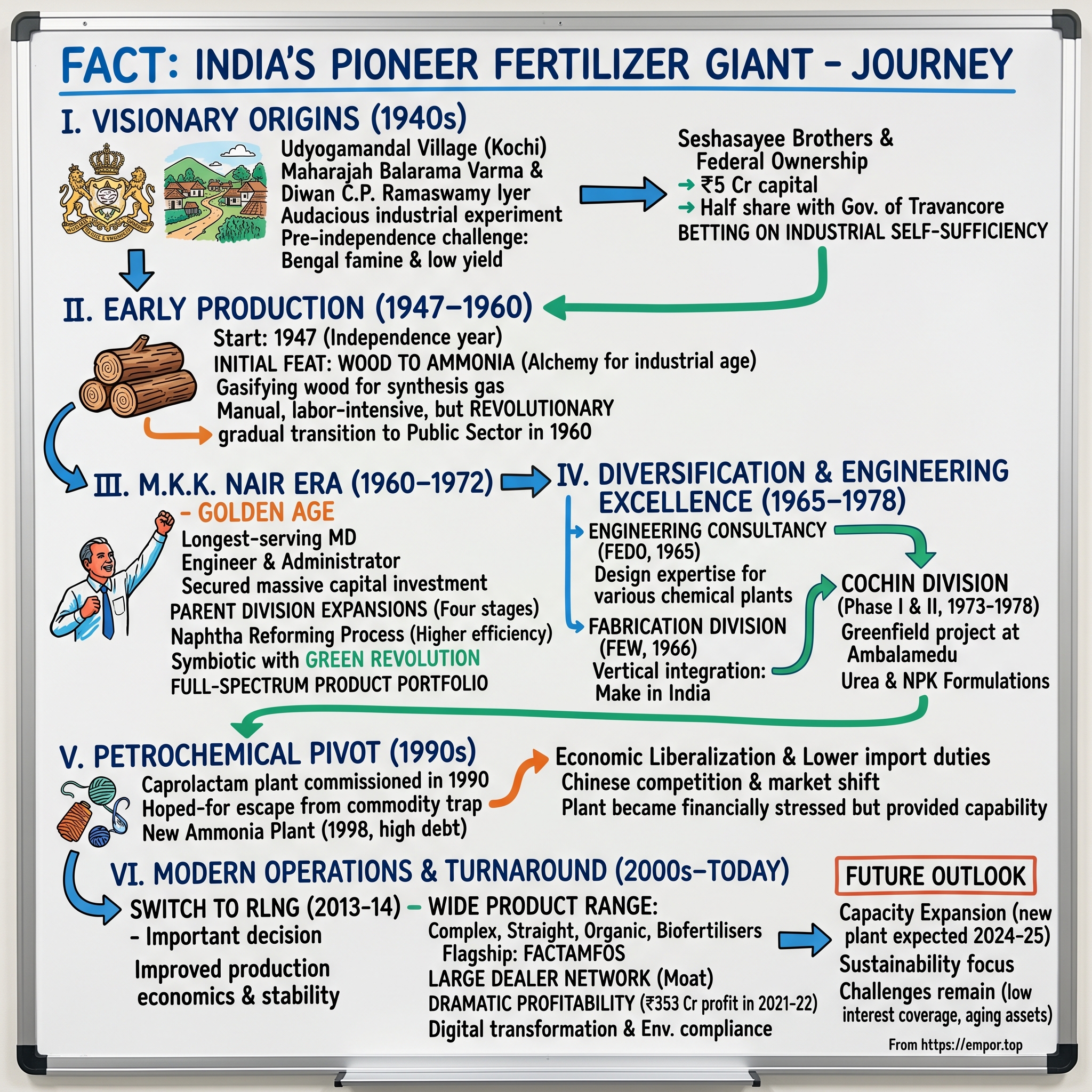
FACT: The Story of India's Pioneer Fertilizer Giant
I. Introduction & Episode Roadmap
There is a particular kind of Indian capital markets story that makes fundamental investors deeply uncomfortable, and Fertilisers and Chemicals Travancore is perhaps its purest specimen.
Consider the underlying numbers. As of September 2026, FACT carried a market capitalisation of roughly ₹49,400 crore against a book value per share of about ₹21 and a trailing twelve-month net profit of approximately ₹28 crore.1 Those figures translate to a trailing price-to-earnings ratio in the thousands and a price-to-book multiple in the mid-thirties—a valuation structure typically reserved for pre-revenue biotechnology firms or software companies compounding at 50 percent annually. Yet FACT manufactures ammonium phosphate sulphate for paddy farmers in Palakkad and caprolactam for nylon tyre cord. While its three-year average return on equity reached a respectable 27 percent, its most recent full-year return on equity stood at around 2 percent.1
So what exactly is being valued here?
That question forms the spine of this story, and answering it requires looking far beyond the stock chart. FACT was conceived in 1943, in the shadow of the Bengal famine, by a princely state that concluded it could not rely on external supplies to feed its population. It was India's first large-scale fertilizer plant. The company pioneered wood gasification for ammonia synthesis when no other feedstock was available, then abandoned the process when local forest reserves shrank. Later nationalised, FACT expanded into a sprawling industrial township, diversified into petrochemicals, nearly collapsed under high naphtha feedstock costs, shut its flagship chemical plant for nearly a decade, and was rescued not by operational brilliance but by selling land back to the state government that had provided that land in the first place.2
And then, around 2022, the stock price surged roughly tenfold.
The core tension lies in the gap between those two narratives. The operational story is a slow, grinding, politically mediated turnaround with genuine engineering achievements and genuine structural limits. The market story is a momentum phenomenon in a security where the Government of India holds 90 percent of the shares and the entire free float is a rounding error.1 Both narratives are true simultaneously. The analytical challenge is to determine which force is driving the price, and what happens when the two collide.
The roadmap outlines the narrative ahead.
The narrative begins in the 1940s, with a Maharajah, a Diwan with imperial ambitions, a private promoter family from Madras, and the historical reality that India's fertilizer industry began as a famine-prevention project in a princely state. It proceeds through nationalisation and the M.K.K. Nair era, when FACT functioned less as a conventional company than as a nation-building institution—constructing townships, operating schools, and establishing an in-house engineering division that designed plants for third parties.
Then comes the structural downturn: the 1990s caprolactam diversification, which initially appeared to offer an escape from price-controlled fertilizers but turned into a decade-long capital sink. In the 2000s and 2010s, dependence on naphtha as a feedstock left FACT structurally uncompetitive against gas-based producers in northern India, bringing the company to a point where management publicly stated it required ₹500 crore simply to continue existing.3
Next is the turnaround triad—land monetisation, debt extinguishment, and the arrival of natural gas via the GAIL pipeline to Kochi—which together moved FACT from technical insolvency to a functional balance sheet.
The analysis then examines modern operations: what FACT actually sells, to whom, at what margin, and why the Factamfos brand holds greater commercial weight among dealers in Thrissur than in return-on-capital calculations.
Governance and capital structure follow: 90 percent government ownership, a Chairman and Managing Director with no equity stake, performance evaluated against a Memorandum of Understanding with the Department of Fertilizers rather than shareholder returns, and a minimum public shareholding deadline that passed without resolution.4
Finally, the investment analysis applies Helmer's 7 Powers framework, incorporates a historical falsification layer that tests moat claims against FACT's operating record, presents a risk radar, and stress-tests the bull and bear cases against each other.
The history begins where FACT started—with hunger.
 Subscribe on LinkedIn
II. Pre-Independence Vision & Royal Origins (1943–1959)
In 1943, rice was not moving.
The Bengal famine killed between two and three million people, driven less by absolute crop failure than by distribution collapses, wartime requisitioning, and a colonial administration prioritizing military supply over civilian survival. For the princely states of southern India, watching the catastrophe unfold was an education in vulnerability. Travancore imported a substantial share of its rice. If shipping lanes closed or the Madras Presidency restricted grain movement, Travancore risked widespread starvation regardless of state policy.
Maharajah Sree Chithira Thirunal Balarama Varma and his Diwan, Sir C.P. Ramaswamy Iyer, recognized that Travancore had to increase agricultural yields on existing land. In the technology of the 1940s, boosting crop yields required nitrogen.
This origin shaped a fundamental characteristic of FACT: the company was established not for commercial return, but as an instrument of state food security policy that treated fertilizer as infrastructure akin to roads or dams. Subsequent chapters of FACT's history—price controls, subsidy dependence, state bailouts, and reluctance to decommission unviable plants—stemmed from this founding premise. FACT originated as a strategic asset that happened to have shareholders, rather than a commercial enterprise that happened to become strategic.
The execution, however, relied on private enterprise. Fertilisers and Chemicals Travancore Limited was incorporated in 1943 and promoted by Seshasayee Brothers, a Madras industrial group with a track record in paper and engineering.5 Capital was assembled from the Governments of Travancore, Cochin, and Madras alongside private investors. Decades before the terminology became standard, FACT operated as a public-private partnership, with a princely state outsourcing industrial execution to private entrepreneurs while retaining a policy stake.
The promoters selected Udyogamandal—meaning "industrial precinct"—on the banks of the Periyar River near Alwaye, a few kilometers upstream from Kochi's present-day industrial belt. At the time, the site was undeveloped land. When the plant was commissioned in 1947 with an initial annual capacity of 50,000 tonnes of ammonium sulphate, it became India's first large-scale fertilizer facility.5
Synthesizing ammonium sulphate required ammonia, which in turn required hydrogen. In 1947, global ammonia production relied heavily on steam reforming of natural gas. Newly independent India possessed almost no natural gas infrastructure, virtually no naphtha cracking capacity, and severe foreign exchange constraints on fuel imports.
Kerala, however, had timber.
FACT's initial ammonia unit utilized wood gasification, burning timber under controlled, oxygen-starved conditions to produce synthesis gas rich in hydrogen and carbon monoxide, before purifying the hydrogen for ammonia synthesis. Operating a chemical synthesis plant on firewood was a notable engineering feat for a newly independent nation seeking to build heavy chemical infrastructure from local resources without relying on imported hydrocarbons.
Yet the process was commercially fragile. Because wood has low energy density relative to its bulk, transportation costs escalated rapidly as plant capacity scaled. Expanding the timber collection radius raised delivered feedstock costs and strained local forest reserves. Within a decade, wood gasification was no longer viable.
FACT responded with the first of several feedstock conversions. It transitioned to electrolytic hydrogen, using Kerala's abundant hydroelectricity to split water, until rising power tariffs and supply constraints limited that route. The company then shifted in stages to naphtha reforming, matching the broader Indian industry standard that would later create severe financial strain.
This initial fifteen-year period established a recurring operational pattern. FACT repeatedly demonstrated technical adaptability—executing three major feedstock conversions over its history—yet that flexibility rarely yielded a sustained cost advantage. Each conversion resolved an immediate supply crisis but failed to place FACT on the lower end of the industry cost curve. The company remained structurally disadvantaged by its location far from India's gas fields, coal deposits, and low-cost power centers, leaving it dependent on whichever feedstock policy favored at Kochi.
Meanwhile, FACT's long-term governance structure took shape. Control transferred to the Government of Kerala in 1960, and two years later, in 1962, the Government of India assumed majority ownership, placing FACT under what became the Department of Fertilizers.5 With the exit of the private promoters, the famine-prevention initiative was fully transformed into a state-owned Public Sector Undertaking.
That transition set the stage for FACT's most ambitious expansion era—and the leadership that defined it.
III. Modern History & The Inflection Point: Gas, Land, & Turnaround (1960–2022)
The M.K.K. Nair Era: Building an Institution Instead of a Company
A visitor walking through Udyogamandal today encounters features unusual for an industrial site: a school, a hospital, housing colonies, a library, and a cultural association. This layout was not an accident of urban drift, but the deliberate creation of one man.
M.K.K. Nair, an Indian Administrative Service officer who served as FACT's Managing Director through the 1960s and into the early 1970s, is remembered in Kerala less as a corporate executive than as a public figure—a patron of Malayalam literature and theatre who ran a fertilizer company on the side. That characterization understates his industrial work, but it captures the ethos. Under Nair, FACT functioned explicitly as a nation-building institution: the plant was a means, while the township was the focal point.
The industrial output of that era was substantial. FACT built out the Cochin Division at Ambalamedu in two phases, adding complex fertilizer capacity well beyond the original Udyogamandal footprint. In 1965, it created FEDO—FACT Engineering and Design Organisation—as an in-house engineering and consultancy arm. In 1966, it added FEW, FACT Engineering Works, for fabrication and erection.5
FEDO reflected the broader ambition of the era. During the 1960s, India imported not only fertilizers but also the production facilities and design engineering required to build them. FEDO attempted to internalize those capabilities by creating a domestic design house for fertilizer and chemical plants. For a time, it succeeded, securing external projects across fertilizers, chemicals, and pipelines.
While this logic aligned with the import-substitution policies of the license-permit raj, FEDO was structurally a services unit attached to a commodity manufacturer. It competed for talent and contracts against dedicated engineering firms unburdened by plant operations. Today, FEDO and FEW together contribute a small single-digit percentage of FACT's revenue.6 Although they retain internal value by enabling brownfield projects with reduced external dependency, their contribution is immaterial to overall investment valuation. Any analysis that assigns meaningful value to FACT's engineering arm overstates its commercial significance.
The Caprolactam Gamble: A Case Study in Capital Allocation
By the late 1980s, FACT management faced a structural constraint common across the Indian fertilizer sector: government-regulated selling prices. Under the Retention Price Scheme and its successors, a fertilizer plant earned a regulated return based on costs, capping upside regardless of operational efficiency. Efficiency gains were largely recaptured by the pricing formula.
To escape capped returns, management sought to diversify into unregulated products, choosing caprolactam.
Caprolactam, the monomer used to manufacture nylon-6, serves key markets in tyre cord, filament yarn, industrial fabrics, and engineering plastics. In the late 1980s, growing domestic demand relied heavily on imports. Caprolactam production also integrated logically with FACT's existing chemistry: it required ammonia as a feedstock and generated ammonium sulphate—already sold to plantations across the Western Ghats—as a primary byproduct. On paper, the project offered an unregulated, higher-margin revenue stream closely aligned with core operations.
FACT commissioned its Petrochemical Division in 1990–91 to produce caprolactam at a capital cost the company described as exceeding ₹600 crore.5
The diversification ultimately failed.
While the plant functioned technically, the input cost position proved unsustainable. Caprolactam economics depend on the spread between benzene and ammonia costs on one side and international caprolactam prices on the other. Because FACT produced ammonia from refinery-derived naphtha, rising crude oil prices directly inflated ammonia costs and compressed operating margins. Simultaneously, massive expansion of Chinese caprolactam capacity during the 2000s pushed Asian spot prices toward the marginal cost of the world's most efficient gas- and coal-based producers—a cost curve position FACT could not match.
By 2012, the plant became uneconomic to operate, and FACT suspended production. It stayed stopped until September 2021—approximately nine years.7
This nine-year shutdown highlights a central flaw in FACT's historical capital allocation. A facility costing over ₹600 crore—the company's flagship diversification—generated no revenue for nearly a decade while continuing to absorb depreciation, interest expenses, maintenance costs, and management oversight. Management neither wrote off the asset nor sold it. The plant remained idle, demonstrating how a strategy sound in market demand can fail through an uncompetitive cost structure.
In commodity chemicals, possessing production technology provides little advantage if feedstock costs sit high on the global cost curve. A plant capable of manufacturing caprolactam without a competitive input cost operates as a structural liability rather than a valuable option.
The Dark Decades: The Naphtha Trap
The caprolactam shutdown was a symptom; the underlying disease was naphtha.
Through the 2000s and early 2010s, Indian fertilizer production bifurcated. Plants in northern and western India, connected to the HVJ gas pipeline and later the expanding GAIL network, transitioned to natural gas. Facilities without pipeline access remained tied to naphtha or fuel oil. The energy cost differential between the two feedstocks determined commercial viability. When government policy benchmarked subsidies against efficient gas-based production, naphtha-based producers faced a mandate to convert feedstocks or face insolvency.
FACT could not convert because no gas pipeline extended to Kochi.
Geography dictated operational outcomes. Situated at the southwestern tip of the Indian gas grid, Kerala remained disconnected from major pipelines. Although the Petronet LNG terminal at Puthuvype near Kochi opened in 2013 with substantial regasification capacity, it operated severely underutilized for years due to missing downstream pipeline infrastructure. Despite operating a few kilometers from a major LNG import terminal, FACT could not access natural gas. Management publicly discussed shifting to LNG as early as 2013.8 The physical pipeline connection took far longer to materialize.
Severe financial deterioration followed. Losses accumulated, eroding net worth into negative territory. Working capital constraints delayed vendor payments and restricted raw material purchases, lowering plant utilization and worsening unit production costs. By early 2014, FACT was publicly described as needing roughly ₹500 crore simply to continue operating.3 Operational survival rested entirely on government support packages rather than cash flow generation.
This period highlights FACT's lack of operational agency. The company could not raise selling prices under government controls, convert feedstocks without pipeline infrastructure, or decommission unviable assets without political approval. Operational survival depended entirely on external decisions by GAIL, the Union Cabinet, and the Department of Fertilizers.
The Turnaround Triad: 2019–2021
Within approximately eighteen months, three external developments reshaped FACT's balance sheet more significantly than any operational initiative over the preceding two decades.
First, the land. FACT held a large contiguous industrial land bank at Udyogamandal, much of it unutilized—an inheritance from an era of generous state land allotments. In July 2019, the Union Cabinet approved the sale of 481.79 acres of FACT land to the Government of Kerala for approximately ₹970 crore.2 Under the transaction terms, 150 acres were sold at ₹1 crore per acre, in exchange for which the state government agreed to grant FACT freehold rights over 143.22 acres it occupied; the remaining 331.79 acres were sold at approximately ₹2.4758 crore per acre.9 The stated purpose was explicit—address working capital deficiency, improve the balance sheet, reduce bank borrowings, and fund capacity expansion.2
Equity markets responded immediately, with FACT shares rising sharply on the Cabinet announcement.10 Solvency was achieved not through operational improvement, but through monetizing long-held real estate. A separate proposal to sell roughly 170 acres to BPCL for around ₹500 crore had been under discussion since at least 2016, reflecting refinery expansion needs within the same industrial belt.11
Second, the debt. Proceeds were deployed to clear high-cost bank borrowings and statutory arrears. Removing this debt burden eliminated punitive interest rates that had consumed operating profits. Debt clearance did not alter underlying manufacturing efficiency, but it allowed operating earnings to reach the bottom line.
Third, the gas. GAIL completed the Kochi–Koottanad–Bengaluru–Mangaluru pipeline, connecting the Puthuvype terminal to regional industrial demand. FACT retired naphtha and converted its ammonia plants to regasified LNG.5 Energy costs per tonne of ammonia dropped substantially, restoring the economic viability of caprolactam production. In September 2021, after approximately nine years of idleness, the 50,000 tonne-per-annum caprolactam unit resumed operations, with the company indicating it could add several hundred crore to annual turnover.7
Financial results reflected these changes immediately. Revenue rose from roughly ₹1,955 crore in FY2019 to ₹6,198 crore in FY2023, while operating profit expanded from approximately ₹10 crore to ₹755 crore over the same period.1
However, evaluating the repeatability of this turnaround requires analyzing its underlying drivers. The balance sheet was repaired through a non-recurring land sale. The cost structure was improved by state-funded pipeline infrastructure outside FACT's control. Furthermore, the revenue surge in FY2022 and FY2023 coincided with a global fertilizer and commodity price spike following disruptions to Russian and Belarusian supply, which temporarily expanded industry-wide margins.
None of these three drivers represents a durable competitive advantage; they consist of an asset sale, a public infrastructure project, and a favorable commodity cycle. While the turnaround restored solvency and energy competitiveness, it created no structural mechanism for FACT to earn above its cost of capital through an economic downturn.
Subsequent financial performance illustrates this cyclical vulnerability. From the FY2023 peak, revenue fell to roughly ₹5,051 crore in FY2024 and approximately ₹4,051 crore in FY2025, while operating profit dropped from ₹755 crore to about ₹358 crore and then to roughly ₹95 crore.1 Net profit followed the same trajectory, falling to around ₹41 crore in FY2025.1 This earnings contraction reflects the operating profile of a business lacking pricing power when market conditions normalize.
Stripping away both the crisis narrative and the rally narrative reveals the underlying realities of FACT's current operating business.
IV. Modern Operations, Product Portfolio, & Segment Economics
Inside an agri-input dealership in Thrissur or Palakkad during the pre-monsoon buying season, stacked fertilizer bags carry a distinct livery identified by a ratio rather than a brand name: 20-20. Farmers do not ask for FACT or complex fertilizer; they ask for 20-20.
That shorthand refers to NP 20:20:0:13—twenty percent nitrogen, twenty percent phosphorus, zero potassium, and thirteen percent sulphur—marketed commercially as Factamfos. For a paddy farmer in central Kerala or a cardamom grower in the Western Ghats, this nutrient formulation is tailored to local soil chemistry. The region's acidic laterite soils are sulphur-deficient but well supplied with potassium from rock weathering and plantation organic matter recycling. Factamfos is designed specifically for the agricultural dirt of South India.
This regional brand equity represents FACT's primary commercial asset, though determining its strategic strength requires examining what that preference actually achieves—and what it cannot.
The Fertilizer Division: The Actual Business
The fertilizer segment generates the vast majority of FACT's revenue. Management divides its manufactured product line between Factamfos (NP 20:20:0:13) and ammonium sulphate, alongside traded fertilizer products.1 Each category carries distinct operating economics.
Factamfos is manufactured at the Cochin Division in Ambalamedu, where FACT operates sulphuric acid and phosphoric acid plants that feed its granulation units.6 Phosphoric acid represents the primary raw material cost. Because India imports most of its phosphate requirements, FACT purchases imported phosphoric acid while also manufacturing a portion locally from imported rock phosphate and sulphur. Molten sulphur is sourced directly from the adjacent BPCL Kochi refinery via pipeline, providing a meaningful logistics advantage over competitors that must import and remelt solid sulphur.
Ammonium sulphate provides a distinct commercial profile, containing roughly 20.6 percent nitrogen and 23 percent sulphur. It is the preferred fertilizer for tea, coffee, rubber, and plantation crops across the Western Ghats, where crops demand sulphur and tolerate ammonium sulphate's acidifying effect on soil. Crucially, ammonium sulphate is produced as a primary co-product during caprolactam manufacturing. Consequently, restarting caprolactam operations directly affected the fertilizer division by generating co-product volume.
Traded goods—primarily muriate of potash and imported complex fertilizers—supplement the manufactured portfolio. These are distributed through a dealer network spanning several thousand outlets across Kerala, Tamil Nadu, Karnataka, Andhra Pradesh, and Telangana.5 While trading generates top-line volume and maintains dealer relationships, it yields narrow operating margins. Consequently, high trading volume can expand reported revenue while diluting overall profitability. For instance, in trailing FY2026, revenue rose to roughly ₹5,293 crore from ₹4,051 crore in FY2025, yet trailing operating profit remained essentially stagnant at approximately ₹105 crore.1 This earnings divergence reflects a higher proportion of traded goods, margin compression in manufactured goods, or a combination of both.
Why the Brand Doesn't Buy What You Think It Buys
A rigorous evaluation of FACT requires separating commercial brand strength from economic pricing power.
Factamfos enjoys genuine brand recognition among regional dealers and farmers. In a market dominated by homogeneous commodity granules, brand recall helps secure retail shelf space and reduces the discounting necessary to move inventory.
However, complex fertilizers in India operate under the Nutrient Based Subsidy (NBS) regime. Under NBS, the central government establishes fixed per-nutrient subsidy rates. Although maximum retail prices are nominally decontrolled, effective farm-gate prices remain constrained by government oversight and political sensitivity. When global import prices for phosphoric acid or ammonia escalate without a matching increase in NBS rates, fertilizer manufacturers must absorb the margin squeeze.
FACT cannot pass higher input costs to retail buyers, nor can competitors like Coromandel International or IFFCO. Larger, lower-cost producers, however, possess broader scale and balance sheet capacity to absorb margin compression.
This pricing dynamic is evident in quarterly results. In the third quarter of FY2026, FACT posted a net loss of approximately ₹67.90 crore on net sales of roughly ₹1,568 crore, compared to a profit in the prior-year period. Operating losses reached approximately ₹42.88 crore, yielding a negative 2.73 percent operating margin against a positive 2.42 percent margin in the preceding quarter.12 Even as top-line revenue expanded year-over-year, profitability contracted sharply.
These results highlight a critical distinction: FACT possesses brand preference without pricing power. Brand preference dictates product selection at a given price, whereas pricing power allows a producer to set prices. Because the Ministry of Chemicals and Fertilizers governs price boundaries, FACT functions as a cost-taker on both raw material inputs and finished goods sales.
The Petrochemical Division: A High-Beta Bolt-On
The restarted 50,000-tonne-per-annum caprolactam facility remains small relative to global peers, where single-train additions in China routinely surpass FACT's entire nameplate capacity. Segment profitability depends entirely on the spread between benzene and energy inputs against Asian caprolactam spot prices.
Caprolactam introduces dual-edged operating leverage. When nylon spreads widen, the unit generates incremental earnings alongside co-product ammonium sulphate. In weak market environments—the predominant condition amid persistent Asian overcapacity—the facility represents a fixed-cost burden. Maintaining operations during margin squeezes reflects political incentives to demonstrate asset utilization, even when idling would preserve cash flow.
The Engineering Arm
FEDO and FEW continue to offer engineering, procurement, construction, and detailed engineering services for fertilizers, chemicals, and industrial pipelines. Their primary value is internal, allowing FACT to carry out brownfield modifications without paying third-party engineering margins. Given their small contribution to overall revenue, these divisions represent an internal operational capability rather than an independent driver of shareholder value.
Infrastructure and Sourcing
FACT operates two manufacturing complexes in the Kochi industrial corridor: Udyogamandal at Eloor, housing ammonia, ammonium sulphate, and caprolactam facilities; and the Cochin Division at Ambalamedu, housing ammonia, sulphuric acid, phosphoric acid, and Factamfos granulation units.6 Both sites connect directly to deepwater port facilities for imported raw materials and to the regional natural gas pipeline.
This location provides a genuine regional logistics advantage. Deepwater port access for bulk raw materials, direct refinery pipeline integration for molten sulphur, nearby regasified LNG infrastructure, and established rail and road links place FACT closer to South Indian agricultural demand than northern or western competitors. Because fertilizers are heavy, low-value bulk commodities, proximity to end markets significantly reduces freight expense.
However, freight efficiency does not equal low-cost manufacturing. FACT's production scale remains modest compared to domestic industry leaders, and its primary input cost—phosphoric acid—is a globally traded commodity priced by a concentrated cartel of North African and Middle Eastern suppliers.
The resulting operational profile is clear: FACT is a regionally advantaged manufacturer and distributor of complex fertilizers, supported by strong brand recognition and solid freight logistics, but lacking control over selling prices or core raw material costs, while carrying a highly cyclical petrochemical operation. This structure describes a stable regional business, but not a high-return compounding engine.
Evaluating FACT's long-term trajectory requires examining how this asset is governed, how its management is evaluated, and how its public shareholding structure operates.
V. Current Management, Governance, & Capital Allocation
Every listed company's annual report contains a section on executive remuneration. For most large Indian private companies, it runs several pages, detailing stock options, performance shares, and long-term incentive plans calibrated to total shareholder return. For FACT, the section is brief, and the most defining figure is zero—reflecting zero equity ownership by executive management and zero stock-based compensation.
That single structural detail explains more about FACT's operational behavior than any corporate strategy document.
The Chairman
S. Sakthimani serves as Chairman and Managing Director of FACT, having been recommended through the Public Enterprises Selection Board process and appointed to lead the company.1314 His professional background combines financial and technical credentials: he is a qualified Cost and Management Accountant, a Company Secretary, and a Metallurgical Engineer, with prior service as Director (Finance & Marketing) at Cement Corporation of India alongside earlier roles at Steel Authority of India, Rashtriya Ispat Nigam, Scooters India, and Engineering Projects (India).13
That career path reveals an executive formed entirely inside the Indian public sector heavy-industry complex—steel, cement, engineering—and specifically within entities that faced severe capital constraints. Managing scarcity, executing turnarounds, and maintaining working capital discipline under pressure define that administrative tradition. For an enterprise recovering from technical insolvency, that background provides a stabilizing framework: conserving cash, enforcing credit terms, limiting discretionary capital expenditure, and avoiding speculative investments.
Sakthimani has also held additional charge of the Director (Finance) portfolio, concentrating financial oversight within the executive office. While efficient during restructuring, this dual role consolidates reporting and approval authority within a single office.
However, managing public sector liquidity differs from generating returns above the cost of capital in a commodity market where finished goods prices are regulated by central authorities. Delivering economic outperformance under those structural constraints remains an open challenge for any public sector leadership team.
How Performance Is Actually Measured
Executive performance at FACT is evaluated primarily through a Memorandum of Understanding (MoU) signed annually with the Department of Fertilizers. Within the Indian public sector fertilizer framework, MoU targets focus on production volumes, plant capacity utilization, specific energy consumption per tonne, subsidy claim processing efficiency, and capital expenditure project milestones.
Missing from that evaluation framework are standard market metrics: return on capital employed, return on equity, free cash flow per share, and share price performance.
This structure reflects the underlying institutional incentives. Management teams evaluated on output volume and energy efficiency are incentivized to maximize plant throughput and minimize unit energy consumption. Under these parameters, facilities may continue operating even when market conditions would prompt a private owner to idle capacity. Capital expansion is pursued partly because project completion represents a key performance indicator, while documentation of subsidy claims receives meticulous attention. Consequently, management incentives align with volume targets rather than optimizing capital efficiency for equity holders.
An investor evaluating FACT equity is acquiring a business operating under mandates distinct from total shareholder return. While standard across the public sector enterprise landscape, this operational alignment requires careful evaluation when benchmarked against high market valuation multiples.
The Float: Where the Valuation Actually Comes From
The core mechanism driving FACT's market valuation lies in its shareholding distribution.
The Government of India owns 90 percent of FACT's equity. Domestic institutional investors hold approximately 8.59 percent, leaving a public retail float of roughly 1.41 percent.1
That modest float—representing roughly one and a half percent of a company valued at approximately ₹49,400 crore—creates a distinct pricing mechanism.1
In equity markets, prices are established at the margin by active trading. When nine-tenths of total shares are held permanently by a sovereign state, market transactions occur within a restricted volume of tradeable stock. Modest institutional or retail demand operating against a narrow float can generate pronounced upward price movements. As market capitalization expands, momentum strategies and index-tracking funds generate additional buying volume, further elevating the quoted price. The resulting aggregate valuation extrapolates the marginal trading price of the public float across the entire state holding.
The stock's multi-year rally from low double-digit levels to approximately ₹764 by September 2026 reflects recorded transaction prices.1 However, it does not indicate the valuation at which a majority stake could be liquidated or transacted.
The resulting valuation metrics display a marked divergence from historical fundamentals. FACT trades at a trailing price-to-earnings ratio in the thousands,1 with a price-to-book multiple of roughly 36 times against a book value of approximately ₹21 per share.1 These multiples contrast with a trailing return on equity of about 2 percent and a return on capital employed of roughly 8.65 percent.1 Standard discounted cash flow models based on complex fertilizer economics struggle to reconcile these figures, highlighting the degree to which market pricing is influenced by float dynamics.
Capital Allocation: What They Are Actually Doing With the Money
Following its balance sheet repair, FACT's capital allocation has remained focused on core manufacturing operations rather than external diversification or speculative ventures.
The primary capital deployment is a brownfield complex fertilizer expansion at the Cochin Division. Nuberg EPC was contracted to construct a 1,650 tonne-per-day NPK plant at Ambalamedu, expanding FACT's total complex fertilizer nameplate capacity toward approximately 3,650 tonnes per day.15 This project represents a roughly 45 percent increase in complex fertilizer capacity. Executed as an internal brownfield development, it leverages existing phosphoric and sulphuric acid infrastructure, utility connections, deepwater port access, and established regional distribution channels.
Remaining capital expenditures have targeted operational debottlenecking, raw material logistics, and energy efficiency upgrades, driven partly by mandatory targets under national industrial energy efficiency regulations and evolving carbon intensity guidelines.
Evaluating this capital program requires contextualizing it against historical projects, notably the caprolactam diversification that remained idle for nine years due to unfavorable input economics. While the engineering rationale for the Ambalamedu expansion is structured around sunk cost integration, long-term returns depend on global phosphoric acid pricing and domestic Nutrient Based Subsidy rates rather than manufacturing execution alone.
Expanding production volume increases operational exposure to prevailing unit margins. If subsidy formulas or raw material costs compress spreads—as observed between FY2024 and FY2026—additional capacity yields lower aggregate profitability. The expansion achieves management's volume and capacity goals; whether it enhances economic returns for equity holders will depend on realized segment margins following plant commissioning.
This dynamic establishes the central analytical question for investors: reconciling an operational plan focused on public sector volume mandates with a market valuation built on low float dynamics.
VI. The Investor Spine: Moats, Helmer's 7 Powers, & Historical Falsification
Every investment case is a set of claims about why the future will be better than the base rate. The discipline that separates analysis from storytelling is testing each claim against the strongest disconfirming evidence in the company's own record—not against hypothetical risks, but against events FACT has actually experienced.
FACT is unusually well-suited to this exercise because its eighty-year history offers real-world evidence for nearly every thesis advanced on its behalf.
Hamilton Helmer's 7 Powers, Applied Without Charity
Branding — moderate, and narrower than it looks. Factamfos commands genuine recall among plantation and paddy farmers in Kerala and Tamil Nadu, driving dealer push and reliable volume placement. This represents FACT's clearest competitive advantage. However, Helmer's test for Branding as a Power requires that it support a persistent price premium. Under the Nutrient Based Subsidy regime, FACT cannot charge a premium; brand equity converts into market share in a fixed-price market rather than expanded margins. It functions as a distribution asset rather than a pricing asset.
Cornered Resource — weak to moderate, and the strongest genuine candidate. The contiguous industrial footprint at Udyogamandal and Ambalamedu—featuring direct refinery pipelines for molten sulphur, regasified LNG pipeline access from the Kochi terminal, and deepwater port connectivity for bulk imports—is exceptionally difficult to replicate. Assembling a comparable site in Kerala is virtually impossible due to environmental regulations and population density. While this creates a formidable barrier to new regional entrants, it does not prevent existing competitors from shipping product into the region, which remains the primary competitive threat.
Scale Economies — weak. FACT remains sub-scale relative to domestic complex fertilizer majors and significantly sub-scale against global phosphate producers. Its facilities are sized for regional demand—a logical choice for engineering logistics, but an economic drawback when purchasing raw materials in a global market where larger buyers command better pricing.
Counter-Positioning, Network Economies, Switching Costs, Process Power — absent. Incumbents can readily replicate FACT's business model, no network effects accrue as farm adoption grows, farmers face no switching costs to purchase competing 20:20:0:13 formulations, and granulating complex fertilizer offers no proprietary process advantage over peers. These powers are simply absent from the business.
In summary, FACT holds roughly one and a half of Helmer's seven powers—both regional in scope, and neither capable of generating pricing power.
Thesis Claim 1: A Regional Moat With Pricing Power
The claim. Decades of brand loyalty to Factamfos, combined with a formulation tailored to South Indian soils and an established dealer network, provide FACT with defensible regional dominance and margin protection.
The disconfirming evidence. The test of this claim is how the company handles an unpassable input cost shock. This scenario has occurred twice in three years. Through FY2024, as international phosphoric acid and ammonia costs rose while subsidy rates declined from crisis peaks, FACT's operating profit dropped from approximately ₹755 crore to about ₹358 crore despite a far smaller decline in revenue.1 In FY2025, operating profit contracted further to roughly ₹95 crore.1 By the third quarter of FY2026, the company recorded an operating loss of approximately ₹42.88 crore on net sales of roughly ₹1,568 crore—even as quarterly sales rose 65 percent year-over-year.12 A business with genuine pricing power does not incur operating losses during periods of sharp top-line expansion.
Concurrently, regional competition has intensified. Coromandel International has expanded distribution of its Gromor brand across Andhra Pradesh, Telangana, and Karnataka from a lower cost base backed by deeper backward integration into phosphoric acid, while IFFCO maintains a cooperative distribution network that no standalone manufacturer matches. FACT's position in Kerala remains strong, but across the broader South Indian market, it operates as a regional participant rather than a dominant player.
The verdict. The moat claim is substantially narrowed. FACT retains a clear freight and brand advantage in Kerala and adjacent districts that supports reliable volume placement, but it possesses no pricing power. The key indicator to monitor is fertilizer segment operating margin during periods of high imported raw material costs. Unless FACT can sustain positive segment operating earnings through an input price spike without an offsetting subsidy adjustment, the pricing power claim remains unproven.
Thesis Claim 2: Caprolactam as Valuable Optionality
The claim. The restarted 50,000-tonne-per-annum caprolactam unit serves as an unregulated, higher-margin growth engine that diversifies FACT beyond regulated fertilizer economics.
The disconfirming evidence. This claim has a long record of historical disconfirmation. The plant was originally commissioned in 1990–91 at a capital cost exceeding ₹600 crore based on this exact thesis.5 It was subsequently idled for nine years, from 2012 until September 2021, because uncompetitive input costs made operations unviable.7
While converting feedstock from naphtha to regasified LNG improved ammonia input costs, the fundamental structural challenge remains. The benzene input leg remains tied to crude oil prices, while output pricing is dictated by global spot markets heavily influenced by large-scale Chinese producers. Given that Chinese additions during the 2010s and 2020s expanded global capacity significantly, a 50,000-tonne facility operates at a structural scale disadvantage. Notably, management commentary at the restart highlighted top-line contribution—projecting several hundred crore in turnover—rather than margin expansion.7 In commodity chemicals, revenue generation matters far less than realized spread.
The verdict. The optionality claim is rejected as a structural moat and classified as cyclical exposure. Caprolactam operates as a high-beta asset whose profitability depends on global spreads outside FACT's control. Its main non-cyclical benefit is generating ammonium sulphate co-product for the regional plantation market. Sustained positive petrochemical segment operating profit across a full down-cycle in Asian caprolactam prices would be required to alter this assessment.
Thesis Claim 3: A Structural Financial Turnaround
The claim. FACT has permanently repaired its balance sheet and operational cost structure, transitioning from a chronic loss-maker into a durably profitable enterprise.
The disconfirming evidence. Evaluating this claim requires examining the origin of the balance sheet repair. The primary debt reduction was funded by selling 481.79 acres of land to the Government of Kerala for approximately ₹970 crore—a transaction approved by the Union Cabinet explicitly to address working capital shortfalls and pay down bank debt.2 This represented a one-time asset monetization that cannot be repeated.
Furthermore, balance sheet leverage has re-emerged. Disclosures show total borrowings of approximately ₹1,805 crore against reserves of roughly ₹724 crore for FY2025,1 driven by expanding working capital needs linked to subsidy receivables and raw material import financing. Descriptions of FACT as a "debt-free entity post-land sale" are not supported by reported financial statements.
Earnings performance following the turnaround peak further clarifies the trend: net profit fell from approximately ₹613 crore in FY2023 to roughly ₹128 crore in FY2024, approximately ₹41 crore in FY2025, and about ₹28 crore over the trailing twelve months into FY2026,1 with fourth-quarter FY2026 net profit reported at roughly ₹3.16 crore.16
The verdict. The claim is qualified, and the "structural" characterization rejected. The shift from naphtha to regasified LNG delivered a permanent improvement in unit energy costs via regional pipeline infrastructure. However, the underlying business model remains unchanged: profitability continues to depend on government subsidy rates, global raw material prices, and the timing of subsidy disbursements. Demonstrating a structural turnaround requires generating positive operating cash flow across a full fertilizer down-cycle without relying on asset sales or state support.
Thesis Claim 4: Strategic Government Backing as an Advantage
The claim. Ninety percent government ownership provides strategic backing, raw material security, preferential fuel allocation, and a guarantee of solvency during downturns.
The disconfirming evidence. The historical record indicates that state ownership offers a sovereign floor for solvency rather than a mechanism for sustained equity returns. Furthermore, government intervention has historically operated with a lag. State support was not deployed to prevent years of operational losses and net worth erosion through the 2000s and 2010s; intervention occurred only after the company publicly required roughly ₹500 crore simply to maintain basic operations.3 Similarly, the pipeline connection required to lower feedstock costs took nearly a decade to materialize after the Kochi LNG terminal was commissioned.
Additionally, state ownership creates counterparty concentration. FACT operates under a single dominant authority—the Government of India—which establishes selling price ceilings via subsidy formulas, disburses a major share of corporate revenue, manages subsidy payment timing, appoints executive leadership, and holds 90 percent of the equity. While market commentary often views state ownership as a competitive moat, it also represents an existential commercial dependency.
The verdict. The claim is inverted. Government ownership provides a backstop against liquidation, but it also caps commercial returns. Minority shareholders participate alongside a controlling owner whose primary objectives are regional food security and agricultural price stability rather than maximizing per-share equity value.
This structural reality leads directly to what can go wrong from here—where ownership dynamics themselves represent a primary risk factor.
VII. Risk Radar & Earnings Call Analysis
A recurring pattern runs through FACT's quarterly disclosures: announcements of record production for Factamfos and ammonium sulphate, followed by a conjunction, followed by an explanation of why profits fell anyway.
That pattern is not an evasion; it accurately reflects the operating reality. Yet it also serves as a central signal in corporate disclosures, demonstrating that operational volume does not translate into bottom-line profitability—even though volume remains the primary metric on which management performance is evaluated.
What the Disclosures Actually Say
The dominant theme across recent reporting has been the disconnect between raw material import costs and subsidy realization. Executive disclosures repeatedly attribute margin compression to the lag between surging international prices for imported phosphoric acid and ammonia and administrative revisions to Nutrient Based Subsidy (NBS) payouts. This explanation is structurally credible, aligning with industry-wide reporting across Indian complex fertilizer manufacturers.
A second recurring issue involves working capital strain. Delayed subsidy disbursements from the Government of India stretch the cash conversion cycle. Because imported raw materials require hard-currency settlement on commercial terms, short-term debt must bridge the cash timing gap. This dynamic accounts for the roughly ₹1,805 crore of borrowings on the FY2025 balance sheet despite earlier debt reduction efforts.1 As a result, interest expense remains an active drag on operating earnings.
A third key disclosure accompanied the FY2026 results, when management indicated that temporary shutdowns at select manufacturing facilities were expected to affect operations due to geopolitical disruptions in West Asia. This warning carries operational weight because West Asia and North Africa supply FACT's rock phosphate, phosphoric acid, and a substantial portion of its ammonia. Supply chain friction in that shipping corridor represents a direct threat to plant utilization.
FACT's reporting across the FY2024 to FY2026 period has maintained internal consistency. Disclosures have consistently framed margin weakness as a structural cost-subsidy mismatch rather than attributing losses to transient one-off charges. However, public filings lack a specific, quantified operational strategy to restore segment margins independent of favorable NBS rate adjustments. Relying on Ministry revisions to restore profitability describes a state policy dependency rather than an executable corporate strategy.
Furthermore, FACT maintains a sparse communication posture relative to other large-cap Indian listed enterprises, characterized by minimal analyst coverage, infrequent earnings calls, and a shareholder base overwhelmingly dominated by the promoter. A company capitalised near ₹49,400 crore with essentially no sell-side scrutiny is an information-poor environment, and information-poor environments are where valuations detach.1
The Material Risks
Subsidy budget and NBS rate risk. This represents the primary operational risk. FACT's realized margin per tonne is a residual formula: the government NBS subsidy rate plus the retail market price, minus imported raw material costs. Because FACT controls none of these three variables, any reduction in federal fertilizer subsidy allocations within the Union Budget, or a downward NBS revision that lags rising raw material costs, compresses operating profits immediately.
Minimum public shareholding. This risk bears directly on FACT's valuation dynamics. Indian securities regulations mandate that listed companies maintain at least 25 percent public shareholding. Central Public Sector Enterprises received repeated extensions, with the government extending the compliance deadline until August 1, 2026.4
Although that deadline has passed, regulatory enforcement remains paused. In March 2026, the Ministry of Finance notified the Securities Contracts (Regulation) Amendment Rules, 2026, updating minimum public shareholding standards, while the Securities and Exchange Board of India (SEBI) granted a temporary waiver from enforcement actions for entities with compliance dates between April 1 and September 30, 2026.1718 Additionally, federal rules empower the government to grant statutory exemptions from shareholding mandates to majority-owned public enterprises.19
While enforcement action has been deferred, the structural float imbalance persists. Reducing government equity from 90 percent to the mandatory 75 percent limit would require placing a 15 percent stake into a market where the existing public float stands at approximately 1.41 percent.1 Absorbing that supply would expand the tradeable float more than tenfold, unwinding the restricted supply mechanism that supported high equity multiples. The controlling shareholder retains the option to execute an Offer for Sale at its discretion, placing public shareholders in an asymmetric position.
Raw material and geopolitical exposure. Phosphoric acid and rock phosphate procurement is concentrated among major producers in Morocco, Jordan, and the Arabian Gulf. Sourcing ammonia and sulphur involves additional supply chain vulnerabilities, as maritime transit disruptions through the Red Sea and the Gulf introduce delivery delays and freight premiums. While pipeline access to molten sulphur from the adjacent BPCL refinery mitigates one input constraint, it does not buffer against global price spikes in imported phosphoric acid.
Geographic concentration. Concentrating sales within South India—and Kerala in particular—provides local freight efficiency but exposes the company to regional demand shocks. Deficient monsoon rainfall, crop shifts away from paddy, or the multi-decade decline in Kerala's cultivated rice acreage directly affect sales volumes. As agricultural land converts to rubber, plantation crops, and commercial development, demand for paddy formulations faces a structural, non-cyclical contraction.
Execution risk on capacity expansion. The brownfield NPK expansion at Ambalamedu adds production capacity into a market constrained by compressed margins. Brownfield construction within operating chemical plants carries commissioning delays, tie-in integration risks, and market exposure if new volume enters during periods of unfavorable NBS subsidy rates.
Energy transition and decarbonization mandates. Ammonia manufacturing remains carbon-intensive, subjecting producers to stricter federal industrial energy efficiency targets and carbon emissions limits. While converting to regasified natural gas addressed baseline compliance, further decarbonization will require additional capital expenditure. Transitioning to green ammonia presents significantly higher unit costs relative to natural gas under current technology cost curves.
Taken together, FACT's principal vulnerabilities stem less from internal operational execution than from external factors: federal subsidy policies, global commodity cycles, and sovereign shareholding strategy. Consequently, investing in FACT represents a primary position on government policy decisions and public float mechanics, rather than an unencumbered operating business.
VIII. Bull vs. Bear Case Stress Test
The most useful way to hold FACT is to separate two questions that retail commentary constantly merges: is this a decent business, and is this a sensible price? The bull case is mostly about the first. The bear case is almost entirely about the second.
The Bull Case, Stated Fairly
Volume growth is contracted and visible. The 1,650 TPD NPK expansion at Ambalamedu takes complex fertilizer capacity toward roughly 3,650 TPD, a substantial increase on an existing footprint.15 In a segment where FACT already has dealer reach, brand recall and a freight advantage in its home market, incremental tonnes should place without a discount war. Operating leverage in granulation plants is real — the fixed cost of the acid plants and utilities spreads over more output.
The cost base is permanently better than it was. This is the strongest genuine element of the bull case and it deserves to be granted without hedging. The move from naphtha to RLNG changed FACT's position on the energy cost curve for good. The company is no longer the structurally highest-cost ammonia producer in India. That does not make it the lowest, but the existential cost disadvantage that nearly killed it is gone, and the infrastructure that removed it is permanent.
Regional position is genuinely hard to replicate. No one is building a new phosphatic complex on the Periyar. The land, the port interface, the refinery-adjacent sulphur pipeline and the gas connection are a package that would be effectively impossible to assemble today in Kerala. Incumbency in heavy chemicals in a land-constrained, environmentally-litigious state is worth something.
Strategic backing is a real floor. India's food security policy will not permit a major South Indian fertilizer producer to fail. Whatever one thinks of the returns, the probability of permanent capital impairment through insolvency is low in a way it is not for a comparably leveraged private commodity producer.
Ammonium sulphate is a quietly good business. Plantation crops in the Western Ghats are a stable, sulphur-hungry demand base, and FACT gets a meaningful share of its ammonium sulphate as a caprolactam co-product. That is the one place in the portfolio where a by-product economics advantage genuinely exists.
The Bear Case, Stated Fairly
The valuation is not a stretch — it is a different category of thing. A trailing P/E in the thousands and a price-to-book near 36 times against 2 percent trailing ROE and 8.65 percent ROCE is not an aggressive multiple.1 It is a price disconnected from the earnings stream by two orders of magnitude. Even granting a full cyclical recovery to FY2023 peak earnings of roughly ₹613 crore, the market capitalisation of approximately ₹49,400 crore implies a multiple around 80 times peak-cycle profit for a regulated commodity producer.1 There is no growth rate that fixes that.
The float is the thesis, and the float can change. Discussed above; the controlling shareholder holds the supply.
Margin has no floor that FACT controls. Two of the last three fiscal years saw operating profit fall by more than half, and Q3 FY2026 produced an outright operating loss on sharply higher sales.112 That is not a cyclical wobble; it is evidence that the cost structure and the price structure are set by different people who are not coordinating.
Caprolactam is a call option with a persistent premium cost. The asset has to earn its keep every quarter against Asian spreads set by producers many times its size.
Capital is being deployed into the weak part of the business. More capacity in a segment that just posted negative operating margin is a defensible operational decision and an uncomfortable capital allocation one.
Porter's Five Forces
Supplier power: high. Phosphoric acid and rock phosphate come from a concentrated global supplier base with strong pricing discipline. Ammonia and sulphur add further exposure. FACT buys on world terms with modest volume leverage. The one structural mitigation is refinery-adjacent molten sulphur.
Buyer power: high, but not where you would expect. The nominal buyer is a fragmented mass of farmers with essentially no individual leverage. The economic buyer is the Government of India, which sets the subsidy rate, influences the retail price, and controls disbursement timing. Concentrated to the point of monopsony on the margin-setting dimension.
Threat of substitutes: moderate and rising. Within the nutrient category, farmers can and do switch between complexes, DAP, single super phosphate and straight fertilizers based on relative subsidised prices. Beyond that, the policy direction toward balanced nutrient use, nano fertilizers, and organic and bio-fertilizer promotion gradually erodes the volume base for conventional complexes.
Threat of new entrants: low. Capital intensity, environmental clearance difficulty, subsidy registration requirements and dealer network build-out make greenfield entry into Indian complex fertilizers unattractive. This is the one force clearly working in FACT's favour.
Competitive rivalry: high. Coromandel International, IFFCO, Paradeep Phosphates, Chambal, Zuari and others compete for the same subsidised rupee, several with greater backward integration into phosphoric acid and greater scale. Because the price is administratively bounded, rivalry expresses itself through distribution reach, dealer credit terms and product availability rather than through price — which advantages players with stronger balance sheets during subsidy receivable squeezes.
The Activist Stress Test
What would a skeptical concentrated investor challenge here, assuming for a moment that the governance structure permitted challenge at all?
First, the capital employed. FACT carries a manufacturing asset base earning single-digit returns on capital while the enterprise trades at a multiple of book that implies extraordinary returns. An activist would ask which assets should exist at all — specifically whether a 50,000 TPA caprolactam unit competing against Chinese mega-plants is a rational use of an Indian public company's capital, or whether the land, the ammonia and the ammonium sulphate off-take would be worth more deployed otherwise.
Second, the concentration of financial control. The CMD holding additional charge of the Director (Finance) portfolio is a governance structure that any outside investor would ask to see unwound, not because of any specific concern but because the separation exists for a reason.
Third, disclosure. A company of this market capitalisation with minimal analyst engagement and limited earnings call cadence would face pressure to publish segment-level margin disclosure with enough granularity for outsiders to model the fertilizer and petrochemical businesses independently.
Fourth, and most bluntly: an activist would point out that the controlling shareholder is sitting on a position worth many multiples of what the underlying business could realistically be sold for, and would ask why it has not been monetised. That is the uncomfortable truth at the centre of the FACT story — the most obvious value-maximising action available to the 90 percent owner is the action that most damages the 10 percent.
Which leads naturally to what the whole episode is actually about.
IX. Playbook: Business & Investing Lessons
1. The PSU float trap is a mechanical phenomenon, not a sentiment one. When a controlling shareholder holds 90 percent of equity and the genuine public float is less than 2 percent, the observed share price is set by a marginal buyer trading against negligible supply. Market capitalisation computed by multiplying that price across the locked-up 90 percent is an arithmetic artefact rather than a true valuation. This dynamic recurs across state-owned enterprises with thin floats, and the pattern resolves consistently: it persists until supply arrives, and then it dissolves. Investor discipline requires asking, before anything else, what fraction of shares could actually be sold at the quoted price.
2. Fixing a balance sheet and fixing a business are different projects. FACT's land sale saved the company from technical insolvency. It extinguished punitive debt, restored vendor relationships, and made plant utilisation possible again. Yet it did nothing to change what a tonne of Factamfos earns in the market. As a general principle, asset monetisation buys time and removes constraints; it does not create a competitive position. When an investor observes a dramatic improvement in reported profitability following an asset sale, tracing the causal chain often reveals that the gain came from lower interest expense rather than expanding gross margins—a finite improvement.
3. In commodity chemicals, the feedstock is the strategy. The single most consequential decision in FACT's eight-decade history was not what to produce, but what to produce it from. Wood gasification gave way to electrolytic hydrogen, then to naphtha, and finally to regasified natural gas—and at every stage, the company's fate depended on where its feedstock sat on the global cost curve relative to competitors. The caprolactam diversification failed not because FACT could not manufacture the chemical, but because it could not manufacture it economically. Technical capability without input-cost competitiveness is merely an expensive liability with a nameplate.
4. Subsidy is a floor and a ceiling simultaneously. This lesson is frequently half-learned. Investors correctly observe that government support reduces the probability of liquidation, but often overlook that the same mechanism caps financial returns. A company whose selling price is administratively bounded cannot generate a premium return over the long run, because excess margin is either competed away by rival subsidised producers or reclaimed through regulatory rate revisions. Subsidised enterprises are survivable, not compoundable, and valuation models must price them accordingly.
5. Incentive design predicts behaviour better than strategy documents. Executive management at FACT is evaluated on production volumes, energy efficiency, and regulatory Memorandum of Understanding compliance, while holding no equity stake. Under those structural conditions, ongoing capacity expansion is entirely predictable, as is indifference to return on capital. Before assessing whether a management team will prioritize shareholder returns, analysts must verify whether any compensation or evaluation metrics connect to equity outcomes. Where no such alignment exists, none should be assumed.
6. An eight-decade operational record is a gift to the analyst. Most corporate evaluations require speculating about whether a competitive moat will endure, but FACT has already run the empirical experiment. Diversification into an unregulated petrochemical product was attempted and failed. Feedstock advantage was pursued and eroded three distinct times. The pricing-power thesis was tested by severe raw material input shocks in FY2024 and FY2026 and failed to survive. When an enterprise possesses eight decades of historical evidence, the burden of proof rests entirely on anyone asserting that this time is different.
X. Epilogue & Looking Forward
Eighty-three years after a Maharajah and his Diwan decided that a princely state should not depend on external supplies for nitrogen, the plant at Udyogamandal is still running. It operates on natural gas now rather than firewood, and it is owned by a republic rather than a kingdom, but the underlying proposition remains unchanged: this facility exists so that farmers in South India can grow more food than the soil would otherwise permit, at a price the state considers politically acceptable.
By that measure—the standard for which FACT was originally built—the enterprise has achieved its core mission. Kerala avoided starvation, the plant survived a feedstock crisis that threatened to close it, and the caprolactam unit that sat idle for nine years is producing again. The company that publicly required ₹500 crore to maintain operations now operates two functioning industrial complexes and is expanding capacity.3
By the metrics applied by the equity market, however, the picture is entirely different. Return on capital employed sits in the high single digits, trailing return on equity is around 2 percent, and the most recent full fiscal year produced a net loss before a marginal fourth-quarter recovery to roughly ₹3.16 crore of profit.116 Against those operational numbers sits a market capitalisation near ₹49,400 crore.1
Both assessments are accurate within their respective contexts. They evaluate fundamentally different outcomes, and the gap between them forms the core investment question.
What happens next depends on three primary variables, none of which FACT controls and only one of which directly reflects operational performance.
The first is fertilizer policy. If the Nutrient Based Subsidy framework evolves to track raw material input costs with shorter lags, FACT's margin volatility will compress, making its capacity expansion a more straightforward investment. Conversely, if subsidy allocations tighten under fiscal constraints, the compressed margins observed from FY2024 through FY2026 will recur across a larger production base.
The second variable is the government's disposition toward its equity stake. The minimum public shareholding deadline of August 1, 2026 has passed, and the regulatory architecture has been updated with statutory exemption powers and a temporary reprieve from penal actions.4171819 While regulatory compliance pressure remains soft, the financial incentive for the promoter to monetize a stake trading far above book value remains substantial. How the Department of Investment and Public Asset Management chooses to address that holding represents the single largest determinant of FACT's share price trajectory, and any action will arrive without advance signaling.
The third variable is execution on the Ambalamedu expansion—the sole factor tied directly to operational management, where success will depend on whether incremental production enters a market capable of yielding positive margins.
The Three KPIs That Matter
For an investor tracking FACT over the coming years, much of the reported data will be noise. Three key performance indicators will not be.
Fertilizer segment operating margin, quarter by quarter. Neither top-line revenue, production volume, nor manufacturing records dictate financial returns. Segment operating margin is the definitive metric testing whether FACT can pass through rising input costs, directly evaluating the strength of its regional moat. Demonstrating positive fertilizer segment margins through an international raw material price spike would prove a capability the company has yet to show. Conversely, swinging to an operating loss during a period of expanding sales—as occurred in the third quarter of FY2026—reaffirms its structural limitations.12
The caprolactam-to-benzene spread. The petrochemical segment's performance is governed entirely by this spread, which can be tracked through international benchmark pricing independent of corporate filings. This spread determines whether the restarted facility generates positive earnings or acts as a fixed-cost drag in any given quarter, providing a reliable leading indicator of segment results.
Government shareholding. This metric functions primarily as a supply indicator rather than a governance parameter. Any reduction in the government's 90 percent stake—whether through an Offer for Sale, a strategic placement, or an employee allotment—would fundamentally alter the float arithmetic supporting current valuation multiples. Consequently, regulatory filings disclosing shareholding changes will carry far greater analytical weight than several quarters of operational reporting.
Ultimately, the story of FACT revolves around the fundamental purpose of an enterprise. Founded to mitigate famine, it fulfilled its founding mandate. Designed as an instrument of state policy, it remains one. Whether a state-owned policy instrument can simultaneously function as a compounder of shareholder capital is a question the coming years will answer with greater clarity than the last four.
References
-
Fertilizers & Chemicals Travancore Ltd — Financial Ratios, Balance Sheet & Quarterly Trends — Screener.in ↩↩↩↩↩↩↩↩↩↩↩↩↩↩↩↩↩↩↩↩↩↩↩↩↩↩
-
Cabinet approves sale of 481.79 acres of land held by FACT to the Government of Kerala and utilization of the sale proceeds by FACT — Prime Minister of India / PIB, 2019-07-24 ↩↩↩↩
-
FACT urgently needs Rs 500 cr for existence — Business Standard, 2014-03-04 ↩↩↩↩
-
PSUs: Govt extends deadline to meet MPS norms till Aug 2026 — PSU Watch ↩↩↩
-
About FACT — The Fertilisers And Chemicals Travancore Limited ↩↩↩↩↩↩↩↩
-
Cochin Division — The Fertilisers And Chemicals Travancore Limited ↩↩↩
-
Caprolactam Plant in Kerala Resumes Operation: Domestic Supplies to Boost Up — ChemAnalyst ↩↩↩↩
-
Cabinet approves sale of FACT's surplus land to Kerala govt for Rs 970 cr — Business Standard, 2019-07-24 ↩
-
FACT soars after cabinet nod for sale of land — Business Standard, 2019-07-25 ↩
-
FACT plans to sell 170 acres land to BPCL for Rs 500 cr — Business Standard, 2016-03-06 ↩
-
FACT Q3 FY26: Fertiliser Giant Posts ₹67.90 Crore Loss Amid Margin Pressure — MarketsMojo ↩↩↩↩
-
From Finance Head to CMD: Who Is S Sakthimani, the PESB-Recommended Chief of FACT Limited? — Indian Masterminds ↩↩
-
Fertilisers and Chemicals Travancore appoints S. Sakthimani as chairman, managing director — MarketScreener ↩
-
Nuberg EPC Wins 1650 TPD NPK Fertilizer Plant Project in India — Nuberg EPC ↩↩
-
FACT Q4FY26 revenue rises, net profit falls to Rs 3.16 crore — ScanX ↩↩
-
Revisiting minimum public shareholding and minimum public offer requirements: The SCRR Amendments, 2026 — Trilegal ↩↩
-
Sebi relaxes MPS stance for listed companies — Business Standard, 2025-08-19 ↩↩
-
Govt eases Minimum Public shareholding norms for PSUs — Business Today, 2023-01-04 ↩↩
 LinkedIn
 WhatsApp
 Reddit
 Hacker News
 Email
 Kindle
 RSS Feed
 Spotify
 Apple Podcasts
 Amazon Music
 Audible
 YouTube