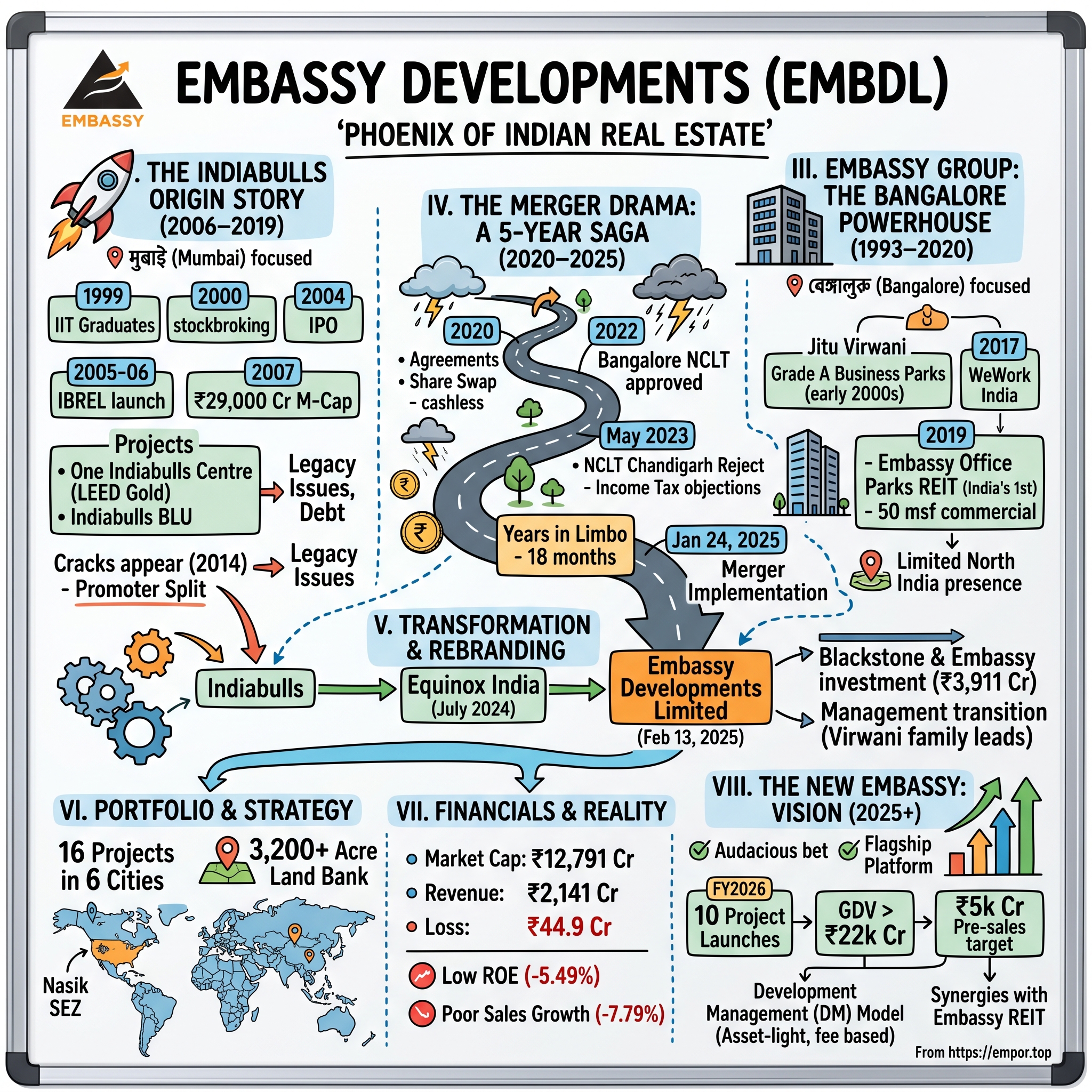
Embassy Developments: The Merger That Took Five Years and a Company That Changed Its Name Twice
I. Introduction & Cold Open
There is a particular kind of corporate limbo that never appears on a financial statement: the state of a listed company whose ownership has been agreed upon, signed, approved by shareholders, cleared by antitrust regulators, and sanctioned by stock exchanges—only to sit stalled for years while a legal tribunal in Chandigarh evaluates the underlying arithmetic of the deal.
That was the condition of a Mumbai-listed real estate developer between August 2020 and January 2025. The company continued trading every business day throughout that period. Its shares changed hands under three successive names, its promoter group shifted, and its balance sheet was recapitalized mid-flight. Yet for most of those 53 months, neither the buyers, the sellers, nor the minority shareholders could say with certainty who would ultimately own the entity.
Today, that entity is Embassy Developments Limited. It carries a market capitalization of roughly ₹8,600 crore on the National Stock Exchange, trading around ₹62 per share—or about 0.88 times its stated book value.1 In an Indian housing market experiencing one of its strongest decade-long upcycles, a valuation below book value signals notable market skepticism.
That skepticism stems in part from contradictory financial indicators. In fiscal year 2025, the company reported a net profit of roughly ₹194 crore.1 By fiscal year 2026, its first full year operating under the Embassy name, it recorded a consolidated net loss of about ₹872 crore.1 Revenue declined, and EBITDA shifted from positive territory into a sharp deficit. Yet over the exact same period, operational metrics moved in the opposite direction: pre-sales—the cash value of home bookings—more than doubled, rising from roughly ₹2,000 crore to ₹4,631 crore.23
A company cannot simultaneously suffer structural collapse and maintain robust operational growth. One of these signals reflects an accounting artifact; determining which figure represents the core reality is central to evaluating the company's trajectory.
A second critical question surrounds management execution. Embassy Group, the Bengaluru-based family enterprise that controls the platform, possesses a verifiable track record in commercial real estate. It co-sponsored and anchors India's first listed real estate investment trust, which has delivered audited quarterly reports to public unitholders since 2019. However, commercial real estate—built around long-term office leases and institutional tenants—requires a fundamentally different operating model than residential development, where Embassy is now managing inherited legacy projects across Mumbai, Delhi-NCR, and Bengaluru.
The resulting picture features a below-book valuation, volatile earnings, triple-digit booking expansion, a promoter team transitioning from commercial to residential development, high-cost debt, and a five-year merger finalized in early 2025. Understanding how these factors converged provides the essential framework for assessing the company's performance.
The story begins with two distinct companies, each possessing assets the other required.
 Subscribe on LinkedIn
II. Two Companies, One Eventual Merger — Origins, Told Fast
In 2006, the prime gauge of the Indian equity market's appetite for real estate was Indiabulls Real Estate.
Sameer Gehlaut founded the Indiabulls group as an online brokerage in 1999 before expanding into financial services and property during the mid-2000s. Indiabulls Real Estate was carved out in 2006 and rode the pre-crisis boom with the aggressiveness of a firm that had yet to experience a downturn. The developer focused on high-value commercial territory, developing One Indiabulls Centre and Indiabulls Finance Centre in Mumbai's Lower Parel—towers that quickly became landmark symbols of the city's financial sector.
The 2008 global financial crisis broke that momentum, and the developer never fully recovered.
What followed over the next decade was a methodical unwinding. In March 2018, Indiabulls Real Estate sold a 50% stake in its flagship Mumbai commercial towers to Blackstone at an enterprise valuation of roughly ₹9,500 crore.4 In September 2019, it sold the remaining stake in its Mumbai and Gurugram commercial portfolio to the same buyer for about ₹2,717 crore.4 The company also divested its international holdings; in November 2019, it completed the sale of 22 Hanover Square in London's Mayfair to an entity linked to its own promoter for roughly £200 million.5
This pattern defined the company's negotiating position heading into 2020. Indiabulls Real Estate was systematically liquidating core prime assets to generate cash and service debt—a strategy of capital preservation rather than growth. By the end of the decade, the business had become a listed vehicle holding land banks, project entitlements, and regulatory approvals across Mumbai and the National Capital Region (NCR). These assets were intrinsically valuable and difficult to replicate, but they sat within an operating business that lacked the capital and market credibility to execute development at pace.
Roughly 900 kilometers south in Bengaluru, a very different real estate enterprise had taken a contrasting path.
Embassy Group was founded in Bengaluru in 1993 by Jitendra "Jitu" Virwani, who entered the industry through family property interests and built the enterprise through direct operational experience.6 Rather than focusing on high-volume residential projects, Virwani prioritized commercial development: constructing large campus-style office parks leased to multinational corporate tenants as Bengaluru grew into a major global technology hub. The model offered steady, predictable rental income rather than the upfront, volatile sales cycles of residential housing.
The validation of this strategy came in early 2019. Embassy Office Parks REIT—co-sponsored by Embassy Group and Blackstone—launched India's first real estate investment trust public offering from March 18 to 20, 2019, raising ₹4,750 crore at ₹300 per unit before listing on April 1, 2019.7 The listing was a structural milestone. Operating a REIT requires converting yield-generating property into a publicly traded security governed by strict quarterly reporting standards, demanding a level of operational discipline and financial transparency rarely required in private real estate.
The REIT established a clear public track record over the following years. In fiscal year 2026, it leased 6.4 million square feet across 86 transactions, grew net operating income 15% year-over-year to ₹3,760 crore, distributed ₹2,396 crore (₹25.28 per unit, up 10%), and guided to another year of double-digit distribution growth in FY2027.8 This performance provided public equity markets with multi-year evidence of the promoter group's ability to manage a large real estate portfolio to institutional standards.
By 2020, the two companies presented complementary positions. Indiabulls Real Estate held land, licences, and a public listing across India's two most valuable property markets—Mumbai and the NCR—but lacked the capital and execution credibility to develop them. Embassy Group brought institutional credibility, operating capital, and strong brand equity in Bengaluru, but lacked a public residential platform in western and northern India.
A transaction combining the two platforms offered clear strategic logic. What was far less predictable was that completing the merger would take five years.
III. The Five-Year Merger Saga (2020–2025)
On August 18, 2020, during the COVID-19 pandemic as Indian construction sites were only beginning to reopen, the boards of Indiabulls Real Estate and Embassy Group agreed to merge. The transaction was structured as an all-stock swap with Indiabulls Real Estate serving as the surviving listed entity, into which two Embassy Group entities—NAM Estates and Embassy One Commercial Property Developments—would be merged. Shareholders of the private Embassy entities received shares in the listed company rather than cash. The exchange ratio was set at 6.619 Indiabulls Real Estate shares for every 10 NAM Estates shares, and 5.406 shares for every 10 shares of Embassy One, valuing the listed shares at ₹92.50—a 25.76% premium over the prior closing price.9
The projected ownership structure demonstrated a shift in operational control. Embassy Group was set to hold roughly 44.9%, while Blackstone's real estate funds and other Embassy institutional investors would hold approximately 19.1%. The existing Indiabulls Real Estate promoter group was reduced to 9.8%, with public and institutional shareholders retaining 26.2%.9 The combined platform spanned 80.8 million square feet of launched and planned area across roughly 30 projects—split 53% commercial and 47% residential—concentrated in the Mumbai Metropolitan Region, the National Capital Region, and Bengaluru.9
In an all-stock merger, the exchange ratio is the decisive economic variable, determining how many shares of the listed company each rupee of private enterprise value commands. Imprecise valuation risks misallocating value between shareholder groups, making an independent valuation fundamental to securing regulatory and market acceptance.
Regulatory approvals initially proceeded along standard timelines. The Competition Commission of India, the Registrar of Companies, and the stock exchanges cleared the transaction. Shareholders and creditors subsequently voted to approve the scheme—a vote later characterized in appellate proceedings as near-unanimous among shareholders and unanimous among creditors.10 Securing the final sanction of the scheme from the National Company Law Tribunal (NCLT) was widely viewed by market participants as a procedural step.
On May 9, 2023, the Chandigarh bench of the NCLT rejected the scheme.
The bench—comprising judicial member Harnam Singh Thakur and technical member Subrata Kumar Dash—did not challenge the commercial rationale of the combination. Instead, it questioned the reliability of the underlying valuation reports. Acting on submissions from the Income Tax Department following search and seizure operations, the tribunal noted "several instances where the amalgamating companies have deviated from the original proposal for amalgamation."11 The tribunal concluded that the valuations failed to comply with ICAI Valuation Standard 102 and Insolvency and Bankruptcy Board of India guidelines, finding that the registered valuers had neither independently verified management's underlying assumptions nor adequately examined incomplete lease negotiations.11 Because the transaction rested on inadequately finalized asset values, the tribunal ruled it unfit for sanction.
The refusal was an unusual legal outcome: despite clearances from every primary regulator and approval from shareholders and creditors, a tribunal halted the merger based on tax authority objections to valuation methodology rather than findings of fraud or minority shareholder prejudice. While activist investors typically challenge deal terms to protect minority equity from expropriation, the Income Tax Department's primary objective was protecting the tax base by scrutinizing how asset step-ups, accumulated losses, and swap considerations were structured. Although both arguments demanded a rigorous valuation, the tax authority's intervention exposed documentation vulnerabilities without establishing substantive harm to minority shareholders.
The subsequent legal appeal required eighteen months to resolve. On January 12, 2025, the National Company Law Appellate Tribunal (NCLAT) overturned the lower tribunal's order and sanctioned the merger scheme. The appellate ruling stated that discounted cash flow is a "universally accepted as a valid recognised method for valuation of shares," adding that given near-unanimous shareholder and unanimous creditor support, the "NCLT, Chandigarh has erred in interfering in the Scheme ignoring the commercial wisdom of shareholders, creditors and Board of Directors of the appellant companies."10 The transferee company also agreed to assume all tax liabilities and ongoing proceedings of the transferor entities, resolving the revenue authority's practical objections.
The merger formally became effective on January 24, 2025. The surviving entity, previously renamed Equinox India Developments, was renamed Embassy Developments Limited effective February 13, 2025.122 Total paid-up capital was restructured to ₹236.50 crore across 118.25 crore shares, including approximately 609 million new shares issued to NAM Estates holders, establishing the Embassy promoter group's equity stake at about 41.4%.12 Operations were consolidated under the Embassy brand across dual headquarters in Mumbai and Bengaluru, absorbing more than 700 employees. Promoter Jitendra Virwani framed the completion as the culmination of "nearly 30 years of unwavering commitment to building a world-class real estate enterprise."12
The cost of the wait
Beyond the official announcements, the five-year delay imposed significant operational costs. Between August 2020 and January 2025, the company operated without a finalized ownership structure or clear strategic certainty. It could not efficiently raise public equity on the reputation of an incoming promoter group that lacked legal control, nor could it fully integrate operational teams or commit capital to long-cycle land acquisitions while its corporate framework remained tied up in court. In real estate development, where value compounding relies on the continuous recycling of capital across project lifecycles, five years of stasis represents foregone market cycles. The competitive gap that emerged between Embassy Developments and its listed residential peers during this period—a gap examined in detail in Section VI—was largely established during this prolonged hiatus.
Legal complications continued even after the merger closed. On December 9, 2025, the NCLT admitted a corporate insolvency resolution process (CIRP) against Embassy Developments. Management contended that the underlying dispute involved a legacy liability mischaracterized as a corporate guarantee, maintaining that the firm remained financially sound and operational while appealing the order. On May 4, 2026, the NCLAT set aside the admission order, quashed the CIRP, and terminated all associated directions.13 Management subsequently noted on its fiscal year 2026 earnings call that the ruling set aside "a significant NCLT admission order, reinforcing its legal position."14
While the appellate decision resolved the immediate insolvency proceeding, the company operated for roughly five months under the shadow of admitted insolvency, incurring a corresponding market valuation discount. For a residential developer reliant on homebuyer trust to secure advance bookings on long-term projects, an insolvency admission carries significant operational risk. The episode underscored that legacy liabilities inherited from the Indiabulls entity remained an ongoing risk factor even after formal legal completion of the merger.
This unresolved liability profile sets the stage for evaluating whether the final transaction terms delivered fair value to each party involved.
IV. Pricing the Deal: Did Anyone Overpay?
Evaluating whether either side overpaid requires first dismantling the standard framework of an acquisition. In a cash transaction, overpaying is a discrete, measurable act: a buyer wires more money than the target asset is worth. In an all-stock merger, no cash changes hands. Instead, shareholders exchange relative ownership of separate assets for proportional ownership of a combined pool. If the exchange ratio is skewed, the harm takes the form of equity dilution—one shareholder base ends up holding a smaller slice of the enlarged company than its contribution warranted. It is a quieter, less transparent form of value transfer, and it was precisely the central issue in the legal valuation dispute.
The meaningful question is therefore not whether anyone overpaid, but what each party contributed and what each received in return.
Embassy Group contributed physical assets, brand equity, and, crucially, institutional capital-raising capacity. That access to capital manifested nearly a year before the merger legally closed. On April 6, 2024, while the legal appeal remained pending, the board of the former Indiabulls entity approved a preferential allotment of equity shares and convertible warrants totaling approximately ₹3,911 crore.15 Blackstone committed ₹1,235 crore and Embassy Group committed ₹1,160 crore. The issue comprised 9.14 crore fully paid equity shares alongside 25.94 crore convertible warrants, all priced at ₹111.51 per share, targeting post-conversion equity stakes of 18.7% for Embassy Group and 12.4% for Blackstone.15
This capital injection served as a balance-sheet stabilization event rather than a growth initiative. Two years into a halted merger and facing tax-authority challenges to its valuation, the listed developer recapitalized alongside two major institutional real estate investors. The transaction eliminated immediate solvency concerns from the merger's critical path while establishing a firm, arm's-length valuation reference of ₹111.51 per share. The timing was strategic: capital was committed before the NCLAT ruling was handed down, indicating that both investors priced and underwrote the legal risk directly into the terms.
The warrants subsequently converted in stages. In May 2025, four months after the merger became effective, promoter entity Bellanza Developers invested ₹415 crore for 5 crore shares, while Blackstone fund vehicle NCL SG Holdings invested ₹645 crore for 7.7 crore shares, representing a combined capital infusion of ₹1,060 crore. Following this allotment, the Embassy promoter group held a 42.96% stake, while the Blackstone fund held 10.93%.16
The Blackstone disambiguation
Treating Blackstone's involvement as a single, continuous position misinterprets the nature of its holdings. The firm held two distinct exposures across different asset classes and cycles.
Blackstone was an original co-sponsor of Embassy Office Parks REIT. In December 2023, it divested its remaining 23.5% stake in the REIT—selling roughly 22.36 crore units at approximately ₹316 per unit for about ₹7,100 crore—to institutional buyers, fully exiting India's pioneer listed REIT.17 That sale represented the realization of a mature, income-generating commercial property portfolio built over a decade.
Conversely, Blackstone's investment in Embassy Developments represents fresh capital allocated to a different asset class under different conditions: a minority equity position in a listed residential developer with legacy legal liabilities, entered at ₹111.51 per share between 2024 and 2025. The former was an exit from stabilized commercial yields; the latter was an entry into a residential development platform carrying operational and legal execution risks. Conflating the two trades creates the misleading impression that a single institutional investor was simultaneously bullish and bearish on the same corporate platform.
Benchmarking, and its limits
Determining whether the ₹111.51 entry price was attractive at the time remains difficult to benchmark. The company lacked stabilized net earnings, historical profit-and-loss statements were distorted by recurring asset sales, and post-merger accounting adjustments rendered immediate financial results non-comparable to industry peers.
The public market's subsequent valuation of the equity provides a clearer picture. Against the ₹111.51 subscription price paid by Blackstone and the promoter group, the stock traded around ₹62 per share in late August 2026, representing approximately 0.88 times stated book value.1 In an Indian housing cycle characterized by broad-based expansion, listed residential peers have generally traded at premiums to book value. The prevailing discount indicates that public markets either question the carrying value of the asset base, apply a heavy discount to earnings volatility and capital costs, or both. Investors marking the 2024 preferential allotment to current market prices face significant unrealized paper losses.
Ultimately, the primary cost of the transaction was measured in time and lost strategic optionality rather than cash outlay. Embassy Group secured a nationwide listed residential platform without deploying cash reserves, but absorbed five years of strategic stasis and an extended regulatory challenge over its asset valuations. Minority shareholders suffered no demonstrated expropriation—a conclusion supported by the appellate court's findings and by subsequent capital infusions priced well above current market trading levels. Nevertheless, the valuation dispute remains a notable governance marker. A share-swap structure that invited sustained regulatory challenge due to incomplete valuation documentation highlights ongoing considerations regarding disclosure rigor and execution discipline.
With the legal structure settled and the ownership framework established, attention turns to the operational vehicle created by the combination.
V. The Business Today: Land Bank, Projects, and the Asset-Light Pivot
The defining feature of the company's balance sheet is a 3,251-acre land bank spanning more than seven cities and supporting a portfolio of over 40 projects.18
In Indian real estate, the details following a headline land figure matter more than the acreage itself. Land becomes an asset or a liability depending on whether it is fully paid for, legally clear, and immediately developable. Management describes the land bank as fully paid up, meaning it carries no deferred acquisition liabilities to compete with construction capital.19 On paper, a gross development value of roughly ₹48,000 crore across active projects and prospective land—representing 40 million to 45 million square feet of saleable and leasable area—provides a substantial development runway relative to the company's ₹8,600 crore market capitalization.1920
However, scale does not equal liquidity. Of the total acreage, more than 1,400 acres sit in Nashik. On its first-quarter fiscal 2027 earnings call, management disclosed that unlocking this parcel requires a "debonding" process involving five government agencies, expected to take six to nine months, calling it a priority but "not the most immediate focus."21 That detail recalibrates the headline number: nearly half the land bank is not an active development asset, but a multi-year regulatory project with an uncertain timeline. Land that cannot be developed for years functions more as an illiquid store of value than an active growth engine.
Three businesses in one wrapper
The operating company comprises three distinct segments.
Residential development serves as the primary growth engine. This follows the traditional Indian developer model: acquire land, secure regulatory approvals, launch projects, sell units off-plan, collect payments against construction milestones, and deliver completed homes.
Commercial and Special Economic Zone (SEZ) assets represent the inherited base—reflecting the office development heritage of both merged entities. While generating steadier, less cyclical income, they are not the primary focus of incremental growth. The company's guidance reflects this prioritization: of its fiscal 2026 launch target, residential projects accounted for ₹18,600 crore in gross development value, compared to ₹3,500 crore for commercial projects.19
Development management (DM) is the third segment and represents a strategic shift in capital allocation.
Under the DM model, a landowner—typically a family or smaller developer with prime property but limited execution capability—partners with Embassy. Embassy handles design, construction, branding, and sales in exchange for a fee equal to roughly 10% of project revenue. Embassy avoids buying the land, funding initial construction from its balance sheet, or carrying inventory risk like a traditional developer.20
This structure resembles the hotel management model, where major operators manage properties owned by third parties, earning fees on revenue without carrying real estate assets on their balance sheets. Applied to residential real estate, the monetization model relies on brand equity to generate fee income without upfront land acquisition costs.
Management has emphasized this model's role in its growth strategy. Of its ₹8,000 crore pre-sales target for fiscal 2027, ₹2,000 crore—or 25%—is projected to come from just two development-management housing projects.2021
While conceptually compelling, the model carries clear operational constraints.
First, the strategy remains unproven for the company at scale. Two projects represent a pilot program rather than an established track record. The model depends entirely on brand equity strong enough to persuade landowners to surrender project economics—a proposition Embassy has not yet demonstrated in residential housing on a large scale. Furthermore, the model offers no proprietary moat, as competing developers can offer similar or more favorable fee splits to landowners.
Second, a fee of 10% of project revenue does not translate directly into net profit. Embassy bears internal overhead, including sales, marketing, and project management teams. While generating positive margins, absolute cash returns are lower than those earned from successful proprietary developments.
Myth vs. reality: is this actually an asset-light pivot?
Financial commentary often describes Embassy's strategy as an "asset-light pivot." However, a true pivot implies a fundamental shift in the company's core operating model, whereas disclosed data indicates a far more modest evolution.
The asset-light designation applies strictly to the DM projects, not to the broader business. The consolidated entity continues to carry thousands of acres of land, more than ₹5,300 crore in debt, and an annual construction budget guided at roughly ₹2,500 crore.114 Based on management's fiscal 2027 projections, 75% of pre-sales target value remains tied to capital-heavy owned developments, while the DM contribution relies on two uncompleted projects.2021
In practice, Embassy has introduced a fee-based service alongside a capital-intensive core development business, rather than transitioning into an asset-light platform. This distinction directly affects valuation. Pure asset-light platforms command higher valuation multiples because capital returns decouple from balance-sheet scale. Disclosed metrics do not support applying asset-light valuation multiples to the consolidated business. Instead, the DM model currently functions as a supplementary growth lever. Validating a broader strategic transition will require sustained landowner adoption against established peers and repeatable fee income beyond initial project launches.
Where the growth is actually showing up
Operational metrics represent the strongest operational evidence for the platform's recovery.
In fiscal 2025, pre-sales reached roughly ₹2,000 crore—an 11% increase over the prior year—while cash collections totaled approximately ₹1,900 crore.19 For fiscal 2026, pre-sales rose 128% to ₹4,631 crore, driven by six project launches representing a cumulative gross development value of about ₹16,300 crore, culminating in a quarterly record of ₹2,632 crore in the fourth quarter.143 First-quarter fiscal 2027 results built on this momentum, generating ₹868 crore in pre-sales compared to ₹198 crore in the prior-year period—a 338% increase. Over the same period, collections grew 54% to ₹496 crore, while area sold expanded 135% to 484,000 square feet.1821
Inventory absorption rates provide further detail on sales quality. Approximately 72% of inventory launched in Bengaluru sold within six months, and nearly 59% of the 4.3 million square feet launched across projects in fiscal 2026 was sold by June 30, 2026.18 High absorption indicates disciplined pricing aligned with market demand rather than volume driven by heavy discounting.
The developer's expansion into Mumbai provides a critical test of brand transferability. Embassy Citadel, an ultra-luxury single-tower project in Worli with an estimated gross development value exceeding ₹8,800 crore, recorded ₹797 crore in bookings within 45 days of launch. The company subsequently awarded a construction contract valued at over ₹850 crore to Leighton Asia for the project.1422 On its first-quarter call, management noted it had secured full-height building approvals upfront—a notable operational step in a market where phased approvals frequently delay construction schedules.21
These operational indicators point to two distinct conclusions for investors.
On the positive side, end-user demand is strong, absorption is rapid, and brand equity has successfully transferred from Bengaluru to South Mumbai's competitive luxury market. The launch performance of Embassy Citadel demonstrates that the platform can source and execute high-value projects outside its original home market.
Conversely, triple-digit pre-sales growth must be evaluated against a suppressed baseline caused by five years of merger stasis. The fiscal 2026 pre-sales figure of ₹4,631 crore reflects operational normalization for an asset base of this size rather than structural outperformance. Moreover, reliance on large individual projects like Embassy Citadel introduces quarterly revenue lumpiness. Ultimately, cash collections—rather than upfront booking commitments—remain the decisive metric for tracking sustained financial recovery.
This operational baseline leads to a broader comparison: how Embassy Developments' performance compares with the wider residential real estate sector over the same period.
VI. Industry Structure: Where Embassy Sits Among India's Listed Developers
A single metric frames Embassy's position within India's residential market, highlighting the scale of the operational challenge ahead.
In fiscal year 2026, India's eleven largest listed developers booked combined pre-sales of ₹1,48,158 crore, an 18% increase from ₹1,25,841 crore in the prior year.23 Embassy Developments contributed ₹4,631 crore to that total—accounting for roughly 3%. Across the broader market of 28 tracked listed real estate firms, aggregate pre-sales reached approximately ₹1.95 lakh crore.24
The individual scoreboard for the same fiscal year illustrates the gap. Godrej Properties led the sector with ₹34,171 crore in bookings, up 16%. Prestige Estates followed with ₹30,024 crore, representing a 76% surge—the fastest growth among major peers. Lodha Developers posted ₹20,530 crore in pre-sales, up 16%, while DLF recorded ₹20,143 crore, a slight decline from ₹21,223 crore in the previous year.24 Mid-tier peers also posted strong operational growth: Sobha expanded pre-sales by 30%, Puravankara grew 48%, and Keystone grew 33%.23
At ₹4,631 crore in pre-sales, Embassy Developments operates in a lower volume tier. Its bookings represent roughly one-seventh of Godrej Properties' total, and its market capitalization remains a small fraction of DLF's. This operational gap reflects the compound cost of the five-year tribunal delay: while Embassy remained stalled in regulatory proceedings, listed competitors roughly doubled their booking volumes across an expanding national footprint.
Applying the competitive lens properly
Real estate development rarely yields durable competitive moats. Evaluating the sector through a structural competitive framework clarifies where pressure points exist.
Barriers to entry remain moderate. Substantial capital requirements exclude undercapitalized entities, and compliance under India's Real Estate (Regulation and Development) Act (RERA) enforces strict escrow discipline and delivery timelines. However, entry at the single-project level—securing one viable site with a local partner—remains accessible. Consequently, India's market remains fragmented across thousands of regional developers, slowing industry consolidation.
Supplier power resides primarily in land. Land represents the scarce, non-substitutable core input, allowing landowners to capture significant economic rent during market upcycles. This dynamic highlights the strategic rationale for Embassy's fully paid-up land bank, which locks in legacy cost structures. However, as demonstrated by the Nashik parcel, un-entitled land functions as illiquid tied-up capital rather than an active development asset.
Buyer power has increased structurally. RERA provides home purchasers with mandatory project disclosures, escrow protections, and enforceable delivery schedules. Combined with online pricing transparency, buyers routinely compare offerings across developers. Nevertheless, in supply-constrained micro-markets anchored by established brands, developers retain pricing power—as evidenced by Embassy's 72% six-month project sell-through rate.
Substitutes pose limited threat. While rental housing serves as a substitute at the margin, homeownership remains the primary wealth-building asset and cultural aspiration for Indian households.
Rivalry represents the binding constraint, intensifying as geographic boundaries dissolve. Over the past five years, major developers have aggressively expanded beyond their home markets. Godrej Properties now generates 68% of its pre-sales outside its home Mumbai Metropolitan Region market. Prestige Estates—historically a Bengaluru-focused developer and Embassy's primary regional peer—now derives 60% of pre-sales from Mumbai, Hyderabad, and the National Capital Region. Similarly, Lodha generates 32% of bookings from Pune and Bengaluru.23 Large listed platforms now compete directly across every major tier-one market.
Evaluated through Hamilton Helmer's 7 Powers framework, the platform's strategic profile is sharply defined. Scale economies are currently absent; Embassy's pre-sales are roughly one-seventh those of the market leader, limiting its leverage in material procurement, contractor allocation, and debt pricing. Cornered resources exist partially in fully paid land holdings in Bengaluru and the Mumbai Metropolitan Region, though discounted by entitlement timelines. Brand equity serves as the strongest asset, supported by initial launch traction at Embassy Citadel. Counter-positioning via the development management model remains limited, as established peers can readily replicate fee-based structures. Finally, switching costs, network effects, and process power remain largely inapplicable in an industry where consumers transact infrequently.
Consequently, brand reputation and legacy land holdings represent the platform's primary defensible assets, alongside an emerging fee-based development initiative. While valuable, these assets do not yet constitute a broad structural moat against national competitors.
The one advantage nobody talks about, and the one disadvantage everybody should
A critical competitive divergence across listed developers lies in the cost of capital.
In real estate development, debt service represents a direct cost of goods sold rather than a passive balance-sheet detail. Because multi-year project lifecycles require sustained funding from land acquisition through construction and handover, borrowing costs directly dictate project margins. A developer funding construction at a 9% interest rate operates on fundamentally different economics than one borrowing at 15%. Larger listed peers with investment-grade credit profiles and institutional backing secure financing at the lower end of that spectrum, whereas Embassy Developments carries higher capital costs.
Management's stated competitive strategy aims to address this cost gap by expanding the development management model to grow bookings without capital outlay, launching projects in new regional markets to demonstrate brand portability, and lowering debt costs to close the margin gap with peers.2021 While strategically coherent, this approach remains an ongoing execution effort rather than an established outcome, with balance-sheet re-rating dependent on public market confidence.
Evaluating whether such a re-rating is justified requires examining the underlying financial structure, where accounting entries and operational realities diverge significantly.
VII. Under the Hood: The FY26 Swing
Here is the puzzle in its starkest form. In FY2026 Embassy Developments sold more than twice as many homes by value as it did the year before, and reported that its financial performance had deteriorated catastrophically.
The reported line: total income of ₹1,905 crore against ₹2,547 crore the prior year; EBITDA of negative ₹300 crore against positive ₹531 crore; a net loss of ₹872.47 crore against a profit of about ₹194–203 crore.25114 Quarterly, the deterioration was steady rather than a single event: losses of ₹166 crore, ₹153 crore, ₹233 crore and ₹323 crore across the four quarters of FY2026, then ₹234 crore in Q1 FY2027 on revenue of just ₹217 crore versus ₹681 crore a year earlier.1
Management's explanation is the same on every call: this is revenue recognition, not operating deterioration.
What the accounting actually does
The explanation deserves a plain-English unpacking, because it is the hinge of the whole investment case.
Indian real estate developers recognise revenue on completion. A buyer books an apartment in 2026 and pays instalments through 2029. The developer receives that cash — it is real, it is bankable, it funds construction. But the developer is not permitted to call it revenue until the project is finished and possession is handed over. Until then the money sits on the balance sheet as a liability, and the costs of building sit as inventory.
The consequence is that the reported P&L of a developer is not a picture of this year's business. It is a picture of projects completed this year. A company that completes three towers in a year and none the next will look brilliant and then look broken, having done exactly the same amount of work in both.
That is what happened here. On the Q1 FY2027 call, management attributed the widened loss to "timing of project completions under completion accounting," noting there were no project completions in the quarter at all.21 Meanwhile the fixed costs — interest, overheads, sales and marketing on record launches — all ran through the P&L. Revenue near zero, costs at full run-rate, and the arithmetic writes itself.
There is a second, compounding factor that makes the FY2025 comparison actively misleading. The merger was accounted for as a reverse acquisition. The FY2025 results therefore comprised twelve months of NAM Estates and its subsidiaries plus only two months of the listed entity and its 174 subsidiaries.25 The ₹194 crore FY2025 "profit" and the ₹872 crore FY2026 "loss" are not measurements of the same company. Anyone drawing a trend line between them is drawing it through two different entities.
So is the explanation credible? Partly, and the qualification matters.
The supporting evidence is genuine: collections rose 54% year on year in Q1 FY2027 to ₹496 crore, and cash receipts do not care about accounting standards.18 On the Q3 FY2026 call, management pointed to EBITDA being dragged by legacy Indiabulls-era projects reaching operational completion at their inherited economics, and asserted cash margins of 45% to 60% on newer projects.26 If that margin claim holds, the completion of today's launches would eventually produce a very different P&L.
The problem is that "if that margin claim holds" is not yet checkable. Cash margin on an unbuilt project is a management estimate of construction costs that have not been incurred. And Aditya Virwani himself supplied the reason to discount it, telling reporters in June 2026 that "cost has gone up a lot" and that "the entire industry faces short-term profit margin compression," citing material availability — tiles specifically — alongside price increases, while maintaining the company had "some cushion to absorb increase in input cost."20 A 45–60% cash margin assumption and an acknowledgement of industry-wide margin compression are in tension. Both cannot be fully true at the projected magnitude.
The genuine cash-flow check is more sobering than the collections number alone. Operating cash flow for FY2026 was ₹44 crore, against ₹1,461 crore in FY2025, and management disclosed negative operating cash flow of ₹285 crore in Q1 FY2027.121 Free cash flow for FY2026 was effectively nil.1 That is what a company in the investment phase of a launch cycle looks like — construction spend running ahead of collections — but it means the business is currently consuming cash, not generating it, and the collections growth has not yet outrun the construction programme.
The debt is the real story
Which makes the balance sheet the thing to watch, and here the trajectory runs against the deleveraging narrative.
Net debt at the end of FY2025 was ₹2,273 crore, against gross debt of ₹2,756 crore and cash of ₹483 crore.19 By the end of FY2026, net institutional debt was around ₹3,000 crore.14 By June 30, 2026, gross institutional debt was roughly ₹4,500 crore against ₹1,202 crore of cash, for net institutional debt of about ₹3,363 crore.18 Total borrowings on the consolidated balance sheet rose from ₹4,607 crore to ₹5,322 crore across FY2026.1
Net institutional debt therefore rose roughly 48% in five quarters. The ratio looks benign — net debt to equity of 0.35x is genuinely conservative for a developer, and management called it "comfortable" on the Q1 call.21 But that comfort is manufactured by a large equity base created through the merger and the recapitalisations, not by debt reduction. The absolute debt is going up.
And it is expensive debt. The average cost is roughly 14–14.8%, with the Blackstone-related tranche accruing at 18%.1421 To put that in context: a developer paying 14.8% on project debt in an environment where its larger listed peers finance at high single digits is surrendering several hundred basis points of project IRR to its lenders every year. On roughly ₹4,500 crore of gross debt, each 100 basis points is about ₹45 crore a year — real money against a company with negative EBITDA.
Management has a plan, and it is specific. Guidance is to bring the cost of debt toward 10% within twelve to eighteen months, with new construction finance already being raised at sub-9%, and refinancing of the high-cost tranches targeted for around March–April 2027 as collections accelerate — deliberately attacking the interest cost before repaying principal.202126
The execution so far is mixed and worth reading carefully. In July 2026 the company issued ₹1,020 crore of senior secured redeemable non-convertible debentures at an 11% coupon payable quarterly, maturing in 2029, with about ₹920 crore — roughly 90% — applied to repaying or refinancing existing debt.27 Eleven percent is a clear improvement on 14.8%, and refinancing at a lower coupon is exactly the right move. Two details deserve attention. First, these NCDs were unrated and unlisted, which is a meaningful signal: an unrated instrument is one no credit agency has been asked to opine on, and it narrows the buyer base to investors doing their own underwriting.27 A company genuinely converging on a 10% cost of capital would ordinarily want a rating. Second, the total authorisation was expanded to ₹1,570 crore, leaving ₹550 crore of further headroom — which is refinancing capacity, and also latent room to re-lever.27
Then, on August 10, 2026, the board approved a preferential issue of 3.25 crore convertible warrants at ₹111.51 to promoter entity Embassy Property Developments, raising up to ₹362.62 crore explicitly to repay shareholder debt and reduce cost of capital, with the promoter group indicating it would exercise within six months rather than take the full eighteen months regulation allows.2818 Two things are notable. The ₹111.51 price is the same reference struck in April 2024 — roughly 80% above where the shares were trading — so the promoter is injecting equity at a substantial premium to market, which is a genuinely shareholder-friendly structure and a costly signal of conviction. But it is also a promoter converting its own loan into equity, not new third-party capital validating the story.
The three numbers that actually matter
Reported quarterly profit is close to useless for this company, and will remain so until the current launch cohort completes. An investor tracking it will be whipsawed in both directions.
The metrics that carry real information are, in order: collections — cash actually received, which cannot be produced by a launch event or an accounting policy; pre-sales sell-through, meaning the percentage of launched inventory sold within a defined window, which tests whether product and pricing are right rather than just whether launches happened; and the blended cost of debt, which is the single clearest measure of whether the market's perception of this credit is actually improving.
Those three, tracked quarterly against management's own stated targets, will resolve this story faster than any income statement.
That last point — management's own stated targets — leads directly to the harder question. How much should an investor trust what this team says it will do?
VIII. Management & Capital Allocation
Evaluating the leadership team is unusually straightforward because its track record offers clear evidence of what management has demonstrated and what remains unproven.
The board was constituted on February 25, 2025, weeks after the merger closed: Jitendra Virwani as Chairman, his son Aditya Virwani as Managing Director, Sachin Shah continuing as Chief Executive Officer and Executive Director, and Rajesh Kaimal as Chief Financial Officer and Executive Director, with K.G. Krishnamurthy—previously the independent Chairman of the pre-merger entity—staying on as an independent director.29 The promoter group holds about 42.65% as of mid-2026.1
Jitendra Virwani anchors the management team's credibility. He established Embassy in 1993 without a formal business education, learning the industry on site, and built a portfolio that expanded past 62 million square feet across commercial, residential, hospitality, and retail assets, according to Forbes India.6 His stated philosophy serves more as a brand position than an operating rule—"we are not in the business of selling real estate, but of selling a global lifestyle"—yet aligns with high-end developments such as the Four Seasons Private Residences at Embassy ONE and Embassy Boulevard.6
As Managing Director, Aditya Virwani leads daily operations and has outlined a goal to "replicate and amplify" in residential development the strategies that succeeded in commercial property.19 That objective encapsulates the core strategic thesis, while also presenting the central execution test, as commercial and residential platforms fail under different conditions. Commercial projects decline gradually through rising vacancy, whereas residential developments can encounter sudden stress from unsold inventory, cost overruns, and delivery delays that trigger regulatory and reputational penalties.
Testing the credibility claim against the record
The bullish case for management rests on a straightforward premise: because the team executed a listed REIT to institutional standards, investors should trust its residential guidance. That premise requires rigorous examination against disclosed outcomes.
What the REIT record genuinely proves. The REIT provides seven years of audited public reporting, steady distribution growth, a 15% year-over-year increase in net operating income alongside 6.4 million square feet leased in fiscal 2026, and forward guidance projecting another year of double-digit distribution expansion.8 These metrics demonstrate operational discipline, corporate tenant relationships, and capital markets execution sustained through market disruptions, including office vacancies during the pandemic.
What it does not prove. The REIT record reflects asset management expertise rather than residential development sales. While skills in land acquisition, regulatory approvals, and construction oversight transfer directly, consumer marketing, retail broker networks, inventory pricing, and homebuyer delivery obligations under RERA require different operational capabilities. Furthermore, the REIT was built by the sponsor group rather than the current listed entity, leaving Embassy Developments with a public track record of only six quarters.
The direct test: promises versus outcomes, in this company. Evaluating management's track record against its public targets provides useful context.
In May 2025, alongside fiscal 2025 financial results, management established two primary targets for fiscal 2026: launching projects with a combined gross development value of ₹22,000 crore and achieving residential pre-sales of approximately ₹5,000 crore.19 By February 2026, on its third-quarter earnings call, management reaffirmed confidence in the ₹5,000 crore pre-sales target after securing roughly ₹2,000 crore in the first nine months—an expectation that required a ₹3,000 crore fourth quarter.26 Actual full-year pre-sales reached ₹4,631 crore across six project launches totaling about ₹16,300 crore in gross development value.143 Management described the result on its fourth-quarter call as a "marginal shortfall in FY26 free sales due to project approval delays in Bangalore."14 That characterization is accurate for pre-sales but understates the launch shortfall. A 26% reduction in planned launches represents a material delay, particularly when attributed to approval bottlenecks in Bengaluru, the promoter group's primary home market where operational relationships are strongest.
The more revealing test is the profitability timeline. On its third-quarter fiscal 2026 earnings call, management indicated that the company would achieve profitability within four to six quarters as higher-margin developments contributed to recognized revenue.26 By August 2026, on the first-quarter fiscal 2027 call, management stated that net losses would continue for an additional five to six quarters before the earnings model inflected.21 Reading both statements sequentially shows the projected breakeven window moving outward by three to four quarters over a six-month period. While completion accounting rules cause revenue recognition to shift alongside construction timelines, this revision represents the most direct forward commitment made by leadership. Further extensions in upcoming quarters would signal a recurring forecasting issue.
Management's communication has remained consistent and detailed regarding these mechanics. The completion-accounting rationale has been presented clearly across earnings calls without shifting to broader external explanations, offering specific operational context rather than generic references to market conditions.
The pledge overhang
Promoter share pledging represents a primary corporate governance consideration for the platform.
Data from Screener indicates that promoters have pledged approximately 64.9% of their equity holding.1 Recent disclosures show a reduction in encumbered shares: between June and July 2026, the promoter group released pledges over 6,36,34,560 shares—releasing 2 crore shares on June 9, 1 crore on July 15, and 3,36,34,560 shares valued at ₹205.64 crore on July 31, with the final tranche released by Embassy Property Developments.30 Reported encumbrance on the relevant stake fell from 18.56% to 16.14% of total voting capital.
The mechanics of share pledging carry structural risks for public equity holders. When promoters pledge equity to secure loans, lenders establish minimum collateral thresholds. If the share price experiences a sharp decline, lenders retain the right to liquidate pledged shares in open-market transactions. This sequence can turn market volatility into forced selling and potential control shifts—a risk of particular relevance for equity trading below stated book value.
The central question is why a promoter group capable of committing ₹1,160 crore in primary equity in 2024, ₹415 crore in 2025, and ₹362.62 crore in 2026 pledged a major portion of its listed equity over the same period. A plausible explanation is that holding-company resources are heavily deployed, with debt secured against pledged shares funding equity injections into the operating company. While structurally logical, this arrangement places holding-company leverage beneath operating-company equity, leaving the capital structure vulnerable during sector downturns.
One disambiguation worth getting right
Because of shared corporate origins, a recurring point of confusion requires clarification. Regulatory proceedings by the Enforcement Directorate and the Central Bureau of Investigation involving Sameer Gehlaut pertain exclusively to Indiabulls Housing Finance—renamed Sammaan Capital—an independent listed financial services entity with separate leadership and no operational or ownership ties to Embassy Developments. The connection is limited to a historical brand name no longer used by either firm. Investors reviewing legacy reporting must distinguish between these separate corporate entities.
Two operational commitments carry clear target dates: reaching ₹8,000 crore in fiscal 2027 pre-sales and reducing the blended cost of debt toward 10% within twelve to eighteen months of mid-2026.20 Management's performance against these two benchmarks will provide a clear measure of execution capability over the coming year.
Before evaluating the investment outlook, it is necessary to examine the primary downside risks to the thesis.
IX. Risk Radar
The risks facing Embassy Developments reflect standard operational and financial pressures in Indian real estate, concentrated in a business with less balance-sheet buffer than its primary competitors.
Refinancing and cost of capital. A blended cost of debt near 14.8% presents a persistent drag on project economics that pre-sales expansion alone cannot offset, especially when major peers secure financing at far lower rates.14 Lowering borrowing costs toward 10% requires two conditions outside management's direct control: capital markets remaining open to a developer reporting net losses, and lenders re-rating a corporate credit that spent five months navigating an admitted insolvency proceeding. While the July 2026 issuance of non-convertible debentures at 11% demonstrates initial progress, their unrated and unlisted structure indicates that broad institutional credit access remains incomplete.27 If refinancing stalls between 12% and 13% rather than reaching 10%, roughly ₹100 crore to ₹150 crore in annual pre-tax cash flow will remain committed to interest service instead of funding construction or returning capital to shareholders.
Promoter pledge and forced-selling risk. Although pledge releases through mid-2026 have reduced promoter exposure, significant equity encumbrance remains. Because the stock trades at a discount to book value, the shares offer less price cushion against potential collateral margin calls than higher-valued peers.
Earnings opacity and mispricing. Completion-based accounting creates quarterly financial results that reflect past project handovers rather than current sales performance. This lag cuts both ways: public markets may penalize the company for non-operational accounting deficits or reward it during delivery cycles for work completed years earlier. For long-term investors, this accounting structure introduces both valuation opportunities and drawdown risks, depending on whether underlying cash generation validates project margins over time.
Competitive encroachment. The primary competitive threat from national developers lies in land acquisition rather than aggressive retail pricing. Peers with lower capital costs can bid more competitively for prime parcels in core markets like Bengaluru. In land-constrained urban centers, developers with cheaper financing hold a structural advantage when acquiring future development sites.
Cyclicality and rate sensitivity. Residential housing demand remains sensitive to interest rate movements and employment growth among urban professionals. After a prolonged multi-year upcycle, higher mortgage rates or hiring decelerations in Bengaluru's technology sector could weaken absorption rates and booking velocity. This geographic concentration leaves the platform disproportionately exposed to economic conditions in its core market.
Input cost pressure. Management has acknowledged rising material costs and supply constraints while projecting cash margins of 45% to 60% on unbuilt inventory.2026 Because developers sell units at fixed prices while procuring materials across a multi-year construction cycle, input inflation rests entirely on the builder. Rising material costs present a direct challenge to the margin assumptions underlying projected profitability timelines.
Legacy liability tail. The consolidation absorbed 174 corporate entities from the Indiabulls platform.25 The December 2025 insolvency admission—originating from a disputed legacy guarantee before being set aside on appeal—demonstrates that historical liabilities retain the potential to disrupt operations and depress market valuation.13
Execution and organizational risk. Management is concurrently integrating corporate cultures, accelerating residential launches, entering South Mumbai's luxury market, expanding the development management model, refinancing debt, and unwinding promoter share pledges. Executing these strategic shifts simultaneously requires substantial managerial bandwidth from a leadership team with six quarters of joint public-company history.
The project launch delays experienced in Bengaluru during fiscal year 2026 provide early evidence of these operational bandwidth constraints.
X. Bull vs. Bear: The Investment Case
Evaluating Embassy Developments requires setting out the bull and bear arguments in their strongest forms before weighing the evidence between them.
The bull case
A promoter group with a seven-year, audited, institutionally scrutinised operating record now controls a fully paid land bank of over 3,200 acres, a portfolio of more than 40 projects, and a brand that demonstrated its reach by selling ₹797 crore of luxury inventory in South Mumbai's Worli district within 45 days—yet the public market values the entire platform below its stated book value.181 Annual pre-sales expanded from ₹2,000 crore to ₹4,631 crore with momentum pointing higher, supported by six-month sell-through rates of 72% in its core market that signal genuine end-user demand rather than price discounting.18 Reported net losses stem from completion-based accounting rules compounded by a non-comparable reverse-merger baseline, rather than operational decline. Balance-sheet deleveraging carries a specific, checkable timeline, and the initial refinancing tranche achieved borrowing costs more than three percentage points below the platform's blended rate. The promoter group is injecting fresh equity at ₹111.51 per share while the stock trades near ₹62—demonstrating direct financial conviction at a substantial premium to market prices.28 Finally, the development management model provides a clear pathway to expand booking volumes without upfront land acquisitions, bypassing the primary drain on corporate capital in residential real estate.
The bear case
Reported profitability has deteriorated for five consecutive quarters, and management's promised inflection point has already slipped by nearly a year.2621 Net institutional debt expanded roughly 48% over five quarters while the company described itself as deleveraging, and the cost of that debt remains near 15% with a specific tranche accruing at 18%.1821 Operating cash flow reached just ₹44 crore for all of FY2026 before turning negative by ₹285 crore in the first quarter of FY2027, confirming that the business continues to consume cash.121 Promoter pledging near 65% of the holding signals substantial leverage at the holding-company level, regardless of operating progress.1 The operational scale gap to industry leaders DLF, Godrej Properties, Lodha, and Prestige Estates spans five to seven times on pre-sales and shows no sign of closing, while those national competitors aggressively contest Embassy's core Bengaluru market with significantly cheaper capital.2423 The first full year of guidance under new leadership resulted in a miss on both stated operational targets.1419 Finally, a quarter of the FY2027 growth plan relies on a development management model consisting of just two projects that have yet to be delivered.
Weighing it
The two cases are not symmetrical because they address different time horizons and rest on evidence of unequal quality.
The bull case's strongest element—demand and inventory absorption—is supported by empirical operational data: cash collections up 54%, sell-through rates remaining consistent across consecutive quarters, and a Mumbai launch outcome that directly tested brand transferability and succeeded.18 That performance is difficult to discount. The assertion that Embassy remains strictly a regional Bengaluru brand has been narrowed, if not disproven; while Embassy Citadel represents a single project, it established traction in India's most competitive luxury market.
The bull case's weakest element is the margin assumption. The projected earnings recovery relies entirely on cash margins of 45% to 60% surviving four years of construction cost inflation that management itself has flagged as significant.2620 That claim remains unverified from the outside because no project launched under the current corporate structure has reached completion. It should be held at low confidence until delivered outcomes validate the guidance.
The bear case's strongest element is the cost of capital, which represents a structural handicap rather than a temporary cyclical issue. High borrowing costs compound simultaneously across land acquisition, project returns, and debt service. While the 11% non-convertible debenture issuance proves partial progress, its unrated and unlisted structure indicates that credit markets remain cautious.27
The bear case's weakest element is the reported quarterly loss, which attracts significant investor attention but conveys limited diagnostic value. Evaluating a developer operating under completion accounting on short-term net profit is a fundamental misinterpretation of sector reporting.
This leaves a single decisive variable that directly tests management's operational execution: whether collected cash grows faster than the cost of servicing the debt used to generate it. If FY2027 cash collections approach the guided ₹3,000 crore while the blended cost of debt declines from 14.8% toward 11% to 12%, the operating model functions as designed, and reported earnings will eventually reflect operational progress as project completions materialize.2120 Conversely, if collections stall near ₹2,000 crore and refinancing remains stuck above 13%, the company will continue funding an ambitious construction pipeline with expensive debt against inventory with eroding margins—making the market's below-book valuation appear prescient rather than overly pessimistic.
In summary, the demand thesis is well-evidenced and largely intact; the margin thesis remains unproven; the deleveraging thesis is directionally supported by initial refinancing but contradicted by absolute debt expansion; and the management credibility thesis, transferred from commercial REIT operations, persists at a reduced strength—demonstrated in asset management, partially proven in residential development, and already subject to one cycle of guidance revisions.
There are broader lessons in this trajectory that extend well beyond a single developer.
XI. Playbook: Durable Lessons
Regulatory approval is not a formality, and time in limbo is a real cost. Every constituency with an economic interest in the transaction approved it—regulators, shareholders, creditors, and boards. Yet completing the deal required another eighteen months of appellate litigation after a tribunal rejected the scheme over valuation documentation. For dealmakers and investors, the lesson is clear: the final regulatory step is rarely a procedural formality. The primary cost of the delay was not legal fees, but five years of strategic stasis during which competitors expanded their footprints and doubled booking volumes.
Reputation is asset-class specific and does not transfer automatically. Embassy Group established a strong track record in commercial real estate and REIT management. That background confers credibility, institutional capital access, and market standing. However, it does not guarantee execution capability in residential housing, which carries different operational risks, sales cycles, and buyer expectations. The project launch delays in Bengaluru during fiscal year 2026 provide a clear indication that expertise in commercial leasing does not instantly translate into residential development.
Asset-light models offer strategic leverage, but rely entirely on brand strength. Development management, akin to hotel franchising, converts brand equity into fee income without balance-sheet capital. The model generates attractive returns when a developer's brand commands a premium that landowners are willing to pay for. Where that brand equity is unproven, fee margins compress while the developer retains execution obligations. The true test of an asset-light model is not its presence in a strategic presentation, but whether landowners choose the platform over larger national competitors offering similar terms.
Long-cycle revenue recognition requires evaluating cash flow over reported profit. Completion accounting in real estate creates the same analytical challenge as percentage-of-completion in infrastructure or deferred revenue in software: the income statement reflects past project handovers rather than current business activity. In long-cycle industries, evaluating performance requires tracking pre-sales for demand, cash collections for operational reality, and treating net profit as a lagging accounting indicator. Evaluating a developer on short-term quarterly earnings risks confusing project timing with operational trajectory.
Promoter pledging represents a structural risk that can overshadow operational progress. High share encumbrance and a stable operating business can coexist during market upcycles, but a sharp drop in equity valuation can turn holding-company leverage into a direct threat to corporate stability. The essential analytical question is not merely whether pledged stakes are declining, but what debt the pledged shares secure and how control rights respond if collateral thresholds are breached.
Industry consolidation typically stems from capital imbalances rather than strategic ambition. The combination at the center of this story occurred because one entity held entitlements and land banks it could not capitalize, while the other possessed operating capital and brand equity but lacked a nationwide listed platform. This template—a capital-constrained developer combining with an institutionally backed platform—is likely to recur across India's real estate sector. As this transaction demonstrated, the efficiency of judicial tribunals in evaluating deal terms remains an essential variable when underwriting consolidation.
XII. Epilogue & What to Watch
Eighteen months after the merger became effective, Embassy Developments remains a platform defined primarily by forward-looking targets rather than an established operating record under its unified identity. With six quarters of financial reporting under its present structure and no completed project cohort under current ownership, evaluation of the business rests largely on two specific, measurable commitments.
The first is achieving ₹8,000 crore in fiscal year 2027 pre-sales—comprising approximately ₹6,000 crore from owned developments and ₹2,000 crore from development management contracts—supported by a project launch pipeline representing about ₹19,400 crore in gross development value across eleven projects in Bengaluru, the Mumbai Metropolitan Region, and the National Capital Region.2021 The first-quarter fiscal 2027 pre-sales result of ₹868 crore represents roughly 11% of that full-year target, making performance heavily dependent on launches scheduled for the remainder of the year, including four planned for the second quarter.21 Given the project launch delays experienced in fiscal 2026, execution against this launch timeline represents a key operational test.
The second commitment is reducing the blended cost of debt toward 10% by late 2027, with a primary refinancing window targeted for March and April of that year.2021 The issuance structure will serve as a key metric alongside the interest rate: a rated, listed debt placement at a lower coupon would indicate broad institutional credit re-rating, whereas continued reliance on unrated private placements at higher rates would suggest that capital cost reductions remain dependent on individual negotiations.
Beyond these near-term targets, three broader questions will determine the company's long-term trajectory.
First, whether promoter share pledging continues to decline at the pace recorded in mid-2026 or stalls—which would indicate whether holding-company leverage remains a constraint despite recent equity infusions.
Second, whether the projected timeline to recognized profitability holds at five to six quarters or extends further. The third-quarter fiscal 2027 financial disclosures will provide the next key update on revenue recognition timing.
Third, whether Embassy Developments narrows the operational scale gap with national industry leaders or settles into a mid-tier position. While operating as a regional developer represents a viable business model, the company's valuation and strategic positioning imply national expansion goals, whereas pre-sales volume currently remains well behind market leaders.
The transaction also carries broader implications for the Indian real estate sector. If the combined entity successfully monetizes its land bank and achieves sustained profitability, the structure will provide a template for consolidating capital-constrained developers holding land entitlements into institutionally backed platforms. Furthermore, the appellate ruling establishing that judicial tribunals should defer to the commercial judgment of shareholders and creditors when expert valuations are properly supported provides greater legal predictability for future corporate restructurings.10
At present, the empirical record demonstrates that Embassy Developments can generate robust pre-sales volume, but has yet to prove it can translate booking growth into net profit under its current corporate structure. Financial results in upcoming quarters will clarify whether current earnings deficits reflect temporary project completion timing or persistent structural cost pressures.
References
-
Embassy Developments Ltd — consolidated financials, shareholding and key ratios — Screener.in, accessed 2026-08-27 ↩↩↩↩↩↩↩↩↩↩↩↩↩↩↩
-
Equinox India and Embassy Group merger successfully completed — Embassy Developments press release, 2025-01-24 ↩↩
-
Embassy Developments achieves record pre-sales of Rs 2,632 crore in Q4 FY26 — Business Upturn, 2026 ↩↩↩
-
Indiabulls Real Estate sells properties to Blackstone for Rs 2,700 crore — Business Standard, 2019-09-26 ↩↩
-
Clivedale Overseas Limited completed the acquisition of Hanover Square property, London from Indiabulls Real Estate Limited — MarketScreener, 2019-11-01 ↩
-
Embassy Group: Crafting the future of India's urban elite — Forbes India ↩↩↩
-
Embassy REIT Leases 6.4 MSF in FY2026 and Grows Net Operating Income by 15%; Guides to Double-Digit Growth in FY2027 — Embassy Office Parks REIT newsroom, 2026-04-27 ↩↩
-
For merger with Embassy Group, Indiabulls Real Estate approves share swap ratio — RealtyNXT, 2020-08-18 ↩↩↩
-
NCLAT gives go-ahead for Indiabulls Real Estate–Embassy Group merger — The Week / PTI, 2025-01-12 ↩↩↩
-
NCLT blocks merger of Embassy Group with Indiabulls; asset valuation is critical in scheme of amalgamation to determine share swap ratio — Legal Era, 2023 ↩↩
-
NCLAT gives go-ahead for Indiabulls Real Estate–Embassy Group merger — Business Standard, 2025-01-12 ↩↩↩
-
Embassy Developments Limited: NCLAT quashes insolvency proceedings against company — InvestyWise, 2026-05 ↩↩
-
Embassy Developments Ltd (BOM:532832) Q4 2026 Earnings Call Highlights: Record Pre-Sales — GuruFocus via Yahoo Finance, 2026 ↩↩↩↩↩↩↩↩↩↩↩
-
Indiabulls Real Estate to raise Rs 3,911 cr from Blackstone Group, Embassy Group & others — Business Standard, 2024-04-06 ↩↩
-
Promoters, Blackstone infuse Rs 1,060 cr in Embassy Developments — The Week / PTI, 2025-05-23 ↩
-
Blackstone exits Embassy REIT; sells entire 23.5% stake for Rs 7,100 cr — Business Standard, 2023-12-20 ↩
-
Embassy Developments: Q1 FY27 Pre-Sales Soar 338% to ₹868 Crore — investor update summary, InvestyWise, 2026-08 ↩↩↩↩↩↩↩↩↩↩
-
Embassy Developments Limited announces FY2025 financial results post successful completion of merger; sets FY2026 GDV target of ₹22,000 crs and targets residential pre-sales of ₹5,000 crs — Embassy Group press release, 2025-05 ↩↩↩↩↩↩↩↩
-
Embassy Developments aims ₹8,000 cr pre-sales in FY27 on strong home demand: MD Aditya Virwani — Outlook Business, 2026-06-07 ↩↩↩↩↩↩↩↩↩↩↩↩↩
-
Embassy Developments Ltd (BOM:532832) Q1 2027 Earnings Call Highlights: Pre-sales Surge 338% — GuruFocus via Investing.com, 2026-08-11 ↩↩↩↩↩↩↩↩↩↩↩↩↩↩↩↩↩↩↩
-
Embassy Developments jumps after awarding Rs 850 crore contract for Mumbai luxury project — Business Standard, 2026-06-15 ↩
-
Mumbai, Hyderabad and NCR drive listed developers' 18% pre-sales growth in FY26: ANAROCK — Storyboard18, 2026 ↩↩↩↩
-
India's 28 big listed realty firms clock ₹1.95 trn pre-sales in FY26 — Business Standard, 2026-06-24 ↩↩↩
-
Embassy Developments Limited announces FY2025 financial results post successful completion of merger, sets FY2026 GDV target of ₹22,000 crs — Business Standard / ANI press release, 2025-05-31 ↩↩↩
-
Embassy Developments Q3 FY26 earnings conference call transcript disclosure — InvestyWise, 2026-02 ↩↩↩↩↩↩↩
-
Embassy Developments raises ₹1,020 crore via NCDs for debt refinancing — Whalesbook, 2026-07 ↩↩↩↩↩
-
Embassy Developments raises Rs 362.62 cr via warrants for shareholder debt repayment — Multibagg, 2026-08-10 ↩↩
-
Embassy Developments Limited appoints Jitendra Virwani as Chairman and Aditya Virwani as its Managing Director; announces growth initiatives and fundraising plans — Embassy Group press release, 2025-02-25 ↩
-
Embassy Developments: Promoter releases pledge on 3.36 crore shares worth ₹205 crore — Whalesbook, 2026-07-31 ↩
 LinkedIn
 WhatsApp
 Reddit
 Hacker News
 Email
Email Kindle
 RSS Feed
 Spotify
 Apple Podcasts
 Amazon Music
 Audible
 YouTube